
The Arnold shoulder press looks like a traditional dumbbell press with one important difference: you rotate your arms as you press.
Table of Contents
That extra movement makes the exercise popular with bodybuilders and recreational lifters, but it also makes technique and weight selection more important. The Arnold press can be an effective shoulder exercise, yet it is not automatically better than a standard shoulder press and it may not feel comfortable for every shoulder.
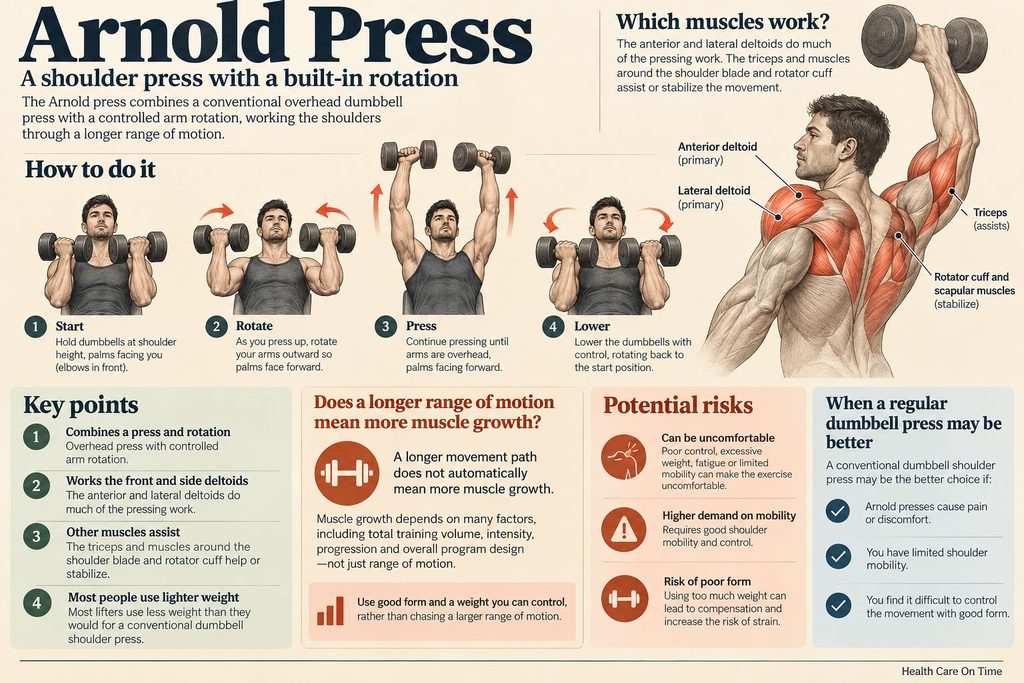
Quick Answer: The Arnold shoulder press is a dumbbell overhead press that begins with your palms facing your body and gradually rotates them forward as you press overhead. It primarily trains the front and side deltoids, with assistance from the triceps and shoulder stabilizers. It can build shoulder strength and provide useful training variety, but the added rotation requires control. Use a manageable weight and stop if you experience sharp or persistent joint pain.
The movement is named after Arnold Schwarzenegger, who helped popularize it during his bodybuilding career. Today, you will see it in commercial gyms, bodybuilding programs, home workouts, and shoulder-training routines.
Its reputation can sometimes get ahead of the evidence.
There is much more research on resistance training, conventional overhead pressing, deltoid activation, and shoulder mechanics than there is on the Arnold press specifically. That means claims such as “the Arnold press is the best shoulder exercise” or “it works every deltoid head better” should be treated cautiously.
Patients and fitness-minded readers often ask our medical reviewers whether the Arnold press is safer or more effective than a normal shoulder press. The answer depends on what you are trying to accomplish, how your shoulders move, your training experience, and whether you can perform the exercise without pain.
At a Glance
• The Arnold press combines an overhead dumbbell press with controlled arm rotation.
• The anterior and lateral deltoids do much of the pressing work.
• The triceps and muscles around the shoulder blade and rotator cuff assist or stabilize.
• Most lifters use less weight than they would for a conventional dumbbell shoulder press.
• A longer movement path does not automatically mean more muscle growth.
• Poor control, excessive weight, fatigue, or limited mobility can make the exercise uncomfortable.
• A normal dumbbell press may be the better choice if Arnold presses cause pain or are difficult to control.
What Is the Arnold Shoulder Press?
The Arnold shoulder press, usually called the Arnold press, is a dumbbell exercise that combines overhead pressing with a gradual change in hand and elbow position.
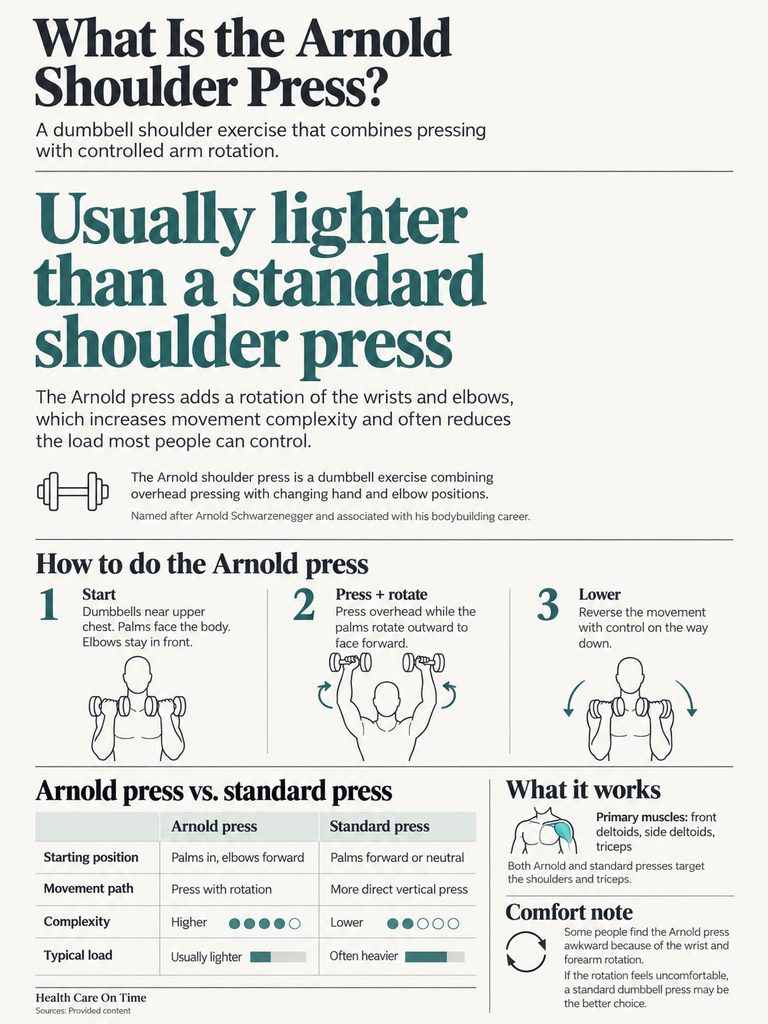
You normally begin with the dumbbells near your upper chest or shoulders. Your palms face toward your body and your elbows sit somewhat in front of your torso.
As you press upward, you gradually rotate your arms so that your palms face forward near the top.
The movement is then reversed as you lower the dumbbells.
Why Is It Called the Arnold Press?
The exercise became associated with Arnold Schwarzenegger during his bodybuilding career and eventually took his name.
Our medical reviewers recommend choosing exercises based on comfort, control, training goals, and the ability to progress safely rather than reputation alone.
Arnold Press vs. Regular Dumbbell Shoulder Press
The Arnold press and standard dumbbell shoulder press share much of the same basic purpose. Both involve moving dumbbells overhead and both challenge the deltoids and triceps.
The differences are mainly in the starting position, rotation, movement path, complexity, and amount of weight you can usually control.
| Feature | Arnold press | Standard dumbbell shoulder press | Practical takeaway |
| Starting hand position | Palms usually face the body | Palms neutral or facing forward | Arnold press begins in a more rotated position |
| Movement path | Longer and rotational | More direct | Arnold press requires more coordination |
| Typical training load | Usually lighter | Often heavier | Standard press may be easier to progressively load |
| Primary muscles | Front and side deltoids, triceps | Front and side deltoids, triceps | Muscle involvement overlaps substantially |
| Exercise complexity | Higher | Lower | Standard press may be easier to learn |
| Shoulder mobility demand | Generally greater | Moderate | Individual comfort matters |
| Wrist and forearm rotation | More | Less | Arnold press can feel awkward for some lifters |
Neither is automatically superior.
What Muscles Does the Arnold Press Work?
The Arnold press primarily trains the shoulders, but overhead pressing involves several muscles working together.
The most visible work comes from the deltoids and triceps. Muscles surrounding the shoulder blade and shoulder joint also contribute to control and stability.
Research on conventional shoulder pressing shows meaningful activation of the anterior and middle portions of the deltoid. One study comparing several shoulder exercises reported high anterior and medial deltoid activity during shoulder pressing. PubMed
Direct evidence on the Arnold press itself is less extensive, so findings from conventional shoulder pressing should not be presented as proof that the Arnold variation produces identical or superior results.
Anterior Deltoid
The anterior deltoid sits on the front of your shoulder.
It helps raise the upper arm in front of the body and contributes strongly during pressing movements.
The Arnold press begins with the elbows positioned somewhat forward and transitions into overhead pressing, which places substantial demand on the anterior deltoid.
If your routine already includes bench presses, incline presses, push-ups, and overhead pressing, your front delts may already receive significant stimulation.
Lateral Deltoid
The lateral or middle deltoid helps move the upper arm away from the body and contributes during overhead pressing.
Research on standard shoulder pressing shows that this part of the deltoid is active during the movement. PubMed
If shoulder width or side-delt development is a specific goal, direct lateral-raise variations can still play an important role because they challenge the muscle differently.
Posterior Deltoid
The posterior deltoid sits on the back of the shoulder.
It may assist with stabilization during pressing, but the Arnold press should not be described as a major rear-delt exercise simply because rotation occurs.
In research comparing shoulder exercises, posterior deltoid activity during pressing was lower than during some exercises that more directly target the back of the shoulder. PubMed
Rows, reverse fly variations, rear-delt raises, and other pulling movements are generally more direct choices for posterior shoulder development.
Triceps
The triceps extend your elbows.
As the dumbbells move upward, your elbows straighten, which means the triceps contribute throughout the pressing phase.
This involvement is similar to what occurs in conventional overhead pressing.
Your triceps may become one of the limiting muscles in a hard set, especially if they are already fatigued from chest or arm training.
Rotator Cuff
The rotator cuff consists of four muscles that help control and stabilize the shoulder joint.
Its role is often misunderstood.
These muscles are not only responsible for rotation. They also help maintain the position of the head of the upper-arm bone while larger muscles generate force.
That stabilizing function becomes important during any loaded overhead movement.
Trapezius and Scapular Muscles
Your shoulder blades are designed to move when your arms rise overhead.
The trapezius, serratus anterior, and other muscles around the shoulder blade help coordinate this movement.
You do not need to force your shoulder blades permanently downward during an Arnold press. Normal overhead motion includes upward rotation of the scapula.
The goal is controlled movement, not a completely frozen shoulder blade.
Does the Arnold Press Work All Three Deltoid Heads?
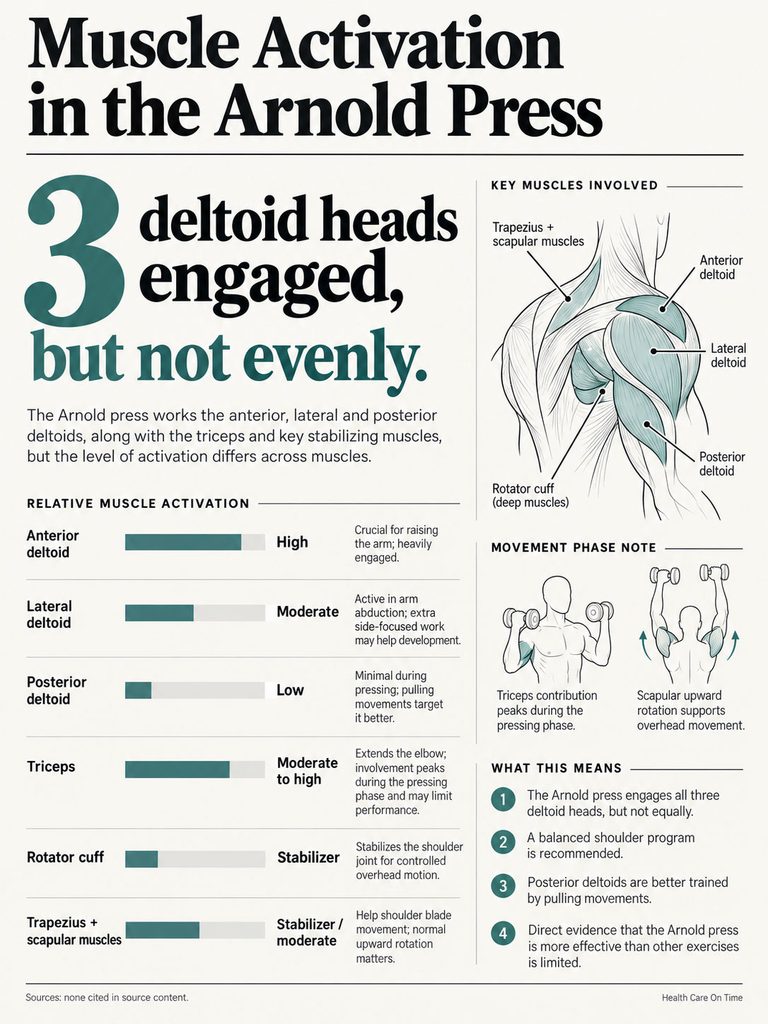
All three portions of the deltoid can contribute during the exercise, but they are not necessarily challenged equally.
Muscle activation does not automatically mean optimal muscle growth, and using a muscle during an exercise does not mean that exercise is the best way to train it.
Direct research demonstrating that Arnold presses build all three deltoid heads better than other exercises is limited.
A more balanced shoulder program may combine overhead pressing with lateral raises and posterior-delt work instead of expecting one exercise to cover every function.
Arnold Press Benefits
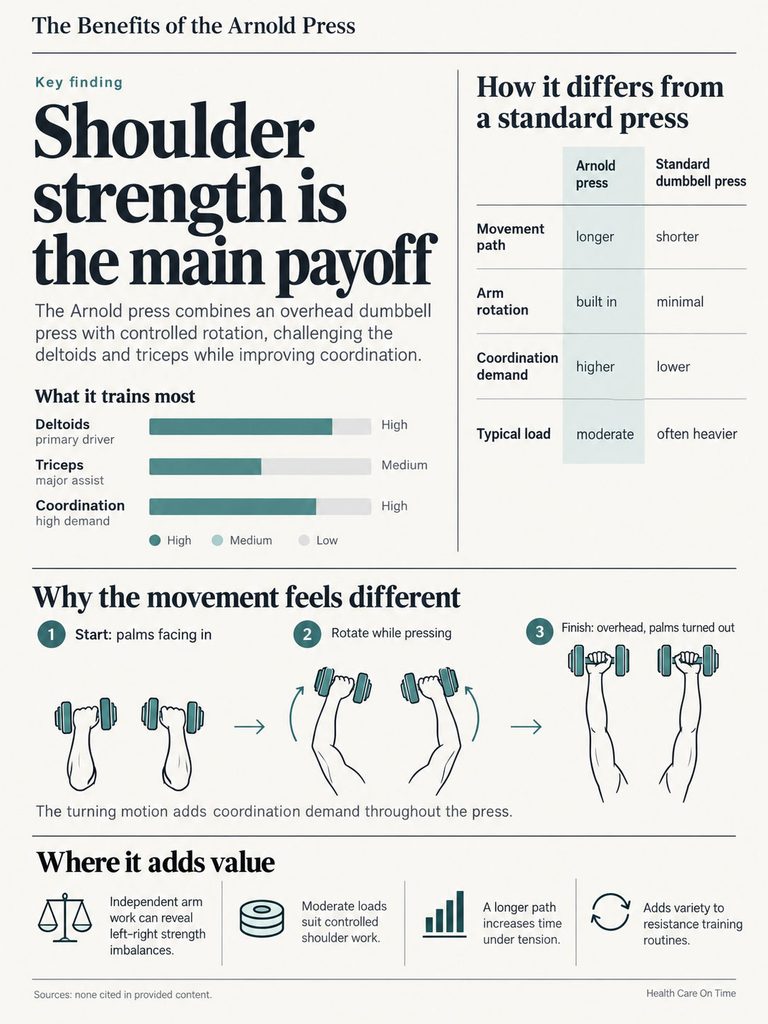
The Arnold press can be useful when it fits your body and program. Its main advantages come from resistance training, dumbbells, overhead pressing, and the extra coordination required by the rotational path.
1. It Can Build Shoulder Strength
The exercise loads the deltoids and triceps. Progressive resistance training can improve strength and muscle size, although those benefits are not unique to the Arnold press.
2. It Uses a Longer Movement Path
Starting with the dumbbells in front of the body creates a longer path than many conventional presses. That gives you more movement to control, but a longer path does not by itself prove greater muscle growth.
3. It Challenges Coordination
Pressing while gradually rotating the arms demands more coordination than a straight overhead press. This can be useful when you want a controlled variation, provided the rotation remains smooth rather than forced.
4. Each Arm Works Independently
Because each hand holds its own dumbbell, differences between sides can be easier to notice. Dumbbells do not automatically correct imbalances, but one arm cannot directly lift the other arm’s load.
5. It Can Be Challenging With Moderate Weight
Most lifters use less weight than on a standard shoulder press. That can make the Arnold press suitable for controlled moderate-load work when maximum pressing strength is not the goal.
6. It Adds Exercise Variety
The movement can add variety without being mandatory. Current resistance-training evidence supports many effective exercise and equipment choices, so consistency, progressive overload, and good technique matter more than choosing the most complicated variation.
How to Do an Arnold Press Properly
A seated Arnold press with back support is a practical way to learn the movement. Start with lighter dumbbells than you use for a standard shoulder press and prioritize a smooth, repeatable path.
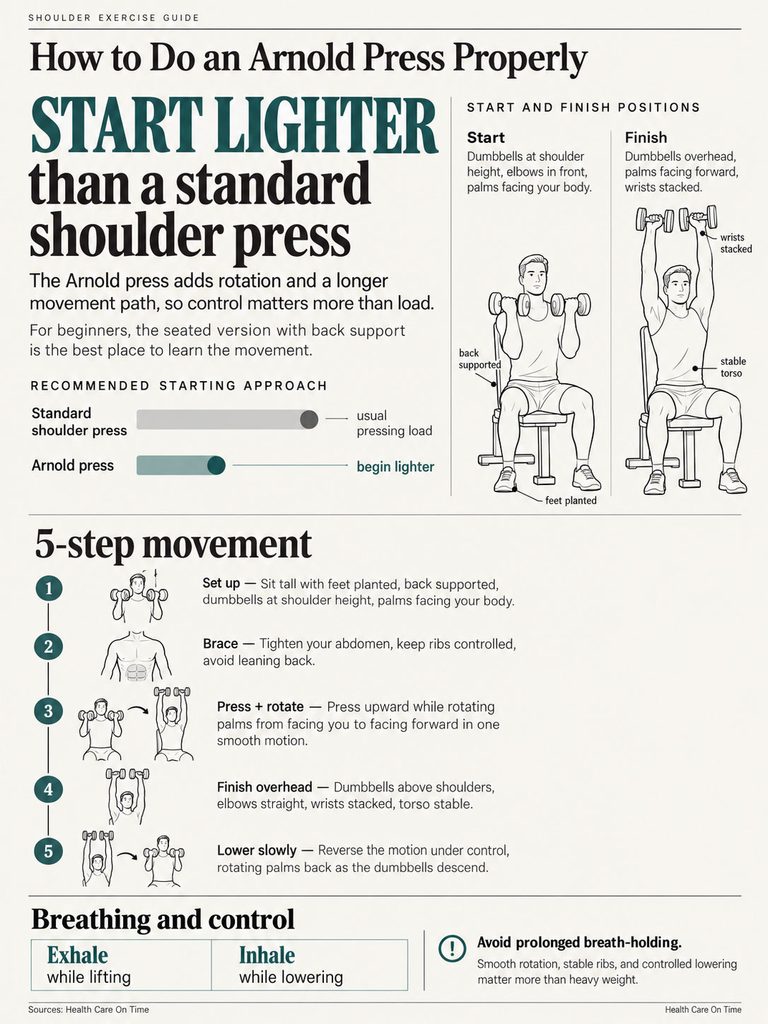
Step 1: Set Up
Sit with your feet planted and your back supported. Hold the dumbbells near shoulder or upper-chest height with your palms facing your body and your elbows slightly forward.
Step 2: Brace Your Torso
Tighten your abdomen and keep your ribs controlled. Avoid leaning back or increasing the arch in your lower back as the weights rise.
Step 3: Press and Rotate
Press upward while gradually rotating your palms from facing you to facing forward. The press and rotation should happen together as one smooth movement, not as a sudden twist.
Step 4: Finish Overhead
Finish with the dumbbells roughly above your shoulders and your elbows naturally straight. Keep your wrists stacked and your torso stable.
Step 5: Lower Under Control
Reverse the movement slowly. Rotate the palms back toward your body as the dumbbells descend, then reset before the next repetition.
Quick Arnold Press Form Checklist
- Use a manageable weight.
- Keep your feet planted and torso stable.
- Start with palms facing your body.
- Press and rotate gradually.
- Finish with the weights over the shoulders.
- Lower slowly and reverse the rotation.
- Stop the set when form deteriorates.
How Should You Breathe?
For general resistance training, exhale during the lifting phase and inhale during the lowering phase. Avoid prolonged breath-holding unless you have been specifically coached in bracing for heavier lifting.
8 Arnold Press Mistakes That Can Ruin Your Form
The Arnold press becomes harder to control as fatigue builds. These are the mistakes most likely to change the movement or signal that the load is too heavy.
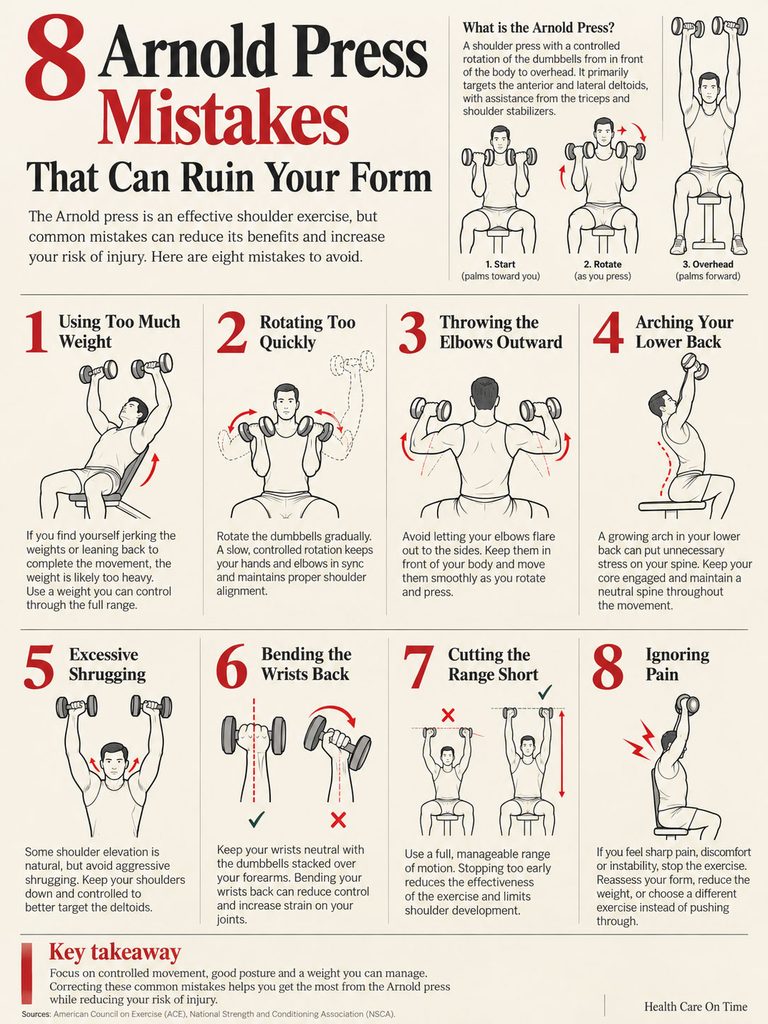
1. Using Too Much Weight
Reduce the load if you must jerk the dumbbells upward, lean far backward, or rush the rotation.
2. Rotating Too Quickly
Rotate gradually as you press. Fast twisting can make the hands and elbows move out of sync.
3. Throwing the Elbows Outward
The elbows naturally move outward, but the transition should be smooth rather than a sudden flare.
4. Arching Your Lower Back
A growing back arch often means the load is too heavy, fatigue is setting in, or overhead mobility is limited.
5. Excessive Shrugging
Your shoulder blades should move naturally overhead, but aggressive shrugging and neck tension can signal poor control.
6. Bending the Wrists Back
Keep the dumbbells reasonably stacked over the forearms. If the wrists collapse backward, reduce the load or adjust your grip.
7. Cutting the Range Short
Use a comfortable range you can control. Do not shorten every repetition simply to keep heavier weights moving.
8. Ignoring Pain
Muscle fatigue is expected. Sharp joint pain, painful catching, instability, numbness, tingling, or sudden weakness are reasons to stop and reassess rather than push through the set.
Arnold Press Risks and Who Should Be Cautious
The Arnold press is not inherently unsafe, but it combines overhead elevation, external load, and rotation. That combination can be uncomfortable for some shoulders, especially when the weight is too heavy or the movement is forced.
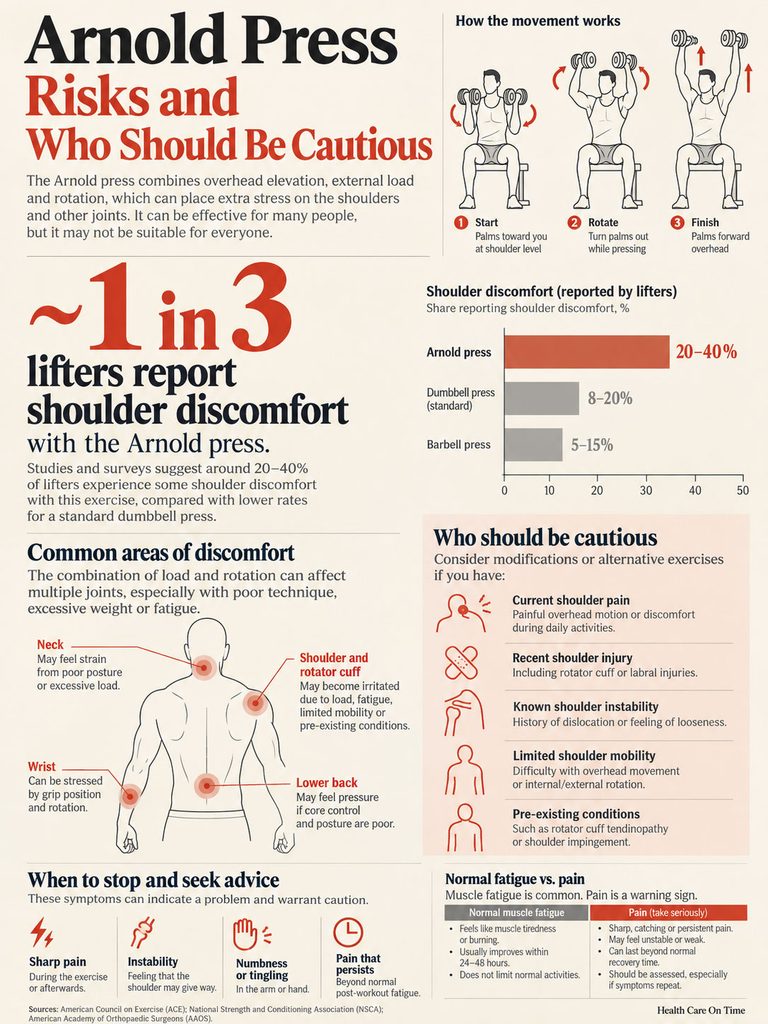
Shoulder and Rotator Cuff Irritation
Pain can reflect many factors, including load, fatigue, limited mobility, previous injury, or an existing shoulder condition. It is not accurate to say the Arnold press automatically causes impingement. If overhead motion is already painful, adding weight and rotation may worsen symptoms.
Wrist, Neck, and Lower-Back Discomfort
Wrist pain can occur if the wrists bend back or the rotation is aggressive. Neck tension often appears with excessive shrugging, while a large backward lean can increase lower-back stress. Reducing the load or choosing a simpler press may help.
Who Should Consider Another Exercise?
Modify or avoid the movement if you have current painful overhead motion, a recent shoulder injury or surgery, recurrent instability, a history of dislocation, painful catching, unexplained weakness, numbness, tingling, or a medical restriction on overhead resistance exercise.
Normal Muscle Fatigue vs. Pain
A burning sensation in the deltoids near the end of a hard set can be normal fatigue. Stop if you experience sharp or stabbing pain, painful catching, instability, sudden weakness, numbness, tingling, or pain that continues or worsens after training. Persistent or significant symptoms deserve individualized assessment.
Arnold Press vs. Shoulder Press: Which One Fits Your Goal?
The Arnold press does not need to beat the standard shoulder press for it to be useful.
Each has advantages.
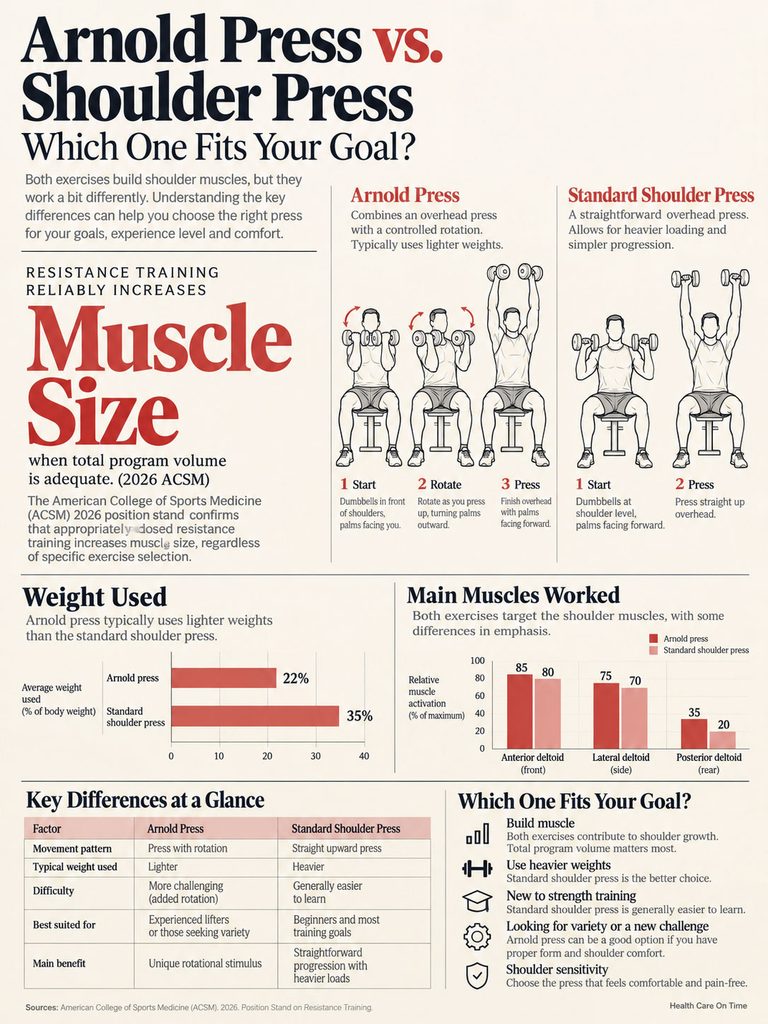
For Muscle Growth
Both exercises can contribute to shoulder hypertrophy.
The Arnold press uses a longer rotational path and usually requires lighter dumbbells.
The standard shoulder press is easier to load heavily and progress in a straightforward way.
The 2026 ACSM resistance-training review found that resistance training reliably increases muscle size and that higher weekly volume can enhance hypertrophy. Exercise complexity itself was not identified as a requirement for muscle growth. PubMed
That means your total program matters more than choosing a supposedly perfect press.
For Strength
A standard shoulder press generally has the practical advantage.
The simpler path often lets you use more weight and track progressive overload more easily.
The ACSM review reported greater strength gains with heavier loads in the evidence evaluated, particularly when training included loads of at least about 80% of one-repetition maximum. ACSM
That finding applies to resistance training broadly, not specifically to Arnold presses.
For Beginners
A standard dumbbell press is usually easier to learn.
Beginners already need to manage posture, elbow position, wrist control, and an overhead movement.
Adding rotation creates another variable.
Learning a simpler press first can make the Arnold variation easier later.
For Experienced Lifters
Experienced trainees may use the Arnold press as:
- A primary shoulder exercise
- A secondary press after heavier work
- A moderate-repetition hypertrophy exercise
- An occasional variation
- A movement used when heavy loading is not the priority
For Sensitive Shoulders
Choose the press that feels comfortable.
Some people prefer the Arnold press because they like the changing arm position.
Others find the rotation irritating and prefer a neutral-grip or standard shoulder press.
There is no requirement to include Arnold presses in a balanced program.
Resistance Training and Shoulder Exercise Context
An Arnold press is only one exercise inside a much larger fitness plan.
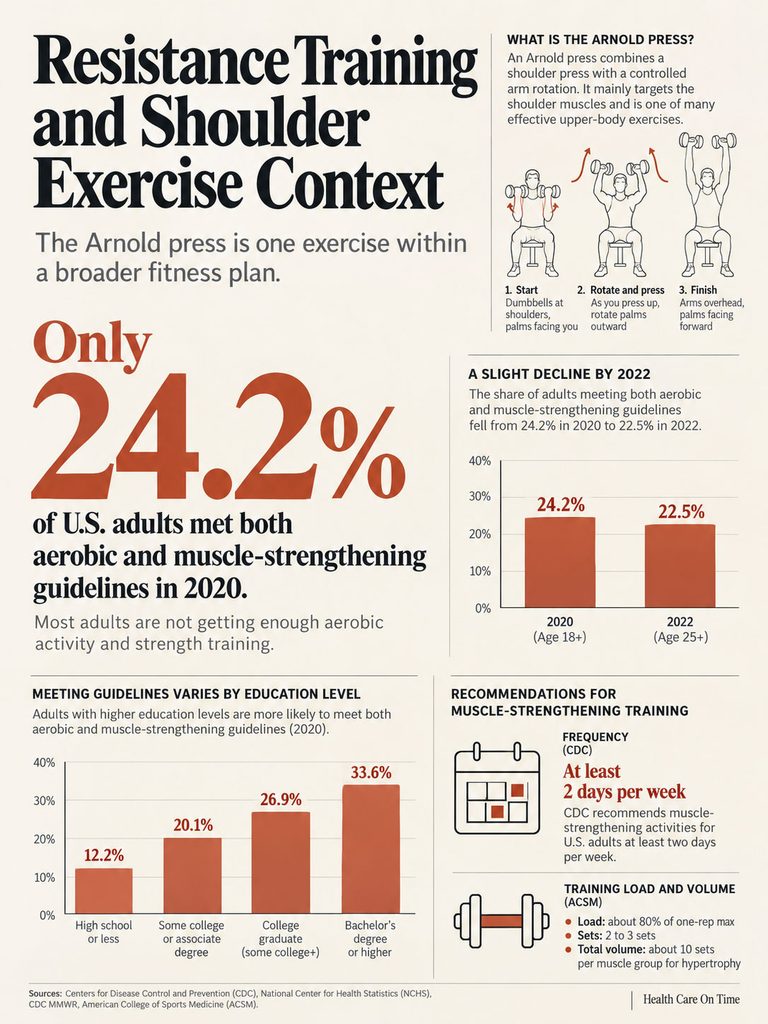
CDC recommends that U.S. adults perform muscle-strengthening activities involving the major muscle groups on at least two days per week. CDC
Population data show that many adults do not meet both aerobic and strengthening recommendations.
| Data point | Number | Source |
| U.S. adults age 18+ meeting both aerobic and strengthening guidelines in 2020 | 24.2% | CDC/NCHS |
| U.S. adults age 25+ meeting both guidelines in 2022 | 22.5% | CDC/MMWR |
| Adults with high school education or less meeting both guidelines in 2022 | 12.2% | CDC/MMWR |
| Adults with bachelor’s degree or higher meeting both guidelines in 2022 | 33.6% | CDC/MMWR |
| Recommended muscle-strengthening frequency | At least 2 days/week | CDC |
| Strength-oriented loading highlighted in ACSM’s 2026 review | At least about 80% 1RM | ACSM |
| Sets associated with greater strength in ACSM’s review | 2 to 3 sets | ACSM |
| Weekly volume associated with greater hypertrophy | About 10 sets per muscle group | ACSM |
CDC’s National Center for Health Statistics reports that 24.2% of U.S. adults met both aerobic and muscle-strengthening guidelines in the referenced 2020 dataset. CDC/NCHS
A CDC analysis of adults age 25 and older reported that 22.5% met both guidelines in 2022. Rates differed substantially by education level, ranging from 12.2% among adults with a high school education or less to 33.6% among adults with at least a bachelor’s degree. CDC MMWR
How Many Sets and Reps of Arnold Press Should You Do?
There is no universal Arnold press prescription.
Your experience, goals, total shoulder volume, and the exercises around it should guide your programming.
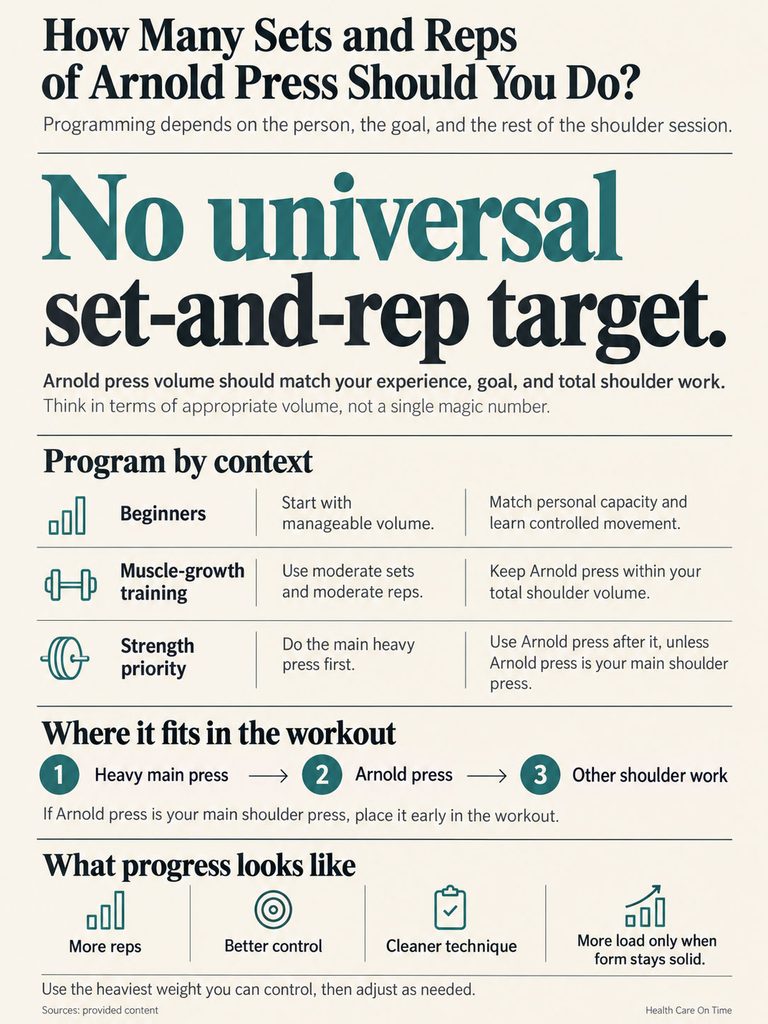
Beginners
A reasonable starting point is:
- 2 to 3 sets
- About 8 to 12 controlled repetitions
- Light to moderate dumbbells
- Two or more repetitions left in reserve while learning
Muscle-Growth Training
A typical hypertrophy-oriented approach might include:
- 2 to 4 working sets
- Moderate repetitions
- Controlled lowering
- A challenging but repeatable effort level
- Progressive increases in repetitions or load over time
Do not look at Arnold press volume in isolation.
Bench pressing, incline pressing, shoulder pressing, push-ups, lateral raises, and other exercises can all contribute to total shoulder training.
Where Should the Arnold Press Go in a Workout?
If shoulder strength is the priority, perform your main heavy press before the Arnold press.
For example:
- Standard dumbbell or barbell shoulder press
- Arnold press
- Lateral raise
- Rear-delt exercise
If the Arnold press is your main shoulder press, place it early while you are fresh.
Avoid putting it late in a workout if fatigue makes your rotation sloppy or causes your back to arch.
How Much Weight Should You Use?
Use the heaviest weight that still lets you control the entire movement.
The load is probably too heavy if:
- You jerk the dumbbells upward
- Your back arches progressively
- Your wrists collapse
- One arm moves very differently from the other
- You cannot lower the dumbbells under control
- You shorten the range dramatically
- Shoulder pain appears
You do not have to add weight every week.
Progress can also come from performing more repetitions, improving control, adding a set, or completing the same workload with cleaner technique.
Seated vs. Standing Arnold Press
Both variations train similar upper-body muscles, but the rest of your body faces different demands.
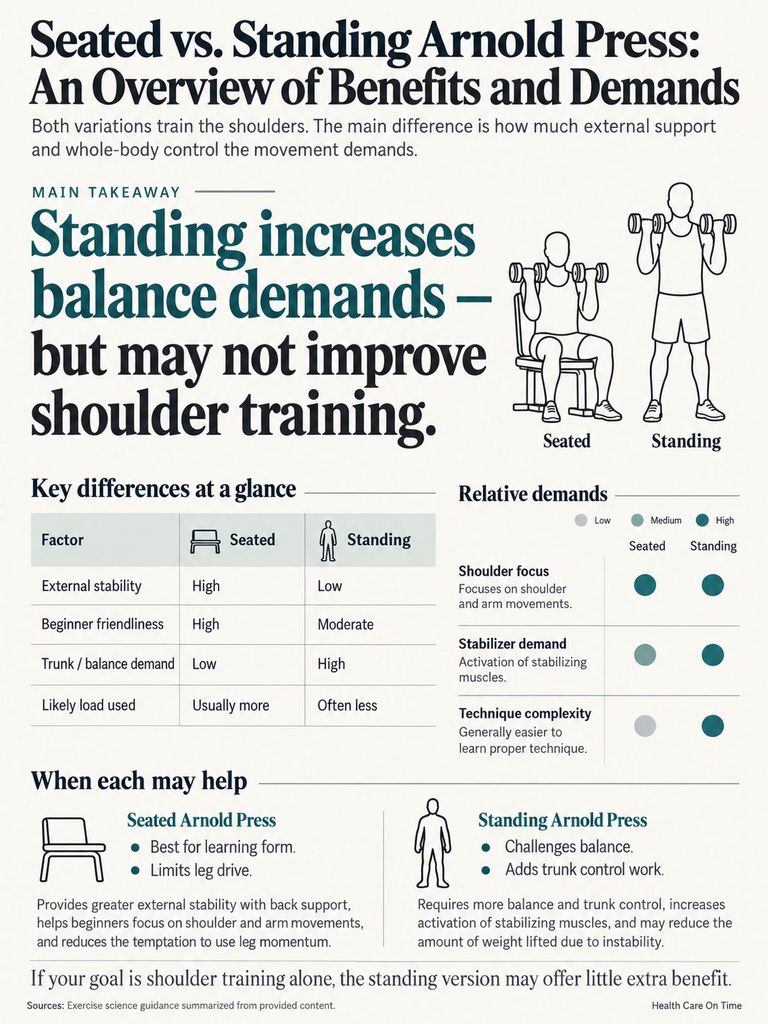
Seated Arnold Press
A seated version with back support provides greater external stability.
That can help beginners focus on the movement of the shoulders and arms.
It may also reduce the temptation to generate momentum through the legs.
This is generally the easiest variation for learning technique.
Standing Arnold Press
The standing version requires more balance and trunk control.
Research on standard shoulder pressing has found that standing dumbbell presses can increase activation of some stabilizing muscles while reducing the amount of weight a person can lift compared with more stable pressing conditions. PubMed
If shoulder training is the priority, the extra instability of standing may not provide a meaningful advantage.
Arnold Press Alternatives
You can train your shoulders effectively without Arnold presses. The best substitute depends on whether you want a simpler press, less rotation, or more targeted deltoid work.
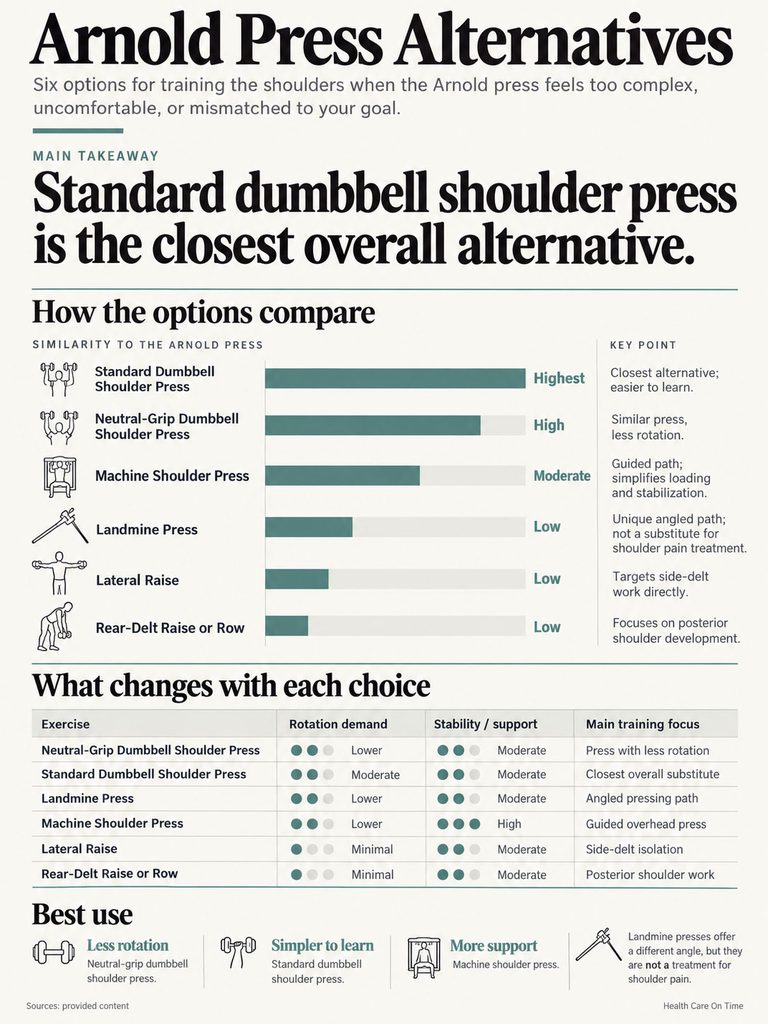
Neutral-Grip Dumbbell Shoulder Press
Press with the palms facing each other. This keeps independent dumbbell loading while removing most of the rotational component.
Standard Dumbbell Shoulder Press
This is the closest simple alternative and is usually easier to learn and progressively load.
Landmine Press
The angled pressing path can feel different from fully vertical pressing. It is an exercise option, not a treatment for unexplained shoulder pain.
Machine Shoulder Press
A guided path reduces some stabilization demands and can make shoulder and triceps loading easier to control.
Lateral Raise
Use lateral raises when you want more direct side-delt work rather than relying on pressing alone.
Rear-Delt Raise or Row
Rows and reverse-fly variations provide more direct posterior-shoulder work than the Arnold press.
When Should You Stop the Arnold Press?
Not every uncomfortable repetition means you are injured.
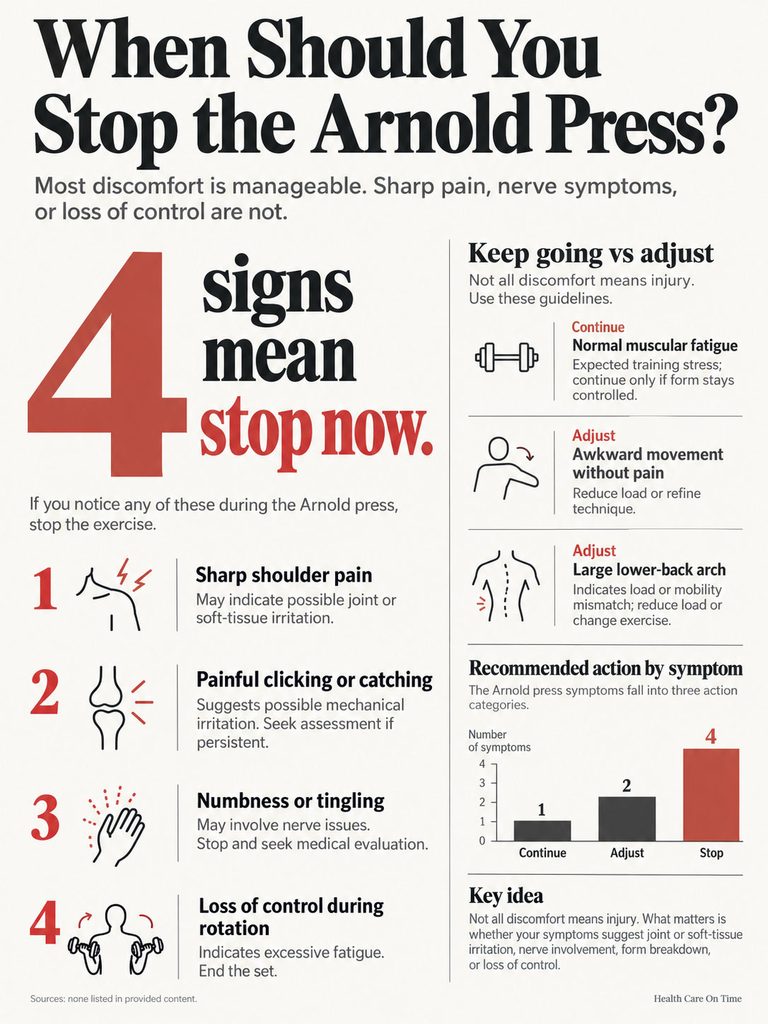
You should still pay attention to symptoms that go beyond normal muscle fatigue.
| Scenario | What it may mean | Recommended action |
| Normal muscular fatigue | Expected training stress | Continue only while form remains controlled |
| Movement feels awkward but not painful | Technique or load may need adjustment | Reduce weight and reassess |
| Sharp shoulder pain | Possible joint or soft-tissue irritation | Stop the exercise |
| Painful catching or clicking | Possible mechanical irritation | Stop and seek assessment if persistent |
| Numbness or tingling | Possible nerve involvement | Stop and seek medical evaluation |
| Large repeated lower-back arch | Load or mobility mismatch | Reduce load or change the exercise |
| Loss of control during rotation | Excessive fatigue or resistance | End the set |
| Pain that continues after training | May require evaluation | Speak with a healthcare professional |
A painless click is not automatically evidence of damage.
A click combined with pain, catching, weakness, instability, or reduced function deserves more attention.
In cases reviewed by our medical team, the pattern of symptoms usually matters more than the sound itself.
Is the Arnold Press Worth Doing?
For many healthy lifters, the Arnold press can be a useful exercise.
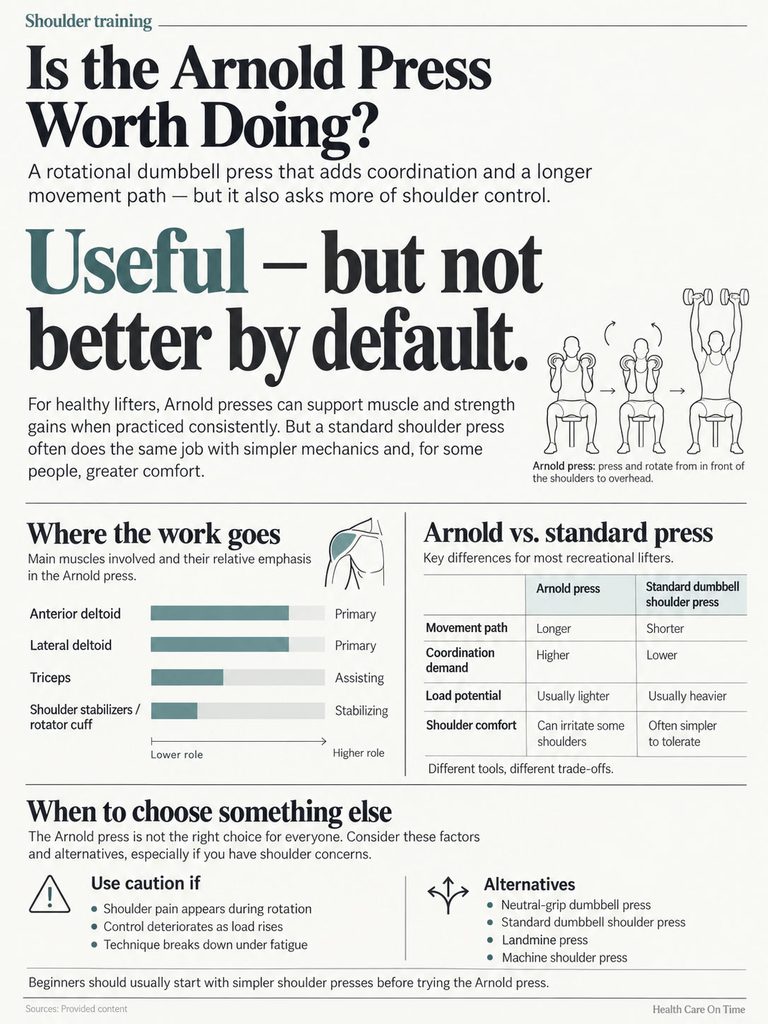
It trains the deltoids and triceps, provides a long movement path, and adds a coordination challenge that distinguishes it from simpler pressing variations.
The larger resistance-training evidence shows that strength and muscle growth can be achieved through many exercise configurations when training is progressive and consistent. PubMed
Use the Arnold press when:
- It feels comfortable
- You can control the rotation
- Your torso remains stable
- You want a dumbbell pressing variation
- It fits your total shoulder volume
- You can progress it without losing technique
Choose another shoulder press when:
- Rotation causes pain
- Your wrists repeatedly collapse
- You cannot keep your lower back controlled
- You want to prioritize maximum pressing strength
- Another movement fits your mobility better
- You simply prefer another exercise
The name of an exercise matters far less than whether it helps you train consistently.
Frequently Asked Questions
What Muscles Does the Arnold Press Work?
The Arnold press mainly trains the anterior and lateral deltoids. The triceps assist during elbow extension, while the rotator cuff and muscles around the shoulder blade help stabilize and control the movement. The posterior deltoid can contribute, but it is not the primary target.
Is the Arnold Press Better Than a Shoulder Press?
No exercise is universally better. The Arnold press uses more rotation and usually requires lighter weights, while a conventional shoulder press is simpler and often easier to progressively overload. Both can support muscle and strength gains when performed consistently with appropriate resistance.
Is the Arnold Press Bad for Your Shoulders?
The Arnold press is not inherently bad for healthy shoulders. However, its combination of overhead movement and rotation may irritate some people. Reduce the load if control deteriorates, and stop if you experience sharp pain, instability, painful catching, or symptoms that persist.
Can the Arnold Press Cause Shoulder Impingement?
You cannot assume the Arnold press causes shoulder impingement simply because rotation occurs. Shoulder pain can involve training load, anatomy, tissue health, mobility, previous injury, and other factors. If overhead pressing repeatedly produces pain, discontinue the movement and seek assessment when appropriate.
Does the Arnold Press Work the Side Delts?
Yes. The lateral or middle deltoid contributes during overhead pressing. That does not mean the Arnold press is necessarily the best side-delt exercise. Lateral raises provide a more targeted way to train shoulder abduction and can complement overhead pressing.
Does the Arnold Press Work the Rear Delts?
The rear delts can assist with shoulder control, but they are not a primary target of the Arnold press. If posterior shoulder development is important, include rows, reverse fly variations, or rear-delt raises rather than depending on pressing alone.
Should Beginners Do Arnold Presses?
Beginners can learn Arnold presses, but a standard dumbbell shoulder press is simpler. Learning basic overhead pressing first reduces the number of movement variables you need to control. If you start with Arnold presses, use light dumbbells and consider a seated version with back support.
Is a Seated or Standing Arnold Press Better?
Neither is always better. A seated Arnold press offers more external stability and is usually easier to learn. A standing Arnold press adds balance and trunk-control demands. Choose the version that lets you perform smooth, pain-free repetitions without excessive back movement.
How Heavy Should Arnold Presses Be?
Use a weight that allows controlled rotation, stable wrists, and a steady torso throughout the set. Arnold press loads are often lighter than standard shoulder-press loads. If you need to jerk the weights or lean backward dramatically, reduce the resistance.
How Many Sets and Reps Should You Do?
Beginners can start with 2 to 3 sets of about 8 to 12 controlled repetitions. More experienced lifters can adjust the range based on strength, hypertrophy, and weekly training volume. There is no special Arnold press repetition range that produces uniquely better results.
Why Does My Shoulder Hurt During Arnold Presses?
Possible causes include excessive load, forced rotation, poor control, fatigue, limited mobility, or an existing shoulder issue. Pain does not identify the exact problem. Stop painful repetitions and seek professional evaluation if symptoms are severe, persistent, recurrent, or associated with weakness or instability.
What Is the Best Alternative to the Arnold Press?
A neutral-grip or standard dumbbell shoulder press is usually the simplest alternative. Both preserve overhead pressing while removing much of the rotational component. A landmine press or machine shoulder press can also work depending on your training goal and comfort.
Disclaimer: This article provides general educational information and is not a substitute for individualized medical advice, diagnosis, physical therapy, or exercise supervision. Stop exercising if you experience sharp pain, instability, numbness, tingling, sudden weakness, or other concerning symptoms. Seek guidance from a qualified healthcare professional when symptoms are significant, persistent, recurrent, or related to a previous injury or medical condition.
References
- Centers for Disease Control and Prevention: Adult Activity Guidelines
- CDC National Center for Health Statistics: Exercise or Physical Activity
- CDC MMWR: Adults Meeting Aerobic and Muscle-Strengthening Guidelines
- American College of Sports Medicine: Updated Resistance Training Guidelines
- PubMed: ACSM Position Stand on Resistance Training Prescription
- PubMed: Body Position and Loading Modality During Shoulder Pressing
- PubMed: Deltoid Activation During Shoulder Exercises
- Mayo Clinic: Weight Training Do’s and Don’ts
- Mayo Clinic: Strength Training Basics