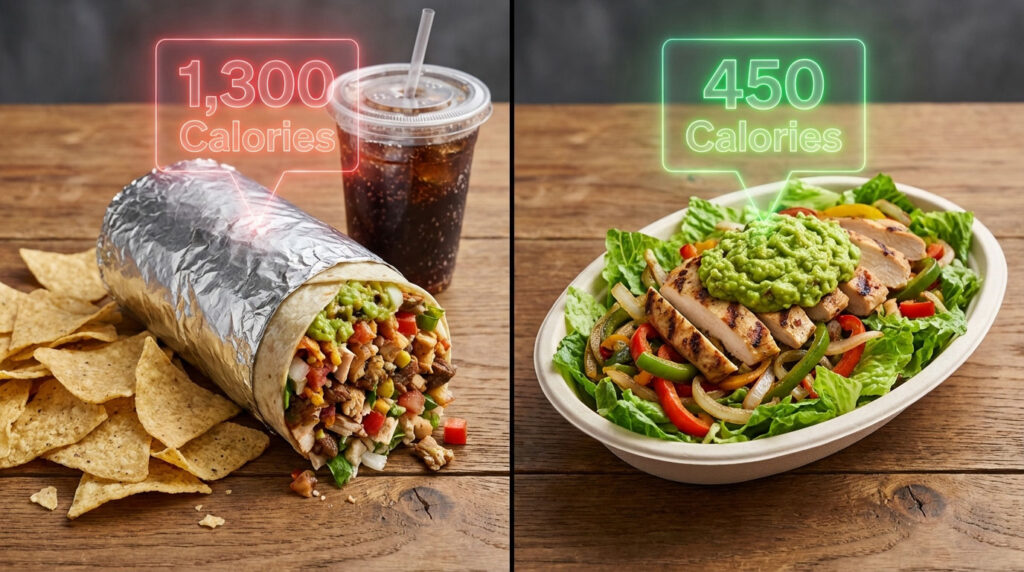
Is Chipotle healthy? The answer depends entirely on the specific choices you make while standing in that fast-moving line. While Chipotle Mexican Grill sets itself apart with minimally processed, non-GMO ingredients and “responsibly raised” meats, a standard user order often exceeds 1,000 calories and contains over 2,000 mg of sodium. However, by strategically customizing your bowl—specifically by eliminating the flour tortilla and limiting high-calorie sides—you can engineer a high-protein, nutrient-dense meal under 500 calories that aligns perfectly with weight loss, muscle gain, or Keto diet goals.
Table of Contents
The Paradox of Fast-Casual Health Choices
Walking into a Chipotle often feels like entering a safe haven of nutrition. The smell of grilled peppers, the sight of employees mashing fresh avocados, and the open kitchen layout create an atmosphere of transparency. It feels fundamentally different from a traditional fast-food burger joint where the food comes from a freezer. This perception is built on their “Food with Integrity” promise, which guarantees no artificial flavors, colors, or preservatives.

However, there is a distinct disconnect between ingredient quality and nutritional density. You can consume high-quality ingredients and still consume an excessive amount of energy. A New York Times data analysis famously revealed that the average Chipotle order clocks in at nearly 1,070 calories. This places a seemingly “healthy” burrito on par with a double-patty burger meal from other major chains in terms of raw energy.
The danger lies in the assembly line format. It relies on “decision fatigue” and the additive nature of the menu. A ladle of sour cream seems harmless. A sprinkle of cheese feels necessary. A side of chips is an automatic reflex. Suddenly, you have consumed 75% of your daily caloric needs in a single sitting.
This guide provides a definitive, deep-dive Chipotle nutrition breakdown. We will analyze every ingredient, calorie count, and macro profile to help you navigate the menu like a professional nutritionist. Whether you are cutting for a competition, bulking for size, or strictly eating Keto, here is how to make the menu work for your physiology.
The Core Concept: Ingredients vs. Macros (What “Healthy” Really Means)
To truly answer if is Chipotle healthy, we must distinguish between two often conflated concepts: “clean eating” and “calorie management.” You can eat entirely clean, unprocessed ingredients and still gain weight if you are in a persistent caloric surplus. Conversely, you can lose weight eating processed food if you remain in a deficit. Chipotle sits in a unique middle ground where both scenarios are possible.
Assessing Ingredient Quality and Ethical Sourcing
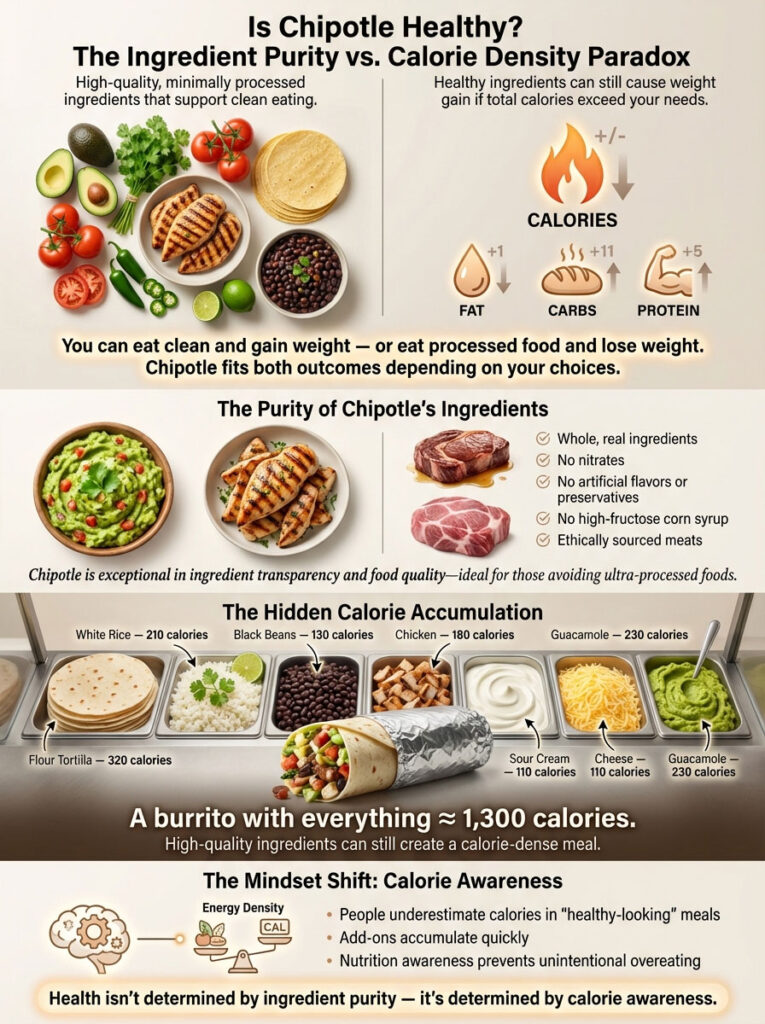
Chipotle shines when we strictly analyze food quality. Unlike competitors that may rely on fillers, stabilizers, and “pink slime,” Chipotle uses whole ingredients. The chicken is real muscle meat. The guacamole consists of hand-mashed avocados, lime juice, jalapeños, red onion, and cilantro. There are no added nitrates in the meat or high-fructose corn syrup in the salsas.
For a consumer focused on gut health, avoiding ultra-processed foods, and reducing chemical intake, these are massive victories. This transparency is why many health-conscious consumers turn to Chipotle healthy options over other fast-food alternatives. Their commitment to sourcing pork from pigs raised outdoors or in deeply bedded barns (Carnitas) and using pasture-raised beef when possible adds an ethical layer to the health conversation.
The “Build-Your-Own” Calorie Trap
The nutritional problem arises with the Chipotle calories math. The menu is designed around “add-ons” that carry significant energy density. The human brain is not great at visualizing volume versus calories.
- The Flour Tortilla: 320 calories (The equivalent of a personal pizza crust).
- White Rice: 210 calories (Often over-served by employees).
- Black Beans: 130 calories.
- Chicken: 180 calories.
- Sour Cream: 110 calories.
- Cheese: 110 calories.
- Guacamole: 230 calories.
If you order a standard burrito with “everything,” you are holding a 1,300-calorie bomb before you even add the chips and a drink. Understanding Chipotle nutrition facts is the only way to eat here without unintentionally sabotaging your diet.
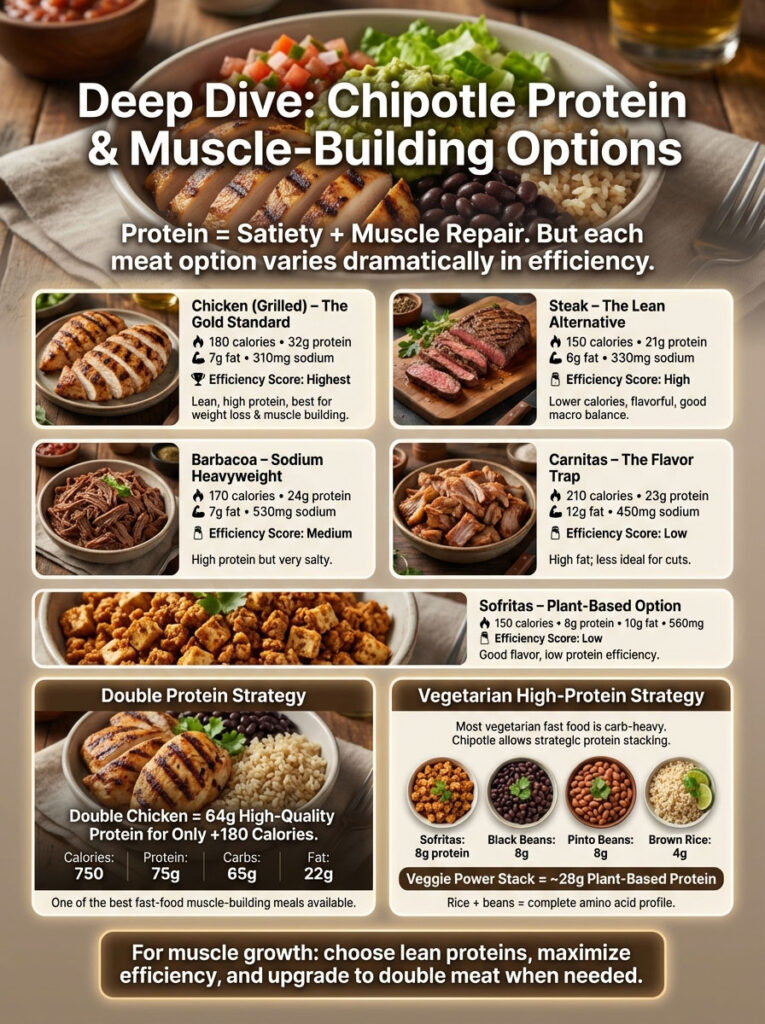
Deep Dive: Chipotle Protein & Muscle Building Options
For athletes, bodybuilders, and fitness enthusiasts, the primary inquiry is often how much protein in a Chipotle chicken bowl? Protein is the most satiating macronutrient, meaning it keeps you fuller for longer, and it is essential for muscle repair. Chipotle offers some of the most accessible high-protein fast food on the market, but the variance between meat choices is significant.
Ranking the Meats by Protein Efficiency and Leanness
Not all proteins are created equal. If you are tracking Chipotle macros, you need to look at the protein-to-calorie ratio. You want the most protein for the “cheapest” caloric cost.
Grilled Chicken (The Gold Standard):
Chicken is marinated in chipotle pepper and grilled. It consistently offers high protein with relatively low fat. It is the safest bet for anyone watching their weight.
Steak (The Lean Alternative):
Steak is often leaner than people expect. It is cooked medium-rare and marinated in adobo. While it has a slightly lower protein count per serving than chicken, it is lower in calories than the shredded meats.
Carnitas (The Flavor Trap):
This is shredded pork. While delicious, it is higher in fat because it is slow-cooked and requires more fat to maintain moisture. It is less optimal for a strict cut.
Barbacoa (The Sodium Heavyweight):
Shredded beef braised with spices. It has a distinctively high sodium count and moderate fat. If you are watching blood pressure, this is the meat to skip.
Sofritas (The Plant-Based Option):
This is the vegan option made from organic tofu. It is tasty and braised in peppers, but it ranks lowest on the protein-per-calorie scale compared to the meats. It also carries a high sodium load due to the marinade.
Below is a detailed comparison to help you choose the best high protein order at chipotle.
| Protein Option (4oz Serving) | Calories | Protein (g) | Fat (g) | Sodium (mg) | Efficiency Score |
| Chicken | 180 | 32g | 7g | 310 | Highest |
| Steak | 150 | 21g | 6g | 330 | High |
| Barbacoa | 170 | 24g | 7g | 530 | Medium |
| Carnitas | 210 | 23g | 12g | 450 | Low |
| Sofritas (Vegan) | 150 | 8g | 10g | 560 | Low |
The “Double Protein” Strategy for Bulking
If your goal is muscle growth (hypertrophy), a standard scoop of chicken (32g protein) might not be sufficient to stimulate maximum muscle protein synthesis. This is where the Chipotle double chicken bowl protein strategy becomes essential.
Asking for “double meat” usually costs an extra $3.50 to $6.00 depending on your location. However, it doubles your protein intake to a massive 64g of protein for only 180 extra calories.
For a bodybuilder, this is an incredible value proposition. A bowl with brown rice, black beans, and double chicken provides roughly:
- Calories: 750
- Protein: 75g
- Carbs: 65g
- Fat: 22g
This is a near-perfect “bulking” meal. It provides sustained energy from complex carbohydrates and massive amino acid support for recovery. Comparing this to a protein bar or shake, the bioavailability of whole-food protein from chicken is superior for most athletes.
High Protein Vegetarian Chipotle Order Strategies
Vegetarians often struggle to hit protein targets at fast-food chains because most options are carb-heavy (pasta, bread, fries). At Chipotle, you have to be strategic to get a complete amino acid profile. A standard healthy chipotle veggie bowl often relies on beans and Sofritas.
- Sofritas: 8g protein.
- Black Beans: 8g protein.
- Pinto Beans: 8g protein.
- Brown Rice: 4g protein.
To get a high protein vegetarian chipotle order, you should stack these sources. Order Sofritas and both types of beans. The combination of rice and beans creates a complete protein, meaning it contains all nine essential amino acids necessary for human health.
The Veggie Power Stack: Sofritas + Black Beans + Pinto Beans + Brown Rice = ~28g of Plant-Based Protein. While this is lower than the chicken option, it is significantly higher than most vegetarian fast-food meals.
The Calorie & Sodium Traps: What to Avoid for Weight Loss
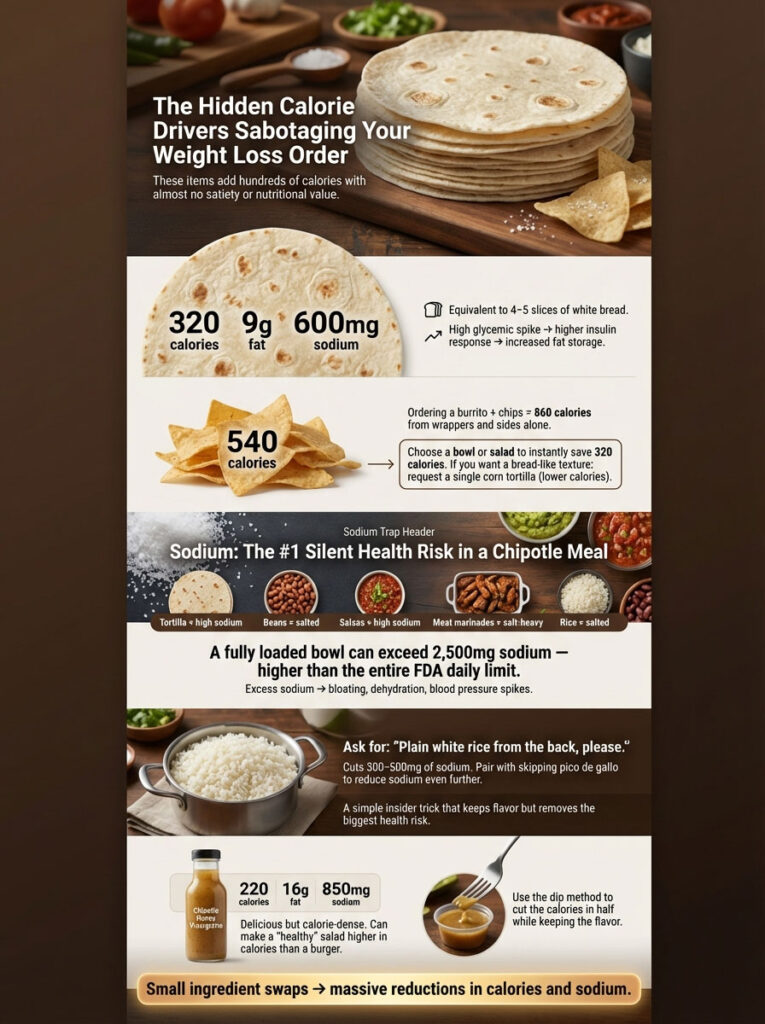
If you are trying to design a Chipotle weight loss order, you must identify and eliminate the hidden calorie drivers. These are the items that offer little nutritional value but skyrocket the energy density of your meal.
The Flour Tortilla and Chips (The Empty Carbs)
The number one enemy of a lean order is the burrito wrapper itself. The large flour tortilla contains 320 calories, 9g of fat, and 600mg of sodium. It is essentially the caloric equivalent of eating four to five slices of standard white bread before you even touch the meat and beans. From a glycemic index standpoint, the refined flour spikes blood sugar rapidly, leading to an insulin response that can promote fat storage.
Then there are the chips. A regular bag of chips is 540 calories.
If you order a burrito and chips, you have consumed 860 calories just from the flour, corn, and oil alone. That is nearly half the daily caloric requirement for an average adult, consumed in “sides” and wrappers that provide almost no micronutrients or satiety.
The Fix: Always choose the Chipotle bowl or salad format. This instantly saves you 320 calories. If you desperately need the bread texture, ask for a small corn tortilla on the side (used for tacos), which is significantly lower in calories.
The Sodium Reality Check (The #1 Health Risk)
One of the most critical aspects of Chipotle nutrition is the Chipotle sodium content. This is the single biggest “silent” health risk on the menu. Sodium is used liberally in almost every step of the cooking process to enhance flavor and preserve freshness.
- The tortilla is high in sodium.
- The beans are salted.
- The salsa is packed with salt.
- The meat marinade is salt-heavy.
- Even the rice is tossed with salt and lime juice.
A fully loaded bowl can easily hit 2,500mg of sodium, which exceeds the FDA’s recommended daily limit of 2,300mg. For individuals with high blood pressure, heart concerns, or those sensitive to water retention, this is a major concern. Consuming this much sodium in one sitting leads to significant bloating and dehydration.
Insider Secret: The “Plain Rice” Sodium Hack
Most customers do not realize that the cilantro-lime rice is pre-mixed with a significant amount of salt. However, every Chipotle kitchen keeps a pot of plain white and brown rice in the back warmer. This is typically reserved for children’s meals, customers with cilantro soap-gene sensitivity, or even service dogs.
The Hack: When you get to the rice station, politely ask the server: “Can I get the plain white rice from the back, please?”
The Result: You instantly cut approximately 300-500mg of sodium from your bowl. Combined with skipping the fresh tomato salsa (pico de gallo), you have successfully neutralized the biggest health risk on the menu while still enjoying the full texture of the meal.
The Vinaigrette Warning
The Chipotle Honey Vinaigrette has a cult following, but it is nutritionally dense. A single 2-ounce serving contains 220 calories, 16g of fat, and 850mg of sodium. It is made with rice bran oil, red wine vinegar, honey, and spices.
Adding this dressing to a “healthy” salad can ironically make it higher in calories than a burger. The sugar content from the honey also adds a glycemic load to the meal.
If you must have it, ask for it on the side and use the “dip method”; dip your fork in the dressing before stabbing your lettuce. This ensures you get the flavor in every bite but consume only half the portion.
Mastering the Menu: Healthiest Orders by Goal
Now that we understand the data, let’s build specific orders. Whether you want a healthy Chipotle chicken bowl for cutting or a massive meal for bulking, here are the blueprints.
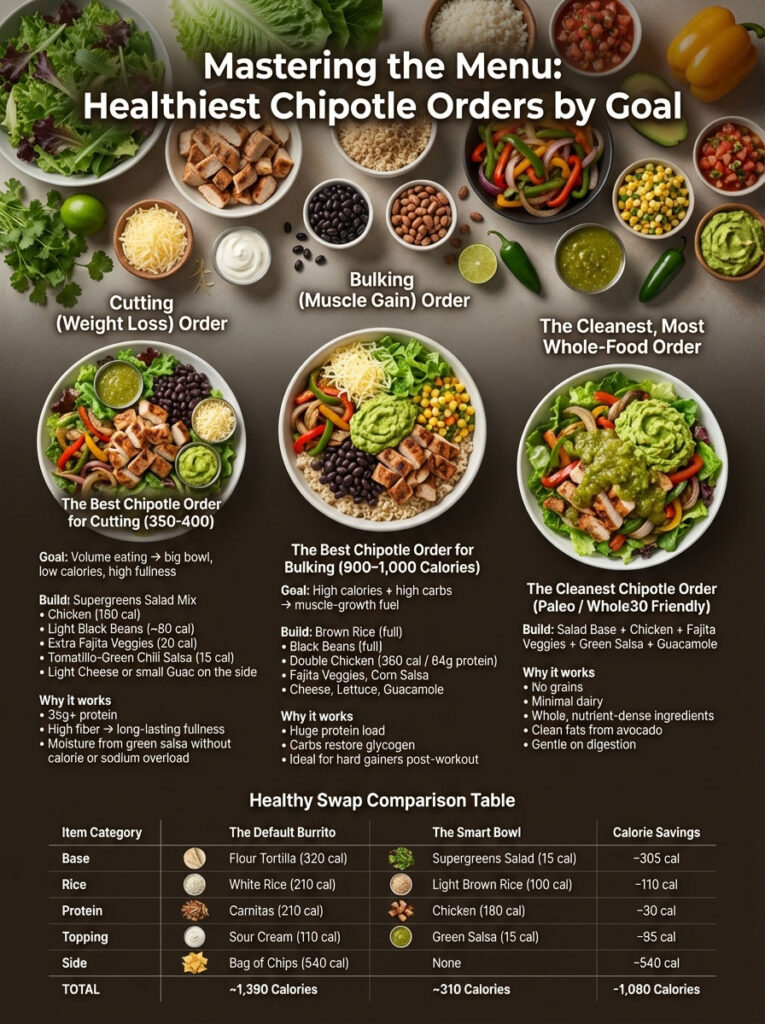
The Best Chipotle Order for Cutting (Weight Loss)
When focusing on a Chipotle weight loss order, the goal is “Volume Eating.” You want the physical weight of the food to be high (to fill your stomach and stretch the stomach lining, signaling fullness) while keeping the calories low.
The Order:
- Base: Supergreens Salad Mix (Lettuce/Kale).
- Protein: Chicken (180 cal).
- Beans: Light scoop of Black Beans (approx. 80 cal).
- Veggies: Fajita Veggies (20 cal) — Ask for extra.
- Salsa: Tomatillo-Green Chili Salsa (15 cal).
- Fat: Light sprinkle of Cheese OR Guacamole on the side (use sparingly).
Why it works: The chipotle chicken bowl calories for this specific build come out to roughly 350–400 calories with over 35g of protein. The fiber from the greens and beans keeps you full for hours. The green salsa adds moisture without the sodium overload of the red salsa or the calorie overload of the vinaigrette.
The Best Chipotle Order for Bulking (Muscle Gain)
For the best chipotle order for bulking, we need caloric density and carbohydrates to fuel training and replenish glycogen stores.
The Order:
- Base: Brown Rice (Full scoop).
- Beans: Black Beans (Full scoop).
- Protein: Double Chicken (360 cal / 64g protein).
- Veggies: Fajita Veggies.
- Toppings: Roasted Chili-Corn Salsa, Cheese, Lettuce, and Guacamole.
This meal provides approximately 900–1,000 calories and a massive protein punch. It is an ideal post-workout meal for hard gainers who struggle to eat enough food to grow. The brown rice provides slow-digesting carbs, while the corn salsa adds a sweet crunch and extra carbs.
The “Cleanest” Order (Minimally Processed)
If your definition of chipotle healthy options relies on avoiding inflammatory oils or grains, this is your order. This is often preferred by those following a Whole30 or strict Paleo approach.
The Order: Salad Base + Chicken + Fajita Veggies + Green Salsa + Guacamole.
This eliminates all grains, most dairy (unless you add cheese), and focuses strictly on whole, micronutrient-rich foods. The fats come from avocado, and the protein comes from grilled meat. It is simple, effective, and digestion-friendly.
The Healthy Swap Comparison Table
Small changes yield massive results. See how swapping just a few items transforms the nutritional profile of your meal.
| Item Category | “The Default Burrito” | “The Smart Bowl” | Calorie Savings |
| Base | Flour Tortilla (320 cal) | Supergreens Salad (15 cal) | -305 cal |
| Rice | White Rice (210 cal) | Light Brown Rice (100 cal) | -110 cal |
| Protein | Carnitas (210 cal) | Chicken (180 cal) | -30 cal |
| Topping | Sour Cream (110 cal) | Green Salsa (15 cal) | -95 cal |
| Side | Bag of Chips (540 cal) | None | -540 cal |
| TOTAL | ~1,390 Calories | ~310 Calories | -1,080 Calories |
Chipotle Lifestyle Bowls & Special Diets (Keto, Paleo, Vegan)
Chipotle has embraced the modern diet landscape by officially launching Lifestyle Bowls. These are pre-configured menu items designed to fit specific macronutrient requirements. While you can order these by name from the app, you can also build them yourself on the line if you know the rules.
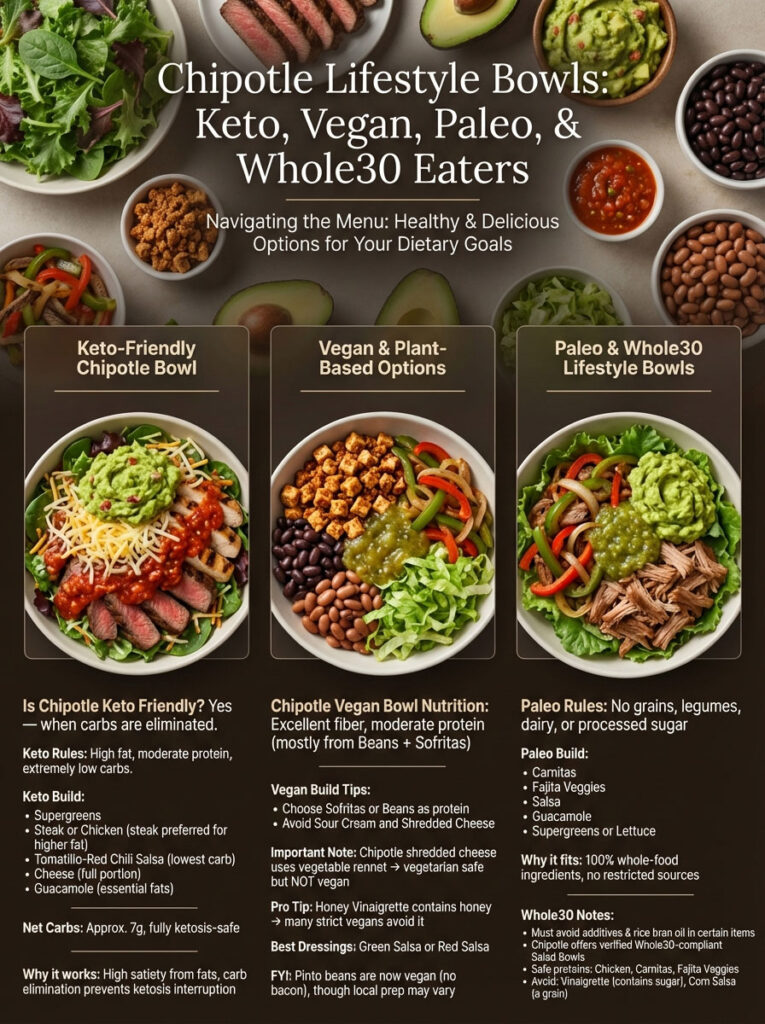
Is Chipotle Keto Friendly?
Yes, chipotle keto bowl options are plentiful if you know the strict rules of ketosis. The ketogenic diet requires high fat, moderate protein, and extremely low carbs (usually under 20-50g per day). To keep your order Keto friendly, you must banish rice, beans, and corn salsa from your bowl. These are all high-carb ingredients that will kick you out of ketosis immediately.
The Perfect Keto Build:
- Base: Supergreens Mix.
- Protein: Steak or Chicken (Steak has slightly more fat, which is good for Keto).
- Salsa: Tomatillo-Red Chili Salsa (Lowest carb salsa).
- Dairy: Cheese (Full portion).
- Fat: Guacamole (Essential for fat content).
Net Carbs: This bowl contains approximately 7g of net carbs, making it perfectly safe for ketosis. The fat from the cheese and guacamole ensures you stay satiated despite the lack of bulk from rice and beans.
Vegan and Plant-Based Options
The chipotle vegan bowl nutrition profile is excellent for fiber but requires attention to protein. As mentioned, Sofritas is the primary protein source. However, you can also rely on beans.
The difference between the “Vegetarian” and “Vegan” bowl is dairy. Vegans must avoid the sour cream and shredded cheese. Interestingly, Chipotle’s shredded cheese uses a vegetable-based rennet, so it is vegetarian-safe, but it is still a dairy product.
Pro Tip for Vegans: The Chipotle Honey Vinaigrette contains honey, which some strict vegans avoid as it is an animal byproduct. Stick to the Green or Red salsas for dressing. Additionally, the pinto beans are now vegan (cooked with cumin and garlic), whereas in the past, they were cooked with bacon. Always double-check current local preparation methods if you have severe restrictions, but traditionally, they are now bacon-free nationwide.
Paleo and Whole30 Compliance
The Chipotle Paleo bowl is strict. Paleo avoids grains, legumes, dairy, and processed sugar. This means no rice, no beans, no cheese, no sour cream, and no corn salsa. It might sound restrictive, but a bowl with Carnitas, heaps of fajita veggies, salsa, and guacamole is rich, flavorful, and 100% Paleo compliant.
For Whole30, the rules are even stricter regarding additives. You must avoid the rice bran oil used in some cooking processes. However, Chipotle has worked closely with the Whole30 program to verify that their specific Salad Bowls (using the Supergreens base) with Chicken, Carnitas, or Fajita Veggies are compliant. The key is avoiding the Vinaigrette (sugar) and the Corn Salsa (grain).
Expert Strategies & Insider Hacks
You do not need to be a former employee to order like a pro. These strategies will help you get more value and better nutrition for your money.
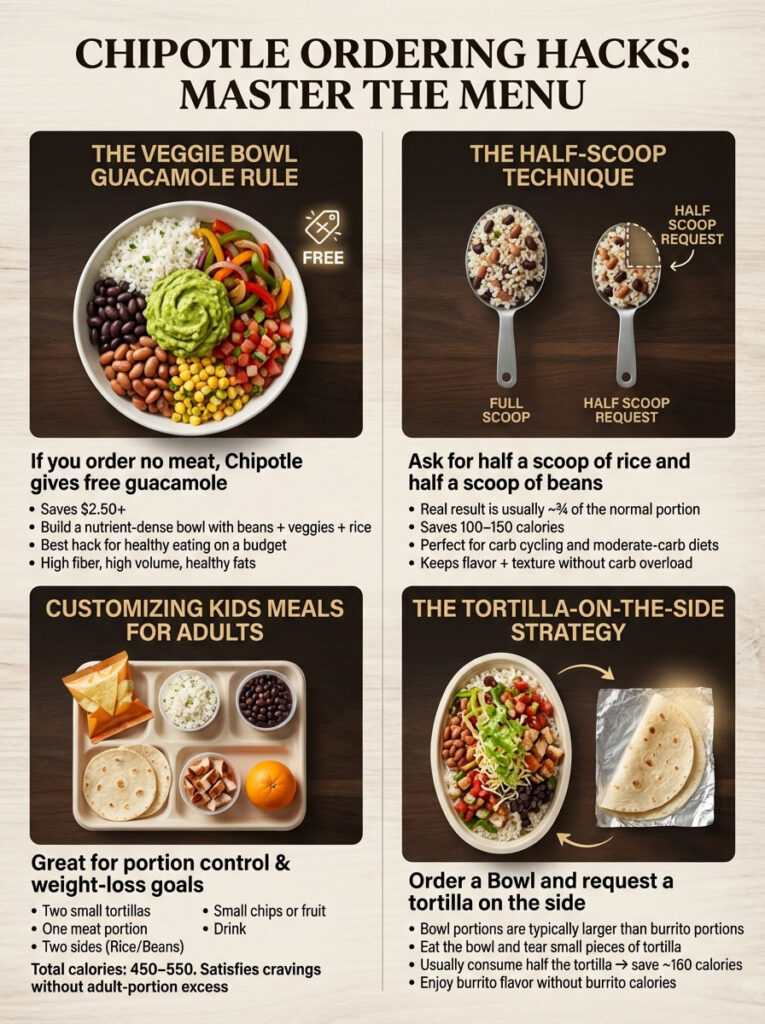
The “Veggie Bowl” Guacamole Rule
This is the best-kept secret at Chipotle. If you order a meatless meal (Vegetarian), Guacamole is included for free.
Usually, guac costs over $2.50 extra. By ordering a bowl with black beans, pinto beans, fajita veggies, and rice, you get a filling meal and the premium healthy fats of avocado without the surcharge. This is a great strategy for saving money while keeping your meal nutrient-dense. If you are trying to eat healthy on a budget, the Veggie Bowl is the mathematical winner.
The “Half-Scoop” Technique
Carb cycling or strictly watching your chipotle carb count? You do not have to eliminate rice entirely. Ask for “half a scoop of rice” and “half a scoop of beans.”
Servers are usually trained to be generous, so a “half scoop” often ends up being a manageable 3/4 portion. This gives you the texture and flavor you crave but saves you roughly 100-150 calories compared to the heavy-handed standard scoop. This allows you to fit Chipotle into a moderate-carb diet without feeling deprived.
Customizing Kids Meals for Adults
If you struggle with portion control, the “Build Your Own” Kids Meal is a legitimate hack for a chipotle weight loss order.
You get:
- Two soft taco shells (or tortillas).
- A portion of meat.
- Two sides (Rice/Beans).
- A small bag of chips or fruit.
- A drink.
The total calorie count for this meal usually hovers around 450–550 calories. It satisfies the craving for “Chipotle taste” without the massive portion size of the adult bowl. It also effectively limits the amount of chips you can eat because the bag is smaller.
The “Tortilla on the Side” Strategy
If you absolutely love the burrito experience but want to save calories, order a Bowl and ask for a tortilla on the side.
Why? When they wrap a burrito, they are limited by the size of the tortilla. When they fill a bowl, they tend to give slightly larger portions of the base ingredients. You can then tear off pieces of the tortilla to eat with your bowl, likely consuming only half of it, saving 160 calories while still enjoying the bread.
Analyzing Drinks and Sides (The Forgotten Calories)
We often focus so intensely on the bowl that we forget the liquid calories. Chipotle offers a line of “Tractor” organic lemonades and aguas frescas. While these are organic and non-GMO, they are sugar bombs.
A large Mandarin Agua Fresca can contain over 60g of sugar. If you are asking is Chipotle healthy, pairing a clean salad with a drink containing more sugar than a soda negates the health benefits.
Stick to water, unsweetened iced tea, or the diet soda options if you are managing insulin levels or total calorie intake.
The Queso Blanco Question:
Chipotle introduced Queso Blanco to compete with other chains. From a health perspective, it is a high-calorie addition (120 calories per serving) that offers high saturated fat and sodium with minimal protein benefit. Unlike Guacamole, which offers healthy monounsaturated fats and fiber, Queso is largely “empty” calories. If you must choose a dip, Guacamole is the nutritionally superior choice every time.
Chipotle vs. The Competition: A Nutritional Showdown
How does Chipotle stack up against other fast-casual heavyweights?
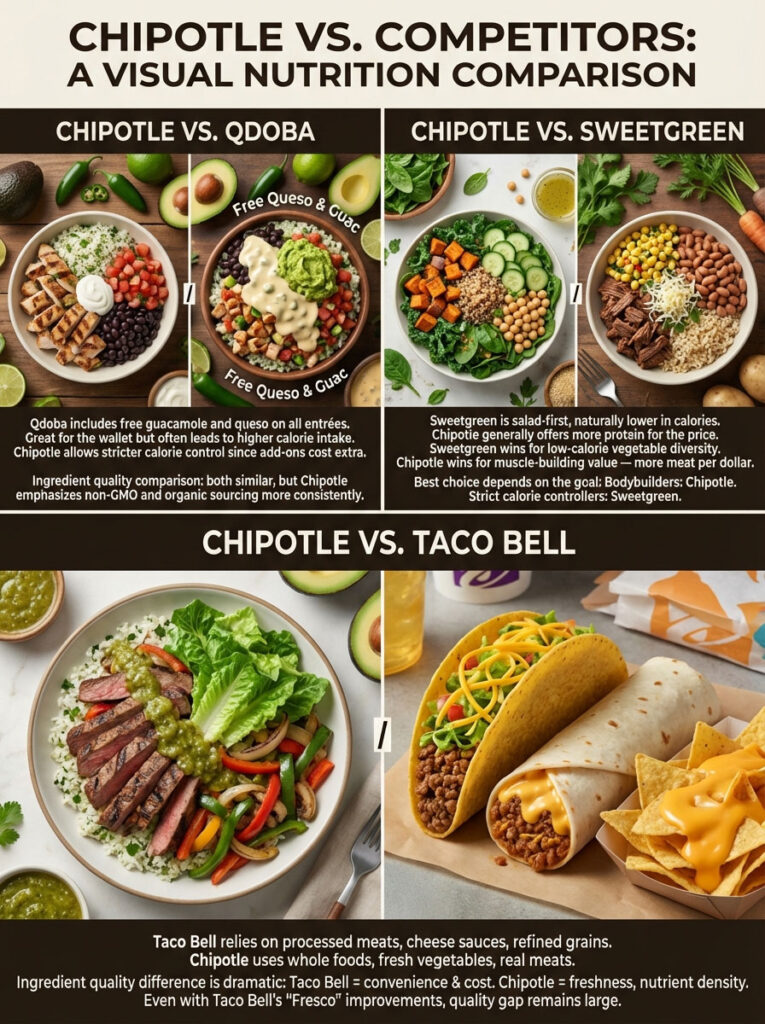
Chipotle vs. Qdoba:
Qdoba offers free guacamole and queso on all entrees. While this is great for the wallet, it is dangerous for the waistline. The “free” aspect encourages consumption of high-calorie add-ons that you might skip at Chipotle to save money. Nutritionally, both use similar ingredients, but Chipotle’s commitment to non-GMO and organic sourcing is generally higher.
Chipotle vs. Sweetgreen:
Sweetgreen is a salad-first concept. Generally, Sweetgreen offers lower calorie options by default because the base is greens rather than rice. However, Chipotle wins on protein price-per-gram. A chicken bowl at Chipotle is often cheaper and contains more meat than a salad at Sweetgreen. For bodybuilders, Chipotle is the better value; for strict calorie counters, Sweetgreen offers more variety in low-calorie vegetables.
Chipotle vs. Taco Bell:
This is barely a comparison. Taco Bell relies heavily on processed meats, cheese sauces, and refined grains. While Taco Bell has improved its “Fresco” menu, Chipotle’s ingredient quality is in a different stratosphere. Chipotle uses whole foods; Taco Bell uses rehydrated components.
Meal Prep Hacks: Buying in Bulk
For those who meal prep on Sundays, Chipotle can actually be a time-saving hack. You can buy “meats by the pound” or large sides of beans and rice from the catering menu or even by asking nicely at the register during slow hours.
Buying a pound of grilled chicken and a large container of black beans allows you to portion out three or four lunches for the week. This ensures you control the portion size exactly (using a food scale at home) while enjoying the flavor of Chipotle’s marinade without the daily line waiting or the temptation of the chips.
Summary & Key Takeaways
So, is Chipotle healthy? The final verdict is that Chipotle is a neutral nutritional tool. It mirrors the choices you make. It can be a catastrophic calorie bomb loaded with sodium and saturated fat, or it can be a clean, high-protein fuel source that rivals a home-cooked meal.
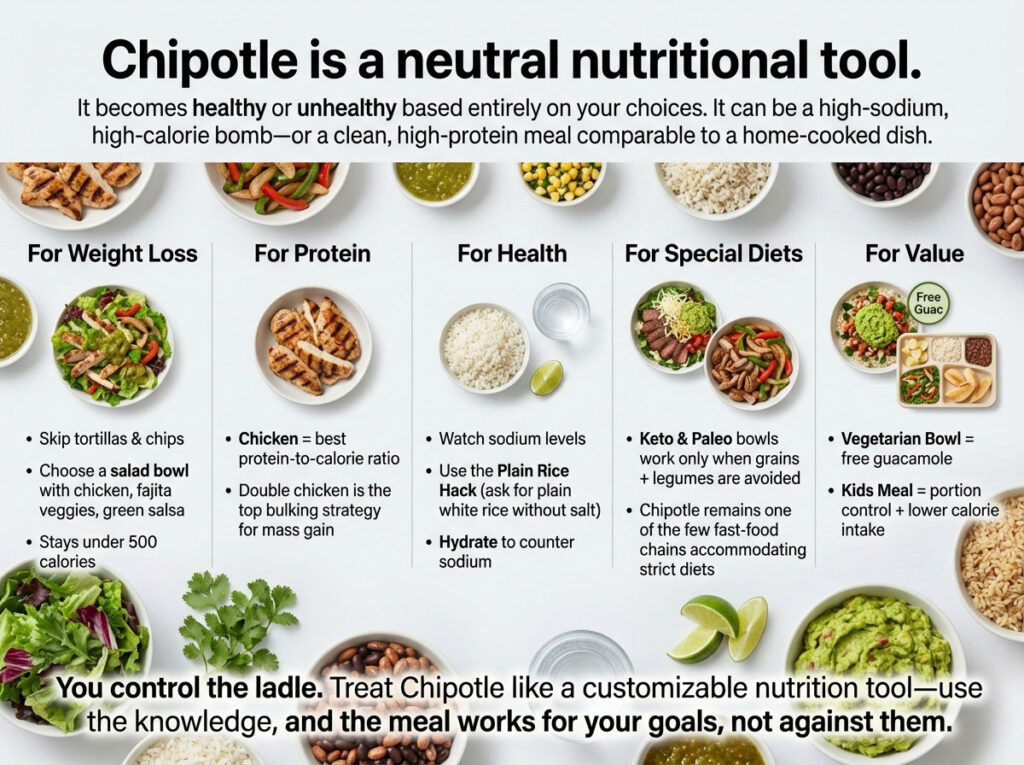
Key Takeaways:
- For Weight Loss: Always skip the tortilla and chips. Stick to a salad bowl with chicken, fajita veggies, and green salsa. This keeps you under 500 calories.
- For Protein: Chicken provides the best protein-to-calorie ratio. Double chicken is the ultimate bulking hack for mass gain.
- For Health: Be mindful of Chipotle sodium content. Use the “Plain Rice Hack” to save massive amounts of salt. Drink plenty of water to counteract the salt.
- For Diets: The Chipotle Keto bowl and Paleo bowl are viable fast-food options if you strictly avoid grains and legumes.
- For Value: The Vegetarian Bowl gives you free Guacamole. The Kids Meal gives you portion control.
Next time you are in line, remember that you are in control of the ladle. Use the Chipotle nutrition calculator data in your head to make choices that align with your health goals, rather than falling victim to the default order.
Frequently Asked Questions (FAQ)
Is Chipotle healthy for weight loss?
Yes, Chipotle can be excellent for weight loss if you strictly choose a Chipotle bowl instead of a burrito. A salad bowl with chicken, black beans, and fajita veggies is roughly 400 calories and very filling due to the high protein and fiber content. The key to weight loss at Chipotle is avoiding high-calorie toppings like sour cream, extra cheese, vinaigrette, and chips.
How many calories are in a Chipotle bowl with everything?
A “fully loaded” burrito bowl with white rice, black beans, chicken, mild salsa, corn salsa, sour cream, cheese, and guacamole contains approximately 1,050 to 1,150 calories. If you add a side of chips and a sugary drink, the total meal can easily exceed 1,600 to 1,800 calories, which is close to the total daily limit for many adults.
Which is healthier: Brown rice or White rice at Chipotle?
Brown rice is slightly healthier because it contains more fiber and micronutrients than white rice, which helps regulate blood sugar absorption. However, nutritionally, they are very similar in calorie count (210 cal) and carbohydrate content. Both are seasoned with the same cilantro, lime, and salt mixture. If you prefer the taste of white rice, the nutritional difference is negligible unless you are strictly monitoring glycemic index.
Is the Chipotle vinaigrette healthy?
The Chipotle Honey Vinaigrette is very high in calories. One serving contains 220 calories, 16g of fat, and significant sugar from the honey. It is considered one of the unhealthiest items on the salad menu if used in full. To enjoy it responsibly, ask for it on the side and use only half, or mix a small amount with the green salsa to dilute the calories while keeping the flavor.
What is the highest protein item at Chipotle?
Per 4oz serving, Chicken offers the most protein (32g). However, if you are looking for a specific meal configuration, a double chicken bowl with beans provides the highest total protein, easily exceeding 60g per bowl. This makes it a favorite among bodybuilders and strength athletes.
Does Chipotle have MSG?
No. Chipotle explicitly states that they do not use added MSG (Monosodium Glutamate) in their food. They focus on using “real ingredients” and are committed to serving food without artificial flavors or colors. The savory flavor comes from natural glutamates found in tomatoes and meats, combined with salt and spices.
Is Chipotle processed food?
Chipotle is considered “minimally processed.” Unlike many fast-food chains that use processed meat patties, reconstituted onions, or nuggets, Chipotle cooks raw meat and fresh vegetables on-site daily. However, the flour tortillas and chips undergo processing before arriving at the store. Compared to the industry standard, it is significantly less processed.
How to order low sodium at Chipotle?
To reduce Chipotle sodium content, use the “Secret Menu” hack: ask for plain white rice from the warmer (without the salt/lime mix). Combine this with skipping the fresh tomato salsa and corn salsa. Choose a salad base and use sour cream (low sodium) for flavor instead of salty salsas. You can also ask for “light” seasoning on meats if you catch a fresh batch being grilled, though this is rare during rush hours.
Is Sofritas good for you?
Sofritas is a healthy plant-based protein made from organic tofu. It is lower in cholesterol and saturated fat than red meat. However, it is higher in sugar and sodium (560mg) compared to the chicken option due to the braising liquid. It is an excellent choice for vegans but should be consumed in moderation if you are watching salt intake.
Can you eat Chipotle every day and be healthy?
You can eat Chipotle daily if you vary your orders to ensure nutritional balance and strictly control your calorie intake. However, due to the high sodium levels, eating it every single day might lead to excessive salt intake, which can affect blood pressure and water retention. It is best used as a tool in a varied diet rather than the sole source of nutrition.
What is in a Keto bowl at Chipotle?
A Chipotle Keto bowl typically consists of a Supergreens lettuce base, steak or chicken, tomatillo-red chili salsa, cheese, and guacamole. It strictly excludes rice, beans, and corn to keep the net carb count low (usually under 10g net carbs). It relies on the fats from cheese and avocado to provide energy.
Are Chipotle chips healthy?
Chipotle chips are made from corn, sunflower oil, lime juice, and salt. While they are made from simple, recognizable ingredients, they are deep-fried and calorie-dense (540 calories per bag). They offer little nutritional satiety and are a source of inflammatory Omega-6 fatty acids from the oil, making them an unhealthy choice for weight loss or general health optimization.
References
- Chipotle Mexican Grill. (n.d.). Nutrition Calculator & Nutrition Facts.
- The New York Times. (2015). The 1,000-Calorie Burrito: How Standard Orders Add Up.
- U.S. Food and Drug Administration (FDA). Sodium in Your Diet.
- Whole30 Approved Partners. Chipotle Standards and Compliance.