
You stare at the drain, heart sinking as another clump washes away. It feels like a nightmare you cannot wake up from, stripping away your confidence strand by strand. Thyroid Hair Loss is devastating because it is so visible, yet your doctor keeps saying your labs are fine.
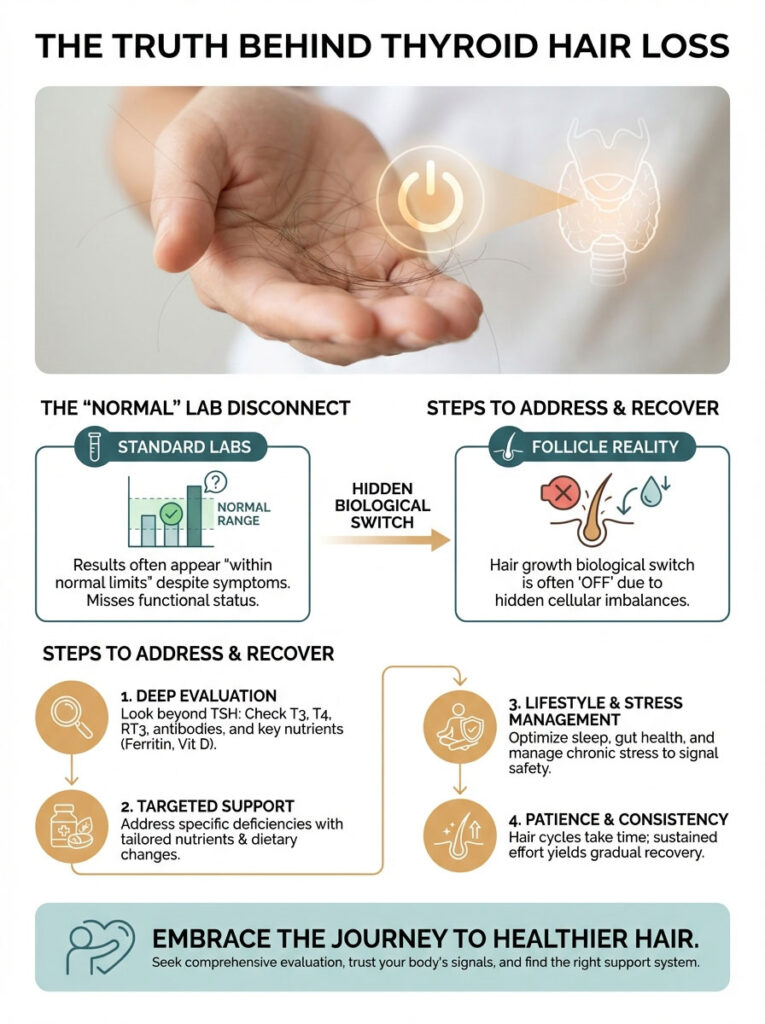
I have reviewed countless cases where patients feel gaslit by their own blood work. The disconnect between “normal” test results and the reality on your scalp is massive. But here is the truth: your follicles are not dead, they are just starving.
There is a specific biological switch that needs flipping to restart the engine. Once you understand the hidden numbers that actually matter, you can stop the shed. Let’s uncover the secret to waking your hair up.
Want to go deeper on this? Read the full article here: Thyroid Hair Loss: Will It Grow Back? (Regrowth Guide)
The Energy Crisis in Your Scalp
Think of your body like a power grid during a blackout. When energy is scarce, the grid manager cuts power to non-essential neighborhoods first to keep the hospital running. In your body, your hair is that non-essential neighborhood.
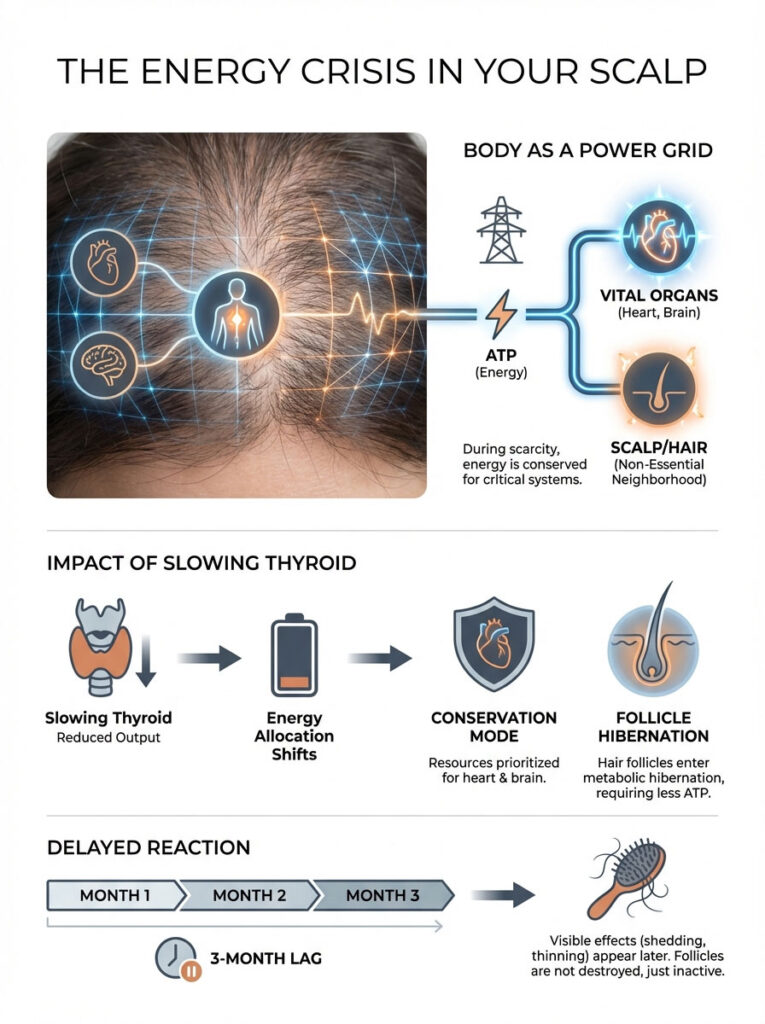
Your hair cells divide incredibly fast, demanding massive amounts of ATP (cellular energy). When your thyroid slows down, it slashes this energy budget. I found that the body ruthlessly conserves resources for vital organs like the heart and brain.
Consequently, the hair follicles simply shut down operation. They enter a state of metabolic hibernation. They aren’t destroyed; they are just waiting for the lights to come back on.
The Delayed Reaction
- The Trigger: Stress or hormone drop happens (Day 0).
- The Pause: Follicles stop growing (Day 1-30).
- The Shed: Hair actually falls out (Day 90).
This three-month lag is why you are confused. You are looking for a cause from yesterday, but the damage happened seasons ago.
The “Medication Shed” Paradox
This is the most terrifying moment for my patients. You finally start taking medication to fix your thyroid, and suddenly, you lose more hair. It feels like a cruel joke.
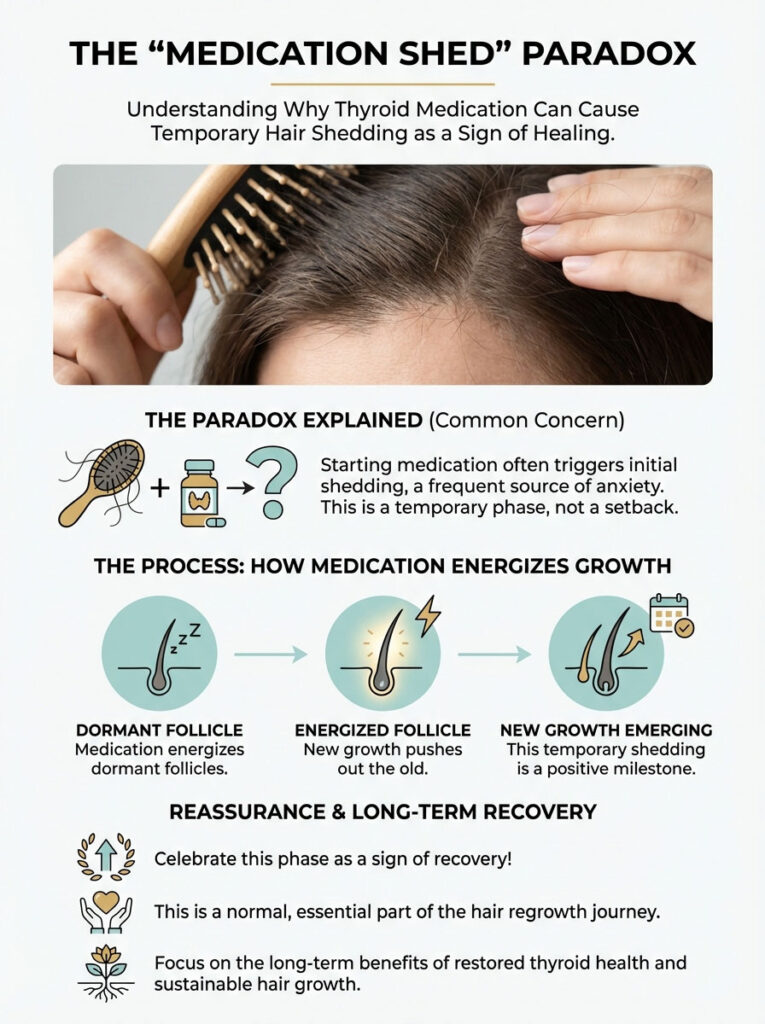
Here is the bizarre reality: this shedding is actually a sign of success. When the medication kicks in, it surges energy into the dormant follicles. These follicles wake up and immediately start building a new hair.
However, the pore is blocked by the old, dead hair that has been sitting there for months. The new hair pushes the old one out to make room. I tell my patients to celebrate this shed; it means the factory is back online.
The Numbers Your Doctor Ignores
Most labs use a statistical average to define “normal.” This includes sick people, elderly people, and those with poor health. You do not want to be average; you want to be optimal.
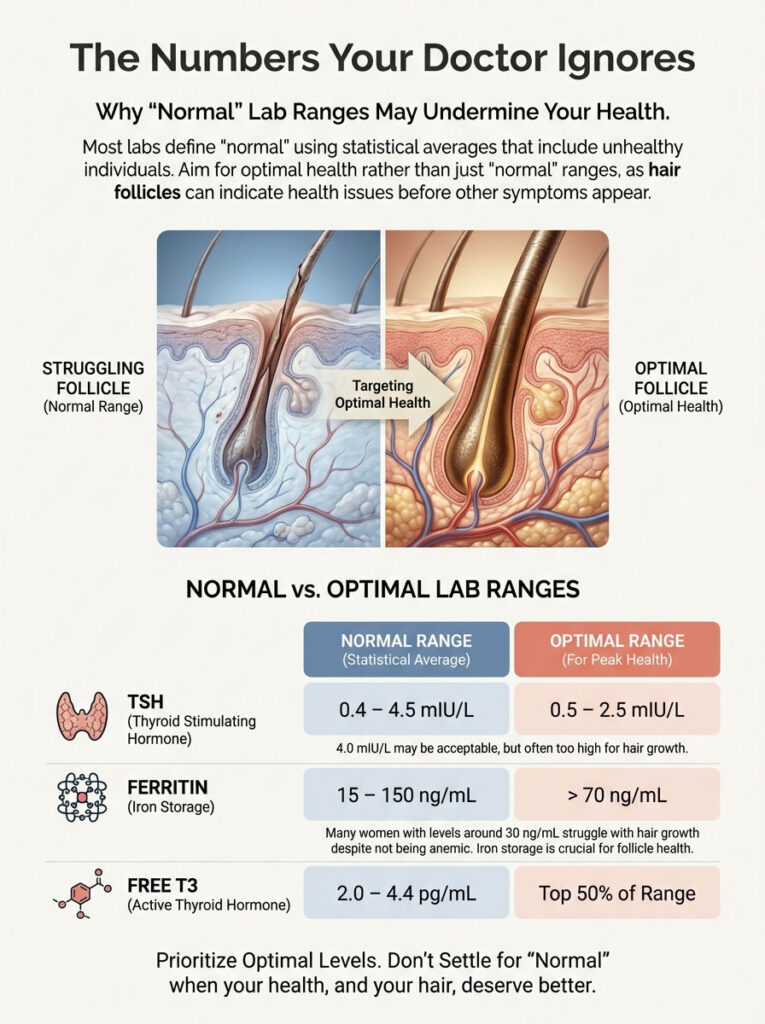
If your TSH is 4.0 mIU/L, most doctors will send you home. But for hair growth, that level is often too high. The follicle is the canary in the coal mine—it dies long before you feel tired.
Optimal vs. Normal Labs
| Marker | Lab “Normal” Range | Hair Growth Optimal Range |
|---|---|---|
| TSH | 0.4 – 4.5 mIU/L | 0.5 – 2.5 mIU/L |
| Ferritin | 15 – 150 ng/mL | > 70 ng/mL |
| Free T3 | 2.0 – 4.4 pg/mL | Top 50% of Range |
I have seen dozens of women with a Ferritin level of 30 ng/mL who cannot grow hair. Technically, they aren’t anemic, but their follicles are suffocating without iron storage.
The “Queen Anne” Sign
There is a peculiar visual clue that appears on your face. It is called the Sign of Hertoghe. Look closely at your eyebrows in the mirror.
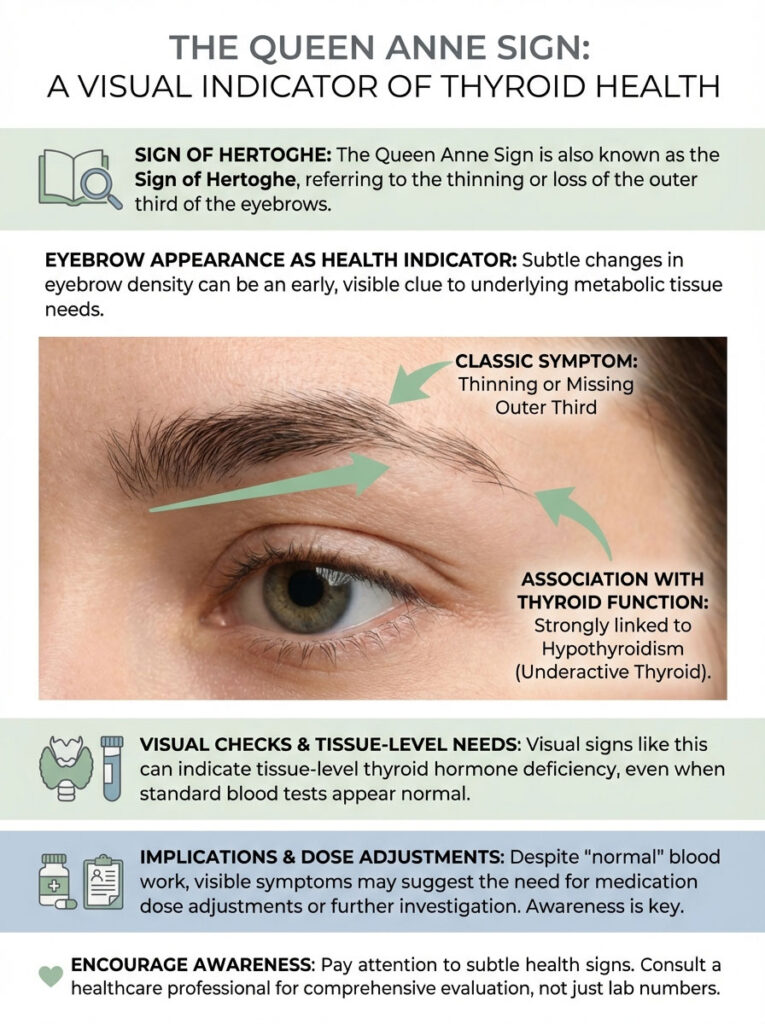
If the outer third of your eyebrow is thinning or missing entirely, this is a classic thyroid red flag. It was named after a royal figure who displayed this exact symptom. I use this as a quick visual check for tissue-level hypothyroidism.
Even if your blood work looks okay, disappearing eyebrows suggest your cells are still hungry. It confirms that the medication dose might need tweaking.
The Nutrient You Must Watch
While iron is the fuel, other nutrients are the spark plugs. Zinc and Selenium are non-negotiable for thyroid function. Without them, your medication stays inactive.
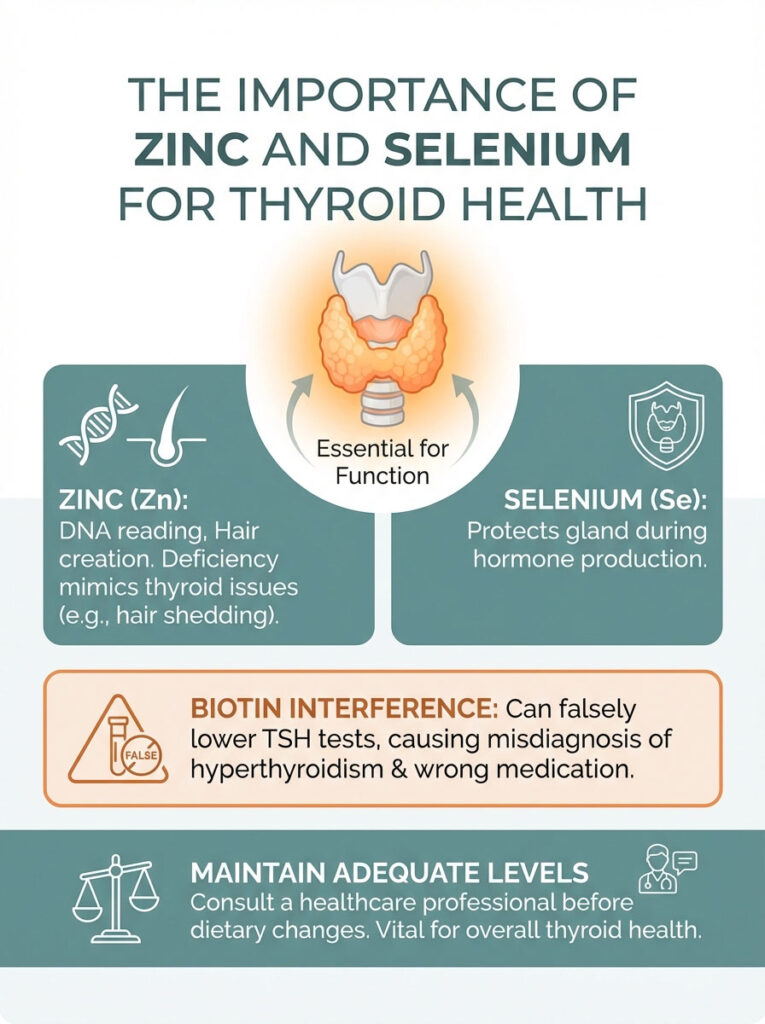
Selenium protects the gland from damage during hormone production. Zinc helps read the DNA blueprint for creating hair. If you are deficient in zinc, you will shed hair exactly like a thyroid patient.
The Biotin Warning
- The Good: Biotin strengthens keratin (hair structure).
- The Bad: It completely messes up lab tests.
- The Fix: Stop taking it 5 days before blood work.
I cannot stress this enough: Biotin can make your TSH look falsely low. Your doctor might lower your dose thinking you are hyperthyroid, which would be a disaster for your hair.
The Timeline for Regrowth
Patience is your only option here. Hair recovery is a marathon, not a sprint. You are fighting biology that moves in 90-day cycles.
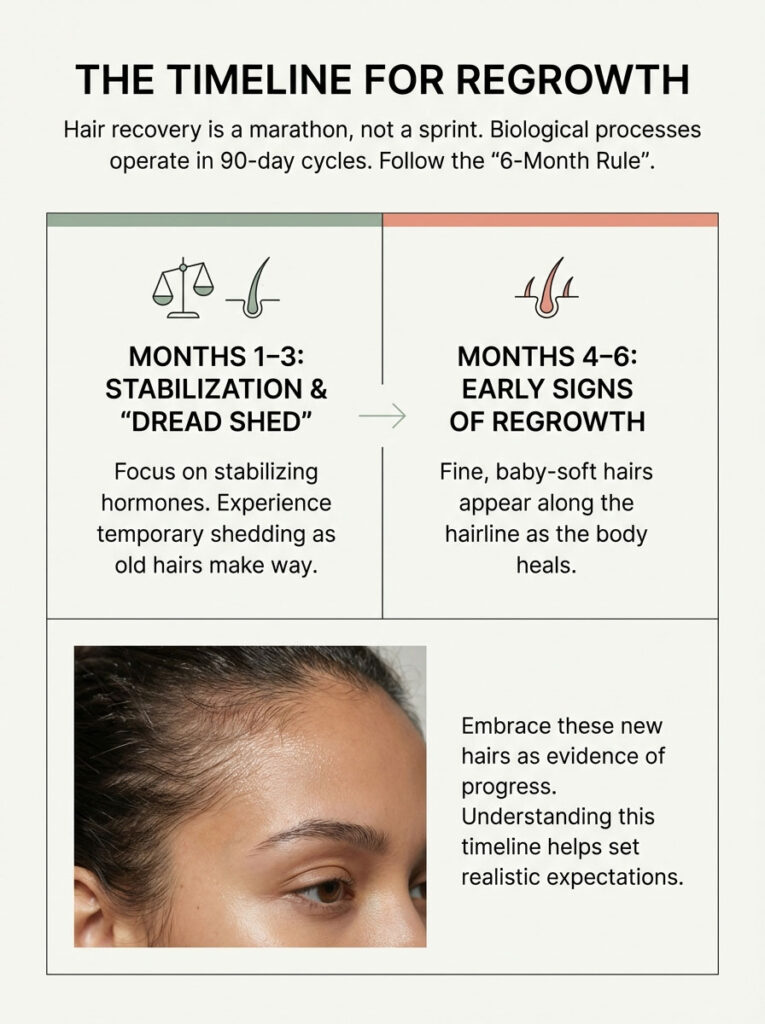
My experience dictates a strict “6-Month Rule.” The first three months are for stabilizing hormones and enduring the dread shed. The next three months are when the magic starts.
You will first see fine, baby-soft hairs along your hairline. They will look wild and untamable. Love them, because they are the proof that your body is healing.
How to Support the Process
While waiting for the internal chemistry to fix itself, you can help from the outside. Use a caffeine-based shampoo to stimulate blood flow. Consider Minoxidil as a temporary bridge.
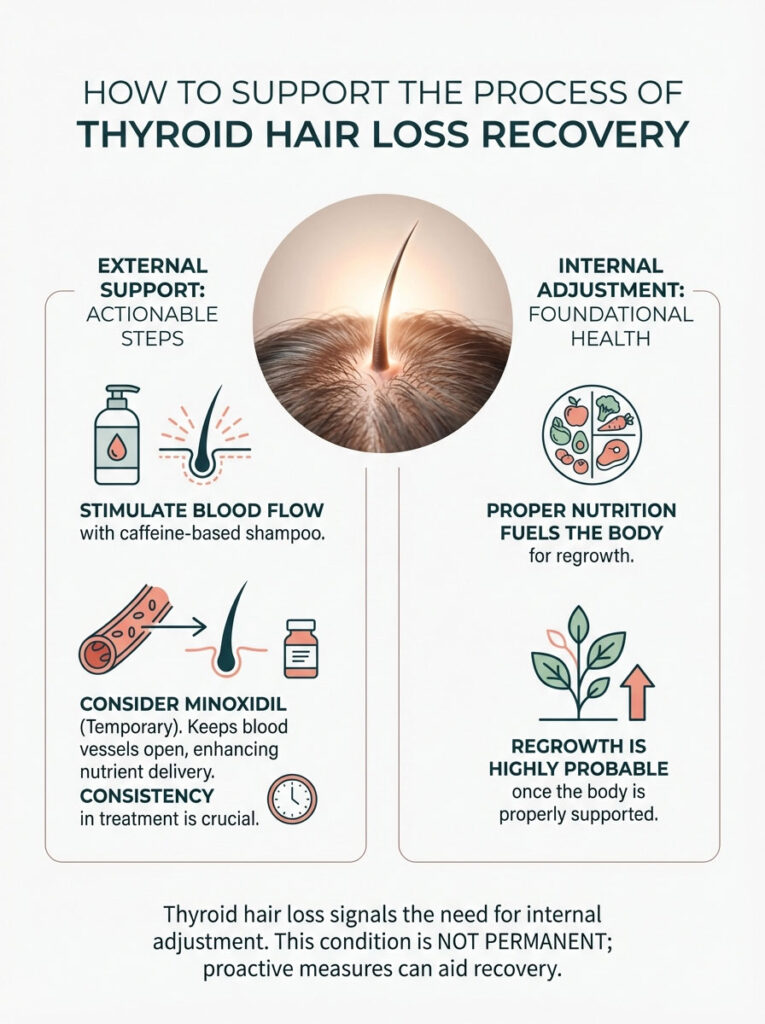
Minoxidil keeps the blood vessels open, force-feeding nutrients to the root. It buys you time while the iron and thyroid hormones do the heavy lifting internally. Just remember, consistency is key.
Thyroid Hair Loss is not a life sentence. It is a signal flare. Once you fuel the body correctly, the regrowth is almost inevitable.