
Someone in America has a heart attack every 40 seconds. Your morning routine might matter more than you think.
Every 40 seconds, someone in the United States has a heart attack. That’s roughly 805,000 heart attacks per year, according to the CDC. And while most people know that smoking, high cholesterol, and a sedentary lifestyle raise the risk, there’s one habit that flies under the radar for millions of Americans: skipping breakfast.
About one in four young adults in the U.S. skip breakfast on any given day, per CDC data. Among high schoolers, the number is even more alarming. A 2023 CDC Youth Risk Behavior Survey found that 75% of American teens don’t eat breakfast daily. That’s not just a quirky habit. It’s a pattern that starts early and sticks around. And a growing body of research suggests it could be quietly chipping away at heart health.
What the Latest Research Actually Shows
A major meta-analysis published in December 2025 in Frontiers in Cardiovascular Medicine pulled together data from nine studies covering more than 300,000 participants. The findings were straightforward: people who regularly skipped breakfast had a 17% higher risk of cardiovascular disease compared to those who ate a morning meal (OR: 1.17, 95% CI: 1.09 to 1.26).
But that number gets sharper when you break it down by disease type. Breakfast skippers showed a 14% higher risk of coronary artery disease, and the link to cardiovascular mortality was even stronger, with a 49% increase in risk.
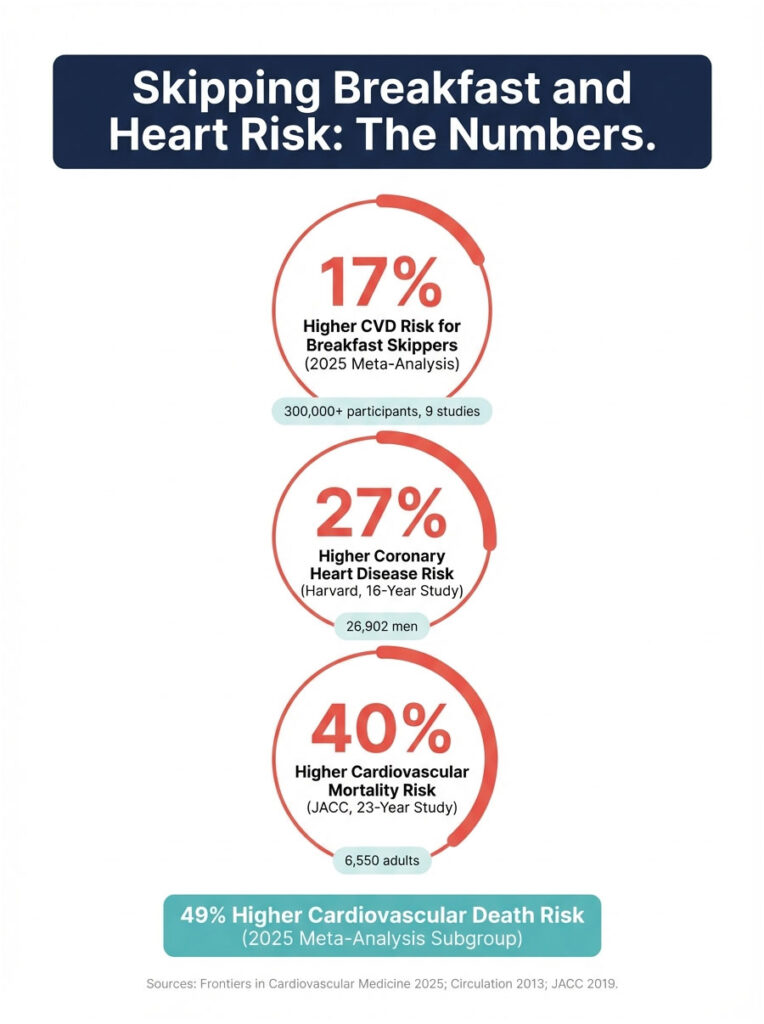
This wasn’t a one-off finding, either. The 2025 meta-analysis builds on more than a decade of consistent signals. A landmark Harvard study published in Circulation back in 2013 tracked 26,902 American men for 16 years and found that skipping breakfast was tied to a 27% greater risk of coronary heart disease. A separate study in the Journal of the American College of Cardiology (JACC) followed 6,550 adults for up to 23 years and found that breakfast skippers faced a 40% higher risk of dying from cardiovascular causes.
So this isn’t new science. But it is getting harder to ignore.
Why Skipping That Morning Meal Hits the Heart So Hard
Here’s the thing about breakfast: it’s not just fuel. It’s a metabolic reset button. When you eat in the morning, you break an overnight fast and kick-start a chain of biological processes that keep your blood sugar steady, your blood pressure in check, and your cholesterol balanced.
Skip that meal, and those dominoes start falling in the wrong direction.
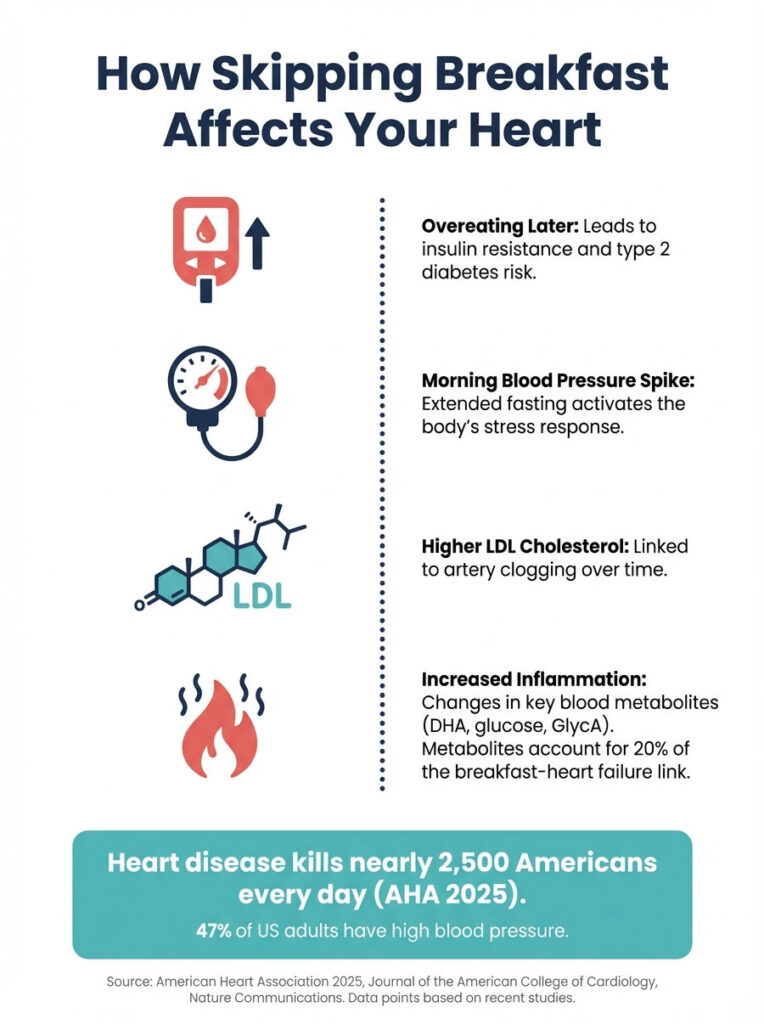
Researchers have identified at least four pathways through which breakfast skipping may hurt the heart. First, people who don’t eat breakfast tend to overeat later in the day. That leads to bigger spikes in blood sugar, more insulin resistance, and (over time) a higher risk of type 2 diabetes. And diabetes is one of the top risk factors for heart disease.
Second, the extended overnight fast can trigger the body’s stress response. Research has shown that skipping breakfast activates the hypothalamic-pituitary-adrenal (HPA) axis, which raises blood pressure during the morning hours. That’s a problem, because heart attacks already happen most frequently in the morning.
Third, there’s the cholesterol connection. Multiple studies have found that habitual breakfast skipping is associated with higher LDL cholesterol (the kind that clogs arteries) and unfavorable changes in total cholesterol. A 2024 Mendelian randomization study published in Scientific Reports confirmed a causal link between breakfast skipping and changes in key blood metabolites, including the ratio of DHA to total fatty acids, glucose, and inflammatory markers. Those three metabolites alone accounted for about 20% of the connection between skipping breakfast and heart failure risk.
And fourth, let’s be honest: people who skip breakfast tend to have other unhealthy habits, too. They’re more likely to smoke, drink more alcohol, exercise less, and eat fewer fruits and vegetables. Breakfast skipping may be one piece of a bigger pattern. But even after researchers adjusted for all of those factors, the association between missing the morning meal and heart risk held up.
Heart disease remains the leading cause of death in the United States, killing nearly 2,500 Americans every day, according to the American Heart Association’s 2025 statistics update. About 47% of U.S. adults have high blood pressure, and 57% have been diagnosed with type 2 diabetes or prediabetes. Anything that nudges those numbers higher (even something as seemingly small as skipping a meal) deserves attention.
What Cardiologists and Nutrition Experts Are Saying
“What we’re seeing across multiple large studies is a consistent signal: regularly skipping breakfast is associated with higher cardiovascular risk,” said Dr. Wei Bao, an epidemiologist at the University of Iowa and lead author of the JACC study on breakfast and cardiovascular mortality. He was involved in one of the key studies informing recent meta-analyses.
“You don’t need a gourmet breakfast to protect your heart,” said Dr. Francisco Lopez-Jimenez, a cardiologist at Mayo Clinic who has spoken publicly about the link between breakfast and heart health. He was not involved in the 2025 meta-analysis. “Even something simple, like a bowl of oatmeal with berries or a piece of whole-grain toast with avocado, can make a meaningful difference over time.”
“I tell my patients that breakfast doesn’t have to be complicated or time-consuming,” said Dr. Marie-Pierre St-Onge, an associate professor of nutritional medicine at Columbia University and a contributor to the AHA’s scientific statement on meal timing. She was not involved in the 2025 meta-analysis. “The key is consistency. Eating something nutritious in the morning helps regulate appetite and energy for the rest of the day.”
5 Simple Ways to Protect Your Heart at Breakfast
So what should you actually do with this information? Here are five practical changes you can start making this week.
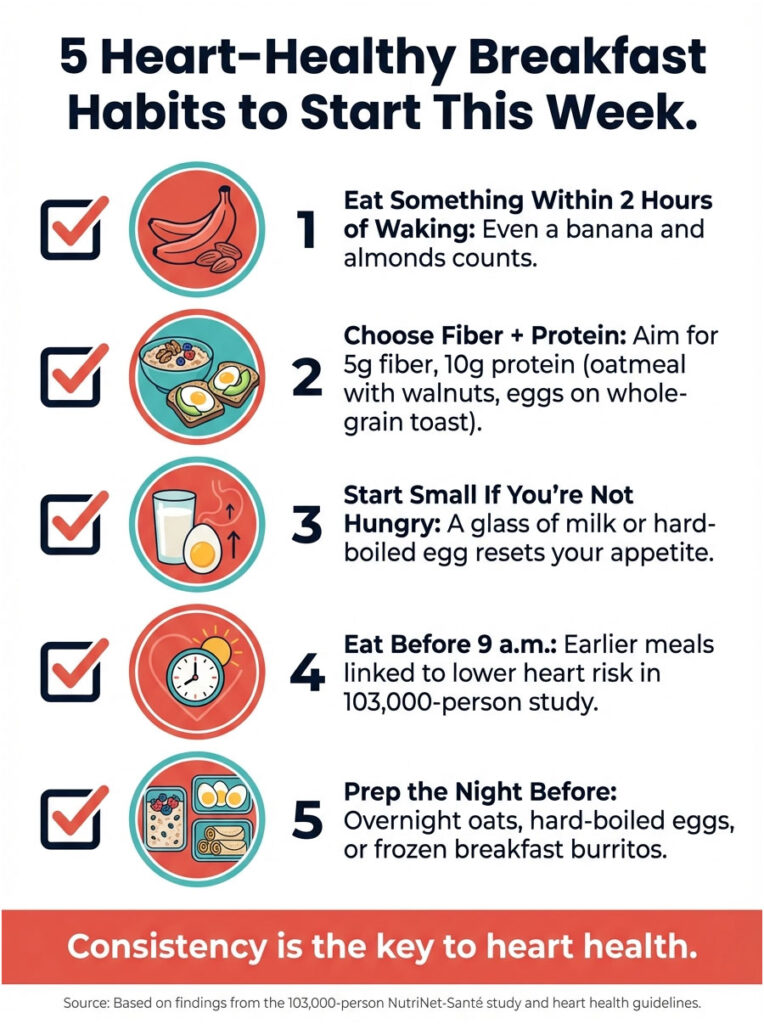
The first step is the simplest: just eat something in the morning. It doesn’t have to be a full sit-down meal. A banana and a handful of almonds on your way out the door counts. A small container of Greek yogurt with a sprinkle of granola takes less than two minutes. The goal is to break the overnight fast within a couple of hours of waking up.
Second, lean toward fiber and protein rather than sugar. A bowl of sugary cereal or a pastry from the drive-through might technically count as breakfast, but it won’t do your heart any favors. Aim for something with at least 5 grams of fiber and 10 grams of protein. Think: oatmeal topped with walnuts, eggs on whole-grain toast, or a smoothie made with spinach, frozen berries, and a scoop of nut butter.
Third, if you’re someone who “isn’t hungry in the morning,” start small. A glass of milk, a handful of trail mix, or even a hard-boiled egg can begin resetting your hunger cycle. Most people find that within a week or two of eating breakfast regularly, their appetite starts showing up on schedule.
Fourth, try to eat breakfast before 9 a.m. A large French study of more than 103,000 adults, published in Nature Communications in 2023, found that people who ate their first meal after 9 a.m. had a higher risk of cardiovascular disease compared to those who ate before 8 a.m. Timing matters, not just whether you eat, but when.
Fifth, prep ahead for busy mornings. Overnight oats take five minutes to assemble the night before. Hard-boiled eggs keep in the fridge for a week. Frozen breakfast burritos (filled with beans, eggs, and veggies) can be microwaved in 90 seconds. The biggest barrier to breakfast is usually time, not appetite, so removing that barrier is half the battle.
What This Research Doesn’t Tell Us
Before you panic about the occasional missed breakfast, let’s put this in context.
All of the major studies linking breakfast skipping to heart risk are observational. That means they show an association, not a direct cause-and-effect relationship. Researchers can’t say for certain that skipping breakfast causes heart attacks. It’s possible that something else entirely (maybe poor sleep, late-night eating, or overall dietary quality) is the real driver, and breakfast skipping is just a marker.
The data on breakfast timing was also self-reported in most studies, which means it’s subject to recall errors. And the definitions of “breakfast” varied from study to study. Some counted a cup of coffee as breakfast; others required actual food.
The Harvard study followed only men, and most participants were white. The JACC study had a more diverse cohort but still relied on data from the 1988-1994 NHANES cycle. The 2025 meta-analysis tried to account for these gaps, but more research (especially randomized controlled trials) would help fill in the picture.
Still, the consistency of the signal across different populations, different countries, and different time periods is hard to dismiss. When multiple studies point in the same direction over more than a decade, it’s worth paying attention.
The Bottom Line
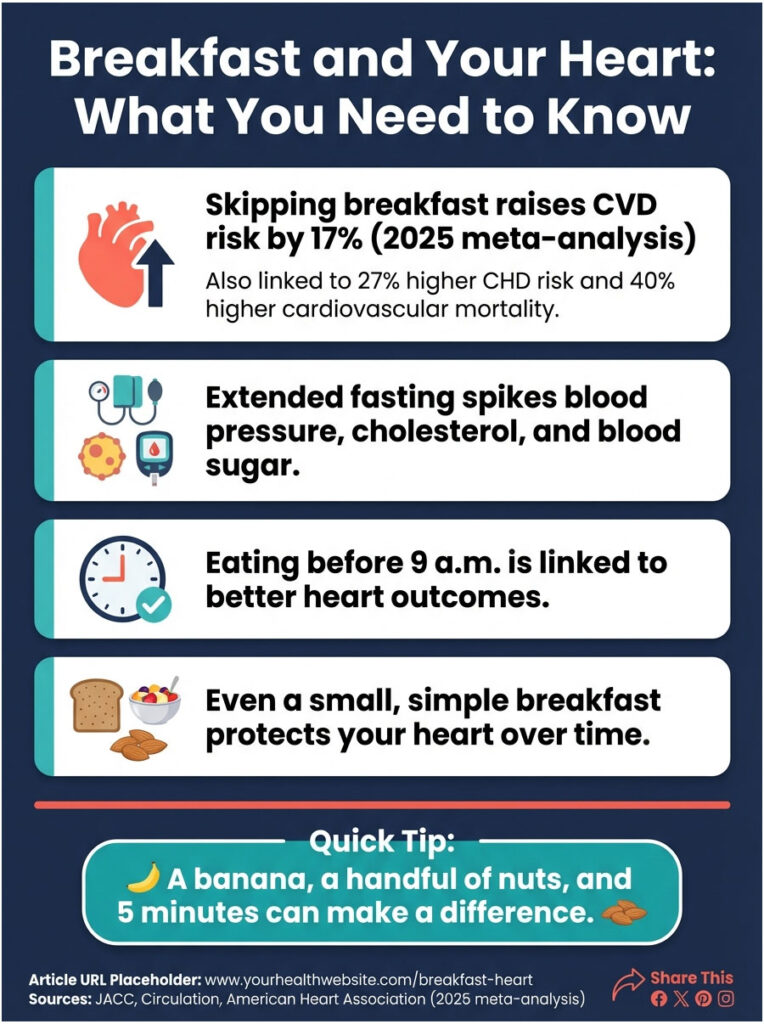
The evidence linking regular breakfast skipping to higher heart disease risk is strong, consistent, and growing. A 2025 meta-analysis confirmed what cardiologists have suspected for years: eating breakfast regularly appears to be one of the simplest, most accessible things you can do to support your cardiovascular health.
You don’t need anything fancy. A piece of fruit, a handful of nuts, and five minutes of your morning can go a long way.
MEDICAL DISCLAIMER
This article is meant to keep you informed, not to replace your doctor’s advice. Before making any changes to your diet or health routine, talk with a healthcare provider who knows your medical history. Everyone’s body is different, and what works for one person might not be the right fit for another. If you’re experiencing chest pain, shortness of breath, or other signs of a heart problem, call 911 or get to an emergency room right away.
REFERENCES AND SOURCES
[1] Zhang H, Zhang S, Liu Y, Wang X, Hu J. “The association between skipping breakfast and cardiovascular disease: a meta analysis.” Frontiers in Cardiovascular Medicine, 12, 2025. DOI: 10.3389/fcvm.2025.1565806 https://www.frontiersin.org/journals/cardiovascular-medicine/articles/10.3389/fcvm.2025.1565806/full
[2] Cahill LE, Chiuve SE, Mekary RA, et al. “Prospective Study of Breakfast Eating and Incident Coronary Heart Disease in a Cohort of Male US Health Professionals.” Circulation, 128(4):337-343, July 2013. DOI: 10.1161/CIRCULATIONAHA.113.001474 https://www.ahajournals.org/doi/10.1161/circulationaha.113.001474
[3] Rong S, Snetselaar LG, Xu G, et al. “Association of Skipping Breakfast With Cardiovascular and All-Cause Mortality.” Journal of the American College of Cardiology, 73(16):2025-2032, April 2019. DOI: 10.1016/j.jacc.2019.01.065 https://www.jacc.org/doi/10.1016/j.jacc.2019.01.065
[4] Palomar-Cros A, Srour B, Andreeva VA, et al. “Dietary circadian rhythms and cardiovascular disease risk in the prospective NutriNet-Sante cohort.” Nature Communications, 14, 7899, December 2023. DOI: 10.1038/s41467-023-43444-3 https://www.nature.com/articles/s41467-023-43444-3
[5] Bi Z, Liu Y, Li T, et al. “Blood metabolites mediate effects of breakfast skipping on heart failure via Mendelian randomization analysis.” Scientific Reports, 14, 18924, August 2024. DOI: 10.1038/s41598-024-69874-7 https://www.nature.com/articles/s41598-024-69874-7
[6] Centers for Disease Control and Prevention. “Heart Disease Facts.” Updated 2025. https://www.cdc.gov/heart-disease/data-research/facts-stats/index.html
[7] Martin SS, Aday AW, Allen NB, et al. “2025 Heart Disease and Stroke Statistics: A Report of US and Global Data From the American Heart Association.” Circulation, 151:e41-e660, 2025. DOI: 10.1161/CIR.0000000000001303 https://www.ahajournals.org/doi/10.1161/CIR.0000000000001303
[8] Morze J, Danielewicz A, Rynkiewicz A, Przybylowicz K. “Skipping Breakfast and the Risk of Cardiovascular Disease and Death: A Systematic Review of Prospective Cohort Studies in Primary Prevention Settings.” Journal of Cardiovascular Development and Disease, 6(3):30, September 2019. DOI: 10.3390/jcdd6030030 https://pmc.ncbi.nlm.nih.gov/articles/PMC6787634/