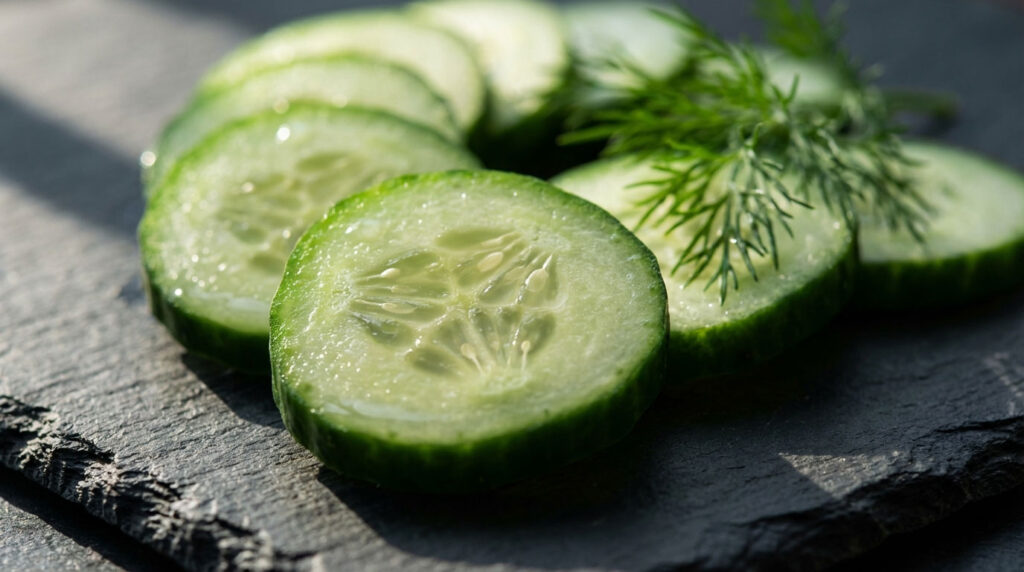
About 300 million pounds of cucumbers move through American grocery stores every single year. And thanks to a viral TikTok trend that sent cucumber salad videos soaring past 15 million views in 2024, even more people are reaching for this crunchy, mild-flavored produce. But here’s a question that keeps popping up: do cucumbers have any nutritional value, or are they basically crunchy water?
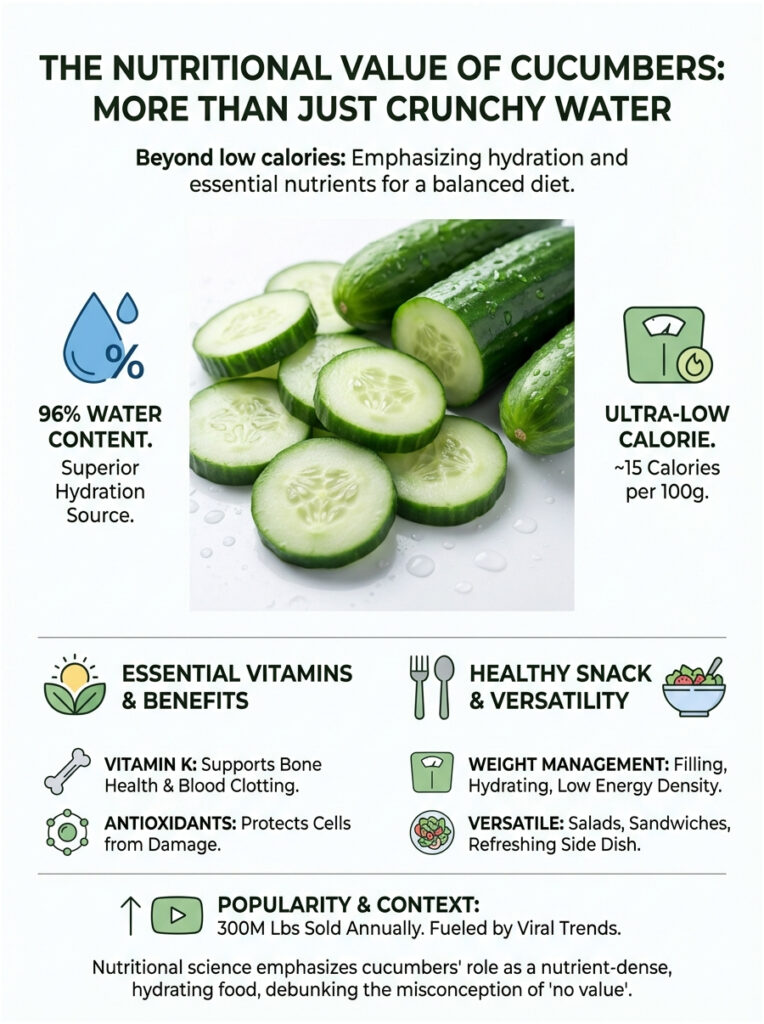
It’s a fair question. At 96% water and only 15 calories per 100 grams, cucumbers don’t exactly scream “superfood.” But nutritional scientists and registered dietitians say that framing misses the point entirely. The real story is more interesting, and more useful, than you’d expect.
What’s Actually Inside a Cucumber? The Nutrition Breakdown
According to the USDA FoodData Central database, one whole medium cucumber (about 301 grams) with the peel still on contains roughly 45 calories, 11 grams of carbohydrates, 2 grams of protein, and 1.5 grams of fiber. Those numbers sound modest. And they are.
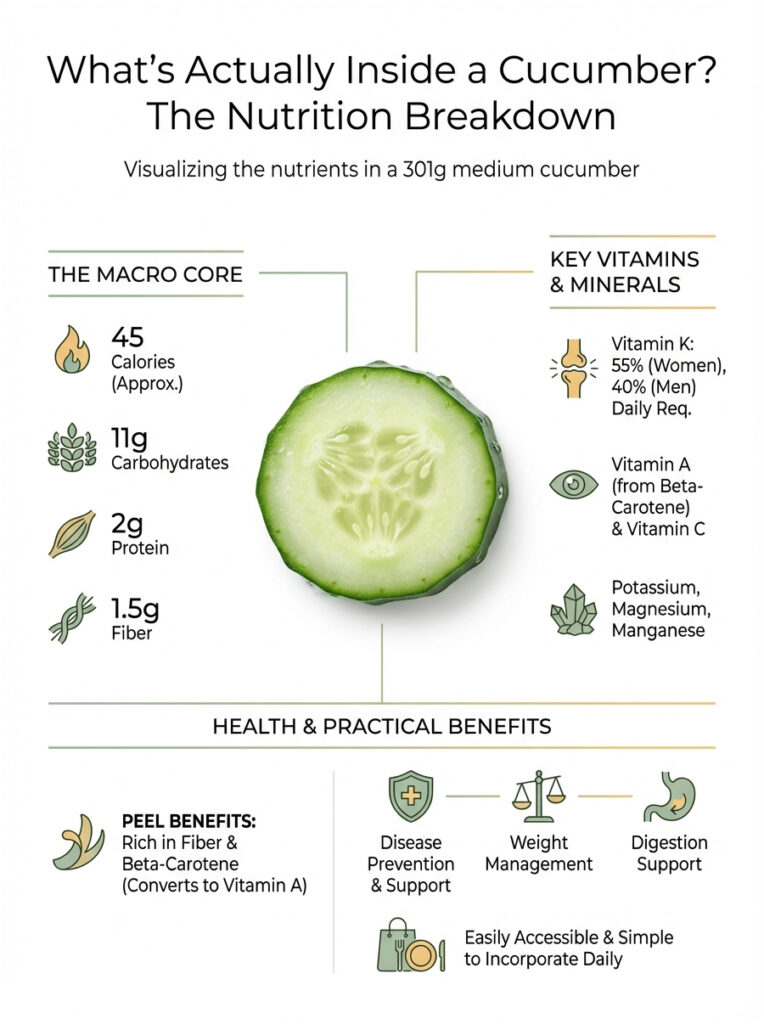
But look at the micronutrient profile and things get more interesting. That same cucumber delivers about 55% of a woman’s daily vitamin K requirement (roughly 40% for men), along with measurable amounts of vitamins A and C, potassium, magnesium, and manganese. The peel holds most of the fiber and a concentrated source of beta-carotene, which the body converts into vitamin A.
“Cucumbers can help with disease prevention, weight management, and digestion,” says registered dietitian Amber Sommer, RD, LD, of the Cleveland Clinic. “And because they are readily available and easy to eat, everyone can reap the benefits.”
Why This Matters for the Average American Diet
Here’s the context that makes cucumbers worth paying attention to. The CDC reports that only about 1 in 10 American adults eats enough fruits and vegetables each day. The recommended intake is roughly 2 to 3 cups of vegetables daily, and most of us fall well short.
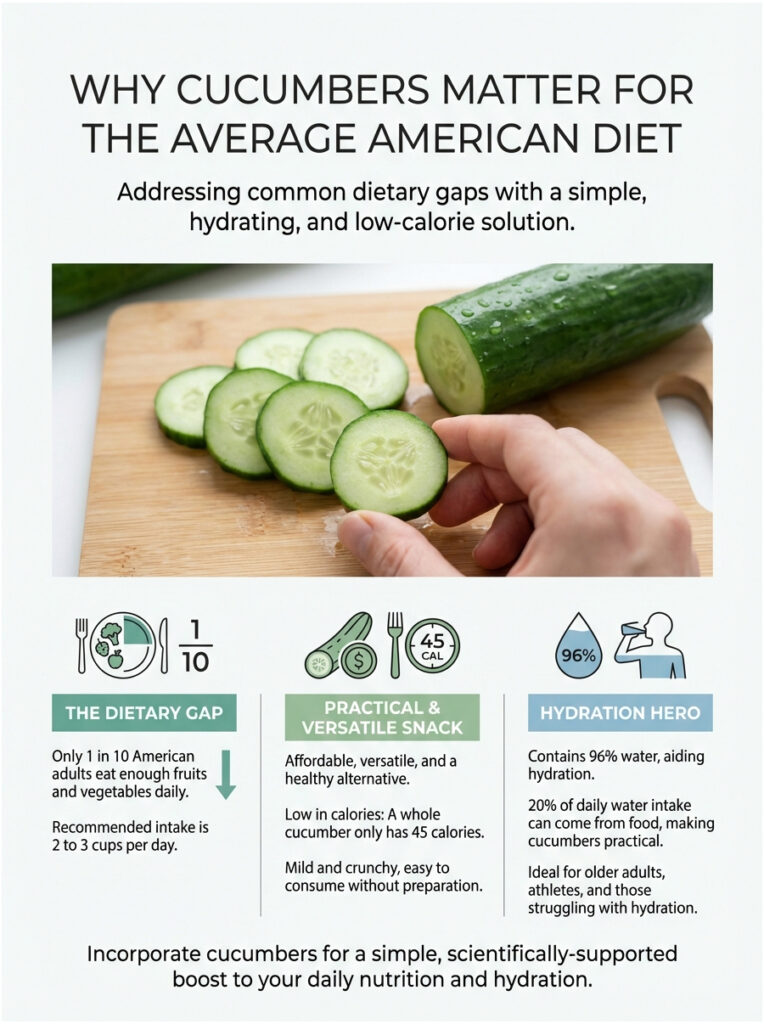
Dr. Matthew Landry, an assistant professor of population health and disease prevention at the University of California, Irvine, put it this way in a 2025 American Heart Association interview: “Anytime we can get folks to eat more fruits and vegetables, I love seeing that.” He called cucumbers affordable, versatile, and a relatively healthy replacement for chips or other snacks.
That’s the real value proposition. Cucumbers won’t deliver the nutritional punch of kale or broccoli. Nobody is claiming they will. But they fill a different role. They’re the vegetable people actually eat, because they’re mild, crunchy, cheap, and require zero preparation. You can eat a whole cucumber for 45 calories. Try doing that with potato chips.
The hydration angle matters too. The National Academies of Sciences estimates that about 20% of daily water intake comes from food. At 96% water content, cucumbers are one of the most hydrating foods you can eat. For older adults, athletes, or anyone who struggles to drink enough water, that’s a practical benefit.
What Nutrition Experts Say About Cucumber’s Place in Your Diet
“A cucumber overall is a great food to add to your daily intake,” says Amy Goldsmith, founder of Kindred Nutrition and a registered dietitian. She notes that the nutritional profile changes depending on what you eat alongside it, which is key. Cucumbers pair well with hummus, feta, or grilled chicken, turning a low-calorie base into a genuinely filling snack.
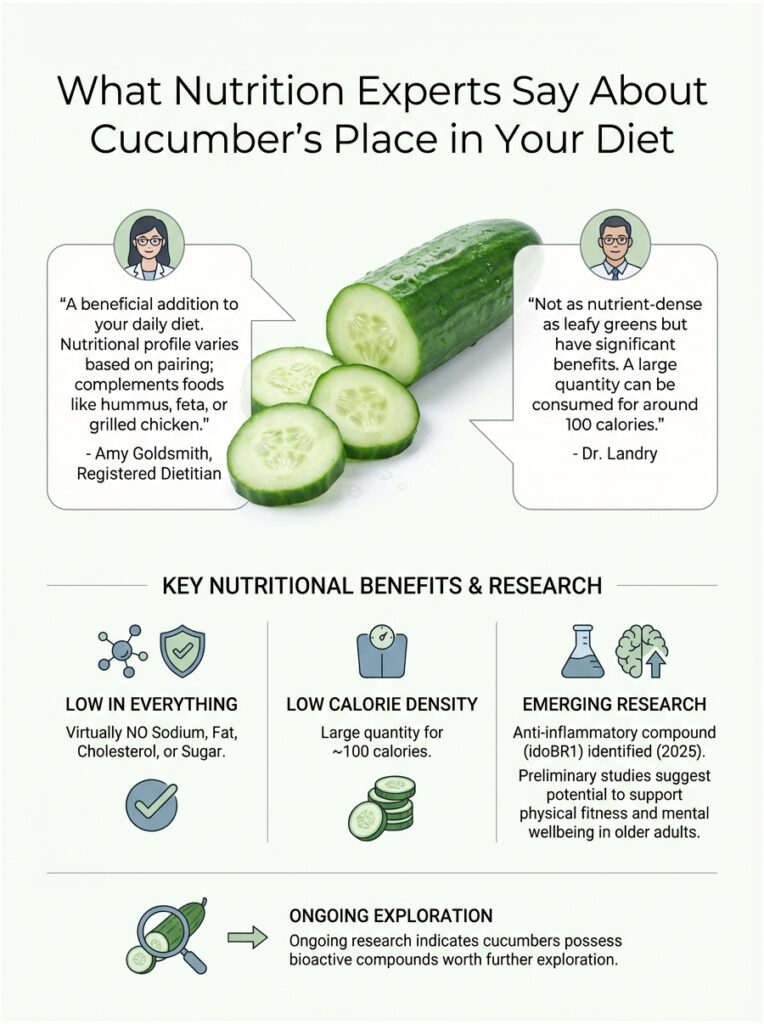
Dr. Landry offered a balanced take in his American Heart Association interview. He acknowledges cucumbers aren’t “supernutritious” compared to leafy greens like kale or collard greens. But the nutritional appeal, he says, is as much about what cucumbers don’t contain as what they do: virtually no sodium, no fat, no cholesterol, and almost no sugar.
“You could eat cups of them, and barely reach 100 calories or so,” Landry says.
Recent research from 2025, published in Frontiers in Nutrition, also explored an anti-inflammatory compound found in cucumbers called idoBR1 (an iminosugar). A study from Aberystwyth University in the UK found that oral supplementation with a cucumber extract containing this compound showed potential for supporting physical fitness and mental wellbeing in older adults. While these findings are preliminary and the research used a concentrated extract rather than whole cucumbers, it adds to a growing body of evidence that cucumbers contain bioactive compounds worth studying.
5 Simple Ways to Get More Nutrition from Cucumbers
So what should you actually do with all this? Here are specific, practical steps that work with a real American lifestyle.
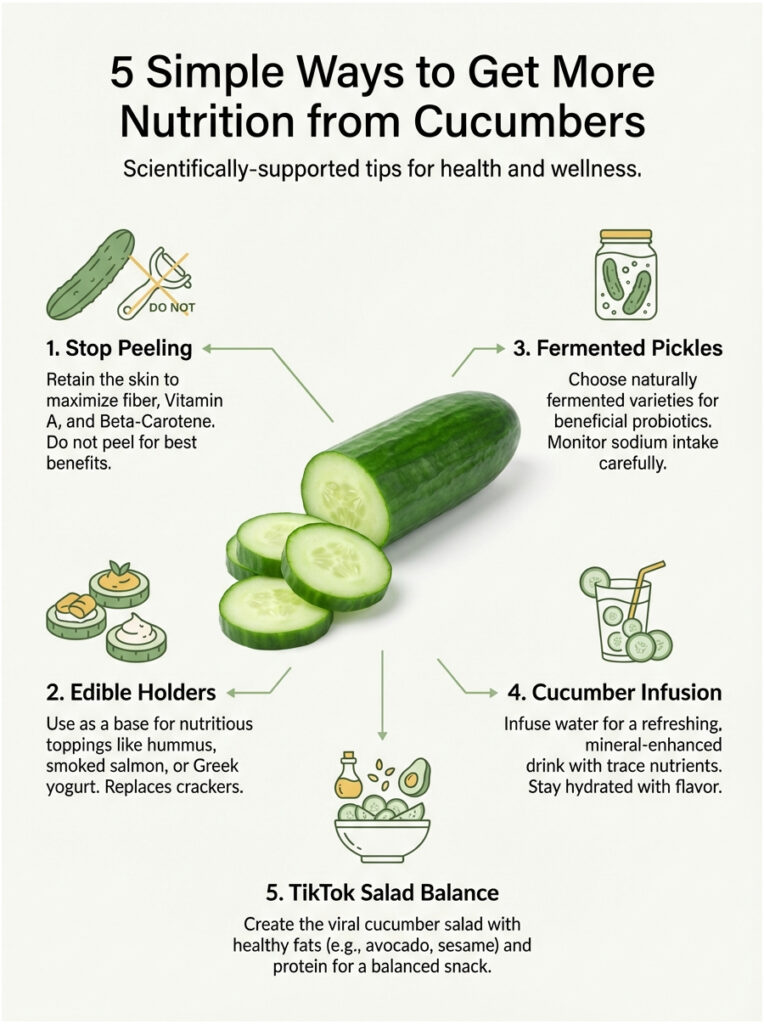
First, stop peeling your cucumbers. The skin is where most of the fiber, vitamin A, and antioxidant beta-carotene live. Peeling removes a significant portion of the nutritional value. If pesticides are a concern, buy organic or wash your cucumbers thoroughly under warm running water.
Second, use cucumbers as a vehicle for more nutritious foods. Slice them thick and top with a spoonful of hummus, a sliver of smoked salmon, or a dollop of Greek yogurt with everything bagel seasoning. This turns a 15-calorie base into a protein-rich, filling snack. That’s a smart swap for crackers or chips.
Third, don’t ignore the fermentation angle. Naturally fermented pickles (not the vinegar-brined kind you find at most supermarkets) contain GABA, a compound that USDA Agricultural Research Service studies have linked to reduced blood pressure and lower anxiety. Look for pickles that say “naturally fermented” on the label and contain live cultures. Just watch the sodium: one large pickle can pack over 1,000 milligrams.
Fourth, add cucumber to your water. If you struggle to drink enough fluids, cucumber-infused water is more than a spa trend. Toss a few slices into a pitcher and keep it in the fridge. The mild flavor makes plain water more appealing, and you’re getting a tiny boost of minerals with each glass.
Fifth, try the viral approach. The TikTok cucumber salad (thin slices with soy sauce, sesame oil, garlic, and rice vinegar) actually combines cucumbers with healthy fats, protein-boosting sauces, and anti-inflammatory garlic. It’s a genuinely balanced snack if you keep the sodium in check.
The Honest Limitations (And Why That’s Okay)
Let’s be real about what cucumbers can’t do. They are very low in protein (about 2 grams in a whole cucumber), very low in fiber compared to beans or broccoli, and won’t provide the omega-3 fatty acids, iron, or B12 that your body needs. If someone tried to survive primarily on cucumbers, they’d be at risk of serious nutritional deficiency. Cucumbers are a supporting player, not the star.
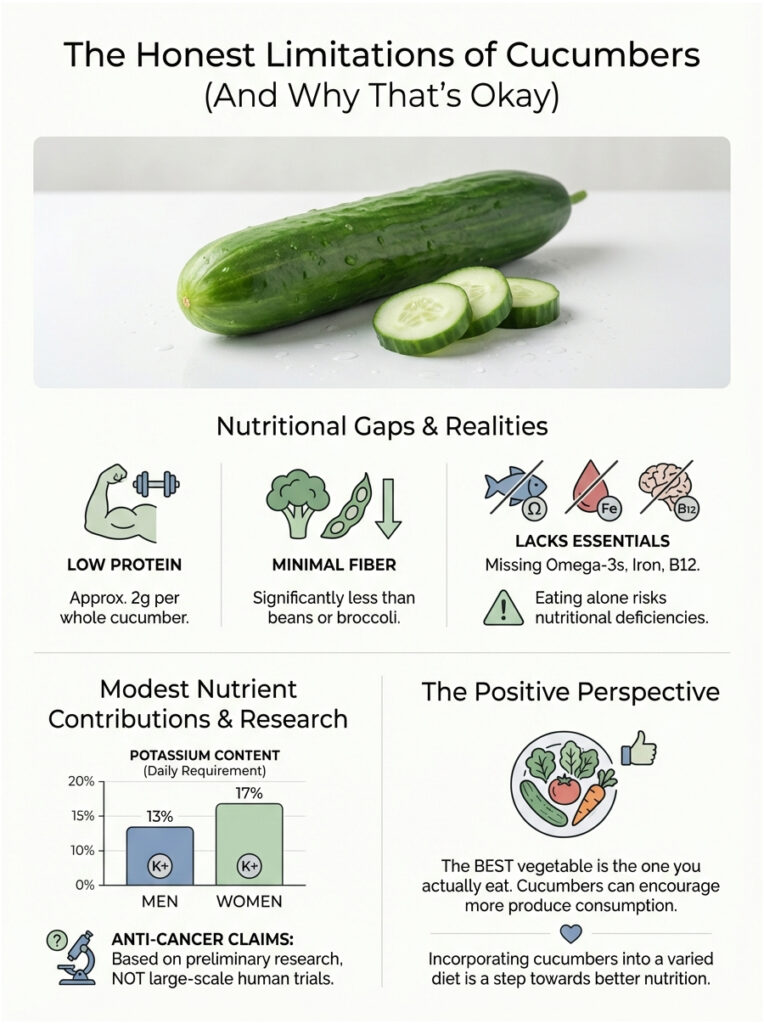
The potassium content, which some websites hype, is actually pretty modest. An entire cucumber provides only about 13% of a man’s daily potassium requirement, or 17% of a woman’s. You’d be better off with a banana or a serving of leafy greens for that specific mineral.
And the cucumber compound research (cucurbitacins, idoBR1) is mostly preliminary. Most studies use concentrated extracts, not whole cucumbers. The anti-cancer and anti-inflammatory claims you see floating around online are based on early-stage or lab research. We don’t have large-scale human clinical trials saying “eat cucumbers to prevent cancer.” That distinction matters.
But here’s what dietitians keep coming back to: the best vegetable is the one you actually eat. If cucumbers get you eating more produce, that alone is a significant health win for most Americans.
The Bottom Line
Do cucumbers have nutritional value? Yes, genuinely. They won’t rival spinach or sweet potatoes on a nutrient-per-calorie basis. But they deliver meaningful amounts of vitamin K, useful hydration, antioxidant compounds, and a near-zero calorie entry point into eating more vegetables. For a country where 9 out of 10 adults don’t eat enough produce, that matters more than you’d think.
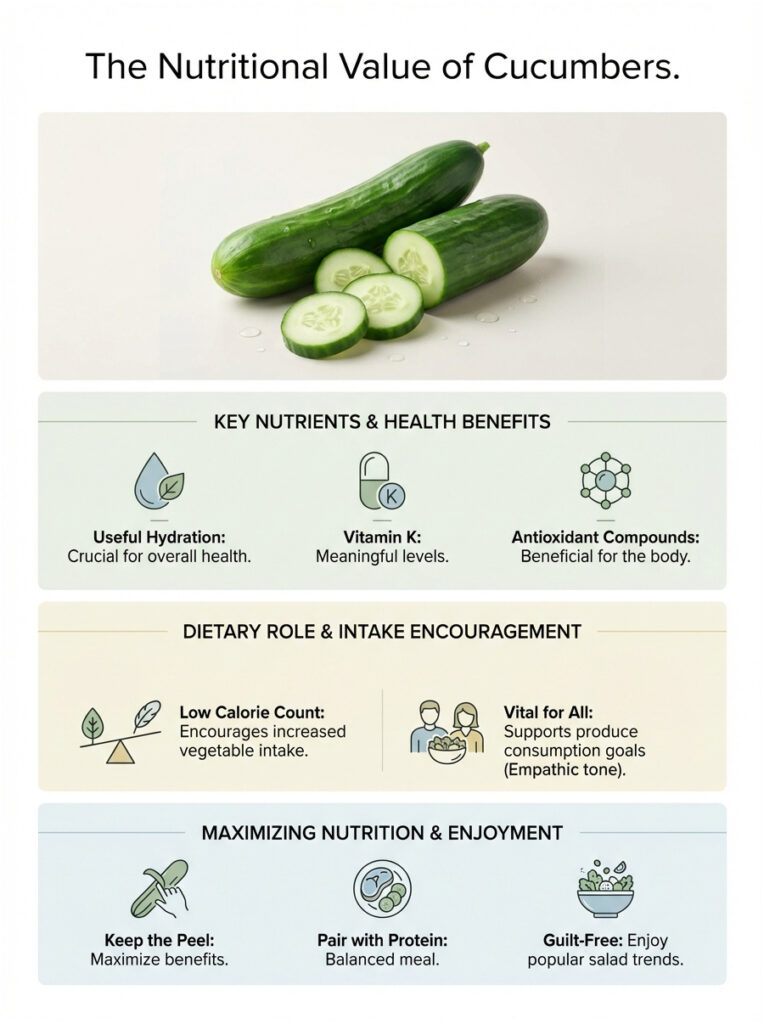
Keep the peel on. Pair them with protein. And don’t feel guilty about enjoying the TikTok salad trend. Your body is getting more out of that cucumber than the calorie count suggests.
A Quick Note on Your Health
This article is here to inform, not to replace a conversation with your doctor or dietitian. Before making significant changes to your eating habits, especially if you’re managing a health condition like diabetes, kidney disease, or food allergies, it’s always worth checking in with a healthcare provider who knows your situation. Every body is different, and what works well for one person might not be the right fit for another. If you have concerns about your nutrition or hydration, a registered dietitian can help you build a plan tailored to your specific needs.
References and Sources
- U.S. Department of Agriculture. “Cucumber, with peel, raw.” FoodData Central, 2022. https://fdc.nal.usda.gov/fdc-app.html#/food-details/2346406/nutrients
- American Heart Association News. “Cucumbers are trendy, but how healthy are they?” January 17, 2025. https://www.heart.org/en/news/2025/01/17/cucumbers-are-trendy-but-how-healthy-are-they
- Cleveland Clinic Health Essentials. “Are Cucumbers Good for You?” April 3, 2023. https://health.clevelandclinic.org/benefits-of-cucumbers
- Lloyd AJ, Nash RJ, et al. “Oral supplement in healthy older adults to support physical fitness and mental wellbeing.” Frontiers in Nutrition, Vol. 12, May 2025. doi: 10.3389/fnut.2025.1563999
- Centers for Disease Control and Prevention. “Only 1 in 10 Adults Get Enough Fruits or Vegetables.” CDC Newsroom, 2024. https://www.cdc.gov/nccdphp/dnpao/division-information/media-tools/adults-702702702702702702-702702702.html
- Johanningsmeier S, et al. “GABA content in fermented cucumber products.” Journal of Food Composition and Analysis, 2021. USDA Agricultural Research Service. https://www.ars.usda.gov/news-events/news/research-news/2021/pickling-cu
- Ball L, Wong PT. “Nutrition experts on the viral TikTok cucumber trend.” The Conversation, 2025. https://theconversation.com/sometimes-you-need-to-eat-an-entire-cucumber-nutrition-experts-on-the-viral-tiktok-trend-253545
- Healthline. “6 Health Benefits of Eating Cucumber.” Updated February 29, 2024. https://www.healthline.com/nutrition/health-benefits-of-cucumber