A standard 1.5-ounce shot of 80-proof (40% ABV) vodka contains approximately 96–97 calories. This calorie count is consistent across all unflavored brands, whether you choose a premium bottle like Grey Goose or a budget option like Smirnoff. The calories in vodka are derived solely from ethanol, which provides 7 calories per gram, rather than from sugar or carbohydrates. However, caloric density increases significantly with alcohol strength: a 100-proof shot contains 124 calories, and flavored budget vodkas often contain hidden sugars that can add 15–20 extra calories per serving.
Table of Contents
We have all stood in the liquor aisle on a Friday afternoon, staring at the shelves. Your eyes dart between the crystal-clear bottle of Grey Goose on the top shelf and the plastic-handled jug of Popov on the bottom. You want to make a healthier choice. You wonder if paying four times the price for the premium bottle means you are getting a “cleaner” spirit that is better for your waistline. It is a logical assumption to make. In almost every other area of nutrition, paying more often equates to higher quality ingredients and better health outcomes. We assume quality means better nutrition.
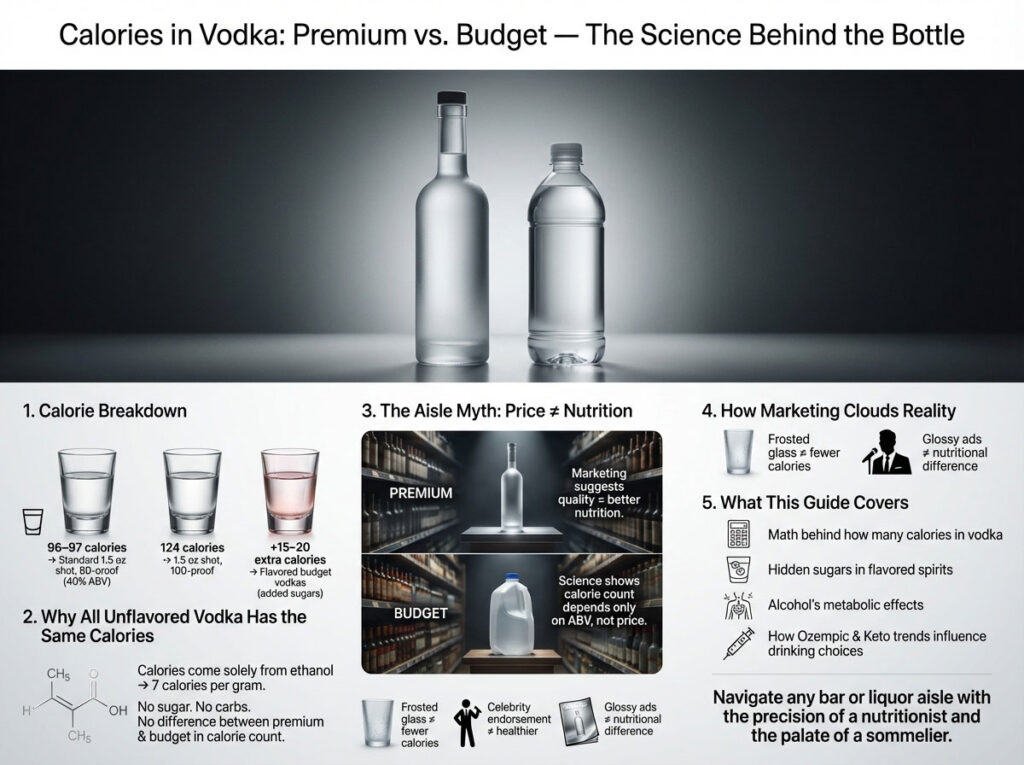
But when it comes to vodka nutrition facts, the industry marketing often clouds the scientific reality. The truth is not found in the frosted glass, the celebrity endorsements, or the high-gloss advertising campaigns. It is found in the chemistry of fermentation and distillation.
This guide is your definitive resource. We are going to dismantle the marketing myths surrounding the premium vs. budget vodka comparison. We will break down the exact math behind how many calories in vodka, analyze the deceptive labeling of flavored spirits, explore the physiological impact of alcohol on metabolism, and examine how modern trends like Ozempic and the Keto diet are reshaping how Americans drink. By the end of this article, you will be able to navigate any bar menu or liquor store aisle with the precision of a nutritionist and the palate of a sommelier.
The Science of Spirits: What is in Your Shot?
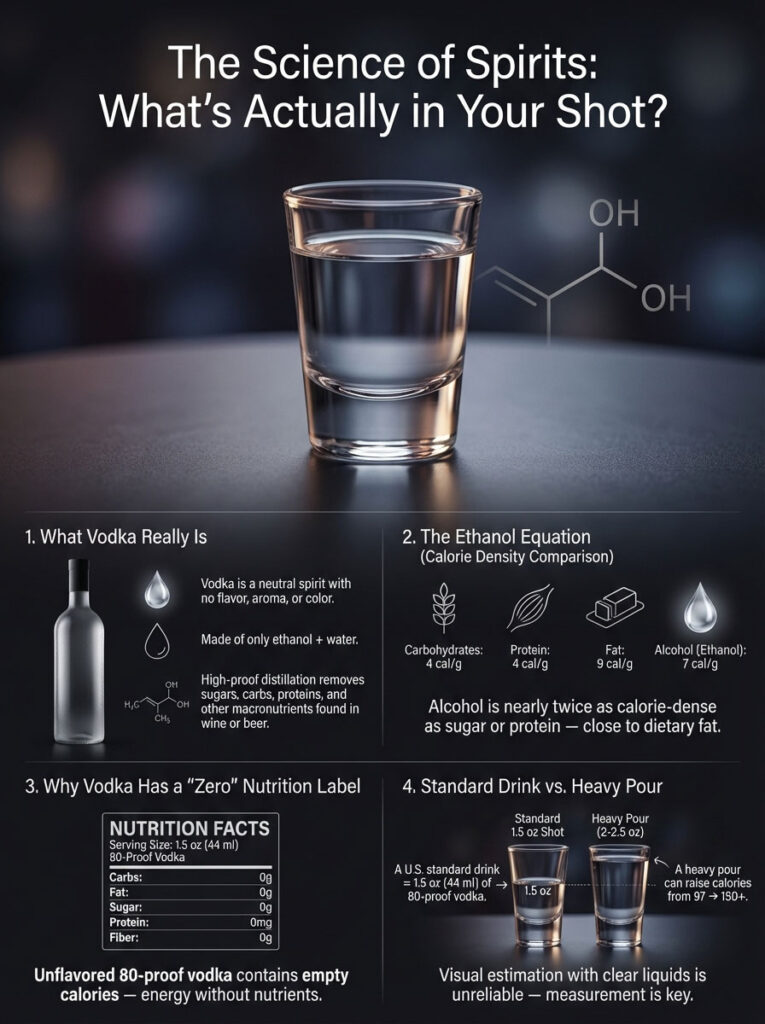
To truly understand vodka shot calories, you first have to understand what vodka actually is. By US legal definition, vodka is a neutral spirit without distinctive character, aroma, taste, or color. It is essentially just two things: ethanol and water. Unlike wine, which is a complex matrix of tannins, sugars, and anthocyanins, or beer, which is rich in carbohydrates and proteins from malted grains, vodka is distilled to a point of near-purity. This high-proof distillation process strips away the macronutrients we usually count in our daily diet.
The Ethanol Equation
The source of energy in vodka is ethanol. In the world of nutrition and metabolic science, alcohol is often referred to as the “fourth macronutrient.” While we typically track proteins, fats, and carbohydrates, alcohol has its own unique caloric density. Here is how it stacks up against the big three:
- Carbohydrates: 4 calories per gram
- Protein: 4 calories per gram
- Fat: 9 calories per gram
- Alcohol (Ethanol): 7 calories per gram
This is the most critical number to remember. Alcohol is almost twice as dense in calories as sugar or protein. It sits closer to pure dietary fat in terms of energy density. When you ask how many calories in vodka, you are essentially asking how much ethanol is in the glass. The water in the vodka contributes zero calories. Therefore, the calorie count is inextricably linked to the alcohol percentage.
The “Zero” Profile
For unflavored, 80-proof vodka, the nutritional label is a series of zeros. This can be confusing for consumers who are used to reading food labels where calories usually come from a mix of macros. For standard vodka, the profile looks like this:
- Carbohydrates: 0g
- Fat: 0g
- Sugar: 0g
- Protein: 0g
- Sodium: 0mg
- Fiber: 0g
This creates a unique situation for the body. When you consume a vodka shot, you are consuming what nutritionists call “empty calories.” These are units of energy that provide no nutritional benefit like vitamins, minerals, or fiber. They are fuel, but they are not nourishment.
Defining the Standard Drink
In the United States, clarity on serving size is vital for calorie counting. A “standard drink” is defined strictly as 1.5 fluid ounces (44 ml) of 80-proof spirits. This is the amount typically held by a standard jigger used by professional bartenders.
However, human error is a significant variable. If you are pouring at home without a jigger, or if you are at a dive bar with a heavy-handed bartender, that “single” drink can easily turn into 2 or 2.5 ounces. This “heavy pour” is the most common reason people underestimate their intake. A generous pour can turn a 97-calorie drink into a 150-calorie drink before you even add a mixer. Visual estimation is notoriously inaccurate with clear liquids, so using a measuring tool is the only way to be certain of your caloric intake.
Comprehensive Health Breakdown: It’s Not Just About Weight
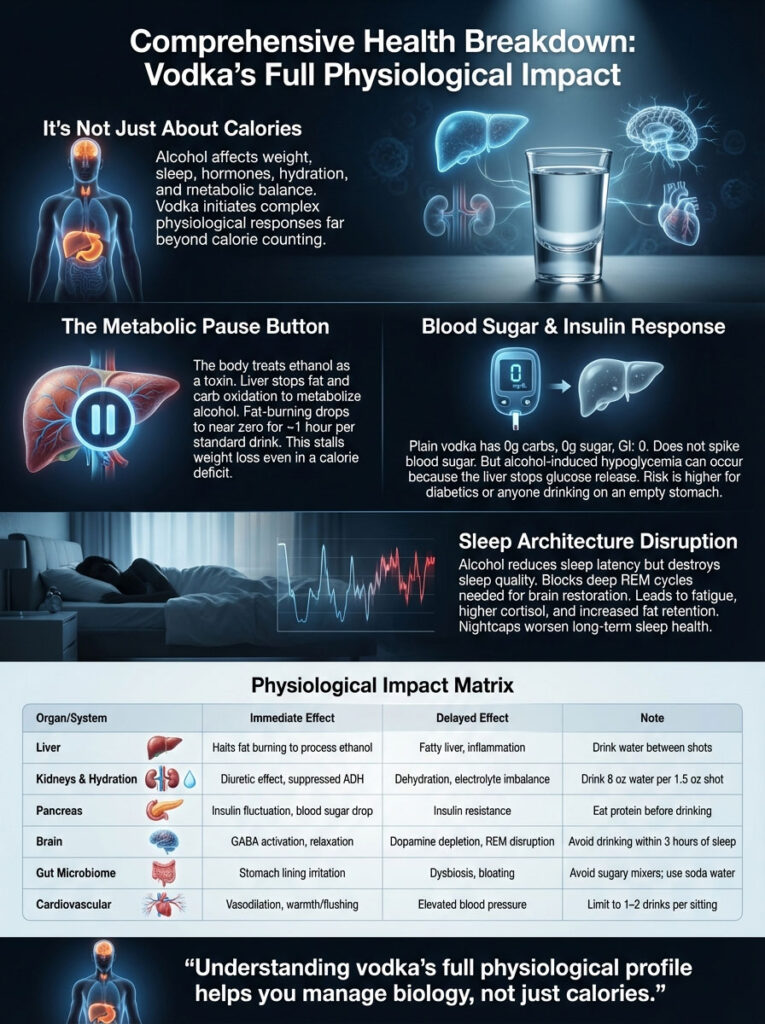
While the calorie count is the primary focus for dieters, the health breakdown of vodka consumption goes far beyond simple addition and subtraction. Alcohol affects nearly every organ system in the body, initiating complex metabolic cascades that can influence your weight, sleep, hydration, and hormonal balance. Understanding these physiological effects is crucial for anyone trying to maintain a healthy lifestyle while enjoying a drink.
The Metabolic Pause Button
The most immediate health impact of vodka is metabolic prioritization. Unlike food, which can be stored as glycogen or body fat for later use, the body views alcohol as a toxin that must be eliminated immediately.
When ethanol enters the bloodstream, your liver essentially puts all other metabolic processes on hold. It halts the oxidation of fats and carbohydrates to focus entirely on breaking down the alcohol. This is why drinking can stall weight loss even if you are in a caloric deficit. For the duration that alcohol is in your system (roughly one hour per standard drink), your fat-burning potential drops to near zero.
Blood Sugar and Insulin Response
One of the unique health aspects of vodka is its effect on blood glucose. Because plain vodka has 0g of sugar and 0g of carbs, it has a Glycemic Index (GI) of zero. It does not cause an immediate spike in blood sugar like beer or sweet cocktails do.
However, a phenomenon known as “alcohol-induced hypoglycemia” can occur. Because the liver is busy processing alcohol, it stops releasing glucose into the bloodstream to maintain levels. For diabetics or those on strict low-carb diets, this can cause blood sugar to drop dangerously low if alcohol is consumed on an empty stomach.
Sleep Architecture Disruption
Many people use a “nightcap” to help them fall asleep, believing alcohol is a sleep aid. While vodka is a central nervous system depressant and can help you lose consciousness faster (reduced sleep latency), it destroys sleep quality.
Alcohol prevents the brain from entering deep REM (Rapid Eye Movement) sleep, which is essential for cognitive restoration and emotional regulation. This is why you might wake up feeling exhausted after a night of drinking, even if you slept for eight hours. The lack of restorative sleep also raises cortisol levels, which can lead to increased belly fat retention over time.
Physiological Impact Matrix
To provide a clearer picture of what happens inside your body, we have compiled a health breakdown matrix detailing the immediate and delayed effects of vodka consumption.
| Body System | Immediate Effect | Delayed/Long-Term Impact | Health Consideration |
| Liver | Oxidative Priority: Halts fat burning to process ethanol. | Fatty Liver: Chronic consumption leads to fat accumulation and inflammation. | Drink water between shots to help liver filtration load. |
| Kidneys & Hydration | Diuretic Effect: Suppresses vasopressin (ADH), causing increased urination. | Dehydration: Leads to electrolyte imbalance, headaches, and dry skin. | For every 1.5 oz shot, drink 8 oz of water to neutralize dehydration. |
| Pancreas | Insulin Fluctuation: May cause initial drop in blood sugar. | Insulin Resistance: Heavy use can impair insulin sensitivity over time. | Eat a protein-rich meal before drinking to stabilize glucose. |
| Brain | GABA Activation: Increases relaxation; lowers inhibition. | Dopamine Depletion: Increases anxiety (“Hangxiety”) and disrupts REM sleep. | Avoid drinking within 3 hours of bedtime for better sleep quality. |
| Gut Microbiome | Irritation: High-proof alcohol can damage stomach lining. | Dysbiosis: Can kill beneficial gut bacteria, leading to bloating. | Avoid sugary mixers which feed bad gut bacteria; stick to soda water. |
| Cardiovascular | Vasodilation: Blood vessels expand (warmth/flushing). | BP Elevation: Consistent heavy drinking raises blood pressure. | Moderation is key; 1-2 drinks max per sitting. |
Understanding this breakdown shifts the perspective from just “counting calories” to managing your overall biology. The goal is to minimize the metabolic stress on your liver and kidneys while enjoying your drink.
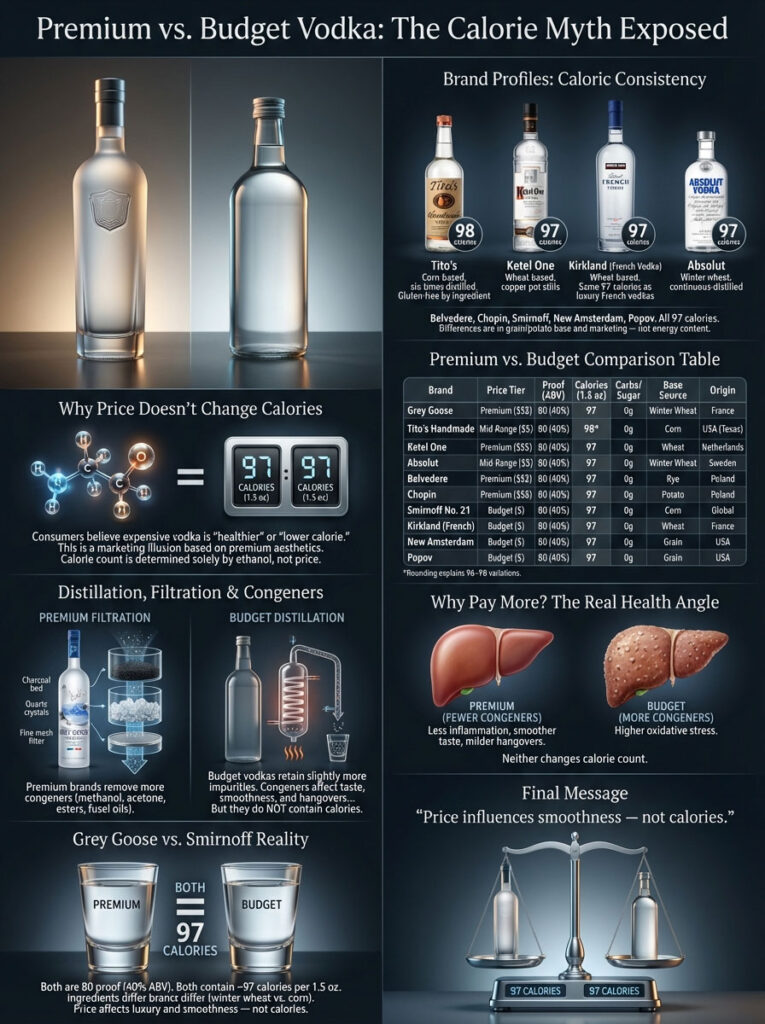
Premium vs. Budget Vodka Comparison: The Calorie Myth
There is a persistent belief among consumers that expensive vodka is “healthier,” “lighter,” or “lower in calories.” This is one of the most successful marketing tricks in the beverage industry. It relies on the halo effect, where we attribute positive traits (like healthiness) to products that look premium. Let us look at the hard data.
Distillation and Filtration
The price difference between a $12 bottle and a $50 bottle usually comes down to three factors: the raw ingredients, the marketing budget, and the distillation process.
Premium brands like Belvedere, Chopin, or Grey Goose focus heavily on their base ingredients. They might use rye, potato, or soft winter wheat, and they often source their water from specific artesian wells or glacial springs. They distill and filter the spirit multiple times. The goal of this extensive processing is to remove congeners.
Congeners are chemical byproducts of fermentation, such as methanol, acetone, acetaldehyde, esters, and fusel oils. They are technically impurities. They give cheap alcohol its harsh “burn,” its medicinal smell, and its rough finish.
- Budget brands (like Burnett’s, Kamchatka, or Popov) are often distilled fewer times or use continuous column stills that prioritize volume over purity. This leaves higher trace levels of congeners in the liquid.
- Premium brands filter these out through activated charcoal, quartz crystals, Herkimer diamonds, or even lava rocks.
Here is the catch: Congeners do not have calories. Removing them makes the vodka taste smoother. It reduces the “burn” in your throat. It drastically reduces the severity of your hangover the next day. But it does not change the energy density of the ethanol. The caloric value is determined by the alcohol molecule itself, not the trace impurities floating around it.
The Grey Goose vs. Smirnoff Reality
Let’s compare two titans of the industry to illustrate this point: Grey Goose (Premium) and Smirnoff No. 21 (Budget).
Grey Goose is made from French winter wheat from the Picardy region and spring water from Gensac-la-Pallue. It is marketed as a luxury good, often selling for $30 to $50 depending on the market. The marketing implies a sophisticated, lighter experience.
Smirnoff is made from non-GMO corn and is one of the most accessible vodkas in the world, usually retailing for $12 to $15. It is triple distilled and ten times filtered.
If you pour 1.5 ounces of each into separate glasses, the nutritional profile is identical. Both are 40% ABV. Both yield approximately 97 calories. The liver processes the ethanol in exactly the same way. The price tag provides you with a smoother experience, a nicer bottle, and social status, but it does not provide you with a calorie deficit.
Deep Dive: Brand Profiles and Caloric Consistency
To further prove that calories are standardized, we can examine the production methods of the top-selling brands in the USA.
1. Tito’s Handmade Vodka:
Tito’s has exploded in popularity because it is made from corn, making it naturally gluten-free. It is distilled six times in pot stills. Despite the “handmade” moniker and the rigorous distillation, a shot of Tito’s is 40% ABV and contains 98 calories. (Note: The 1-calorie difference often cited in databases is due to rounding decimals, not a physical difference in energy).
2. Ketel One:
This Dutch vodka is wheat-based and distilled in copper pot stills. It is known for a crisp finish. Like the others, the standard 80-proof version is exactly 97 calories per 1.5 ounces.
3. Kirkland Signature (Costco):
Rumors abound that Kirkland French Vodka is actually Grey Goose in a different bottle. While they share a water source region and wheat base, they are likely produced at different distilleries. However, nutritionally, they are twins. The Costco budget option delivers the exact same 97 calories as its luxury French counterpart.
4. Absolut:
A Swedish winter wheat vodka. Absolut is continuous-distilled, meaning it is distilled hundreds of times. This creates a very pure ethanol profile. Yet, the calorie count remains immovable at 97.
Detailed Brand Comparison Table
To visualize this, we have compiled a premium vs. budget vodka comparison table. This data proves that caloric content is standardized by proof, not price.
| Brand | Price Tier | Proof (ABV) | Calories (1.5 oz) | Carbs/Sugar | Base Source | Origin |
| Grey Goose | Premium ( | 80 (40%) | 97 | 0g | Winter Wheat | France |
| Tito’s Handmade | Mid-Range ( | 80 (40%) | 98* | 0g | Corn | USA (Texas) |
| Ketel One | Premium ( | 80 (40%) | 97 | 0g | Wheat | Netherlands |
| Absolut | Mid-Range ( | 80 (40%) | 97 | 0g | Winter Wheat | Sweden |
| Belvedere | Premium ( | 80 (40%) | 97 | 0g | Rye | Poland |
| Chopin | Premium ( | 80 (40%) | 97 | 0g | Potato | Poland |
| Smirnoff No. 21 | Budget ($) | 80 (40%) | 97 | 0g | Corn | Global |
| Kirkland (French) | Budget ($) | 80 (40%) | 97 | 0g | Wheat | France |
| New Amsterdam | Budget ($) | 80 (40%) | 97 | 0g | Grain | USA |
| Popov | Budget ($) | 80 (40%) | 97 | 0g | Grain | USA |
*Note: Small variances (96 vs 98) in database reporting are usually due to rounding methods used by different agencies or slight variations in density measurements, not actual nutritional differences.
Why Pay More? The Health Angle
If the calories are the same, why buy premium? Is it just a waste of money? Not necessarily. The answer lies in inflammation and recovery.
The congeners found in budget vodka—methanol, fusel oils, acetone—are essentially low-level toxins that the body must work harder to eliminate. While the liver is busy processing the ethanol, these impurities can linger, causing oxidative stress.
High levels of congeners trigger a stronger inflammatory response in the body. This leads to the dreaded “hangxiety” (hangover anxiety), severe headaches, nausea, and physical exhaustion. For fitness enthusiasts, a cheap vodka hangover might ruin a workout the next day or increase recovery time. A cleaner, premium vodka might allow you to function better and return to your routine faster. In this indirect way, premium vodka supports a healthy lifestyle better than budget brands, even if the vodka shot calories are the same.
The “Flavor Trap”: Botanicals vs. Flavored Vodkas
This is the section where the rules change. If you step away from plain vodka and move toward flavored options, you must be vigilant. The market has split into two very different categories: “Botanical Infusions” and “Traditional Flavored Vodkas.” Confusing the two can lead to massive hidden calorie consumption.
The Rise of “Spa Water” Spirits (Botanicals)
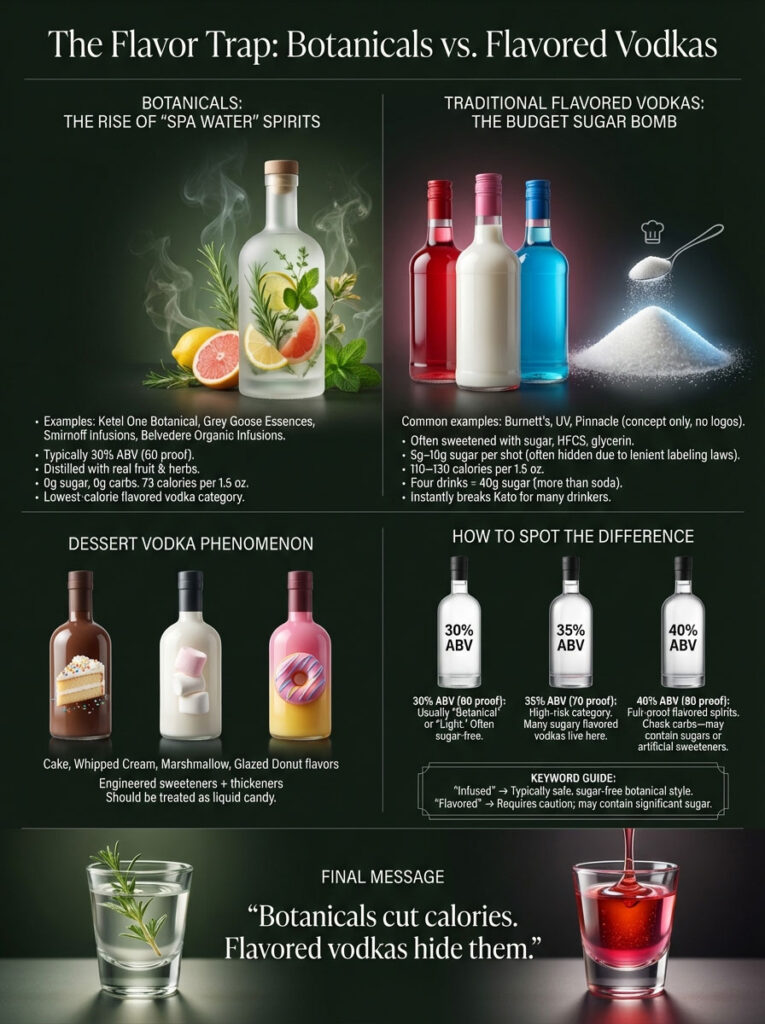
In recent years, health-conscious consumers demanded a better option than the sugary syrups of the past. Brands responded with “Botanical” lines. Notable examples include Ketel One Botanical, Grey Goose Essences, Smirnoff Infusions, and Belvedere Organic Infusions.
These are not technically “vodka” in the traditional sense because their ABV is usually lowered to 30% (60 proof). The production method involves distilling the spirit with real fruit and herbs, much like gin production, rather than adding artificial flavoring after the fact.
- The Result: These spirits typically contain 0g sugar and 0g carbs.
- The Calorie Count: Because the alcohol is lower (30%), the calories drop significantly to 73 calories per 1.5 oz.
If you are looking for the lowest calorie vodka brands, these botanical lines are the gold standard. They offer flavor without the glycemic spike.
The Budget Sugar Bomb
On the other end of the spectrum, we have traditional flavored vodkas. Think of the brands that line the shelves of college party stores: Burnett’s, UV, Pinnacle, or cheap vanilla, cherry, and whipped cream flavors.
To make cheap ethanol palatable, manufacturers often add heavy doses of sugar, high-fructose corn syrup, and glycerin. This masks the harsh burn of the cheap alcohol base. Unfortunately, alcohol labeling laws in the US are looser than food labeling laws, so brands are not always required to list sugar content on the bottle.
- The Hidden Cost: These drinks can contain 5g to 10g of sugar per shot.
- The Calorie Count: A single shot can skyrocket to 110–130 calories.
While 13 to 30 extra calories does not sound like much, it adds up rapidly. If you consume four drinks over the course of a night, you have inadvertently consumed 40 grams of sugar—more than a can of full-sugar soda—hidden in your alcohol. This can knock a Keto dieter out of ketosis instantly.
The Dessert Vodka Phenomenon
A special sub-category involves “Dessert Vodkas” that taste like Cake, Whipped Cream, Marshmallow, or Glazed Donut. These are chemically engineered to trigger nostalgia and sweetness. They almost always contain thickeners and sweeteners. If you are drinking these, you should assume you are drinking liquid candy.
How to Spot the Difference
How do you know if you are buying a sugar-free essence or a sugary syrup bomb? Check the ABV and the label terminology.
- 30% ABV (60 Proof): Usually indicates a “Light” or “Botanical” version. These are likely no-sugar options designed for the wellness crowd.
- 35% ABV (70 Proof): The danger zone. Many sugary flavored vodkas sit here. The alcohol is lowered to make room for the sugar syrup volume.
- 40% ABV (80 Proof): If it is flavored and full proof, check the carbs carefully. It might use artificial sweeteners, or it might be packed with sugar.
- Keywords: Look for “Infused” (usually safe) vs. “Flavored” (check carefully).
The Proof Factor: How ABV Impacts Caloric Density
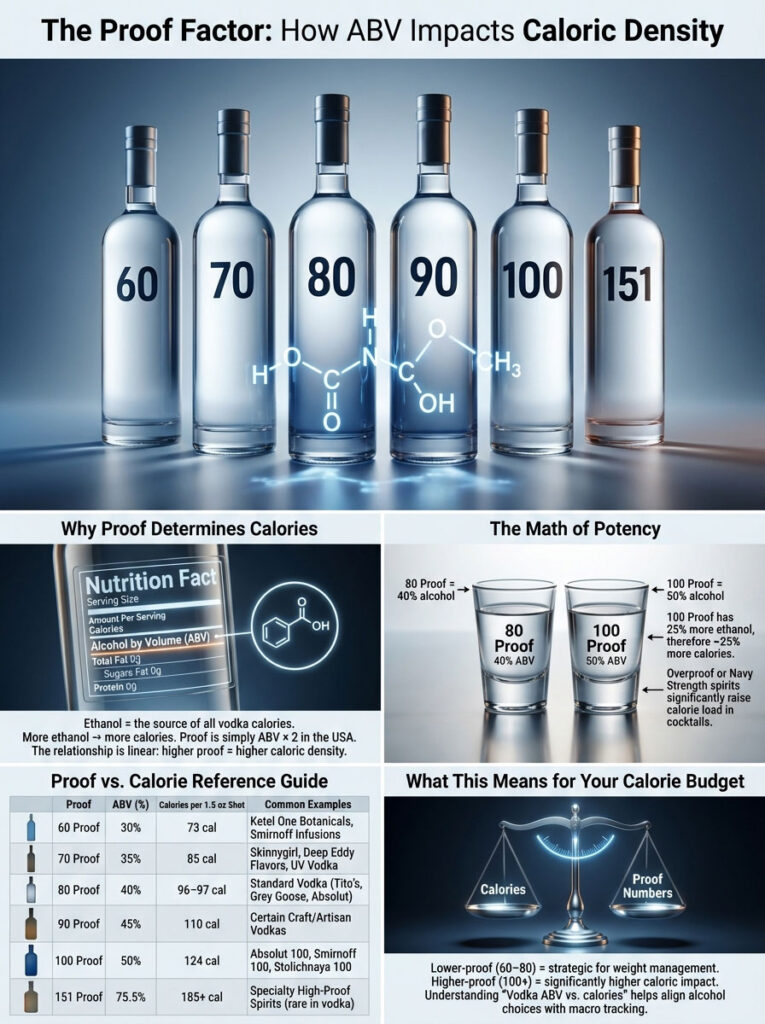
We have established that ethanol is the source of calories. Therefore, the more ethanol in the bottle, the higher the calorie count. This is a linear mathematical relationship. When you are checking vodka nutrition facts, the most important number on the label is the “Proof.”
The Math of Potency
In the USA, “Proof” is simply double the Alcohol By Volume (ABV) percentage. This system dates back to the 18th century when sailors would “prove” their rum rations were not watered down by mixing them with gunpowder and lighting them on fire. If it ignited, it was “proof” (over 57% ABV). Today, the math is simpler:
- 80 Proof = 40% Alcohol
- 100 Proof = 50% Alcohol
Many craft cocktails call for “Overproof,” “Navy Strength,” or “Bi-Bond” spirits to stand up against strong mixers. While this improves the flavor profile of the cocktail, it drastically increases the caloric load. A 100-proof vodka contains 25% more alcohol than an 80-proof vodka. Consequently, it contains roughly 25% more calories.
Proof vs. Calorie Reference Guide
Use this table to estimate your intake based on the bottle strength. This is crucial for anyone tracking macros.
| Proof | ABV (%) | Calories per 1.5 oz Shot | Common Examples |
| 60 Proof | 30% | 73 cal | Ketel One Botanicals, Smirnoff Infusions |
| 70 Proof | 35% | 85 cal | Skinnygirl, Deep Eddy Flavors, UV Vodka |
| 80 Proof | 40% | 96-97 cal | Standard Vodka (Tito’s, Grey Goose, Absolut) |
| 90 Proof | 45% | 110 cal | Certain Craft/Artisan Vodkas |
| 100 Proof | 50% | 124 cal | Absolut 100, Smirnoff 100, Stolichnaya 100 |
| 151 Proof | 75.5% | 185+ cal | Specialty High-Proof Spirits (Rare in Vodka) |
This data helps answer the common query regarding “Vodka ABV vs calories.” If you are trying to cut weight, sticking to 80-proof or the lower 60-proof options is a strategic move. Conversely, if you are drinking 100-proof spirits, you need to adjust your daily calorie budget accordingly.
Modern Drinking Trends & Health Impact
The way Americans drink is changing. We are moving away from the volume-heavy binge-drinking culture of the past toward a more mindful, quality-focused approach. Several cultural and pharmaceutical factors are driving this shift.
The GLP-1 Effect (Ozempic & Wegovy)
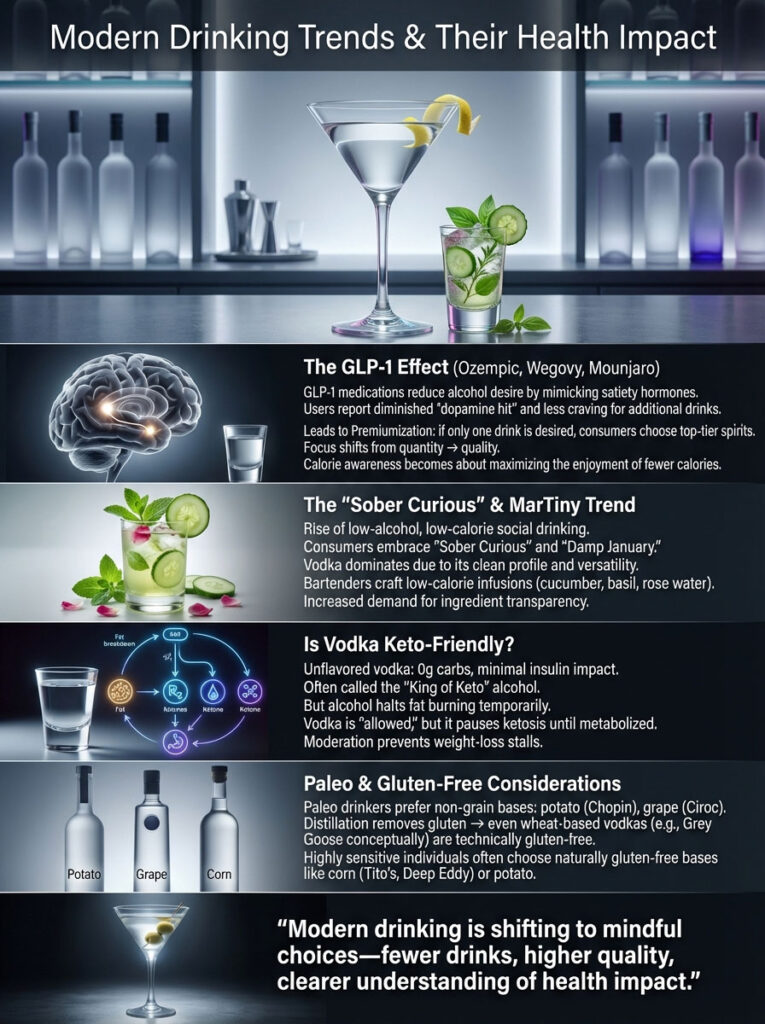
One of the most fascinating developments in the health world is the rise of GLP-1 receptor agonists like Ozempic, Wegovy, and Mounjaro. Originally designed for diabetes and weight loss, these drugs have a side effect that is reshaping the alcohol industry: they reduce the desire to drink.
These medications work by mimicking a hormone that signals satiety to the brain. This affects the reward center. Users on GLP-1 medications often report that they no longer get the “dopamine hit” or the “buzz” from alcohol. They feel full faster, and the urge to consume drink after drink vanishes.
This has led to a market trend called “Premiumization.” If a person on Ozempic can only physically tolerate one drink before feeling too full, they do not want a cheap well vodka. They want the best. They are willing to pay $18 for a single martini made with top-tier Grey Goose or Chopin because they are prioritizing experience over volume. For these consumers, knowing how many calories in vodka is less about restricting intake and more about maximizing the quality of the few calories they do consume.
The “Sober Curious” Movement
You may have noticed the rise of the “MarTiny”—miniature cocktails served in 2-ounce glasses. This aligns with the “Sober Curious” or “Damp January” movements. People are looking for low calorie vodka drinks that allow them to participate in the social ritual of toasting and drinking without the caloric or cognitive penalty of getting drunk.
Vodka is the spirit of choice here because of its cleanliness. It allows bartenders to create delicate, low-calorie infusions—using cucumber, basil, or rose water—that mimic the complexity of wine without the sugar or the hangover. This trend is pushing brands to be more transparent about their ingredients and nutritional facts.
Is Vodka Keto-Friendly?
The Keto diet requires the body to be in a state of ketosis, burning fat for fuel instead of carbohydrates. To stay in ketosis, you must keep net carb intake extremely low (usually under 20-50g per day).
Vodka is widely considered the “King of Keto” alcohol. Because unflavored vodka has 0g carbs, it does not spike insulin significantly or kick you out of ketosis immediately upon consumption.
However, there is a biological catch that Keto dieters must understand. The body views alcohol as a poison. When you drink vodka, your liver pauses fat burning (ketogenesis) to metabolize the ethanol. So, while vodka is an “allowed” Keto friendly alcohol, drinking it effectively hits the “pause button” on your weight loss for a few hours. Once the alcohol is cleared, your body returns to burning fat. This is why moderation is key; too much alcohol will stall progress even if it is zero-carb.
Paleo and Gluten-Free Considerations
For Paleo dieters, the source of the vodka matters. Paleo purists often avoid grain-based vodkas (corn, wheat, rye) and opt for potato-based or grape-based vodkas. Brands like Chopin (Potato) or Ciroc (Grape) are preferred in these circles.
Regarding gluten: Scientifically, the distillation process vaporizes the alcohol and leaves the heavy proteins (gluten) behind. Therefore, even wheat-based vodkas like Grey Goose are technically gluten-free and safe for most people with Celiac disease. However, many people with extreme sensitivity prefer to play it safe with naturally gluten-free bases like corn (Tito’s, Deep Eddy) or potato (Monopolowa).
Practical Strategies: The Mixer Math
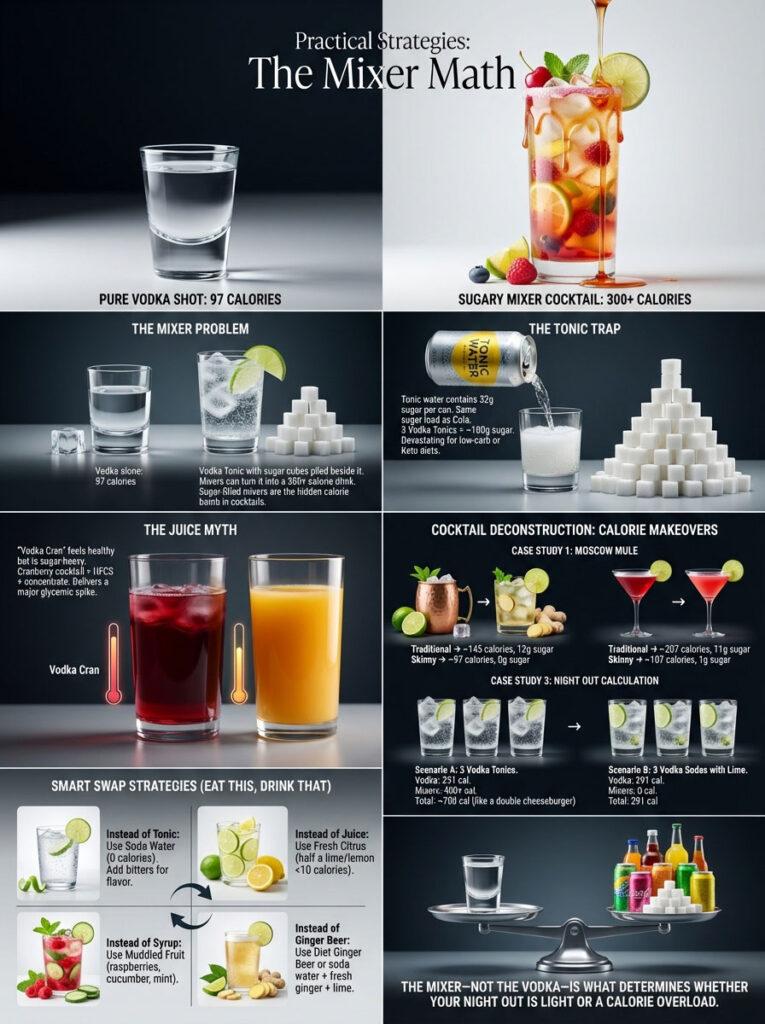
You can buy the most expensive, triple-distilled, sugar-free vodka on the market, but you can ruin its nutritional profile in seconds depending on what you mix it with. The mixer is the silent killer of diets. A vodka shot is 97 calories. A Vodka Tonic is a different beast entirely.
The Tonic Trap
Tonic water is deceptive. Because it is clear and tastes bitter, people assume it is healthy like sparkling water. In reality, tonic water is carbonated water loaded with quinine and sugar. A standard 12-ounce can of tonic water contains about 32 grams of sugar—roughly the same as a can of Cola.
If you drink three Vodka Tonics, you have consumed nearly 100 grams of sugar. That is a caloric disaster for anyone, especially those on low-carb diets.
The Juice Myth
Cranberry juice and Orange juice are also sugar-dense. A “Vodka Cran” might feel healthier because it contains fruit, but commercial cranberry juice cocktail is usually high-fructose corn syrup with a splash of cranberry concentrate. It packs a heavy glycemic punch.
The Strategy: Eat This, Drink That
To keep your calories in 1.5 oz vodka from ballooning into a 300-calorie bomb, follow these swap strategies:
- Instead of Tonic: Use Soda Water (Club Soda). It has 0 calories, 0 sugar, and 0 sodium. If you miss the bitterness of tonic, add a dash of orange or angostura bitters.
- Instead of Juice: Use Fresh Citrus. Squeezing half a lime or lemon into your drink adds immense flavor, acidity, and vitamin C for negligible calories (less than 10).
- Instead of Syrup: Use Muddled Fruit. Muddle fresh raspberries, cucumber slices, or mint leaves at the bottom of the glass. You get the flavor essence without the refined sugar syrup.
- Instead of Ginger Beer: For a Moscow Mule, use a sugar-free ginger beer or mix soda water with fresh ginger root and lime.
Cocktail Deconstruction: Calorie Makeovers
Let’s look at real-world examples of how mixer choices change the math.
Case Study 1: The Moscow Mule
- Traditional: 1.5 oz Vodka (97) + 4 oz Ginger Beer (48) + Lime. Total: ~145 calories + 12g sugar.
- Skinny: 1.5 oz Vodka (97) + Diet Ginger Beer (0) + Lime. Total: ~97 calories + 0g sugar.
Case Study 2: The Cosmopolitan
- Traditional: 1.5 oz Vodka (97) + 1 oz Cointreau (95) + 1 oz Cranberry Juice (15) + Lime. Total: ~207 calories + 11g sugar.
- Skinny: 1.5 oz Vodka (97) + Splash fresh orange juice (5) + Splash unsweetened cranberry juice (5) + Stevia + Lime. Total: ~107 calories + 1g sugar.
Case Study 3: The Night Out Calculation
- Scenario A: You drink 3 Vodka Tonics.
- Vodka Calories: 291
- Mixer Calories: 400+
- Total: ~700 Calories (Equivalent to a double cheeseburger).
- Scenario B: You drink 3 Vodka Sodas with Lime.
- Vodka Calories: 291
- Mixer Calories: 0
- Total: 291 Calories.
The difference is staggering. The alcohol is the same, but the caloric impact is less than half.
Summary & Key Takeaways
Navigating the liquor store does not have to be a guessing game. When it comes to vodka shot calories, the science is straightforward, even if the marketing is not. Whether you are prepping for a wedding, managing your weight, or just trying to avoid a Sunday morning headache, knowledge is your best tool.
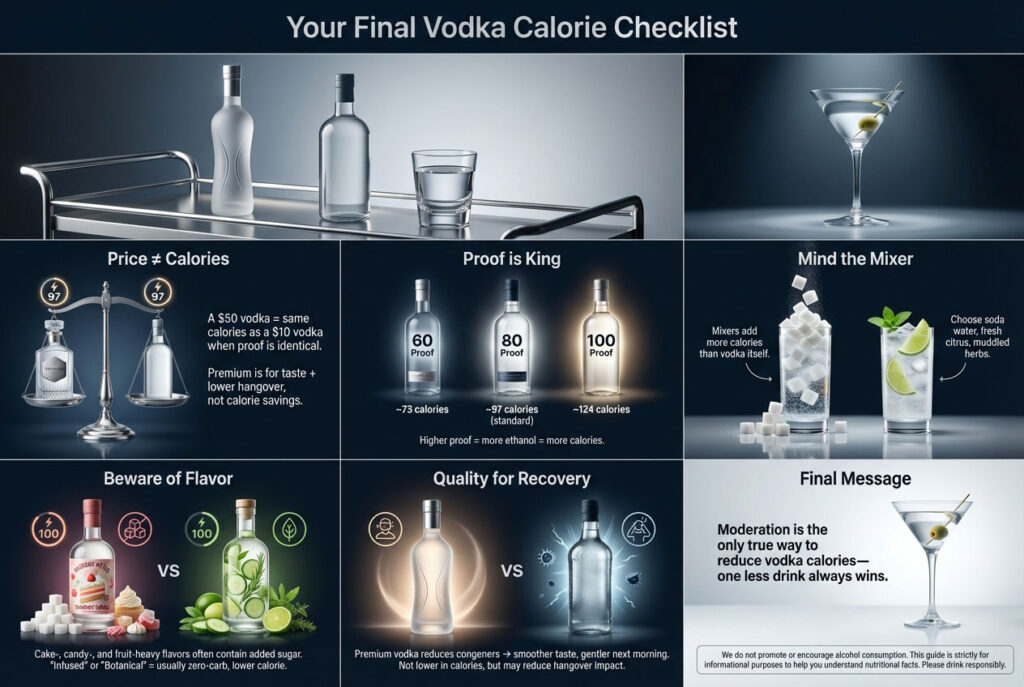
Here is your final checklist for the next time you stock your bar cart:
- Price ≠ Calories: A $50 bottle of premium vodka has the same calorie count as a $10 budget bottle, provided they are the same proof. Do not buy expensive vodka expecting it to be “diet.” Buy it for the taste and the reduced hangover.
- Proof is King: The higher the ABV, the higher the calories. 80-proof (97 cals) is standard. 100-proof (124 cals) is denser. 60-proof botanicals (73 cals) are the lightest.
- Beware of Flavor: If it tastes like cake, candy, or heavy fruit, it likely has added sugar and extra calories. Look for “Infused” or “Botanical” labels for zero-carb options.
- Mind the Mixer: The mixer causes more weight gain than the spirit. Stick to soda water, fresh citrus, and muddled herbs to keep your drink truly low-calorie.
- Quality for Recovery: While premium vodka won’t save you calories, its lack of congeners may save you from a debilitating hangover, helping you stay active and healthy the next day.
Whether you choose Grey Goose for the status or Kirkland for the value, moderation remains the only true secret to health. The most effective way to reduce vodka calories is simply to drink one less glass.
Disclaimer: We do not promote or encourage alcohol consumption. This guide is strictly for informational purposes to help you understand nutritional facts. Please drink responsibly.
Frequently Asked Questions (FAQ)
Does cheap vodka have more sugar than premium vodka?
No. Standard unflavored vodka, regardless of price, contains 0g of sugar. Brands like Smirnoff (budget) and Grey Goose (premium) both have zero sugar. However, cheap flavored vodkas often use added sugar syrups to mask the taste of harsh alcohol, whereas premium flavored vodkas typically use natural essences with no added sugar.
What is the absolute lowest calorie vodka brand?
The lowest calorie options are typically the “Botanical” or “Light” lines that have a lower ABV (30% or 60 proof). Examples include Ketel One Botanical, Smirnoff Infusions, and Grey Goose Essences, which contain approximately 73 calories per 1.5 oz serving compared to the standard 97 calories.
How many calories are in a double shot of vodka?
A standard shot is 1.5 oz. A double shot is typically 3.0 oz. Since a single shot of 80-proof vodka is ~97 calories, a double shot contains approximately 194 calories. Be aware that many bars pour “doubles” as their standard serving without telling you.
Can I drink vodka while on a Keto diet?
Yes, vodka is one of the most popular choices for Keto dieters because unflavored vodka contains 0g of carbohydrates. To stay in ketosis, ensure you mix it with calorie-free mixers like soda water rather than tonic or juice. Remember that alcohol will pause ketone production temporarily.
Does 100-proof vodka have significantly more calories?
Yes. 100-proof vodka contains 50% alcohol by volume, compared to 40% for standard vodka. This higher concentration of ethanol means a 1.5 oz shot of 100-proof vodka contains about 124 calories, roughly 28% more than a standard shot.
Is vodka better than gin or tequila for weight loss?
Nutritionally, they are almost identical. Gin, tequila, vodka, and rum (unflavored) all contain roughly 97 calories per 1.5 oz shot if they are 80-proof. The “best” one is the one you enjoy without adding sugary mixers. Gin may have trace botanicals, but the caloric difference is negligible.
Why does cheap vodka give me a worse hangover?
Cheap vodkas are often distilled fewer times and filtered less rigorously. This leaves higher traces of congeners (impurities like fusel oils, methanol, and acetone) in the liquid. These impurities are difficult for the liver to process and contribute to increased inflammation and more severe hangovers compared to ultra-pure premium brands.
Does flavored vodka contain carbs?
It depends on the type. “Infused” vodkas (like Grey Goose Essences) usually have 0g carbs. Traditional flavored vodkas (like Vanilla, Sweet Tea, or Cherry) often have added sugar, ranging from 2g to 10g of carbs per shot. Always read the nutrition label or check the brand’s website if you are diabetic or on Keto.
How many shots of vodka equal a cheeseburger in calories?
A typical fast-food cheeseburger is around 300–350 calories. Since one shot of vodka is ~97 calories, drinking three to four shots delivers roughly the same caloric energy as eating a cheeseburger.
Is vodka gluten-free?
Most vodkas are distilled to such a high degree that the gluten protein is removed, even if the base ingredient is wheat (like Grey Goose or Absolut). However, people with Celiac disease often prefer vodkas made from naturally gluten-free bases like corn (Tito’s, Deep Eddy, Smirnoff) or potatoes (Chopin, Monopolowa) to be 100% safe.
Does drinking vodka slow down my metabolism?
Yes. The body views alcohol as a toxin and prioritizes metabolizing it over everything else. When you drink vodka, your body pauses burning fat and carbohydrates to burn off the alcohol first. This “metabolic pause” can delay fat loss if you drink frequently.
Are there calories in vodka soda?
A vodka soda contains only the calories from the vodka itself (approx 97 calories for 1.5 oz), as plain soda water has zero calories. This makes it one of the lowest-calorie alcoholic drinks available, provided you do not add cordial or syrup.
Medical & Safety Disclaimer
1. Educational Purpose Only (Not Medical Advice): This guide is strictly for informational and educational purposes. It does not constitute medical, nutritional, or dietetic advice. The information regarding alcohol metabolism, liver function, and dietary impacts is based on general scientific data and may not apply to your specific biological profile. The author is not a medical professional. Always consult a physician or registered dietitian before making significant changes to your diet or alcohol consumption, especially if you have pre-existing conditions such as diabetes, liver disease, or metabolic disorders.
2. Accuracy of Nutritional Data: All calorie counts, carbohydrate values, and nutritional breakdowns provided are estimates based on standard 1.5 oz servings of 80-proof spirits and common food databases (such as the USDA). Actual nutritional values may vary by brand, production batch, region, and serving size. We cannot guarantee 100% accuracy for every specific bottle or pour.
3. Responsible Consumption & Legal Age: This content is intended solely for audiences of legal drinking age in their respective jurisdictions. We do not promote, condone, or encourage binge drinking, underage consumption, or alcohol abuse. Alcohol is a substance that affects the central nervous system and can be addictive. Please drink responsibly and never drink and drive.
4. Addiction Support: If you or someone you know is struggling with alcohol use disorder or mental health issues related to substance use, please seek professional help immediately. In the USA, you can contact the SAMHSA National Helpline at 1-800-662-HELP (4357).
References:
- U.S. Department of Agriculture (USDA) FoodData Central. “Alcoholic beverage, distilled, vodka, 80 proof.”
- National Institute on Alcohol Abuse and Alcoholism (NIAAA). “What Is a Standard Drink?”
- Cederbaum A. I. (2012). Alcohol metabolism. Clinics in liver disease, 16(4), 667–685.
- National Institutes of Health (NIH). “Rethinking Drinking: Alcohol and your health.”