Kale spent a decade as the poster child for “superfood.” Then a nutrient-density ranking published in a CDC journal put it in 15th place, behind spinach, romaine, and even chives.
Table of Contents
That doesn’t make kale a fraud. It makes it a good vegetable with a few real strengths and a lot of loud marketing attached. Here’s what the human studies actually show, and where the hype outruns the data.
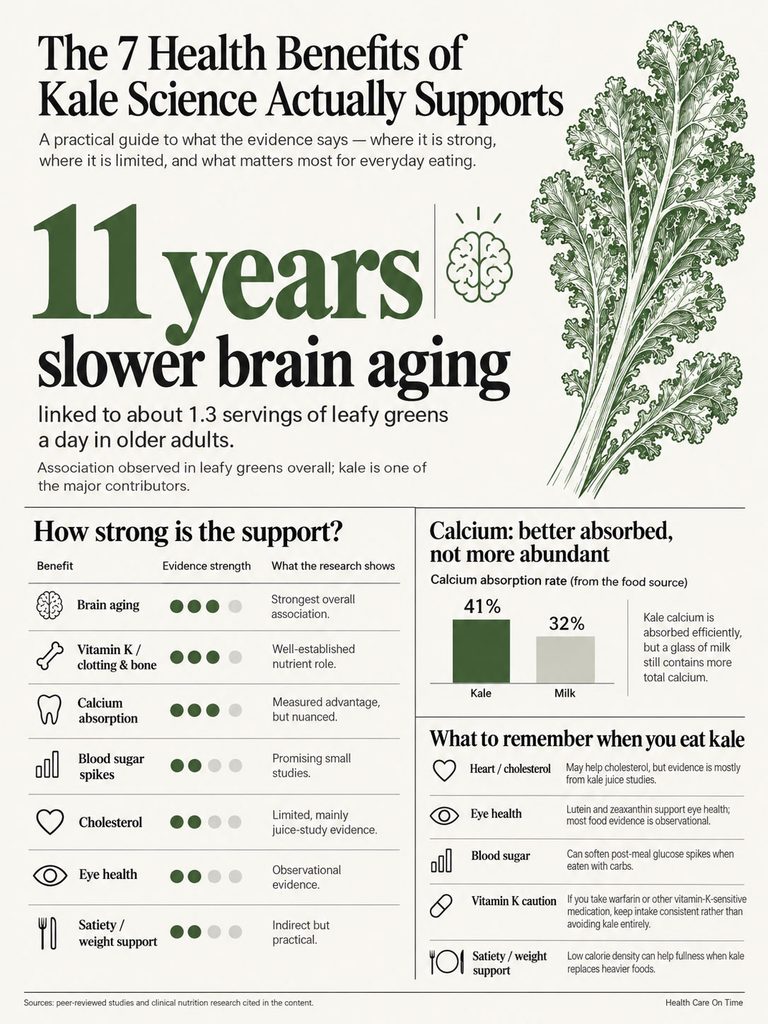
Quick Answer: The health benefits of kale backed by science include better cholesterol numbers, eye-protecting lutein and zeaxanthin, well-absorbed calcium, slower brain aging linked to leafy greens, vitamin K for clotting and bone, smaller blood sugar spikes after meals, and fullness on very few calories. Three popular claims are hyped: detox, cancer prevention, and “healthiest green on Earth.” Most kale trials are small.
The 7 science-backed benefits of kale:
- Better cholesterol numbers (small juice trial)
- Lutein and zeaxanthin for eye health
- Calcium that absorbs better than milk’s
- Slower brain aging linked to leafy greens
- Vitamin K for clotting and bone
- Smaller blood sugar spikes after meals
- Fullness on very few calories
At a Glance
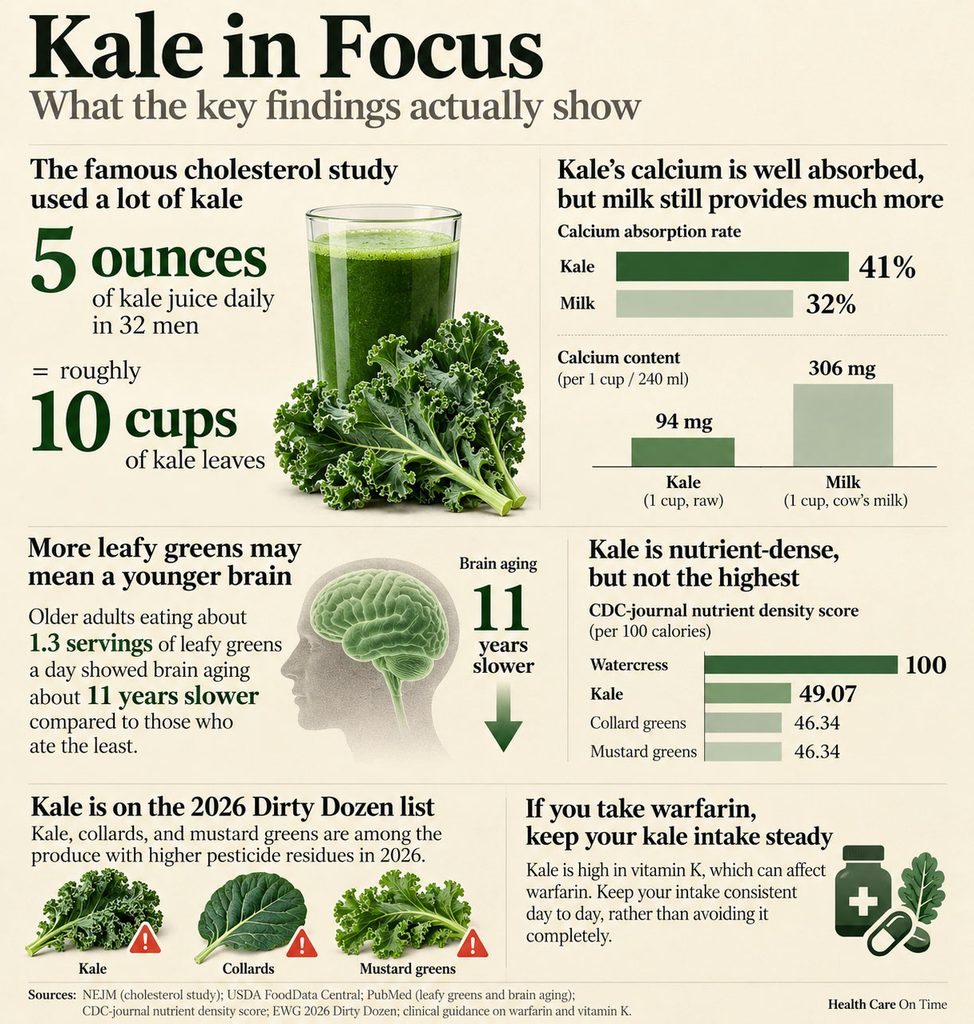
- The famous cholesterol study used about 5 ounces of kale juice daily in 32 men, roughly 10 cups of leaves.
- Kale’s calcium absorbs at about 41% vs. 32% for milk, but a glass of milk still holds far more calcium.
- Older adults eating about 1.3 servings of leafy greens a day showed brain aging about 11 years slower.
- Kale scored 49.07 on a CDC-journal nutrient density scale; watercress scored 100.
- Kale, collards, and mustard greens sit on the 2026 Dirty Dozen pesticide list.
- If you take warfarin, keep your kale intake steady, not zero.
Our medical team reviewed the kale studies most often quoted online, working from the original papers rather than summaries. What follows separates the human evidence from the lab hype.
What Makes Kale Nutritious (Without the Calorie Math)
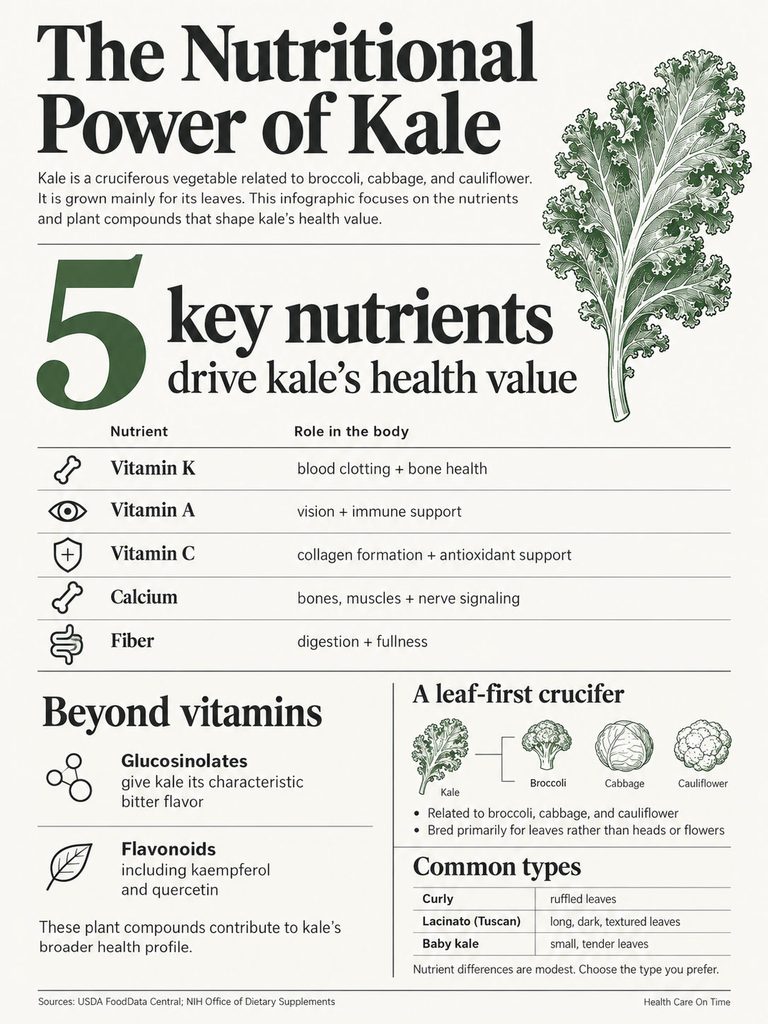
Kale is a cruciferous vegetable. It’s the same plant species as broccoli, cabbage, and cauliflower; farmers simply bred it for leaves instead of heads or flowers.
Calorie and portion numbers live in our full breakdown, How Many Calories in Kale? This article focuses on what kale’s nutrients actually do in your body.
The Nutrients That Do the Heavy Lifting
Five nutrients explain most of kale’s reputation:
- Vitamin K1. A loosely packed cup of raw kale gives roughly 80 mcg. That’s about two-thirds of the daily adequate intake for men (120 mcg) and most of it for women (90 mcg), per the NIH Office of Dietary Supplements.
- Vitamin C. Kale carries more than most leafy greens.
- Beta-carotene. Your body converts it to vitamin A.
- Lutein and zeaxanthin. These yellow pigments collect in the retina.
- Low-oxalate calcium. Unlike spinach, kale doesn’t lock up its calcium.
Kale also carries glucosinolates, the sulfur compounds behind the bitter bite of all cruciferous vegetables, plus flavonoids such as kaempferol and quercetin.
Curly, Lacinato, and Baby Kale
Curly kale is the frilly supermarket standard. Lacinato kale (also sold as Tuscan or “dinosaur” kale) has flat, bumpy, dark leaves and a milder taste. Baby kale is simply harvested young.
Nutrient differences between types are modest. The one you’ll actually eat is the right one.
The 7 Health Benefits of Kale Science Actually Supports
These seven benefits have at least some human data behind them. The strength varies a lot, so each one comes with an honest note on what was really tested.
1. It May Improve Cholesterol, but the Famous Study Used Juice
Nearly every kale article quotes “HDL up 27%, LDL down 10%.” Those numbers are real. They come from a Korean trial that most pages never actually describe.
What the Trial Actually Tested
Researchers recruited 32 university staff men with total cholesterol above 200 mg/dL. Each drank 150 mL (about 5 ounces) of kale juice a day for 12 weeks.
After three months, HDL rose 27% and the HDL-to-LDL ratio climbed 52%, while LDL fell 10%. The size of the change also depended on whether the men smoked.
Here’s the context most pages skip. One physician’s analysis estimated the daily juice equaled about 10 cups of kale, and LDL fell closer to 20% among the nonsmokers.
The study was small, all male, and Korean, and its abstract describes no separate control group. That makes it a promising signal, not proof that a kale salad will move your lipid panel.
What It Means for You
If your LDL is high, kale fits well inside a cholesterol-lowering eating pattern. It won’t replace a statin your doctor prescribed.
Patients booking a lipid profile test through HealthCareOnTime often ask whether greens alone can fix their numbers. The honest answer: diet helps, but one food rarely does the job by itself.
2. It Feeds the Pigments That Protect Your Eyes
Lutein and zeaxanthin build up in the macula, the part of the retina responsible for sharp central vision. There they filter blue light and act as antioxidants.
The National Eye Institute’s AREDS2 trial tested a supplement with 10 mg lutein and 2 mg zeaxanthin as a safer replacement for beta-carotene. The trial enrolled 4,203 older adults with age-related macular degeneration (AMD).
Kale is one of the richest food sources of both pigments, far ahead of carrots. Our article Are Carrots Good for Eye Health? explains why leafy greens beat the classic “eat your carrots” advice.
The caveat: AREDS2 tested supplements in people who already had AMD. Studies linking leafy greens to lower AMD risk in healthy people are observational.
One practical tip: these pigments dissolve in fat. Kale eaten with olive oil, avocado, or eggs delivers more lutein to your bloodstream than plain leaves.
3. Its Calcium Absorbs Better Than Milk’s
This is kale’s most underrated benefit, and none of the top-ranking pages explain it properly.
In a study of 11 women, calcium absorption from kale averaged about 41%, compared with about 32% from milk tested in the same women. The researchers credited kale’s low oxalate content, which sets it apart from spinach.
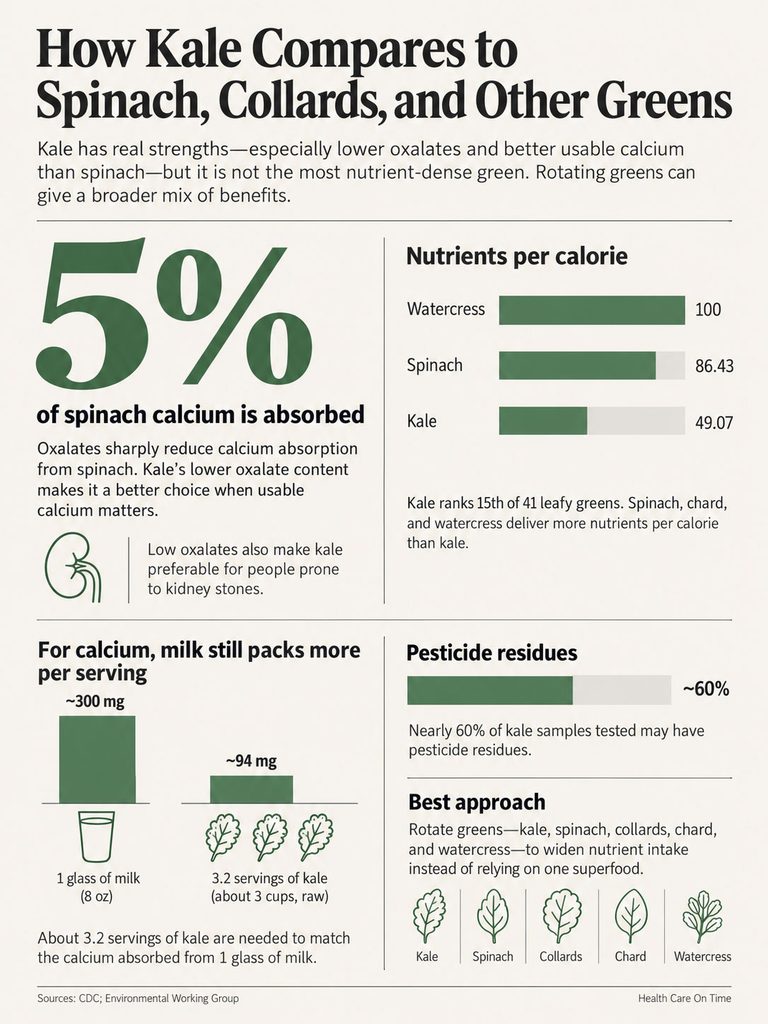
Now the catch. Absorption rate isn’t the same as total calcium. One nutrition textbook table estimates you’d need about 3.2 servings of kale (85 g, or 3 ounces, each) to match the absorbed calcium in one 8-ounce glass of milk.
So kale is a genuinely useful calcium source if you avoid dairy. It just isn’t a one-to-one milk replacement.
4. Leafy Greens Are Linked to Slower Brain Aging
A Rush University and Tufts team followed 960 adults aged 58 to 99 in the Memory and Aging Project.
People in the top fifth for leafy green intake ate about 1.3 servings a day. They showed much slower cognitive decline than those eating almost none, a gap equal to being about 11 years younger.
The researchers pointed to lutein, vitamin K, nitrate, folate, beta-carotene, and kaempferol as the nutrients concentrated in those greens. Kale contains most of them.
This was an observational study, not a trial. People who eat lots of greens often have other healthy habits too. Still, the finding is strong enough that the MIND diet, built by the same research group, names leafy greens as a core food.
5. Vitamin K Supports Normal Clotting and Bone
Your liver needs vitamin K to make clotting proteins. Your bones need it to activate osteocalcin, a protein that helps bind calcium into bone tissue.
Most US adults get enough vitamin K to prevent deficiency, according to NIH. Kale is an easy way to stay comfortably above that line.
The bone link is real biology, but supplement trials for fracture prevention have been mixed. Treat kale as one part of a bone-healthy diet with calcium, vitamin D, and weight-bearing exercise, not as a bone treatment.
This same vitamin is why people taking warfarin need a plan, covered below.
6. It May Soften Blood Sugar Spikes After Meals
A Japanese randomized, double-blind, placebo-controlled crossover trial tested 42 adults aged 21 to 64 whose blood sugar ran high after meals. They ate either a placebo or 7 or 14 grams of a kale-containing food alongside a high-carb meal.
Even the 7-gram dose lowered the blood sugar rise after eating, and the 14-gram dose was safe.
That’s a well-designed trial, but it was small, short, and used a prepared kale food rather than fresh leaves. It suggests kale alongside your carbs may help a little. It doesn’t make kale a diabetes treatment.
Patients who track their numbers with an HbA1c or fasting glucose test through our network can use this simply: add a side of greens to carb-heavy meals rather than eating pasta or rice alone.
7. It Helps You Feel Full on Very Few Calories
Kale is mostly water and fiber, so it adds volume to your plate without adding much energy. Foods with low energy density let you eat a satisfying portion for fewer calories.
No trial shows kale itself causes weight loss. The benefit comes from swapping: kale in place of a heavier side, or kale bulking up pasta, soups, and grain bowls.
Kale chips are the exception. Once oil goes on, calories climb fast. Our kale calories guide shows the math.
How Strong Is the Evidence for Each Benefit?
| Benefit | Evidence Strength | Study Type and Size | Dose Used | What It Means on Your Plate |
| Cholesterol | Low to moderate | Small trial, 32 Korean men, no control group described | 150 mL juice daily (about 10 cups kale), 12 weeks | Helpful inside a heart-healthy diet; not a statin swap |
| Eye health | Moderate | AREDS2 supplement trial, 4,203 adults with AMD; food data observational | 10 mg lutein + 2 mg zeaxanthin daily (supplement) | Eat kale with fat; take supplements only on your eye doctor’s advice |
| Calcium | Moderate | Absorption study, 11 women | 300 mg calcium test load | About 3 servings of kale = 1 glass of milk |
| Brain aging | Moderate (observational) | Cohort, 960 older adults, about 5 years | About 1.3 servings of leafy greens daily | About 1 cup raw or ½ cup cooked greens most days |
| Vitamin K | Strong for clotting; mixed for bone | NIH reviews, many studies | Varies | Keep intake steady, especially on warfarin |
| Blood sugar | Low to moderate | Crossover trial, 42 Japanese adults | 7 to 14 g kale food with one meal | Pair greens with carb-heavy meals |
| Fullness | Low (indirect) | Energy-density research; no kale-specific trial | Not tested | Use kale to bulk up meals |
What the Evidence Can’t Tell You Yet
Three limits apply to almost every kale study.
First, the trials are small. The largest kale-specific trial here enrolled 42 people, and the cholesterol trial had 32.
Second, few were done in the US. The cholesterol trial was Korean and the blood sugar trial was Japanese, so diets and body types differ from the average American’s.
Third, the strongest results often came from juice, powders, or prepared foods, not the bagged kale in your fridge. Our medical reviewers weigh those studies as direction, not dose.
3 Kale Claims That Are Overhyped
“Kale Detoxes Your Body”
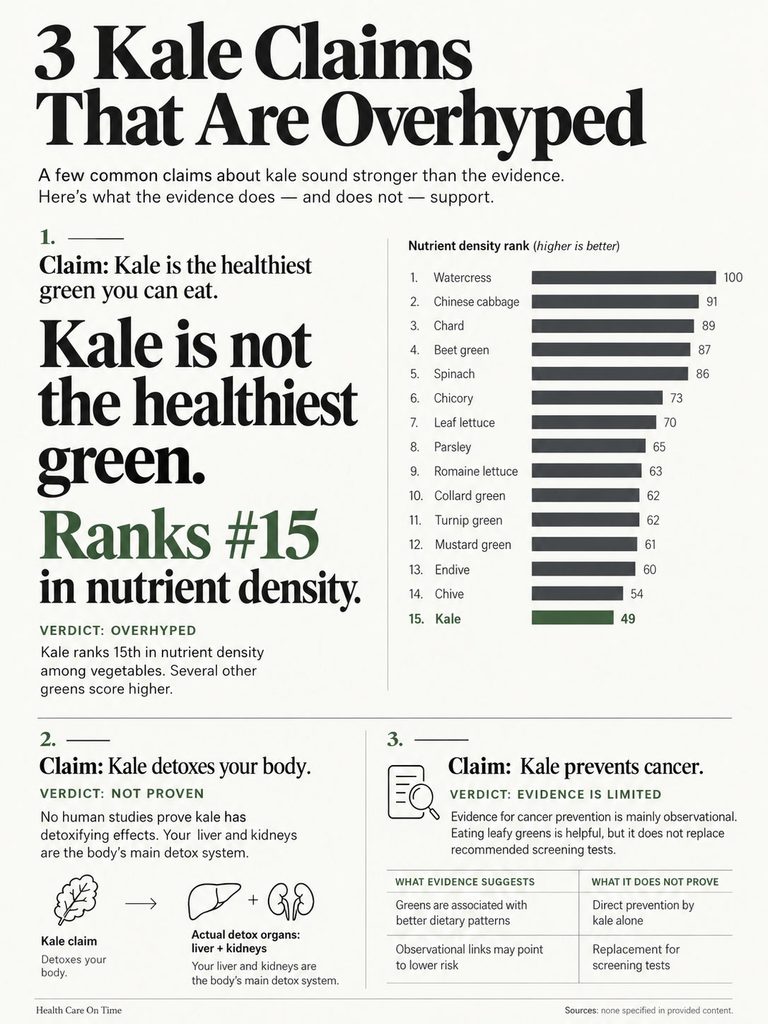
Cleveland Clinic’s kale page lists toxin removal among kale’s benefits. No human study shows kale clears toxins from your body.
Your liver and kidneys handle detoxification around the clock. Glucosinolates do switch on certain liver enzymes in lab and animal studies, but that’s not the same as a measurable detox effect in people.
Our medical reviewers treat “detox” as a marketing word, not a clinical outcome. If a product promises to detox you with kale, that’s your cue to skip it.
“Kale Prevents Cancer”
Many pages say kale fights cancer. The strongest direct support comes from animals: compounds in cruciferous vegetables have slowed bladder, breast, colon, liver, lung, and stomach cancers in rats and mice.
In people, the evidence is observational and covers cruciferous vegetables as a group, not kale alone. Higher intake is linked to modestly lower risk of some cancers, such as colorectal cancer. That’s encouraging, but it isn’t prevention.
Patients often ask us whether eating greens means they can skip a screening test. It doesn’t. The proven steps are still a varied diet, no tobacco, limited alcohol, and staying current on recommended cancer screening.
“Kale Is the Healthiest Green You Can Eat”
In 2014, the CDC journal Preventing Chronic Disease published a ranking of 41 “powerhouse” fruits and vegetables by nutrient density.
Kale scored 49.07. Watercress hit a perfect 100, Chinese cabbage scored 91.99, and spinach scored 86.43.
Kale finished 15th, behind chard, beet greens, leaf lettuce, romaine, collards, and chives. It still qualified as a powerhouse food. It just isn’t the champion its marketing suggests.
How Kale Compares to Spinach, Collards, and Other Greens
Where Kale Wins
Calcium absorption is kale’s clear edge. Spinach is high in oxalate, which binds calcium in your gut. Purdue research found only about 5% of spinach calcium gets absorbed, versus about 28% from milk in that study.
Kale is also low in oxalate overall, which matters if you’ve had calcium oxalate kidney stones. Our spinach health benefits and iron in spinach articles cover spinach’s tradeoffs in detail.
Where Kale Loses
Per calorie, spinach, chard, and watercress pack more of the 17 nutrients the CDC-journal ranking measured, including folate. Romaine lettuce even edged out kale.
In cases seen across our diagnostic network, people who lean on one “superfood” often eat fewer vegetables overall. Rotating your greens works better. Each one brings something the others lack.
Kale by the Numbers
| Statistic | Number | Source |
| Kale nutrient density score | 49.07 (15th of 41) | Di Noia, Preventing Chronic Disease (CDC), 2014 |
| Watercress / spinach nutrient density score | 100 / 86.43 | Di Noia, Preventing Chronic Disease (CDC), 2014 |
| Calcium absorption, kale vs. milk | 40.9% vs. 32.1% | Heaney and Weaver, American Journal of Clinical Nutrition, 1990 |
| Kale servings to match absorbed calcium in 1 glass of milk | About 3.2 servings (3 oz each) | Weaver bioavailability data, nutrition textbook table |
| Leafy greens linked to slower brain aging | About 1.3 servings/day; about 11 years “younger” | Morris et al., Neurology, 2018 (960 adults) |
| Kale samples with a possible-carcinogen pesticide residue | Nearly 60% | EWG analysis of USDA testing, 2026 |
| US adults meeting vegetable recommendations | 10.0% | CDC MMWR, 2022 |
Raw, Cooked, Juiced, or Chips: How to Get the Most From Kale
Add a Little Fat
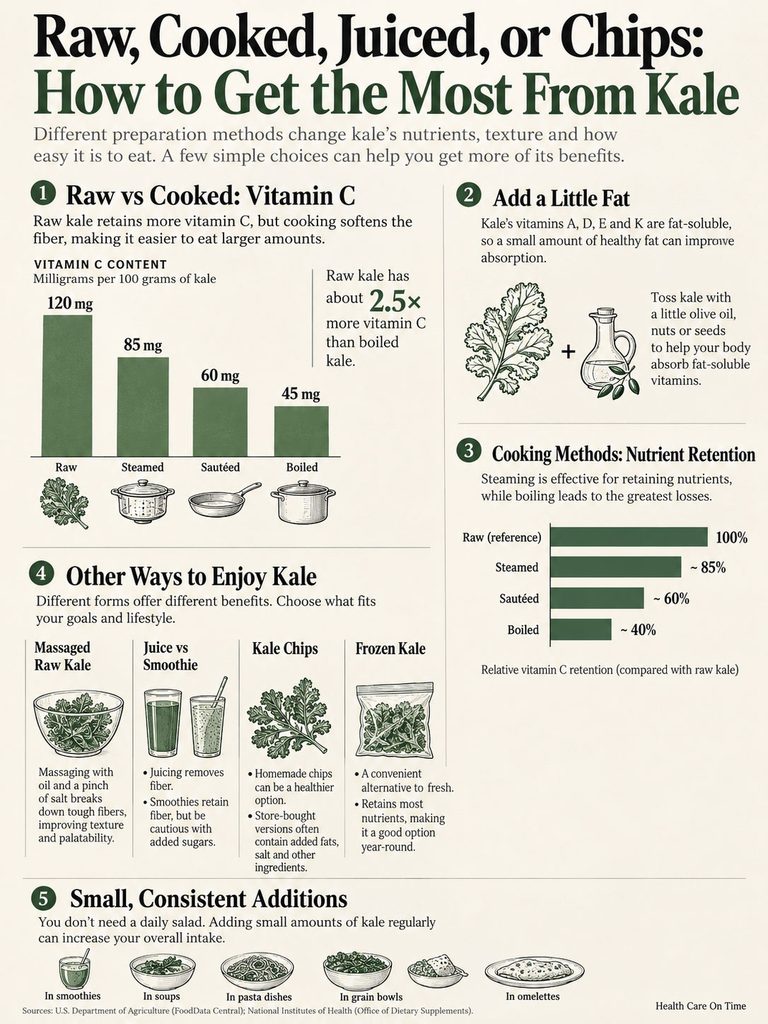
Beta-carotene, lutein, zeaxanthin, and vitamin K are all fat-soluble. A teaspoon of olive oil, a handful of nuts, or an egg alongside your kale helps you absorb them.
Raw vs. Cooked Kale
Raw kale keeps more vitamin C, which breaks down with heat and leaches into cooking water. Cooking softens fiber, shrinks volume, and lets you eat more leaves in one sitting.
Steaming for a few minutes is a good middle ground. A USDA Agricultural Research Service lab study found steamed kale bound bile acids better than raw kale. That’s a mechanism tied to cholesterol lowering, though it was a test-tube result, not a human trial.
Boiling loses the most water-soluble vitamins. If you boil kale, use the liquid in soup instead of pouring it down the drain.
Massaging Raw Kale
Rubbing chopped raw kale with a little oil and salt for about a minute breaks down its tough fibers. It turns a chewy salad into a tender one, which makes you far more likely to finish it.
The Juice and Smoothie Trap
Juicing removes most of the fiber, the part that keeps you full and feeds your gut bacteria. The cholesterol trial also used a daily dose most people won’t keep up for long.
Smoothies keep the fiber, which is better. Watch the fruit and sweeteners, though. A “green” smoothie can carry as much sugar as a can of soda.
Kale Chips
Homemade kale chips with a light spray of oil make a reasonable snack. Store-bought versions often add a lot of oil, salt, and cashew-based coatings, so read the Nutrition Facts panel.
Frozen vs. Fresh Kale
Frozen kale is blanched before freezing, which costs some vitamin C but keeps most minerals, vitamin K, and carotenoids. It’s often cheaper per serving and never wilts in the drawer.
For soups, stews, smoothies, and pasta sauces, frozen kale works just as well as fresh. Save fresh leaves for salads and quick sautés where texture matters.
5 Easy Ways to Eat More Kale
You don’t need a kale salad every day. Small additions add up across a week:
- Stir a handful of chopped kale into canned soup or chili during the last 3 minutes of heating.
- Blend a cup of baby kale into a fruit smoothie; the fruit hides the bitterness.
- Sauté kale with garlic and olive oil as a 5-minute side for chicken, fish, or eggs.
- Fold chopped kale into scrambled eggs, omelets, or breakfast burritos.
- Toss massaged kale into grain bowls with beans, avocado, and a lemon dressing.
Pairing kale with a little fat in each of these, such as olive oil, eggs, or avocado, also helps you absorb its carotenoids.
Buying and Storing Kale
Pick bunches with firm, deep-green leaves and no yellowing. Store kale unwashed in a loose bag in the crisper drawer, ideally at 32 to 36°F, and use it within about 5 days.
In cases reviewed by our medical team, the most common kale problem isn’t preparation. It’s buying a bunch, letting it wilt, and throwing it out. Prewashed bags and frozen kale fix that.
Who Should Be Careful With Kale
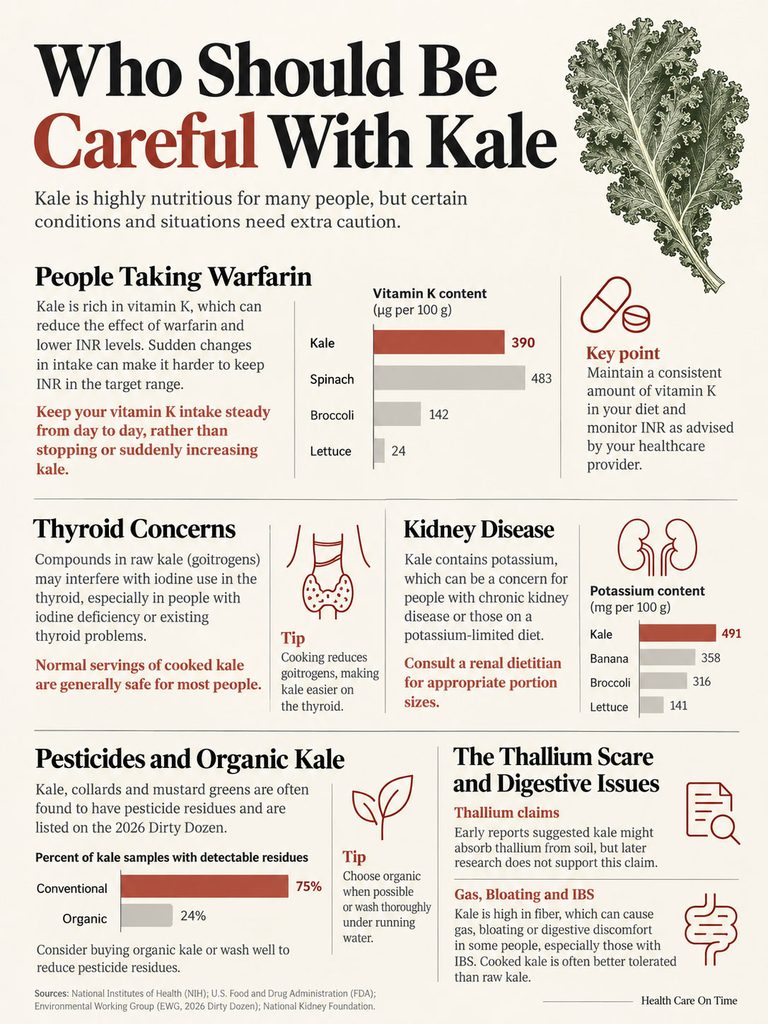
People Taking Warfarin
Warfarin (Coumadin) works by blocking vitamin K. A sudden jump in kale can lower your INR and raise clot risk; a sudden drop can push your INR too high.
You don’t need to avoid kale. The standard advice is to keep vitamin K intake steady from week to week so your dose can be set around it.
Across patients we serve, trouble usually starts with a new diet, a juice cleanse, or a holiday change in eating. Tell your anticoagulation clinic before big changes. Newer blood thinners such as apixaban aren’t affected by vitamin K. Our warfarin guide covers more.
Thyroid Concerns
Raw cruciferous vegetables contain goitrogens, which can interfere with how your thyroid uses iodine. Problems mainly show up with very large raw amounts plus low iodine intake. Normal cooked servings are fine for most people, including those with treated hypothyroidism.
For the full picture, see our guide Is Kale Good for Thyroid Health? and ask about a TSH test if you drink large raw kale juices daily.
Kidney Disease
Kale contains potassium. If you have advanced chronic kidney disease or follow a potassium-limited diet, follow your renal dietitian’s portion advice.
The good news for people prone to kidney stones: kale is low in oxalate, unlike spinach.
Pesticides and Organic Kale
Kale, collards, and mustard greens made EWG’s 2026 Dirty Dozen, which drew on USDA testing of 54,344 samples across 47 fruits and vegetables.
Nearly 60% of kale samples carried a residue of a pesticide considered a possible carcinogen. The main culprit was DCPA, which the EPA suspended on an emergency basis in August 2024.
If your budget allows, buy organic kale. If not, wash conventional kale well under running water. Eating it still beats skipping vegetables.
The Thallium Scare
In 2015, a widely shared magazine story claimed kale was absorbing thallium, a toxic metal, and making people sick. It rested on a small, non-peer-reviewed set of tests, and no later research confirmed a public health problem.
Gas, Bloating, and IBS
Kale’s fiber and sulfur compounds can cause gas, especially in large raw portions. Start small, cook it, and increase slowly. People with IBS often tolerate cooked kale better than raw.
How Much Kale Should You Eat?
There’s no official kale target. Earlier Dietary Guidelines for Americans suggested about 1½ cups of dark green vegetables per week on a 2,000-calorie diet. The 2025 to 2030 edition dropped separate vegetable subgroup targets in favor of overall vegetable intake.
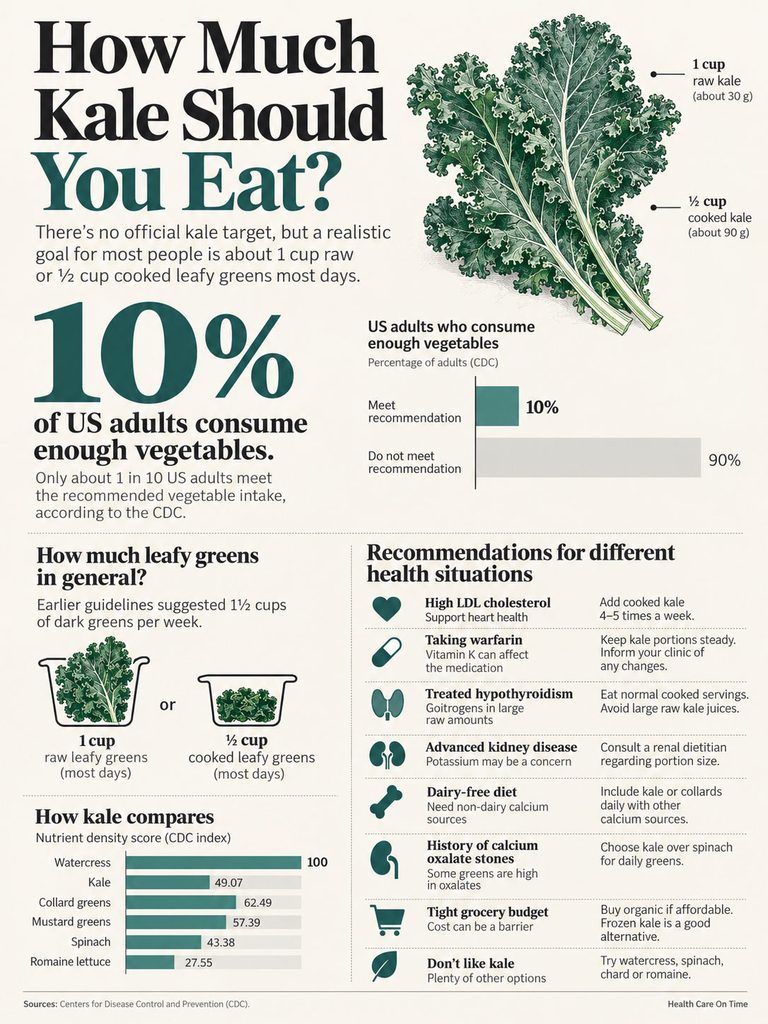
A realistic goal is about a cup of raw or half a cup of cooked leafy greens most days. That’s close to the amount linked to slower brain aging. Kale can be one of several greens in that rotation.
Only 10% of US adults eat enough vegetables, according to the CDC. Our team sees the same pattern: for most people, the problem isn’t too much kale. It’s too few vegetables of any kind.
What to Do Based on Your Situation
| Your Situation | What to Do | Why |
| High LDL cholesterol | Add cooked kale 4 to 5 times a week inside a heart-healthy diet; recheck lipids in 3 months | Kale juice trial showed a 10% LDL drop; diet works best as a pattern |
| Taking warfarin | Keep kale portions steady; tell your clinic before big changes | Vitamin K shifts your INR |
| Treated hypothyroidism | Eat normal cooked servings; skip daily large raw juices | Goitrogens matter mainly at high raw doses |
| Advanced kidney disease | Ask your renal dietitian about portion size | Kale contains potassium |
| Dairy-free diet | Eat kale or collards daily alongside other calcium sources | 41% absorption, but about 3 servings = 1 glass of milk |
| History of calcium oxalate stones | Choose kale over spinach for daily greens | Kale is low in oxalate |
| Tight grocery budget | Buy organic only if affordable; frozen kale works well | Dirty Dozen listing, but any vegetables beat none |
| Don’t like kale | Swap in watercress, spinach, chard, or romaine | All four score higher on nutrient density |
| Smoothie drinker | Blend instead of juicing; limit fruit to 1 cup | Juicing strips fiber; fruit adds sugar |
The Bottom Line on Kale
Kale earns a place on your plate, just not a throne. The best human data supports modest help with cholesterol, eye health, calcium intake, brain aging, and blood sugar after meals, mostly from small studies.
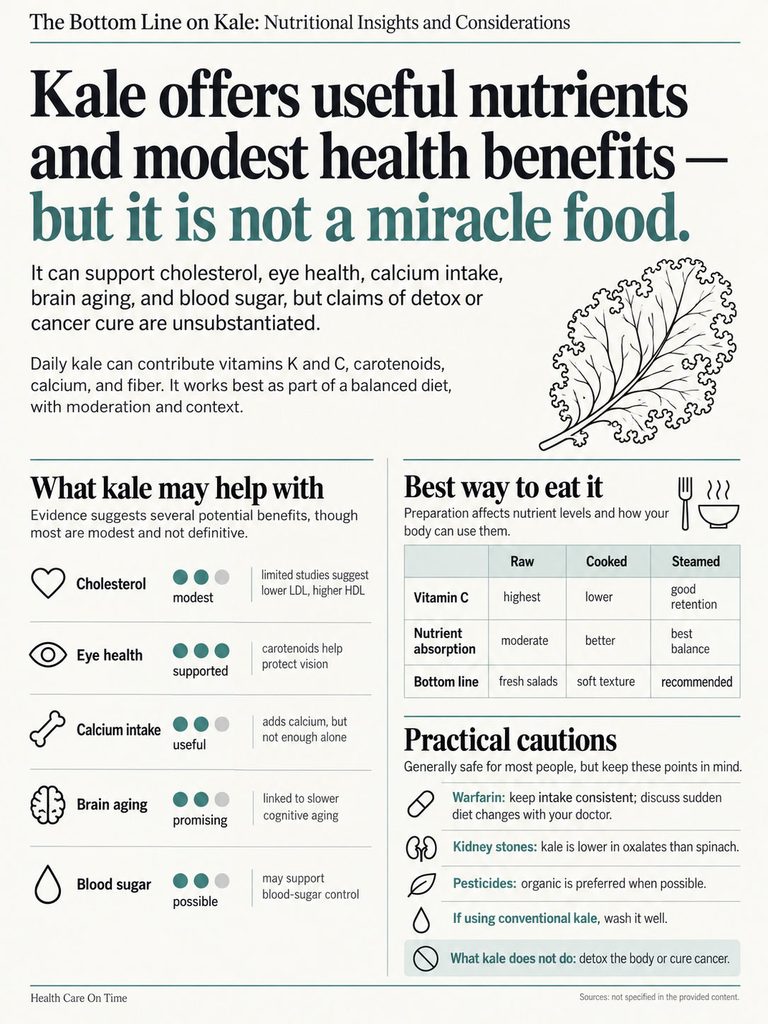
The detox, cancer cure, and “number one green” claims don’t hold up. Spinach, watercress, chard, and romaine each beat kale on some measures, so rotating greens gives you more than any single one.
If you take warfarin, have kidney disease, or drink large raw kale juices, talk with your doctor first. For everyone else, a cup of greens most days, eaten with a little fat, is a simple habit our medical team stands behind.
Frequently Asked Questions
Is kale really a superfood?
“Superfood” isn’t a medical term. Kale is nutrient-dense and has real benefits, but a CDC-journal ranking placed it 15th of 41 powerhouse foods, behind watercress, spinach, and romaine. Think of kale as one strong vegetable in a rotation rather than a miracle food that outperforms everything else.
What happens if you eat kale every day?
For most people, daily kale adds vitamin K, vitamin C, carotenoids, calcium, and fiber for very few calories. You may notice extra gas at first. If you take warfarin, daily kale is fine as long as the amount stays consistent and your anticoagulation clinic knows about it.
Is raw or cooked kale healthier?
Both work well. Raw kale keeps more vitamin C, while cooked kale lets you eat more leaves at once and pairs easily with fat for better carotenoid absorption. Steaming for a few minutes is a good balance. Avoid long boiling unless you use the cooking liquid in soup.
Does kale lower cholesterol?
A small Korean trial found that about 5 ounces of kale juice daily for 12 weeks lowered LDL by 10% and raised HDL by 27% in men with high cholesterol. That’s promising but limited. Kale helps most as part of an overall heart-healthy diet, not as a standalone treatment.
Is kale bad for your thyroid?
Not in normal amounts. Raw cruciferous vegetables contain goitrogens, but problems mainly appear with very large raw intakes plus low iodine. Cooking reduces the effect. People with hypothyroidism who take thyroid medication can usually eat cooked kale freely and discuss large raw juices with their doctor.
Can you eat kale while taking warfarin?
Yes. The key is consistency, not avoidance. Eating about the same amount of vitamin K each week lets your doctor set the right warfarin dose. Avoid sudden big increases or decreases in kale, and tell your anticoagulation clinic before starting any new diet or juice plan.
Is kale healthier than spinach?
Neither wins outright. Spinach scores higher on overall nutrient density and folate. Kale’s calcium is far better absorbed because spinach is high in oxalate. Kale is also the better pick if you’ve had kidney stones. Eating both, along with other greens, is the smartest approach.
Is kale juice as good as eating kale?
No. Juicing strips out most of the fiber, which supports fullness and gut health. The famous juice trial used about 5 ounces daily, the equivalent of roughly 10 cups of leaves. Blended smoothies keep the fiber and are a better choice than juice if you want to drink your greens.
Should you buy organic kale?
If you can afford it, yes. Kale, collards, and mustard greens are on EWG’s 2026 Dirty Dozen, and many conventional samples carry pesticide residues. If organic isn’t in your budget, wash conventional kale thoroughly under running water. Eating it still beats skipping greens entirely.
Can kale cause kidney stones?
Kale is low in oxalate, the compound behind most kidney stones, so it’s a better choice than spinach if you’re prone to stones. People with advanced kidney disease should still watch potassium and follow their care team’s advice on portion sizes for kale and other leafy greens.
How much kale is too much?
There’s no set upper limit for whole kale. Very large daily raw amounts, especially juiced, may cause gas or matter for thyroid health in people low in iodine. For most adults, one to two cups a day within a varied diet is plenty to get the benefits.
Is baby kale as nutritious as mature kale?
Mostly, yes. Baby kale is picked young, so its leaves are more tender and milder in flavor. Nutrient levels differ somewhat between baby and mature leaves, but not enough to matter in a normal diet. Choose whichever version you’ll actually eat on a regular basis.
Disclaimer: This article is for general information only and is not medical advice. Talk with your doctor or a registered dietitian before making major diet changes, especially if you take warfarin or another blood thinner, have kidney disease, or have a thyroid condition.
References
- Kim SY et al. Kale juice improves coronary artery disease risk factors in hypercholesterolemic men. Biomed Environ Sci, 2008
- Heaney RP, Weaver CM. Calcium absorption from kale. Am J Clin Nutr, 1990
- Di Noia J. Defining Powerhouse Fruits and Vegetables: A Nutrient Density Approach. Preventing Chronic Disease (CDC), 2014
- Kondo S et al. Intake of kale suppresses postprandial increases in plasma glucose. Biomedical Reports, 2016
- Morris MC et al. Nutrients and bioactives in green leafy vegetables and cognitive decline. Neurology, 2018 (summary via Brain & Life, American Academy of Neurology)
- National Eye Institute. Age-Related Eye Disease Studies (AREDS/AREDS2)
- NIH Office of Dietary Supplements. Vitamin K Fact Sheet for Health Professionals
- Environmental Working Group. Shopper’s Guide to Pesticides in Produce
- CDC MMWR. Adults Meeting Fruit and Vegetable Intake Recommendations, 2022
- Cleveland Clinic. Kale Benefits