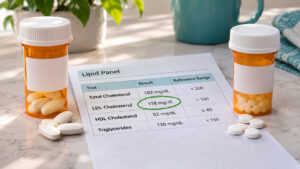
For most healthy adults, an energy drink now and then is very unlikely to hurt the liver. The liver injuries on record involve people drinking several cans a day for weeks, or a heavy burst within a single day, often with alcohol or an existing liver problem in the picture.
Table of Contents
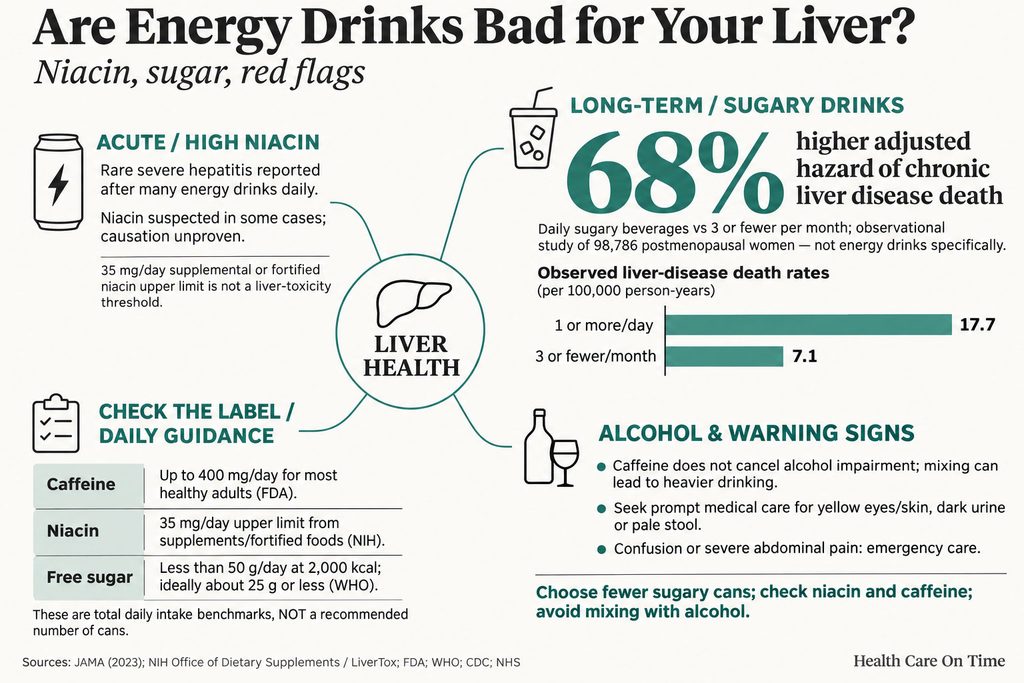
Quick answer: Energy drinks are an uncommon cause of liver damage, but they can harm the liver in two ways. Heavy daily use has been tied to a small number of acute hepatitis and liver failure cases, mostly blamed on high doses of added niacin (vitamin B3). Sugar-sweetened cans also add fructose that can build liver fat over the years. Keep caffeine under 400 mg a day, check the niacin line on the label, and don’t mix energy drinks with alcohol.
How the Liver Handles What’s in the Can
Almost everything in an energy drink passes through the liver. Caffeine is cleared mainly by liver enzymes, niacin is processed there, and the fructose half of table sugar is handled almost entirely by the liver, which turns any excess into fat. Herbal extracts such as guarana, ginseng and green tea extract also go through the liver before they leave the body.
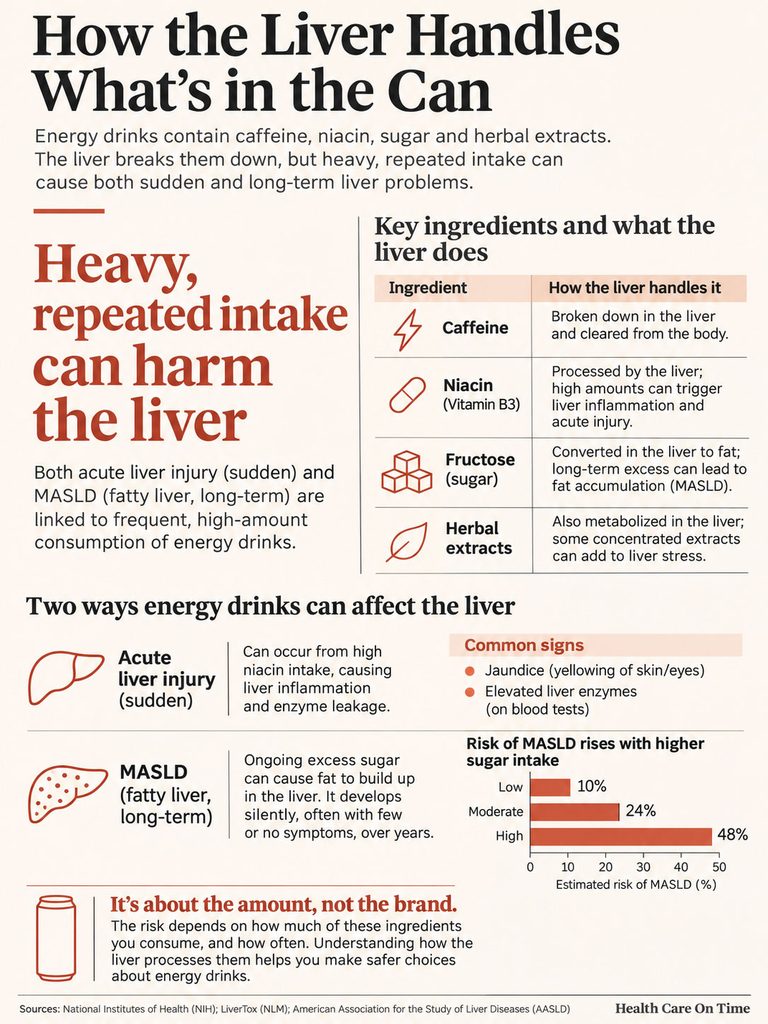
When energy drinks do cause liver trouble, it tends to come in one of two forms, and they work on very different clocks.
The first pattern is acute injury. Over days to weeks, liver cells become inflamed and start leaking liver enzymes into the blood, sometimes at levels in the thousands, and the skin and eyes can turn yellow. This is drug-induced or supplement-induced hepatitis, and in the energy drink cases niacin is the usual suspect.
The second pattern is slow. Extra sugar, year after year, adds fat to the liver, usually with few or no symptoms, and that fat can eventually lead to inflammation and scarring. Doctors now call this metabolic dysfunction-associated steatotic liver disease, or MASLD, the newer name for nonalcoholic fatty liver disease.
A single can fits neither pattern; both take repeated, heavy intake, so the amounts on the back of the can matter more than the brand.
Ingredient by Ingredient: What Can Hurt the Liver
Of everything in the can, niacin has the clearest record of direct liver injury. Sugar probably does more harm across decades of daily drinking, while caffeine, for all the attention it gets, has little proven effect on the liver itself.
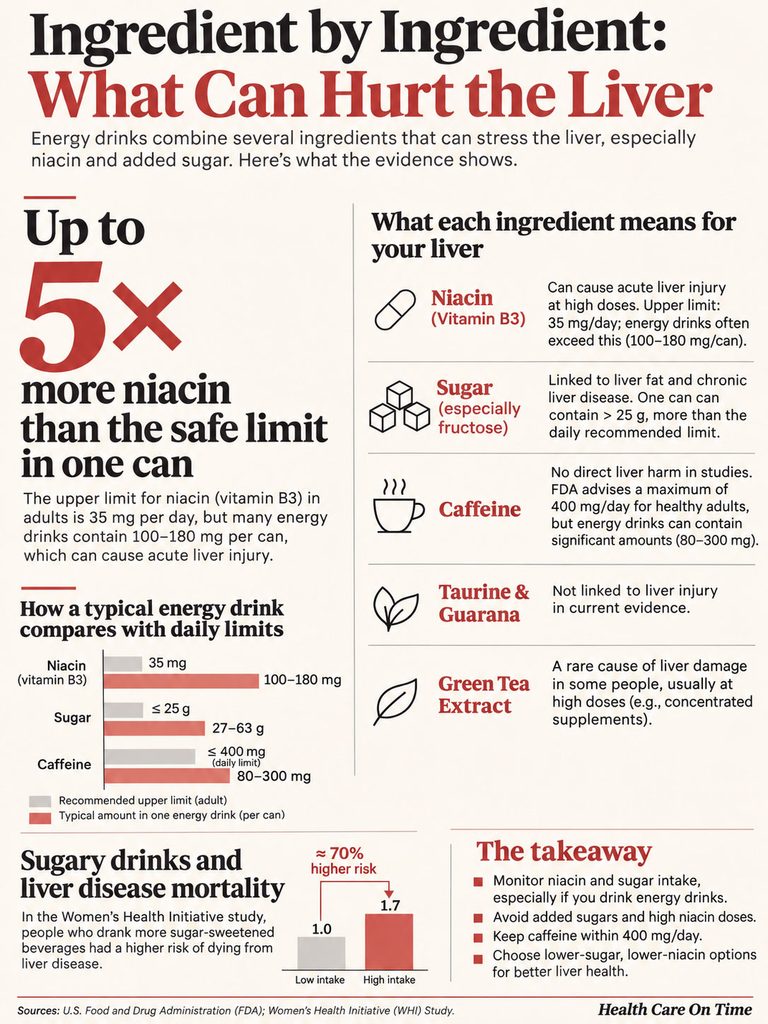
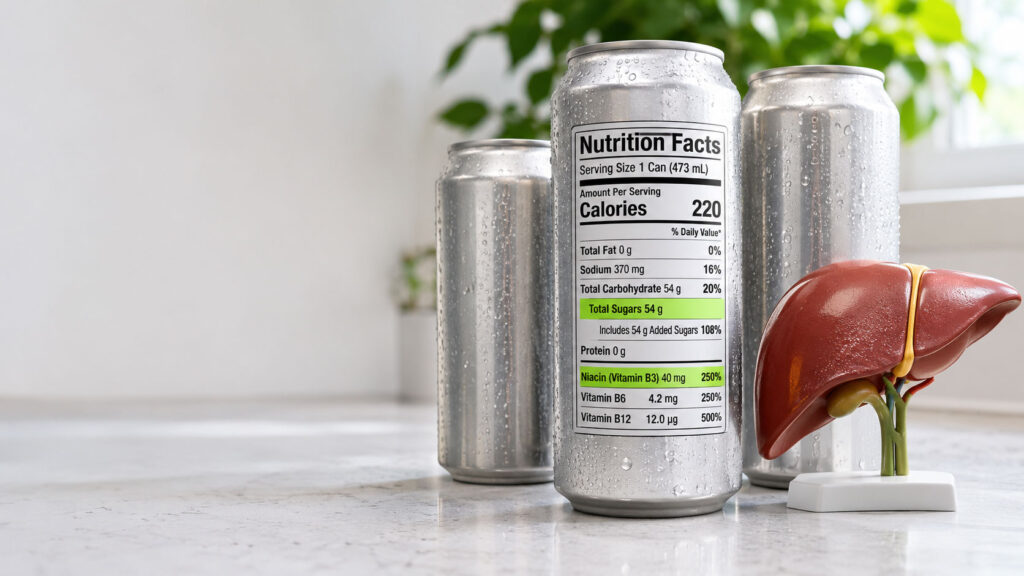
The table below uses amounts printed on current US labels. Niacin is often listed only as a percent of the Daily Value (DV); the DV for niacin is 16 mg, so 100% DV equals 16 mg and 250% DV works out to about 40 mg.
| Ingredient | What it can do to the liver | Point where it becomes a concern | Amount on a typical US can |
| Niacin (vitamin B3, usually as niacinamide) | High doses can cause acute hepatitis; the main suspect in published energy drink liver cases | Adult upper limit for added niacin is 35 mg a day; liver cases involved about 120 to 300 mg a day | Red Bull 8.4 oz: 100% DV (about 16 mg); Rockstar Original 16 oz: 16 mg; Celsius 12 oz: 20 mg; Monster Original 16 oz: 250% DV (about 40 mg) |
| Added sugar (sucrose, glucose) | Fructose is turned into liver fat; daily sugary drinks are linked to higher liver disease death rates | Federal guidelines advise avoiding added sugar and keeping any meal under 10 g | Red Bull 8.4 oz: 26 g; Monster Original 16 oz: 54 g; Rockstar Original 16 oz: 63 g |
| Caffeine (plus guarana, a plant source of caffeine) | Not shown to injure the liver by itself | FDA cites 400 mg a day for healthy adults; around 1,200 mg taken quickly can cause seizures | Red Bull 8.4 oz: 80 mg; Monster Original 16 oz: 160 mg; Rockstar Original 16 oz: 161 mg; Celsius 12 oz: 200 mg |
| Taurine, glucuronolactone, inositol, L-carnitine | No liver injury tied to them in the published energy drink cases | No liver threshold established | Usually inside an unquantified “energy blend” |
| Green tea extract (in some brands, such as Celsius) | Concentrated extract is a rare, unpredictable cause of supplement liver injury | Risk is idiosyncratic, so no safe or unsafe dose is defined | Amount per can not disclosed on the label |
| Nonnutritive sweeteners (sucralose, acesulfame potassium, erythritol) | Linked to liver fat in early observational data; no direct injury | Federal guidelines advise avoiding them | Present in sugar-free versions; amounts not listed |
Niacin: the ingredient behind most liver cases
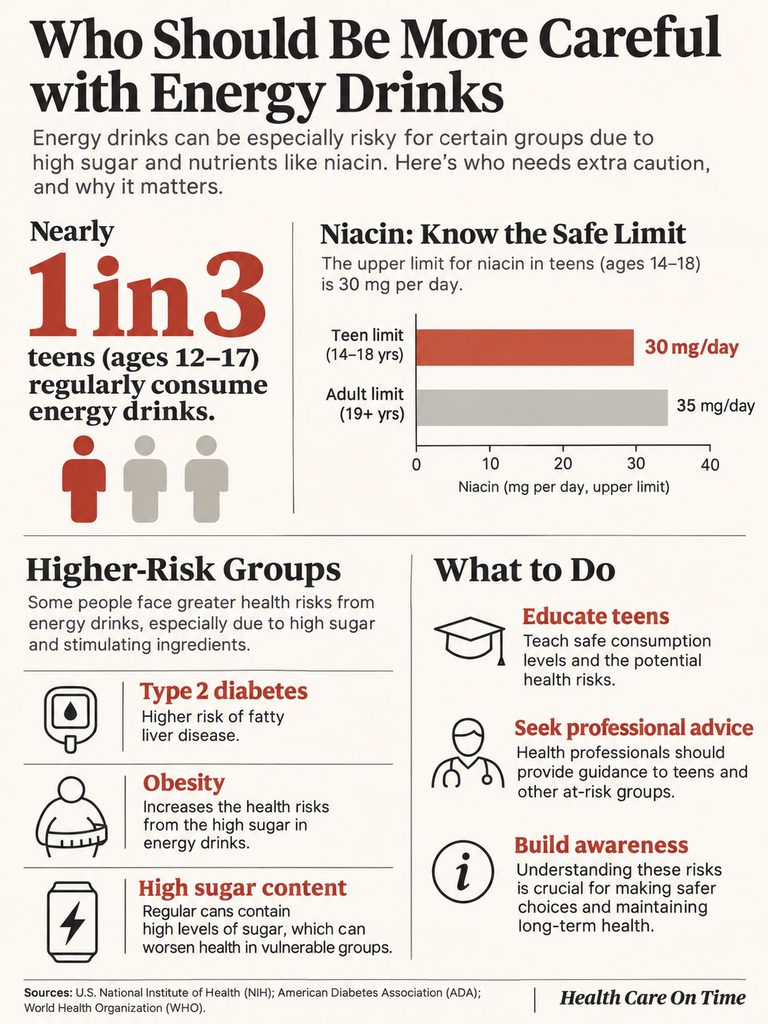
Niacin is a B vitamin your body needs in small amounts. The NIH Office of Dietary Supplements sets the adult Recommended Dietary Allowance at 16 mg a day for men and 14 mg for women, and the Tolerable Upper Intake Level at 35 mg a day for adults, 30 mg for teens 14 to 18, and 20 mg for children 9 to 13. That upper limit applies to supplemental niacin, not the niacin naturally in food, and it’s based on skin flushing rather than liver damage.
Liver toxicity from niacin usually takes far more. Prescription-strength nicotinic acid at 1,000 to 3,000 mg a day can cause serious side effects, high doses taken for months or years can be toxic to the liver, and extended-release forms carry more risk. Energy drinks mostly use niacinamide, which doesn’t cause flushing, so people can take in a lot of it without any warning sign on the skin.
Energy drinks still turn up in liver clinics because the published cases involved daily niacin intakes of roughly 120 to 300 mg, well under the classic toxic range but three to nine times the adult upper limit, kept up for weeks or longer. The doctors who wrote up the 2014 case suspected a cumulative effect, possibly made worse by years of binge drinking. Nobody has shown exactly how low the risky dose goes, which is one more reason to keep added niacin near the upper limit, not far above it.
Two cans of Monster Original, at about 40 mg each, already carry more than twice the 35 mg limit, and a B-complex vitamin taken the same morning pushes the total higher still.
Sugar and liver fat
A single 16-ounce can may hold 54 to 62 grams of added sugar, more than the recommended maximum for a whole day. The fructose half of that sugar goes straight to the liver, and steady overload turns into stored fat.
The strongest US evidence on sugary drinks and the liver comes from the Women’s Health Initiative. In a 2023 JAMA study of 98,786 postmenopausal women followed for a median of 20.9 years, those who drank one or more sugar-sweetened beverages a day had a chronic liver disease death rate of 17.7 per 100,000 person-years, compared with 7.1 among women who drank three or fewer a month, an adjusted hazard ratio of 1.68. Liver cancer rates were higher as well (18.0 vs 10.3 per 100,000 person-years). The study asked only about soft drinks and fruit drinks, and it was observational, so it shows a link and can’t prove cause.
The current Dietary Guidelines for Americans, 2025–2030 advise avoiding added sugars altogether, name energy drinks among the sugar-sweetened beverages to skip, and say any meal with added sugar should stay under 10 g. One Red Bull carries 26 g.
Caffeine and the liver
Caffeine is the ingredient most people worry about, yet the evidence for direct liver harm is thin. The authors of a 2024 transplant case wrote that caffeine by itself likely does not cause liver injury, pointing out that autopsy-based reports of caffeine toxicity found no liver damage. Caffeine’s known harms are mostly to the heart and nervous system: fast heart rate, palpitations, high blood pressure, anxiety and, at very high doses, seizures.
Caffeine still sets the ceiling on how many cans make sense. For healthy adults, 400 mg a day is the amount the FDA treats as not generally linked to negative effects, and energy drinks range from 54 to 328 mg per 16 fluid ounces, so three cans of a strong brand can push past the limit before dinner. Switching to black coffee keeps the caffeine and drops the sugar and niacin, which makes energy drinks vs coffee an easy call where the liver is concerned.
Taurine, guarana and the herbal blend
Taurine is an amino acid your body already makes and gets from meat and fish, and the published liver cases don’t point to it. Guarana is mostly a second source of caffeine. Green tea extract, found in some fitness-style energy drinks, has a more troubling record.
As a concentrated supplement ingredient, it’s a known if rare cause of liver injury. In the federally funded Drug-Induced Liver Injury Network, 40 of 1,414 assessed cases (3%) were attributed to green tea, 35% of those were severe, and 8% needed a liver transplant. The reaction appears to be immune-driven and tied to a gene variant, HLA-B*35:01, found in 72% of the green tea cases. Energy drink labels don’t say how much extract is inside, so the risk from one can is unknown and probably small, but anyone who has had a reaction to a green tea supplement should skip drinks that contain it.
What the Published Liver Cases Show
Energy drinks and serious liver injury have been linked in only a handful of published cases. Each describes one patient, so none proves that energy drinks damage livers in general.
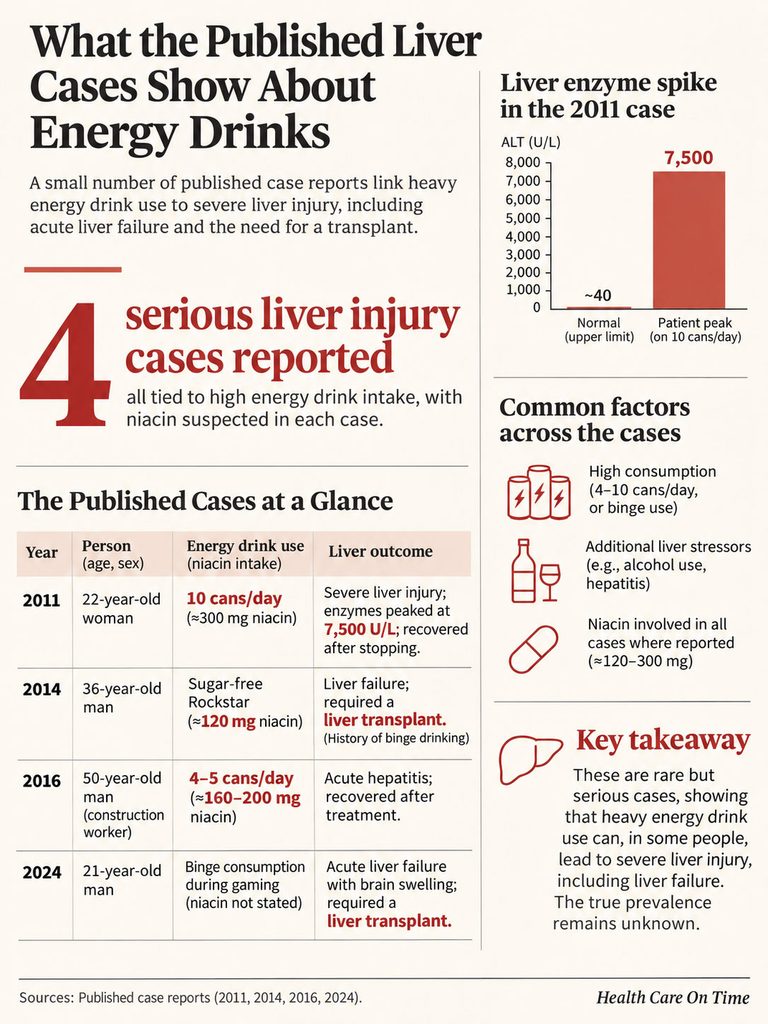
A healthy 22-year-old woman drank about 10 cans a day for two weeks, roughly 300 mg of niacin a day, in the first case to be published, in 2011. Her ALT and AST, two key liver enzyme tests, rose above 7,500 U/L. After she stopped, she recovered, and a month later her ALT was 22 and her AST 26, both normal.
Going sugar-free didn’t protect a 36-year-old man described in 2014, who drank three 8-ounce cans of a sugar-free Rockstar every day for a year, about 120 mg of niacin a day. He also had a 15-year habit of weekend binge drinking and had downed 10 beers about three hours before his symptoms began. His bilirubin reached 16.1 mg/dL, his liver failed, and he needed a transplant. The authors suspected niacin and proposed that years of alcohol use had changed how his liver processed it, making him more vulnerable.
A construction worker, 50, treated in Florida and written up in 2016, drank four to five energy drinks a day for about three weeks to keep up. Each bottle had 40 mg of niacin, so he was taking in an estimated 160 to 200 mg a day. Tests showed he had been infected with hepatitis C at some point. He developed acute hepatitis and recovered after treatment and stopping the drinks.
The 2024 case involved a 21-year-old man with no long habit at all. He drank multiple energy drinks in quick succession over about 24 hours to stay awake through a video game stream lasting more than 30 hours. He had also used cannabis that week. He developed acute liver failure with brain swelling and received a liver transplant on his third day in the hospital.
In every case the person drank far more than one can a day, usually for weeks or in a single heavy binge, and in two of them a second liver stressor (binge drinking, an old hepatitis C infection) sat in the background. Niacin was the leading suspect wherever the doctors named one. Two of the four recovered after stopping, with blood tests showing signs the liver was healing within weeks to a month; the other two needed a transplant.
Published cases also tend to collect the dramatic outcomes, since mild enzyme bumps that settle on their own rarely get written up. The true number of people with energy drink liver stress is unknown, and so is the number who drink heavily with no liver effect at all.
How Many Energy Drinks a Day Is Too Many?
No health agency has set a liver-specific limit for energy drinks, so the useful limits come from the ingredients. For a healthy adult, three numbers matter most: 400 mg of caffeine a day, 35 mg of added niacin a day, and as little added sugar as possible.
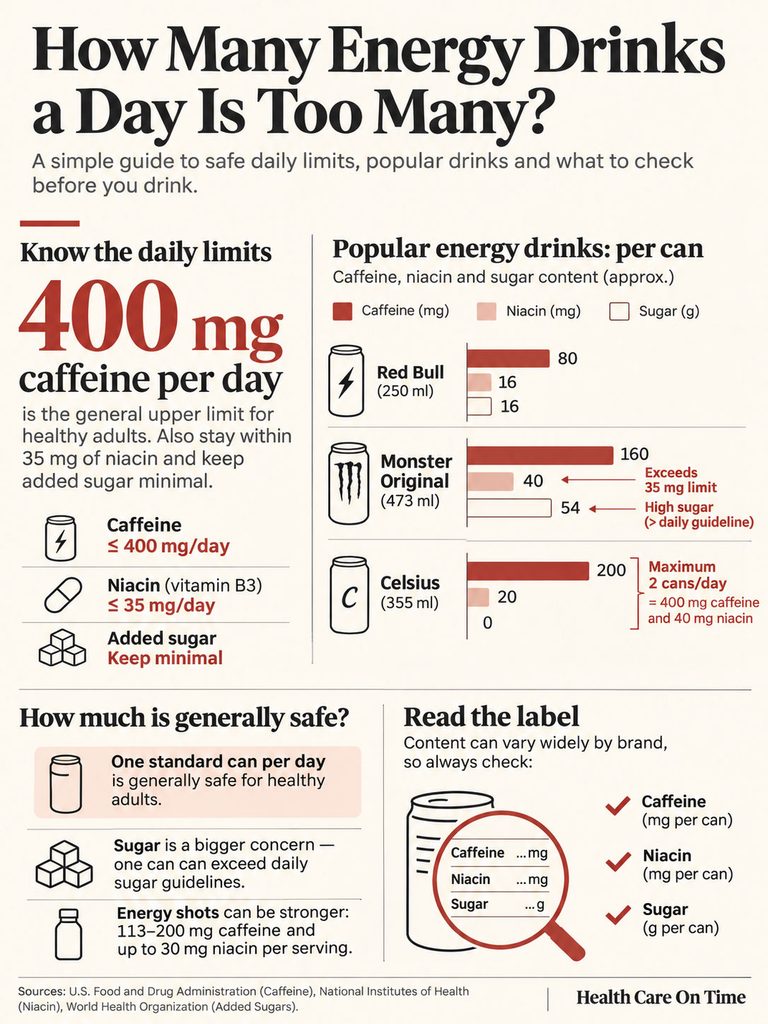
One 8.4-ounce Red Bull stays inside all three except sugar, with 80 mg of caffeine and about 16 mg of niacin. One Monster Original, with 160 mg of caffeine, 54 g of sugar and about 40 mg of niacin, already passes the niacin limit and the sugar guidance in a single can. Two Celsius cans, the maximum its label allows, add up to 400 mg of caffeine and 40 mg of niacin. That’s the whole caffeine budget for the day, gone by lunch.
For a healthy adult with no liver disease who doesn’t drink heavily, one standard can a day hasn’t been linked to liver injury in the published cases. With sugared cans the more realistic daily worry is the sugar, since one can often carries more than the Dietary Guidelines would accept across a whole day. A sugar-free can of a brand with a lower niacin count is the lower-risk version of a daily habit.
Past two cans, there’s little room left on niacin or caffeine. People who reach for a third or fourth can, especially on long shifts or study nights, are the group the published cases describe.
Energy shots count too
Small energy shots are easy to forget when you add up a day, even though a 2 to 2.5 ounce shot holds 113 to 200 mg of caffeine. The drink in the 2011 case listed 30 mg of niacin per 2-ounce serving, close to the whole adult upper limit in a few sips, along with large doses of vitamins B6 and B12.
Reading the label in 30 seconds
Turn the can around and check three lines before you buy a second one. Look for the caffeine amount, which is often printed near the ingredient list rather than in the Nutrition Facts panel; the niacin line, where 100% DV means about 16 mg; and added sugars in grams. Then multiply by the number of cans you actually drink, plus any vitamins or other caffeine you take that day, and compare the totals with 400 mg, 35 mg and 10 g per meal.
Sugar-Free vs Regular Energy Drinks vs Alcohol
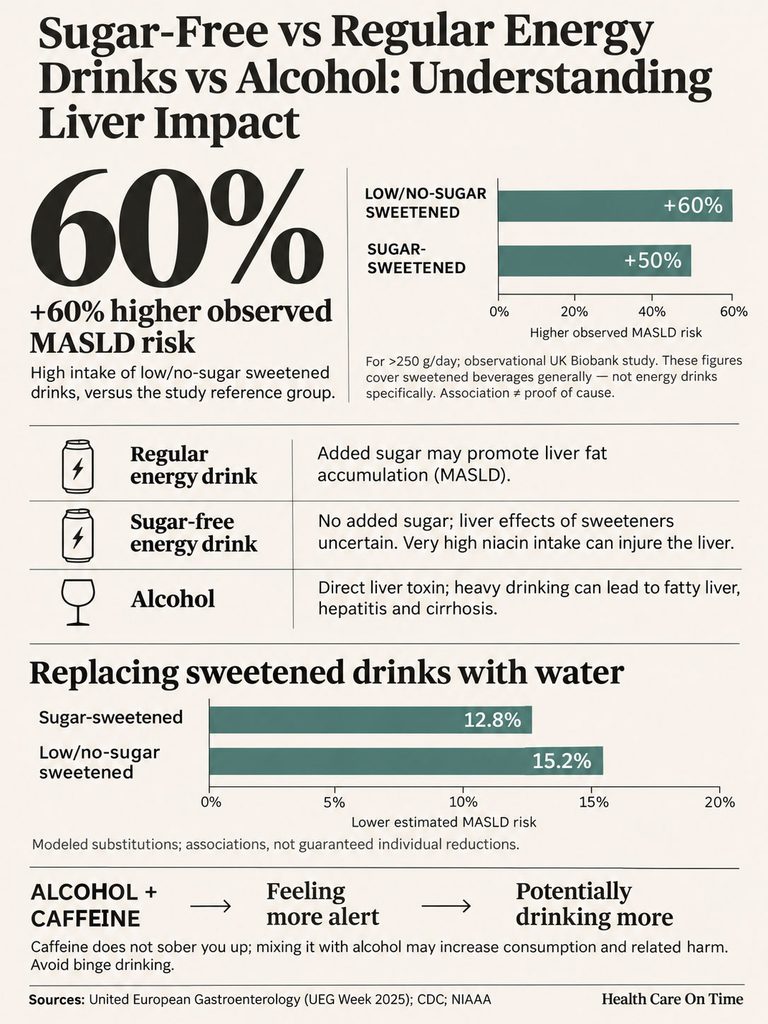
Swapping a sugared can for a sugar-free one removes the biggest long-term liver burden, but it leaves the niacin, the caffeine and the herbal blend in place. Alcohol is a different matter, a direct liver toxin with decades of evidence behind it.
| Factor | Regular energy drink | Sugar-free energy drink | Alcohol |
| Main liver concern | Added sugar driving liver fat, plus niacin at high intake | Niacin at high intake; possible sweetener effects | Direct toxicity to liver cells |
| Typical liver disease it’s tied to | MASLD (fatty liver) over years; rare acute hepatitis with heavy use | Rare acute hepatitis with heavy use | Alcohol-associated fatty liver, hepatitis, cirrhosis |
| Sugar per can | 26 g (Red Bull 8.4 oz) to 63 g (Rockstar 16 oz) | 0 g | None in straight spirits; sugary mixers add more |
| Strength of evidence | Large US cohort links daily sugary drinks to liver deaths | A few case reports; early cohort data on sweeteners | Decades of data; 42.8% of 2018 US liver disease deaths involved alcohol |
| Liver effect of one serving | Minimal | Minimal | Low for most healthy adults; risk rises with binge and heavy drinking |
| What happens with combining | Caffeine can mask drunkenness and lead to more drinking | Same masking effect | Raises total liver load |
Are sugar-free energy drinks safer for the liver?
For fatty liver risk, probably yes, though the evidence isn’t settled. In the Women’s Health Initiative study, artificially sweetened drinks were not tied to liver cancer or liver disease deaths (hazard ratios of 1.17 and 0.95, neither statistically significant), in contrast with sugary drinks.
A newer British analysis complicates that. In a study of 123,788 UK Biobank adults presented at UEG Week 2025, people who drank more than 250 grams a day (about one can) of low- or no-sugar drinks had a 60% higher risk of developing MASLD over a median of 10.3 years, compared with a 50% higher risk for sugary drinks, and only the diet drinks were linked to liver-related deaths. The findings are early, from a conference presentation rather than a published paper, and the adults were British. Replacing either kind of drink with water lowered MASLD risk by 12.8% to 15.2%.
The sugar-free Rockstar in the 2014 case is a reminder that removing sugar does nothing about niacin.
Energy drinks and alcohol together
Most of the extra harm from mixing the two comes through behavior. Caffeine doesn’t blunt alcohol’s effects on the body, but it can make a person feel more alert, so they keep drinking. About one in five college students mix alcohol with energy drinks in a given year, and in November 2010 the FDA found that adding caffeine to alcoholic beverages was unsafe, after which producers removed the caffeine from premixed versions.
More drinks per night means more alcohol reaching the liver, and binge drinking (about four drinks for women or five for men within roughly two hours) is a common path to the kind of liver damage alcohol causes, from fatty liver to cirrhosis. The 36-year-old who needed a transplant was a weekend binge drinker. On a night out, club soda or water is the safer mixer.
US Numbers Behind the Concern
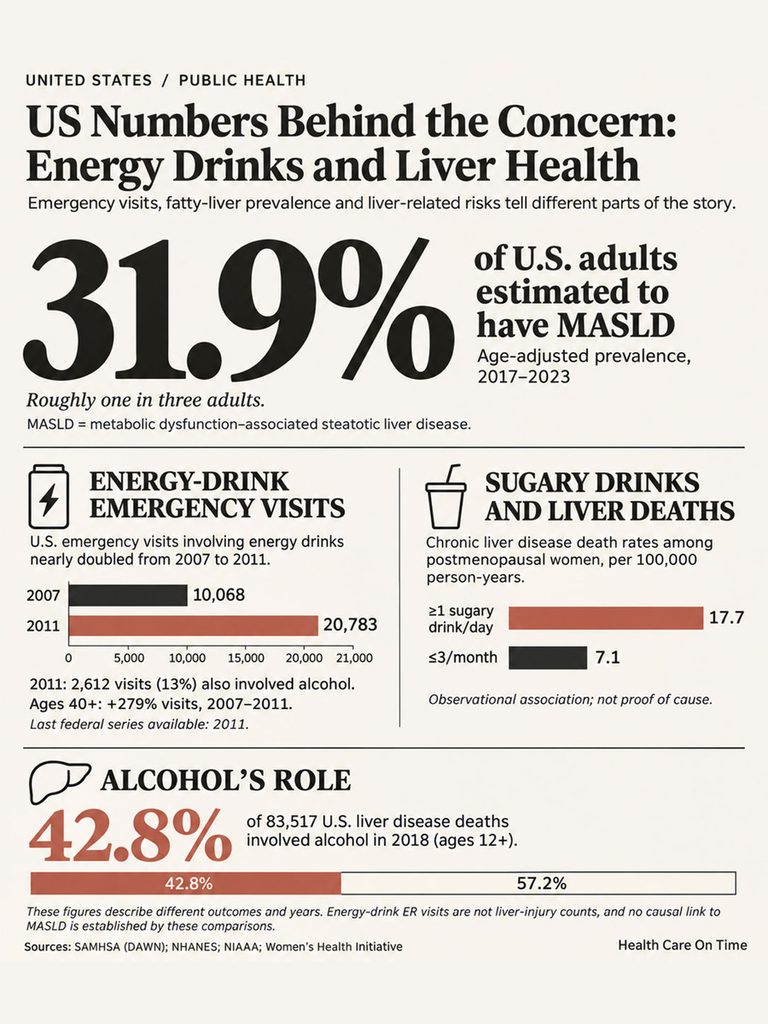
Energy drink emergencies are a small slice of US hospital care, and the federal ER tally stopped at 2011. Fatty liver is another story: liver scans of 12,199 adults suggest about a third of US adults already have it, and alcohol shows up in a large share of liver deaths.
| Measure | Figure | Source |
| ER visits involving energy drinks | 10,068 in 2007; 20,783 in 2011 | SAMHSA Drug Abuse Warning Network |
| Share of 2011 energy drink ER visits that also involved alcohol | 13% (2,612 visits) | SAMHSA Drug Abuse Warning Network |
| Energy drink ER visits among adults 40 and older | Up 279% from 2007 to 2011 | SAMHSA Drug Abuse Warning Network |
| US adults with MASLD (fatty liver not caused by alcohol) | 31.9%, age-adjusted, 2017–2023 | NHANES analysis, Clinical and Molecular Hepatology |
| US liver disease deaths involving alcohol | 42.8% of 83,517 deaths in 2018 | NIAAA |
| Women drinking 1+ sugary drinks a day, chronic liver disease deaths | 17.7 vs 7.1 per 100,000 person-years | JAMA, Women’s Health Initiative |
Who Should Be More Careful
These groups have less room for error:
- Anyone with known liver disease, including fatty liver, hepatitis B or C, or cirrhosis. The 2016 case involved a man with past hepatitis C infection, and a damaged liver has less reserve to absorb another insult.
- Heavy or binge drinkers, whose livers may already be under strain.
- People who take a B-complex, multivitamin or niacin supplement, since the niacin adds up.
- Anyone who has had liver injury from a supplement, especially one containing green tea extract.
- Children and teens. Medical experts advise against energy drinks for this age group, and the Red Bull, Monster, Rockstar and Celsius labels all carry warnings for children and for people who are pregnant or nursing.
Nearly one-third of teens ages 12 to 17 drink energy drinks regularly, and their niacin upper limit is lower, at 30 mg a day for ages 14 to 18.
People with type 2 diabetes or obesity already carry a higher risk of fatty liver, so the sugar in regular cans weighs more heavily for them.
Liver Warning Signs and When to See a Doctor
Liver trouble often causes no symptoms until it’s advanced, which is why blood tests catch many problems first. When symptoms of liver disease do appear, they can include:
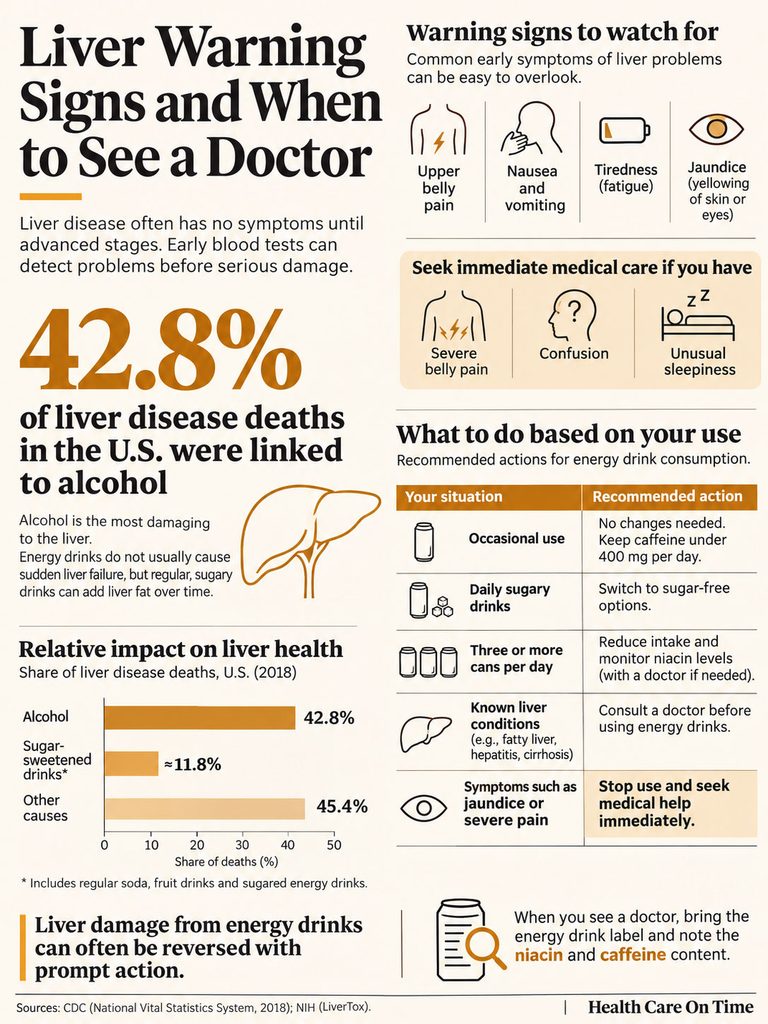
- Yellowing of the skin and the whites of the eyes (jaundice), which can be harder to see on darker skin
- Dark urine, or pale stools
- Pain and swelling in the abdomen
- Swelling in the legs and ankles
- Itchy skin and easy bruising, two common skin signs of liver damage
- Constant tiredness, nausea or vomiting, and loss of appetite
In the energy drink cases, the first complaints were usually upper belly pain, nausea or vomiting, and tiredness, with jaundice following.
If you’ve been drinking several cans a day and notice those symptoms, stop the drinks and call your doctor the same day. Don’t wait it out. Seek emergency care for belly pain so bad you can’t stay still, or for confusion or unusual sleepiness, which in liver failure can signal that toxins are reaching the brain.
When you see a doctor, bring the cans or photos of the labels so they can see the niacin and caffeine amounts. Mention every can, shot and supplement, even the ones that seem too small to matter. Some questions to bring:
- “Could the energy drinks explain these liver numbers, or should we look for something else first?”
- “Do we need to recheck the ALT and AST after a few weeks off the drinks?”
- “Does the niacin in these cans add up to too much with the multivitamin on top?”
- “The scan showed fatty liver. Is one sugar-free can a day still okay, or is it time to quit?”
| Your situation | What to do | Why |
| One can now and then, no liver disease | No liver-specific change needed; keep caffeine under 400 mg a day | No liver injury has been tied to occasional use |
| One sugared can every day | Switch to sugar-free or a smaller can, or replace it with water or unsweetened coffee | Daily sugary drinks are linked to higher liver disease death rates |
| Three or more cans a day, or a 24-hour binge | Cut back now; add up niacin from the labels and keep it near 35 mg | Every published liver case involved this level of use |
| Energy drinks mixed with alcohol | Stop combining them | Caffeine masks drunkenness and leads to more drinking |
| Known fatty liver, hepatitis or cirrhosis | Ask your doctor before any energy drink use | Existing damage leaves less margin, especially with niacin |
| Jaundice, dark urine or upper belly pain after heavy use | Stop the drinks and call a doctor the same day; go to the ER for severe pain or confusion | These match the early signs in published cases |
Frequently Asked Questions
Will energy drinks hurt the liver?
Occasional use is very unlikely to. Heavy use, usually several cans a day for weeks, has been linked to rare cases of acute hepatitis and liver failure, mostly blamed on high niacin intake, and daily sugary cans can add liver fat over years.
Is it bad to have one energy drink a day?
Not for the liver, if you’re a healthy adult who doesn’t drink heavily. With a regular can, the sugar is the bigger daily problem.
What drinks are hardest on the liver?
Alcohol is by far the hardest on the liver; it was involved in 42.8% of US liver disease deaths in 2018. After alcohol, sugar-sweetened drinks such as regular soda, fruit drinks and sugared energy drinks are linked to fatty liver and, in one large study, higher liver disease death rates. Very high-niacin energy drinks and supplements containing concentrated green tea extract are rarer causes of acute injury.
What organ is most affected by energy drinks?
Most energy drink complaints involve the heart and nervous system, since caffeine is what most people overdo: a racing pulse, palpitations, jitters and lost sleep. Liver injuries have been reported, but they’re rare and mostly involve heavy use.
Can energy drinks cause fatty liver?
Regular ones can contribute over time, because the liver turns surplus fructose into fat, and a daily sugared can adds up over months. Early data suggest even sugar-free versions may be linked to liver fat, though that research is still preliminary.
How much niacin is too much?
The adult upper limit for added niacin is 35 mg a day. Liver cases from energy drinks involved roughly 120 to 300 mg a day for weeks, and prescription doses of 1,000 to 3,000 mg can be toxic to the liver.
Is Red Bull or Monster worse for your liver?
Per can, Monster Original carries more of everything that matters for the liver. It has 54 g of sugar and about 40 mg of niacin (250% DV) in 16 ounces, compared with 26 g of sugar and about 16 mg of niacin in an 8.4-ounce Red Bull. Ounce for ounce they’re similar; the bigger can is the difference. Neither has been singled out in a published liver case, and the brand matters less than how many cans you drink and whether you add alcohol. If you drink one a day, the smaller can or a sugar-free version keeps niacin and sugar lower.
Is liver damage from energy drinks reversible?
Often, yes. In two of the four cases above, liver enzymes returned toward normal within weeks to a month after the person stopped. The other two progressed to liver failure and needed transplants, so early symptoms deserve prompt attention.
Medical disclaimer: This article is for general information and isn’t a substitute for advice from your doctor. If you have symptoms of liver disease, take medicines or supplements, or have a known liver condition, talk with a healthcare professional before changing how much caffeine, niacin or energy drinks you consume.
References
- U.S. Food and Drug Administration. Spilling the Beans: How Much Caffeine Is Too Much? Content current as of August 28, 2024. https://www.fda.gov/consumers/consumer-updates/spilling-beans-how-much-caffeine-too-much
- NIH Office of Dietary Supplements. Niacin: Fact Sheet for Health Professionals. Updated November 18, 2022. https://ods.od.nih.gov/factsheets/Niacin-HealthProfessional/
- National Center for Complementary and Integrative Health. Energy Drinks. Updated July 2018. https://www.nccih.nih.gov/health/energy-drinks
- Substance Abuse and Mental Health Services Administration. The DAWN Report: Update on Emergency Department Visits Involving Energy Drinks. January 10, 2013. https://www.samhsa.gov/data/sites/default/files/DAWN126/DAWN126/sr126-energy-drinks-use.htm
- Centers for Disease Control and Prevention. Effects of Mixing Alcohol and Caffeine. https://cdc.gov/alcohol/fact-sheets/caffeine-and-alcohol.htm
- Zhao L, et al. Sugar-Sweetened and Artificially Sweetened Beverages and Risk of Liver Cancer and Chronic Liver Disease Mortality. JAMA. 2023;330(6):537-546. https://pmc.ncbi.nlm.nih.gov/articles/PMC10410478
- Liu L, et al. Sugar- and low/non-sugar-sweetened beverages and risks of MASLD and liver-related mortality: UK Biobank. Presented at UEG Week 2025. https://ueg.eu/a/378
- Elsayed S, Nelson M. Dietary Guidelines for 2025–2030: Recommendations From the USDA and HHS. American Family Physician. 2026;114(1):98-100. https://aafp.org/afp/2026/0700/practice-guidelines-dietary-guidelines
- Current burden of steatotic liver disease and fibrosis among adults in the United States, 2017-2023. Clinical and Molecular Hepatology. 2025;31(2):382-393. https://pubmed.ncbi.nlm.nih.gov/39610192/
- National Institute of Diabetes and Digestive and Kidney Diseases. Nonalcoholic Fatty Liver Disease (MASLD) and NASH. https://www.niddk.nih.gov/health-information/liver-disease/nafld-nash/all-content
- National Institute on Alcohol Abuse and Alcoholism. Alcohol Facts and Statistics. https://niaaa.nih.gov/sites/default/files/publications/NIAAA_Alcohol_FactsandStats_102020.pdf
- Mayo Clinic. Liver disease: Symptoms and causes. https://www.mayoclinic.org/diseases-conditions/liver-problems/symptoms-causes/syc-20374502
- Vivekanandarajah A, Ni S, Waked A. Acute hepatitis in a woman following excessive ingestion of an energy drink: a case report. J Med Case Rep. 2011;5:227. https://pmc.ncbi.nlm.nih.gov/articles/PMC3141691
- Huang B, Kunkel D, El Kabany M. Acute Liver Failure Following One Year of Daily Consumption of a Sugar-Free Energy Drink. ACG Case Rep J. 2014;1(4):214-216. https://pmc.ncbi.nlm.nih.gov/articles/PMC4435335/
- CBS News. Too many energy drinks caused man’s “acute” health crisis, doctors say (on Harb JN et al., BMJ Case Reports, 2016). https://www.cbsnews.com/news/energy-drinks-caused-acute-hepatitis-liver-damage-doctors-report
- Jesse BD, Nguyen NV, Balasanova AA. Acute liver failure and liver transplant after energy drink consumption. Prim Care Companion CNS Disord. 2024;26(1):23cr03613. https://www.psychiatrist.com/wp-content/uploads/2024/01/acute-liver-failure-liver-transplant-energy-drink-consumption-pcc-23cr03613.pdf
- Ahmad J, et al. Characterization of green tea-associated liver injury (Drug-Induced Liver Injury Network). 2021. https://repository.niddk.nih.gov/publications/222
- Product labels: Red Bull Energy Drink 8.4 fl oz (https://www.redbull.com/us-en/energydrink/red-bull-energy-drink-ingredients-list); Rockstar Original 16 fl oz (https://www.rockstarenergy.com/products/original-og); Monster Energy Original 16 oz (https://www.heb.com/product-detail/product/4773570); Celsius Sparkling Watermelon 12 oz (https://heb.com/product-detail/celsius-zero-sugar-sparkling-energy-drink-watermelon/2101196)