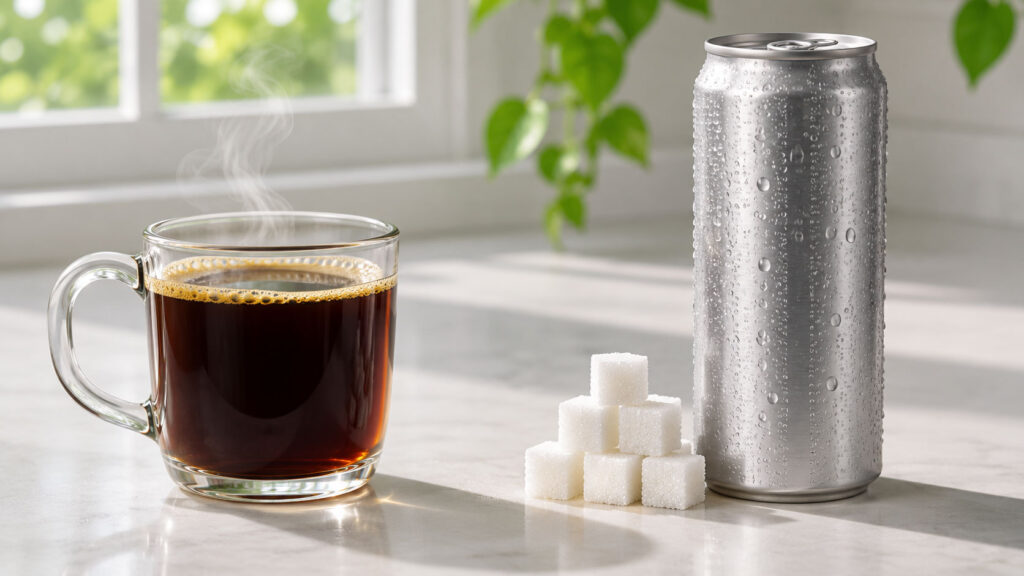
For most adults, plain black coffee is the healthier daily caffeine habit. Ounce for ounce the caffeine is similar, so the gap comes from serving size, sugar, acidity and the extra stimulants in many cans.
Table of Contents
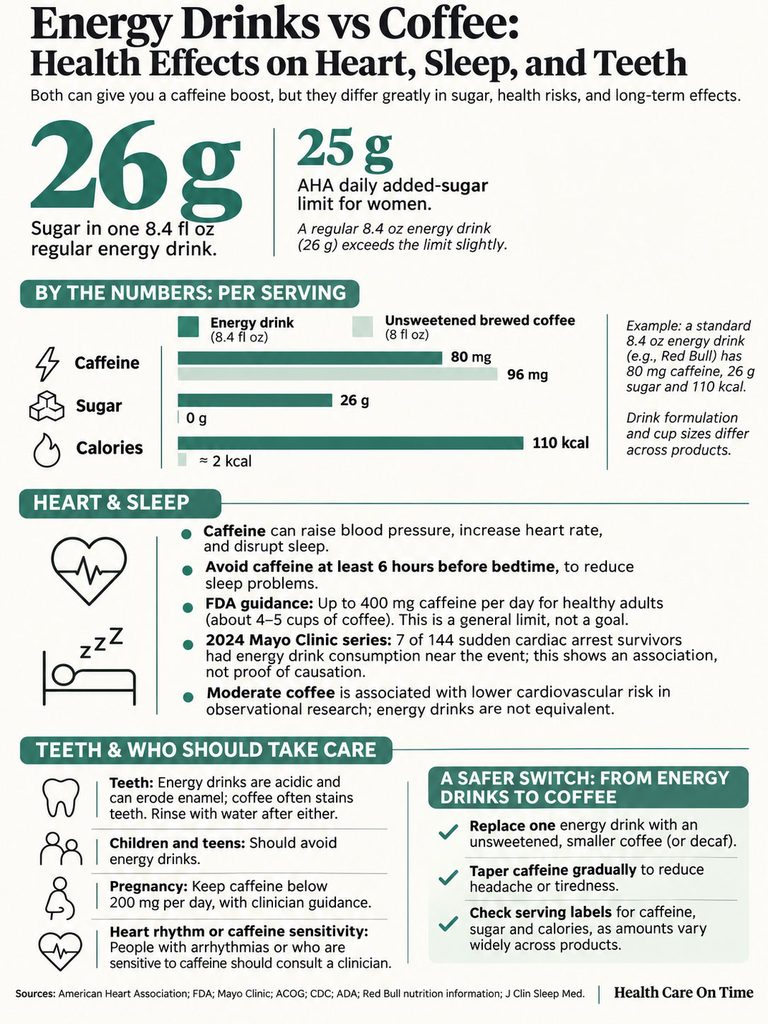
Quick answer: Black coffee wins for daily use. An 8-ounce cup has about 95 mg of caffeine, 0 g of sugar and 2 calories, and moderate coffee drinking is linked to lower heart disease risk. A 16-ounce sugared energy drink has 151 to 160 mg of caffeine and 50 to 54 g of sugar, which is more than a woman’s whole daily added-sugar limit. Sugar-free cans fix the sugar, not the acid or the extra stimulants.
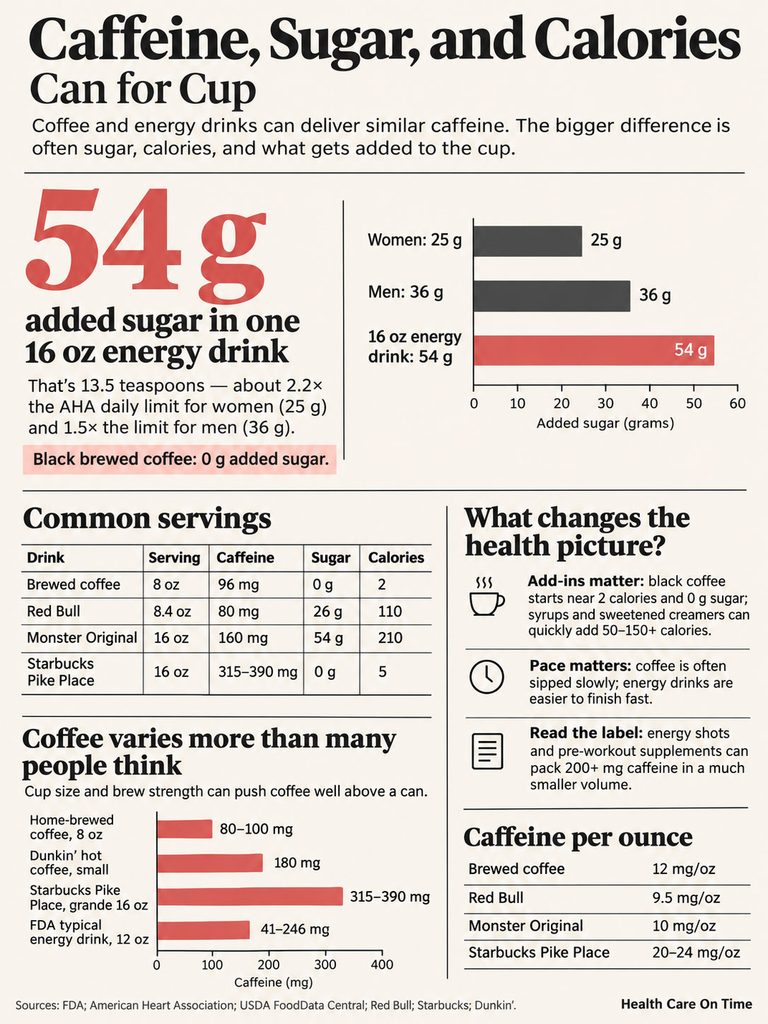
Caffeine, Sugar and Calories, Can for Cup
Brand figures come straight from each product’s Nutrition Facts panel as sold in US stores in November 2026, and the coffee rows use USDA and FDA data. The last column divides each drink’s caffeine by the 95 mg in a standard 8-ounce cup of brewed coffee.
| Drink and size | Caffeine | Sugar | Calories | Equal to (8 oz cups of coffee) |
| Brewed coffee, black, 8 fl oz | 95 mg | 0 g | 2 | 1.0 |
| Brewed coffee, black, 12 fl oz | 113 to 247 mg | 0 g | 3 | 1.2 to 2.6 |
| Red Bull Energy Drink, 16 fl oz | 151 mg | 50 g | 210 | 1.6 |
| Red Bull Sugar Free, 16 fl oz | 151 mg | 0 g | 25 | 1.6 |
| Monster Energy original, 16 fl oz | 160 mg | 54 g | 230 | 1.7 |
| Celsius, 12 fl oz | 200 mg | 0 g | 10 | 2.1 |
Every gram of sugar in the Red Bull and Monster rows is added sugar, and coffee has none until you stir some in. Caffeine is a closer race than the reputation suggests: a 16-ounce Red Bull or Monster lands somewhere between one and a half and one and three-quarter cups of drip coffee, and a 12-ounce mug from a coffee shop can easily pass both.
Labels also drift as companies reformulate, so read the can you actually bought. Grocery listings for Monster’s sugar-free Ultra line disagree with each other, with one store showing 105 mg and another 140 mg for what appears to be the same 16-ounce can.
Is an energy drink stronger than coffee per ounce?
Brewed coffee runs 9.4 to 20.6 mg of caffeine per fluid ounce in the American Heart Association’s 2026 fact sheet, and the USDA’s standard cup works out to about 11.9 mg per ounce. Divide the label numbers by the can size and Red Bull comes to about 9.4 mg per ounce, Monster to 10 mg and Celsius to about 16.7 mg. So a mainstream can holds roughly what the same volume of coffee would, sometimes less, but it comes in a bigger serving, it’s cold and sweet, and many people finish it in minutes instead of sipping it over half an hour.
Energy shots and pre-workout powders are a separate category. Shots carry 40 to 69 mg per fluid ounce, three to four times regular coffee, and some pre-workout supplements contain more than 12 times the concentration found in brewed coffee, which means a 2-ounce shot can deliver about as much caffeine as two mugs of coffee in a couple of swallows.
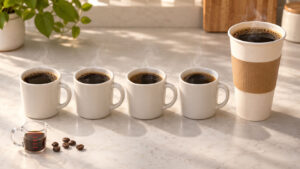
Coffee isn’t always the low-caffeine option either, because restaurants don’t have to disclose caffeine and cup sizes keep growing. The FDA gives a 12-ounce cup of regular brewed coffee a range of 113 to 247 mg. Run a 16-ounce cup through the top of the AHA’s per-ounce range and you get about 330 mg, more than two Red Bulls’ worth in one order.
How much sugar is too much in one can?
The American Heart Association sets the added-sugar ceiling at 36 grams a day for most men and 25 grams for most women and children over 2. A 16-ounce Red Bull, at 50 grams, is twice the women’s limit. A 16-ounce Monster, at 54 grams, is one and a half times the men’s.
Sweetened coffee can close that gap fast. Flavored syrup, sweetened creamer and whipped cream turn coffee into a different drink from the black coffee in the heart research, and the AHA expects added sugar, syrups, milk or cream to shrink coffee’s benefits. People with diabetes have one more reason to skip the syrup, because caffeine on its own can lower insulin sensitivity for a while even in black coffee.
How Many Cups of Coffee Equal One Energy Drink?
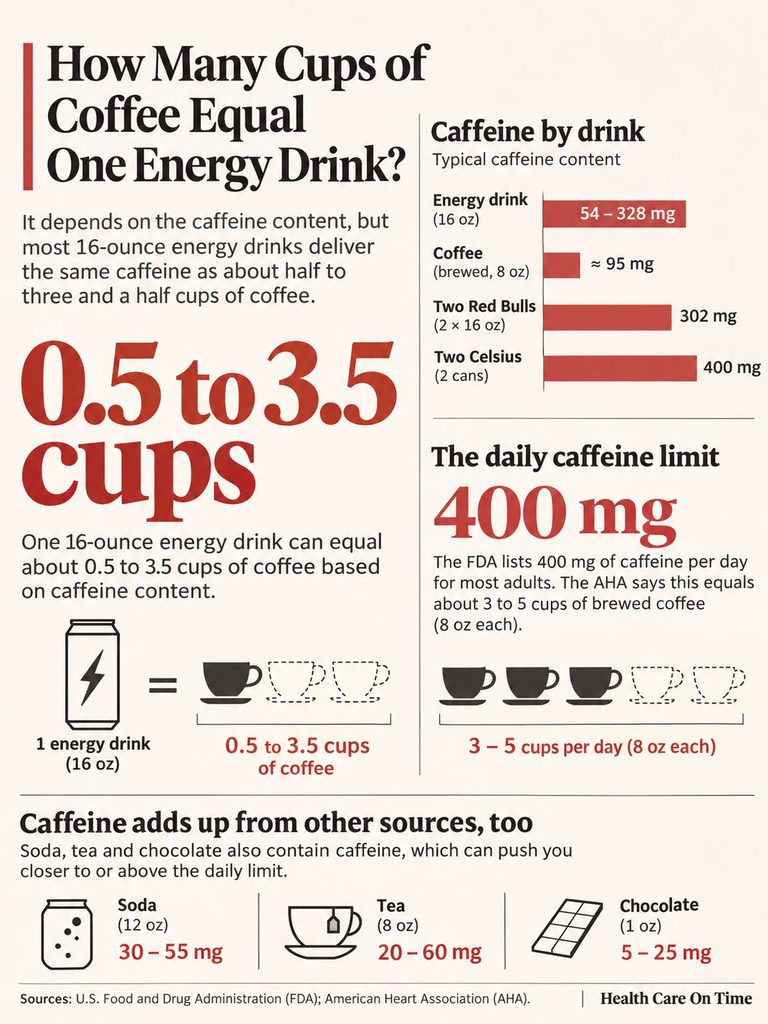
One 16-ounce energy drink usually equals about one and a half to two cups of brewed coffee in caffeine. Counting one 8-ounce cup as 95 mg:
- 16-ounce Red Bull or Red Bull Sugar Free (151 mg): about 1.6 cups
- 16-ounce Monster Energy (160 mg): about 1.7 cups
- 12-ounce Celsius (200 mg): a little over 2 cups, from a smaller can
- 8.4-ounce Red Bull (80 mg): a bit under one cup
Across the whole market the spread is wide. The FDA lists energy drinks at 54 to 328 mg of caffeine per 16 fluid ounces, so one can might equal half a cup of coffee or about three and a half.
The daily ceiling for most adults is 400 mg, which the AHA’s 2026 caffeine statement translates into 3 to 5 eight-ounce cups of black coffee. Two 16-ounce Red Bulls come to 302 mg. Two Celsius cans reach 400 mg by themselves, and the Celsius label caps use at two servings a day, so a morning coffee on top of that habit puts you over before dinner. Soda, tea and chocolate count toward the total as well.
Does an Energy Drink Give You More Energy Than Coffee?
The lift from both drinks comes from caffeine, and at a matched dose the effects people care about are the same: quicker reaction time, sharper alertness and concentration, and some protection against the fog that follows a short night. Whether taurine, ginseng or guarana add anything useful is unclear, because research on them is limited.
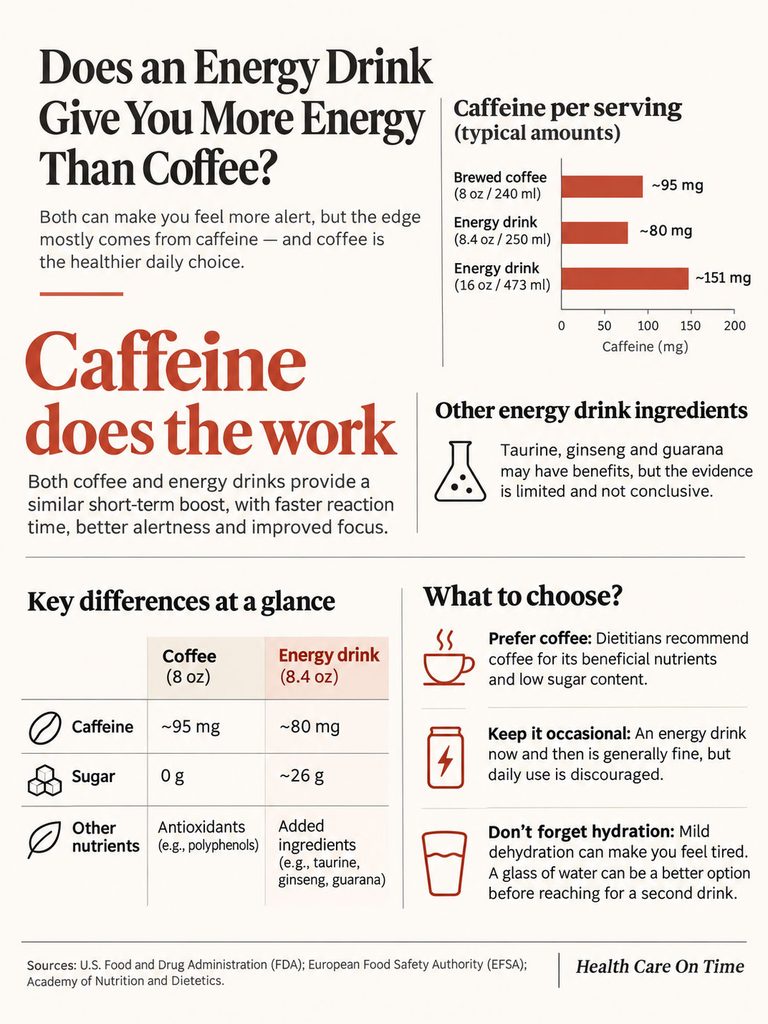
Sugar is what makes a can feel different. Fifty grams of fast sugar brings a quick burst, then blood sugar drops and the tiredness returns, and another can starts to look like the fix. Dietitians at University Hospitals in Cleveland don’t treat an occasional can as a problem, but they steer daily drinkers toward coffee, a plant food with nutrients and no added sugar, and toward a low-sugar can for people who truly can’t stand coffee.
An afternoon slump can also be thirst. Mild dehydration causes fatigue, dry mouth and trouble with attention and short-term memory, so a glass of water is worth trying before the second drink of the afternoon.
Is an Energy Drink Worse for Your Heart Than Coffee?
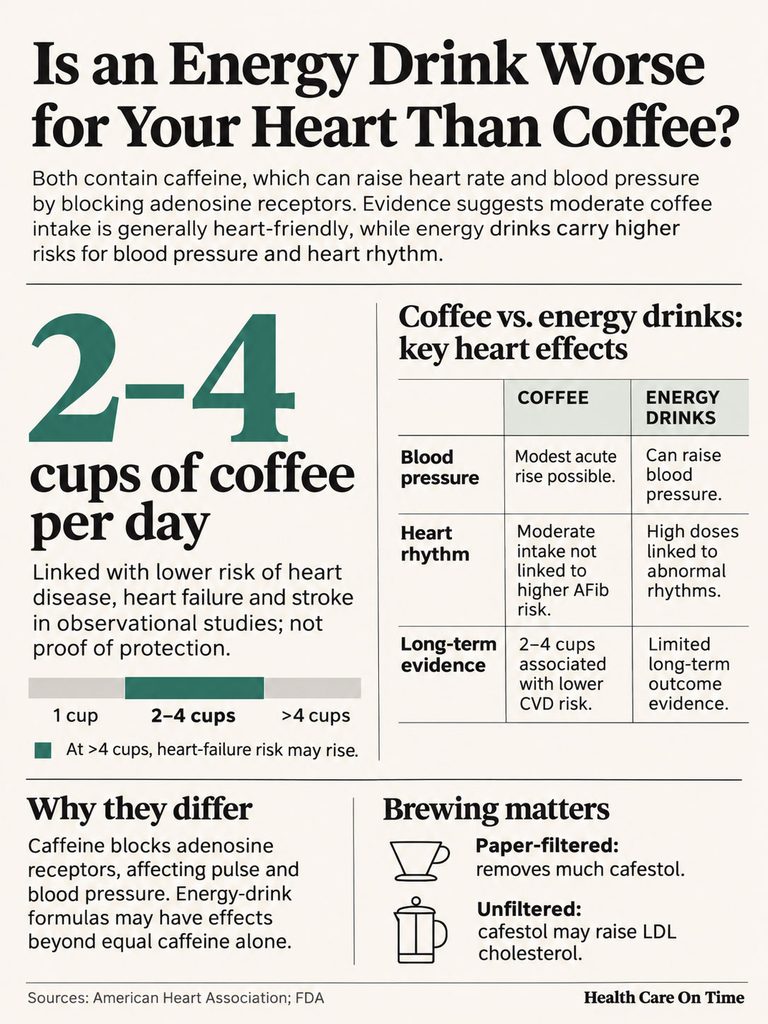
Caffeine blocks adenosine receptors and briefly raises heart rate, blood pressure and alertness. In regular coffee drinkers much of that effect fades with tolerance. The open questions are about the long run for coffee and about whether energy drinks do anything beyond their caffeine.
What years of coffee research show
The American Heart Association published a scientific statement on caffeine and cardiovascular disease in Circulation in July 2026, and its conclusions on coffee lean positive.
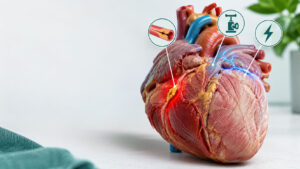
People who drank 2 to 4 cups of caffeinated coffee a day had a lower risk of heart disease, heart failure and stroke, while more than 4 cups a day may push heart failure risk up. Randomized trials tie caffeine from coffee to less atrial fibrillation, and 1 to 3 cups a day showed no link with AFib, though the same amount may bring more premature ventricular contractions, the extra beats that feel like a skip or thump in the chest.
Blood pressure is less tidy. Among people who started with optimal readings, 1 to 3 cups a day went with a higher chance of developing high blood pressure and more than 3 cups with a lower chance, a pattern nobody has explained well, and much of the evidence is observational, so other habits could be shaping it.
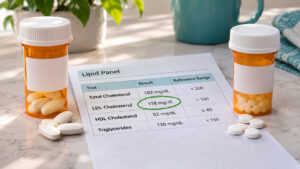
How you brew matters if your LDL cholesterol runs high, because unfiltered coffee (French press, espresso, Turkish or boiled) contains cafestol, which raised LDL in trials, while paper-filtered drip coffee and instant coffee don’t contain it.
The same statement treats energy drinks differently. Higher caffeine intakes, like those in energy drinks and energy shots, go with higher blood pressure and irregular heart rhythm, and very high doses have been linked to abnormal rhythms even in healthy adults under 30. Other ingredients in energy drinks, bars, gels and caffeine supplements may also speed up how fast caffeine is absorbed and push blood pressure higher.
Same caffeine dose, different heart response
A small German experiment published in 2022 tested whether an energy drink is just coffee in a can. Sixteen healthy adults, average age about 30, drank either three cups of coffee or 750 mL of a commercial energy drink on separate days. Both servings held 240 mg of caffeine. The energy drink also came with taurine and about 82.5 grams of sugar.
Forty-five minutes later, heart rate hadn’t moved after either drink. One ECG marker did differ: periodic repolarization dynamics, which tracks sympathetic stress on the heart muscle, rose from 3.64 to 5.85 deg² after the energy drink and stayed flat after coffee (3.47 vs 3.16 deg²). Because both drinks held the same caffeine, the researchers suspected another ingredient was behind the difference.
With 16 people, one ECG per session and no caffeine-only drink for comparison, the study can’t say whether taurine, sugar or something else caused the change.
The November 2026 cardiac arrest study, in context
The study behind the November 2026 headlines was presented at the American Heart Association’s Scientific Sessions. Sai Samayamanthula, a medical student at the University of Virginia, and colleagues went through 28,345 adverse event filings sent to an FDA safety database for foods and supplements between 2017 and 2025, and 854 of them involved energy drinks or supplements with caffeine or other stimulants.
| What was measured | Figure | Where it comes from |
| FDA adverse event filings, 2017 to 2025 | 28,345 total; 854 involved caffeine or stimulant products | AHA Scientific Sessions 2026 abstract (preliminary) |
| Cardiac arrest mentioned, vs other products | About 11 times as often | AHA 2026 abstract |
| Heart attack mentioned | About 4.5 times as often | AHA 2026 abstract |
| Ventricular arrhythmia or palpitations mentioned | About 4 times as often | AHA 2026 abstract |
| Cardiovascular filings from adults 18 to 34 | About 45% | AHA 2026 abstract |
| US emergency visits involving energy drinks | 10,068 in 2007; 20,783 in 2011 | SAMHSA Drug Abuse Warning Network |
| US energy drink sales, 2024 | More than $20 billion | American Heart Association |
Rapid heart rate, chest pain and fainting also showed up more often. The two headline outcomes are different emergencies, since a heart attack is a blocked artery starving heart muscle while cardiac arrest is the heart’s rhythm failing so it stops pumping.
The ratios compare one pile of voluntary filings with another. They can’t give anyone’s personal risk, because the database doesn’t count the millions of people who drank these products and felt fine, and it misses anyone who had a heart problem and never filed. Products were grouped by ingredient rather than brand, and the stimulant group included supplements made with synephrine, yohimbine, ephedra and DMAA, which sit a long way from a can of Red Bull. Younger people may also simply use these products more, and that alone would put them in more filings.
The research is preliminary and hasn’t been published as a full peer-reviewed paper. Gregory Marcus, who chaired the AHA caffeine statement and wasn’t part of the study, said it does not prove that caffeine products cause these events.
Even so, it fits an older pattern, since federal data showed emergency visits involving energy drinks doubling between 2007 and 2011 and the 2026 AHA statement had already flagged high-dose caffeine products on separate evidence. Samayamanthula wants doctors to ask young patients with palpitations, chest pain or fainting about these products, and if you’re the young person with those symptoms, mention every can and supplement from that day when you’re seen.
Which One Hurts Your Sleep More?
Caffeine from either drink keeps you awake by blocking adenosine, the chemical that builds sleep pressure through the day, and in most people it peaks in the blood within about an hour.
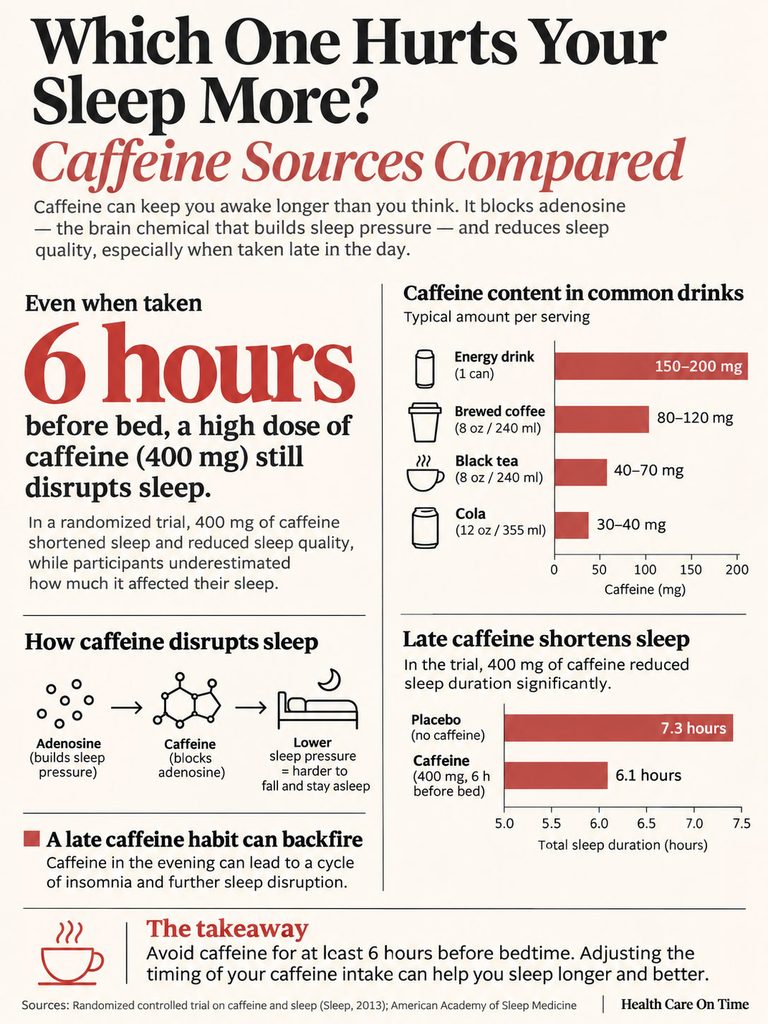
In a randomized trial in Detroit, 400 mg of caffeine taken at bedtime, 3 hours before bed or 6 hours before bed all disrupted sleep in 12 healthy sleepers. Even the six-hour dose cut total sleep time by more than an hour. Participants underestimated it. Their diaries showed a smaller loss than the sleep monitor recorded, so feeling fine the next morning isn’t good evidence that a late can did no harm.
Energy drinks tend to cause more sleep trouble because of when people drink them, usually during a mid-afternoon slump, a night shift or a late session of studying or gaming. A single can holds 150 to 200 mg, and a Celsius at 4 p.m. adds 200 mg just as your caffeine level should be falling. The trial’s authors back the usual advice of no substantial caffeine for at least six hours before bed, whatever the source.
A late can, a short night and a bigger dose the next morning can turn into a loop, and with ongoing insomnia moving the last caffeine of the day earlier is the simplest change to try.
Do Energy Drinks Damage Teeth More Than Coffee?
Coffee mostly stains teeth, while energy drinks erode enamel through acid, and the sugar-free versions erode it too.
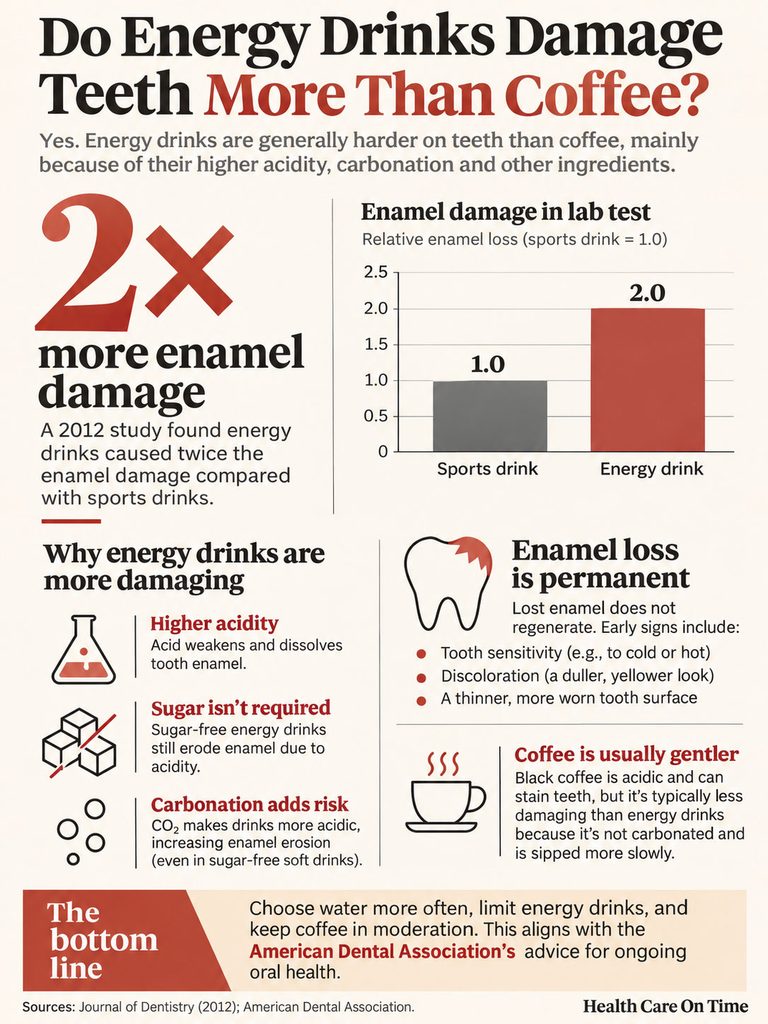
The lab evidence is from 2012, when researchers writing in General Dentistry measured the acidity of 13 sports drinks and 9 energy drinks and then bathed slices of human tooth enamel in them for 15 minutes, four times a day, with two hours in artificial saliva between rounds. After five days the energy drinks had caused about twice the enamel damage of sports drinks. Real mouths have saliva working all day, as the beverage industry pointed out at the time, so the lab numbers overstate the damage, though the ranking between drink types still held.
Less sugar means less food for cavity bacteria, but carbonated soft drinks are still the main dietary cause of enamel erosion, sugar-free versions included, because carbonation itself raises a drink’s acidity. Lost enamel doesn’t grow back. Early signs are twinges with hot, cold or sweet foods and a yellowish tint as the enamel thins.
The American Dental Association’s advice for people who keep drinking them:
- Drink through a straw, and sip and swallow instead of holding or swishing.
- Rinse with water, or have milk or cheese afterward, to help neutralize acid.
- Wait about an hour before brushing, since freshly softened enamel wears more easily.
- Chew sugarless gum to keep saliva flowing.
Black coffee is acidic as well, though it isn’t carbonated and people tend to sip it slowly, so staining is the bigger dental complaint.
What Else Is in the Can?
A typical energy drink pairs caffeine and sugar (or sweeteners) with taurine, B vitamins and plant extracts. Monster’s original label lists an “energy blend” of glucose, taurine, Panax ginseng extract, L-carnitine, caffeine, glucuronolactone, inositol, guarana extract and maltodextrin. Red Bull Sugar Free swaps sugar for sucralose and acesulfame potassium.
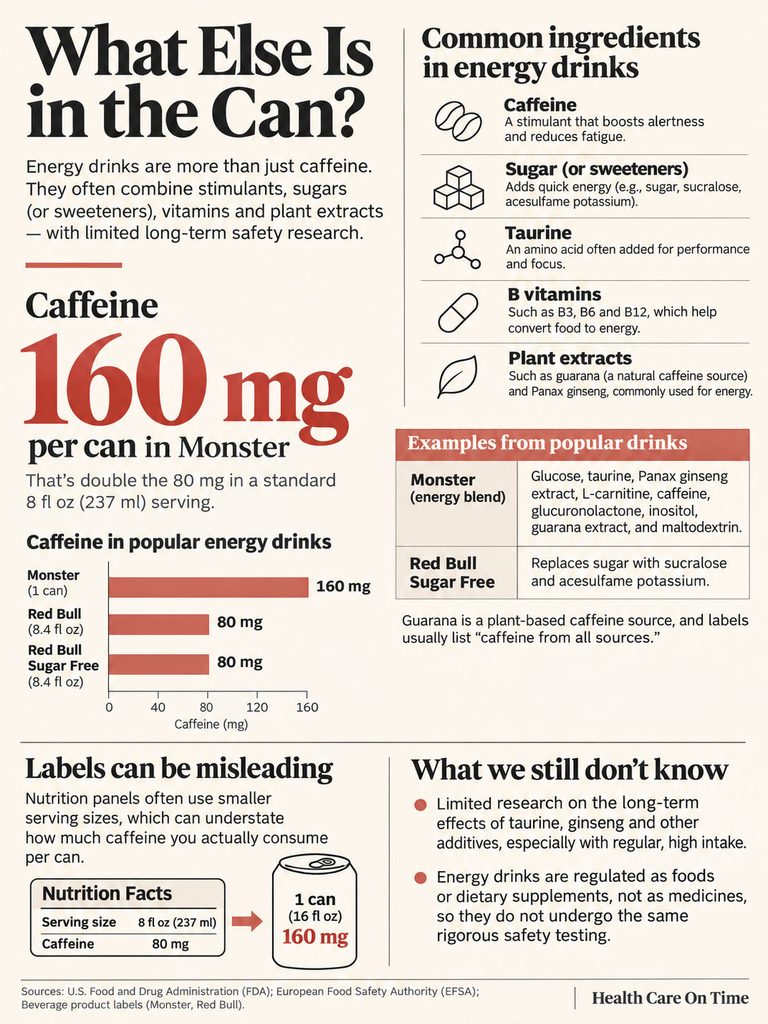
Guarana is a plant source of caffeine, which is why many US labels read “caffeine from all sources.” Watch the serving line too. The Monster label lists 80 mg of caffeine per 8 fl oz serving and only then adds 160 mg per can, and the Nutrition Facts panel on some listings shows the per-serving numbers, so a quick glance at a 16-ounce can can understate what you’ll drink by half. Big B-vitamin numbers on the panel don’t make a sugary drink healthy. Research on taurine, ginseng and most other add-ins is thin, and some herbal ingredients can interact with prescription drugs.
Coffee is one food with decades of large studies behind it. Energy drinks are sold as foods or dietary supplements, not medicines, so they skip drug-style safety testing, and the FDA has no rule written for “energy drinks” in particular beyond the general standards for safe ingredients.
Who Should Skip Energy Drinks Entirely
The American Academy of Pediatrics advises against energy drinks for children and adolescents because of the sugar and caffeine, and no safe caffeine limit has been set for kids. In young people, too much caffeine can raise heart rate and blood pressure and bring palpitations, anxiety, sleep problems and dehydration. Celsius states on the can that it isn’t recommended for anyone under 18. Emergency departments have also seen a rising number of children treated for caffeine toxicity, with vomiting, high blood pressure, a racing heart and rhythm problems among the symptoms.
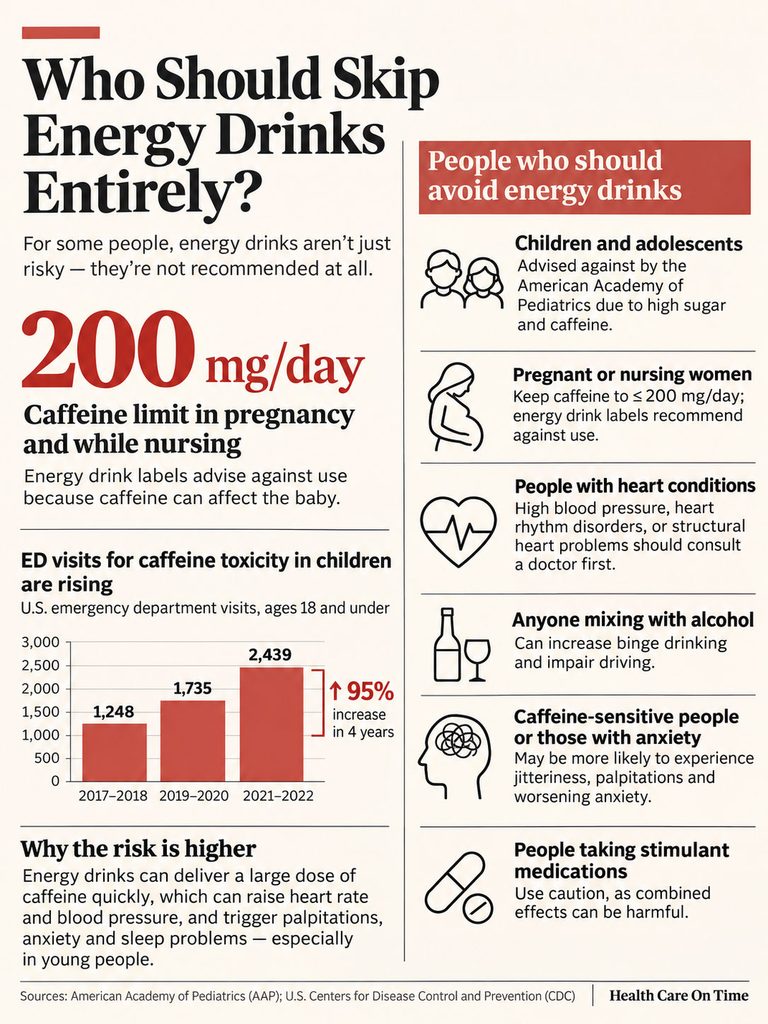
Pregnancy and breastfeeding call for a lower ceiling, usually 200 mg of caffeine a day or less, with your own limit set by your clinician. Energy drink labels say they aren’t recommended for pregnant or nursing women. One Celsius would use up the day.
If you have high blood pressure, a heart rhythm disorder, a structural heart problem or a history of fainting, get your doctor’s view before using energy drinks at all, since high doses can raise blood pressure sharply in people who already have hypertension and rhythm problems are the main warning sign in the newer research.
Alcohol is a separate problem. Caffeine doesn’t lower alcohol’s effect on the body; it only makes people feel less drunk, so they drink more. The CDC links mixing the two with binge drinking, injuries and impaired driving, and about one in five college students did it in the past year. Premixed caffeinated alcoholic drinks left US shelves after the FDA ruled in 2010 that the combination wasn’t safe, though people still mix their own.
People who are sensitive to caffeine, live with an anxiety disorder or take stimulant medication should go easy on both drinks, and energy drinks make it easier to take a large dose quickly.
Switching From Energy Drinks to Coffee
If you want off energy drinks but still want caffeine, swap dose for dose at first so your body barely registers a change.
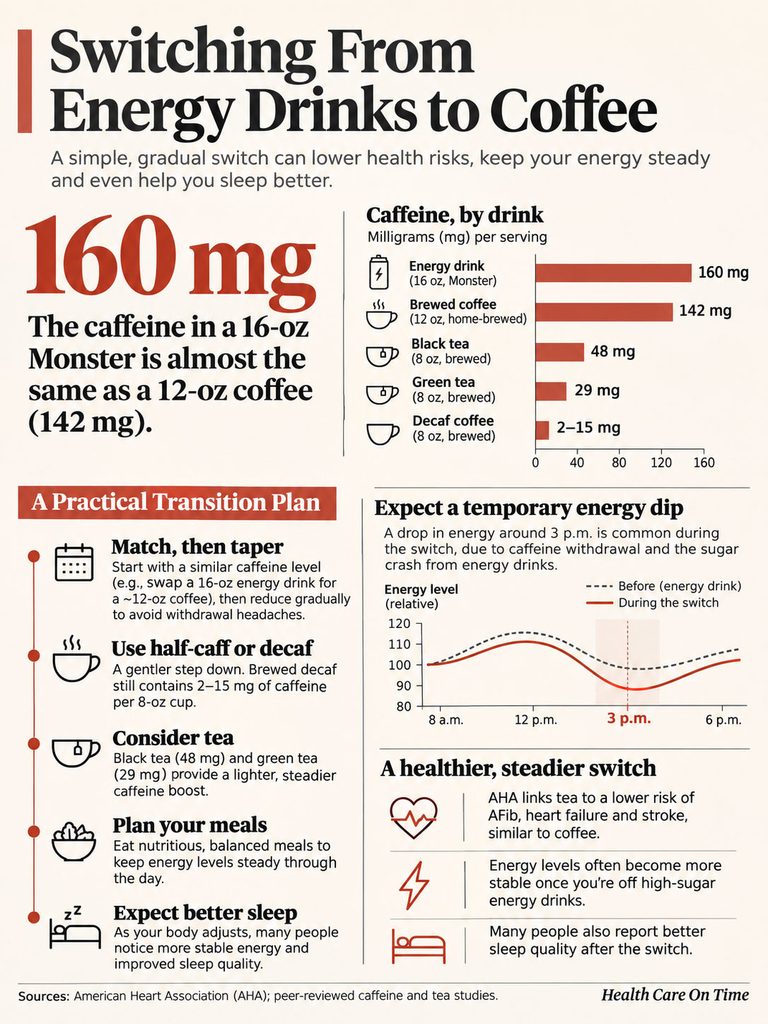
Match your current intake first. A daily 16-ounce Monster has 160 mg, and a 12-ounce mug of home-brewed coffee at the USDA’s rate comes to about 142 mg, close enough that most people won’t notice. A two-can habit works out to roughly three 8-ounce cups spread across the morning and early afternoon. Drunk black, the sugar falls from 54 grams to zero.
Then taper slowly. Withdrawal isn’t dangerous, but stopping suddenly often brings a few days of headaches and tiredness, which is why the FDA recommends cutting caffeine gradually. Replacing one cup with half-caff or decaf helps, keeping in mind that brewed decaf still has about 2 to 15 mg per 8-ounce cup.
Tea is a gentler step after that. Mayo Clinic’s charts put an 8-ounce cup of brewed black tea at about 48 mg and green tea at about 29 mg, and the AHA statement found tea linked to lower risk of AFib, heart failure and stroke, much like coffee.
The first week tends to feel flat around 3 p.m., partly from withdrawal and partly because the sugar crash you used to fix with another can is still showing up, so plan a real lunch for that window. Meals built on foods that give you steady energy carry you further than a can, and the dip usually eases once your sleep improves.
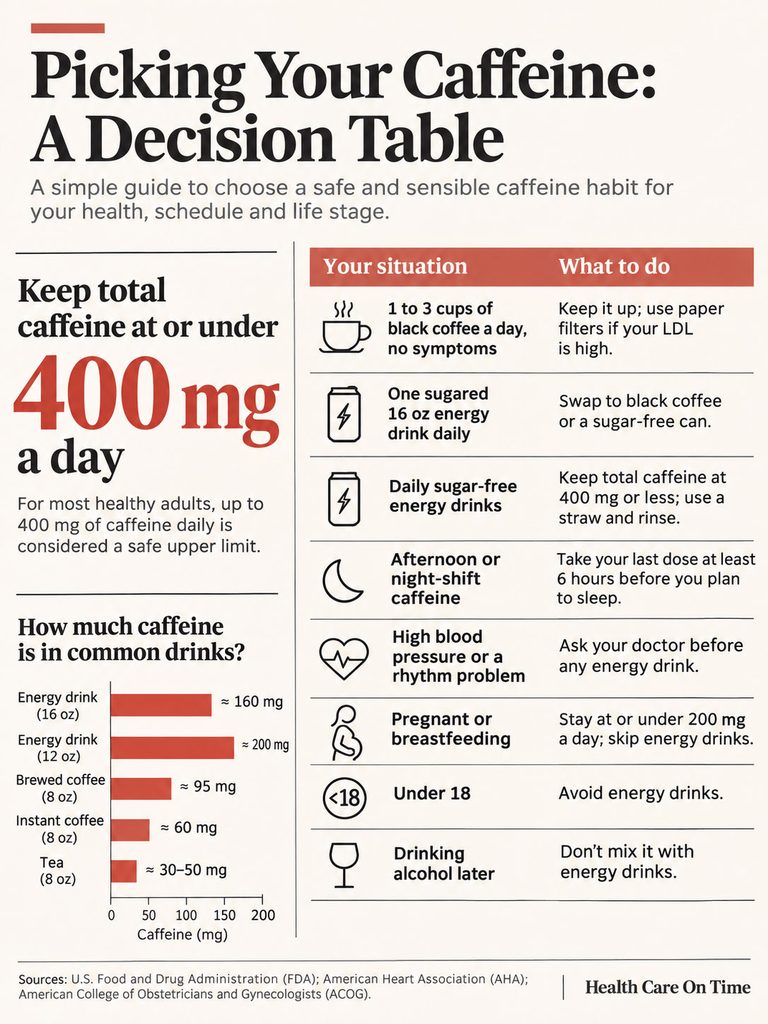
Picking Your Caffeine: A Decision Table
| Your situation | What to do | Why |
| 1 to 3 cups of black coffee a day, no symptoms | Keep it up; use paper filters if your LDL is high | Moderate coffee is tied to lower heart disease and stroke risk; filters remove cafestol |
| One sugared 16 oz energy drink daily | Swap to black coffee or a sugar-free can | One can carries 50 to 54 g of added sugar, past the daily limit |
| Daily sugar-free energy drinks | Keep total caffeine at 400 mg or less; use a straw and rinse | A 12 oz Celsius alone is 200 mg, and carbonation keeps the drink acidic |
| Afternoon or night-shift caffeine | Last dose at least 6 hours before you plan to sleep | Caffeine taken that far ahead still shortened sleep in a trial |
| High blood pressure or a rhythm problem | Ask your doctor before any energy drink | High-dose caffeine products are linked to higher pressure and rhythm problems |
| Pregnant or breastfeeding | Stay at or under 200 mg a day; skip energy drinks | Labels say not recommended, and one 200 mg can uses the whole day |
| Under 18 | Avoid energy drinks | The American Academy of Pediatrics advises against them |
| Drinking alcohol later | Don’t mix it with energy drinks | Caffeine hides impairment and is tied to binge drinking |
When to Get Medical Help
Call 911 for chest pain, fainting, severe shortness of breath, or a racing or irregular heartbeat that doesn’t settle within a few minutes after an energy drink, coffee or stimulant supplement. Seizures, confusion or repeated vomiting after a big caffeine dose also need emergency care, and the FDA estimates that toxic effects such as seizures can appear with rapid intake of about 1,200 mg, a level far easier to hit with shots, pure caffeine powders and pre-workout products than with coffee.
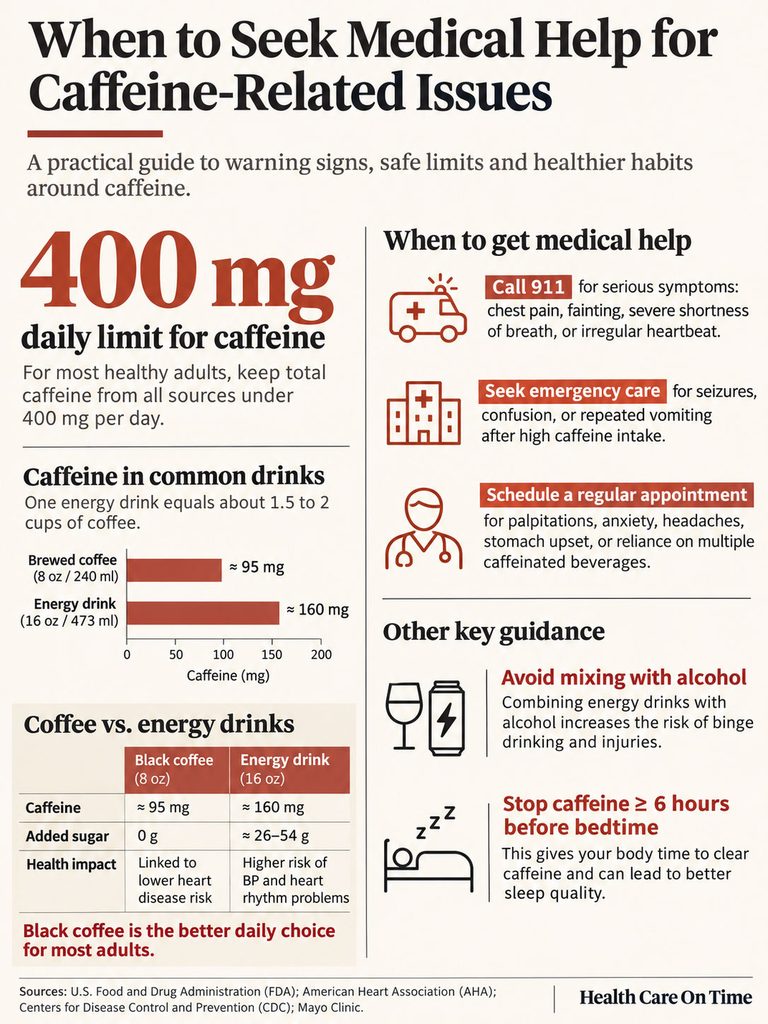
Make a regular appointment if palpitations, new anxiety, headaches, stomach upset or poor sleep seem to track your caffeine, or if you can’t get through the day without several cans.
Frequently Asked Questions
Is coffee better or worse for you than energy drinks?
For most adults, black coffee is better. It has no sugar, almost no calories and long-term data tying 2 to 4 cups a day to lower heart disease, heart failure and stroke risk. Energy drinks bring sugar or sweeteners, acid and extra stimulants, and high-dose caffeine products are linked to blood pressure and rhythm problems. An occasional can won’t hurt a healthy adult, but coffee makes the better daily habit.
How many coffees equal one energy drink?
About one and a half to two. A 16-ounce Red Bull or Monster equals roughly 1.6 to 1.7 cups of 8-ounce brewed coffee, and a 12-ounce Celsius a little over 2.
Is 1 Red Bull a day unhealthy?
For a healthy adult the caffeine is fine: 80 mg in the 8.4-ounce can and 151 mg in the 16-ounce. Sugar is the real cost. The small can has 26 grams, slightly over the AHA’s daily added-sugar limit for women, and the 16-ounce can has twice that limit. Daily, that’s a lot of sugar plus regular acid exposure for your teeth. Red Bull Sugar Free drops the sugar to zero (25 calories in 16 ounces) but keeps the acid. Check with your doctor first if you have high blood pressure, a rhythm problem or are pregnant.
What is the 2 hour coffee rule?
A social media trend of putting off your first coffee after waking so caffeine doesn’t overlap with the body’s natural cortisol rise in the first hour. Jackson Health System describes the common version as a 60 to 90 minute wait and calls the science on timing still evolving. Waiting is harmless if it helps you skip an afternoon crash, though no strong evidence shows it makes coffee healthier.
Are sugar-free energy drinks healthier than coffee?
Healthier than sugared energy drinks, yes; healthier than black coffee, no clear evidence. You skip 50 grams or more of sugar, but you keep the acid, the added stimulants and often more caffeine per can, and long-term research on sugar-free energy drinks is scarce next to the decades of heart data on coffee.
Can energy drinks cause a heart attack in young people?
Nothing so far proves it. The 2026 analysis of FDA filings found heart attacks mentioned about 4.5 times as often with caffeine and stimulant products, and adults 18 to 34 made up about 45% of the cardiovascular filings, yet that kind of data shows a link, not a cause. The AHA does connect very high caffeine doses to abnormal rhythms in healthy adults under 30, so chest pain, palpitations or fainting after a can mean stop drinking and get checked.
Can you drink coffee and an energy drink on the same day?
Yes, as long as the total stays at or under 400 mg and the last dose lands well before bedtime. A morning cup of brewed coffee (about 95 mg) plus a 16-ounce Monster in the early afternoon (160 mg) stays comfortably under that limit. Swap the Monster for two Celsius cans and you’d pass 400 mg. Add up every source, including soda and tea.
Is it safe to mix energy drinks with alcohol?
No. Caffeine hides how drunk you feel without reducing alcohol’s effects, which raises the risk of binge drinking and injuries.
How long before bed should you stop caffeine?
At least six hours. In the Detroit trial, people lost more than an hour of sleep even with that much lead time and didn’t realize it. Caffeine-sensitive people often do better with an early afternoon cutoff.
Medical disclaimer: This article is for general information and doesn’t replace advice from your doctor, pharmacist or dentist. Caffeine limits differ with pregnancy, heart conditions, medications and age. Always check the label on the specific product you drink, since formulas change. If you have chest pain, fainting or a racing heartbeat, call 911.
References
- American Heart Association. Caffeine and cardiovascular disease: fact sheet on the 2026 scientific statement. July 2026.
- Samayamanthula S, et al. American Heart Association Scientific Sessions 2026, preliminary abstract; summary of the AHA release: Energy drinks linked to 11 times more reports of cardiac arrest. November 11, 2026.
- Action News Jax. Study examines risk of energy drinks for cardiac arrest, heart attacks in young adults. November 2026.
- U.S. Food and Drug Administration. Spilling the Beans: How Much Caffeine Is Too Much? Updated August 2024.
- USDA National Nutrient Database for Standard Reference, Release 26. Basic Report 14209: Coffee, brewed from grounds, prepared with tap water.
- Schüttler D, et al. Impact of energy drink versus coffee consumption on periodic repolarization dynamics. European Journal of Nutrition. 2022;61:2847-2851.
- Drake C, et al. Caffeine effects on sleep taken 0, 3, or 6 hours before going to bed. Journal of Clinical Sleep Medicine. 2013;9(11):1195-1200.
- Mayo Clinic Health System. What’s the latest buzz on energy drinks? September 2025.
- University Hospitals. Are energy drinks more harmful than coffee? August 2023.
- American Heart Association. How too much added sugar affects your health.
- American Dental Association, MouthHealthy. Erosion: what you eat and drink can impact teeth.
- HealthDay. Energy and sports drinks eat away at teeth, study finds (General Dentistry, May/June 2012). May 2012.
- Centers for Disease Control and Prevention. Effects of mixing alcohol and caffeine.
- Substance Abuse and Mental Health Services Administration. Update on emergency department visits involving energy drinks. The DAWN Report, January 2013.
- Mayo Clinic. Caffeine content for coffee, tea, soda and more. February 2025.
- Jackson Health System. Should you wait 90 minutes before drinking coffee?
- Product labels as listed by US retailers, November 2026: Red Bull 16 fl oz (H-E-B); Red Bull Sugar Free 16 fl oz (Randalls); Monster Energy 16 fl oz (Costco); Monster Energy blend ingredients (FoodMaxx); Celsius 12 fl oz (Giant); Red Bull 8.4 fl oz (Red Bull); Monster Zero Ultra (H-E-B); Monster Zero Ultra (FoodMaxx).