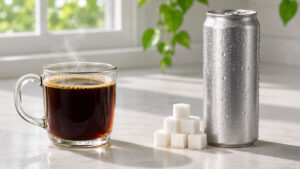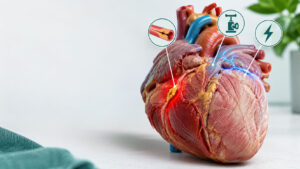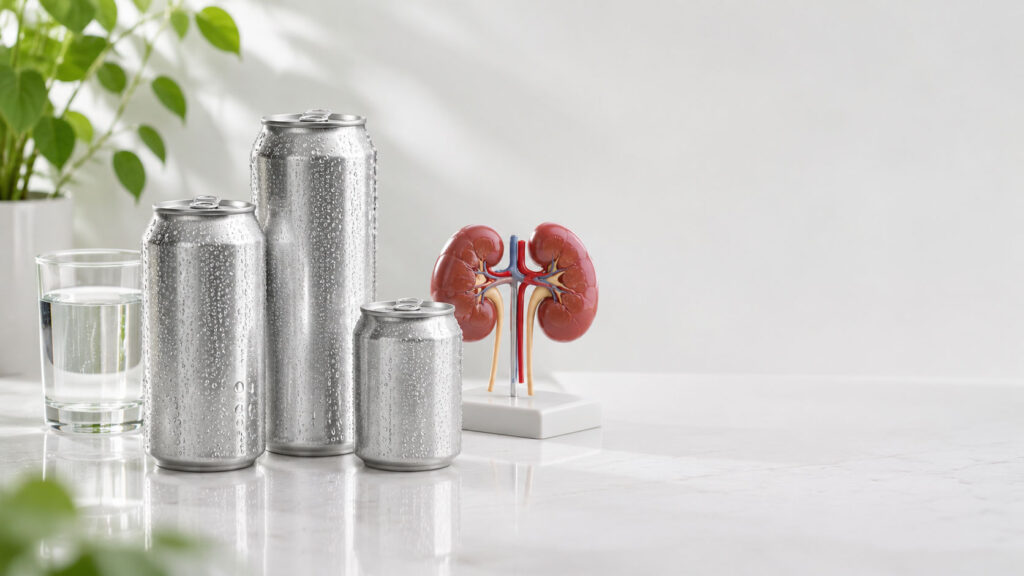
For most healthy adults, an occasional energy drink won’t harm the kidneys. The risk climbs with dose: several cans a day, large cans chugged during hard exercise, or any regular use when you already have kidney disease, kidney stones or high blood pressure.
Table of Contents
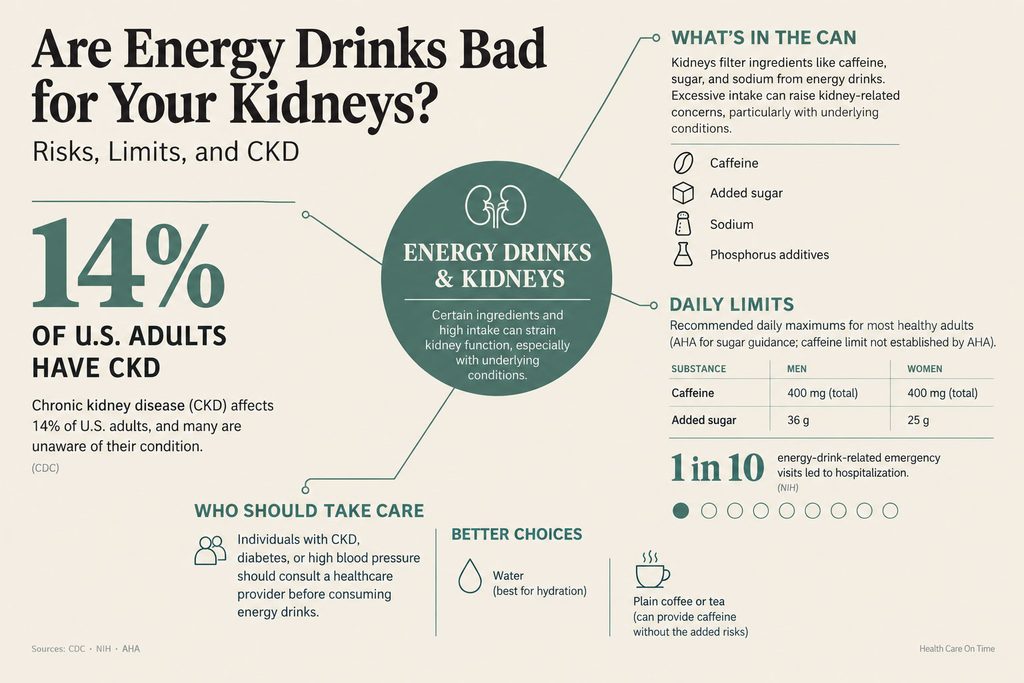
Quick Answer: Energy drinks are bad for your kidneys mainly in large or frequent amounts. One standard can usually stays under the FDA’s 400 mg daily caffeine limit for healthy adults, but many cans also carry 54 to 62 grams of added sugar and up to about 380 mg of sodium. Rare cases of acute kidney injury involved liters a day. People with CKD, kidney stones or high blood pressure should limit or avoid them and ask their doctor first.
Why your kidneys notice an energy drink
Your kidneys filter everything you drink. Caffeine, sugar, salt, acids and the herbal “energy blend” all end up in the blood, and the kidneys have to sort out what to keep and what to send to the bladder. A single can is a small job for two healthy kidneys. Several cans a day, every day, is a steady extra workload, and the ingredients that make the job harder (sodium, fructose, phosphorus additives) are the same ones behind kidney stones and slow kidney decline.
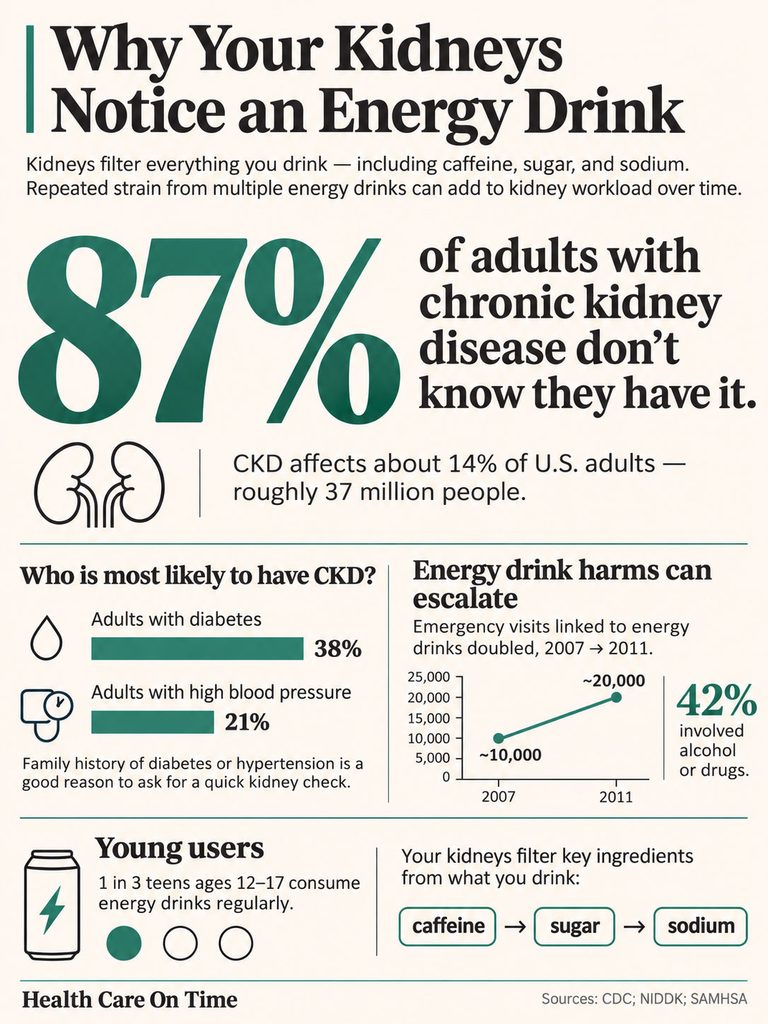
Plenty of people who feel fine already have reduced kidney function. An estimated 14% of US adults, about 37 million people, have chronic kidney disease, and roughly 87% of them don’t know it, so “healthy kidneys” is an assumption many energy drink fans haven’t checked.
| Finding | Number | Source |
| US adults with chronic kidney disease | 14%, about 37 million people | CDC, updated March 2026 |
| Adults with CKD who don’t know they have it | About 87% | CDC, updated March 2026 |
| Adults with diabetes estimated to have CKD | About 38% | CDC, updated March 2026 |
| Adults with high blood pressure estimated to have CKD | About 21% | CDC, updated March 2026 |
| Energy drink-related emergency visits, 2007 to 2011 | Doubled; 1 in 10 visits in 2011 led to hospitalization | NIH NCCIH |
| Energy drink emergency visits in 2011 involving alcohol or other drugs | 42% | NIH NCCIH |
| Teens aged 12 to 17 who drink energy drinks regularly | Almost one-third | NIH NCCIH |
With that much overlap between diabetes, high blood pressure and kidney disease, a quick blood and urine kidney check before a daily habit settles in is sensible for anyone with those conditions in the family.
Some effects arrive fast and some take years. Within hours, a big caffeine and stimulant load raises blood pressure and sends you to the bathroom more often, and with heat, heavy sweating or alcohol that fluid loss adds up. Over months, daily sugar and sodium raise the chance of kidney stones. Over years, a habit that pushes up weight, blood sugar and blood pressure feeds diabetes and high blood pressure, the main causes of kidney failure in US adults.
None of these effects is unique to energy drinks. Soda, sweet tea and large coffees can do some of the same things, which is why the dose and the daily habit count for more than the brand on the can.
What each ingredient does to your kidneys
Energy drinks share a basic recipe: carbonated water, caffeine, sugar or sweeteners, sodium citrate or salt, acids for flavor and shelf life, and a proprietary blend that usually includes taurine, guarana, glucuronolactone and B vitamins. A 16-ounce can of Monster Energy Original, for example, lists sodium citrate and salt, benzoic and sorbic acid as preservatives, and a blend of taurine, panax ginseng, L-carnitine, caffeine, glucuronolactone, inositol and guarana extract.
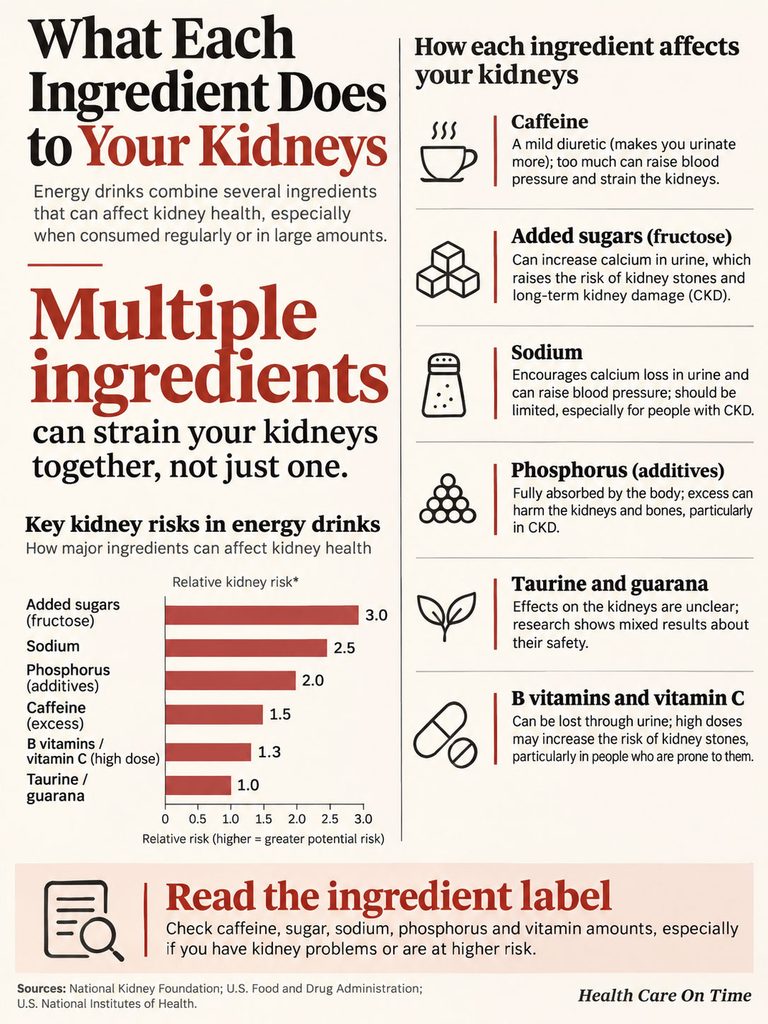
| Ingredient | What it does in the kidneys | Where it starts to matter | What a typical can holds |
| Caffeine (plus guarana) | Mild diuretic; large doses raise blood pressure for a few hours | Above 400 mg a day for most adults (FDA); toxic effects such as seizures with rapid intake around 1,200 mg | 41 to 246 mg per 12 oz; 54 to 328 mg per 16 oz (FDA range) |
| Added sugar (sucrose, glucose) | Fructose raises calcium in urine; daily sugary drinks are linked to stones and to CKD | Above 36 g a day for men or 25 g for women (AHA added sugar limit) | 54 to 62 g in a 16-oz can (NIH NCCIH); Monster Original 54 g |
| Sodium | More sodium pulls more calcium into urine and raises blood pressure | Daily total over 2,300 mg (NIDDK); tighter limits for stone formers and CKD | 85 mg (Rockstar Original) to 380 mg (Monster Zero Ultra) per 16-oz can |
| Phosphorus additives (phosphoric acid, “PHOS” ingredients) | Additive phosphorus is absorbed almost completely; damaged kidneys can’t clear it | Any regular intake with CKD; normal blood level is 2.5 to 4.5 mg/dL (NKF) | Rarely listed; Rockstar Original lists 0 mg, so check the ingredient line for “phos” |
| Taurine, glucuronolactone, ginseng | Animal studies are mixed, showing both harm and protection | No set threshold; present in the drinks tied to rare kidney injury cases | Amounts not listed on most US cans; one case drink held 800 mg taurine per liter |
| B vitamins and vitamin C | Extra amounts leave through urine; vitamin C supplements may affect stone risk | Stone formers who also take vitamin C pills | Celsius: 60 mg vitamin C and 20 mg niacin (130% DV) per 12-oz can |
Caffeine
At normal doses, caffeine does little to the kidneys. Most adults can have up to 400 milligrams a day without dangerous effects, and while caffeine does make you pee more, the effect is mild enough that coffee and tea still count toward your daily fluid.
A 16-ounce energy drink can hold anywhere from 54 to 328 mg, though, and some people drink two or three in a few hours to get through a shift or a workout. Guarana adds caffeine of its own; most US energy drinks print “caffeine from all sources” on the can, which at least makes the total easy to find. Speed counts as much as the total. Taken quickly, around 1,200 mg can cause seizures. Long before that point, the fast heartbeat and higher blood pressure from a big dose strain the small blood vessels inside the kidneys, and the extra trips to the bathroom count for more when you’re also sweating heavily, sick with vomiting or diarrhea, or drinking alcohol, because those situations already pull fluid out of the body faster than you replace it.
Sugar
Sugar has the clearest link to kidney problems over time. A single 16-ounce regular can may hold 54 to 62 grams of added sugar. With an added sugar limit of 36 grams for most men and 25 grams for most women, one Monster Original (54 grams) or Rockstar Original (63 grams) uses up more than a full day’s allowance. Sugar-free cans sidestep this.
In the short run, fructose increases how much calcium the kidneys release into urine, which feeds calcium stones. In the long run, a daily sugary-drink habit adds to weight gain, insulin resistance and type 2 diabetes, one of the two main causes of kidney failure in US adults. Because liquid sugar doesn’t fill you up the way food does, a can at lunch rarely means eating less at dinner.
Sodium
Energy drinks taste sweet, so their sodium tends to go unnoticed. Rockstar Original lists 85 mg per 16-ounce can, Red Bull 105 mg per 8.4-ounce can, Monster Original 370 mg (16% of the daily value) and Monster Zero Ultra 380 mg.
Most of it comes from sodium citrate, which buffers the tart taste of citric acid, plus a little added salt in some formulas.
On its own, 370 mg is small next to a fast-food meal. The daily total is what counts, especially for anyone who forms calcium stones or has CKD, since more sodium makes the kidneys push more calcium into urine and raises blood pressure. Adults should aim for less than 2,300 mg of sodium a day, and stone formers are asked to stick to that limit even when they take stone-prevention medicine.
Phosphorus and acids
Dark colas contain phosphoric acid, and some bottled drinks use other phosphate additives. Phosphorus from additives is completely absorbed by the body, so people with CKD learn to spot phosphoric acid and other phosphate additives on ingredient lists. Healthy kidneys clear the extra phosphorus without trouble. In CKD it builds up, and over time high phosphorus pulls calcium from bones and adds to calcium deposits in blood vessels.
Most popular energy drinks use citric acid rather than phosphoric acid, and phosphorus usually isn’t on the Nutrition Facts panel at all. Rockstar Original is one of the few cans that prints a phosphorus line, at 0 mg. With CKD, the practical step is to read the ingredient list and look for any word containing “phos.”
Taurine, guarana and the “energy blend”
Taurine is an amino acid the body makes on its own and also gets from food, and nobody has shown what it does to human kidneys at energy drink doses. In animals, the evidence on taurine points both ways: one study found kidney damage with an energy drink and with a caffeine plus taurine mix, while others suggest taurine may protect the kidney.
US cans rarely list how much of each blend ingredient they contain, which makes any of them hard to judge. In a randomized trial of two energy drinks, the heart rhythm change was larger than the caffeine dose alone would predict, while the blood pressure rise was linked mainly to caffeine, and the researchers called for more study of whether one ingredient or the combination is responsible. For taurine, glucuronolactone and ginseng, the risk at the doses people drink is unknown, and probably small at one can.
Vitamins at high doses
Many cans carry B vitamins at 100% to 250% of the daily value, and some add vitamin C. Celsius, for instance, lists 60 mg of vitamin C and 20 mg of niacin (130% of the daily value) per 12-ounce can. Water-soluble vitamins your body doesn’t use leave in your urine, which is harmless for most people. Vitamin C supplements can affect kidney stone risk, though, so a stone former who has a can and a vitamin C pill every day should mention both to a doctor.
Is one energy drink a day okay?
For a healthy adult with normal kidney function, one standard can a day is unlikely to damage the kidneys by itself. Caffeine is usually well under the limit: a Red Bull has 80 mg, a Monster Original has 160 mg, and even a 200 mg Celsius leaves room below 400 mg, which works out to roughly four cups of brewed coffee, 10 cans of cola or two energy shots.
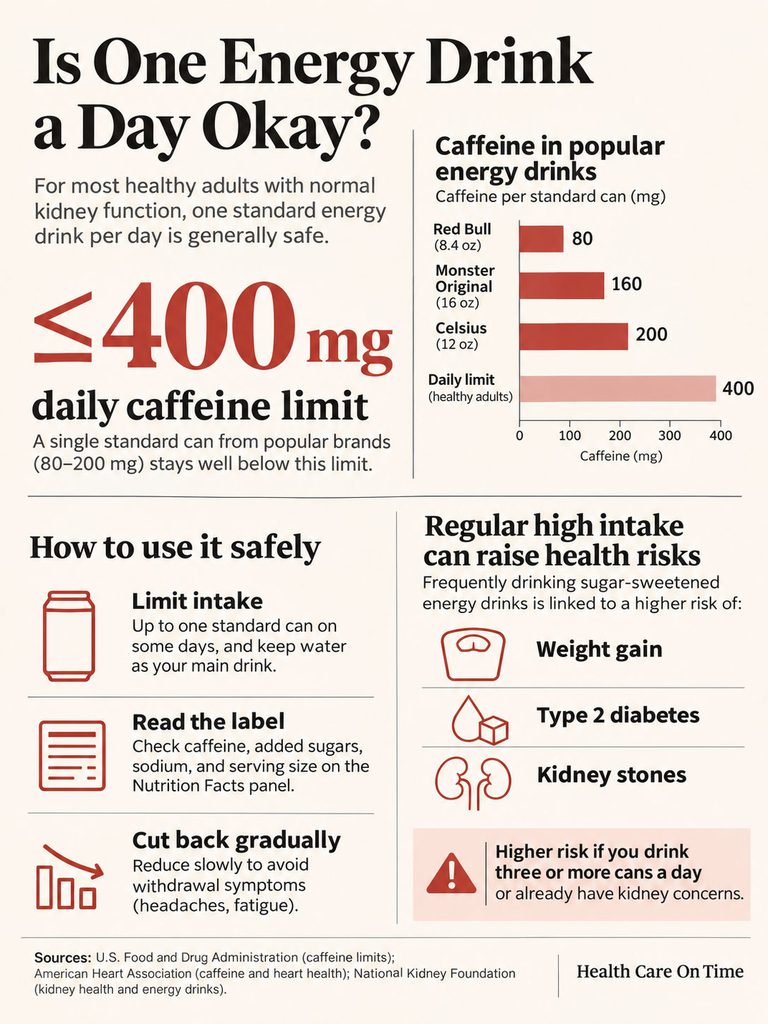
A regular 16-ounce can still brings more than a day’s worth of added sugar, and repeated for years, that habit raises the odds of weight gain, type 2 diabetes and kidney stones. A sugar-free can removes the sugar but keeps the sodium, the caffeine and the blend.
Can size changes the math. Many people count a 24-ounce can or a large fountain drink as “one,” and caffeine scales with volume, so two 16-ounce cans of a high-caffeine brand can reach the 400 mg line by mid-afternoon, before coffee or soda is counted. A can sipped over a morning with breakfast is a very different load from the same can finished in five minutes before a run, and a second can at 4 p.m. often means poor sleep, which tends to bring a third can the next day.
Reading a can takes about ten seconds once you know where to look. On the Nutrition Facts panel, check the caffeine line (or the “caffeine from all sources” statement), the added sugars line and the sodium line, then scan the ingredient list for any word with “phos” in it. Check the serving size too, since some larger cans still list two servings per container, which doubles every number on the panel if you finish the can.
To cut back, drop one can every few days rather than all at once. Caffeine withdrawal isn’t dangerous, but the headaches and fatigue send a lot of people straight back to the old habit.
A sensible rule for healthy adults: one standard can on some days, counted toward your total daily caffeine, with water as your main drink. Most of the trouble shows up in people who drink three or more cans a day, drink them fast, or drink them while their kidneys are already under stress. If you need an energy drink every day just to function, that tiredness deserves its own check, since poor sleep, anemia, thyroid problems and even early kidney disease can all cause fatigue.
Monster, Red Bull, Celsius and sugar-free cans
The figures below come from each product’s Nutrition Facts panel, and formulas change, so check the can in your hand.
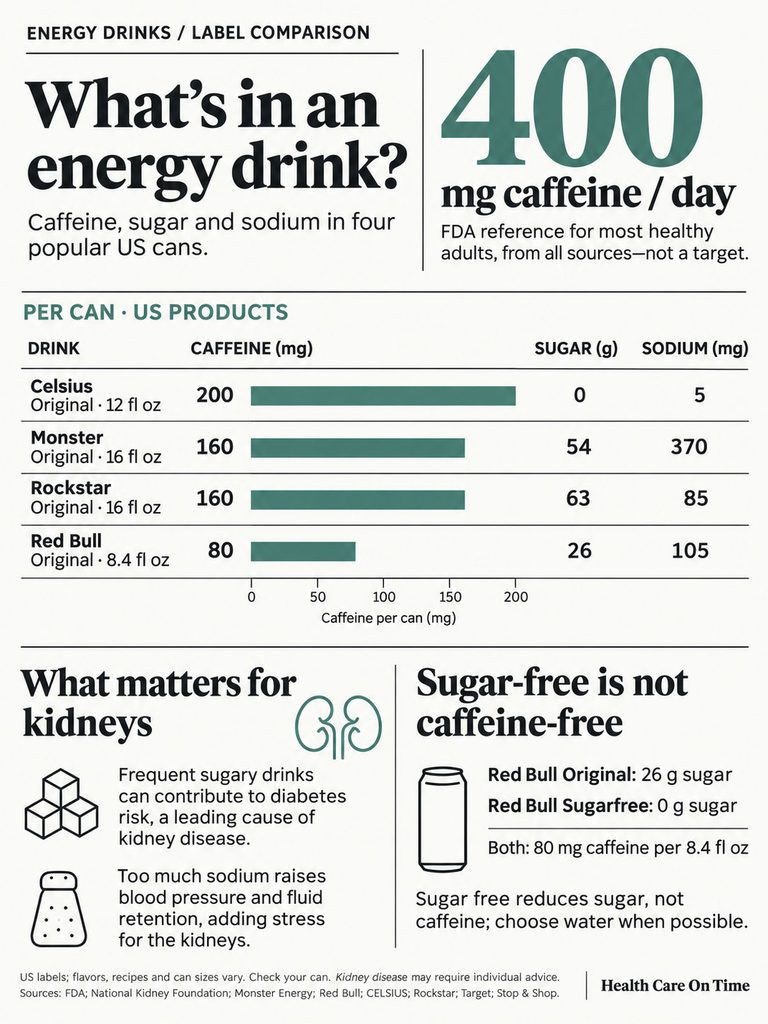
| Drink (size) | Caffeine | Total sugar | Sodium | Share of 400 mg caffeine limit | Label source |
| Monster Energy Original (16 oz) | 160 mg | 54 g (all added) | 370 mg | 40% | Monster can label |
| Monster Zero Ultra (16 oz) | 150 mg | 0 g | 380 mg | 38% | Monster can label |
| Red Bull Energy Drink (8.4 oz) | 80 mg | 26 g | 105 mg | 20% | Red Bull US nutrition declaration |
| Celsius Zero Sugar (12 oz) | 200 mg | 0 g | 5 mg | 50% | Celsius can label |
| Rockstar Original (16 oz) | 161 mg | 63 g (all added) | 85 mg | 40% | Rockstar US nutrition facts |
Monster Original is the can to watch for both sugar (54 grams) and sodium (370 mg), and Zero Ultra trades the sugar for slightly more sodium. Neither is a kidney toxin at a can a day for a healthy adult, but for anyone with stones, CKD or high blood pressure, that sodium line is the one to read first.
Red Bull in the small 8.4-ounce can has the least caffeine here and modest sodium. Its 26 grams of sugar is still about a woman’s entire daily added sugar limit, and the bigger Red Bull cans scale up from there.
Rockstar Original carries the most sugar of the five, 63 grams, which is well over the daily added sugar limit for men and women alike, though its sodium is the lowest of the 16-ounce cans.
Celsius has almost no sodium and no sugar, which suits kidneys better. Its caffeine is high, though: 200 mg in one 12-ounce can. The label itself says not to exceed two servings a day, and two cans put you right at 400 mg with nothing left for coffee or tea.
Are sugar-free energy drinks better for your kidneys?
Mostly, yes, for the sugar part of the risk. Dropping 50 to 60 grams of sugar takes away the fructose effect on urine calcium and the long-term push toward diabetes. Monster Zero Ultra uses erythritol, sucralose and acesulfame potassium instead.
The caffeine, the sodium and the stimulant blend are all still in the can, though. Research on artificial sweeteners and kidneys is murkier than for sugar. In one large study of kidney stones, artificially sweetened noncola sodas showed only a borderline link, and a 2024 study cited in the National Kidney Foundation’s hydration guidance tied more than one serving a day of either sugar-sweetened or artificially sweetened drinks to kidney risk, based on what people recalled drinking. If you’re going to have a can, sugar-free is the better pick, and water beats both.
What the research shows so far
No large study has followed energy drink users and measured their kidneys over years, so the evidence is pieced together from single-patient case reports, short trials in healthy volunteers and big observational studies of sugary drinks in general.
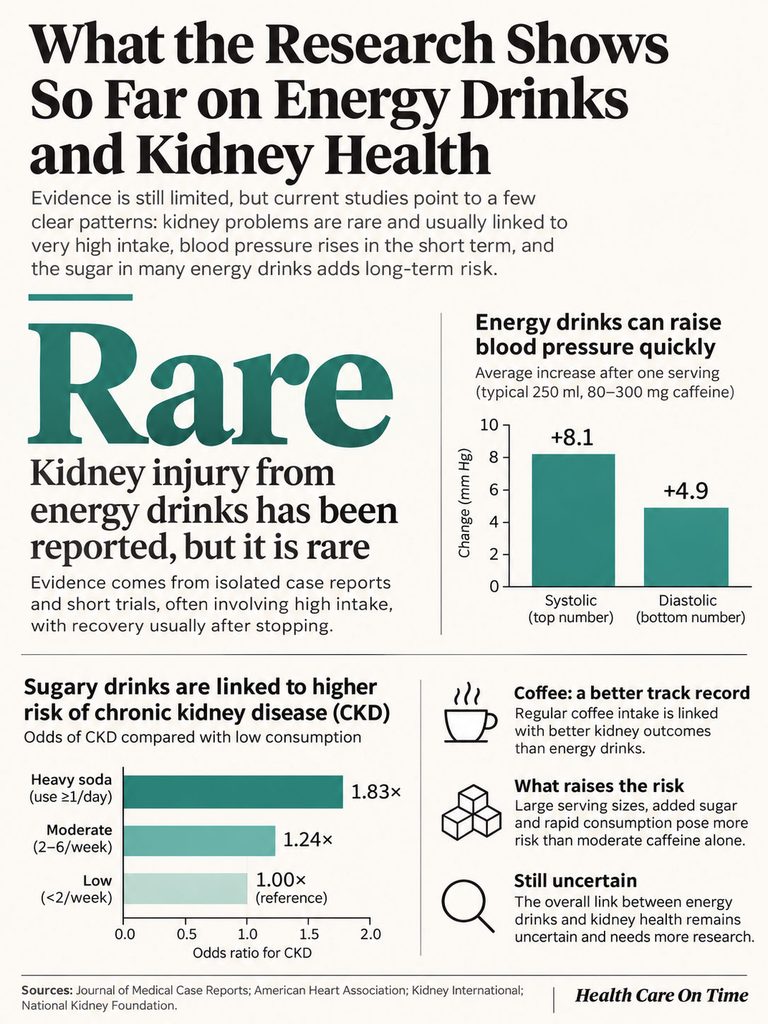
Kidney injury from energy drinks is rare, and in the cases on record the amounts were huge. A healthy 21-year-old man in a 2025 case report drank about 2 liters of an energy drink every day for roughly a month while training for a running race, then arrived with nausea, vomiting and malaise. His creatinine, a blood marker of kidney function, was 5.31 mg/dL and climbed to 10.32 mg/dL on day 4, which met the definition of stage 3 acute kidney injury, most likely acute tubular necrosis (injury to the kidney’s filtering tubes). He didn’t need dialysis; after he stopped the drink his creatinine fell to 1.20 mg/dL by day 16, and his kidneys were still normal two years later.
His drink held about 150 mg of caffeine per liter, so his daily caffeine was roughly 300 mg, under the FDA limit, while the total volume and taurine load were large. The same review found four earlier cases of energy drink kidney injury, and three of them also involved alcohol or the combination of ibuprofen with the blood pressure drug lisinopril. Two of those patients needed dialysis, recovery took about 3 to 17 days, and the exact trigger still isn’t known.
Short-term blood pressure effects have firmer evidence. In a randomized, placebo-controlled trial, 34 healthy young adults drank 32 ounces of one of two commercial energy drinks within an hour. Their systolic pressure rose about 4.6 to 6.1 mm Hg and diastolic about 4 mm Hg more than with placebo, and the heart’s QTc interval lengthened by 6.1 to 7.7 milliseconds. Each 32-ounce serving held 304 to 320 mg of caffeine. The changes lasted through four hours of monitoring, and the paper advised people with hypertension to limit energy drinks, though it couldn’t test them directly: volunteers with high blood pressure were excluded, and no one was followed for years.
For long-term harm, the sugar data are the strongest. Across three long-running cohorts of US health professionals and nurses, stone risk was 23% higher in the highest versus lowest intake of sugar-sweetened cola and 33% higher for sugar-sweetened noncola drinks, while coffee and tea were tied to lower risk. In the Jackson Heart Study, which followed 3,003 Black adults in Mississippi with normal kidney function, 185 (6%) developed CKD over a median of 8 years, and a drinking pattern heavy in soda, sweetened fruit drinks and water carried 61% higher odds of CKD in the top third versus the bottom third (odds ratio 1.61). Neither study looked at energy drinks by name, but a regular energy drink is a sugar-sweetened, noncola, carbonated beverage. The water in the Mississippi pattern may have included flavored or sweetened waters, which the study couldn’t separate.
When the caffeine comes from coffee, kidney outcomes look better, not worse. Among 14,207 middle-aged US adults in the ARIC study, followed for a median of 24 years, people who drank 2 to 3 cups of coffee a day were less likely to be hospitalized for acute kidney injury than people who never drank it (hazard ratio 0.83). In a national sample of 4,863 US adults with CKD, those in the highest caffeine group (above 213.5 mg a day) had lower all-cause mortality than those in the lowest (hazard ratio 0.78).
Both of those are observational, and coffee drinkers may differ from non-drinkers in ways the studies couldn’t fully measure. Along with the case reports, they suggest that very large servings, sugar, sodium and fast drinking do more harm to kidneys than moderate caffeine does.
People who need a stricter limit
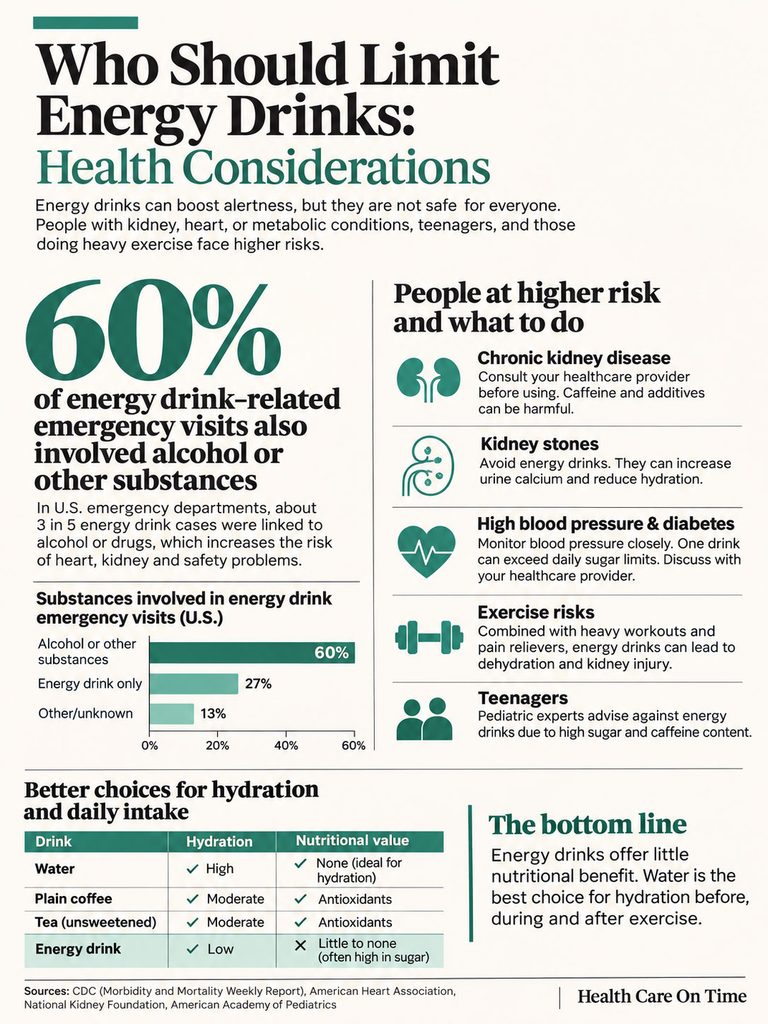
Kidney disease, stones, high blood pressure and diabetes all shrink the margin for error with energy drinks, and so does the way some people use them around exercise.
If you have chronic kidney disease
With CKD at any stage, talk with your nephrologist or a kidney dietitian before drinking energy drinks at all. The National Kidney Foundation places them among drinks that may harm kidney health because of their caffeine, added sugar and additives. Damaged kidneys clear sodium and phosphorus poorly, blood pressure control becomes more important, and many people with CKD also have diabetes. Ask before the first can. If your care team has set a fluid limit, a 16-ounce can uses a chunk of it with no nutritional benefit.
Bring your latest creatinine and eGFR results to that conversation and ask specifically about sodium, phosphorus and caffeine. Plain coffee or tea in moderation usually fits a kidney-friendly diet more easily, since both are on the lower-phosphorus drink list. People with polycystic kidney disease often get caffeine advice specific to their condition from their specialist.
If you’ve had kidney stones
Stone formers have the clearest reason of any group to skip regular energy drinks. Sugar raises urine calcium, sodium does the same, and drinking energy drinks in place of water lowers the amount of urine you make. The goal for most people with a stone history is to make at least 2 liters (about 8 cups) of urine a day, which usually takes about 8 to 12 cups of fluid spread through the day, and stone prevention guidance specifically asks for fewer sugary drinks and regular sodas.
If you still want the occasional can, pick a sugar-free, lower-sodium option, drink it with food, and keep water as your main fluid. Sudden one-sided back pain, pain with urination or blood in the urine can mean a kidney stone is moving again, and it deserves a call to your doctor the same day.
If you have high blood pressure or diabetes
High blood pressure damages the small vessels in the kidneys that filter waste, and diabetes does similar damage through high blood sugar. About 38% of US adults with diabetes and 21% of adults with high blood pressure are estimated to have CKD.
A large serving raised systolic pressure by several points within hours in healthy volunteers, and the usual treatment goal for most adults with high blood pressure is below 130/80, so there isn’t much room to spare. If you take blood pressure medicine, check a home reading after a can and bring the numbers to your next visit. Regular, sugar-sweetened cans fit poorly with diabetes, because one of them can hold more than twice a woman’s daily added sugar limit.
Workouts, heat and pain relievers
A long, hot workout fueled by energy drinks, followed by ibuprofen for sore muscles is a common and risky combination for healthy kidneys. Heavy sweating lowers blood volume, severe dehydration is a recognized cause of acute kidney injury, and so are NSAIDs such as ibuprofen (Motrin, Advil), especially at higher doses. Alcohol and NSAIDs showed up again and again in the case reports. Water works better. Drink it before, during and after hard exercise, and don’t use an energy drink as your workout fluid.
Sports drinks aren’t a fix either, since many add sugar and sodium of their own, and for most workouts under an hour water is enough. Save alcohol for another night, too: in 2011, 42% of energy drink-related emergency visits involved alcohol or other drugs, and alcohol already pulls fluid out of the body.
Teens
For children and teens the advice is simpler: skip energy drinks. Pediatric experts, including the American Academy of Pediatrics, discourage them because of the sugar and caffeine, and the FDA has not set a safe caffeine level for this age group. Teen athletes also face the same heat-and-hard-training risk described above.
Warning signs and what to do next
Acute kidney injury can be silent. When symptoms do appear, they include making less urine than usual (or none), swelling in the legs, ankles or feet, fatigue, shortness of breath, confusion, nausea, flank pain between the ribs and hips, and in severe cases seizures. Very dark, foamy or reddish urine is another reason to get checked, since urine color in kidney failure often shifts before other symptoms show.
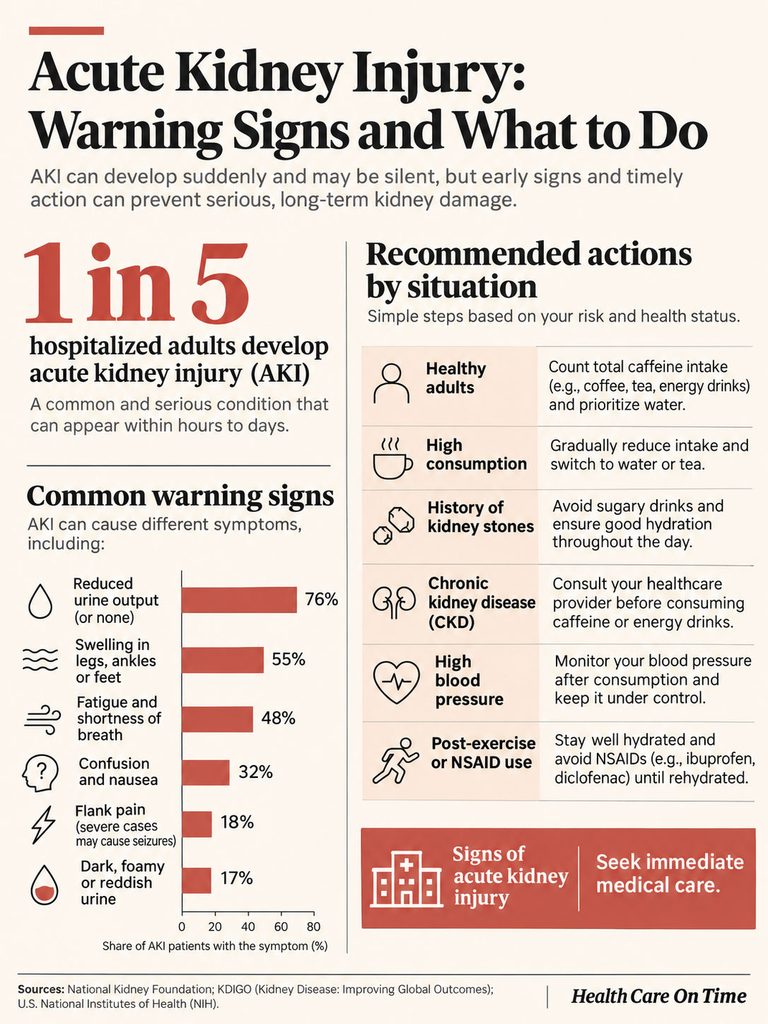
| Your situation | What to do | Why it matters |
| Healthy adult, one standard can on some days | Count it toward a 400 mg daily caffeine total; make water your main drink | Keeps caffeine within the FDA’s level for most adults |
| Three or more cans a day, or 24-oz cans | Cut back by one can every few days; switch some to water or unsweetened tea | Lowers sugar, sodium and caffeine load; slow cuts ease withdrawal headaches |
| History of kidney stones | Skip sugary cans; aim for at least 2 liters of urine a day | Sugar and sodium raise urine calcium (NKF) |
| CKD at any stage | Ask your nephrologist or renal dietitian before drinking any; check for “phos” ingredients | Damaged kidneys can’t clear additive phosphorus well |
| High blood pressure | Avoid large servings; check home blood pressure after a can | 32 oz raised systolic pressure by about 4.6 to 6.1 mm Hg in healthy adults |
| Hard workout in heat, plus ibuprofen | Drink water instead; avoid NSAIDs until you’ve rehydrated | Dehydration and NSAIDs are both causes of acute kidney injury |
| Little or no urine, swelling or vomiting after heavy use | Stop the drinks and get same-day medical care | These are signs of acute kidney injury |
Routine tests catch most kidney problems before symptoms show up. A blood creatinine test with eGFR and a urine albumin test are simple and widely available, and if you drink energy drinks often and also have diabetes, high blood pressure or a family history of kidney disease, ask for regular urine testing at your yearly checkup.
What to drink instead
Water is the best drink for your kidneys. It has no sugar, sodium or additives, and drinking enough of it is the single most important step against kidney stones. There’s no fixed number of glasses for everyone: total fluid needs for the average healthy adult run about 11.5 to 15.5 cups a day from all drinks and food, and urine that is colorless or light yellow is a simple sign you’re getting enough.
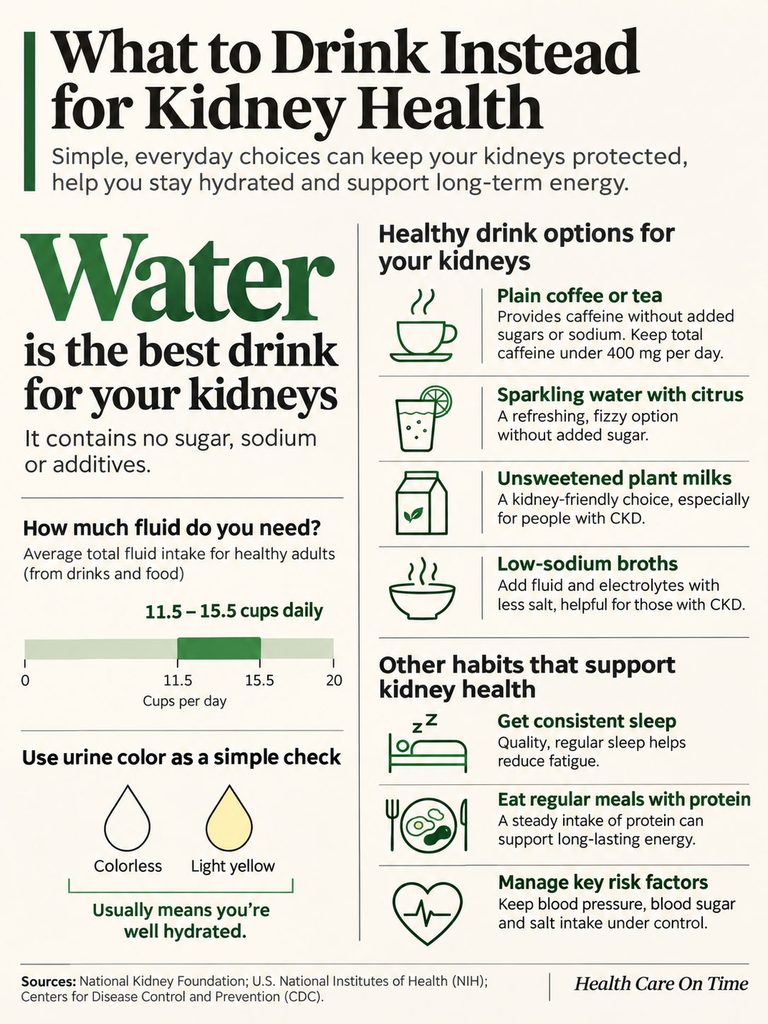
If what you want is the lift, plain coffee or tea gives you caffeine without the sugar, the sodium or the proprietary blend, and both are on the lower-phosphorus list. Keep the total under 400 mg and go easy on syrups and sweetened creamers. Coffee still cuts into sleep when it’s late in the day, and a sweetened coffee drink brings back the sugar problem, so the choice between energy drinks and coffee depends on what actually goes in the cup. Sparkling water with a squeeze of citrus works for people who miss the fizz.
If you have CKD, unsweetened plant milks without added phosphorus and low-sodium broths are other options your dietitian may suggest, and plain milk may need a limit.
For fatigue that keeps sending you to the cooler, consistent sleep, regular meals with protein and a short walk in daylight often do more than a second can, and the same habits that protect the kidneys (steady blood pressure and blood sugar, less salt, careful pain reliever use) help energy too.
Questions to ask your doctor
Bring these to your next visit, along with the can or a photo of its label.
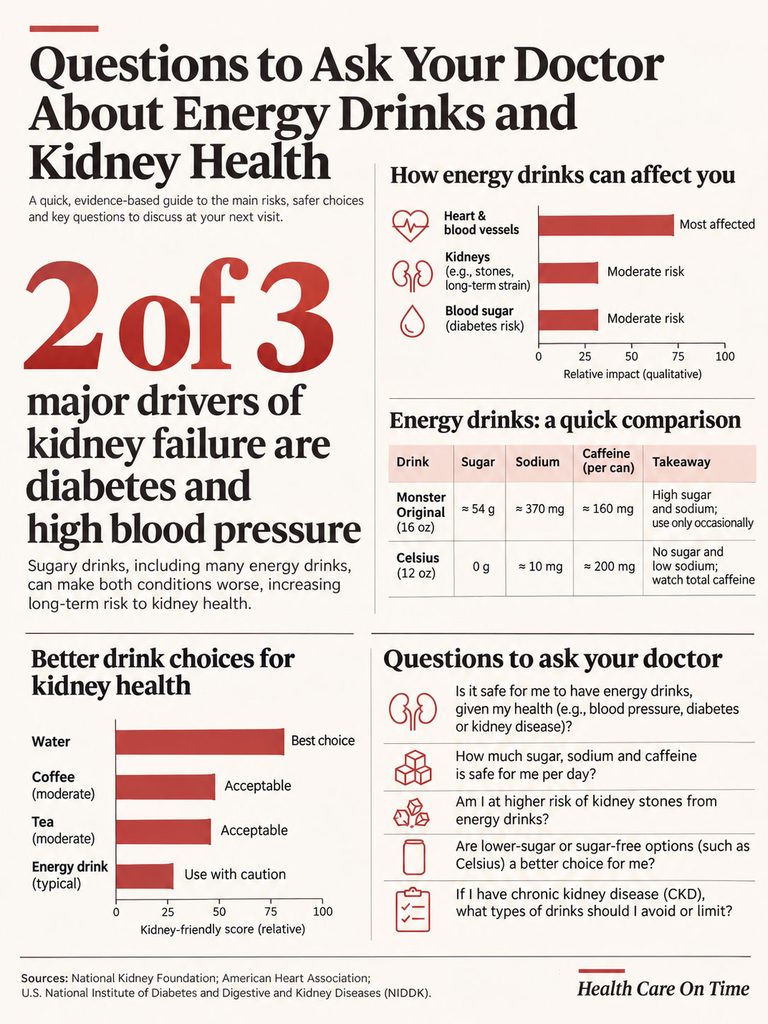
- “Is one can a day still fine if the eGFR is normal?”
- “After a calcium oxalate stone, is a sugar-free can still a problem, or is it mostly the sugar?”
- “What daily sodium target makes sense for kidneys like these?”
- “Is it worth checking blood pressure at home after an energy drink, and what reading should prompt a call?”
- “What’s the safest pain reliever after a hard workout, given these kidney results?”
Frequently Asked Questions
What organ are energy drinks bad for?
The heart and blood vessels react fastest, with higher blood pressure and heart rhythm changes after big servings. Kidneys feel the slower effects of sugar, sodium and dehydration, and rarely an acute injury after very heavy use.
Is it bad to have one energy drink a day?
Not for the kidneys of most healthy adults. The bigger long-term issue is the sugar in a regular can, so sugar-free and under 400 mg of total caffeine is the safer version.
What damages the kidneys the most?
Diabetes and high blood pressure cause most kidney failure in US adults. Frequent high-dose NSAID use, severe dehydration, repeated stones, smoking and obesity also take a toll. A heavy sugary-drink habit feeds several of these at once, and large amounts during heat or hard exercise can stress the kidneys quickly.
What is the #1 best drink for your kidneys?
Water. Plain coffee and tea in moderation are reasonable second choices for most people.
Can energy drinks cause kidney stones?
They can raise the risk. Sugar and sodium both increase calcium in urine, sugar-sweetened sodas are linked to a 23% to 33% higher stone risk in large studies, and a can that replaces a glass of water also means less urine. After a stone, regular cans are best skipped.
Is Monster bad for your kidneys?
A Monster Original now and then isn’t known to damage healthy kidneys. Each 16-ounce can still carries 160 mg of caffeine, 54 grams of added sugar and 370 mg of sodium, which is a lot for anyone with stones, CKD, diabetes or high blood pressure. Zero Ultra drops the sugar but has 380 mg of sodium.
Is Celsius bad for your kidneys?
With no sugar and 5 mg of sodium, Celsius is easier on kidneys than a regular can. Its 200 mg of caffeine is the downside, so stay within the two-can label limit and count your coffee.
Can I drink energy drinks if I have CKD?
Ask your kidney doctor first. Most people with CKD do better without them because of the sodium, caffeine, possible phosphorus additives and fluid limits. If an occasional can is allowed, pick sugar-free, low-sodium and free of “phos” ingredients, and keep it rare.
Medical disclaimer: This article is for general information and isn’t a substitute for advice from your doctor or another qualified health professional. Talk with your care team before changing what you drink if you have kidney disease, kidney stones, high blood pressure, diabetes or heart problems, or if you take prescription medicines. If you notice much less urine than usual, swelling, confusion or chest pain, seek medical care right away.
References
- US Food and Drug Administration. Spilling the Beans: How Much Caffeine Is Too Much? Content current as of August 28, 2024. https://www.fda.gov/consumers/consumer-updates/spilling-beans-how-much-caffeine-too-much
- National Center for Complementary and Integrative Health (NIH). Energy Drinks. Last updated July 2018. https://www.nccih.nih.gov/health/energy-drinks
- Murt A. Energy drink-induced acute kidney injury: a case report and review of the literature. J Med Case Rep. 2025;19:522. https://pmc.ncbi.nlm.nih.gov/articles/PMC12539089/
- Shah SA, et al. Impact of high volume energy drink consumption on electrocardiographic and blood pressure parameters: a randomized trial. J Am Heart Assoc. 2019;8(11):e011318. https://pmc.ncbi.nlm.nih.gov/articles/PMC6585360
- Ferraro PM, Taylor EN, Gambaro G, Curhan GC. Soda and other beverages and the risk of kidney stones. Clin J Am Soc Nephrol. 2013;8(8):1389-1395. https://pmc.ncbi.nlm.nih.gov/articles/PMC3731916
- Rebholz CM, et al. Patterns of beverages consumed and risk of incident kidney disease. Clin J Am Soc Nephrol. 2019;14(1):49-56. https://pubmed.ncbi.nlm.nih.gov/30591520/
- Tommerdahl KL, et al. Coffee consumption may mitigate the risk for acute kidney injury: results from the ARIC study. Kidney Int Rep. 2022;7(7):1665-1672. https://pesquisa.bvsalud.org/bvsdip/resource/pt/mdl-35812301
- Bigotte Vieira M, et al. Caffeine consumption and mortality in chronic kidney disease: a nationally representative analysis. Nephrol Dial Transplant. 2019;34(6):974-980. https://urotoday.com/recent-abstracts/urologic-oncology/renal-cancer/106945-caffeine-consumption-and-mortality-in-chronic-kidney-disease-a-nationally-representative-analysis.html
- Centers for Disease Control and Prevention. Chronic Kidney Disease in the United States. Updated March 31, 2026. https://www.cdc.gov/kidney-disease/php/data-research
- Centers for Disease Control and Prevention. Chronic Kidney Disease in the United States, 2023 (fact sheet). https://nccd.cdc.gov/ckd/documents/ckd_factsheet_2023.pdf
- National Kidney Foundation. Healthy Hydration for Your Kidneys: What to Sip and What to Skip. https://www.kidney.org/news-stories/healthy-hydration-your-kidneys-what-to-sip-and-what-to-skip
- National Kidney Foundation. Phosphorus and Your CKD Diet. Last updated July 16, 2024. https://www.kidney.org/kidney-topics/phosphorus-and-your-ckd-diet
- National Kidney Foundation. Kidney Stones Diet and Prevention. Last updated September 28, 2026. https://www.kidney.org/node/154344
- National Kidney Foundation. High Blood Pressure and Chronic Kidney Disease. Last updated August 13, 2026. https://www.kidney.org/node/18196
- National Kidney Foundation. Acute Kidney Injury (AKI). Last updated February 26, 2024. https://www.kidney.org/kidney-topics/acute-kidney-injury-aki
- National Institute of Diabetes and Digestive and Kidney Diseases. Eating, Diet, and Nutrition for Kidney Stones. https://niddk.nih.gov/health-information/urologic-diseases/kidney-stones/eating-diet-nutrition
- American Heart Association. How Too Much Added Sugar Affects Your Health. https://cpr.heart.org/en/healthy-living/healthy-eating/eat-smart/sugar/how-too-much-added-sugar-affects-your-health-infographic
- Mayo Clinic. Caffeine: How much is too much? https://www.mayoclinic.org/healthy-lifestyle/weight-loss/in-depth/caffeine/art-20045678
- Mayo Clinic. Water: How much should you drink every day? https://www.mayoclinic.org/water/ART-20044256
- Monster Energy Original and Monster Zero Ultra, 16 fl oz, Nutrition Facts (Giant Food Stores product listings). https://giantfoodstores.com/groceries/beverages/energy-drinks/monster-energy-drink-16-oz-can.html and https://giantfoodstores.com/groceries/beverages/energy-drinks/monster-zero-ultra-energy-drink-12-pk-16-oz-cans.html
- Red Bull North America. Red Bull Energy Drink ingredients and nutrition. https://www.redbull.com/us-en/energydrink/red-bull-energy-drink-ingredients-list
- Celsius Zero Sugar Sparkling Watermelon Lemonade, 12 fl oz, Nutrition Facts (H-E-B product listing). https://www.heb.com/product-detail/celsius-zero-sugar-sparkling-energy-drink-watermelon-lemonade/14063512
- Rockstar Energy. Original O.G. nutrition facts. https://www.rockstarenergy.com/products/original-og