For most people with IBS, the best fiber supplement is a soluble, slowly fermented one, and psyllium (the fiber in Metamucil) has the most trial evidence behind it. Which product suits you best depends on whether constipation, diarrhea or gas is your main problem.
Table of Contents
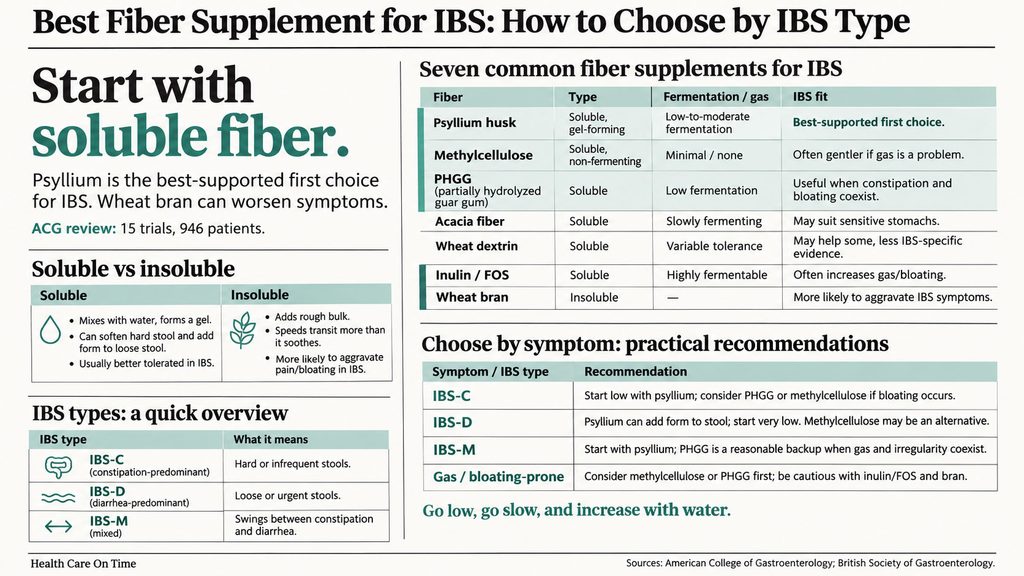
Quick answer: Start with psyllium (Metamucil or a store brand) if you have IBS-C or mixed IBS. If gas is your biggest complaint, methylcellulose (Citrucel) is non-fermentable, and partially hydrolyzed guar gum (Sunfiber) is certified low-FODMAP. For IBS-D, soluble fiber can firm loose stools; psyllium and PHGG are the usual first tries. Skip wheat bran, inulin and chicory root. Start with one dose a day, take it with a full 8-ounce glass of water, and increase slowly.
Which Fiber Supplement Fits Your Type of IBS
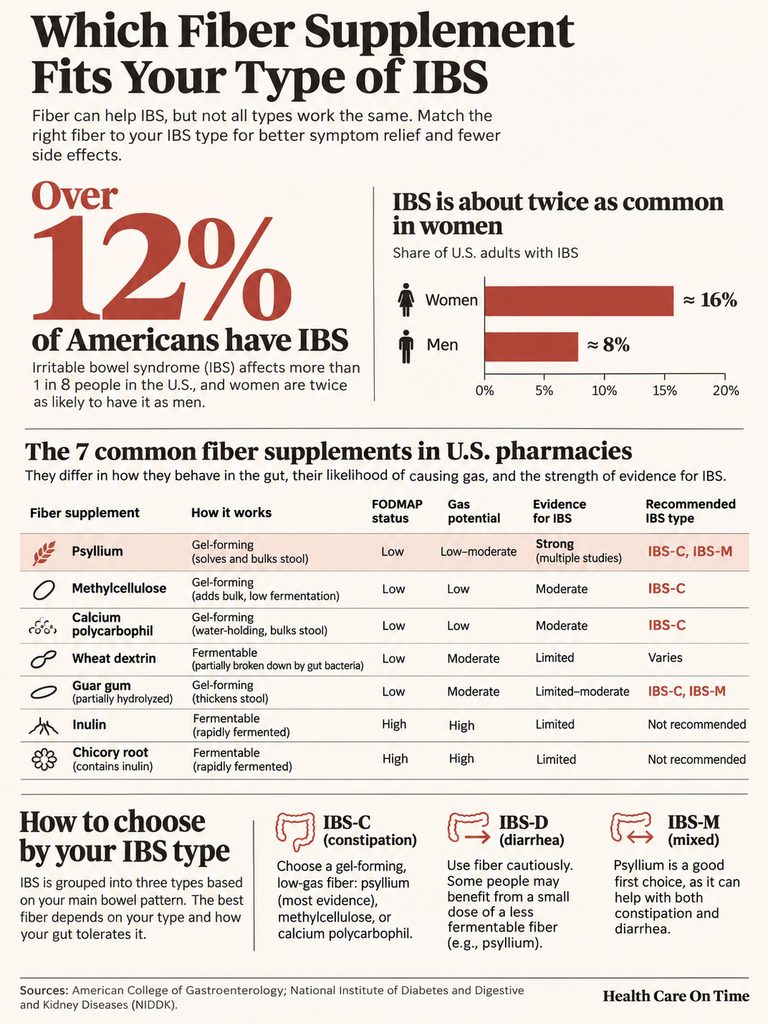
Doctors split IBS into types based on what your stools look like on bad days. In IBS-C, more than a quarter of stools are hard or lumpy. In IBS-D, more than a quarter are loose or watery. Mixed IBS (IBS-M) means both happen often. About 12 percent of people in the United States have IBS, and women are up to twice as likely as men to get it.
Two powders can both say “fiber” on the tub and behave in opposite ways inside a sensitive gut, because one forms a gel and barely ferments while the other is a short-chain carbohydrate that gut bacteria break down quickly and turn into gas.
Seven fiber types make up nearly everything on US pharmacy shelves.
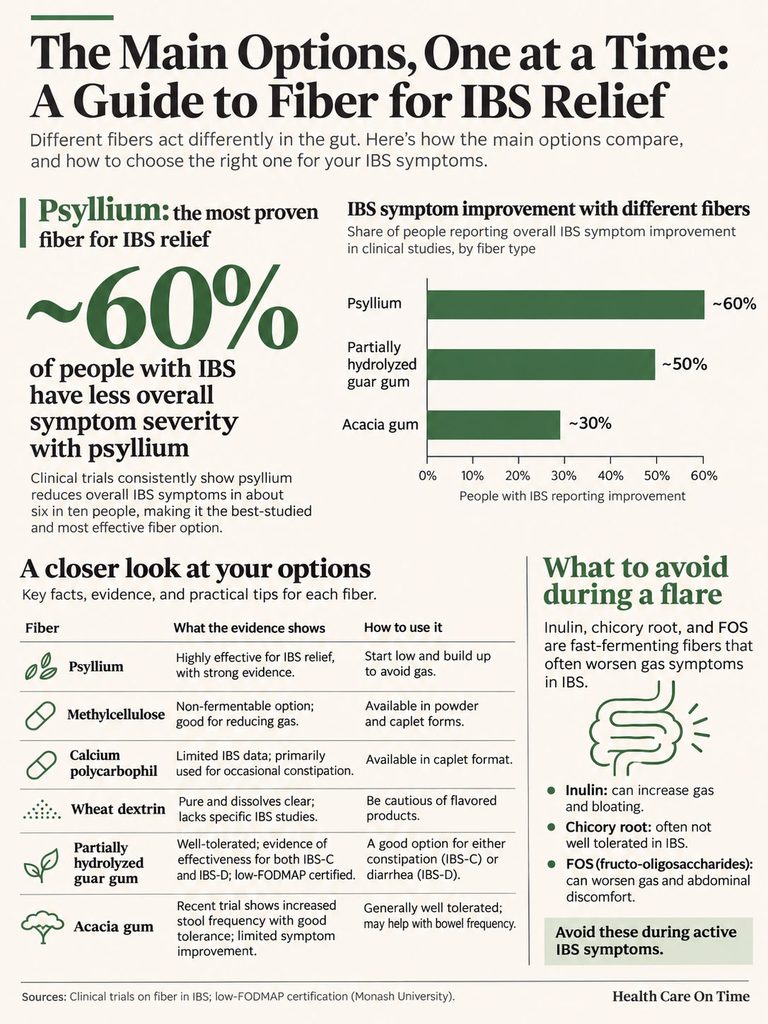
| Fiber (US brand example) | How it behaves | FODMAP status | Gas potential | IBS evidence | Best fit |
| Psyllium (Metamucil, store brands) | Soluble, gel-forming, poorly fermented | Listed as suitable for IBS | Bloating, gas and cramping are the common side effects, mostly early | Strongest: several RCTs and meta-analyses | IBS-C and IBS-M first; can be tried in IBS-D |
| Methylcellulose (Citrucel) | Gel-forming, non-fermentable | Listed as suitable for IBS | Low, because gut bacteria don’t ferment it | Limited; may help IBS-C | IBS-C or anyone bothered by gas |
| Calcium polycarbophil (FiberCon) | Synthetic bulk-forming laxative caplet | No Monash rating | No IBS gas data | One older study showed symptom improvement | Constipation per label; IBS data thin |
| Wheat dextrin (Benefiber Original) | Soluble, dissolves clear, non-thickening | No Monash rating; labeled gluten-free (under 20 ppm) | Not studied in IBS | Not formally studied in IBS | Fiber top-up if you tolerate it; not an evidence-based IBS pick |
| Partially hydrolyzed guar gum (Sunfiber) | Water-soluble, slowly fermented | A PHGG product is Monash low-FODMAP certified | Improved bloating and gas scores vs placebo at 6 g/day (2016 RCT) | Small RCTs | IBS-C, IBS-D and bloating-predominant IBS |
| Acacia gum | Soluble, slowly fermented | No Monash rating | No more bloating or flatulence than placebo at 10 g/day (2024 RCT) | One RCT in IBS-C | IBS-C with a sensitive gut |
| Inulin, chicory root, FOS | Short-chain, highly fermentable | High FODMAP | High; may worsen gas-related symptoms | Not recommended for most | Avoid during IBS flares and the low-FODMAP elimination phase |
Psyllium heads the list because it’s the one fiber the American College of Gastroenterology (ACG) names directly, as potentially useful in every subtype but most helpful in IBS-C and IBS-M, and preferred over wheat bran for overall symptom relief.
Why the Fiber Type Decides How You Feel
Soluble fiber dissolves and forms a gel as it moves through the intestine. The gel holds water. That softens hard stool and also gives loose stool more body, so soluble fiber can help with both diarrhea and constipation. Insoluble fiber, such as wheat bran, adds bulk and speeds things along, which is fine in a healthy gut and often means more pain and bloating in an irritable one.
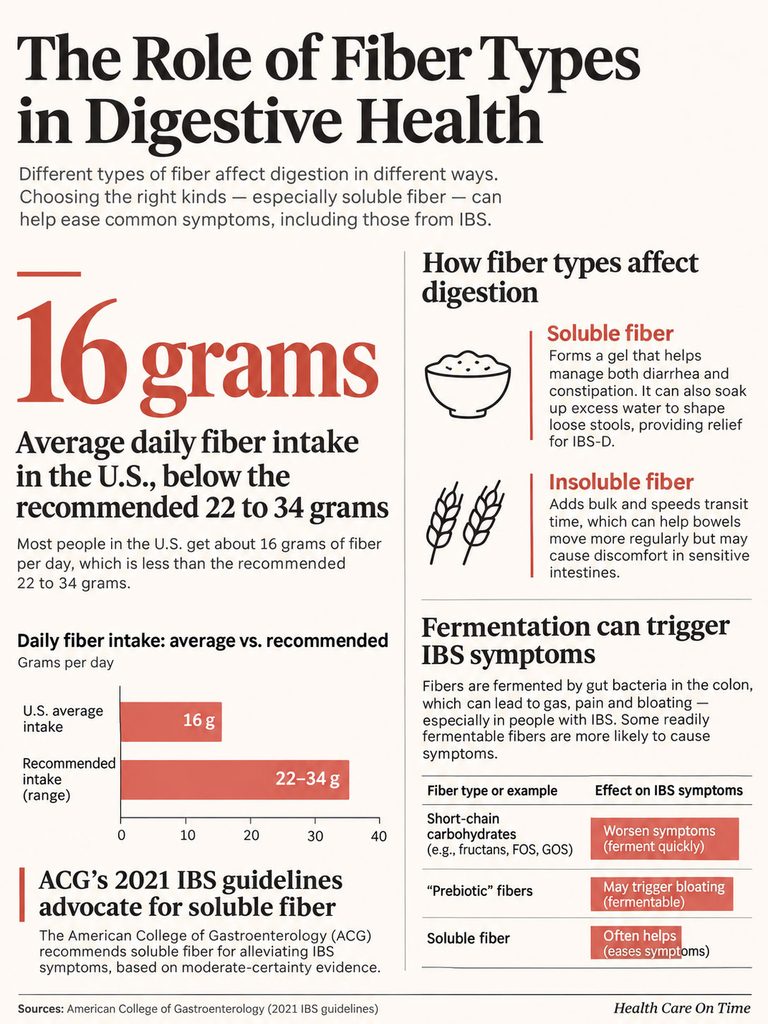
The ACG’s 2021 IBS guideline comes down on the same side: soluble, but not insoluble, fiber for global IBS symptoms, based on moderate-certainty evidence.
Bacteria in the colon ferment some fibers and release gas as they go, and in IBS that gas tends to register as pain or bloating sooner than it would for someone else. Short-chain carbohydrates such as fructans, FOS and GOS ferment quickly and worsen symptoms in most people with IBS. Longer, more complex fibers break down slowly and cause less trouble. Psyllium and methylcellulose sit at the slow or non-fermenting end; inulin and FOS sit at the fast end.
The gel also explains why fiber gets used for IBS-D at all, which surprises people who think of fiber only as a constipation remedy. A soluble fiber soaks up some of the excess water in loose stool and gives it shape, so a small, steady dose can make stools more formed and urgency a bit less frantic. The dose has to stay low at first, though, since a jump in fermentable fiber can loosen things further.
The word “prebiotic” sells supplements, but for a sensitive gut it usually signals a highly fermentable fiber, the exact property that triggers bloating.
FODMAPs are a group of poorly absorbed short-chain carbohydrates (fermentable oligosaccharides, disaccharides, monosaccharides and polyols), and a fiber product can carry them in two ways. The fiber itself may be a FODMAP, as inulin and FOS are. Or the flavoring adds one: sugar alcohols such as sorbitol are polyols, and the low-FODMAP diet limits sweeteners ending in “-ol”, so a chewable or gummy can undo the benefit of a good fiber without the front of the box giving any hint of it.
Most Americans could use the extra fiber anyway. The Dietary Guidelines for Americans suggest 22 to 34 grams a day for adults, yet only about 5 percent of American adults reach that, and the average intake is around 16 grams. A supplement can close part of that gap when a low-FODMAP diet makes beans, wheat and many fruits harder to eat.
The Main Options, One at a Time
Psyllium (Metamucil and store brands)
Psyllium husk is a soluble, gel-forming fiber that’s poorly fermented, and it has the deepest IBS evidence of any fiber. A 2014 meta-analysis of 14 randomized trials with 906 patients found that soluble fiber reduced the chance of staying symptomatic, with a number needed to treat of 7. Bran didn’t help significantly.
The best-known single trial ran in Dutch general practices. Its 275 adults took 10 grams a day of psyllium, bran or a rice-flour placebo for 12 weeks, and in the first month 57% of the psyllium group reported adequate relief versus 35% on placebo, while symptom severity scores fell by 90 points with psyllium compared with 49 on placebo. Bran had the most early dropouts, mostly people whose symptoms got worse on it.
Psyllium does cause gas for some people. Bloating, distention, flatulence and cramping are its most common side effects, especially in the first stretch, which is the whole reason to start low and build up over days to weeks. These effects often fade over the first few weeks. When they don’t, moving to a non-fermenting fiber makes sense.
Each Metamucil packet of the orange powder contains about 3.4 grams of psyllium husk. New users start with one dose a day and gradually work up to three, each mixed in at least 8 ounces of liquid. Some people are allergic to inhaled or swallowed psyllium; if mixing the powder has ever made you sneeze, wheeze or break out, mention it to a doctor before going further.
Technique matters with psyllium more than with any other fiber. Put the dose in an empty glass, add the liquid, stir hard and drink it right away, because the mixture keeps thickening as it stands; if it turns to sludge before you finish, add more liquid and stir again instead of forcing it down.
Plain, unflavored psyllium husk is the simplest version. Flavored and sugar-free tubs add sweeteners and other ingredients, and when you’re trying to work out what your gut is reacting to, fewer ingredients help.
Methylcellulose (Citrucel)
If gas is the part of IBS you hate most, this is usually the one to try. Methylcellulose forms a gel but gut bacteria can’t ferment it, and the Monash University FODMAP team describes it as non-fermentable and gel-forming, so it may soften stools in IBS-C, with more studies still needed.
Each heaping tablespoon of Citrucel powder carries 2 grams of methylcellulose. That’s less fiber per scoop than a psyllium dose, so it can take more servings to get a similar effect; adults start at one tablespoon and can add one tablespoon at a time, up to three times a day.
Check which tub you’re buying. Citrucel Orange gets 60 calories per dose from sucrose and maltodextrin. The Sugar Free version uses aspartame instead, with 52 mg of phenylalanine per adult dose, which rules it out for anyone with phenylketonuria. There are also 500 mg caplets, up to 12 a day.
Caplets are convenient, but the math works against them: it takes four of them to match the methylcellulose in a single tablespoon of powder.
Calcium polycarbophil (FiberCon)
Good IBS data on FiberCon is scarce. A 2009 summary of the ACG’s earlier recommendations could point to just one study in which calcium polycarbophil improved symptoms.
The FiberCon label lists one use, occasional constipation, and its directions are written with that use in mind, not loose stools or IBS-D.
Its appeal is the format. It’s a caplet, and some people stick with a caplet far better than with a gritty drink. Each caplet holds 625 mg of calcium polycarbophil and 140 mg of calcium; adults take 2 caplets per dose, up to 8 in 24 hours, each dose with at least 8 ounces of fluid, and full benefit normally takes one to three days of steady use. If you already take a calcium supplement, run the combined total past your pharmacist.
Wheat dextrin (Benefiber Original)
Benefiber Original is pure wheat dextrin, and a 2-teaspoon serving provides 3 grams of soluble fiber. It dissolves clear. It doesn’t thicken. Plenty of people find it the easiest fiber to keep taking.
Wheat dextrin hasn’t been formally studied in IBS, though, so its comfort comes with no trial evidence for IBS symptoms. The powders contain less than 20 ppm of gluten and meet the FDA definition of gluten-free; even so, Benefiber’s own FAQ tells people with gluten intolerance to avoid products with any gluten level unless a doctor says otherwise.
The bigger IBS problem sits elsewhere in the lineup. Inulin from chicory root is in the Strawberry Lemonade stick packs, the Dual Action stick packs and the prebiotic gummies, and the chewables are sweetened with sorbitol, so a shopper who grabs any box marked “Benefiber” without reading the ingredients can walk out with a high-FODMAP product.
Partially hydrolyzed guar gum (Sunfiber)
PHGG is guar gum that’s been partly broken down so it dissolves completely and has no taste, which means it can go into coffee, tea or water without changing much. It ferments slowly, and the Monash team lists it as possibly well tolerated and helpful for both IBS-C and IBS-D, one of the few fibers with any IBS-D support. A PHGG product from Taiyo, the maker of Sunfiber, carries Monash low-FODMAP certification.
In the largest trial, 121 adults with all IBS subtypes took 3 grams a day for one week and then 6 grams a day for 11 weeks. Bloating scores improved more with PHGG than with placebo (−4.1 vs −1.2), and so did combined bloating-and-gas scores (−4.3 vs −1.12). Pain, stool frequency and quality of life didn’t change. With funding from companies that sell PHGG, the trial needs confirming by independent groups.
Acacia gum
A 2024 trial in adults with IBS-C gave 10 grams a day of acacia fiber (5 grams for the first five days) and found it raised stool frequency by 1.3 stools a week versus 0.4 on placebo. Bloating, abdominal pain and flatulence were no worse than placebo, a good sign for tolerance. Overall IBS symptom scores didn’t budge. Keep in mind that the acacia supplier helped fund the work and employed one of the authors.
Inulin, chicory root and FOS
These fibers turn up in “gut health” gummies, protein bars and prebiotic drinks. They’re short-chain fructans, they ferment fast, and inulin may worsen gas-related symptoms. If a label lists inulin, chicory root, FOS, oligofructose or GOS, put it back while your IBS is active. Wheat bran belongs on the same list for two reasons at once: it’s insoluble, and it contains fructans.
Metamucil vs Benefiber for IBS
Metamucil is the better choice for IBS. Its psyllium is recommended by name in IBS guidance and was tested in the largest IBS trials; Benefiber’s wheat dextrin hasn’t been studied in IBS at all.
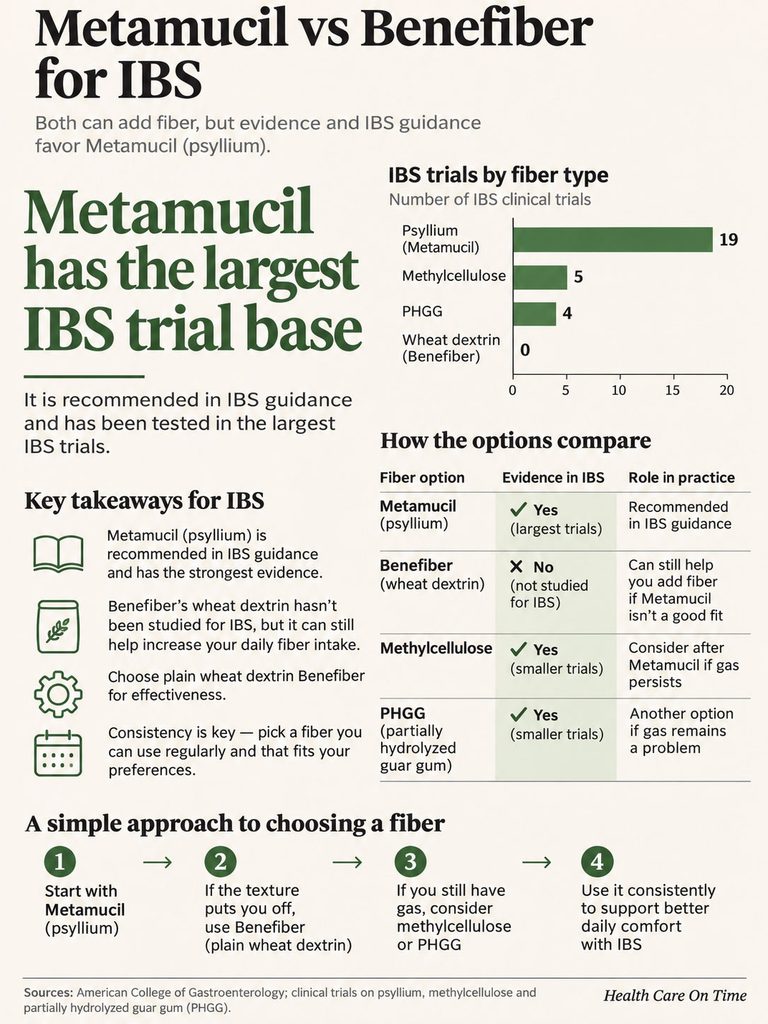
Benefiber still has a place. If psyllium’s thick texture is the reason you keep skipping doses, a clear powder you take every day may do more for your fiber intake than a better-studied one that sits in the cabinet, as long as it’s the plain wheat dextrin version.
The differences that matter day to day:
- Evidence: psyllium has randomized IBS trials and meta-analyses; wheat dextrin has none in IBS.
- Dose: about 3.4 g of psyllium husk per Metamucil packet versus 3 g of fiber per 2 teaspoons of Benefiber Original.
- Texture: Metamucil thickens as it sits, so drink it promptly; Benefiber stays clear and thin.
- Several Benefiber sub-brands contain inulin or sorbitol, so the flavor you pick matters.
- Benefiber is wheat-derived but tests below 20 ppm gluten, while psyllium contains no wheat.
After a few weeks of Metamucil with a slow build-up, if gas still bothers you, the next swap is usually methylcellulose or PHGG, not Benefiber.
What the Research Shows, in Numbers
A 2026 meta-analysis in Gastroenterology, led by Heidi Staudacher of Monash University, pooled 30 randomized trials with 1,904 patients. Across 16 trials that measured clinical response, 52% of people taking fiber responded compared with 44% on control treatments, and psyllium raised the likelihood of response by about 53%. Wheat bran showed no significant benefit.
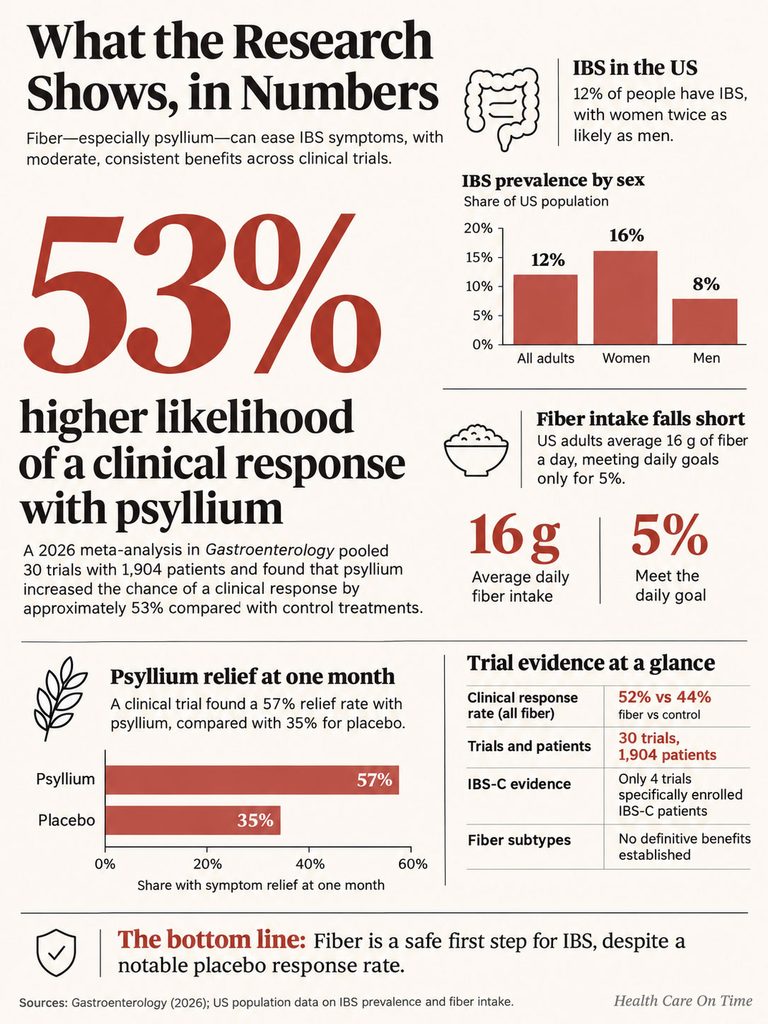
Only four of those trials enrolled people with IBS-C specifically, so the authors couldn’t say which subtype benefits most. Claims that one fiber is “best for IBS-D” rest on mechanism and small studies. No head-to-head trial settles it.
| Finding | Number | Source |
| People in the US with IBS | About 12% | NIDDK |
| Women vs men | Women up to 2 times more likely | NIDDK |
| US adults meeting daily fiber goals | About 5%; average intake 16 g/day | Cleveland Clinic |
| Fiber vs control, clinical response (16 RCTs, 1,293 patients) | 52% vs 44% | Staudacher et al., Gastroenterology 2026 |
| Psyllium, likelihood of response vs control | About 53% higher | Staudacher et al., Gastroenterology 2026 |
| Soluble fiber, number needed to treat (14 RCTs, 906 patients) | 7 | Moayyedi et al., Am J Gastroenterol 2014 |
| Psyllium vs placebo, adequate relief at month 1 (275 patients) | 57% vs 35% | Bijkerk et al., BMJ 2009 |
| Symptom severity drop at 3 months | Psyllium 90 points, bran 58, placebo 49 | Bijkerk et al., BMJ 2009 |
| Acacia fiber, change in stools per week (IBS-C) | +1.3 vs +0.4 on placebo | Eur J Nutr trial, 2024 |
A 2009 review of the ACG’s earlier recommendations put psyllium’s number needed to treat at 6 and found bran no better than placebo for global symptoms.
An 8-point gap in response rates means plenty of people improve on placebo too, and plenty of people taking fiber still need other treatment, but because fiber is cheap and safe for most adults, it’s still the sensible first step.
Using Fiber During a Low-FODMAP Diet
The ACG also recommends a limited trial of a low-FODMAP diet for overall IBS symptoms. It usually runs for a few weeks. If symptoms improve, FODMAP foods come back one group at a time to see which ones you tolerate.
Fiber intake often drops during that elimination phase, because so many high-FODMAP foods are also high-fiber foods, and a supplement is a reasonable way to fill the hole when food alone falls short. Psyllium, methylcellulose and a certified PHGG product fit best; people with mixed IBS can pair one with a reduced-FODMAP diet.
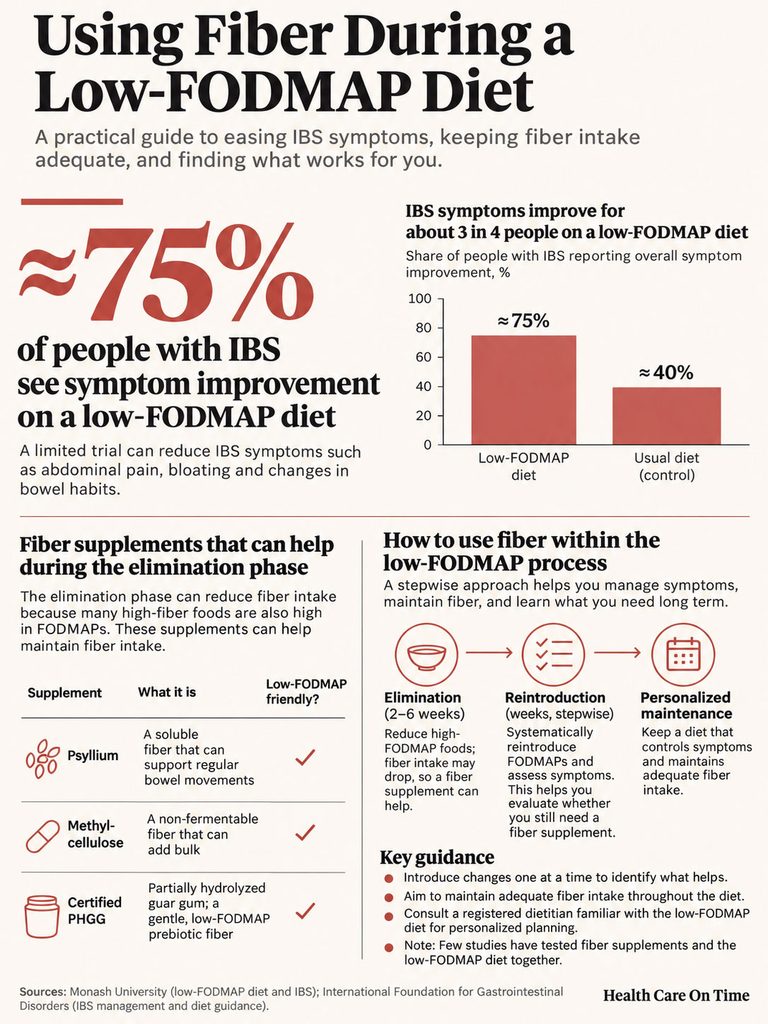
Very little research has tested fiber supplements and the low-FODMAP diet together, or followed either for the long term. Change one thing at a time. Start the diet and a new supplement in the same week and you won’t know which one helped.
Reintroduction is also a good moment to ask whether you still need the supplement, since a broader diet may bring enough fiber back on its own. A registered dietitian who knows the low-FODMAP diet can plan both pieces so the elimination phase doesn’t leave you short on fiber for weeks.
Starting a Fiber Supplement Without a Gas Flare
Most bad experiences with fiber come from too much, too soon. The fix is to introduce fiber slowly and drink plenty of water every day, which limits gas, bloating and constipation.
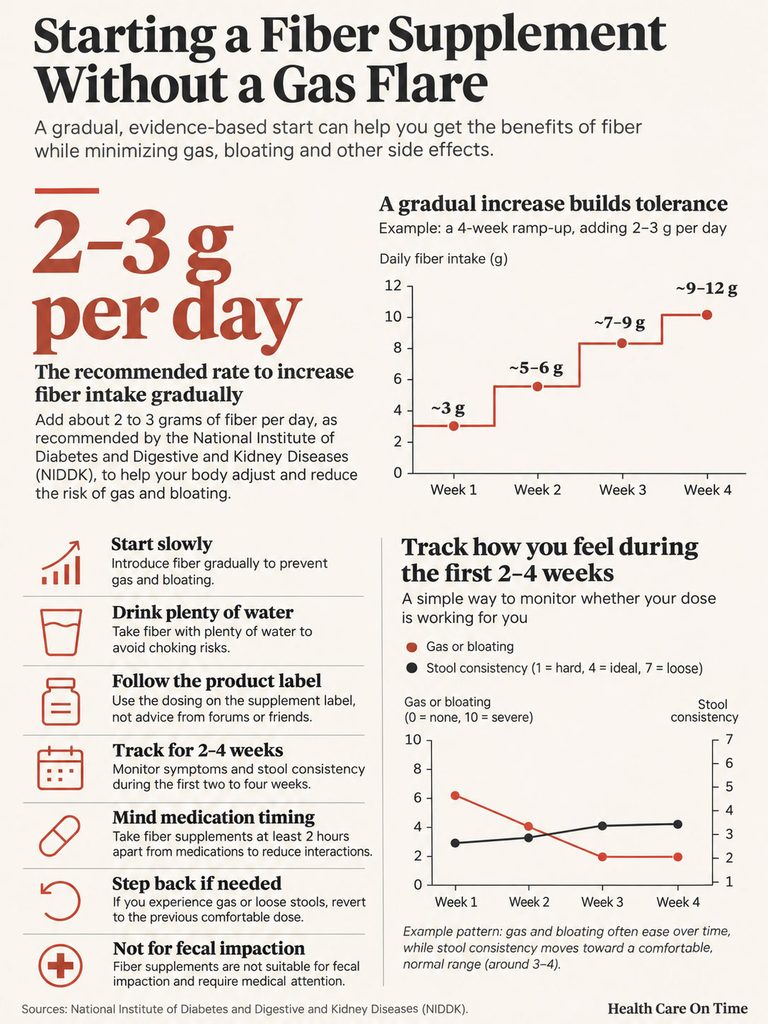
Use the dose on your product’s label, not one from a forum or a friend. For Metamucil, that’s one dose a day at first and a gradual climb toward three. For Citrucel powder, it’s one tablespoon, adding one tablespoon at a time. With any fiber, a small start and a build-up over several days is the safer path.
Psyllium, methylcellulose and calcium polycarbophil labels all carry a choking warning, since the fiber can swell and block the throat or esophagus if you don’t drink enough with it. Mix each dose in at least 8 ounces of water or another liquid and drink it promptly. Don’t take bulk fibers at all if you have trouble swallowing.
Bulk fiber can also change how well some drugs are absorbed, and the Metamucil and FiberCon labels both say to take fiber 2 or more hours before or after other drugs, which can get awkward if you already take thyroid medicine first thing in the morning or several pills spread through the day, so ask your pharmacist to help map out a schedule.
Psyllium’s benefits build over days to weeks, and FiberCon normally needs one to three days of steady use; switch every few days and you’ll never know what worked. A steady two- to four-week trial at the same dose, with a quick note each day on stools and symptoms, gives a much clearer answer.
On the food side, a rise of about 2 to 3 grams a day is the pace NIDDK suggests, and plenty of the usual foods for constipation relief sit fine with IBS in normal portions, so a supplement doesn’t have to carry the whole load.
If gas or loose stools get worse
Drop back to the last dose that felt fine and stay there for a week before trying to increase again. Highly fermentable fibers or high doses can cause gas, bloating, diarrhea and pain even in people without IBS, and too much fiber can also loosen stools, so a smaller dose or a different fiber usually solves it. If loose stools carry on after you’ve cut back, the warning signs of diarrhea in adults tell you when to stop waiting and call a doctor.
One hard limit: fiber supplements are not for fecal impaction, which needs medical treatment first.
Picking a Fiber by Situation
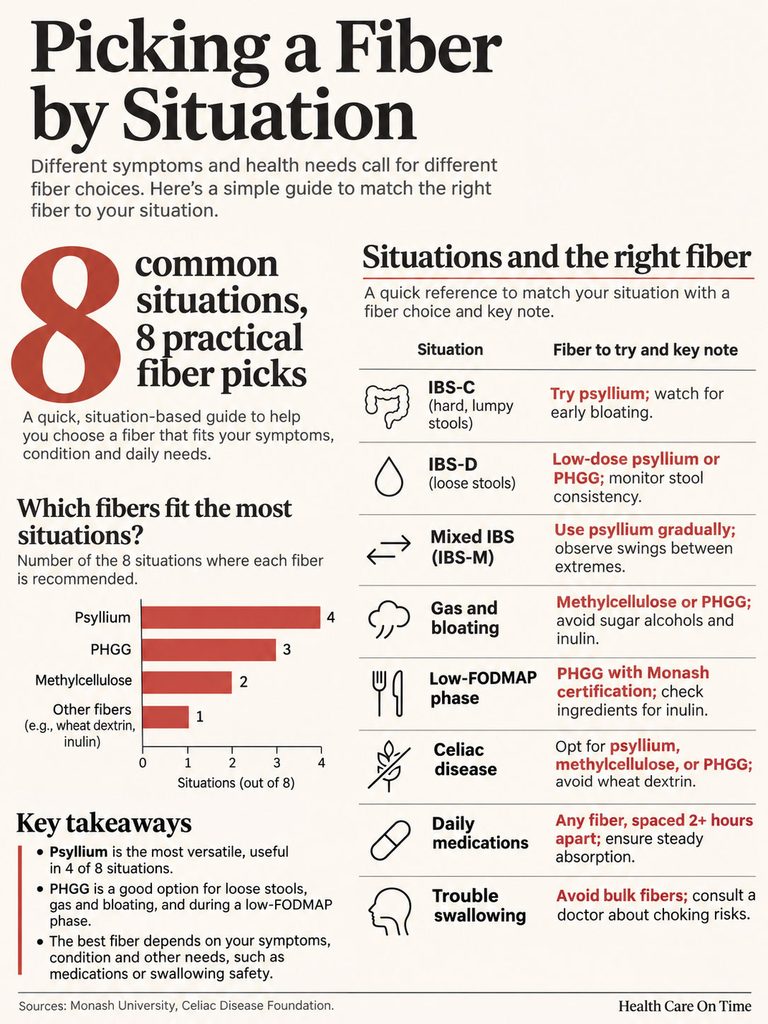
| Your situation | What to try first | Watch for |
| IBS-C (mostly hard, lumpy stools) | Psyllium, building to the label’s full dose | Early bloating; switch to methylcellulose if it lasts past a few weeks |
| IBS-D (mostly loose stools) | Low dose of psyllium or PHGG | Stools getting looser; cut back and see a doctor if diarrhea persists |
| Mixed IBS (IBS-M) | Psyllium, slowly | Swings toward either extreme; hold the dose steady for 2 to 4 weeks before judging |
| Gas and bloating are the main problem | Methylcellulose (Citrucel) or PHGG | Sugar alcohols or inulin hidden in flavored versions |
| On the low-FODMAP elimination phase | PHGG with Monash certification, psyllium or methylcellulose | Inulin, chicory root, FOS and GOS on the ingredient list |
| Celiac disease or strict gluten-free diet | Psyllium, methylcellulose or PHGG | Wheat dextrin products, even when labeled gluten-free |
| Taking daily prescription medicines | Any fiber, spaced 2+ hours from other drugs | Thyroid and other medicines that need steady absorption |
| Trouble swallowing | Don’t use bulk fibers; ask your doctor | Choking risk on the psyllium, methylcellulose and polycarbophil labels |
See a Doctor Before You Self-Treat
Fiber can ease IBS. It can’t treat a different disease that looks like IBS, and about 10 to 15 percent of people with intestinal complaints may have an organic disease such as colon cancer or inflammatory bowel disease, so new or changing symptoms deserve a proper evaluation before a long run of supplements.
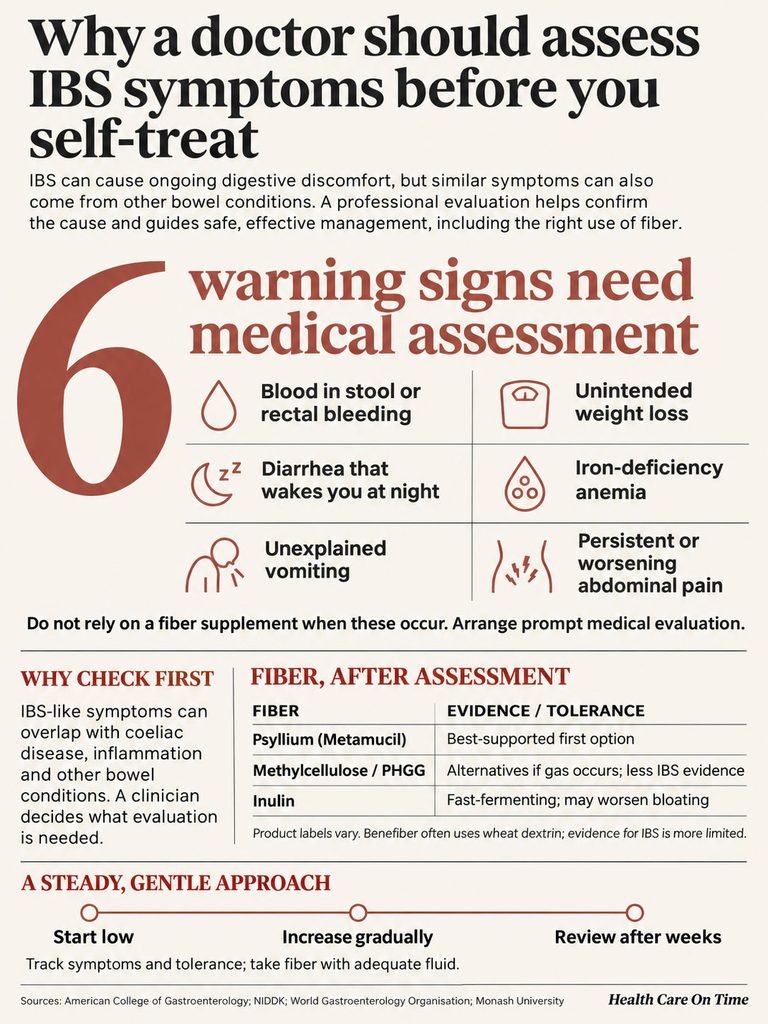
Get checked promptly for weight loss, diarrhea at night, rectal bleeding, iron deficiency anemia, unexplained vomiting, or pain that isn’t relieved by passing gas or stool. The fiber labels add stop signs of their own: constipation lasting more than 7 days, any rectal bleeding, or no bowel movement after using the product.
Blood in the stool is never something to treat with a fiber supplement and wait out, even if you’ve had hemorrhoids before.
If you already have a diagnosis, a short visit can still spare you a lot of guesswork. Questions worth asking:
- Is this IBS-C, IBS-D or mixed, and does that change which fiber you’d start with?
- If gas is the worst symptom, would psyllium or Citrucel be the better first try?
- How many hours apart should fiber be from the medicines already prescribed?
- Is a dietitian referral for a low-FODMAP trial worth doing before adding a supplement?
- Do any of these symptoms need a stool test, blood work or a colonoscopy first?
Frequently Asked Questions
What is the best fiber supplement for someone with IBS?
Most people do best starting with psyllium. It’s soluble, poorly fermented and backed by randomized trials. If it causes too much gas, methylcellulose (Citrucel) or partially hydrolyzed guar gum (Sunfiber) are the usual alternatives.
Which type of fiber is best for IBS?
Soluble fiber that ferments slowly or not at all, such as psyllium, methylcellulose or PHGG. Fast-fermenting inulin and FOS cause more gas.
Is Metamucil or Benefiber better for IBS?
Metamucil has the stronger case. Its psyllium has IBS trial evidence and an ACG recommendation, and Benefiber’s wheat dextrin has none. Benefiber is easier to drink, but some Benefiber products contain inulin or sorbitol, both of which can set off symptoms, so read the box if you pick it.
What fiber do gastroenterologists recommend?
Psyllium comes up first, since it’s the soluble fiber the American College of Gastroenterology names in its IBS treatment guidance and the one with the largest trials. Methylcellulose is the common pick for people bothered by gas, and PHGG is an option that may help both IBS-C and IBS-D. Wheat bran is generally not recommended: trials show no clear benefit, and in one large primary care study it had the most early dropouts from worsening symptoms.
Can a fiber supplement make IBS worse?
Yes, especially if you start too high. A full dose on day one, or a fast-fermenting fiber like inulin or chicory root, can bring more gas, bloating, cramping or loose stools. Starting low, drinking enough water and choosing psyllium, methylcellulose or PHGG lowers that risk. If symptoms keep getting worse after a few weeks, stop and talk with your doctor.
How long does fiber take to help IBS?
Fiber laxatives usually produce a bowel movement within 12 to 72 hours, but IBS symptom relief builds more slowly, over days to weeks. In the largest primary care trial, psyllium’s edge over placebo showed up within the first month. Give one product a steady two- to four-week trial before you judge it.
Is psyllium low-FODMAP?
For practical purposes, yes. IBS reviews list psyllium as a suitable, generally well-tolerated fiber because it’s poorly fermented. A minority of people with IBS still react to it, so start small and choose unflavored psyllium to skip added sweeteners.
Can you take fiber supplements with IBS medicines?
Usually, with spacing. Take the fiber at least 2 hours before or after other drugs, as the Metamucil and FiberCon labels direct, because bulk fiber can change how well some medicines are absorbed. Ask your pharmacist about any drug where steady blood levels matter.
Medical disclaimer: This article is for general information and doesn’t replace advice from your doctor, pharmacist or a registered dietitian. Follow the dosing on your product’s label. Talk with a healthcare professional before starting a fiber supplement if you’re pregnant, have trouble swallowing, take daily medicines or have any warning signs such as rectal bleeding, weight loss or diarrhea at night.
References
- National Institute of Diabetes and Digestive and Kidney Diseases. Definition & Facts for Irritable Bowel Syndrome.
- National Institute of Diabetes and Digestive and Kidney Diseases. Eating, Diet, & Nutrition for Irritable Bowel Syndrome.
- American College of Gastroenterology. IBS Treatment: Soluble Fiber (Psyllium, Ispaghula Husk).
- MDCalc. ACG Guideline: Management of Irritable Bowel Syndrome.
- HMP Global Learning Network. ACG Clinical Practice Guidelines: Pharmacotherapy for IBS.
- Muir J. An Overview of Fiber and Fiber Supplements for Irritable Bowel Syndrome. Gastroenterol Hepatol. 2019.
- Monash University FODMAP. Fibre supplements and IBS. 2017.
- Mayo Clinic News Network. Home remedies: Irritable bowel syndrome.
- Mayo Clinic. Irritable bowel syndrome: Symptoms and causes.
- Cleveland Clinic. The Best Fiber Supplements.
- DailyMed. Metamucil Therapy for Regularity (psyllium husk powder) label.
- NDC List. Citrucel powder (methylcellulose) FDA label.
- Drugs.com. Citrucel Tablets package label.
- NDC List. FiberCon (calcium polycarbophil) FDA label.
- Benefiber. Fiber FAQ.
- Benefiber Powder 5.4 oz product label. Retail listing with Supplement Facts.
- American Family Physician. ACG Releases Recommendations on the Management of Irritable Bowel Syndrome. 2009.
- Moayyedi P, et al. The effect of fiber supplementation on irritable bowel syndrome: a systematic review and meta-analysis. Am J Gastroenterol. 2014.
- Bijkerk CJ, et al. Soluble or insoluble fibre in irritable bowel syndrome in primary care? Randomised placebo controlled trial. BMJ. 2009.
- Staudacher HM, et al. Fiber Supplementation in Irritable Bowel Syndrome: A Systematic Review and Meta-Analysis of Randomized Controlled Trials. Gastroenterology. 2026. Summary report.
- Niv E, et al. Randomized clinical study: Partially hydrolyzed guar gum (PHGG) versus placebo in the treatment of patients with irritable bowel syndrome. Nutr Metab. 2016.
- Acacia fiber or probiotic supplements to relieve gastrointestinal complaints in patients with constipation-predominant IBS: a randomized placebo-controlled trial. Eur J Nutr. 2024.