
That sloshing, plugged-up feeling after a swim or shower has a clock on it. The water itself is harmless; the problem is what happens when it overstays its welcome and turns your ear canal into a warm, damp place where bacteria thrive.
Table of Contents
Here’s the reassuring part. Most trapped water drains on its own or with a simple nudge from gravity, and the safest fixes use no tools at all. The riskiest thing you can do is reach for a cotton swab.
Patients commonly ask us how to get water out of the ear without making it worse, and the honest answer is that gentle beats aggressive every time. This guide walks through five methods that work, what to never do, and the habits that keep water from settling in again.

Quick Answer: To get water out of your ear, tilt your head to the affected side and gently tug your earlobe to let gravity drain it. If that fails, cup your palm over the ear to create light suction, move your jaw by yawning or chewing, dry the canal with a low, cool hair dryer held about a foot away, or use over-the-counter drying drops (or a 50/50 mix of rubbing alcohol and white vinegar). Skip drops if you have ear pain, tubes, or a possible eardrum hole, and see a doctor if water lingers past a few days.
At a Glance
- Trapped water is usually harmless at first, but leaving it too long invites swimmer’s ear, an outer-ear-canal infection.
- The five safest methods are gravity and earlobe tugging, palm suction, jaw movement, warm dry air, and drying drops.
- Never use cotton swabs, fingers, or ear candles; they push water deeper and can damage the canal or eardrum.
- Skip ear drops if you have ear tubes, a perforated eardrum, ear pain, or drainage.
- Swimmer’s ear drives about 2.4 million US healthcare visits a year, and children are hit hardest.
- See a provider if water stays put past two or three days or if you notice pain, discharge, or muffled hearing.
Why Water Gets Trapped in Your Ear (and Why It Matters)
Water rolling into your ear is normal and usually drains right back out. Trouble starts when a slight block in the ear canal traps the water inside, which can feel like a tickle, cause muffled hearing, or bring on ear pain.
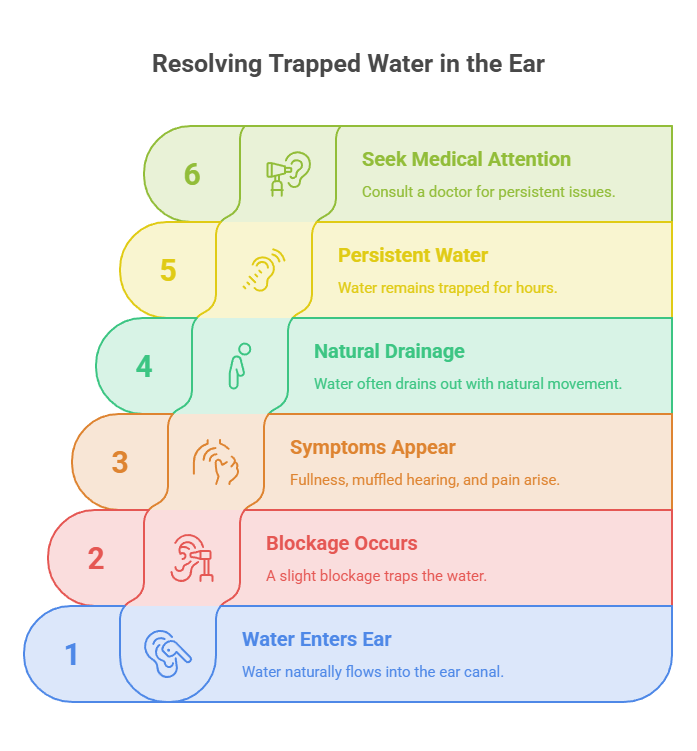
The sensation is hard to ignore: fullness, a faint sloshing when you move your head, and sound that seems to come through a pillow. Most of the time it clears within minutes as you walk around and tilt your head naturally.
The cases worth attention are the ones that drag on. Water that’s still there hours later, especially with any discomfort, is the kind that benefits from a deliberate fix rather than waiting it out.
The Anatomy: Your Ear Canal and Earwax
Your outer ear canal is a slightly curved tunnel that runs from the opening to the eardrum. That gentle curve, along with a normal lining of earwax, is exactly what can hold a droplet in place.
Water often gets stuck when the canal is curved or partly blocked by earwax, leaving the droplet trapped behind a barrier of wax or skin where it just won’t drain. Surface tension does the rest, pinning a small amount of water against the canal wall.
Earwax is protective, not dirty. It keeps the canal slightly water-resistant and traps debris, so the goal is always to coax water past it, never to dig the wax out. Stripping that layer tends to make the next bout of trapped water more likely.
Outer-Ear Water vs Fluid Behind the Eardrum
This distinction trips up a lot of readers, and it changes what you should do. The five methods here target water sitting in the outer ear canal, in front of the eardrum, which is the common swimming-and-showering scenario.
Fluid that collects behind the eardrum, in the middle ear, is a different situation tied to colds, allergies, or ear infections. You can’t drain it by tilting your head, because the eardrum seals it off from the canal.
Our medical reviewers note that middle-ear fluid usually needs a provider’s input rather than at-home draining. If you have ongoing pressure or muffled hearing after a cold rather than after a swim, that points toward the middle ear and a checkup.
Who Traps Water Most Often
Some ears hold onto water more than others, and the reasons are mostly structural. A naturally narrow or extra-curvy ear canal gives water more places to pool, and a buildup of earwax leaves less room for it to drain back out.
Frequent swimmers, surfers, and people who wear hearing aids or earbuds for hours are all more prone to trapped water and swimmer’s ear. Across the cases our network sees, daily water exposure paired with over-cleaning the ears is a common setup, since stripped wax and constant moisture work against each other.
If you notice water getting trapped after nearly every swim, that pattern itself is worth mentioning at a routine visit. A provider can check for excess wax or a canal shape that makes trapping more likely, and suggest custom-fitted swim molds if plain earplugs aren’t sealing well.
The Real Risk: Swimmer’s Ear
Leaving water in the canal is what turns a minor annoyance into an infection. Swimmer’s ear, known medically as acute otitis externa, is a bacterial infection caused by water that stays in the outer ear canal long enough to wear down protective wax and skin, creating a moist home for bacteria.
The scale is larger than most people assume. An estimated 2.4 million US healthcare visits result in a swimmer’s ear diagnosis each year, costing roughly half a billion dollars in direct care.
Drying your ears promptly is the single best way to stay out of that statistic. The infection is common precisely because the trigger, water sitting too long, is so easy to overlook.
5 Safe Ways to Get Water Out of Your Ear
Start gentle and work your way down the list. Across the cases our network sees, the first two or three methods solve the problem far more often than people expect, and none of them require putting anything inside the canal.
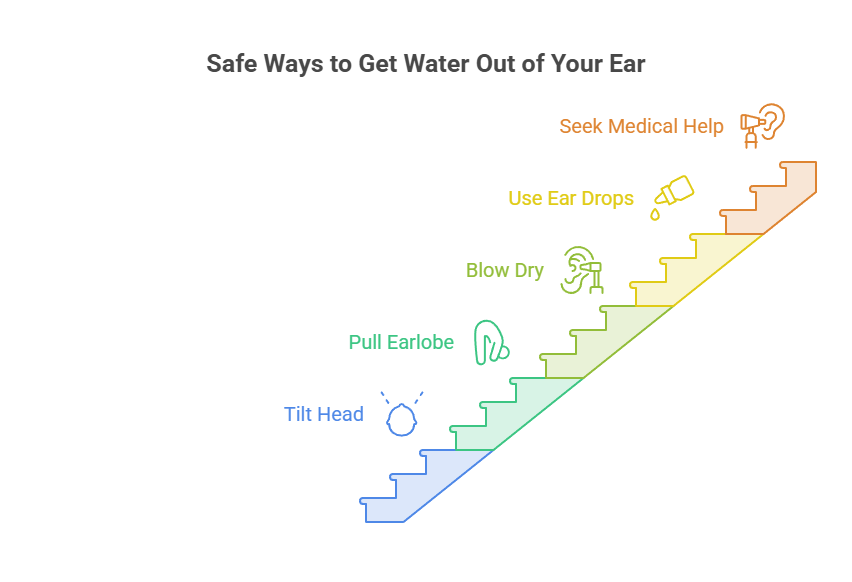
A quick note on what success feels like: you’ll usually sense a small trickle, a pop, or a sudden return of clear hearing. That’s your cue to stop, since once the water’s out, more effort only risks irritation.
1. Tilt, Tug, and Let Gravity Work
This is the first thing to try, and often the only one you’ll need. Tilt your head so the affected ear faces down, then gently pull on your earlobe to straighten the canal and help the water drain on its own.
Give it a few seconds, then add motion if needed. Gently shaking your head while it’s tilted can move the water out faster, and pulling the ear in different directions helps you find the angle that releases it.
If standing isn’t working, lie down. Resting on your side with a towel under your head lets gravity pull the water out while you wait. Sleeping with the affected ear down overnight gives stubborn droplets an extended chance to escape, and many people wake up clear.
2. Create a Gentle Vacuum With Your Palm
When gravity alone won’t do it, light suction can. The technique sounds odd but it’s simple and safe when done softly.
Cup your hand over the ear to make a gentle seal, then quickly flatten and cup it again repeatedly to create a light suction that may pull the water out. Tilt your head sideways, rest the ear on your cupped palm, push and release in a rapid motion, then tilt your head down to let the water drain.
The watchword is gentle. Patients who book tests through HealthCareOnTime sometimes overdo this one, and forceful pressure can irritate the canal or trap the water tighter, so keep it light with no slapping.
3. Move Your Jaw: Yawn, Chew, or the Valsalva Maneuver
Your jaw sits close to the eustachian tubes, the small passages that connect your ears to your throat. Moving it can shift trapped water loose, and it pairs well with the gravity method.
Chewing gum or yawning moves the muscles near your eustachian tubes, which can open and close them and push trapped water out. Try this with your head tilted toward the affected side for a little extra help from gravity.
The Valsalva maneuver adds gentle pressure. Pinch your nose, close your mouth, and exhale gently through your nose until you feel a light pop, which means the tubes have opened. Use mild pressure only; blowing hard can hurt your eardrum, so stop at the first soft pop.
4. Dry It Out With Warm Air or a Warm Compress
If the water is clinging on, evaporation is your friend. A hair dryer works well when you respect the settings.
Set the dryer to its lowest heat and speed, hold it at least 12 inches from your ear, and direct the airflow toward the canal opening for 20 to 30 seconds while the ear faces down. Keeping the dryer on a low, cool setting at least two feet away is the safest approach to drying the outer ear.
A warm compress is a gentler alternative. Hold a warm, damp cloth against the outer ear for about 30 seconds, then tilt your head and repeat up to four times to relax the canal and encourage the water to move.
Some people find that inhaling steam from a hot shower loosens things up too. The warmth thins the water and relaxes the surrounding tissue, which can be enough to break the seal holding it in place.
5. Use Drying Drops (OTC or DIY Alcohol-Vinegar)
When water is stuck behind earwax, drops can help where the other methods stall. Drugstores sell drying drops labeled for swimmer’s ear, and there’s a well-known homemade version.
A common homemade solution is equal parts rubbing alcohol and white vinegar; the alcohol dries the ear while the vinegar breaks down the earwax that may be trapping the water. Use a clean dropper for a few drops, wait about 30 seconds, then tilt your head to let it run back out.
One important caution before you reach for any drops. Don’t use eardrops if you have an ear infection, a perforated eardrum, or ear tubes, and check with a provider if you’re unsure. Our lab partners report that this single misstep accounts for a lot of avoidable ear pain, so when in doubt, leave the drops alone.
| Method | How To Do It | Best For | Caution |
| Tilt and tug | Tilt ear down, pull earlobe, shake head gently | The first try; most everyday cases | Be gentle; no violent shaking |
| Palm vacuum | Cup palm over ear, push and release to create suction | Water that gravity alone won’t budge | Keep it light; never slap or press hard |
| Jaw and Valsalva | Yawn, chew gum, or gently exhale against a pinched nose | Pressure or fullness with the water | Use mild pressure only with Valsalva |
| Warm air or compress | Low, cool hair dryer 12+ inches away; or warm cloth | Lingering moisture after other methods | Never high heat or close to the ear |
| Drying drops | OTC drops or 50/50 rubbing alcohol and white vinegar | Water trapped behind earwax | Avoid with tubes, eardrum holes, or infection |
What You Should Never Do
Knowing what to avoid matters as much as knowing the fixes. A few popular moves do real damage, and they’re worth calling out plainly.
Skip Cotton Swabs, Fingers, and Ear Candles
The instinct to swab is strong and it’s the wrong one. Don’t use cotton swabs, your fingers, or ear candles, because the wrong move can push water deeper, scratch the canal, or even puncture your eardrum.
Swabs are especially counterproductive with water. Q-tips and similar instruments tend to push earwax deeper toward the eardrum, packing it down rather than clearing it. That packed wax is exactly what traps the next droplet, so swabbing can set up a recurring problem.
Ear candling deserves its own mention. No clinical evidence supports ear candling as safe or effective; it carries real burn risks and can deposit wax instead of removing it. It’s a method to retire entirely.
Who Should Avoid Ear Drops
Drops are useful for many people and risky for some. The dividing line is the health of your eardrum and canal.
Avoid alcohol, vinegar, hydrogen peroxide, or any drops if you have a known or suspected perforated eardrum, ear tubes (tympanostomy tubes), an active ear infection, or any ear pain or drainage. Drops that reach the middle ear through a hole in the eardrum can cause real harm.
Across patients we serve, those with diabetes or a weakened immune system should also check with a provider before self-treating. Swimmer’s ear can occasionally become a more serious infection in these groups, so caution is warranted from the start.
How Common Is Swimmer’s Ear? The US Numbers
If you’ve ever felt silly googling a plugged ear at 11 p.m., the data says you have plenty of company. Water-related ear problems are one of the most common reasons people land in primary care during the warm months.
Swimmer’s ear accounts for about 8.1 visits per 1,000 people each year and nearly 600,000 hours of clinicians’ time. The pattern is seasonal and skews young. Rates are highest in children ages 5 to 9 and 10 to 14, incidence peaks in the summer, yet 53% of all visits are among adults aged 20 and older.
The summer spike makes sense: more swimming, more head submersion, and more humidity that slows the canal from drying out. The lifetime odds are meaningful too. Roughly 10% of people will develop otitis externa at some point in their lives.
The cause is almost always microbial rather than the water itself. In North America, about 98% of swimmer’s ear cases come from bacteria rather than fungus.
| Metric | US Figure | Source |
| Annual healthcare visits for swimmer’s ear | ~2.4 million | CDC (MMWR, 2003 to 2007) |
| Direct healthcare cost per year | ~$0.5 billion | CDC (MMWR) |
| Visit rate, all ages | 8.1 per 1,000 population | CDC (MMWR) |
| Highest rate by age group | Children ages 5 to 9 (18.6 per 1,000) | CDC (MMWR) |
| Lifetime risk of otitis externa | ~10% of people | National Library of Medicine |
| Cases caused by bacteria (North America) | ~98% | Clinical literature (MNT/CDC) |
These figures carry one practical message. Swimmer’s ear is common, mostly preventable, and almost always tied to water that sat too long, which puts the power to avoid it largely in your hands.
How to Prevent Water From Getting Trapped
Getting water out is reactive; the real win is keeping it from settling in the first place. The CDC’s prevention advice is refreshingly low-tech and easy to build into a swim or shower routine.
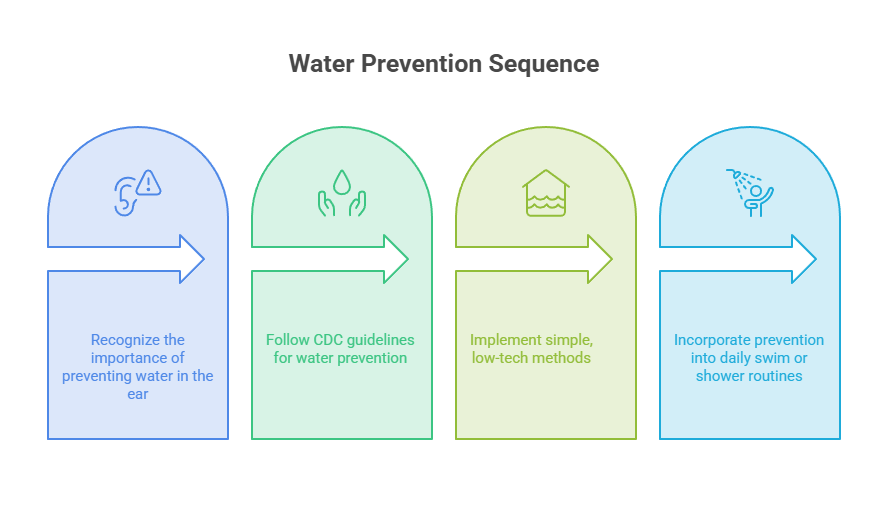
Before You Swim or Shower
Create a barrier when you know water exposure is coming. Use a bathing cap, earplugs, or custom-fitted swim molds when you swim.
For showers and baths, a simple trick helps if you’re prone to trapping water. A cotton ball lightly coated with petroleum jelly tucked into the outer ear keeps water out without going into the canal.
Swimmers who get water stuck often find that a snug silicone earplug is the difference-maker. Moldable plugs that seal the outer ear are inexpensive and reusable, and a swim cap pulled over the ears adds a second layer.
After You Get Out of the Water
The first minute out of the pool is when habit pays off. Tilt your head back and forth so each ear faces down to let water drain, pull your earlobe in different directions to coax it out, and dry your ears well with a towel.
Keep the towel on the outer ear only. Patients commonly ask us whether to dig in with a corner of the towel, and the answer is no; wick the opening, don’t probe the canal, since probing reintroduces the swab problem.
Build these few seconds into your routine the way you’d dry off the rest of your body. Consistency is what keeps trapped water from becoming a pattern.
If You’re Prone to Swimmer’s Ear
Some people trap water every single time, and a preventive routine is worth it for them. If you’ve had swimmer’s ear before and have a healthy eardrum, alcohol-based drying drops used after swimming can help.
Suggested prevention measures include reducing how much water reaches the ears with plugs or caps and using alcohol-based ear-drying solutions. Our medical reviewers note that people who swim daily benefit most from a consistent post-swim drying habit, since one missed session is often all it takes.
A word on earwax and prevention. Resist the urge to over-clean; stripping the canal of wax removes a natural water-resistant layer. If genuine buildup is a recurring problem, a provider can clear it safely without the risks of home digging.
When to See a Doctor
At-home methods handle the vast majority of trapped-water situations. The job is to recognize the smaller number of cases that need professional help before they escalate.
Connect with a primary care physician or an ENT if water is still in your ear after two or three days, or if you develop signs of infection like swelling, since an untreated infection can lead to hearing loss or other complications. Pain that worsens when you tug the outer ear is a classic swimmer’s ear signal and a reason to call.
A provider has tools you don’t. They can safely remove water or impacted wax with suction or gentle irrigation, look at the eardrum directly with an otoscope, and prescribe medicated drops if an infection has taken hold.
Don’t tough out worsening symptoms. Early swimmer’s ear is simple to treat, while a neglected infection can spread to nearby tissue and become far more involved.
| Scenario | Recommended Action | Urgency |
| Water clears within minutes to a few hours | No action needed; normal | None |
| Water still trapped after a day, no pain | Try drying drops and warm dry air | Low / monitor |
| Water lingering past 2 to 3 days | Call a primary care provider or ENT | Moderate / within days |
| Ear pain, especially when tugging the ear | Get evaluated for swimmer’s ear | Moderate to high / 1 to 2 days |
| Drainage, fever, or muffled or lost hearing | See a provider promptly | High / same day or next day |
| You have ear tubes, a possible eardrum hole, or diabetes | Skip home drops; consult a provider | High / before self-treating |
Frequently Asked Questions
How do you get water out of your ear that won’t come out?
Start with gravity: tilt the ear down and tug your earlobe while shaking your head gently. If that fails, try palm suction, jaw movement, or a low, cool hair dryer held a foot away. Drying drops help when earwax is trapping the water. See a provider if it persists past a few days.
Will water in my ear go away on its own?
Often, yes. In mild cases, water drains naturally within minutes to a few hours as you move, chew, and go about your day. Sleeping with the affected ear facing down gives gravity extra time. If it stays trapped beyond two or three days or starts to hurt, treat it actively and consider a checkup.
How long does it take for water to drain from your ear?
Usually just minutes. Most trapped water clears quickly once you tilt your head or move around. Stubborn droplets caught behind earwax can take longer and may need a drying method. Water that hasn’t cleared after two to three days is worth a provider’s attention, since lingering moisture raises infection risk.
What happens if water stays in your ear too long?
It creates a warm, damp environment where bacteria multiply, which can lead to swimmer’s ear, an outer-ear-canal infection. Symptoms include itching, pain that worsens when you tug the ear, redness, and sometimes drainage. Removing water promptly is the best prevention. Untreated infections can spread and, rarely, cause hearing or tissue problems.
How do you get water out of your ear after swimming?
Right out of the pool, tilt your head so each ear faces down, pull your earlobe in different directions, and towel-dry the outer ear. Add palm suction or a yawn if needed. If you’re prone to trapping water and have a healthy eardrum, alcohol-based drying drops afterward can help keep your ears clear.
Are rubbing alcohol and vinegar drops safe for ears?
For many people, yes. A 50/50 mix of rubbing alcohol and white vinegar helps dry the canal and break down earwax. Do not use it if you have ear tubes, a perforated or suspected-perforated eardrum, an active infection, or any ear pain or drainage. When in doubt, ask a provider before using any drops.
Can I use a hair dryer to dry my ear?
Yes, with care. Set it to the lowest heat and speed, hold it at least 12 inches (ideally up to two feet) from your ear, and move it back and forth while tugging the earlobe and facing the ear down. Never use high heat or hold it close, which can burn delicate skin.
Why does my ear still feel clogged after the water is gone?
A lingering plugged feeling is often leftover earwax that the water softened and shifted, or mild canal irritation. Crackling or muffled sounds after water exposure are usually harmless and clear within a day. If fullness or muffled hearing persists, or you suspect impacted wax, a provider can check and safely clear it.
How do I get water out of a child’s or baby’s ear?
Gently. The safest approach for a baby is to dab the outer ear with a soft, dry towel and tilt the head so the ear faces down; never insert anything into the canal. For older children, tilting and earlobe tugging work well under adult supervision. Call a pediatrician if pain or drainage appears.
Can water in the ear cause hearing loss?
Trapped water itself causes only temporary, muffled hearing that resolves once it drains. The concern is an untreated infection: swimmer’s ear can cause short-term hearing changes, and rarely, a serious or spreading infection can lead to longer-lasting complications. Prompt drying and timely treatment of any infection protect your hearing.
Do silicone earplugs really prevent water in the ear?
Yes. A snug-fitting earplug or custom swim mold creates a barrier that keeps water out of the canal, which is why the CDC lists them as a top prevention step. Moldable silicone plugs that seal the outer ear work well for most people. Swim caps and bathing caps add extra protection.
When should I see a doctor about water in my ear?
See a provider if water hasn’t cleared after two or three days, or if you have ear pain, drainage, fever, or muffled or lost hearing. Pain that spikes when you tug the outer ear points to swimmer’s ear. People with ear tubes, a possible eardrum perforation, or diabetes should consult a provider before self-treating.
Medical Disclaimer: This article is for general educational purposes and reflects current US medical guidance. It is not a substitute for professional medical advice, diagnosis, or treatment. If you have ear pain, drainage, ear tubes, a known or suspected eardrum perforation, diabetes, or symptoms that persist or worsen, contact a qualified healthcare provider before trying at-home remedies.
References
- CDC, Preventing Swimmer’s Ear (Healthy Swimming)
- CDC, Estimated Burden of Acute Otitis Externa, United States (MMWR)
- Mayo Clinic, Swimmer’s Ear: Symptoms & Causes
- Mayo Clinic, Swimmer’s Ear: Diagnosis & Treatment
- Cleveland Clinic, How To Get Water Out of Your Ear Safely
- Healthline, How to Get Water Out of Your Ear
- Baptist Health, How To Get Water Out of Your Ear
- ENT & Allergy Specialists, What Should I Do if Water Gets Stuck in My Ear?