Search that question and page one hands you three different answers. One major health site says 18. Another says 22. A third says 24. Same tomato, same country, same year.
Table of Contents
Only one of those numbers is right. The reason the others exist is a copying error that has spread across half the internet, and once you see it you cannot unsee it.
Here is the fix, plus everything USDA’s database actually holds on tomatoes, from a single cherry tomato to a tablespoon of ketchup.
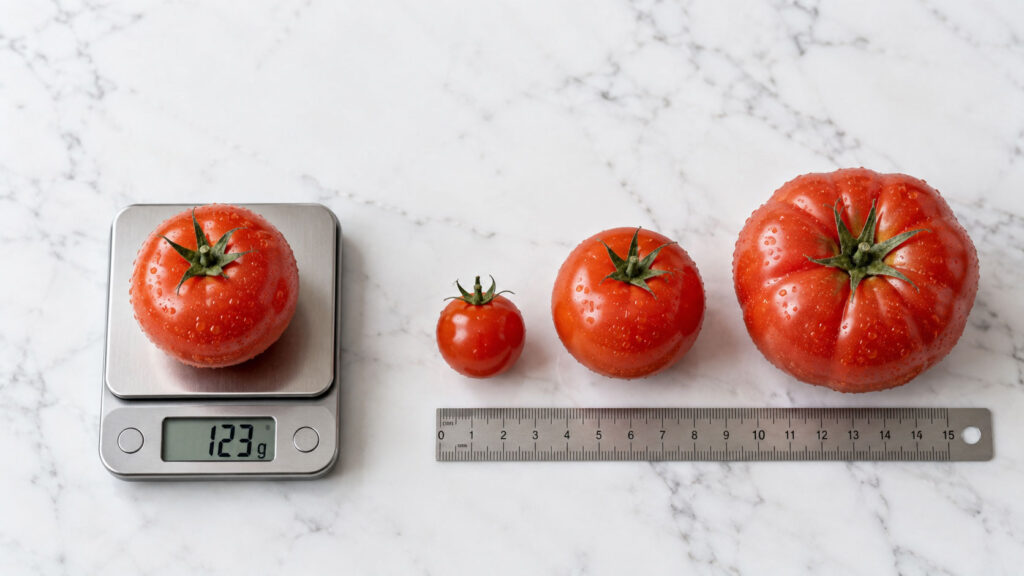
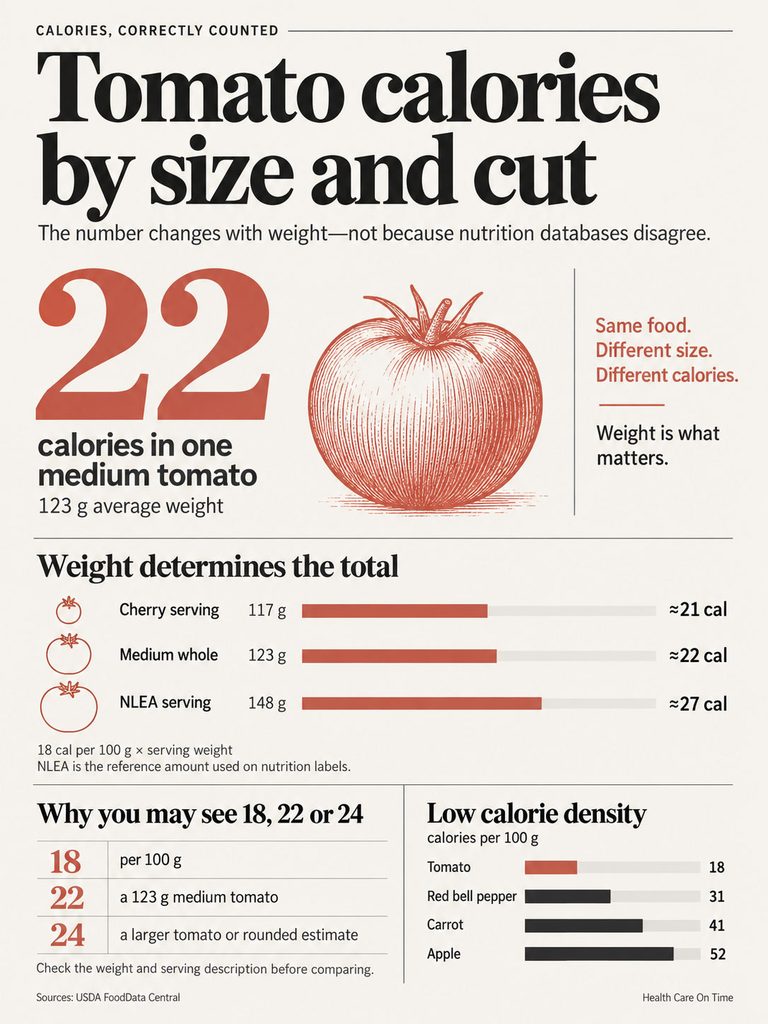
Quick Answer: A medium raw tomato (123 grams, about 4.3 ounces) contains 22 calories. Per 100 grams, raw red tomatoes have 18 calories, which is where the confusion begins. A small tomato (91 g) has 16 calories, a large one (182 g) has 33, and a single cherry tomato (17 g) has 3. All figures come from USDA FoodData Central entry 170457.
At a Glance
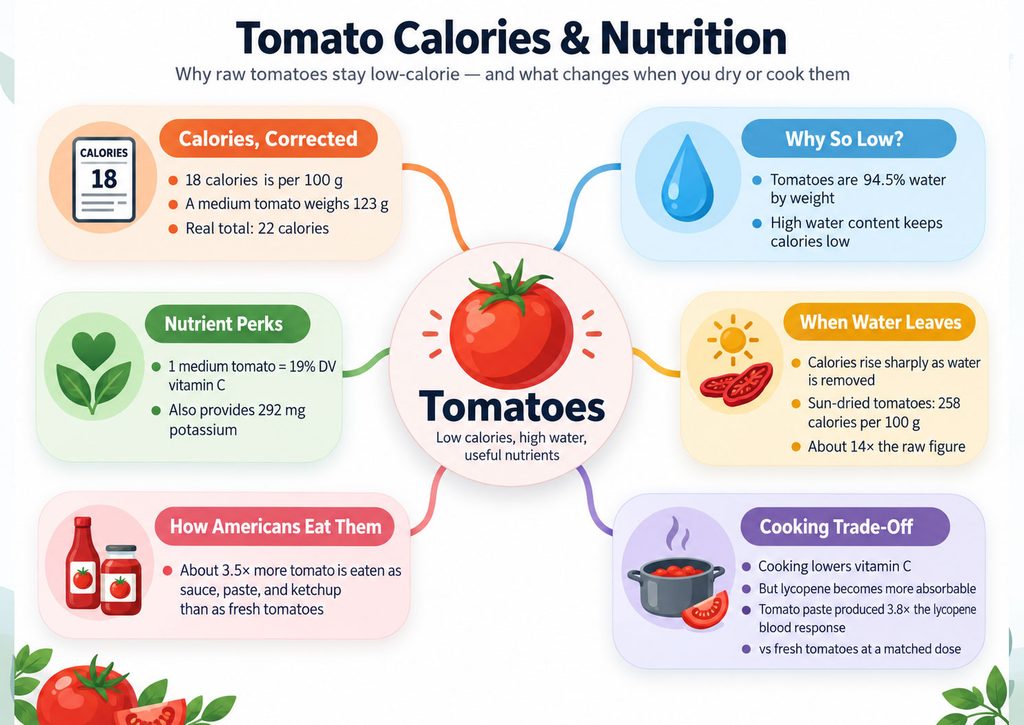
• The widely repeated “18 calories” is per 100 grams, not per tomato. A medium tomato weighs 123 g, so the real figure is 22.
• Tomatoes are 94.5% water by weight, which is the entire reason the calorie count stays so low.
• One medium tomato delivers 19% of the Daily Value for vitamin C plus 292 mg of potassium.
• Calories climb sharply once water leaves. Sun-dried tomatoes reach 258 calories per 100 g, roughly fourteen times the raw figure.
• Americans eat about three and a half times more tomato as sauce, paste, and ketchup than as fresh fruit.
• Cooking cuts vitamin C but makes lycopene far more absorbable. Tomato paste produced 3.8 times the lycopene blood response of fresh tomatoes at a matched dose.
The Short Answer: Tomato Calories by Size and Cut
Why You See 18, 22, and 24 for the Same Tomato
Nutrition databases publish food composition per 100 grams. That is the international convention, and it is what USDA FoodData Central lists first for raw red tomatoes: 18 calories, 0.88 g protein, 3.89 g carbohydrate, 1.2 g fiber, 94.5 g water.
The trouble starts when a writer copies that block and labels it “one medium tomato.” A medium tomato is not 100 grams. USDA measures it at 123 grams, about 4.3 ounces, roughly 2.6 inches across.
Run the arithmetic and the answer is clean. 18 calories per 100 g multiplied by 1.23 gives 22.1 calories. That is your medium tomato.
You can catch the error yourself on the pages carrying it. They list 18 calories and 94.5 grams of water for “a medium tomato,” then a few paragraphs later correctly report 17 mg of vitamin C and 292 mg of potassium for that same tomato. Those micronutrient numbers are the true per-123-gram values. The macros and the micros are sitting on two different serving sizes inside one article.
The stray “24 calories” figure traces to an older database that no longer exists. It matches no current USDA entry.
Our medical reviewers see this unit mismatch surface repeatedly in patient food diaries and in the apps used to build them. A 4-calorie gap on one tomato is nothing. The same error applied across a full day of tracked produce stops being nothing.
Calories in a Tomato by Size, Cut, and Cup
Every gram weight below is USDA’s own published portion weight for raw red ripe tomatoes, year-round average. Calories are calculated at 18 kcal per 100 g and rounded.
| Serving | USDA Weight | Ounces | Calories | Carbs (g) | Fiber (g) | Net Carbs (g) |
| Cherry tomato, 1 | 17 g | 0.6 oz | 3 | 0.7 | 0.2 | 0.5 |
| Thin slice | 15 g | 0.5 oz | 3 | 0.6 | 0.2 | 0.4 |
| Medium slice (1/4 in) | 20 g | 0.7 oz | 4 | 0.8 | 0.2 | 0.6 |
| Thick slice (1/2 in) | 27 g | 1.0 oz | 5 | 1.1 | 0.3 | 0.8 |
| Wedge (1/4 of a medium) | 31 g | 1.1 oz | 6 | 1.2 | 0.4 | 0.8 |
| Plum or Roma tomato, 1 | 62 g | 2.2 oz | 11 | 2.4 | 0.7 | 1.7 |
| Small whole (2.4 in) | 91 g | 3.2 oz | 16 | 3.5 | 1.1 | 2.4 |
| Medium whole (2.6 in) | 123 g | 4.3 oz | 22 | 4.8 | 1.5 | 3.3 |
| NLEA label serving | 148 g | 5.2 oz | 27 | 5.8 | 1.8 | 4.0 |
| Cup, cherry tomatoes | 149 g | 5.3 oz | 27 | 5.8 | 1.8 | 4.0 |
| Cup, chopped or sliced | 180 g | 6.3 oz | 32 | 7.0 | 2.2 | 4.8 |
| Large whole (3 in) | 182 g | 6.4 oz | 33 | 7.1 | 2.2 | 4.9 |
Three notes on that table.
Grape tomatoes are missing because USDA publishes no weight for them. They typically run 8 to 10 grams, which lands at 1 or 2 calories each.
The NLEA row is the 148-gram portion FDA uses for nutrition labeling on fresh tomatoes. If you have seen a grocery placard claiming 25 calories, that is where it came from, rounded.
Beefsteak tomatoes have no separate USDA entry either. A supermarket beefsteak commonly runs 200 to 300 grams, or 7 to 10.6 ounces, putting it at 36 to 54 calories. Weigh it if you are counting closely, because beefsteak size varies more than any other common variety.
A one-pound clamshell of cherry tomatoes, the standard American package, comes to roughly 82 calories for the whole box.
How a Tomato Stacks Up Against Other Produce
Per 100 grams, raw tomato sits at 18 calories. Cucumber with peel is 15, celery 16, zucchini 17, iceberg lettuce 14.
Move up the scale and red bell pepper is 31, carrot 41, and a raw apple with skin 52. A tomato runs roughly a third the calorie density of an apple and less than half that of a carrot.
That places tomatoes at the bottom of the produce aisle for energy density, in the same band as cucumber and celery rather than with sweeter fruits.
The Full USDA Nutrition Breakdown for One Raw Tomato
Macronutrients in a Medium Tomato
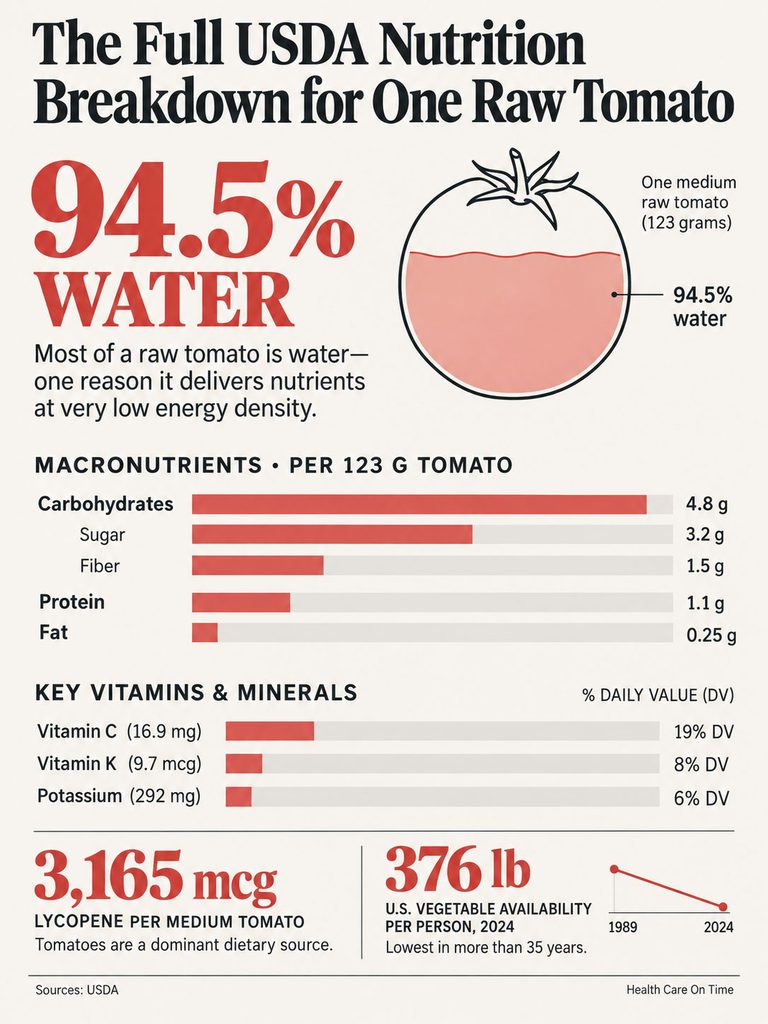
Here is the complete macro profile for a 123-gram medium tomato, calculated from USDA entry 170457.
Carbohydrate lands at 4.8 grams, of which 3.2 grams are sugar and 1.5 grams are fiber. Net carbs come to 3.3 grams.
The sugar is almost entirely fructose and glucose in a near even split, about 1.7 grams and 1.5 grams. There is no sucrose, no starch, and no maltose.
Protein is 1.1 grams. Fat is 0.25 grams, mostly polyunsaturated. Water accounts for 116 of the 123 grams.
The fiber deserves a closer look. Roughly 87% of it is insoluble, made of hemicellulose, cellulose, and lignin, and most of it sits in the skin and the seed jackets. Peel and seed a tomato and you throw away most of its fiber.
Vitamins and Minerals That Actually Move the Needle
| Nutrient | Per Medium Tomato (123 g) | % Daily Value |
| Vitamin C | 16.9 mg | 19% |
| Potassium | 292 mg | 6% |
| Vitamin K | 9.7 mcg | 8% |
| Vitamin A | 52 mcg RAE | 6% |
| Folate | 18.4 mcg | 5% |
| Fiber | 1.5 g | 5% |
| Vitamin E | 0.66 mg | 4% |
| Magnesium | 13.5 mg | 3% |
| Sodium | 6 mg | Under 1% |
Vitamin C is the standout. Nineteen percent of the Daily Value from a 22-calorie food is a strong return, and it undercuts the assumption that citrus has a monopoly on the nutrient.
Potassium at 292 mg is modest against the 4,700 mg Daily Value, but it accumulates. A cup of chopped tomatoes carries 427 mg, and a cup of tomato juice carries more than 500.
Vitamin K matters for one specific group. At 9.7 mcg per tomato this is a low vitamin K food, which is welcome news for anyone on warfarin told to keep intake steady. Patients on anticoagulants ask our medical team about tomatoes regularly, and the honest answer is that tomatoes are not the vegetable to watch. Leafy greens are.
Sodium is effectively absent in fresh tomatoes. That changes the moment you open a can, covered below.
Lycopene, Beta-Carotene, and the Rest of the Carotenoids
Lycopene is the pigment that turns a ripe tomato red, and tomatoes are the dominant dietary source of it in the American diet.
Raw red tomatoes carry 2,573 mcg of lycopene per 100 grams, which comes to about 3,165 mcg in one medium tomato. Alongside it sit 449 mcg of beta-carotene, 101 mcg of alpha-carotene, and 123 mcg of lutein and zeaxanthin per 100 grams.
Lycopene is fat-soluble and locked inside the tomato’s cell walls. Eat a tomato plain and you absorb a fraction of what is present. Eat it cooked, chopped, and with a little olive oil, and you absorb considerably more. The evidence sits further down this page.
Green tomatoes contain essentially no lycopene. Yellow and orange varieties carry less lycopene and more beta-carotene. If red pigment is what you want, ripeness and color intensity are your indicators.
Ninety-Five Percent Water, and Why That Is the Whole Story
A tomato is 94.5% water by weight. That single fact explains the calorie count better than any nutrient breakdown does.
Water contributes weight and volume without contributing energy. Fill a plate with a food that is nineteen parts water to one part everything else, and the plate looks full while the calorie total stays near zero.
Nutrition researchers call this low energy density, and it is the mechanism behind most weight-management claims made about tomatoes. Nothing exotic is happening. The tomato is mostly water.
For context on how much room that leaves in the American diet, USDA Economic Research Service put total per capita vegetable and pulse availability at 376 pounds in 2024, the lowest level in more than 35 years and down from a 1996 peak of 426 pounds.
Calories Change With the Form, Not Just the Size
Here is the part almost every calorie page skips. Americans do not primarily eat fresh tomatoes.
USDA Economic Research Service data puts 2023 US consumption at 20.3 pounds per person for fresh-market tomatoes and 73.3 pounds per person for processed. Sauce, paste, salsa, ketchup, canned, and juice together outweigh fresh tomatoes by more than three to one.
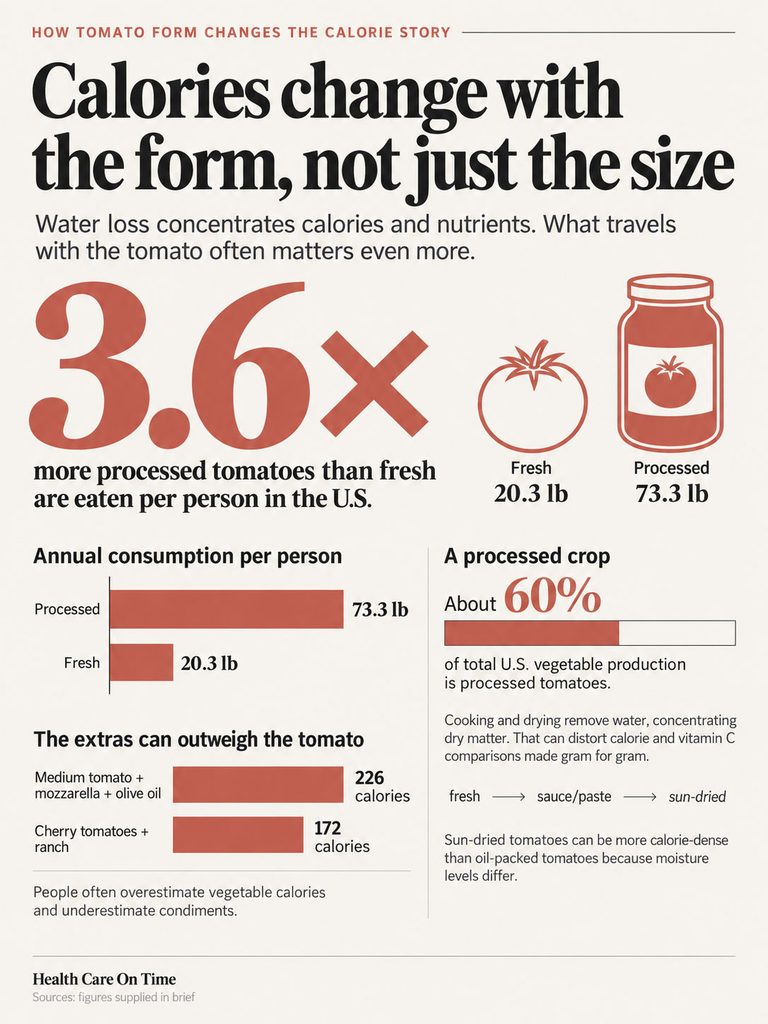
ERS also reports that tomatoes account for roughly 6 of every 10 pounds of processed vegetables produced in the United States. If you are counting calories from tomatoes, the fresh number is the smaller half of the problem.
Raw, Cooked, Canned, and Concentrated
| Tomato Form | Calories / 100 g | Vitamin C (mg) | Lycopene (mcg) | Potassium (mg) |
| Raw, red, ripe | 18 | 13.7 | 2,573 | 237 |
| Raw, green | 23 | 23.4 | 0 | 204 |
| Cooked, red | 18 | 22.8 | Not reported | 218 |
| Canned, in tomato juice | 17 | 12.6 | 2,537 | 191 |
| Tomato juice, canned | 17 | 12.6 | 2,537 | 191 |
| Sauce, canned, no salt | 24 | 7.0 | 13,895 | 297 |
| Crushed, canned | 32 | 9.2 | 5,106 | 293 |
| Purée, canned, no salt | 38 | 10.6 | 21,754 | 439 |
| Paste, canned, no salt | 82 | 21.9 | 28,764 | 1,014 |
| Ketchup (catsup) | 101 | 4.1 | 12,062 | 281 |
| Sun-dried, in oil, drained | 213 | 102 | Not reported | 1,565 |
| Sun-dried, plain | 258 | 39.2 | Not reported | 3,427 |
All values are USDA SR Legacy. Two rows in that table mislead if taken at face value, so both need explaining.
The cooked row. USDA lists cooked red tomatoes at 18 calories and 22.8 mg of vitamin C per 100 grams, which appears to say cooking raises vitamin C. It does not. The cooked entry is a separate laboratory analysis of different tomatoes, not the same tomatoes measured before and after heat. Water loss during cooking concentrates whatever survives, so comparing a raw entry with a cooked entry on a per-100-gram basis compares different amounts of dry matter. Cooking destroys vitamin C. The database structure hides it.
The sun-dried reversal. Plain sun-dried tomatoes run 258 calories per 100 grams while the oil-packed drained version runs 213, which reads backward. Water explains it. Oil-packing rehydrates the fruit, so 100 grams of oil-packed product contains less dried tomato solid than 100 grams of the plain product. Piece for piece, the oil-packed version still costs more calories.
Paste, Sauce, Juice, and Ketchup in Real Portions
Per 100 grams is not how anyone uses these products. Here is the practical math.
Two tablespoons of tomato paste weigh about 33 grams and deliver 27 calories along with 334 mg of potassium. That is a tenth of the calories in a medium banana for roughly four-fifths of the potassium.
One tablespoon of ketchup weighs 17 grams and delivers 17 calories, about 3.9 grams of sugar, and roughly 154 mg of sodium. Three tablespoons on a burger clears 50 calories and 460 mg of sodium.
Half a cup of canned tomato sauce with no salt added runs about 30 calories. Salted versions can carry 500 mg or more of sodium in the same half cup.
Five pieces of plain sun-dried tomato weigh about 10 grams and cost 26 calories. Half a cup, which disappears fast off a charcuterie board, is 139 calories.
A 14.5-ounce can of diced tomatoes, the standard American pantry size, holds roughly 411 grams and about 70 calories.
The Calories You Add Dwarf the Calories in the Tomato
This is the point that matters most for anyone actually managing weight.
A medium tomato is 22 calories. Slice it, layer it with an ounce of fresh mozzarella and a tablespoon of olive oil, and the plate lands near 226 calories. The tomato is under 10% of that total.
A cup of cherry tomatoes is 27 calories. Two tablespoons of ranch dressing add about 145. The dip is more than five times the vegetable.
Fried green tomatoes take a single medium tomato from 22 calories to roughly 166, driven almost entirely by batter and frying oil.
Across the diet questions HealthCareOnTime receives, the pattern holds steady. People overestimate the calories in vegetables and underestimate the calories in what goes on top.
What the Research Actually Shows About Tomatoes
Cooking Trades Vitamin C for Lycopene
The most useful finding on tomato preparation is nearly thirty years old and still stands.
Gärtner, Stahl, and Sies published a controlled human trial in the American Journal of Clinical Nutrition in 1997. Participants received a matched 23 mg dose of lycopene, from either fresh tomatoes or tomato paste, each taken with 15 grams of corn oil.
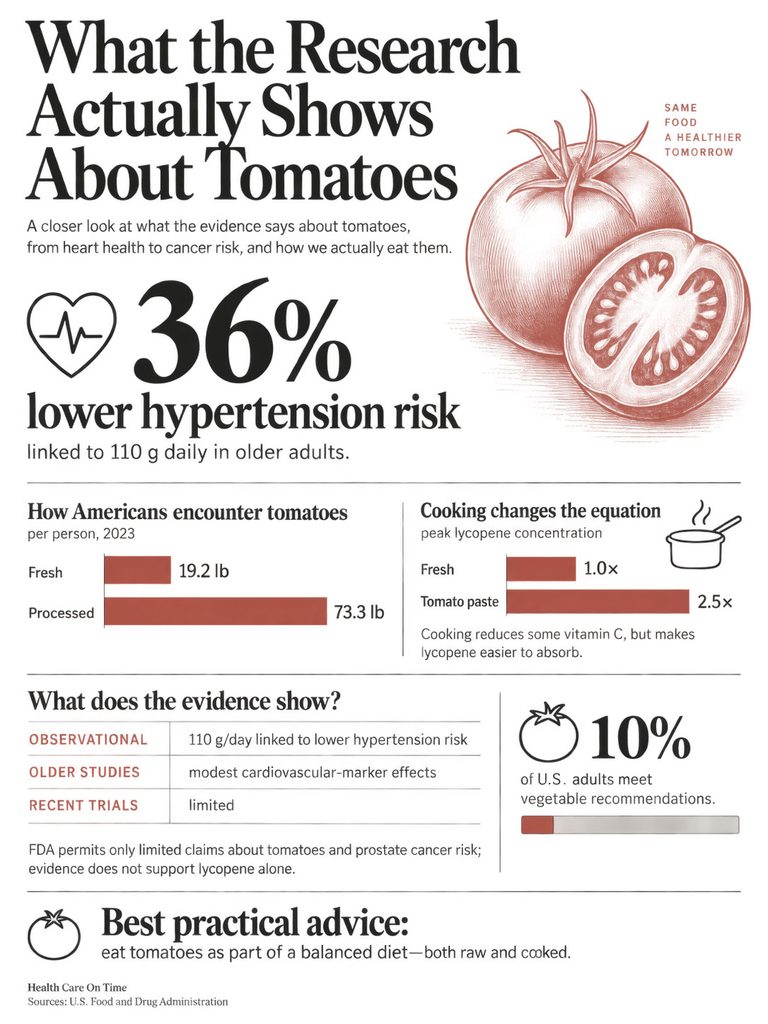
Tomato paste produced 2.5 times the peak lycopene concentration and 3.8 times the area under the curve compared with fresh tomatoes. The isomer pattern was identical in both foods, so the difference came from the food matrix, not the molecule.
Heat and mechanical processing break the cell walls that trap lycopene. Fat then carries it across the intestinal wall. That is why a simmered sauce with olive oil delivers more usable lycopene than a raw slice, even though the raw slice holds more vitamin C.
A fair caveat: this trial is from 1997 and enrolled a small group. It has been repeatedly reproduced in direction, and it remains the reference for tomato lycopene bioavailability, but it is not recent evidence and should not be presented as such.
The practical takeaway is that raw and cooked tomatoes are not competing. They deliver different things, and a diet containing both covers more ground than one containing either alone.
Tomatoes and Blood Pressure
The largest population study on this question came out of the PREDIMED trial in Spain.
Murcia-Lesmes and colleagues published the analysis in the European Journal of Preventive Cardiology in 2024. They followed 7,056 older adults at high cardiovascular risk for three years, 82.5% of whom already had hypertension, sorting daily tomato intake into four bands: under 44 g, 44 to 82 g, 82 to 110 g, and above 110 g.
Among the 1,097 participants without hypertension at baseline, those in the highest intake group had a hazard ratio of 0.64 for developing it, a 36% lower risk than the lowest consumers. Diastolic pressure ran lower in the intermediate group too, by 0.65 mmHg.
The number worth remembering is 110 grams a day. That is less than one medium tomato, roughly four-fifths of one. It also counted tomato in every form, including gazpacho and sauce.
What Statistics Say About Tomatoes in the American Diet
| Statistic | Figure | Period | Source |
| US per capita fresh tomato availability | 19.2 lb | 2023 | USDA Economic Research Service |
| US per capita processed tomato consumption | 73.3 lb | 2023 | USDA ERS via AgMRC |
| Imports as share of fresh tomato supply | 68.9% | 2025 | USDA ERS Outlook |
| Mexico’s share of US fresh tomato imports | 90% | 2023 to 2025 | USDA ERS |
| Tomato share of US processed vegetable output | About 6 of every 10 lb | 2023 | USDA ERS |
| US adults meeting vegetable intake targets | 10.0% | 2019 | CDC MMWR 71(1), Jan 2022 |
| Total per capita vegetable and pulse availability | 376 lb, lowest since 1988 | 2024 | USDA ERS, April 2025 |
| Hypertension risk above 110 g/day tomato intake | HR 0.64 | 3-year follow-up | Eur J Prev Cardiol 2024 |
| Lycopene absorption, paste vs fresh (AUC) | 3.8-fold higher | Matched 23 mg dose | Am J Clin Nutr 1997 |
That CDC figure is the context for everything else here. Only one in ten American adults hits the vegetable target. Tomatoes are the second most consumed vegetable in the country behind potatoes, which makes them one of the few realistic entry points for closing that gap.
What the FDA Would and Would Not Let Anyone Claim
Health claims about tomatoes get made loosely. The federal record is far more restrained, and it is worth knowing where the line actually sits.
On November 8, 2005, the FDA ruled on two petitions asking permission to advertise cancer risk reduction from tomatoes and from lycopene. One came from a supplement maker, the other from a coalition that included H.J. Heinz.
The agency allowed a single heavily hedged claim for tomatoes and tomato sauce. Labels could state that very limited and preliminary scientific research suggests eating half a cup to one cup of tomatoes or tomato sauce a week may reduce prostate cancer risk, followed by the FDA’s own note that there is little scientific evidence supporting the claim.
On lycopene itself the agency was blunt. It found no credible evidence supporting a relationship between lycopene consumption, whether as a food ingredient, a food component, or a dietary supplement, and reduced risk of any cancer named in the petition.
Two decades later that distinction still holds. Tomatoes as a whole food have limited supportive evidence. Lycopene extracted and sold in a capsule does not.
Where the Evidence Is Thin
Balance matters, and the tomato literature is not uniformly positive.
A single-blind randomized controlled trial by Thies and colleagues in 2012 enrolled 225 middle-aged adults with signs of metabolic syndrome, assigning them to a control diet, a lycopene supplement, or a diet high in tomato-based foods. Neither systolic nor diastolic blood pressure shifted significantly, and lipid markers did not move either.
The PREDIMED finding is observational, not causal. People who eat more tomatoes within a Mediterranean cohort also tend to eat more olive oil, more vegetables, and less processed meat. Statistical adjustment reduces that problem without removing it.
Both anchor studies are also more than a decade old, and no large recent trial has settled the question either way.
Our nutrition reviewers treat tomatoes as a genuinely useful food with a modest, uncertain effect on cardiovascular markers rather than as a treatment. That framing is defensible. Anything stronger is not.
Tomatoes, Blood Sugar, Weight, and Portion Reality
Glycemic Index and Glycemic Load
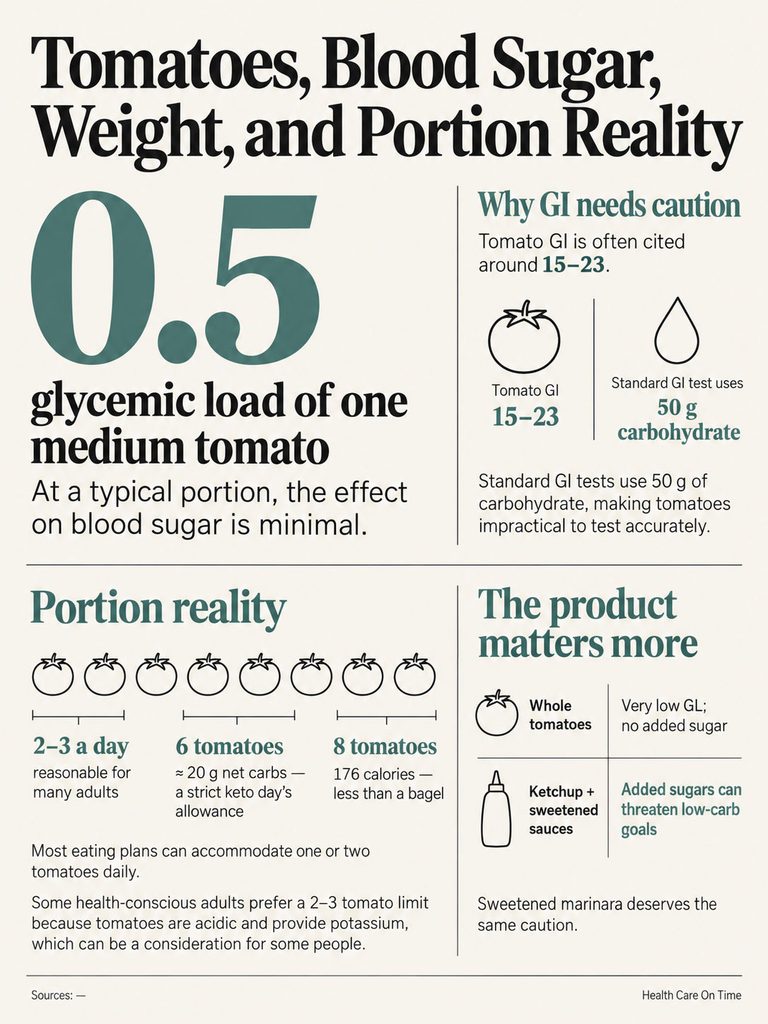
Tomatoes are commonly assigned a glycemic index near 15, sometimes 23. Both numbers should be read carefully.
Standard glycemic index testing requires a portion containing 50 grams of available carbohydrate. A medium tomato holds 3.3 grams of net carbohydrate, so testing one properly would mean eating roughly fifteen tomatoes in a sitting.
Published tomato GI values therefore come from small studies, extrapolation, or estimation rather than the standard protocol. The figure to trust is not the index but the load.
Glycemic load for a medium tomato works out near 0.5, and for a full cup of chopped tomatoes near 1. Anything under 10 counts as low. Tomatoes are effectively a non-event for blood sugar at normal portions.
Tomato products are a separate question. Ketchup at 3.9 grams of sugar per tablespoon and sweetened pasta sauces add up quickly across a meal.
Why Low-Calorie Does Not Mean Unlimited
Tomatoes will not derail a calorie deficit. Eight medium tomatoes in a day total 176 calories, less than a bagel.
The volume-eating benefit is real but bounded. Water and fiber add bulk and slow a meal down, which helps some people eat less overall. It does not create a deficit by itself.
Two to three medium tomatoes daily is a sensible ceiling for most healthy adults, and the reasons to stay near it involve acid and potassium far more than calories.
Keto and Low-Carb Portion Math
A medium tomato carries 3.3 grams of net carbs. On a strict 20-gram daily ketogenic budget, six medium tomatoes would consume the whole allowance.
A cup of cherry tomatoes runs 4.0 grams of net carbs. Half a cup of canned sauce with no added sugar runs about 4.5.
Most low-carb plans accommodate one to two medium tomatoes a day without strain. The items that break the budget are ketchup, sweetened marinara, and sun-dried tomatoes, which carry 43 grams of net carbs per 100 grams.
When Tomatoes Are a Problem, and What to Do
Acid Reflux and GERD
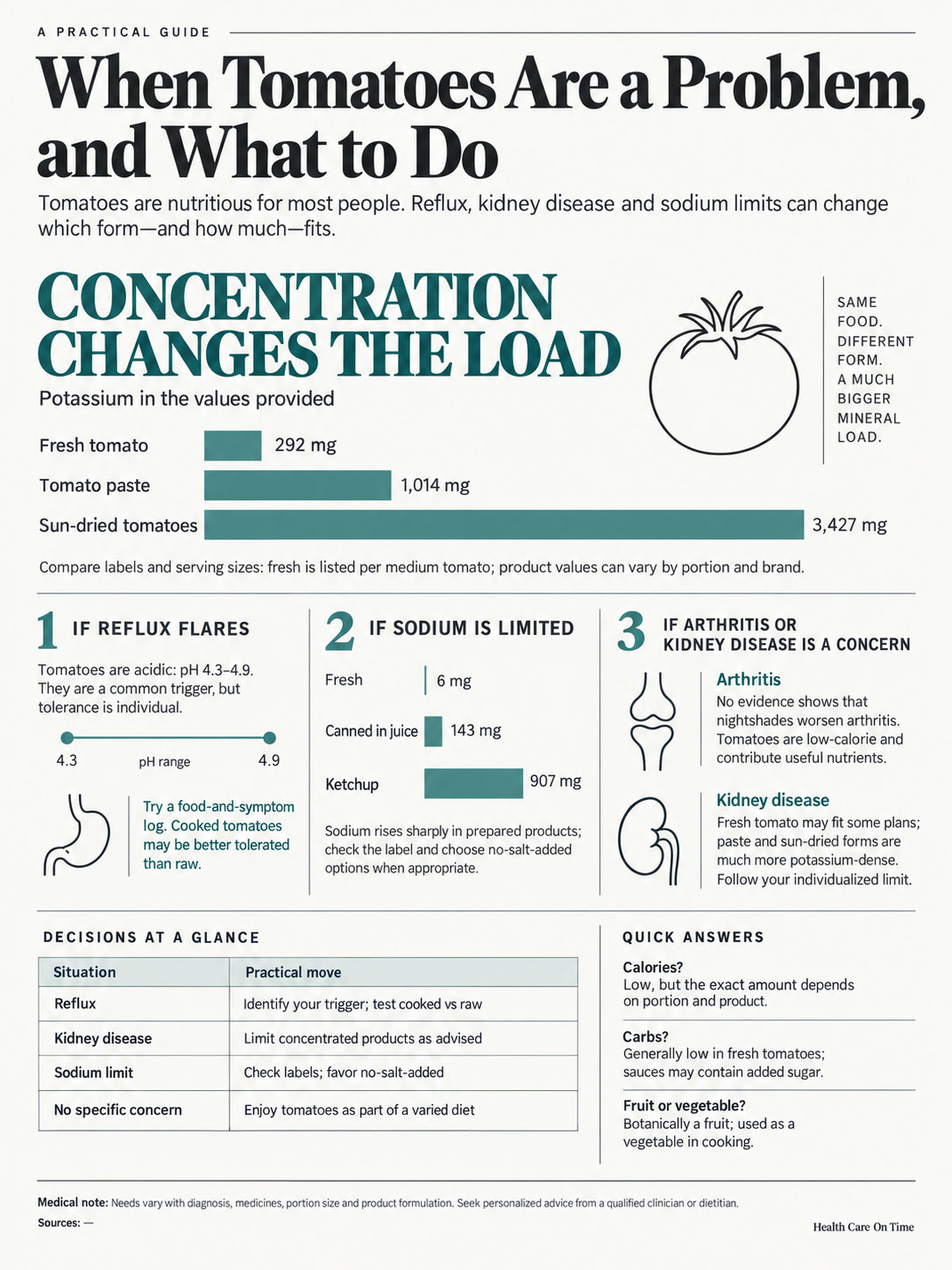
Tomatoes sit at a pH of roughly 4.3 to 4.9, firmly acidic, and they rank among the most frequently reported reflux triggers.
Current gastroenterology guidance has moved away from handing every patient the same elimination list. The recommended approach is individualized trigger identification, because triggers vary substantially between people and blanket restriction removes nutritious foods from those who tolerate them fine.
If tomatoes reliably produce symptoms for you, cooked and diluted forms are often tolerated better than raw slices or concentrated paste. If they do not, there is no reason to avoid them.
Kidney Disease and Potassium
For anyone on a potassium-restricted renal diet, tomato products are the concern, not fresh tomatoes.
A medium tomato holds 292 mg of potassium, which most restricted diets can accommodate. Tomato paste holds 1,014 mg per 100 grams, and plain sun-dried tomatoes carry 3,427 mg per 100 grams, one of the highest concentrations in the entire produce category.
Patients booking kidney function panels with us often assume the fresh fruit is the issue. The paste, the sauce, and the sun-dried varieties are where the potassium load actually sits.
The Nightshade and Arthritis Claim
Tomatoes belong to the nightshade family alongside potatoes, eggplant, and peppers, and they contain small amounts of the alkaloid tomatine.
No controlled human evidence shows that nightshade vegetables worsen arthritis or inflammatory joint disease. The Arthritis Foundation’s position is that the connection is unsupported, and the sensible approach is a short personal elimination trial rather than permanent avoidance.
Given that tomatoes supply vitamin C, potassium, and carotenoids at a cost of 22 calories, dropping them on an unproven theory is a poor trade.
Sodium Hiding in Canned Tomatoes
Fresh tomatoes carry 6 mg of sodium per medium fruit. Canned tomatoes packed in juice carry around 143 mg per 100 grams, and salted canned sauces go higher.
Ketchup runs roughly 907 mg of sodium per 100 grams, about 154 mg per tablespoon.
No-salt-added canned tomatoes are stocked in nearly every American supermarket and are nutritionally identical apart from the sodium. Draining and rinsing canned tomatoes removes a meaningful share of it too.
What to Do in Your Situation
| Your Situation | Best Choice | Limit or Avoid | Practical Portion |
| Tracking calories precisely | Weigh in grams, multiply by 0.18 | Assuming “medium” without weighing | 123 g = 22 calories |
| Trying to lose weight | Whole raw or roasted tomatoes | Creamy dressings, cheese pairings, fried preparations | 2 to 3 medium daily |
| Managing blood pressure | Fresh, no-salt-added canned, homemade sauce | Ketchup, salted canned sauce, salted tomato juice | 110 g or more daily |
| On a low-potassium renal diet | Small amounts of fresh tomato | Paste, sun-dried, purée, tomato juice | Confirm limits with your dietitian |
| Taking warfarin | Any tomato form, kept consistent | Sudden large swings in leafy greens, not tomatoes | No special restriction |
| Following keto or low-carb | Fresh tomatoes, no-sugar-added sauce | Ketchup, sweetened marinara, sun-dried | 1 to 2 medium daily |
| Managing acid reflux | Cooked and diluted forms if tolerated | Raw slices and concentrated paste if they trigger you | Test individually |
| Wanting maximum lycopene | Cooked sauce or paste with olive oil | Relying on raw tomatoes alone | 2 tbsp paste with a fat source |
Frequently Asked Questions
How many calories are in one medium tomato?
A medium raw tomato weighing 123 grams contains 22 calories, per USDA FoodData Central entry 170457. It also provides 4.8 grams of carbohydrate, 1.5 grams of fiber, 1.1 grams of protein, and almost no fat. Real tomatoes vary in size, so weigh yours if precision matters.
Why do some sites say a tomato has 18 calories and others say 22?
The 18 figure is USDA’s per-100-gram value and 22 is the per-medium-tomato value. Some publishers copied the 100-gram block and mislabeled it as one medium tomato. Both numbers are correct for their own serving size, but only 22 applies to a whole medium tomato.
How many calories are in a cherry tomato?
One cherry tomato weighs about 17 grams and contains 3 calories. A full cup weighs 149 grams and comes to 27 calories with 5.8 grams of carbohydrate. Grape tomatoes are smaller, around 8 to 10 grams, which puts them near 1 or 2 calories each.
How many calories are in a large beefsteak tomato?
USDA’s large tomato is 182 grams and 33 calories. Supermarket beefsteak tomatoes often run bigger, commonly 200 to 300 grams, putting them at 36 to 54 calories. Weigh rather than estimate, since beefsteak size varies more than any other common variety.
Is a tomato a fruit or a vegetable?
Botanically a fruit, since it develops from a flower ovary and holds seeds. Legally in the United States it is a vegetable. In Nix v. Hedden, decided May 10, 1893, the Supreme Court unanimously classified tomatoes as vegetables under the Tariff Act of 1883, based on how people actually eat them.
Do cooked tomatoes have more calories than raw ones?
Not meaningfully. USDA lists cooked red tomatoes at 18 calories per 100 grams, the same as raw. What changes is water content and nutrient availability. Cooking reduces vitamin C and increases absorbable lycopene. Added oil or butter is what raises the calorie count, not the heat.
How many calories are in sun-dried tomatoes?
Plain sun-dried tomatoes contain 258 calories per 100 grams, roughly fourteen times the raw figure, because drying strips out nearly all the water. Five pieces weigh about 10 grams and cost 26 calories. Oil-packed drained versions list at 213 calories per 100 grams.
Are tomatoes good for weight loss?
They help, within limits. At 94.5% water, tomatoes add volume and fiber to a plate for very few calories, which supports a calorie deficit. They do not burn fat or speed metabolism. The bigger variable is what accompanies them, since dressings and cheese usually contribute far more.
How many carbs are in a tomato, and are tomatoes keto friendly?
A medium tomato has 4.8 grams of total carbohydrate and 3.3 grams of net carbs after fiber. That fits most ketogenic budgets at one to two tomatoes daily. Ketchup, sweetened sauces, and sun-dried tomatoes are the forms that cause trouble on strict low-carb plans.
Do tomatoes raise blood sugar?
Rarely at normal portions. A medium tomato carries a glycemic load near 0.5, far below the threshold of 10 that defines low impact. Sweetened tomato products are different, since ketchup contains about 3.9 grams of sugar per tablespoon and some jarred sauces contain more.
How many tomatoes can you safely eat in a day?
Two to three medium tomatoes daily suits most healthy adults. Calories are not the constraint. Very high intakes can trigger reflux in sensitive people, and concentrated products can push potassium high enough to matter with kidney disease. Extreme long-term intake has occasionally produced orange skin discoloration.
Do you get more lycopene from ketchup than from a fresh tomato?
Per 100 grams, yes. Ketchup contains 12,062 mcg of lycopene against 2,573 mcg in raw tomatoes. Per realistic serving, no. A tablespoon of ketchup is 17 grams, giving about 2,050 mcg, alongside sugar and sodium. Tomato paste is the better concentrated source.
Medical Disclaimer: This article is for general information and does not replace personalized medical or dietary advice. Nutrient values come from USDA FoodData Central and represent averages across varieties, growing conditions, and ripeness, so individual tomatoes will differ. If you have kidney disease, take anticoagulants, manage diabetes, or live with gastroesophageal reflux disease, speak with your physician or a registered dietitian before making significant changes to your intake of tomatoes or tomato products.
References
- USDA FoodData Central, Tomatoes, red, ripe, raw, year round average (FDC ID 170457)
- Gärtner C, Stahl W, Sies H. Lycopene is more bioavailable from tomato paste than from fresh tomatoes. Am J Clin Nutr. 1997;66(1):116-122
- Murcia-Lesmes D, et al. Association between tomato consumption and blood pressure in an older population at high cardiovascular risk: observational analysis of PREDIMED trial. Eur J Prev Cardiol. 2024;31(8):922-934
- US Food and Drug Administration. Qualified Health Claims: Letters of Denial, Lycopene and Various Cancers, November 8, 2005
- CDC. Adults Meeting Fruit and Vegetable Intake Recommendations, United States, 2019. MMWR Morb Mortal Wkly Rep. 2022;71(1):1-9
- USDA Economic Research Service. Vegetables and Pulses topic page and Yearbook Tables
- USDA Economic Research Service. Vegetables and Pulses Outlook, April 2025 (VGS-375)
- Agricultural Marketing Resource Center. Tomatoes commodity profile
- Nix v. Hedden, 149 U.S. 304 (1893). US Supreme Court