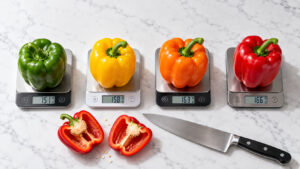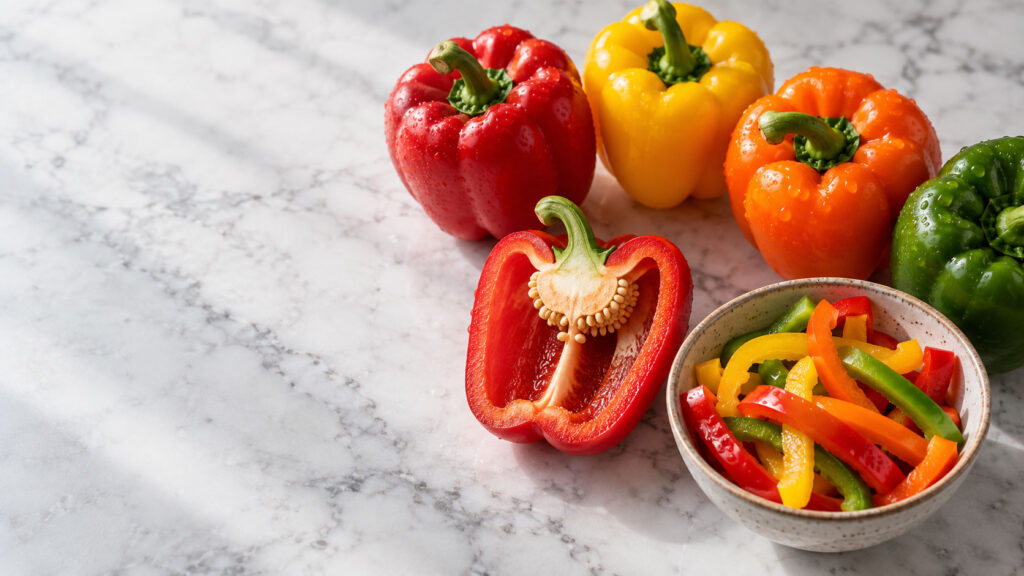
A red bell pepper is just a green bell pepper that stayed on the plant longer. That one fact drives most of the “red is healthier” advice online. It also explains why so much of that advice is exaggerated.
Table of Contents
Quick Answer: The health benefits of eating bell peppers that research actually supports come from vitamin C, carotenoids, and low calorie density. One medium red pepper covers more than a full day of vitamin C. Claims that bell peppers burn fat, prevent cancer, or match paprika supplement results are overhyped. Bell peppers contain no meaningful capsaicin, and most “paprika” trials tested capsules, not food.
The 7 real benefits, in order of evidence strength:
- Very high vitamin C
- Better iron absorption from plant foods
- Provitamin A (mainly red peppers)
- Eye carotenoids: lutein and zeaxanthin
- Low energy density for weight control
- Modest fiber for gut health
- A place in produce-rich diets linked to lower chronic disease risk
At a Glance
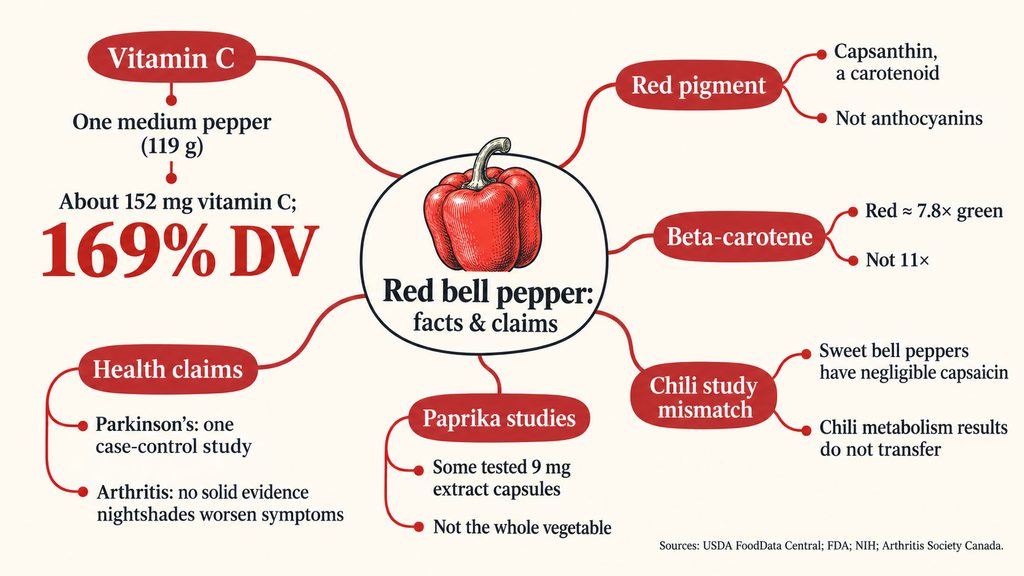
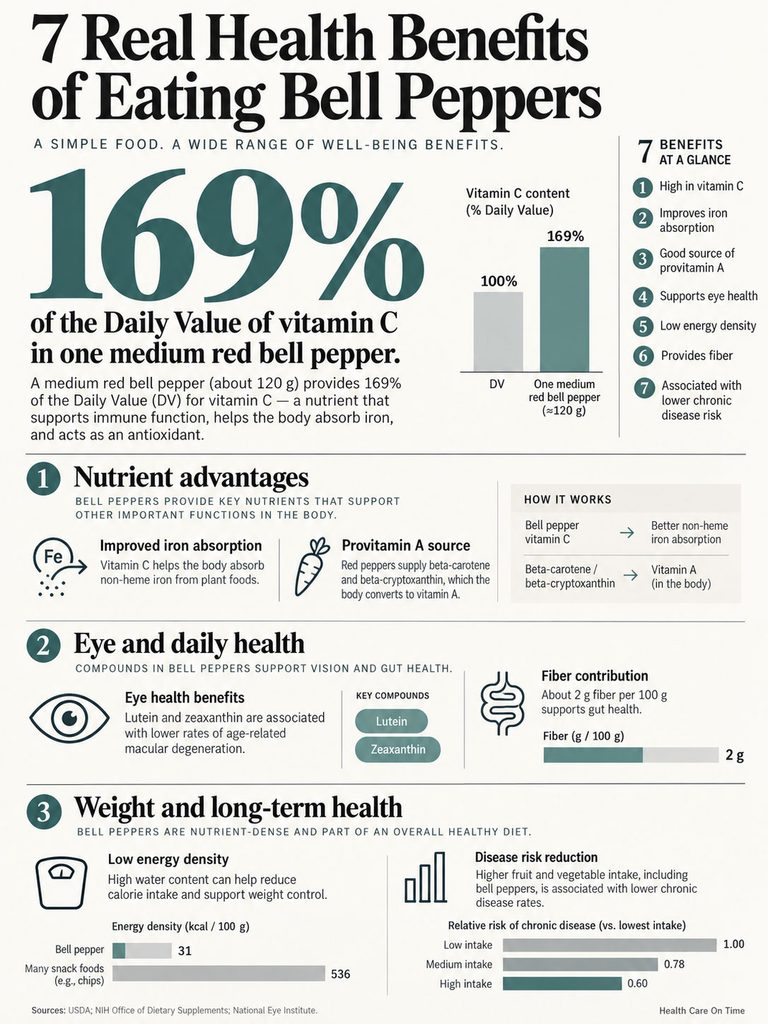
- One medium red bell pepper (about 4.2 ounces) supplies roughly 169% of the Daily Value for vitamin C.
- Red bell peppers get their color from capsanthin, not anthocyanins, despite what some top-ranking pages claim.
- The popular “11 times more beta-carotene” figure is inflated. USDA data puts red at about 7.8 times green.
- Sweet bell peppers have essentially no capsaicin, so chili pepper metabolism studies don’t apply.
- Most “paprika” research tested a 9 mg supplement capsule, not the vegetable.
- A Parkinson’s disease finding is intriguing but rests on one case-control study.
- There’s no solid evidence that nightshades worsen arthritis for most people.
What Makes Bell Peppers Nutritionally Different
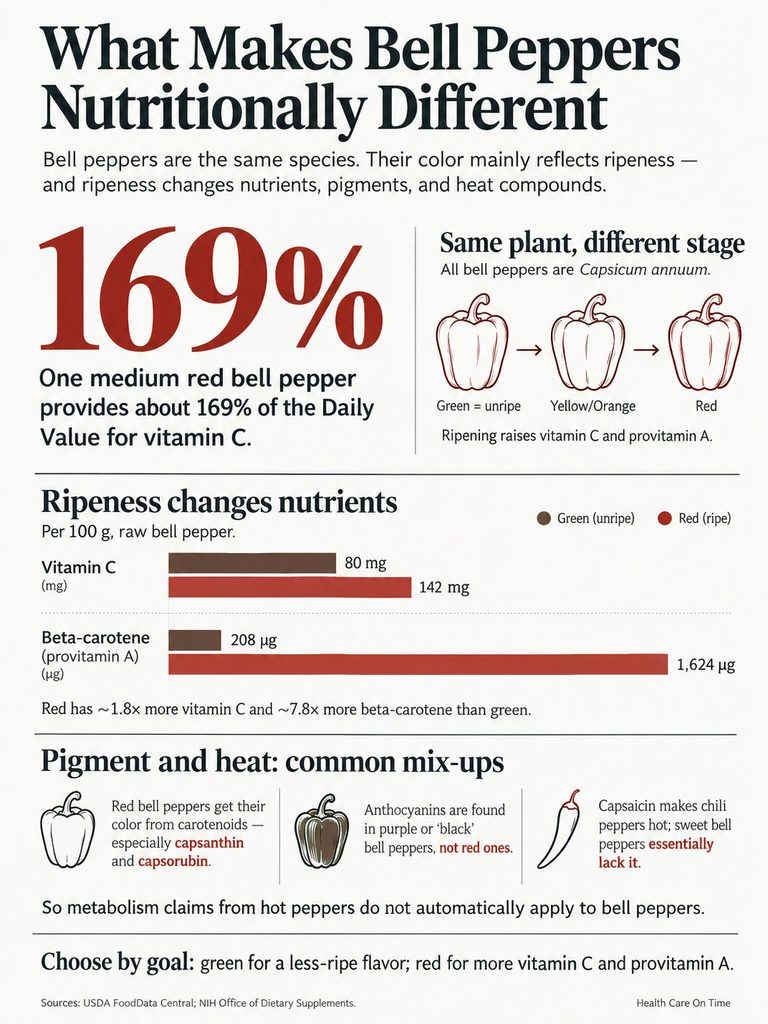
Bell peppers are Capsicum annuum, the same species as jalapeños and cayenne. The sweet types simply lack the gene that creates heat. What changes from one bell pepper to the next is ripeness and pigment.
Our dietitian reviewers often notice that shoppers treat each color as a separate vegetable. It’s more accurate to see the colors as stages of the same fruit. For exact calorie and portion numbers by color, see our bell pepper calories guide.
Same Plant, Different Ripeness
Green peppers are harvested before they ripen. Left on the plant, they turn yellow or orange, then red. The plant breaks down chlorophyll and builds carotenoids, which changes the flavor and the nutrient profile.
That means “healthier” depends on what you’re after. Ripening raises vitamin C and provitamin A. Some eye-related carotenoids stay higher at the green stage.
The Pigments That Matter
Four compound groups explain most bell pepper benefits:
- Capsanthin and capsorubin: red pigments found almost only in ripe red peppers.
- Beta-carotene: converted by the body into vitamin A.
- Beta-cryptoxanthin: another provitamin A carotenoid.
- Lutein and zeaxanthin: carotenoids that concentrate in the retina.
Why Red Peppers Don’t Owe Their Color to Anthocyanins
One high-ranking health page says some bell peppers, especially red ones, contain anthocyanins that create their deep color, and it uses that to support a brain-health claim. Red bell peppers are colored by capsanthin and capsorubin, which are carotenoids. Anthocyanins appear only in purple or “black” bell pepper cultivars.
This distinction matters. Anthocyanin research, mostly on berries, doesn’t transfer to red peppers because the two pigment families behave differently in the body.
The Capsaicin Question
Capsaicin is what makes chili peppers hot. Sweet bell peppers carry a recessive gene variant that shuts down capsaicin production, which is why they score zero on the Scoville scale.
Any claim that bell peppers “rev your metabolism like hot peppers” borrows evidence from the wrong food. Patients who ask us about pepper-based weight loss are usually surprised to hear this.
7 Real Health Benefits of Eating Bell Peppers
The table below grades the most common claims by the type of evidence behind them. “Whole food” means studies of people eating vegetables. “Extract” means capsules or concentrates.
| Claim | Key compound | Best color | Evidence type | Whole food or extract | Verdict |
| Meets daily vitamin C | Ascorbic acid | Red, yellow | USDA nutrient analysis | Whole food | Real |
| Improves non-heme iron absorption | Vitamin C | Red, yellow | Controlled absorption studies | Whole food and pure vitamin C | Real |
| Supplies vitamin A | Beta-carotene, beta-cryptoxanthin | Red | USDA nutrient analysis | Whole food | Real |
| Supports eye carotenoid intake | Lutein, zeaxanthin | Green | Cohorts plus AREDS2 (supplement) | Mixed | Real but modest |
| Helps weight control | Low energy density | All | Energy-density feeding trials | Whole food | Real |
| Supports gut health | Fiber (about 2 g per 100 g red) | All | General fiber evidence | Whole food | Real but small |
| Lowers chronic disease risk | Overall produce pattern | All | Large prospective cohorts | Whole food diets | Real, pattern-level |
| Burns fat | Capsaicin | None (bell has none) | Chili pepper studies only | Not applicable | Hyped |
| Prevents cancer | Beta-cryptoxanthin | Red | Pooled cohorts, smoker subgroup | Diet-reported | Hyped |
| Skin, endurance, belly fat | Paprika xanthophylls | Red | Small RCTs, 9 mg capsules | Extract | Hyped |
1. Vitamin C at a Level Few Foods Match
A medium red bell pepper (about 119 grams, or 4.2 ounces) delivers roughly 150 mg of vitamin C. That’s about 169% of the Daily Value. Yellow peppers run even higher per 100 grams, and green peppers still supply about 80 mg per 100 grams.
For comparison, a medium orange provides about 70 mg. One red pepper gives you roughly double that.
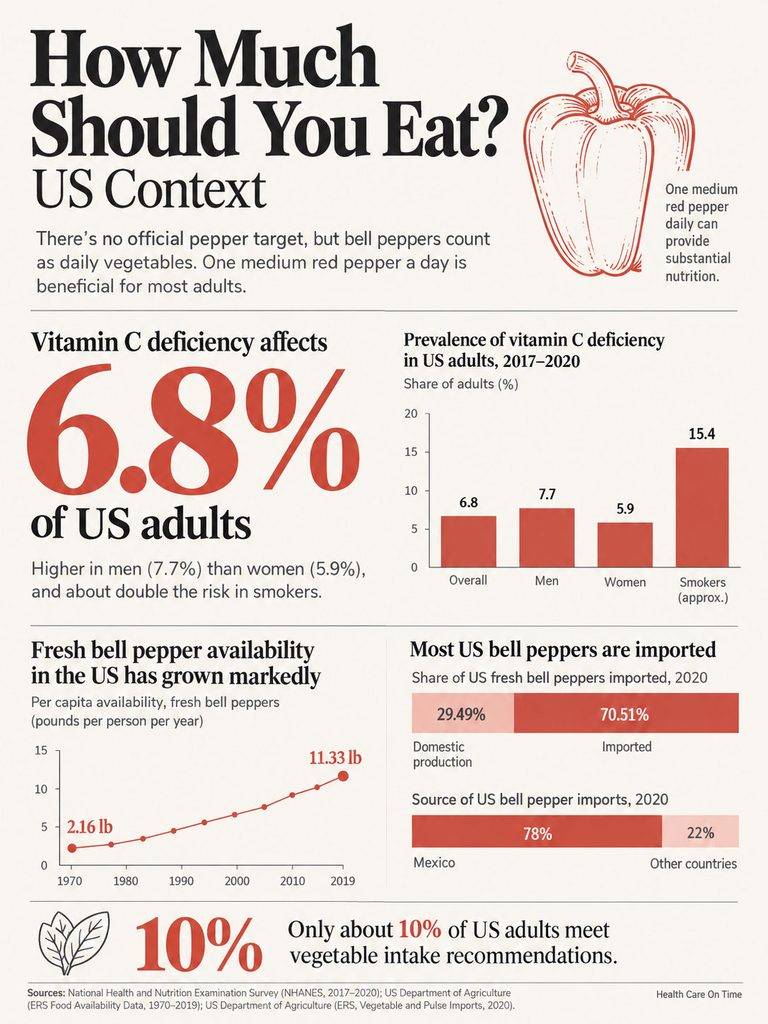
Do Americans actually fall short? In CDC’s NHANES 2017–2018 data, 6.8% of adults were vitamin C deficient, with men at 7.7% and women at 5.9%. The same analysis found that smokers and people with low dietary intake had about twice the deficiency risk.
Smokers need 35 mg more per day than the standard 90 mg for men and 75 mg for women, according to the NIH Office of Dietary Supplements. Half a red pepper covers that extra need on its own.
Vitamin C does more than fight colds. Your body uses it to build collagen for skin, blood vessels, and healing wounds, and to recycle other antioxidants like vitamin E. Because the body can’t store much of it, a steady daily supply from food matters more than an occasional large dose.
2. Better Iron Absorption From Plant Foods
Iron from plants (non-heme iron) is poorly absorbed on its own. Vitamin C converts it into a form your gut takes up more readily. In single-meal studies, adding vitamin C-rich foods raises non-heme iron absorption several-fold.
This is most useful for vegetarians, people with heavy periods, and anyone told their ferritin is low. Patients booking iron studies with us often ask what to eat alongside beans or spinach. Raw pepper strips are one of the simplest answers. Our iron and anemia diet guide covers the full pairing strategy.
A few easy pairings:
- Add diced raw red pepper to a lentil or black bean bowl.
- Top a spinach salad with yellow pepper strips.
- Keep tea and coffee at least an hour away from iron-rich meals, since their polyphenols block absorption.
3. Provitamin A From Red Peppers
Red bell peppers carry about 1,600 mcg of beta-carotene per 100 grams, plus beta-cryptoxanthin. Both convert into vitamin A, which supports night vision, skin, and immune function.
Green peppers carry far less. This is where red truly outperforms green, just not by the figure often repeated. WebMD states red peppers have almost 11 times the beta-carotene and twice the vitamin C of green. USDA records put the gaps at about 7.8 times for beta-carotene and about 1.6 times for vitamin C.
4. Eye Carotenoids: Lutein and Zeaxanthin
Lutein and zeaxanthin build up in the macula, the part of the retina responsible for sharp central vision. Cohort studies link diets rich in these carotenoids to lower rates of advanced age-related macular degeneration.
Here’s the honest part. The AREDS2 trial used 10 mg of lutein plus 2 mg of zeaxanthin daily in supplement form. A medium green pepper supplies roughly 0.4 mg. Peppers add to your total, but leafy greens like kale and spinach do far more of the work.
Green peppers lead the common colors on lutein and zeaxanthin, which surprises most readers. Our medical reviewers suggest mixing colors instead of chasing one.
5. Low Energy Density for Weight Control
Bell peppers are about 92% water, which gives them very low energy density: plenty of volume for few calories.
Feeding studies consistently show that people eat fewer total calories when meals include low-energy-density vegetables. A cup of sliced peppers with hummus can replace a handful of chips at a fraction of the calories. The benefit comes from the swap, not from any fat-burning compound.
6. Fiber and Gut Support (Modest)
Red peppers provide about 2 grams of fiber per 100 grams. That’s helpful, but it isn’t a high-fiber food. Adults need 25 to 38 grams a day.
Think of peppers as a contributor rather than a fix. Two peppers a day add roughly 5 grams, which matters mostly alongside beans, whole grains, and fruit.
7. Part of the Produce Pattern Tied to Lower Disease Risk
Large prospective studies link higher fruit and vegetable intake to lower rates of heart disease, stroke, and early death. Bell peppers are among the easiest vegetables to add, since many kids and picky eaters accept them raw.
The benefit here belongs to the eating pattern, not to peppers alone. That’s still a strong reason to eat them, because the CDC reports that only about 1 in 10 US adults meets vegetable recommendations.
3 Bell Pepper Benefits That Get Overhyped
“Burns Fat Like Chili Peppers”
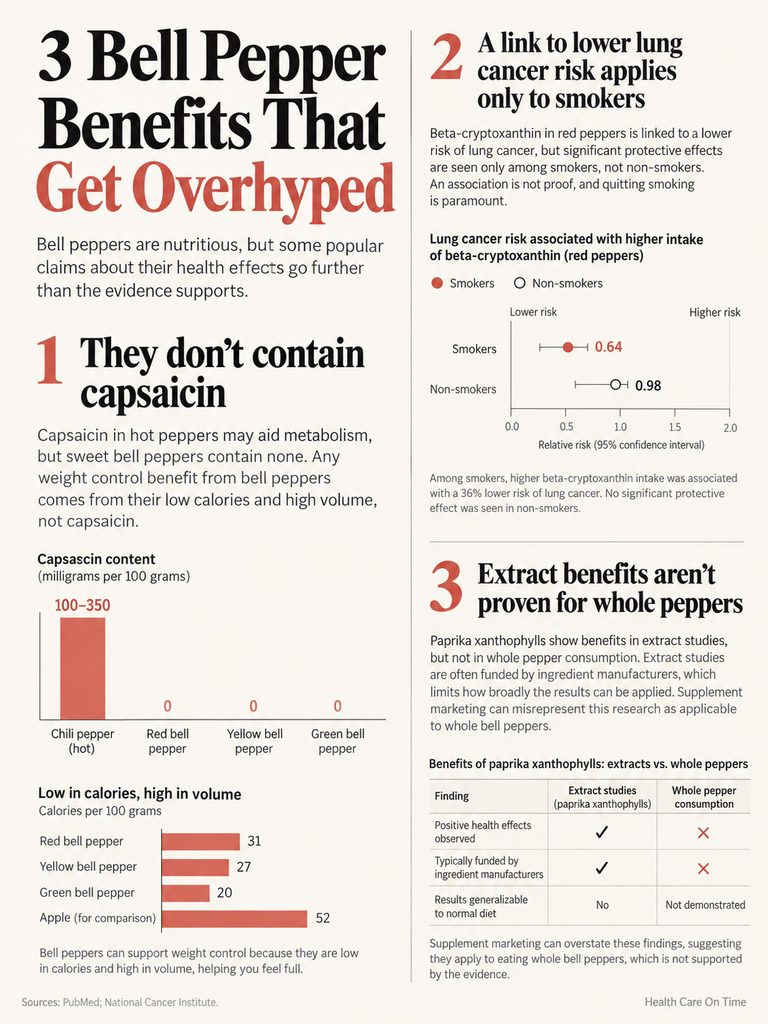
Capsaicin can slightly raise energy use and curb appetite in some studies. Those studies used hot peppers or capsaicin capsules.
Sweet bell peppers contain essentially zero capsaicin, so the metabolism claim comes from a different food. Peppers help weight control through volume, and only through volume.
“Prevents Cancer”
The strongest data here involves beta-cryptoxanthin, a carotenoid found in red peppers, citrus, and papaya. A pooled analysis of seven cohorts tracked 399,765 people and linked higher beta-cryptoxanthin intake to lower lung cancer risk (RR 0.76, highest vs lowest intake), while beta-carotene showed no link.
The catch: when the data were split by smoking status, the significant protective link appeared only among current smokers. That’s an association in one subgroup, not proof that peppers prevent cancer. For smokers, the real prevention step is quitting.
“Paprika Extract Studies Prove It”
Several randomized trials report benefits from red paprika xanthophylls. One crossover trial in college students, for example, used a daily soft capsule containing 9 mg of paprika xanthophylls. Others tested skin moisture and belly fat.
These are extract studies, usually small and often linked to ingredient makers. They say little about eating a pepper at dinner. In cases reviewed by our medical team, supplement marketing frequently presents them as “bell pepper research.”
The Surprise Finding: Peppers and Parkinson’s Disease
In 2013, University of Washington researchers compared 490 people newly diagnosed with Parkinson’s disease against 644 people without it. Their theory: peppers belong to the same plant family as tobacco and contain trace nicotine, and tobacco users have lower Parkinson’s rates.
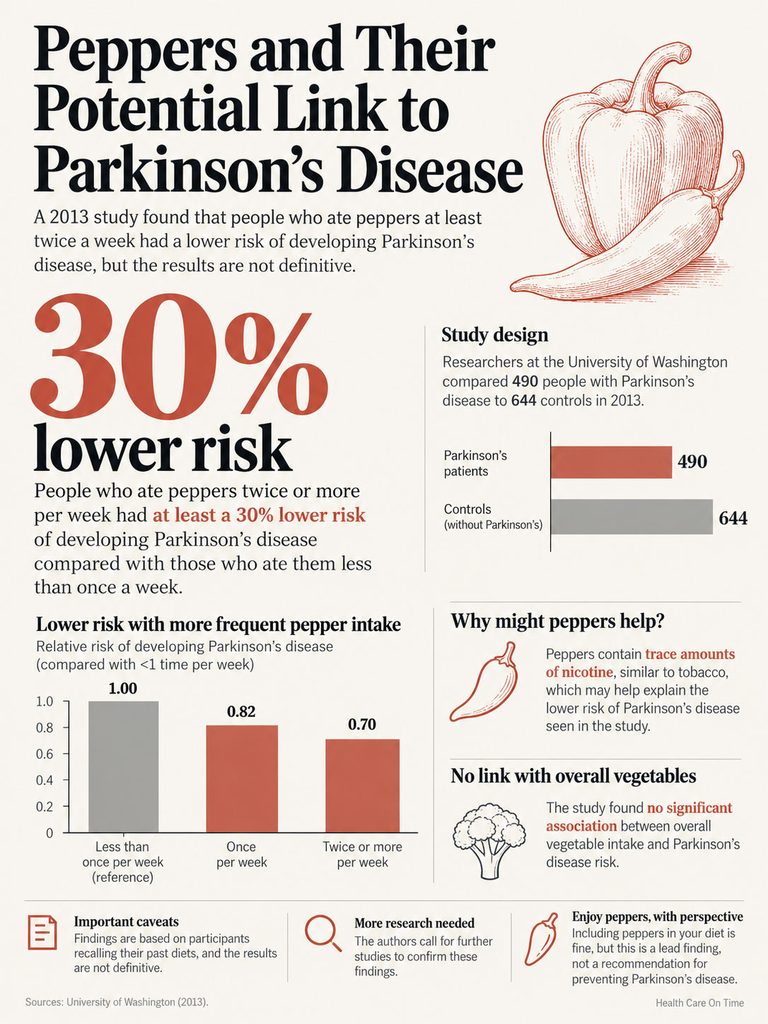
The lead author reported that eating peppers twice or more per week was consistently linked to at least a 30% lower risk. When all vegetables were combined, there was no association, which made the pepper signal stand out.
Why This Is a Lead, Not a Recommendation
This was a case-control study that relied on people recalling their past diets. No large prospective study has confirmed it, and the authors themselves called for more research.
It’s a nice reason to enjoy peppers. It isn’t a reason to eat them to prevent Parkinson’s.
Red vs Green vs Yellow vs Orange: Which Color Wins?
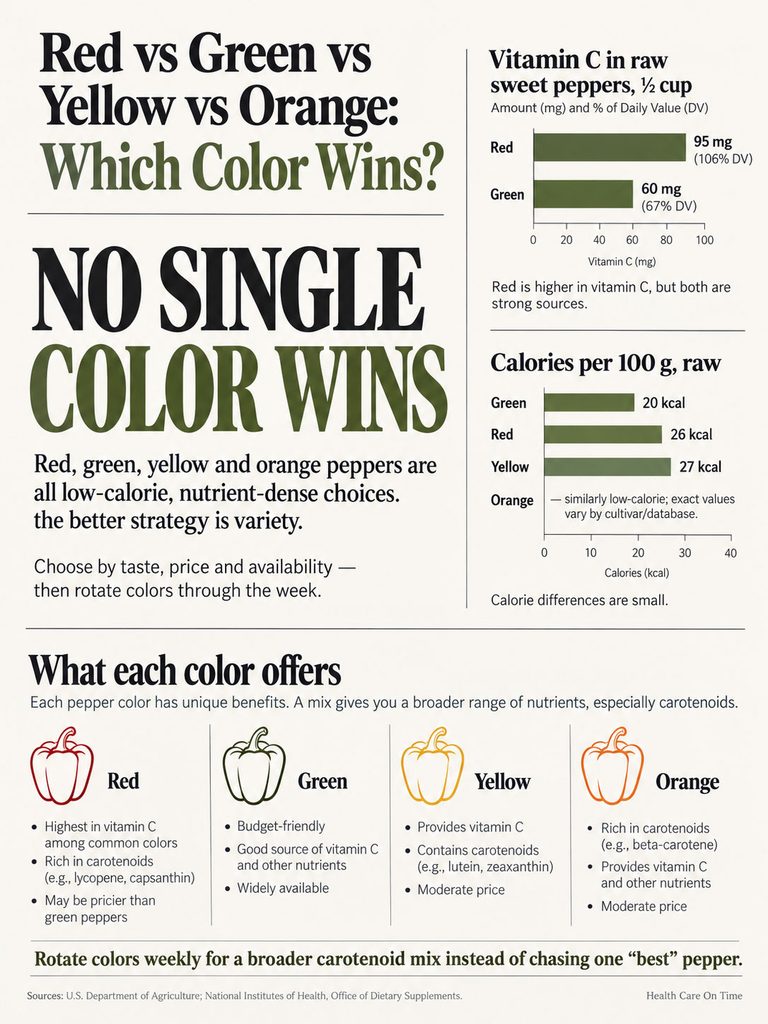
No single color wins across the board. Here’s how the colors split:
- Red: highest in beta-carotene, beta-cryptoxanthin, and capsanthin, with high vitamin C.
- Yellow: highest vitamin C per 100 grams in USDA data.
- Orange: falls between red and yellow on most carotenoids.
- Green: most lutein and zeaxanthin of the common colors, lowest in natural sugar, usually cheapest.
Our dietitian reviewers recommend buying by budget and taste, then rotating colors through the week. That covers every major carotenoid without overpaying for “superfood” red. The per-color numbers are laid out in our bell pepper calories breakdown.
Raw or Cooked? How Prep Changes the Benefits
Heat and Vitamin C Loss
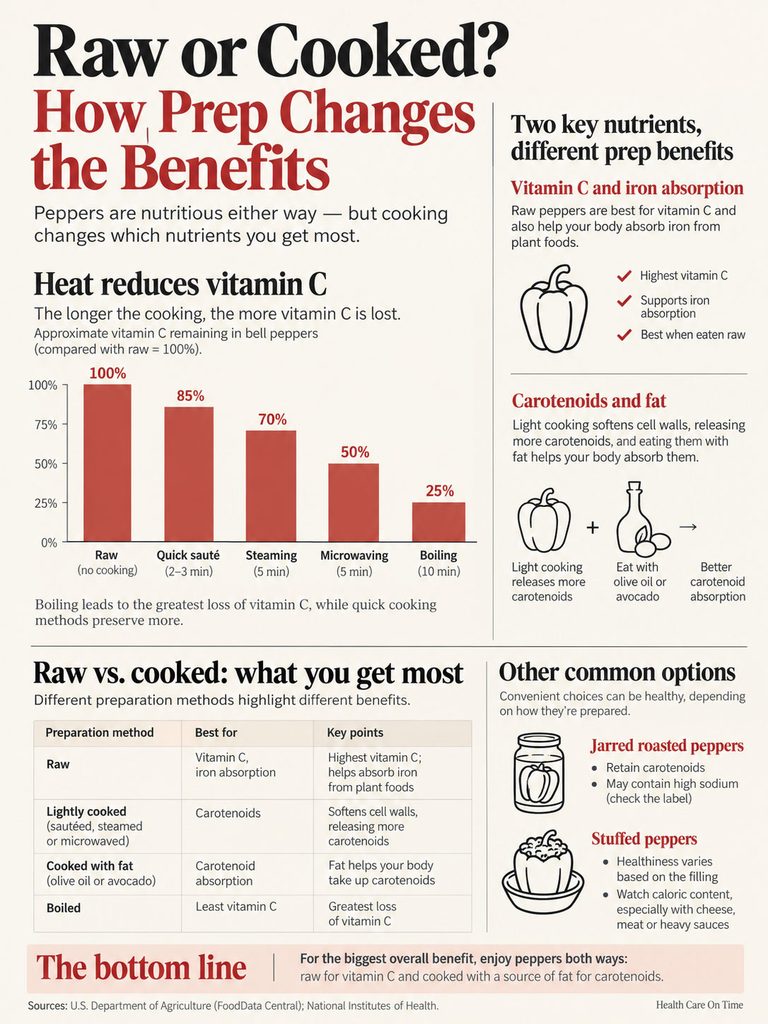
Vitamin C dissolves in water and breaks down with heat. Boiling loses the most because the vitamin leaches into the cooking water. Quick stir-frying, roasting, and microwaving hold on to more.
If vitamin C or iron absorption is your goal, eat at least some of your peppers raw.
Fat and Carotenoid Absorption
Carotenoids dissolve in fat. A teaspoon of olive oil, a few slices of avocado, or a sprinkle of cheese helps you absorb more beta-carotene and lutein. Light cooking also softens cell walls, which can release more carotenoids.
The best strategy uses both: raw peppers for vitamin C, and cooked peppers with a little fat for carotenoids.
Roasted, Jarred, and Stuffed Peppers
Jarred roasted peppers keep most of their carotenoids, but check the sodium. Some brands carry 200 mg or more per serving.
Stuffed peppers are only as healthy as the filling. One packed with sausage and cheese can top 500 calories, while a bean-and-brown-rice filling stays much lighter.
How Much Should You Eat? US Context
There’s no official pepper target. The Dietary Guidelines for Americans count bell peppers toward your daily vegetables, with red ones in the red and orange subgroup. About one medium pepper a day is a realistic, useful amount for most adults.
What One Pepper a Day Adds Up To
Here’s what a daily medium red pepper contributes over a week, based on USDA averages:
- Roughly 1,050 mg of vitamin C, or about 11 to 12 days’ worth at the adult Daily Value.
- About 13,500 mcg of beta-carotene, a meaningful share of weekly vitamin A needs.
- About 17 to 18 grams of fiber across seven days.
That’s real nutrition for a food that costs about $1 to $2 per pepper at most US grocery stores. In cases reviewed by our medical team, the people who benefit most are those starting from low produce intake, not those who already eat a varied diet.
| US statistic | Value | Source |
| Adults with vitamin C deficiency (2017–2018) | 6.8% overall | CDC NHANES, Powers et al. 2023 |
| Deficiency by sex | Men 7.7%, women 5.9% | CDC NHANES 2017–2018 |
| Smokers’ deficiency risk | About double | CDC NHANES analysis |
| Fresh bell pepper availability per person | 2.16 lb (1970) vs 11.33 lb (2019) | USDA via The Packer |
| Share of US fresh bell peppers imported | 70.51% (2020) | USDA trade data |
| Mexico’s share of bell pepper imports | 78% (2021) | USDA trade data |
| Adults meeting vegetable recommendations | About 10% | CDC MMWR |
Americans eat more peppers than ever. Per-person availability grew from 2.16 pounds in 1970 to 11.33 pounds in 2019, while imports rose from 33.8% of supply in 2000 to 70.51% in 2020.
Seasonality explains part of that shift. USDA’s Economic Research Service found that summer imports of bell peppers from Mexico rose 742% between 2008–10 and 2018–20. Late summer through early fall is still peak season for US-grown peppers.
Buying, Storing, and Prepping Bell Peppers
Pick peppers that feel heavy for their size, with firm, glossy skin and a green, fresh-looking stem. Skip any with soft spots, wrinkles, or dark patches near the stem.
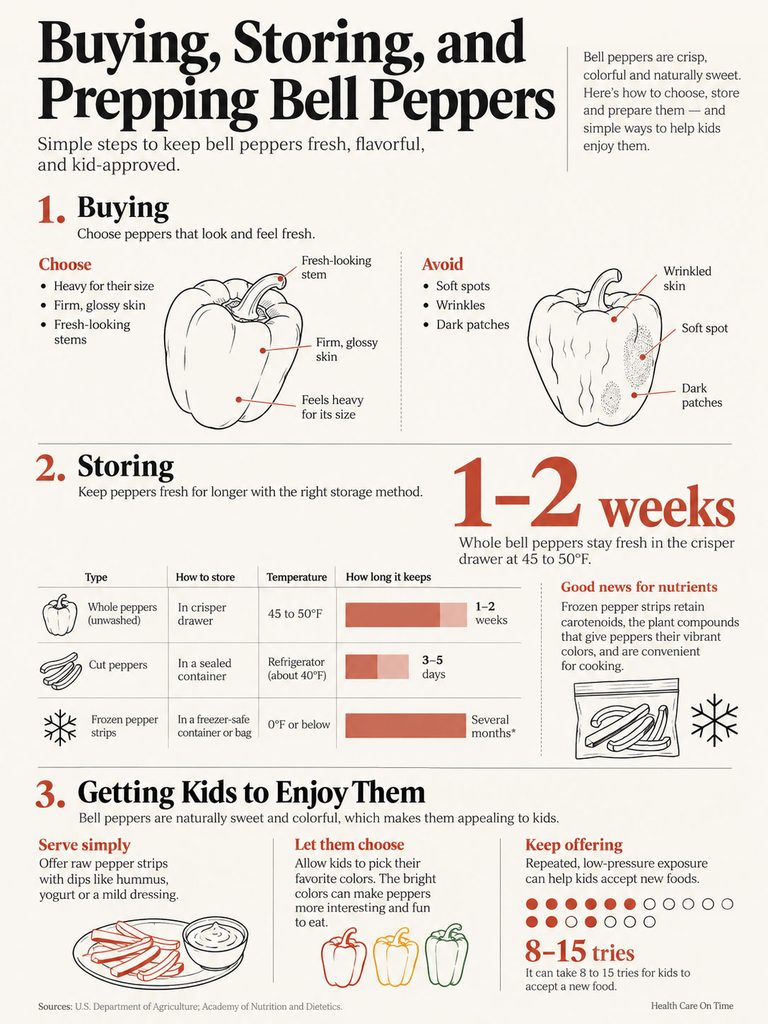
Store whole peppers unwashed in the crisper drawer, ideally around 45 to 50°F. They keep about one to two weeks. Cut peppers last three to five days in a sealed container.
Frozen pepper strips are a smart budget option. They’re frozen soon after harvest, keep most of their carotenoids, and go straight into stir-fries, soups, and fajitas without thawing. Across patients we serve, keeping a bag of frozen peppers on hand is one of the habits that sticks best.
Getting Kids and Picky Eaters on Board
Bell peppers are one of the most kid-friendly vegetables because they’re sweet, crunchy, and colorful. Red, yellow, and orange peppers taste noticeably sweeter than green, so start there.
Serve raw strips with a dip like ranch, hummus, or guacamole, and let kids pick their own colors. Pediatric feeding experts note that repeated, low-pressure exposure works better than forcing a bite, and it may take 8 to 15 tries before a new food feels familiar.
Who Should Be Careful
Nightshades and Arthritis
Bell peppers belong to the nightshade family, along with tomatoes, potatoes, and eggplant. The belief that nightshades worsen arthritis is widespread online.
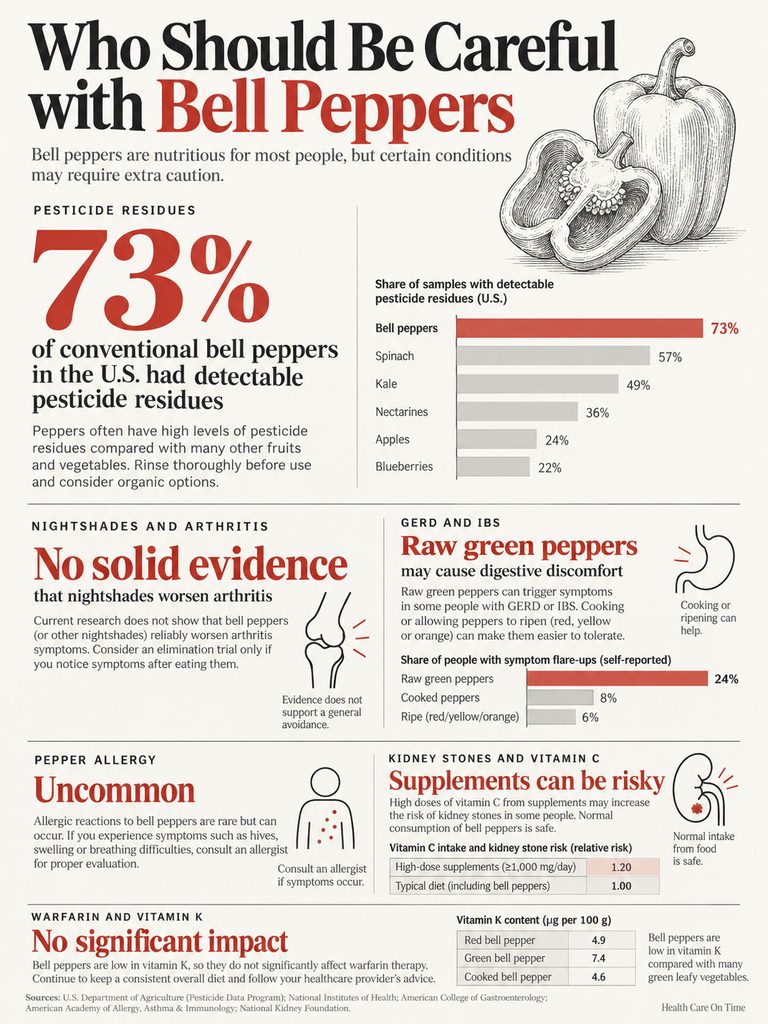
The Arthritis Foundation says there’s no solid scientific evidence that nightshades trigger arthritis flares in most people. If you suspect a personal link, try a two- to four-week elimination and then reintroduce peppers, ideally with guidance from your clinician.
GERD, IBS, and Why Green Peppers “Repeat”
Some people get burping, gas, or heartburn after raw green peppers. The tough skin and compounds in unripe fruit appear to be the usual culprits.
Patients commonly ask us whether this means an allergy. Usually it doesn’t. Roasted, peeled, or ripe red peppers are often better tolerated. If upper stomach pain or nausea keeps coming back, read our guide on upper stomach pain and nausea and book a visit with your clinician.
Pesticides and the EWG List
Peppers regularly rank high for pesticide residues. In the 2024 analysis, 101 individual pesticides turned up across bell and hot pepper samples. In the 2026 edition, bell and hot peppers landed just outside the Dirty Dozen, flagged alongside green beans as items worth watching.
For balance, toxicologists have criticized EWG’s ranking method, and detected residues usually fall well below EPA limits. Rinse peppers under running water. Buy organic if it fits your budget, but don’t skip peppers because organic costs more.
Pepper Allergy and Cross-Reactivity
True bell pepper allergy is uncommon. It has been reported in people sensitive to mugwort pollen or latex. Mouth itching, hives, or swelling after eating peppers deserves an allergist visit.
Kidney Stones and High-Dose Vitamin C
Some pages warn that too much vitamin C from peppers can cause kidney stones. The concern is real for high-dose supplements, which have been linked to a higher risk of oxalate stones, especially in men with a past history of stones.
Food is a different story. Reaching supplement-level doses from peppers alone would take several peppers every day. If you’ve had calcium oxalate stones, keep vitamin C supplements modest and talk to your clinician, but there’s no reason to avoid a pepper at dinner.
Warfarin and Vitamin K
Bell peppers are low in vitamin K, providing only single-digit micrograms per 100 grams. They aren’t a warfarin concern the way spinach or kale can be. On warfarin, keep your overall intake steady and tell your clinician before making big diet changes.
What the Evidence Can’t Tell You Yet
Three honest limits apply to everything above:
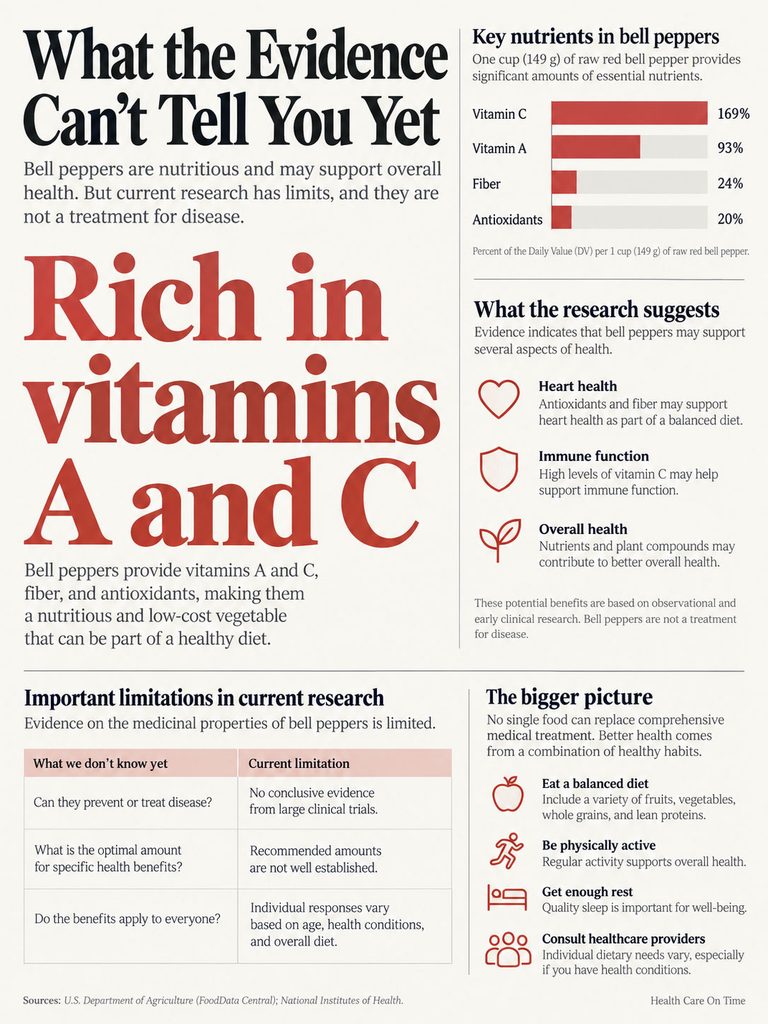
- No long-term trials of whole bell peppers exist for disease outcomes. The benefits come from nutrient content, short absorption studies, and diet-pattern cohorts.
- The most exciting findings are observational or extract-based. The Parkinson’s result is one case-control study, and the cancer link applies to a smoker subgroup. Paprika benefits come from 9 mg capsules.
- Nutrient values vary. Variety, ripeness, growing conditions, and storage time shift vitamin C and carotenoid levels, so USDA figures are averages, not guarantees.
Our medical team’s reading: bell peppers are a genuinely nutritious, low-cost vegetable. They aren’t a treatment for anything.
Putting It Into Practice
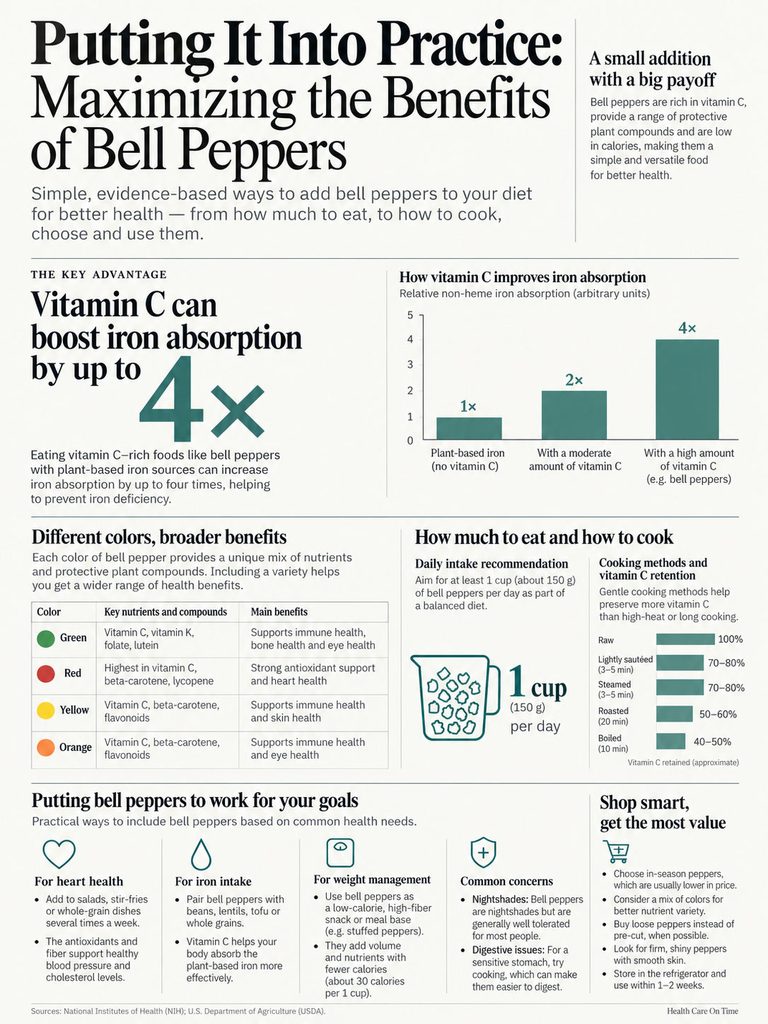
| Scenario | Recommended action | Why |
| Low ferritin or plant-based diet | Add 1/2 raw red or yellow pepper to bean, lentil, or spinach meals | Vitamin C boosts non-heme iron absorption |
| You smoke | Eat 1 raw pepper daily and ask your clinician about quitting support | Smokers need 35 mg more vitamin C and face double the deficiency risk |
| Eye health goal | Pair green peppers with kale or spinach plus a little oil | Green leads on lutein among peppers; greens supply more |
| Trying to lose weight | Swap chips for 1 cup of pepper strips with hummus | Low energy density, not fat burning |
| Heartburn after green peppers | Switch to roasted or peeled red peppers | Ripe, cooked peppers are often gentler |
| On warfarin | Keep pepper intake steady; no restriction needed | Very low vitamin K |
| Worried about nightshades and joints | Try a 2 to 4 week break, then reintroduce | No broad evidence of harm |
| Tight grocery budget | Buy green, or frozen mixed peppers | Similar vitamin C per dollar; frozen keeps nutrients |
Five easy ways to eat more peppers:
- Keep pre-sliced strips at eye level in the fridge for snacking.
- Add diced peppers to scrambled eggs, omelets, or breakfast burritos.
- Roast a sheet pan of mixed colors on Sunday for grain bowls all week.
- Use halved peppers as “boats” for tuna or chicken salad.
- Toss frozen pepper strips straight into stir-fries and fajitas.
Frequently Asked Questions
Is it good to eat bell peppers every day?
Yes, for most people. A medium pepper daily supplies more than a full day’s vitamin C, some provitamin A, and useful fiber for very few calories. Rotate colors for a broader carotenoid mix. Cut back only if you notice digestive discomfort or have a confirmed pepper allergy.
Which color bell pepper is the healthiest?
No single color wins. Red has the most beta-carotene and provitamin A. Yellow has the highest vitamin C per 100 grams in USDA data. Green leads on lutein and zeaxanthin and usually costs less. Mixing colors across the week gives you the widest nutrient spread.
Do bell peppers have more vitamin C than oranges?
Yes. A medium red bell pepper provides roughly 150 mg of vitamin C, while a medium orange provides about 70 mg. Even green peppers match or beat oranges by weight. Eat peppers raw or lightly cooked to keep the most vitamin C.
Are raw bell peppers healthier than cooked?
Each has an advantage. Raw peppers keep more vitamin C, which is heat-sensitive and water-soluble. Lightly cooked peppers eaten with a little fat release carotenoids like beta-carotene more easily. Eating both, raw in snacks and salads and cooked in meals, covers both nutrient groups.
Do bell peppers help with weight loss?
Indirectly. Bell peppers are about 92% water and very low in calories, so they add volume and help you feel full on less. They don’t burn fat. Their value comes from replacing higher-calorie foods like chips, crackers, or extra rice in your meals.
Do bell peppers contain capsaicin?
No, or only trace amounts. Sweet bell peppers carry a gene variant that blocks capsaicin production, which is why they aren’t spicy. Research on capsaicin and metabolism used hot peppers or capsules, so those results don’t apply to bell peppers at all.
Are bell peppers bad for arthritis or inflammation?
For most people, no. The Arthritis Foundation notes there’s no solid evidence that nightshades like bell peppers worsen arthritis. A small number of people report sensitivity. If you suspect a link, try a short elimination trial with your clinician rather than cutting all nightshades permanently.
Do bell peppers help you absorb iron?
Yes. The vitamin C in bell peppers converts plant-based (non-heme) iron into a form your gut absorbs more easily. Pair raw peppers with beans, lentils, tofu, or spinach. Avoid drinking tea or coffee with those meals, because their compounds reduce iron absorption.
Can bell peppers improve eyesight?
They support eye health but won’t sharpen vision. Bell peppers supply vitamin A precursors and small amounts of lutein and zeaxanthin, which help protect the retina. The amounts are modest next to leafy greens. Peppers won’t correct nearsightedness or replace a regular eye exam.
Why do green peppers cause burping or heartburn?
Unripe green peppers have tougher skins and compounds some people digest poorly, leading to burping, gas, or reflux. Roasted, peeled, or ripe red peppers are often easier to tolerate. Ongoing upper stomach pain or heartburn deserves a clinician visit to check for GERD or ulcers.
Should you buy organic bell peppers?
It’s optional. Peppers often rank high for pesticide residues, and in the 2026 EWG list they landed just outside the Dirty Dozen. Detected residues are usually below EPA limits. Buy organic if your budget allows; otherwise, rinse conventional peppers well under running water.
Are bell peppers safe on warfarin?
Yes. Bell peppers are very low in vitamin K, with only single-digit micrograms per 100 grams. They don’t meaningfully affect INR the way leafy greens can. Keep your overall diet consistent while on warfarin, and check with your clinician before major dietary changes.
Disclaimer: This article is for general education and does not replace advice from your doctor, registered dietitian, or pharmacist. If you have a medical condition, take prescription medicines, or have food allergies, talk with a qualified healthcare professional before changing your diet. HealthCareOnTime’s medical team reviews content for accuracy, but individual needs vary.
References
- Cleveland Clinic: Health Benefits of Bell Peppers
- Healthline: Bell Peppers 101, Nutrition Facts and Health Benefits
- WebMD: Surprising Health Perks of Peppers
- NC State Extension: Nutritional Benefits of Peppers
- Powers et al. Vitamin C Status of US Adults, NHANES 2017–2018 (J Appl Lab Med 2023)
- NIH Office of Dietary Supplements: Vitamin C Fact Sheet
- Männistö et al. Dietary Carotenoids and Lung Cancer, Pooled Analysis of Seven Cohorts (2004)
- Beta-Cryptoxanthin and Lung Cancer in Smokers (PMC)
- University of Washington: Do Peppers Reduce Risk of Parkinson’s? (2013)
- Searles Nielsen et al., Annals of Neurology 2013 (commentary)
- Paprika Xanthophyll Crossover RCT in College Students (Nutrients 2025)
- National Eye Institute: AREDS and AREDS2
- The Packer: Fresh Bell Pepper Per-Capita Consumption Keeps Climbing
- USDA ERS: Imports of Bell Peppers From Mexico Grow
- El Camino Health: Update on 2026 Pesticides
- CDC MMWR: Fruit and Vegetable Intake Among US Adults
- USDA FoodData Central
- Arthritis Foundation