A high thyroid test result can mean your thyroid is underactive. A low result can mean it’s overactive.
That reversal makes TSH test results confusing before you even reach the reference range. Add an unexplained “H” or “L” in your patient portal, and a routine blood test can leave you with more questions than answers.
Table of Contents
The useful question is what your result means alongside thyroid hormone levels, symptoms, medications, and medical history. Those details determine whether you need repeat testing, treatment, or a different explanation.
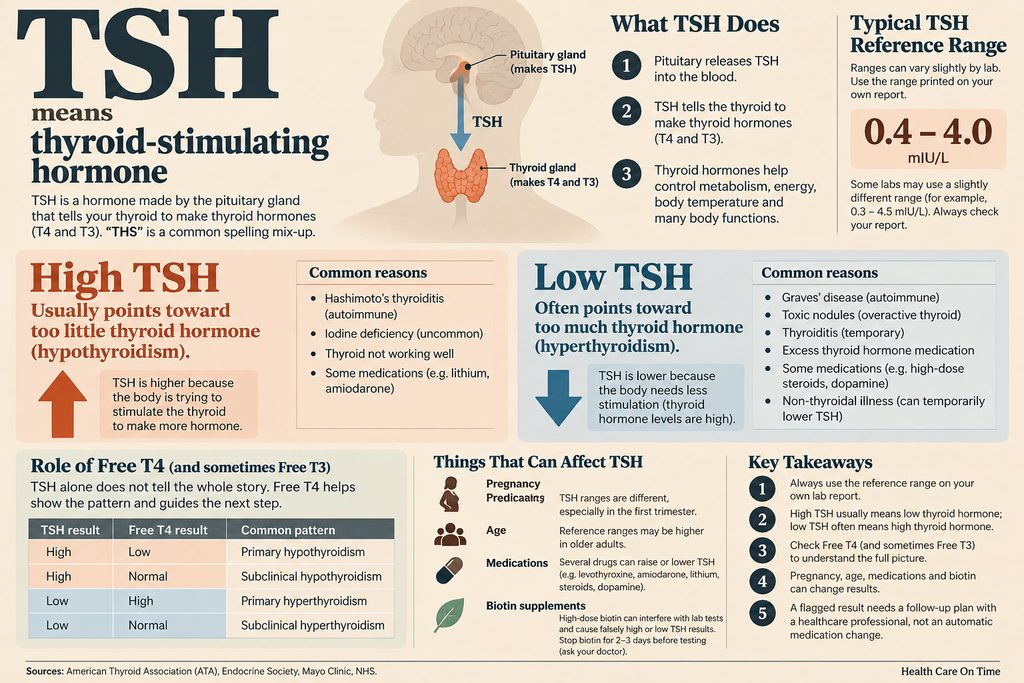
Quick Answer: High TSH often means your thyroid is underactive, while low TSH often means it’s overactive. Your clinician interprets the result alongside free T4, symptoms, medications, and your laboratory’s reference range. Pregnancy, age, illness, and supplements can affect interpretation. An abnormal result may need repeat testing or additional thyroid tests before a diagnosis or treatment decision is made.
At a Glance
- TSH means thyroid-stimulating hormone. “THS” is a common spelling mix-up.
- High TSH usually points toward too little thyroid hormone; low TSH often points toward too much.
- Use the reference interval printed on your own report.
- Free T4 helps distinguish important result patterns.
- Pregnancy, age, medications, and biotin can change interpretation.
- A flagged result needs a follow-up plan, not an automatic medication change.
At HealthCareOnTime, our guide explains the usual patterns first, then the exceptions. Start with your complete report rather than comparing an isolated number with an online chart.
What Is TSH, and Why Does It Move in the Opposite Direction?
TSH is a hormone produced by your pituitary gland, near the base of your brain. It signals your thyroid gland to produce thyroid hormone.
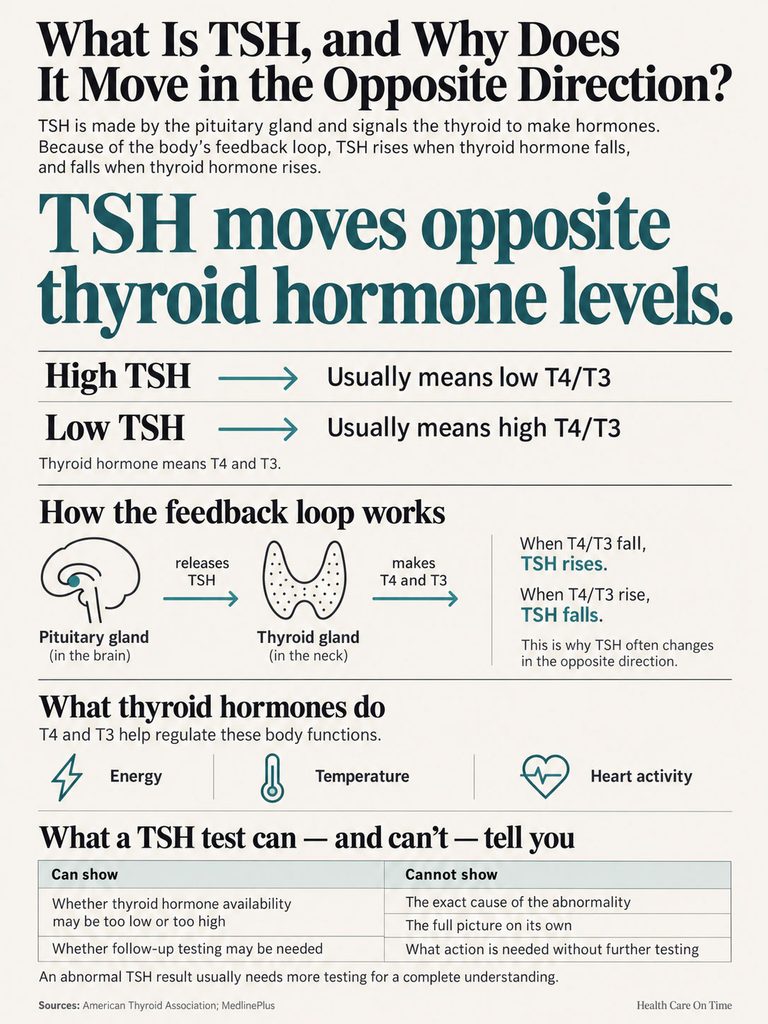
The thyroid makes thyroxine, called T4, and triiodothyronine, called T3. These hormones influence energy use, temperature regulation, heart activity, and other functions.
Understanding the Feedback Loop
When circulating thyroid hormone falls, the pituitary usually sends a stronger signal. TSH rises to encourage more production.
When thyroid hormone rises, the pituitary usually reduces its signal. TSH falls because less stimulation is needed.
The American Thyroid Association’s thyroid function testing guide explains this feedback relationship. It accounts for the seemingly backward connection between high TSH and an underactive thyroid.
For a simple comparison, think of TSH as the request for production, rather than the finished product. A louder request can mean the thyroid isn’t supplying enough hormone.
What the Test Can and Cannot Tell You
TSH testing helps assess thyroid function and monitor treatment. An abnormal result alone doesn’t identify the cause.
It also doesn’t provide a medication dose, establish how long a problem has existed, or measure every aspect of thyroid health.
MedlinePlus’s TSH test resource describes why additional blood tests may follow an abnormal result.
Keep the questions separate: Is hormone availability abnormal? What is causing it? What action is appropriate? Your TSH number helps answer the first question, but usually cannot answer all three by itself.
High, Low, and Normal TSH Results at a Glance
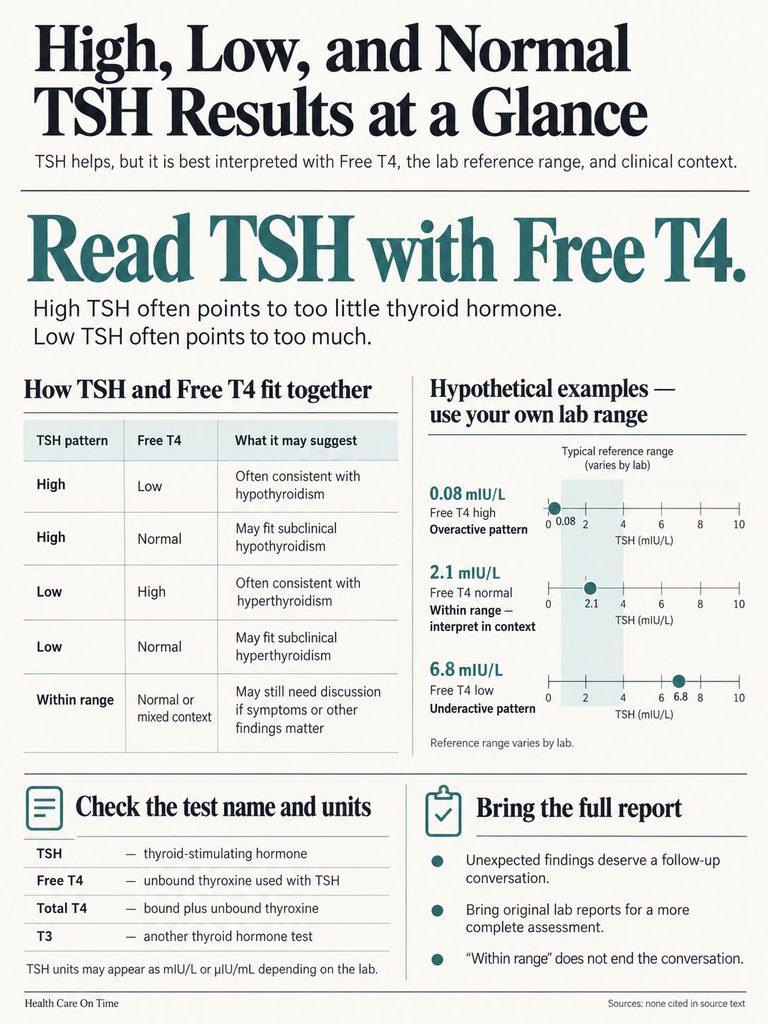
Free T4 measures the portion of T4 circulating without attachment to transport proteins. Reading it alongside TSH makes several important patterns easier to recognize.
Compare TSH With Thyroid Hormone Levels
The values below are hypothetical examples, not universal cutoffs. They assume a nonpregnant adult laboratory using a TSH interval of 0.4-4.5 mIU/L.
| Result pattern | Example TSH | Thyroid hormone finding | Possible interpretation | Discussion to have |
| Within the assumed interval | 2.0 mIU/L | Free T4 within range | Thyroid function may be normal | Review why testing was ordered and any symptoms |
| Mildly elevated TSH | 5.5 mIU/L | Free T4 within range | Possible subclinical hypothyroidism | Ask whether the finding persists and needs treatment |
| Elevated TSH | 12.0 mIU/L | Free T4 below range | Pattern consistent with overt primary hypothyroidism | Discuss cause, treatment, and monitoring |
| Low TSH | 0.2 mIU/L | Free T4 and T3 within range | Possible subclinical hyperthyroidism or another explanation | Review medications, persistence, and risk factors |
| Markedly suppressed TSH | 0.05 mIU/L | Free T4 and/or T3 elevated | Thyroid hormone excess | Evaluate the cause and treatment needs |
| Unexpected TSH response | 0.3 or 2.0 mIU/L | Free T4 below range | Possible central hypothyroidism, illness, or interference | Request assessment beyond TSH alone |
UCLA Health’s TSH testing guide explains how TSH, T4, and T3 contribute different information.
An apparently normal TSH can be unexpected when free T4 is low. A healthy pituitary would usually increase its signal in response to inadequate thyroid hormone.
That exception is one reason the phrase “within range” shouldn’t end the conversation when other findings don’t fit.
Check the Units and Test Names
TSH commonly appears in mIU/L, meaning milli-international units per liter. Some reports use micro-international units per milliliter, written as µIU/mL.
These units are numerically equivalent: 1 mIU/L equals 1 µIU/mL. Changing the unit label doesn’t change the number’s meaning.
TSH, free T4, total T4, and T3 are different tests. Before comparing reports, check the test name, unit, collection date, and laboratory interval.
Our comparison table is a reading aid. Bring the original reports to your clinician so the full results remain visible.
What Is a Normal TSH Level?
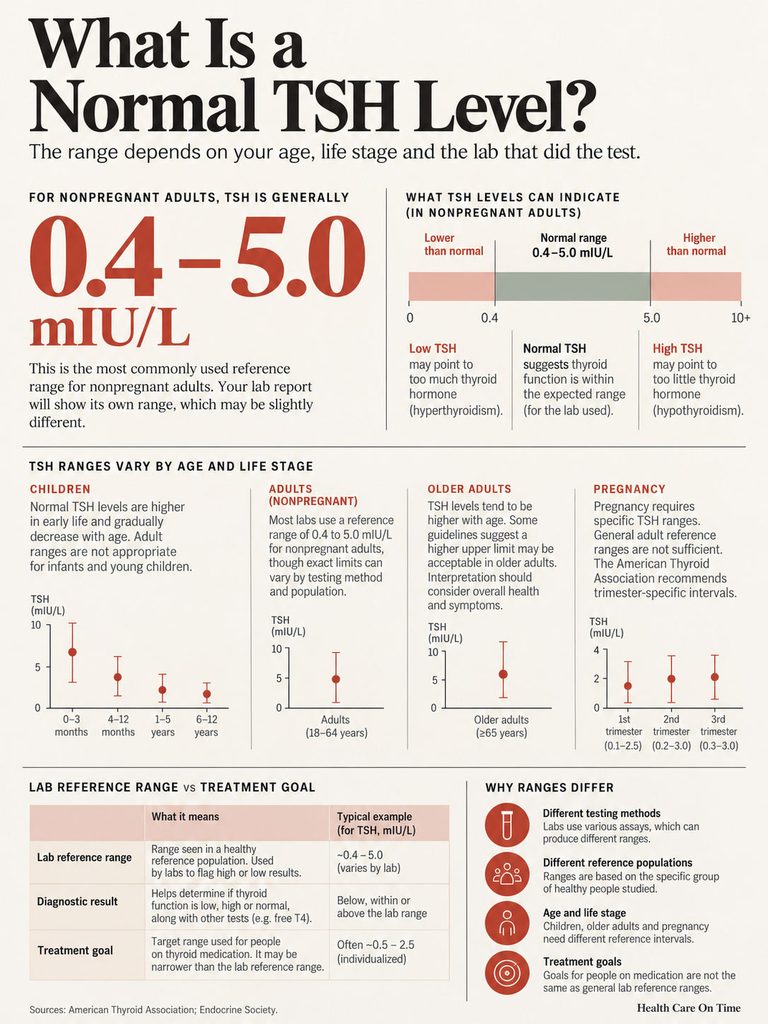
Many published nonpregnant adult intervals fall approximately between 0.4 and 5.0 mIU/L. That description is a starting point, not a universal definition of normal.
Why Your Report May Differ From an Online Chart
MedlinePlus lists 0.4-4.8 µU/mL, while UCLA Health lists 0.5-5.0 mIU/L. Testing methods and reference populations can differ.
Imagine a TSH of 4.7. A website using an upper limit of 4.0 labels it high; a laboratory using 4.8 may not flag it.
The practical answer is to use your report’s interval and ask whether your circumstances require a different interpretation. Repeatedly searching for a preferred online range won’t resolve that question.
How Age Changes Interpretation
Children need age-specific intervals. A general adult range should not be used for an infant or child.
Some laboratories also allow a higher upper TSH limit in older adults. A small elevation therefore doesn’t mean exactly the same thing in every age group.
Cleveland Clinic’s TSH overview illustrates age-related differences. Your clinician also considers symptoms, other results, and treatment risks.
Pregnancy Requires Its Own Interpretation
The American Thyroid Association’s pregnancy guidelines, updated in 2026, favor laboratory and trimester-specific intervals when available.
If appropriate intervals aren’t available, clinicians can use alternative approaches while recognizing their limitations. A general adult chart isn’t enough to make the decision.
A TSH of 2.5 mIU/L is not a universal diagnostic cutoff for pregnancy. A target used when treating an established condition answers a different question.
Reference Intervals and Treatment Targets Are Different
A reference interval helps classify a laboratory result. A treatment target guides care for someone with a particular diagnosis or treatment history.
For example, selected thyroid cancer patients may intentionally have TSH maintained below a general reference interval. That requires a specialist’s plan.
At HealthCareOnTime, our range discussion keeps these concepts separate. Ask whether the number being discussed is a diagnostic boundary, a laboratory flag, or your individual treatment goal.
What Do High TSH Levels Mean?
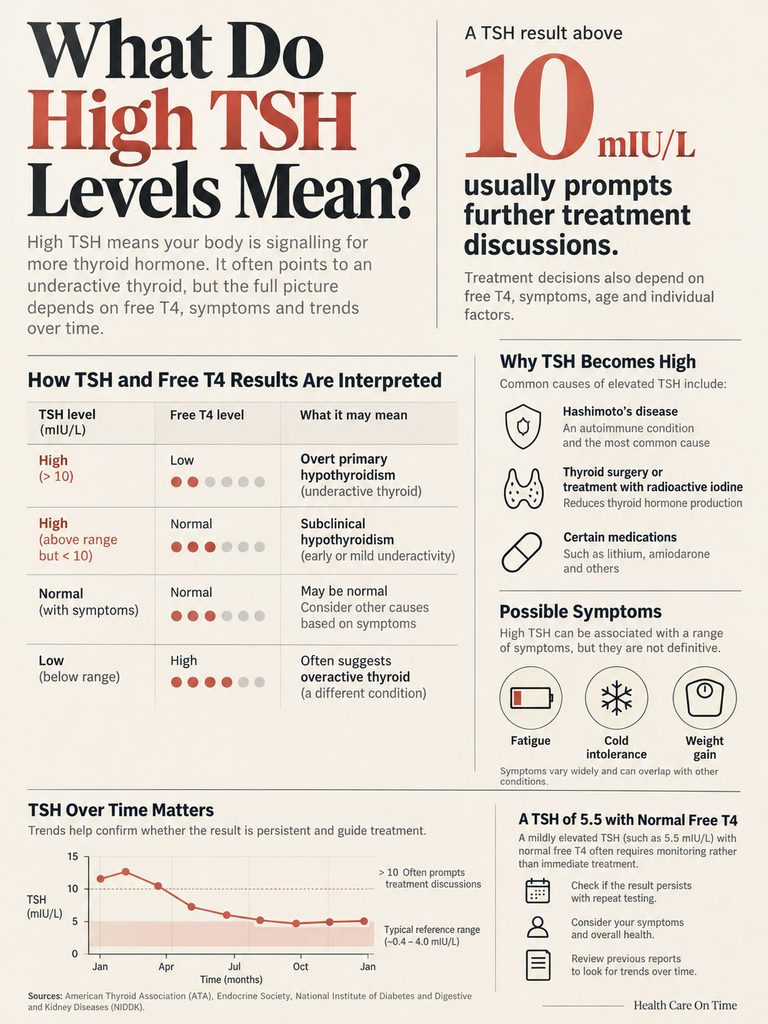
High TSH levels often mean the pituitary is increasing its request for thyroid hormone. Free T4 helps show whether the thyroid’s supply has fallen below range.
High TSH With Low Free T4
Elevated TSH with low free T4 is the typical pattern of overt primary hypothyroidism. “Primary” means the problem originates in the thyroid gland.
The American Thyroid Association’s adult hypothyroidism resource describes TSH and free T4 as the main diagnostic blood tests.
A confirmed finding leads to a discussion of cause and treatment. The result doesn’t specify the medication dose or establish that every symptom is thyroid-related.
High TSH With Normal Free T4
This pattern may indicate subclinical hypothyroidism. The term describes laboratory findings, not a guarantee that you have no symptoms.
Some people are monitored. Others may benefit from treatment after considering the degree of elevation, persistence, symptoms, antibodies, and personal circumstances.
The American Thyroid Association’s Hashimoto’s guidance explains why a mildly elevated TSH doesn’t automatically require medication.
What a TSH Above 10 Means
A result above 10 mIU/L generally warrants a more direct treatment discussion than a minor elevation. It still needs interpretation with free T4 and clinical context.
The US Preventive Services Task Force’s thyroid discussion identifies this as an important clinical threshold while noting uncertainty around milder abnormalities.
Don’t treat 10 as an emergency dividing line. A person with TSH of 12 may need timely outpatient care, while someone with a different number and severe symptoms may need urgent assessment.
Common Causes and Symptoms
Hashimoto’s disease is a common cause of hypothyroidism. Other causes include thyroid surgery, radioactive iodine treatment, thyroiditis, and certain medicines.
Possible symptoms include fatigue, cold intolerance, constipation, dry skin, and weight gain. These symptoms also occur for other reasons.
NIDDK’s hypothyroidism guide explains why symptoms alone cannot establish the diagnosis.
Example: TSH 5.5 With Normal Free T4
Consider a hypothetical nonpregnant adult whose TSH is 5.5 and whose laboratory upper limit is 4.5. Free T4 remains normal.
The useful questions are whether this pattern persists, whether there are relevant symptoms, and whether other findings change the treatment decision.
Bring previous reports and a timeline. Our examples help prepare that conversation; they don’t turn one number into a personal diagnosis.
What Do Low TSH Levels Mean?
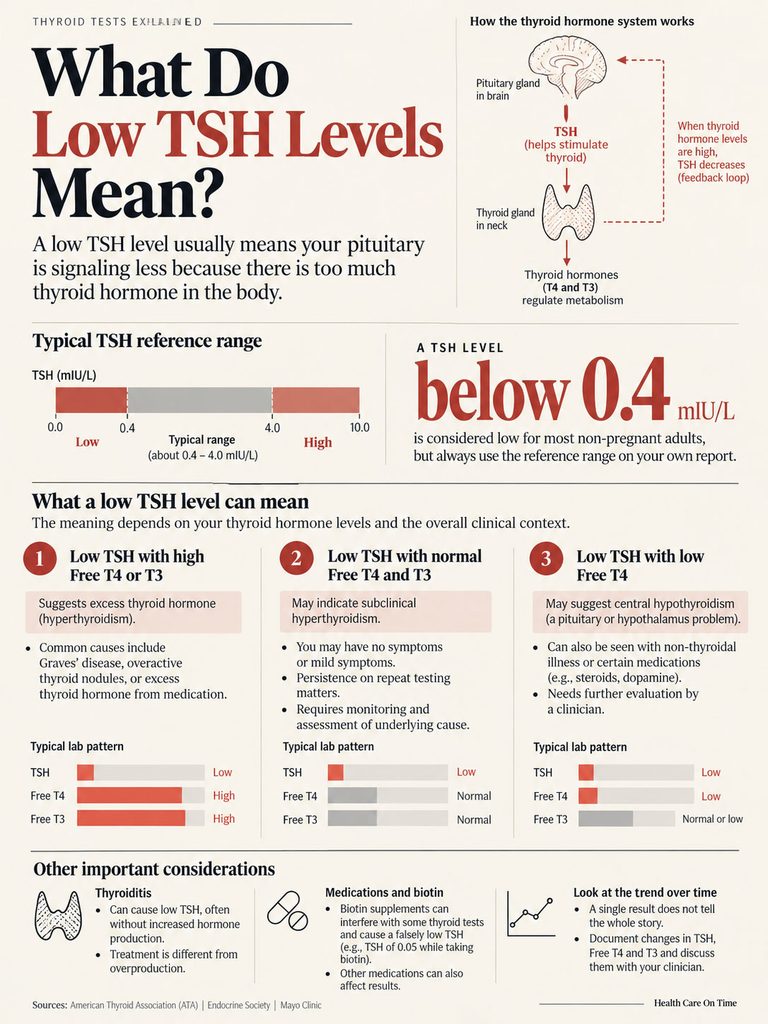
Low TSH levels often reflect reduced pituitary signaling in response to excess thyroid hormone. However, the cause and accompanying hormone levels matter.
Low TSH With Elevated Free T4 or T3
This pattern indicates thyroid hormone excess. Causes can include Graves’ disease, overactive nodules, thyroiditis, or excessive thyroid hormone replacement.
The American Thyroid Association’s hyperthyroidism guide explains why identifying the cause helps determine treatment.
Symptoms can include palpitations, shakiness, heat intolerance, sleep difficulty, and unexplained weight loss. Fatigue can occur too, so feeling tired doesn’t distinguish the two thyroid directions.
Low TSH With Normal Thyroid Hormone
Low TSH with free T4 and T3 within range may represent subclinical hyperthyroidism. A clinician considers whether the abnormality persists and whether another explanation exists.
The degree of suppression matters. TSH of 0.25 and TSH of 0.02 may lead to different discussions.
The ATA hyperthyroidism guidelines pay particular attention to persistent TSH below 0.1 mIU/L, especially in adults age 65 or older and people with relevant heart or bone risks.
Low TSH With Low Free T4
This combination doesn’t fit the usual overactive-thyroid pattern. It can suggest central hypothyroidism involving the pituitary or hypothalamus.
Illness and medication effects can also complicate interpretation. TSH alone cannot sort out those possibilities.
UCLA Health identifies pituitary dysfunction as an exception to the usual low-TSH explanation.
Why Thyroiditis Can Change Direction
Thyroiditis can release stored hormone from an inflamed gland without increased hormone production. Some forms later produce an underactive phase.
The American Thyroid Association’s thyroiditis guide explains why treatment differs from conditions where the thyroid actively overproduces hormone.
If your results move from low TSH toward high TSH over time, show the sequence to your clinician. Dates make the pattern more informative than scattered screenshots.
Example: TSH 0.05 While Taking Biotin
Imagine a person with TSH of 0.05 who takes a hair-and-nail supplement. The result could reflect genuine thyroid hormone excess, laboratory interference, or another explanation.
The supplement doesn’t prove the result is false. Its exact dose, free T4/T3 findings, symptoms, and medication history help guide assessment.
At HealthCareOnTime, our low-TSH examples focus on those missing pieces. Ask what evidence supports the interpretation before assuming a particular diagnosis.
Why Thyroid Results Deserve Follow-Up
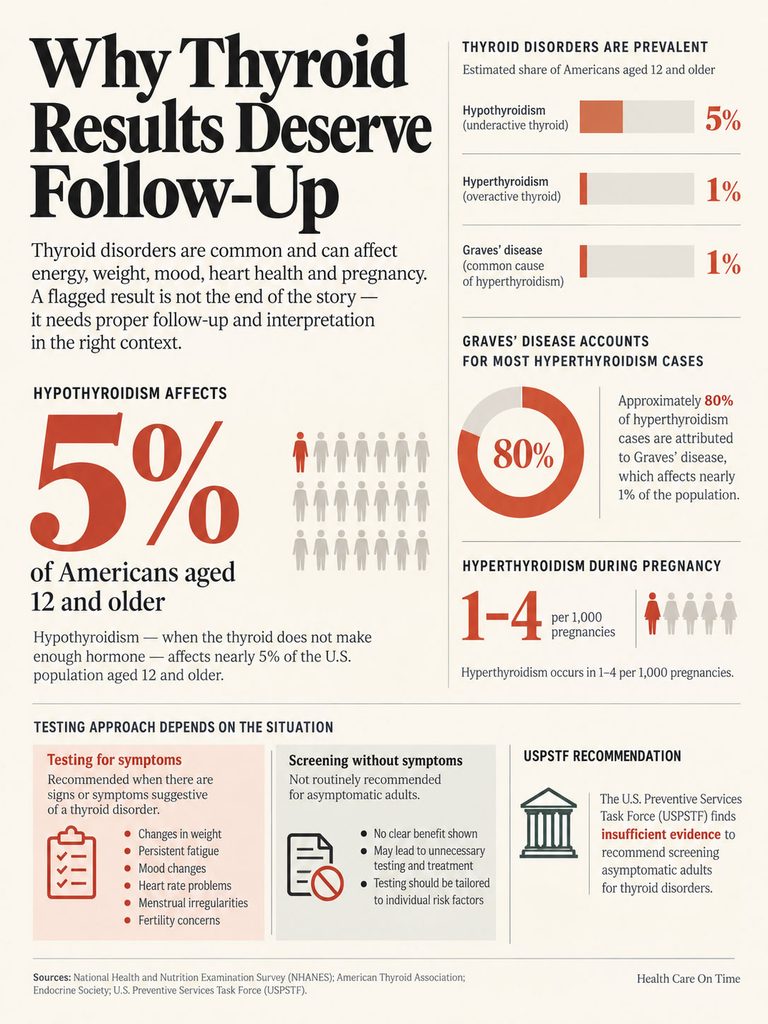
Thyroid disorders are common enough to deserve attention. Population statistics provide context, but they cannot establish what caused your result.
Published US Thyroid Statistics
| Measure | Published estimate | Population or denominator | Source |
| Hypothyroidism | Nearly 5 in 100 | Americans age 12 and older | NIDDK: Hypothyroidism |
| Hyperthyroidism | About 1 in 100 | Americans age 12 and older | NIDDK: Hyperthyroidism |
| Graves’ disease | Nearly 1 in 100 | Americans | NIDDK: Graves’ Disease |
| Hyperthyroidism attributed to Graves’ disease | About 4 in 5 cases | US hyperthyroidism cases | NIDDK: Graves’ Disease |
| Hyperthyroidism during pregnancy | 1-4 per 1,000 pregnancies | US pregnancies | NIDDK: Thyroid Disease and Pregnancy |
These are currently published estimates, not newly collected annual rates. Their underlying evidence dates vary. The rows also use different populations and definitions, so they should not be added together.
“Nearly 1 in 100 people” describes population frequency. “About 4 in 5 cases” describes the share of an already diagnosed condition attributed to one cause.
Our statistics table keeps those denominators visible. Otherwise, an accurate number can still leave the wrong impression.
Testing Symptoms Differs From Screening Everyone
Testing someone with symptoms or a known condition differs from screening every adult without symptoms.
The USPSTF recommendation finds insufficient evidence to determine the balance of benefits and harms of screening nonpregnant, asymptomatic adults.
That finding doesn’t mean you should ignore an abnormal report. It means testing decisions should match the clinical question.
Does Every Abnormal TSH Result Need Treatment?
No. Treating confirmed overt disease and treating a mild laboratory abnormality are different decisions.
What Research Says About Mild Elevations
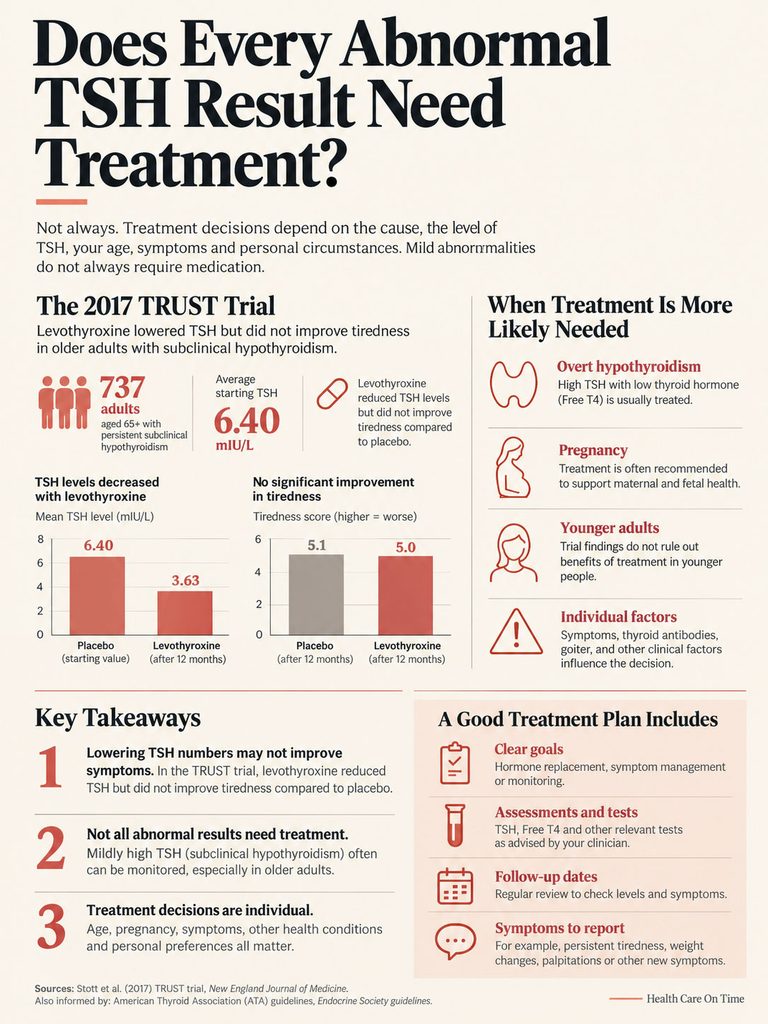
The 2017 TRUST randomized trial included 737 adults age 65 or older with persistent subclinical hypothyroidism.
Levothyroxine lowered TSH, but it didn’t improve the primary symptom and tiredness outcomes compared with placebo at one year. The average starting TSH was 6.40 mIU/L.
This was a European trial with US research participation, not a US prevalence study. Its findings don’t establish that treatment never helps younger adults, pregnant patients, or people with overt hypothyroidism.
The practical lesson is that improving a laboratory number doesn’t automatically improve every symptom. Ask what benefit treatment is expected to provide in your situation.
Agree on the Goal Before Starting
Ask whether the goal is replacing deficient hormone, reducing confirmed hormone excess, managing symptoms, or monitoring a borderline finding.
Also ask how the plan will be assessed. A useful plan identifies the tests, expected follow-up date, symptom changes to report, and circumstances that would alter the approach.
At HealthCareOnTime, our treatment discussion emphasizes that shared understanding. “We’ll monitor it” should come with a schedule and a reason, just as a prescription should.
What Can Affect Your TSH Test Results?
An unexpected result deserves a review of medications, supplements, illness, and testing conditions. These details may explain the result or show why confirmation is needed.
Biotin and Laboratory Interference
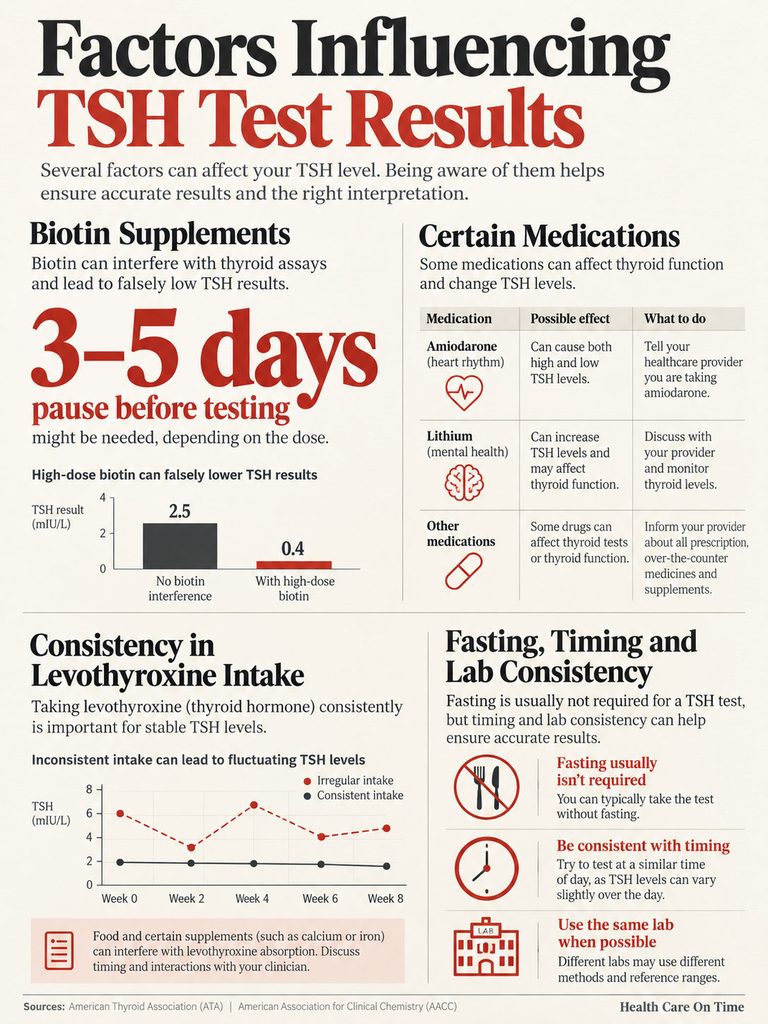
Biotin, or vitamin B7, is found in many hair-and-nail supplements. It can interfere with some assays and produce misleading thyroid results.
An ATA discussion of biotin research describes interference with 10,000 mcg daily and discusses a 3-5-day supplement pause before testing.
That isn’t a universal instruction for every patient. Dose, timing, and laboratory method matter, so obtain specific directions from your clinician or laboratory.
Photograph the ingredient panel. The product name alone may not show whether it contains biotin or how much you’re taking.
Medications and Recent Illness
Amiodarone, lithium, glucocorticoids, and thyroid medications can affect thyroid function or interpretation. Serious illness can also alter the pattern.
MedlinePlus’s preparation advice recommends discussing medicines with your provider rather than stopping them independently.
Mention recent hospitalization and iodine-containing contrast used during imaging. Include over-the-counter products alongside prescriptions.
How You Take Levothyroxine
Food, calcium, iron, and other products can affect levothyroxine absorption. Consistency matters when interpreting follow-up results.
The ATA thyroid hormone treatment guide discusses administration and interactions.
Explain missed doses and routine changes honestly. A clinician needs to know what you actually take, not only what the prescription label says.
For example, a new morning calcium supplement is relevant information. Ask your clinician or pharmacist how to separate products rather than changing your prescription dose yourself.
Fasting and Collection Time
TSH testing alone generally doesn’t require fasting, although other tests collected at the same visit may. TSH can vary during the day.
Ask whether a similar collection time and the same laboratory would help with comparisons. Also ask about thyroid medication timing before the sample.
Our preparation checklist focuses on getting those instructions before your visit. Write them down so the next test doesn’t introduce avoidable uncertainty.
What Should You Do After an Abnormal Result?
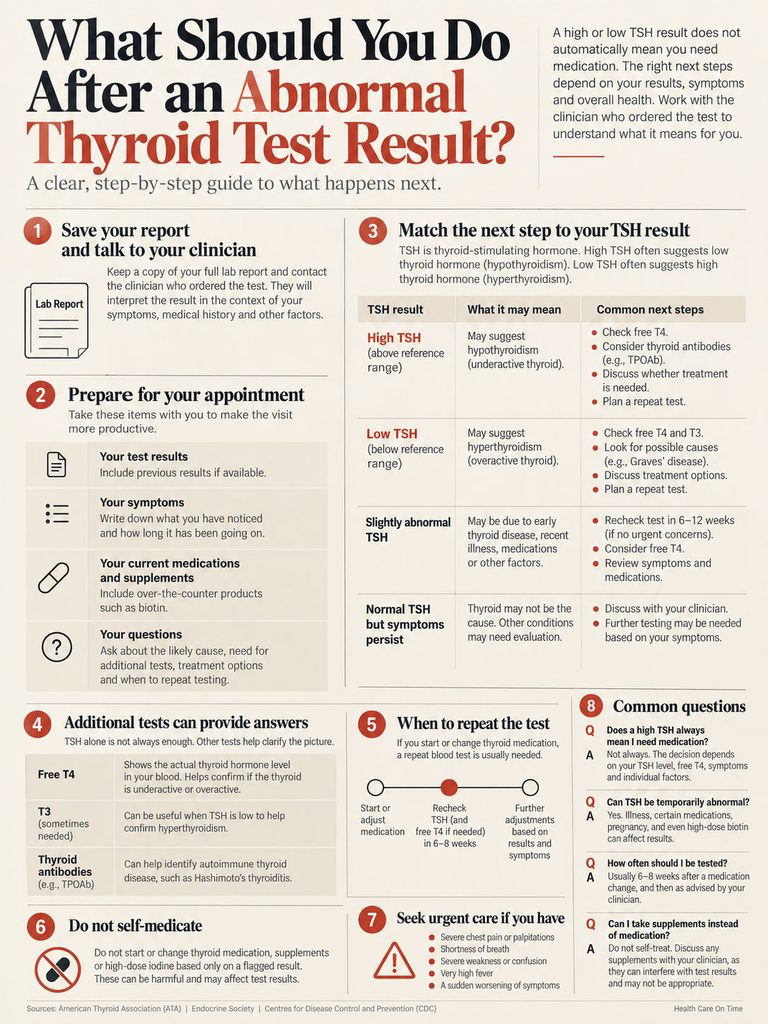
Save the complete report, then contact the clinician who ordered the test. An isolated portal flag doesn’t provide a follow-up plan.
Your Appointment Checklist
- Record the TSH value, unit, and laboratory interval.
- Find free T4 or T3 results from the same collection.
- Gather earlier reports with their dates.
- List symptoms and when they began.
- List medications, supplements, and recent changes.
- Mention pregnancy, pregnancy plans, or recent delivery.
- Confirm who reviews the results and when you’ll hear back.
If you’re writing a portal message, keep it specific: provide the result, any accompanying tests, current symptoms, and the question you need answered.
For example: “The TSH result is 5.5 and free T4 is within range. What follow-up do you recommend, and when should it happen?” Add relevant symptoms rather than assuming they share one cause.
Match the Action to the Situation
| Scenario | Specific finding | Recommended action | Timing or context |
| Mild elevation | Example: TSH 5.5 mIU/L with normal free T4 | Discuss persistence, symptoms, and repeat testing | Clinician sets the interval |
| More substantial elevation | TSH above 10 mIU/L | Review free T4, cause, and treatment considerations | Arrange timely clinician review |
| Marked suppression | TSH below 0.1 mIU/L | Review free T4/T3, medicines, and heart or bone risks | Timely review; symptoms affect urgency |
| Unexpected hormone pattern | Low free T4 with low or apparently normal TSH | Request assessment beyond TSH alone | Clinician evaluates possible central or other causes |
| Pregnancy | Flagged result at any gestational stage | Contact your obstetric or thyroid clinician | Prompt pregnancy-specific interpretation |
| Possible interference | Unexpected result while taking biotin, such as 10,000 mcg daily | Share the dose and obtain preparation or retesting instructions | Follow the laboratory’s specific plan |
| Medication adjustment | Started or changed levothyroxine | Confirm the follow-up blood test | Often about 6-8 weeks; some situations need earlier checks |
| Severe symptoms | Chest pain, fainting, severe breathing difficulty, or fever with confusion and racing heartbeat | Seek emergency care | Call 911 in the United States |
No TSH value in this table automatically establishes an emergency. Symptoms and the overall clinical situation determine urgency.
What Additional Tests May Clarify
Free T4 helps classify an abnormal TSH pattern. T3 may help when hyperthyroidism is suspected, including when free T4 remains normal.
Thyroid antibodies can help identify autoimmune causes. NIDDK’s thyroid testing guide explains these roles.
Ask what each test will answer. More tests aren’t automatically more useful; the purpose is to resolve the uncertainty relevant to your care.
Confirm the Repeat-Test Schedule
After starting or changing levothyroxine, the ATA adult hypothyroidism guide describes blood testing at approximately 6-8 weeks. Some circumstances require closer monitoring.
An untreated borderline result may use a different interval. Pregnancy, symptoms, and abnormal free T4 can alter the schedule.
Before leaving, confirm the date, tests ordered, and person responsible for reviewing them. Ask what should trigger an earlier call.
Avoid Trying to Fix the Number Yourself
Don’t buy a thyroid supplement or change medication because a result was flagged. Excess iodine and excessive thyroid hormone can create problems.
Weight changes also need realistic interpretation. The ATA thyroid and weight guide explains that thyroid function is only one influence on weight.
For many patients with hypothyroidism, it describes roughly 5-10 pounds of thyroid-related weight gain, with individual variation. Treatment shouldn’t be presented as a promise of major weight loss.
Know When Symptoms Need Emergency Care
Call 911 for severe chest pain, fainting, or serious breathing difficulty. Fever with marked confusion and a racing heartbeat can also require emergency assessment.
MedlinePlus describes thyroid storm as a rare, life-threatening emergency associated with uncontrolled thyroid hormone excess.
For worsening symptoms that aren’t an emergency, contact your clinician rather than waiting silently for the next laboratory appointment. Explain what changed and when.
Frequently Asked Questions
What Does a High TSH Test Result Mean?
High TSH often means the pituitary is asking an underactive thyroid to produce more hormone. Low free T4 supports overt primary hypothyroidism; normal free T4 may indicate a subclinical pattern. Your clinician also reviews symptoms, medications, the laboratory interval, and whether the finding persists before deciding on treatment.
What Does a Low TSH Test Result Mean?
Low TSH often suggests thyroid hormone excess, but it doesn’t establish the cause. Free T4 and sometimes T3 clarify the pattern. Thyroid medication, supplements, illness, pregnancy, and pituitary conditions can change interpretation. Ask what the accompanying tests show before assuming you have an overactive thyroid.
What Is a Normal TSH Level for Adults?
Many published nonpregnant adult intervals fall approximately between 0.4 and 5.0 mIU/L, but laboratories differ. Use the interval printed on your report. Your clinician may interpret the result differently because of age, pregnancy, pituitary disease, or treatment history. A treatment target isn’t necessarily the laboratory’s diagnostic boundary.
Is a TSH Level of 5 High?
It depends on your laboratory’s interval. A result of 5.0 exceeds an upper limit of 4.5 but sits at the boundary of a range ending at 5.0. Free T4 and personal circumstances help determine follow-up. The number alone doesn’t establish a diagnosis or specify a medication dose.
What Does a TSH Level Above 10 Mean?
A result above 10 mIU/L generally deserves timely discussion about hypothyroidism and treatment considerations. Free T4 helps classify the pattern. Your clinician reviews symptoms, persistence, age, and pregnancy-related circumstances. The value isn’t automatically an emergency, and it doesn’t tell you which medication dose would be appropriate.
What Does High TSH With Normal Free T4 Mean?
This combination may indicate subclinical hypothyroidism. The term describes laboratory findings rather than symptom severity. Some people are monitored, while others may be treated. Repeat results, symptoms, thyroid antibodies, age, and pregnancy-related considerations help guide the decision. Ask what findings would change the plan for you.
Can Low TSH Mean an Underactive Thyroid?
Yes. Low or inappropriately normal TSH with low free T4 can suggest central hypothyroidism involving the pituitary or hypothalamus. Illness and medications can provide other explanations. This exception is why low TSH shouldn’t automatically be labeled hyperthyroidism without reviewing accompanying hormone levels and the clinical situation.
Can You Have Thyroid Symptoms With Normal TSH?
Yes, symptoms associated with thyroid disease can occur with normal TSH because fatigue, constipation, anxiety, and weight changes have many causes. A normal result makes several common thyroid disorders less likely, but persistent symptoms still deserve assessment. Your clinician decides whether additional thyroid testing or a different evaluation is useful.
Do You Need to Fast Before a TSH Blood Test?
TSH testing alone generally doesn’t require fasting. Other tests collected during the same appointment may have different instructions. Ask about fasting, supplements, and medication timing before your visit. Don’t stop prescribed treatment independently. Written preparation instructions make it easier to follow the same approach at your next test.
Can Biotin Affect TSH Test Results?
Yes. Biotin can interfere with some laboratory methods and produce misleading thyroid results. The effect depends on dose, timing, and the assay. Give your clinician and laboratory the exact amount you take. Follow their directions about pausing supplements or repeating testing rather than choosing a universal interval yourself.
When Should You Repeat an Abnormal TSH Test?
There’s no single schedule for every abnormality. Follow-up after a levothyroxine adjustment often occurs around 6-8 weeks, while an untreated borderline result may use another interval. Pregnancy, abnormal free T4, marked suppression, and worsening symptoms can require earlier assessment. Confirm the date and who will review the result.
How Are TSH Results Interpreted During Pregnancy?
Pregnancy results should use laboratory and trimester-specific intervals when available. Treatment targets can differ from diagnostic reference limits, particularly if you already take levothyroxine. The updated ATA guidance supports individualized assessment. Contact your obstetric or thyroid clinician about a flagged result rather than applying a general adult chart.
Medical Disclaimer: This HealthCareOnTime article provides general education and doesn’t diagnose thyroid disease or replace individualized care. Reference intervals, hypothetical examples, and follow-up descriptions cannot determine your treatment. Ask a licensed clinician to interpret TSH test results alongside other findings, symptoms, pregnancy status, medications, and medical history. Don’t start, stop, or adjust prescribed thyroid medication based on this article. Preparation instructions may differ by laboratory method and supplement dose. Seek emergency care for severe chest pain, fainting, serious breathing difficulty, or marked confusion with fever and a racing heartbeat. In the United States, call 911.
References
- MedlinePlus: TSH Test
- MedlinePlus: TSH Medical Encyclopedia
- Cleveland Clinic: TSH Levels
- UCLA Health: TSH Test
- American Thyroid Association: Thyroid Function Tests
- American Thyroid Association: Adult Hypothyroidism
- American Thyroid Association: Hashimoto’s Thyroiditis
- American Thyroid Association: Hyperthyroidism
- American Thyroid Association: Thyroiditis
- American Thyroid Association: Thyroid Hormone Treatment
- American Thyroid Association: Biotin and Thyroid Testing
- American Thyroid Association: Thyroid and Weight
- American Thyroid Association: Hyperthyroidism Guidelines
- American Thyroid Association: Pregnancy and Postpartum Guidelines
- NIDDK: Thyroid Tests
- NIDDK: Hypothyroidism
- NIDDK: Hyperthyroidism
- NIDDK: Graves’ Disease
- NIDDK: Thyroid Disease and Pregnancy
- USPSTF: Thyroid Dysfunction Screening
- TRUST Trial: Thyroid Hormone Therapy for Older Adults
- MedlinePlus: Thyroid Storm