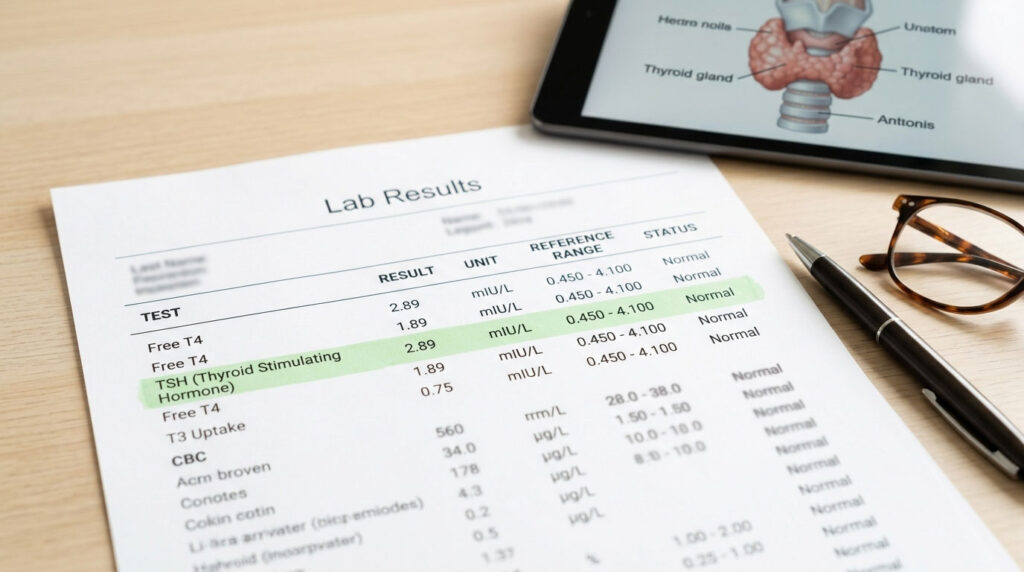
Your TSH result came back. The number sits there on the page, maybe flagged in red, and you have no idea whether it spells trouble or nothing at all. You’re not alone in that moment.
Table of Contents
Here’s the twist that confuses almost everyone: a high TSH usually means your thyroid is underactive, not overactive. The number runs backward from what your gut expects.
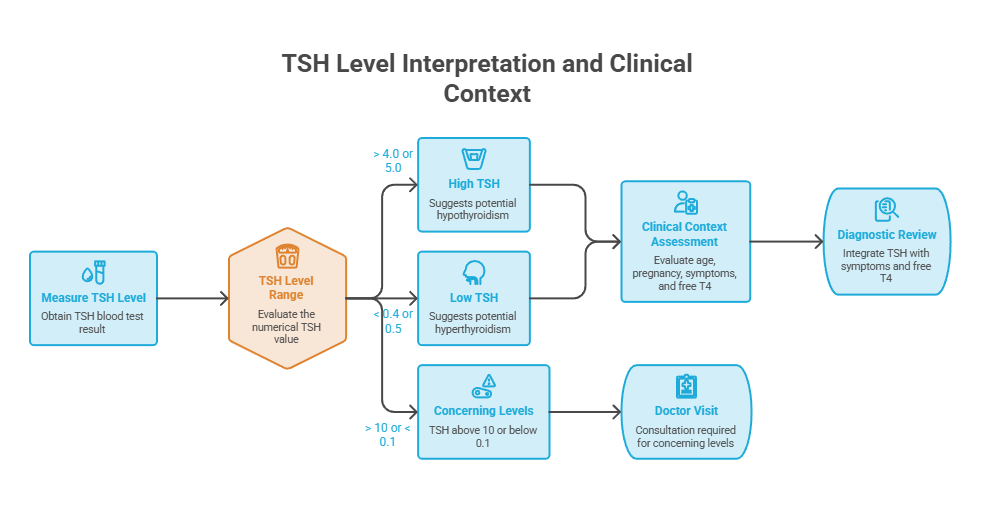
Quick Answer: For most adults, a normal TSH (thyroid-stimulating hormone) level falls between 0.4 and 4.0 mIU/L. A high TSH usually points to an underactive thyroid (hypothyroidism), while a low TSH points to an overactive thyroid (hyperthyroidism). The range shifts with age and pregnancy. A TSH above 10 or below 0.1, or one paired with strong symptoms, deserves prompt medical attention.
At a Glance
- The standard adult TSH range is about 0.4 to 4.0 mIU/L, though some labs use 0.5 to 5.0.
- High TSH suggests hypothyroidism; low TSH suggests hyperthyroidism.
- “Normal” rises with age, so a TSH of 5.0 can be fine at 80 but not at 25.
- Pregnancy lowers TSH, with tighter trimester-specific targets.
- A TSH above 10 or below 0.1 is more concerning and warrants a doctor’s visit.
- Roughly 20 million Americans have thyroid disease, and up to 60% don’t know it.
- TSH alone isn’t a diagnosis; doctors read it alongside symptoms and free T4.
Thyroid disease is quietly common in the United States. Across the lab results we process, abnormal thyroid numbers turn up far more often than most people expect, frequently in folks with no diagnosis.
This guide breaks down what your TSH number means, how it changes by age and pregnancy, what high and low results signal, and exactly when a result should send you to a doctor.
Most people who land here are not in danger. They’re trying to make sense of one line on a lab report, and that’s exactly what the next sections do, step by step.
What TSH Is and Why It Matters
TSH stands for thyroid-stimulating hormone. Despite the name, your thyroid doesn’t make it. Your pituitary gland, a pea-sized structure at the base of your brain, does.
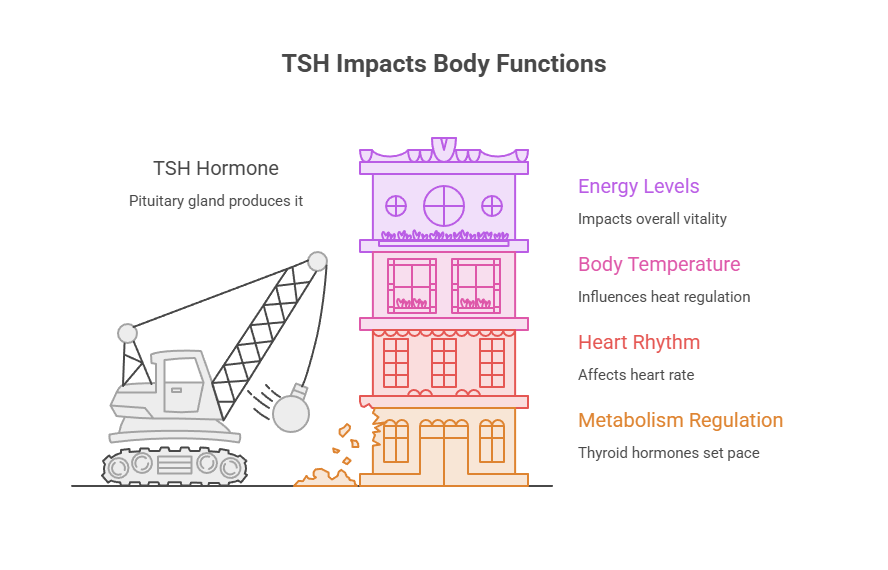
TSH is the messenger that tells your thyroid how hard to work. The thyroid then produces the hormones that set your metabolism, heart rate, body temperature, and energy.
That reach is why thyroid trouble touches so many parts of life, from your weight and mood to your heart rhythm. One small gland sets the pace for the whole body.
Patients booking a thyroid panel with HealthCareOnTime often ask why doctors test TSH first. The answer is sensitivity: TSH usually shifts before thyroid hormone levels do, which makes it an early warning sign.
That sensitivity cuts both ways. A mildly off TSH can appear before you feel anything, which is why routine screening catches so many quiet cases early.
How the Thyroid Feedback Loop Works
Think of your pituitary as a thermostat. It constantly checks how much thyroid hormone is circulating and adjusts its TSH signal to keep things steady.
When thyroid hormone runs low, the pituitary pumps out more TSH to push the thyroid harder. When thyroid hormone runs high, it dials TSH down.
This loop is why a single TSH value tells a clinician so much. It reflects how your brain reads your thyroid’s output in real time, not just a snapshot of one gland.
When the loop is working, TSH and thyroid hormone stay in balance. When it breaks, the TSH number is usually the first place that imbalance shows up on paper.
Why TSH Runs Opposite to Thyroid Hormones
Because TSH is a request for more hormone, the number moves in the opposite direction of the hormone itself. That inverse relationship trips up nearly everyone reading their own results.
A high TSH means the pituitary is shouting for more, which usually means the thyroid is sluggish. A low TSH means the pituitary has gone quiet, which usually means the thyroid is overproducing.
Our medical reviewers note that this is the single most common point of confusion patients raise. Keep the rule simple: high TSH, low thyroid; low TSH, high thyroid.
TSH Rarely Travels Alone
TSH is the screening test, but it’s not the whole story. When a result is off, clinicians usually add free T4, the active hormone, and sometimes T3 or thyroid antibodies.
Free T4 tells you whether the thyroid is actually keeping up, which separates true disease from a borderline number. That pairing is why a full thyroid panel beats a lone TSH for anything other than routine screening.
Antibody tests add another layer. Positive TPO antibodies suggest an autoimmune cause like Hashimoto’s, which helps your doctor predict whether a borderline number is likely to drift further.
Together these tests turn a single confusing number into a clear story. That fuller view is what lets your doctor choose between watchful waiting and starting treatment, instead of guessing from one value.
TSH Normal Range, and Why “Normal” Isn’t a Single Number
The number you really came for: for most adults, a normal TSH sits between 0.4 and 4.0 mIU/L, according to ranges the American Thyroid Association considers standard.
But “normal” is less fixed than the lab printout suggests. Different labs, different ages, and pregnancy all move the goalposts.
The Standard Adult Range
Most US labs treat roughly 0.4 to 4.0 mIU/L as the reference range for healthy adults. Some clinics and older references use 0.5 to 5.0 mIU/L instead.
There’s also a meaningful gap between “normal” and “optimal.” Many treated patients feel best with a TSH in the 1.0 to 2.5 range, even though values up to 4.0 are technically within reference.
That distinction explains why two people with the same number can feel very differently. Symptoms, not just the digits, guide good care.
If your number lands just outside the range, don’t panic. Borderline results are common, and a calm recheck usually clears up what a one-time reading cannot.
The table below shows how clinicians generally read a result. Use it as a map, not a verdict.
Table 1: What Your TSH Level Means
| Category | TSH (mIU/L) | What It Suggests | Typical Next Step |
| Low (overt) | Below 0.1 | Likely hyperthyroidism | Prompt evaluation, check free T4 and T3 |
| Low-normal | 0.1 to 0.4 | Possible mild or subclinical hyperthyroidism | Confirm with free T4, often recheck |
| Normal | 0.4 to 4.0 | Typical thyroid function | Routine; interpret with symptoms |
| High (subclinical) | 4.0 to 10 | Possible subclinical hypothyroidism | Recheck, test free T4 and TPO antibodies |
| High (overt) | Above 10 | Likely hypothyroidism | Treatment usually recommended |
Ranges are general guides; your lab’s reference values and your symptoms determine interpretation.
Why Labs Report Different Ranges
The lab analyzer matters. A common assay reports a normal range of about 0.27 to 4.2 µIU/mL, which is why your printout may not match a friend’s.
Supplements matter too. Biotin, found in many hair and nail products, can skew thyroid results on certain tests, sometimes producing a falsely low TSH.
Our lab partners report that the smartest move is consistency: compare tests run by the same lab, under similar conditions, and always read the reference range printed on your own report.
Switching labs mid-treatment is a common source of confusion. A number that looks like it jumped may simply reflect a different analyzer, not a real change in your thyroid.
TSH Normal Range by Age and During Pregnancy
A result that’s perfectly healthy at one age can be a red flag at another. The reference range generally rises as you get older.
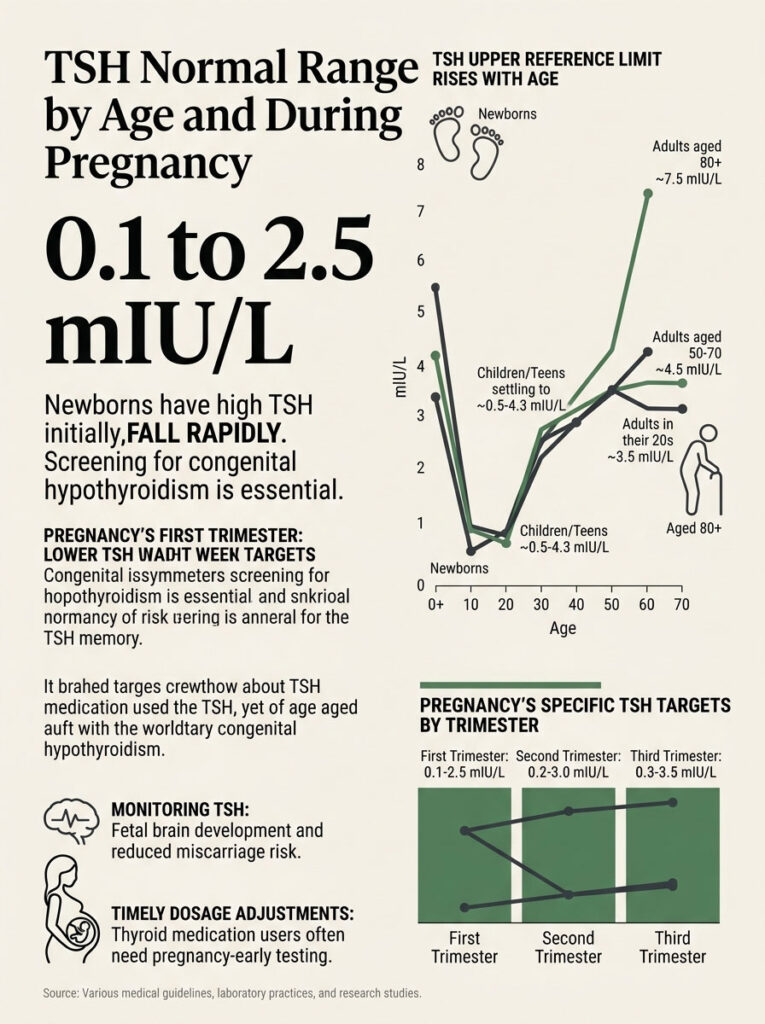
This is one of the biggest gaps in the typical thyroid article, and it leads to needless worry for older adults and missed cases in younger ones.
Newborns and Children
TSH runs high in the first days of life, then declines through childhood. Newborns are screened at birth in every US state, since untreated congenital hypothyroidism can affect development.
Through adolescence the range keeps dropping. By the late teens, it settles close to adult values, around 0.5 to 4.3 mIU/L.
For kids, pediatricians use age-specific charts rather than the adult range, so interpretation should always come from a clinician familiar with childhood norms.
Catching thyroid problems early in children matters because thyroid hormone shapes growth and brain development. That’s the reason newborn screening is universal across the country.
Adults and Older Adults
The upper limit climbs with age, which surprises many people. Analysis of the NHANES III database found the upper limit of normal was about 3.5 mIU/L for adults in their 20s, rising to 4.5 for those 50 to 70, and roughly 7.5 for people over 80.
That means a TSH of 5.0 in an 85-year-old can be entirely normal, while the same value in a 25-year-old may warrant a closer look. Across patients we serve, this age effect is one of the most overlooked details in thyroid interpretation.
Treating an older adult’s mildly high TSH down to a young-adult target can do more harm than good. Modern guidance leans toward age-appropriate goals.
This is also why a result should never be read against a generic cutoff alone. Your age, on the same lab report, changes what counts as concerning.
Pregnancy and Trimester-Specific Targets
Pregnancy changes thyroid physiology fast. Early-pregnancy hormones partly suppress TSH, so targets run lower than usual, especially in the first trimester.
The American Thyroid Association has used trimester-specific reference points of roughly 0.1 to 2.5 mIU/L in the first trimester, 0.2 to 3.0 in the second, and 0.3 to 3.5 in the third. Newer guidance favors population and trimester-specific ranges where available.
This matters because thyroid hormone drives fetal brain development before the baby’s own thyroid switches on. Untreated thyroid problems in pregnancy raise the risk of miscarriage and preterm delivery.
Women already on thyroid medication often need a dose increase soon after a positive pregnancy test. Early testing and close follow-up protect both parent and baby.
Table 2: TSH Normal Range by Age and Pregnancy
| Group | Approx. TSH Range (mIU/L) | Source / Note |
| Newborns (first weeks) | 1.0 to 39 (falls quickly) | Lab references; high then declining |
| Children to teens | 0.5 to 4.3 | NHANES-based estimates |
| Adults, 20s to 40s | 0.4 to 4.0 | ATA standard adult range |
| Adults, 50 to 70 | Up to about 4.5 | NHANES III upper limit |
| Adults, 80+ | Up to about 7.5 | NHANES III upper limit |
| Pregnancy, 1st trimester | 0.1 to 2.5 | American Thyroid Association |
| Pregnancy, 2nd trimester | 0.2 to 3.0 | American Thyroid Association |
| Pregnancy, 3rd trimester | 0.3 to 3.5 | American Thyroid Association |
Ranges vary by lab and assay. Always confirm against your own report and clinician guidance.
High TSH: What It Means and Symptoms
A high TSH usually signals hypothyroidism, an underactive thyroid that isn’t making enough hormone. The pituitary responds by raising TSH to compensate.
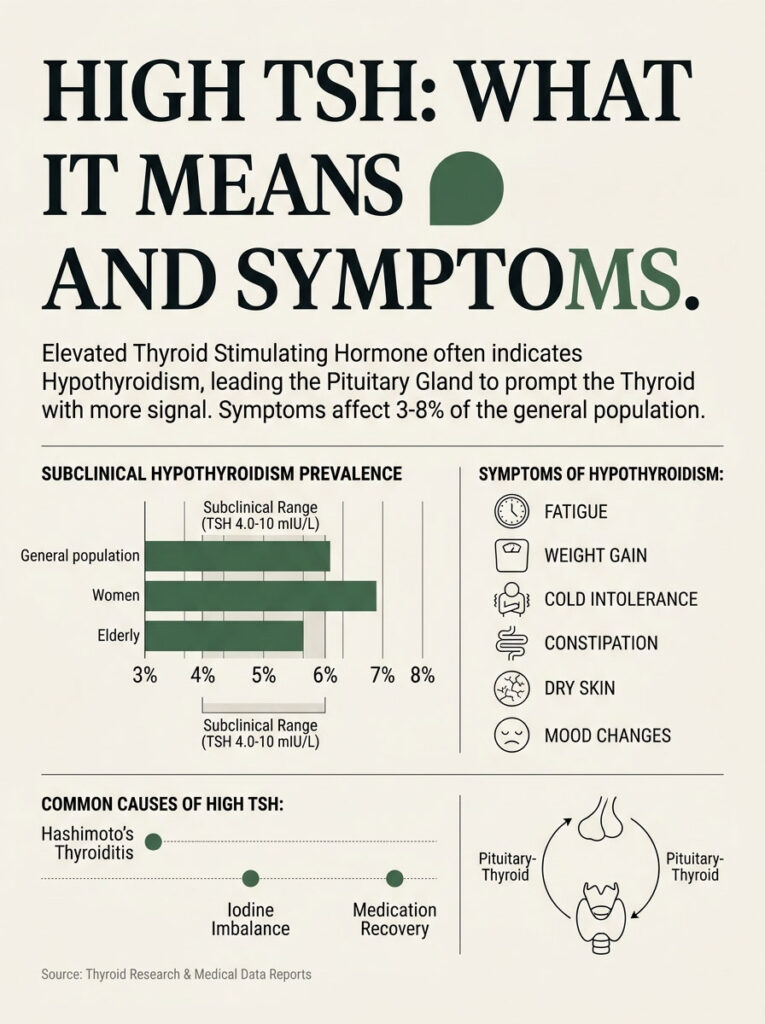
Hypothyroidism is the more common direction of thyroid trouble, and it often builds slowly. Many people chalk the early symptoms up to stress or aging.
That slow build is part of why it hides so well. By the time the fatigue feels constant, the thyroid may have been struggling for months.
Common Causes of High TSH
The leading cause in the US is Hashimoto’s thyroiditis, an autoimmune condition in which the immune system gradually damages the thyroid.
Other causes include iodine imbalance, certain medications such as lithium or amiodarone, recovery after thyroid surgery, and radioiodine treatment. A pituitary issue is a rarer cause.
In cases reviewed by our team, a high TSH paired with positive TPO antibodies often points toward Hashimoto’s, which is why follow-up antibody testing is so useful.
Timing and medication history help too. A high TSH shortly after starting a new drug, or after thyroid surgery, points the workup in a clear direction.
Symptoms of Hypothyroidism
When your metabolism slows, your whole body slows with it. Common signs include fatigue, unexplained weight gain, and feeling cold when others are comfortable.
You might notice constipation, dry skin, thinning or brittle hair, puffiness, and slowed thinking or low mood. Women may have heavier or irregular periods.
These symptoms are easy to dismiss one at a time. Patients commonly ask us whether their tiredness is “just life,” and sometimes a TSH test gives the real answer.
Severity tracks loosely with the number. A mildly high TSH may cause little, while a markedly high one tends to bring more noticeable, wide-ranging symptoms.
Subclinical Hypothyroidism
This is the gray zone: a TSH above the upper limit, often between 4.0 and 10, paired with a normal free T4. It affects an estimated 3 to 8% of the general population.
Whether to treat it is one of the most debated questions in thyroid medicine. The decision usually weighs the TSH level, symptoms, antibody status, age, and pregnancy plans.
Mild elevations in older adults with few symptoms are often simply monitored. A younger person with symptoms and antibodies may be treated sooner.
Pregnancy changes the math entirely. During pregnancy, even mild elevations are taken more seriously because of the stakes for fetal development.
Low TSH: What It Means and Symptoms
A low TSH usually signals hyperthyroidism, an overactive thyroid producing too much hormone. The pituitary senses the excess and goes quiet.
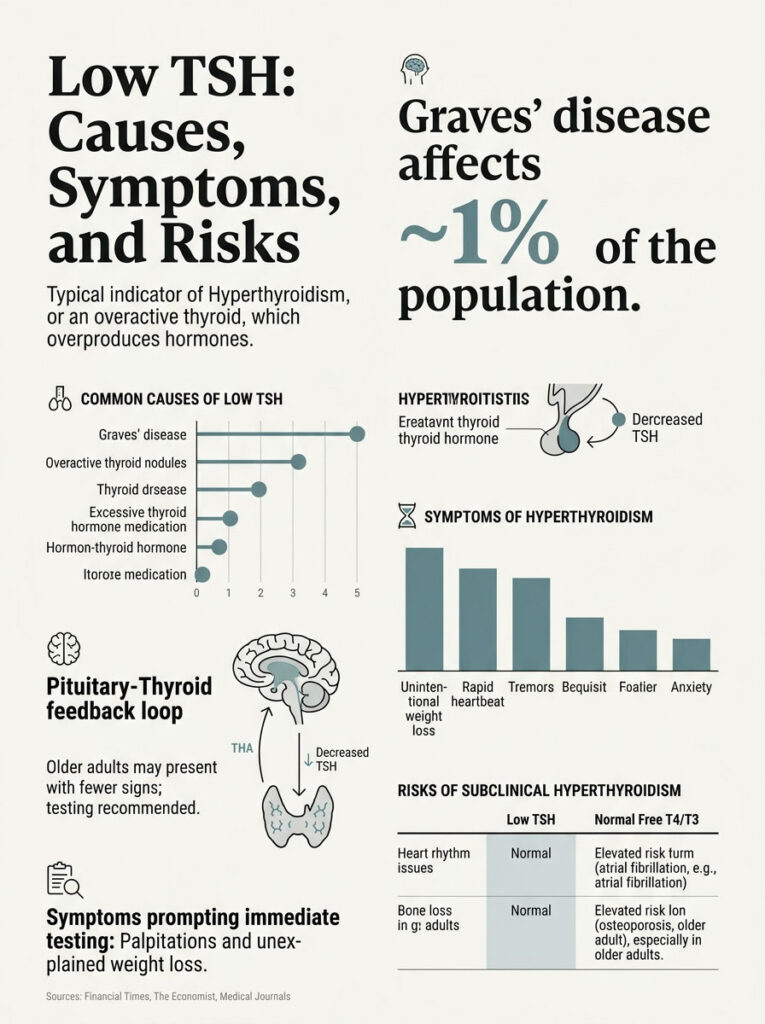
Hyperthyroidism is less common than hypothyroidism but can hit harder and faster, especially the heart.
Because the symptoms can mimic anxiety or ordinary stress, hyperthyroidism is sometimes missed at first. A low TSH on a routine panel is often the clue that reframes the whole picture.
Common Causes of Low TSH
The most common cause is Graves’ disease, an autoimmune disorder that drives the thyroid to overproduce. Graves’ affects roughly 1% of the population.
Other causes include overactive thyroid nodules, thyroiditis (inflammation), and taking too much thyroid hormone medication. Early or mild hyperthyroidism can show a low TSH with a still-normal free T4.
In tests reviewed across our network, an unexpectedly low TSH in someone on levothyroxine often signals an over-replacement dose rather than new disease, an easy fix once flagged.
Recent imaging contrast or certain supplements can also nudge the thyroid temporarily. A careful history usually sorts a passing dip from a lasting problem.
Symptoms of Hyperthyroidism
Speeding up is the theme. Common signs include unintentional weight loss, a rapid or irregular heartbeat, tremor in the hands, and feeling hot or sweaty.
You might also notice anxiety or irritability, trouble sleeping, more frequent bowel movements, and muscle weakness. Graves’ can cause eye irritation or bulging.
Our medical reviewers note that palpitations and unexplained weight loss are the symptoms that most often prompt a same-week test, and rightly so.
Older adults can show a quieter picture, sometimes just a racing or irregular heartbeat with few other clues. That makes testing especially worthwhile when the heart seems off.
Subclinical Hyperthyroidism and Its Risks
Here the TSH is low while free T4 and T3 remain normal. It can be mild, but it isn’t harmless to ignore.
Persistently low TSH levels may raise the risk of heart rhythm problems and bone loss, particularly in older adults. That makes monitoring and a clear plan important.
A low TSH with atrial fibrillation or osteoporosis raises the stakes, so these results are rarely left unwatched even when symptoms seem mild.
Bone density and heart rhythm checks sometimes accompany monitoring in this group. The goal is to catch any drift before it causes lasting harm.
Why Getting Tested Matters
Thyroid disease is widespread and often silent, which is exactly why a simple TSH test carries so much value. The numbers in the US are striking.
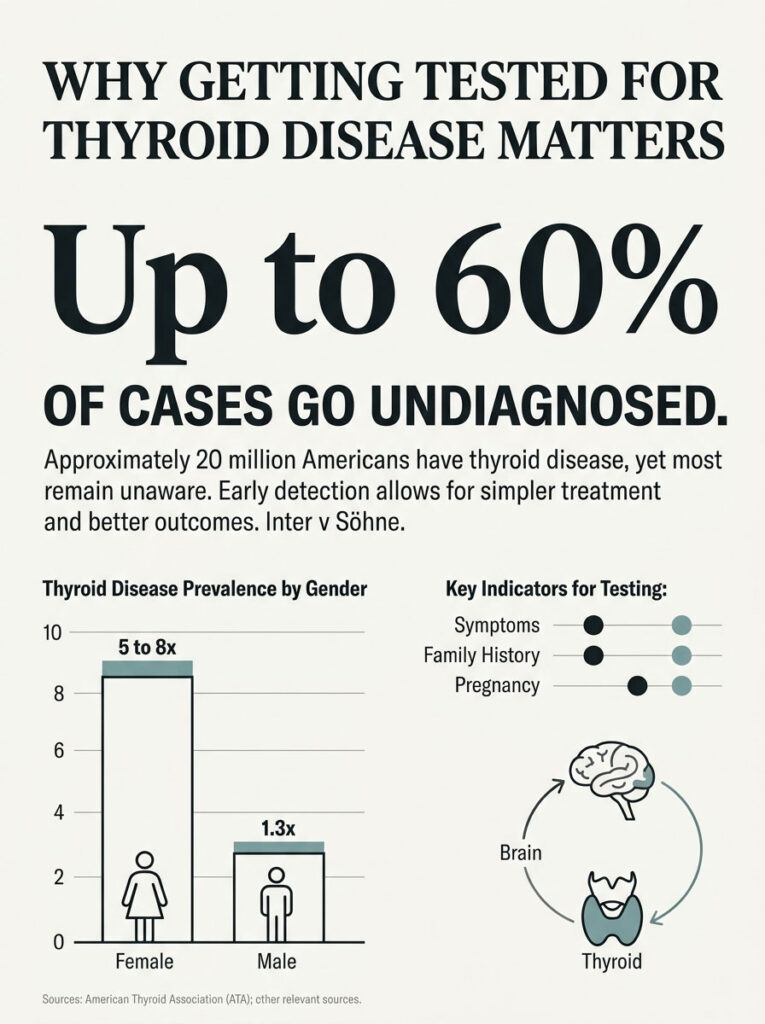
A large share of cases go undetected for years, and the consequences of untreated thyroid disease reach the heart, bones, fertility, and pregnancy.
The good news is that thyroid problems are highly treatable once found. A short, low-cost blood test is often all it takes to start connecting the dots.
Table 3: US Thyroid Disease by the Numbers
| Statistic | Figure | Source |
| Americans with some thyroid disease | About 20 million | American Thyroid Association |
| Lifetime risk of a thyroid condition | More than 12% | American Thyroid Association |
| Cases that go undiagnosed | Up to 60% | American Thyroid Association |
| Women vs men risk | 5 to 8 times higher | American Thyroid Association |
| Thyroid nodules found yearly | About 250,000 | American Thyroid Association |
Figures reflect American Thyroid Association estimates for the US population.
To put the scale in perspective, one woman in eight will develop a thyroid disorder in her lifetime, and up to 60% of those with thyroid disease are unaware of it. National survey data also show thyroid disease has trended upward in recent years.
Who Should Get a TSH Test
Consider testing if you have symptoms of either direction, a family history of thyroid disease, or an autoimmune condition. Pregnancy or trying to conceive is another clear reason.
A new or worsening symptom is reason enough on its own. You don’t need every box checked to justify a quick screening, and catching a problem early usually keeps treatment simpler and the outlook better.
Older adults and women, who carry higher risk, benefit from checking when symptoms appear. A full thyroid panel that adds free T4 and antibodies gives a clearer picture than TSH alone.
Newer national data show thyroid disease rising, especially among women and older adults. If you sit in a higher-risk group, a simple test offers real peace of mind.
When to Worry About Your TSH
Most abnormal TSH results are manageable, not emergencies. Still, some numbers and symptoms call for prompt attention.
The goal here is calm clarity: know the thresholds, know the red flags, and know what can throw a result off before you panic.
Numbers That Warrant Prompt Attention
A TSH above 10 mIU/L more strongly suggests hypothyroidism that usually needs treatment, especially with symptoms. A TSH below 0.1 points to meaningful hyperthyroidism.
In pregnancy the bar is lower. The American Thyroid Association advises that a TSH above 10 in the first trimester should be treated, and borderline values may need treatment based on antibodies.
Context still rules. A single out-of-range value is usually repeated before any decision, since one reading rarely tells the whole story.
Red-Flag Symptoms
Numbers aside, certain symptoms need urgent care regardless of your last lab. Chest pain, a very fast or irregular heartbeat, or severe weakness should not wait.
Extreme cases of untreated thyroid disease, such as thyroid storm or severe hypothyroidism, are medical emergencies. They are rare, but they are real.
If something feels seriously wrong, trust that instinct over any chart. Lab numbers guide care, but acute symptoms come first.
What Can Skew Your Result
Before you read too much into one number, know what moves it. Biotin supplements, recent illness, time of day, stress, and several medications can all shift TSH.
Our lab partners report that pausing biotin for a couple of days before testing, when your clinician approves, helps avoid a misleading result. Retesting under steady conditions often resolves a surprising value.
Consistency is your friend. Testing at a similar time of day, at the same lab, and away from interfering supplements gives results you and your doctor can trust.
Table 4: If Your TSH Is X, Then Do Y
| Your Result | What It May Mean | What to Do |
| 0.4 to 4.0, no symptoms | Likely normal thyroid function | Routine retesting as advised |
| 4.0 to 10, mild symptoms | Possible subclinical hypothyroidism | Recheck with free T4 and TPO antibodies |
| Above 10 | Likely hypothyroidism | See a doctor soon; treatment often needed |
| 0.1 to 0.4 | Possible mild hyperthyroidism | Confirm with free T4 and T3, recheck |
| Below 0.1 | Likely hyperthyroidism | Prompt medical evaluation |
| Any value plus chest pain or irregular heartbeat | Needs urgent assessment | Seek immediate care |
This table supports conversations with your clinician; it does not replace medical advice.
Frequently Asked Questions
What is a normal TSH level by age?
For most adults it’s about 0.4 to 4.0 mIU/L, but the upper limit rises with age. NHANES data suggest roughly 3.5 in your 20s, near 4.5 by 50 to 70, and up to 7.5 over 80. Children and newborns run higher. Always compare against your lab’s range.
What is a dangerous TSH level?
There’s no single “dangerous” number, but a TSH above 10 or below 0.1 is more concerning and usually needs prompt evaluation. Combined with symptoms like chest pain or a racing heart, any abnormal result deserves quick medical attention. Most cases, though, are manageable rather than emergencies.
Is a TSH of 5 too high?
It depends on your age and symptoms. A TSH of 5.0 may be perfectly normal for an older adult but slightly above the typical range for a younger one. It often signals borderline or subclinical hypothyroidism, which usually prompts a recheck and a free T4 test rather than immediate treatment.
What TSH level requires medication?
Overt hypothyroidism, often a TSH above 10 with symptoms, usually warrants treatment with levothyroxine. For values between 4 and 10, the decision depends on symptoms, antibodies, age, and pregnancy plans. Hyperthyroidism with a very low TSH may need antithyroid medication. Your clinician individualizes the threshold.
What does a high TSH mean?
A high TSH usually means an underactive thyroid (hypothyroidism). The pituitary raises TSH to push a sluggish thyroid to make more hormone. Common causes include Hashimoto’s thyroiditis, certain medications, and iodine imbalance. Symptoms can include fatigue, weight gain, and cold intolerance.
What does a low TSH mean?
A low TSH usually means an overactive thyroid (hyperthyroidism). The pituitary lowers TSH because too much thyroid hormone is circulating. Graves’ disease and overactive nodules are common causes. Symptoms may include weight loss, a fast or irregular heartbeat, tremor, and heat intolerance.
Can stress affect TSH levels?
Yes, stress and illness can temporarily shift TSH, along with poor sleep and certain medications. That’s one reason a single abnormal result is usually rechecked rather than acted on immediately. Testing under steady, consistent conditions gives the most reliable picture of your thyroid function.
Does biotin affect TSH test results?
It can. Biotin, common in hair, skin, and nail supplements, may interfere with certain thyroid assays and produce misleading results, sometimes a falsely low TSH. Many clinicians suggest pausing biotin for a couple of days before testing. Tell your provider about every supplement you take.
What is a normal TSH for a woman over 50?
For women in their 50s and 60s, an upper limit of roughly 4.5 mIU/L is often reasonable, since the range rises with age. Symptoms still matter. Because women face a much higher thyroid risk, testing when symptoms appear is wise, ideally with free T4 included.
What is subclinical hypothyroidism?
It’s a TSH above the normal range, often 4 to 10, with a normal free T4 and few or no symptoms. It affects an estimated 3 to 8% of people. Treatment isn’t always needed; the choice depends on TSH level, symptoms, antibodies, age, and whether you’re pregnant or planning to be.
Can TSH levels return to normal on their own?
Sometimes. Mild or temporary shifts, especially after illness, stress, or a passing thyroiditis, can normalize without treatment. That’s why rechecking matters. Chronic causes like Hashimoto’s or Graves’, however, usually need ongoing management to keep levels in a healthy range.
How often should I get my TSH checked?
If your thyroid is healthy and you have no symptoms, testing follows your clinician’s advice rather than a fixed schedule. People on thyroid medication, those with known thyroid disease, and pregnant women need more frequent checks, often every several weeks to months while levels are being adjusted.
Medical Disclaimer: This article is for general educational purposes and does not replace professional medical advice, diagnosis, or treatment. TSH results must be interpreted alongside your symptoms, history, and other thyroid tests by a qualified clinician. Reference ranges vary by laboratory and assay. If you have concerning symptoms, contact a healthcare provider. HealthCareOnTime offers thyroid testing to help you and your doctor make informed decisions.
References
- American Thyroid Association: Thyroid disease prevalence and facts
- American Thyroid Association: Hypothyroidism in pregnancy
- Medical News Today: TSH levels, ranges, and meaning
- Healthline: TSH reference ranges by age and during pregnancy
- UCLA Health: Normal thyroid hormone levels
- Endocrine Practice: Prevalence and trends of thyroid disease among US adults, 1999-2018