Grab the bottle in your medicine cabinet and read the directions. If it’s Tylenol Extra Strength, the number printed there is 6 tablets a day, not the 8 that many top search results still repeat.
Table of Contents
That gap matters, especially right now. Poison centers typically see the most acetaminophen exposures in fall and winter, when cold and flu medicines pile up on nightstands.
Quick Answer: Most healthy adults can take 2 Tylenol 500mg tablets (1,000 mg) every 6 hours, with no more than 6 tablets (3,000 mg) in 24 hours unless a doctor says otherwise. The 4,000 mg figure on the label is the point where severe liver damage becomes possible, not a daily target. Take less if you drink alcohol daily, have liver disease, take warfarin, or are older and frail.
At a Glance
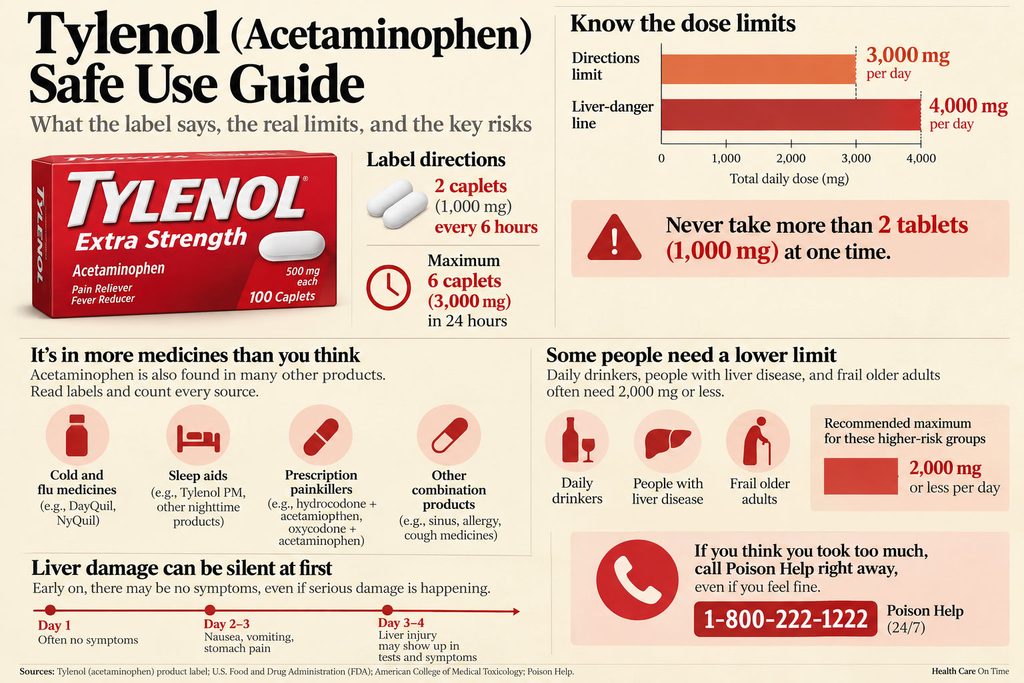
- The Tylenol Extra Strength label says 2 caplets every 6 hours, max 6 caplets in 24 hours.
- 3,000 mg is the directions limit. 4,000 mg is the liver-danger line.
- Never take more than 2 tablets (1,000 mg) at one time.
- Acetaminophen hides in cold medicines, sleep aids, and prescription painkillers, so count every source.
- Daily drinkers, people with liver disease, and frail older adults often need 2,000 mg or less.
- Liver damage from too much acetaminophen can feel like nothing for the first day.
- If you think you took too much, call Poison Help at 1-800-222-1222 right away, even if you feel fine.
The Short Answer: 6 Tablets, and Why the Box Shows Two Numbers
Here is the plain rule from the package. Take 2 caplets every 6 hours while symptoms last, don’t go over 6 caplets in 24 hours unless a doctor directs it, and don’t use it longer than 10 days without a doctor’s advice.
Six tablets of 500 mg equals 3,000 mg. That is your everyday ceiling for self-treatment.
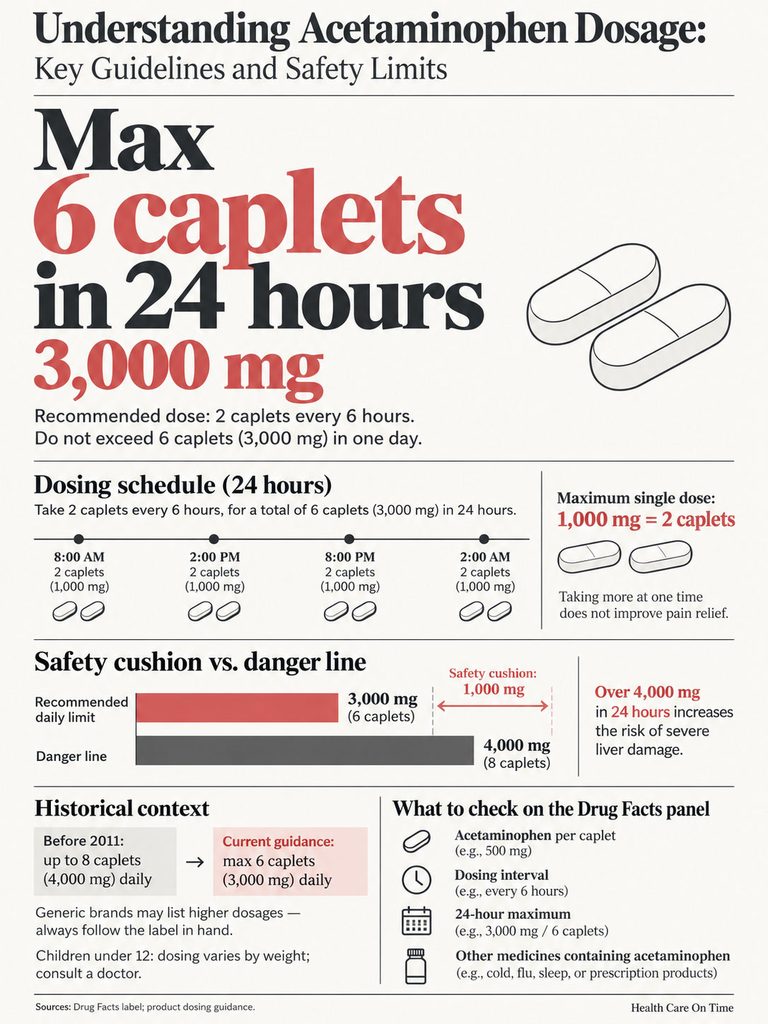
Directions Limit (3,000 mg) vs Danger Line (4,000 mg)
Read a little further down the same box and a second number appears. The liver warning says severe liver damage may occur above 4,000 mg in 24 hours, when combined with other acetaminophen drugs, or with 3 or more alcoholic drinks a day.
So the label is telling you two different things:
- 3,000 mg is how much the maker tells you to take on your own.
- 4,000 mg is the line past which the risk of serious harm climbs.
The 1,000 mg gap is a safety cushion. It covers the extra acetaminophen people take without noticing, like a dose of cold medicine or a pill taken an hour early.
Our medical team has reviewed dozens of dosing pages on this question. Most treat 4,000 mg as the goal. It isn’t.
Why “8 Tablets” Still Shows Up Online
Before 2011, the Extra Strength label allowed 8 caplets a day (4,000 mg). That year, the maker, McNeil, lowered the directions to 6 caplets to cut accidental overdoses.
Many websites never caught up. One top-ranking page still says most adults can take 1 tablet every 6 hours, up to 8 tablets a day, which doesn’t even add up, since 1 tablet every 6 hours is only 4 a day.
Generic and store-brand acetaminophen follows its own label, and federal rules for nonprescription acetaminophen still allow up to 4,000 mg a day. So a store-brand bottle may list a higher daily count than Tylenol does. Follow the bottle in your hand, and when in doubt, use the lower number.
Per Dose: Can You Take 3 at Once?
No. The single-dose limit for adults is 1,000 mg, which is 2 tablets of 500 mg. Taking 3 (1,500 mg) at once doesn’t give meaningfully better pain relief, and it raises the load on your liver.
If 2 tablets aren’t controlling your pain, that’s a signal to try a different medicine or call a doctor, not to take more.
Here is how the common products compare:
| Product | Acetaminophen per pill | Pills per dose | Hours between doses | Max pills in 24 hrs | Max acetaminophen per day |
| Tylenol Regular Strength | 325 mg | 2 | 4 to 6 | 10 | 3,250 mg |
| Tylenol Extra Strength caplets | 500 mg | 2 | 6 | 6 | 3,000 mg |
| Tylenol Rapid Release Gels | 500 mg | 2 | 6 | 6 | 3,000 mg |
| Tylenol 8HR Arthritis Pain | 650 mg | 2 | 8 | 6 | 3,900 mg |
| Tylenol PM Extra Strength | 500 mg (plus diphenhydramine) | 2 at bedtime | Once daily | 2 | 1,000 mg |
| Excedrin Extra Strength | 250 mg (plus aspirin and caffeine) | 2 | 6 | 8 | 2,000 mg |
Always confirm against the Drug Facts panel on your package, since formulas change.
What About Kids and Teens?
Tylenol Extra Strength 500 mg is labeled for adults and children 12 and older, who follow the same 6-tablet daily limit as adults. For children under 12, the label says to ask a doctor.
Children’s doses are based on weight, not age, and come from products like Children’s Tylenol liquid (160 mg per 5 mL). Always use the dosing cup or syringe packed with that exact bottle, never a kitchen spoon. If you’re unsure of your child’s dose, a pharmacist can work it out from their weight in a minute.
Read the Label in 30 Seconds
Patients commonly ask us what to look for on a crowded box. Check three spots on the Drug Facts panel:
- Active ingredients: look for “acetaminophen” or “APAP” and note the milligrams per pill.
- Directions: find the “do not take more than” line. That’s your daily pill count.
- Warnings: the liver warning lists the alcohol and combination-drug rules.
How to Space Your Doses: A Real 24-Hour Schedule
The 6-hour gap isn’t arbitrary. It gives your liver time to clear most of the last dose before the next one arrives.
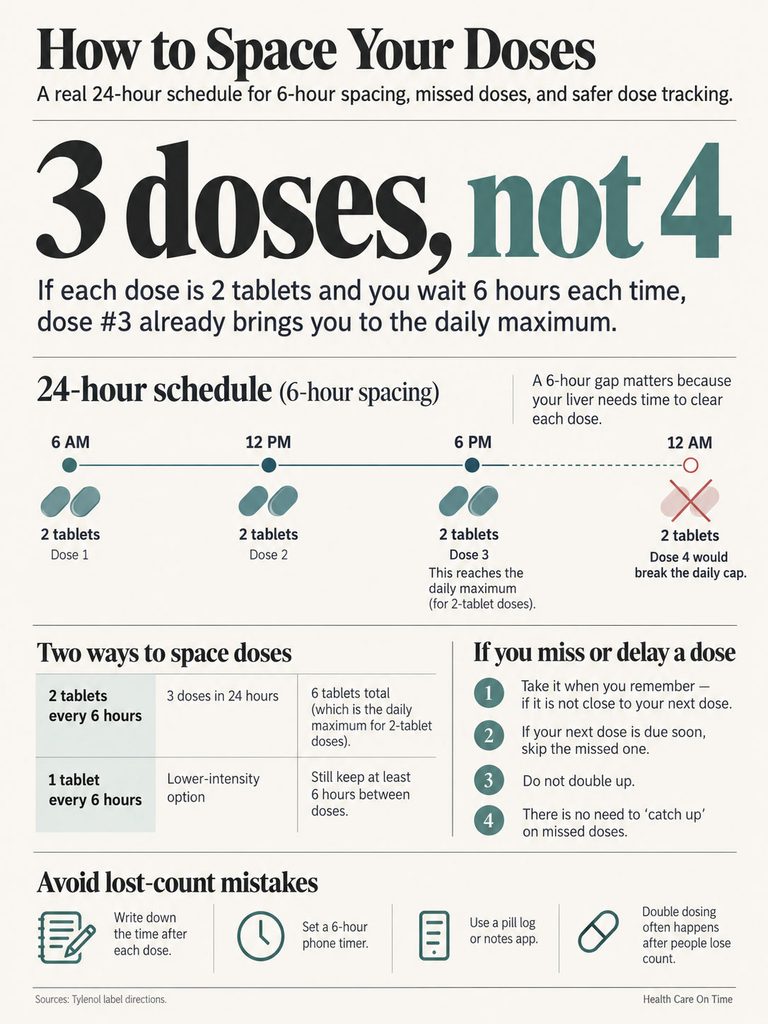
Sample Schedule for 2 Tablets Every 6 Hours
| Time | Dose | Running total |
| 8:00 a.m. | 2 tablets (1,000 mg) | 1,000 mg |
| 2:00 p.m. | 2 tablets (1,000 mg) | 2,000 mg |
| 8:00 p.m. | 2 tablets (1,000 mg) | 3,000 mg |
| 2:00 a.m. | None | Stop. Daily max reached. |
A full every-6-hours clock would allow 4 doses, but the label caps you at 3 doses of 2 tablets. That’s the step most people miss.
If 1 tablet per dose is enough, you can take 1 every 6 hours and stay well under the limit.
Missed or Late Dose Rules
Tylenol is taken as needed, so there’s no catching up. If you skipped a dose, take the next one when you need it, as long as 6 hours have passed since the last.
Never double up to make up for a missed dose.
Tracking Tricks That Prevent Double Dosing
Across the dosing questions our team fields, the most common story behind an accidental overdose is simple: someone lost count.
- Write the time and dose on a sticky note or in your phone each time.
- Pre-count the day’s tablets into a small dish or pill organizer.
- Keep one bottle in one spot so two family members don’t both give a dose.
- At night, when you’re sick and groggy, check the note before reaching for the bottle.
Why the Limit Exists: How Acetaminophen Hurts the Liver
At normal doses, your liver processes most acetaminophen safely and sends it out in your urine. A small portion becomes a toxic byproduct called NAPQI.
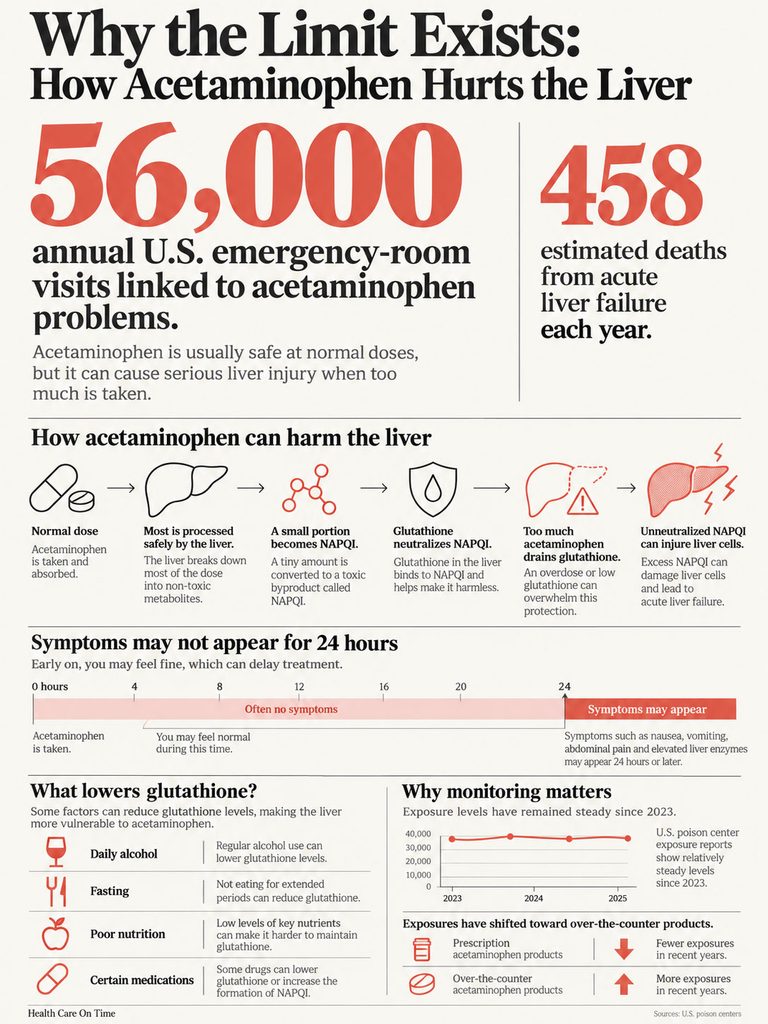
NAPQI and Glutathione in Plain English
Your liver neutralizes NAPQI with a protective substance called glutathione. Think of glutathione as a mop and NAPQI as a spill.
At normal doses, the mop keeps up. Take too much, and the mop runs dry. NAPQI then attacks liver cells directly.
Anything that drains glutathione or speeds up NAPQI production lowers your safe limit. Daily alcohol, fasting, poor nutrition, and certain medicines all do this.
Why Liver Damage Is Silent at First
The cruel part of acetaminophen overdose is the delay. Someone can take a dangerous amount and feel normal, or only mildly queasy, for the first 24 hours.
By the time pain under the right ribs, yellow eyes, or confusion shows up, liver damage is already underway. That’s why treatment depends on acting before symptoms appear.
How Big the Problem Is in the US
Acetaminophen overdose is common, and newer poison center data shows it hasn’t gone away:
| Measure | Figure | Source |
| Adult poison exposures involving pain medicines, 2024 | 132,016 (10.4% of adult cases, top category) | America’s Poison Centers |
| Child poison exposures involving pain medicines, 2024 | 78,993 (9.1% of child cases) | America’s Poison Centers |
| Single-substance acetaminophen exposures, 2022 | 94,782 | NPDS 2022 Annual Report |
| Acetaminophen combination-product exposures, 2022 | 27,432 (down 8.9% from 2021) | NPDS 2022 Annual Report |
| Yearly US ER visits from acetaminophen overdose | More than 56,000 | Acute Liver Failure Study Group, Hepatology |
| Yearly deaths from acute liver failure | An estimated 458 | Acute Liver Failure Study Group, Hepatology |
| Share of US acute liver failure tied to acetaminophen | Nearly 50% | Acute Liver Failure Study Group, Hepatology |
The poison center numbers show a clear shift. A review of poison center liver-injury reports from 2000 to 2024 found that combination prescription products declined after the FDA dose caps, while acetaminophen-alone exposures kept rising. In other words, the risk has moved from prescription bottles to the over-the-counter shelf.
One honest caveat: the ER visit and death estimates come from older US studies, and newer national totals are reported in different ways. America’s Poison Centers says annual acetaminophen exposures have held generally steady since 2023, with 2025 tracking close to 2024.
Who Should Take Less Than 6 Tablets
The 3,000 mg limit is for healthy adults. Many people need a lower ceiling, and some need medical guidance before using acetaminophen at all.
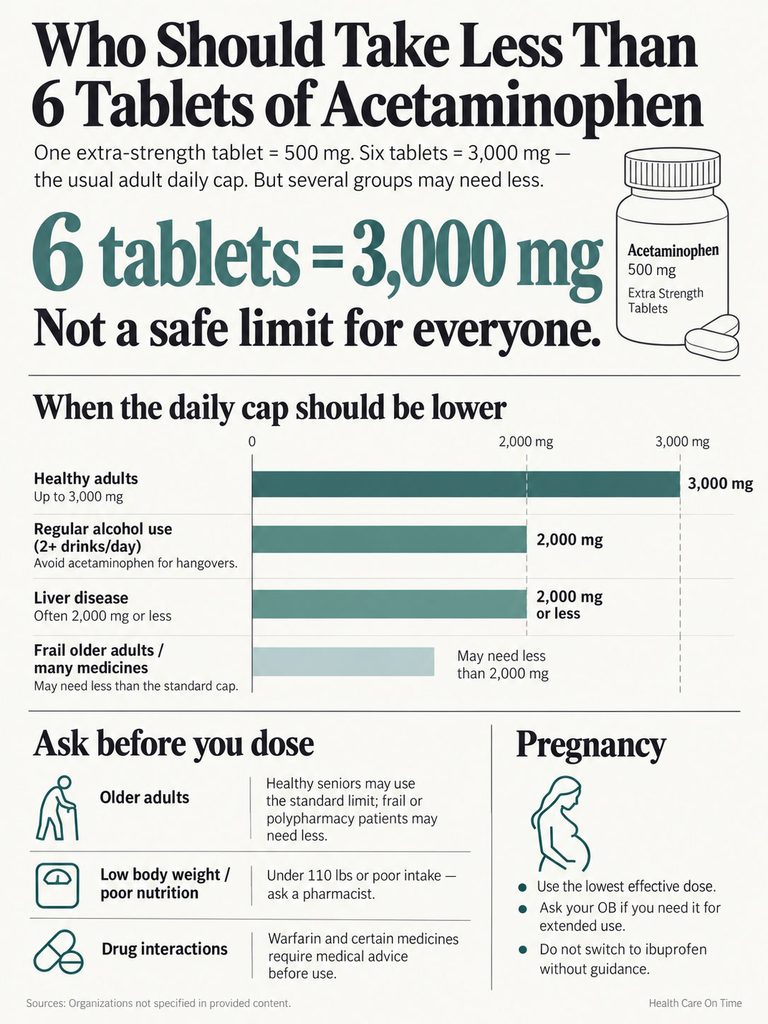
If You Drink Alcohol
The label draws the line at 3 or more drinks a day. Regular drinking speeds up NAPQI production and drains glutathione at the same time, so the liver gets hit from both sides.
If you drink daily, many doctors suggest staying at 2,000 mg or less and checking with your provider first. Don’t use Tylenol for a hangover after heavy drinking.
If You Have Liver Disease
People with cirrhosis, hepatitis B or C, or fatty liver disease can often still use acetaminophen, and doctors frequently prefer it over ibuprofen for them. The dose usually drops to 2,000 mg a day or less.
That call belongs to your doctor. In cases reviewed by our medical team, many people with fatty liver don’t know they have it until a routine liver panel flags a high ALT.
Adults 65 and Older
Older livers clear drugs more slowly, and older adults often take more medicines that interact. Healthy seniors can usually stay with the standard 3,000 mg limit.
Frail older adults, light eaters, or people on several prescriptions may need a lower cap. A pharmacist can review the full medication list in a few minutes, usually at no charge.
Low Body Weight or Poor Nutrition
If you weigh less than about 110 pounds, are fasting, have an eating disorder, or have been too sick to eat for days, your glutathione stores may be low. Ask a pharmacist for a dose based on your weight.
Warfarin and Other Interacting Drugs
The Tylenol label tells anyone on the blood thinner warfarin to check with a doctor or pharmacist before use. Taking acetaminophen regularly for several days can raise your INR and your bleeding risk.
Certain seizure medicines (carbamazepine, phenytoin), the TB drug isoniazid, and rifampin can also change how your liver handles acetaminophen.
Pregnancy
Acetaminophen has long been the standard pain and fever reliever in pregnancy, and the guidance is now debated in public. In September 2025, the FDA started a label change citing a possible association with autism and ADHD, while also stating that a causal link has not been established and that contrary studies exist.
ACOG has affirmed the drug’s safety and benefits in pregnancy, noting that the two highest-quality studies found no significant link to autism, ADHD, or intellectual disability. ACOG also stresses that untreated fever and pain can harm both mother and baby.
Where both sides agree: use the lowest dose that works, for the shortest time, and talk with your OB if you need it for more than a day or two. Don’t simply switch to ibuprofen, which carries its own pregnancy risks.
The Hidden Acetaminophen Trap
Most accidental overdoses don’t come from a Tylenol bottle alone. They come from stacking. People who overdosed by accident were more likely to have been using two or more acetaminophen products at once.
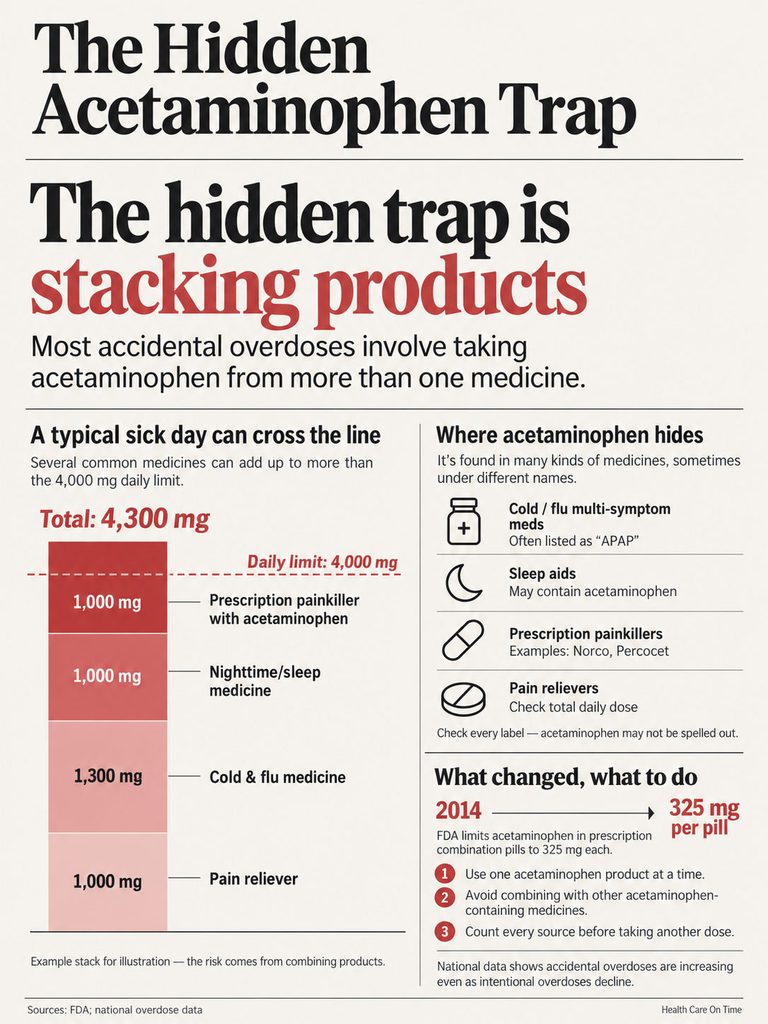
Cold, Flu, and Sleep Products
Acetaminophen sits inside many multi-symptom products, often listed as “APAP” on the Drug Facts panel. Common examples include:
- NyQuil and DayQuil Cold & Flu
- Theraflu and Mucinex Fast-Max multi-symptom versions
- Tylenol PM and store-brand “PM” pain relievers
- Excedrin and other headache combinations
- Alka-Seltzer Plus and Vicks combination products
Prescription Painkillers
Norco, Vicodin, Percocet, and many generic hydrocodone or oxycodone combinations contain acetaminophen. Since 2014, the FDA has limited prescription combination pills to 325 mg of acetaminophen each, but those milligrams still count toward your total.
If you take one of these, don’t add Tylenol unless your prescriber confirms the math works.
Stacking Math: How a Normal Sick Day Goes Over
Here’s a realistic flu day that feels careful but isn’t:
| Time | What you took | Acetaminophen |
| 8:00 a.m. | 2 Tylenol Extra Strength | 1,000 mg |
| 12:00 p.m. | 2 DayQuil LiquiCaps | 650 mg |
| 2:00 p.m. | 2 Tylenol Extra Strength | 1,000 mg |
| 4:00 p.m. | 2 DayQuil LiquiCaps | 650 mg |
| 8:00 p.m. | 2 Tylenol Extra Strength | 1,000 mg |
| 10:00 p.m. | NyQuil liquid, 30 mL | 650 mg |
| Total | 4,950 mg |
Every dose followed its own label. Together, they cross the 4,000 mg danger line by nearly 1,000 mg.
National hospital data shows that while intentional acetaminophen overdoses declined, accidental ones climbed, and stacking like this is a big reason.
The fix: use one acetaminophen product at a time. If you take a multi-symptom cold medicine, skip the separate Tylenol, or pick a cold product without acetaminophen.
Tylenol vs Ibuprofen vs Naproxen: Which Fits Your Situation
Acetaminophen isn’t the only option, and it isn’t always the best one.
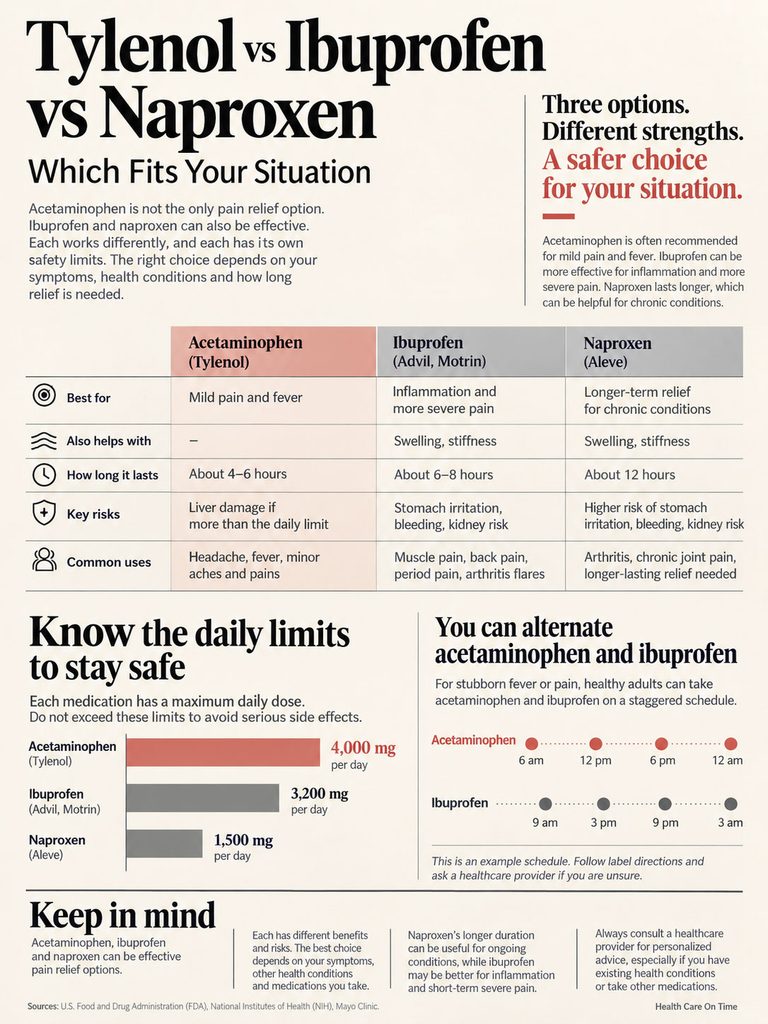
- Acetaminophen (Tylenol) eases pain and fever but doesn’t reduce swelling. It’s gentle on the stomach and kidneys. The main risk is the liver.
- Ibuprofen (Advil, Motrin) reduces pain, fever, and inflammation. The OTC limit is 1,200 mg a day (six 200 mg tablets). It can irritate the stomach, raise blood pressure, and strain the kidneys.
- Naproxen (Aleve) works like ibuprofen but lasts longer. The OTC limit is 3 tablets (660 mg) in 24 hours.
Quick fit guide
- Stomach ulcers, kidney disease, or on a blood thinner: acetaminophen is often the safer pick.
- Sprains, menstrual cramps, or arthritis flares with swelling: ibuprofen or naproxen often work better.
- Liver disease or daily drinking: ask your doctor first, since both drug types carry risks for you.
Healthy adults can alternate acetaminophen and ibuprofen for stubborn fever or pain, since the two work differently. Keep each one within its own daily limit.
Took Too Much? What to Do and When
If you think you went over the limit, don’t wait to see whether you feel sick. With acetaminophen, feeling fine tells you very little.
Early vs Late Overdose Signs
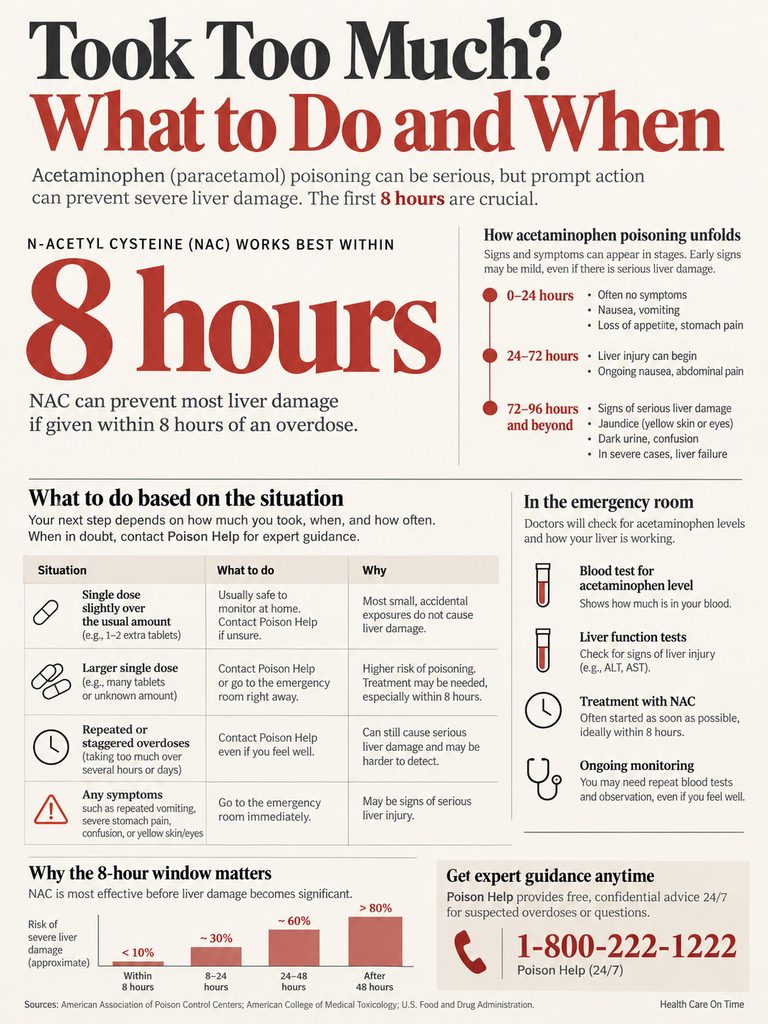
Acetaminophen poisoning usually unfolds in stages:
- First 24 hours: no symptoms, or mild nausea, vomiting, sweating, and tiredness.
- 24 to 72 hours: pain under the right ribs, and liver blood tests (ALT, AST) start rising.
- 72 to 96 hours: peak liver injury, with yellow skin or eyes, dark urine, confusion, and bleeding problems.
- After 4 days: recovery for those treated in time, or liver failure that may need a transplant.
Why the 8-Hour Window Matters
The antidote, N-acetylcysteine (NAC), refills the liver’s glutathione supply. It works best when started within 8 hours of a large overdose.
Doctors check your acetaminophen blood level at least 4 hours after the dose to decide on treatment. Getting to that test early is what saves livers.
What Happens at the ER
People are often nervous about going in, so here’s what usually happens. Staff ask what you took, how much, and when, so bring the bottles or boxes with you.
You’ll get a blood test for your acetaminophen level, usually at least 4 hours after the dose, plus liver and kidney tests. If treatment is needed, NAC is given through an IV, often over about 21 hours. Most people treated early go home without lasting liver damage.
Staggered Overdose: The Sneaky Version
Not every overdose happens at once. Taking a little too much over 2 or 3 days, called a staggered or repeated overdose, can be just as dangerous and harder to diagnose, because blood levels don’t fit the standard charts.
Our lab partners report that elevated liver panels after a week of heavy cold-medicine use are a pattern worth taking seriously, even when the person never felt overdosed.
What to Do in Each Situation
| Scenario | What to do | How urgent |
| Took 1 extra tablet, still under 3,500 mg for the day | Skip your next dose, recount, and restart your 6-hour clock | Low, no call needed |
| Took 8 tablets (4,000 mg) in 24 hours, healthy adult | Take no more acetaminophen for 24 hours; call Poison Help if unsure | Moderate, same day |
| Went over 4,000 mg in 24 hours | Call Poison Help at 1-800-222-1222 now | High, right away |
| Took a large amount at once (10 or more tablets) | Call 911 or go to the ER now, even with no symptoms | Emergency |
| Over the limit for 2 or more days in a row | Call Poison Help or your doctor today; you may need blood tests | High, same day |
| Drank heavily and took Tylenol, or take it daily with 3+ drinks | Call Poison Help for advice on your exact amounts | Moderate to high |
| A child got into the bottle | Call Poison Help now, even if you’re not sure any was swallowed | High, right away |
| Any amount plus yellow eyes, right-side belly pain, or confusion | Call 911 or go to the ER | Emergency |
Poison Help is free, confidential, and open 24 hours a day. Most accidental acetaminophen exposures can be safely managed at home with a poison center’s guidance, and the specialists will tell you if yours can’t.
How Long Can You Take Tylenol Every Day?
The 10-Day Pain and 3-Day Fever Rule
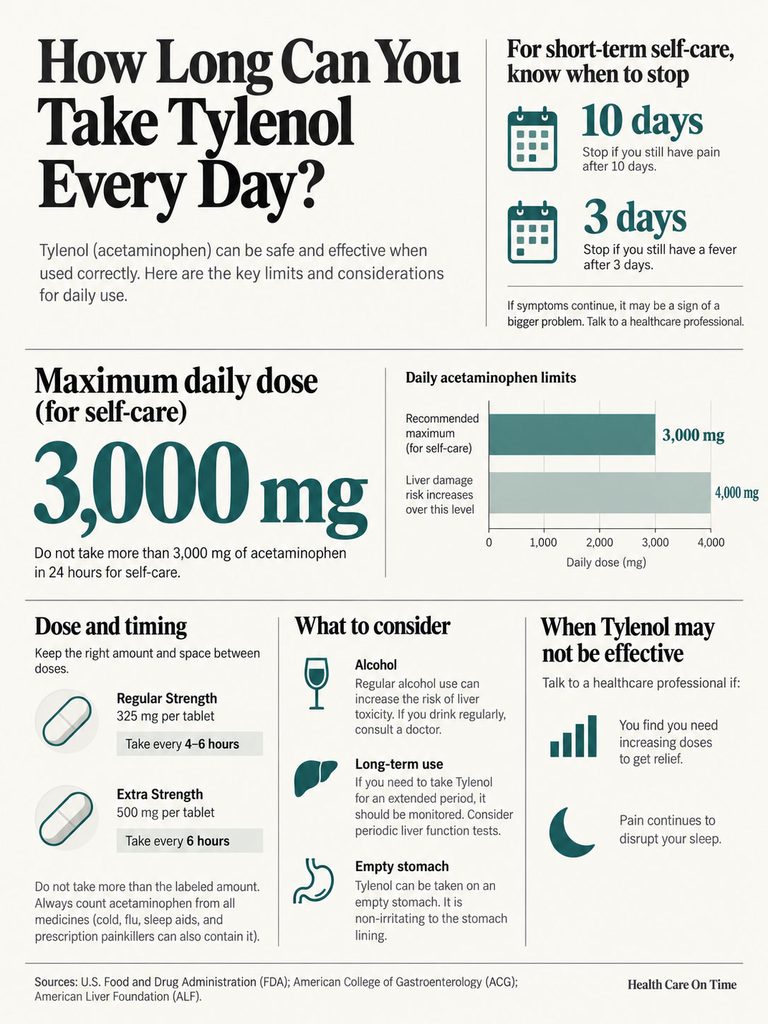
The label sets clear limits for self-care: stop and see a doctor if pain worsens or lasts beyond 10 days, or if fever worsens or lasts beyond 3 days.
Pain that outlasts that window needs a diagnosis, not a longer run of pills.
Long-Term Use and Liver Testing
People with arthritis or chronic pain sometimes take acetaminophen daily for months under a doctor’s care. That can be reasonable at 3,000 mg or less.
If that’s you, ask whether a periodic liver panel makes sense. Patients booking liver function tests with us often find it reassuring to have a baseline ALT and AST on file before long-term use begins.
Signs Tylenol Isn’t the Right Tool
If you find yourself needing the full 6 tablets every day, or watching the clock for your next dose, that’s useful information. It often means the pain needs a different approach, such as physical therapy, an anti-inflammatory, or a diagnosis you haven’t had yet.
Pain that wakes you at night, comes with fever or weight loss, or keeps getting worse should be checked by a doctor rather than covered up with more pills.
Frequently Asked Questions
Can You Take 3 Tylenol 500mg at Once?
No. The maximum single adult dose is 2 tablets (1,000 mg). Three tablets equal 1,500 mg, which goes above the labeled dose without adding much pain relief. If 2 tablets don’t help, wait for your next dose, try a different type of pain reliever, or ask a doctor about your pain.
Is 4,000 mg of Tylenol a Day Safe?
It’s the upper limit, not a recommended amount. The Extra Strength label directs a maximum of 3,000 mg a day for self-care and warns that liver damage may occur above 4,000 mg. Some doctors prescribe up to 4,000 mg for short periods in healthy adults, but only under their supervision.
How Many Hours Apart Should You Take Tylenol 500mg?
Wait at least 6 hours between doses of Tylenol Extra Strength. Regular Strength 325 mg tablets allow 4 to 6 hours, and 8HR Arthritis needs 8 hours. Even with 6-hour spacing, stop after 3 doses of 2 tablets in 24 hours to stay at 3,000 mg.
Can You Take Tylenol After Drinking Alcohol?
It’s best to avoid it, especially after heavy drinking. Alcohol increases the toxic byproduct of acetaminophen and lowers your liver’s defenses. If you have 3 or more drinks daily, ask your doctor before using any acetaminophen. For a hangover headache, water, food, and rest are safer first steps.
What Happens If You Take 8 Tylenol 500mg in a Day?
Eight tablets equal 4,000 mg, the maximum the label considers potentially safe. For a healthy adult, a single day at that amount rarely causes harm. Skip acetaminophen for the next 24 hours. If you drink, have liver disease, or did this several days in a row, call Poison Help at 1-800-222-1222.
Can You Take Tylenol and Ibuprofen Together?
Yes, most healthy adults can take both, since they work in different ways. Many people alternate them every 3 hours for fever or pain. Keep each medicine within its own daily limit. People with kidney disease, ulcers, heart disease, or blood thinners should ask a doctor before using ibuprofen.
How Long Does Tylenol Stay in Your System?
Acetaminophen’s half-life is about 2 to 3 hours in healthy adults, so most of a dose clears within about 24 hours. Pain relief usually lasts 4 to 6 hours. Liver disease, older age, and overdose can slow clearance a lot, which is why spacing and daily limits matter.
Is Tylenol Safe for Seniors Every Day?
For healthy older adults, daily acetaminophen at 3,000 mg or less is generally considered safe and is often preferred over ibuprofen. Frail seniors, those with liver problems, light eaters, and people on warfarin may need 2,000 mg or less. Review all medications with a pharmacist to catch hidden acetaminophen.
Can You Take Tylenol on an Empty Stomach?
Yes. Unlike ibuprofen and aspirin, acetaminophen doesn’t irritate the stomach lining, so you can take it with or without food. It may work slightly faster on an empty stomach. Long fasting is different, though. Days without eating can lower liver defenses, so use lower doses during a long illness.
Is Tylenol Safe During Pregnancy?
ACOG considers acetaminophen appropriate in pregnancy when needed, at the lowest effective dose for the shortest time. In 2025, the FDA began adding a possible autism and ADHD association to the label, while stating that cause hasn’t been proven. Talk with your OB if you need it for more than a day or two.
What’s the Difference Between Tylenol Regular and Extra Strength?
Regular Strength has 325 mg per tablet, with up to 10 tablets (3,250 mg) a day. Extra Strength has 500 mg per tablet, with up to 6 tablets (3,000 mg) a day. Both contain the same drug. Extra Strength simply means fewer pills per dose and a longer gap between doses.
How Do You Know If Tylenol Hurt Your Liver?
Early liver injury often causes no symptoms, so a blood test is the only reliable check. A liver panel measures ALT and AST, which rise when liver cells are damaged. Later signs include right-side belly pain, yellow eyes, dark urine, and confusion. Any of those after heavy acetaminophen use needs urgent care.
Disclaimer: This article is for general education and doesn’t replace advice from your doctor or pharmacist. Dosing for children, pregnant people, and anyone with liver disease or on other medicines should come from a health professional. If you think you or someone else took too much acetaminophen, call Poison Help at 1-800-222-1222 or 911 now, even if there are no symptoms. If you’re thinking about harming yourself, call or text 988 to reach the Suicide and Crisis Lifeline any time.
References
- Tylenol Extra Strength Caplets: Drug Facts and directions
- America’s Poison Centers: National poison center statistics, 2024
- America’s Poison Centers: No national increase in acetaminophen exposures
- NPDS liver injury reports, 2000 to 2024 (ReachMD summary)
- Lee WM. Acetaminophen and the US Acute Liver Failure Study Group. Hepatology, 2004
- ER visits due to acetaminophen toxicity in the USA. BMJ Open, 2015
- Harvard Health Publishing: Acetaminophen overdose and liver problems
- American College of Gastroenterology: Trends in US acetaminophen overdose
- FDA: Prescription acetaminophen products limited to 325 mg per dosage unit
- ACOG: ACOG affirms safety and benefits of acetaminophen during pregnancy
- MedlinePlus: Acetaminophen overdose
- Know Your Dose: Acetaminophen safety campaign
- Poison Help (HRSA): 1-800-222-1222