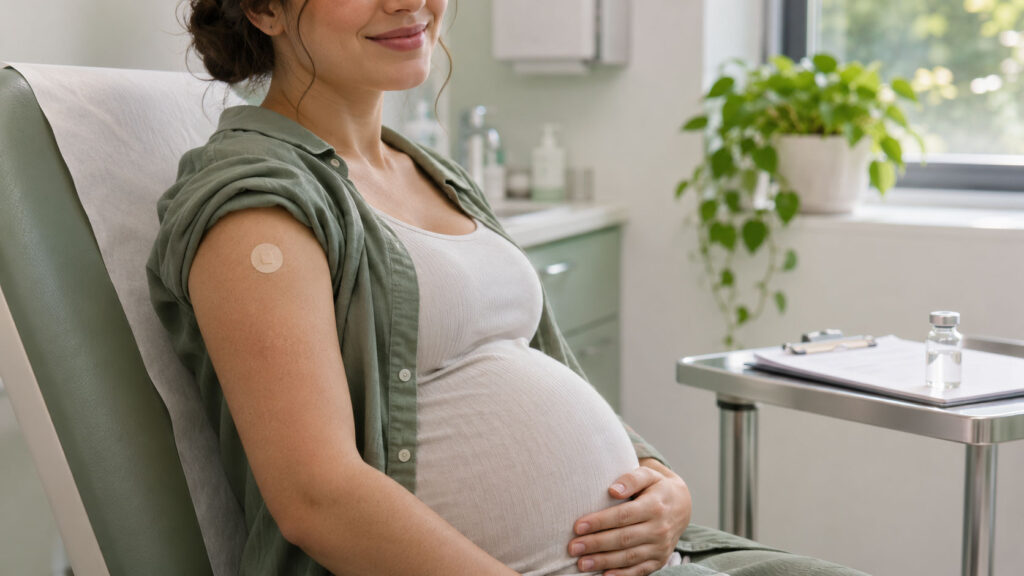
Most side effects of the maternal RSV vaccine (Abrysvo) are a sore arm, tiredness, a headache or some nausea, and they usually clear within two to three days. The questions that take longer to answer are about preterm birth and high blood pressure, and both now have several years of data behind them.
Table of Contents
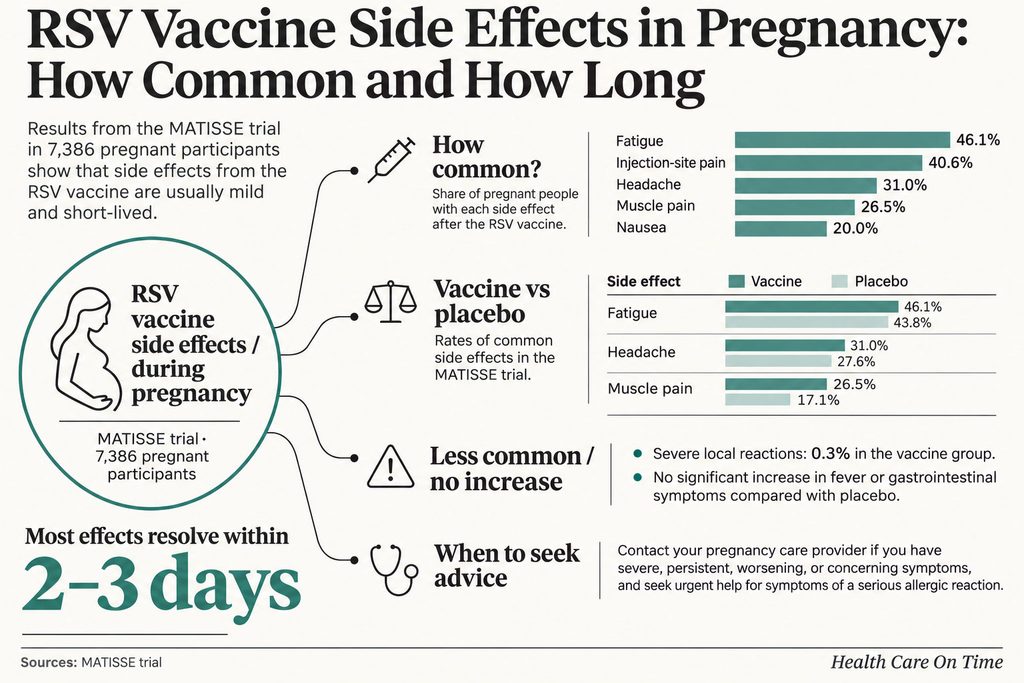
Quick answer: In the main trial, 40.6% of pregnant people who got Abrysvo had pain where the shot went in, compared with 10.1% on placebo. Muscle pain, headache and fatigue were also common, but placebo groups had most of those too. Most reactions faded within 2 to 3 days. Preterm birth was slightly more frequent in the trial, which is why the shot is limited to 32 through 36 weeks. Large US studies since 2023 have not found more preterm births.
What Side Effects Are Normal After the RSV Vaccine in Pregnancy?
The common side effects of the RSV vaccine in pregnancy are pain at the injection site, fatigue, headache, muscle pain and nausea, with redness or swelling at the site in a smaller share of people. Abrysvo is the only RSV vaccine approved and recommended for use during pregnancy in the US. The GSK (Arexvy) and Moderna (mResvia) RSV shots are for adults and are not meant for pregnant women. That means almost everything known about side effects comes from one product and mostly from one large trial, MATISSE, which randomized 7,386 pregnant people between 24 and 36 weeks.
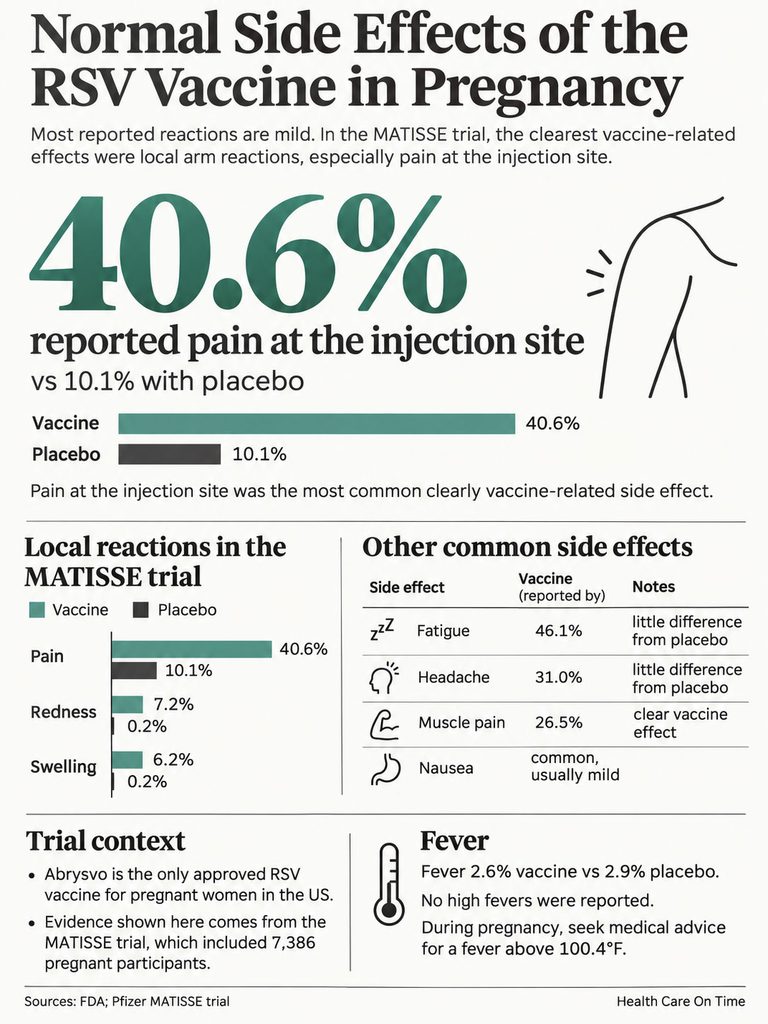
Every participant kept an electronic diary for 7 days after the shot, and half of them got a placebo. A woman in her third trimester is often tired, often has headaches and is sometimes nauseated, shot or no shot, so the placebo column matters as much as the vaccine column. Subtract one from the other and you get a rough idea of what the vaccine itself added.
| Side effect (within 7 days) | Abrysvo | Placebo | Added by the vaccine | What it means for you |
| Pain at the injection site | 40.6% | 10.1% | About 30 points | The clearest vaccine effect; most arm pain is gone 2 to 3 days after it starts |
| Redness at the site | 7.2% | 0.2% | About 7 points | Caused by the shot, but uncommon |
| Swelling at the site | 6.2% | 0.2% | About 6 points | Caused by the shot; a small patch is typical |
| Fatigue | 46.1% | 43.8% | About 2 points | Nearly all would have happened anyway |
| Headache | 31.0% | 27.6% | About 3 points | A small extra over the usual pregnancy headaches |
| Muscle pain | 26.5% | 17.1% | About 9 points | The body-wide effect most tied to the vaccine |
| Nausea | 20.0% | 19.2% | Less than 1 point | Mostly pregnancy, not the shot |
| Joint pain | 11.6% | 10.5% | About 1 point | Barely different from placebo |
| Diarrhea | 11.2% | 11.5% | None | No difference at all |
| Vomiting | 7.8% | 7.0% | Less than 1 point | Close to placebo |
| Fever of 100.4°F (38.0°C) or higher | 2.6% | 2.9% | None | No difference, but 100.4°F or higher still needs a call |
The rates are from the Abrysvo prescribing information, revised in December 2025; the “added” column is plain subtraction.
Arm Reactions Are the Clearest Vaccine Effect
Pain, redness and swelling at the injection site are the side effects the vaccine clearly causes. Roughly four in 10 people had some arm pain, against one in 10 on placebo, and redness or swelling showed up in about 6% to 7% of vaccinated people while almost nobody on placebo had them. Severe local reactions were rare: 0.3% in the vaccine group and none on placebo.
Expect a sore upper arm for a day or two. Lying on that side may be uncomfortable, and lifting a toddler or a laundry basket can feel awkward.
Fatigue, Headache and Nausea Are Mostly Background Symptoms
Fatigue was the most common complaint overall, at 46.1%, yet the placebo group logged it at 43.8%. If you were already worn out before the appointment, the week after it may feel no different at all. Headache shows a small gap of about three percentage points. Muscle aches show a bigger one, about nine points, and they are the systemic effect most likely to be the shot.
Nausea, diarrhea, joint pain and vomiting all ran at close to the same rate in both groups. If you feel queasy the day after the vaccine, it may be the shot, but the trial suggests it is at least as likely to be pregnancy itself. Severe systemic reactions, the kind that stop you from doing normal daily activity, affected 2.3% of people in both groups.
Abrysvo contains no live virus, so it can’t give you RSV. A stuffy nose or cough that starts the same week is a coincidence, usually an ordinary virus, and it’s handled the way any cold during pregnancy is: rest, fluids and a check with your OB before reaching for cold medicines.
Fever Was Not More Common Than With Placebo
Fever was uncommon, at 2.6% with the vaccine and 2.9% with placebo, and high fevers above 102.2°F (39.0°C) were almost absent in both groups. So a real fever after the shot is unlikely to be the vaccine. A temperature of 100.4°F or higher in pregnancy is one of CDC’s urgent maternal warning signs, and it deserves a call to your OB, especially with belly pain, leaking fluid or fewer baby movements. Doctors take a high or lasting fever in pregnancy seriously because of its possible effects on the baby, so the cause needs finding even if it turns out to be minor.
How Long Do RSV Vaccine Side Effects Last?
In the trial, most local and body-wide reactions in pregnant participants were mild to moderate and resolved within 2 to 3 days of starting, so for most people RSV vaccine side effects in pregnancy are over by the weekend if the shot was midweek. The diaries covered only the first 7 days. Anything that begins well after that week falls outside what the vaccine data can explain, and it’s more likely to be something else.
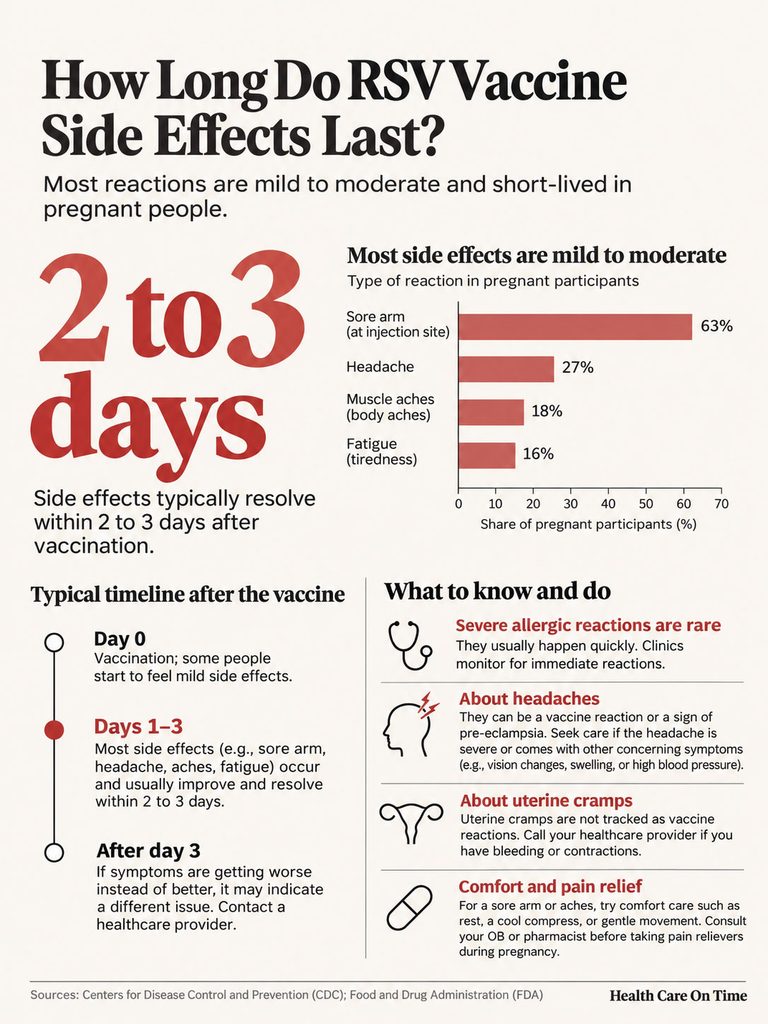
Call if symptoms are getting worse after day three instead of better, or if something doesn’t fit the table at all: a rash spreading beyond the arm, swelling in the face or hands, trouble breathing. Severe allergic reactions to vaccines usually appear quickly. Clinics ask you to wait a short while after a shot for that reason.
Headaches need a second look. A headache is a common vaccine reaction, and it’s also an early sign of pre-eclampsia, which often appears in the third trimester. A vaccine headache is usually mild, comes on in the first day or so and eases with rest. A headache that keeps building, refuses to quit, or comes with blurry vision, spots, swelling of the face or belly pain needs a blood pressure check the same day. Don’t assume the shot is to blame just because the timing lines up.
The same goes for cramping or tightening. Uterine cramps aren’t among the reactions the trial tracked or found. Regular contractions, a gush or trickle of fluid, or bleeding after the shot are labor or pregnancy signs to call about on their own terms.
Easing a Sore Arm or an Achy Day
Nothing in the trial tested home remedies, so this is plain comfort care. Book the shot on a lighter day if you can, and ask for it in the arm you use less. Wear a loose sleeve. Keep moving the arm through the day, because a shoulder held still tends to feel stiffer the next morning, and a cool cloth can take the edge off.
If the muscle aches or headache are bothering you enough to want medicine, check with your OB or pharmacist about which pain reliever suits your pregnancy, especially if you have high blood pressure, kidney problems or take other medicines.
Preterm Birth and High Blood Pressure: The Risks Still Under Study
What these numbers do and don’t mean: In the main trial, babies were born preterm in 5.7% of vaccinated pregnancies and 4.7% of placebo pregnancies. Among people vaccinated at 32 through 36 weeks, the approved window, it was 4.3% vs 3.7%. Neither gap was statistically significant, and the label says the data can’t prove or rule out a link. Pre-eclampsia was 1.8% vs 1.4%. Since approval, US studies of tens of thousands of pregnancies have found no rise in preterm birth. A possible small rise in pregnancy-related high blood pressure has shown up in some of them and is still being studied.
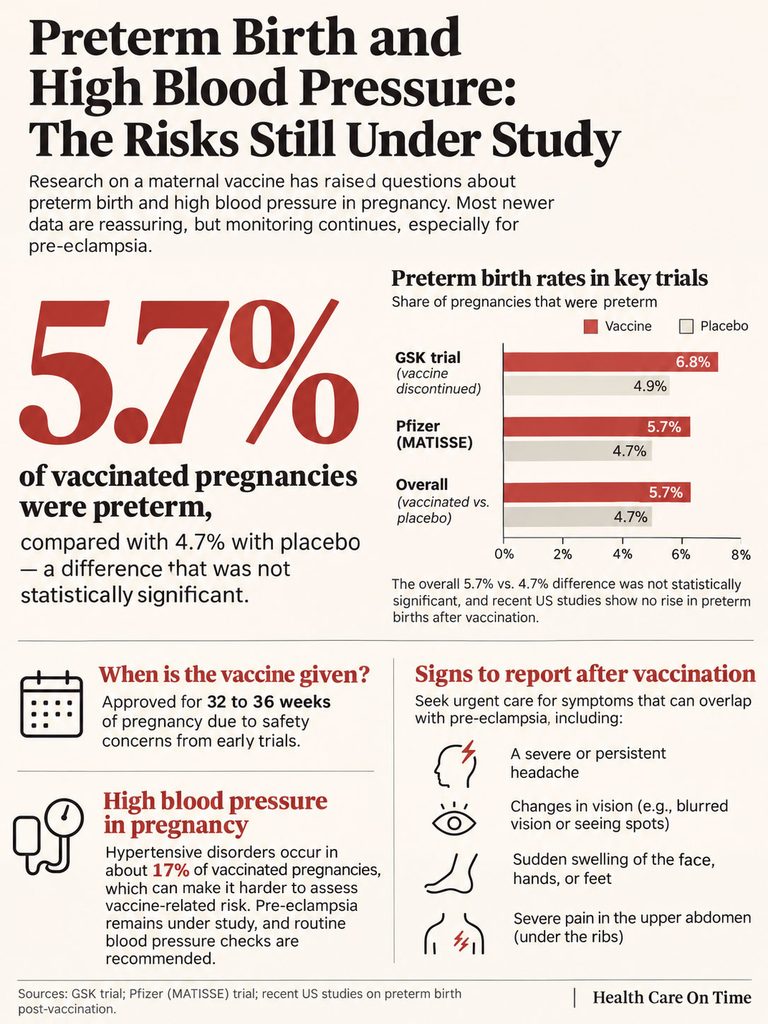
Preterm birth worries people more than any sore arm, and the worry started inside the clinical trials themselves.
Why the Label Limits the Shot to 32 to 36 Weeks
Two companies tested RSV vaccines in pregnancy. GSK’s candidate trial was stopped on February 25, 2022, after its safety monitors saw more preterm births in the vaccine group: 6.8% vs 4.9%, a relative risk of 1.37. The gap was concentrated in low- and middle-income countries (relative risk 1.56), while high-income countries showed no clear difference (1.04). GSK dropped that vaccine. It was never approved and is a different product from Abrysvo.
Pfizer’s MATISSE trial vaccinated people anywhere from 24 to 36 weeks, with a median of 31 weeks and 2 days, and 207 of 3,659 vaccinated pregnancies ended in preterm birth, against 172 of 3,646 on placebo. That gap was smaller than GSK’s and could have been chance, yet FDA reviewers still treated it as a possible signal, and when their clinical review split it by country, the shape looked familiar: 8.3% vs 4.0% in South Africa, 6.4% vs 4.0% in Argentina, and 5.7% vs 5.3% in the US. The preterm births also clustered late. Of the 201 counted in the vaccine group in the CDC’s ACIP review, 97% (194) happened at or after 33 weeks, when babies usually do well.
The FDA approved Abrysvo only for 32 through 36 weeks, away from the early weeks where a preterm birth does the most harm, and Section 5.2 of the label states plainly that the data can neither establish nor exclude a causal link. A result that isn’t statistically significant can still be real, and the label’s wording leaves room for that.
Abrysvo has not been studied before 24 weeks or in pregnancies at increased risk of preterm birth. If you’ve delivered early before or have a short cervix, you belong to a group the trial didn’t include.
What US Studies Since 2023 Have Found
Since approval, tens of thousands of US pregnancies have been tracked, and the results have been steadier on preterm birth than on blood pressure.
| Study (source) | Who was studied | Preterm birth | Hypertensive disorders of pregnancy |
| MATISSE trial, all doses (Abrysvo label) | 3,659 vaccinated vs 3,646 placebo, 24 to 36 weeks | 5.7% vs 4.7% (not significant) | Pre-eclampsia 1.8% vs 1.4%; gestational hypertension 1.2% vs 1.1% |
| MATISSE, 32 to 36 weeks (Abrysvo label) | 1,667 vaccinated vs 1,640 placebo | 4.3% vs 3.7% | Not broken out for this subgroup |
| New York City hospitals, 2023 to 2024 (Son et al., JAMA Network Open, 2024) | 2,973 births, 34.5% vaccinated | 5.9% vs 6.7%; adjusted odds ratio 0.87 (0.62 to 1.20) | 20.1% vs 18.1%; adjusted odds ratio 1.10 (0.90 to 1.35), but a time-based model gave 1.43 (1.16 to 1.77) |
| Five US health plans, first season (Michnick et al., JAMA Network Open, 2026) | 13,619 vaccinated pregnancies vs 14,747 given other pregnancy vaccines | Relative risk 0.79 (0.65 to 0.98), no increase | Relative risk 1.14 (1.02 to 1.27), a possible increase flagged |
| Vaccine Safety Datalink, preliminary (CDC vaccine safety page) | Vaccinated at 32 to 36 weeks | No increased risk | Further studies underway |
| Five US health plans, two seasons (IDWeek 2026 interim conference data) | 29,486 vaccinated pregnancies, matched to unvaccinated | 4.7% vs 6.3% | 16.8% vs 15.8% |
Neither the two-hospital New York City study nor the much larger health-plan surveillance found more preterm births, and the larger one saw no rise in stillbirth and no maternal Guillain-Barré cases. Blood pressure is where both studies hedged. In New York, the extra risk appeared in only one of the ways the researchers ran the numbers. The health-plan study was built as an early-warning system, so it adjusted for other differences between groups only roughly, and it couldn’t rule out small increases in hypertensive disorders or in premature rupture of membranes.
The last row is early, unpublished data, presented at a conference in October 2026. The analysis is interim and Pfizer funded it. A final, more rigorous analysis is planned.
Pre-eclampsia: Why It Stays on the Watch List
High blood pressure in pregnancy is common to begin with. In the US health-plan data, about 17% of vaccinated pregnancies had some pregnancy-related hypertensive disorder, which shows how much background there is for any vaccine effect to hide in. That is part of why the signal is hard to pin down. A difference of half a percentage point in a trial, or a relative risk near 1.1 in claims data, can come from the vaccine, from who chooses to get vaccinated, or from how diagnoses get coded.
Until better-controlled data arrive, hypertensive disorders of pregnancy, including pre-eclampsia, stay on the federal list of possible risks under further study, even though a 2025 pooled review of the published studies judged the vaccine generally well tolerated overall.
Whatever you decide, pre-eclampsia is already being watched for: blood pressure and urine checks at every visit are part of routine screening in pregnancy, shot or no shot. If you already have chronic high blood pressure or had pre-eclampsia before, it makes sense to talk through the vaccine and the infant antibody option with your OB, since your baseline risk is higher either way.
Signs to Report Right Away
From CDC’s list of urgent warning signs, these are the ones that overlap with pre-eclampsia, and they apply in the weeks after a vaccine like any other time:
- A headache that won’t go away or gets worse, especially with vision changes
- Extreme swelling of your hands or face
- Trouble breathing, chest pain or a fast-beating heart
- Severe belly pain that doesn’t go away
- Your baby’s movements slowing or stopping
- Vaginal bleeding or fluid leaking
Can the RSV Vaccine Harm Your Unborn Baby or Bring On Labor?
Babies in the trial were followed from birth, and there was no sign of more birth defects or fetal deaths with the vaccine; fetal deaths were 0.3% (10) in the vaccine group and 0.2% (9) with placebo. Deaths in the newborn period were 3 with the vaccine and 5 with placebo. Low birth weight was a little more common with the vaccine, 5.1% vs 4.3%, and newborn jaundice was 7.3% vs 6.9%, small gaps that track with the slight preterm imbalance since early babies are more often small and jaundiced.
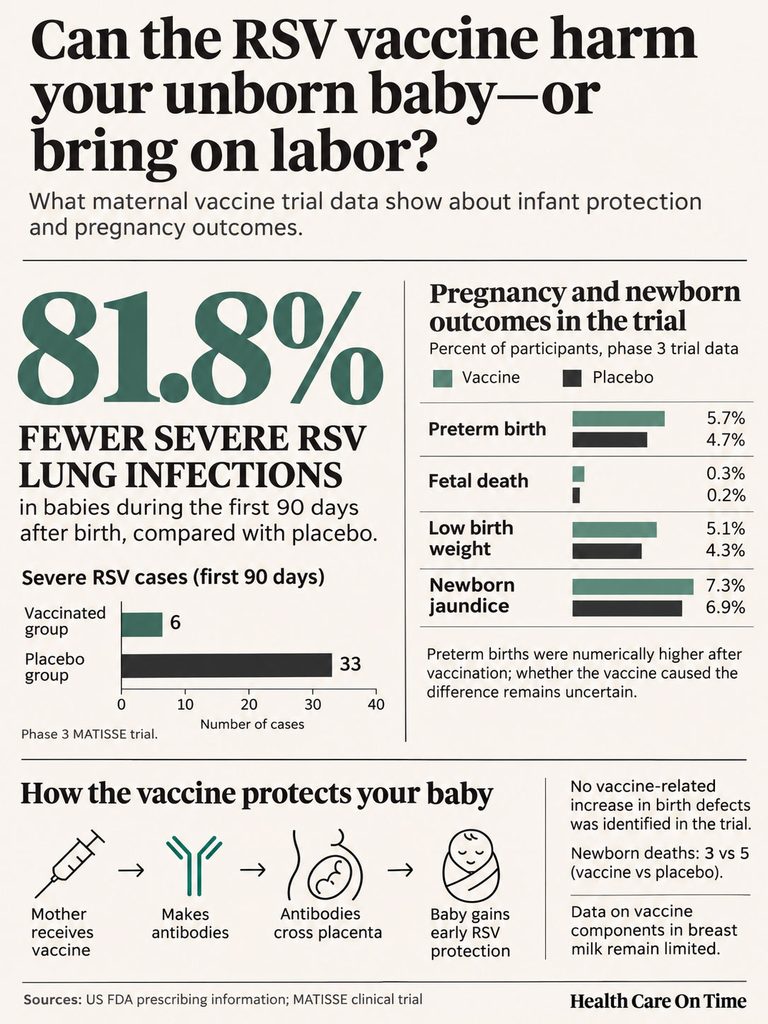
The vaccine works by having your immune system make antibodies, which cross the placenta. The baby doesn’t receive the vaccine itself. Your body needs about two weeks after the shot to make enough antibodies and move them across, which is why the timing rules exist at all. That design is why the benefit shows up in the baby: in the trial, the vaccine cut severe RSV lung infections that needed medical care by 81.8% in the first 90 days after birth and by 69.4% through 180 days.
Nothing in the data shows Abrysvo bringing on labor. The two large US studies found preterm birth no higher, and slightly lower, among vaccinated pregnancies. Lower rates in vaccinated groups may partly reflect who gets vaccinated, often people with steady prenatal care, so those numbers shouldn’t be read as the vaccine preventing early birth either.
Timing feeds the worry. A shot at 36 weeks lands a few weeks before a normal due date, so some women will go into labor within days of it by coincidence. Comparing vaccinated and unvaccinated groups, as the studies above did, is how researchers sort coincidence from cause. And if contractions have started or delivery is expected within two weeks, the vaccine wouldn’t have time to protect the baby anyway.
Some things are still unknown. Nobody knows yet whether Abrysvo passes into breast milk, and there are no data on breastfed babies. Trial babies followed to 24 months had similar rates of serious problems in both groups.
Mom’s Vaccine vs Baby’s Shot: Does Your Baby Still Need One?
Usually not. The CDC recommends one of two ways to protect a baby from severe RSV, and most babies need only one. The first is the maternal vaccine during pregnancy. The second is a long-acting antibody given to the baby: nirsevimab (Beyfortus) or clesrovimab. The antibody gives protection right away that lasts at least 5 months. The maternal vaccine gives about 6 months of protection after birth, but only if there’s time for your antibodies to build and cross over, which takes about two weeks.
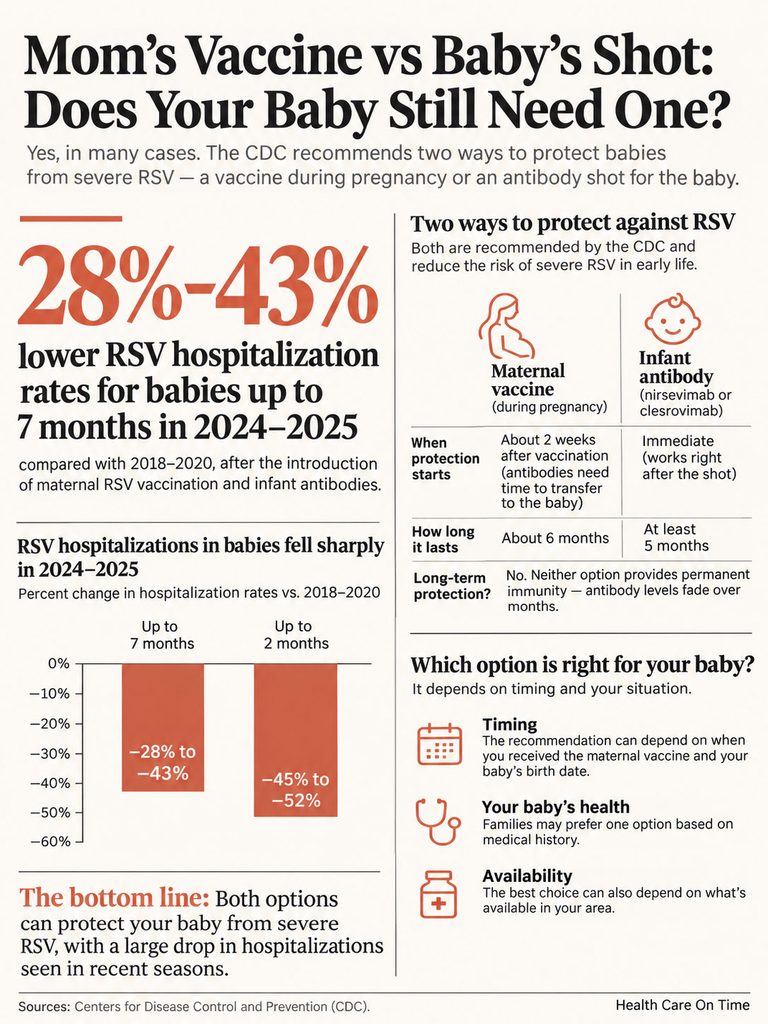
Together, the two products have changed what US hospitals see. In the 2024 to 2025 season, the first with both widely available, CDC surveillance found RSV hospitalization rates in babies up to 7 months old were 28% to 43% lower than in the 2018 to 2020 seasons, depending on the network. For the youngest babies, up to 2 months old, the drop was 45% to 52%. That report couldn’t split credit between the vaccine and the antibody, and on its own it can’t prove cause.
Neither option makes a baby immune for good. Antibodies passed from you fade over the first months, and the baby’s own shot wears off too. Hand washing, keeping sick visitors away from a newborn, and calling the pediatrician early for fast breathing or poor feeding still matter in RSV season, whichever route you choose.
Which one makes sense depends on dates, history and a few medical details. If you lean toward the baby’s shot, its own RSV shot side effects in babies are mostly a sore leg and a fussy day.
| Your situation | What’s recommended for the baby | Why |
| You got Abrysvo at 32 to 36 weeks, and the baby was born 14 or more days later | Usually no infant antibody in the first season | Your antibodies had time to cross the placenta |
| The baby was born less than 14 days after your shot | Infant antibody (nirsevimab or clesrovimab) | Not enough time for protection to transfer |
| You got the RSV vaccine in an earlier pregnancy, not this one | Infant antibody after birth | A second maternal dose is not recommended at this time |
| You are past 36 weeks and 6 days, or delivery is planned within 2 weeks | Skip the maternal shot; plan the infant antibody | The vaccine needs about two weeks to protect the baby |
| Your due date falls outside the vaccine season (for example, born in summer) | Infant antibody in the fall, before RSV season | Protection is timed to when RSV circulates |
| You have a condition that weakens your immune response, or the baby needs heart bypass or ECMO | Infant antibody may be considered anyway | Your antibodies may be low or lost |
| You haven’t decided yet | Either option is acceptable; talk it through at your next visit | Both prevent severe RSV in young babies |
The 14-day cutoff and the exceptions for weakened immunity and bypass go back to the 2023 ACIP recommendation, which current CDC guidance still follows.
Both routes are recommended, and families split. Some prefer the vaccine because the baby is protected from the first day without a newborn injection. Others prefer the infant antibody because it avoids any pregnancy-related question about preterm birth or blood pressure, and the protection can be timed to RSV season. Availability and insurance also play a part, so ask the pediatrician’s office ahead of time whether it stocks the antibody.
Timing, a Second Pregnancy and Other Practical Questions
CDC and ACOG Now Use Different Seasonal Windows
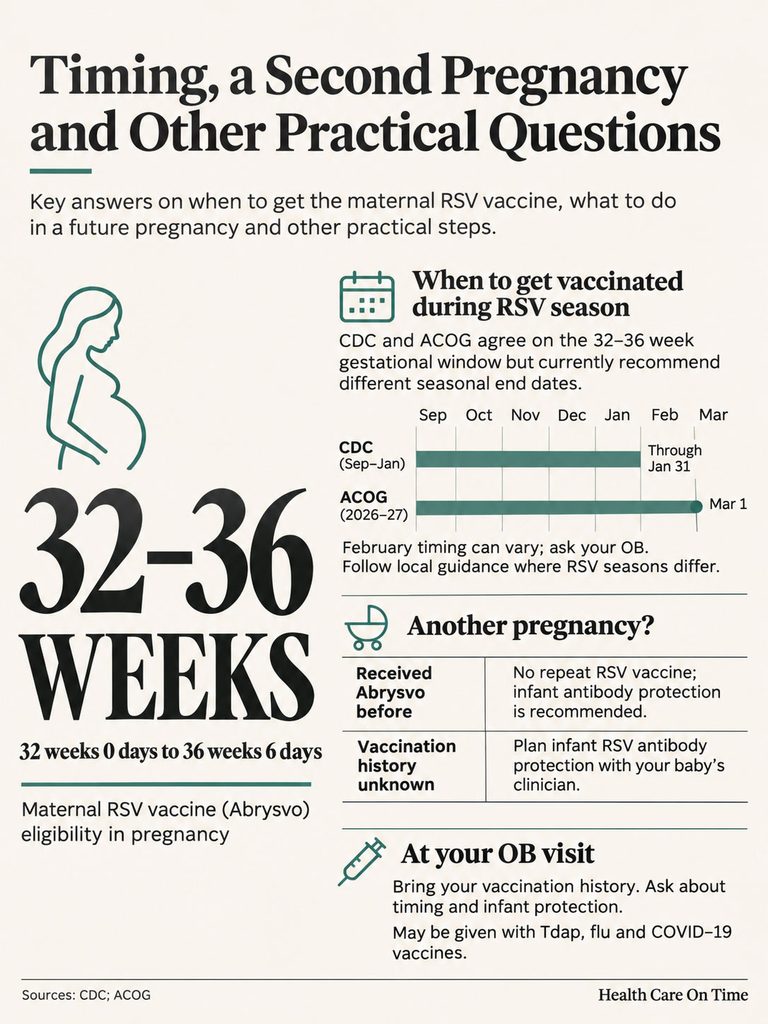
Both agree on the gestational window: 32 weeks 0 days through 36 weeks 6 days. They differ on the months. The CDC recommends the vaccine September through January in most of the continental US. For the 2026 to 2027 season, ACOG extended its window to September 1 through March 1, because recent RSV seasons have run later into spring. In February, though, RSV activity at the time of delivery can’t be predicted, and if you’re vaccinated and RSV has already faded when the baby arrives, the baby won’t be eligible for the antibody in the fall. A February shot is worth discussing with your OB for that reason.
Places with less predictable seasons, such as Alaska, Hawaii, Puerto Rico, Guam, the US Virgin Islands and southern Florida, follow state or local timing.
A Second Pregnancy
If you received Abrysvo in a previous pregnancy, neither the CDC nor ACOG recommends another dose now. There isn’t data yet on whether the earlier antibodies still protect a new baby, so the plan for the second baby is the infant antibody after birth. The CDC says it is still evaluating whether revaccination would help. If you can’t remember whether you had it last time, ask the office to pull your vaccine records before the visit. When a mother’s vaccination status is unknown, the guidance treats the baby as unprotected and recommends the antibody.
Getting It With Flu, Tdap or COVID-19 Shots
The CDC’s clinical guidance for pregnant people allows the RSV vaccine at the same visit as Tdap, flu and COVID-19 vaccines. A mild illness like a cold is not a reason to delay; a moderate or severe illness usually is. At a pharmacy, confirm the product name, since only Abrysvo should be given in pregnancy. Many people simply get it at a routine third-trimester prenatal care visit along with Tdap.
Questions to Bring to Your Next OB Visit
Bring dates and your history to the visit, plus any of these that apply:
- “The last baby came early. Does the baby’s antibody shot make more sense than the vaccine this time?”
- “Could this baby come in the next two weeks? Is it too late for the vaccine?”
- “The blood pressure numbers have been higher lately. Should we skip the vaccine and plan the baby’s shot?”
- “Does the pediatrician stock nirsevimab or clesrovimab, and will insurance pay for it?”
- “If the shot happens in February, is the baby covered next fall?”
Who Shouldn’t Get Abrysvo, and What the Nerve Warning Means
Anyone who has had a severe allergic reaction, such as anaphylaxis, to a component of the vaccine should not receive it. A moderate or severe illness, with or without fever, is a reason to wait until you’ve recovered. A minor cold is not. Timing rules out others: before 32 weeks the shot isn’t recommended because of the preterm question, and after 36 weeks and 6 days there usually isn’t enough time for antibodies to reach the baby.
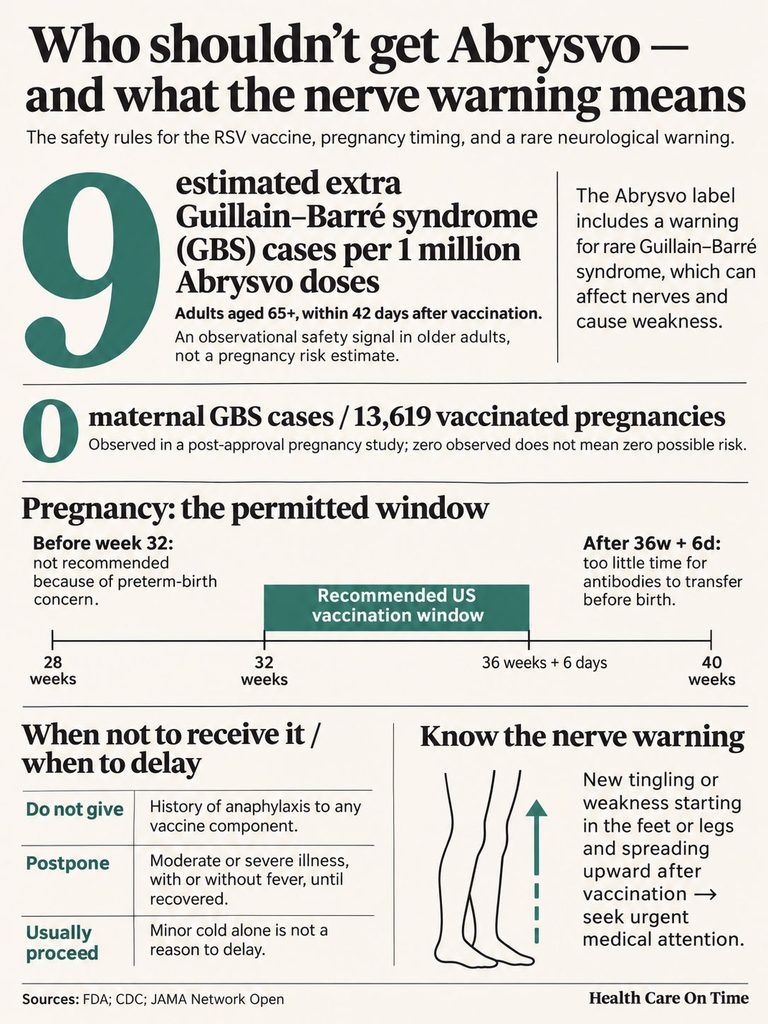
The Abrysvo label also carries a warning about Guillain-Barré syndrome (GBS), a rare nerve disorder that causes weakness. That warning comes from a study of Medicare beneficiaries aged 65 and older, which estimated about 9 extra cases per million doses in the 42 days after vaccination; even there, the evidence was judged insufficient to prove cause. No GBS cases were seen in the pregnancy trials, and the 2026 US health-plan study of 13,619 vaccinated pregnancies found no maternal GBS cases either.
Still, new weakness or tingling that starts in the feet or legs and moves upward, in the weeks after any vaccine, needs prompt medical attention.
When to Call Your Doctor After the Shot
Most RSV vaccine side effects in pregnancy need nothing more than rest and time. Call your OB, or get care right away for the urgent signs, if any of these happen:
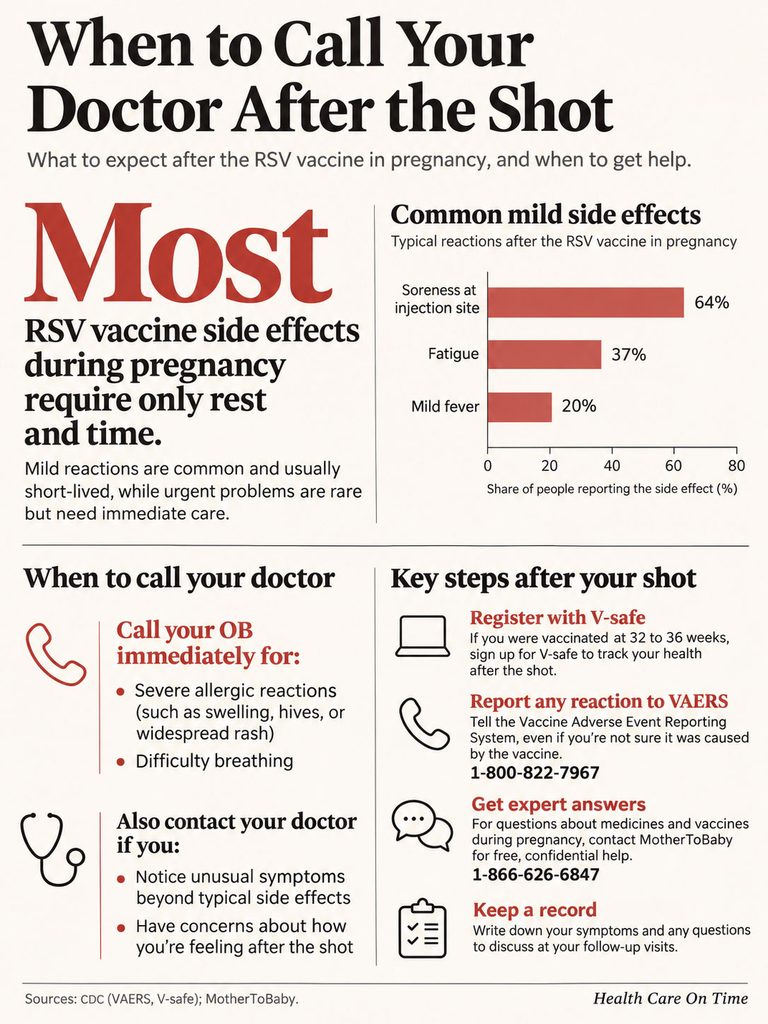
- A fever of 100.4°F or higher
- Arm redness or swelling that keeps spreading after day two or three
- Any symptom of an allergic reaction, such as hives, facial swelling or trouble breathing
- Contractions, fluid leaking, bleeding or fewer baby movements
- A severe or worsening headache, vision changes, or sudden swelling of the hands or face
Any reaction after vaccination can be reported to VAERS at 1-800-822-7967, even if you’re unsure the vaccine caused it. CDC also invites people vaccinated at 32 to 36 weeks to register with V-safe, which tracks how people feel after the shot. For questions about medicines and vaccines in pregnancy, MotherToBaby offers free, confidential help at 1-866-626-6847.
Why Some People Decide Against It
People who hold off on the shot are rarely against vaccines in general. Usually they’re worried about an early birth, unsure about a vaccine this new, or confused by federal headlines.
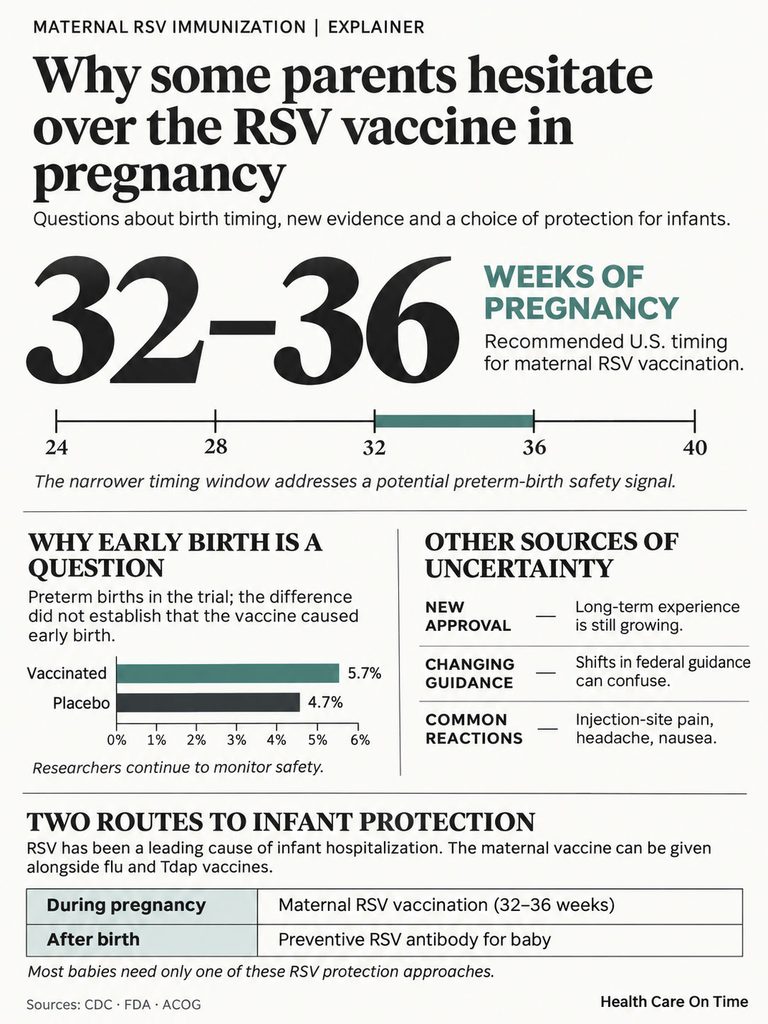
The early-birth worry has the most data behind it now, and the studies above address it directly. The blood pressure question is still open. The vaccine was first recommended in September 2023, so long-term follow-up is limited to the trial babies, as with any vaccine in its first years. The safety systems watching it (VAERS, V-safe and the Vaccine Safety Datalink) are the same ones used for flu and Tdap shots in pregnancy.
On federal guidance, the change was smaller than many headlines suggested. In January 2026, HHS released a revised childhood schedule that moved the infant RSV antibody from a recommendation for all babies to one for high-risk groups. A federal court stayed that schedule on March 16, 2026, so the earlier recommendation for nirsevimab remains in effect. The maternal vaccine recommendation itself was not changed. ACOG continues to recommend the vaccine and published its own 2026 to 2027 timing.
RSV itself is the leading cause of hospitalization among US infants, and the risk is highest in the first months of life, exactly the window the maternal vaccine covers. Against that, the open concern is a possible small rise in a blood pressure diagnosis that hasn’t been confirmed. For someone whose main worry is the pregnancy itself, planning the antibody for the baby protects the newborn without any vaccine during pregnancy.
Frequently Asked Questions
What Are the Side Effects of the RSV Vaccine While Pregnant?
The most common are pain at the injection site (40.6%), headache (31.0%), muscle pain (26.5%) and nausea (20.0%). Fatigue is frequent too, though placebo groups reported it almost as often. Most effects are mild and fade in 2 to 3 days.
How Long Do RSV Vaccine Side Effects Last in Pregnancy?
Usually 2 to 3 days from when they start. Anything getting worse after that, or starting more than a week later, needs its own explanation.
Can the RSV Vaccine Harm Your Unborn Baby?
No harm has shown up so far. The trial saw no rise in birth defects or fetal deaths, and newborn deaths were slightly fewer in the vaccine group. Low birth weight ran a little higher, in step with the small preterm gap. The baby never receives the vaccine, only your antibodies, which sharply cut severe RSV in the first months. Since approval, US studies haven’t found more preterm births, though research on maternal blood pressure goes on.
Can an RSV Shot Induce Labor?
There’s no evidence that it does. Large US studies found preterm birth rates no higher in vaccinated pregnancies, and the shot is limited to 32 through 36 weeks to avoid the earlier weeks where any risk would matter most.
If You Get the RSV Vaccine While Pregnant, Does Your Baby Need the Shot Too?
Usually not, as long as the baby is born at least 14 days after your vaccine. Babies born sooner than that, and babies of mothers vaccinated only in an earlier pregnancy, should get nirsevimab or clesrovimab. A few rare medical situations, such as a weakened maternal immune system or newborn heart surgery with bypass, may call for the antibody even when the mother was vaccinated on time.
What Is the Controversy About the RSV Vaccine in Pregnancy?
Two issues drive it. A different GSK candidate vaccine was stopped in 2022 for more preterm births, and Abrysvo’s own trial showed a small, non-significant preterm gap, which led the FDA to limit it to 32 through 36 weeks. Some US studies have also flagged a possible small rise in pregnancy-related high blood pressure, which is still under study. Changes in federal vaccine guidance in 2025 and 2026 added confusion, though the maternal vaccine recommendation was not changed.
Is Diarrhea a Side Effect of the RSV Vaccine in Pregnancy?
Probably not. In the trial, diarrhea showed up at almost exactly the same rate with the vaccine and with placebo, so a loose stomach the next day is more likely a pregnancy thing or a passing bug. Drink fluids, and call if it lasts or comes with fever or belly pain.
Can You Get the RSV Vaccine in a Second Pregnancy?
Not at this time. If you had it before, the plan for the new baby is the infant antibody after birth.
Why Would Someone Choose Not to Get the RSV Vaccine While Pregnant?
Usually because of the preterm and blood pressure questions, a history of early delivery, or a preference for the infant antibody, which protects the baby without any vaccine during pregnancy. Choosing the antibody instead is fully supported by CDC guidance. Ending up with neither leaves a newborn unprotected in the months when RSV hits hardest.
Is It Safe to Get the RSV Vaccine With the Flu Shot or Tdap?
Yes. The CDC allows Abrysvo at the same visit as flu, Tdap and COVID-19 vaccines.
Medical disclaimer: This article is for general information and does not replace advice from your obstetrician, midwife or pediatrician. Vaccine recommendations and labels change; check current guidance with your care team before making decisions about your pregnancy or your baby.
References
- Pfizer. ABRYSVO prescribing information, revised December 2025.
- US Food and Drug Administration. BLA clinical review memorandum, ABRYSVO, August 2023.
- CDC, Advisory Committee on Immunization Practices. Use of the Pfizer RSV vaccine during pregnancy. MMWR, October 13, 2023.
- CDC. Interim evaluation of RSV hospitalization rates among infants and young children after introduction of RSV prevention products. MMWR, 2025.
- CDC. Immunizations to protect infants, updated August 18, 2025.
- CDC. RSV vaccine guidance for pregnant women.
- CDC. RSV vaccine safety, updated July 11, 2025.
- CDC. Urgent maternal warning signs.
- Son M, et al. Nonadjuvanted bivalent RSV vaccination and perinatal outcomes. JAMA Netw Open, 2024.
- Michnick AI, et al. Sequential safety surveillance of RSVpreF vaccination during pregnancy early in the postapproval period. JAMA Netw Open, 2026.
- Healio. More data support RSV vaccination during pregnancy (IDWeek 2026 interim data), November 4, 2026.
- Palmero M, et al. Side effects associated with RSVpreF maternal vaccination: a scoping review. Cureus, 2025.
- MDedge. Risk for preterm birth stops maternal RSV vaccine trial, March 2024.
- Immunize.org. How ACOG’s RSV recommendations for 2026–27 differ from CDC’s, reviewed November 8, 2026.
- Congressional Research Service. Changes to CDC vaccine recommendations in 2025 and 2026, updated July 29, 2026.