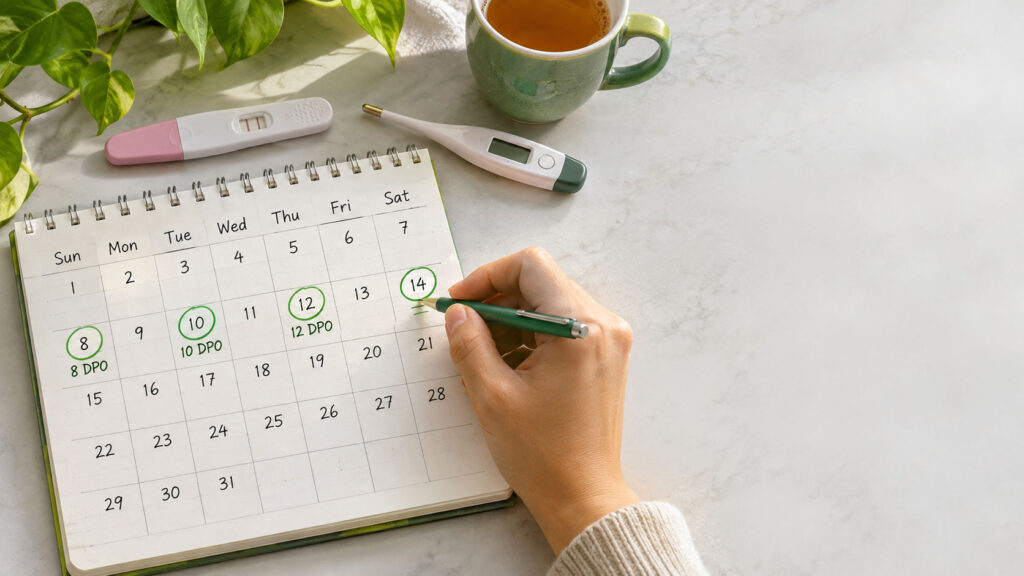
Some early signs of pregnancy can show up before a missed period, but most of them overlap with PMS, and none of them can confirm a pregnancy on its own. What separates them is timing, counted in days past ovulation (DPO).
Table of Contents
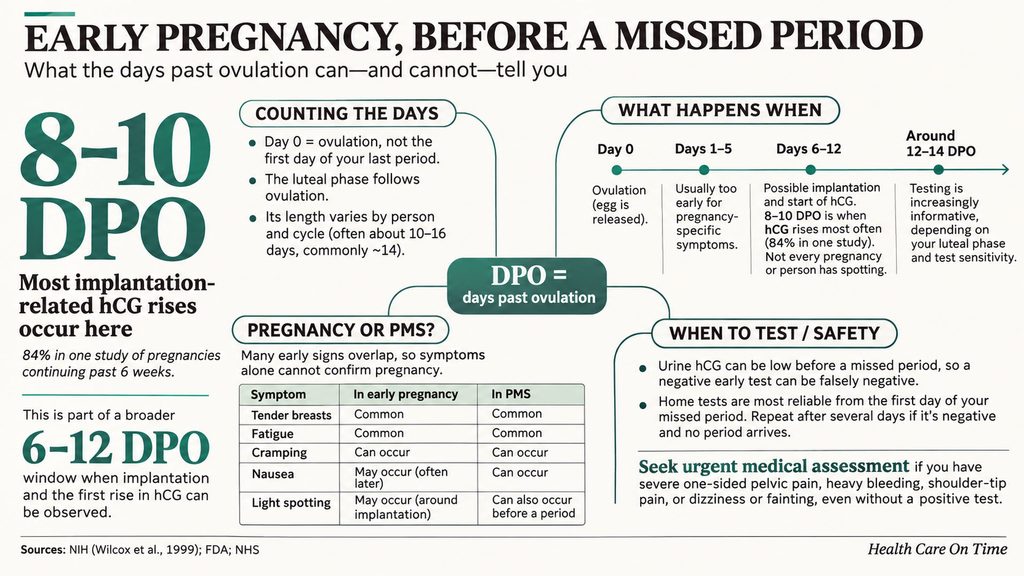
Quick answer: The earliest signs, such as light spotting, mild cramps, sore breasts and tiredness, can start around 10 to 14 days past ovulation, when implantation usually finishes and hCG starts rising. Most of them also happen before a normal period. Nausea tends to start later, often after the period is due. A home pregnancy test is the only reliable check at home; it becomes useful on the day of your missed period and is most reliable 1 to 2 weeks after.
Why early pregnancy and PMS feel so much alike
After you ovulate, the empty follicle in your ovary becomes the corpus luteum and starts making progesterone. That happens in every ovulatory cycle, whether or not an egg was fertilized. Progesterone can make your breasts tender, slow your gut down, leave you bloated and make you feel tired, so the second half of any cycle already comes with a built-in set of symptoms that look a lot like “early pregnancy.”
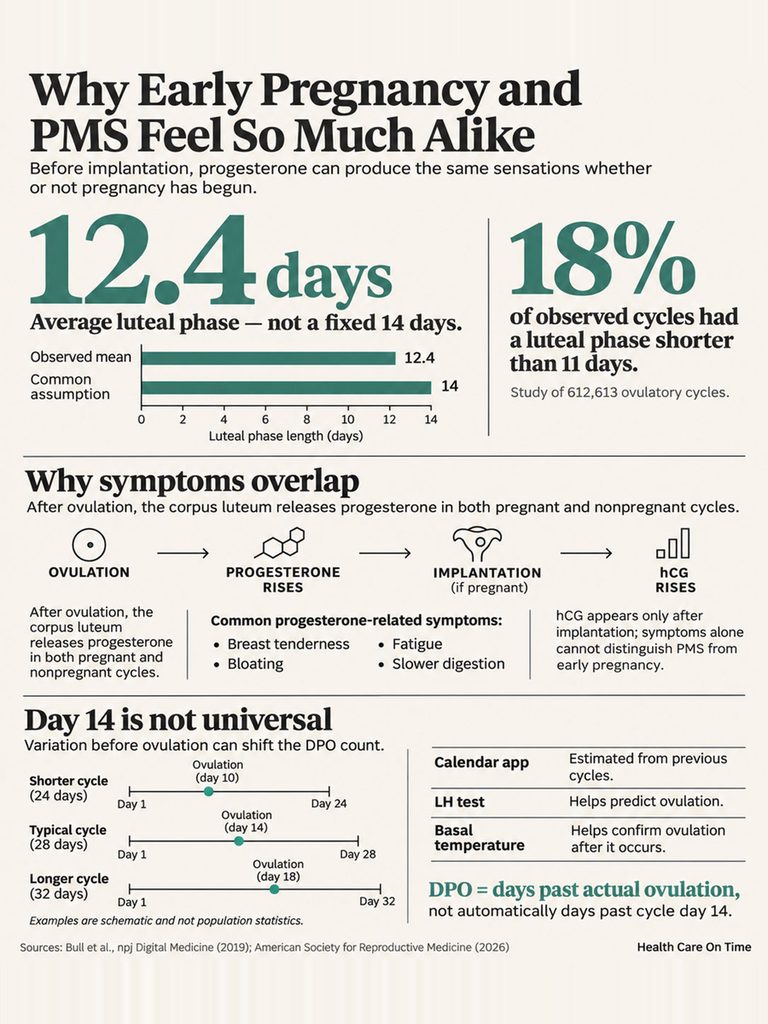
Pregnancy only changes the picture once the embryo implants in the uterine lining and starts making human chorionic gonadotropin (hCG). hCG tells the corpus luteum to keep making progesterone instead of shutting down, which is why the period doesn’t arrive. Before implantation, a pregnant body and a non-pregnant body are running on almost the same hormones.
The luteal phase, the stretch between ovulation and your period, is also shorter and less predictable than the textbook 14 days. Across more than 600,000 cycles logged in a cycle-tracking app study, it averaged 12.4 days, and 18% of cycles had a luteal phase under 11 days. Only 13% of the cycles were exactly 28 days long.
Counting DPO when your cycle isn’t 28 days
Every DPO number in this guide starts from ovulation, not from the first day of your last period. People with longer cycles ovulate later: in that same data set, the time from the start of the period to ovulation averaged 12.4 days in 21- to 24-day cycles, 15.2 days in 25- to 30-day cycles and 19.5 days in 31- to 35-day cycles. If your cycles run 33 days and you assume you ovulated on day 14, your “10 DPO” may really be 4 or 5 DPO, which is far too early for any pregnancy hormone.
A temperature rise on a basal body temperature chart or a positive ovulation (LH) test gives you a real day zero. Without either one, go by how late your period is. A period-tracking app that only knows your bleeding dates is estimating ovulation from your past cycles, so the DPO number it shows you is a rough guess rather than a measurement.
The day-by-day DPO timeline
Implantation doesn’t happen on a set day. When 221 women trying to conceive collected a urine sample every day, the pregnancies that continued had implanted anywhere from 6 to 12 days after ovulation, with 84% landing on days 8, 9 or 10. Counting every conception in that data, not just the ones that continued, 54% had implanted by day 9 and 46% on day 10 or later.
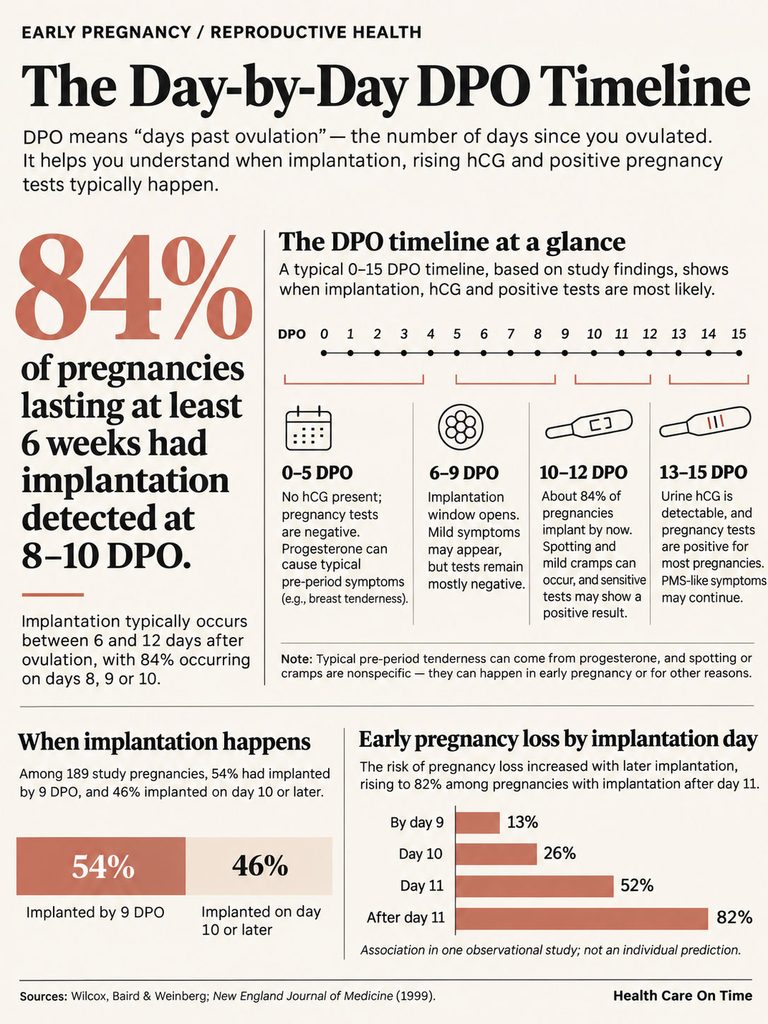
hCG appears right after. A 2021 cohort of 256 women trying to conceive found the first hCG rise came a median of 9 days after ovulation, and 88% had it within 8 to 10 days. Levels start tiny and roughly double every few days, so urine tests lag a few days behind.
| Days past ovulation | What’s happening | Signs you might notice | What a home test can show |
| 0-5 DPO | Egg is fertilized or not and travels down the tube; no implantation yet; progesterone rises in every ovulatory cycle | Breast tenderness, bloating or tiredness from progesterone, identical in pregnant and non-pregnant cycles | Negative; no hCG is being made |
| 6-9 DPO | Implantation window opens (6 to 12 DPO); 54% of conceptions have implanted by day 9 | Most people feel no different; a few notice light spotting or mild cramps | Almost always negative; median hCG rise is day 9 |
| 10-12 DPO | 84% of continuing pregnancies implanted on days 8 to 10; implantation bleeding usually falls at 10 to 14 DPO | Pink or brown spotting, mild cramps, sore breasts, tiredness; nausea starts for some | A very sensitive test is sometimes positive; many are still negative |
| 13-15 DPO | Period is due for many people; urine hCG is detectable 12 to 15 days after ovulation in a 28-day cycle | PMS-like symptoms continue past the expected start of the period | Positive in most pregnancies with a sensitive test; 10 to 20 of every 100 are still negative on the first day of a missed period |
| 16-21 DPO | Period is late; hCG keeps climbing | Nausea is more common (median onset 16 DPO); a basal temperature that stays high 18 or more days | Reliable; the FDA calls 1 to 2 weeks after a missed period the most reliable window |
Anything you feel at 3 or 5 DPO can’t come from a pregnancy hormone, because there is no hCG in your body yet. Pregnancy-specific changes become possible around 10 DPO, which is almost exactly when a period would be getting ready to start anyway.
Timing also matters for how a pregnancy goes. About a quarter of those pregnancies (48 of 189) ended within six weeks of the last menstrual period. Losses were 13% when implantation happened by day 9 and 26% at day 10, then jumped to 52% at day 11 and 82% after that. A faint positive that fades a few days later, often called a chemical pregnancy, can be this kind of very early loss.
Early signs that can show up before a missed period
None of these is required. Plenty of people with healthy pregnancies notice nothing at all until the period is late, and plenty of people notice every one of them in a month they turn out not to be pregnant.
Light spotting (implantation bleeding)
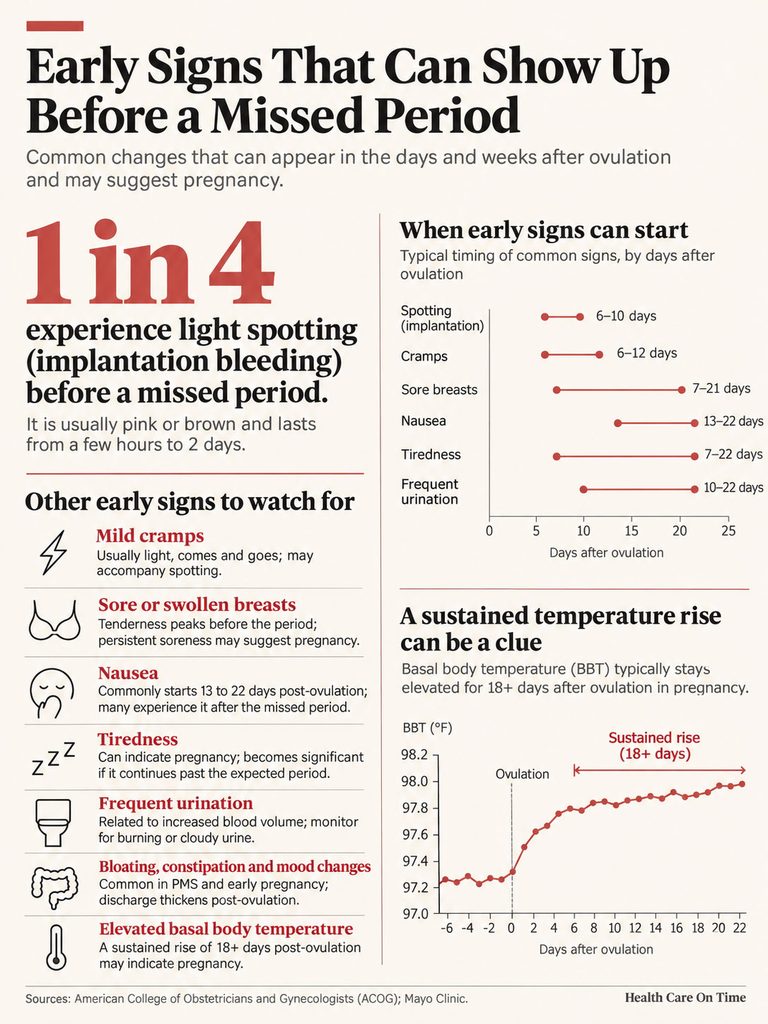
About 1 in 4 pregnant people get implantation bleeding, usually 10 to 14 days after ovulation, right when a period might start, so mixing the two up is easy.
The bleeding is usually pink, brown or dark brown and very light. It may need a panty liner but shouldn’t soak a pad or contain clots, and it lasts from a few hours to about two days. Bright red flow that gets heavier, or bleeding with clots, points to a period or something else. A period usually picks up over its first several hours while implantation bleeding stays light, so watching it for about four hours tells you more than the color does.
Don’t test during the spotting, because hCG is still low then and the result will probably be negative even if you are pregnant.
Mild cramps
Cramping can come along with implantation bleeding. It’s usually mild, comes and goes over a few days and feels lighter than period cramps. On its own it’s hard to read, because cramping after ovulation happens in plenty of cycles with no pregnancy.
Sore or swollen breasts
People read a lot into sore breasts, yet a Canadian study that followed 53 women through 720 cycles found breast tenderness and swelling peaked in the late luteal phase, just before the period, and scored higher in normally ovulating cycles. Sore breasts at 10 DPO usually mean you ovulated well. What points toward pregnancy is soreness that hasn’t let up by the time your period was due.
Nausea
Nausea usually arrives later than people expect. In the 2021 cohort, the median start was 16 days after ovulation, around or just after the missed period for many women; half had their first symptoms between 13 and 22 days after ovulation, and almost all of them (94.1%) had some nausea or vomiting eventually.
Queasiness at 12 or 13 DPO does happen. A wave of nausea at 4 DPO has no pregnancy hormone behind it yet and is more likely tied to food, stress or a stomach bug.
Not feeling sick at 12 DPO doesn’t mean much either. Across whole pregnancies, 70 to 85 percent of pregnant women get nausea and vomiting at some point in the first nine weeks, which leaves a real share who never feel sick and many who start only after the period is late.
Tiredness
If you’re 11 DPO and wiped out, it could be pregnancy, PMS or just a short night. Pregnancy fatigue can begin as early as one week after conception, but tiredness is also one of the most common PMS complaints. It becomes more telling only if it carries on past the day your period should have come.
Peeing more often
Needing the bathroom more often is tied to the rise in blood volume in pregnancy. It’s one of the vaguer signs, because drinking more, cold weather, caffeine and simple attention to your body can all make you notice it. Burning, urgency or cloudy urine point more toward a urinary tract infection, which needs a call to your provider either way.
Bloating, constipation, mood and discharge
Progesterone relaxes smooth muscle, the gut included, so bloating and constipation are common in the second half of any cycle and in early pregnancy. Loose stools are a different story, since the prostaglandins released right before bleeding speed the gut up, which makes diarrhea a more typical period sign than a pregnancy one. Mood swings and irritability turn up in both situations. Discharge also thickens after ovulation whether or not you conceived, so the white, creamy discharge many people notice before a period can’t tell you much either way.
A temperature that stays high
Basal body temperature (BBT) rises slightly after ovulation, usually by less than half a degree Fahrenheit (0.3°C), and drops back around the time the period starts. A rise that lasts 18 or more days after ovulation may be an early sign of pregnancy. BBT is one of the few home signals tied to an actual day count, though illness, fever and some medicines can throw readings off, and most people need a few cycles of charting before their BBT chart patterns make sense.
Smell, taste and food changes
Some people notice smells they used to ignore, or suddenly can’t face coffee or meat. Those aversions are real early pregnancy symptoms. Cravings are harder to read, since they’re a classic PMS complaint too. A metallic taste and a sense of simply “feeling pregnant” get mentioned a lot during the two-week wait, but neither is tied to a day count or a hormone level the way spotting or a BBT rise is, and both are easy to talk yourself into after a week of watching every twinge.
Pregnancy or PMS: how to tell them apart
PMS is common. Almost 50% of people who menstruate report at least one PMS symptom, about 20% of those have symptoms that disrupt daily life, and about 3% have the more severe premenstrual dysphoric disorder (PMDD). PMS starts in the second half of the cycle and usually clears up 1 to 2 days after the period begins.
Pregnancy symptoms, by contrast, keep going, and often build, after the date the period was due; before that date, symptoms alone can’t settle the question.
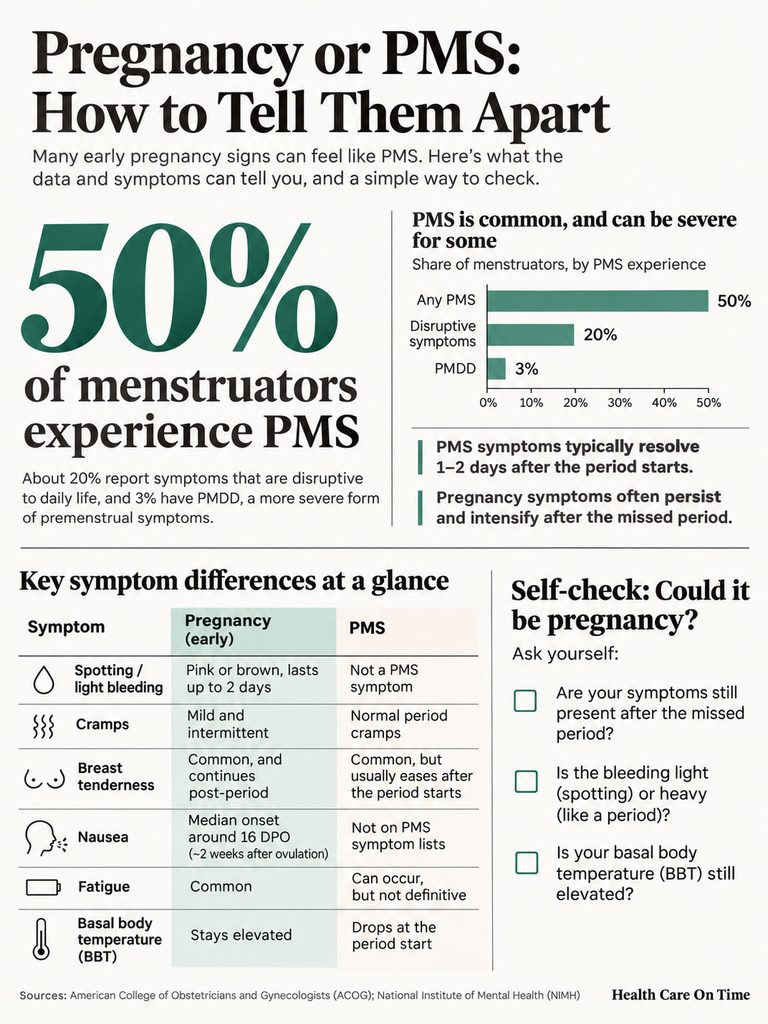
| Sign | In early pregnancy | With PMS | What actually helps tell them apart |
| Spotting or light bleeding | About 1 in 4; usually 10 to 14 DPO; pink or brown, light, up to about 2 days | Not a PMS symptom, though some people spot right before a period | Amount and color: a flow that turns red and heavier is a period |
| Cramps | Mild, come and go, around implantation | Pelvic pain and cramps are common | Cramps that turn into a normal period settle the question |
| Breast tenderness | Common; continues past the missed period | Peaks in the late luteal phase in normal ovulatory cycles | Whether it keeps going after the period was due |
| Nausea | Median onset about 16 DPO | Not on standard PMS symptom lists | Timing: nausea that starts around or after the missed date leans toward pregnancy |
| Fatigue | Can start about a week after conception | Very common | Doesn’t help on its own |
| Bloating, constipation | Common from progesterone | Common | Doesn’t help on its own |
| Mood swings, irritability | Common | Common; PMDD in about 3% | Doesn’t help on its own |
| Food cravings or aversions | Aversions and smell changes are typical | Cravings are typical | Doesn’t settle it; cravings fit both |
| BBT | Stays high 18 or more days after ovulation | Drops around the start of the period | The most date-specific at-home clue |
Before you test, it’s worth asking yourself a few plain questions. Has the day your period was due come and gone with the symptoms still there? Is any bleeding still light and brownish, or has it turned into a real flow? Is your temperature still up?
No single physical sign is certain, either. Every symptom above has a non-pregnancy explanation, plenty of pregnancies have no early symptoms at all, and even a missed period can come from stress, hard training or a hormone imbalance. A positive pregnancy test is as close to certain as you can get at home.
When a home pregnancy test will be accurate
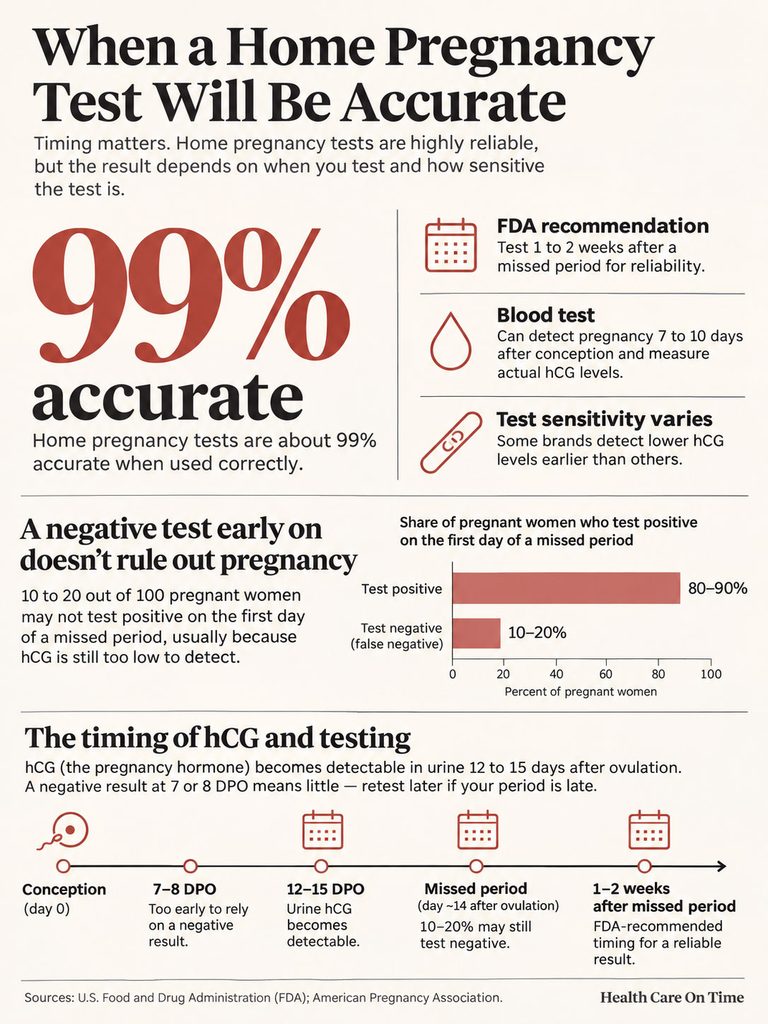
Used correctly, home pregnancy tests are about 99% accurate (manufacturers cite 98% to 99%). That figure assumes you test at the right time. Nearly all wrong results are false negatives from testing too early, and a positive read within the instructed time is far more trustworthy than an early negative.
Why early tests miss so many pregnancies
In a 28-day cycle, urine hCG becomes detectable 12 to 15 days after ovulation, and 10 to 20 out of every 100 pregnant women won’t see a positive on the first day of a missed period. That’s why the FDA’s home test guidance points to 1 to 2 weeks after a missed period as the most reliable time.
The hCG level at the missed period can be very low. To catch 95% of pregnancies on that day, a test has to detect about 12.4 mIU/mL, and only one of the 18 brands checked in a 2004 lab study could do that; one, two and three days later, the level needed for the same coverage had climbed to 21, 35 and 58 mIU/mL.
| What was measured | Number | Source |
| Implantation timing in continuing pregnancies | 6 to 12 DPO; 84% on days 8 to 10 | Wilcox et al., New England Journal of Medicine, 1999 (221 women) |
| Conceptions implanted by day 9 | 54% | Jukic et al., Human Reproduction, 2011 |
| First hCG rise after ovulation | Median day 9; 88% within days 8 to 10 | Gadsby et al., BMC Pregnancy and Childbirth, 2021 |
| Pregnant people with implantation bleeding | About 1 in 4 | Cleveland Clinic |
| Pregnant women with a negative home test on the first day of a missed period | 10 to 20 of every 100 | FDA |
| hCG level needed to detect 95% of pregnancies at the missed period | 12.4 mIU/mL | Cole et al., American Journal of Obstetrics and Gynecology, 2004 |
| Pregnancies detected on the day of the expected period, six home tests | 97% (5.5 mIU/mL tests) vs 54% to 67% (22 mIU/mL tests) | Clinical Chemistry and Laboratory Medicine, 2011 |
| Nausea or vomiting onset after ovulation | Median 16 days | Gadsby et al., BMC Pregnancy and Childbirth, 2021 |
| People who menstruate reporting at least one PMS symptom | Almost 50% | Cleveland Clinic |
Brands don’t all work the same
Sensitivity varies a lot. When six over-the-counter tests were run on urine from 120 pregnancies in 2011, First Response manual and digital tests detected 5.5 mIU/mL and picked up 97% of pregnancies on the day the period was expected, while EPT and Clearblue tests needed 22 mIU/mL and caught 54% to 67%. Products get reformulated, so use those numbers as a guide to the range rather than a current ranking, and check the sensitivity printed on the package insert.
What a negative result means at each point
At 7 or 8 DPO, a negative tells you almost nothing. In most pregnancies hCG has only just started to rise, and urine levels are usually still too low for a home test to read.
On the day your period is due, a negative carries more weight, but a real share of pregnancies still won’t show yet. Treat it as tentative and test again in several days if your period hasn’t started. If you’re a full week late and still negative, pregnancy becomes much less likely; test once more the following week, and if the period still hasn’t come, see your provider, because a late period has other causes worth finding.
If you test early anyway, pick a test with a low detection threshold (the mIU/mL number on the insert) and plan on a second test before you trust the first.
Getting a result you can trust
- Test with your first urine of the morning when it’s early days, since that’s when hCG is most concentrated. Later in the day, wait at least three hours since you last urinated, and skip the big glass of water beforehand.
- Read the result within the time on the instructions, which for most tests means before 10 minutes. A line that appears after that can be an evaporation line, and telling a faint line from an evaporation line gets hardest in exactly this early window.
- Check the date on the box before you use it.
- Negative but still no period? Repeat it after several days; hCG rises quickly in early pregnancy.
Most medicines, including antibiotics and pain relievers, don’t change the result. Fertility medication that contains hCG is the main exception, since it can cause a false positive.
Blood tests
A blood test is slightly more sensitive and can pick up pregnancy about 7 to 10 days after conception. Most people only get one during fertility treatment or when something seems off, and it has one advantage over a urine stick: it measures the actual hCG level, so a clinician can watch whether it’s rising as it should.
What to do next
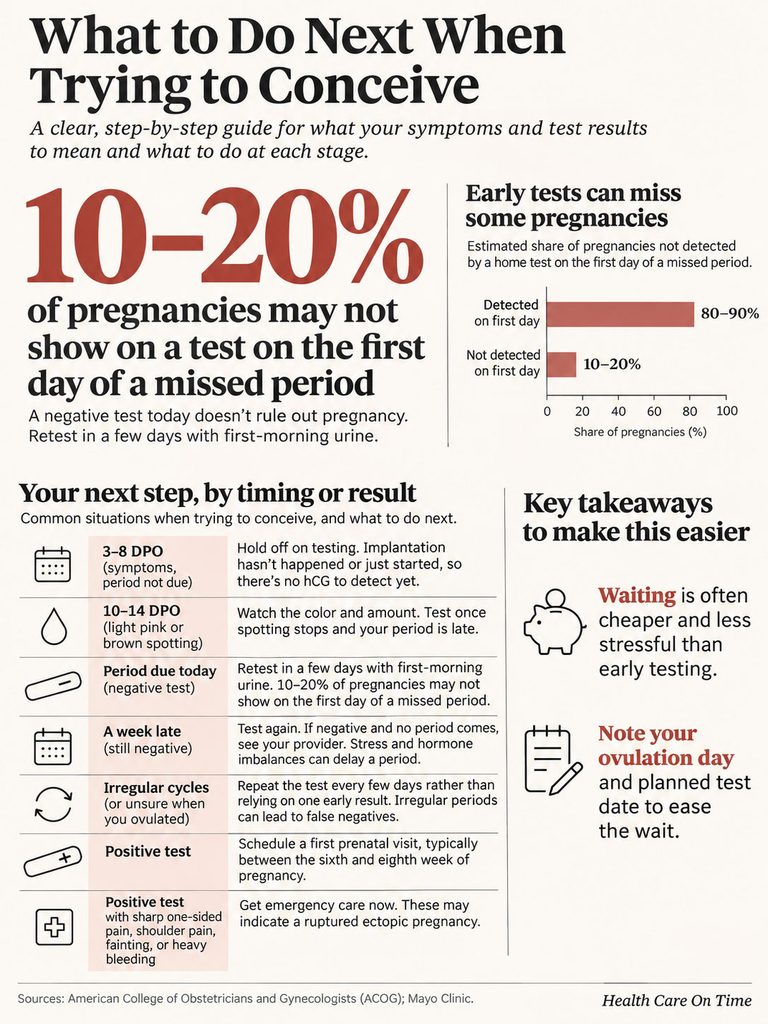
| Your situation | What to do | Why |
| Symptoms at 3 to 8 DPO, period not due yet | Hold off on testing | Implantation hasn’t happened or has just started, so there’s no hCG to detect |
| Light pink or brown spotting around 10 to 14 DPO | Watch the color and amount; test once the spotting stops and your period is late | hCG is still low during implantation bleeding, so an early test is likely negative |
| Period due today, negative test | Retest in a few days with first-morning urine | 10 to 20 of every 100 pregnancies don’t show on the first day of a missed period |
| Period a week late, still negative | Test once more; if it’s negative again and no period comes, see your provider | Stress, too much exercise and hormone imbalances can delay a period |
| Irregular cycles or no idea when you ovulated | Repeat the test every few days rather than relying on one early result | Irregular periods are a common reason for false negatives |
| Positive test | Schedule a first prenatal visit | The first visit usually happens between the sixth and eighth week of pregnancy |
| Positive test with sharp one-sided pain, shoulder pain, fainting or heavy bleeding | Get emergency care now | These can be signs of a ruptured ectopic pregnancy |
If you’re trying to conceive, the first two rows are the hardest to follow. Waiting is still cheaper and less stressful than a run of early negatives, and a calendar note with your ovulation day and planned test date makes the second half of the cycle easier to get through than checking for symptoms every morning.
When to call a doctor right away
Two problems need prompt care once you know or suspect you’re pregnant.
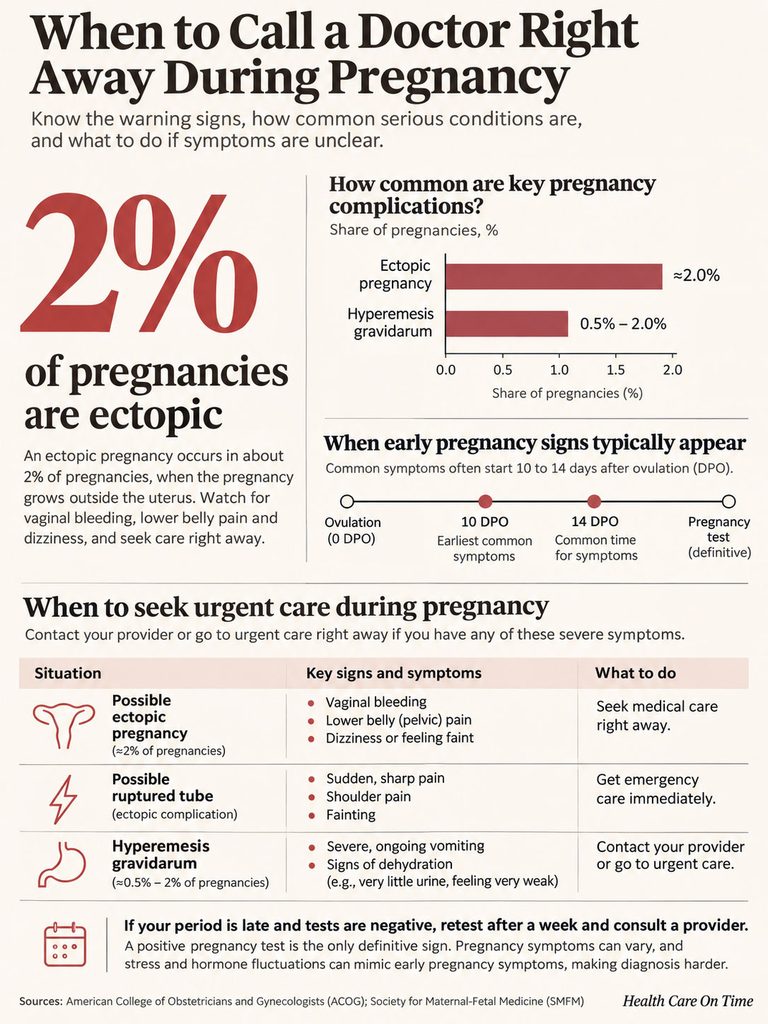
An ectopic pregnancy, where the embryo implants outside the uterus, happens in about 2% of pregnancies, nearly always (about 90%) in a fallopian tube. Early on it can feel like any other pregnancy. Warning signs include vaginal bleeding, pain in the lower belly, pelvis or lower back, and dizziness or weakness, while sudden sharp pain, shoulder pain, fainting or rectal pressure can mean the tube has ruptured, which is a medical emergency.
Severe vomiting is the other thing not to sit on. Hyperemesis gravidarum, the extreme form of pregnancy sickness, affects about 0.5 to 2 percent of pregnancies and can leave you dehydrated.
Call your provider or go to urgent care if you have:
- Bleeding that soaks a pad or comes with clots
- Cramping that is severe or stays on one side
- A positive test plus dizziness, fainting or shoulder pain
- Vomiting so frequent that you can’t keep fluids down
Frequently Asked Questions
How do I tell if I’m pregnant before my missed period?
You can’t know for sure from how you feel, because spotting, cramps, sore breasts and tiredness all show up before ordinary periods too. Watch for signs that start around 10 to 14 DPO and are still there after your period was due, or a BBT that stays high for 18 or more days after ovulation. Then confirm with a sensitive home test on the day your period is due, repeated a few days later if it’s negative.
Are there any 100% signs of pregnancy before a missed period?
There aren’t any. Only a positive pregnancy test, ideally confirmed by your provider, settles it.
How soon after ovulation can pregnancy symptoms start?
Symptoms caused by hCG can only begin after implantation, 6 to 12 days after ovulation, and hCG itself usually starts rising around day 9. Most people feel nothing different before about 10 DPO. Nausea, the sign people wait for, most often begins after 13 DPO.
Can early pregnancy show on your face?
Nothing reliable before a missed period. Acne flare-ups are a common PMS symptom, so a pre-period breakout points neither way. Melasma, the brown patches on the cheeks, forehead or upper lip known as the “mask of pregnancy,” affects 15% to 50% of pregnant women, but it’s tied to the hormone levels of later pregnancy, long after the days before a missed period.
How does your stomach feel in very early pregnancy?
Often bloated, mildly crampy or constipated, much like before a period, because progesterone slows digestion. Some people also get waves of queasiness around or after the missed period. Sharp or one-sided pain isn’t typical and should be checked.
Can you be pregnant and feel completely normal?
Yes. Many people notice nothing until well after the missed period, and some never feel sick at all.
If it’s implantation bleeding, will a test be positive?
Probably not yet. hCG is still low while the spotting is happening, so a test that day is likely to be negative even in a pregnancy. Wait until the spotting has stopped and your period is late.
How many days before a missed period can a pregnancy test work?
The most sensitive tests can sometimes turn positive before the period is due, but many pregnancies won’t show that early. From the day of the missed period onward, results are far more reliable.
Can you get a positive pregnancy test at 8 DPO?
It’s possible but uncommon. hCG usually starts rising around day 9 after ovulation, and in a 28-day cycle it typically becomes detectable in urine at 12 to 15 DPO. A negative at 8 DPO rules nothing out.
Can stress cause pregnancy-like symptoms and a late period?
Yes, on both counts. Stress can delay a period, as can intense exercise and hormone problems, which is why a missed period alone doesn’t prove pregnancy. Fatigue, poor sleep, irritability and an upset stomach are on PMS symptom lists too, so a stressful second half of the cycle can feel a lot like early pregnancy. If your period is late and tests stay negative, give it a week, test again and talk to your provider if it still doesn’t come.
Medical disclaimer: This article is for general information and does not replace advice from a doctor, nurse practitioner or midwife. If you have heavy bleeding, severe pain, fainting or shoulder pain, seek emergency care. For questions about a positive or unclear test, contact your health care provider.
References
- Bull JR, et al. Real-world menstrual cycle characteristics of more than 600,000 menstrual cycles. npj Digital Medicine, 2019.
- Wilcox AJ, Baird DD, Weinberg CR. Time of implantation of the conceptus and loss of pregnancy. New England Journal of Medicine, 1999.
- Jukic AMZ, Weinberg CR, Baird DD, Wilcox AJ. The association of maternal factors with delayed implantation and the initial rise of urinary human chorionic gonadotrophin. Human Reproduction, 2011.
- Gadsby R, et al. The onset of nausea and vomiting of pregnancy: a prospective cohort study. BMC Pregnancy and Childbirth, 2021.
- Wood M, Shirin S, Goshtasebi A, Prior JC. Breast tenderness and swelling experiences related to menstrual cycles and ovulation in healthy premenopausal women. PLOS ONE, 2025.
- Miller KE. Tips from Other Journals: accuracy of home pregnancy tests at the time of missed menses (Cole LA, et al., Am J Obstet Gynecol 2004). American Family Physician, 2004.
- The utility of six over-the-counter (home) pregnancy tests. Clinical Chemistry and Laboratory Medicine, 2011.
- U.S. Food and Drug Administration. Pregnancy (home use tests).
- Cleveland Clinic. Am I Pregnant?
- Cleveland Clinic. Implantation Bleeding
- Cleveland Clinic. Home Pregnancy Test
- Cleveland Clinic. PMS (Premenstrual Syndrome)
- Cleveland Clinic. Ectopic Pregnancy
- Cleveland Clinic. Melasma
- MedlinePlus. Premenstrual syndrome
- Mayo Clinic. Symptoms of pregnancy: What happens first
- Mayo Clinic. Basal body temperature for natural family planning
- Johns Hopkins Medicine. 10 Early Signs of Pregnancy
- Torrey B. Practice Guideline Briefs: ACOG releases guidelines on nausea and vomiting of pregnancy. American Family Physician, 2004.