
For measles and rubella, two documented MMR doses are treated as lifelong protection, and US guidance recommends no routine booster for adults. Mumps is the exception. Protection against it fades over time, and that’s why some adults get an extra dose during outbreaks.
Table of Contents
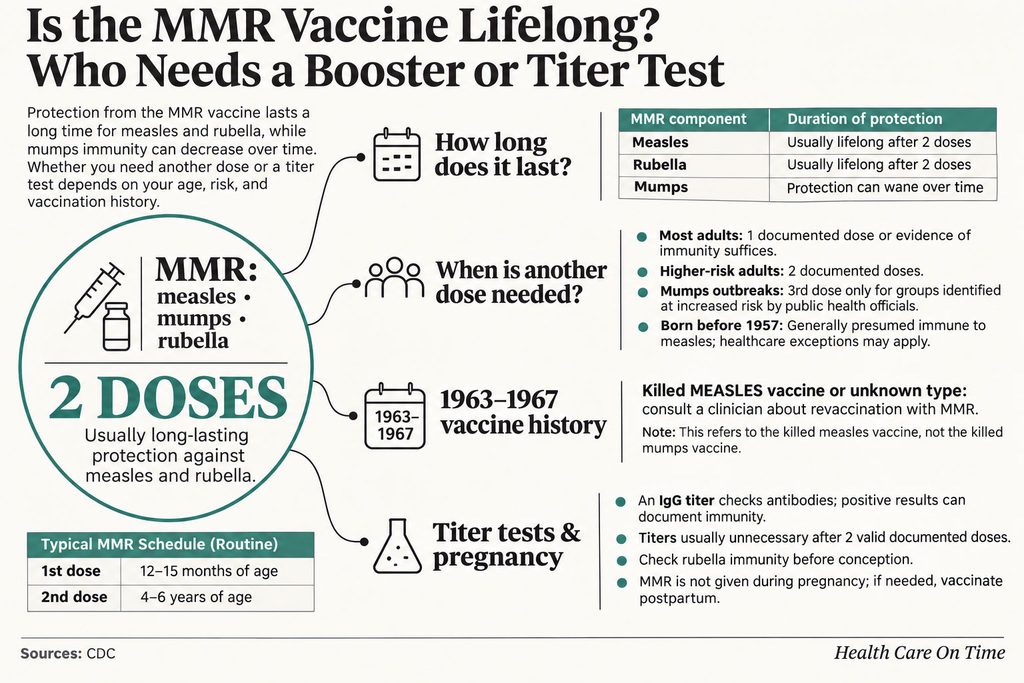
Quick Answer: Yes, for most people. CDC considers two documented MMR doses given at age 12 months or older to be lifelong protection against measles, and no adult booster is recommended. One dose of the rubella component protects about 97% of people, with no sign that protection weakens enough to matter. Mumps immunity does fade, so a third dose is advised only for groups that public health officials name during a mumps outbreak.
Most adults vaccinated as children need nothing more. What can change that is your birth year, missing paperwork, a dose of the failed 1960s killed vaccine, or a job, school or pregnancy plan that calls for proof of two doses.
How Long MMR Protection Lasts for Each of the Three Viruses
MMR is one shot carrying three separate live, weakened viruses, and your body builds a separate defense against each one. Because the viruses are live, they copy themselves a little after the injection, which trains the immune system much the way a mild natural infection would, and that is a large part of why a childhood series can last into old age. Unlike the flu vaccine, which is reformulated and given again every season because the virus keeps changing, MMR is a childhood series meant to cover you for good. The three parts don’t age the same way, though. Measles and rubella protection holds up for decades in almost everyone who responds to the vaccine, while mumps protection is weaker from the start and drops further with time.
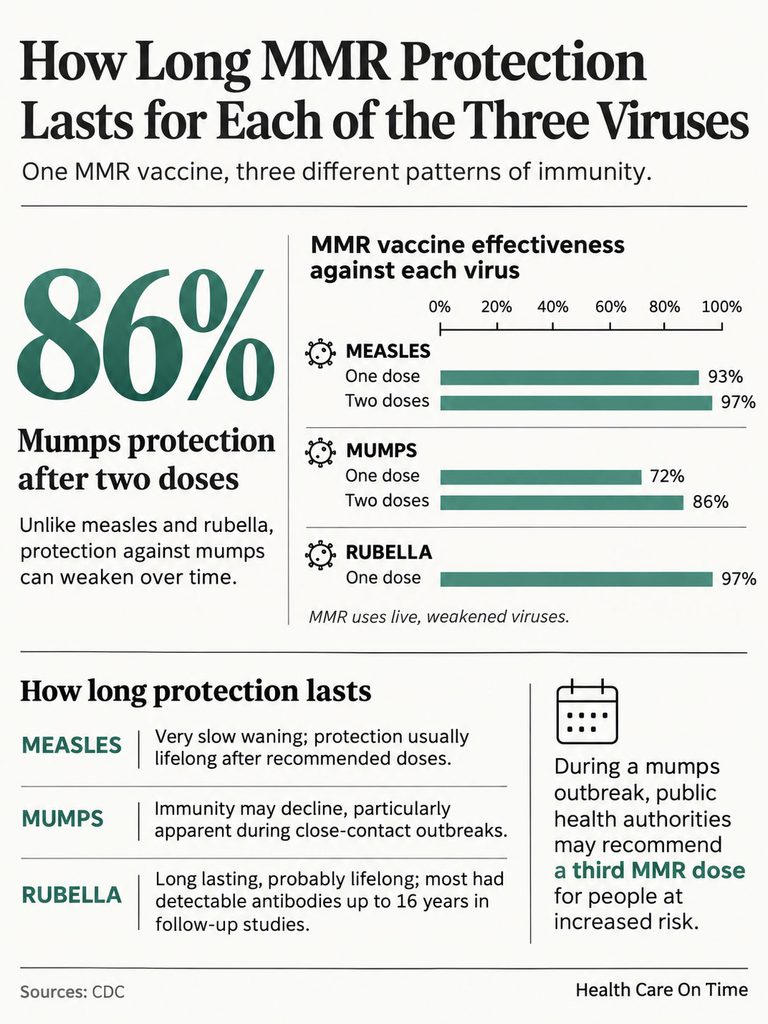
| Measure | Measles | Mumps | Rubella |
| Protection after 1 dose | 93% | 72% | 97% |
| Protection after 2 doses | 97% | 86% | Not listed separately; one dose is the rubella standard |
| Antibodies in long-term follow-up | About 95% still had antibodies 11 years after vaccination | 74% to 95% still had antibodies over 12 years after 2 doses, with levels falling | Most people still had antibodies up to 16 years after 1 dose |
| Evidence of waning | Very slow: about 0.039% per year in an England model | Yes, clearly seen in close-contact outbreaks | ACIP found no waning that raises disease risk |
| Routine adult booster | No | No | No |
| When an extra dose is advised | Killed or unknown-type vaccine before 1968; 2 doses for healthcare workers, college students and travelers | A third dose if public health officials name your group during an outbreak | One more dose if rubella IgG is unclear and you could become pregnant |
Measles
Two doses of MMR are 97% effective at preventing measles, and one dose is 93% effective. The second dose was never meant as a booster in the usual sense. It exists to catch the small group of people whose immune systems didn’t respond to the first shot, which is why someone who responded once is expected to stay protected.
People who got two doses at 12 months or older are considered protected for life and don’t need a booster dose for measles. Antibody follow-up in the 2013 ACIP recommendations, still the full US reference document for MMR, fits that picture: about 95% of vaccinated people still had measles antibodies 11 years after their first dose. High two-dose coverage is also what let the United States declare endemic measles eliminated in 2000, and rubella along with congenital rubella syndrome in 2004.
Lifelong still leaves a small gap, since roughly 3 in 100 people with two doses can catch measles after an exposure.
Mumps: the part that fades
One dose of the mumps component prevents mumps about 72% of the time and two doses about 86% of the time, with a wide range across studies (32% to 95%). Antibodies fall as well. In the ACIP review, 74% to 95% of two-dose recipients still had detectable mumps antibodies over 12 years of follow-up, though their levels declined over that period.
Where that decline shows up is in close-contact outbreaks, and a 2015 to 2016 outbreak at the University of Iowa made it measurable. Before the outbreak, 98.1% of the 20,496 enrolled students had at least two MMR doses, and 259 students still got mumps; those whose second dose was 13 or more years earlier had more than nine times the risk. During the outbreak, 4,783 students took a third dose, and their attack rate was 6.7 per 1,000 compared with 14.5 per 1,000 among those with two doses, a 78.1% lower risk after adjusting for time since the second shot (New England Journal of Medicine, 2017).
In 2017, ACIP voted unanimously that people with two doses who are identified by public health authorities as part of a group at increased risk during a mumps outbreak should get a third dose of a mumps-containing vaccine. No serious adverse events turned up among 14,368 people who received a third MMR dose. Protection against severe mumps holds even as protection against infection wanes, but nobody yet knows how long the extra boost from a third dose lasts, and limited evidence suggests antibody levels drop within about a year after it.
Mumps outbreaks cluster where people live and socialize in close quarters, such as dorms, sports teams and tight-knit communities, and that heavy, repeated contact can overwhelm immunity that holds up fine in everyday life.
Rubella
One dose of rubella vaccine is about 97% effective (range 94% to 100%). US guidance treats a single dose as enough for rubella, even though nearly everyone ends up with two because rubella travels inside the same shot as measles and mumps.
Rubella antibodies do drift down over the years. In the ACIP data, most people still had detectable antibodies up to 16 years after one dose, and the committee found no sign that the slow decline leaves people open to catching rubella. A borderline rubella result matters mainly for people who could become pregnant, because rubella during pregnancy can cause miscarriage and serious birth defects.
Do MMR Antibodies Fade Over the Years?
Measles antibodies do decline a little, very slowly, and the small gap that creates shows up mostly in large outbreaks rather than as a reason for individual adults to get a booster.
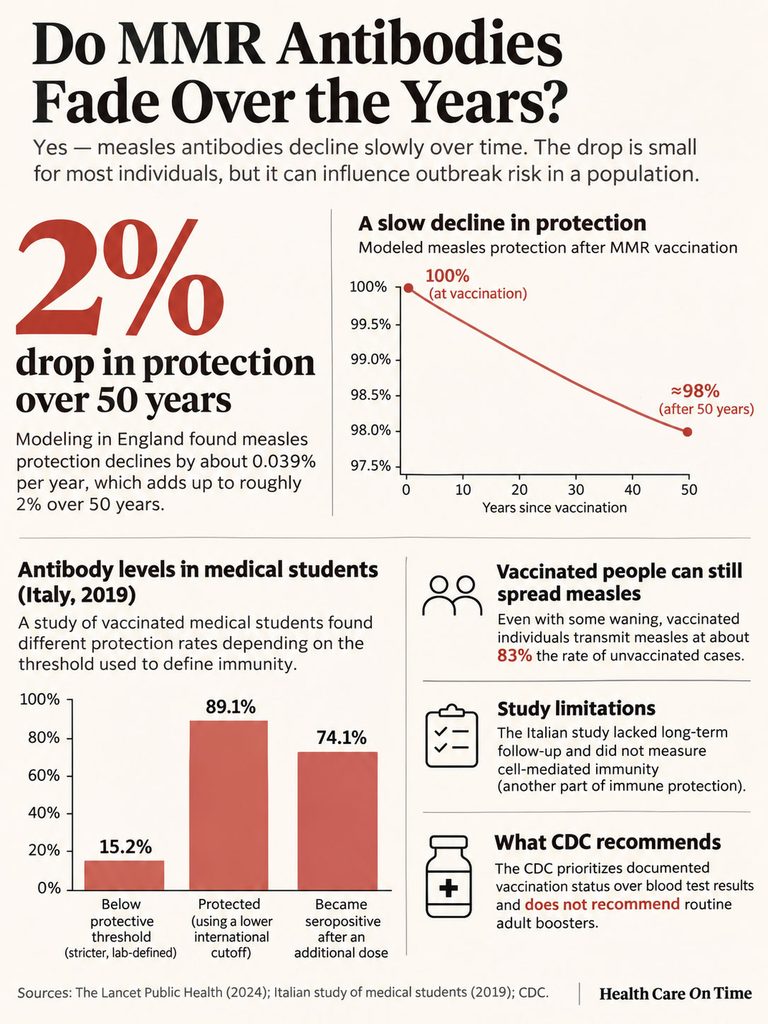
A 2024 modeling study in The Lancet Public Health put a number on it. Researchers fitted a model to measles cases in England from 2010 to 2019, when a rising share of cases occurred in people with two doses, and found that a model without waning couldn’t reproduce what happened: it predicted a median of 75 cases among two-dose recipients older than 15, against 202 actually observed, and adding slow waning brought the model close to the real count. The best-fitting loss was about 0.039% of protection per year, which works out to roughly 2 percentage points over 50 years. Small as that is, measles spreads so easily that a slight gap across millions of people gives the virus more room in big outbreaks. Vaccinated people who did catch measles also passed it on less, causing about 83% as many onward infections as unvaccinated cases.
Blood-test studies can make the picture look worse than it is, partly because of where labs set their cutoffs. In a 2019 Italian cohort of 2,000 medical students and residents in Bari, all with two documented doses and an average age of 21.1, 15.2% fell below the lab’s protective threshold. Using a lower cutoff of 120 mIU/mL from international guidance, 89.1% counted as protected. Among those retested after one extra dose, 74.1% became seropositive.
The Italian authors were open about the study’s limits: one measurement per person, so no one’s antibodies were actually tracked over time; no way to rule out past exposure to wild measles; a young, single-region group of healthcare trainees; and no measurement of cell-mediated immunity, the T-cell side of the immune system that can protect even when antibody levels look low.
A low number on a blood test, then, isn’t the same as being unprotected. For measles, CDC ranks documented, age-appropriate vaccination above a later titer result, and none of this research has changed the US advice against routine adult boosters.
Do You Need Another Dose? CDC Guidance by Birth Year, Doses and Job
The rows below follow published CDC and ACIP guidance for the situations adults run into most. They aren’t personal medical advice, and a doctor may adjust them for your health history.
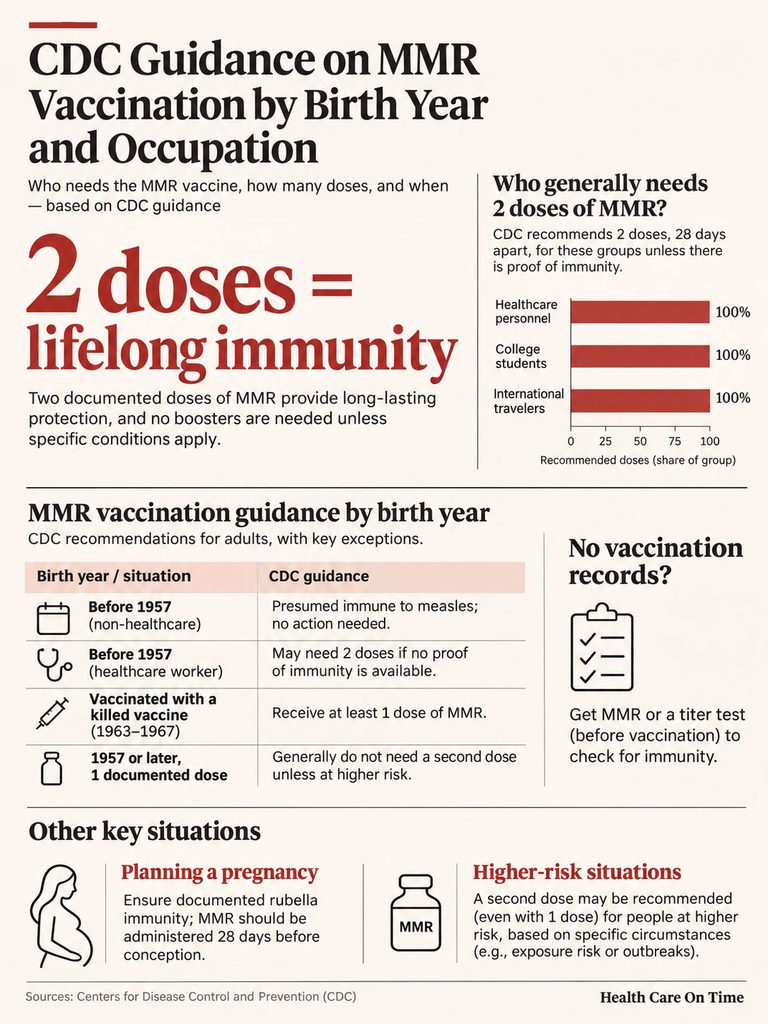
| Your situation | What CDC guidance says to do | Fine print |
| Born before 1957, not a healthcare worker | Nothing; you’re presumed immune to measles | Blood testing isn’t recommended on the basis of birth year; you can still choose MMR if you have no reason to avoid it |
| Born before 1957, healthcare worker | Birth year counts in routine settings; facilities should consider 2 doses if you lack lab proof of immunity | Many hospitals require a titer or 2 documented doses for all staff |
| Vaccinated 1963 to 1967 with killed vaccine, or vaccine type unknown | Get at least 1 dose of MMR | Documented live measles vaccine from the 1960s does not need repeating |
| Born 1957 or later with 1 documented dose, no special risk | Nothing for most adults | There’s no adult catch-up program for a second dose |
| 2 documented doses at 12 months or older | Nothing; no booster | A later negative measles titer doesn’t override documented doses |
| No records and no proof of immunity | Get MMR (1 dose, or 2 if in a higher-risk group), or get a titer first | There’s no harm in an extra dose if you turn out to be immune |
| Healthcare worker born 1957 or later | 2 doses at least 28 days apart, or lab evidence of immunity | Verbal reports of vaccination aren’t accepted |
| College or other post-high school student | 2 doses at least 28 days apart | Mumps risk is highest in campus outbreaks |
| International traveler age 12 months or older | 2 doses at least 28 days apart before the trip | Infants 6 to 11 months get 1 early dose, then 2 more after age 1 |
| Could become pregnant | Positive rubella IgG or documented vaccination only; birth year doesn’t count | Avoid pregnancy for 28 days after MMR |
| In a group named during a mumps outbreak | A third dose of MMR | No third dose is recommended for measles outbreaks |
Born before 1957
Measles was nearly universal in childhood before the first vaccines arrived in 1963, so adults born before 1957 almost all caught it and kept the immunity for life. A 2025 review in the Cleveland Clinic Journal of Medicine puts the immune share of this group at up to 98%.
CDC’s clinical guidance doesn’t call for titers or MMR on the basis of birth year alone, even before international travel. Two exceptions apply. Healthcare facilities should consider vaccinating staff born before 1957 who lack lab evidence of immunity, and birth year never counts as rubella proof for anyone who could become pregnant.
Vaccinated in the 1960s, or not sure which vaccine
Two kinds of measles vaccine arrived in 1963: a live weakened vaccine and an inactivated (“killed”) one. The killed vaccine, used from 1963 through 1967, turned out not to work. It went to fewer than 1 million people, under 5% of adults, but most people vaccinated as children in that era have no paperwork, so they can’t tell which one they got.
Documented live vaccine from the 1960s doesn’t need repeating. Killed vaccine, or no idea which one, calls for at least one dose of MMR, and missing paperwork from that decade lands you in the “unknown type” group by default.
Mumps has a similar, later history. People vaccinated before 1979 with a killed mumps vaccine or a mumps vaccine of unknown type, and who are at high risk for mumps (healthcare work is the usual example), should be considered for two doses of MMR.
One documented dose
The routine two-dose childhood schedule only became the US standard in 1989, after a run of measles outbreaks in the late 1980s. Plenty of adults who grew up in the 1970s and early 1980s got a single dose and were considered fully vaccinated at the time.
For adults born in 1957 or later with one dose on record and no special risk, the routine MMR recommendations treat that one dose, or other presumptive evidence of immunity, as sufficient for most adults, and there’s no national push for adults to go back for a second. The calculation changes only if you move into a group that needs two: healthcare work, college, international travel, or HIV without severe immunosuppression.
Two documented doses
Nothing more is needed. Two doses given at 12 months or older, on paper, count as lifelong measles protection, and no MMR booster is recommended for adults. A later titer doesn’t undo that. If a later blood test comes back negative or equivocal for measles, documented vaccination supersedes the titer and no additional measles dose is recommended. A woman of reproductive age with a negative or equivocal rubella result is the exception and should get a third MMR dose.
People with a history of immune suppression, such as a past transplant or chemotherapy, may be advised by a specialist to get revaccinated even with good records, because treatment can erase earlier vaccine immunity.
No records at all
Childhood records can turn up with a parent, an old school or college health office, a former pediatrician, a military record, or your state’s immunization information system, which many states let adults search online or request by form. Written documentation of the doses counts. A verbal memory of being vaccinated doesn’t, and neither does a parent’s recollection. Paper or digital copies both work.
Check the dates on whatever you find, because a dose given before the first birthday doesn’t count toward the two-dose series.
Once you have proof, keep it somewhere you can reach it. A photo of the card on your phone, a printout in a home file, and a copy sent to your current doctor’s office will save you from repeating this search the next time a new job, a graduate program or a trip abroad asks for it. If your state’s registry has your doses, ask whether you can download an official record, since many employers prefer that to a handwritten card.
If nothing turns up and you were born in 1957 or later, you have two acceptable paths: get MMR, or have a titer drawn first. The shot is often simpler, and there’s no harm in getting another dose of MMR even if you may already be immune to measles, mumps or rubella.
Healthcare jobs, college and international travel
These three groups need two documented doses, separated by at least 28 days, unless they have lab proof of immunity. For healthcare personnel born in or after 1957, ACIP defines adequate vaccination as two doses of live measles vaccine, two doses of live mumps vaccine and at least one dose of live rubella vaccine, which in practice means two MMR shots.
A health worker who catches measles can spread it to patients who are too young, too sick or too immunosuppressed to be vaccinated themselves, and an exposed worker without proof of immunity may have to be kept away from patients for a while afterward. That’s why employers ask for written records or a lab result and won’t accept a verbal report, even from someone who is sure they were vaccinated as a child.
Colleges have a similar problem with mumps. Shared rooms, shared drinks, team sports and parties bring the kind of close, repeated contact that let the Iowa outbreak spread among students who were almost all fully vaccinated.
International travelers age 12 months and older should have both doses before they leave. Babies 6 to 11 months old who are traveling get one early MMR dose, then still need the usual two doses after their first birthday. For trips inside the country, extra doses come into play only if you’re going to an area with an ongoing outbreak and the local health department recommends them.
Planning a pregnancy
For anyone who could become pregnant, only a positive rubella antibody test or documented vaccination counts as proof of immunity, and birth before 1957 doesn’t qualify. If you’ve had one or two doses and your rubella IgG comes back unclear, the guidance is one more MMR dose, up to a maximum of three, with no need to retest afterward.
MMR is a live vaccine, so it isn’t given during pregnancy, and the standard advice is to wait 28 days after a dose before getting pregnant. There’s no evidence that the rubella vaccine virus harms a fetus, which is why an accidental dose early in an unrecognized pregnancy isn’t treated as an emergency, but the waiting period stays in place as a precaution. Pregnant people without rubella immunity are vaccinated right after delivery. Other vaccines are still given during pregnancy, some precisely so the newborn starts life protected, as with RSV immunization for babies.
Titer Blood Test or Just Get the Shot?
An MMR titer is a blood test that measures IgG antibodies to measles, mumps and rubella. A positive measles IgG counts as laboratory evidence of immunity and can stand in for missing records. A titer can’t diagnose a current infection, so it isn’t the right test if you have symptoms or a recent exposure.
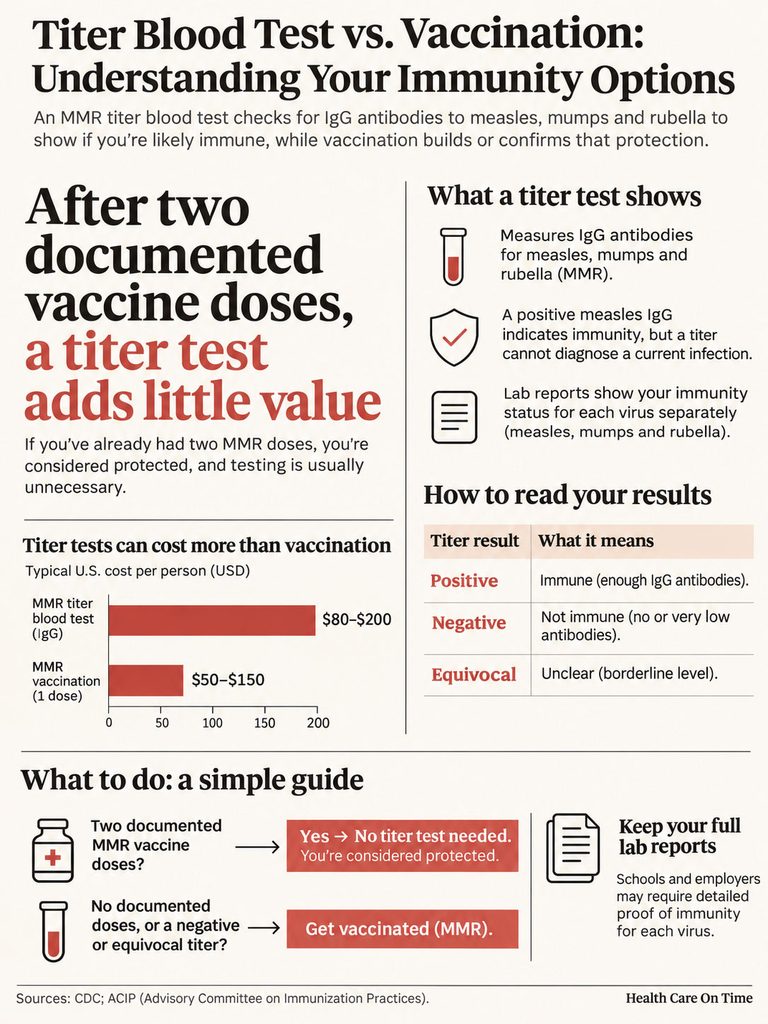
Results usually come back in three categories for each virus: positive (immune), negative, or equivocal, meaning the level sits close to the lab’s cutoff. Anyone who had an antibody test after a COVID shot will recognize the format, a level compared against a cutoff, but cutoffs differ between labs and test kits, and the Italian study above showed how much that choice moves the “protected” share. For adults without documented doses, an equivocal result is handled the same as a negative one.
A titer earns its cost in a few situations:
- You have no records and would rather skip an unneeded shot.
- An employer or school wants proof and your paperwork is gone.
- You’re planning a pregnancy and want a clear rubella result.
It usually adds nothing after two documented doses, since those outrank the result, and it isn’t needed after a fresh dose either, because the guidance says testing to confirm immunity after vaccination isn’t necessary. Birth before 1957 alone isn’t a reason to test unless you work in healthcare, and screening before vaccination isn’t needed for anyone who already has acceptable evidence of immunity.
Price can tip the decision, since a titer sometimes costs more than the shot. In November 2026, the Labcorp OnDemand MMR immunity test listed at $139 (ages 18 to 100, results 1 to 2 days after the sample reaches the lab), and the Quest MMR antibody test at $142 plus a $6 physician service fee, available for patients age 12 and older. Both take HSA and FSA funds. A doctor-ordered test may be covered by insurance, so check your plan first.
With no documented doses, a negative or equivocal titer means you’re treated as not immune, and the usual next step is one dose of MMR. With two documented doses, a negative measles result doesn’t call for another dose.
The lab report usually lists each virus on its own line, often with a word such as “immune,” “non-immune” or “equivocal” next to a number, and you can be immune to one virus and not another. Mumps is often the one that comes back low. Keep the full report, not just a note that you “passed,” because schools and employers often ask to see the result for each disease separately.
Can You Still Get Measles After Being Vaccinated?
Yes, but it’s uncommon and tends to be milder. A measles infection in a vaccinated person is called a breakthrough infection, and it’s rare: about 3 in 100 people with two doses, and about 7 in 100 with one dose, will get measles if they’re exposed. Intense or long exposure, such as living with someone who has measles, makes breakthrough more likely.
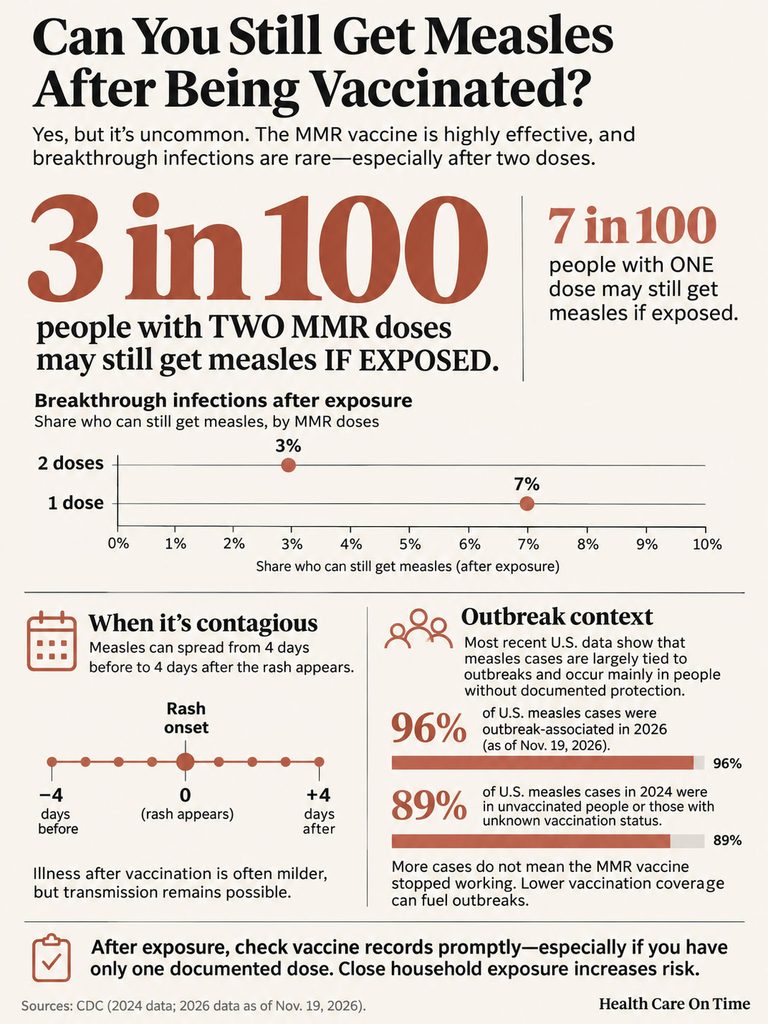
When vaccinated people do get sick, they usually have fewer complications and are less likely to spread the virus. The illness can look different, too, with a faint or missing rash, or one that starts on the trunk and arms instead of the face, which can delay a diagnosis. The contagious window doesn’t shrink: it still runs from 4 days before the rash appears to 4 days after.
| Measure | Figure | Source |
| Confirmed US measles cases in 2026, as of November 19 | 5,838 | CDC measles cases and outbreaks, updated November 20, 2026 |
| Share of 2026 cases tied to outbreaks | 96% (5,629 of 5,838) | Same CDC update |
| New US measles outbreaks in 2026 | 43 | Same CDC update |
| Measles deaths reported in 2026 (subject to change) | 6 | Same CDC update |
| Confirmed US measles cases in all of 2025 | 2,289 | CDC yearly case totals |
| Vaccination status of 285 US cases in 2024 | 89% unvaccinated or unknown, 7% one dose, 4% two doses | CDC 2024 case summary |
| Exposed people with 2 doses who get measles | About 3 in 100 | CDC measles FAQ, updated August 5, 2026 |
| Exposed people with 1 dose who get measles | About 7 in 100 | CDC measles FAQ |
| People who got the ineffective killed vaccine, 1963 to 1967 | Fewer than 1 million | CDC measles FAQ |
The 2026 case counts are preliminary and change weekly. The 2024 figures are the latest full year shown with a vaccination-status split, and they match the long-running pattern in which the large majority of US measles cases occur in people who are unvaccinated or whose status is unknown.
Record case counts in 2025 and 2026 don’t mean the vaccine stopped working. More measles virus is moving through communities with lower vaccination rates, which raises the number of exposures that everyone, vaccinated or not, runs into, and the same small breakthrough percentage then turns into more actual cases.
Your own protection hasn’t changed if you’re vaccinated, but if measles is reported where you live or work, it’s worth confirming your records now rather than after an exposure, especially if you have only one dose and fall into a group that is supposed to have two. Local health departments sometimes recommend an extra dose for adults in an outbreak area, and they publish that advice for the specific counties involved.
Is Today’s MMR the Same Vaccine From 30 Years Ago?
If you were vaccinated anytime since the late 1970s, very likely yes. The measles strain in Merck’s M-M-R II, the Enders-Edmonston strain once called “Moraten,” was licensed in 1968, and M-M-R II was the only MMR vaccine used in the United States from 1978 until 2022, per the ACIP report on PRIORIX. Its mumps component is the Jeryl Lynn strain, and its rubella component is the Wistar RA 27/3 strain.
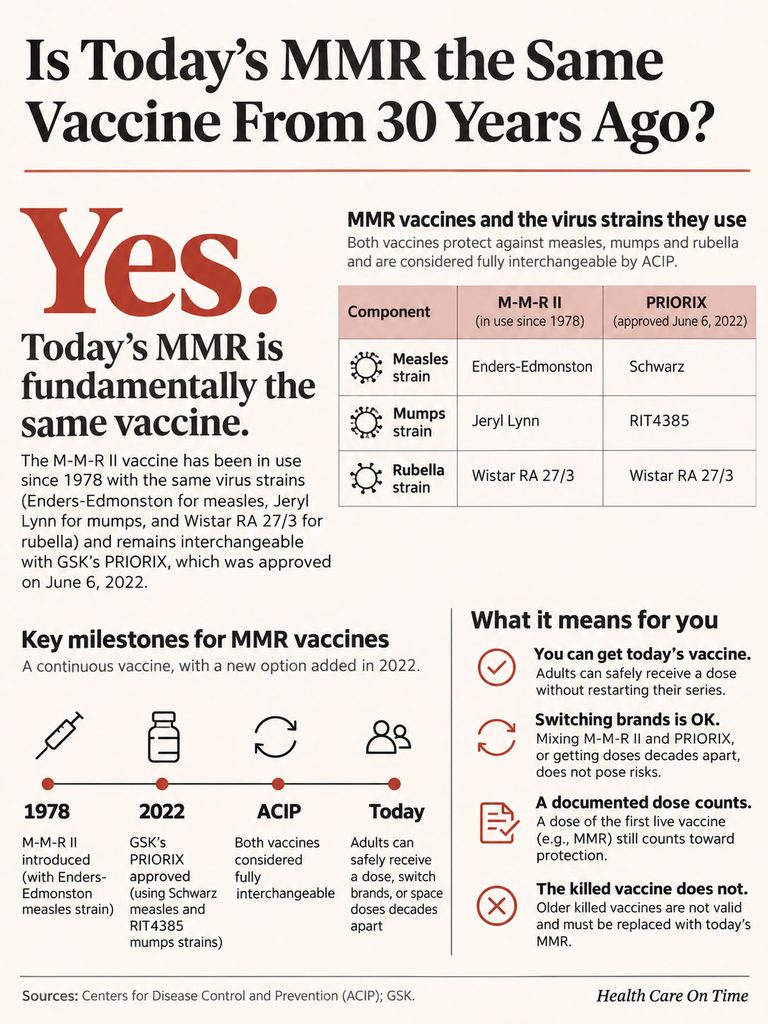
The FDA approved a second MMR vaccine, GSK’s PRIORIX, on June 6, 2022. It uses the Schwarz measles strain and the RIT4385 mumps strain with the same RA 27/3 rubella strain, and ACIP considers the two vaccines fully interchangeable, so a person who got M-M-R II as a child and PRIORIX as an adult has two valid doses.
The vaccines that differ from today’s are older ones: the earliest live measles vaccine, Edmonston B, used from 1963 through 1975, and the killed vaccine from 1963 through 1967. A documented dose of the first still counts, while the second has to be replaced.
Switching brands, or getting a dose decades after the first one, causes no trouble. Adults who need to catch up simply get MMR now, with no need to restart a series, and a dose of today’s vaccine on top of old immunity is safe.
MMR Side Effects in Adults and Who Should Wait
Most adults have no problems at all, or only a sore arm, a fever or a mild rash. Joint pain is the side effect adults notice more than children. It’s linked to the rubella part of the vaccine in people who weren’t already immune to rubella, shows up in up to 1 in 4 females past puberty, and usually starts 1 to 3 weeks after the shot before going away on its own.
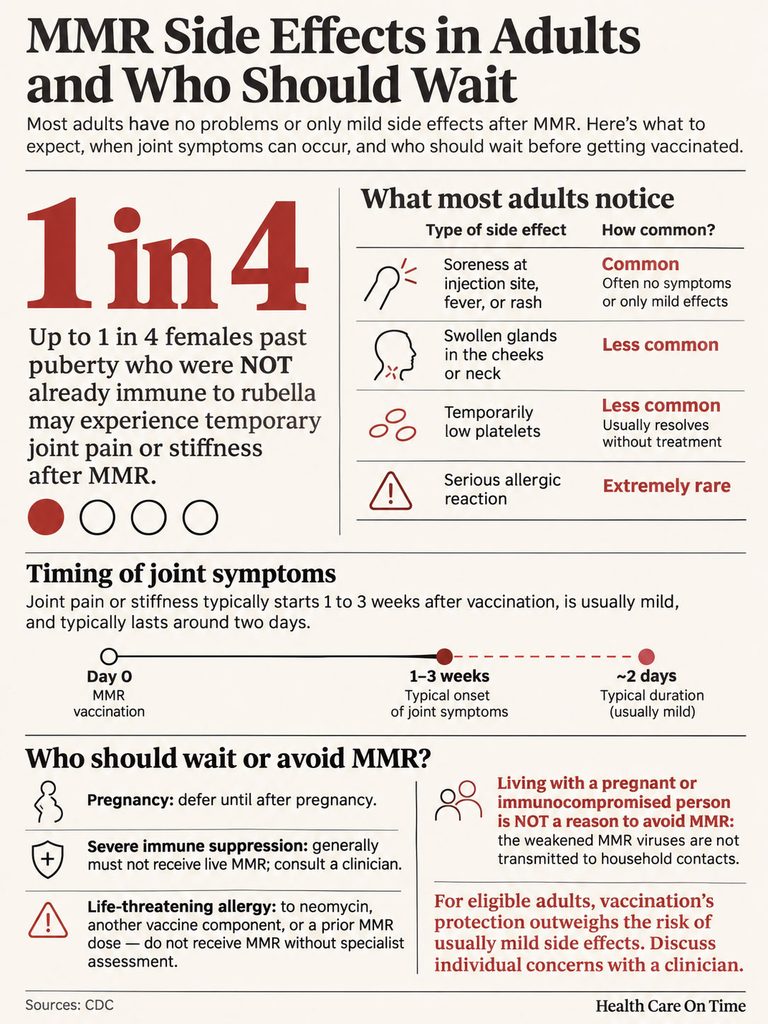
Less common effects include swelling in the cheeks or neck and, rarely, a temporary drop in platelets that usually resolves without treatment. Serious allergic reactions are extremely rare. Anyone who has had a life-threatening allergic reaction to neomycin, or to any other vaccine ingredient, shouldn’t get MMR.
Check with a clinician first if any of these apply:
- pregnancy, or a chance you could be pregnant
- a weakened immune system from disease or treatment
- a severe reaction to an earlier MMR or MMRV dose
- a recent blood transfusion, or tuberculosis
- another vaccine in the past 4 weeks, or feeling unwell on the day
The weakened viruses in MMR can’t spread from person to person, so getting the shot is safe if you live with someone who is pregnant or immunocompromised.
When to Call a Doctor After a Measles or Mumps Exposure
Timing matters after a measles exposure. If you aren’t immune, an MMR dose given within 72 hours of first exposure may prevent measles or make it milder, and immune globulin given within 6 days is the option for people who can’t get the vaccine, such as some pregnant people, infants and people with weak immune systems. A clinician shouldn’t give both at once, because immune globulin cancels out the vaccine.
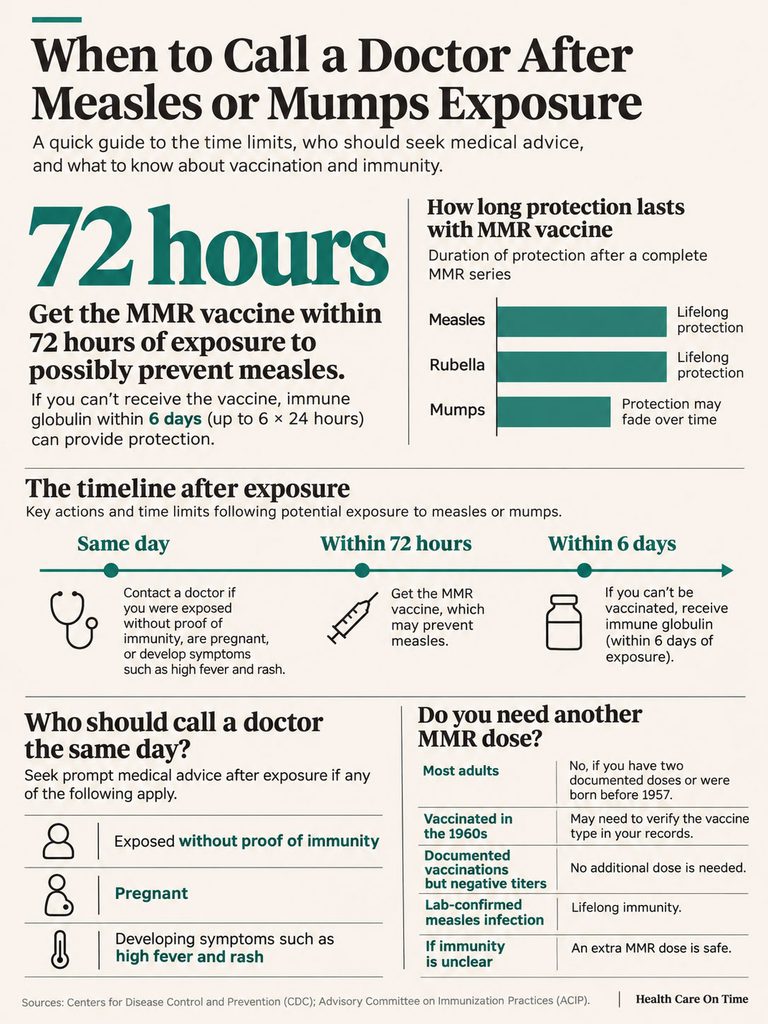
Call your doctor or local health department the same day if you were exposed and have no proof of immunity, if you’re pregnant and were exposed, or if you develop a high fever, cough, runny nose and red, watery eyes followed by a rash. Phone before you show up, so the office can keep you away from other patients in the waiting room.
Questions worth bringing to that call or to a routine visit:
- Do these old records count as two valid doses, or was one of them given before age 1?
- If you were vaccinated in the 1960s and the paperwork is gone, is one MMR dose enough?
- Will your hospital or school still want a titer even though you have two documented doses?
- Should you check your rubella immunity before you start trying to get pregnant?
- If you’ve had chemo or a transplant, do you need the MMR shots again?
Frequently Asked Questions
Do adults need to get the MMR vaccine again?
Most don’t. Two documented doses, birth before 1957 (outside healthcare) or one documented dose with no special risk all mean nothing more is needed. The adults who should get MMR are those with the killed 1960s vaccine or an unknown type, and anyone with no proof of immunity.
How long is the MMR vaccine good for?
For measles and rubella, protection after the recommended doses is considered lifelong. Mumps protection lasts many years but fades, which is why a third dose is sometimes advised during outbreaks.
Can you get measles if you were vaccinated 50 years ago?
That depends on which vaccine you got. Someone vaccinated around 1976 almost certainly received a live vaccine and is protected. Those vaccinated from 1963 through 1967 may have received the killed vaccine, which didn’t work, so CDC advises at least one MMR dose unless records show the live vaccine. Even with good protection, about 3 in 100 people with two doses can catch measles after exposure, usually with a milder illness. Without records from that era, one dose of MMR is the simple fix.
Is the MMR vaccine the same as it was 30 years ago?
Largely the same. M-M-R II, with the same three strains, was the only MMR vaccine in the United States from 1978 to 2022. PRIORIX, approved in 2022, can be used in its place for any dose.
Is there an MMR booster for adults?
Not a routine one. Adults who already have the recommended doses don’t need an MMR booster.
What if a titer is negative but you have two documented doses?
For measles, documented, age-appropriate vaccination supersedes a later titer, and no extra dose is recommended. Antibody tests can miss protection, partly because they don’t measure the T-cell side of immunity, and lab cutoffs differ. Rubella in someone who could become pregnant is handled differently: a negative or equivocal rubella result after documented doses calls for one more MMR dose, up to a total of three, and no retest afterward. People with a history of immune suppression should ask their specialist.
Does having measles as a child give lifelong immunity?
Yes, if the illness was confirmed by a lab, which is what CDC accepts as proof. Adults born before 1957 are presumed immune because nearly everyone caught measles before vaccines existed.
Is it safe to get MMR if you might already be immune?
An extra dose on top of existing immunity causes no harm, so getting the shot is a reasonable shortcut when records are missing.
Medical disclaimer: This article is for general information and reflects CDC and ACIP guidance at the time of writing. It isn’t personal medical advice. Vaccine recommendations can change, and your health history may change what’s right for you. Talk with your doctor, pharmacist or local health department about your own vaccination needs, and contact them promptly after any measles exposure.
References
- Centers for Disease Control and Prevention. Measles Vaccination. Updated April 29, 2026.
- Centers for Disease Control and Prevention. Measles Questions and Answers. Updated August 5, 2026.
- Centers for Disease Control and Prevention. Clinical Questions about Measles. Updated August 5, 2026.
- Centers for Disease Control and Prevention. Measles Vaccine Recommendations. Updated March 3, 2026.
- Centers for Disease Control and Prevention. Measles Vaccine Recommendations for Specific Groups. Updated July 15, 2024.
- Centers for Disease Control and Prevention. Routine Measles, Mumps, and Rubella Vaccination. Updated January 17, 2025.
- Centers for Disease Control and Prevention. Rubella Vaccine Recommendations. Updated January 17, 2025.
- Centers for Disease Control and Prevention. Mumps Vaccine Recommendations. Updated September 20, 2024.
- Centers for Disease Control and Prevention. Measles Cases and Outbreaks. Updated November 20, 2026.
- Centers for Disease Control and Prevention. MMR Vaccine Safety. Updated July 31, 2024.
- McLean HQ, Fiebelkorn AP, Temte JL, Wallace GS. Prevention of Measles, Rubella, Congenital Rubella Syndrome, and Mumps, 2013: Summary Recommendations of the ACIP. MMWR Recomm Rep. 2013;62(RR-04):1-34.
- Marin M, Marlow M, Moore KL, Patel M. Recommendation of the ACIP for Use of a Third Dose of Mumps Virus-Containing Vaccine in Persons at Increased Risk for Mumps During an Outbreak. MMWR. 2018;67(1):33-38.
- Krow-Lucal E, Marin M, Shepersky L, et al. Measles, Mumps, Rubella Vaccine (PRIORIX): Recommendations of the ACIP, United States, 2022. MMWR. 2022;71(46).
- Cardemil CV, Dahl RM, James L, et al. Effectiveness of a Third Dose of MMR Vaccine for Mumps Outbreak Control. N Engl J Med. 2017;377(10):947-956.
- Robert A, Suffel AM, Kucharski AJ. Long-term waning of vaccine-induced immunity to measles in England: a mathematical modelling study. Lancet Public Health. 2024;9(10):e766-e775.
- Bianchi FP, Stefanizzi P, De Nitto S, et al. Long-term Immunogenicity of Measles Vaccine: An Italian Retrospective Cohort Study. J Infect Dis. 2019;221(5):721-728.
- Rivard KR. Does your adult patient need a measles vaccine? Cleveland Clinic Journal of Medicine. 2025;92(5):279-282.
- National Foundation for Infectious Diseases. Frequently Asked Questions About Measles. Updated March 2025.
- Labcorp OnDemand. Measles, Mumps, Rubella (MMR) Immunity Test. Accessed November 22, 2026.
- Quest Diagnostics. Measles, Mumps, Rubella (MMR) Test. Accessed November 22, 2026.