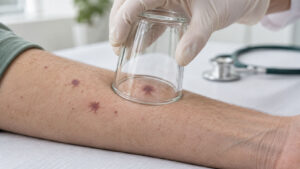
You grab a flashlight, tilt your head back at the bathroom mirror, and there they are: white spots on your tonsils. Most people stop right there and decide it is strep.
Table of Contents
Most people are wrong. In one pediatric study of 100 children with sore throats, only 7 of the 20 kids who had white patches on their tonsils actually grew strep on a throat culture. The white spots are real. What they mean is a different question entirely.
So what does strep throat look like when it truly is strep? Here are the visible signs, the conditions that mimic them almost perfectly, and the findings that mean stop reading and get seen today.
Quick Answer: Strep throat usually shows up as bright red, swollen tonsils and back of the throat, often with white or yellow patches, streaks, or pus on the tonsils. Many people also have tiny red dots on the roof of the mouth, a puffy red uvula, and tender swollen glands under the jaw. Appearance alone cannot confirm it. Only a throat swab can.
At a Glance
- Only about 1 in 10 adults and 3 in 10 children with a sore throat actually have strep.
- White patches on the tonsils are common in strep, but they appear in mono, viral tonsillitis, and thrush just as often.
- Tiny red dots on the roof of the mouth are a stronger visual clue than white spots.
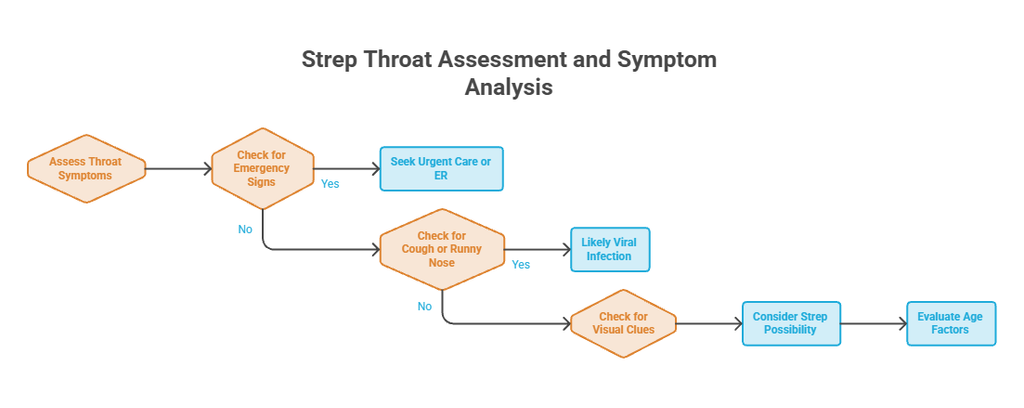
- A cough or runny nose points away from strep and toward a virus.
- Strep is most common in kids ages 5 through 15 and rare in children under 3.
- Even with every classic sign present, the odds of strep top out near a coin flip.
- One-sided throat swelling, drooling, or trouble breathing means urgent care or the ER, not wait-and-see.
What Strep Throat Looks Like Inside Your Mouth
Strep throat is not a look. It is a bacterial infection caused by Streptococcus pyogenes, known as group A strep. What you see in the mirror is your immune system reacting to it.
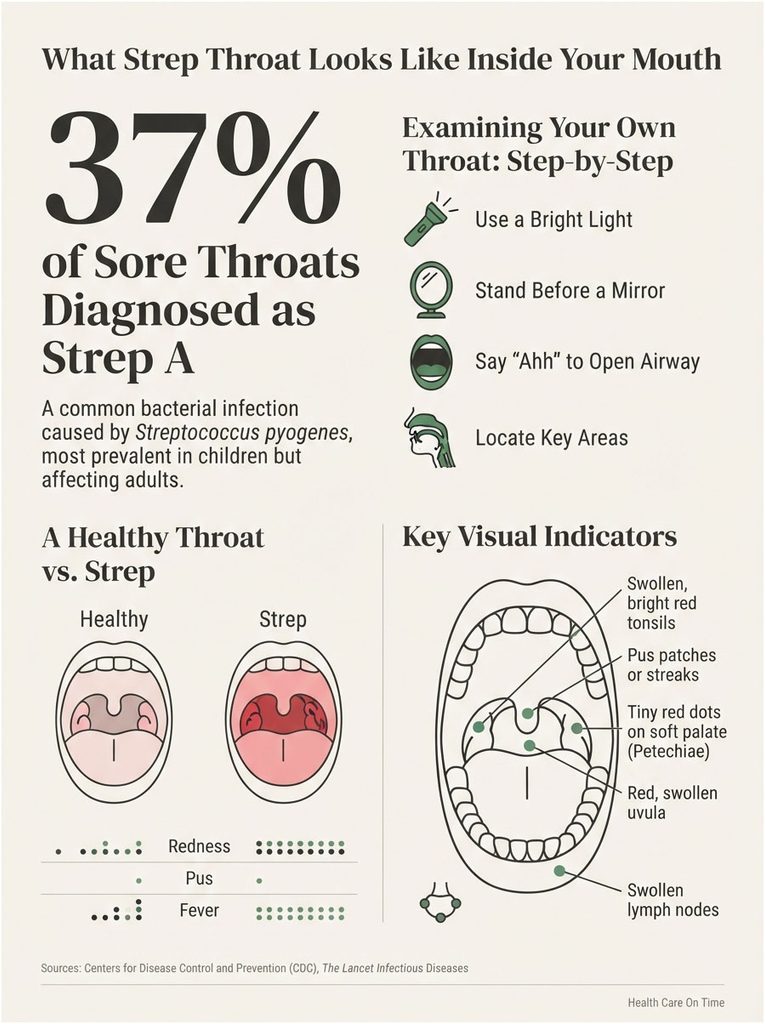
That reaction follows a fairly consistent pattern. A clinician examining a suspected case scans for five specific things, and you can check the same five.
How to Actually Look at Your Own Throat
Most people do this badly, which is why they miss the findings that matter. Stand facing a bright window or use a phone flashlight held beside your cheek, not directly in front of your mouth, so the beam clears your teeth.
Open wide, say ahh to lift the soft palate, and resist pressing your tongue down with a spoon handle. Depressing the tongue triggers gagging and, in someone with a badly swollen airway, can make things worse.
Look at four zones in order: the tonsils on each side, the wall of the throat behind them, the roof of the mouth, and the uvula hanging in the center. Then feel your neck.
Bright Red, Swollen Tonsils and Throat
The first thing that stands out is color. The tonsils and the wall of the throat behind them turn a deep, angry red, noticeably darker than the surrounding tissue.
The tonsils themselves often swell enough to narrow the opening at the back of your mouth. In heavier cases they nearly touch in the middle, which is part of why swallowing hurts so much.
This redness is more intense and more sharply bordered than the dull pink irritation of a common cold. Clinicians describe strep tonsils as swollen and inflamed in a deeper color than the tissue around them, sometimes with visible red streaking.
Our medical reviewers note that patients often reach for the word beefy, and that is a fair description.
White or Yellow Patches, Streaks, and Pus
This is the sign everyone searches for. On the tonsils you may see white or pale yellow material that looks like patches, blotches, streaks, or thick smears.
Clinicians call this tonsillar exudate. It is a mix of dead white blood cells, bacteria, and inflammatory fluid pushed out through the tonsil surface as your body fights back.
What the Patches Actually Look Like
Strep exudate tends to be uneven and patchy rather than a smooth even film. Picture splatters or streaks following the natural grooves of the tonsil, not a uniform coating painted across it.
The color runs from chalk white to creamy yellow. Some people have thick raised deposits, others have thin streaks that are easy to overlook under poor lighting.
Do not try to scrape them. Pus in the throat should not be removed with a finger or swab, since it will keep re-forming until the inflammation settles, and scraping creates wounds while worsening pain and swelling.
When There Are No Patches at All
Plenty of confirmed strep cases show no exudate whatsoever, just intense redness and swelling. Many patients have a milder illness without any pus on the tonsils.
That is the trap. Absence of white spots does not rule strep out, and their presence does not rule it in.
Tiny Red Dots on the Roof of the Mouth
Look past your tonsils and up. On the hard and soft palate you may see a scattering of pinpoint red or purple dots, as though someone flicked a fine-tipped red pen across the roof of your mouth.
These are petechiae, tiny broken capillaries. Palatal petechiae sit alongside tonsillar exudate and uvular swelling as key findings in streptococcal pharyngitis.
They are easy to miss and most people never think to look up there. That is unfortunate, because as the numbers below show, they outperform the white spots that get all the attention.
A Swollen, Red Uvula
The uvula, the small teardrop of tissue hanging at the back of your throat, often swells and reddens with strep. It can look puffy, elongated, or slightly translucent at the tip.
Track its position too. A uvula that stays centered is expected. One pushed sideways is a warning sign covered later in this article.
Swollen, Tender Glands Under the Jaw
This one you feel rather than see. Run your fingertips along the front of your neck, just under the jawline and to either side of the windpipe.
With strep, the lymph nodes there commonly swell into tender lumps that hurt when pressed. Larger, more tender lymph nodes at the front of the neck alongside minimal or no cold symptoms is a pattern clinicians associate with strep in children.
Note the location carefully. Front-of-neck tenderness fits strep. Swelling behind the neck, in the armpits, or in the groin points somewhere else.
What a Healthy Throat Looks Like
Comparison helps. A normal throat is a uniform light to medium pink, moist, and smooth. The tonsils, if you still have them, sit as two small pink mounds with a slightly bumpy or pitted surface.
Those pits are called crypts, and they belong there. A healthy uvula hangs straight down the midline, and healthy neck glands are either not palpable or feel like small painless beads.
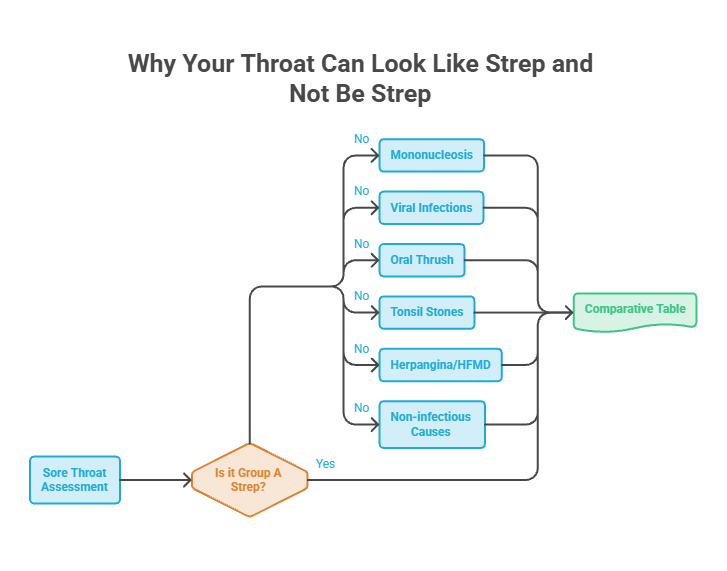
Why Your Throat Can Look Like Strep and Not Be Strep
Every visual sign above appears in conditions that are not strep. Only about 10 percent of adults who seek care for a sore throat turn out to have group A strep, yet 60 percent or more walk out with an antibiotic prescription.
Patients booking throat swabs through HealthCareOnTime frequently arrive already convinced. Here is what else produces the same picture.
Mononucleosis, the Closest Twin
Mono, caused by the Epstein-Barr virus, is the hardest one to separate visually. Both mono and strep produce heavy inflammation at the back of the throat and both create white material there.
Mono exudate is often thicker and grayer, and it can spread onto the soft palate. Mono also brings crushing fatigue lasting weeks, swollen glands in the armpits and groin rather than just the neck, and sometimes puffiness around the eyes.
Palatal petechiae appear in mono as well, though in mono they tend to stay confined to the soft palate. Fever can reach 104 degrees Fahrenheit, and the spleen is enlarged in about half of patients.
That last detail carries practical weight for teenagers, since an enlarged spleen means no contact sports until cleared. Mono peaks in the same teen and young-adult window where strep is still common.
Viral Tonsillitis, Colds, Flu, and COVID
Ordinary respiratory viruses cause the large majority of sore throats. They inflame and swell the tonsils and sometimes produce patchy exudate that looks convincingly bacterial.
The giveaway is the company they keep. Cough and runny nose are uncommon with strep, and if those are your dominant symptoms, strep is less likely to be the cause.
Viral sore throats also build gradually over a day or two alongside congestion, sneezing, hoarseness, or red eyes. A sore throat can occur with COVID-19, but it is rarely the only symptom, with only about 5 to 10 percent of COVID patients having an isolated sore throat.
Oral Thrush
Thrush is a Candida yeast overgrowth. It creates creamy white patches that resemble tonsillar pus but behave differently.
Thrush lesions look like milk curds and can often be wiped away with a swab, revealing red, slightly bleeding tissue underneath. Strep exudate does not wipe off.
Thrush also spreads beyond the tonsils onto the tongue, inner cheeks, and palate, and it usually comes with far less pain and no fever. Risk goes up with inhaled steroids, recent antibiotics, dentures, diabetes, and a weakened immune system.
Tonsil Stones
Tonsilloliths are hardened lumps of trapped debris, bacteria, and dead cells sitting in the tonsil crypts. They look like small white or yellowish pellets embedded in the tonsil surface.
The tonsil surface holds an average of 10 to 20 crypts extending into the tissue, where shed cells and microorganisms collect. The resulting deposits often carry a foul odor and can create a sensation of something stuck in the throat.
The differences are telling: tonsil stones usually cause no fever, minimal pain, a persistent bad taste or bad breath, and they linger for weeks rather than appearing overnight.
Herpangina, Hand-Foot-and-Mouth, and Mouth Ulcers
These produce shallow ulcers with red rims rather than raised white deposits. They are more common in young children, peak in summer and early fall, and often come with lesions elsewhere in the mouth, on the palms, or on the soles.
The texture is the tell. Ulcers are craters set into the tissue. Strep exudate sits on top of it.
Canker sores follow the same logic: a white or yellow center ringed by red, usually solitary, and usually without fever or swollen glands.
Allergies, Reflux, and Simple Irritation
Not every sore throat involves an infection at all. Seasonal allergies and postnasal drip leave the throat red and raw without exudate, typically worse in the morning and paired with itchy eyes or a stuffy nose.
Silent reflux irritates the throat overnight and often presents as hoarseness, throat clearing, and a lump sensation. Dry indoor air in winter, mouth breathing, shouting at a game, and smoke exposure all produce redness that looks alarming and means very little.
Table 1: What Each Condition Actually Looks Like
| Condition | Throat appearance | White material | Cough or runny nose | Fever | Neck glands |
| Strep throat | Deep red, swollen tonsils and pharynx, red dots on palate | Patchy white or yellow streaks, does not wipe off | Usually absent | Sudden, often above 101 F | Tender, swollen, front of neck |
| Viral sore throat | Dull pink to moderately red, mild swelling | Usually none, occasionally light patches | Common, often the first symptom | Mild or absent, gradual | Mildly enlarged or normal |
| Mononucleosis | Very swollen tonsils, heavy inflammation | Thick gray-white coating, may reach soft palate | Usually absent | Prolonged, can last 1 to 2 weeks | Swollen at neck, armpits, and groin |
| Oral thrush | Normal to mildly red underneath | Creamy curd-like patches that wipe off | Absent | Absent | Normal |
| Tonsil stones | Normal pink tonsils | Small hard white or yellow pellets in crypts | Absent | Absent | Normal |
| Peritonsillar abscess | One tonsil bulging, uvula pushed to opposite side | Variable, often on the affected side only | Absent | High and worsening | Very tender, usually one side |
How Much the White Spots Actually Prove
Doctors quantify how useful a physical finding is using something called a likelihood ratio. A ratio of 1 means the finding tells you nothing. Above 3 starts to be meaningfully useful. Above 10 is close to decisive.
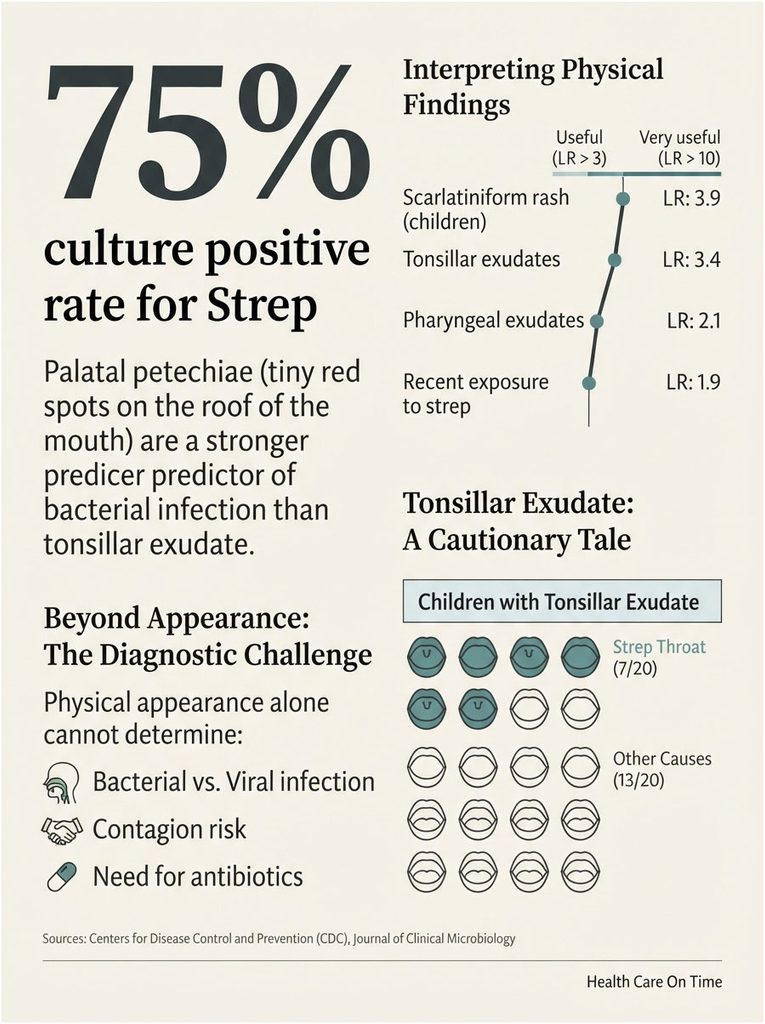
Almost nothing you can see in your own throat clears the bar of 3.
The Numbers Behind Each Sign
A systematic review across adult and pediatric studies found tonsillar exudates carry a positive likelihood ratio of 3.4, pharyngeal exudates 2.1, and recent exposure to someone with strep 1.9. Absence of enlarged tonsils, absence of tender cervical nodes, and absence of exudate each push the odds down only modestly, at 0.6, 0.6, and 0.7.
In children specifically, a scarlatiniform rash performs best at 3.9, followed by palatine petechiae at 2.7, pharyngeal exudates at 1.9, vomiting at 1.8, and tender cervical adenopathy at 1.7.
Read that ordering carefully. In kids, the red dots on the palate beat the white spots on the tonsils.
Why Exudate Misleads
The pediatric study cited at the top of this article makes the point starkly. Of 100 children with sore throat, 20 had tonsillar exudates and only 7 of those grew strep. Meanwhile 8 children had palatal petechiae and 6 of those were culture positive, a rate of 75 percent.
A separate pediatric series reached a similar conclusion from the opposite direction, finding tonsillar exudate had a positive predictive value of 70 percent for pharyngitis that was not streptococcal.
White spots are visually dramatic, which is exactly why they dominate search behavior. Their diagnostic weight does not match their visual weight.
The Three Things Appearance Cannot Tell You
It cannot tell you whether the organism is bacterial or viral, because both produce identical-looking exudate.
It cannot tell you whether you are contagious, since some people carrying strep feel entirely well and can still spread the bacteria.
And it cannot tell you whether you need antibiotics. In cases reviewed by our diagnostic team, that third question is the only one most people actually care about, and a photograph of a throat has never answered it.
Table 2: The Data Behind Strep Throat Diagnosis in the United States
| Finding or statistic | Figure | What it means for you | Source |
| Share of sore throats caused by strep | About 10% of adults, 30% of children | Odds start low even with alarming-looking tonsils | CDC, About Strep Throat (Jan 2026) |
| Tonsillar exudate, positive likelihood ratio | 3.4 | Shifts odds upward but nowhere near confirms | Ebell et al., JAMA, 2000 |
| Palatine petechiae in children, positive LR | 2.7 | Red palate dots outrank white spots in kids | Shaikh et al., J Pediatr, 2012 |
| Scarlatiniform rash in children, positive LR | 3.9 | Strongest single visual sign in pediatrics | Shaikh et al., J Pediatr, 2012 |
| Incidence, children ages 3 to 9 | 93.2 cases per 1,000 person-years | Roughly 85 times the rate in adults 40 to 65 | StatPearls, NIH/NCBI (2026) |
| Incidence, adults ages 40 to 65 | 1.1 cases per 1,000 person-years | Adult strep is genuinely uncommon | StatPearls, NIH/NCBI (2026) |
| US office visits for strep pharyngitis | More than 6 million per year | Among the most common outpatient complaints | AAFP Rapid Evidence Review (2024) |
| Adults with sore throat given antibiotics | 60% or more | Widespread overtreatment despite low strep rates | AAFP Rapid Evidence Review (2024) |
The age gradient in that table is steep: 93.2 cases per 1,000 person-years in children 3 to 9, 40.9 in ages 10 to 19, 8 in adults 20 to 39, and 1.1 in adults 40 to 65.
The Signs of Strep Throat That Show Up Outside Your Throat
The throat is only part of the picture. Several of the most reliable strep throat symptoms have nothing to do with what you see in the mirror.
The No-Cough Clue
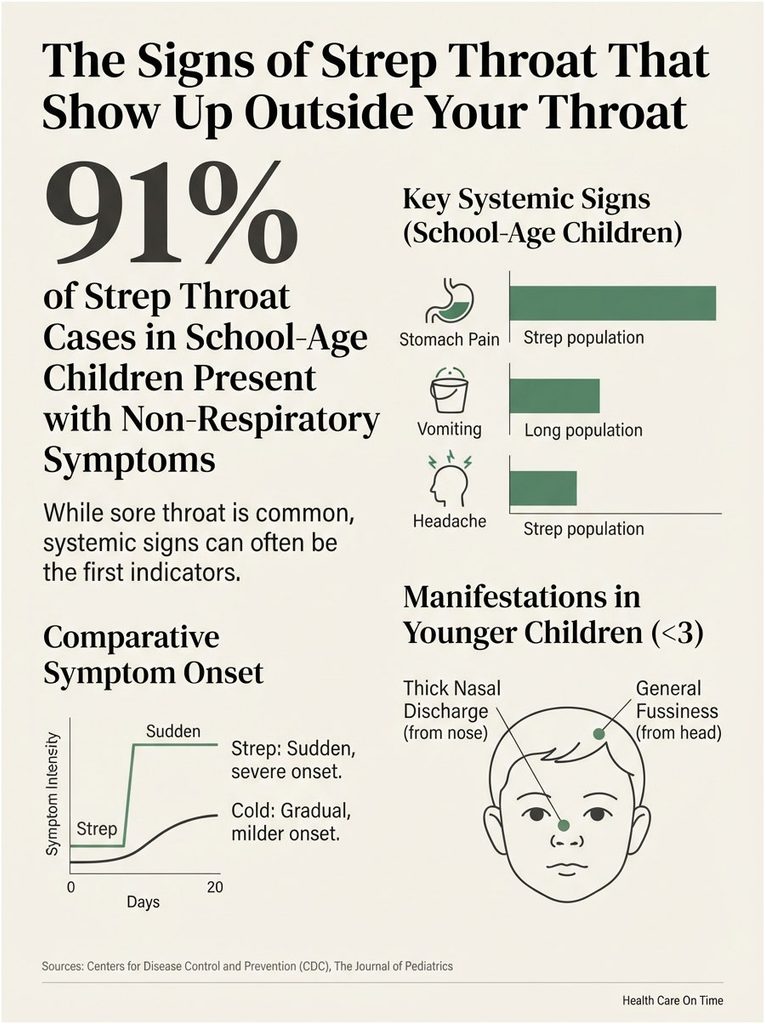
If you are coughing, sneezing, and blowing your nose, strep drops sharply down the list. Cold symptoms such as a runny nose or cough, a hoarse voice, or pink eye make a viral cause far more likely than strep.
A CDC field investigation at a rural Wyoming urgent-care clinic showed how often this gets ignored. Of 24 tested patients aged 3 or older with sore throat, 19 reported cough or runny nose, symptoms pointing toward a virus rather than bacteria.
Sudden Onset Versus Slow Build
Strep tends to arrive fast. People often describe a throat that felt fine at lunch and was unbearable by bedtime.
Colds and viral sore throats build gradually, with the sense of slowly getting sicker over a day or two. The timeline is a genuinely useful clue and costs nothing to assess.
Fever
Strep fever tends to run higher and start abruptly. A temperature above 101 degrees Fahrenheit alongside swollen tonsils with white patches is a classic combination.
Incubation runs about 2 to 5 days from exposure to illness, so think back to who you were around last week.
Seasonality and the US School Calendar
Timing matters more than people expect. Infections cluster during the school year with peaks in winter and early spring, when large groups of children and teens are in close contact.
Strep is most common in children ages 5 to 15 during winter, though it occurs year-round. A February sore throat in a household with elementary schoolers carries a very different prior probability than the same throat in July.
Scarlet Fever: Sandpaper Rash and Strawberry Tongue
When a strep strain produces a specific toxin, the infection comes with a body rash. This is scarlet fever, and it is still strep throat, just with an added visible layer.
The rash feels rough, like sandpaper, when you run a hand across it. It typically starts on the chest and neck and spreads outward, with deeper red streaking in the skin folds at the elbows, armpits, and groin.
The tongue changes too, first developing a white coating, then shedding it to leave a bumpy bright red surface known as strawberry tongue. Our lab partners report this pairing is one of the more reliable prompts for same-day testing.
Scarlet fever still requires a positive strep test before antibiotics are started, and patients without a positive test should not be treated with antibiotics.
What Strep Throat in Children Under 3 Looks Like
Almost nothing described so far applies to toddlers. Respiratory group A strep infection in children under 3 rarely presents as acute pharyngitis. Instead these children develop what is called streptococcosis, involving thick mucus discharge from the nose.
In young children, strep may show up as poor appetite, congestion, unusual tiredness, or general fussiness rather than classic throat pain.
Both scarlet fever and acute rheumatic fever are less common in this age group, so testing is most useful when suspicion is high, such as a feverish toddler with a sandpaper rash and an older sibling recently diagnosed with strep.
Stomach Pain, Vomiting, and Headache in School-Age Kids
Parents are often surprised that a throat infection presents as a stomachache. Strep throat in children can cause headache and stomach pain alongside sore throat and fever.
Vomiting in a school-age child with a sore throat and no cough raises the probability meaningfully, and it is one of the pediatric findings with a measurable likelihood ratio behind it.
How Doctors Confirm It, and How to Pre-Screen at Home
The good news is that the guesswork has been formalized. There are validated scoring systems, and you can run them on yourself in about a minute.
What Changed in 2025
On October 14, 2025, the Infectious Diseases Society of America published Part 1 of an update to its 2012 guideline on group A strep pharyngitis. The panel suggests that clinicians use a clinical scoring system to determine who should be tested for strep.
The reasoning is worth understanding. IDSA notes these scoring systems are most helpful for identifying patients with a low probability of strep, where further testing is unlikely to help. High-risk individuals should still be strongly considered for testing even when their scores are low, including anyone with household exposure to strep or a history of rheumatic fever.
The panel also states the recommendation does not apply to children under three, since strep in that group does not present with the typical features these scores were built around.
Score Yourself in 60 Seconds
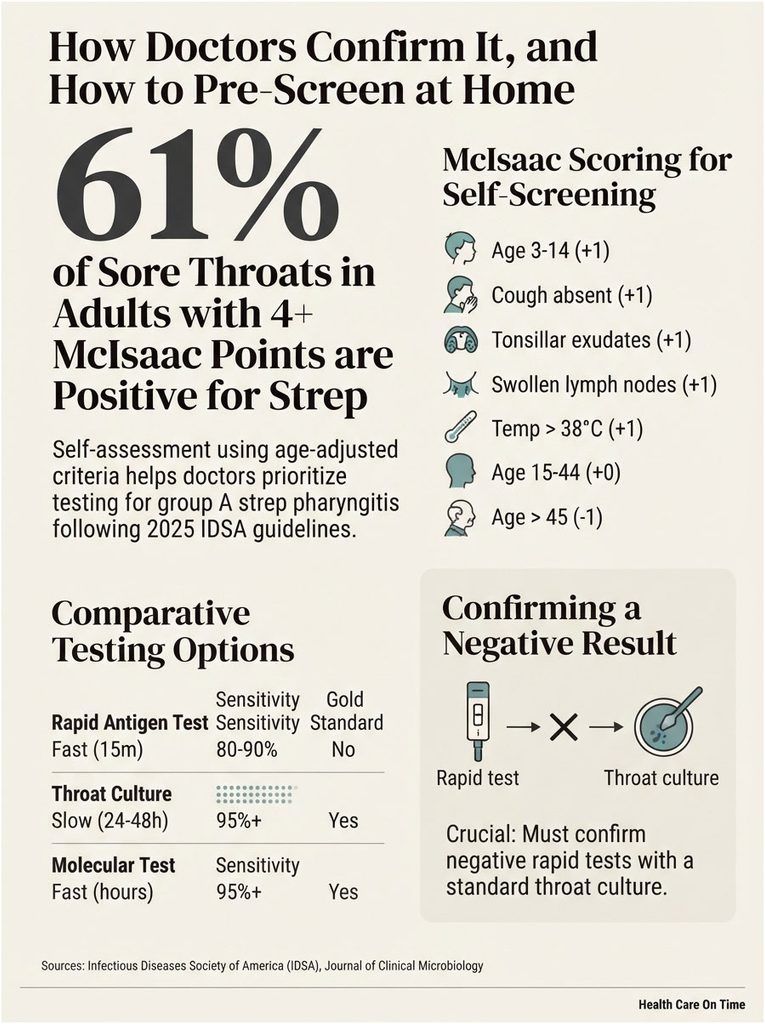
Give yourself one point for each of the following, which together form the Centor criteria:
- No cough
- Swollen, tender lymph nodes at the front of the neck
- Fever above 100.4 degrees Fahrenheit
- Tonsils that are swollen or have white patches on them
The McIsaac version adds an age adjustment: add one point if you are between 3 and 14, add nothing between 15 and 44, and subtract one point if you are 45 or older.
What Your Score Actually Predicts
Here is where the numbers become useful. On the Centor score, 0 to 1 point corresponds to roughly a 7 to 12 percent chance of strep, 2 to 3 points to 21 to 38 percent, and a full 4 points to about 57 percent. Using McIsaac, 0 to 1 point maps to 7.6 to 13.1 percent, 2 to 3 points to 20.8 to 33.6 percent, and 4 to 5 points to 50.7 to 69.3 percent.
Read that ceiling carefully. Even with every classic sign present, you are looking at roughly a coin flip. That is precisely why swabs exist.
Use the score the way clinicians do: as a reason to skip testing when it is very low, not as permission to self-diagnose when it is high.
Rapid Antigen Test, Molecular Test, or Culture
Three testing options are in routine US use, and they behave differently.
The rapid antigen detection test gives results in about 10 minutes. These tests are highly specific at around 95 percent, but sensitivity typically sits near 85 percent and varies widely from 70 to 99 percent.
Roughly 15 percent of people who have strep will get a negative rapid test result. That is why CDC advises confirming a negative rapid antigen test with a throat culture in symptomatic children aged 3 and older.
For adults, a backup throat culture after a negative rapid test is not routinely indicated, since scarlet fever rates are lower and acute rheumatic fever is very rare in adults.
Throat culture remains the reference standard but takes 24 to 48 hours. Molecular tests, or NAATs, are the newer middle path. The Abbott ID NOW Strep A 2 assay was FDA cleared in 2018 with manufacturer-reported sensitivity of 98.5 percent and specificity of 93.4 percent, and its improved sensitivity means negative results no longer require culture confirmation.
Where to Get Tested in the US
Point-of-care strep testing is CLIA-waived, which means it runs anywhere from a pediatrician office to a retail clinic inside a pharmacy or grocery store. Urgent care centers and standalone clinics both handle it routinely.
Emergency departments can test as well, but for a straightforward sore throat they mean longer waits and substantially higher costs. Save the ER for the red-flag findings covered in the next section.
Home Test Kits and Telehealth
Home strep kits exist, but they carry the same sensitivity limits as in-office rapid tests plus added swabbing error, since collecting a proper sample from the back of your own throat is genuinely hard to do well.
Telehealth has a hard boundary here too. Rapid strep tests and throat cultures require an in-person visit and cannot be performed through a virtual appointment. A video call can assess your risk. It cannot swab you.
Red Flags: When How It Looks Means Go Now
Some findings are not a book-an-appointment-this-week situation.
One-Sided Swelling and a Shifted Uvula
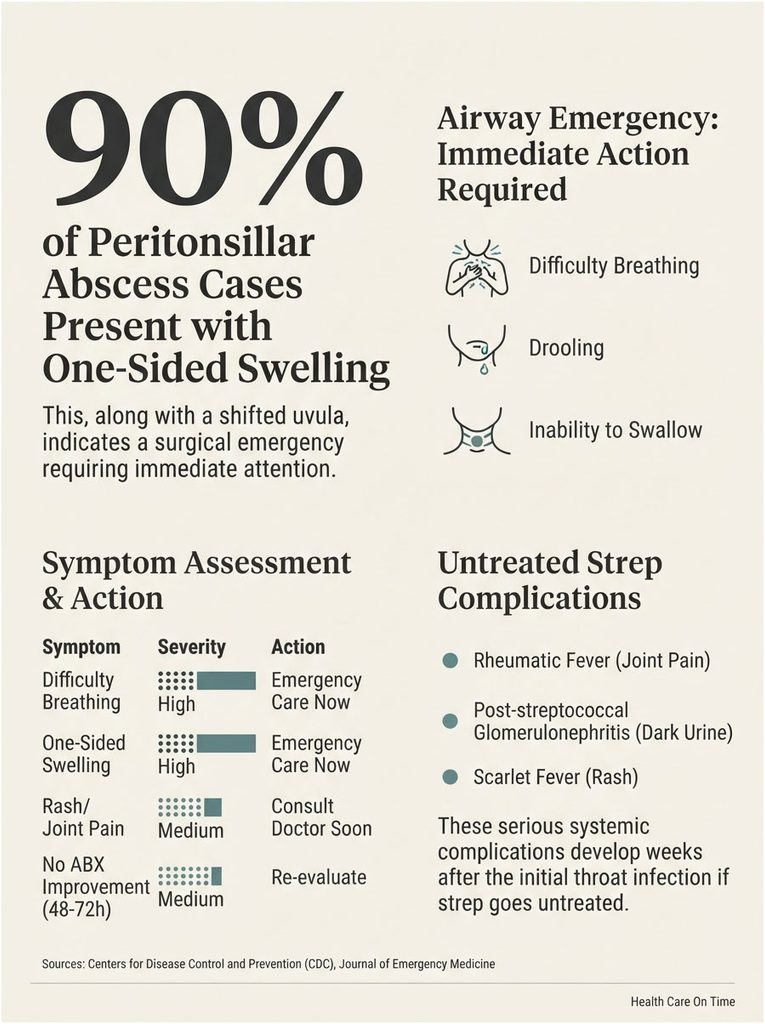
If one tonsil is dramatically more swollen than the other and the uvula appears pushed toward the opposite side, that pattern suggests a peritonsillar abscess, a pocket of pus beside the tonsil.
A peritonsillar abscess is a bacterial infection forming a pocket of pus near one tonsil, often as a complication of tonsillitis or mononucleosis, and in some cases it needs draining right away.
It usually comes with difficulty opening the mouth fully and a muffled, thick-sounding voice.
Drooling, Breathing Difficulty, or Inability to Swallow Saliva
These point toward airway compromise. Someone sitting upright, leaning forward, drooling because swallowing is unbearable, and struggling to breathe needs emergency care immediately.
Do not attempt to press the tongue down for a better look in this situation, since it can trigger spasm and worsen the obstruction. Do not drive yourself.
Rash, Dark Urine, or Joint Pain After a Sore Throat
Untreated strep can trigger delayed complications. Left untreated, group A strep can lead to rheumatic fever, which involves inflammation of the heart, blood vessels, and joints, or to a kidney condition called post-streptococcal glomerulonephritis.
Tea-colored urine, facial puffiness, or migrating joint pain in the weeks after a sore throat warrants prompt evaluation, even if the throat itself has fully healed.
No Improvement After 48 to 72 Hours of Antibiotics
Patients whose symptoms worsen after starting appropriate antibiotics, or who are still symptomatic five days into treatment, should be reevaluated.
Table 3: What You Are Seeing and What to Do About It
| What you see or feel | Most likely explanation | Recommended action | How fast |
| White patches, fever above 101 F, no cough, tender front-neck glands | Possible strep, Centor 3 to 4 | Get a rapid strep test or NAAT swab | Within 24 hours |
| Sore throat with cough, runny nose, sneezing, hoarseness | Viral sore throat | Fluids, rest, symptom relief; test only if it worsens | Reassess at 5 to 7 days |
| Small white specks, no fever, bad breath, ongoing for weeks | Tonsil stones | Saltwater gargles; see ENT if persistent or painful | Routine, non-urgent |
| White patches plus extreme fatigue and glands swollen in armpits or groin | Possible mononucleosis | Request mono testing with the strep swab; avoid contact sports | Within 48 hours |
| Creamy patches that wipe off, spreading to tongue and cheeks | Oral thrush | Primary care visit for antifungal treatment | Within a few days |
| Sandpaper rash on chest and neck plus bright red bumpy tongue | Possible scarlet fever | Strep testing required before antibiotics | Same day |
| One tonsil bulging, uvula pushed sideways, trouble opening mouth | Possible peritonsillar abscess | Urgent care or ER | Same day |
| Drooling, muffled voice, difficulty breathing or swallowing saliva | Possible airway emergency | Call 911 or go to the ER | Immediately |
What Changes After Treatment
Knowing the expected trajectory tells you when to stop worrying and when to call back.
The Day-by-Day Timeline
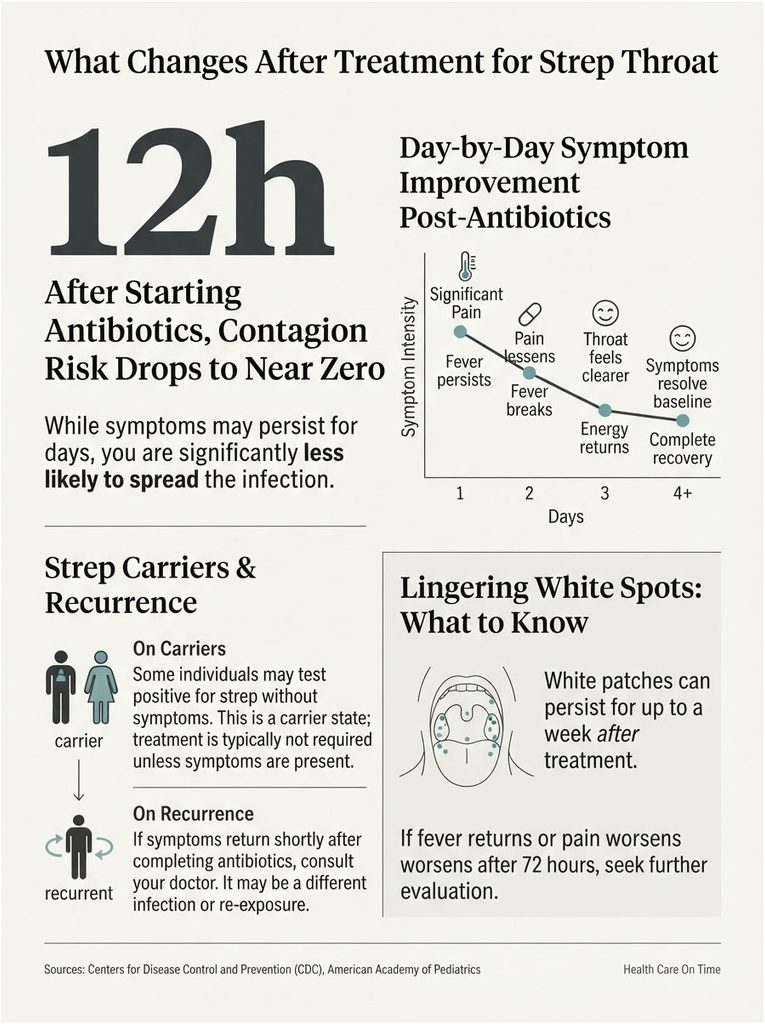
Once antibiotics start, symptoms typically improve within a day or two, though the full course must be completed to control the infection and reduce complication risk.
Even without treatment strep may improve in a few days, but antibiotics reduce severity, shorten sick time, prevent complications, and stop the infection spreading to others.
Fever usually breaks first, often within 24 to 36 hours. Swallowing pain eases next. Visible redness and the white patches fade last, sometimes taking most of a week.
Penicillin and amoxicillin are the usual choices, since both work well against strep and rarely cause serious side effects. Finish the whole course even after you feel fine.
When You Stop Being Contagious
You are generally not contagious 24 hours after starting antibiotics, and most people begin feeling better within one to three days.
For children, the return-to-school rule is slightly different. Per the American Academy of Pediatrics Red Book 2024 to 2027, children with group A strep infections should stay out of school or childcare until they look well and have had at least 12 hours of appropriate antibiotics, with 24 hours advised in outbreak settings or for healthcare workers.
The general guidance for both kids and adults is staying home until 24 hours of antibiotics have passed and the fever has resolved without fever-reducing medication.
Across patients we serve, swapping out a toothbrush a few days into the course is a small step that reduces household reinfection.
When White Spots Linger
Residual patches for several days after the fever resolves are common and not usually concerning if pain and temperature are steadily improving.
Patches persisting beyond two weeks, or a single white or red patch on one tonsil that will not resolve, should be examined rather than watched. A persistent sore throat with a white or red patch on one tonsil, discomfort swallowing, and ongoing earache are symptoms that overlap with tonsil cancer and warrant evaluation.
Recurrent Sore Throats and the Carrier Question
Some people test positive repeatedly without being genuinely infected each time. As many as 1 in 5 children are strep carriers, meaning they carry the bacteria without illness, are less likely to spread it or develop complications, and will keep testing positive on culture even after antibiotic treatment.
Patients commonly ask us why the swab keeps coming back positive when the child feels fine. Carriage is usually the answer, and it changes how a positive result should be read.
Tonsillectomy is rarely used as prevention, with common thresholds being seven documented episodes in one year, five per year for two years, or three per year for three years.
Frequently Asked Questions
Can you have strep throat without white spots?
Yes, and it happens often. Many confirmed cases show only intense redness and swelling with no visible exudate at all, particularly early on and in milder infections. The absence of white patches lowers the probability somewhat but does not rule strep out. Fever, absent cough, and tender front-neck glands still carry weight.
What does strep throat look like on day one?
Early strep often looks less dramatic than expected. Day one typically shows redness and swelling of the tonsils and pharynx, with pain that already feels disproportionate to how the throat appears. White patches and palatal petechiae frequently develop over the following 24 to 48 hours, so an unremarkable-looking throat on day one means very little.
How do I tell strep from mono just by looking?
You largely cannot. Mono exudate tends to be thicker and grayer and may spread onto the soft palate, but the overlap is substantial. The better separators sit outside the throat: mono brings weeks of exhaustion, swollen glands in the armpits and groin rather than just the neck, and sometimes an enlarged spleen requiring a sports restriction.
Do the white spots wipe off?
Not with strep. Streptococcal exudate is embedded in the tonsil tissue, and scraping causes bleeding and pain without removing it. Thrush patches do wipe off, revealing inflamed red tissue underneath, which is a useful bedside distinction. Either way, leave it alone and let a clinician look rather than disturbing the tissue.
What does strep throat look like if you have no tonsils?
Strep still affects the throat wall itself, producing redness, swelling, and sometimes exudate on the back of the pharynx. Having your tonsils removed lowers your risk of getting strep and may make symptoms less severe, but it does not make you immune to the infection.
Can a sore throat with a cough still be strep?
It can, though the odds drop considerably, and cough is one of the strongest signals pointing toward a viral cause. A person can also catch a cold and develop strep separately. That usually looks like a new or sharply worsening sore throat appearing several days into ordinary cold symptoms, which is worth testing.
What does strep throat look like in a toddler?
Usually nothing like the adult picture. In babies and toddlers infected with group A strep, the pattern tends toward fever with fussiness, poor appetite, and a runny nose rather than classic throat findings. Strep is uncommon under age 3, so testing is generally reserved for higher-suspicion situations.
How long do the white spots last after starting antibiotics?
Expect gradual improvement rather than an overnight change. Fever typically resolves within 24 to 36 hours, swallowing pain within two to three days, and residual patches over roughly five to seven days. Patches lasting beyond two weeks, or a one-sided patch that will not clear, should be evaluated in person.
Is a negative rapid strep test reliable?
Reasonably, but not perfectly. Around 15 percent of people with strep get a negative rapid test result. For symptomatic children aged 3 and older, CDC advises confirming a negative rapid antigen test with a throat culture. Adults with a negative rapid test do not routinely need culture backup, since rheumatic fever is very rare in adults.
Can strep throat look like only a red throat with no patches?
Yes. A uniformly red, swollen throat without exudate is an ordinary presentation, especially in the first day. Judge the total picture instead of the tonsils alone: onset speed, fever height, absence of cough, palatal petechiae, and neck gland tenderness each carry as much weight as the appearance of the tonsils themselves.
What does the roof of the mouth look like with strep?
You may see pinpoint red or purple dots scattered across the hard and soft palate, called palatal petechiae, which look like fine red speckling. In children this finding carries more diagnostic weight than tonsillar white spots, yet most people never think to look up there when checking their throat.
When should I go to urgent care instead of waiting?
Go the same day for one-sided throat swelling, a uvula pushed off-center, or trouble opening your mouth. Go immediately for drooling, a muffled voice, or difficulty breathing. Otherwise, a fever above 101 degrees Fahrenheit with white patches and no cough justifies a swab within 24 hours at a clinic, urgent care, or retail health center.
Medical Disclaimer: This article is for general information only and is not a substitute for professional medical advice, diagnosis, or treatment. Visual signs alone cannot confirm or exclude strep throat, and only a laboratory-confirmed throat swab can establish the diagnosis.
Always consult a licensed healthcare provider about your symptoms, and never disregard professional medical advice or delay seeking it because of something you have read here. If you are experiencing difficulty breathing, difficulty swallowing your own saliva, or severe one-sided throat swelling, seek emergency care immediately.
References
- CDC, About Strep Throat
- CDC, Clinical Guidance for Group A Streptococcal Pharyngitis
- CDC, Clinical Guidance for Scarlet Fever
- IDSA, Clinical Practice Guideline Update on Group A Streptococcal Pharyngitis
- StatPearls, Streptococcal Pharyngitis, NIH/NCBI Bookshelf
- AAFP, Streptococcal Pharyngitis: Rapid Evidence Review
- AAFP, Diagnosis of Streptococcal Pharyngitis
- Ebell MH et al., The Rational Clinical Examination: Does This Patient Have Strep Throat? JAMA
- Nibhanipudi KV, Palatal Petechiae Added to Centor Criteria, Global Pediatric Health
- Mayo Clinic, Strep Throat Symptoms and Causes
- Cleveland Clinic, Strep Throat
- Johns Hopkins Medicine, Strep Throat
- Nemours KidsHealth, Strep Throat in Kids and Teens
- Nationwide Children’s Hospital, Strep Throat
- UC Davis Health, How Do You Know if It Is Strep Throat or Sore Throat
- Group A Streptococcus Testing in Pediatrics, Journal of Clinical Microbiology
- Diagnostic Accuracy of Rapid Nucleic Acid Tests for GAS Pharyngitis, Clinical Microbiology and Infection