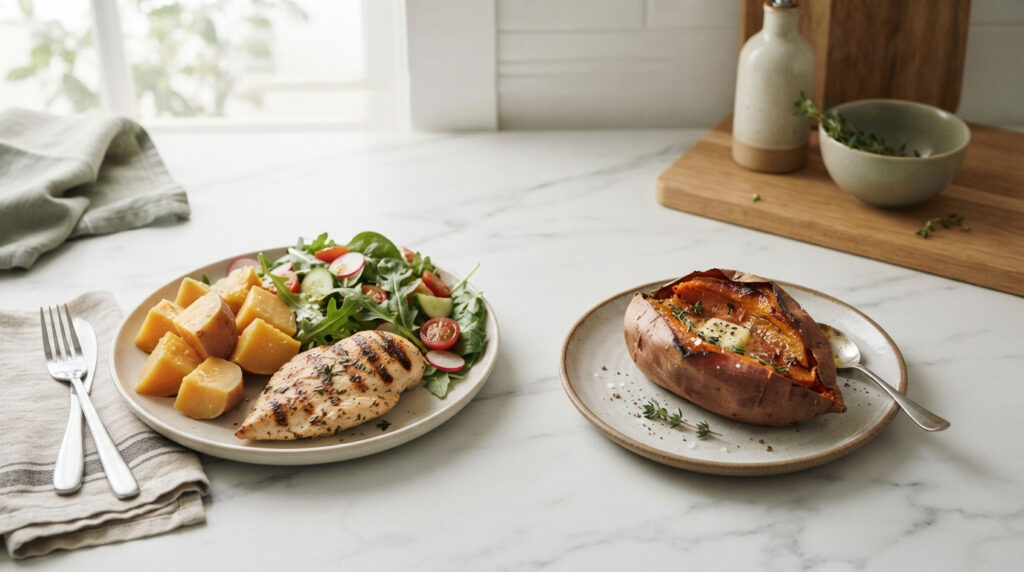
A baked sweet potato can score higher on the glycemic index than a boiled white potato. The vegetable you picked at the store is not the variable that matters most. Your oven is.
That single fact reverses most of what gets written about sweet potatoes and diabetes. And it changes what you should do tonight.
Table of Contents
Quick Answer: Yes, sweet potatoes fit a diabetes eating plan, but three things decide the outcome. Preparation matters most: boiled sweet potato tests at a glycemic index of 41 to 50, while baked tests at 82 to 94. Portion matters second: one medium baked sweet potato holds about 24 grams of carbohydrate. Pairing matters third: eaten with protein, fat, and non-starchy vegetables, the same portion produces a flatter glucose curve.
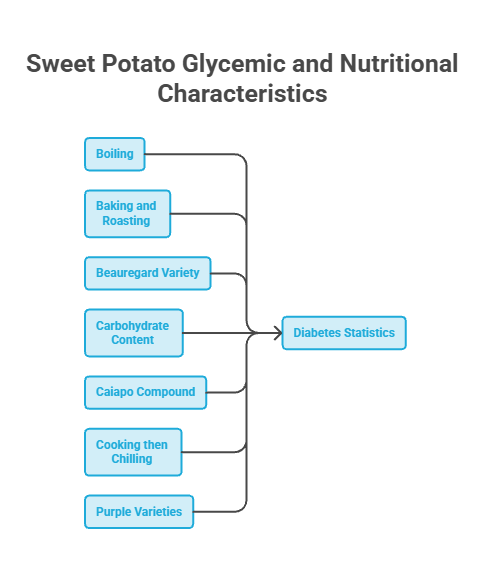
At a Glance
• Boiling produces a low-GI food; baking and roasting produce a high-GI food from the same tuber
• Beauregard, the dominant US variety, tests moderate at 63 to 66 steamed, baked, or microwaved
• A medium sweet potato (about 4 oz) is roughly 24 grams of carbohydrate, a full carb serving for most people
• Caiapo, the studied glucose-lowering compound, is a 4 gram concentrated extract, not the vegetable
• Cooking then chilling raises resistant starch and blunts the glucose response
• Purple varieties are not low-carb, whatever the packaging implies
• 40.1 million Americans have diabetes and 115.2 million adults have prediabetes
The Short Answer, and the Three Things That Decide It
Sweet potatoes are not a free food. They are also not off-limits. They sit in the same category as brown rice or oats: a starchy carbohydrate that behaves well or badly depending on how you handle it.
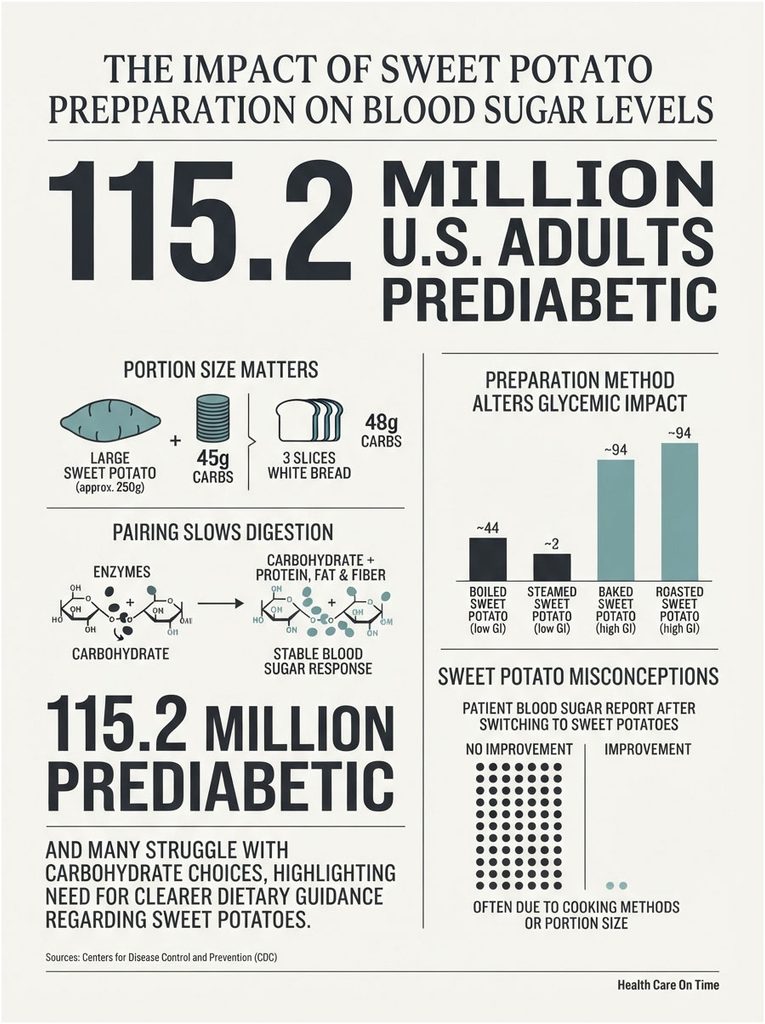
Most articles stop at “yes, in moderation.” That advice is useless because it never defines moderation and never mentions that two identical sweet potatoes, cooked differently, produce dramatically different blood sugar.
Preparation, portion, pairing
Preparation has the single largest effect, larger than variety and larger than skin-on versus peeled. Wet heat keeps the glycemic index low. Dry heat pushes it high.
Portion matters because sweet potatoes are sold in wildly inconsistent sizes. A jumbo baked sweet potato can carry more carbohydrate than two slices of bread.
Pairing matters because carbohydrate eaten alone empties from the stomach faster than the same carbohydrate eaten with protein, fat, and fiber. This one is free, requires no willpower, and works every time.
Patients booking A1C panels with HealthCareOnTime frequently tell us they switched from white potatoes to sweet potatoes and saw no improvement in their numbers. Almost always, they also switched from boiling to baking.
Why this question matters right now
The CDC’s National Diabetes Statistics Report, updated January 2026, estimates 40.1 million Americans have diagnosed or undiagnosed diabetes, about 12.0% of the population, with 29.1 million diagnosed and roughly 11 million unaware.
The prediabetes figure is larger still. CDC counts 115.2 million American adults with prediabetes, more than two in five, and reports that 8 in 10 of them do not know it.
That is a very large number of people making daily carbohydrate decisions without a clear framework. Sweet potato sits near the top of the list of foods they are confused about.
What Is Actually Inside a Sweet Potato
Before glycemic index, get the raw arithmetic straight. Carbohydrate grams drive the response, and that is the number most pages skip entirely.
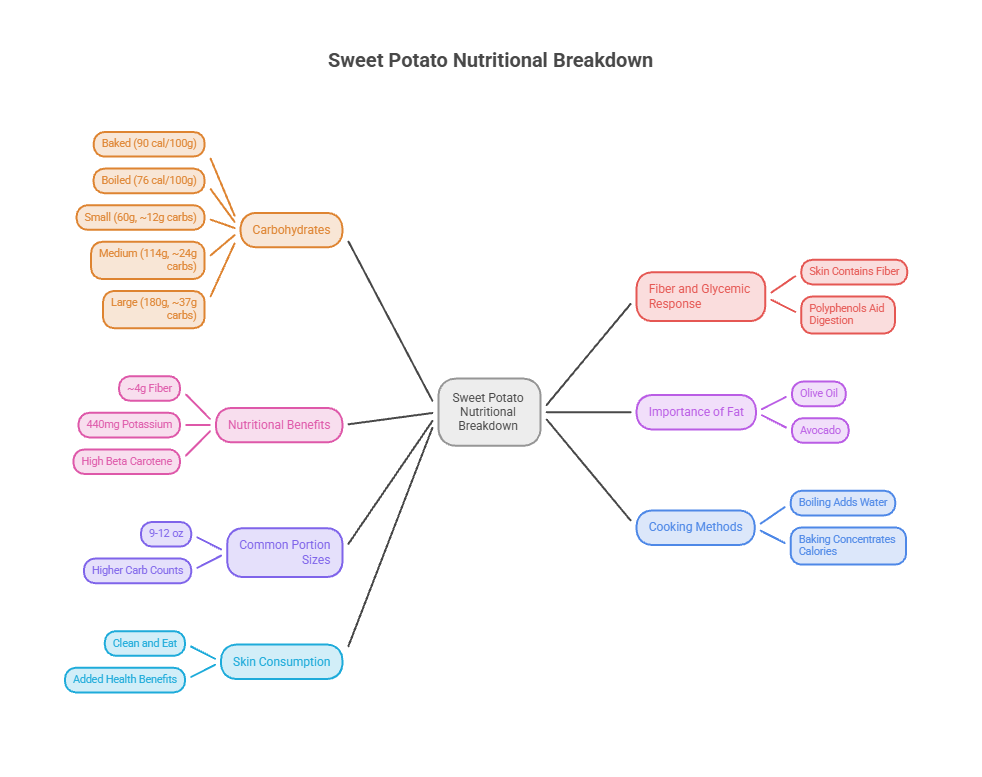
Carbohydrate and calories by real portion
USDA FoodData Central lists baked sweet potato in skin at about 90 calories per 100 grams, and boiled without skin at about 76 calories per 100 grams.
Boiling lowers calorie density because the flesh takes on water. Baking raises it because water evaporates and the flesh concentrates. Same tuber, different math.
USDA gram weights for a baked sweet potato run roughly 60 grams (2 oz) for small, 114 grams (4 oz) for medium, and 180 grams (6.3 oz) for large. That works out to about 12, 24, and 37 grams of total carbohydrate.
Subtract the fiber and a medium sweet potato lands near 20 grams of available carbohydrate. For most adults using carb counting, that is one to one and a half exchanges.
Here is the problem: supermarket sweet potatoes routinely weigh 9 to 12 oz. Nobody weighs them. A single “one sweet potato” dinner can be 50 grams of carbohydrate before anything else touches the plate.
Why the skin changes the math
The skin carries a disproportionate share of the fiber and polyphenols. It also physically slows digestion of the flesh underneath.
Allen’s US study measured skin and flesh separately and found the two behaved differently, with the skin producing lower glycemic responses in several preparations.
Eat the skin. Scrub it under running water, trim any blemishes, and leave it on. It is the easiest single improvement available and it costs nothing.
The nutritional case worth keeping
A medium sweet potato delivers roughly 4 grams of fiber and around 440 milligrams of potassium. Orange-fleshed varieties supply more vitamin A as beta carotene than nearly any other common vegetable.
Beta carotene is fat-soluble, which gives you a second reason to add olive oil or avocado to the plate. You absorb substantially more of it with fat present than without.
None of that cancels the carbohydrate. But it does mean a properly portioned sweet potato earns its place better than most refined starches at the same carb count. Our medical reviewers frame it this way: the question is never whether the food is good, it is whether the portion and the preparation are.
Glycemic Index vs Glycemic Load: The Number That Matters
The glycemic index ranks how fast a food raises blood glucose compared with pure glucose, scored 0 to 100. Under 55 is low, 56 to 69 is medium, 70 and above is high.
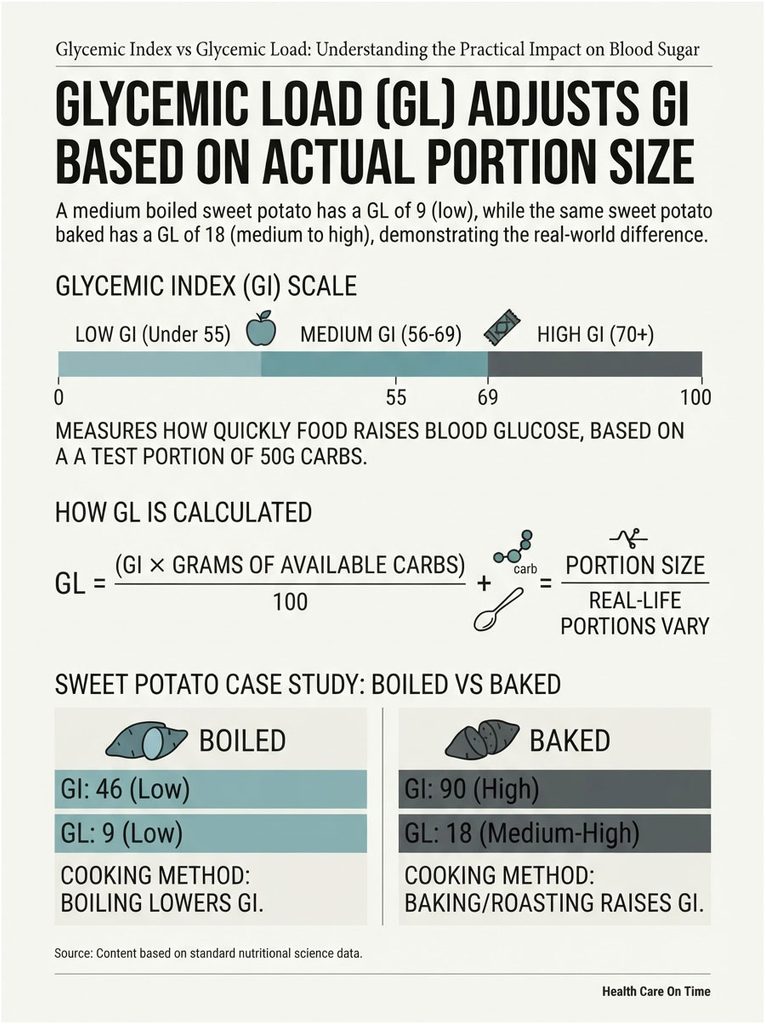
Here is the catch nobody explains. GI is measured on a test portion containing 50 grams of available carbohydrate. For sweet potato, that is roughly two and a half medium ones. Almost nobody eats that in a sitting.
Glycemic load is the practical number
Glycemic load adjusts the GI for the portion you actually eat. The formula is GI multiplied by grams of available carbohydrate, divided by 100. Under 10 is low, 11 to 19 is medium, 20 and above is high.
A medium boiled sweet potato with a GI of 46 and 20 grams of available carbohydrate has a glycemic load of about 9. Low.
The same-sized sweet potato baked at a GI of 90 carries a glycemic load closer to 18. Medium to high.
Same vegetable. Same weight. Roughly double the glucose impact. That is the entire argument of this article compressed into three sentences.
Why boiling lowers it and dry heat raises it
Sweet potatoes contain beta-amylase, an enzyme that converts starch into maltose. Slow dry heat gives that enzyme a long working window, which is precisely why a baked sweet potato tastes sweeter than a boiled one.
That sweetness is not just flavor. It is starch already broken down into simpler sugars before it reaches your small intestine.
Boiling inactivates the enzyme faster and adds water back into the flesh, diluting carbohydrate per bite. The result is a metabolically different food.
The human data is unambiguous. Bahado-Singh and colleagues tested ten cultivars in human volunteers and found GI ranging from 41 to 93 across the tubers, with boiling giving the lowest values at 41 to 50, and baking at 82 to 94 and roasting at 79 to 93 giving the highest.
The American cultivar correction
That study used Jamaican cultivars. US supermarkets sell mostly Beauregard and Covington, so the numbers deserve a local check.
Allen and colleagues at NC State tested Beauregard in 12 volunteers using 25 grams of available carbohydrate. Steamed, baked, and microwaved flesh scored 63, 64, and 66 respectively, placing Beauregard in the moderate range rather than the low range.
The same study found raw flesh at 32 and dehydrated flesh at 41, both firmly low.
Treat the Jamaican boiled figures as the best case and the Beauregard figures as the realistic American middle. Either way, dry-heat cooking moves you in the wrong direction.
How much confidence these numbers deserve
Worth stating plainly: the two anchor studies date to 2011 and 2012, and no larger US trial has replaced them. Both used small samples, ten and twelve subjects respectively, which is standard for GI testing but still small.
Published sweet potato GI values across the literature span 32 to 94 depending on cultivar, maturity, cut size, cooking time, and cooling. Any website quoting one number for “sweet potato” is oversimplifying badly.
Use these figures as a reliable guide to direction, not as precise predictions for your body. The self-test protocol later in this article closes that gap.
| Preparation | Glycemic index (human trials) | Approx. glycemic load per medium serving | Expected blood sugar impact | Verdict for diabetes |
| Boiled, 20 to 30 min, skin on | 41 to 50 (Bahado-Singh 2011) | 8 to 10 | Slow, moderate rise | Best everyday choice |
| Steamed | 63 (Allen 2012, Beauregard) | 12 to 13 | Moderate rise | Very good, close second |
| Microwaved | 66 (Allen 2012, Beauregard) | 13 to 14 | Moderate rise | Good, fast, convenient |
| Cooked then chilled 24 h | Lowered vs freshly cooked | 6 to 9 | Blunted rise, more resistant starch | Excellent, underused |
| Baked whole, 45 to 60 min | 82 to 94 (Bahado-Singh 2011) | 16 to 19 | Fast, sharp rise | Cut the portion in half |
| Roasted in cubes | 79 to 93 (Bahado-Singh 2011) | 16 to 19 | Fast, sharp rise | Occasional, small portion |
| Fried as fries | High, plus added fat and salt | 18 to 30+ | Sharp rise, prolonged | Treat food, not a side dish |
Table 1. Sweet potato glycemic index and glycemic load by cooking method, from human trials.
Not All Sweet Potatoes Are the Same
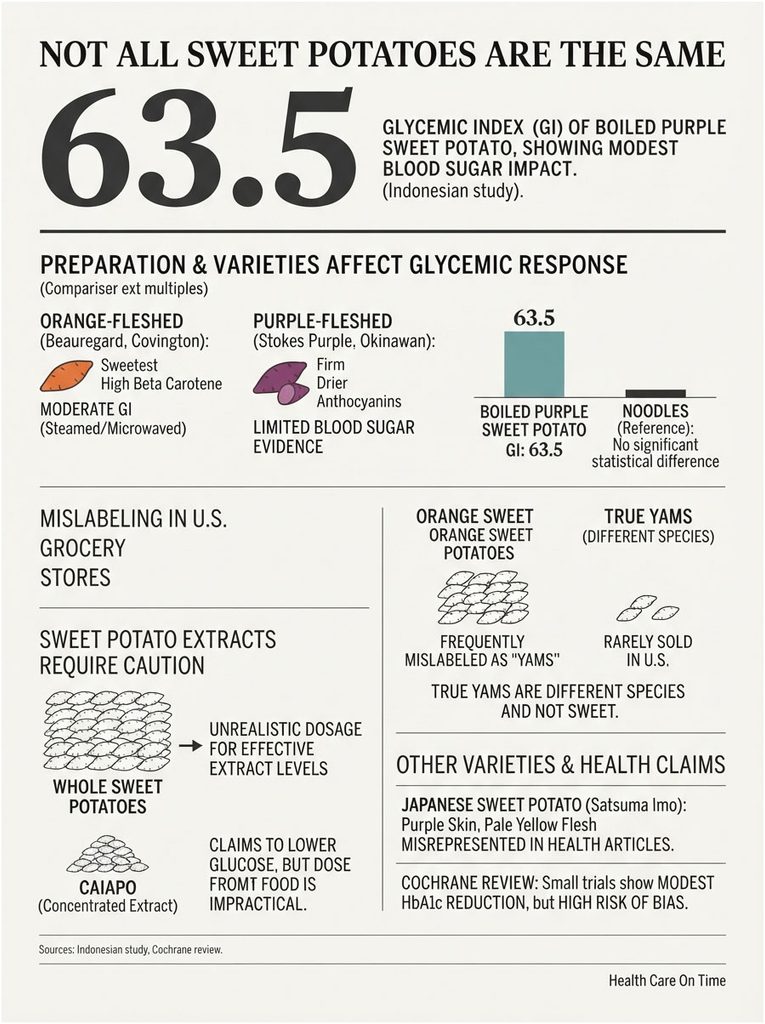
Variety matters less than cooking method, but it is not irrelevant. Three groups show up in American stores, and they are not interchangeable.
Orange-fleshed varieties
Beauregard and Covington dominate US production. Reddish-brown skin, deep orange flesh, high beta carotene, and the sweetest flavor of the three groups.
These are the varieties the American GI data was actually measured on. Moderate GI when steamed or microwaved, high when baked whole.
They are also the ones most likely to be labeled “yams” in American grocery stores, which is a long-standing mislabel. True yams are a different species entirely and are rarely sold in mainstream US supermarkets.
Purple varieties
Stokes Purple and Okinawan sweet potatoes take their color from anthocyanins, the same pigment class found in blueberries and red cabbage. They are firmer, drier, and noticeably less sweet.
Anthocyanins have plausible mechanisms for glucose metabolism, including slowing carbohydrate digestion in the gut. But the human evidence that purple sweet potato specifically lowers blood sugar in people with diabetes is thin.
An Indonesian trial comparing purple sweet potato products found boiled purple sweet potato at a GI of 63.5, resistant-starch-enriched noodles at 58.7, and conventional noodles at 83.7, with the differences not reaching statistical significance.
Purple sweet potatoes are a fine choice and they hold their shape well when boiled. They are not a low-carbohydrate food, and they are not medicine.
Japanese and white-fleshed varieties, and the caiapo problem
This is where most consumer health articles go wrong, so read this part carefully.
Japanese sweet potatoes (Satsuma Imo) have purple skin and pale yellow flesh. Popular health pages tell readers these contain caiapo, a compound shown in trials to lower blood glucose and cholesterol. That statement is technically true and practically misleading.
Caiapo is a concentrated, standardized extract of the white sweet potato cortex, taken as a supplement. The trials used 4 grams per day of that extract. There is no realistic way to reach that dose by eating the vegetable.
The Cochrane review assessed the whole evidence base. It found only three randomized controlled trials totaling 140 participants, all conducted by the same trialist, with unclear or high risk of bias, showing HbA1c improved by a mean difference of 0.3% with 4 g/day of sweet potato preparation compared with placebo.
Cochrane also noted that no study examined diabetic complications, death from any cause, quality of life, or costs, and that adverse effects were mostly mild, including abdominal distension and pain.
A 0.3% HbA1c reduction is real but modest. The trials were small, and every one came from a single research group. Our medical reviewers treat this as preliminary evidence for a supplement, not as a reason to eat more sweet potatoes.
If you want a fuller nutritional comparison between the two tubers, our companion article on sweet potato vs white potato breaks down the per-serving numbers side by side.
How to Eat Sweet Potatoes Without the Spike
Five practical moves, ordered by how much difference each one makes.
1. Fix the portion first
Weigh it once. Just once, so you learn what the right size looks like on your own plate and never have to weigh again.
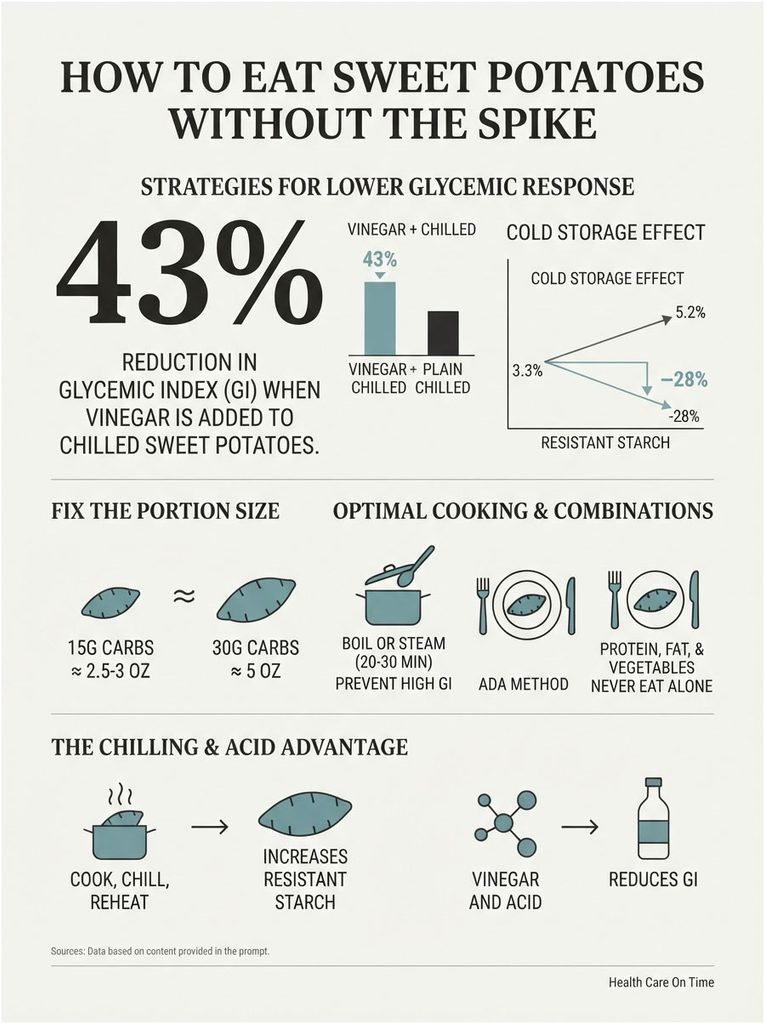
For a 15 gram carbohydrate portion, that is roughly 2.5 to 3 oz of cooked sweet potato, about half a small one or a third of a medium one. For 30 grams of carbohydrate, roughly 5 oz, which is one medium.
Eyeball equivalents worth memorizing: a 15 gram portion is about the size of a computer mouse. A 30 gram portion is about the size of your clenched fist.
Buy small sweet potatoes deliberately. A bag of small ones removes the portioning problem before you ever get to the stove.
2. Boil or steam, then stop
Twenty to thirty minutes in simmering water, skin on, cut into large chunks or left whole. Drain and serve.
If you want the caramelized flavor of baking, split the difference. Boil until nearly done, then finish under the broiler for four or five minutes. You get browning without the hour of enzymatic starch conversion that drives the GI up.
Steaming and microwaving both land in the moderate range and are far better than a long bake. Microwaving a whole sweet potato takes about five minutes and is the most practical weeknight option most people ignore.
3. Cook it, chill it, reheat it
When cooked starch cools, some of it recrystallizes into resistant starch type 3, which digestive enzymes cannot fully break down. It behaves more like fiber than like sugar.
The human evidence in potatoes is specific and quantified. Leeman and colleagues found that cold storage of boiled potatoes raised resistant starch from 3.3% to 5.2% of starch, and that cold potatoes served with vinegar dropped glycemic index by 43% and insulin index by 31% versus freshly boiled.
Cold storage on its own lowered the insulin response by 28%.
Be realistic about the size of this effect. It is a meaningful improvement, not a transformation, and a large portion of chilled sweet potato is still a large portion of carbohydrate.
Practical version: boil a batch on Sunday, refrigerate 24 hours, reheat portions through the week. Resistant starch type 3 is heat-stable and largely survives reheating.
4. Never eat it alone
Protein and fat slow gastric emptying. Acid slows it further. Non-starchy vegetables add volume and fiber without adding carbohydrate.
Sweet potato plus grilled chicken plus a large salad produces a very different curve than sweet potato plus rice plus corn.
The vinegar finding above is not incidental. A splash of vinegar or a squeeze of lemon on the plate is a genuinely evidence-backed move that costs nothing.
5. Put it in the right place on the plate
The ADA Diabetes Plate Method gives you a 9-inch plate: half non-starchy vegetables, one quarter lean protein, one quarter carbohydrate foods.
Sweet potato belongs in that last quarter. Not spread across half the plate on the reasoning that it is a vegetable.
That one framing error accounts for a large share of the confused blood sugar readings we hear about. Sweet potato is a starch that happens to be a vegetable, and the plate should treat it as a starch.
| Metric | Figure | Population or sample | Source |
| US diabetes prevalence | 40.1 million people, 12.0% | All ages, 2023 data | CDC National Diabetes Statistics Report, Jan 2026 |
| US prediabetes prevalence | 115.2 million adults, more than 2 in 5 | US adults | CDC, 2026 |
| Adults with prediabetes who are unaware | 8 in 10 | US adults with prediabetes | CDC, 2026 |
| Boiled sweet potato GI | 41 to 50 | 10 cultivars, 10 human subjects | J Nutr Metab, Bahado-Singh 2011 |
| Baked sweet potato GI | 82 to 94 | 10 cultivars, 10 human subjects | J Nutr Metab, Bahado-Singh 2011 |
| Beauregard steamed / baked / microwaved GI | 63 / 64 / 66 | 12 volunteers, US cultivar | Open Nutr J, Allen 2012 |
| Raw sweet potato flesh GI | 32 | 12 volunteers | Open Nutr J, Allen 2012 |
| Sweet potato extract effect on HbA1c | Mean difference -0.3% | 122 participants, 2 trials | Cochrane Review CD009128 |
| Resistant starch after cold storage | 3.3% to 5.2% of starch | Boiled potato, healthy adults | Eur J Clin Nutr, Leeman 2005 |
| GI reduction, cold storage plus vinegar | 43% lower | Healthy adults | Eur J Clin Nutr, Leeman 2005 |
Table 2. Key United States statistics and human trial findings on sweet potato and blood sugar.
Sweet Potato vs White Potato: Settling It With Numbers
The received wisdom says sweet potatoes are the diabetes-friendly potato. The evidence is more interesting than that.
Where sweet potatoes genuinely win
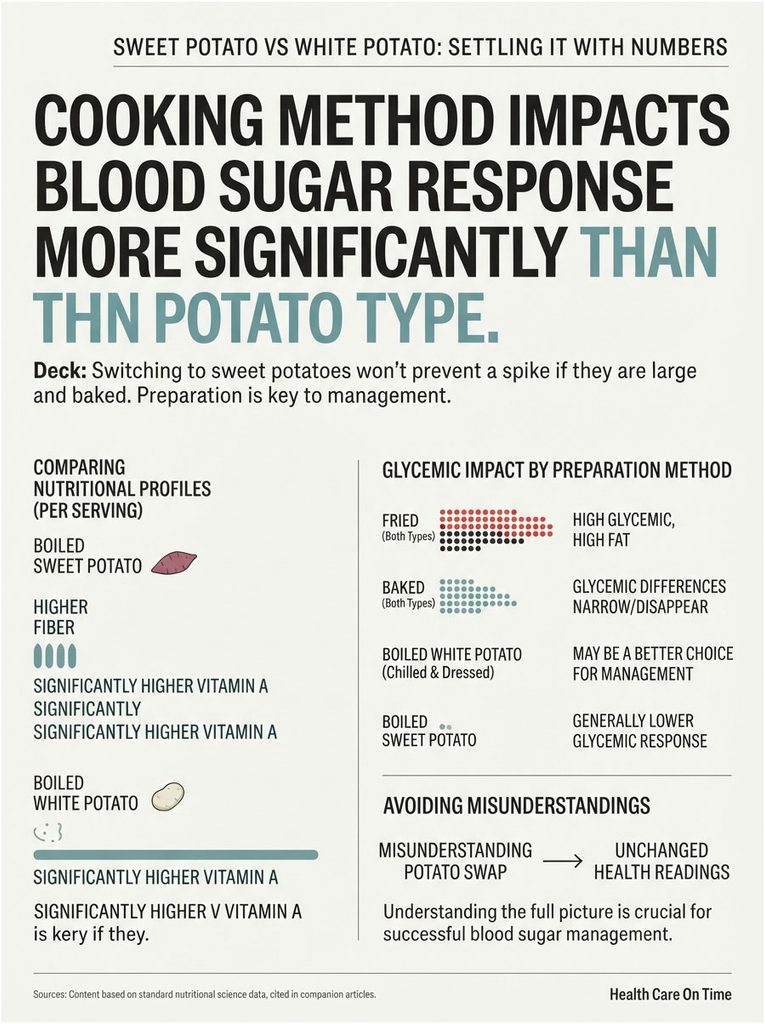
At matched preparation, sweet potatoes usually come out ahead. Boiled sweet potato averages meaningfully lower than boiled white potato across pooled human comparisons.
Sweet potatoes also carry more fiber per serving and vastly more vitamin A. If you are choosing between two boiled tubers, the sweet one is the better pick on both counts.
Where the difference disappears
Bake both and the gap narrows sharply or closes entirely. Published comparisons place baked white and baked sweet potato in a similar high range.
Fry both and you have two high-glycemic, high-fat foods separated mainly by marketing budget.
The verdict most articles get backwards
Cooking method beats potato type. A boiled white potato, chilled overnight and dressed with vinaigrette, is a better blood sugar choice than a jumbo baked sweet potato.
If you have been swapping white for sweet and seeing no change in your readings, this is almost certainly why. Our companion article on potatoes and glycemic index covers the white potato numbers in detail, including the cooled-versus-hot cultivar data.
Mistakes That Turn a Good Choice Into a Bad One
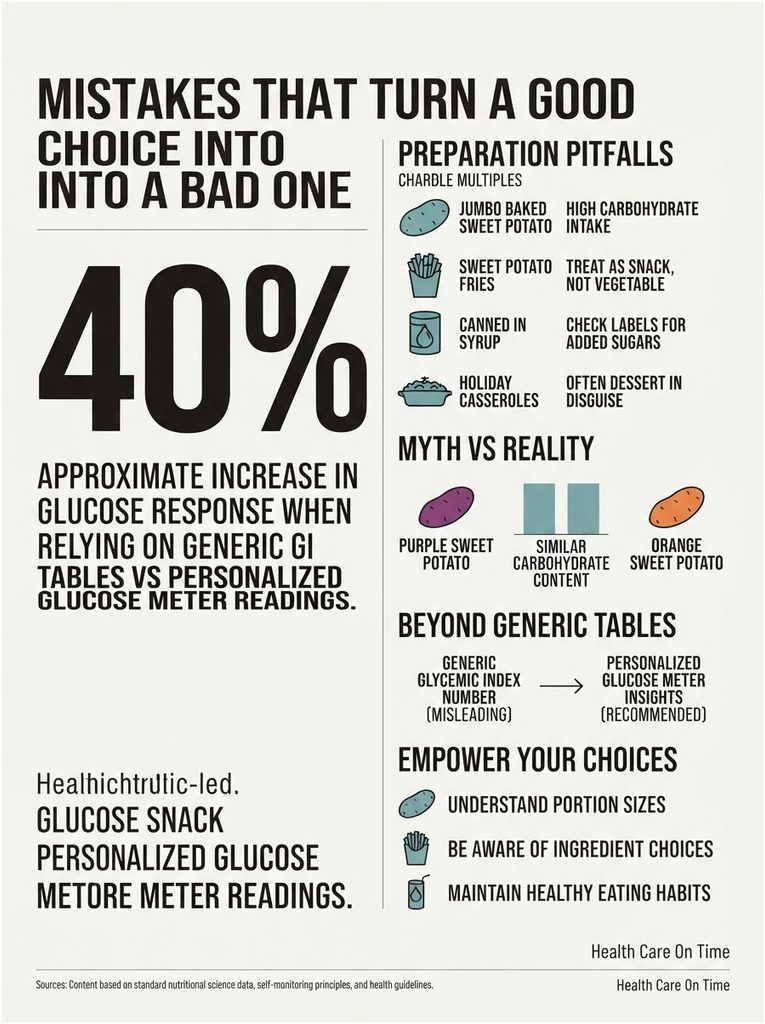
Baking a jumbo sweet potato and calling it a serving
The most common error we see. A 10 oz baked sweet potato is roughly 60 grams of carbohydrate at a high glycemic index. That is a dessert-sized glucose load wearing a vegetable costume.
Size is invisible on a plate. It is very visible on a meter two hours later.
Believing the sweet potato fries halo
Sweet potato fries are fried potatoes. The oil, the enormous surface area, and the high-heat cooking all work against you at once.
Restaurant versions frequently cost more than regular fries because the health halo supports the price. They are not a health food because the tuber underneath is orange.
Portion them like a treat, share the basket, and never count them toward a vegetable serving.
Candied, canned in syrup, and casserole
Canned sweet potatoes are frequently packed in syrup, which adds free sugars to an already high-carbohydrate food. Read the label; some are packed in water and those are fine.
Holiday casseroles stack brown sugar, butter, and marshmallow on top of an already high-GI baked base. That dish is dessert. Plan for it accordingly rather than pretending otherwise.
Assuming purple means low-carb
Purple sweet potatoes carry essentially the same carbohydrate as orange ones. The anthocyanins are a bonus, not a subtraction, and premium pricing does not change the arithmetic.
Trusting a single GI number from the internet
Published values for “sweet potato” range from 32 to 94. A site quoting one figure without naming the cooking method is telling you almost nothing useful.
Your own glucose meter beats any published table. That is the next section.
What to Do in Your Situation
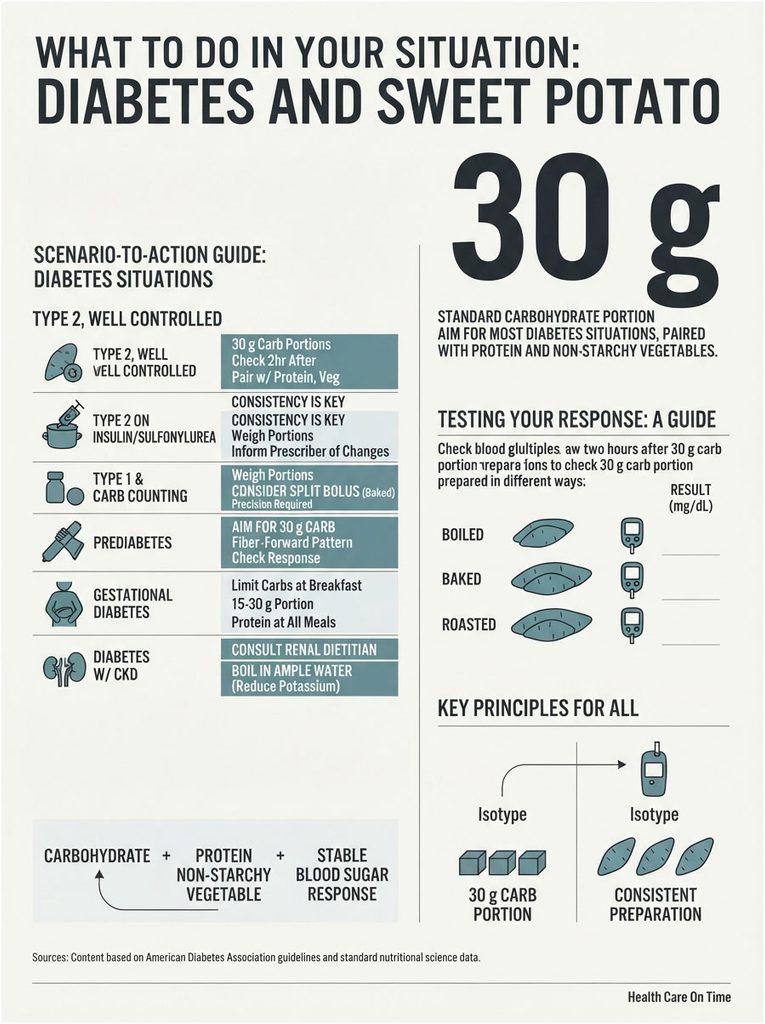
Blanket advice fails because a well-controlled type 2 on metformin and a type 1 on an insulin pump face completely different math.
Type 2 diabetes, well controlled
You likely have room for a 30 gram carbohydrate portion at a meal, boiled or steamed, alongside protein and non-starchy vegetables. Check two hours after eating to confirm.
Type 2 on insulin or a sulfonylurea
Consistency matters more than restriction here. Keep the portion and the preparation the same from meal to meal so your dose reliably matches the food.
If you start cooking and chilling, tell your prescriber. A lower glycemic response with an unchanged dose can push you low.
Type 1 diabetes and carb counting
Weigh the portion until you know it by sight. Baked preparations produce a fast early rise, so consider a split or extended bolus, or dose slightly earlier than usual.
Prediabetes
This is the group with the most to gain and the most freedom to act. Boiled, portioned, and paired, sweet potato fits comfortably within the fiber-forward eating patterns associated with lower type 2 diabetes risk.
Gestational diabetes
Carbohydrate tolerance is typically lowest at breakfast. Save the sweet potato for lunch or dinner, hold the portion at 15 to 30 grams of carbohydrate, and always pair it with protein.
Diabetes with chronic kidney disease
Sweet potatoes are high in potassium, and for this group that outranks the glycemic index question entirely.
Boiling in a large volume of water and discarding the water removes some potassium. Speak with your renal dietitian before making sweet potatoes a regular item.
| Your situation | Recommended carb portion | Best preparation | What to pair it with |
| Type 2, well controlled | 30 g carb (about 5 oz cooked) | Boiled or steamed, skin on | Lean protein plus a large non-starchy vegetable serving |
| Type 2 on insulin or sulfonylurea | 15 to 30 g carb, kept consistent | Boiled, same method every time | Protein and fat; notify prescriber if you change method |
| Type 1, carb counting | Weighed, any size within your ratio | Any, but note baked rises fast | Consider split bolus or earlier dosing with baked |
| Prediabetes | 30 g carb (about 5 oz cooked) | Boiled, or cooked then chilled | Protein, olive oil, vinegar-dressed salad |
| Gestational diabetes | 15 to 30 g carb, not at breakfast | Boiled or steamed | Protein at every carb-containing meal |
| Diabetes with kidney disease | Discuss with renal dietitian first | Boiled in ample water, water discarded | Follow your individual potassium plan |
| Testing your own response | 30 g carb, two ways on two days | Boiled one day, baked the next | Keep the pairing identical both days |
Table 3. Scenario-to-action guide for fitting sweet potato into your eating plan.
How to Test It on Yourself
Published GI values come from group averages in small samples. Individual glucose responses to the same food vary far more than those tables suggest.
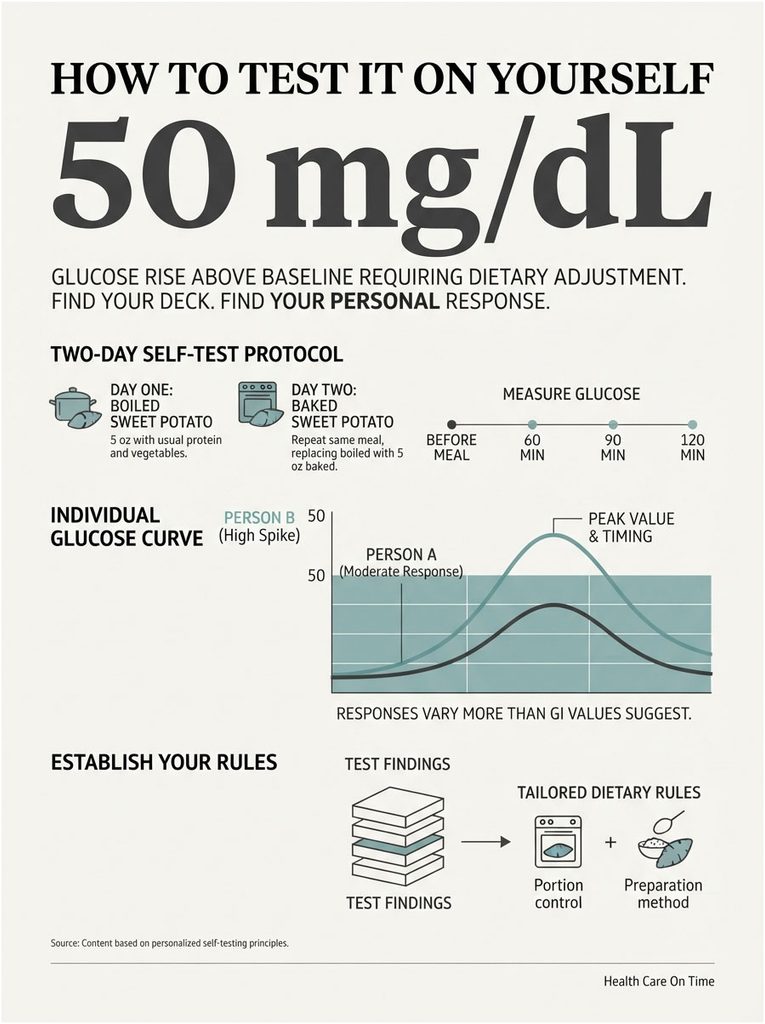
You can settle this for your own body in two days.
The protocol. Pick one meal slot and hold everything else constant. Day one, eat 5 oz of boiled sweet potato with your usual protein and vegetables. Day two, same time, same protein, same vegetables, 5 oz of baked sweet potato.
Check your glucose immediately before the meal, then at 60, 90, and 120 minutes. If you wear a CGM, capture the full curve and note the peak and the time it occurred.
What to look for. Compare the peak value and how far you rose above your pre-meal baseline. A rise of more than 50 mg/dL above baseline suggests the portion or the preparation needs adjusting.
What to do with the result. If boiled works and baked does not, you now have a permanent rule that costs nothing to follow forever. If neither works at 5 oz, drop to 2.5 oz and retest.
Across the patients we serve, this two-day test resolves more confusion than any amount of reading about glycemic index. It also tends to be reassuring, because most people discover they have more room than they feared once the cooking method is fixed.
The Bottom Line
Sweet potatoes are a reasonable carbohydrate choice for most people with diabetes, and a poor one for almost nobody, provided you handle three things.
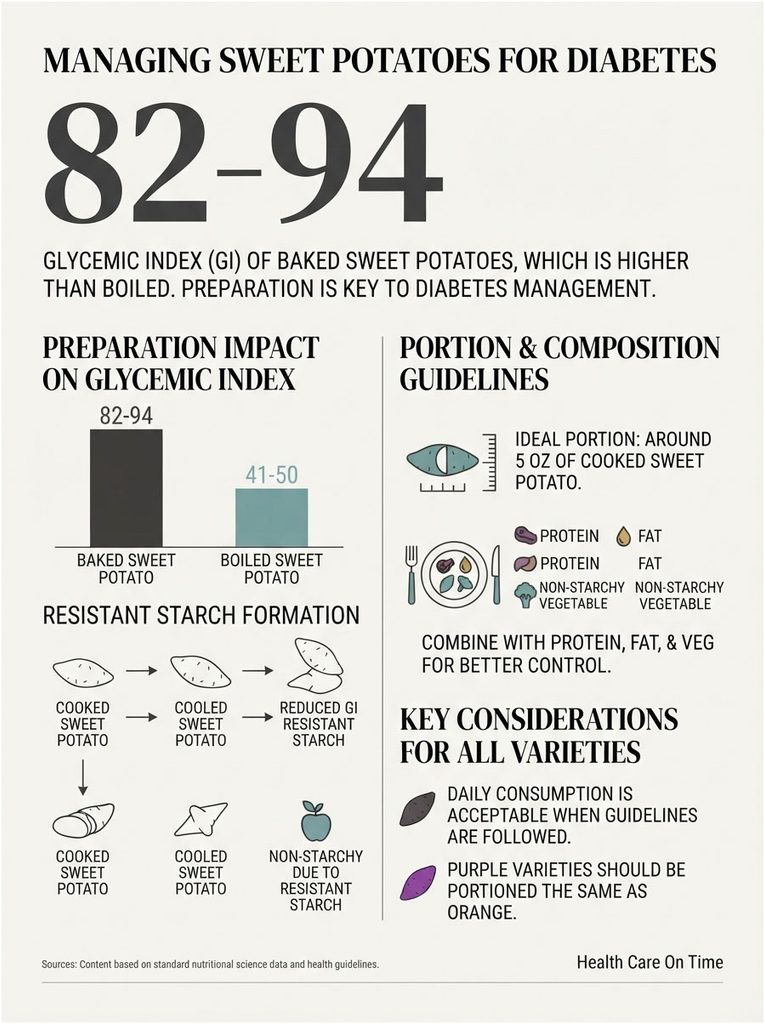
Boil or steam rather than bake. Keep the portion around 5 oz of cooked flesh. Put protein, fat, and non-starchy vegetables on the same plate.
Do those three things and the sweet potato question stops being complicated. Skip them and no amount of vitamin A makes up the difference.
Frequently Asked Questions
How much sweet potato can a diabetic eat in one meal?
Most adults do well with 15 to 30 grams of carbohydrate from sweet potato, which is roughly 2.5 to 5 oz of cooked flesh, or between a third and a whole medium one. Boiled preparations allow the larger end of that range; baked preparations argue for the smaller end.
Is baked sweet potato bad for diabetics?
Not banned, but genuinely higher impact. Human trials place baked sweet potato in the high glycemic index range at 82 to 94, versus 41 to 50 boiled. If you want baked, cut the portion roughly in half and pair it with protein and fat.
What is the glycemic index of boiled sweet potato?
Human testing across ten cultivars found boiled sweet potato at 41 to 50, which is a low-GI food. US Beauregard tested slightly higher at 63 steamed. Longer boiling and skin-on cooking both push the value toward the lower end of the range.
Are sweet potatoes better than white potatoes for blood sugar?
At matched preparation, usually yes, thanks to more fiber and a lower average glycemic index. But cooking method matters more than potato type. A chilled boiled white potato beats a large baked sweet potato for blood sugar.
Do purple sweet potatoes lower blood sugar?
Anthocyanins in purple varieties have plausible mechanisms, but human evidence for lowering blood sugar in people with diabetes remains limited. One trial found boiled purple sweet potato at a GI of 63.5, similar to orange varieties. Enjoy them, but portion them identically.
Does cooling a sweet potato really lower its glycemic index?
Yes, modestly. Cooling cooked starch forms resistant starch that resists digestion. In boiled potatoes, cold storage raised resistant starch from 3.3% to 5.2% and cut glycemic index substantially when combined with vinegar. A real improvement, not a transformation.
Can I eat sweet potatoes every day with type 2 diabetes?
Daily is fine when the portion is controlled and the preparation is right. Boiled, 5 oz or less, eaten with protein and non-starchy vegetables, fits most eating plans. Rotate with other carbohydrate sources so your diet stays varied.
Are sweet potato fries okay for diabetics?
They are fried potatoes with a health halo. Frying adds fat and calories while high-heat cooking raises the glycemic response. Treat them as an occasional treat, portion them deliberately, and never count them as a vegetable serving.
Should I eat the skin?
Yes. The skin holds a disproportionate share of the fiber and polyphenols and slows digestion of the flesh beneath it. Scrub it well rather than peeling. This is the easiest single improvement you can make, and it is free.
How many carbs are in one medium sweet potato?
A medium baked sweet potato of about 4 oz carries roughly 24 grams of total carbohydrate and around 20 grams after subtracting fiber. Supermarket sweet potatoes often run two to three times that weight, so weigh yours once to calibrate your eye.
Can prediabetics eat sweet potatoes?
Yes, and this group benefits most from getting it right. Boiled, portioned to about 30 grams of carbohydrate, and paired with protein, sweet potato fits the fiber-forward eating patterns associated with lower type 2 diabetes risk.
Is sweet potato safe with diabetes and kidney disease?
Sweet potatoes are high in potassium, so this needs individual guidance. Boiling in a large volume of water and discarding it reduces potassium content somewhat. Speak with your renal dietitian before making sweet potatoes a regular part of your meals.
Medical Disclaimer: This article is for informational purposes only and does not constitute medical advice, diagnosis, or treatment. Individual blood glucose responses to food vary considerably, and the portion guidance here is general rather than personalized. If you take insulin, a sulfonylurea, or any glucose-lowering medication, discuss dietary changes with your prescriber before making them, since changes in carbohydrate intake or preparation can affect dosing and hypoglycemia risk. People with chronic kidney disease should consult a renal dietitian regarding potassium intake. Never start, stop, or adjust any medication without professional guidance.
References
- National Diabetes Statistics Report, Centers for Disease Control and Prevention, January 2026
- Diabetes: A U.S. Report Card, Centers for Disease Control and Prevention
- Standards of Care in Diabetes 2026, American Diabetes Association, Diabetes Care 49(Suppl 1)
- Bahado-Singh PS, et al. Relationship Between Processing Method and the Glycemic Indices of Ten Sweet Potato Cultivars, Journal of Nutrition and Metabolism, 2011
- Allen JC, et al. Glycemic Index of Sweet Potato as Affected by Cooking Methods, The Open Nutrition Journal, 2012
- Ooi CP, et al. Sweet Potato for Type 2 Diabetes Mellitus, Cochrane Database of Systematic Reviews
- Leeman M, et al. Vinegar Dressing and Cold Storage of Potatoes Lowers Postprandial Glycaemic and Insulinaemic Responses, European Journal of Clinical Nutrition, 2005
- Nurdjanah S, et al. Chemical Components, Antioxidant Activity, and Glycemic Response Values of Purple Sweet Potato Products, 2022
- Arisanti CIS, et al. Mechanism of Anti-Diabetic Activity from Sweet Potato (Ipomoea batatas): A Systematic Review, Foods, 2023
- What’s in Season: Sweet Potatoes, American Diabetes Association Diabetes Food Hub
- Diabetes Statistics, National Institute of Diabetes and Digestive and Kidney Diseases