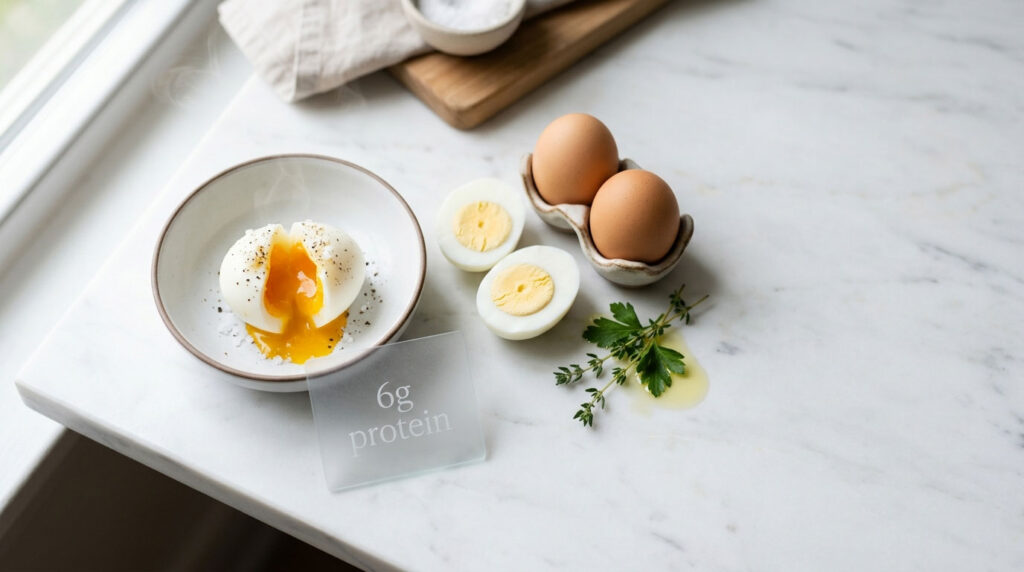
Walk into any gym and you’ll see someone ordering an egg-white omelet, yolks tossed in the trash. They’re throwing away nearly half the protein they came for.
Table of Contents
Here’s the reality. A large egg packs about 6 grams of protein, and roughly 2.7 grams of that lives in the yolk most people discard. The white, the part everyone treats as pure protein, is actually about 88 percent water.
So the real question isn’t just how much protein is in an egg. It’s where that protein hides, how it scales with size, and how many eggs it takes to hit your daily number. This guide answers all of it with USDA data and the latest US research.
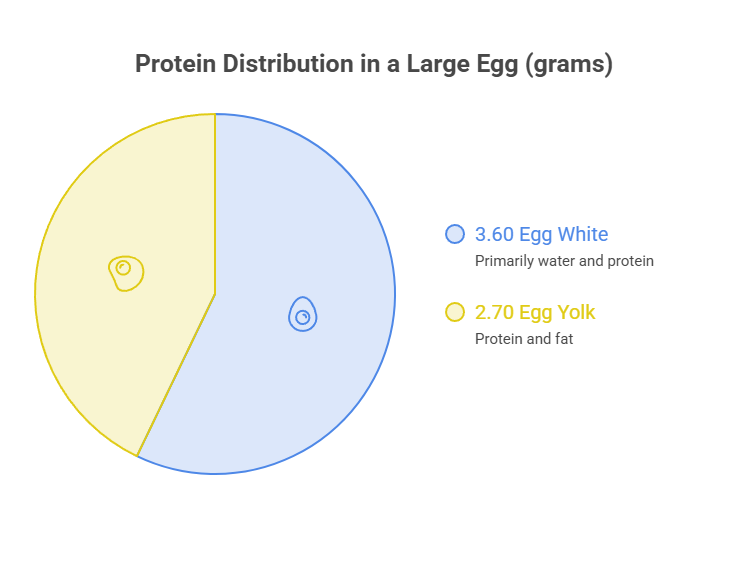
Quick Answer: One large egg has about 6 grams of high-quality, complete protein for roughly 72 calories. The white holds about 3.6 grams and the yolk about 2.7 grams. Protein scales with size, from about 5 grams in a small egg to 8 grams in a jumbo. Eggs contain all nine essential amino acids, which makes them one of the best protein sources you can eat.
At a Glance
- One large egg has about 6 grams of protein for roughly 72 calories.
- The white holds about 3.6 grams; the yolk holds about 2.7 grams.
- Eggs are a complete protein with all nine essential amino acids.
- Protein scales with size, from about 5 grams (small) to 8 grams (jumbo).
- Two large eggs give you about 12 grams of protein.
- Cooked egg protein is absorbed better than raw.
- Up to one to two eggs a day fits most healthy diets.
How Much Protein Is in an Egg, the Short Answer
For most people buying standard large eggs, you can count on about 6 grams of protein each. That’s the number worth memorizing.
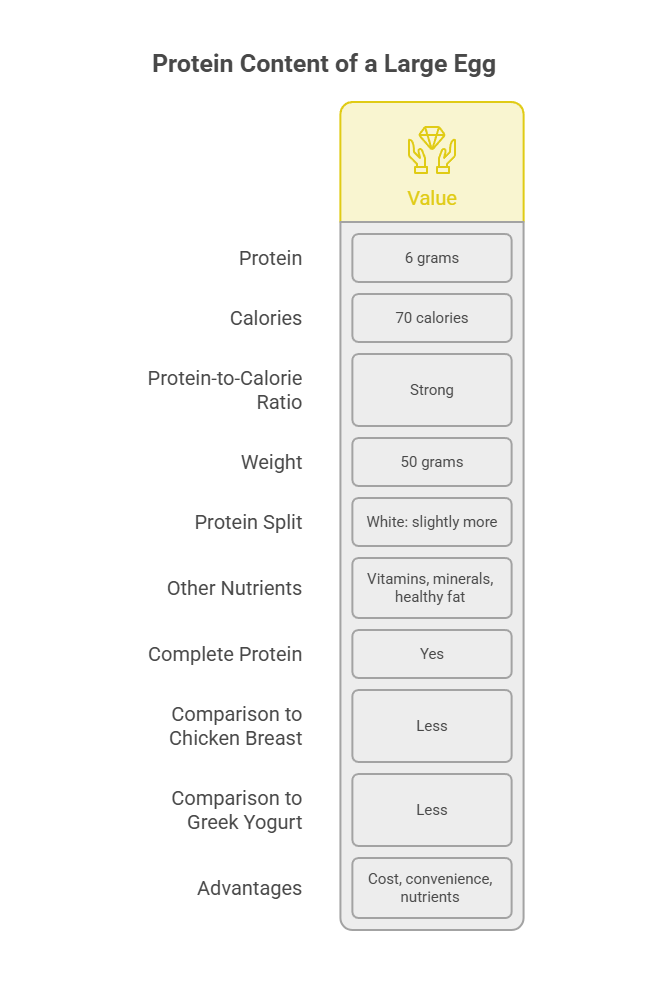
According to Harvard Health, one large egg delivers 6 grams of protein for just 70 calories, alongside a wide range of vitamins and minerals. That’s a strong protein-to-calorie ratio few whole foods match.
Our medical reviewers note that the 6 grams figure is for a standard large egg. Smaller or larger eggs shift that number up or down, which trips up a lot of people tracking macros.
That 6 grams also punches above its weight for fullness. Protein triggers the hormones that signal you’ve eaten enough and lowers ghrelin, the hunger hormone, which is why an egg breakfast tends to keep you satisfied longer than a carb-heavy one.
The number for a large egg
A large egg in the US weighs about 50 grams and contains roughly 6 to 6.3 grams of protein. That protein is split between the white and the yolk, with the white holding a bit more.
The rest of the egg is mostly water, a little healthy fat, and a dense package of micronutrients. At around 72 calories, it’s an efficient way to add protein without piling on calories.
Why eggs count as complete protein
Not all protein is equal, and this is where eggs shine. Eggs contain all nine essential amino acids, the building blocks your body can’t make on its own.
That earns eggs the label complete protein. In fact, eggs were historically used as the reference protein that other foods were measured against. For muscle repair, immune support, and healing, that amino-acid balance matters as much as the gram count.
Most plant proteins fall short on at least one essential amino acid, which is why eggs are so prized. One affordable food covers the full set your body needs.
Stacked against other proteins, eggs hold up well. A large egg’s 6 grams trails a 3-ounce chicken breast (around 26 grams) or a cup of Greek yogurt (about 20 grams), but eggs win on cost, convenience, and the nutrients packed into the yolk.
Protein by Egg Size
The 6 grams rule only holds for large eggs. Buy a different size and the math changes, sometimes by a lot over a few eggs.
Small to jumbo, gram by gram
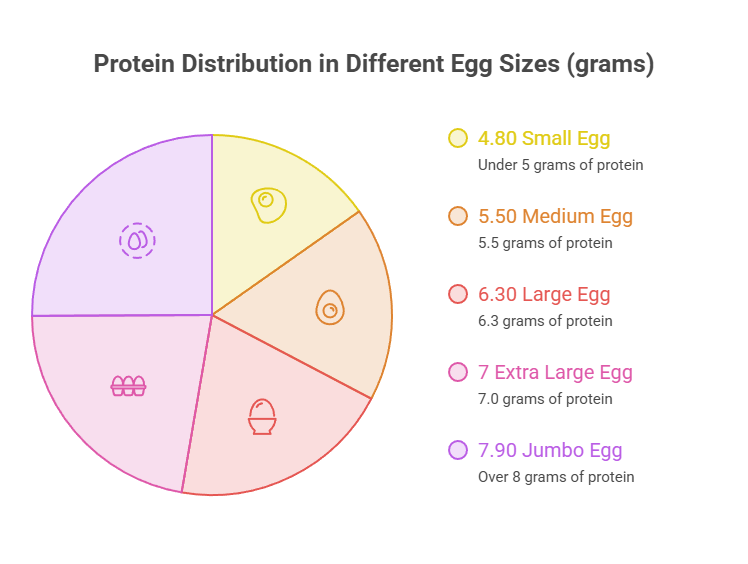
Protein content tracks closely with egg weight. Healthline breaks down the protein in each common US egg size, and the spread is meaningful once you eat two or three.
A small egg has under 5 grams, while a jumbo can top 8 grams. Across a three-egg breakfast, choosing jumbo over small can mean nearly 10 extra grams of protein.
One thing that does not change the protein is shell color. Brown and white eggs carry the same protein and nutrients; the color just reflects the breed of the hen, not the quality of what’s inside.
The table below shows the protein, weight, and calories for each US egg size. Patients commonly ask us which size to buy, and for protein per dollar, large and extra-large usually win.
| Egg Size | Weight (approx.) | Protein (g) | Calories (approx.) | % Daily Protein* |
| Small | 38 g | 4.8 | 54 | ~9% |
| Medium | 44 g | 5.5 | 63 | ~11% |
| Large | 50 g | 6.3 | 72 | ~12% |
| Extra Large | 56 g | 7.0 | 80 | ~14% |
| Jumbo | 63 g | 7.9 | 90 | ~16% |
Figures are based on a 50-gram daily protein reference. The grams climb steadily with size, so the carton label you grab quietly shapes your daily total. Our nutrition team flags egg size as the single most overlooked variable in protein tracking.
How many eggs for your protein goal
This is the practical question. If you’re aiming for a 20 to 30 gram protein hit at breakfast, eggs alone will take three to five, depending on size.
Three large eggs give about 19 grams, and four give about 25 grams. To reach 30 grams from large eggs, you’d need five, which is why most people pair eggs with another protein source.
Across patients we serve, the people who hit their protein targets treat eggs as a base, not the whole meal. A couple of eggs plus Greek yogurt, cottage cheese, or a slice of lean meat closes the gap fast.
Egg White vs Egg Yolk Protein
This is the most misunderstood part of the egg, and it costs people both protein and nutrients. The split is not what most assume.
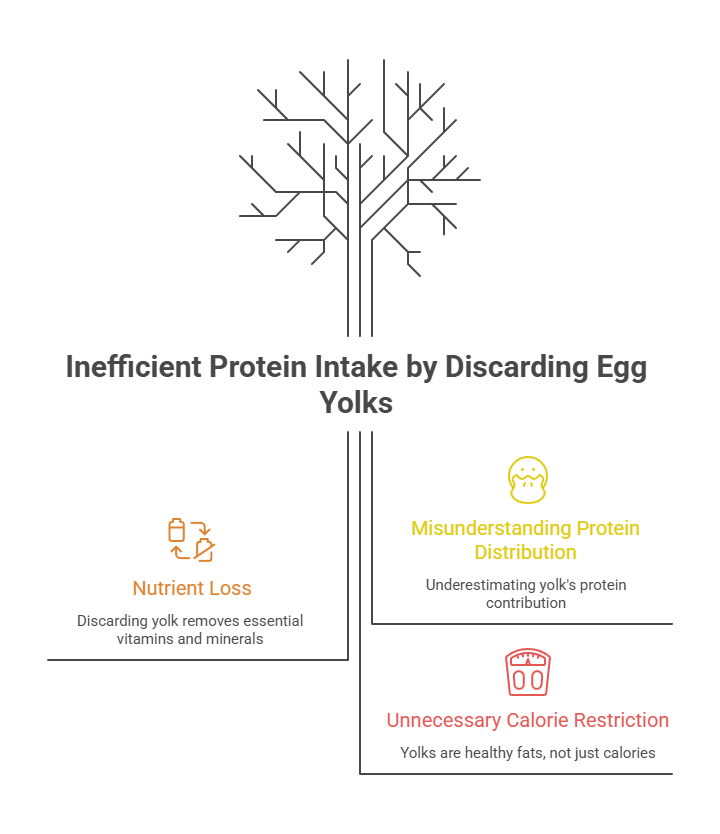
How the protein splits
The egg white does hold more protein, but not by as much as the omelet crowd thinks. A large egg white has about 3.6 grams of protein, while the yolk has about 2.7 grams.
So the yolk carries over 40 percent of the egg’s protein. Tossing it doesn’t make your meal all protein, it just removes a chunk of protein along with the good stuff.
The white earns its reputation in one way: it’s almost pure protein and water, with virtually no fat or calories. For a strict calorie cut, whites have a place.
Why the yolk still matters
The yolk is the nutrient vault. It holds the vitamins A, D, E, and K, most of the B vitamins, plus iron, zinc, and choline.
One large egg supplies about 147 mg of choline, roughly 27 percent of the daily value, and around 90 percent of Americans fall short on choline. That single nutrient supports brain, liver, and, in pregnancy, fetal development.
Our medical reviewers note that for most people, eating the whole egg is the smarter call. You get more protein and a dense set of nutrients the white simply doesn’t have.
Should you eat whites only?
Whites-only makes sense in narrow cases, like a bodybuilder in a strict cutting phase counting every calorie, or someone advised to limit dietary fat. For them, stacking egg whites is a clean protein source.
For everyone else, the trade-off rarely pays off. You lose choline, vitamin D, and healthy fats to save about 2 grams of protein and a few calories.
A common middle path is mixing whole eggs with extra whites. Two whole eggs plus two whites, for example, boosts protein while keeping the yolk nutrients in play.
Carton liquid egg whites make this easy and cheap. A half-cup pour adds roughly 13 grams of protein with almost no fat, a convenient way to stretch the protein in a scramble without piling on yolks.
Is Egg Protein Actually High Quality?
Gram counts only tell part of the story. How well your body uses that protein matters just as much, and eggs score near the top.
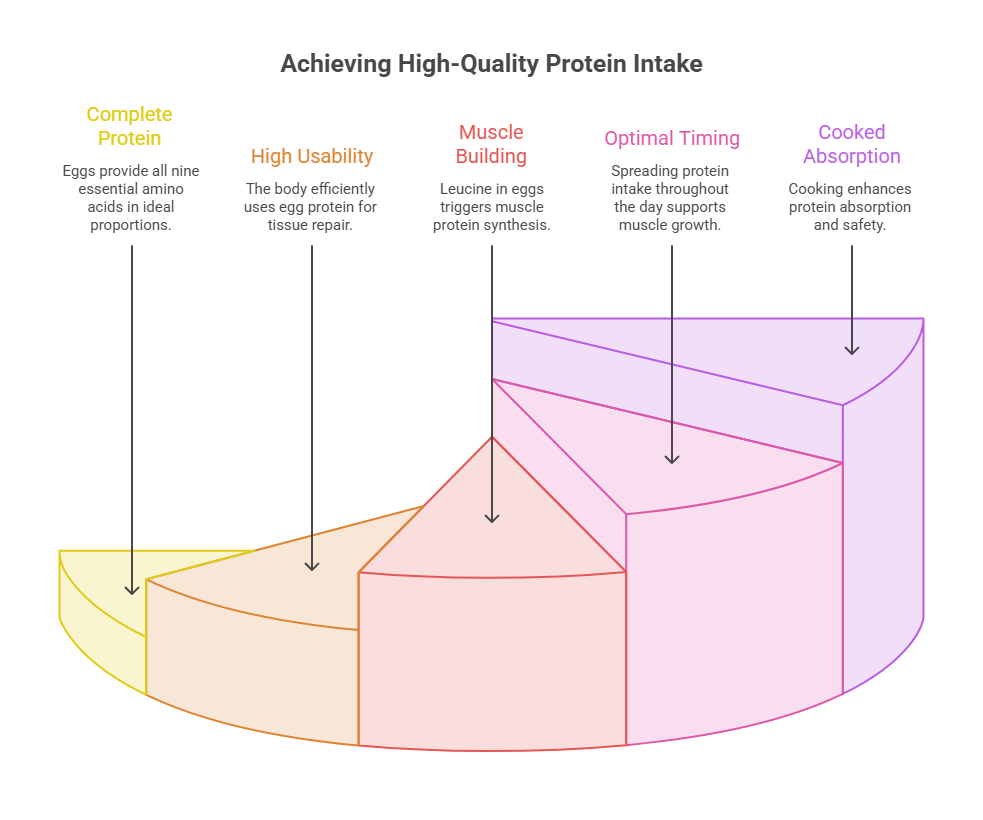
The complete-protein and amino-acid story
Protein quality comes down to amino acids. Eggs provide all nine essentials in close to ideal proportions, which is why they’re considered a gold-standard protein.
This balance makes egg protein highly usable for building and repairing tissue. Harvard Health notes that the nine essential amino acids can’t be made by the body and must come from food, and eggs cover all of them in one package.
Nutrition scientists rank protein quality using scores like the DIAAS, and egg protein consistently lands near the top. That ranking reflects how completely your body can use what the egg provides.
Eggs and muscle building
For muscle, total daily protein matters most, but quality and timing help. Eggs deliver leucine, the amino acid that flips on muscle protein synthesis, which is why they’re a lifter’s staple.
A two-egg serving gives about 12 grams of protein, a solid contribution toward the roughly 20 to 30 grams many experts suggest per meal for muscle support. Pairing eggs with toast, oats, or yogurt rounds out the meal.
In questions sent to our nutrition educators, the surprise is usually that eggs alone won’t max out muscle gains. They’re an excellent piece of the puzzle, not the entire strategy.
Spreading protein across the day helps too. Research suggests muscle responds best to roughly 20 to 40 grams of protein per meal, so two or three eggs at breakfast plus protein at lunch and dinner beats loading it all into one sitting.
Raw vs cooked protein and absorption
Here’s a myth worth busting. Raw and cooked eggs contain roughly the same amount of protein, so cracking raw eggs into a shake doesn’t add grams.
Cooking actually helps. Heat changes the protein structure so your body absorbs it more efficiently, meaning you use more of a cooked egg’s protein than a raw one’s. Studies have put cooked egg protein absorption far above raw.
So there’s no protein advantage to raw eggs, only added salmonella risk. Cooked wins on both absorption and safety.
How Eggs Fit Your Daily Protein Needs
Knowing the per-egg number is step one. Step two is fitting it into your actual daily target, which depends on your body and activity.
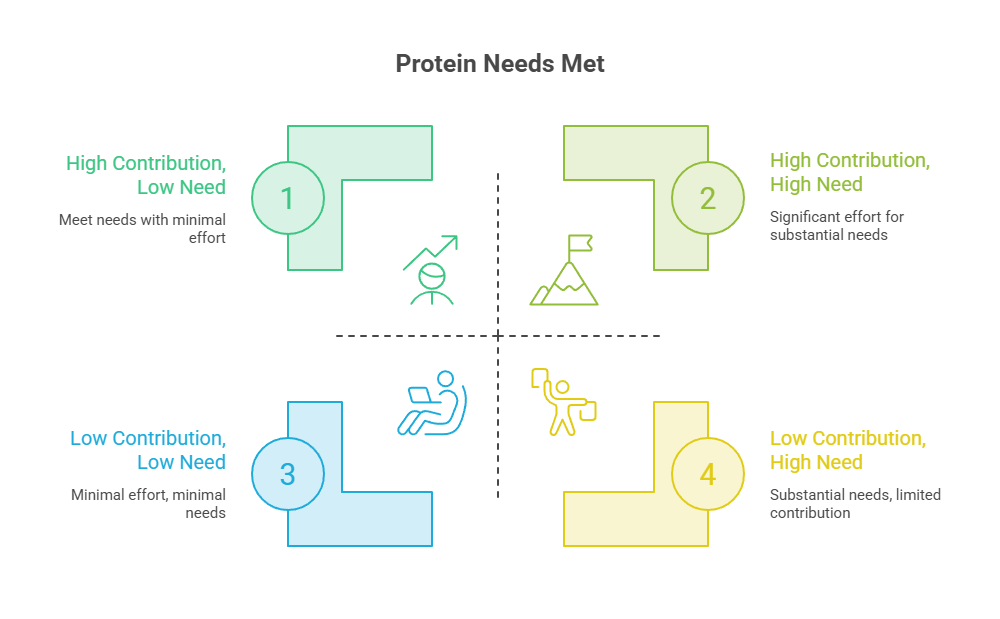
What the RDA actually is
The baseline is simpler than it sounds. The Recommended Daily Allowance for protein is 0.36 grams per pound of body weight, the minimum to prevent deficiency.
In practice, that’s about 56 grams a day for the average sedentary man and 46 grams for the average sedentary woman. Active people, older adults, and those building muscle often need more.
Many experts now suggest higher intakes for older and active adults, closer to 0.45 to 0.55 grams per pound. The RDA is a floor, not an optimal target for everyone.
How many eggs to hit common targets
Eggs can carry a real share of that load. Two large eggs cover roughly a quarter of a typical daily target, and they do it for about 140 calories.
But eating your entire protein quota as eggs isn’t practical or balanced. The smarter approach is using eggs to anchor one or two meals and filling the rest with varied protein sources.
The table below puts US protein needs and key egg facts side by side. Patients booking tests with us often want these numbers in one place.
| Protein Fact | Figure | Source |
| RDA for protein | 0.36 g per pound body weight | Harvard Health |
| Average daily need, sedentary man | ~56 g | Healthline |
| Average daily need, sedentary woman | ~46 g | Healthline |
| Protein in one large egg | ~6.3 g | USDA / Healthline |
| Choline in one large egg | ~147 mg (27% DV) | NIH / eggtester |
| Americans not meeting choline needs | ~90% | NIH |
A quick reality check
If you weigh 150 pounds, your baseline target is about 54 grams of protein a day. Nine large eggs would technically cover it, but nobody should eat nine eggs to chase a single nutrient.
Treat eggs as a high-quality contributor, not the sole source. Spreading protein across meals and foods is better for muscle, satiety, and overall nutrition.
A hard-boiled egg also makes one of the easiest protein snacks around. Keep a few cooked in the fridge and you have a 6-gram, grab-and-go option that beats most packaged snacks on nutrition and cost.
How Many Eggs a Day Is Safe?
This is where cholesterol fears creep in, and the science has shifted hard in eggs’ favor. For most people, eggs are back on the menu.
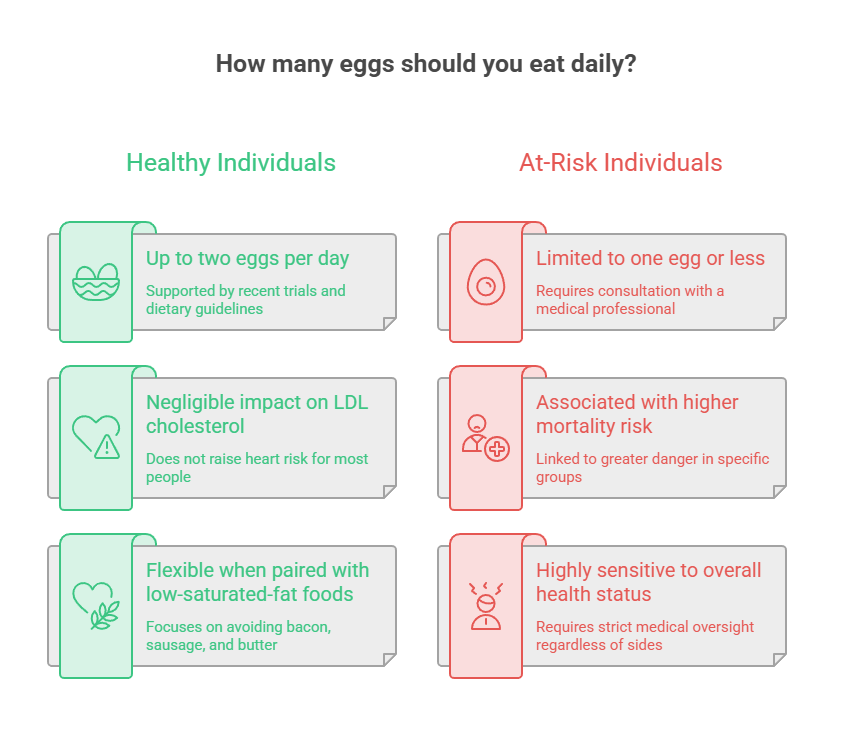
The cholesterol myth, updated
For decades, eggs were blamed for raising blood cholesterol because the yolk is high in dietary cholesterol. That logic turned out to be mostly wrong.
Harvard Health explains that most cholesterol in your body is made by your liver, driven by saturated and trans fat, not the cholesterol you eat. A large egg has only about 1.5 grams of saturated fat, which is why an egg a day doesn’t raise heart risk for most people.
The 2025 Dietary Guidelines reflect this shift. The American Egg Board notes the 2025 guidelines recommend eggs across the lifespan and don’t mention dietary cholesterol at all.
What the latest research says
Recent trials back the reassurance. A 2025 University of South Australia study found that eating two eggs a day, within a low-saturated-fat diet, did not raise LDL cholesterol and pointed to saturated fat as the real driver.
The American Heart Association supports up to two eggs a day for healthy older adults with normal cholesterol. The old rule of no more than a few eggs a week has loosened for most people.
It also matters what you eat with your eggs. The bacon, sausage, buttery toast, and cheese alongside them raise blood cholesterol far more than the egg itself does.
Who should still be cautious
Eggs aren’t unlimited for everyone. People with diabetes or existing heart disease should be more careful, since some research links higher egg intake to greater risk in those groups.
A 2024 study found that in people with cardiovascular disease, eating more than one egg a day was associated with higher mortality risk. If you have a heart condition or high cholesterol, our medical reviewers recommend setting your egg target with your doctor.
Beyond Protein, What Else Is in an Egg
Protein is the headline, but it undersells the egg. Few foods pack this many nutrients into 72 calories.
Choline, vitamin D, B12, and more
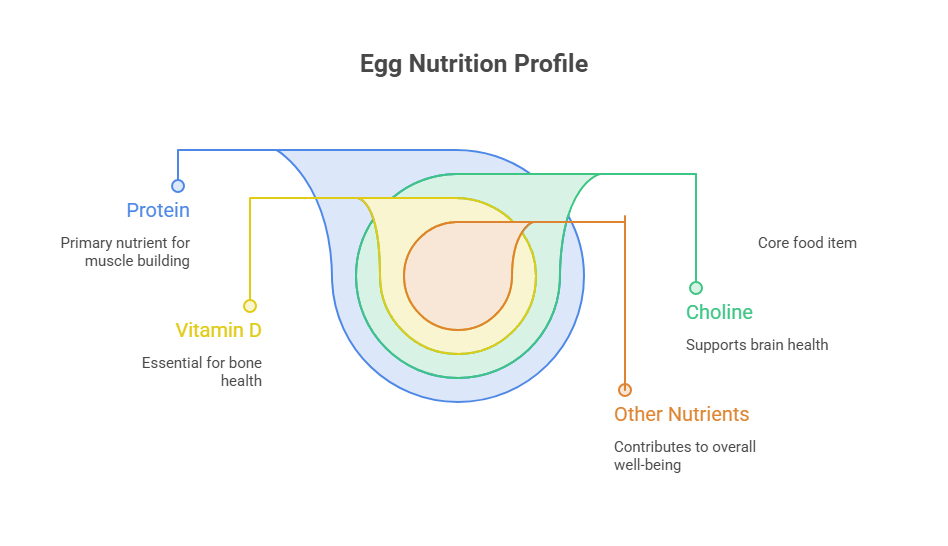
The egg is a micronutrient powerhouse. Beyond protein, it delivers choline for the brain, vitamin B12 for nerves and blood, selenium, riboflavin, and lutein and zeaxanthin for the eyes.
Eggs are also one of the few natural food sources of vitamin D, which matters in the darker months when sun exposure drops. A single egg chips away at several common US nutrient gaps at once.
The vitamin B12 in eggs is worth calling out as well. B12 keeps nerves and red blood cells healthy, and since it’s found almost entirely in animal foods, eggs are a handy source for people who eat little meat.
The lutein and zeaxanthin in the yolk deserve a mention of their own. These antioxidants concentrate in the retina and are linked to lower risk of age-related macular degeneration.
Calories and fat per egg
A large egg has roughly 72 calories and about 5 grams of fat, most of it the healthy unsaturated kind. Only about 1.5 grams is saturated.
That modest calorie and fat load, paired with 6 grams of complete protein, is what makes eggs so efficient. You get a lot of nutrition for very little caloric cost.
For weight management, that efficiency is a real advantage. Swapping a sugary or refined-carb breakfast for eggs adds protein and staying power while keeping calories in check, which can make sticking to a calorie goal easier.
Getting the Most Protein From Your Eggs
The protein is only useful if you actually absorb and build on it. A few simple choices keep egg protein working for you.
Cooking methods that keep protein intact
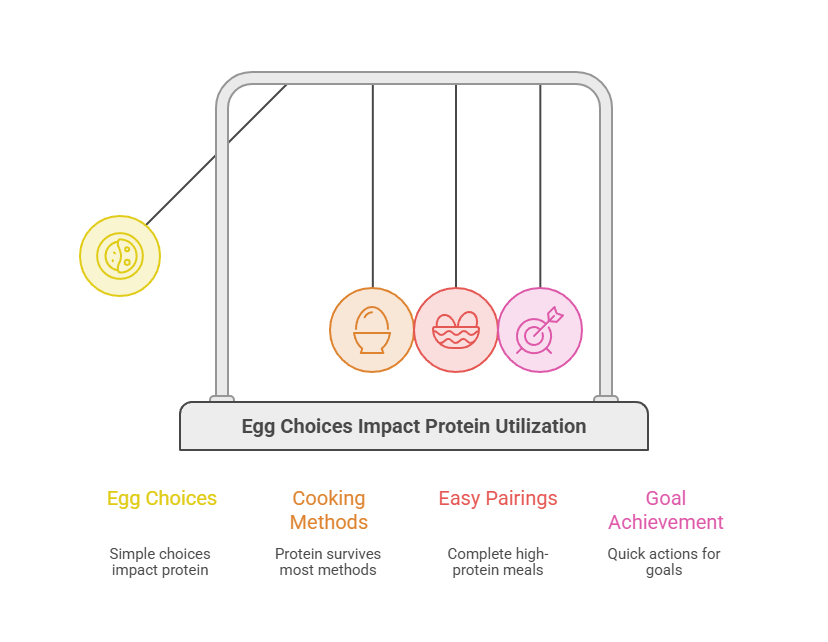
Good news: the protein survives nearly any cooking method. Boiled, poached, scrambled, or fried, the gram count stays about the same.
What changes is the calories you add. Boiling and poaching keep things lean, while frying in butter or oil adds fat and calories without adding protein.
Overcooking at very high heat can make protein slightly harder to digest, so gentle cooking is ideal. A soft scramble or a poached egg is easy on both flavor and digestion.
Easy high-protein egg pairings
To turn eggs into a complete high-protein meal, pair them up. Eggs plus Greek yogurt, cottage cheese, beans, or whole-grain toast pushes a breakfast well past 25 grams of protein.
Vegetables stretch the meal without much cost. Folding spinach, peppers, tomatoes, or mushrooms into a scramble adds fiber, volume, and micronutrients while keeping the protein and calories where you want them.
The table below turns common goals into quick actions. Our educators hand out this kind of cheat sheet when people ask how to build protein around eggs.
| If your goal is… | Then… | Why |
| 30 g protein at breakfast | 3 eggs plus Greek yogurt or cottage cheese | Eggs alone fall short; pairing closes the gap |
| Lowest calories per gram protein | Use mostly egg whites with one whole egg | Whites are near pure protein, minimal calories |
| Maximum nutrients | Eat whole eggs, yolk included | Yolk holds choline, vitamin D, and B vitamins |
| Best absorption and safety | Cook your eggs fully | Cooking aids digestion and kills salmonella |
| Heart condition or high cholesterol | Set your egg limit with your doctor | Risk varies for those with existing conditions |
| Muscle building | 2 to 3 eggs per meal plus other protein | Total daily protein and leucine drive growth |
Limits and Things to Watch
Eggs are overwhelmingly healthy, but a few honest caveats apply. Being clear about them is part of using any food well.
Food safety and raw eggs
Raw and undercooked eggs carry a salmonella risk, especially for young children, older adults, pregnant people, and anyone with a weakened immune system. Cooking eggs until the white and yolk are firm reduces that risk.
If a recipe calls for raw eggs, pasteurized eggs are the safer choice. The small protein gain from raw eggs is never worth a foodborne illness.
Storage matters for safety too. In the US, eggs are washed and should be refrigerated, kept in their carton, and used within a few weeks. A quick float test, where a bad egg floats in water, can flag one that’s past its prime.
Allergies and sensitivities
Egg allergy is one of the most common food allergies, especially in children, though many outgrow it. Reactions range from mild hives to serious anaphylaxis.
If you suspect an egg allergy, our medical reviewers recommend talking to an allergist rather than self-diagnosing. Symptoms after eating eggs always deserve a professional look.
Cholesterol conditions and moderation
For people with diabetes, familial high cholesterol, or existing heart disease, egg intake should be individualized. The general an egg a day is fine message applies to healthy adults, not every case.
Moderation and medical guidance are the rule here. The fact that eggs are nutritious doesn’t mean unlimited eggs are right for everyone.
Frequently Asked Questions
How much protein is in one large egg?
One large egg contains about 6 to 6.3 grams of high-quality, complete protein for roughly 72 calories. The protein is split between the white, with about 3.6 grams, and the yolk, with about 2.7 grams. Eggs supply all nine essential amino acids your body needs.
How much protein is in 2 eggs?
Two large eggs provide about 12 to 12.6 grams of protein, roughly a quarter of the daily protein target for an average adult. They deliver this for about 140 calories, along with choline, vitamin D, B12, and other nutrients, making two eggs a solid protein base for a meal.
Is there more protein in the egg white or yolk?
The egg white has more protein, about 3.6 grams versus 2.7 grams in the yolk of a large egg. However, the yolk holds over 40 percent of the protein plus nearly all the vitamins, minerals, and healthy fats, so eating the whole egg is usually best.
How many eggs do I need for 30 grams of protein?
You’d need about five large eggs to reach 30 grams of protein from eggs alone, since each provides roughly 6 grams. Most people instead eat two or three eggs and pair them with Greek yogurt, cottage cheese, or lean meat to hit 30 grams more easily.
How much protein is in a boiled egg?
A boiled egg has the same protein as a raw one, about 6 grams for a large egg. Cooking does not reduce the protein content, and it actually helps your body absorb that protein more efficiently than eating eggs raw, while also being far safer.
Do scrambled eggs have the same protein?
Yes. Scrambling does not change the protein content, so two scrambled large eggs still give about 12 grams of protein. Just note that adding butter, oil, cheese, or cream raises the calorie and fat count without adding any extra protein to the dish.
How much protein is in a jumbo egg?
A jumbo egg contains about 8 grams of protein, compared with roughly 6 grams in a large egg and under 5 grams in a small one. Because protein scales with size, choosing jumbo eggs adds up over a two or three egg meal.
Are eggs a complete protein?
Yes. Eggs are a complete protein because they contain all nine essential amino acids in well-balanced proportions. This high quality is why eggs were historically used as the reference protein for comparing other foods, and why they support muscle, immune function, and tissue repair so well.
Do raw eggs have more protein than cooked?
No. Raw and cooked eggs contain about the same amount of protein. Cooking does not destroy it, and your body actually absorbs cooked egg protein more efficiently than raw. Raw eggs also carry a salmonella risk, so cooked eggs are the better and safer choice.
How many eggs can I eat a day?
For most healthy adults, up to one to two eggs a day fits a balanced diet, and recent guidelines no longer cap dietary cholesterol. People with diabetes, high cholesterol, or heart disease should be more cautious and set their limit with a doctor, since risk can vary.
Do eggs help build muscle?
Eggs support muscle building thanks to their complete protein and leucine, an amino acid that triggers muscle protein synthesis. Two eggs give about 12 grams of protein. For real muscle gains, total daily protein matters most, so eggs work best alongside other protein sources.
How much protein is in 3 eggs?
Three large eggs provide about 18 to 19 grams of protein for roughly 210 calories. That is a substantial share of a daily target and a strong breakfast base. Adding a side like yogurt or whole-grain toast can push the meal past 25 grams of protein.
Disclaimer: This article is for general information only and is not medical advice. Protein needs and egg tolerance are individual, and your situation can differ from the averages described here. Talk with your doctor or a registered dietitian before making major changes to your diet, especially if you have diabetes, high cholesterol, heart disease, or a suspected egg allergy.
References
- Harvard Health, Eggs, Protein, and Cholesterol
- Harvard Health, Are Eggs Risky for Heart Health?
- Healthline, Protein in Egg
- TODAY, How Much Protein Is in an Egg?
- Ubie, How Much Protein Is in an Egg? The Reality
- American Egg Board, 2025 Dietary Guidelines for Americans
- NIH / EggTester, Egg Nutrition and Choline
- ScienceDaily / UniSA, Eggs and Saturated Fat
- Monash University, Eggs and Cardiovascular Mortality
- Victor Chang Cardiac Research Institute, Eggs and Heart Health