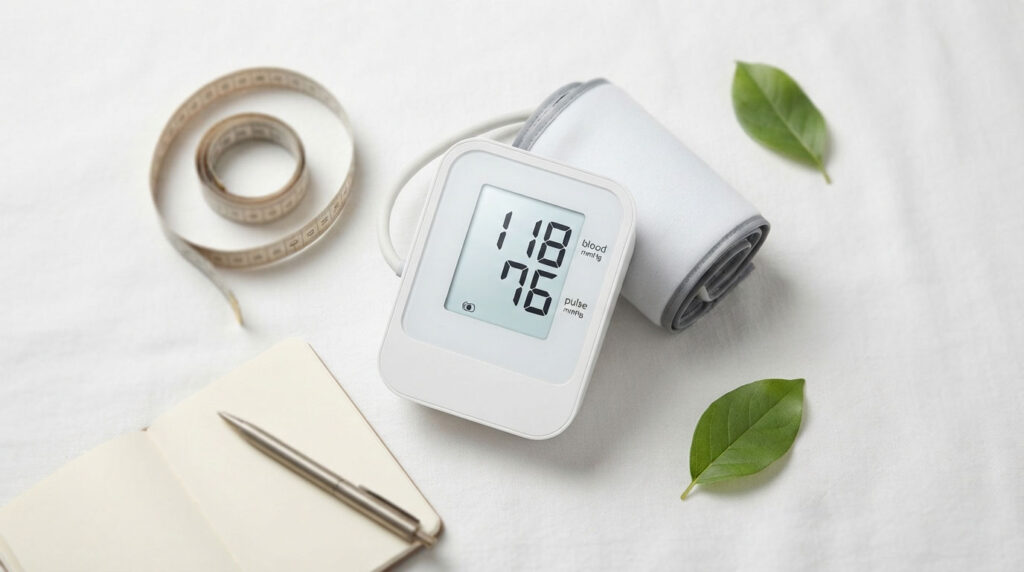
Nearly half of American adults have high blood pressure, yet a single wrong-sized cuff can throw a reading off by more than 10 points. That gap is enough to turn a normal number into a scary one, or hide a real problem behind a falsely calm result.
Table of Contents
Buying a home blood pressure monitor looks simple until you stand in the pharmacy aisle facing forty options at forty different prices. Some cost $25, some cost $250, and the box almost never tells you which one a doctor would actually trust.
This guide fixes that. It covers the two features that decide accuracy, the extras worth paying for, the ones you can skip, and how to confirm your device is telling the truth.
| Quick answer: Choose an automatic, upper-arm cuff monitor listed on the American Medical Association’s validated device list at validatebp.org, sized to your arm. A poor cuff fit is the top cause of inaccurate readings. Skip wrist units, finger units, and smartphone apps for daily tracking. Expect to pay $40 to $60. |
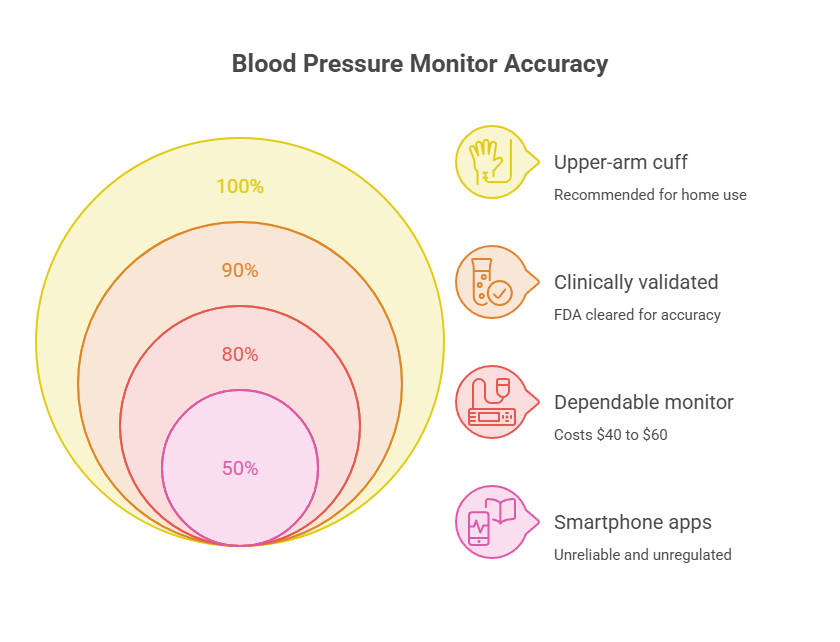
| At a glance: Upper-arm cuff monitors are the only type the American Heart Association recommends for home use.Cuff fit is the biggest driver of accuracy, so measure your arm before buying.“Clinically validated” and “FDA cleared” are not the same thing, and the difference matters.A dependable monitor costs $40 to $60; spending $200 rarely buys better accuracy.Smartphone blood pressure apps are unreliable and are not regulated by the FDA.Bring any new monitor to your next appointment to confirm it matches the office reading. |
Before the detail, here is the short version of what to look for, in order of importance:
- Validation. Confirm the exact model appears on validatebp.org.
- Correct cuff size. Match the cuff to your measured arm circumference.
- Upper-arm placement. Choose an arm cuff, not a wrist or finger unit.
- Automatic operation. The device should inflate and read on its own.
- A clear, large-digit display. Readings should be easy to see at a glance.
Everything after this point explains why each item earns its spot, and which optional features are worth the money.
Why Home Blood Pressure Monitoring Matters Right Now
High blood pressure is common, quiet, and dangerous. It rarely causes symptoms, which is why it earned the nickname “the silent killer” long before most people ever feel a thing.
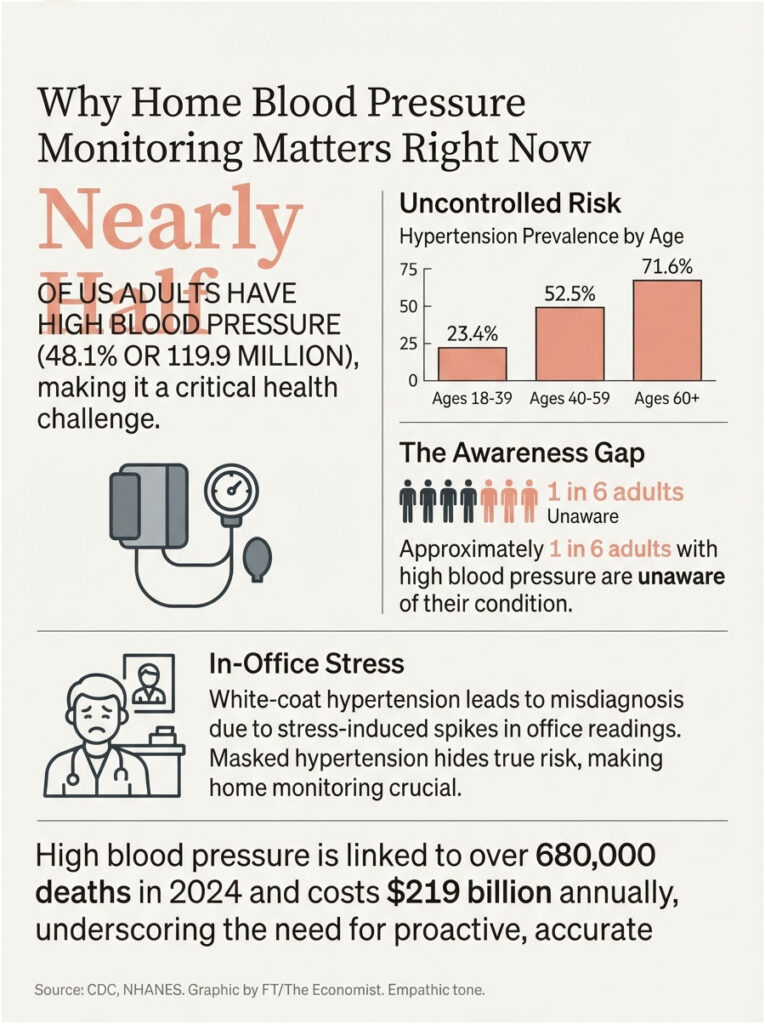
The scale is hard to overstate. According to the CDC, nearly half of US adults (48.1%, or about 119.9 million people) have high blood pressure, defined as a top number above 130, a bottom number above 80, or taking medication for it.
Prevalence climbs sharply with age. Federal survey data show it affects 23.4% of adults ages 18 to 39, then jumps to 52.5% for ages 40 to 59 and 71.6% for those 60 and older, per CDC NHANES figures.
Here is the part that makes home monitoring so useful: control rates are low. Only about one in five adults with high blood pressure has it managed below 130/80, and roughly one in six does not even know they have it.
A number checked twice a year at a clinic cannot catch a problem that shifts week to week. A monitor on your kitchen counter can.
| US Blood Pressure Statistic | Figure | Source |
| Adults with high blood pressure | 48.1% (about 119.9 million) | CDC |
| Adults with blood pressure controlled below 130/80 | About 1 in 5 (20.7%) | CDC / NHANES |
| Adults unaware they have high blood pressure | About 1 in 6 | CDC |
| Deaths with high blood pressure as a primary or contributing cause (2024) | Over 680,000 | CDC |
| Estimated annual US cost of high blood pressure | About $219 billion | CDC |
Patients booking tests through HealthCareOnTime often ask why their pharmacy reading and their doctor reading disagree. The honest answer is that both can be right, because blood pressure is a moving target, not a fixed number.
The payoff is real, not theoretical. Research summarized by Consumer Reports shows home monitoring helps people with hypertension keep their numbers under control, and can even help confirm a diagnosis in the first place.
What Home Monitoring Catches That Office Visits Miss
Two patterns explain most of the confusion, and both are reasons to own a monitor.
The first is white-coat hypertension: your pressure spikes at the doctor’s office from nerves, then settles at home. Without home readings, you might get treated for a problem you do not have.
The second is masked hypertension, the reverse. Your office reading looks fine, but your true daily pressure runs high. This one is more dangerous, because it hides real risk behind a reassuring checkup.
The Mayo Clinic notes that home tracking, known clinically as self-measured blood pressure, helps care teams diagnose high blood pressure earlier and see whether treatment is actually working. That is the whole point of buying the right device.
The One Feature That Decides Everything: Cuff Fit
If you remember nothing else from this guide, remember this: cuff size beats brand, price, and every smart feature combined.
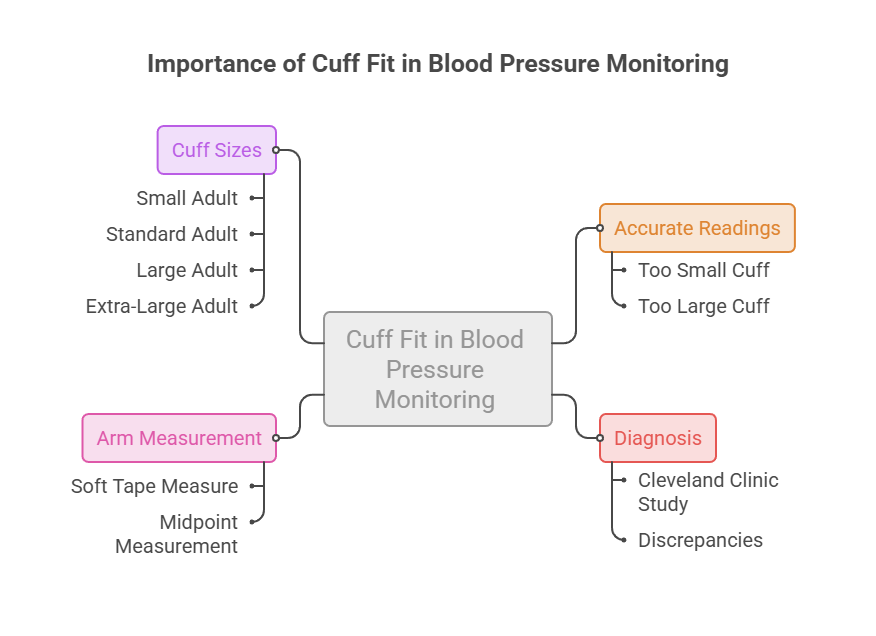
A cuff that is too small squeezes harder than it should and reports pressure that is too high. A cuff that is too large does the opposite. Either way, the number lies.
This is not a minor effect. Cardiologists at the Cleveland Clinic point to a 2023 study that found “miscuffing” produced strikingly inaccurate readings, large enough to change whether someone gets diagnosed at all.
Across the patients we serve, our medical reviewers note that mismatched cuffs are one of the most common reasons a home reading and a lab reading fail to line up.
How to Measure Your Arm for the Right Cuff Size
You need a soft tape measure and thirty seconds. Wrap it around the middle of your upper arm, halfway between your shoulder and your elbow, with the arm relaxed at your side.
Write down the number, then match it to the cuff range printed on the monitor’s box. Most monitors ship with a “standard” cuff, which does not fit everyone.
Here is how common arm sizes map to cuff categories:
| Arm circumference | Cuff size needed |
| 22 to 26 cm (8.7 to 10.2 in) | Small adult |
| 27 to 34 cm (10.6 to 13.4 in) | Standard adult |
| 35 to 44 cm (13.8 to 17.3 in) | Large adult |
| 45 to 52 cm (17.7 to 20.5 in) | Extra-large adult |
If your arm falls near a boundary, size up. A slightly loose fit within the cuff’s stated range reads more accurately than a cuff stretched to its limit. A quick test at the arm: once wrapped, you should be able to slide two fingers under the top edge.
Why “One-Size-Fits-All” Cuffs Fall Short
Plenty of budget monitors advertise a single cuff that “fits most arms.” These are not useless, but they are a compromise.
A molded or wide-range cuff can work if your arm sits comfortably inside its printed range. The problem starts when your arm is at the top or bottom edge, where the fit gets sloppy and the readings drift.
Our medical team has reviewed enough at-home readings to say it plainly: if your upper arm is larger or smaller than average, buy the correct cuff separately rather than trusting a universal one.
How to Tell If a Monitor Is Actually Accurate
A monitor can look professional, carry five-star reviews, and still be wrong. Accuracy is not something you can judge from the box, which is exactly why an independent standard exists.
What “Clinically Validated” Really Means
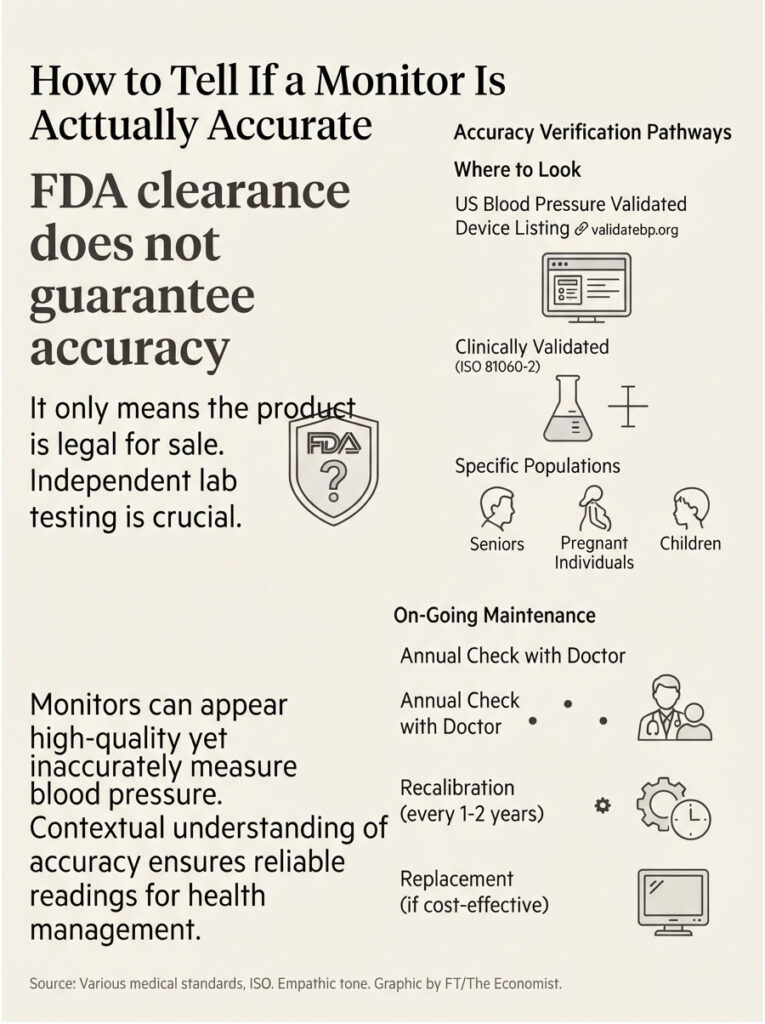
“Clinically validated” means an independent lab tested the device against a reference standard and confirmed it measures within an accepted margin of error. The testing protocol is known as ISO 81060-2.
In the United States, the place to check is the US Blood Pressure Validated Device Listing, a free database run under the American Medical Association. Devices are reviewed by an independent committee of physician experts, not by the manufacturers selling them.
The AMA built this list because, for years, patients had no easy way to separate accurate monitors from the rest. Before you buy, search the model name at validatebp.org. If it is not listed, keep looking.
Why FDA Clearance Is Not the Same as Validation
This trips up almost every shopper, so read it twice. The FDA clears blood pressure monitors for sale, but FDA clearance does not confirm the device is accurate for home use.
Clearance means the product is legal to sell and broadly similar to devices already on the market. It does not mean an independent lab checked its readings against a clinical reference.
That is the whole reason the validated device list exists. As the WebMD guidance puts it, not every cleared monitor is accurate, so validation is the check that actually protects you.
Validation for Seniors, Pregnancy, and Children
A device validated for the general adult population may not hold up for every group. This detail is easy to miss and worth a second look.
The American Heart Association advises that when you are buying for a senior, someone who is pregnant, or a child, you confirm the monitor is validated for that specific population. Pregnancy in particular can change how a device performs.
Patients commonly ask us whether “one good monitor” covers the whole family. Usually it does for typical adults, but for pregnancy or pediatric use, check the validation details rather than assuming.
The One-Year Accuracy Check With Your Doctor
Even a validated monitor can drift over time or take a knock when it gets dropped. A quick habit keeps it honest.
The American Heart Association recommends bringing your device to an appointment once a year so your care team can compare its reading to the office equipment. Do the same right after you first buy it.
Most manufacturers also recommend recalibration every one to two years. If sending the unit back costs nearly as much as a new one, replacing it is the simpler path.
Arm vs. Wrist vs. Finger Monitors: Which to Trust
Walk any pharmacy aisle and you will see three body locations for sale: upper arm, wrist, and finger. They are not equal, and the guidance here is refreshingly clear.
The American Heart Association recommends an automatic, cuff-style, upper-arm monitor and specifically advises against wrist and finger units for routine use, because they give less reliable readings.
| Monitor Type | Accuracy | AHA Stance | Best For | Typical US Price |
| Upper-arm cuff, automatic (validated) | Highest for home use | Recommended | Daily tracking, most people | $40 to $100 |
| Upper-arm cuff, manual (aneroid) | Accurate but skill-dependent | Not for self-use | Trained users only | $20 to $40 |
| Wrist cuff (validated) | Moderate, position-sensitive | Not recommended except when an arm cuff cannot be used | Large arms, special cases | $40 to $90 |
| Finger monitor | Low | Not recommended | None | $20 to $50 |
| Smartphone BP app | Unreliable | Not a medical device | Logging readings only | Free to $10 |
When a Validated Wrist Monitor Is Acceptable
Wrist monitors are not banned, and there is a fair exception worth knowing. A validated wrist device can stand in for an arm cuff when an upper-arm cuff will not fit or cannot be used.
That covers arms too large for available cuffs, certain medical conditions, or situations where an arm reading is not practical. In those cases, technique matters even more.
The AMA notes that a wrist device must sit correctly over the artery and stay at heart level during the reading, with the wrist held still. When people ask us whether wrist units are “good enough,” the answer is: only when an arm cuff genuinely is not an option, and only if the wrist model is validated.
How to Take a Reading You Can Trust
Owning the right monitor is half the job. Using it correctly is the other half, and the steps become second nature fast.
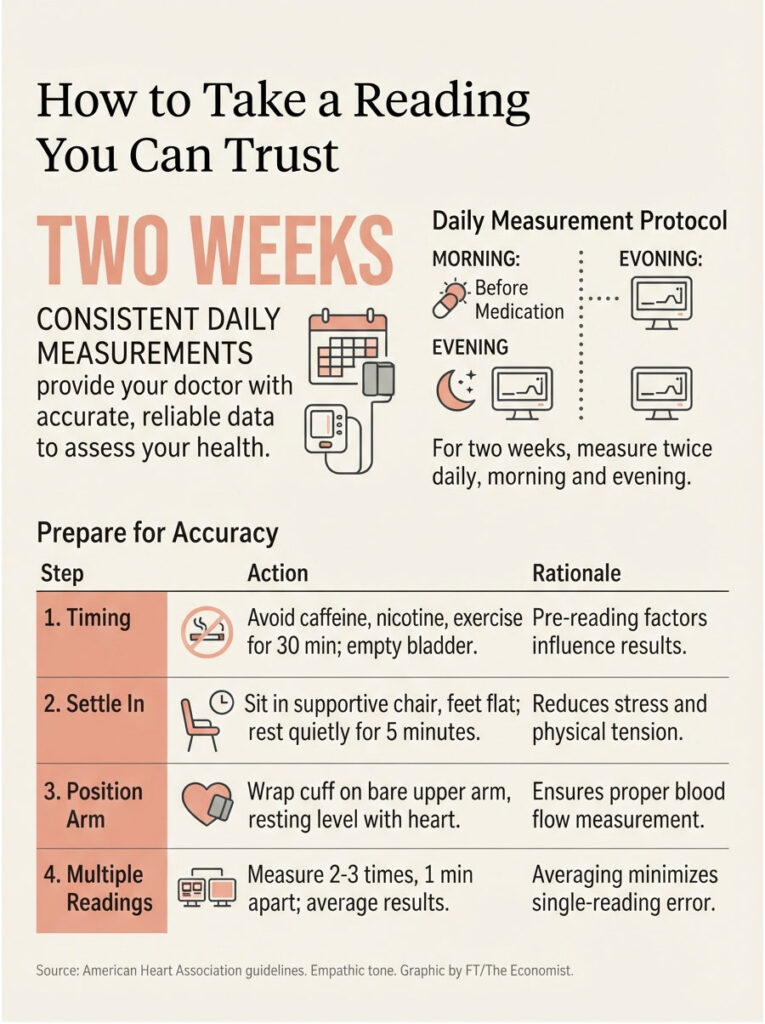
Start with timing. Avoid caffeine, nicotine, and exercise for at least 30 minutes beforehand, and empty your bladder first. Each of these can push a reading up on its own.
Then settle in. Sit in a chair with your back supported and both feet flat on the floor, not crossed. Rest quietly for five minutes before you begin, without talking, scrolling, or watching anything tense.
Position the arm carefully. Wrap the cuff on a bare upper arm, not over a sleeve, and rest that arm on a table so the cuff sits level with your heart. Prop it on a cushion if the table is low.
Take more than one reading. Measure two or three times, about a minute apart, and record the average rather than a single number. One reading can mislead, which is why the AHA recommends averaging.
For the first two weeks, the Mayo Clinic suggests measuring at least twice daily, once in the morning before medication and once in the evening. That baseline gives your doctor real data to work with.
Making Sense of Your Numbers
A monitor gives you two numbers and, on many models, a color-coded category. Knowing what those mean helps you decide when a reading is worth a call to your doctor.
The top number, systolic, is the pressure while your heart beats. The bottom number, diastolic, is the pressure while it rests between beats. Both matter, and either one being high counts.
Here are the standard adult categories used by US guidelines:
| Category | Systolic (top) | Diastolic (bottom) |
| Normal | Below 120 | and below 80 |
| Elevated | 120 to 129 | and below 80 |
| High (Stage 1) | 130 to 139 | or 80 to 89 |
| High (Stage 2) | 140 or higher | or 90 or higher |
| Crisis (seek care) | Higher than 180 | and/or higher than 120 |
A single high reading is not a diagnosis. Blood pressure naturally rises and falls through the day, so patterns across many readings matter far more than any one result.
If you ever record a reading above 180/120 and feel chest pain, shortness of breath, or other warning signs, treat it as an emergency. Our medical reviewers stress that isolated numbers should prompt a repeat measurement first, not panic.
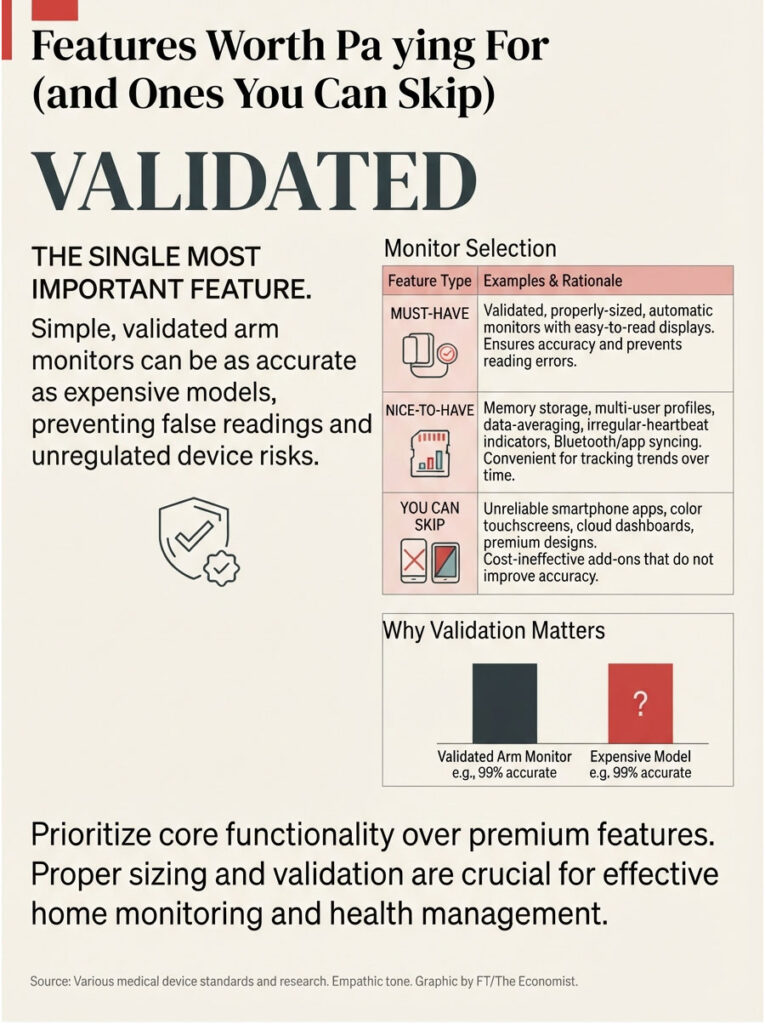
Features Worth Paying For (and Ones You Can Skip)
Once cuff fit and validation are settled, everything else is convenience. Some conveniences genuinely help you stick with monitoring; others just inflate the price.
Must-Have Features
Keep this list short and non-negotiable. A monitor should be validated, sized to your arm, and automatic, meaning it inflates and reads on its own without a stethoscope.
The display should be easy to read at a glance, with large digits and clear numbers. If the screen is crowded with symbols you have to decode, it will slow you down and invite mistakes.
Nice-to-Have Features
These earn their keep for many buyers, especially anyone tracking a trend over months. Memory storage saves past readings so you are not scribbling on paper.
Multi-user profiles keep two people’s data separate, which matters in a shared household. A data-averaging function combines several readings into one figure, which is closer to how clinicians want blood pressure recorded.
An irregular-heartbeat indicator can flag a rhythm worth mentioning to your doctor, though it is not a diagnosis. Bluetooth or app syncing makes it easy to share a clean history with your care team, per Consumer Reports guidance on useful extras.
Features You Can Ignore
Here is where you save money. Smartphone apps that claim to read blood pressure from your fingertip or camera do not work reliably.
The Cleveland Clinic is blunt on this: these products have not been rigorously tested, and the FDA does not regulate them as medical devices. A false “all clear” or a false scare is worse than no reading at all.
Color touchscreens, cloud dashboards, and premium designs are pleasant, not essential. Our lab partners report that a plain validated arm monitor tracks pressure just as accurately as a unit costing five times more.
How Much Should You Actually Spend?
Price and accuracy are not linked the way most shoppers assume. A higher number on the tag does not buy a more truthful reading.
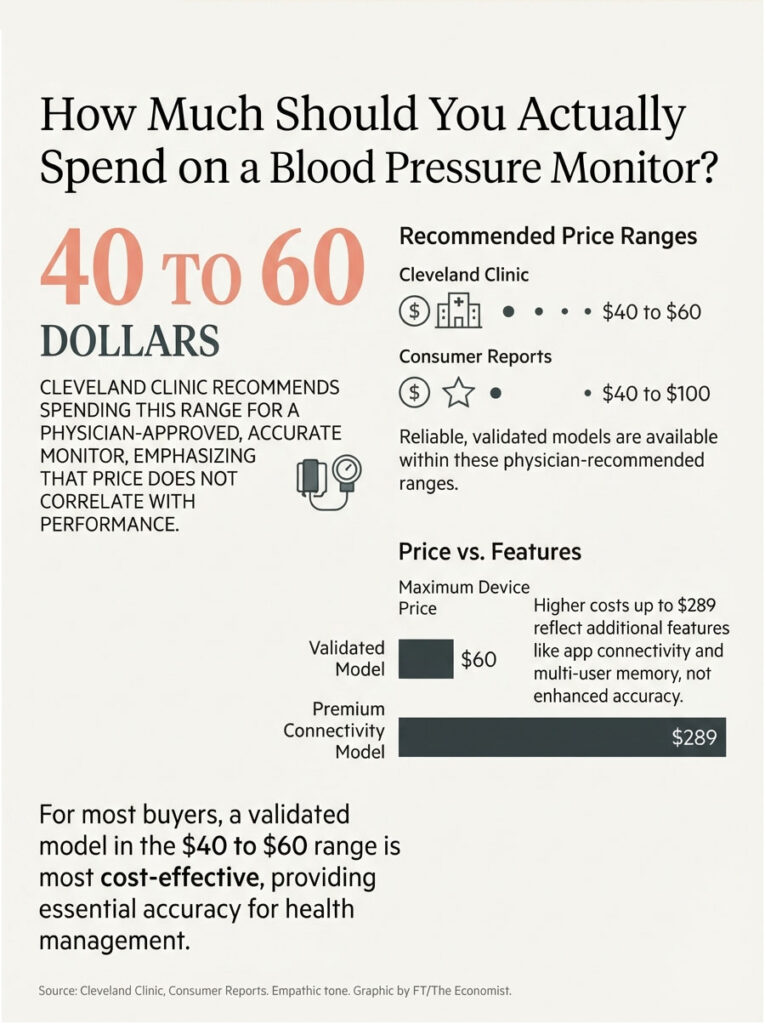
The guidance from cardiologists is consistent. The Cleveland Clinic’s hypertension specialists say you should not have to pay more than $40 to $60 for a physician-approved monitor that does the job well.
Consumer Reports found its recommended models priced from roughly $40 to $100, with strong performers well inside that band. Devices on the market stretch as high as $289, but that ceiling reflects features and design, not superior accuracy.
Where the Extra Money Goes (and When It’s Worth It)
Spending more can make sense for specific reasons, none of which is raw accuracy. Extra dollars typically buy app connectivity, multi-user memory, one-piece “tubeless” designs, or wider-range cuffs.
If sharing data with your doctor automatically will help you stay consistent, connectivity may be worth it. If two people share the device, multi-user memory earns its cost.
For most buyers, though, the best home blood pressure monitor is a plain validated model in the $40 to $60 range. Save the difference, and put it toward the follow-up visit where you confirm your readings are accurate.
Where to Buy and What to Check First
You can buy a home blood pressure monitor without a prescription at pharmacies, big-box stores, medical supply shops, and online. Availability is not the hard part; picking correctly is.
Before you check out, confirm three things beyond validation and cuff size. First, the return policy, so you can swap the device if the cuff fits poorly once it arrives.
Second, the warranty length, since a longer warranty gives you a window to compare the monitor against your doctor’s equipment. Third, whether replacement or alternate-size cuffs are sold for that model, which matters if your arm sits near a size boundary.
Power is a small but real consideration. Most monitors run on AA batteries, while some include an AC adapter; if you plan to keep the device on a counter and use it daily, an adapter saves a steady stream of batteries.
Portability matters for frequent travelers. A one-piece, tubeless design packs smaller and survives a suitcase better than a monitor with a separate hose and base. In cases reviewed across our diagnostic network, the people who monitor most consistently are usually the ones whose device is easy to reach and simple to power.
Mistakes That Quietly Ruin Your Readings
The best monitor in America will still hand you a wrong number if your technique is off. These errors are common, and each one is easy to fix.
- Talking or checking your phone during the reading. Stay quiet and still, since conversation alone can raise the result.
- A full bladder. Use the bathroom first, because a full bladder nudges the number up.
- Wrong arm height. Rest your arm on a table so the cuff sits level with your heart.
- Clothing under the cuff. Wrap the cuff on a bare arm, not over a sleeve.
- Caffeine, nicotine, or exercise within 30 minutes. All three temporarily spike pressure.
- Taking a single reading. Sit quietly for five minutes, then take two or three readings a minute apart and note the average.
In cases reviewed by our medical team, correcting posture and rest time alone often closes most of the gap between a worrying home reading and a normal office result.
Match the Monitor to Your Situation
The right monitor is the one that fits your body and your life, not the one your neighbor likes. Use this quick reference to narrow the field before you buy.
| Your Situation | What to Look For | Why It Matters |
| Large or muscular upper arms | Large or extra-large cuff (35 to 44 cm) or a wide-range cuff | A cuff stretched too tight reports readings that are falsely high |
| Older adult or limited dexterity | One-piece design, large-digit display, single-button operation | Fewer steps mean fewer setup errors and misreads |
| Pregnancy | A device validated specifically for pregnancy or preeclampsia | Standard validation may not hold during pregnancy |
| Two or more household users | Multi-user memory with separate profiles | Keeps each person’s trend data from mixing together |
| Known atrial fibrillation or irregular heartbeat | Doctor’s guidance first, plus an irregular-heartbeat indicator | Automatic monitors can misread an erratic rhythm |
For seniors, a one-piece design with large digits removes fiddly steps and cuts down on misreads. For pregnancy, standard validation may not apply, so look for a device validated specifically for that use.
Anyone with atrial fibrillation or another irregular heartbeat should talk to a doctor before relying on a home monitor, since the technology these devices use can misread an erratic rhythm.
Frequently Asked Questions
What kind of blood pressure monitor do doctors recommend for home use?
Doctors and the American Heart Association recommend an automatic, upper-arm cuff monitor that has been clinically validated. Wrist and finger devices are not advised for routine use because they are less reliable. Check any model against the validated device list at validatebp.org before buying.
Are wrist blood pressure monitors accurate?
Wrist monitors are generally less accurate than upper-arm cuffs and are not recommended for everyday tracking. A validated wrist device is acceptable only when an arm cuff will not fit or cannot be used, and only with careful technique: the wrist must stay at heart level and completely still.
How do I know if my blood pressure monitor is accurate?
Search the exact model name on validatebp.org, the AMA’s validated device listing. If it appears, an independent committee confirmed its accuracy. Then bring the monitor to your next appointment and compare its reading with the office device to confirm they match.
What cuff size do I need for a blood pressure monitor?
Measure around the middle of your upper arm, halfway between shoulder and elbow. Small adult cuffs fit roughly 22 to 26 cm, standard fits 27 to 34 cm, and large fits 35 to 44 cm. If you are near a boundary, size up for a better fit.
How much should a good home blood pressure monitor cost?
A reliable, physician-approved upper-arm monitor typically costs $40 to $60. Recommended models generally range from $40 to $100. Paying more buys features like app syncing or multi-user memory, not better accuracy, so an expensive monitor is rarely necessary.
Do smartphone apps measure blood pressure accurately?
No. Apps that claim to read blood pressure through your finger or phone camera are not reliable and have not been rigorously tested. The FDA does not regulate them as medical devices. Use them only as logbooks for readings from a real validated monitor.
How often should I calibrate my home blood pressure monitor?
Most manufacturers recommend recalibration every one to two years. Beyond that, bring your device to a yearly checkup so your care team can compare it with office equipment. If you drop or damage the monitor, have it checked before trusting it again.
Can two people use the same blood pressure monitor?
Yes, as long as both arms fit the cuff’s size range. For separate trend tracking, choose a monitor with multi-user memory, which stores each person’s readings in its own profile. Without that feature, both users’ numbers land in one mixed history.
Why is my home reading different from the doctor’s office?
Blood pressure shifts constantly, so some difference is normal. Home numbers often run slightly lower, and office numbers can spike from nerves, the white-coat effect. Wrong cuff size or poor technique also cause gaps. Comparing your device at a visit sorts out which factor is at play.
Do I need a prescription to buy a blood pressure monitor?
No. Home blood pressure monitors are sold without a prescription at pharmacies, discount stores, medical supply shops, and online. You can buy one directly. Still, it helps to confirm your device and technique with a doctor before relying on the readings.
Which is better, an arm or wrist blood pressure monitor?
Arm monitors are better for almost everyone. Upper-arm cuffs give more reliable readings and are the type clinical guidelines are built around. Choose a wrist monitor only if an arm cuff will not fit or cannot be used, and make sure the wrist model is validated.
What is the best time of day to check blood pressure at home?
Check at the same times each day, usually morning and evening. Take a morning reading before eating, medication, or coffee, and an evening reading later on. Two or three readings a minute apart, then averaged, give the most dependable picture of your true numbers.
| Disclaimer: This article is for general education and does not replace medical advice. Home monitoring supports, but does not substitute for, care from a licensed professional. Do not start, stop, or change any medication based on home readings without talking to your doctor. Confirm your device and technique with your care team. |
References
- CDC: High Blood Pressure Facts
- CDC NCHS: Hypertension Prevalence Data Brief
- CDC: High Blood Pressure Priorities
- American Heart Association: Monitoring Your Blood Pressure at Home
- American Medical Association: Validation of BP Measurement Devices for Clinical Accuracy
- US Blood Pressure Validated Device Listing (validatebp.org)
- Mayo Clinic: Get the Most Out of Home Blood Pressure Monitoring
- Cleveland Clinic: Buying a Home Blood Pressure Monitor, 6 Things You Need to Know
- WebMD: How to Choose a Home Blood Pressure Monitor
- Consumer Reports: Blood Pressure Monitor Buying Guide