You’ve tried everything. You’re lying in the dark, doing the math on how few hours are left before the alarm, and the harder you push for sleep, the further it slips away. Here’s the part nobody tells you: the effort itself is the problem.
Table of Contents
Sleep is one of the few things you can’t force into happening. What you can do is set up the conditions that make it close to automatic. These 25 tips, drawn from sleep science and the therapy doctors trust most, do exactly that.
Quick answer: To sleep better tonight, keep one fixed wake-up time (weekends included), cool your bedroom to 65 to 68°F, make it fully dark, and stop caffeine by early afternoon. If you’re still awake after 20 minutes, get out of bed and do something boring until you feel sleepy. For insomnia that hits 3-plus nights a week for 3-plus months, ask a doctor about CBT-I, the recommended first-line treatment.
At a glance:
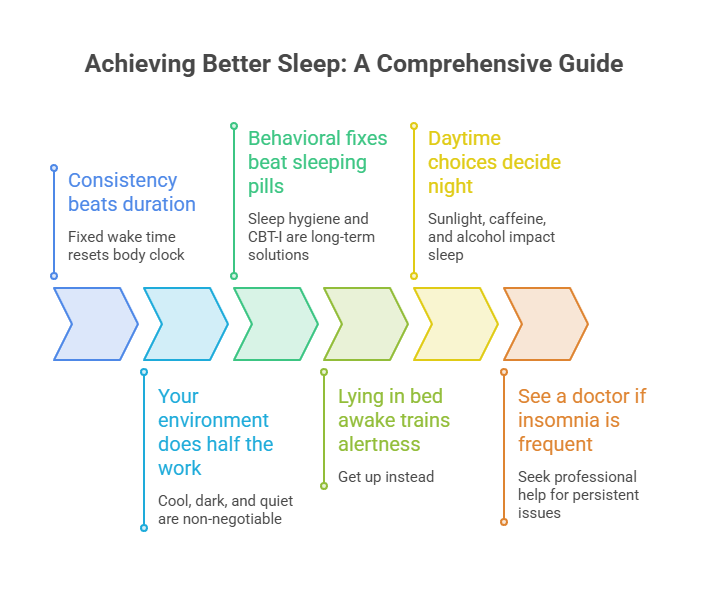
- Consistency beats duration. A fixed wake time resets your body clock faster than any other single habit.
- Your environment does half the work. Cool, dark, and quiet are non-negotiable.
- Behavioral fixes (sleep hygiene and CBT-I) beat sleeping pills over the long run.
- Lying in bed awake trains your brain to stay alert. Get up instead.
- Daytime choices, from sunlight to caffeine to alcohol, decide what happens at night.
- See a doctor if insomnia is frequent, lasting, or wrecking your days.
Insomnia, Explained in Plain English
Insomnia isn’t simply a few rough nights. It’s ongoing trouble falling asleep, staying asleep, or waking too early, paired with daytime fallout like fatigue, brain fog, irritability, or trouble focusing. The daytime piece matters as much as the nighttime piece.
If you’re getting enough time in bed but still can’t sleep or function, that’s the clinical picture, not bad luck.
What Counts as Insomnia
Doctors sort it into two buckets. Acute insomnia is short-term, often set off by stress, travel, illness, or a single hard event, and it usually clears on its own within days or weeks.
Chronic insomnia is the bigger concern. The widely used “3-3 rule” defines it as trouble sleeping at least three nights a week for at least three months.
That line matters, because chronic cases respond best to structured treatment rather than habit tweaks alone. Our medical reviewers note that many people misjudge themselves as “just bad sleepers” when they actually meet the chronic threshold and would benefit from real treatment.
Why It Happens: The 3P Model
Sleep specialists explain insomnia through three forces. Predisposing factors are traits that make you vulnerable, like a naturally anxious temperament or a family history. Precipitating factors are the triggers, such as a job loss, a new baby, or grief.
Perpetuating factors are what keep it going long after the trigger fades, and this is where most people get stuck.
You start watching the clock, dreading bedtime, drinking more coffee to cope, and lying awake for hours. That pattern creates conditioned arousal: your brain learns to link the bed with stress instead of sleep. It explains why “trying harder” backfires and why behavioral retraining works.
Sometimes a physical issue is the hidden driver. Thyroid problems, low vitamin D, iron deficiency, and high cortisol can all disrupt sleep, which is why patients booking sleep-related tests through HealthCareOnTime often start by ruling these out with simple bloodwork.
According to the CDC, about 1 in 3 American adults sleep less than the recommended 7 hours a night. Roughly 10% live with chronic insomnia, and close to a third experience brief symptoms at some point.
Why Fixing Your Sleep Now Matters More Than You Think
Poor sleep isn’t a quirk you tough out. It’s a measurable health problem with a real price tag, and the bill lands on your body, your wallet, and your safety behind the wheel.
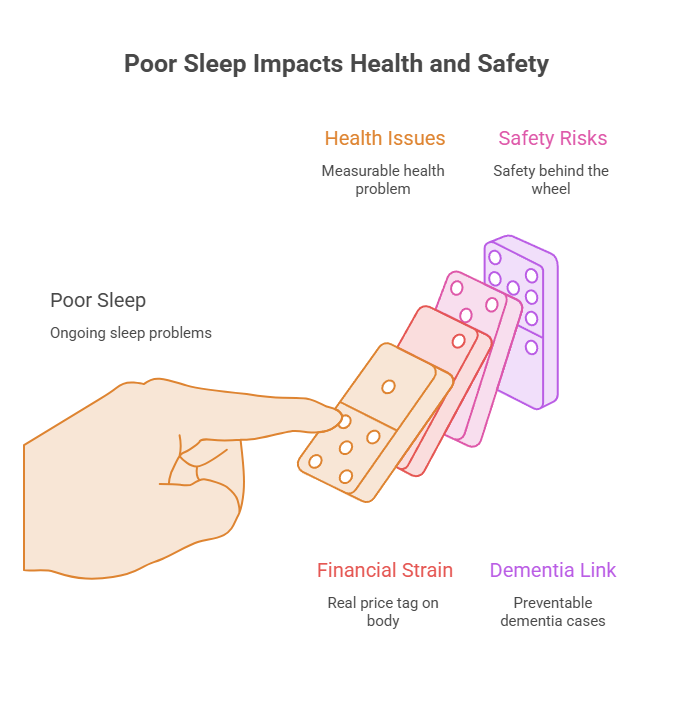
The scale is sobering. An estimated 70 million Americans deal with ongoing sleep problems, and women are about twice as likely as men to experience insomnia, per the American Medical Association.
Recent research from Harvard and Massachusetts General Hospital even ties insomnia to a meaningful share of preventable dementia cases in older adults, estimating that nearly 13% of probable dementia cases in seniors could be linked to it.
Insomnia by the Numbers in America
| Statistic | Figure | Source |
| US adults sleeping under 7 hours | About 1 in 3 | CDC, 2024 |
| Adults with chronic insomnia | Roughly 10% | NIH / StatPearls, 2025 |
| Americans with sleep problems | About 70 million | CDC NHIS |
| Women’s insomnia risk vs men | About 2x higher | AMA, 2025 |
| Annual US productivity cost | About $63 billion | RAND Corporation |
| Lost workdays per person, chronic insomnia | 45 to 54 days/year | RAND Corporation |
The RAND Corporation puts the US economic hit from insufficient sleep at around $63 billion a year, driven by missed work and on-the-job mistakes.
Across the patients our diagnostic network serves, the pattern repeats: people normalize exhaustion for years until it surfaces as something measurable, like rising blood pressure or blood sugar.
How Much Sleep Do You Actually Need?
Before you fix your sleep, it helps to know your target. The CDC and the American Academy of Sleep Medicine recommend that most adults aged 18 to 64 get at least 7 hours a night, and adults 65 and older tend to do well on 7 to 8. More isn’t automatically better, and regularly needing 9-plus hours can itself be a sign worth mentioning to your doctor.
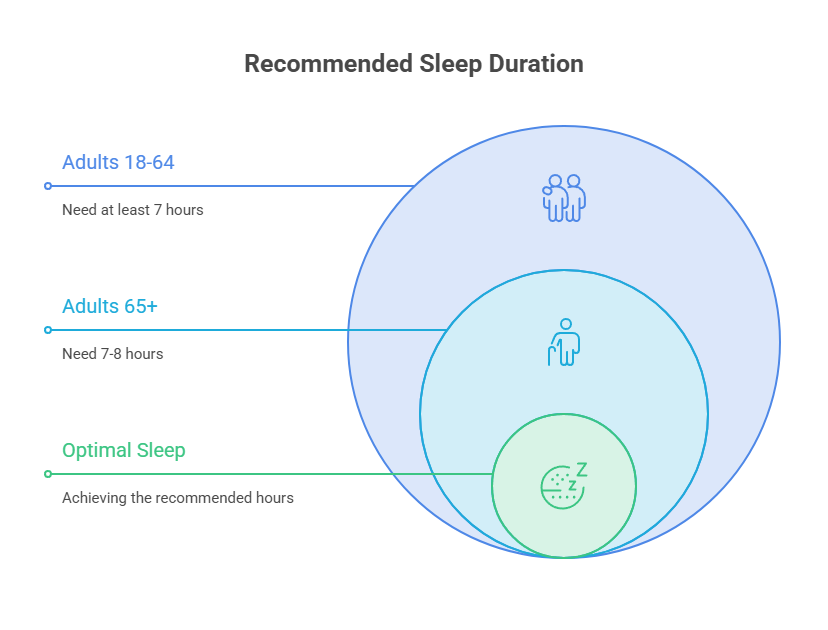
Younger bodies need more. Teens aged 13 to 18 need 8 to 10 hours, school-age kids need 9 to 12, and the number climbs the younger you go. If you have a teenager who seems wired at midnight, that biology is partly why.
The catch is quality, not just quantity. Seven hours of broken, shallow sleep can leave you worse off than a solid six. That’s why most of the tips below target how well you sleep, not only how long you’re in bed.
A practical test: if you wake most days feeling reasonably refreshed and stay alert without constant caffeine, you’re probably getting enough. Patients we see often discover their real problem isn’t hours in bed, but how fragmented those hours have become.
25 Proven Tips to Sleep Better Tonight
The strongest advice here comes straight from cognitive behavioral therapy for insomnia (CBT-I) and basic sleep science. A tip our medical team echoes from clinical guidance: don’t attempt all 25 at once.
Pick one or two each week and add more as they stick. Trying to overhaul everything in a single night rarely lasts.
Build a Sleep Schedule That Sticks (Tips 1 to 5)
1. Anchor one fixed wake time. Set the same wake-up time every day, weekends included. A steady morning alarm is the fastest way to reset your circadian rhythm, because your body clock keys off when you wake, not when you go to bed. A consistent bedtime then falls into place within a couple of weeks.
2. Go to bed only when you’re sleepy. Sleepy means heavy eyelids and nodding off, not just tired or bored. Climbing into bed early “to catch up” usually means more time lying awake, which feeds the conditioned arousal that keeps insomnia alive.
3. Stop chasing lost sleep. You can’t bank or repay sleep like a loan. Sleeping in after a bad night pushes the next bedtime later and keeps the cycle spinning. Hold your wake time even when you’re running on fumes, and your sleep drive rebuilds naturally that evening.
4. Skip the snooze button. Fragmented snooze-alarm sleep is poor quality and leaves you groggier than a clean wake-up. One alarm, feet on the floor, and straight into morning light beats three more nine-minute rounds of broken dozing every time.
5. Limit naps and time them right. If you must nap, keep it under 20 to 30 minutes and well before mid-afternoon. Long or late naps drain your sleep drive, the natural pressure that builds across the day and helps you fall asleep at night.
Highest-Impact Tactics: What They Fix and How Fast
| Tactic | What It Targets | Typical Time to Results | Evidence Level |
| Fixed wake time | Body clock, falling asleep | 1 to 2 weeks | Strong |
| 20-minute get-up rule | Conditioned arousal, staying asleep | A few nights to 2 weeks | Strong |
| Cool, dark bedroom | Sleep onset, deep sleep | Same night | Strong |
| Cutting afternoon caffeine | Falling asleep, lighter sleep | 1 to 3 days | Strong |
| Full CBT-I program | Chronic insomnia, all symptoms | 4 to 8 weeks | Strongest |
Patients we work with often expect the fix to feel dramatic. It rarely does. The wins are quiet and cumulative, which is exactly why the durable tactics above outperform any quick trick you’ll find online.
Engineer Your Bedroom for Sleep (Tips 6 to 11)
6. Cool the room to 65 to 68°F. Your core body temperature has to drop a degree or two for sleep to start. A cool bedroom helps that happen, while a warm, stuffy room is one of the most common reasons people can’t settle. Lower the thermostat, crack a window, or add a fan.
7. Make it cave-dark. Even small amounts of light suppress melatonin and tell your brain it’s still daytime. Blackout curtains, a sleep mask, and a piece of tape over stray LED lights make a real, same-night difference for many people. If you wake to use the bathroom, keep that light dim too, since a bright bulb can flip your brain back to “awake.”
8. Kill the noise or mask it. Sudden sounds pull you out of deep sleep even when you don’t fully wake. A fan, a white-noise machine, or simple foam earplugs smooth out the disruptions, which helps light sleepers and anyone near traffic or noisy neighbors.
9. Reserve the bed for sleep only. No bills, no laptop, no late-night scrolling. When your brain links the bed strictly with sleep and intimacy, lying down becomes a cue to wind down instead of a trigger to start thinking and planning.
10. Match your pillow and mattress to how you sleep. Side, back, and stomach sleepers each need different support. Persistent neck or back aches that wake you in the night are often a fit problem, not a personal failing, and the right setup quietly removes a hidden sleep wrecker.
11. Bank the screens before bed. Blue light from phones and tablets delays melatonin, and the content keeps your mind switched on. Power down 60 to 90 minutes before bed. If that feels impossible, at least use night mode and charge the phone across the room.
Calm the Body and Quiet the Mind (Tips 12 to 17)
12. Try 4-7-8 or box breathing. Inhale for 4 counts, hold for 7, exhale slowly for 8. Or breathe in, hold, out, and hold for 4 each. Slow, extended exhales shift you into the calm “rest and digest” state that invites sleep and lowers a racing heart rate. Counting the breaths also gives your mind a simple anchor, which crowds out the spinning thoughts that keep you alert.
13. Do progressive muscle relaxation. Starting at your feet, tense each muscle group for a few seconds, then release, working up to your face. The contrast between tension and release teaches your body what genuine letting go feels like, which is hard to find when you’re wired.
14. Use the 20-minute get-out-of-bed rule. If you’re still awake after about 20 minutes, leave the bedroom and do something quiet and dull under dim light. Return only when you feel sleepy. This stimulus-control move breaks the bed-equals-frustration link that drives chronic insomnia.
15. Keep a worry-dump notebook. A racing mind is often just unprocessed to-dos and worries circling for attention. Spend 10 minutes earlier in the evening writing them down, so your brain doesn’t feel it has to “hold” everything at 1 a.m. when you should be drifting off.
16. Take a warm shower 60 to 90 minutes before bed. Warming up, then cooling down afterward, mimics the natural temperature drop that signals sleep. It’s a simple, drug-free way to nudge your body toward drowsiness, and it doubles as a relaxing end-of-day ritual.
17. Defuse the racing thoughts. Instead of fighting your thoughts, label them (“there’s the planning thought again”) and let them float past without grabbing on. Trying to force your mind blank usually makes it louder, so the goal is gentle distance, not silence.
Daytime Habits That Decide Your Night (Tips 18 to 23)
18. Get morning sunlight within an hour of waking. Bright light early sets your internal clock and sharpens the day-night contrast your body relies on. Even 10 to 20 minutes outside, no sunglasses, helps you feel naturally sleepy at the right time that evening. On dark winter mornings, a 10,000-lux light therapy lamp can stand in for the sun.
19. Move your body, but time it well. Regular exercise is one of the most reliable sleep boosters, though the benefits build over a few weeks rather than overnight. The Physical Activity Guidelines for Americans recommend 150 minutes a week. Finish intense workouts at least a few hours before bed.
20. Cut caffeine after early afternoon. Caffeine has a half-life of about 5 to 6 hours, so an afternoon coffee can still be in your system at midnight. Switch to water, herbal tea, or other caffeine-free options after about 2 p.m. to protect your night. Watch the hidden sources too, like green tea, soda, dark chocolate, and some over-the-counter pain relievers.
21. Rethink the nightcap. Alcohol may help you doze off, but it fragments the back half of the night and suppresses restorative deep sleep. Our lab partners report that “good sleeper who drinks before bed” is a frequent and fixable culprit behind those 3 a.m. wake-ups.
22. Eat earlier and lighter at night. Heavy, spicy, or very late meals trigger indigestion and reflux that interrupt sleep. Aim to finish dinner two to three hours before bed, and keep evening snacks small if hunger strikes later.
23. Watch hidden stimulants and medications. Nicotine, some decongestants, certain antidepressants, and even dark chocolate can keep you wired. If new sleep trouble lined up with a new medication, raise it with your doctor or pharmacist rather than assuming it’s coincidence.
When Self-Help Isn’t Enough (Tips 24 to 25)
24. Try CBT-I, the first-line treatment. Cognitive behavioral therapy for insomnia retrains the thoughts and habits keeping you awake, and it beats sleeping pills over time. It’s available through trained therapists, structured apps, and self-guided programs, often in just 4 to 8 sessions.
25. Talk to a doctor and rule out disorders. Sometimes insomnia is a symptom of sleep apnea, restless legs syndrome, thyroid trouble, or anxiety. In cases reviewed by our medical team, treating the root cause is what finally restores normal sleep after years of failed quick fixes.
According to the American Academy of Sleep Medicine, CBT-I on its own is the most effective first-line treatment for chronic insomnia, with 50% to 75% of patients reaching meaningful improvement.
How to Fall Asleep Fast Tonight
If you want the short version to use right now, do these five in order:
- Cool and darken the room.
- Get into bed only once you feel sleepy.
- Breathe with the 4-7-8 method for a few rounds.
- Relax your muscles from feet to face.
- If 20 minutes pass and you’re still awake, get up, then return when drowsy.
Proof These Tips Work (Not Just Folk Advice)
Sleep advice gets dismissed as soft. The evidence says otherwise, especially for the behavioral approach behind most of the tips above.
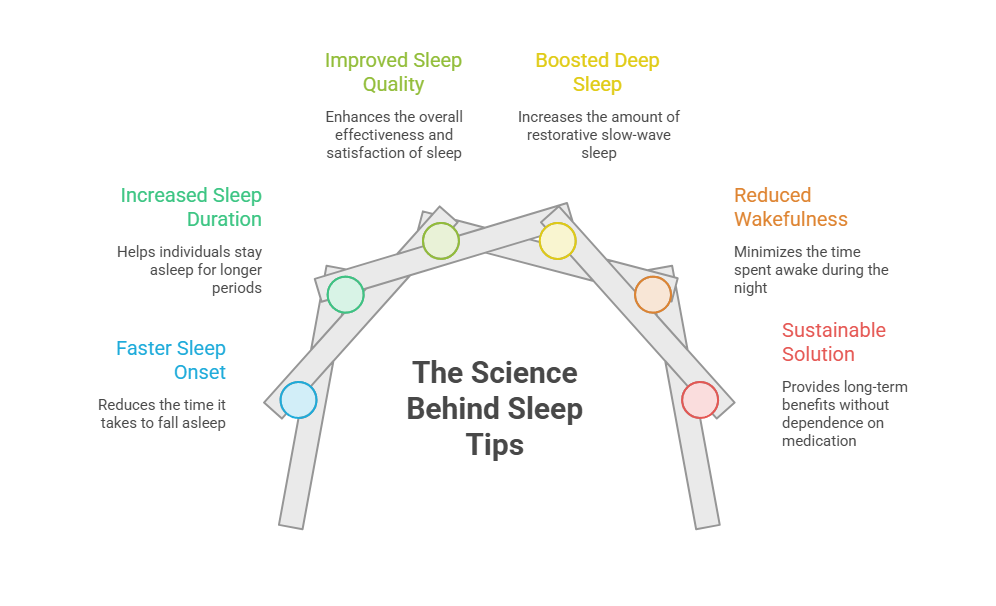
Multiple randomized controlled trials show CBT-I improves how fast you fall asleep, how long you stay asleep, and overall sleep quality. It boosts deep, slow-wave sleep by around 30%, and trims wake-after-sleep-onset by roughly 26 minutes, with gains that hold at six-month follow-up.
Those aren’t small effects. For many people, that adds up to falling asleep noticeably faster and spending far less of the night staring at the ceiling, without the dependence risk that comes with leaning on pills indefinitely.
CBT-I vs Sleep Medication: An Honest Comparison
Sleeping pills win the first 10 days. They deliver fast relief, which is genuinely useful in a crisis. The trouble is what happens after you stop taking them.
Medication benefits typically fade once you quit, and some carry dependence or next-day grogginess risks. CBT-I works more slowly, over 4 to 8 weeks, but the gains stick because you’ve actually changed the pattern underneath.
The AASM’s 2026 guidance leans toward CBT-I alone for most people, reserving medication for shared, case-by-case decisions. Patients commonly ask us whether they’ll be on pills forever, and the honest answer is that for many, the behavioral route means they won’t need them at all.
Do This Right Now If You’re Awake
If you found this page at 2 a.m., skip the reading and act. Match your situation to the row below, then close the screen and try it.
If This Is Happening, Do This Tonight
| Your Situation | What’s Likely Happening | What to Do Tonight |
| Can’t fall asleep after 20 minutes | Conditioned arousal | Get out of bed, dim the lights, do something dull, return when sleepy |
| Wake at 3 a.m. and can’t drift off | Light sleep, racing mind, possible alcohol | Don’t check the clock; try 4-7-8 breathing; get up if 20+ minutes pass |
| Mind won’t stop spinning | Unprocessed worries | Write everything down on paper, then go back to bed |
| Wired but exhausted | Stress hormones, late screens | Cool the room, breathe slowly, dim everything, no phone |
| 3+ bad nights/week for 3+ months | Possible chronic insomnia | Book a doctor visit and ask specifically about CBT-I |
The goal at 2 a.m. isn’t to “win” sleep. It’s to lower the pressure so your body can take over. Forcing it is what kept you up in the first place, so the move is to make falling asleep matter less, not more.
Mistakes That Keep You Awake
Even people doing most things right sabotage themselves with a few habits. These are the ones our medical reviewers flag most often in everyday cases.
Clock-watching tops the list. Every glance at the time adds stress and mental math, both of which make sleep harder, so turn the clock or phone away from view.
Then there’s “trying” to sleep, weekend catch-up marathons, scrolling in bed, and leaning on alcohol or pills as a nightly routine. Each one quietly deepens the problem instead of solving it.
A newer one is worth naming: obsessively checking a sleep tracker. Anxiety about your sleep score can itself cause insomnia, a pattern clinicians now call orthosomnia. Use the data loosely, or take a break from it.
There’s also the weekend reset trap. Staying up late and sleeping in on Saturday and Sunday shifts your body clock the same way a short trip across time zones would, leaving you fighting a mini jet lag every Monday night. Keeping your wake time steady all seven days is unglamorous, but it prevents that whiplash and ranks among the highest-return habits on this entire list.
Frequently Asked Questions
How can I fall asleep in 5 minutes?
Slow your breathing with the 4-7-8 method, relax your muscles from feet to face, and keep the room cool and dark. Five minutes is ambitious when you’re stressed, so the real fix is removing pressure rather than racing a stopwatch, which only adds tension.
What is the 10-3-2-1-0 sleep rule?
It’s a bedtime countdown: no caffeine 10 hours before, no food or alcohol 3 hours before, no work 2 hours before, no screens 1 hour before, and 0 snooze hits in the morning. It bundles several proven habits into one easy-to-remember framework.
Why do I wake up at 3 a.m. every night?
Common causes include alcohol wearing off, stress hormones rising, a too-warm room, or simply lighter sleep in the second half of the night. Don’t check the clock or panic. If you’re awake more than 20 minutes, get up briefly, then return when sleepy.
Should I stay in bed or get up when I can’t sleep?
Get up. Lying awake trains your brain to link the bed with frustration. After about 20 minutes, leave the bedroom, do something quiet and boring under dim light, and go back only once you feel genuinely sleepy again. This is core to CBT-I.
Does melatonin actually work for insomnia?
Melatonin helps most with circadian issues like jet lag or a shifted schedule, less so with classic insomnia. Effects are usually mild, and it isn’t a sedative. It also won’t fix the behavioral patterns driving chronic insomnia, so treat it as a small piece, not a cure.
What’s the best natural sleep aid?
There’s no single magic option. A cool dark room, a fixed wake time, morning sunlight, and a wind-down routine beat any supplement. Magnesium and chamomile help some people modestly, but consistent habits do the heavy lifting for lasting, reliable sleep over time.
How long does it take to fix insomnia?
Simple habit changes can help within a few nights to two weeks. A full CBT-I program usually delivers durable results in 4 to 8 weeks. Chronic insomnia rarely resolves overnight, so steady, patient adjustments beat one-night experiments every time you’re tempted to give up early.
What is CBT-I and how do I get it?
CBT-I is a structured, short-term therapy that retrains the thoughts and behaviors fueling insomnia, and it’s the doctor-recommended first-line treatment. You can access it through trained therapists, primary-care referrals, or evidence-based apps and self-guided online programs, often without medication at all.
When should I see a doctor about insomnia?
See a clinician if sleep trouble hits 3-plus nights a week for 3-plus months, disrupts daily life, or comes with loud snoring, gasping, or leg discomfort. Those signs can point to sleep apnea or other treatable disorders worth checking out properly.
Can lack of sleep actually be dangerous?
Yes. Chronic poor sleep raises the risk of heart disease, diabetes, depression, and accidents, and drowsy driving rivals drunk driving for danger on the road. Treating insomnia is a real health priority, not a luxury or a sign of personal weakness.
What foods help you sleep?
Lighter evening meals with some protein, complex carbs, and magnesium-rich foods like nuts and leafy greens can support sleep. Tart cherry juice and kiwi show modest promise in studies. Timing matters more than any single food, so finish dinner two to three hours before bed.
Why am I exhausted but still can’t sleep?
This often means stress hormones are high, your body clock is off, or late screens and caffeine left you “tired but wired.” Morning sunlight, an afternoon caffeine cutoff, and a calming wind-down routine usually close the gap between feeling exhausted and actually falling asleep.
Disclaimer: This article is for general education and isn’t medical advice. It doesn’t replace diagnosis or treatment from a licensed clinician. If insomnia is persistent or affecting your health, talk to your doctor. For any medical emergency in the US, call 911.
References
- Centers for Disease Control and Prevention (CDC), Sleep Health FastStats
- Mayo Clinic, Sleep tips: 6 steps to better sleep
- American Academy of Sleep Medicine, Chronic Insomnia Treatment Guideline
- National Heart, Lung, and Blood Institute (NHLBI), Healthy Sleep Habits
- Sleep Foundation, What to Do When You Can’t Sleep
- RAND Corporation, The Economic Costs of Insufficient Sleep
- Physical Activity Guidelines for Americans, U.S. Department of Health and Human Services
- AASM Sleep Education, Healthy Sleep Habits