
Picture an adult who has eaten the same handful of foods for twenty years. Plain pasta, one brand of chicken nuggets, crackers, apple juice. They visit a doctor for constant tiredness and hear the usual line: “You’re just a picky eater.”
Table of Contents
That label can miss a real, treatable eating disorder. And because the scale often reads normal, the problem can stay hidden for decades.
Quick Answer: ARFID (avoidant/restrictive food intake disorder) in adults is an eating disorder where a person limits the amount or variety of food they eat because of sensory discomfort, fear of choking, vomiting, or pain, or low interest in eating. It is not driven by weight or body image. See a doctor if your eating causes nutrient gaps, weight loss, fatigue, or trouble at work, meals, or social events.
At a Glance
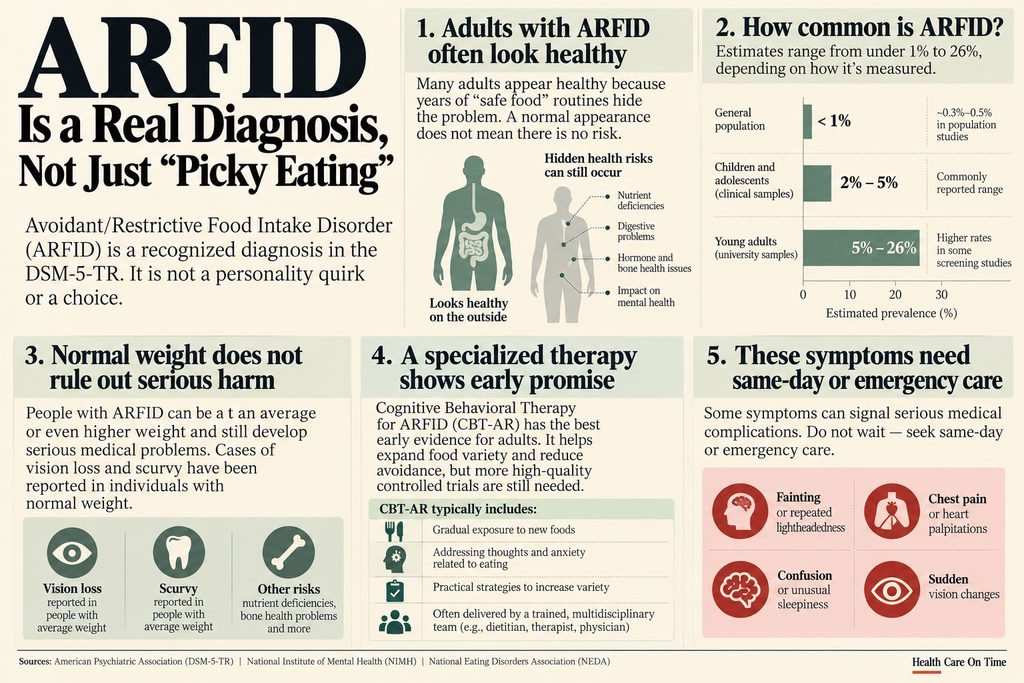
- ARFID is a recognized diagnosis in the DSM-5-TR, not a personality quirk or “picky eating.”
- Adults with ARFID often look healthy because years of “safe food” routines hide the problem.
- Estimates of how common it is range from under 1% to 26%, depending on how it’s measured.
- Normal weight does not rule out serious harm; vision loss and scurvy have been reported at average weight.
- A specialized therapy called CBT-AR has the best early evidence for adults, though controlled trials are still missing.
- Fainting, chest pain, confusion, or sudden vision changes need same-day or emergency care.
What Is ARFID in Adults?
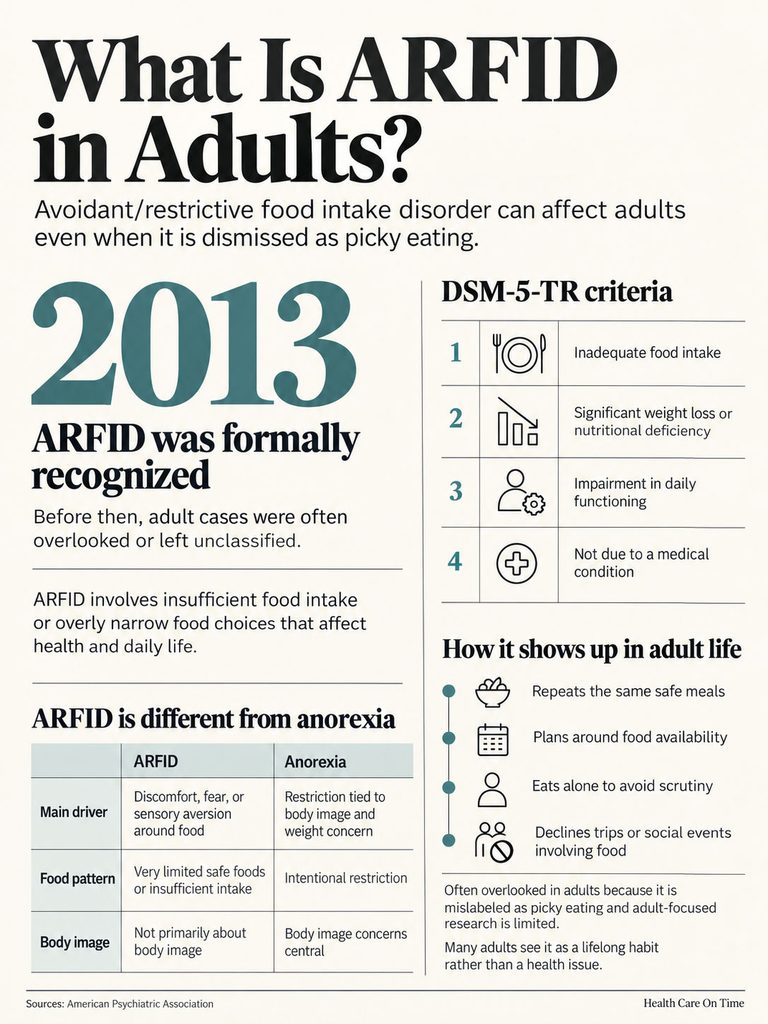
ARFID entered the diagnostic manual in 2013. Before that, many adults with this pattern had no name for it at all.
The core idea is simple. A person eats too little, or too narrow a range of foods, and it causes real harm to the body or to daily life.
The DSM-5-TR Criteria in Plain English
Doctors use four main checks to diagnose ARFID in adults:
- Your eating pattern leads to at least one of these: significant weight loss, a significant nutritional deficiency, dependence on supplements or tube feeding, or clear interference with work, relationships, or social life.
- The restriction isn’t caused by lack of food access or a cultural or religious practice.
- It doesn’t happen during anorexia or bulimia, and there’s no fear of weight gain or distorted body image.
- A medical condition or another mental health disorder doesn’t fully explain it.
That last point matters. Someone with celiac disease who avoids gluten doesn’t have ARFID. But if their avoidance spreads far beyond what their condition requires, it might be.
How ARFID Differs From Anorexia
Both conditions can cause weight loss. The difference is the “why.”
People with anorexia restrict food to control weight or shape. People with ARFID restrict food because eating feels unpleasant, scary, or pointless. Cleveland Clinic describes ARFID as restrictive eating that isn’t caused by a distorted self-image.
Why Adults Get Missed
Adult ARFID is easy to overlook for three reasons. First, many adults grew up hearing they were “picky” and adopted that label themselves.
Second, research and screening tools focused almost entirely on children for years. Third, adults build workarounds, like ordering the same meal everywhere or eating before social events, that hide the struggle from others and from themselves.
Our medical review team sees this pattern often. Adults describe their eating as a lifelong habit, not a health problem, until lab results or fatigue force the question.
How ARFID Shows Up at Work and in Relationships
For adults, the biggest clues often appear outside the kitchen. Business trips get turned down. Client dinners become a source of dread. A new partner notices the same order at every restaurant and starts asking questions.
Some adults plan whole days around where their safe foods are available. Others eat alone in their car at lunch to avoid comments. These habits can feel normal after years, but they are exactly the kind of daily-life impact doctors look for.
The 3 Types of ARFID Adults Experience
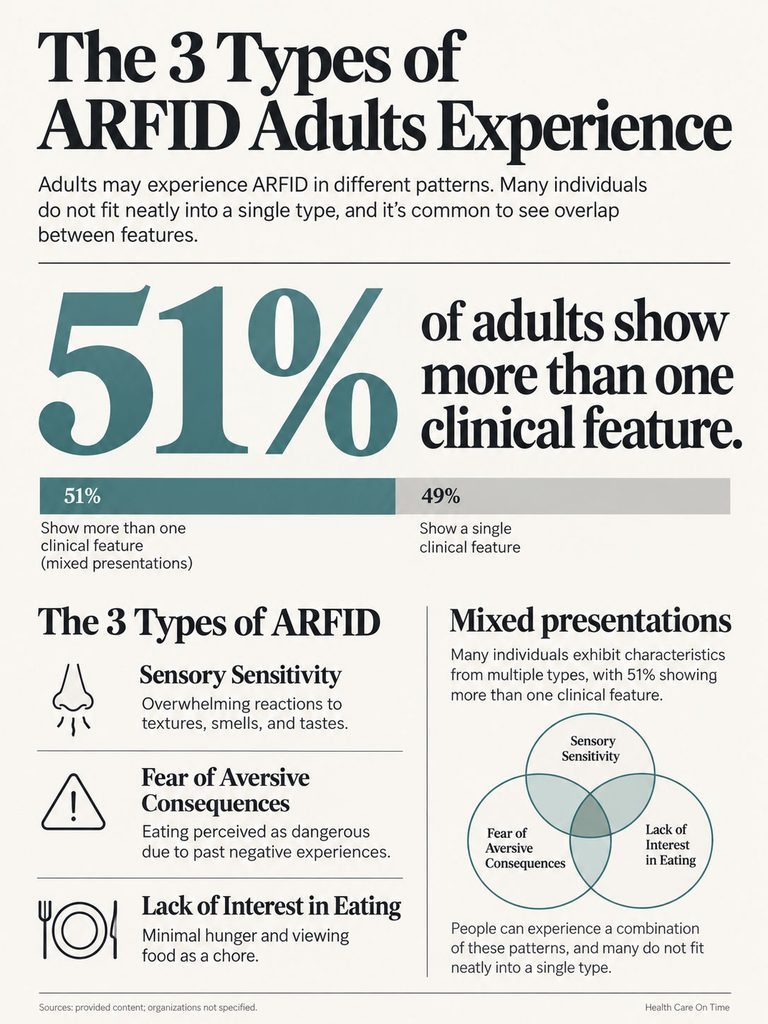
Researchers describe three main drivers behind ARFID in adults. Knowing which one fits you helps shape treatment.
Sensory Sensitivity
This is the type most people picture. Certain textures, smells, colors, temperatures, or tastes feel overwhelming or disgusting.
A person might only eat “beige” foods, avoid anything with mixed textures, or gag at the smell of cooked vegetables. They’re not being difficult; the sensory reaction is intense and real.
Fear of Aversive Consequences
Here, eating feels dangerous. The fear usually traces back to a specific event, such as choking, a bad bout of food poisoning, severe vomiting, or an allergic reaction.
After that event, the person may avoid whole food groups, chew for a very long time, or stick to liquids. Research on adults with this profile found they also tend to report more gastrointestinal sensitivity than adults with other ARFID types.
Lack of Interest in Eating
Some adults simply don’t feel much hunger, forget to eat, or find meals boring and effortful. Food feels like a chore on a to-do list.
This type can overlap with ADHD. Stimulant medications that reduce appetite can make existing low-interest eating worse, so it’s worth telling your prescriber about your eating habits.
Mixed Presentations Are Common
Many people don’t fit neatly into one box. In one study, 51% of patients showed more than one clinical feature. An adult might have sensory aversions and a choking fear at the same time.
9 Warning Signs of ARFID in Adults
These ARFID symptoms in adults usually build slowly. One sign alone rarely means ARFID, but several together deserve attention:
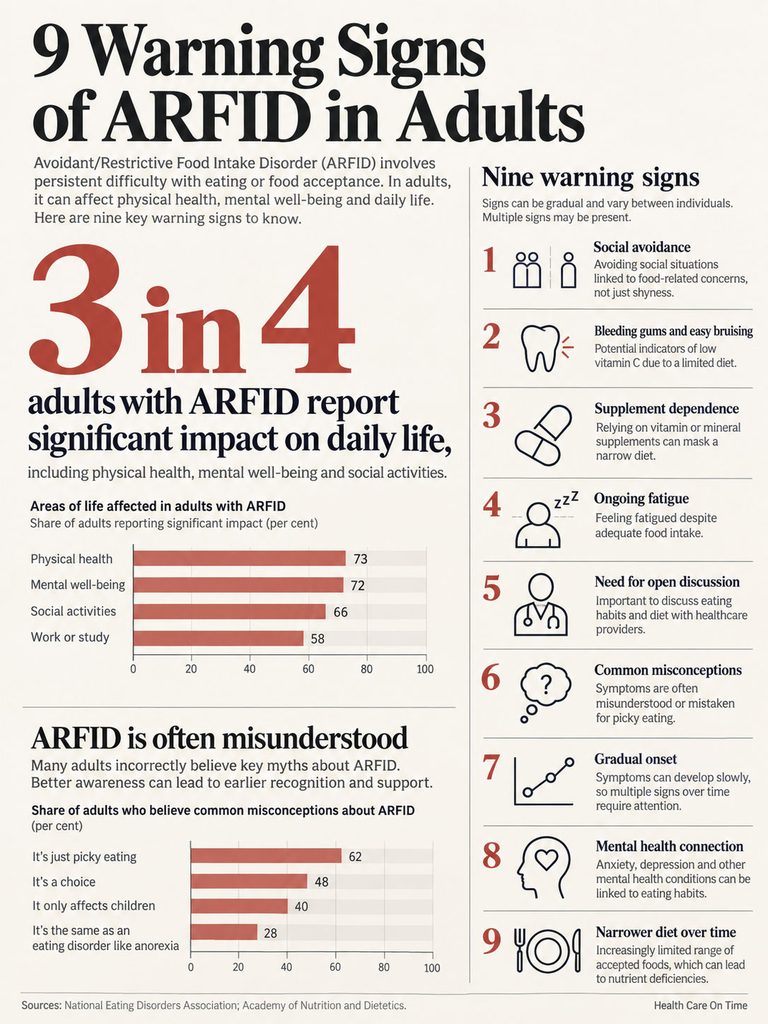
- A short “safe foods” list that has barely changed in years.
- Avoiding whole food groups, most often fruits, vegetables, or proteins.
- Strong gagging, nausea, or panic when faced with new or disliked foods.
- Fear of choking or vomiting that shapes what and how you eat.
- Forgetting to eat or feeling little hunger for most of the day.
- Eating only one brand or preparation and refusing substitutes, even small ones.
- Skipping social events, dates, or work meals because food will be involved.
- Physical signs of low nutrition, such as fatigue, feeling cold, hair thinning, easy bruising, or bleeding gums.
- Relying on shakes or supplements to get through the day.
The Three Most Missed Signs
Social avoidance often gets blamed on shyness. But if you turn down invitations mainly because of the menu, that’s a food problem, not a personality trait.
Bleeding gums and easy bruising can point to low vitamin C. Most people never connect these to their diet.
Supplement dependence feels like a smart fix. It can quietly mask how narrow the diet has become.
Patients who book lab panels through HealthCareOnTime commonly ask why they feel wiped out despite “eating enough.” A narrow diet is one of the first things our reviewers suggest raising with a doctor.
Picky Eating vs ARFID vs Other Conditions
Most adults have foods they avoid. That doesn’t make it a disorder. The line is crossed when eating causes harm to health or daily functioning.
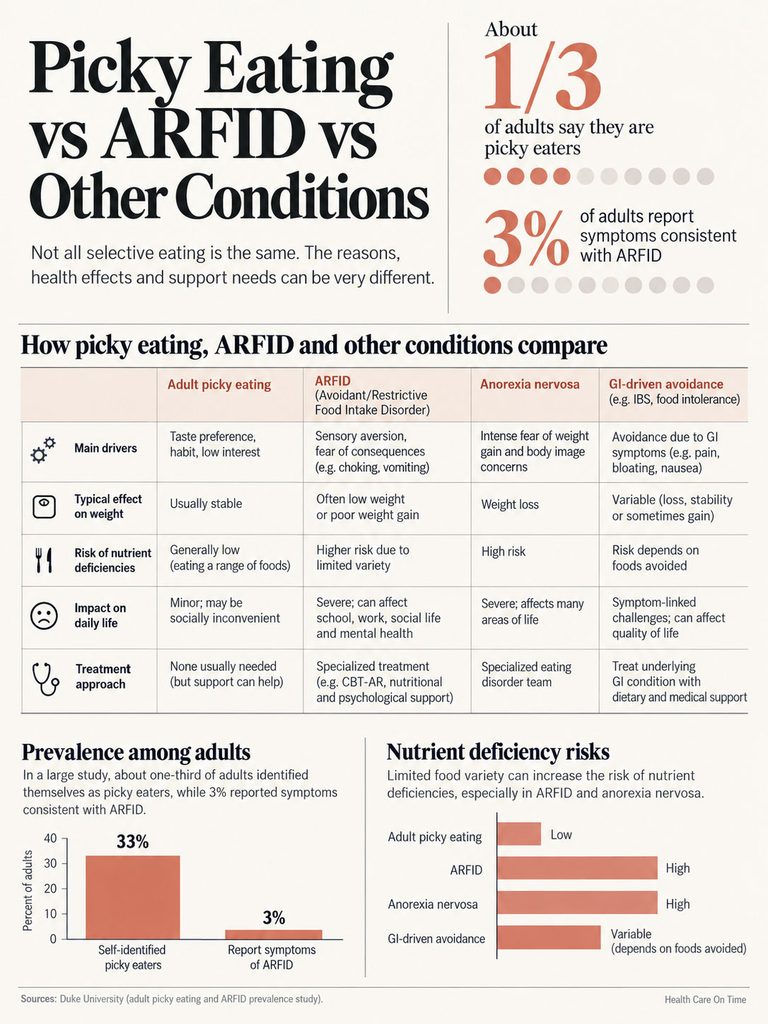
One small study shows the gap well. Among 81 adults, about one-third described themselves as very picky eaters, but only 3% reported ARFID symptoms.
| Feature | Adult picky eating | ARFID | Anorexia nervosa | GI-driven avoidance (IBS, EoE) |
| Main driver | Taste preference | Sensory aversion, fear, or low interest | Fear of weight gain, body image | Pain or symptoms from specific foods |
| Body image concern | No | No | Yes, central | No |
| Effect on weight | Usually none | Loss, stable, or even higher weight | Significant loss | Varies with symptoms |
| Nutrient deficiency risk | Low | Moderate to high | High | Moderate, food-group specific |
| Daily life impact | Minor | Skips meals, events, travel | Severe, often medical | Moderate, symptom-linked |
| Share of self-described picky adults affected | About 1 in 3 adults use the label | About 3% in one 81-adult study | Not applicable | Not applicable |
| First-line help | None needed | CBT-AR, dietitian, doctor | Specialized eating disorder team | Gastroenterologist, dietitian |
The GI column matters more than people think. A gut condition can start the avoidance, and ARFID can then grow on top of it. Both may need treatment at the same time.
How Common Is ARFID in Adults? Why the Numbers Disagree
Search for adult ARFID statistics and you’ll find figures that don’t match at all. That’s not an error; each number measures something different.
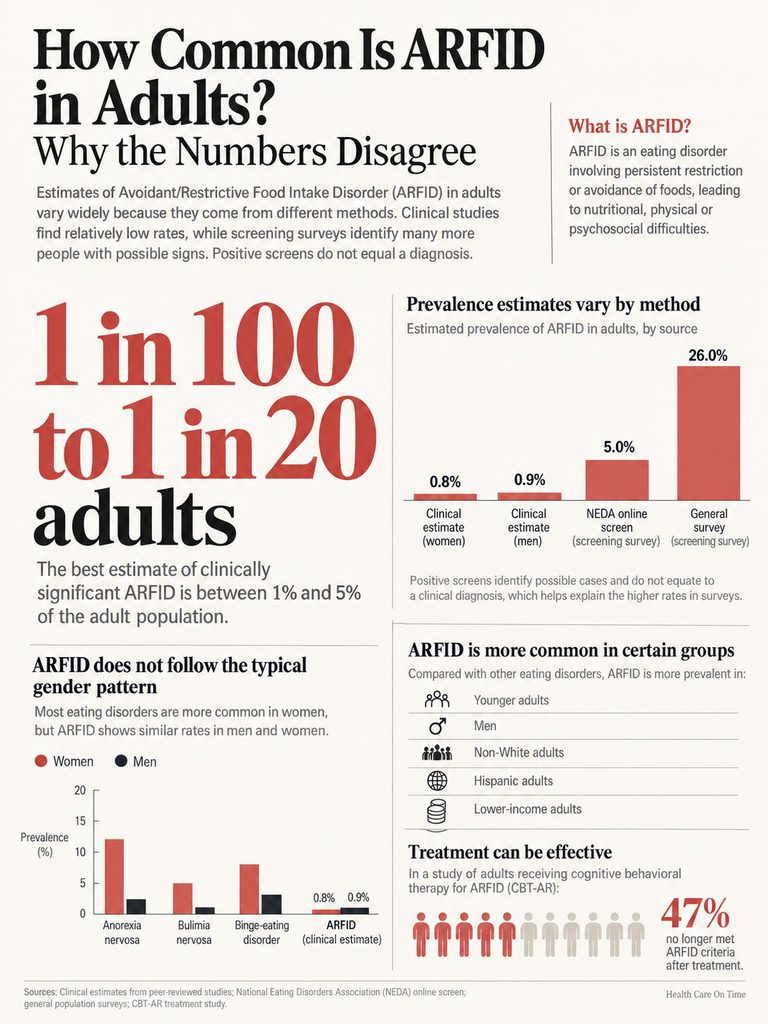
A strict clinical estimate puts the point prevalence at 0.8% for women and 0.9% for men. Screening surveys, which count people who check certain boxes on a questionnaire, report much higher rates.
| Statistic | Figure | Source |
| Point prevalence of adult ARFID (clinical estimate) | 0.8% women, 0.9% men | Primary Care Companion CNS Disord, 2025 |
| Adults screening positive on the NEDA online screen | 5.0% of 47,705 respondents (first analysis) | J Eat Disord, NEDA screen study |
| US and UK adults screening positive in a general survey | 26.0% of 4,002 adults | Brownlow et al., Int J Eat Disord, 2026 |
| Screen-positive rate by sex in that survey | 29.6% women vs 22.1% men | Brownlow et al., 2026 |
| Screen-positive rate, ages 18 to 39 | 31.6% | Brownlow et al., 2026 |
| Range across all non-clinical studies | 0.8% to 28% | Nicholls-Clow review, cited in Brownlow 2026 |
| Adults no longer meeting ARFID criteria after CBT-AR | 47% (vs 70% in youth) | Thomas et al., 2021 |
Screening Positive Is Not a Diagnosis
The 2026 US and UK survey found about one in four adults screened positive. That number grabs headlines, but a screen flags possible cases. It doesn’t confirm them.
The NEDA screen has the opposite limit. People who take an eating disorder screen online already suspect a problem, so the group isn’t random. Its first analysis covered 47,705 adults; the final published study grew to 50,082.
The honest answer: somewhere between 1 in 100 and 1 in 20 adults likely has clinically significant ARFID. Researchers still lack large studies using full diagnostic interviews.
Who Gets It Surprises People
Most eating disorders are diagnosed more often in women. ARFID breaks that pattern.
In the NEDA data, a positive ARFID screen was more common among people who were younger, male, non-White, Hispanic, and lower income than among those with other eating disorders. Men who assume eating disorders “don’t happen to guys” may never think to ask.
What Causes ARFID in Adults?
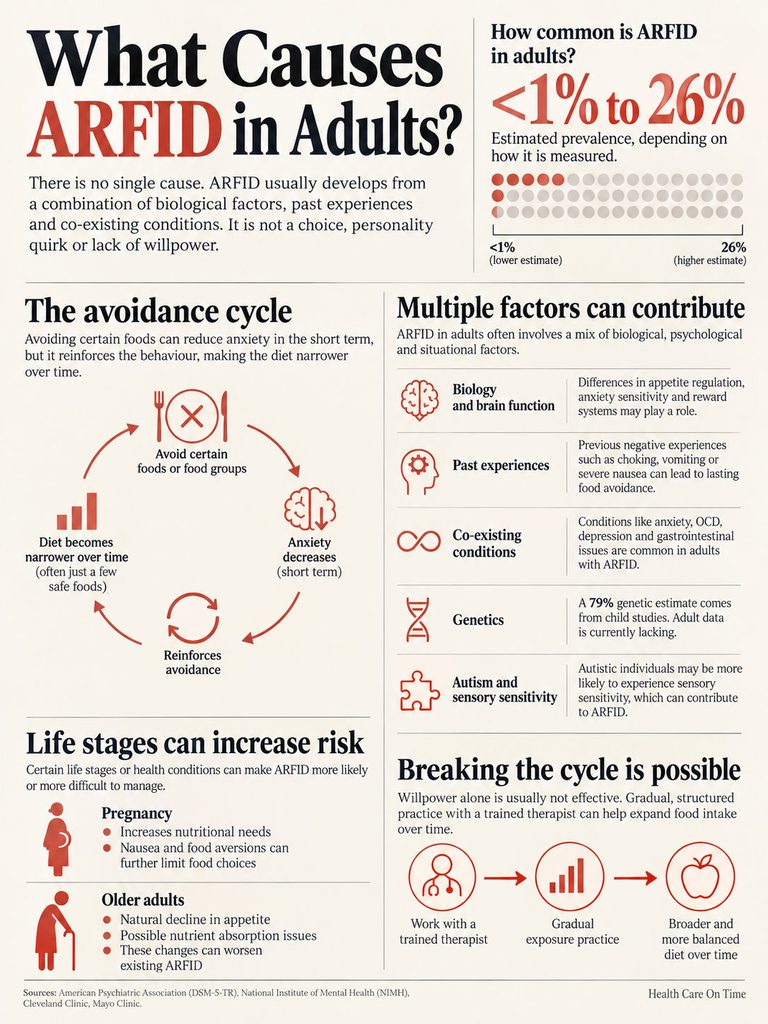
No single cause explains ARFID. Most adults have a mix of biology, past experiences, and other conditions.
Common triggers and risk factors include:
- A frightening food event, such as choking, severe food poisoning, or a violent bout of vomiting.
- Untreated childhood ARFID that carried into adulthood.
- Anxiety, OCD, or PTSD. One clinical report found about one-third of adults with ARFID had moderate to severe OCD symptoms, and one-third had probable PTSD.
- Gut conditions. Disorders of gut-brain interaction, like IBS, were more common in the ARFID group in the 2026 survey.
- ADHD and appetite-lowering medications.
- Early food trauma, including food insecurity or being force-fed as a child.
Why Avoidance Tends to Grow
ARFID often follows a simple loop. You avoid a food, the anxiety drops, and your brain learns that avoiding worked. Next time, the list of “unsafe” foods gets a little longer.
Over years, that loop can shrink a normal diet down to a handful of items. It also explains why willpower alone rarely fixes ARFID. Breaking the loop usually takes planned, gradual practice with a trained therapist.
ARFID Across Adult Life Stages
Pregnancy raises the stakes. Nutrient needs for folate, iron, and other vitamins go up, and nausea can shrink an already narrow food list further. Tell your OB-GYN about your eating early.
Older adults face a different squeeze. Appetite often drops with age, and the body absorbs vitamin B12 less well. A lifelong narrow diet that once “worked” can start causing problems in your 60s or 70s.
What About Genes and Autism?
You may see a claim that ARFID is 79% genetic. That figure comes from a Swedish study of twins ages 6 to 12, not adults. It suggests a strong inherited piece in children, but adult data don’t exist yet.
Autism and ARFID also overlap, especially through sensory sensitivity. Our separate guides on ARFID and autism and on whether eating disorders are genetic cover both links in depth.
Health Risks: Why a Normal Weight Doesn’t Mean You’re Safe
This is the most important point for adults. You can look healthy, have a normal weight, and still be seriously undernourished.
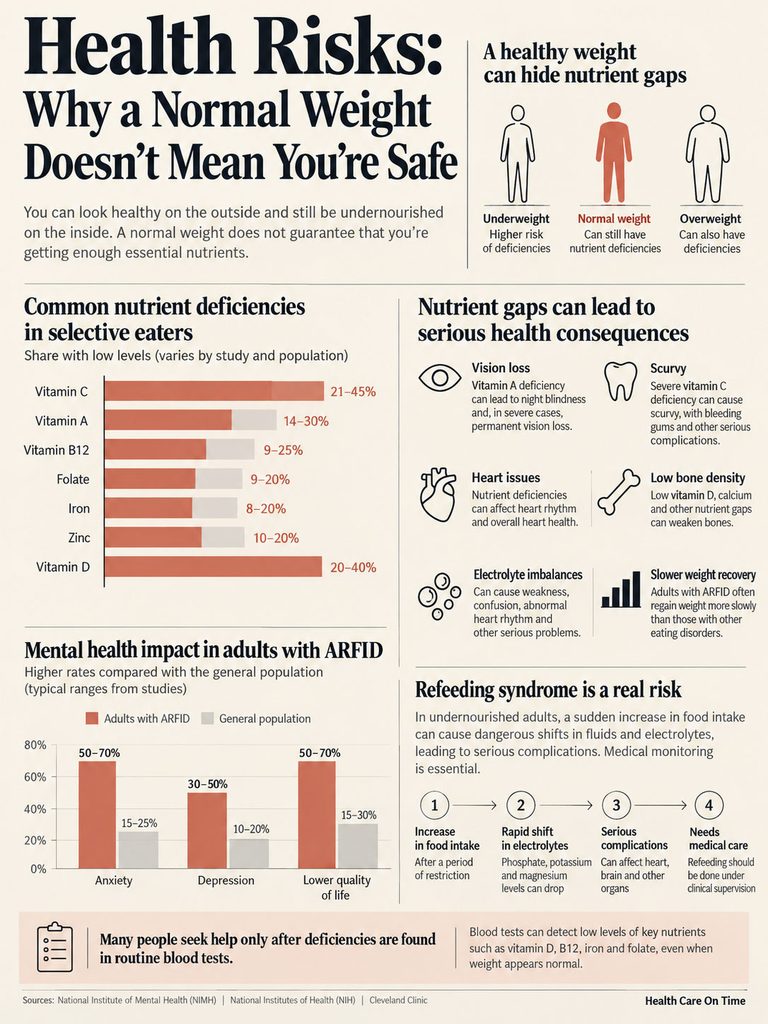
A narrow diet can supply enough energy while missing key vitamins and minerals. Cleveland Clinic notes that some people with ARFID show no obvious signs because the body adapts to the stress.
Nutrient Gaps
The most common deficiencies in selective eaters involve vitamin C, vitamin A, vitamin B12, folate, iron, zinc, and vitamin D.
These gaps can cause real damage. Case reports of scurvy, spinal cord injury, and blindness from selective eating have been described in patients with average or even higher-than-average body weight.
Vision loss from poor nutrition, called nutritional optic neuropathy, is usually painless and gradual. Caught early, it often improves with vitamin replacement, but permanent loss is possible. That’s why night vision trouble deserves a prompt visit, not a wait-and-see approach.
Heart, Bone, and Electrolyte Effects
When ARFID leads to low weight, the risks look similar to other restrictive eating disorders. These include a slow heart rate, heart rhythm changes, electrolyte imbalances, lower bone density, and missed periods.
In one hospital study, adults with ARFID regained weight more slowly than matched patients with anorexia and were less likely to reach their target by discharge. ARFID is not a “milder” eating disorder.
A Note on Restarting Nutrition
If someone has been eating very little for a long time, suddenly eating much more can shift electrolytes in a dangerous way. This is called refeeding syndrome. It’s one reason nutrition rehab for undernourished adults should happen with medical monitoring, not on your own.
Mental Health and Social Costs
Adults with ARFID report high levels of anxiety, depression, and lower quality of life. Many describe years of quiet shame at restaurants, family meals, and work trips.
In lab work reviewed across our diagnostic network, the pattern that stands out is how long adults wait. Many only seek help after a deficiency shows up on routine blood tests ordered for something else.
When to See a Doctor About ARFID
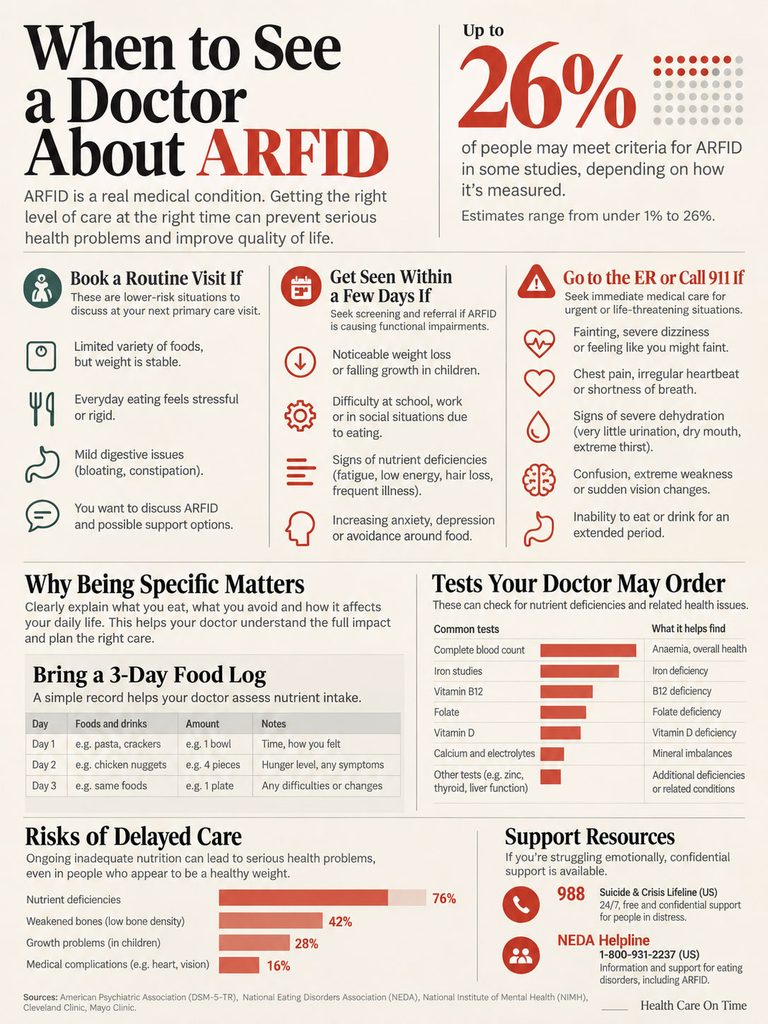
Knowing when to see a doctor comes down to urgency. Use the levels below as a guide, not a replacement for professional judgment.
Book a Routine Visit If…
- Your safe-foods list is short and hasn’t grown in years.
- You avoid social meals, travel, or dating because of food.
- You feel tired, cold, or foggy most days.
- You rely on shakes or supplements to get by.
Get Seen Within a Few Days If…
- You’ve lost weight without trying over the past few months.
- Your gums bleed, you bruise easily, or wounds heal slowly.
- You notice night vision problems, tingling in your hands or feet, or hair loss.
- A recent choking or vomiting event has made you stop eating most solid foods.
Go to the ER or Call 911 If…
- You faint or nearly faint.
- You have chest pain, a pounding or very slow heartbeat, or feel your heart skipping.
- You feel confused, extremely weak, or can’t keep fluids down.
- You have sudden changes in vision.
- Food is stuck in your throat and you can’t swallow your own saliva.
If you’re having thoughts of harming yourself, call or text 988 right away.
| Scenario | What it may mean | Recommended action | Timing |
| Short food list for years, feel fine | Possible ARFID, low immediate risk | Mention it at your next primary care visit | Within 1 to 3 months |
| Skipping work events and dates due to food | Functional impairment, a core ARFID criterion | Ask for an eating disorder screen and therapist referral | Within 2 to 4 weeks |
| Bleeding gums, easy bruising | Possible vitamin C deficiency | Primary care visit with blood work | Within 1 week |
| Night vision trouble or blurry vision | Possible vitamin A or B-vitamin deficiency | Primary care plus an eye exam | Within a few days |
| Stopped eating solids after a choking event | Fear-based ARFID, risk of fast decline | Urgent primary care or telehealth visit | Within 1 to 3 days |
| Fainting, chest pain, or irregular heartbeat | Possible electrolyte or heart problem | Emergency department | Now |
| Food stuck, can’t swallow saliva | Possible food impaction | Call 911 or go to the ER | Now |
What to Say at the Appointment
Many adults feel embarrassed and downplay their eating. Being specific works better:
Say how many foods you eat, how long it has been that way, and what it costs you, like skipped meals with coworkers or constant exhaustion. Then ask two direct questions: “Could this be ARFID?” and “Can we check nutrient levels?”
Bring a simple three-day food log. It gives your doctor facts instead of guesses, and it saves time in a short visit.
Tests Your Doctor May Order
Our medical reviewers note that a basic ARFID workup usually includes:
- CBC to check for anemia.
- CMP, a standard metabolic panel, for electrolytes plus kidney and liver function.
- Magnesium and phosphorus.
- Vitamin B12, folate, and vitamin D.
- Ferritin and iron studies.
- TSH to rule out thyroid problems.
- ECG if you have low weight or heart symptoms.
Your doctor may add vitamin C, vitamin A, or zinc tests based on your diet. Normal results don’t rule out ARFID, since the diagnosis is based on behavior and its impact, not a single lab value.
How ARFID Is Diagnosed and Treated in Adults
Diagnosis
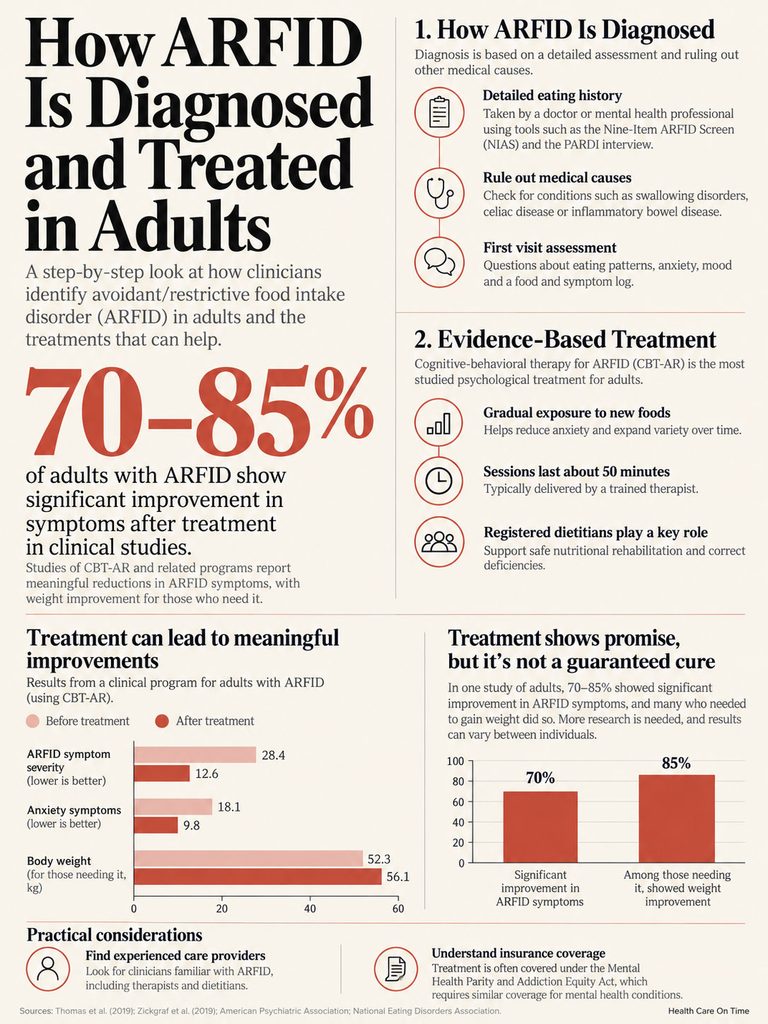
A doctor or mental health professional takes a detailed eating history. They may use screening tools like the Nine-Item ARFID Screen (NIAS) or a structured interview called the PARDI.
They’ll also rule out medical causes, such as swallowing disorders, celiac disease, or inflammatory bowel disease. This step protects you from being told it’s “all in your head” when something physical is also going on.
What a First Visit Usually Looks Like
Expect questions about which foods you eat, when the pattern started, and whether a specific event triggered it. You may be asked about anxiety, mood, ADHD, and gut symptoms too.
The clinician will usually check your vital signs and review recent blood work. Many will ask you to keep a food and symptom log for a week or two. Nothing about a first visit requires you to eat anything you don’t want to eat.
CBT-AR: The Leading Therapy
Cognitive-behavioral therapy for ARFID, called CBT-AR, was developed at Massachusetts General Hospital. It uses gradual, planned exposure to new foods, tailored to your ARFID type. Sessions last about 50 minutes, and open trials offered 20 to 30 of them.
In the first adult study, 15 adults enrolled and 14 finished. After treatment, 47% no longer met criteria for ARFID.
A 2026 real-world study of 549 adults treated through video sessions found improvements across all three ARFID types. Weight also improved in those who needed it.
What the Evidence Can and Can’t Tell Us
Three honest limits apply to every adult ARFID treatment claim you’ll read:
- No randomized trials in adults yet. The first adult CBT-AR study had only 15 people, and the 549-person study had no comparison group.
- Industry ties. Several authors of the 2026 study work for the company that delivered the treatment. The findings may still hold, but independent replication matters.
- No official guidelines. Experts say no formal adult treatment guidelines exist. A Dutch study of 120 adults across 11 treatment centers is testing a 25-session program now.
None of this means treatment doesn’t work. It means the early signals are good, and anyone promising a guaranteed cure is overselling.
Dietitians, Medical Monitoring, and Medication
A registered dietitian helps rebuild nutrition safely and correct deficiencies. Some programs now train dietitians to lead CBT-AR directly.
Your doctor monitors labs, heart health, and weight if needed. No medication is FDA-approved for ARFID. Some doctors try appetite-affecting or anti-anxiety medications off-label, but the evidence comes mostly from small case series.
Finding Care and Paying for It
Look for providers who list ARFID or CBT-AR experience specifically. General therapists may not know exposure-based methods for food.
Under the federal Mental Health Parity and Addiction Equity Act, most US health plans must cover mental health care, including eating disorders, on terms similar to medical care. Ask your insurer about in-network eating disorder specialists and telehealth options.
Patients commonly ask us whether their primary care doctor is the right starting point. For most adults, yes. They can order labs and make the referral.
What You Can Do While You Wait for Care
Specialist waitlists can run weeks or months. A few steps help in the meantime without replacing treatment.
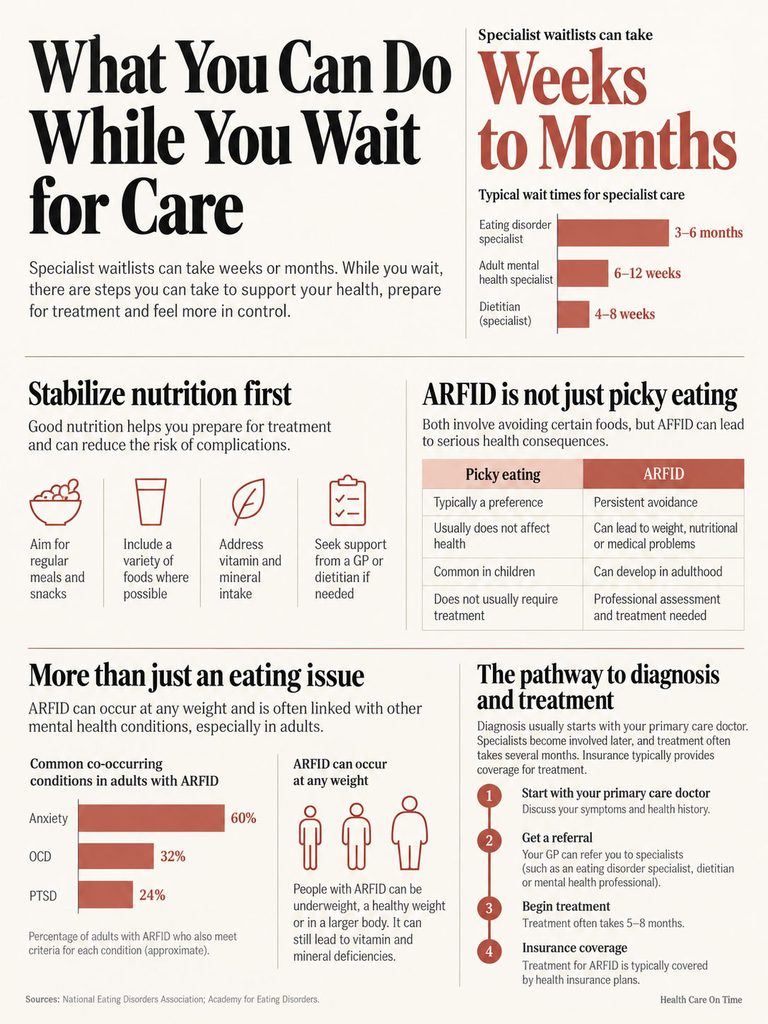
- Get your labs done first. Blood work can catch a deficiency that needs attention now, whatever the final diagnosis.
- Ask before starting supplements. A multivitamin may help, but high doses of some vitamins, like vitamin A, can cause harm. Let your doctor choose.
- Keep eating your safe foods. Don’t try to force yourself off them before you have support. Regular meals matter more than variety right now.
- Track patterns, not portions. Note when eating feels hardest and what triggers avoidance. Your therapist will use this.
- Tell one person you trust. Hiding the struggle takes energy. A friend who knows can make social meals easier.
Our medical team’s view is simple: stabilize first, then expand. Treatment works best when you aren’t starting from a nutrition crisis.
Frequently Asked Questions
Can you develop ARFID as an adult?
Yes. Some adults have had symptoms since childhood that were never diagnosed. Others develop ARFID after a choking event, severe illness, food poisoning, or a new gut condition. Adult onset is less studied than childhood onset, but it’s well documented in case reports and clinic data.
How can you tell ARFID from picky eating?
The key question is harm. Picky eaters dislike some foods but stay healthy and social. ARFID causes weight loss, nutrient deficiencies, supplement dependence, or clear problems at work, meals, or relationships. If your eating limits your life or health, ask a doctor for an evaluation.
What kind of doctor diagnoses ARFID in adults?
Start with a primary care doctor. They can order blood work and rule out medical causes. A psychologist, psychiatrist, or eating disorder specialist usually makes the formal diagnosis. A registered dietitian often joins the care team once ARFID is confirmed.
Can you have ARFID at a normal weight?
Yes. Many adults with ARFID have a normal or higher-than-average weight. A narrow diet can provide enough energy while lacking vitamins and minerals. Serious deficiencies, including vision loss and scurvy, have been reported in people who weren’t underweight.
Is ARFID related to anxiety or OCD?
Often, yes. Anxiety disorders, OCD, and PTSD commonly occur alongside ARFID in adults. Fear-based ARFID in particular shares features with anxiety. Treating the anxiety alone may not fix the eating, so specialists usually address both together.
Can ARFID cause vitamin deficiencies?
Yes, and it’s one of its biggest risks. Common gaps include vitamin C, vitamin A, B12, folate, iron, zinc, and vitamin D. Signs can include fatigue, bleeding gums, easy bruising, tingling, and vision changes. Blood tests can catch these before they cause lasting damage.
Is ARFID the same as autism?
No. They’re separate conditions, though they often overlap. Many autistic people have sensory sensitivities that affect eating, and some meet full ARFID criteria. You can have ARFID without autism and autism without ARFID. Each needs its own assessment.
Does ARFID go away on its own?
Rarely. Without treatment, ARFID tends to persist and may worsen over time. Many adults have had symptoms for decades. With specialized therapy, many people improve, and nearly half in one small adult study no longer met criteria after treatment.
How long does ARFID treatment take?
CBT-AR usually runs 20 to 30 weekly sessions, so roughly five to eight months. Timing depends on your ARFID type, other conditions, and nutrition needs. People needing weight restoration or close medical monitoring may start at a higher level of care first.
Does insurance cover ARFID treatment?
Most US plans must cover eating disorder treatment under federal parity law. Coverage details vary, including prior authorization and in-network limits. Call your insurer, ask for eating disorder specialists by name, and request a case manager if you have trouble finding care.
Can ARFID start after choking or food poisoning?
Yes. A frightening food event is one of the most common triggers for fear-based ARFID. People may avoid the food involved, then entire textures, then most solids. Getting help soon after the event can keep the avoidance from spreading.
How can you support an adult with ARFID?
Avoid pressuring, bribing, or commenting on their plate. Invite them to events without making food the focus. Encourage a doctor visit framed around feeling better, not “fixing” their eating. Learning about ARFID yourself shows them their struggle is real.
Disclaimer: This article is for general education only and is not medical advice, diagnosis, or treatment. Always talk with a qualified healthcare provider about your symptoms. If you or someone you know is struggling with an eating disorder, contact the ANAD Helpline at 1-888-375-7767. If you’re in crisis or thinking about self-harm, call or text 988, or call 911 in an emergency.
References
- Cleveland Clinic: ARFID (Avoidant/Restrictive Food Intake Disorder)
- Brownlow et al. The Prevalence and Burden of ARFID Symptoms in the Adult General Population of the UK and USA. Int J Eat Disord, 2026
- Prevalence, Characteristics, and Correlates of Probable ARFID Among Adult Respondents to the NEDA Online Screen. J Eat Disord
- NEDA Screen Study, full text (PMC)
- Clinical Presentation and Treatment Challenges of Adult ARFID. Prim Care Companion CNS Disord, 2025
- Thomas et al. Cognitive-Behavioral Therapy for Adults With ARFID (PMC)
- Kambanis et al. Effectiveness of Virtually Delivered CBT-AR. Int J Eat Disord, 2026
- CBT Focused on Inhibitory Learning for Adults With ARFID: Study Protocol (PMC)
- Inpatient Hospital Course in Underweight Adults With ARFID vs Anorexia Nervosa (PMC)
- Xerophthalmia and Optic Neuropathy Secondary to ARFID: A Case Report (PMC)
- Eating Recovery Center: ARFID Statistics and Facts
- ANAD: National Association of Anorexia Nervosa and Associated Disorders
- 988 Suicide & Crisis Lifeline