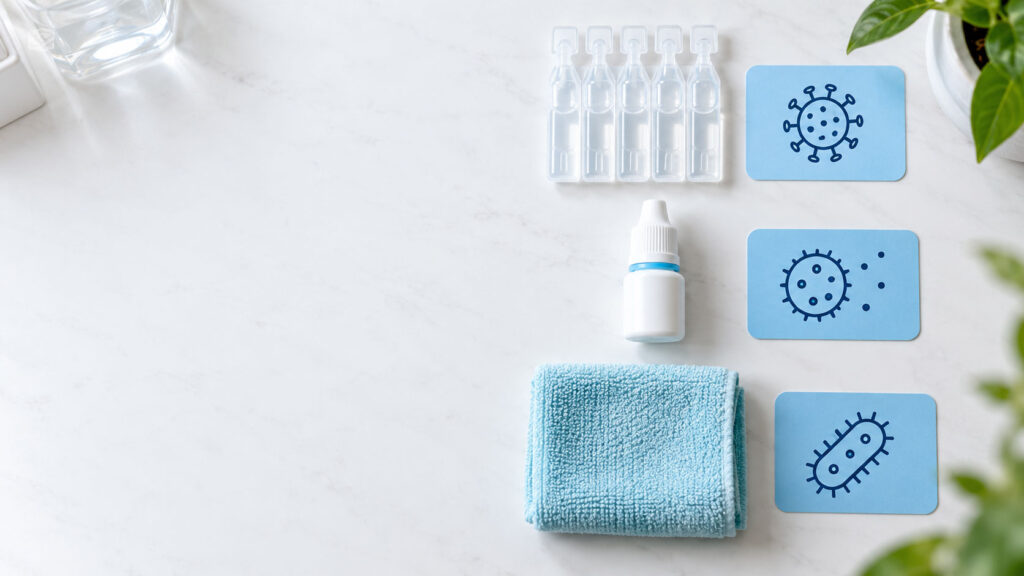
More than half of people with bacterial pink eye get better within about a week using nothing but a placebo drop. That surprises most patients, because the usual reflex is to ask for antibiotics. The catch is that the drop that actually helps depends on which kind of pink eye you have. And some boxes sold as “pink eye relief” are products the FDA says shouldn’t be on the shelf at all.
Table of Contents
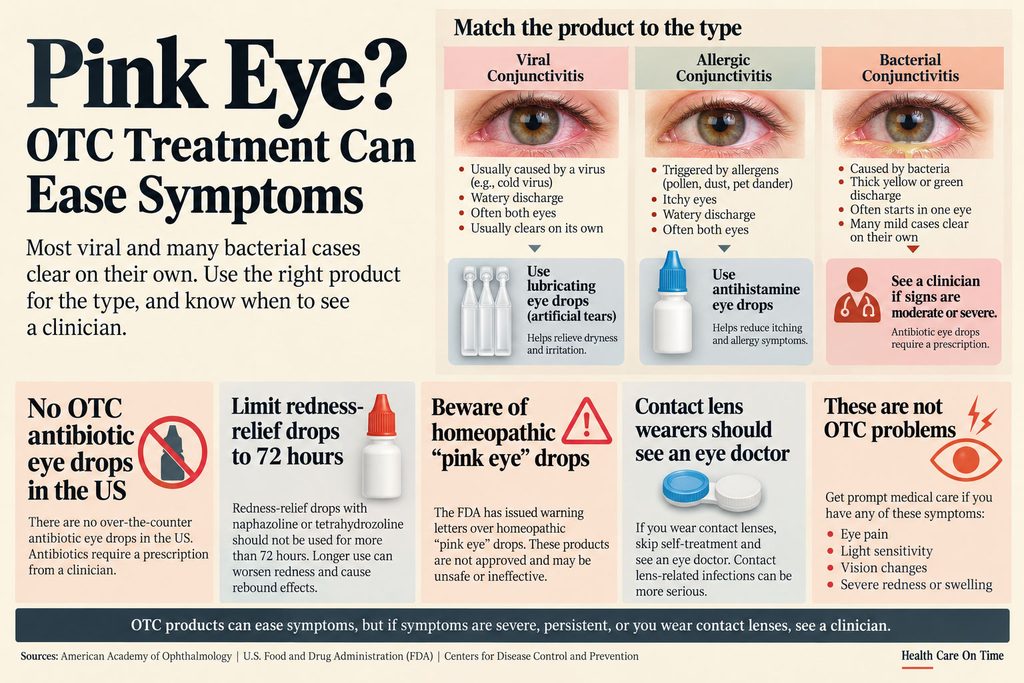
Quick Answer: Yes, you can treat most pink eye over the counter, but OTC products relieve symptoms rather than cure an infection. Preservative-free artificial tears and cool compresses help every type. Antihistamine drops such as olopatadine or ketotifen work for allergic pink eye. The US has no OTC antibiotic eye drops. See a clinician for eye pain, light sensitivity, blurred vision, contact lens use, or no improvement after 2 to 3 days.
At a Glance
- OTC pink eye treatment eases symptoms while viral and most bacterial cases clear on their own.
- Match the product to the type: lubricants for viral, antihistamine drops for allergic, and a clinician visit if bacterial signs are severe.
- The US has no over-the-counter antibiotic eye drops.
- Redness-relief drops with naphazoline or tetrahydrozoline shouldn’t be used longer than 72 hours.
- The FDA has issued warning letters over homeopathic “pink eye” drops.
- Contact lens wearers should skip self-treatment and see an eye doctor.
- Pain, light sensitivity, or vision changes are not OTC problems.
Can You Treat Pink Eye Over the Counter? The Short Answer
Pink eye, or conjunctivitis, is inflammation of the thin clear layer that covers the white of the eye and lines the lids. Viruses, bacteria, allergies, and irritants can all cause it. Most cases are mild, and most get better without prescription medicine.
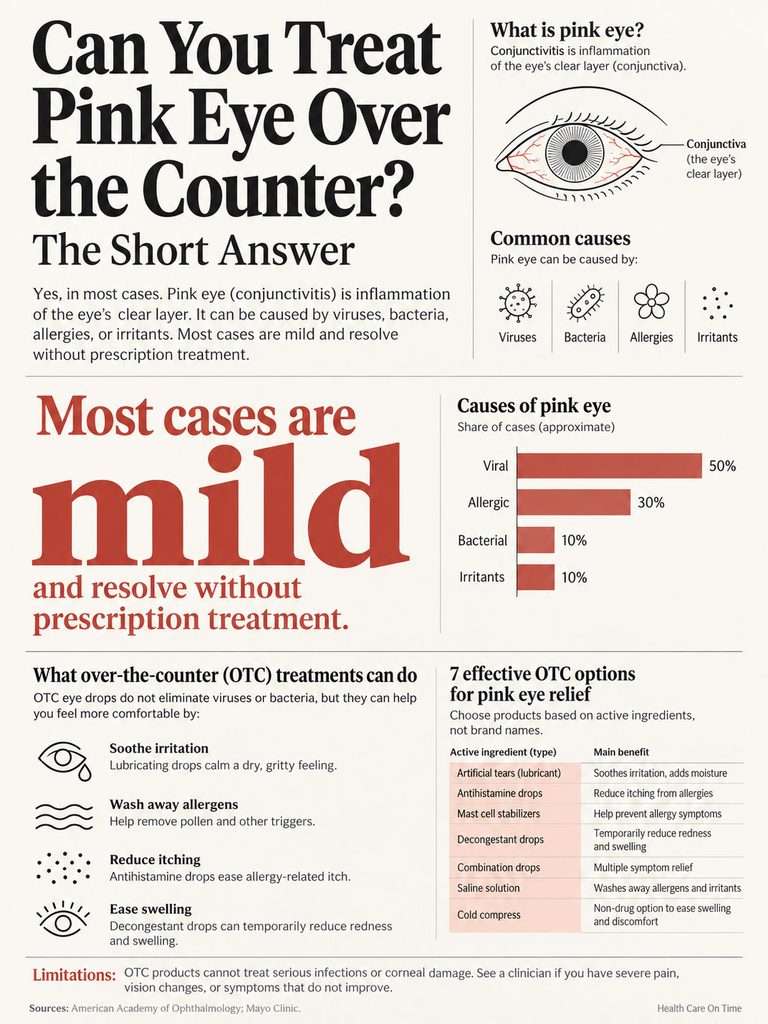
That’s why OTC pink eye treatment works for so many people. It doesn’t kill a virus or bacteria. It keeps you comfortable while your immune system does the work.
What OTC Products Can and Can’t Do
OTC eye drops can soothe irritation, wash out allergens, reduce itching, and ease swelling. Oral pain relievers take the edge off an aching eye. Compresses loosen crusting and calm puffy lids.
What they can’t do is treat a serious bacterial infection, a herpes infection of the eye, or damage to the cornea. Those need a prescription and an exam. Our medical team sees this mix-up often, usually in people who try a new store drop every day for a week while a treatable problem gets worse.
Why Type Matters More Than Brand
The active ingredient matters far more than the brand. An allergy drop does little for viral pink eye. A redness reliever does nothing for any type except make it look better for a few hours.
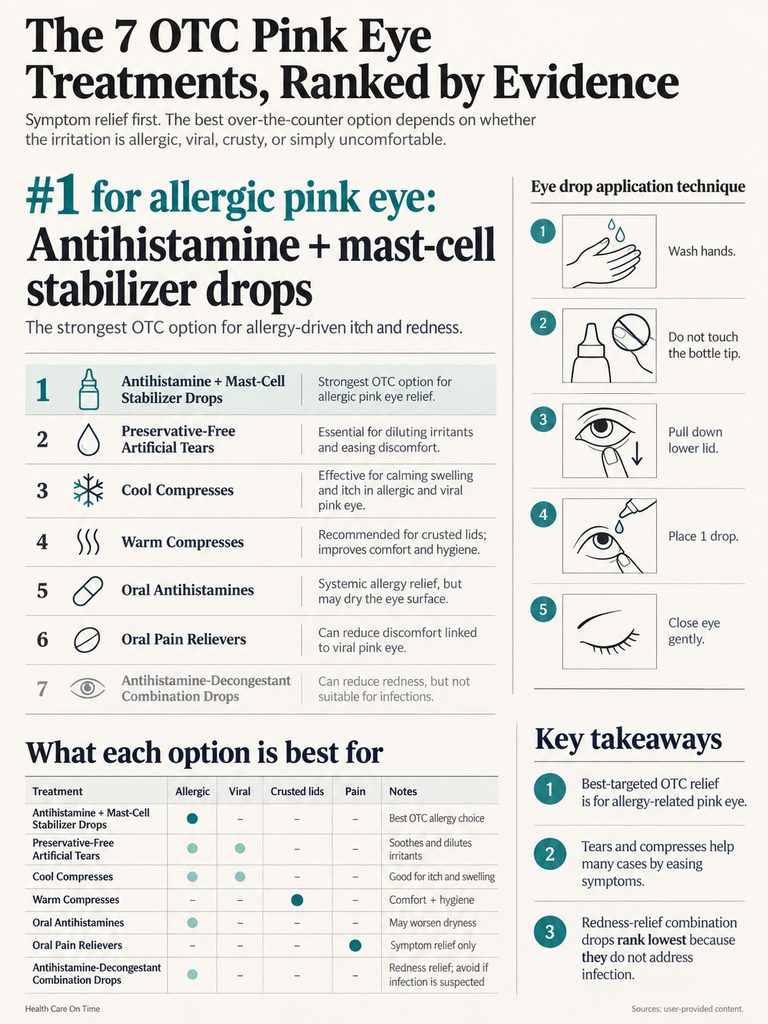
These are the seven OTC options with a real role:
- Preservative-free artificial tears
- Cool compresses
- Warm compresses for crusted lids
- Antihistamine and mast-cell stabilizer drops (olopatadine, ketotifen)
- Antihistamine-decongestant combination drops, short-term only
- Oral antihistamines (cetirizine, loratadine, fexofenadine)
- Oral pain relievers (ibuprofen, acetaminophen)
Which Type of Pink Eye Do You Have?
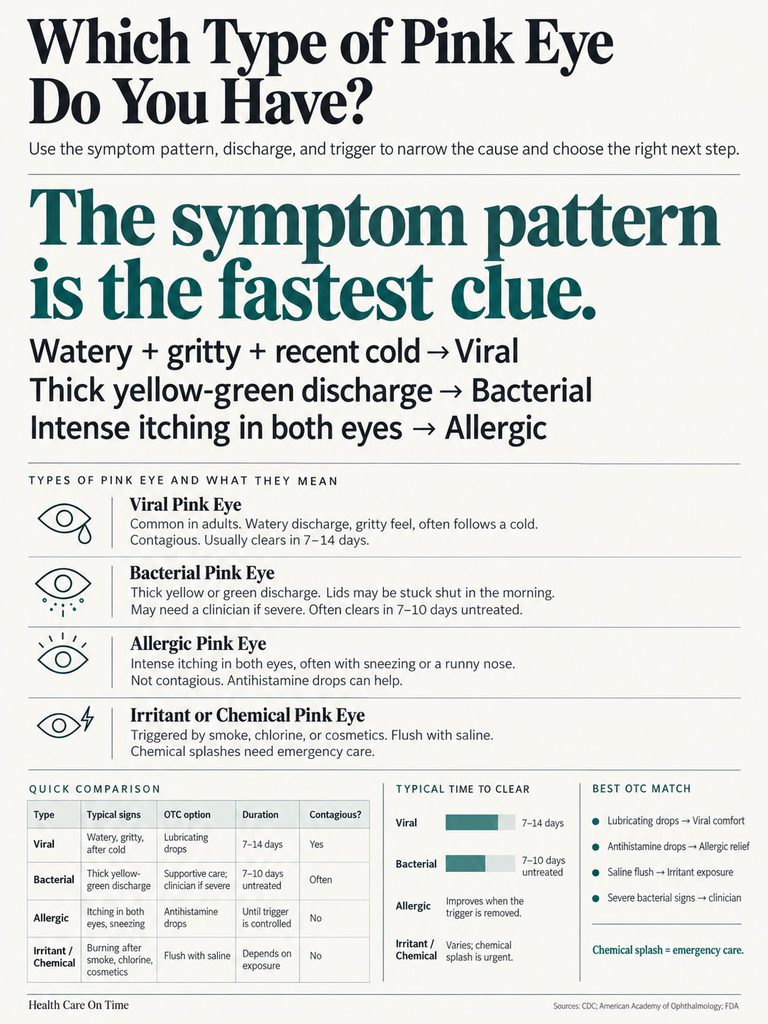
Take a minute to figure out the likely type before you buy anything. Symptoms overlap, so this isn’t perfect. Still, a few patterns point you in the right direction.
Viral Pink Eye
Viral conjunctivitis is the most common type in adults. An estimated 70% of adult cases are linked to adenovirus, while at least half of cases in children may be bacterial.
Viral pink eye usually brings watery discharge, a gritty feeling, and redness that starts in one eye and spreads to the other. It often follows a cold or sore throat. The American Academy of Ophthalmology says viral pink eye should clear within a week or two without treatment.
Bacterial Pink Eye
Bacterial conjunctivitis tends to produce thick yellow or green discharge. Your lids may be glued shut when you wake up. The AAO notes that bacterial pink eye usually makes more mucus than viral or allergic types.
Mild cases often resolve on their own. Heavy discharge, pain, or any case in a contact lens wearer needs a clinician.
Allergic Pink Eye
Allergic conjunctivitis is the itchy one. Both eyes usually flare together, often with sneezing or a runny nose. It follows pollen seasons, pet exposure, or dust.
It isn’t contagious. Antibiotics don’t help allergic pink eye, but antihistamine eye drops often work within minutes.
Irritant or Chemical Pink Eye
Chlorine, smoke, cosmetics, and cleaning sprays can all inflame the eye. Mild cases improve after flushing with saline or clean water and avoiding the trigger. Any chemical splash, especially from something alkaline like drain cleaner, needs continuous rinsing and emergency care.
| Pink eye type | Typical signs | Best OTC options | Avoid | Typical duration | Contagious? |
| Viral | Watery discharge, gritty feel, often after a cold, one eye then both | Preservative-free artificial tears, cool compress, ibuprofen or acetaminophen | Antibiotic drops, steroid drops without an exam | 7 to 14 days, sometimes up to 3 weeks | Yes, while symptoms last |
| Bacterial (mild) | Thick yellow or green discharge, lids stuck shut in the morning | Artificial tears, warm compress to clean lids, lid hygiene | Leftover prescription drops, skin ointments | Often 7 to 10 days untreated | Yes |
| Allergic | Intense itching, both eyes, sneezing, seasonal or pet-related | Olopatadine 0.1% to 0.7%, ketotifen 0.025%, cool compress, oral antihistamine | Antibiotics, redness relievers past 72 hours | As long as exposure continues | No |
| Irritant or chemical | Burning after smoke, chlorine, or cosmetics | Saline or clean-water flush, artificial tears | Rubbing, makeup | Hours to 2 days after exposure ends | No |
| Contact lens related | Pain, light sensitivity, redness in a lens wearer | None; remove lenses and see an eye doctor | Any self-treatment, putting lenses back in | Varies; can threaten vision | Depends on cause |
The 7 OTC Pink Eye Treatments, Ranked by Evidence
Patients who book lab work with us often ask which pharmacy product “actually does something.” Here’s how the options stack up, starting with the ones that help nearly everyone.
1. Preservative-Free Artificial Tears
Artificial tears are the backbone of OTC pink eye treatment. They dilute irritants and allergens, rinse away discharge, and ease the sandy feeling that makes viral pink eye so miserable.
Chill the vials in the fridge for extra comfort. If only one eye is infected, keep a separate supply for each eye, and throw out anything opened during the infection once you recover.
Preserved vs Preservative-Free
Many multi-dose bottles contain preservatives such as benzalkonium chloride, which can sting an already inflamed eye with frequent use. Preservative-free drops can be used as often as needed, while preserved drops are generally best kept to about four times a day.
Preservative-free tears usually come in single-use vials. Each vial is sterile until opened, which matters more than most people realize, as the contamination section below explains.
2. Cool Compresses
A clean washcloth soaked in cool water and wrung out can calm swelling and itch in a few minutes. Cool compresses suit allergic and viral pink eye best.
Use a fresh cloth every time, and a separate cloth for each eye if both are affected.
3. Warm Compresses for Crusted Lids
Warm works better when discharge has dried and your lids stick together. The AAO recommends laying a warm, damp washcloth over the eyes until it cools, repeating several times a day, with a clean cloth each time and a different one for each eye.
Keep it warm, not hot. Eyelid skin is thin and burns easily.
4. Antihistamine and Mast-Cell Stabilizer Drops
For allergic pink eye, these are the strongest OTC drops you can buy. They block histamine and calm the cells that release it, so they relieve itching and help stop it from coming back.
The two main ingredients are olopatadine (Pataday and store brands) and ketotifen 0.025% (Zaditor, Alaway, and store brands). Olopatadine is labeled for ages 2 and up, and ketotifen for ages 3 and up.
Olopatadine Strengths: 0.1% vs 0.2% vs 0.7%
The FDA approved OTC olopatadine 0.1% and 0.2% in February 2020, with a 0.7% version following that summer. The 0.7% strength gives up to 24 hours of itch relief from one daily drop, the 0.2% up to 16 hours, and the 0.1% up to 8 hours with twice-daily use.
These drops won’t shorten viral or bacterial pink eye. But if your eyes itch more than they burn, they’re often the most useful product on the shelf.
5. Antihistamine-Decongestant Combination Drops
Naphcon-A, Opcon-A, and Visine-A pair an antihistamine (pheniramine) with a decongestant (naphazoline). They shrink blood vessels so the eye looks less red, and they dull itching for a few hours.
They’re fine for a day or two of allergy flare. They’re a poor fit for infections, because they hide redness without touching the cause.
The 72-Hour Rebound Redness Rule
Decongestant drops like naphazoline, tetrahydrozoline, oxymetazoline, and phenylephrine shouldn’t be used past 72 hours, because overuse can make redness worse. That rebound can trap people in a loop of using more drops to fix redness the drops caused.
People with narrow-angle glaucoma should avoid these drops unless an eye doctor approves. Store them out of children’s reach; swallowing tetrahydrozoline or naphazoline can cause serious harm. Call Poison Control at 1-800-222-1222 if a child swallows any.
6. Oral Antihistamines
Cetirizine (Zyrtec), loratadine (Claritin), and fexofenadine (Allegra) help when eye allergy comes with sneezing and a runny nose. They work on the whole body, not just the eye.
The trade-off: they can dry the eye surface. Many people do better pairing an allergy eye drop with artificial tears than relying on a pill alone. Adults over 65 should skip sedating options like diphenhydramine (Benadryl).
7. Oral Pain Relievers
Ibuprofen (Advil, Motrin) or acetaminophen (Tylenol) can ease the ache and mild headache that sometimes come with viral pink eye. Stick to the label dose.
If you need a pain reliever just to get through the day, treat that as a signal. Real eye pain, as opposed to scratchiness, is a warning sign covered in the doctor section below.
How to Put In Eye Drops the Right Way
Good technique keeps the bottle clean and gets the drop where it belongs:
- Wash your hands with soap and water for 20 seconds.
- Tilt your head back and gently pull down your lower lid to make a small pocket.
- Hold the bottle tip about half an inch above the eye, without touching lashes or skin.
- Squeeze one drop into the pocket, then close your eye for 1 to 2 minutes.
- Press lightly on the inner corner of the eye to keep the drop from draining into your nose.
- Wait at least 5 minutes before using a second type of drop.
- Recap right away and wash your hands again.
| Active ingredient | Example US brands | Best for | Labeled age | Key limit |
| Lubricants (carboxymethylcellulose, polyethylene glycol, hyaluronate) | Refresh, Systane, TheraTears, store brands | All types, especially viral and irritant | Most labels: all ages; ask a pharmacist for infants | Preserved bottles about 4 times daily |
| Olopatadine 0.1%, 0.2%, 0.7% | Pataday and store brands | Allergic | 2 years and up | Not for infections |
| Ketotifen 0.025% | Zaditor, Alaway, store brands | Allergic | 3 years and up | 1 drop twice daily |
| Naphazoline plus pheniramine | Naphcon-A, Opcon-A, Visine-A | Short allergy flares | 6 years and up | Stop within 72 hours |
| Brimonidine 0.025% | Lumify | Cosmetic redness only | 5 years and up | Masks symptoms; not a pink eye treatment |
What Doesn’t Work (and What to Never Buy)
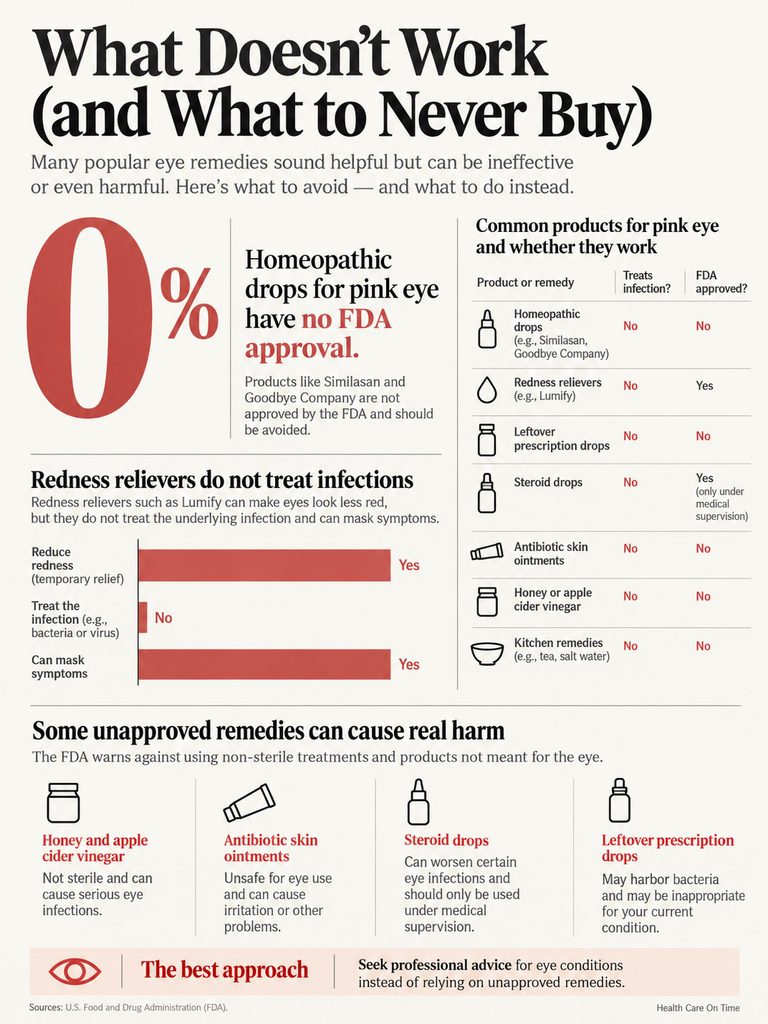
Most guides skip this part of the aisle. Our medical reviewers flag these products and habits because they can delay real care or create new problems.
“Pink Eye Relief” Homeopathic Drops
Homeopathic drops labeled for pink eye were sold at major US retailers for years. The FDA’s November 2023 warning letter to Amazon named Similasan Pink Eye Relief and The Goodbye Company Pink Eye, stating that homeopathic drugs must meet the same legal requirements as any other drug.
A September 2023 round of letters went to eight sellers, including CVS Health over its Pink Eye Relief Drops, largely for claims that the products could treat or prevent eye disease. Enforcement didn’t stop there. In August 2025, the FDA sent another warning letter to a Wyoming distributor over seven Similasan eye drops and a Boiron homeopathic product.
The FDA’s consumer guidance on eye drops now tells people to avoid eye drops labeled homeopathic, because they aren’t FDA-approved.
Redness Relievers Used for Days
Brimonidine drops like Lumify and older decongestant drops make eyes look whiter. They don’t treat inflammation or infection. Using them for pink eye hides how your eye is really doing, which makes it harder to spot when you need a doctor.
Leftover Prescription Drops
It’s tempting to grab an old bottle from a past infection or a family member’s cabinet. Don’t. Opened bottles can harbor bacteria, and the drug may be wrong for your type.
Steroid-containing drops carry the biggest risk. Steroids can make a herpes eye infection much worse and raise eye pressure. Use them only under a clinician’s direction.
Skin Ointments and Kitchen Remedies
Antibiotic skin ointments like Neosporin aren’t made for the eye. Breast milk, honey, tea bags, and apple cider vinegar circulate widely online, but none has good evidence, and anything non-sterile can bring in new bacteria. The FDA specifically lists honey among substances that can cause burning in the eye.
Are Your Eye Drops Safe? The Contamination Problem
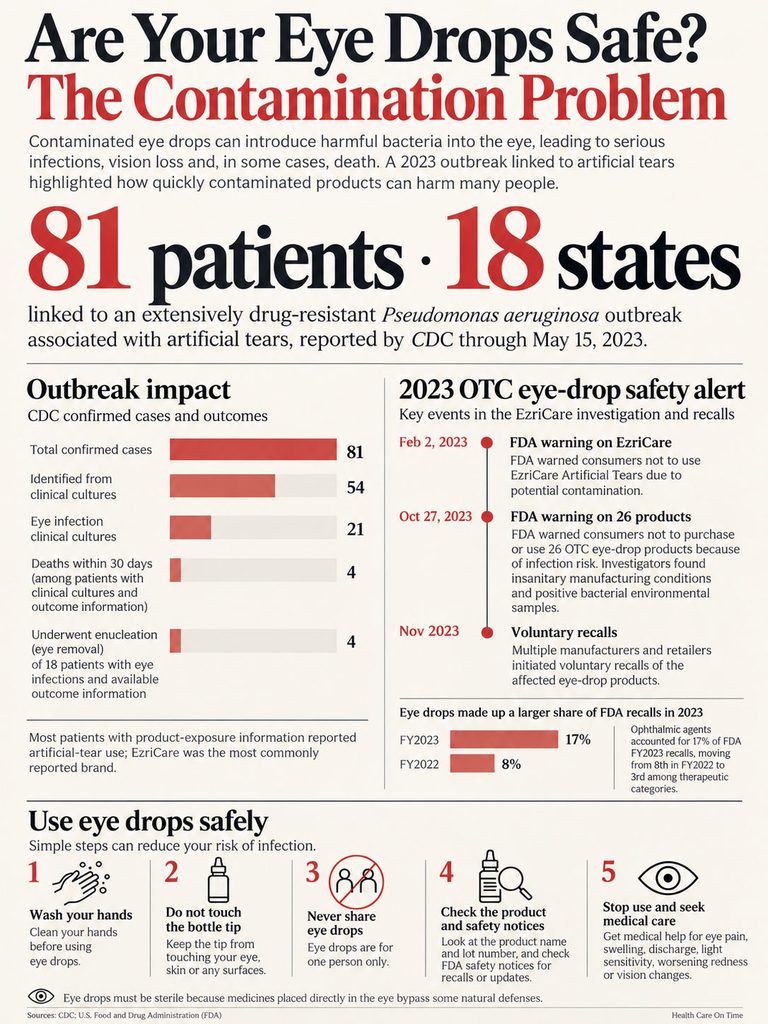
Eye drops bypass some of the body’s usual defenses, so a contaminated bottle can do serious damage. The past few years brought some of the worst eye drop safety events in US history.
What Happened With EzriCare and the 2023 Recalls
A drug-resistant strain of Pseudomonas aeruginosa was traced to artificial tears, most commonly EzriCare. By May 2023, CDC had confirmed 81 cases in 18 states, with four deaths, 14 reports of vision loss, and four people who needed an eye surgically removed, according to a review of the outbreak.
A second wave hit store brands later that year. In October 2023, the FDA told consumers to stop using 26 OTC eye drop products after investigators found insanitary conditions and positive bacterial tests at the manufacturing plant.
How to Buy a Safe Bottle
Across patients we serve, the safest habits are simple:
- Buy from established pharmacies, not unknown online sellers.
- Check the FDA’s eye drop safety page before buying an unfamiliar brand.
- Look for an intact tamper seal and a clear expiration date.
- Choose single-use preservative-free vials when your eye is already inflamed.
- Never let the tip touch your eye, fingers, or any surface.
- Throw out drops used during an infection once you recover.
If pain, worse redness, or blurry vision starts after a new drop, stop it and get seen the same day.
Do You Need Antibiotics? What the Research Says
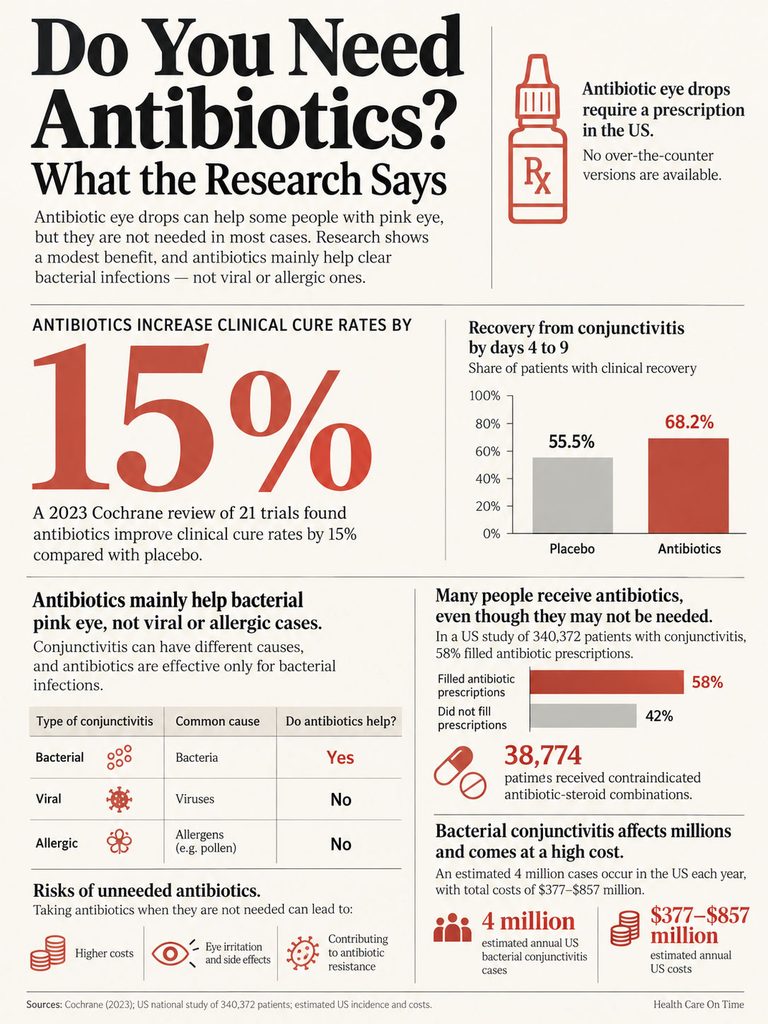
Patients commonly ask us why they can’t just buy antibiotic eye drops at the pharmacy. In the US, every antibiotic eye drop and ointment needs a prescription. There’s no OTC version, whatever an online ad suggests.
The Cochrane Numbers
The best evidence comes from a 2023 Cochrane review of 21 randomized trials with 8,805 participants, ranging from infants to age 97, with 19 of the 21 trials run in the United States.
Compared with placebo, antibiotics raised the chance of clinical cure by an absolute 15%, for a number needed to treat of 7, per the AAFP summary. In the placebo group, 55.5% of participants recovered on their own by days 4 to 9, compared with 68.2% of those given an antibiotic.
In plain terms, antibiotics help bacterial pink eye clear a bit faster. Most people still get better without them, and they do nothing for viral or allergic cases.
The Overprescribing Problem
Antibiotics are used far more than needed. Among 340,372 US managed-care enrollees with acute conjunctivitis, 58% filled at least one topical antibiotic prescription, and 38,774 filled antibiotic-steroid combination products. The researchers flagged those combination drops as contraindicated for acute conjunctivitis.
Unneeded antibiotic drops cost money, can irritate the eye, and feed antibiotic resistance. That’s one more reason OTC care is the right first step for most mild cases.
| Statistic | Figure | Source |
| Recovery with placebo by days 4 to 9 | 55.5% (408 of 735) | Cochrane Review CD001211, 2023 |
| Recovery with antibiotic drops by days 4 to 9 | 68.2% (504 of 739) | Cochrane Review CD001211, 2023 |
| Number needed to treat for one extra cure | 7 | AAFP summary of Cochrane, 2023 |
| Conjunctivitis patients filling antibiotic drops | 58% of 340,372 enrollees | Shekhawat et al., Ophthalmology, 2017 |
| Antibiotic-steroid combination fills | 38,774 patients | Shekhawat et al., Ophthalmology, 2017 |
| Estimated US bacterial conjunctivitis cases | About 4 million per year (135 per 10,000) | Smith and Waycaster, 2009 |
| Annual US cost of bacterial conjunctivitis | $377 million to $857 million | Smith and Waycaster, 2009 |
| Artificial tears outbreak toll | 81 cases, 18 states, 4 deaths, 14 vision loss | CDC, May 2023 |
| OTC eye drops FDA warned against in one action | 26 products | FDA, October 2023 |
The case and cost figures come from 2005 data, so read them as a baseline rather than a current count. That cost study estimated about 4 million bacterial conjunctivitis cases in the US for 2005, an annual rate of 135 per 10,000.
How to Stop Pink Eye From Spreading
Viral and bacterial pink eye pass easily from eye to eye and person to person. A few habits cut the risk sharply:
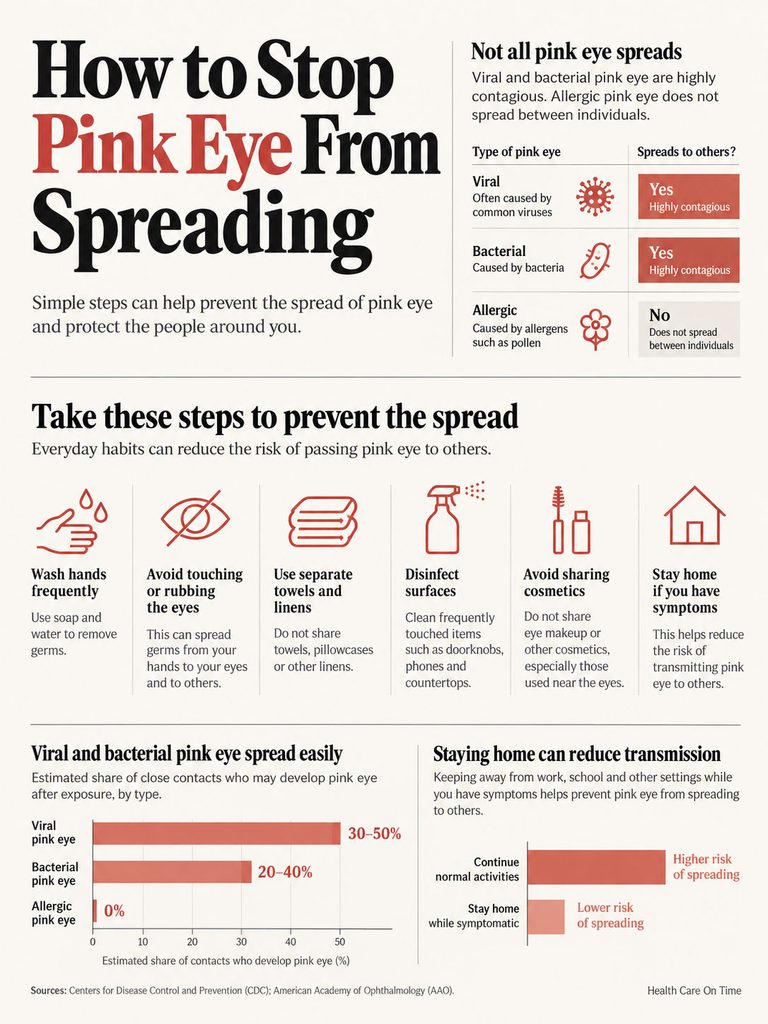
- Wash your hands before and after touching your eyes or putting in drops.
- Don’t share towels, washcloths, pillowcases, makeup, or eye drops.
- Wash pillowcases and towels in hot water, and switch to fresh ones daily until symptoms clear.
- Wipe down phones, remotes, and doorknobs.
- Replace eye makeup and mascara used while you were infected.
The AAO notes that viral and bacterial pink eye are contagious while allergic pink eye is not, so these steps matter most when discharge or a recent cold points to infection.
Special Cases: Contact Lenses, Kids, Pregnancy, and Older Adults
Contact Lens Wearers
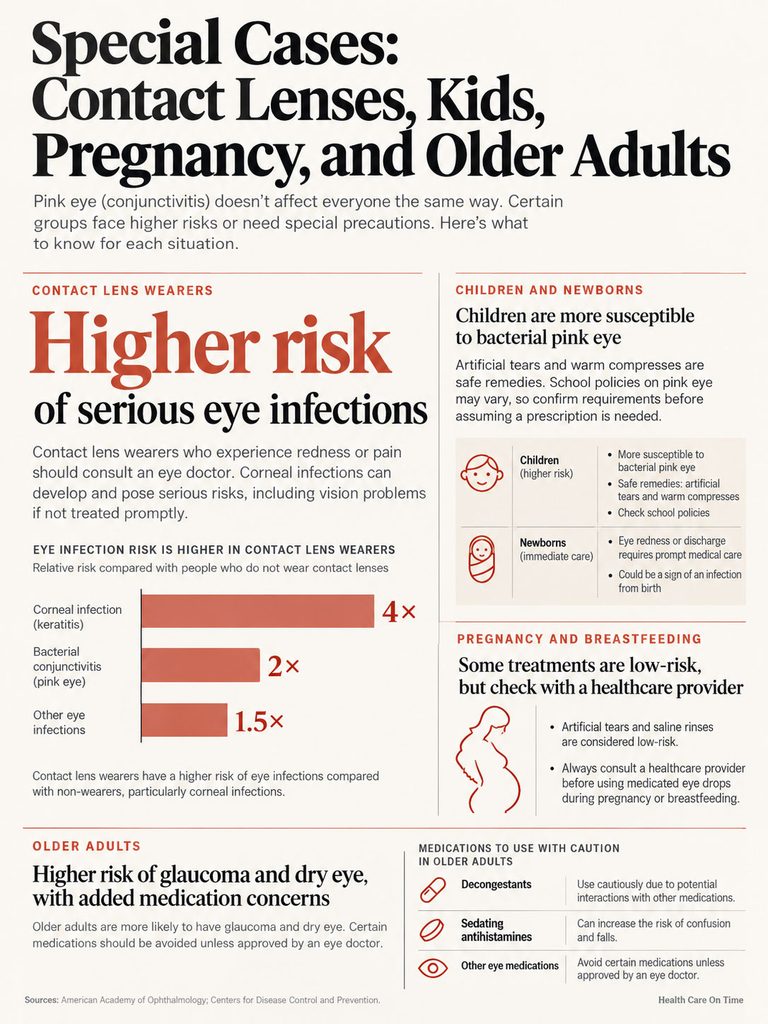
If you wear contacts and your eye turns red and painful, skip OTC pink eye treatment and see an eye doctor. Lens wearers face a higher risk of corneal infection, including Pseudomonas, which can damage vision within a day or two.
Remove your lenses right away and switch to glasses. Throw out the lenses and case you were using when symptoms began, and wait for a clinician’s all-clear before going back to lenses.
Children and School or Daycare Return
Kids get bacterial pink eye more often than adults. Preservative-free artificial tears and warm compresses for crusting are safe starting points. Follow labeled age limits for any medicated drop.
School rules often run stricter than medical advice. The CDC and the American Academy of Pediatrics advise against keeping most children out of school or childcare unless they have systemic symptoms such as fever, but state and local policies vary and may require an antibiotic or a health check. Ask the school what it requires before assuming your child needs a prescription.
Any redness or discharge in a baby younger than 1 month needs same-day care. Newborn conjunctivitis can come from infections picked up during birth.
Pregnancy and Breastfeeding
Artificial tears, saline rinses, and compresses are considered low-risk during pregnancy and breastfeeding. For medicated drops, including antihistamine drops, check with your OB or pharmacist first. Very little of an eye drop reaches the bloodstream, but a quick check is still smart.
Adults 65 and Older
Older adults are more likely to have glaucoma, dry eye, or take medicines that interact with decongestants. Skip naphazoline and tetrahydrozoline unless your eye doctor approves. Avoid sedating oral antihistamines, which raise the risk of confusion and falls.
When to See a Doctor Instead
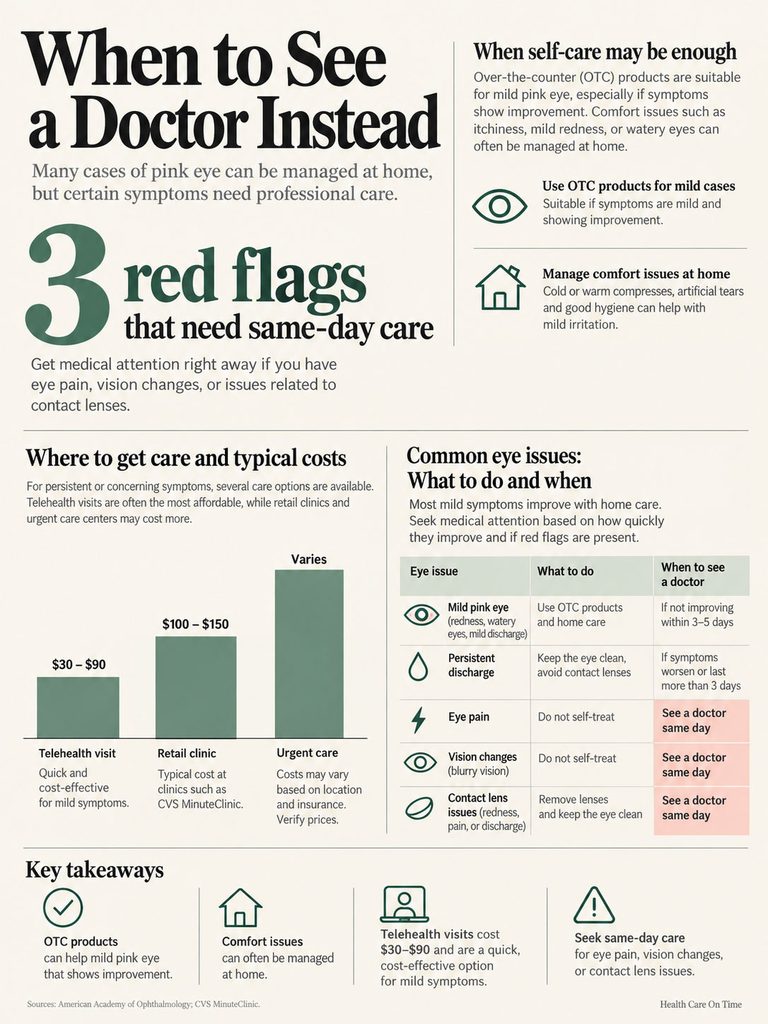
OTC products are for mild pink eye that’s clearly getting better. Our medical team uses a simple rule: comfort problems can be handled at home, but vision and pain problems need an exam.
Red Flags That Need Same-Day Care
- Moderate to severe eye pain, not just a gritty feeling
- Sensitivity to light
- Blurred vision that doesn’t clear when you blink
- Contact lens wear with any redness and pain
- A weakened immune system, such as from HIV, chemotherapy, or transplant medicines
- Heavy discharge that returns right after you wipe it away
- Blisters or a rash on the eyelid or forehead
- A newborn with red eyes or discharge
- Symptoms that worsen, or show no improvement at all after 2 to 3 days
Where to Go
For mild symptoms, a telehealth visit is often the quickest option, and typical self-pay prices run roughly $30 to $90. Retail clinics such as CVS MinuteClinic commonly land around $100 to $150, while urgent care usually costs more. Prices vary by state and insurance, so check before you go.
For pain, vision changes, or contact lens problems, go straight to an optometrist or ophthalmologist. They can examine the cornea under magnification, which a video visit can’t do.
| Scenario | Recommended action | Timeline |
| Itchy eyes, both sides, sneezing, pollen season | Olopatadine or ketotifen drops, cool compress, oral antihistamine if needed | Relief within minutes to hours |
| Watery, gritty eye after a cold, no pain | Preservative-free artificial tears, cool compress, hand hygiene | Gradual improvement over 7 to 14 days |
| Thick discharge, lids stuck shut, mild discomfort | Warm compress, lid cleaning, artificial tears | See a clinician if no improvement in 2 to 3 days |
| Redness after chlorine or smoke | Flush with saline or clean water, artificial tears | Should ease within 24 to 48 hours |
| Chemical splash, especially alkaline cleaners | Rinse continuously for 15+ minutes, call 911 or go to the ER | Immediately |
| Contact lens wearer with red, painful eye | Remove lenses, wear glasses, see an eye doctor | Same day |
| Eye pain, light sensitivity, or blurry vision | See an eye doctor or urgent care | Same day |
| Baby under 1 month with red eye or discharge | Call the pediatrician | Same day |
| Redness drops used for more than 3 days | Stop them, switch to artificial tears | Now; see a clinician if redness persists |
A 3-Day OTC Pink Eye Plan
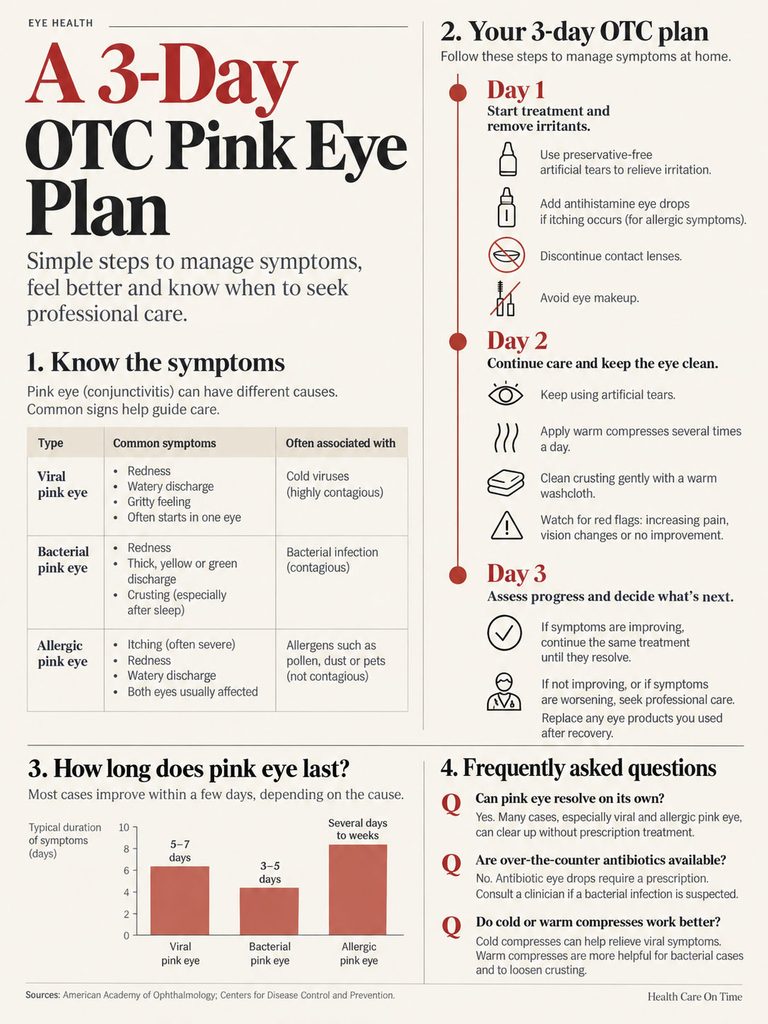
Day 1: Use the type table to find your likely match. Start preservative-free artificial tears. Add antihistamine drops only if itching leads. Stop contact lenses and eye makeup, and begin the anti-spread habits above.
Day 2: Keep up tears and compresses. Clean crusting gently with a warm washcloth, wiping from the inner corner outward. Check yourself for red flags such as pain, light sensitivity, or vision changes.
Day 3: Judge your progress honestly. If your eye looks and feels even slightly better, stay the course; viral cases can take one to two weeks to clear. If nothing has changed or things are worse, book a visit instead of trying another product.
After you recover, replace any eye makeup, opened drops, or lens cases used during the infection.
Frequently Asked Questions
Can pink eye go away on its own?
Yes, most of the time. Viral pink eye usually clears in one to two weeks with no treatment. Even for bacterial pink eye, over half of placebo patients in the 2023 Cochrane review recovered within about a week. Allergic pink eye settles once the trigger is avoided or controlled.
Are there over-the-counter antibiotic eye drops for pink eye?
No. Every antibiotic eye drop and ointment in the United States requires a prescription. Store products marketed for pink eye are lubricants, allergy drops, or homeopathic formulas. If you think you need an antibiotic, a telehealth or retail clinic visit is usually the fastest route.
Is Visine good for pink eye?
Classic Visine-style redness drops shrink blood vessels so the eye looks whiter, but they don’t treat the cause. Use past 72 hours can trigger rebound redness. For viral or bacterial pink eye, preservative-free artificial tears do more good. Visine-A may help a short allergy flare.
Can allergy eye drops help viral pink eye?
Usually not much. Olopatadine and ketotifen target histamine-driven itching, which is the hallmark of allergic pink eye. Viral pink eye tends to feel gritty and watery rather than itchy, so cold artificial tears and cool compresses relieve it better. Save allergy drops for itch-dominant cases.
What’s the fastest way to get rid of pink eye?
No product wipes out viral pink eye overnight. The quickest relief comes from matching treatment to type: allergy drops for itching, lubricants and compresses for viral symptoms, and a clinician visit when bacterial discharge is heavy, since prescription antibiotics can speed recovery by a day or two.
How long is pink eye contagious?
Viral and bacterial pink eye are generally treated as contagious while redness and discharge last, which can be up to two weeks for viral cases. Allergic and irritant pink eye can’t spread. Handwashing, separate towels, and fresh pillowcases cut the risk to your household.
Can kids use OTC pink eye drops?
Preservative-free artificial tears and compresses are generally fine for children. Olopatadine is labeled for ages 2 and up, ketotifen for 3 and up, and naphazoline-pheniramine combos for 6 and up. Babies under 1 month with red eyes or discharge need same-day care, not store products.
Is it safe to use homeopathic pink eye drops?
The FDA advises against eye drops labeled homeopathic because they aren’t FDA-approved. The agency sent warning letters over several “pink eye” products in 2023, including ones sold by major pharmacies and Amazon, and issued more letters in 2025. Standard lubricating or allergy drops are safer choices.
Can contact lens wearers use OTC pink eye treatments?
Not in place of an exam. A red, painful eye in a lens wearer can be a corneal infection that threatens vision. Take the lenses out, switch to glasses, and see an eye doctor the same day. Discard the lenses and case you were using when symptoms began.
Should you use a warm or cold compress for pink eye?
Both have a job. Cold compresses calm itching and swelling, which suits allergic and viral pink eye. Warm compresses soften dried discharge when lids stick together, common with bacterial pink eye. Use a clean cloth every time and a separate one for each eye.
Can breast milk or honey cure pink eye?
No reliable evidence shows breast milk or honey treats pink eye, and neither is sterile. Placing non-sterile liquids in an inflamed eye can introduce new bacteria and cause burning. Sterile preservative-free artificial tears and clean compresses are the safer home options.
When should pink eye be checked by a doctor?
Get seen the same day for eye pain, light sensitivity, blurred vision, contact lens use, a weakened immune system, or a newborn with symptoms. Book a routine visit if symptoms worsen or show no improvement after 2 to 3 days of home care.
Disclaimer: This article is for general educational purposes and is not a substitute for professional medical advice, diagnosis, or treatment. Eye symptoms can signal conditions that threaten vision. If you have eye pain, vision changes, light sensitivity, or a chemical injury, seek medical care promptly. Always read and follow product labels, and ask a pharmacist or clinician before using medicated eye drops. For a possible poisoning, call Poison Control at 1-800-222-1222.
References
- American Academy of Ophthalmology: Pink Eye Quick Home Remedies
- Cochrane Library: Antibiotics versus placebo for acute bacterial conjunctivitis (Chen et al., 2023)
- AAFP: Antibiotics for Acute Bacterial Conjunctivitis (2023)
- PubMed: Shekhawat et al., Antibiotic Prescription Fills for Acute Conjunctivitis, Ophthalmology 2017
- PubMed: Smith and Waycaster, Estimate of the Annual Cost of Bacterial Conjunctivitis in the United States
- FDA: What You Should Know About Eye Drops
- FDA: Warning on 26 OTC Eye Drop Products, October 2023
- FDA Warning Letter to Amazon.com, Inc., November 2023
- FDA Warning Letter to Similasan AG, September 2023
- PMC: Artificial Tears and the VIM-GES-CRPA Outbreak
- Pharmacy Times: FDA Approves OTC Olopatadine Solutions for Eye Allergy Relief
- PMC: Cost-Effectiveness of Pediatric Conjunctivitis Management and Return to School Strategies
- PMC: Pediatric Conjunctivitis Medical Decision Making