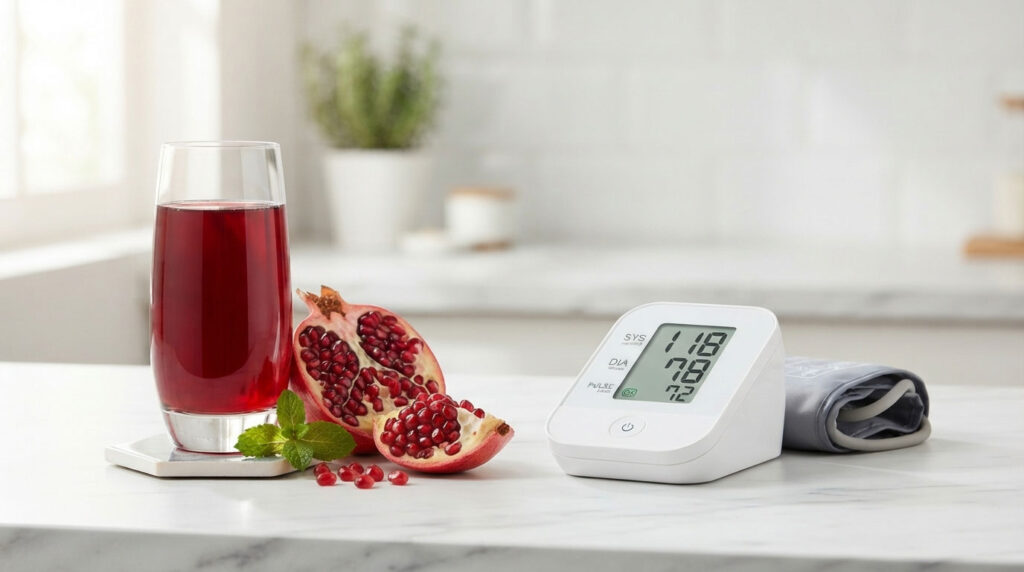
Persian warriors once ate pomegranates before battle, convinced the ruby seeds made them stronger. The legend outlived the evidence, but modern science kept a narrower promise alive: that deep red juice may nudge your blood pressure down. The real questions are by how much, for whom, and whether it’s enough to change your numbers where it counts.
Table of Contents
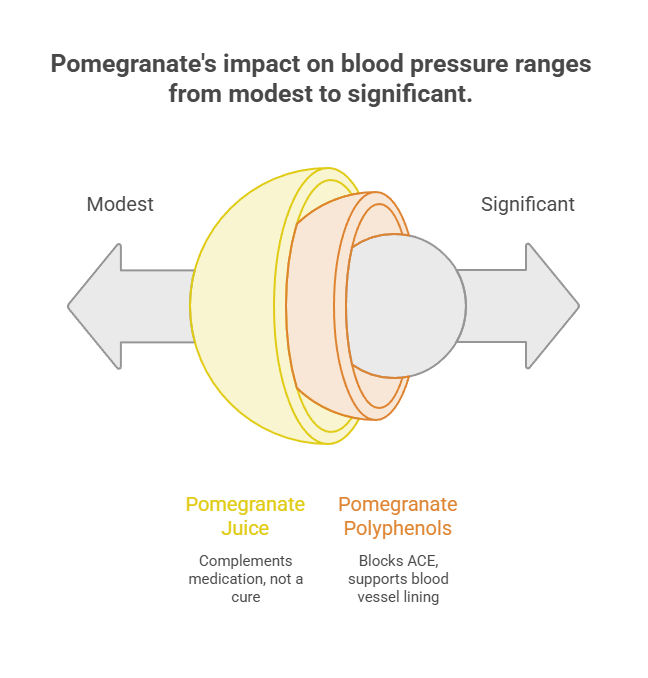
| Quick Answer Yes, pomegranate can lower blood pressure, but the effect is modest. Pooled data from 33 clinical trials shows an average drop of about 3.5 mmHg systolic and 1.5 mmHg diastolic. Juice studies often report closer to 5 mmHg systolic. Pomegranate works mainly by blocking ACE, the same enzyme many blood pressure drugs target. It supports treatment; it does not replace medication. |
| At a Glance Pooled research across 33 trials links pomegranate to roughly a 3.5 mmHg systolic and 1.5 mmHg diastolic reduction.The benefit is real but modest, useful as a supporting habit rather than a standalone fix.Pomegranate polyphenols block ACE and support the blood vessel lining, working in the same direction as some blood pressure drugs.Research-backed servings run 5 to 8 ounces of 100% juice daily, though 8 ounces carries about 30 grams of natural sugar.Pomegranate can add to the effect of blood pressure medication and interact with drugs processed by the liver, so timing matters.Nearly half of US adults (48.1%) have high blood pressure, and only about 1 in 5 have it under control. |
The Short Answer, Does Pomegranate Actually Work?
Here’s the honest verdict. Pomegranate does lower blood pressure, but the drop is small, and it varies from person to person. Anyone promising a dramatic cure is overselling it.
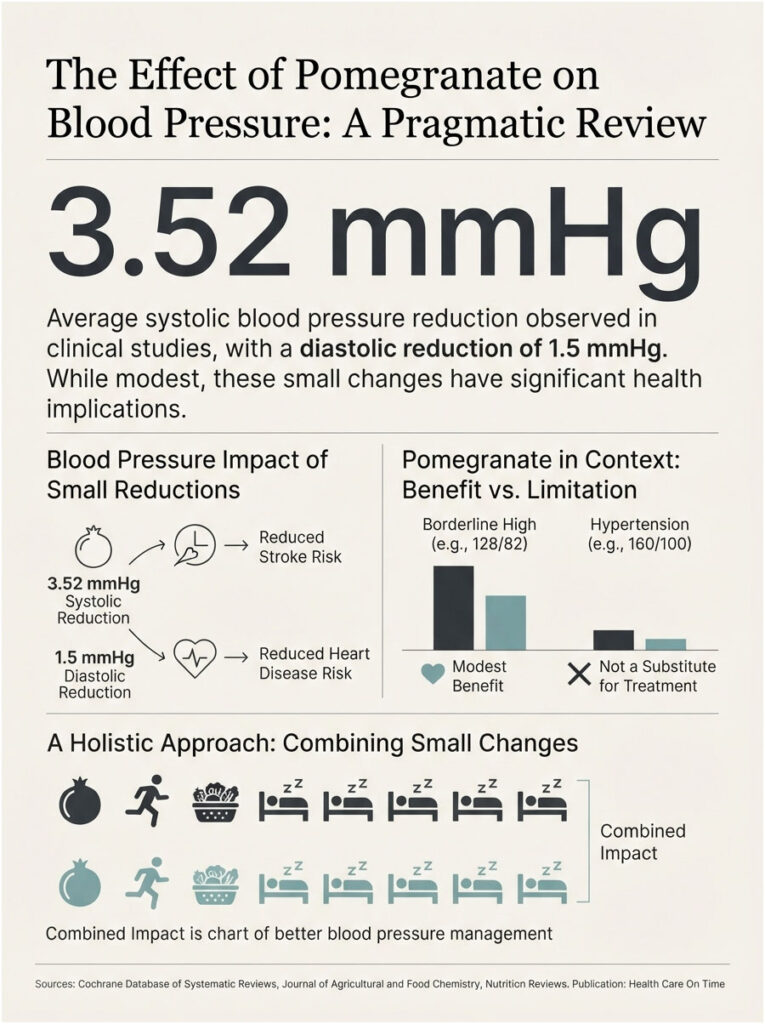
The strongest evidence to date comes from a January 2026 systematic review and meta-analysis of 33 clinical trials, which found pomegranate significantly reduced both systolic and diastolic blood pressure across adults. The average systolic reduction landed at about 3.52 mmHg, with diastolic falling roughly 1.5 mmHg.
That might sound too small to bother with. It isn’t. Our medical reviewers point out that even a 5 mmHg systolic drop is tied to meaningfully lower stroke and heart disease risk over time, which puts pomegranate in useful territory as a daily habit rather than a gimmick.
The number that matters is your starting point. A 3 to 5 mmHg reduction can be genuinely helpful if your reading sits in borderline range, say 128 over 82. It edges you back toward normal and buys margin. If your blood pressure runs 160 over 100, though, pomegranate alone won’t bring you to safety, and treating it like medicine could delay care you actually need.
There’s a second reason the modest number is worth respecting. Blood pressure benefits from small, stacked changes. Cutting sodium, walking daily, sleeping better, and adding a polyphenol-rich drink each move the needle a little, and together they add up to a lot. Pomegranate is one honest tile in that mosaic.
So does pomegranate lower blood pressure? Yes, modestly and reliably in most studies. Is it a replacement for treatment? No. The rest of this guide shows exactly what the research found, where studies disagree, and how to use pomegranate well.
How Pomegranate Affects Blood Pressure (The Science)
Pomegranate isn’t magic, and the mechanism is well understood. Three overlapping effects explain most of the benefit seen in trials, and knowing them also explains the safety cautions later.
The ACE Inhibition Connection
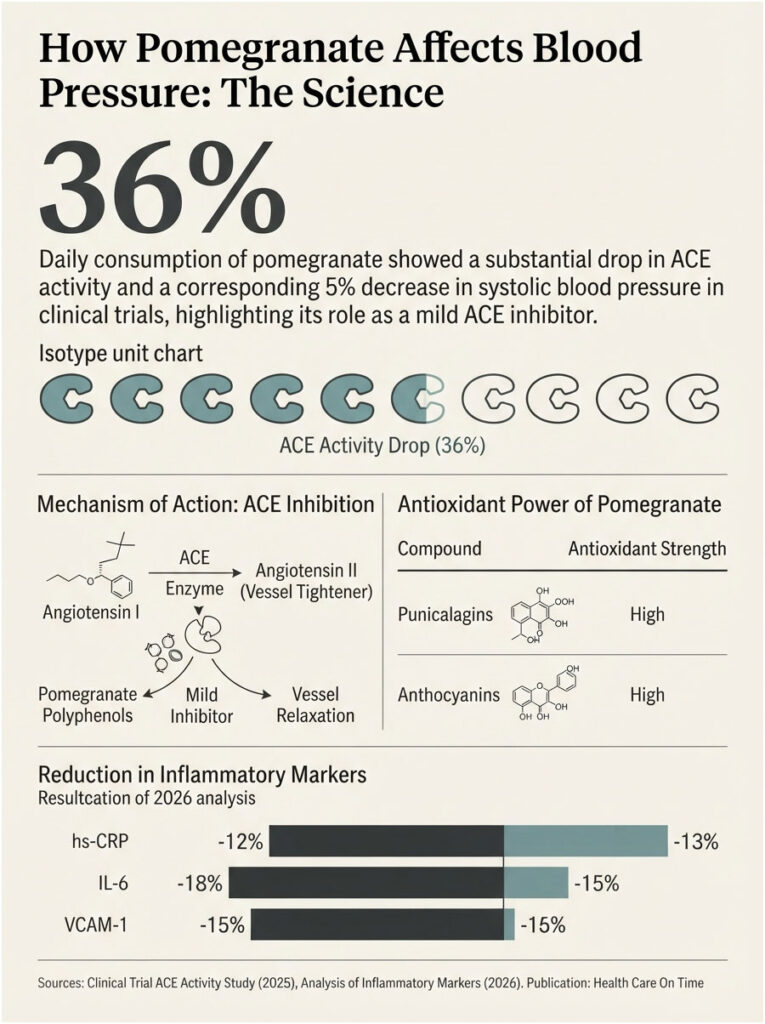
Your body makes an enzyme called ACE, short for angiotensin-converting enzyme. ACE turns a hormone into angiotensin II, a compound that tightens blood vessels and tells your body to hold onto salt and water. Both effects raise blood pressure. An entire class of prescription drugs, ACE inhibitors like lisinopril and ramipril, works by shutting this enzyme down.
Pomegranate appears to do a gentler version of the same thing. In a landmark trial, participants drinking a small daily dose of pomegranate juice showed a 36% average drop in ACE activity alongside a 5% fall in systolic pressure.
Less ACE activity means less vessel tightening, which means blood flows through wider pipes at lower pressure. This shared pathway is exactly why caution matters if you already take an ACE inhibitor, a point covered fully in the safety section. Two things pushing the same lever can push too far.
Polyphenols, Punicalagins, and Anthocyanins
Pomegranate is packed with plant compounds called polyphenols, and it carries more of them than most fruits. The heavy hitters are punicalagins, anthocyanins (the pigment behind the red color), and ellagic acid.
These pomegranate polyphenols are strong antioxidants. Its antioxidant capacity is often measured as higher than that of green tea or red wine. They calm oxidative stress and inflammation inside blood vessel walls, and chronic inflammation is a known driver of stiff, narrowed arteries that hold pressure high.
The 2026 pooled analysis backs this up beyond blood pressure numbers, reporting drops in inflammatory markers like interleukin-6 in people taking pomegranate. Our lab partners consistently see inflammation and cardiovascular strain travel together, so easing one tends to help the other. That’s part of why researchers describe pomegranate as heart-protective rather than a single-purpose blood pressure trick.
Endothelial Function and Nitric Oxide
The endothelium is the thin lining inside every blood vessel. When it’s healthy, it releases nitric oxide, a signaling molecule that tells artery walls to relax and widen. Wider arteries carry the same blood at lower pressure.
High blood pressure both damages this lining and is worsened by the damage, a feedback loop that makes hypertension stubborn. Pomegranate compounds help protect the endothelium and support nitric oxide activity, which nudges that loop in the right direction.
Better endothelial function also explains why pomegranate’s benefits show up across several heart measures, not just the top or bottom blood pressure number. It’s working on the plumbing itself, not masking a symptom.
What the Studies Show, Reviewed Side by Side
Talk is cheap, so here’s the actual evidence laid out. Watch how form (juice vs extract), dose, and study length shift the results.
| Study / Source | Form & Daily Dose | Duration | Systolic Change | Diastolic Change |
| 2026 meta-analysis, 33 trials | Juice, extract, mixed | 2 wk to 18 mo | -3.52 mmHg (sig.) | -1.50 mmHg (sig.) |
| Aviram landmark trial | Juice, ~2 oz (50 mL) | 1 to 12 mo | ~5% drop (sig.) | Not significant |
| Queen Margaret University | Extract capsule | 8 weeks | -2.57 mmHg (n.s.) | -2.79 mmHg (sig.) |
| Older adults, 55 to 70 | Extract, 740 mg | 12 weeks | -5.22 mmHg (sig.) | -2.94 mmHg (n.s.) |
| Hemodialysis patients | Juice, ~3 oz, 3x/wk | 12 months | Significant drop | Reduced |
The Landmark Aviram ACE Study
The trial that put pomegranate on the map gave hypertensive patients a small daily dose of juice, a little under 2 ounces. Seven of ten responded, and the drop in ACE activity gave scientists a clear reason why the pressure fell.
It was tiny, only ten people, so it can’t carry the argument alone. But it opened a research line that larger reviews later mostly confirmed, and it pinpointed the ACE mechanism that still anchors the science today.
Where Studies Disagree, and Why
The numbers aren’t identical across trials, and that’s worth understanding rather than hiding. A Queen Margaret University extract study found a significant diastolic drop but a systolic change that missed statistical significance.
Now flip that. A separate 12-week extract trial in adults aged 55 to 70 saw a clear systolic fall of about 5.2 mmHg, while the diastolic change didn’t reach significance. Same fruit, opposite pattern.
Four variables explain most of the disagreement: the dose, the study length, the form used (juice versus concentrated extract), and the participants’ starting blood pressure. People who begin with higher readings usually show bigger drops, because there’s more room to move. Shorter studies sometimes miss effects that longer ones catch.
Patients we serve often ask which number pomegranate helps most, and the honest answer is that it depends on the study, though systolic is where juice research shows up most consistently. That aligns with WebMD’s clinical monograph, which notes daily pomegranate juice can lower systolic pressure by roughly 5 mmHg but doesn’t appear to move diastolic much.
Zooming out to juice specifically sharpens the picture. An earlier meta-analysis of 8 randomized controlled trials found pomegranate juice significantly lowered both systolic and diastolic pressure, and the systolic benefit held regardless of the dose or how long people drank it. That consistency is reassuring, because it means even a modest daily glass appears to pull in the right direction rather than needing a large amount to work.
The takeaway across all this variation is steady: the direction is consistently downward, and the size is consistently modest.
High Blood Pressure in America, Why This Matters
Before deciding whether a glass of juice is worth it, it helps to see the size of the problem it’s up against.
| Metric | Figure | Source |
| US adults with high blood pressure | 48.1% (119.9M) | CDC |
| Adults controlled below 130/80 | 20.7% (~24.8M) | CDC / NHANES |
| Adults unaware they have it | About 1 in 6 | CDC |
| Deaths where high BP was a factor (2024) | Over 680,000 | CDC |
| Annual cost of high BP (2019) | $219 billion | CDC |
| Prevalence, adults 60 and older | 71.6% | CDC NCHS |
The numbers are sobering. Nearly half of American adults live with high blood pressure, and only about one in five have it controlled to a safe level below 130 over 80.
Risk climbs sharply with age, jumping from 23.4% in adults under 40 to 71.6% in those over 60. Across the patients we serve booking blood pressure panels, that age curve shows up plainly, which is why prevention habits started early tend to pay off most.
There’s also the awareness gap. Roughly 1 in 6 people with high blood pressure don’t know they have it, because it usually causes no symptoms until damage is done. That silence is what makes hypertension so dangerous, and it’s why home monitoring matters more than how any single glass of juice tastes.
This is the backdrop for pomegranate. A modest, natural nudge is genuinely useful across a population this affected, as long as nobody mistakes it for the whole answer. Against $219 billion in annual costs, a heart-friendly habit that’s also pleasant to drink is easy to justify, within limits.
How Much Pomegranate Juice to Drink
If you want to try it, the dose used in research is worth copying rather than guessing at.
The Research-Backed Serving
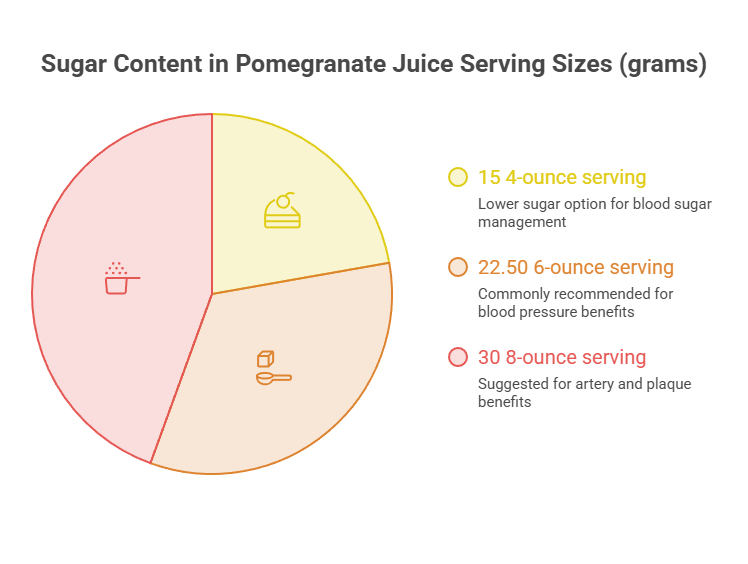
Most trials used between 4 and 8 ounces (120 to 240 mL) of 100% pomegranate juice daily. For blood pressure specifically, around 5 ounces shows up often as a practical daily amount that matches what studies delivered.
Longer studies aiming at artery and plaque benefits leaned toward the higher 8-ounce serving. Consistency matters more than a single large dose, because the effect builds over weeks, not hours. A glass every day beats a big pour once in a while.
The Sugar and Calorie Tradeoff
Here’s where honesty beats hype. An 8-ounce glass of pure pomegranate juice carries roughly 30 grams of natural sugar and about 135 calories. Those are naturally occurring sugars, not added, but your bloodstream doesn’t draw that distinction.
For most people that’s fine in moderation. For anyone watching blood sugar or weight, a 4-ounce serving delivers a solid polyphenol dose with half the sugar load. Our medical reviewers generally suggest treating juice as a swap within the day’s calories, not an extra habit stacked on top of everything else you already drink.
Whole Fruit vs Juice vs Extract
You have three ways to get pomegranate, and they aren’t interchangeable. Whole arils, the edible seeds, give you fiber that blunts the sugar spike and adds fullness, but they deliver fewer concentrated polyphenols per serving than juice does.
Juice is the most-studied form for blood pressure and the easiest to dose precisely, at the cost of concentrated sugar. Pomegranate extract capsules skip the sugar entirely and show real results in extract trials, though quality and dosing vary by brand and aren’t FDA-tested for consistency the way medications are.
| Your Situation | Recommended Approach | Watch For |
| Healthy BP, want prevention | 4 to 8 oz 100% juice daily | Sugar and calorie load |
| Already on BP medication | Ask your doctor; keep servings modest | Additive drop, dizziness |
| Diabetes or prediabetes | Whole arils or a small 4 oz pour | Blood sugar spikes |
| Surgery scheduled | Stop about 2 weeks before | Bleeding and BP in surgery |
| On statins or liver-processed drugs | Check interactions before starting | Altered drug levels |
| Want the strongest results | Pair with the DASH diet, not instead | Juice alone is modest |
How to Choose a Quality Pomegranate Juice
Not all pomegranate juice is equal, and the label tells you most of what you need to know. Picking the right bottle is the difference between a heart-friendly habit and a sugar-loaded one that works against you.
Read the Label First
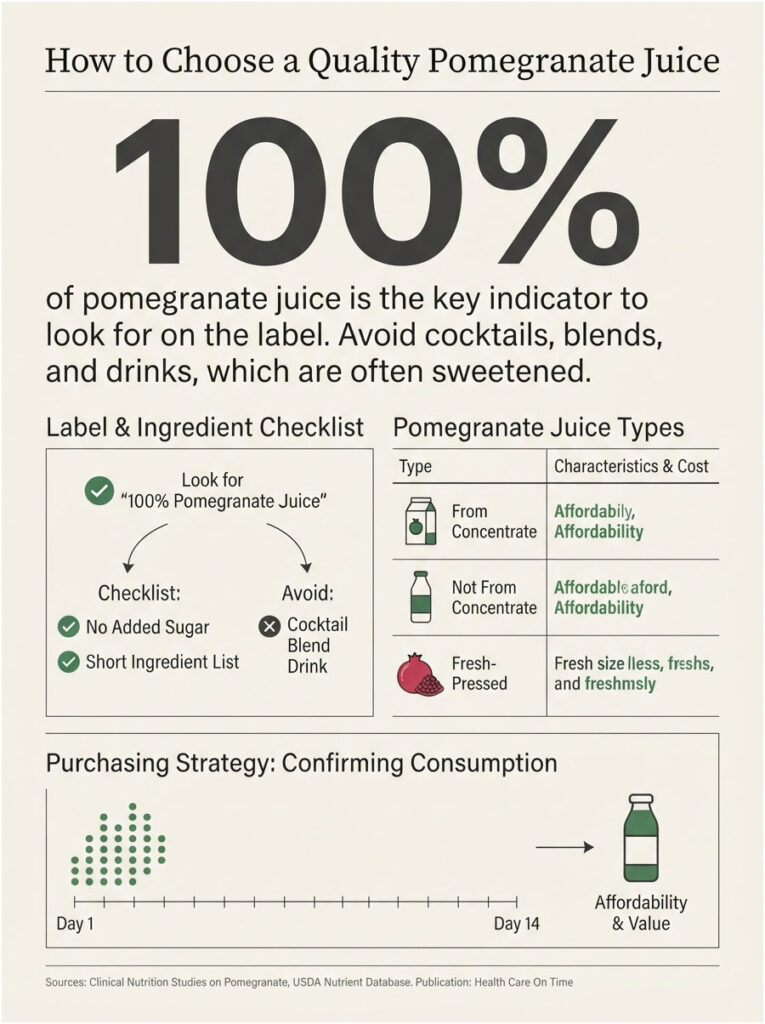
Look for “100% pomegranate juice” with no added sugar and no other fruit juices mixed in. The ingredient list should be short, ideally just pomegranate juice, or pomegranate juice from concentrate and water.
Skip anything labeled “cocktail,” “blend,” or “drink,” which are usually mostly apple or grape juice with a splash of pomegranate for color and marketing. From concentrate or not from concentrate both work fine, as long as the bottle is genuinely 100% juice. The trials that showed a benefit used pure juice, never sweetened blends.
Trusted Options and Fresh-Pressed
In US stores, widely available 100% pomegranate juices make this easy, and many grocery chains carry a store-brand pure version at a lower price per ounce. Concentrate that you dilute at home stretches further and lets you control exactly how much you pour.
Pressing your own from fresh arils is the freshest route and skips processing entirely, though it takes effort and the juice runs tart on its own. Whichever form you pick, our medical reviewers suggest buying the smallest size first to confirm you’ll actually drink it daily before committing to a large bottle.
Pomegranate vs Other Natural Options
Pomegranate isn’t the only fruit or drink studied for blood pressure, and it’s fair to ask where it honestly ranks against the alternatives.
| Option | Typical Systolic Effect | Sugar Load | Best For |
| Pomegranate juice | ~3 to 5 mmHg | High (~30g/8 oz) | Broad heart benefits, taste |
| Beetroot juice | ~4 to 8 mmHg | Moderate | Fastest, strongest BP drop |
| Hibiscus tea | ~4 to 7 mmHg | None | Calorie-free daily option |
| DASH diet pattern | ~8 to 14 mmHg | N/A | Largest proven effect overall |
Beetroot juice tends to show a stronger and faster systolic effect in trials, thanks to its high nitrate content that converts to nitric oxide. If raw blood-pressure numbers are the only goal, beet juice often edges out pomegranate.
Hibiscus tea also holds up well in studies and skips the sugar problem entirely, making it a strong pick for anyone avoiding calories who still wants a research-supported drink. It’s steepable, cheap, and easy to make a daily ritual.
So why choose pomegranate at all? Taste, tolerance, and its wider heart benefits around cholesterol and inflammation, which the single-purpose options don’t match. Patients commonly ask us for the one best option, and the practical truth is that the best one is the heart-healthy habit you’ll actually keep up. None of these drinks beats the DASH eating pattern, which can lower systolic pressure by 8 to 14 mmHg, or prescribed medication for genuine hypertension. Think of pomegranate as a pleasant assist, not the main event.
Who Should Be Careful (Safety and Interactions)
Natural doesn’t mean risk-free. A few groups should talk to a doctor before making pomegranate a daily habit.
Blood Pressure Medication Interactions
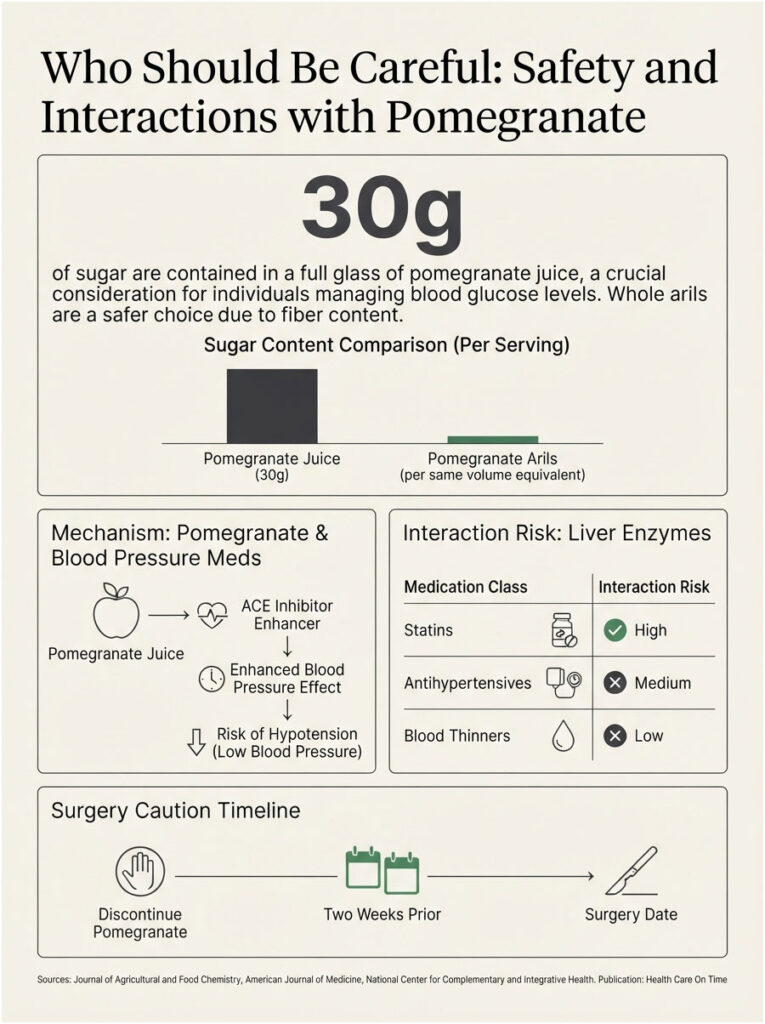
This is the big one. Because pomegranate lowers blood pressure through the ACE pathway, layering it on top of an ACE inhibitor or other BP drug can add to the effect and push your pressure too low.
Signs of overshooting include dizziness, lightheadedness, or feeling faint when you stand up quickly. None of that is dangerous to check for, and none of it means pomegranate is off-limits. It simply means anyone on medication should keep servings modest and tell their prescriber about the habit so dosing can account for it.
Diabetes and Blood Sugar
Pomegranate juice is still juice. The 30 grams of sugar in a full glass can move blood glucose, which matters for anyone with diabetes or prediabetes trying to hold steady numbers.
Whole arils or a smaller pour are the safer choices here. The fiber in whole seeds slows sugar absorption in a way juice can’t, so you get the polyphenols without as sharp a spike. Pairing any juice with a meal helps as well.
Surgery and Other Cautions
Because pomegranate affects blood pressure, it can interfere with control during and after an operation. Standard guidance is to stop pomegranate about two weeks before scheduled surgery.
Pomegranate can also affect the liver enzymes (the CYP450 system) that break down many medications, including some statins and other common drugs, which can change how much of the drug reaches your bloodstream. People with plant allergies may react to pomegranate too. When patients raise these situations, our team’s standard answer is to clear it with a physician first rather than assume a fruit is automatically harmless.
What to Realistically Expect
Setting expectations correctly is half the battle, so here’s the honest timeline. Pomegranate is not a same-day fix. Studies measured meaningful changes over 4 to 12 weeks of daily servings, with the longest trials running a year or more.
Give it at least three to four weeks of consistent daily juice before judging whether your numbers moved. The best way to know is data, not feel, since blood pressure changes are silent. A home monitor and a simple log tell you far more than any single reading at the doctor’s office.
Expect a small win, not a transformation. If your pressure drops a few points and holds, that’s a success worth keeping. If your readings stay high, that’s a signal to lean harder on diet, exercise, and a conversation about medication, not to drink more juice.
Practical Steps to Add Pomegranate the Right Way
Ready to try it? Keep it simple and consistent.
- Pick 100% pomegranate juice with no added sugar. Skip “pomegranate blend” drinks, which are often mostly apple or grape juice with a splash of pomegranate for color and marketing.
- Start with 4 to 8 ounces once daily, ideally with a meal to soften the sugar impact on your blood glucose.
- If you have diabetes or prediabetes, favor whole arils or a 4-ounce serving instead of a full glass.
- Track your blood pressure at home for a few weeks so you can see whether your numbers actually respond.
- Treat it as one piece of a plan that includes the DASH diet, less sodium, regular movement, good sleep, and any prescribed medication.
To lower blood pressure naturally, pomegranate is a reasonable addition, not a cornerstone. The cornerstones stay the same: diet, exercise, sleep, and medical care when your readings call for it.
Frequently Asked Questions
How much does pomegranate lower blood pressure?
Pooled data from 33 trials shows an average drop of about 3.5 mmHg systolic and 1.5 mmHg diastolic. Juice studies often report closer to 5 mmHg systolic. The effect is modest but consistent, and it tends to be larger for people whose readings start only slightly elevated.
How long before pomegranate affects blood pressure?
It’s a gradual effect, not an instant one. Most studies measured changes over 4 to 12 weeks of daily consumption, and some trials ran 12 to 18 months. Expect to give it several weeks of consistent daily servings before checking whether your numbers have actually shifted.
Is pomegranate juice better than beet juice for blood pressure?
For raw systolic numbers, beet juice usually shows a stronger and faster effect because of its high nitrate content. Pomegranate offers broader heart benefits around cholesterol and inflammation. The better choice is the one you’ll drink consistently and tolerate well without piling on sugar.
Can you drink pomegranate juice with blood pressure medication?
Talk to your doctor first. Pomegranate lowers pressure through the same ACE pathway some drugs use, so combining them can drop your blood pressure too far. Watch for dizziness or lightheadedness, keep servings modest, and always tell your prescriber about the habit.
Can diabetics drink pomegranate juice?
With caution. A full glass has about 30 grams of natural sugar, which can raise blood glucose. Whole pomegranate arils are a safer bet because their fiber slows sugar absorption. If you choose juice, keep it near 4 ounces and pair it with a meal to blunt the spike.
Is whole pomegranate better than juice?
For sugar control, yes. Whole arils include fiber that blunts blood sugar spikes and adds fullness. Juice, though, delivers more concentrated polyphenols per serving and is the form most blood pressure studies used. Choose whole fruit if managing sugar, juice for easy, research-matched dosing.
Does pomegranate thin the blood?
Pomegranate has mild effects on circulation and may slightly influence bleeding, which is why guidance suggests stopping it about two weeks before surgery. It is not a blood thinner like warfarin or aspirin. If you take blood-thinning medication, check with your doctor before adding it daily.
What’s the best time to drink pomegranate juice?
There’s no proven best time for blood pressure. Drinking it with a meal helps soften the sugar impact on your blood glucose. Consistency matters far more than timing, so pick a moment you’ll remember daily and stick with it week after week.
Can pomegranate replace blood pressure medication?
No. A 3 to 5 mmHg drop can’t match what medication does for moderate or severe hypertension. Relying on juice alone can delay treatment you need and raise your risk of stroke or heart damage. Use pomegranate alongside your prescribed plan, never as a swap.
How much pomegranate juice is too much?
Beyond the sugar and calorie load, large daily amounts add up fast, roughly 135 calories and 30 grams of sugar per 8 ounces. For most people, 4 to 8 ounces daily is a sensible ceiling. Those managing weight, blood sugar, or diabetes should stay near the lower end.
Does pomegranate extract work as well as juice?
Extract trials show real blood pressure benefits and skip the sugar, which appeals to people with diabetes. The tradeoff is that supplement quality and dosing vary by brand and aren’t FDA-verified for consistency. Juice remains the most-studied form, so pick extract from a reputable maker if you go that route.
Is pomegranate juice from concentrate as good as fresh?
For blood pressure, yes, as long as it’s 100% juice with no added sugar. The polyphenols hold up well through the concentration process. Fresh-pressed juice is slightly higher in a few nutrients and skips processing, but a quality 100% concentrate delivers the same core benefit at a lower cost.
| Disclaimer This article is for general education and isn’t a substitute for professional medical advice. High blood pressure is a serious condition that often has no symptoms. Do not start, stop, or change any medication or supplement, including pomegranate, without talking to a qualified healthcare provider. If your readings are consistently elevated, seek medical care promptly. |
References
- CDC, High Blood Pressure Facts
- CDC NCHS, Hypertension Prevalence Data Brief 511
- CDC NCCDPHP, Health and Economic Benefits of Blood Pressure Interventions
- Effects of pomegranate on blood pressure and endothelial function, 2026 meta-analysis of 33 trials, ScienceDirect
- Effects of pomegranate juice on blood pressure, meta-analysis of 8 RCTs, ScienceDirect
- The effects of pomegranate juice consumption on blood pressure and cardiovascular health, PubMed
- Effect of pomegranate extract on blood pressure and anthropometry in adults, Queen Margaret University trial, NCBI
- Effects of pomegranate extract on inflammatory markers and cardiometabolic risk in adults 55 to 70, NCBI
- Does pomegranate intake attenuate cardiovascular risk factors in hemodialysis patients, NCBI
- Pomegranate monograph, uses, interactions, and dosing, WebMD