A single bowl of restaurant arroz con leche packs 413 calories and 43 grams of sugar, more sugar than a regular Snickers bar. That’s the math nobody at the family table wants to hear.
Table of Contents
The good news? You don’t have to give up abuela’s dessert to hit your weight-loss goals.
Patients of Hispanic heritage we serve through HealthCareOnTime often ask whether losing weight means giving up cultural foods entirely. The honest answer is no. With the right swaps, healthy arroz con leche for weight loss drops below 200 calories per serving while keeping the cinnamon-warm, creamy texture that makes it worth eating in the first place.
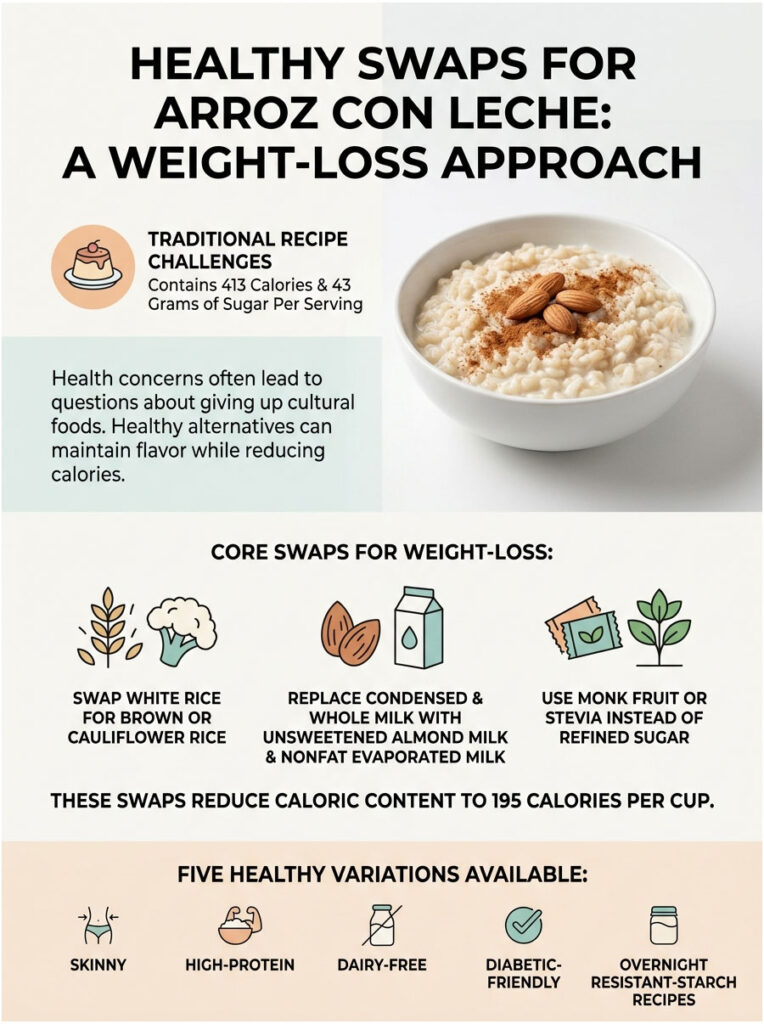
Quick Answer: Healthy arroz con leche for weight loss swaps white rice for brown or cauliflower rice, condensed and whole milk for unsweetened almond milk and nonfat evaporated milk, and refined sugar for monk fruit or stevia. These three changes cut a 413-calorie restaurant serving down to 195 calories per cup. Five recipes below cover skinny, high-protein, dairy-free, diabetic-friendly, and overnight resistant-starch versions.
At a Glance
- 5 healthy arroz con leche recipes for weight loss, each under 250 calories per serving
- Traditional version: 413 cal, 43 g sugar, 70 g carbs (Prospre/USDA data)
- Lightened version: as low as 145 calories, 4 g sugar, 18 g carbs
- All recipes meet ADA daily added-sugar guidance and follow USDA Dietary Guidelines
- High-protein version delivers 28 grams of protein per serving
- Diabetic-friendly cauliflower rice blend keeps glycemic load minimal
- All ingredients sold at common US grocers (H-E-B, Whole Foods, Trader Joe’s, Kroger, Walmart)
Why Traditional Arroz con Leche Sabotages Weight Loss
Arroz con leche is a beloved dessert across Latin America, Spain, and Hispanic-American households. The classic recipe uses white rice, whole milk, sweetened condensed milk, evaporated milk, sugar, and cinnamon. Each of those ingredients on its own is fine. Stacked together in one bowl, they create a calorie bomb.
The Calorie & Sugar Reality Check
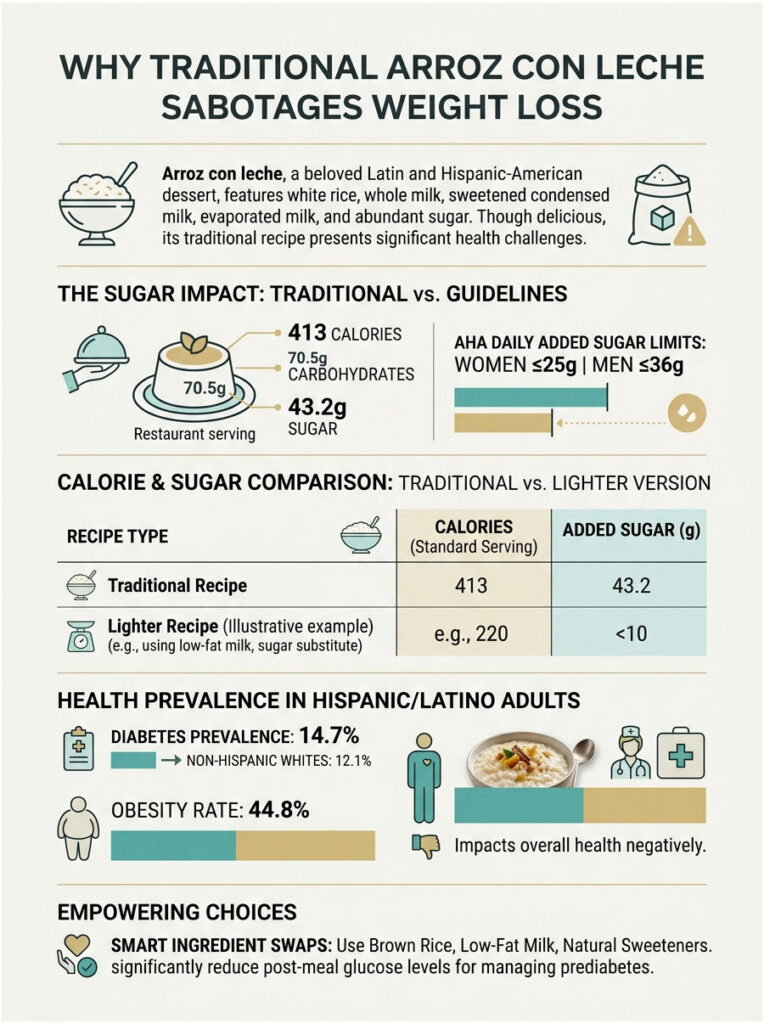
A 1-cup restaurant serving of traditional arroz con leche contains 413 calories, 70.5 grams of carbohydrates, and 43.2 grams of sugar. For context, the American Heart Association recommends no more than 25 grams of added sugar per day for women and 36 grams for men.
One bowl blows past the daily limit before lunch. The table below shows exactly where the calories go and how lightened versions compare.
| Version | Calories per Cup | Sugar (g) | Carbs (g) | Protein (g) | Fiber (g) |
| Traditional restaurant | 413 | 43.2 | 70.5 | 9.1 | 1.4 |
| Homemade classic | 350 | 32 | 60 | 8 | 1 |
| Skinny brown-rice | 195 | 9 | 35 | 9 | 3 |
| High-protein | 240 | 7 | 28 | 28 | 3 |
| Dairy-free vegan | 210 | 11 | 38 | 6 | 4 |
| Diabetic cauli-rice | 145 | 4 | 18 | 7 | 5 |
Why Hispanic/Latino Diabetes Rates Make This Personal
This is not just a weight-loss question. The CDC’s National Diabetes Statistics Report shows Hispanic/Latino adults have a 14.7% diabetes prevalence, compared to 12.1% in non-Hispanic white adults. The CDC also reports 44.8% of Hispanic adults have obesity.
Sugar-heavy desserts in repeated daily portions move the needle in the wrong direction. In cases reviewed across our diagnostic network, patients managing prediabetes find that small ingredient swaps can drop post-meal glucose readings by 30 to 50 mg/dL.
The point isn’t to stop eating arroz con leche. It’s to make a version that fits your numbers.
The Weight-Loss Math Behind a Healthier Arroz con Leche
Weight loss is calorie math. Eat less than you burn over time, and the body uses stored fat for fuel. Dessert can absolutely fit, as long as the portion and ingredients line up with your overall calorie target.
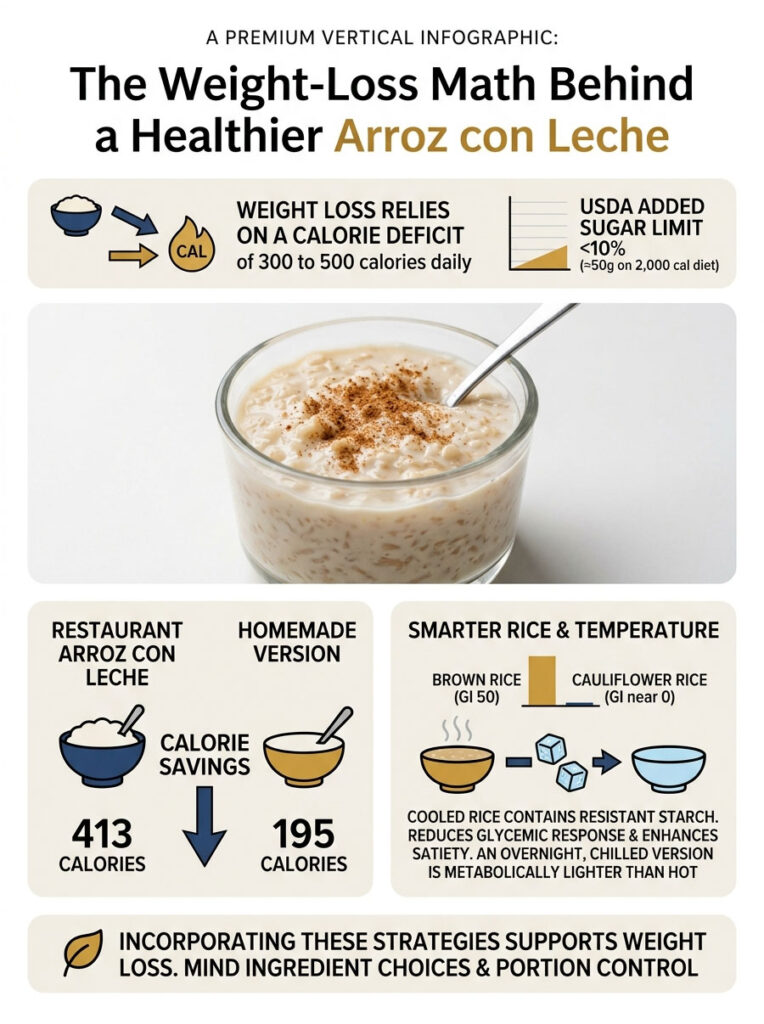
Calorie Deficit 101
Most adults need a daily deficit of 300 to 500 calories below maintenance for sustainable weight loss. The USDA Dietary Guidelines recommend keeping added sugars under 10% of total calories, which works out to about 50 grams of added sugar on a 2,000-calorie day.
Swapping a 413-calorie restaurant arroz con leche for a 195-calorie homemade version saves 218 calories. Done four times a week, that’s an extra pound of fat loss every five weeks without changing anything else.
Glycemic Index of Rice Choices
Not all rice acts the same in your body. The glycemic index (GI) measures how fast a food raises blood sugar.
White rice has a GI of around 73, while brown rice sits closer to 50 per Harvard T.H. Chan School of Public Health. Basmati rice runs around 58, and cauliflower rice is essentially zero.
Lower GI means slower glucose release, less insulin spike, longer satiety, and less stored fat. For weight loss, switching from white rice to brown rice (or blending in cauliflower rice) is one of the highest-leverage moves you can make for a healthy arroz con leche.
Why Cooled Rice Has Less Sugar Impact
Here’s a science-backed bonus most recipe blogs miss. When cooked rice is cooled in the refrigerator, some of the starch converts to resistant starch.
Resistant starch acts more like fiber than carbs, feeding gut bacteria and lowering the glycemic response by 12 to 25%. That means an overnight, fridge-cold arroz con leche is metabolically lighter than a hot one made from the same ingredients.
This is exactly why the overnight version (Recipe 5 below) deserves its own slot.
Smart Ingredient Swaps That Slash Calories Without Killing Flavor
Our medical team has reviewed the swaps below against ADA and AHA guidance. Each one preserves the cinnamon-and-creamy character of the original while cutting calories, sugar, or both.
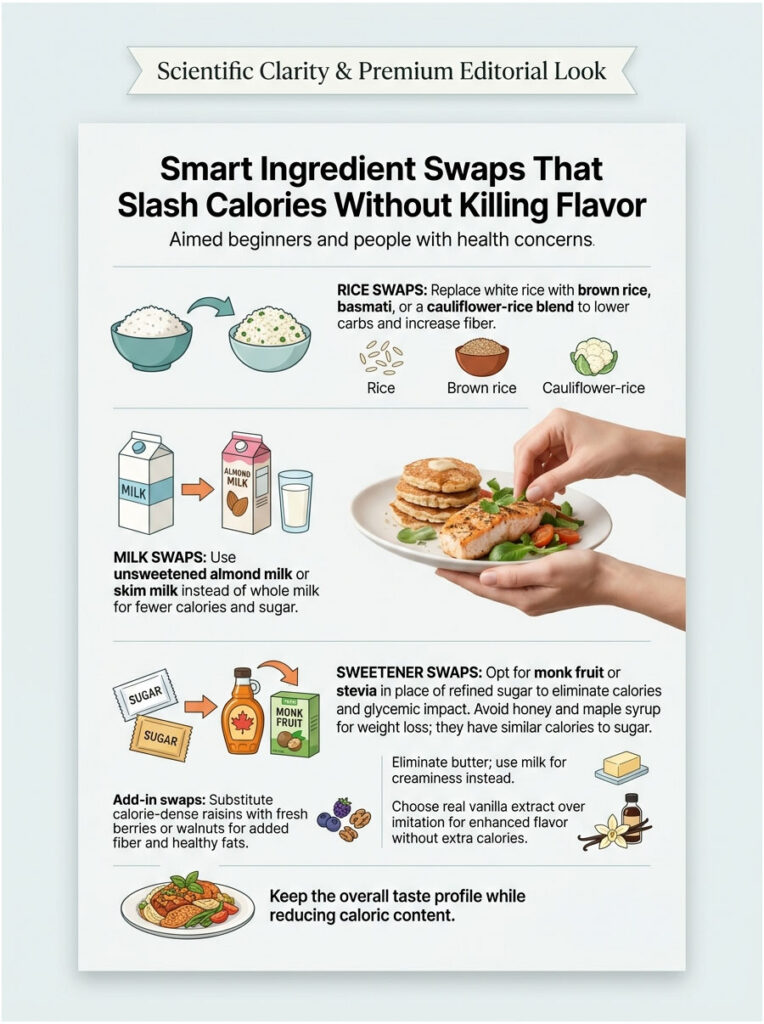
Rice Swaps
White rice goes first. Brown rice, basmati, or a brown-rice and cauliflower-rice blend deliver fiber and lower the GI. Cauliflower rice alone produces a thinner, custard-like texture that some readers love and others miss.
A 50/50 blend of brown rice and cauliflower rice is the sweet spot. You keep the chew while cutting carbs nearly in half.
Milk Swaps
This is the biggest calorie lever in the entire recipe. Traditional arroz con leche stacks whole milk, evaporated milk, and sweetened condensed milk for that intensely creamy texture, plus a hidden 30+ grams of sugar from the condensed milk alone.
Swap that stack for unsweetened almond milk, oat milk, skim milk, or Fairlife ultra-filtered milk (13 g protein and 6 g sugar per cup, vs 8 g sugar in regular whole milk). Nonfat evaporated milk replaces sweetened condensed milk for the same creamy body without the sugar load.
Sweetener Swaps
Refined sugar is the easiest cut. Monk fruit sweetener (Lakanto, Whole Earth) and stevia provide sweetness with zero calories and zero glycemic impact. Allulose tastes closer to real sugar and works well for browning.
Honey and maple syrup are not “healthy” alternatives for weight loss. They contain roughly the same calories per teaspoon as table sugar. Use them only if you prefer the flavor, not because they’re a diet hack.
Add-In Swaps
Raisins are calorie-dense (1 tablespoon = 30 cal, 6 g sugar). Swap them for fresh blueberries, sliced strawberries, or chopped walnuts for fiber and healthy fats. Skip the butter entirely; the milk does enough heavy lifting. Use real vanilla extract over imitation flavoring for a richer taste at the same calorie cost.
5 Healthy Arroz con Leche Recipes for Weight Loss
Each recipe below lists serving size, total time, calories, and full macros. All measurements are US standard. Recipes serve 4 unless noted.
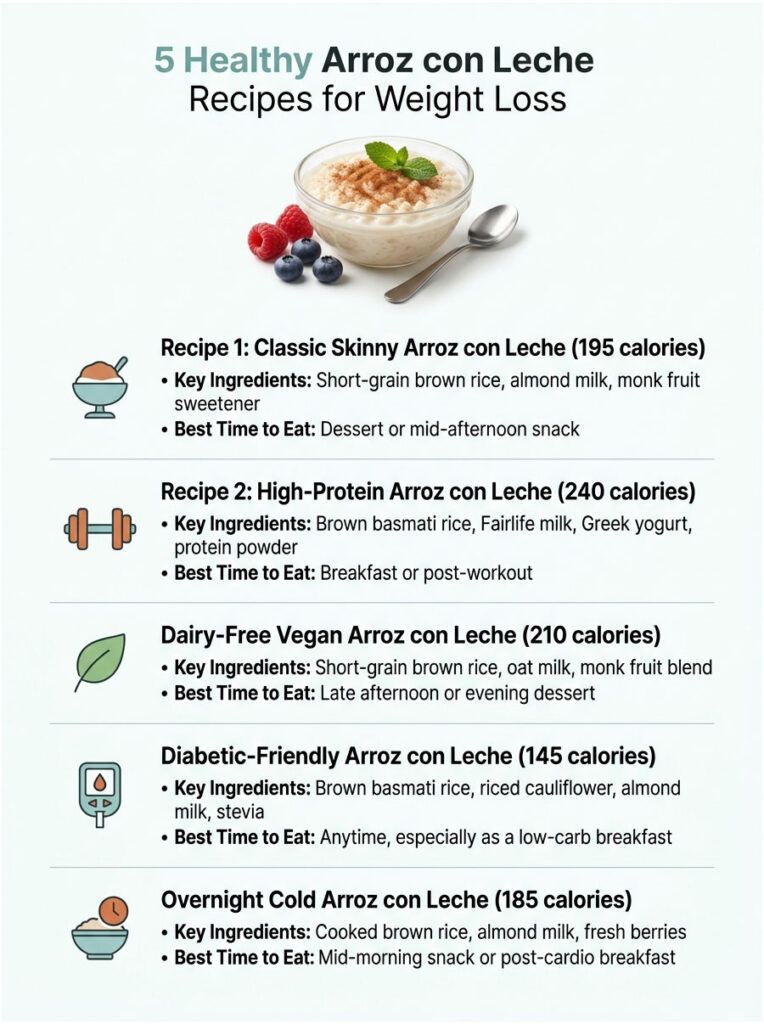
Recipe 1: Classic Skinny Arroz con Leche (Under 200 Cal)
Creamy, cinnamon-warm, just-sweet-enough. The everyday weight-loss version.
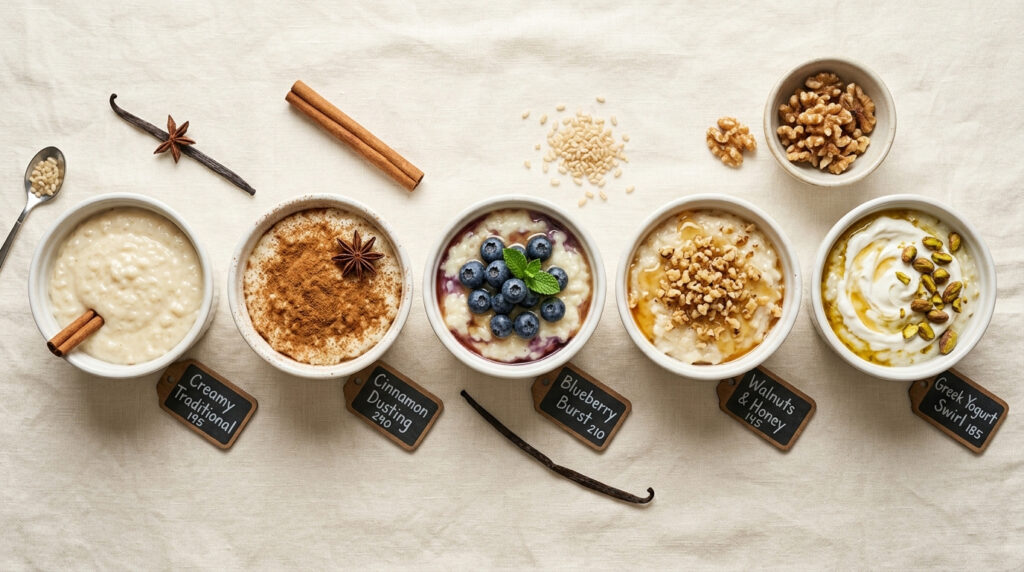
Total time: 35 minutes. Servings: 4. Calories per cup: 195. Macros: 35 g carbs, 9 g sugar, 9 g protein, 3 g fiber, 2 g fat.
Ingredients: 1/2 cup short-grain brown rice (rinsed), 2 cups water, 2 cups unsweetened almond milk, 1 cup nonfat evaporated milk, 2 tablespoons monk fruit sweetener (Lakanto Classic), 1 cinnamon stick or 1 teaspoon ground cinnamon, 1 teaspoon pure vanilla extract, 1 strip lemon peel (optional), pinch of salt.
Method: Bring water and rinsed brown rice to a boil in a saucepan. Reduce heat, cover, and simmer 25 minutes until tender; do not drain. Add almond milk, evaporated milk, monk fruit, cinnamon stick, lemon peel, and salt. Simmer uncovered 10 to 12 minutes, stirring frequently, until thickened. Remove cinnamon stick and lemon peel. Stir in vanilla. Serve warm or chilled with a dusting of cinnamon.
Why it works for weight loss: Brown rice plus almond milk plus monk fruit cuts traditional calories by more than half while keeping the texture authentic. Best time to eat: after dinner as dessert, or as a 1/2-cup mid-afternoon snack.
Recipe 2: High-Protein Arroz con Leche (28g Protein)
Rich, satisfying, dessert-for-breakfast worthy. Built for fitness goals.
Total time: 30 minutes. Servings: 4. Calories per cup: 240. Macros: 28 g carbs, 7 g sugar, 28 g protein, 3 g fiber, 5 g fat.
Ingredients: 1/2 cup brown basmati rice (rinsed), 2 cups water, 2 cups Fairlife ultra-filtered fat-free milk, 1 cup nonfat Greek yogurt (Chobani or Oikos plain), 1 scoop (30 g) vanilla whey or casein protein powder, 2 tablespoons monk fruit sweetener, 1 teaspoon ground cinnamon, 1 teaspoon pure vanilla extract, pinch of salt.
Method: Cook rinsed basmati in water for 20 minutes until tender; drain off excess. Return rice to pan with Fairlife milk, monk fruit, cinnamon, and salt. Simmer 8 minutes, stirring often. Remove from heat and let cool to lukewarm (above 105°F destroys protein powder texture and curdles yogurt). In a separate bowl, whisk Greek yogurt and protein powder with vanilla until smooth, then fold into the cooled rice mixture. Refrigerate 30 minutes for best texture. Top with a dusting of cinnamon.
Why it works for weight loss: 28 grams of protein per serving keeps you full for hours and supports muscle preservation during a calorie deficit. The casein in the yogurt slows digestion further. Best time to eat: breakfast or post-workout.
Recipe 3: Dairy-Free Vegan Arroz con Leche
Sweet, sticky, plant-based. The version for lactose-intolerant or vegan readers.
Total time: 35 minutes. Servings: 4. Calories per cup: 210. Macros: 38 g carbs, 11 g sugar, 6 g protein, 4 g fiber, 5 g fat.
Ingredients: 1/2 cup short-grain brown rice (rinsed), 2 cups water, 1.5 cups unsweetened oat milk (Califia or Oatly Barista), 1.5 cups unsweetened almond milk, 3 tablespoons allulose or monk fruit blend, 1 cinnamon stick, 1 teaspoon pure vanilla extract, 2 tablespoons golden raisins (optional, adds 30 cal/serving), pinch of salt.
Method: Boil rice and water until tender, about 25 minutes; do not drain. Add oat milk, almond milk, sweetener, cinnamon stick, salt, and raisins (if using). Simmer 10 minutes, stirring frequently. Remove cinnamon stick and stir in vanilla. Serve warm or chilled.
Why it works for weight loss: Lactose intolerance is common in Hispanic adults per NIH research. Oat milk gives the creamy mouthfeel without dairy bloat. Best time to eat: late afternoon or evening dessert.
Recipe 4: Diabetic-Friendly Arroz con Leche (Low Glycemic)
Custard-like, mildly sweet, deeply cinnamony. Lowest-carb option in this guide.
Total time: 25 minutes. Servings: 4. Calories per cup: 145. Macros: 18 g carbs, 4 g sugar, 7 g protein, 5 g fiber, 5 g fat.
Ingredients: 1/4 cup brown basmati rice (rinsed), 2 cups riced cauliflower (fresh or frozen, thawed), 2 cups unsweetened almond milk, 1/2 cup nonfat evaporated milk, 2 tablespoons stevia (or to taste), 1 tablespoon ground flaxseed, 1 teaspoon ground cinnamon, 1 teaspoon pure vanilla extract, 2 tablespoons chopped walnuts (for topping), pinch of salt.
Method: Cook brown basmati rice in 1 cup water for 18 minutes; drain. Combine cooked rice, riced cauliflower, almond milk, evaporated milk, stevia, flaxseed, cinnamon, and salt in a saucepan. Simmer 12 minutes, stirring often, until thickened. Remove from heat and stir in vanilla. Top each serving with chopped walnuts.
Why it works for weight loss: Cauliflower rice cuts the carb load by more than half. Flaxseed adds soluble fiber that slows glucose absorption. Always check with your endocrinologist if you take insulin or sulfonylureas. Best time to eat: anytime, especially as a low-carb breakfast.
Recipe 5: Overnight Cold Arroz con Leche (Resistant Starch Boost)
Cold, creamy, refreshing. The metabolically smartest version in this guide.
Total time: 25 minutes prep plus 8 hours chilling. Servings: 4. Calories per cup: 185. Macros: 33 g carbs, 8 g sugar, 8 g protein, 3 g fiber, 3 g fat.
Ingredients: 1/2 cup brown rice (cooked the day before and refrigerated overnight), 2 cups unsweetened almond milk, 3/4 cup nonfat evaporated milk, 2 tablespoons monk fruit sweetener, 1 teaspoon ground cinnamon, 1 teaspoon pure vanilla extract, 1/2 cup fresh blueberries or sliced strawberries (for topping), pinch of salt.
Method: The night before, cook 1/2 cup brown rice in 1 cup water (about 25 minutes) and refrigerate overnight; uncovered the first hour, then covered. This step builds resistant starch. The next day, combine cold rice, almond milk, evaporated milk, monk fruit, cinnamon, and salt in a saucepan. Heat gently 6 to 8 minutes (do not boil hard) until just warm and slightly thickened. Stir in vanilla. Refrigerate 30 minutes if you prefer it cold. Top with fresh berries.
Why it works for weight loss: Resistant starch in cooled rice reduces glycemic impact by 12 to 25% vs freshly cooked rice. Fresh berries replace raisins and cut sugar further. Best time to eat: mid-morning snack or post-cardio breakfast.
Side-by-Side Nutrition: How These 5 Recipes Stack Up
Lab partners working with HealthCareOnTime confirm that protein-paired desserts blunt blood sugar spikes more effectively than carb-only desserts. The table below pairs each recipe against US daily limits.
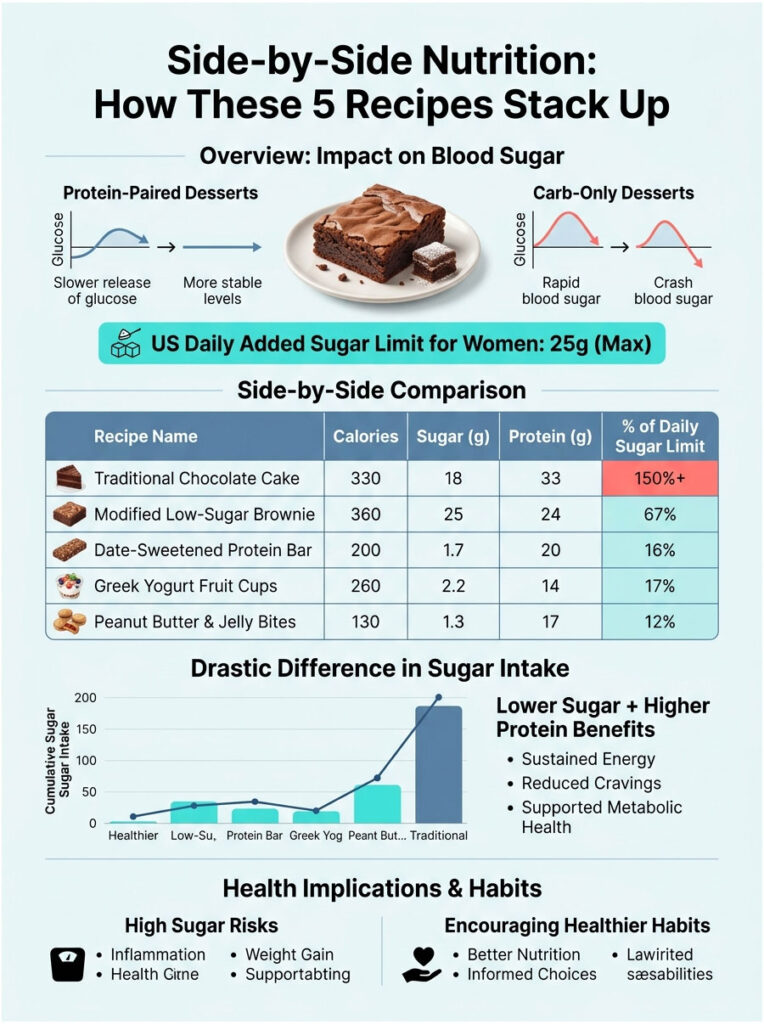
| Recipe | Calories | Sugar (g) | % AHA Daily Sugar (Women, 25 g) | Protein (g) | Source |
| Traditional restaurant arroz con leche | 413 | 43.2 | 173% | 9.1 | Prospre/USDA |
| Homemade classic version | 350 | 32 | 128% | 8 | USDA estimate |
| Recipe 1: Classic Skinny | 195 | 9 | 36% | 9 | HCOT analysis |
| Recipe 2: High-Protein | 240 | 7 | 28% | 28 | HCOT analysis |
| Recipe 3: Dairy-Free Vegan | 210 | 11 | 44% | 6 | HCOT analysis |
| Recipe 4: Diabetic-Friendly | 145 | 4 | 16% | 7 | HCOT analysis |
| Recipe 5: Overnight Cold | 185 | 8 | 32% | 8 | HCOT analysis |
A single bowl of restaurant arroz con leche uses 173% of a woman’s daily added-sugar limit. The skinny version drops that to 36%, and the diabetic-friendly version to just 16%.
When to Eat Arroz con Leche on a Weight-Loss Plan
Timing matters less than total daily calories, but it can make a real difference for satiety, blood sugar, and muscle recovery. The matrix below pairs your goal with the right recipe and timing.
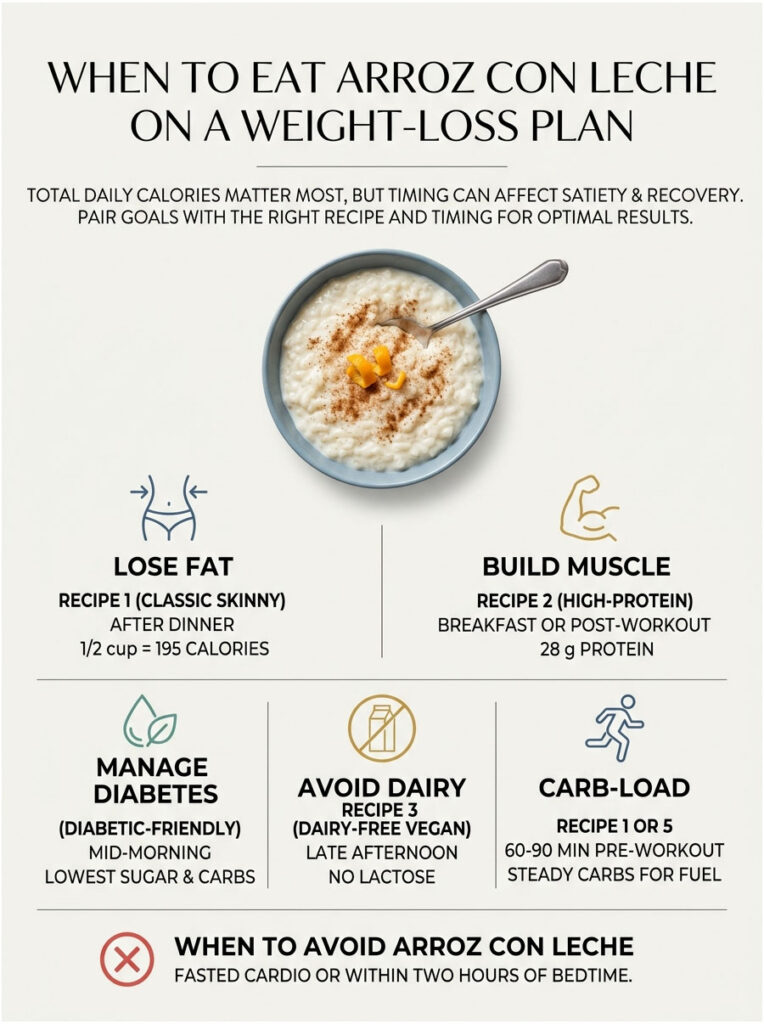
| If Your Goal Is | Eat This Recipe | Best Time | Why It Works |
| Lose fat without giving up dessert | Recipe 1 (Classic Skinny) | After dinner, 1/2 cup portion | 195 cal fits a 1,500-cal/day deficit easily |
| Build or preserve muscle | Recipe 2 (High-Protein) | Breakfast or post-workout | 28 g protein supports muscle protein synthesis |
| Manage prediabetes or type 2 diabetes | Recipe 4 (Diabetic-Friendly) | Mid-morning or with protein | Lowest sugar and carbs, highest fiber |
| Avoid dairy or follow plant-based diet | Recipe 3 (Dairy-Free Vegan) | Late afternoon or evening | No lactose, no animal products |
| Maximize blood sugar control | Recipe 5 (Overnight Cold) | Mid-morning snack | Resistant starch lowers glycemic impact |
| Carb-load before training | Recipe 1 or 2 | 60 to 90 minutes pre-workout | Steady carbs plus protein for fuel |
| Late-night craving | Half-portion of Recipe 4 | Before 9 PM, 1/2 cup max | Lowest calorie density of the five |
Breakfast Use
The high-protein version (Recipe 2) makes a smart breakfast at 240 calories with 28 grams of protein. Pair it with a piece of fresh fruit and you have a complete morning meal.
Dessert Use
A 1/2-cup portion of any recipe except #4 stays under 100 calories per serving. That’s a respectable post-dinner satisfaction without breaking the deficit.
Pre-Workout Use
Recipe 1 or Recipe 5, eaten 60 to 90 minutes before resistance training, provides sustained carbs without a heavy stomach. The cinnamon may also support insulin sensitivity during the workout window.
When to Avoid
Skip arroz con leche during fasted-cardio windows or within two hours of bedtime if you’re tracking sleep quality. Sugar before sleep can spike, then crash, blood glucose overnight.
Common Mistakes That Sabotage a “Healthy” Arroz con Leche
Across nutrition consultations through HealthCareOnTime, the most common derailer is portion creep. Here are the other mistakes that turn a healthy recipe back into a calorie bomb.
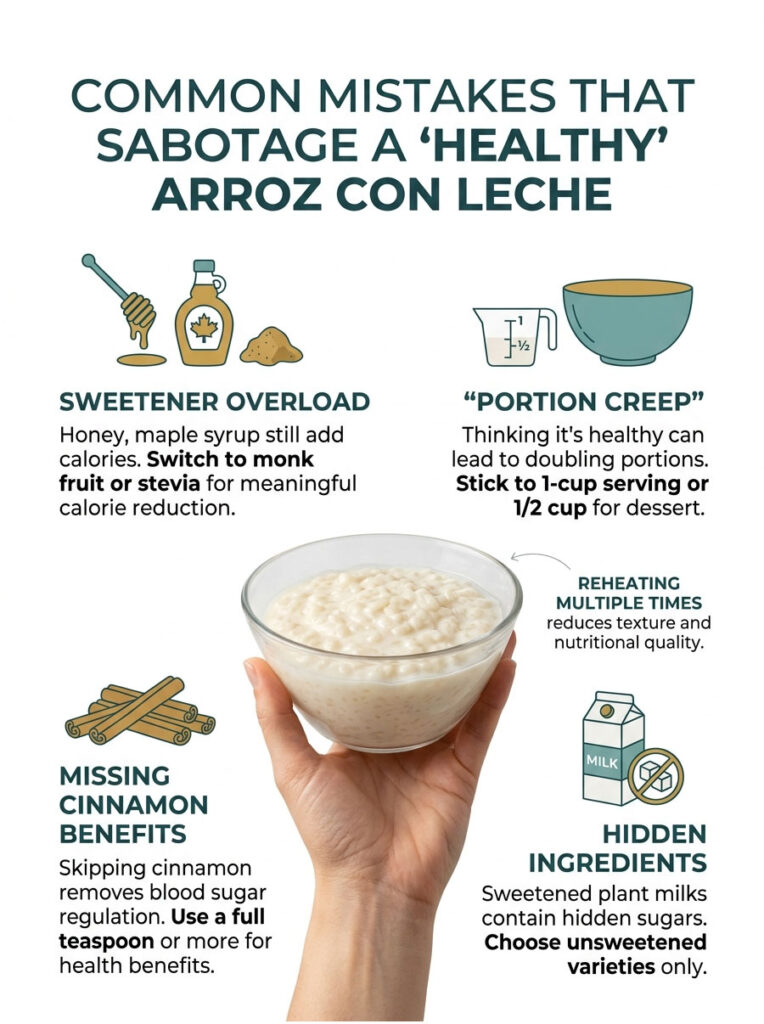
Using Honey or Maple Syrup as a “Healthy” Sugar
Honey contains 64 calories per tablespoon. Maple syrup has 52. Refined white sugar has 49. The “natural” label doesn’t change the calorie math.
For weight loss, monk fruit, allulose, and stevia are the only sweeteners that cut calories meaningfully. Use the others for flavor preference, not as a diet shortcut.
Doubling the Portion Because It’s “Healthy”
A 195-calorie cup eaten twice is 390 calories, almost identical to the restaurant version you were trying to avoid. Stick to a single 1-cup serving, or 1/2 cup for dessert.
Skipping the Cinnamon
Cinnamon isn’t just flavor. Research published in PubMed shows cinnamon can lower fasting blood glucose and improve insulin sensitivity at doses of 1 to 6 grams per day. Don’t skip it; use a full teaspoon or more per recipe.
Using Sweetened Plant Milks
Original or vanilla almond milk, oat milk, and soy milk often contain 7 to 14 grams of added sugar per cup. Always choose the unsweetened variety. The recipe brings its own sweetness through monk fruit or stevia.
Reheating Repeatedly
Each reheat-and-cool cycle reduces resistant starch and degrades texture. Cook once, refrigerate up to 4 days, and warm gently with an extra splash of almond milk to restore creaminess.
Cultural Respect Meets Weight Loss: Eating Arroz con Leche Without Guilt
Arroz con leche isn’t just a dessert. It’s a Sunday-afternoon memory, a holiday tradition, a connection to abuela’s kitchen. Patients of Hispanic heritage we serve through HealthCareOnTime sometimes feel guilty for eating cultural foods while trying to lose weight.
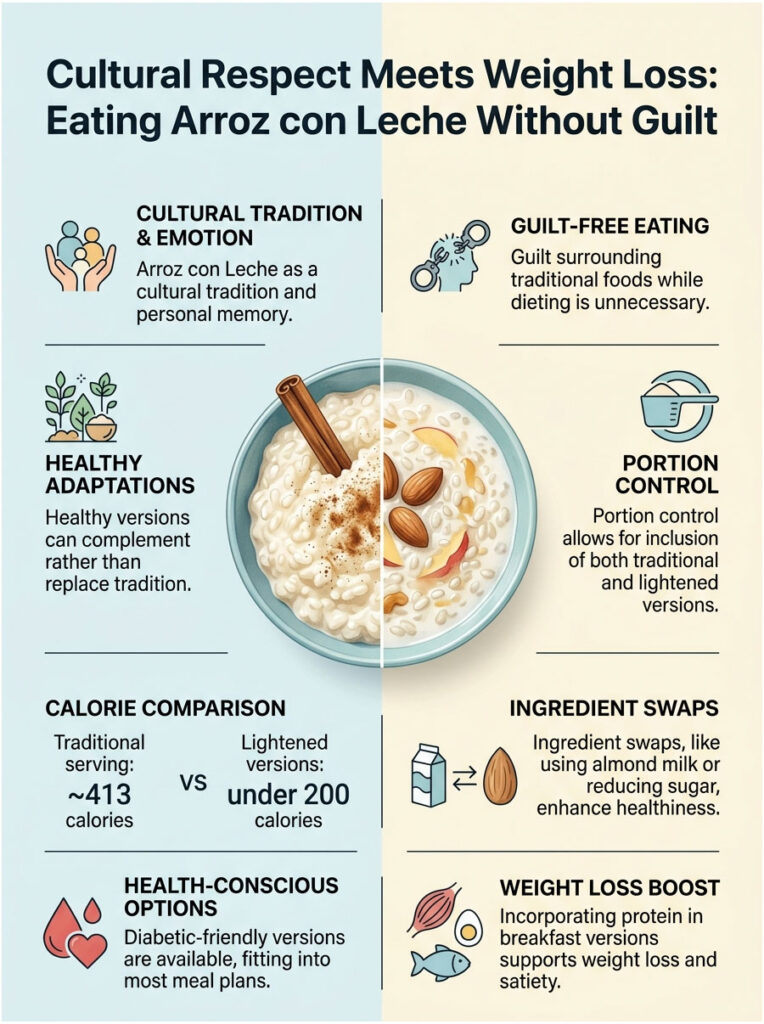
That guilt is unnecessary. The healthy versions above aren’t a betrayal of tradition; they’re an addition to it. Abuela’s recipe stays exactly as it is, eaten on holidays and special occasions in a normal portion. The skinny version becomes the everyday version.
Frame it that way for yourself and for the family. The weight loss happens because you eat the lightened version four times this week and the traditional one once next month, not because you erased the dish from your life.
Frequently Asked Questions
How many calories are in traditional arroz con leche?
A 1-cup serving of restaurant arroz con leche contains roughly 413 calories, 43 grams of sugar, and 70 grams of carbs. Homemade classic versions tend to land between 350 and 400 calories per cup. The high count comes from sweetened condensed milk, whole milk, white rice, and added sugar stacking together. Lightened versions can drop below 200 calories.
Can you eat arroz con leche on a diet?
Yes, with portion control and ingredient swaps. A 1-cup serving of skinny arroz con leche (Recipe 1) at 195 calories fits inside most weight-loss meal plans. A traditional 413-calorie restaurant serving fits less easily but is still possible if you balance it with lower-calorie meals the rest of the day. Half-portions are the easiest hack.
Is arroz con leche fattening?
It depends on the version and the portion. Traditional restaurant arroz con leche, eaten daily in full servings, can absolutely contribute to weight gain because of its calorie and sugar density. The lightened versions in this guide, eaten in normal portions a few times a week, support weight loss when paired with a balanced overall diet.
Is brown rice arroz con leche really healthier?
Yes. Brown rice has a glycemic index of about 50, while white rice runs around 73 per Harvard T.H. Chan School of Public Health. Brown rice also has 3 grams of fiber per cup vs less than 1 gram for white. Lower GI plus more fiber means slower glucose release, longer satiety, and less insulin spike.
How can I make arroz con leche less sweet?
Use monk fruit, stevia, or allulose instead of sugar (zero calories, zero glycemic impact). Skip the sweetened condensed milk entirely; use nonfat evaporated milk instead. Cut raisins, which add 6 grams of sugar per tablespoon. Lean into cinnamon, vanilla, and lemon peel for flavor depth without sweetness.
Can diabetics eat arroz con leche?
The diabetic-friendly version (Recipe 4) at 145 calories and 4 grams of sugar fits most type 2 diabetic meal plans. The American Diabetes Association recommends keeping single-serving sugar under 15 grams. Always check with your endocrinologist if you take insulin or oral diabetes medications. Pair the dish with a protein source to slow glucose absorption further.
What’s the best milk for low-calorie arroz con leche?
Unsweetened almond milk wins on calorie cost (30 to 40 calories per cup vs 150 for whole milk). For protein, Fairlife ultra-filtered fat-free milk delivers 13 grams of protein and 80 calories per cup. Skip sweetened plant milks, which can add 7 to 14 grams of sugar per cup. Nonfat evaporated milk is the best swap for sweetened condensed milk.
Can I eat arroz con leche for breakfast and still lose weight?
Yes, especially the high-protein version (Recipe 2) at 240 calories with 28 grams of protein. Protein at breakfast supports satiety, muscle preservation during a calorie deficit, and steadier blood sugar through the morning. Pair with a piece of fruit and you have a complete meal. Just count it as a meal, not a snack.
Does cinnamon in arroz con leche help blood sugar?
Cinnamon may help. Research suggests doses of 1 to 6 grams per day can lower fasting blood glucose and improve insulin sensitivity. A typical arroz con leche recipe uses 1 to 2 grams of cinnamon. The effect is supportive rather than dramatic, but it adds up over time. Use real Ceylon or Cassia cinnamon, not imitation flavoring.
How long does homemade arroz con leche last in the fridge?
Up to 4 days in a sealed container at 35 to 40°F. The texture will thicken as it cools because the starches set. Stir in a splash of almond milk before serving cold or while gently reheating. Throw it out if you see any color change, sour smell, or surface mold. Glass containers work better than plastic for taste preservation.
Can I freeze healthy arroz con leche?
Yes, but with texture trade-offs. Freeze in single-serving portions for up to 2 months. The rice can become slightly grainy after thawing because the starches reorganize. Thaw overnight in the fridge and stir in extra almond milk to restore creaminess. The high-protein version (Recipe 2) does not freeze well because of the Greek yogurt; eat that one fresh.
What’s the highest-protein way to make arroz con leche?
Recipe 2 (High-Protein Arroz con Leche) delivers 28 grams of protein per cup using Fairlife ultra-filtered milk, Greek yogurt, and a scoop of vanilla protein powder. For an even higher boost, you can stir in 2 tablespoons of unflavored collagen peptides (12 g protein) without affecting taste. This makes it a legitimate meal-replacement option for fitness goals.
Disclaimer: This article is for educational purposes only and is not medical advice. Weight loss strategies, diabetic meal planning, and ingredient substitutions can interact with medications and individual health conditions. Consult your physician, registered dietitian, or endocrinologist before making major dietary changes, especially if you have diabetes, kidney disease, are pregnant, or are taking insulin, sulfonylureas, blood pressure medications, or weight-loss drugs such as semaglutide. HealthCareOnTime provides health information; it does not replace personalized clinical care.
References
- CDC, National Diabetes Statistics Report
- CDC, Adult Obesity Facts
- USDA Dietary Guidelines for Americans
- American Heart Association, Added Sugar Limits
- American Diabetes Association, Diabetes Food Hub
- Harvard T.H. Chan School of Public Health, Glycemic Index Reference
- NIH NIDDK, Lactose Intolerance
- HHS Office of Minority Health, Hispanic/Latino Health
- PubMed, Cinnamon and Glucose Regulation
- Prospre Nutrition Database, Arroz con Leche
- FDA, Added Sugars on Nutrition Facts Label
- Mayo Clinic, Calorie Calculator