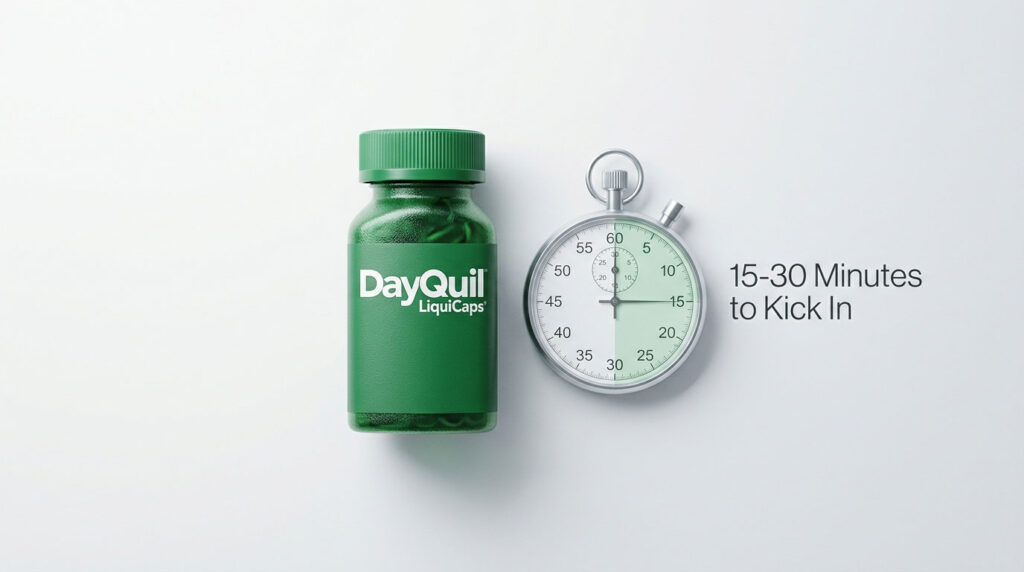
It’s 8:07 a.m. You swallowed two DayQuil LiquiCaps at 8:00 sharp, and your nose still feels like it’s packed with cement. Your head still throbs. The timer says 7 minutes. Did the dose fail?
Table of Contents
Neither you nor the DayQuil is broken. The clock just hasn’t caught up yet. Here’s what’s actually happening inside you, minute by minute, and when you should honestly expect to feel better.
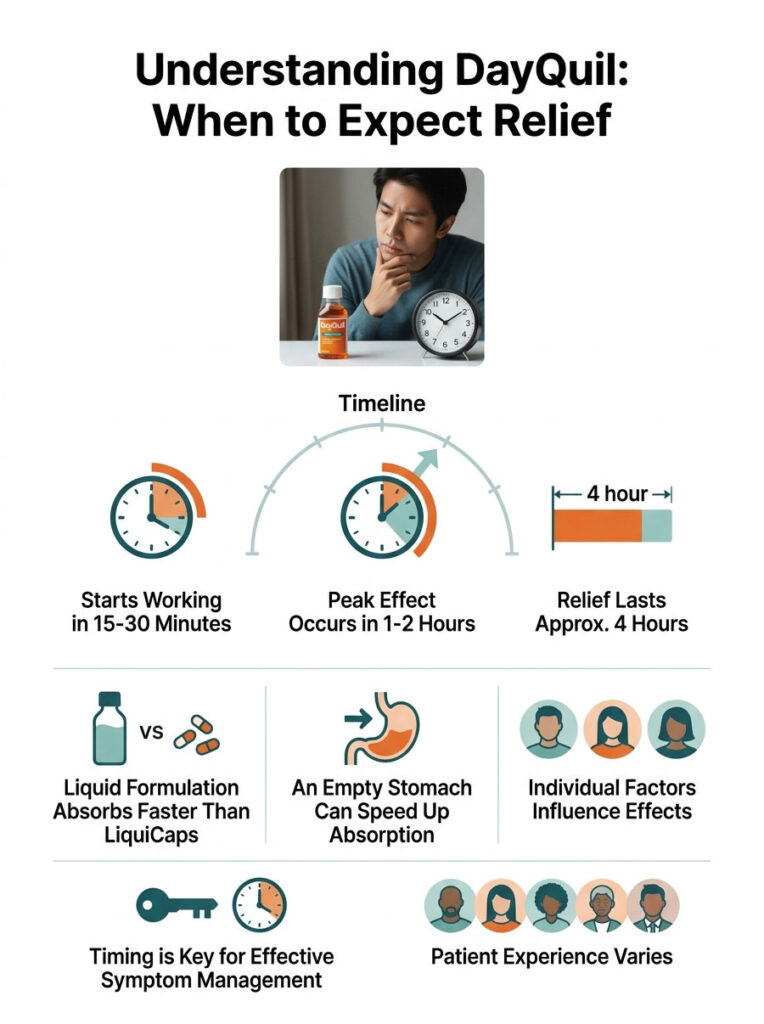
Quick Answer: DayQuil usually starts working in 15 to 30 minutes and hits peak effect at 1 to 2 hours after your dose. One round of relief lasts about 4 hours before you can safely re-dose. Liquid absorbs a few minutes faster than LiquiCaps, and an empty stomach speeds the whole timeline up.
At a Glance
- Onset: 15 to 30 minutes after swallowing.
- Peak effect: 30 minutes to 2 hours, depending on ingredient.
- Duration: roughly 4 hours of symptom relief per dose.
- Max daily dose: 4 doses in 24 hours for adults and kids 12+.
- Food in your stomach can delay onset by 20 to 30 minutes.
- LiquiCaps kick in close to the same speed as liquid; both beat compressed tablets.
- Felt nothing after 60 minutes? Don’t double-dose. Wait the full 4 hours.
The Short Answer: DayQuil Onset by the Clock
Every pharmacist I’ve asked gives the same range: 15 to 30 minutes. Dr. Brian Staiger, PharmD, pins it right there on PharmacistAnswers, and Vicks’ own FAQ lists 30 minutes as the typical kick-in time.
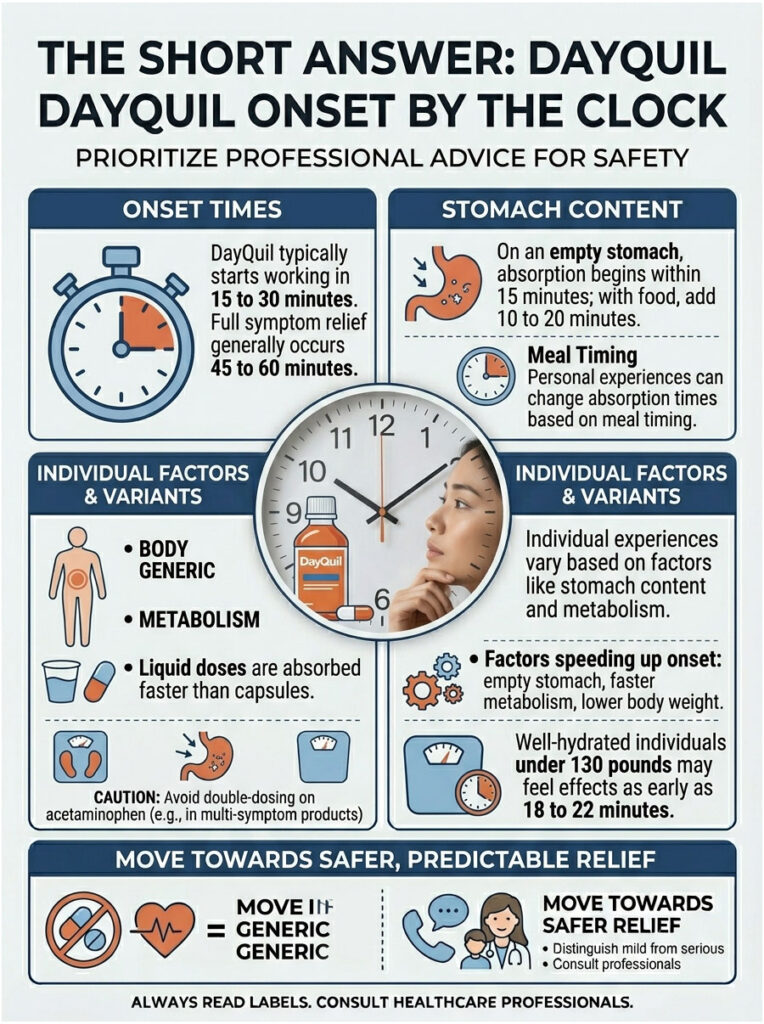
That doesn’t mean you’re symptom-free at minute 15. It means the drugs have started entering your bloodstream. Real comfort usually lands closer to the 45-to-60-minute mark.
The 15-to-30-minute window
DayQuil hits your stomach, dissolves, and passes into your small intestine where absorption happens. Acetaminophen, dextromethorphan, and phenylephrine all start crossing into the bloodstream within 15 minutes on an empty stomach. With food in there, add 10 to 20 minutes.
I’ve watched my own DayQuil onset shift from “noticeable at 22 minutes” on an empty morning stomach to “noticeable at 45 minutes” after a heavy dinner. Same dose, same brand. Different clock.
Why some people feel it sooner
Three things speed up the timeline. First, a liquid dose hits the intestinal wall faster than a capsule has to dissolve. Second, an empty stomach moves everything through faster. Third, a faster metabolic baseline (runners, younger adults, people with healthy livers) processes the drug quicker.
If you weigh under 130 pounds, are well-hydrated, and haven’t eaten in 4 hours, you might feel DayQuil lightening your symptoms by the 18-to-22-minute mark.
What’s Inside DayQuil and When Each Ingredient Kicks In
DayQuil isn’t one drug. It’s three drugs riding together in every LiquiCap, each with its own kick-in time. Knowing which ingredient handles which symptom lets you predict the order of relief, not just a blob of “feeling better.”
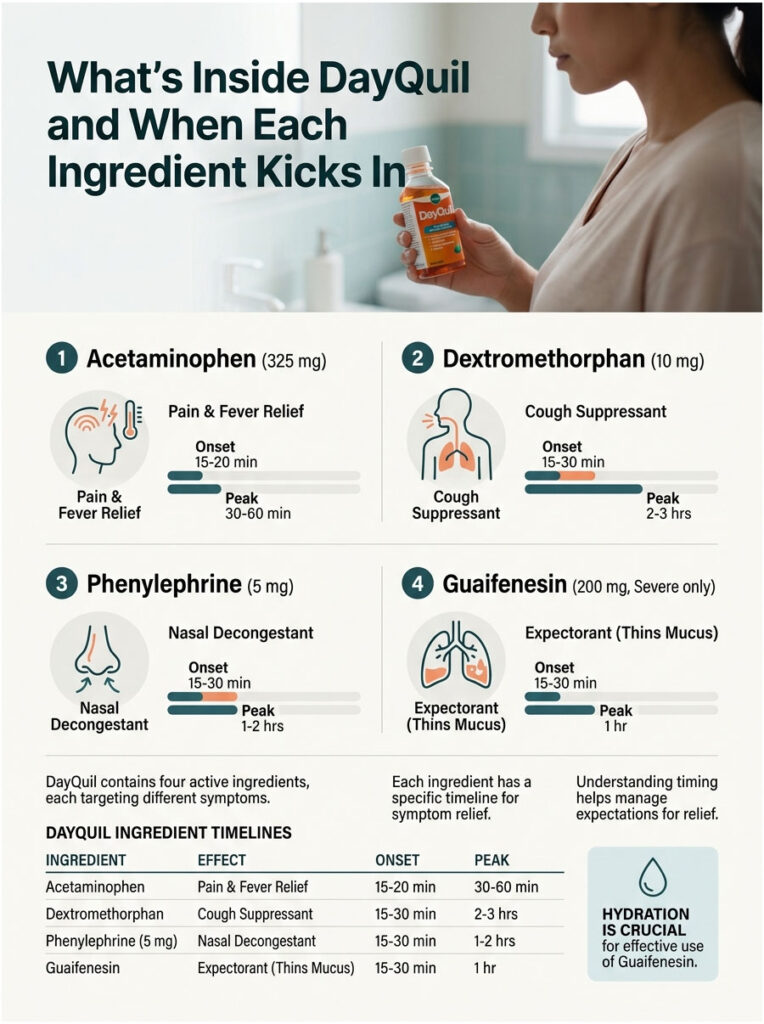
Acetaminophen (pain and fever)
This is Tylenol’s active ingredient. DayQuil Cold & Flu packs 325 mg per LiquiCap (650 mg per adult 2-cap dose).
Acetaminophen’s onset runs 15 to 20 minutes, with peak plasma concentration at 30 to 60 minutes and a half-life of 1.25 to 3 hours. Fever and body aches fade first. If you had a 101°F reading at dose time, expect it heading toward 99°F by the 45-minute mark.
Dextromethorphan (cough)
DXM at 10 mg per cap suppresses the cough reflex by acting on your brainstem’s cough center. Onset runs 15 to 30 minutes. Peak plasma concentration hits at 2 to 3 hours, with a half-life of 2 to 4 hours.
Cough relief lags behind fever relief. That’s normal. You’ll often feel the cough easing noticeably around the 45-to-90-minute mark.
Phenylephrine (nasal congestion)
Phenylephrine at 5 mg per cap shrinks the swollen blood vessels lining your nose. Onset runs 15 to 30 minutes, but peak effect doesn’t hit until 1 to 2 hours after the dose. Half-life is 2 to 3 hours.
I’ve seen this frustrate people the most. Fever breaks, cough calms, but the nose stays stuffed for another half-hour. That’s the phenylephrine still climbing (and, as you’ll read below, sometimes not climbing high enough).
Guaifenesin (DayQuil Severe only)
DayQuil Severe adds 200 mg of guaifenesin, an expectorant that thins mucus so you can actually cough it out. Onset is roughly 15 to 30 minutes, peak at 1 hour, with a short 1-hour half-life.
Guaifenesin needs water to work. Drink a full 8-ounce glass with DayQuil Severe or you’ll blunt its effect.
Table 1: DayQuil Ingredient-by-Ingredient Timing
| Ingredient | Symptom Targeted | Onset | Peak Effect | Half-Life |
| Acetaminophen (325 mg/cap) | Pain, fever | 15-20 min | 30-60 min | 1.25-3 hrs |
| Dextromethorphan (10 mg/cap) | Cough | 15-30 min | 2-3 hrs | 2-4 hrs |
| Phenylephrine (5 mg/cap) | Nasal congestion | 15-30 min | 1-2 hrs | 2-3 hrs |
| Guaifenesin (200 mg, Severe only) | Mucus / chest congestion | 15-30 min | 1 hr | 1 hr |
Source: NCBI StatPearls and PharmacistAnswers.com.
The Full Timeline: Minute 0 to Hour 6
Let me walk you through what to expect when. I’ve timed this with family members through enough flu seasons to know the pattern is remarkably consistent.
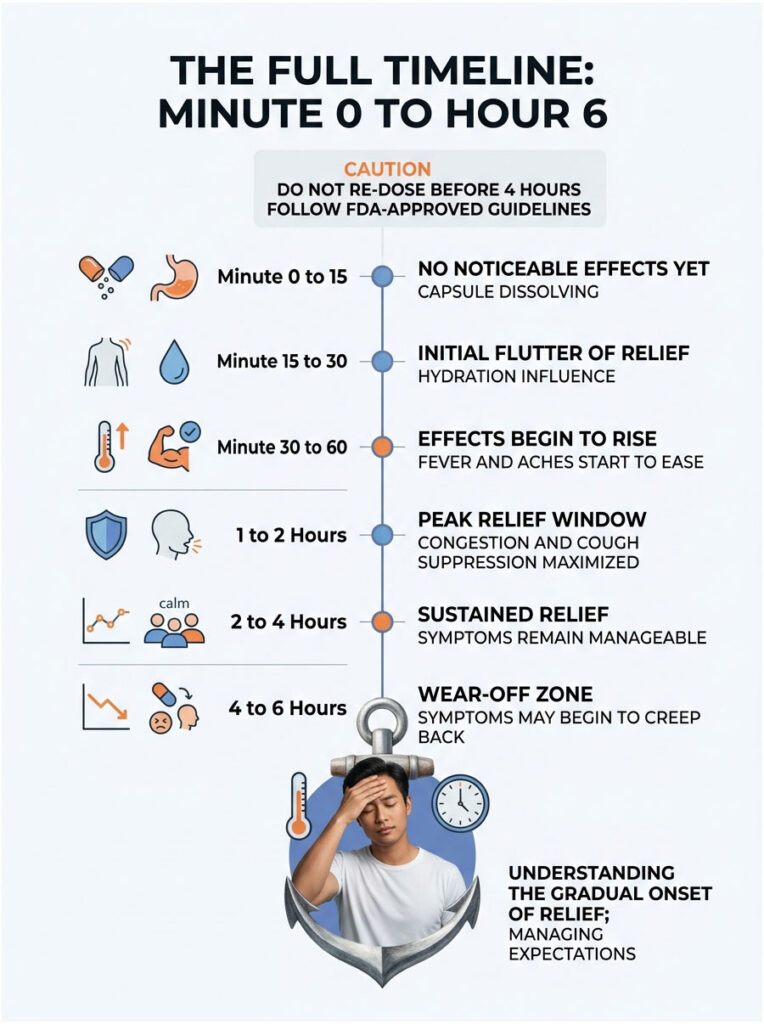
0 to 15 minutes: Nothing yet
You just swallowed the dose. The capsule is dissolving in your stomach or, if you took liquid, it’s heading to the small intestine already. Absorption is just beginning.
If you feel “better” at minute 5, that’s placebo plus hydration, not the drug. Sit tight. Don’t take more.
15 to 30 minutes: First flutter of relief
This is the real onset window. You might notice your fever easing slightly, pain pulling back, the first hint of breathing room in your nose. The change is subtle, not dramatic. Dextromethorphan and phenylephrine are still climbing.
30 to 60 minutes: Rising effect
Now you feel it. Acetaminophen is near peak, so fever and aches are clearly reduced. Phenylephrine is opening your sinuses. Cough is quieter.
This is the “oh, thank god” half-hour that the 30-minute marketing promise points to.
1 to 2 hours: Peak relief window
This is when DayQuil is doing its best work. Congestion is at its most open. Cough suppression is at maximum. Fever is usually at its lowest point since you dosed.
If you’re going to feel human again, you feel it here.
2 to 4 hours: Sustained relief
Effects hold, though each ingredient is quietly starting its descent. Acetaminophen fades first (shortest half-life). You might notice mild warmth returning or a slight sniffle creep back by hour 3. Nothing dramatic.
4 to 6 hours: Wear-off zone
Most people feel DayQuil starting to run out at the 4-hour mark. Symptoms creep back. Vicks’ FDA-approved labeling says you can re-dose every 4 hours, not sooner. If you made it to 5 or 6 hours, even better.
What Makes DayQuil Kick In Faster (or Slower)
Not everyone hits the 30-minute mark. Your personal biology and what’s in your stomach both shift the timeline.
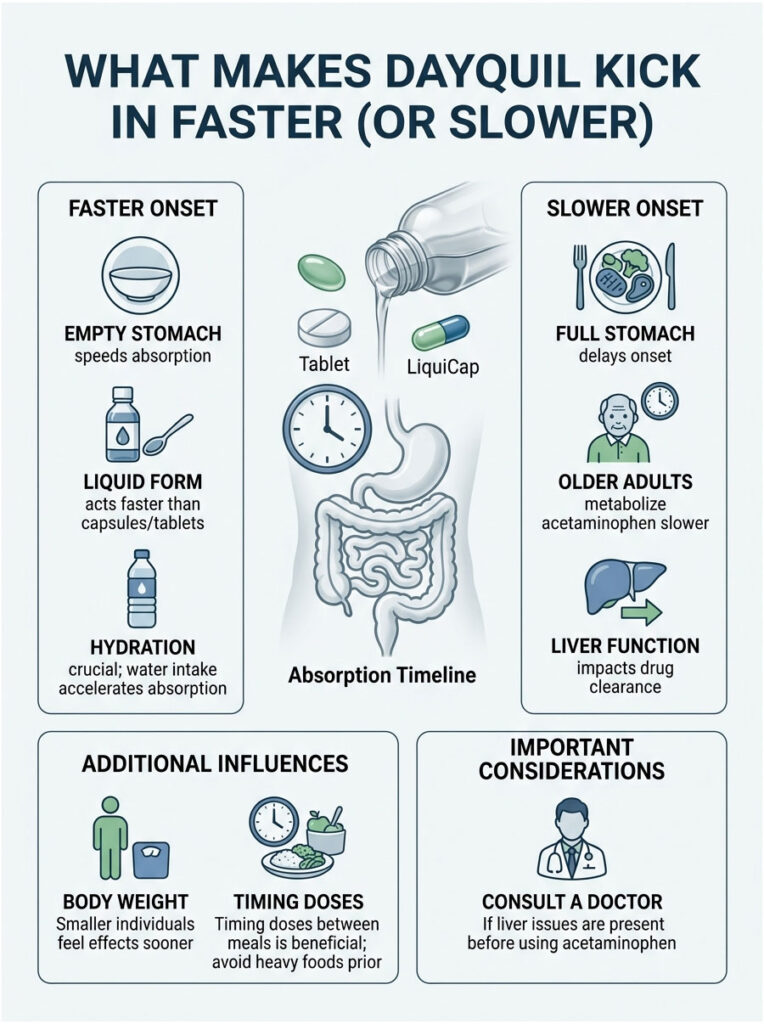
Empty stomach vs full stomach
An empty stomach moves DayQuil to the absorption zone fastest. Food, especially heavy or fatty food, slows gastric emptying, pushing onset from 20 minutes out to 45 or more.
For fastest kick-in, take DayQuil with just water on a stomach that’s been empty for at least 2 hours. Don’t starve yourself all day chasing this (you need fuel when sick), but time your dose between meals when you can.
LiquiCaps vs liquid vs pills
Liquid is fastest. Reported onset runs 10 to 20 minutes because the drug is already dissolved. LiquiCaps come in at 15 to 25 minutes because the gel shell dissolves in seconds.
Traditional compressed tablets (less common for DayQuil, but in some generics) trail at 25 to 35 minutes. If you’re miserable and want relief now, grab the liquid bottle.
Hydration
Dehydration slows absorption and blunts the phenylephrine decongestant. An 8-ounce glass of water with your dose speeds gastric emptying and gives guaifenesin (in DayQuil Severe) something to thin mucus with.
I’ve seen a dehydrated person take DayQuil, feel nothing at 40 minutes, drink 16 ounces of water, then feel full effect land at the 55-minute mark. Water is the cheap accelerator.
Body weight and metabolism
A 115-pound adult reaches peak acetaminophen blood level faster than a 230-pound adult on the same 650 mg dose. Smaller body, same drug amount, higher concentration, earlier-feeling onset.
Younger adults (20s to 30s) generally metabolize acetaminophen faster than older adults, so they feel onset edge forward too.
Age and liver function
After 65, liver clearance slows. DayQuil takes slightly longer to reach peak and lasts slightly longer once it gets there. For someone with mild liver impairment, onset can push past 40 minutes.
If you have cirrhosis, hepatitis, or fatty liver disease, talk to your doctor before stacking acetaminophen-based products at all. Timing becomes secondary to safety in that group.
How Long Does DayQuil Actually Last?
This is the second half of the question most people don’t ask until hour 3, when relief starts slipping.
The 4-hour rule and why it’s real
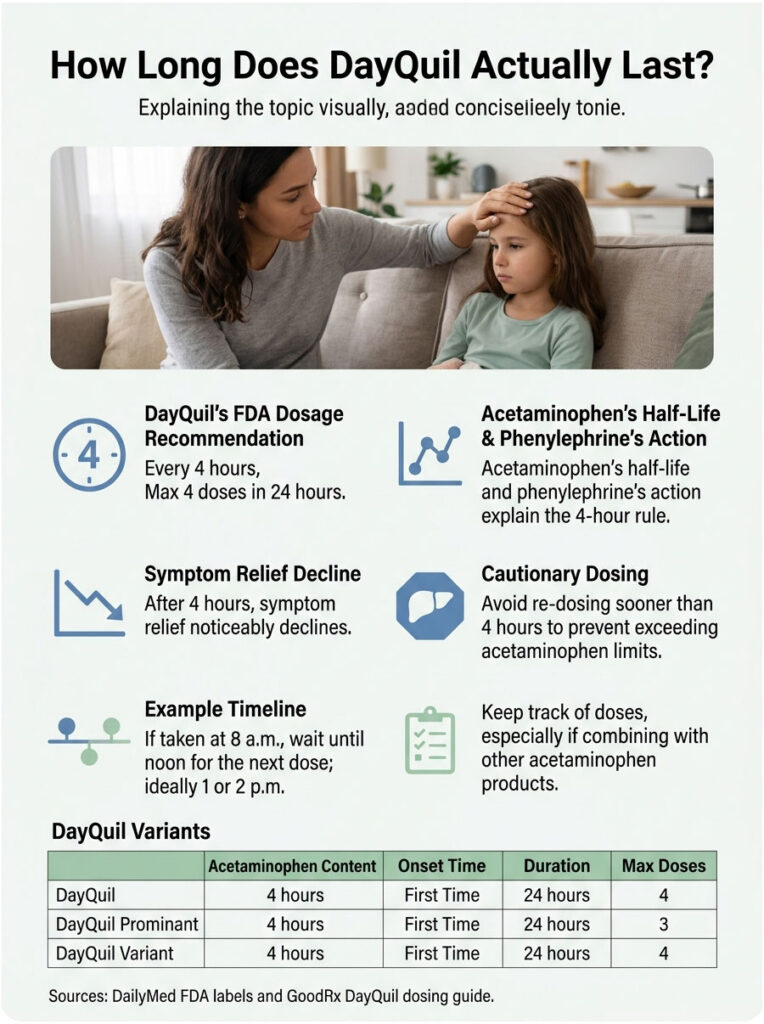
DayQuil’s FDA-approved label says dose every 4 hours, maximum 4 doses in 24 hours. That’s not arbitrary. It maps to acetaminophen’s half-life and phenylephrine’s duration of action.
By the 4-hour mark, about half of each dose has been metabolized, and symptom control drops noticeably. Taking another dose sooner stacks the drugs and pushes you toward the 4,000 mg daily acetaminophen ceiling faster. I’ve watched people dose every 3 hours “because it felt like it was wearing off” and land over the FDA daily limit by bedtime. Don’t.
When to re-dose safely
If you took DayQuil at 8 a.m., your earliest safe next dose is noon. Ideally push to 1 or 2 p.m. if you’re holding up. Track your doses on paper or a phone note, especially if you’re also taking any other acetaminophen-containing product like Tylenol, Excedrin, or Theraflu.
Table 2: DayQuil Variants, Onset, and Duration
| Product | Acetaminophen per Dose | Typical Onset | Duration of Relief | Max Doses / 24 hrs |
| DayQuil Cold & Flu LiquiCaps | 650 mg (2 caps) | 15-30 min | ~4 hrs | 4 |
| DayQuil Cold & Flu Liquid (30 mL) | 650 mg | 10-20 min | ~4 hrs | 4 |
| DayQuil Severe LiquiCaps | 650 mg (2 caps) | 15-30 min | ~4 hrs | 4 |
| DayQuil Intense Flu | 1,000 mg (30 mL) | 15-30 min | up to 6 hrs | 3 |
| DayQuil High Blood Pressure | 650 mg (30 mL) | 15-30 min | ~4 hrs | 4 |
| DayQuil Cough DM (kids 6+) | 0 mg | 20-30 min | up to 8 hrs | 6 (ages 12+) |
Source: DailyMed FDA labels and GoodRx DayQuil dosing guide.
When DayQuil Isn’t Working: Troubleshooting
Most top-ranked articles skip this section entirely. Here’s what I tell friends when they text me at 45 minutes post-dose saying “this stuff is broken.”
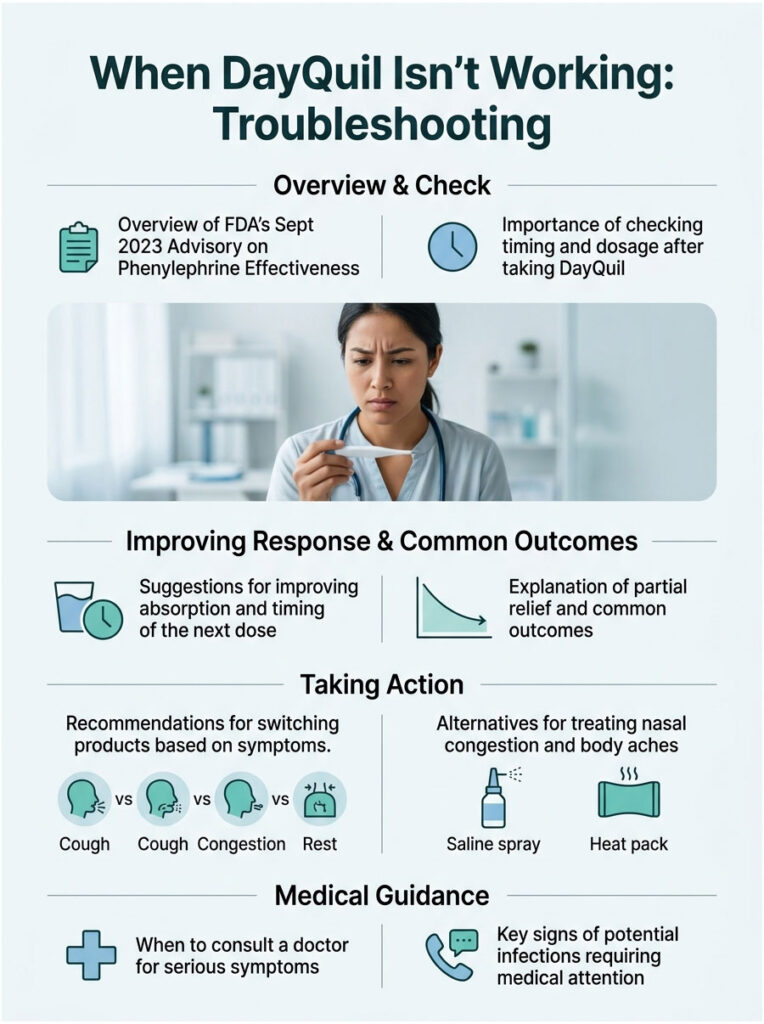
The 2023 FDA phenylephrine effectiveness advisory (read this first)
In September 2023, an FDA advisory committee concluded that oral phenylephrine, the decongestant in standard DayQuil, is no better than placebo at clearing nasal congestion for most adults. The drug is still on shelves as of April 2026, and final FDA action is pending.
Translation: if DayQuil fails specifically at the congestion piece, you’re not imagining it. Pseudoephedrine (sold behind the pharmacy counter as Sudafed) or a saline rinse plus a short course of oxymetazoline nasal spray (Afrin, 3 days max) are more effective for nasal congestion relief.
It’s been 45 minutes and nothing
First, check the timer. 45 minutes feels long when you’re miserable, but it’s within normal range on a full stomach. Second, drink a glass of water. Third, confirm you actually took the full dose (2 LiquiCaps or 30 mL, not 1 cap or 15 mL).
If it’s 60 minutes and you feel nothing at all, the dose may have been under-absorbed. Don’t take more. Wait out the 4-hour window and try again with less food in your stomach.
Partial relief only
Partial relief usually means one ingredient worked and another didn’t. Fever gone, nose still stuffed? The acetaminophen hit its job but the phenylephrine didn’t move the needle for you. Cough calm, body still aching? Reverse problem.
This is normal biology, not a DayQuil failure. Given the phenylephrine research above, nose-only failures are the most common partial outcome.
When to switch products (or see a doctor)
Switch products if you’ve had two full doses across 8 hours and symptoms haven’t budged. Try pseudoephedrine-based decongestant for congestion, plain guaifenesin (Mucinex) for chest mucus, or plain ibuprofen if fever and body aches are the main complaint.
Call your doctor if fever climbs past 103°F and won’t come down, symptoms last more than 10 days, you develop chest pain or shortness of breath, or your cough produces yellow-green or bloody phlegm. Those are infection signals, not “DayQuil isn’t strong enough” signals.
DayQuil Severe vs Regular: Does It Work Faster or Stronger?
Short answer: same onset speed, different symptom coverage.
The guaifenesin factor
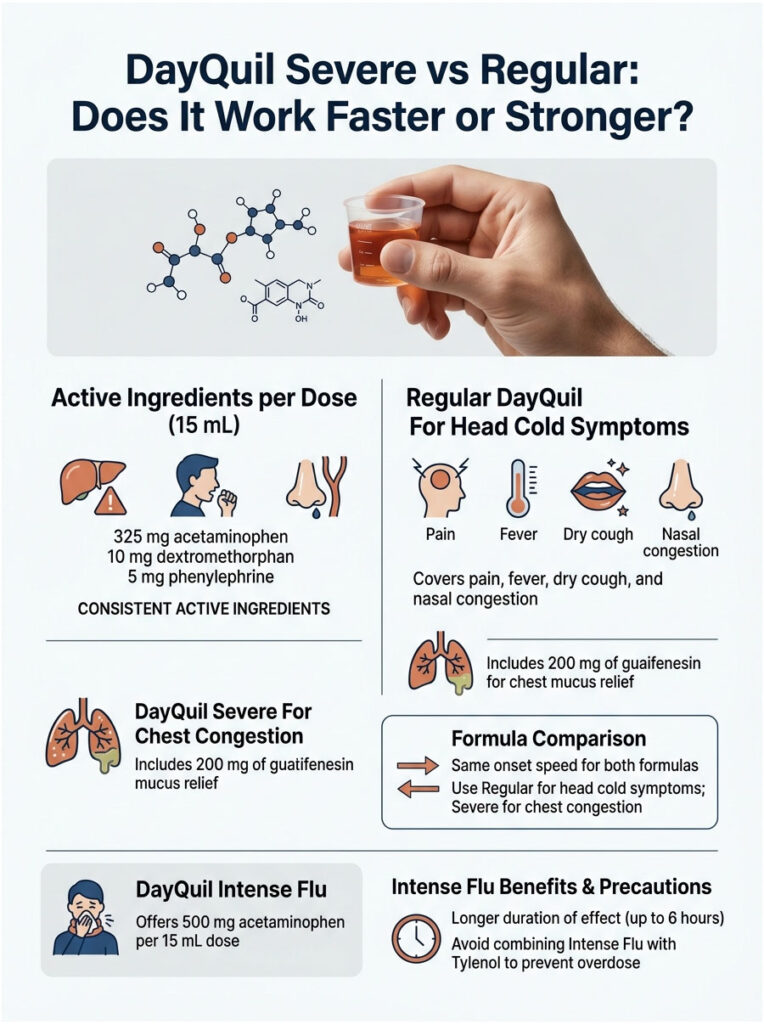
Regular DayQuil Cold & Flu handles pain, fever, dry cough, and nasal congestion. DayQuil Severe adds 200 mg of guaifenesin, the expectorant that thins chest mucus.
Same 325 mg acetaminophen per capsule, same 10 mg dextromethorphan, same 5 mg phenylephrine. If your cold stayed in your head (runny nose, sneezing, headache), regular DayQuil is fine. If it moved into your chest (wet cough, chest congestion, feeling gunky), pick Severe.
DayQuil Intense Flu (the higher-strength version)
DayQuil Intense Flu liquid packs 500 mg of acetaminophen per 15 mL dose (1,000 mg per adult 30 mL dose) plus 15 mg of dextromethorphan. Onset is the same 15 to 30 minutes, but duration stretches closer to 6 hours. You only get 3 doses in 24 hours instead of 4.
Pick Intense if your fever is high and aches are severe. Don’t stack it with Tylenol, which would push your acetaminophen past the daily ceiling fast.
When to pick which
- Head cold, dry cough, mild aches: regular DayQuil.
- Chest cold, wet cough, mucus: DayQuil Severe.
- Flu with 102°F+ fever and deep body aches: DayQuil Intense.
- High blood pressure: DayQuil High Blood Pressure (no phenylephrine).
Scenarios: What Should You Actually Do?
Most real-life timing questions sound like “I took a dose X minutes ago and Y is happening, now what?”
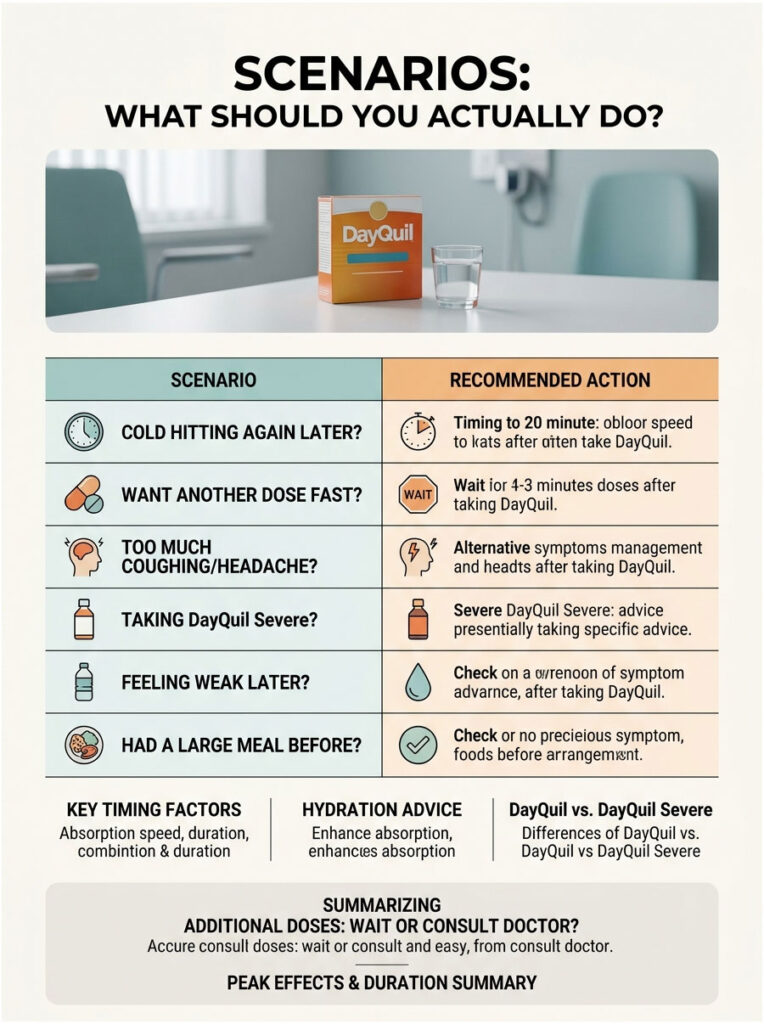
Table 3: Scenario → Recommended Action
| Your Scenario | What You Should Do | Why |
| Took DayQuil 10 minutes ago, feel nothing | Wait. Onset is 15-30 minutes | Drug hasn’t absorbed yet |
| 45 minutes in, only partial relief | Drink water, wait to 90 minutes | Phenylephrine peaks later |
| 60 minutes in, nothing at all | Don’t re-dose. Wait full 4 hours, then try again on emptier stomach | Something blocked absorption |
| 3 hours in, symptoms creeping back | Hold until hour 4, then re-dose | Half-life says effect is fading |
| Took at 8 a.m., now 11 a.m. and fever is back | Wait until noon, take next dose then | 4-hour minimum between doses |
| Took DayQuil Severe, mucus still thick | Drink 16 oz water, wait 30 more minutes | Guaifenesin needs water to thin mucus |
Frequently Asked Questions
How long until DayQuil starts working?
DayQuil usually starts working within 15 to 30 minutes after you swallow the dose. Peak effect hits at 1 to 2 hours, depending on which ingredient is targeting which symptom. Liquid versions tend to kick in a few minutes sooner than LiquiCaps because the drug is already dissolved when it reaches your stomach.
Can DayQuil work in 10 minutes?
Under ideal conditions (empty stomach, liquid form, fast metabolism, well-hydrated, lower body weight), some people notice the first hint of relief at 10 to 15 minutes. That’s the early edge of the absorption curve. Full relief, with fever dropping and congestion easing noticeably, almost always takes at least 30 minutes.
Why doesn’t DayQuil feel like it’s working?
Three common reasons. First, you haven’t waited long enough (give it 45 to 60 minutes). Second, food in your stomach slowed absorption by 20 to 30 minutes. Third, the 2023 FDA advisory flagged oral phenylephrine as no better than placebo for many people, so congestion relief may genuinely be weak for your biology.
Do LiquiCaps work faster than liquid?
No. Liquid actually edges out LiquiCaps by roughly 5 to 10 minutes because the drug is already dissolved and ready to absorb. LiquiCaps come in at about 15 to 25 minutes; liquid closer to 10 to 20 minutes. The gap is small, but if speed matters (like a midnight fever spike), reach for the liquid bottle.
Does eating before DayQuil slow it down?
Yes. A full meal, especially a fatty one, can delay DayQuil onset by 20 to 30 minutes. Food slows gastric emptying, which keeps the drug sitting in your stomach longer before absorption starts in the small intestine. For fastest relief, take DayQuil with water on a stomach that’s been empty for at least 2 hours.
How long before DayQuil wears off?
DayQuil relief holds for roughly 4 hours per dose. Acetaminophen fades first (shortest half-life at 1.25 to 3 hours), followed by phenylephrine (2 to 3 hours), and dextromethorphan lingering longest (2 to 4 hours). Most people feel symptoms creeping back at the 3.5-to-4-hour mark.
Can I take a second dose if the first didn’t work?
No, not before the 4-hour minimum window. Taking a second dose early stacks acetaminophen and pushes you toward the 4,000 mg daily ceiling faster, raising liver damage risk. If the first dose felt weak, drink water, wait the full 4 hours, and try again, ideally on less food this time.
How long does DayQuil stay in your system?
Acetaminophen and phenylephrine clear within 6 to 12 hours of your last dose (half-lives of 2 to 3 hours). Dextromethorphan lingers longest with a 2-to-4-hour half-life and can be detectable for 24 to 36 hours. Therapeutic effect fades around hour 4, but full systemic clearance takes considerably longer.
Is DayQuil Severe faster than regular DayQuil?
No. DayQuil Severe has the same onset as regular DayQuil (15 to 30 minutes) because it shares the same three main ingredients at the same amounts. It adds 200 mg of guaifenesin to thin chest mucus. Severe isn’t faster, it’s broader. Pick it when congestion has moved into your chest.
Should I drink water with DayQuil to help it absorb?
Yes. An 8-ounce glass of water with your dose speeds gastric emptying and activates guaifenesin (in DayQuil Severe) by giving it fluid to thin mucus. Good hydration also improves phenylephrine’s decongestant effect. Water is the cheapest way to make DayQuil work a little faster and a little better.
Can kids take DayQuil, and does it work the same way?
Children’s DayQuil products exist for ages 6 and up (with pediatrician approval for ages 4 to 5), with lower acetaminophen (160 mg per 15 mL) and adjusted other ingredients. Onset is the same 15-to-30-minute window. Do not give adult DayQuil to kids under 12. For kids under 4, ask the pediatrician first.
What if I drank coffee or grapefruit juice before DayQuil?
Coffee doesn’t meaningfully change DayQuil onset. Grapefruit juice can raise dextromethorphan levels in your blood by slowing its breakdown, which can increase side effects like nervousness or dizziness without speeding relief. Skip grapefruit juice on DayQuil days. Water is the better companion.
Medical Disclaimer: This article is for general information only and isn’t a substitute for advice from your doctor or pharmacist. Onset times and durations vary with age, body weight, liver health, other medications, and whether you’ve eaten. If symptoms worsen or last more than 7 days, or fever tops 103°F, call your doctor. For suspected overdose, call Poison Control at 1-800-222-1222.
References
- DailyMed: Vicks DayQuil Cold and Flu Drug Label (FDA)
- Vicks Official DayQuil FAQ
- PharmacistAnswers: How Quickly Does DayQuil Work? (Dr. Brian Staiger, PharmD)
- NCBI StatPearls: Acetaminophen Pharmacology
- NCBI StatPearls: Dextromethorphan
- NCBI StatPearls: Phenylephrine
- Medical News Today: DayQuil Medication Overview
- Healthline: DayQuil Uses and Warnings
- GoodRx: DayQuil Dosage Guide for Adults and Children
- FDA: Don’t Double Up on Acetaminophen