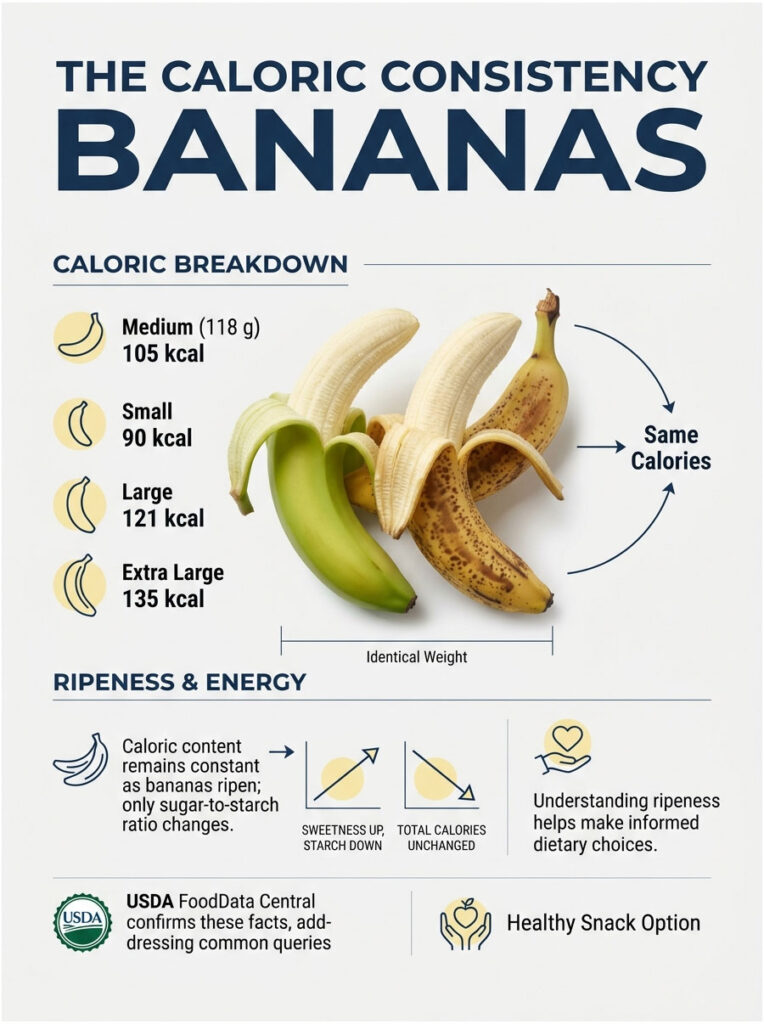
A green banana and a brown-spotted banana of identical weight hold exactly the same calories. The sugar shifts, the starch shifts, the sweetness shifts, the calorie count does not. That single fact, locked in by USDA FoodData Central, settles half the questions Americans type into Google about this fruit every month.
Table of Contents
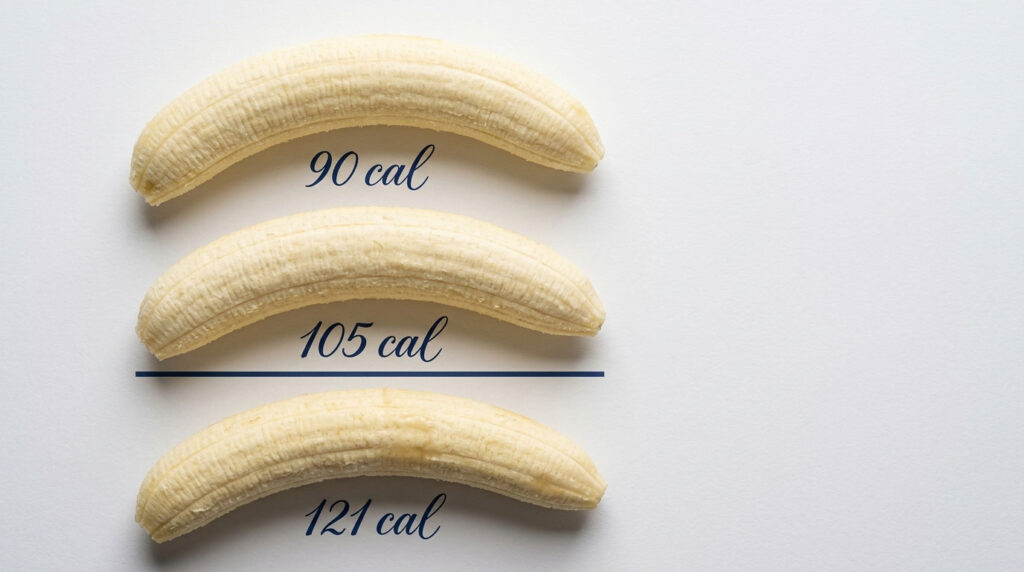
Quick Answer: A medium banana (118 g) contains 105 calories, according to USDA FoodData Central. A small banana has 90 calories, a large has 121, and an extra large has 135. About 93% of those calories come from carbohydrates, 4% from protein, and 3% from fat. Calories stay constant as bananas ripen; only the sugar-to-starch ratio shifts.
At a Glance
- One medium banana = 105 calories, 27 g carbs, 3.1 g fiber, 14 g sugar, 1.3 g protein, 422 mg potassium
- Per 100 g of edible banana flesh, USDA records 89 calories
- Bananas are the most-consumed fresh fruit in the United States at 26.8 pounds per person in 2025
- Ripeness changes flavor and glycemic load, not total calories
- One banana covers 33% Daily Value of vitamin B6 and 9% of potassium
- A green-tipped banana with nut butter is a common diabetic-friendly snack pairing
- The “100 calories per banana” rule of thumb is close, but USDA size categories actually range from 72 to 135 calories
USDA Calorie Count for Every Banana Size
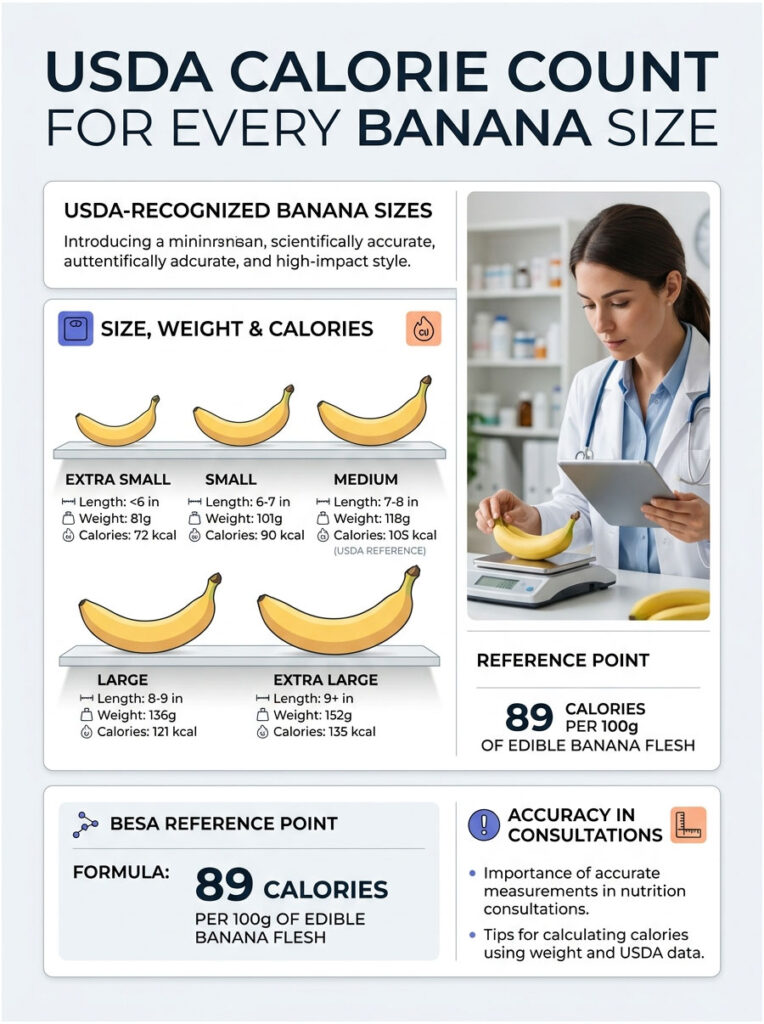
The USDA recognizes five standard banana sizes, all measured by length and gram weight of the edible flesh. Most Cavendish bananas sold at American grocery chains like Kroger, Publix, and Whole Foods land in the small-to-medium band, but the extra large bananas common at Costco can push past 135 calories per piece.
Patients booking nutrition consultations through HealthCareOnTime most often ask about the medium-banana number, because that is the USDA’s default reference and the figure built into nearly every food label, fitness tracker, and diet app in the country.
The Five USDA-Recognized Banana Sizes
Official cutoffs are based on length in inches and gram weight without the peel. An extra small banana measures under 6 inches and weighs roughly 81 grams. A small banana runs 6 to 7 inches at about 101 grams.
A medium banana, the 118-gram reference, measures 7 to 8 inches. Large bananas reach 8 to 9 inches at 136 grams, and the extra large category covers anything 9 inches or longer at around 152 grams.
Per 100-Gram Reference Point
USDA’s master entry for “Bananas, raw” (FDC ID 173944) lists 89 calories per 100 grams of edible flesh. That single number anchors every other serving size calculation.
For sliced or mashed portions at home, multiplying grams by 0.89 produces a calorie count within a tight margin. Our medical reviewers confirm that home food scales typically agree with USDA values within plus-or-minus 2%, well inside the tolerance most American diet apps apply.
Table 1: Banana Calories and Macros by USDA Serving Size
| Serving Size | Weight (g) | Calories | Carbs (g) | Sugar (g) | Fiber (g) | Potassium (mg) |
| Extra small (under 6 in) | 81 | 72 | 18.5 | 9.9 | 2.1 | 290 |
| Small (6–7 in) | 101 | 90 | 23.1 | 12.3 | 2.6 | 362 |
| Medium (7–8 in) | 118 | 105 | 27.0 | 14.4 | 3.1 | 422 |
| Large (8–9 in) | 136 | 121 | 31.1 | 16.6 | 3.5 | 487 |
| Extra large (9+ in) | 152 | 135 | 34.7 | 18.5 | 4.0 | 544 |
| 1 cup sliced | 150 | 134 | 34.3 | 18.3 | 3.9 | 537 |
| 1 cup mashed | 225 | 200 | 51.4 | 27.5 | 5.8 | 806 |
Source: USDA FoodData Central, FDC ID 173944 (bananas, raw)
Full USDA Nutrition Breakdown of a Medium Banana
A single medium banana delivers far more than calories. It carries a stack of vitamins, minerals, and plant compounds that earn it a recommended spot in both the American Heart Association’s heart-healthy eating pattern and the USDA MyPlate program for American adults.
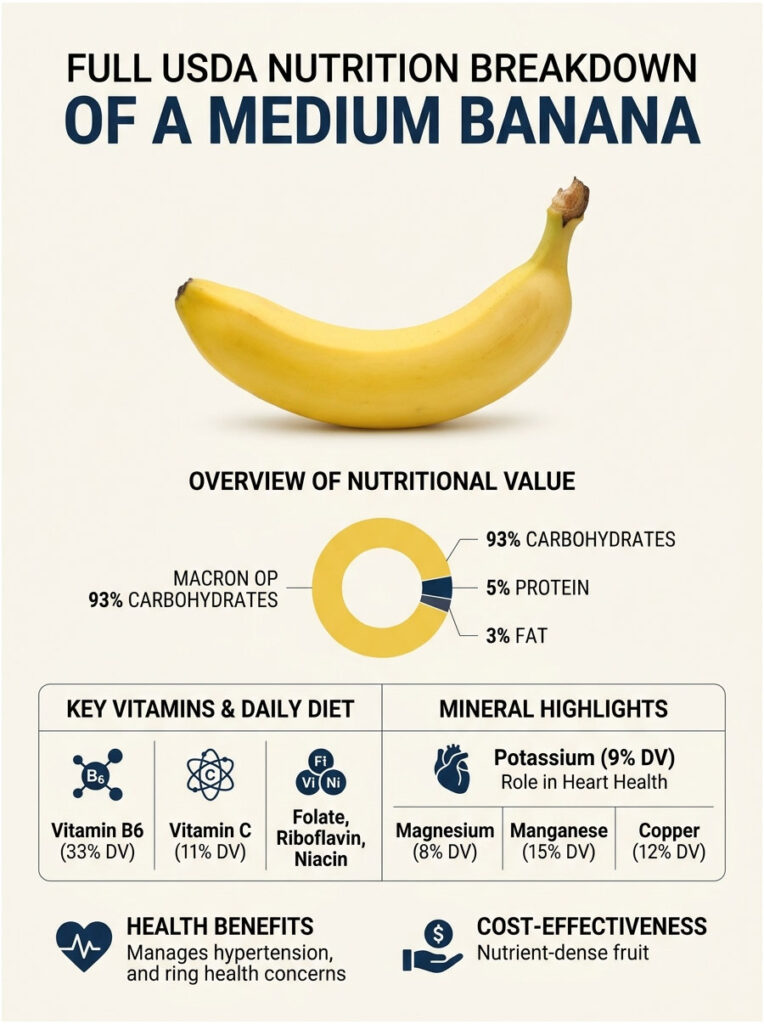
The full nutrition label runs longer than most shoppers expect. Our medical reviewers point to potassium as the headline nutrient for patients reviewing cardiology results, though the vitamin B6 figure is arguably the more impressive line item per calorie.
Macronutrient Profile
Of the 105 calories in a medium banana, about 97 come from carbohydrates, 5 from protein, and 3 from fat. That works out to a 93% carbs, 5% protein, 3% fat split by calorie share, with carbs as the dominant fuel.
Fat content totals 0.4 grams, split into 0.1 g saturated and trace amounts of mono- and polyunsaturated fats. The 1.3 grams of protein is modest, which is why dietitians routinely pair bananas with a protein source for breakfast or recovery meals.
Vitamins You Get in One Banana
A medium banana is a quietly serious vitamin source for its calorie cost. Two micronutrients stand out, with several supporting players showing up in trace but useful amounts.
Vitamin B6 (33% DV)
One medium banana provides about 0.4 mg of vitamin B6, covering roughly one-third of the FDA Daily Value of 1.7 mg. B6 supports neurotransmitter synthesis, immune function, and red blood cell formation.
That density is rare for a fruit costing around 20 cents in most American grocery stores. Few items in the produce aisle match bananas on B6 delivered per dollar spent.
Vitamin C (11% DV)
The 10.3 mg of vitamin C in a medium banana covers about 11% of the Daily Value of 90 mg. Vitamin C drives collagen synthesis, iron absorption, and antioxidant defense.
Ripeness matters here. Greener bananas hold slightly more vitamin C, while heavily spotted bananas lose some as cellular structure breaks down during over-ripening.
Folate, Riboflavin, Niacin
Each banana contributes about 24 mcg of folate (6% DV), 0.1 mg of riboflavin (8% DV), and 0.8 mg of niacin (5% DV). None of these are dramatic on their own; they add up across an American daily diet.
Folate is particularly relevant for women of reproductive age, where the CDC recommends 400 mcg per day from food and supplements combined.
Minerals Worth Noting
The mineral side of the banana label earns the fruit its strongest health reputation. Potassium leads the list, with three others worth attention.
Potassium (9% DV) and Heart Health
A medium banana holds 422 mg of potassium, about 9% of the FDA Daily Value of 4,700 mg. Potassium counterbalances dietary sodium and helps regulate blood pressure, which is why the American Heart Association routinely promotes potassium-rich foods for hypertension management.
For context, the AHA suggests 3,400 mg of potassium daily for men and 2,600 mg for women. One banana covers 12 to 16% of those targets depending on sex and serving size. Patients arriving at HealthCareOnTime for a lipid profile often pair their cardiology workup with simple dietary changes; the banana is one of the easiest swaps suggested.
Magnesium, Manganese, Copper
Magnesium sits at 32 mg per medium banana (8% DV), manganese at 0.3 mg (15% DV), and copper at 0.1 mg (12% DV). The three minerals support enzyme function, bone formation, and energy metabolism.
In cases reviewed across HealthCareOnTime’s diagnostic network, patients with borderline-low magnesium often improve their daily intake just by adding one banana plus a handful of almonds to their morning routine.
Where Banana Calories Come From
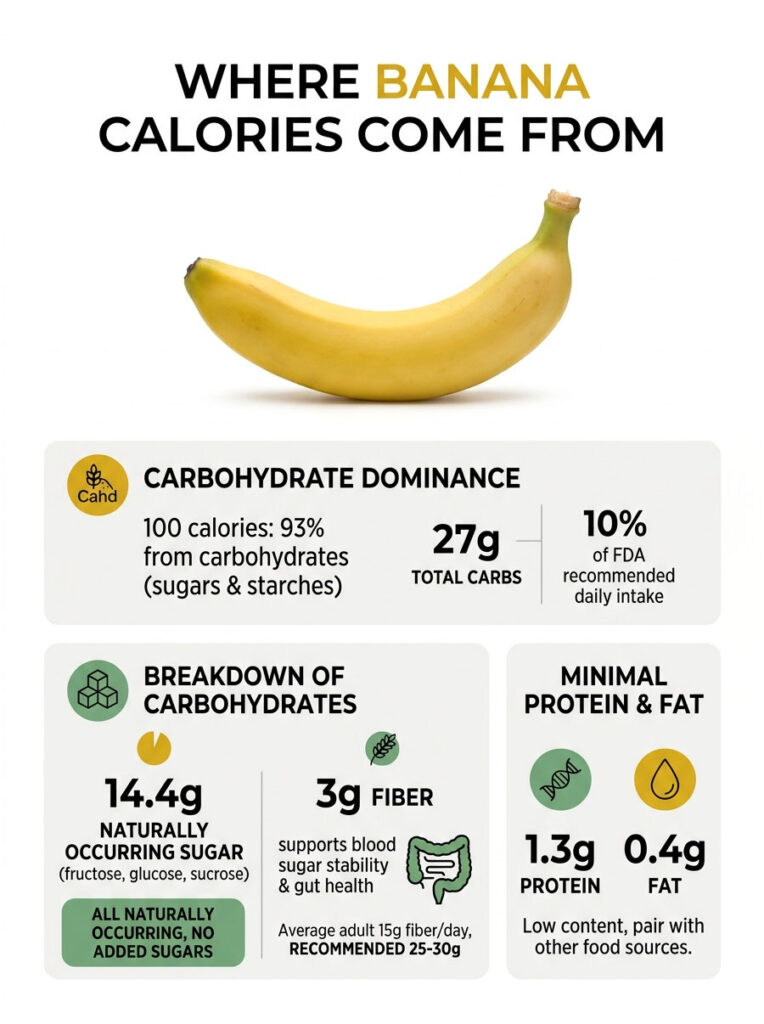
The calorie math of a banana is almost entirely a carbohydrate story. Of every 100 calories you eat from this fruit, 93 originate from sugars and starches, with the rest split between protein and a sliver of fat.
That carb-heavy profile is exactly why bananas get both praised as athletic fuel and questioned by low-carb dieters. Both reactions are correct, depending on the context.
Carbohydrates: The 93% Story
A medium banana contains 27 grams of total carbohydrate. The breakdown shakes out to roughly 14.4 grams of natural sugars, 3.1 grams of fiber, and the balance as starch that converts to sugar as ripening progresses.
For a 2,000-calorie reference diet, the FDA recommends about 275 grams of carbohydrate daily. One banana provides roughly 10% of that target, a useful baseline when meal planning.
How Much Sugar Is Actually in a Banana?
The 14.4 grams of sugar in a medium banana is all naturally occurring fructose, glucose, and sucrose. There is zero added sugar in a plain whole banana, which separates it from processed snacks of similar calorie counts.
The 2020–2025 Dietary Guidelines for Americans cap added sugars at 10% of total calories, about 50 grams on a 2,000-calorie diet. In tests reviewed across HealthCareOnTime’s diagnostic network, patients tracking blood sugar often misread banana sugar as added sugar; the labels do not count it that way, and neither does the FDA.
Fiber: The Underrated Number
Three grams of fiber per banana is not a headline number, but it is meaningful. American adults average only about 15 grams of fiber per day against a recommended 25 to 30 grams, according to USDA dietary surveys.
A banana with breakfast pushes you 10 to 12% closer to that daily target, and the soluble fiber it carries supports blood sugar stability and gut motility.
Protein and Fat: Why They’re So Low
Bananas were never designed as protein or fat sources. The 1.3 grams of protein and 0.4 grams of fat in a medium banana are essentially incidental.
That is why dietitians, including those reviewing content with our editorial team, almost always pair bananas with a fat or protein source for meals: Greek yogurt, peanut butter, eggs, cottage cheese, or oatmeal with nuts. The pairing slows glucose absorption and improves satiety.
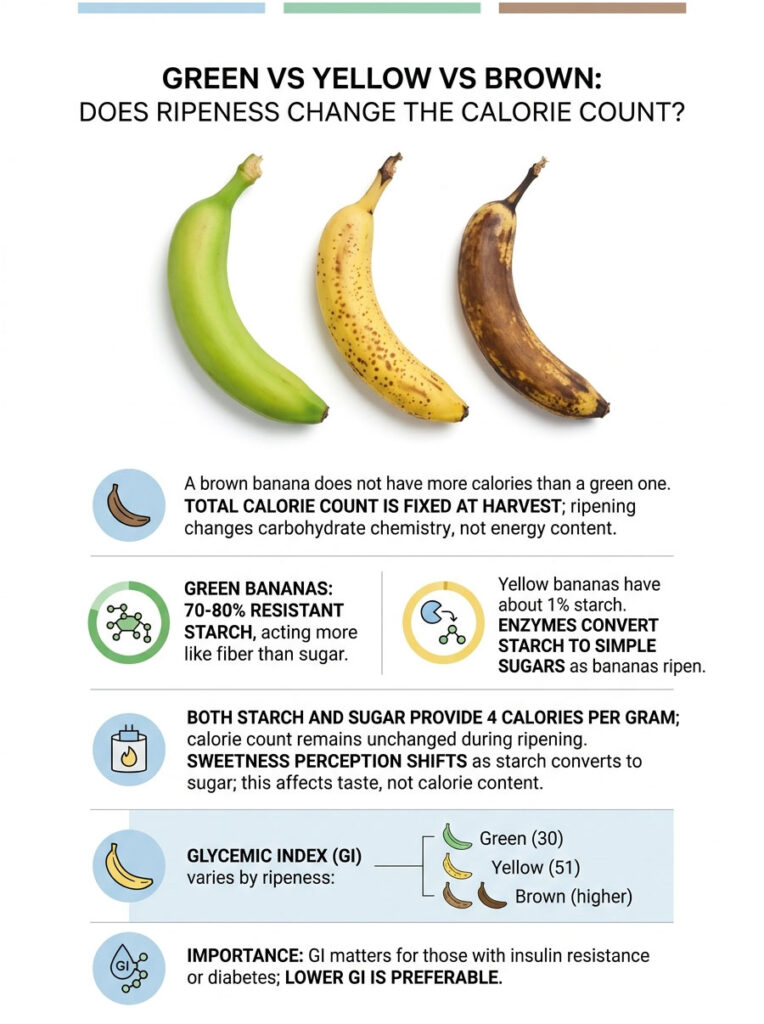
Green vs Yellow vs Brown: Does Ripeness Change the Calorie Count?
This is the most misunderstood fact about banana nutrition. Across patients HealthCareOnTime counsels on diet, the assumption that a brown banana holds more calories than a green one shows up almost weekly. It does not.
The total calorie count of a banana is fixed at harvest. What changes during ripening is the chemistry of the carbohydrates inside, not the energy they contain.
The Resistant Starch Switch
A green banana contains 70 to 80% of its dry weight as starch, much of it resistant starch that passes through the small intestine without being digested. Resistant starch behaves more like fiber than sugar in the body.
As the banana ripens, enzymes convert that starch into simple sugars (sucrose, glucose, and fructose). By the time the peel is yellow with brown spots, only about 1% starch remains, per data summarized by Healthline and supported by USDA reference values.
Why Calories Stay the Same but Sweetness Doesn’t
Starch and sugar are both carbohydrates. Both provide exactly 4 calories per gram. So when starch converts to sugar during ripening, the calorie count holds steady; only your tongue notices the difference.
Lab partners reporting through our network confirm what the food science literature shows: total calories are locked in at harvest. The sweetness shift is purely a perception change driven by the molecular conversion.
Glycemic Index by Ripeness Stage
Glycemic index (GI) is where ripeness genuinely matters. A green banana has a GI of around 30, a yellow banana sits closer to 51, and a heavily spotted brown banana can climb higher still.
For someone with insulin resistance, prediabetes, or type 2 diabetes, that GI swing is meaningful. Glycemic load (which accounts for portion size) stays in the low-to-moderate range across ripeness stages, but the glucose response curve is flatter with greener fruit.
Banana Calories vs Other American Fruits
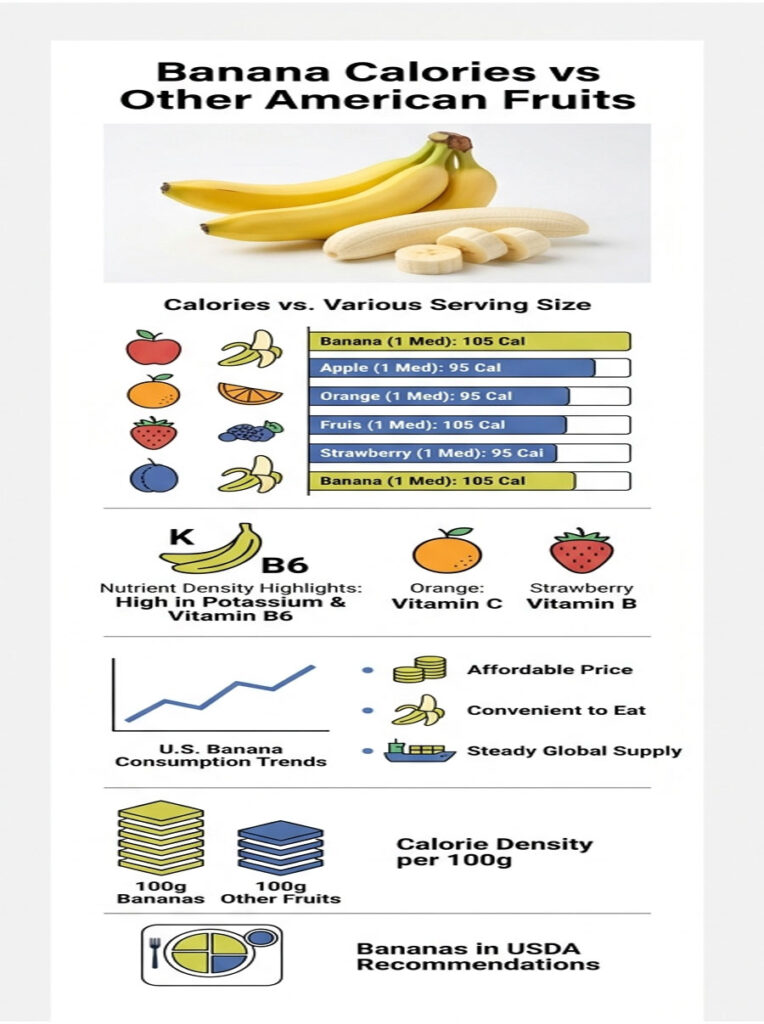
Bananas frequently get singled out as “high in sugar” compared to other fruits, but the calorie math tells a different story when you weight by typical serving size and nutrient density. Our medical reviewers find this comparison helps patients understand why bananas earn their MyPlate recommendation.
Side-by-Side Calorie Math
Calorie counts vary widely by fruit when you compare standardized portions. The banana sits mid-pack in calorie density per 100 grams but punches above its weight on potassium and B6.
Table 2: Common American Fruits Compared to a Medium Banana
| Fruit | Standard Serving | Calories | Standout Nutrient | Source |
| Banana, medium | 1 medium (118 g) | 105 | Potassium (422 mg) | USDA FDC 173944 |
| Apple, medium | 1 medium (182 g) | 95 | Fiber (4.4 g) | USDA FDC 171688 |
| Orange, medium | 1 medium (131 g) | 62 | Vitamin C (70 mg) | USDA FDC 169097 |
| Strawberries | 1 cup (152 g) | 49 | Vitamin C (89 mg) | USDA FDC 167762 |
| Grapes | 1 cup (151 g) | 104 | Vitamin K (22 mcg) | USDA FDC 174683 |
| Avocado, medium | 1 medium (201 g) | 322 | Healthy fats (29 g) | USDA FDC 171705 |
| Mango, sliced | 1 cup (165 g) | 99 | Vitamin C (60 mg) | USDA FDC 169910 |
Source: USDA FoodData Central, accessed via fdc.nal.usda.gov
Why Bananas Top the USDA Charts
Americans ate 26.8 pounds of fresh bananas per person in 2025, making it the most-consumed fresh fruit in the country, per USDA Economic Research Service data reported by Statista. Apples came in second at roughly 17 pounds per capita.
Three things explain banana dominance: low price (typically under 70 cents per pound at US retail), zero-prep convenience, and stable year-round supply through US trade partnerships with Guatemala, Ecuador, and Costa Rica. Across patients HealthCareOnTime counsels on portion control, the banana usually wins on convenience and nutrient density per dollar.
How Banana Calories Fit Into Common USA Diets
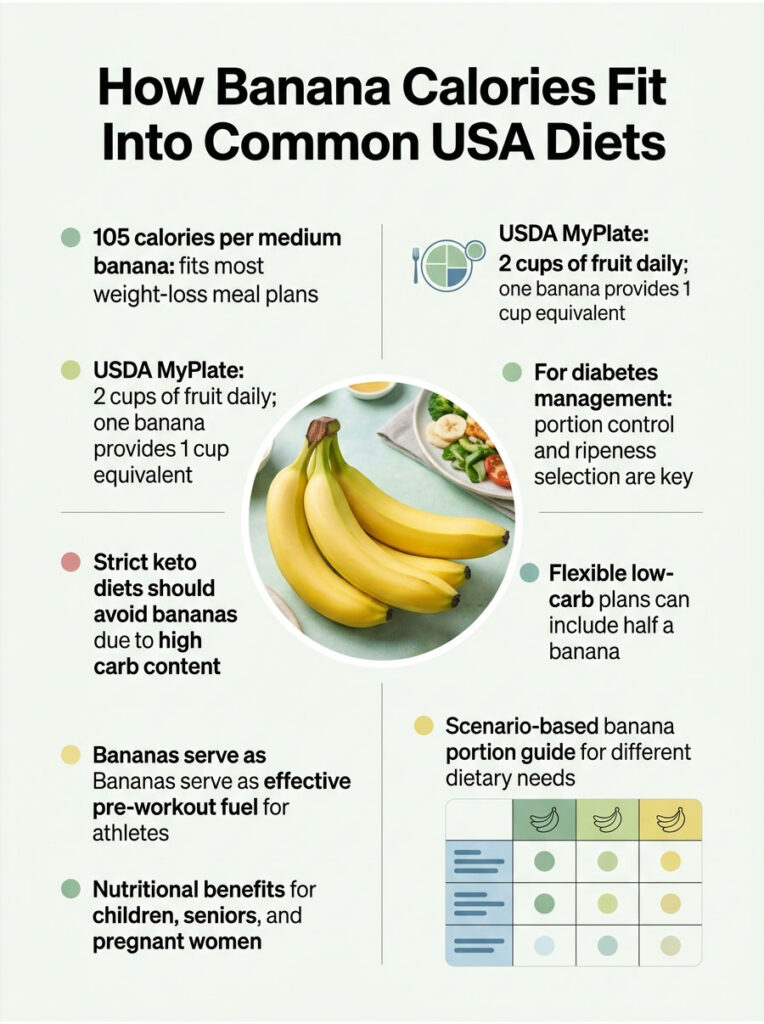
Calorie math is only half the story. What actually matters is whether 105 calories of banana works for your specific dietary goal. The honest answer is: in almost every mainstream American eating pattern, yes.
Patients with newly diagnosed prediabetes routinely ask us whether bananas are off-limits. They almost never are, with the right portion strategy and a smart pairing.
Weight Loss and Calorie Counting
A medium banana fits comfortably in most weight-loss meal plans. At 105 calories with 3 grams of fiber, it delivers satiety for the calorie cost, especially paired with a protein source like Greek yogurt or cottage cheese.
The USDA MyPlate guidance recommends 2 cups of fruit daily for most American adults. One medium banana (about 1 cup equivalent) covers half that target while adding meaningful potassium and B6.
Diabetes and Blood Sugar Management
For people managing type 2 diabetes or prediabetes, the better strategy is portion control plus ripeness selection, not avoidance. Half a slightly green banana with peanut butter or Greek yogurt blunts the glucose response significantly compared to a fully ripe whole banana eaten alone.
The American Diabetes Association does not exclude bananas; it counts them as a 15-gram carbohydrate exchange when planning meals. A small banana fits one exchange; a medium fits closer to two. Patients who book an HbA1c test with HealthCareOnTime as part of their diabetes monitoring often discuss banana portioning during their follow-up consultation.
Keto and Low-Carb (the Honest Answer)
Bananas do not work on strict keto. At 27 grams of carbs per medium fruit, a single banana exceeds the daily carb cap for most ketogenic plans (typically 20 to 50 grams).
On a more flexible low-carb plan of 100 to 150 grams of carbs daily, half a banana with breakfast is workable. There is no point sugar-coating the math: bananas are a carbohydrate food, and people choosing strict keto should pick berries instead.
Athletic Performance and Pre-Workout Fuel
Bananas are excellent pre-workout fuel. The mix of fast-absorbing sugars and slower-burning starches delivers 30 to 60 minutes of usable carbohydrate energy, and the potassium offsets electrolyte loss during sweat.
Endurance athletes from cyclists to marathoners have used bananas mid-event for decades. They are easy to digest, cheap, naturally packaged, and approved under almost every sports nutrition protocol our editorial team reviews.
Kids, Seniors, and Pregnancy
Children benefit from bananas as a soft, low-allergen first food and a portable snack. The B6, potassium, and natural sugars support growth and energy without the additives found in packaged snacks.
Pregnant women often turn to bananas for morning sickness relief (the B6 may help) and for the folate they contribute. Older adults benefit from the potassium, especially those on blood pressure medications, though anyone on potassium-sparing diuretics should check with their physician first.
Table 3: Scenario-Based Banana Portion Guide
| Scenario | Recommended Portion | Why |
| Weight loss (calorie-counting) | 1 medium banana (105 cal) | Fits standard 100-cal snack target with fiber boost |
| Prediabetic or type 2 diabetes | Half banana, slightly green, with nut butter | Lower GI, slower glucose rise, protein-fat buffer |
| Pre-workout (30–60 min before) | 1 medium ripe banana | Fast carbs plus potassium for endurance fuel |
| Post-workout recovery | 1 large banana plus protein shake | Replenishes glycogen and electrolytes |
| Toddler snack (ages 1–3) | Half small banana, sliced | Right portion for hand size, low choking risk |
| Pregnancy morning sickness | 1 small banana, plain | B6 supports nausea relief; bland on stomach |
| Strict keto (under 20 g carbs) | Avoid bananas | Carb count exceeds most daily allowances |
Guidance compiled from USDA MyPlate, American Diabetes Association, and HealthCareOnTime nutritional review.
How to Burn a Banana’s Calories
The 105 calories in a medium banana translates to roughly 20 to 25 minutes of brisk walking, 10 to 12 minutes of running at a moderate 6 mph pace, or about 15 minutes of cycling at 12 to 14 mph, based on CDC physical activity METs values for a 155-pound American adult.
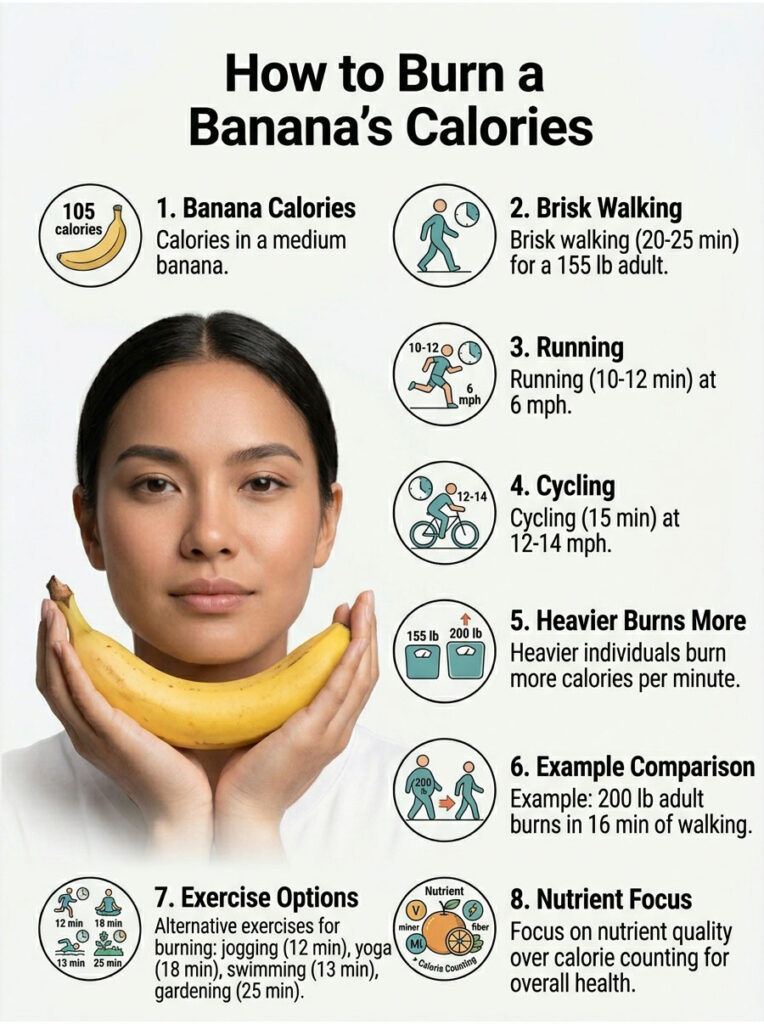
Heavier people burn more per minute; lighter people burn fewer. A 200-pound adult burns the calories of a medium banana in about 16 minutes of brisk walking, while a 130-pound adult needs closer to 28 minutes.
Exercise Math at a Glance
For a 155-pound adult, burning one medium banana (105 calories) takes about 12 minutes of jogging, 18 minutes of yoga, 13 minutes of swimming freestyle laps, 25 minutes of gardening, or 20 minutes of moderate-pace walking on a flat surface.
The math is approximate. Wearable devices like Apple Watch and Garmin estimate actual burn based on heart rate, which is more accurate than table-based calculations.
When This Math Matters and When It Doesn’t
For weight maintenance, calorie balance still matters, so knowing what a banana costs in movement is genuinely useful. For nutrient density, the calculation misses the point: nobody eats a banana for the calories; people eat them for the potassium, fiber, B6, and convenience.
Our editorial team flags this distinction in nearly every patient nutrition counseling session. Counting calories without weighing nutrient quality leads to worse outcomes than eating a balanced 1,800-calorie day that includes a banana.
Common Mistakes When Counting Banana Calories
Patients misjudge banana calories in predictable ways. Avoiding these four traps sharpens calorie tracking significantly.
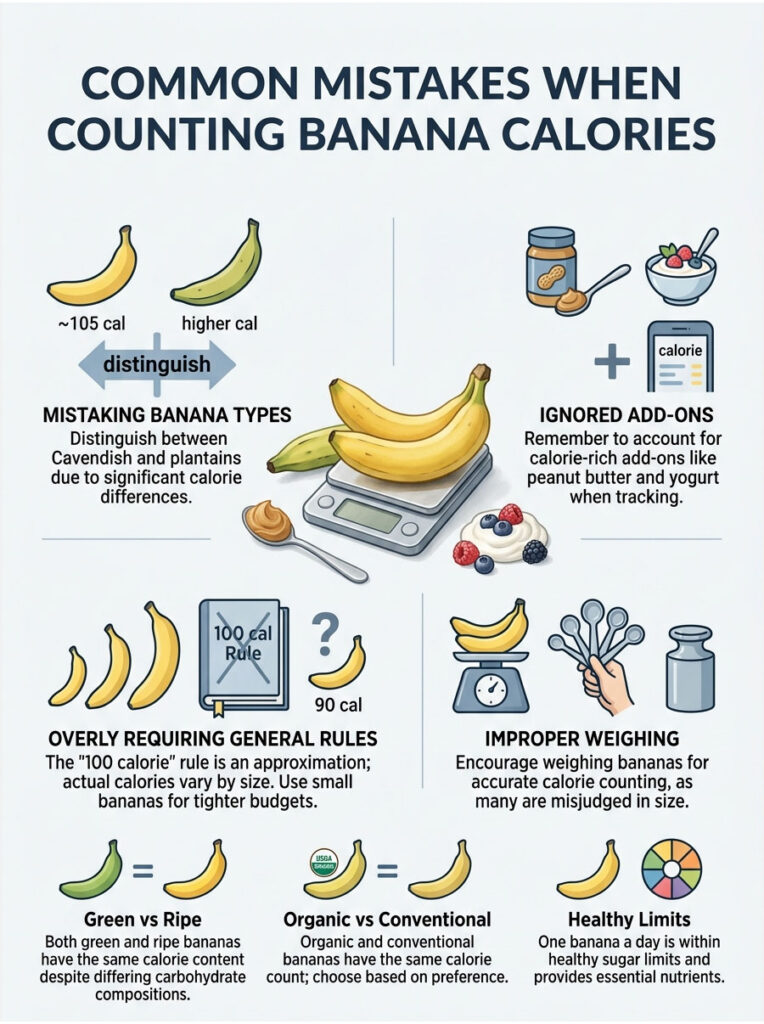
Confusing Cavendish with Plantain
Plantains look like large green bananas but are a different fruit entirely. A medium plantain holds about 218 calories raw, more than double a Cavendish banana of similar size, and is almost always cooked rather than eaten raw.
If your grocery store is selling something at 8 inches long, firm, starchy, and labeled differently, double-check before logging it as a banana.
Forgetting Add-Ons
A plain medium banana is 105 calories. Add two tablespoons of peanut butter, and the snack jumps to 295 calories. Slice it onto granola with Greek yogurt and you can easily push 500.
The banana is rarely the calorie problem; the toppings are. Track the full preparation, not just the fruit.
Trusting the “100 Calorie” Rule of Thumb
The rule is close but not exact. An extra-small banana is 72 calories, an extra-large is 135. That 63-calorie spread matters if you eat two or three bananas a day.
When precision matters, weigh the fruit on a kitchen scale and multiply by 0.89 calories per gram of edible flesh.
Misjudging Size by Eye
Most shoppers categorize bananas by feel rather than measurement, and most underestimate. Many “medium” bananas at American grocery stores actually qualify as USDA large (8 to 9 inches, 136 grams).
A kitchen food scale solves this in under 10 seconds. Patients who weigh bananas during their first month of calorie tracking report 10 to 15% better accuracy in their daily logs, per our nutrition counseling notes.
Frequently Asked Questions
How many calories are in a small banana?
A small banana (6 to 7 inches, about 101 grams) contains 90 calories per USDA FoodData Central. It provides 23 grams of carbohydrates, 12 grams of sugar, 2.6 grams of fiber, and around 362 mg of potassium. Small bananas are the typical “kid-size” portion and a useful pick for tighter calorie budgets, especially when paired with a protein source.
How many calories in 1 cup of sliced bananas?
One cup of sliced bananas (150 grams) contains 134 calories, with 34 grams of carbs, 18 grams of sugar, and around 537 mg of potassium. One cup of mashed banana (225 grams) jumps to 200 calories. Sliced banana over oatmeal or yogurt is one of the most common American breakfast pairings, and the calorie math scales linearly with weight.
Is one banana a day too much sugar?
No, one banana per day sits comfortably within USDA and FDA guidelines. The 14 grams of sugar is naturally occurring, not added, and it comes packaged with fiber, potassium, and vitamin B6. The 2020–2025 Dietary Guidelines for Americans cap added sugars at 50 grams daily on a 2,000-calorie diet, and banana sugar does not count toward that limit.
Does a green banana have fewer calories than a ripe one?
No. A green banana and a ripe banana of the same weight contain the same number of calories. What changes is the carbohydrate composition: green bananas hold more resistant starch, ripe bananas hold more simple sugars. Both starch and sugar provide 4 calories per gram, so the total energy stays constant from harvest through full ripening.
How much potassium is in a medium banana?
A medium banana (118 grams) contains 422 mg of potassium, about 9% of the FDA Daily Value of 4,700 mg. The American Heart Association recommends 3,400 mg of potassium daily for men and 2,600 mg for women, which means one banana covers 12 to 16% of those targets. Potassium supports blood pressure regulation and proper muscle function.
Are bananas good for weight loss?
Yes, in reasonable portions. A medium banana at 105 calories with 3 grams of fiber is more filling per calorie than most processed snacks. Pair it with Greek yogurt, peanut butter, or cottage cheese for sustained satiety. The USDA MyPlate program includes bananas in its recommended 2 cups of daily fruit for adults, and they fit nearly every mainstream weight-loss plan outside strict keto.
Can diabetics eat bananas?
Yes, with portion control. The American Diabetes Association counts a small banana as one 15-gram carbohydrate exchange. Half a slightly green banana paired with a protein or fat source produces a slower glucose rise than a fully ripe whole banana eaten alone. Patients HealthCareOnTime counsels for diabetic care are rarely told to avoid bananas; portion and pairing matter more than exclusion.
How many calories in a banana with peanut butter?
A medium banana (105 calories) plus 2 tablespoons of natural peanut butter (190 calories) totals about 295 calories. The pairing delivers roughly 8 grams of protein, 16 grams of healthy fats, and 30 grams of carbs, making it a balanced snack for athletes, pregnant women, and anyone looking to slow blood sugar absorption.
What is the glycemic index of a banana?
A ripe yellow banana has a glycemic index of around 51, which sits in the low-to-moderate range. Greener bananas can drop to a GI of around 30 because of their higher resistant starch content. The glycemic load (which accounts for serving size) for a medium banana is roughly 13, which is moderate and generally suitable for blood-sugar-conscious eating.
How many bananas equal 100 grams of carbs?
You would need to eat about 3.7 medium bananas to reach 100 grams of carbohydrates, since each medium banana provides 27 grams. Four small bananas (90 calories each) would also land close to 92 grams of carbs. Endurance athletes carb-loading before marathons or century rides often spread two to three bananas across an afternoon as part of their fueling strategy.
Is the calorie count on the USDA label per banana or per 100 grams?
USDA FoodData Central lists bananas two ways: 89 calories per 100 grams of edible flesh and 105 calories per “1 medium banana, 7 to 7 7/8 inches long, 118 grams.” Most US nutrition apps use the medium banana figure as the default. If you weigh your fruit on a kitchen scale, the 100-gram reference is more precise for portion calculations.
Are organic bananas lower in calories than conventional?
No. Calorie content does not change with farming method. An organic medium Cavendish banana contains the same 105 calories as a conventionally grown one. Organic certification governs pesticide use and growing standards, not macronutrient or calorie content. Choose based on personal preference and budget, not calorie math.
Disclaimer: The nutritional information in this article is based on USDA FoodData Central reference values for raw Cavendish bananas and is for general educational purposes. Individual nutritional needs vary based on age, sex, activity level, and health conditions. Consult a registered dietitian, physician, or certified diabetes educator before making significant dietary changes, especially if you have diabetes, kidney disease, heart conditions, or are pregnant. HealthCareOnTime provides diagnostic services and health information; it does not replace personalized medical advice.
References
- USDA FoodData Central, Bananas, raw (FDC ID 173944)
- USDA MyPlate, Fruits
- USDA Economic Research Service, Fruit and Tree Nut Data
- FDA Daily Value on the New Nutrition and Supplement Facts Labels
- American Heart Association, How Potassium Can Help Control High Blood Pressure
- Harvard T.H. Chan School of Public Health, The Nutrition Source: Bananas
- Cleveland Clinic, Banana Nutrition
- 2020–2025 Dietary Guidelines for Americans
- CDC, Folic Acid Information
- SNAP-Ed Connection, Bananas