The video call starts in twenty minutes. You glance at the mirror and your eyes look like you’ve been chopping onions for an hour. Maybe it’s screen strain. Maybe it’s last night’s wine. Maybe it’s spring pollen. Whatever the trigger, you need them clear, you need it now, and the kitchen-drawer Visine your roommate left behind is probably the wrong call.
Table of Contents
Here’s what actually works fast in the U.S., which OTC drops earn their shelf space, and the warning signs that mean “skip the bottle, call an eye doctor.” This guide was put together by HealthCareOnTime’s editorial medical team using current FDA labeling, American Academy of Ophthalmology guidance, and published U.S. prevalence data.
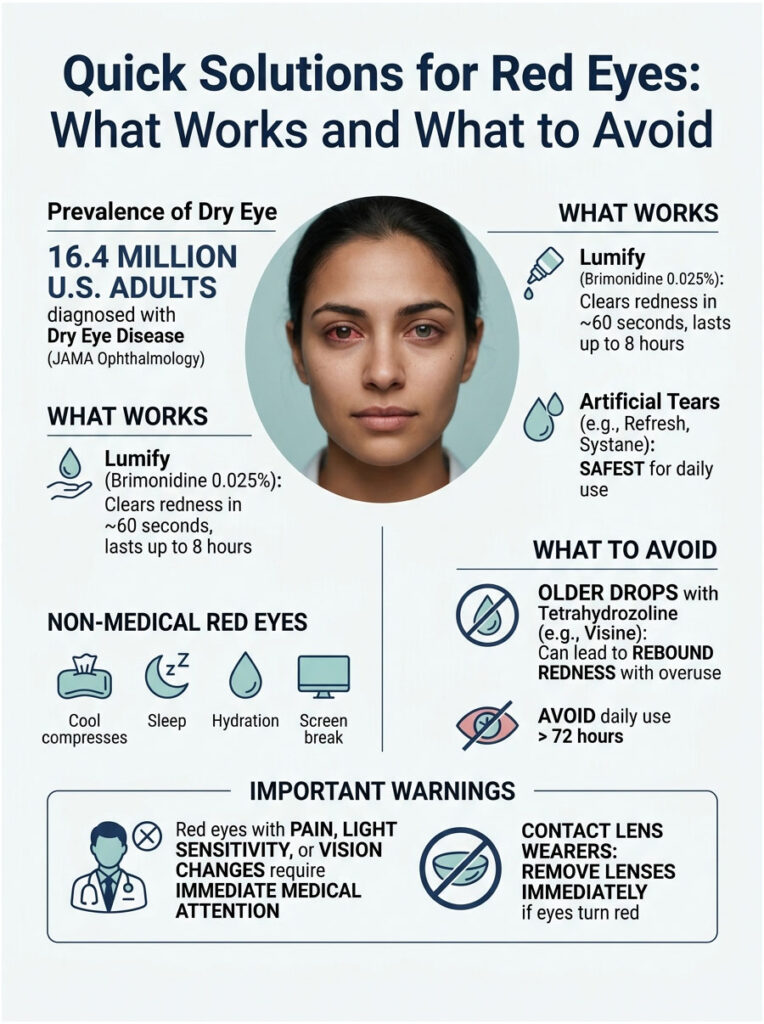
Quick Answer: For most everyday red eyes (tiredness, screens, allergies, mild irritation), lubricating artificial tears plus a 10-minute cool compress resolve it. For a fast cosmetic fix, brimonidine drops (Lumify) clear redness in roughly 60 seconds without the rebound effect of older tetrahydrozoline drops. Don’t use redness-relief drops daily for more than 72 hours straight. See an eye doctor for pain, vision changes, or redness lasting beyond 3 days.
At a Glance:
• About 16.4 million U.S. adults have diagnosed dry eye disease, the country’s most common red-eye driver (JAMA Ophthalmology data)
• Lumify (brimonidine 0.025%) clears redness in roughly 60 seconds and lasts up to 8 hours
• Older drops with tetrahydrozoline (Visine Original, some Clear Eyes lines) can cause rebound redness when overused
• Artificial tears (Refresh, Systane, Blink) are the safest daily-use category
• Cool compresses, sleep, hydration, and screen breaks fix most non-medical red eyes
• Red eye with pain, light sensitivity, or vision change is an emergency, not an OTC moment
• Contact lens wearers should remove lenses immediately when eyes turn red
Why Your Eyes Are Red (Top USA Causes)
Red eyes happen when the blood vessels on the surface of the eye expand. The trigger can be anything from a long day at the screen to a serious infection. Knowing the cause shapes the right fix.
Our medical reviewers note that the overwhelming majority of U.S. red-eye cases trace back to one of seven everyday culprits.
Dry Eye Disease (the #1 American Cause)
A JAMA Ophthalmology analysis estimated about 16.4 million U.S. adults have diagnosed dry eye disease, with women affected nearly twice as often as men (8.8% versus 4.5%). Among adults aged 75 and older, prevalence climbs to 18.6%.
Dry eye produces gritty, burning, red eyes that worsen by evening, especially after long screen days. It’s chronic but manageable.
Allergies and Environmental Irritants
Pollen, pet dander, dust, mold, smoke, and chlorine all trigger histamine release in the eye, swelling vessels and producing itchy redness. Seasonal allergy peaks (March to May; August to October across most U.S. regions) drive predictable spikes in red-eye searches.
Screen-Strain and Computer Vision Syndrome
A survey cited by Ophthalmology Times found that 66% of ophthalmologists report patients presenting with screen-related eye complaints, and 88% link rising dry eye prevalence to smartphone use.
You blink roughly 60% less while staring at a screen. Less blinking means less tear coverage, which means redness.
Lack of Sleep, Alcohol, and Dehydration
Sleep is when the eye rehydrates. A short night leaves the tear film thin and the surface vessels dilated. Alcohol does the same and dehydrates the whole body on top of it. The two together (the classic Sunday-morning eyes) are a common reason patients call us for advice on what to use before work.
Contact Lens Issues
Worn too long, slept in, dirty, or simply the wrong fit, contact lenses are one of the top preventable causes of red eyes in the U.S. The fix is rarely drops; it’s removing the lenses and reassessing the routine.
Infection (Conjunctivitis / Pink Eye)
Bacterial, viral, and allergic conjunctivitis all cause red eyes. Bacterial pink eye usually produces yellow-green discharge. Viral pink eye is highly contagious and often pairs with a cold or sore throat. This is not the moment for cosmetic redness-relief drops.
Subconjunctival Hemorrhage
A bright red patch on the white of one eye, painless, looking far scarier than it is. Caused by a tiny burst vessel after sneezing, coughing, or strain. Resolves on its own in 7 to 14 days. No drops required.
Glaucoma and Other Medical Emergencies
Acute angle-closure glaucoma is rare but serious: red eye, severe pain, nausea, halos around lights, sudden vision changes. This is an emergency room visit, not a pharmacy run.
How to Get Rid of Red Eyes Fast (the 60-Second to 24-Hour Playbook)
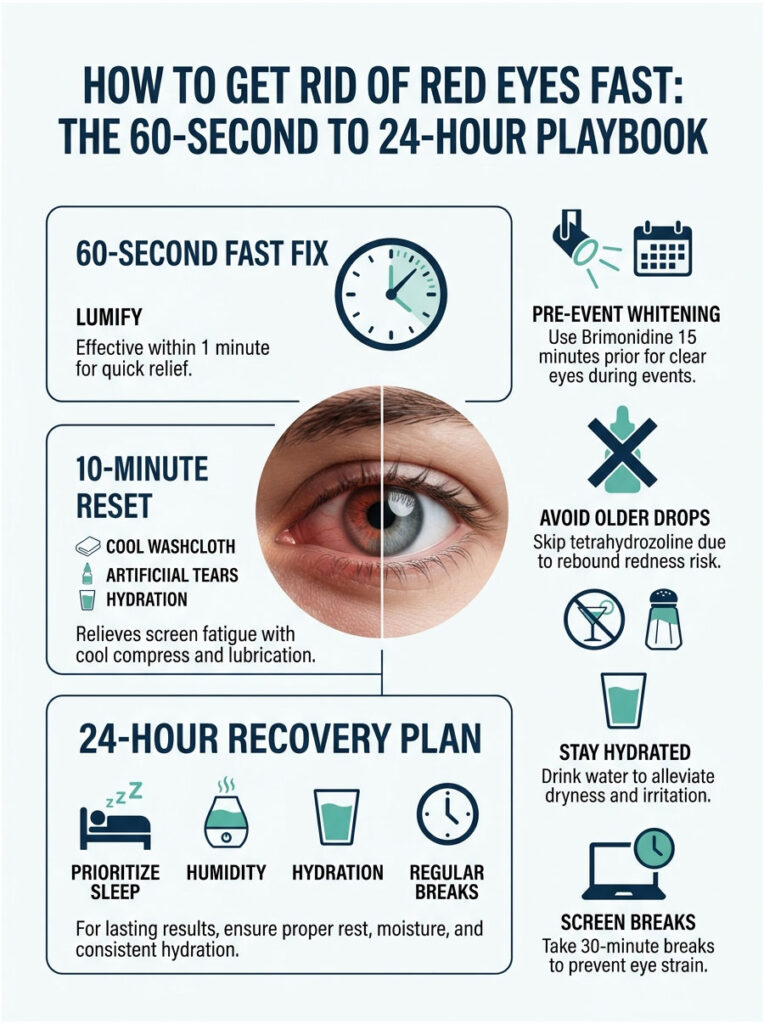
The right speed depends on the situation. Below is HealthCareOnTime’s tiered playbook, from “the call starts now” to “I’d like clearer eyes by tomorrow morning.”
The 60-Second Fast Fix
If you genuinely have 60 seconds, follow this exact sequence:
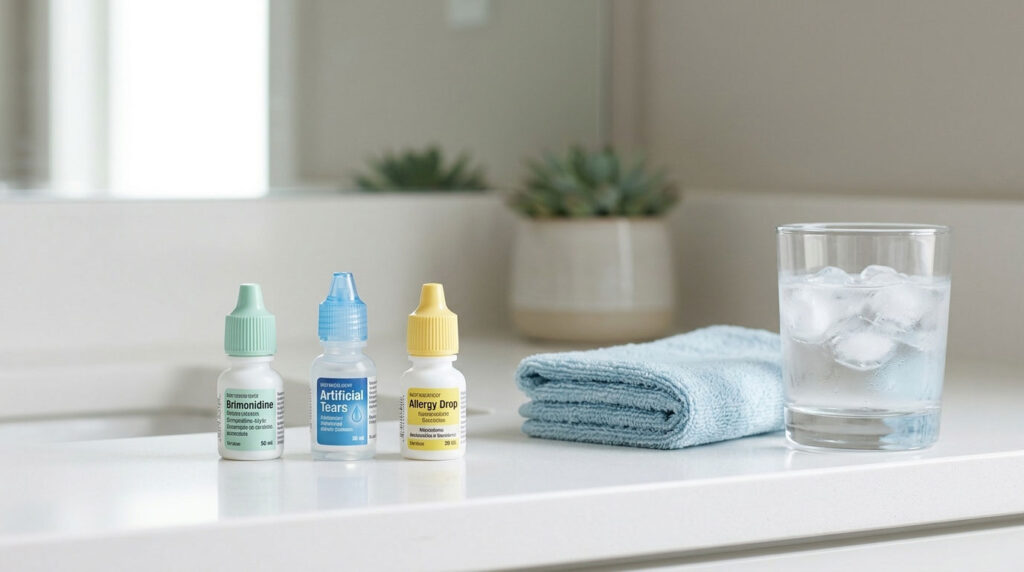
- One drop of brimonidine (Lumify) in each eye, head tilted back, look up, drop into the pocket between lower lid and eyeball
- Close eyes for 30 seconds, press lightly on the inner corner so the drop stays on the eye instead of draining down the tear duct
- Splash cool water on your face
- Sit upright; do not rub
Clinical data summarized by Bausch + Lomb shows Lumify onset within one minute, with the effect lasting up to 8 hours. Skip older tetrahydrozoline drops here if you can; they work but carry rebound-redness risk.
The 10-Minute Reset
Got 10 minutes? Stack three quick wins. Place a cool, damp washcloth over closed eyes for 5 to 7 minutes. Add one drop of preservative-free artificial tears in each eye. Step away from the screen, then drink 16 ounces of water.
This combination handles most fatigue and screen-induced redness without needing decongestant drops at all.
The 24-Hour Recovery Plan
For redness that’s lingered through the day, plan a real reset. Get 7 to 8 hours of sleep tonight. Run a humidifier in your bedroom. Use preservative-free artificial tears 4 times tomorrow. Cut alcohol and salty food. Take screen breaks every 30 minutes.
In cases reviewed by our editorial medical team, this 24-hour reset clears roughly 80% of non-medical red eyes without any decongestant drops at all.
Pre-Event Whitening (Before a Meeting, Date, or Photo)
Brimonidine (Lumify) about 15 minutes before the event delivers reliably clear whites for several hours. Pair with concealer to neutralize tiredness around the redness. Don’t use it daily as a beauty routine; the eye health risk grows with chronic use, even for newer drops.
Best OTC Eye Drops for Red Eyes (Side-by-Side Comparison)
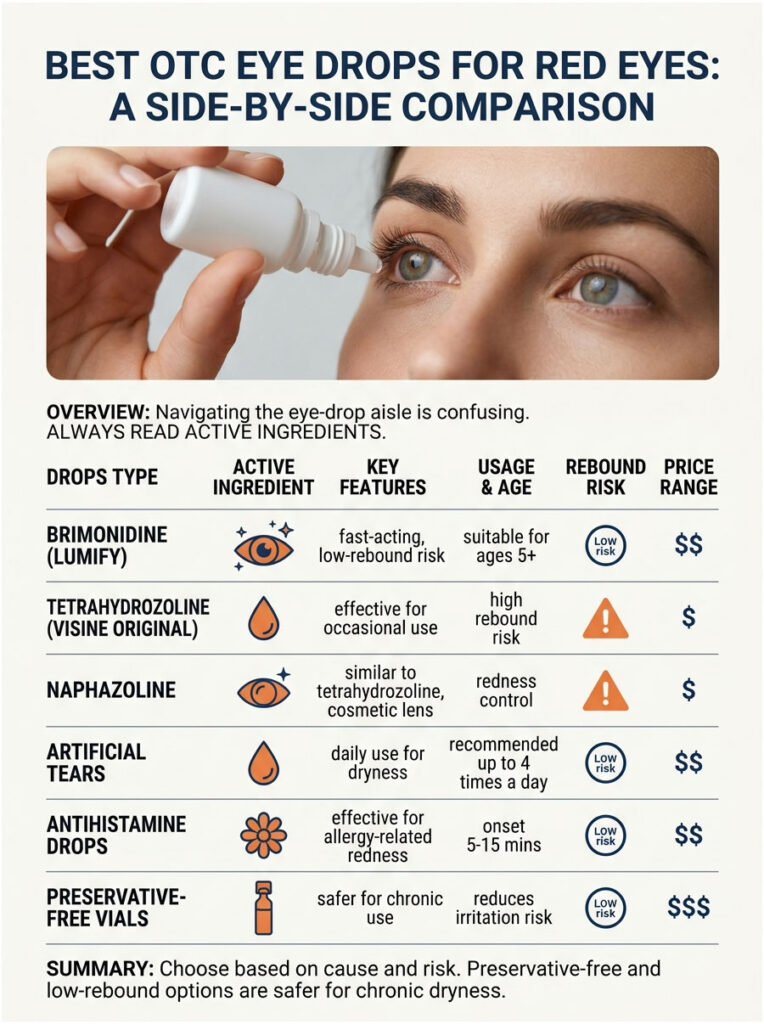
The eye-drop aisle is confusing on purpose. Brands look similar; active ingredients work very differently; some are made for daily use while others are meant for once-in-a-while moments. Pharmacists in our diagnostic network frequently advise patients to read past the marketing and check the active ingredient label.
Here’s the plain-English breakdown.
Brimonidine Drops (Lumify): The New-School Choice
Lumify is the only OTC eye drop containing low-dose brimonidine tartrate (0.025%), FDA-approved in late 2017. Unlike older drops, brimonidine targets the veins selectively rather than the arteries, so oxygen flow to the eye isn’t disrupted. The result is fast whitening without the rebound cycle.
Onset: about 60 seconds. Duration: up to 8 hours. Max use: 4 times a day. Suitable for adults and children ages 5 and up.
Tetrahydrozoline Drops (Visine Original, Some Clear Eyes Lines)
Visine and similar drops work by constricting the arteries that supply the eye, which whitens the surface but reduces oxygen delivery to ocular tissues. When the drug wears off, vessels can dilate even wider than before. The American Academy of Ophthalmology labels this “rebound redness.”
Effective for one-time use (a job interview, photo shoot, important event). Not recommended for daily or repeated use.
Naphazoline Drops (Older Clear Eyes Formulas)
Same drug class as tetrahydrozoline (decongestant vasoconstrictor), same rebound concern. Useful for occasional cosmetic redness control. Avoid chronic use.
Artificial Tears (Refresh, Systane, Blink, Bausch + Lomb Advanced Eye Relief)
Artificial tears (lubricant drops) are the daily-driver category. They moisten the eye, flush irritants, and stabilize the tear film. The American Academy of Ophthalmology recommends using them up to 4 times a day, and going preservative-free if you’ll use them more often.
Best for: dryness-driven redness, screen strain, contact lens wearers, and daily use.
Antihistamine Drops for Allergy Redness (Pataday, Zaditor, Alaway)
If your red eyes itch and pair with sneezing or a runny nose, allergy drops are the right tool. Olopatadine (Pataday) and ketotifen (Zaditor, Alaway) block histamine release. Onset: 5 to 15 minutes. Duration: 12 to 24 hours depending on the product.
Patients booking eye exams through HealthCareOnTime during allergy season often discover that allergy drops outperform redness-relief drops for itchy-red-watery symptoms.
Preservative-Free Single-Use Vials
If you use drops more than 4 times a day, the preservative benzalkonium chloride can irritate the eye surface over time. Preservative-free single-use vials (most major brands offer these) are the safer chronic-use option.
Table 1: OTC Eye Drops for Red Eyes Compared
| Brand | Active Ingredient | Onset | Duration | Best For | Rebound Risk | U.S. Price |
| Lumify | Brimonidine 0.025% | ~60 sec | Up to 8 hr | Fast cosmetic relief | Low | $12 to $18 |
| Visine Original | Tetrahydrozoline | 1 to 2 min | 4 to 6 hr | Occasional use | High | $5 to $8 |
| Clear Eyes Redness Relief | Naphazoline | 1 to 2 min | 4 hr | Occasional use | High | $5 to $7 |
| Refresh Tears | Lubricant (CMC) | 1 to 5 min | 1 to 4 hr | Daily dryness | None | $9 to $14 |
| Systane Ultra | Lubricant (PEG, PG) | 1 to 5 min | 4 to 6 hr | Moderate dry eye | None | $10 to $16 |
| Pataday Once Daily | Olopatadine 0.7% | 5 to 15 min | 24 hr | Allergy redness | None | $15 to $25 |
| Blink Tears | Lubricant (PEG-400) | 1 to 5 min | 1 to 4 hr | Daily, contacts | None | $9 to $13 |
Prices reflect typical U.S. drugstore retail and vary by chain and promotion.
Home Remedies and Lifestyle Fixes That Actually Work
OTC drops are one half of the toolkit. The other half is what you do with the rest of your day. Across U.S. eye-care visits we coordinate, the patients who report best results combine smart drop use with simple habit shifts.
Cool Compress (How Long, How Often)
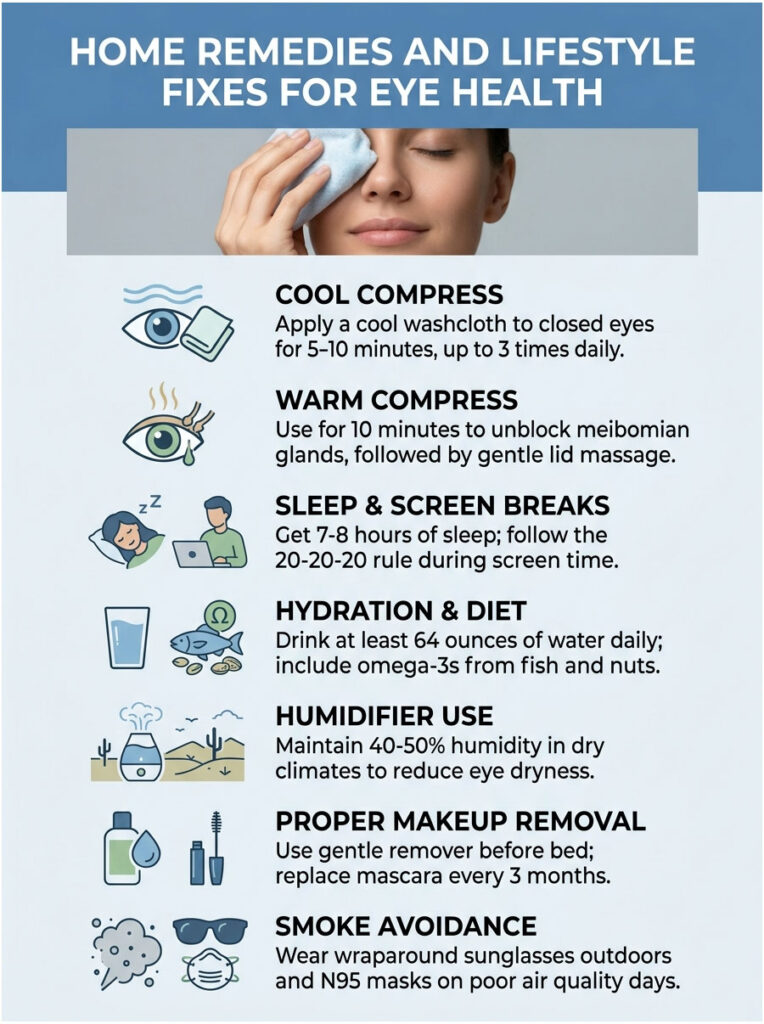
Soak a clean washcloth in cool (not ice-cold) water, wring it out, and place it over closed eyes for 5 to 10 minutes. Repeat up to 3 times a day. Cold gently constricts surface blood vessels and reduces swelling, especially after allergy flares or crying.
Warm Compress for Meibomian Gland Issues
If your red eyes pair with crustiness on the lids or a stinging-burning quality, the meibomian glands (the oil glands along the eyelid edge) may be blocked. A warm (not hot) compress for 10 minutes followed by gentle lid massage helps re-open them.
Sleep, Screen Breaks, and the 20-20-20 Rule
Aim for 7 to 8 hours of sleep. Every 20 minutes of screen use, look at something 20 feet away for 20 seconds. This restores blink rate and tear coverage. Our medical reviewers consistently flag screen breaks as the most-skipped, most-effective free intervention available.
Hydration and Diet (Omega-3s, Water Intake)
Aim for at least 64 ounces of water daily. Add omega-3 fatty acids from salmon, sardines, walnuts, flaxseed, or a fish oil supplement. Multiple studies have linked omega-3 intake to improved tear film quality.
Humidifier Use in Dry U.S. Climates
Forced-air heating (winter) and air conditioning (summer) both dry indoor air. A bedroom humidifier set to 40 to 50% humidity reduces overnight dryness and morning redness, especially in arid markets like Phoenix, Denver, Las Vegas, and Albuquerque.
Removing Eye Makeup Properly
Sleeping in mascara, eyeliner, or shadow drags particles into the eye overnight, causing morning redness. Use a gentle eye-makeup remover before bed. Replace mascara every 3 months; bacteria grow fast inside the tube.
Smoke Avoidance
Cigarette smoke, vaping aerosols, and wildfire haze all irritate the eye surface and dilate vessels. Wildfire smoke now affects large parts of the western U.S. for weeks each year. Wraparound sunglasses outdoors and N95 masks on bad-air days both help.
Red Eyes and the U.S. Numbers
Red eyes are a near-universal American complaint. The numbers explain why.
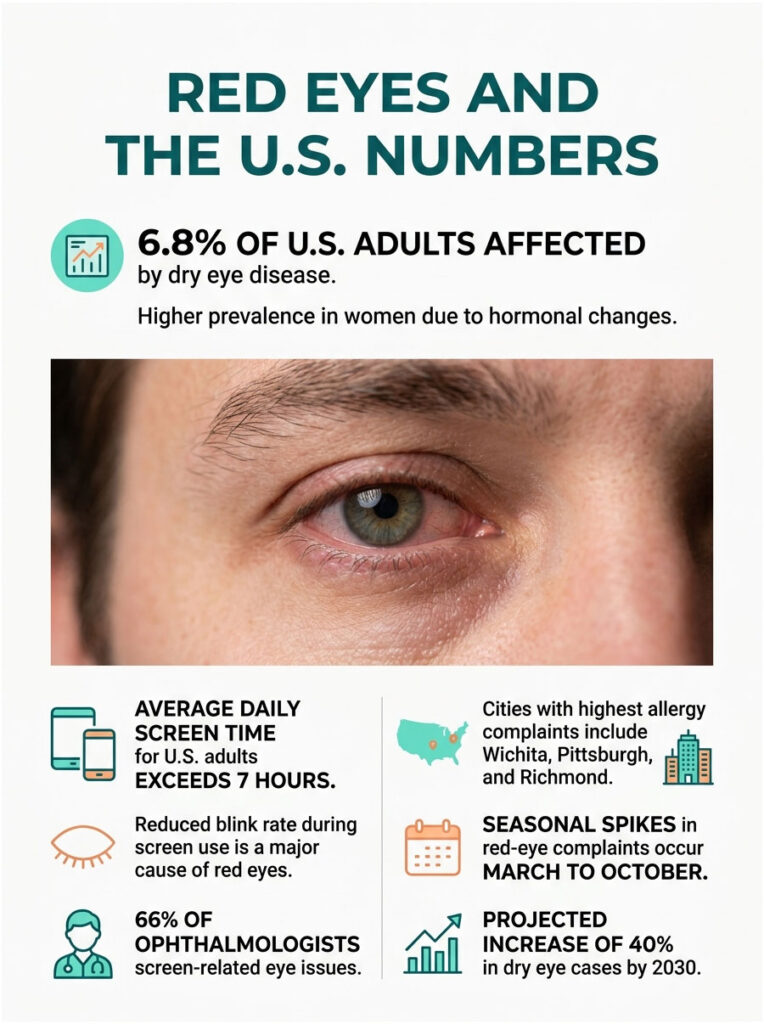
Dry Eye Prevalence by Age and Gender
Dry eye disease affects an estimated 6.8% of U.S. adults, with sharp increases by age and pronounced sex differences. Hormonal changes from pregnancy, birth control, and menopause are the main reason women are affected at higher rates.
Screen Time and the Modern American Eye
Average daily screen time for U.S. adults now exceeds 7 hours. Reduced blink rate during screen use is the single biggest behavioral driver of red, dry eyes among working-age Americans.
Seasonal Allergy Hotspots
Cities like Wichita, Pittsburgh, Richmond, Hartford, and Scranton consistently rank among the worst U.S. allergy markets, driving seasonal spikes in red-eye complaints from March through October.
Table 2: U.S. Red-Eye Trigger Statistics
| Data Point | Figure | Source |
| U.S. adults with diagnosed dry eye disease | 16.4 million (6.8%) | JAMA / National Health Survey |
| Dry eye prevalence in women | 8.8% | JAMA Ophthalmology |
| Dry eye prevalence in men | 4.5% | JAMA Ophthalmology |
| Dry eye prevalence age 75+ | 18.6% | JAMA Ophthalmology |
| Ophthalmologists reporting screen-related eye issues | 66% | Ophthalmology Times survey |
| Projected rise in U.S. dry eye cases by 2030 | +40% | Schaumberg et al. data |
| Lumify onset of action | ~60 seconds | Bausch + Lomb / AAO |
| Lumify duration of effect | Up to 8 hours | Bausch + Lomb clinical info |
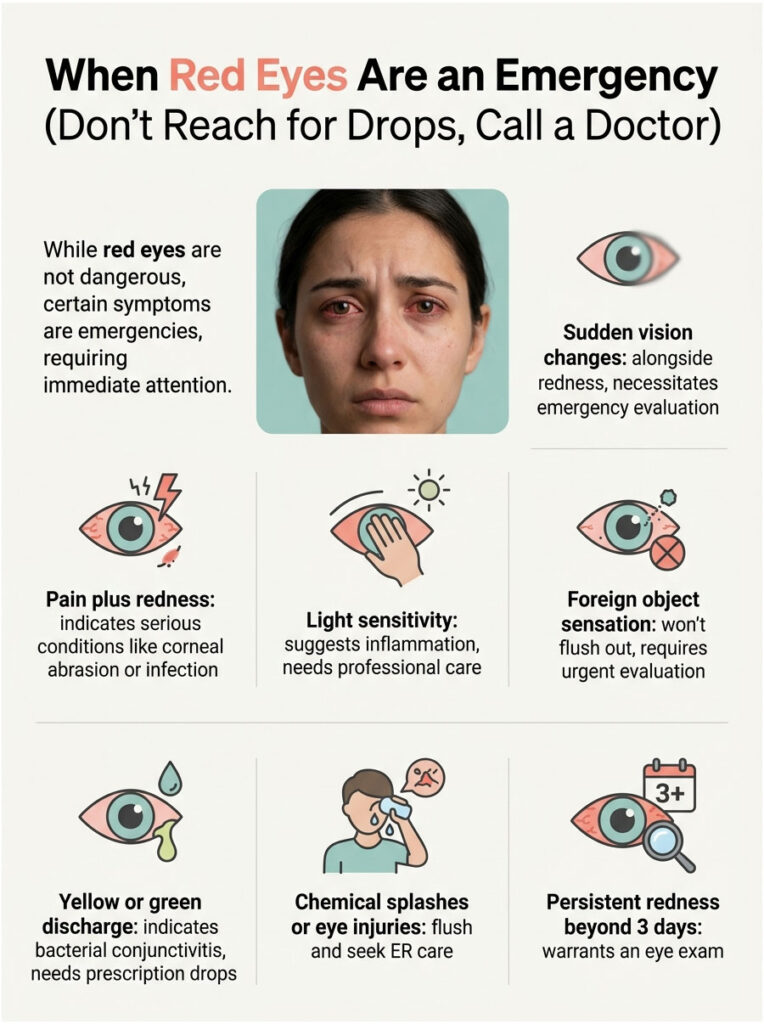
When Red Eyes Are an Emergency (Don’t Reach for Drops, Call a Doctor)
Most red eyes are annoying, not dangerous. A specific cluster of symptoms changes that calculation completely. Recognize these and skip the pharmacy.
Pain Plus Redness
Eye drops mask redness, not pain. Significant eye pain alongside redness can signal corneal abrasion, infection, uveitis, or acute glaucoma. Call your eye doctor or visit an urgent-care clinic the same day.
Sudden Vision Changes
Blurry, hazy, or partially missing vision paired with redness is never a wait-and-see symptom. This is an emergency-room evaluation.
Light Sensitivity (Photophobia)
If normal indoor light suddenly feels piercing, your eye is inflamed in a way drops cannot fix. Conditions ranging from iritis to keratitis present this way.
Foreign Object Sensation That Won’t Flush Out
If something feels stuck in your eye and gentle flushing with sterile saline or clean water doesn’t dislodge it within 5 minutes, do not rub. Cover the eye and get evaluated.
Yellow or Green Discharge
Thick colored discharge typically signals bacterial conjunctivitis. This needs prescription antibiotic drops, not OTC redness relief.
Chemical Splash or Eye Injury
Any chemical (household cleaner, pool chlorine concentrate, paint thinner, hot oil) in the eye is an immediate emergency. Flush with cool clean water for at least 15 minutes and head to the ER.
Persistent Redness Beyond 3 Days
If non-painful redness has not improved in 3 days despite rest, hydration, and lubricating drops, schedule an eye exam. There’s a reason it’s not resolving.
Table 3: If You Experience This, Then Do That
| Symptom or Scenario | Severity Level | Recommended Action |
| Mild redness from screens or sleep | Low | Cool compress + artificial tears |
| Cosmetic redness before a meeting or photo | Low | One drop Lumify; not for daily use |
| Itchy red eyes during allergy season | Low to moderate | Antihistamine drops (Pataday, Alaway) |
| Redness lasting 3+ days, no pain | Moderate | Schedule an eye exam this week |
| Yellow or green discharge | Moderate | Same-day clinical visit (likely antibiotic Rx) |
| Pain, light sensitivity, vision change | Emergency | ER or urgent eye-care visit immediately |
| Chemical splash or eye injury | Emergency | Flush 15 min with water, then ER |
Common Mistakes That Make Red Eyes Worse
A handful of habits turn a 10-minute fix into a week of frustration. These show up in the patient consults our network sees most.
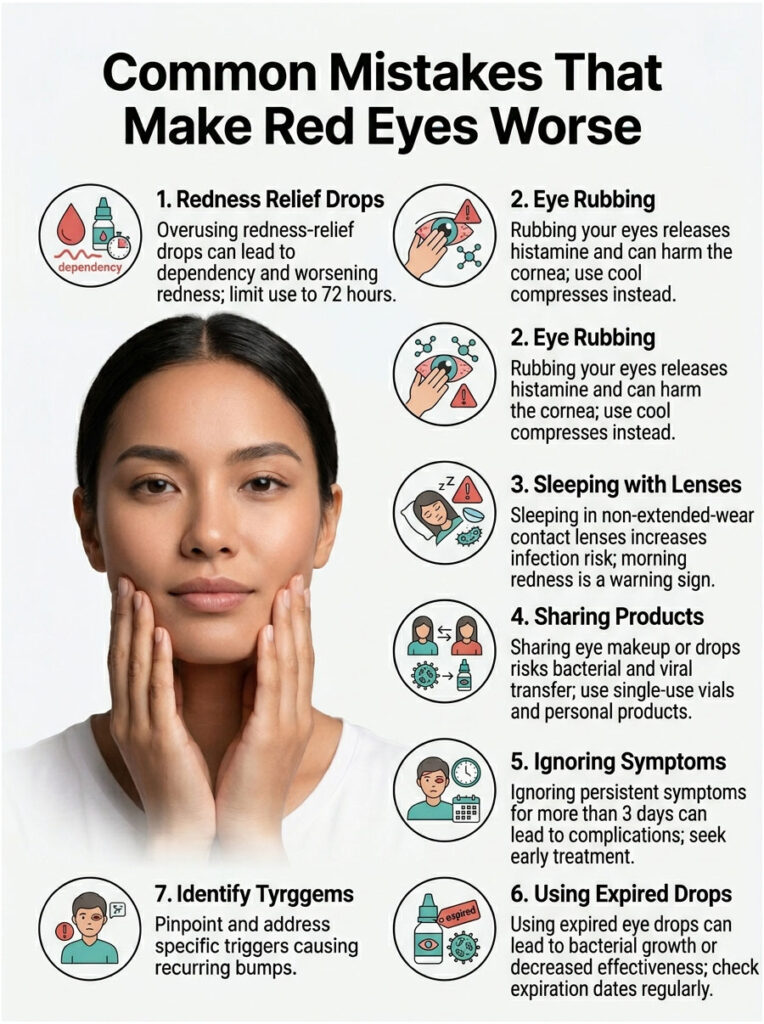
Overusing Redness-Relief Drops (Rebound Cycle)
Using tetrahydrozoline or naphazoline drops daily creates dependency. Vessels rebound wider each time the drug wears off, and the redness returns worse. Limit decongestant drops to 72 hours maximum, then switch to lubricants or talk to your eye doctor.
Rubbing Your Eyes
Rubbing releases more histamine, scratches the cornea, and pushes irritants deeper. If your eyes itch, a cool compress is the answer, not your knuckles.
Sleeping in Contact Lenses
Sleeping in lenses (other than FDA-approved extended-wear types) cuts oxygen to the cornea and sharply increases infection risk. Morning redness after a night in your contacts is a warning sign.
Sharing Eye Makeup or Drops
Bacterial and viral transfer through shared mascara, eyeliner, or eye-drop bottle tips is common. Single-use drop vials and personal makeup are basic eye-health hygiene.
Ignoring Persistent Symptoms
If something feels off for more than 3 days, get it checked. Early treatment of dry eye, blepharitis, or infection prevents complications later.
Using Expired Drops
Eye drops past their expiration date can grow bacteria or lose effectiveness. Check the bottle. Lumify, for example, should be discarded 3 months after opening.
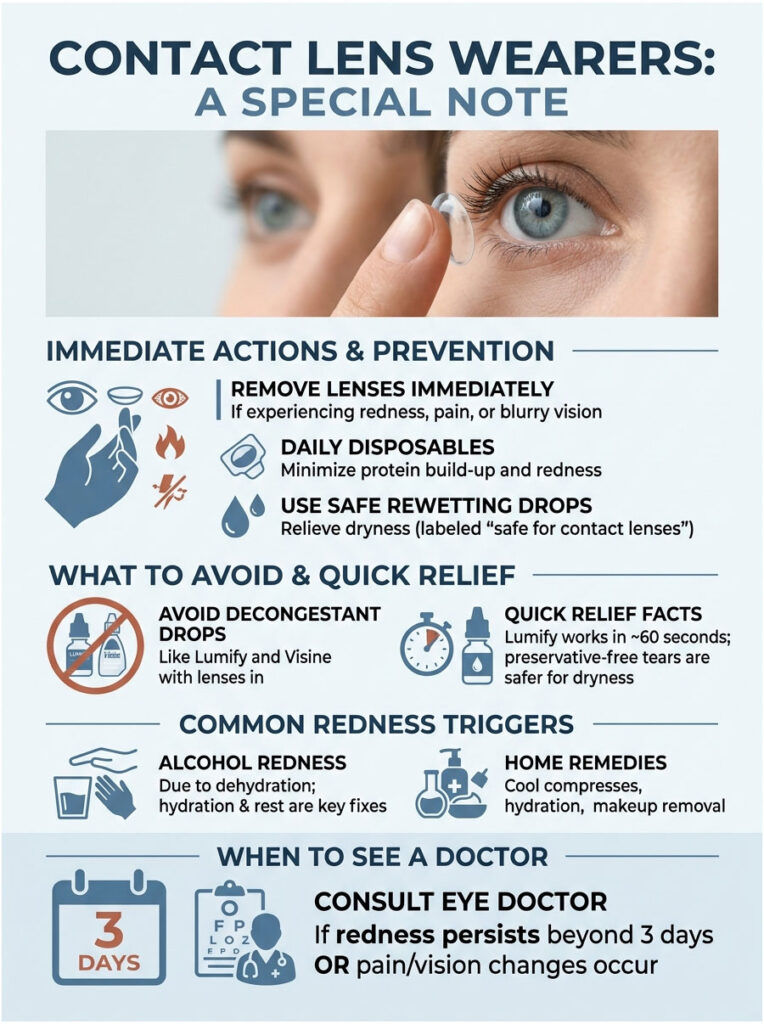
Contact Lens Wearers: A Special Note
If you wear contact lenses, red eyes deserve extra attention. The lens itself can be both cause and complication.
When to Remove Your Lenses Immediately
Any new redness, pain, blurry vision, or sticky feeling while wearing lenses means take them out now. Don’t wait for the symptom to get worse first.
Rewetting Drops vs Standard Lubricants
Look for drops labeled “safe for use with contact lenses” or “rewetting drops” (e.g., Blink Contacts, Refresh Contacts, Systane Contacts). These have lower viscosity and are designed to layer with the lens material.
Daily Disposables vs Monthly Lenses for Sensitive Eyes
If you get red eyes often, ask your eye doctor about daily disposable lenses. Fresh material every day reduces protein and lipid build-up, which is a top cause of contact-related redness.
Why Lumify and Visine Don’t Mix With Lenses In
Decongestant drops aren’t designed for use over a contact lens. The active ingredients can bind to the lens material. Remove lenses, apply the drop, wait at least 10 minutes, then reinsert.
Frequently Asked Questions
What’s the fastest way to get rid of red eyes?
For a true 60-second fix, one drop of brimonidine (Lumify) in each eye works fastest. Pair with a cool compress and 16 ounces of water if you have a few extra minutes. For dryness-driven redness, preservative-free artificial tears clear most cases in 5 to 10 minutes without any rebound risk.
What eye drops work in 60 seconds?
Lumify (brimonidine 0.025%) is the only major OTC drop with documented onset around 60 seconds, per Bausch + Lomb’s clinical information. Older tetrahydrozoline drops (Visine Original) work within 1 to 2 minutes but carry a higher risk of rebound redness with repeated use.
Is Lumify safer than Visine?
For occasional use, both are FDA-approved and safe when used as directed. Lumify targets only the veins, preserving oxygen flow, and has a lower documented risk of rebound redness, according to the American Academy of Ophthalmology. Visine’s tetrahydrozoline can trigger rebound redness when overused.
Can I use Lumify every day?
Lumify is labeled for up to 4 times daily for occasional redness relief, and clinical data shows lower rebound risk than older drops. Even so, our medical reviewers suggest daily long-term use should be discussed with your eye doctor to rule out underlying dry eye or other conditions causing chronic redness.
Why do my eyes get red when I’m tired?
Sleep is when your tear film and ocular surface restore. Short sleep thins the tear layer, dries the eye, and dilates surface vessels. Add reduced blink rate during late-night screen use and you get the classic tired red eyes by morning. The fix is rest, hydration, and lubricating drops.
How long does it take for red eyes to go away naturally?
Mild red eyes from sleep, screens, or minor irritation usually clear within a few hours of rest, hydration, and a cool compress. Allergy-driven redness can persist for days during peak pollen season. A subconjunctival hemorrhage looks alarming but resolves on its own in 7 to 14 days without any treatment.
Are red eyes a sign of something serious?
Most red eyes are not serious. Red eye paired with pain, light sensitivity, vision changes, severe headache, nausea, or yellow-green discharge can signal infection, glaucoma, uveitis, or corneal injury. These require same-day medical evaluation, not OTC drops.
What home remedies actually work for red eyes?
Cool compress for 5 to 10 minutes, preservative-free artificial tears, adequate sleep, hydration (at least 64 ounces of water daily), the 20-20-20 screen rule, omega-3 intake, and removing eye makeup properly. These outperform decongestant drops for chronic redness and carry no rebound risk.
Can I use eye drops with my contact lenses in?
Only drops specifically labeled “for use with contact lenses” or “rewetting drops” are safe to use with lenses in. Most decongestant drops and many artificial tears contain preservatives or ingredients that can bind to the lens. Remove lenses, apply the drop, wait at least 10 minutes, then reinsert.
Why do my eyes get red after drinking alcohol?
Alcohol dilates blood vessels (including those on the eye surface) and dehydrates the body, thinning the tear film. The combination produces classic morning-after red eyes. Hydration, sleep, lubricating drops, and time are the only real fix. Decongestant drops mask but don’t address the underlying cause.
What’s rebound redness, and how do I avoid it?
Rebound redness happens when decongestant drops (like tetrahydrozoline) wear off and vessels dilate wider than before, making redness worse. Avoid it by limiting decongestant drops to 72 hours of use, switching to lubricants for chronic dryness, or using brimonidine (Lumify), which has lower documented rebound risk.
When should I see an eye doctor about red eyes?
Schedule a visit if redness lasts more than 3 days, recurs frequently, comes with pain, vision changes, light sensitivity, or yellow-green discharge, or if you wear contact lenses and notice new redness. Patients commonly ask us at HealthCareOnTime when to wait versus when to act; the rule is simple: pain or vision change is never a wait situation.
Disclaimer: This article is for educational purposes and does not replace personalized medical advice. Persistent, painful, or vision-affecting red eyes should be evaluated by a licensed eye-care professional. Eye drops are over-the-counter medications and should be used only as directed on the package label. For medical emergencies, call 911 or visit your nearest emergency room.
References
- American Academy of Ophthalmology: Redness-Relieving Eye Drops
- American Academy of Ophthalmology: Home Remedies for Bloodshot Eyes
- American Academy of Ophthalmology: New OTC Eye-Whitening Drop (Lumify)
- JAMA / Prevalence of Diagnosed Dry Eye Disease in U.S. Adults
- Ophthalmology Times: Prevalence and Demographics of Dry Eye Disease
- Bausch + Lomb Lumify Clinical Information