A state agriculture fact sheet says a cup of shredded cabbage has 50 calories. USDA’s own nutrition education program says the same cup has 18. Both pages are live on government websites right now.
Table of Contents
So which number is right? Our medical review team checked every figure in this guide against USDA FoodData Central, the federal database behind most nutrition labels and calorie apps. Here is what cabbage actually contains, serving by serving.
Quick Answer: One cup of chopped raw green cabbage (89 g) has 22 calories. One cup shredded (70 g) has 18 calories, and 100 grams has 25. A medium head (908 g, about 2 pounds) has roughly 227 calories. One cup of boiled cabbage (150 g) has 35 calories. Red cabbage runs slightly higher at 31 calories per 100 grams. Source: USDA FoodData Central, SR Legacy.
Cabbage calories by serving size (raw green cabbage unless noted):
- 1 medium leaf (23 g): 6 calories
- 1 ounce (28 g): 7 calories
- 1 cup shredded (70 g): 18 calories
- 1 cup chopped (89 g): 22 calories
- 100 grams (3.5 oz): 25 calories
- 1 cup boiled, drained (150 g): 35 calories
- 1 medium head (908 g): 227 calories
At a Glance
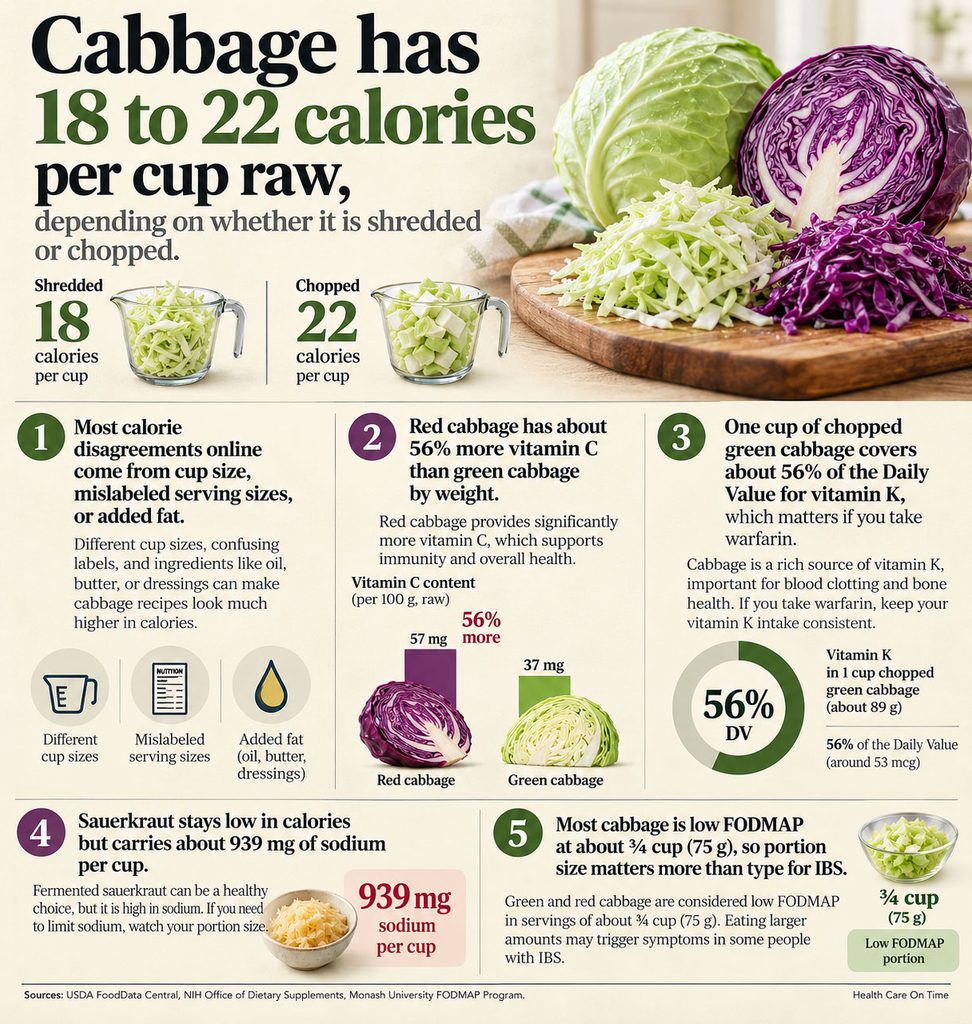
- Cabbage has 18 to 22 calories per cup raw, depending on whether it is shredded or chopped.
- Most calorie disagreements online come from cup size, mislabeled serving sizes, or added fat.
- Red cabbage has about 56% more vitamin C than green cabbage by weight.
- One cup of chopped green cabbage covers about 56% of the Daily Value for vitamin K, which matters if you take warfarin.
- Sauerkraut stays low in calories but carries about 939 mg of sodium per cup.
- Most cabbage is low FODMAP at about ¾ cup (75 g), so portion size matters more than type for IBS.
How Many Calories Are in Cabbage? (Every Serving Size)
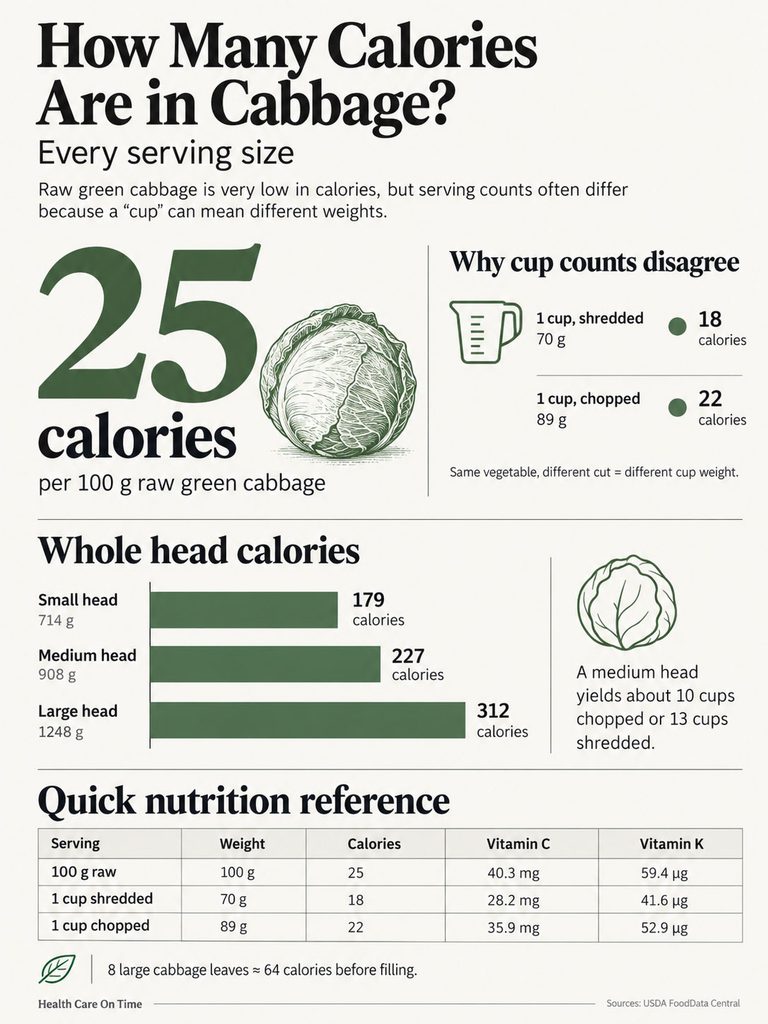
Cabbage is one of the lowest-calorie vegetables in the produce aisle. Raw green cabbage, USDA FDC 169975, provides 25 calories per 100 grams, or about 7 calories per ounce.
The number you see on a given website depends almost entirely on how that site defines a serving. That is where most of the confusion starts.
Calories per Cup: Chopped vs Shredded
USDA lists two different cup weights for raw cabbage, and they are not interchangeable.
- 1 cup chopped (89 g): 22 calories
- 1 cup shredded (70 g): 18 calories
Shredded cabbage packs into the cup less densely, so the cup holds about 21% less cabbage. USDA SNAP-Ed uses the shredded measure and lists 18 calories for a 70 g cup, while Healthline uses the chopped measure at 22 calories for 89 grams. Both are correct; they measure different amounts of cabbage.
If you track food in an app, weigh your cabbage once. A kitchen scale removes the guesswork, and most apps let you log by grams.
Calories in a Whole Head of Cabbage
USDA publishes three standard head weights for raw green cabbage. Here is the math at 25 calories per 100 grams:
| Head size | USDA weight | Weight in pounds | Calories |
| Small (about 4½ inch diameter) | 714 g | 1.6 lb | 179 |
| Medium (about 5¾ inch diameter) | 908 g | 2.0 lb | 227 |
| Large (about 7 inch diameter) | 1,248 g | 2.8 lb | 312 |
You may see slightly different head totals elsewhere. FatSecret lists a small head at 171 calories, a medium head at 218, and a large head at 300, which implies lighter head weights than USDA’s. Real heads vary widely, so the weight printed on your grocery receipt is the best guide.
A medium head yields roughly 10 cups chopped or 13 cups shredded. That is a lot of food for about 227 calories.
Calories per Leaf, Ounce, and 100 Grams
- 1 small leaf (15 g): 4 calories
- 1 medium leaf (23 g): 6 calories
- 1 large leaf (33 g): 8 calories
- 1 ounce (28 g): 7 calories
- 100 grams (3.5 oz): 25 calories
Patients planning cabbage rolls often ask us how many leaves fit a calorie goal. Even eight large leaves come to about 64 calories before filling, so the filling sets the total.
Table 1: Cabbage Calories and Key Nutrients by Type
| Cabbage type and form | USDA FDC ID | Calories per 100 g | Calories per standard cup | Vitamin C per cup | Vitamin K per 100 g |
| Green, raw | 169975 | 25 | 22 (89 g chopped) | 32.6 mg | 76.0 mcg |
| Green, boiled, drained | 169976 | 23 | 35 (150 g) | 56.3 mg | 108.7 mcg |
| Red, raw | 169977 | 31 | 28 (89 g chopped) | 50.7 mg | 38.2 mcg |
| Savoy, raw | 169978 | 27 | 19 (70 g shredded) | 21.7 mg | 68.8 mcg |
| Napa (Chinese), raw | 169222 | 16 | 12 (76 g shredded) | 20.5 mg | 42.9 mcg |
| Bok choy, raw | 170390 | 13 | 9 (70 g shredded) | 31.5 mg | 45.5 mcg |
| Sauerkraut, canned | 169279 | 19 | 27 (142 g) | 20.9 mg | 13.0 mcg |
Why Websites Disagree on Cabbage Calories
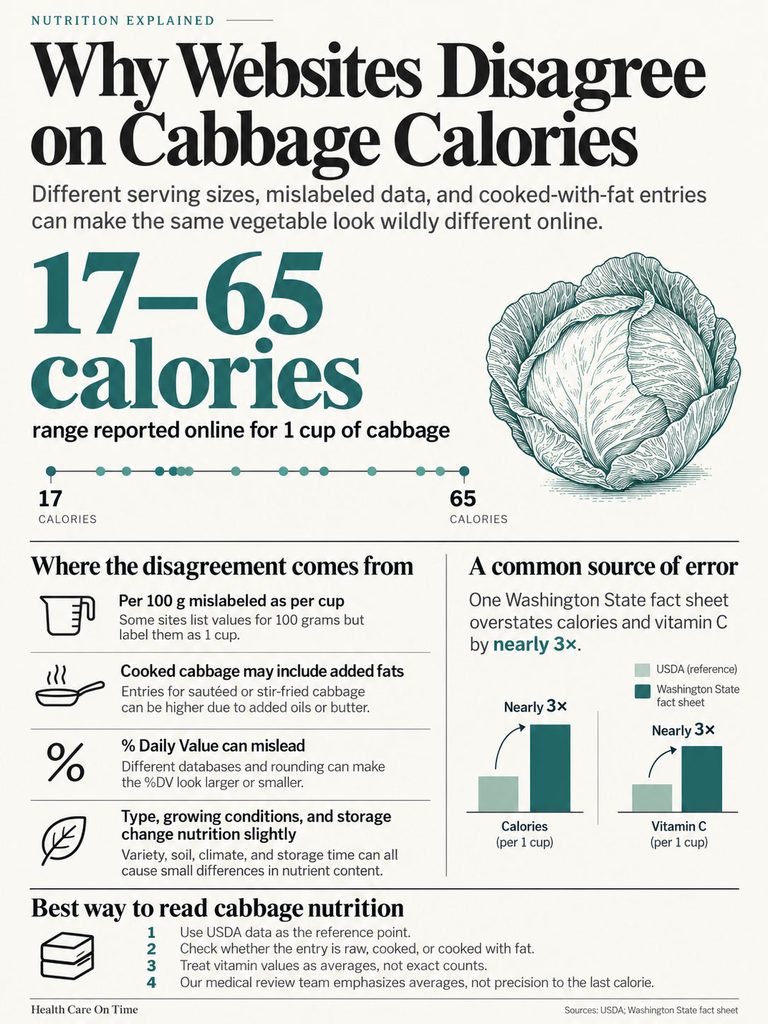
Search “calories in cabbage” and you will find per-cup figures of 17, 18, 21, 22, 23, 25, 35, 50, and even 65. Only a few of those describe plain raw cabbage. The rest come from one of four mix-ups.
Per-100-Gram Figures Labeled as Per Cup
The most common error is quoting the per-100-gram value (25 calories) as if it were a cup. One weight loss site says a cup of raw shredded cabbage has about 25 calories in its text, then lists 22 calories per cup in its own nutrient table.
A shredded cup weighs 70 grams, not 100. The real figure is 18.
The Fact Sheet That Is Off by Almost Three Times
A Washington State Department of Agriculture farm-to-school fact sheet states that one cup of shredded raw cabbage contains 50 calories and 5 grams of fiber, plus 190% of the daily recommended vitamin C.
USDA data for that same 70 g cup show about 18 calories, 1.8 grams of fiber, and 25.6 mg of vitamin C, roughly 28% of the Daily Value. The fact sheet overstates calories by nearly 3 times and vitamin C by nearly 7 times.
Percent Daily Value Mix-Ups
Cleveland Clinic’s cabbage page says a cup of chopped raw green cabbage is 22 calories and delivers 54% of the daily value for vitamin C and 85% for vitamin K. The calories match USDA. The percentages do not.
Using FDA’s current Daily Values (90 mg for vitamin C, 120 mcg for vitamin K), the 89 g cup gives 36% and 56%. Those numbers line up with Healthline’s figures.
Cooked Figures With Fat Added
Some databases log “cooked cabbage” as cabbage cooked with butter or oil. FatSecret lists cooked green cabbage at 65 calories per cup, with 4.32 grams of fat. Plain boiled cabbage has almost no fat.
Another nutrition site lists a cooked cup of about 150 grams at 17 calories, which errs the other way. USDA’s boiled, drained cabbage comes to 35 calories for that 150 g cup.
| Number you may see | Where it comes from | What it actually measures |
| 18 calories per cup | USDA SNAP-Ed | Correct: 70 g shredded raw |
| 22 calories per cup | Healthline, Cleveland Clinic, USDA | Correct: 89 g chopped raw |
| 25 calories per cup | Several weight loss sites | Per 100 g, mislabeled as a cup |
| 28 calories per cup | Red cabbage databases | Correct for red, not green |
| 35 calories per cup | USDA boiled | Correct: 150 g boiled, no fat |
| 50 calories per cup | State agriculture fact sheet | Error; no USDA record supports it |
| 65 calories per cup | Calorie-tracking database | Cooked with added fat |
How We Checked These Numbers
Every value in this guide comes from USDA’s SR Legacy records, the long-standing reference set inside FoodData Central. SR Legacy was finalized in 2018, and USDA now adds newer lab analyses under a separate data type called Foundation Foods.
Real cabbage varies with variety, growing season, and storage time, so any single head can land a few calories above or below these averages. Our medical review team treats the figures here as reliable averages, not exact counts for the head in your fridge.
Full USDA Nutrition Breakdown of Green Cabbage
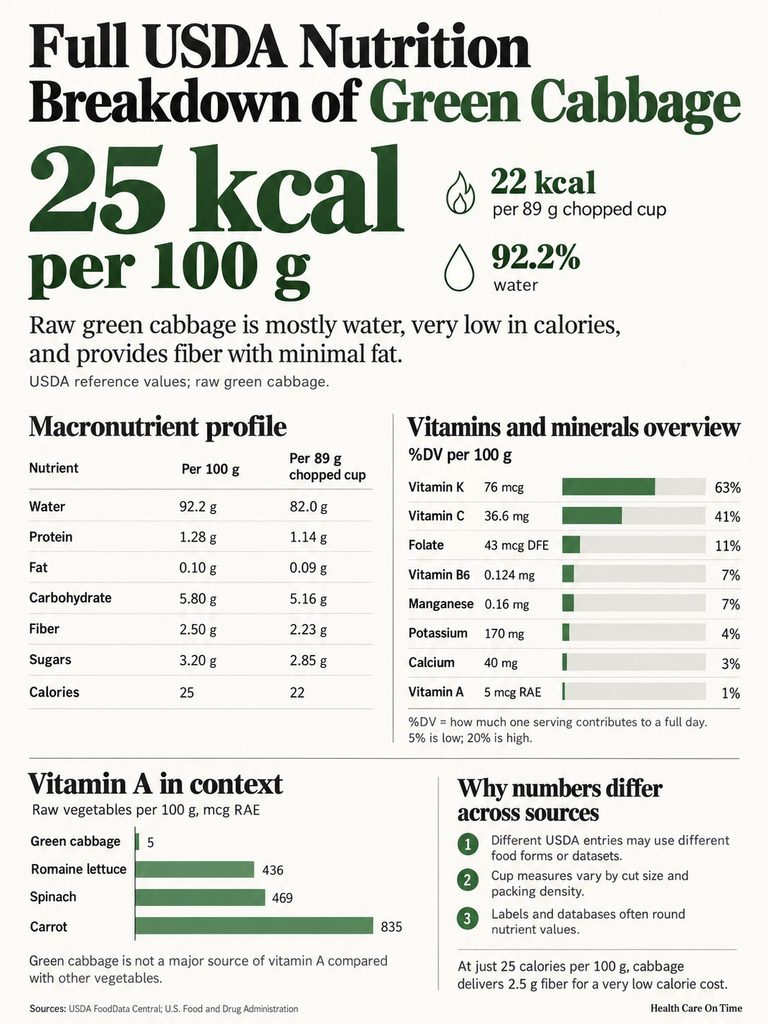
Here is the full nutrient profile of raw green cabbage, per 100 grams and per 89 g chopped cup.
Macronutrients
| Nutrient | Per 100 g | Per 1 cup chopped (89 g) |
| Calories | 25 | 22 |
| Water | 92.2 g | 82.0 g |
| Protein | 1.3 g | 1.1 g |
| Fat | 0.1 g | 0.1 g |
| Total carbohydrate | 5.8 g | 5.2 g |
| Dietary fiber | 2.5 g | 2.2 g |
| Total sugars | 3.2 g | 2.8 g |
| Net carbs | 3.3 g | 3.0 g |
About 80% of cabbage’s few calories come from carbohydrate, and almost half of that carbohydrate is fiber. Cabbage is over 92% water, which is why it fills a plate without adding much energy.
Vitamins
- Vitamin K: 67.6 mcg per cup (56% DV). This is cabbage’s standout nutrient.
- Vitamin C: 32.6 mg per cup (36% DV).
- Folate: 38 mcg per cup (10% DV).
- Vitamin B6: 0.11 mg per cup (6% DV).
Green cabbage contains very little vitamin A, only about 5 mcg RAE per 100 grams. Red cabbage and bok choy contain much more.
Minerals
- Potassium: 151 mg per cup (3% DV)
- Calcium: 36 mg per cup (3% DV)
- Manganese: 0.14 mg per cup (6% DV)
- Sodium: 16 mg per cup (1% DV)
Cabbage is not a mineral powerhouse. Its value lies in vitamins K and C, fiber, and plant compounds called glucosinolates, all at a very low calorie cost.
What “%DV” Means on a US Label
Percent Daily Value compares a nutrient to a reference amount set by the FDA for a 2,000-calorie diet. FDA raised vitamin C to 90 mg and set vitamin K at 120 mcg in its 2016 label update.
Older websites that still use pre-2016 values will show different percentages for the same cabbage. That is one more reason numbers drift across the internet.
Raw vs Cooked Cabbage: What Changes
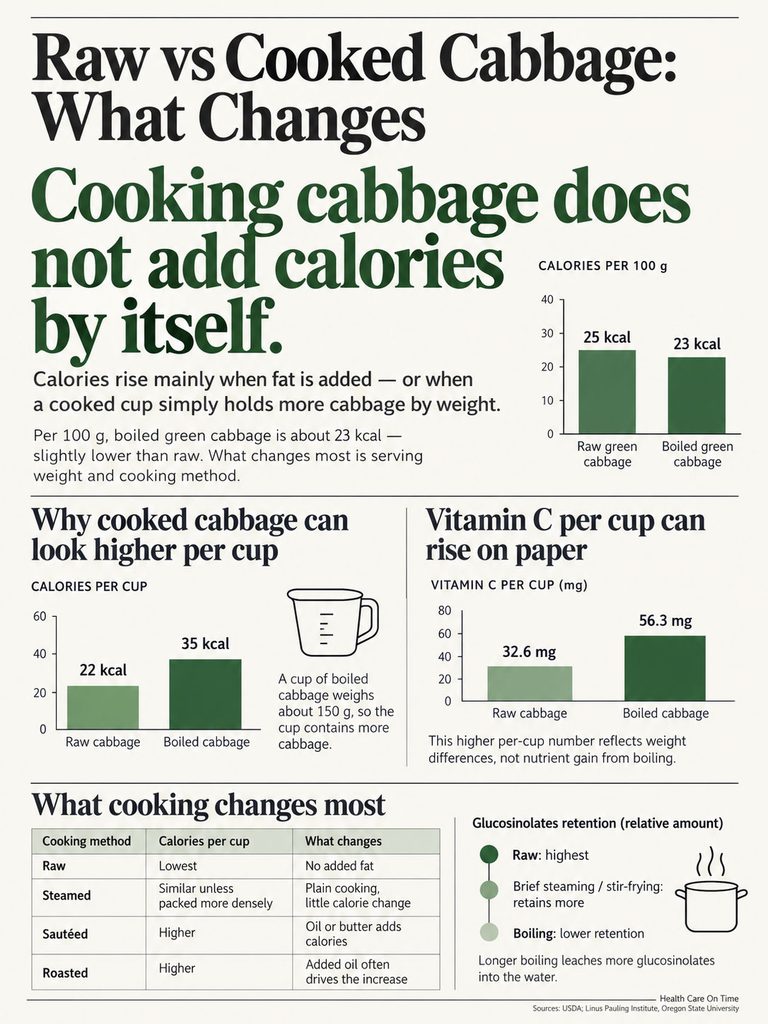
Cooking does not add calories unless you add fat. It changes water content, cup weight, and some vitamins.
Calories per 100 Grams vs per Cup
Boiled green cabbage, FDC 169976, has 23 calories per 100 grams, slightly fewer than raw. But a cup of boiled cabbage weighs 150 grams, because cooked leaves collapse and pack tightly.
So per cup, boiled cabbage looks “higher” at 35 calories, while bite for bite it is essentially the same food. When patients ask us why cooked cabbage seems to have more calories, this cup-weight effect is nearly always the answer.
The Vitamin C Paradox
USDA lists 56.3 mg of vitamin C in a cup of boiled cabbage and only 32.6 mg in a cup of raw chopped cabbage. That looks backward, since heat and water destroy vitamin C.
Two things explain it. First, the boiled cup holds 150 grams of cabbage against 89 for raw. Second, the raw and boiled entries are separate lab analyses of different samples, not one batch measured before and after cooking.
Per 100 grams, boiled (37.5 mg) and raw (36.6 mg) look nearly identical in USDA’s tables. In a real pot, longer boiling in more water does pull vitamin C out of the leaves. Short steaming or quick sautéing keeps more of it.
How Cooking Method Changes the Calorie Count
| Method | What changes | Approximate calories per cup |
| Raw, chopped | Nothing added | 22 |
| Steamed or boiled, drained | Water lost, cup packs tighter | 35 |
| Sautéed with 1 tbsp olive oil | About 119 calories of oil added | 150 to 155 |
| Roasted wedges with 1 tbsp oil | Same oil math | 150 to 160 |
| Braised with 1 tbsp butter | About 102 calories of butter added | 135 to 140 |
The oil, butter, or bacon fat decides the calorie total. Cabbage itself is a small fraction of it.
Glucosinolates and Cooking Time
Cabbage, like broccoli and cauliflower, contains glucosinolates. These sulfur compounds give cabbage its sharp taste and are widely studied for potential health effects.
Long boiling leaches glucosinolates into the water. Brief steaming or a quick stir-fry retains more. For a deeper look at crucifer chemistry, see our broccoli vs cauliflower comparison.
Green vs Red vs Savoy vs Napa vs Bok Choy
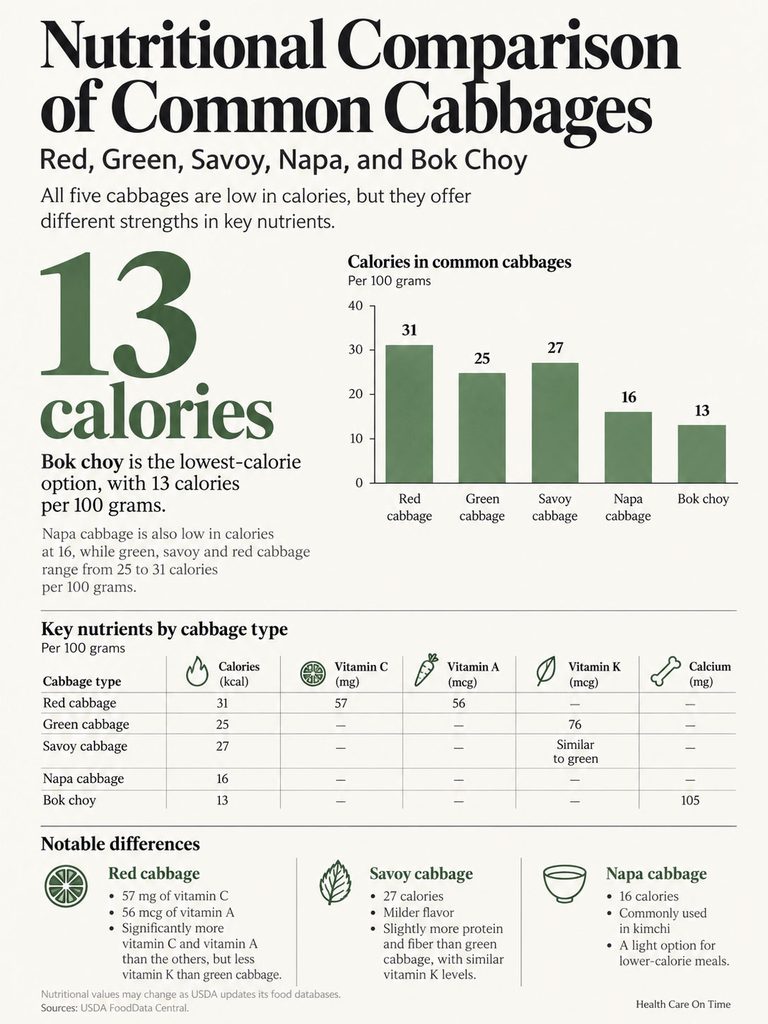
All five are sold as cabbage in US grocery stores, but they are not nutritionally identical.
Red Cabbage: More Calories, More Vitamin C
Red (purple) cabbage, FDC 169977, has 31 calories per 100 grams versus 25 for green. Its USDA profile lists 57 mg of vitamin C, 243 mg of potassium, and 56 mcg RAE of vitamin A per 100 grams.
That is about 56% more vitamin C than green cabbage and roughly 11 times the vitamin A. Red cabbage gets its color from anthocyanins, the same pigment family found in blueberries.
The trade-off is vitamin K. Red cabbage has about half as much (38.2 mcg vs 76 mcg per 100 grams).
Savoy Cabbage
Savoy has crinkled, looser leaves and a milder flavor. It provides 27 calories per 100 grams and slightly more protein and fiber than green cabbage.
A shredded cup comes to about 19 calories. Savoy’s vitamin K is close to green cabbage’s.
Napa Cabbage
Napa (also sold as Chinese cabbage or pe-tsai) is the oblong, pale cabbage used in kimchi. It is the lightest of the head cabbages at 16 calories per 100 grams.
USDA added a new Foundation Foods record for napa leaf in December 2025, part of a broader refresh of its vegetable data. Values may shift slightly as newer records replace older ones.
Bok Choy
Bok choy is technically a cabbage, though it does not form a head. At 13 calories per 100 grams, it is the lowest-calorie option here.
It also stands out for calcium (105 mg per 100 grams) and vitamin A. For volume at the lowest calorie cost, bok choy wins.
Cabbage in Real Meals: Coleslaw, Sauerkraut, Kimchi, Soup
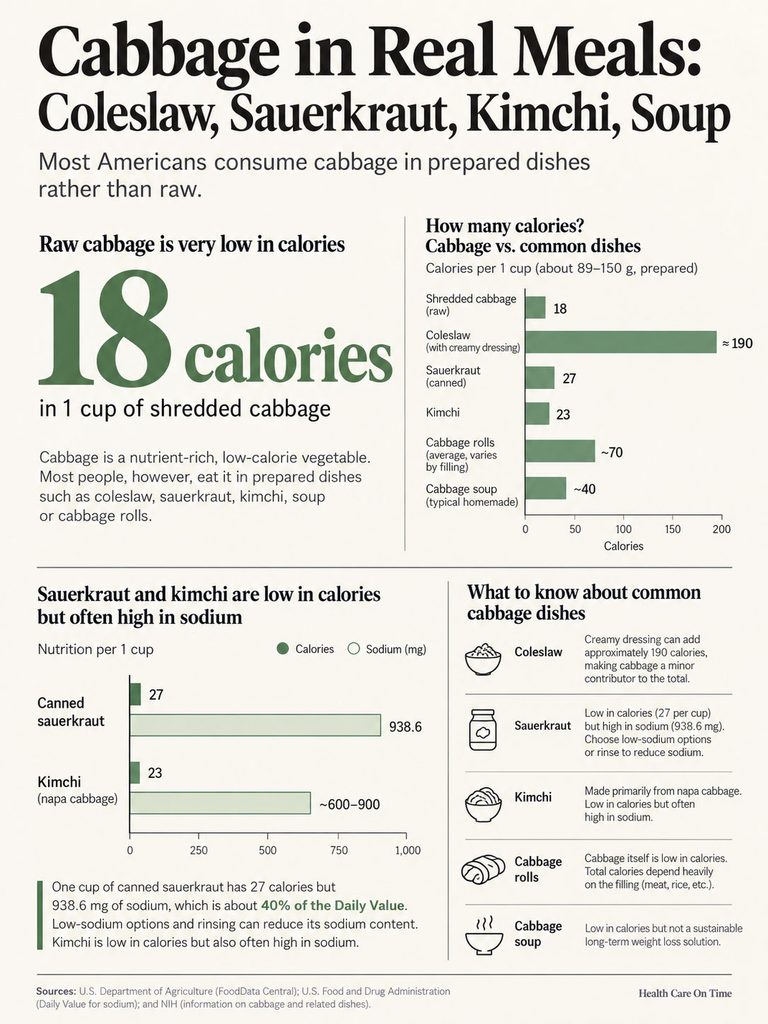
Most Americans eat cabbage in prepared dishes rather than plain. That is where the calorie picture changes completely.
The Coleslaw Dressing Trap
A cup of shredded cabbage has 18 calories. Regular mayonnaise has about 94 calories per tablespoon, so two tablespoons of a mayo-based dressing add roughly 190 calories.
In a typical creamy coleslaw, the cabbage supplies under 10% of the calories. Switching to a vinegar-based slaw, or using half mayo and half plain Greek yogurt, cuts the total sharply while keeping the crunch.
Patients reviewing weight loss plans with us often log “coleslaw” simply as a vegetable serving. It does count toward vegetables, but the dressing can make it one of the highest-calorie sides on the plate.
Sauerkraut: Low Calorie, High Sodium
Canned sauerkraut, FDC 169279, is still very low in calories. One cup (142 g) has 27 calories, 4.1 grams of fiber, and 938.6 mg of sodium, which is 39% of the Daily Value.
The FDA Daily Value for sodium is 2,300 mg, so a full cup of sauerkraut uses up about 40% of it. Low-sodium canned versions cut sodium by more than half, and rinsing drained sauerkraut lowers it further.
Shelf-stable canned sauerkraut is heat-processed, so it usually contains no live cultures. If gut bacteria are your goal, look for refrigerated, unpasteurized sauerkraut labeled “live cultures.”
Kimchi and Cabbage Rolls
Kimchi is mostly napa cabbage, so the cabbage itself adds very few calories. Like sauerkraut, kimchi is salty, and sodium varies widely by brand. Check the Nutrition Facts panel before you scoop.
Cabbage rolls depend almost entirely on the filling. Ground beef, rice, and tomato sauce make up most of the calories, while two large leaves add fewer than 20.
The Cabbage Soup Diet
The cabbage soup diet promises fast weight loss in seven days. People do lose weight on it, because the soup is extremely low in calories and the plan is very restrictive.
Much of that early loss is water and stored carbohydrate (glycogen), which returns once normal eating resumes. A bowl of cabbage soup is a fine light meal, but a week of it is not a sustainable plan.
Is Cabbage Good for Weight Loss, Keto, and Blood Sugar?
Cabbage fits nearly every mainstream eating plan. Its main advantage is energy density.
Energy Density and Volume Eating
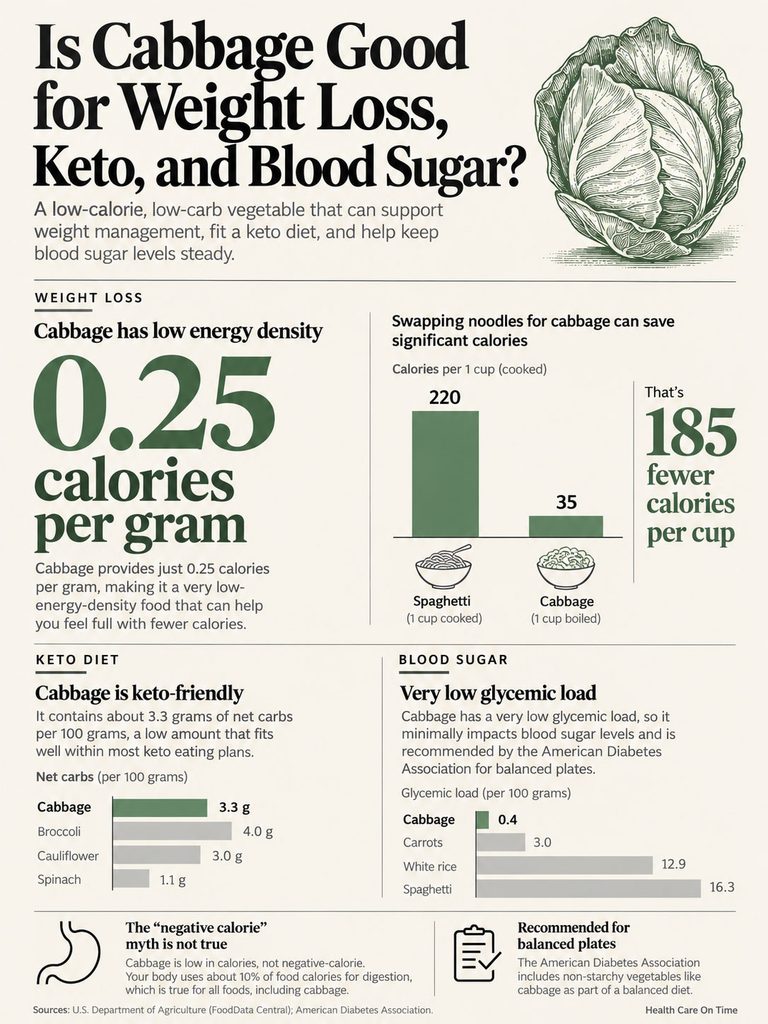
Raw cabbage has 0.25 calories per gram. By comparison, cooked pasta has about 1.6 calories per gram and potato chips more than 5.
Low-energy-density foods let you eat a larger, more filling portion for fewer calories. Swapping half the noodles in a stir-fry for shredded cabbage can cut that dish’s calories by hundreds without shrinking the plate.
Here is the math. One cup of cooked spaghetti has about 220 calories, while one cup of boiled cabbage has 35. Trading one for the other in a two-cup pasta bowl saves roughly 185 calories, and the bowl looks just as full.
Patients who send us meal logs before a weight check-in often find that one simple swap like this does more than cutting out a snack. It works because the portion stays the same size.
Net Carbs for Keto
Raw green cabbage has about 3.3 grams of net carbs per 100 grams (total carbs minus fiber). A chopped cup has about 3 grams.
That makes cabbage one of the more keto-friendly vegetables. Keep in mind that “net carbs” is not a term defined by FDA, so labels and apps calculate it in different ways.
Glycemic Load and Diabetes
Cabbage has a very low glycemic load, because a normal serving contains so little digestible carbohydrate. It barely moves blood sugar for most people.
The American Diabetes Association recommends filling half the plate with non-starchy vegetables, and cabbage qualifies. Our lab partners see the clearest picture of diet changes in an HbA1c test, which reflects a roughly three-month average.
The “Negative Calorie” Myth
Some sites claim cabbage burns more calories to digest than it contains. Digestion uses roughly 10% of a food’s calories, so a 22-calorie cup costs about 2 calories to process.
Cabbage is not negative-calorie. It is simply very low-calorie, which is useful enough on its own.
Who Should Watch Their Cabbage Intake
Cabbage is safe for nearly everyone. A few groups should pay attention to portion size or consistency.
Warfarin and Vitamin K Consistency
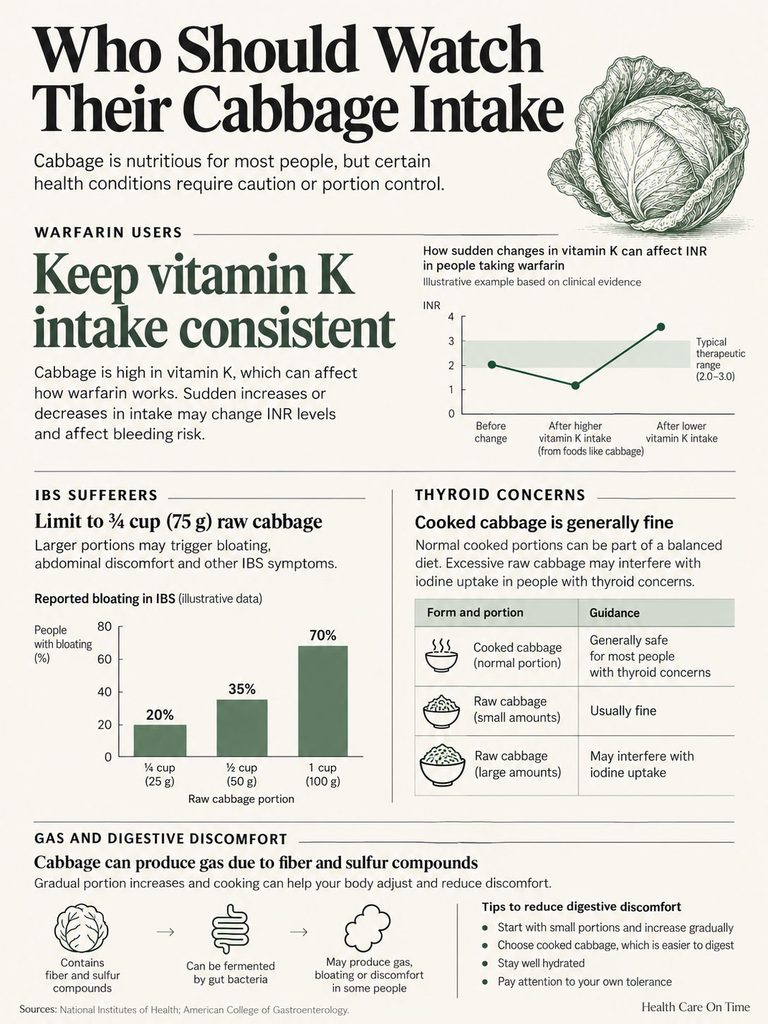
Warfarin (brand name Jantoven) works by blocking vitamin K. Sudden changes in vitamin K intake can move your INR, the blood test that tracks warfarin’s effect.
A chopped cup of raw green cabbage has about 68 mcg of vitamin K. A cup of boiled cabbage has about 163 mcg, more than the full 120 mcg Daily Value. The NIH Office of Dietary Supplements notes that people on warfarin should keep vitamin K intake consistent rather than avoid it.
In INR questions we see across our diagnostic network, the problem is rarely a steady cabbage habit. It is a sudden change, like a week of coleslaw at summer cookouts. Tell your clinician about large diet shifts before your next PT/INR test.
IBS and FODMAPs
Cabbage contains fermentable carbohydrates (FODMAPs) that can trigger bloating in people with irritable bowel syndrome. Portion size decides tolerance.
Monash University rates red cabbage low FODMAP at ½ cup (75 g), with servings over 150 g turning moderate and over 180 g high in fructans. Common green cabbage is also rated low at 75 grams.
Savoy is less settled. Monash now lists savoy cabbage as low FODMAP at 75 g, while earlier testing put the limit at 40 g, and some websites still repeat the older number. Check the current Monash app before a strict elimination phase.
Thyroid and Goitrogens
Cruciferous vegetables contain compounds that, in very large raw amounts, can interfere with iodine uptake by the thyroid. Normal servings of cabbage are not a concern for people with adequate iodine intake.
Cooking reduces these compounds further. For the details on how much is too much, see our guide on whether kale is good for thyroid health.
Gas and Bloating
Cabbage’s fiber and sulfur compounds feed gut bacteria, which produce gas. That is normal digestion, not a sign of intolerance.
Increasing portions gradually, cooking the cabbage, and drinking enough water usually helps. Persistent pain, weight loss, or blood in the stool is never “just cabbage” and warrants a visit to a clinician.
Table 3: Cabbage Decision Guide
| Scenario | Recommended action | Why |
| You take warfarin | Eat a steady amount weekly; avoid sudden binges | 1 cup boiled has about 163 mcg vitamin K, 136% DV |
| You have IBS | Start at ¾ cup (75 g) raw per meal | Monash moderate-fructan threshold for red cabbage is 150 g |
| You follow a low-sodium diet | Choose fresh cabbage; limit sauerkraut to ¼ cup | 1 cup sauerkraut has about 939 mg sodium |
| You follow keto | Use green cabbage freely as a noodle or rice swap | About 3 g net carbs per chopped cup |
| You have type 2 diabetes | Fill half your plate with cabbage and other non-starchy vegetables | Very low glycemic load per serving |
| You have hypothyroidism | Eat normal cooked portions; keep iodine adequate | Goitrogen effects require very large raw intakes |
| You are trying to lose weight | Swap mayo slaw for vinegar slaw | Saves about 150 to 190 calories per serving |
Cabbage in the US Diet: How Much Americans Eat
Cabbage remains a steady, affordable staple in American kitchens, even as overall vegetable intake slips.
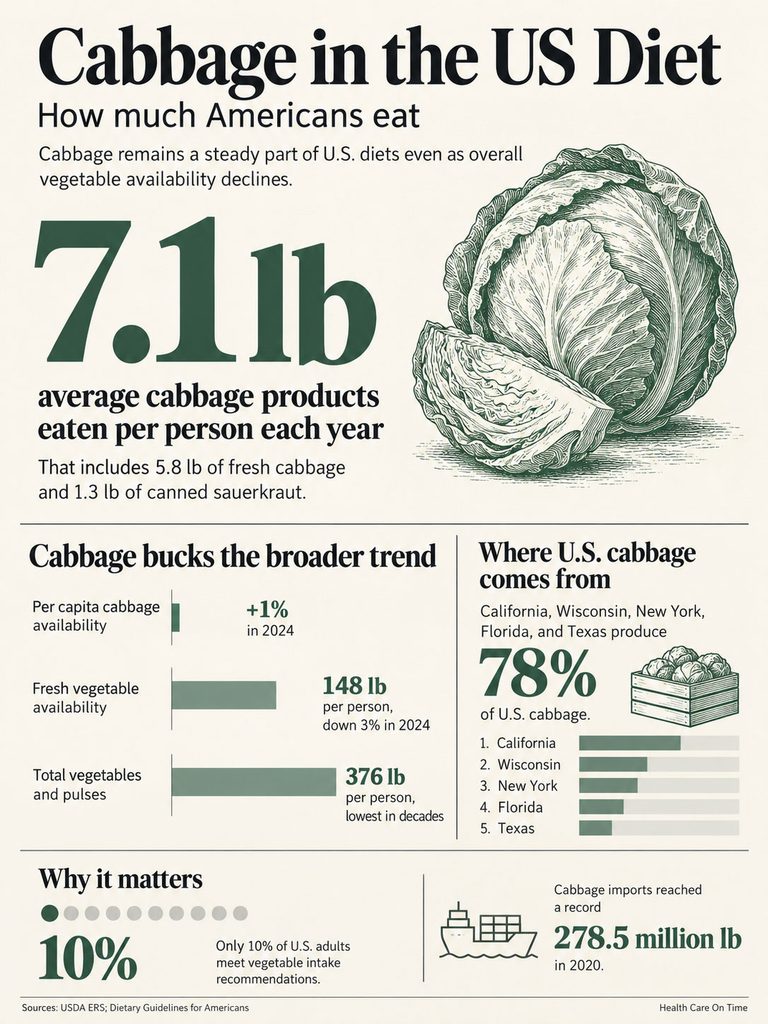
Table 2: US Cabbage and Vegetable Statistics
| Statistic | Value | Source |
| Change in per capita cabbage availability, 2024 | Up 1% | USDA Economic Research Service, VGS-375 |
| Per capita fresh vegetable availability, 2024 | 148 lb, down 3% | USDA Economic Research Service |
| Total vegetable and pulse availability, 2024 | 376 lb per person, lowest in decades | USDA Economic Research Service, VGS-375 |
| Fresh cabbage consumed per person | 5.8 lb fresh plus 1.3 lb canned kraut (2016, latest breakout) | USDA ERS via AgMRC |
| Share of US cabbage grown in five states | 78% (CA, WI, NY, FL, TX) | AgMRC |
| US cabbage imports | Record 278.5 million lb (2020) | AgMRC, citing USDA ERS |
| US adults meeting vegetable recommendations | 10.0% | CDC MMWR, BRFSS 2019 |
USDA ERS reported that per capita fresh vegetable availability fell 3% in 2024 to 148 pounds, while cabbage rose 1%. Total vegetable and pulse availability fell to 376 pounds per person, the lowest level in decades.
Just five states, California, Wisconsin, New York, Florida, and Texas, produce 78% of the nation’s cabbage. Only 1 in 10 American adults eats enough vegetables, according to the CDC, and an inexpensive head of cabbage stretches across many meals.
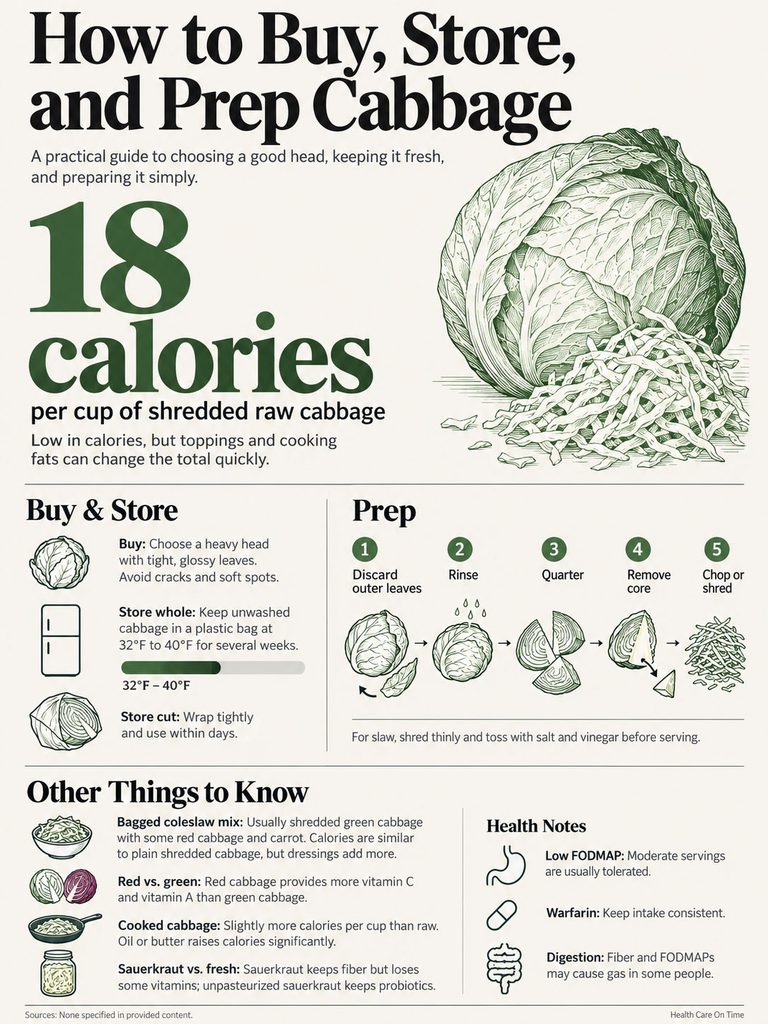
How to Buy, Store, and Prep Cabbage
The right head and the right storage keep cabbage crisp and its vitamins intact.
Buying
Choose a head that feels heavy for its size, with tight, glossy outer leaves. Avoid heads with cracks, black spots, or soft areas near the core.
Red and green cabbage are available year-round in the US. Peak harvest from southern states runs from fall through spring, with northern states adding summer supply.
Storing
Store a whole, unwashed head in a plastic bag in the refrigerator crisper drawer at 32°F to 40°F. Kept this way, it often lasts several weeks and sometimes up to two months.
Once cut, cabbage starts losing vitamin C. Wrap cut halves tightly and use them within a few days. Bagged coleslaw mix is best used soon after opening.
Bagged Coleslaw Mix and Pre-Shredded Cabbage
Plain bagged coleslaw mix is usually just shredded green cabbage with a little red cabbage and carrot. Its calories land close to plain shredded cabbage, around 15 to 20 per cup, so it is a fair time-saver.
Read the label before you buy. Some kits include a dressing packet that adds 100 calories or more per serving, plus sugar and sodium. Rinse pre-shredded cabbage before eating, and keep it cold at 40°F or below.
Prepping
Peel off and discard the outer two or three leaves. Rinse the head, cut it into quarters, and slice out the tough core before chopping.
For slaw, shred thinly and toss with a little salt and vinegar 15 minutes before serving. The leaves soften without heavy dressing.
Frequently Asked Questions
How many calories are in 1 cup of shredded cabbage?
One cup of shredded raw green cabbage weighs about 70 grams and contains 18 calories, according to USDA. A chopped cup weighs more (89 grams), so it comes to 22 calories. Both figures are correct for their serving sizes, which is why you see both online.
How many calories are in a whole head of cabbage?
A medium head of green cabbage weighs about 908 grams (2 pounds) and contains roughly 227 calories. USDA lists a small head at 714 grams (about 179 calories) and a large head at 1,248 grams (about 312 calories). Weigh your head for the most accurate count.
Is cabbage a negative-calorie food?
No. Digesting food uses about 10% of its calories, so a 22-calorie cup of cabbage costs roughly 2 calories to process. Cabbage is very low in calories, which helps with weight management, but your body still gains a net 20 calories from it.
Does cooked cabbage have more calories than raw?
Per 100 grams, boiled cabbage has slightly fewer calories (23 vs 25). Per cup, boiled cabbage shows more (35 vs 22) because cooked leaves pack tightly, so a cup holds more cabbage. Adding oil or butter adds 100 to 120 calories per tablespoon.
Is red cabbage healthier than green cabbage?
Red cabbage has more vitamin C (57 vs 36.6 mg per 100 grams), far more vitamin A, and anthocyanin pigments. Green cabbage has about twice the vitamin K. Red has slightly more calories, 31 vs 25 per 100 grams. Both are excellent choices.
How many net carbs are in cabbage?
Raw green cabbage has about 3.3 grams of net carbs per 100 grams, or about 3 grams per chopped cup. That makes it one of the more keto-friendly vegetables. Red cabbage runs a bit higher at roughly 5.3 grams of net carbs per 100 grams.
Is cabbage good for weight loss?
Yes. Cabbage has only 0.25 calories per gram, plus fiber and lots of water, so large portions stay low in calories. It works best as a swap for higher-calorie foods like noodles or rice. Watch dressings, since two tablespoons of mayo add about 190 calories.
How many calories are in coleslaw?
It depends on the dressing. One cup of shredded cabbage has 18 calories, and two tablespoons of regular mayonnaise add about 190, so a creamy homemade cup lands near 200. Vinegar-based slaws with a little oil come in far lower. Check deli labels, since recipes vary widely.
Is sauerkraut as healthy as fresh cabbage?
Sauerkraut keeps cabbage’s fiber and low calorie count (27 calories per cup) but loses some vitamin C and adds about 939 mg of sodium per cup. Shelf-stable canned versions are usually pasteurized, so they lack live cultures. Refrigerated, unpasteurized sauerkraut keeps its probiotics.
Can you eat cabbage if you take warfarin?
Usually yes, if your intake stays consistent. Cabbage is high in vitamin K, which counteracts warfarin, so sudden large changes can affect your INR. Eat a similar amount each week and tell your clinician about big diet changes before your next INR test.
Is cabbage low FODMAP?
Green and red cabbage are low FODMAP at about ¾ cup (75 grams) per meal, according to Monash University. Larger servings of red cabbage become moderate in fructans above 150 grams. Savoy cabbage is now rated low at 75 grams, though older sources still list 40 grams.
Why does cabbage cause gas?
Cabbage contains fiber, fermentable carbohydrates called FODMAPs, and sulfur compounds. Gut bacteria break these down and produce gas, which is normal. Smaller portions, cooking the cabbage, and increasing intake gradually usually reduce bloating. See a clinician for persistent pain or other symptoms.
Disclaimer: This article is for general education and is not medical advice. Nutrient values come from USDA FoodData Central and may differ from specific products. If you take warfarin or other blood thinners, have IBS, thyroid disease, kidney disease, or follow a sodium-restricted diet, talk with your healthcare provider or a registered dietitian before making major diet changes.
References
- USDA FoodData Central: Cabbage, raw (FDC 169975)
- USDA FoodData Central: Cabbage, cooked, boiled, drained (FDC 169976)
- USDA FoodData Central: Cabbage, red, raw (FDC 169977)
- USDA FoodData Central: Cabbage, savoy, raw (FDC 169978)
- USDA FoodData Central: Sauerkraut, canned (FDC 169279)
- USDA FoodData Central: Update Log
- USDA SNAP-Ed: Cabbage Seasonal Produce Guide
- USDA Economic Research Service: Vegetables and Pulses Outlook VGS-375
- Agricultural Marketing Resource Center: Cabbage
- FDA: Daily Value on the Nutrition and Supplement Facts Labels
- NIH Office of Dietary Supplements: Vitamin K Fact Sheet
- CDC MMWR: Adults Meeting Fruit and Vegetable Intake Recommendations
- Monash FODMAP: FODMAP Stacking
- FODMAP Everyday: Cabbage FODMAPs
- Washington State Department of Agriculture: Facts for Cabbage
- Healthline: 9 Potential Health Benefits of Cabbage
- Cleveland Clinic: 8 Health Benefits of Cabbage