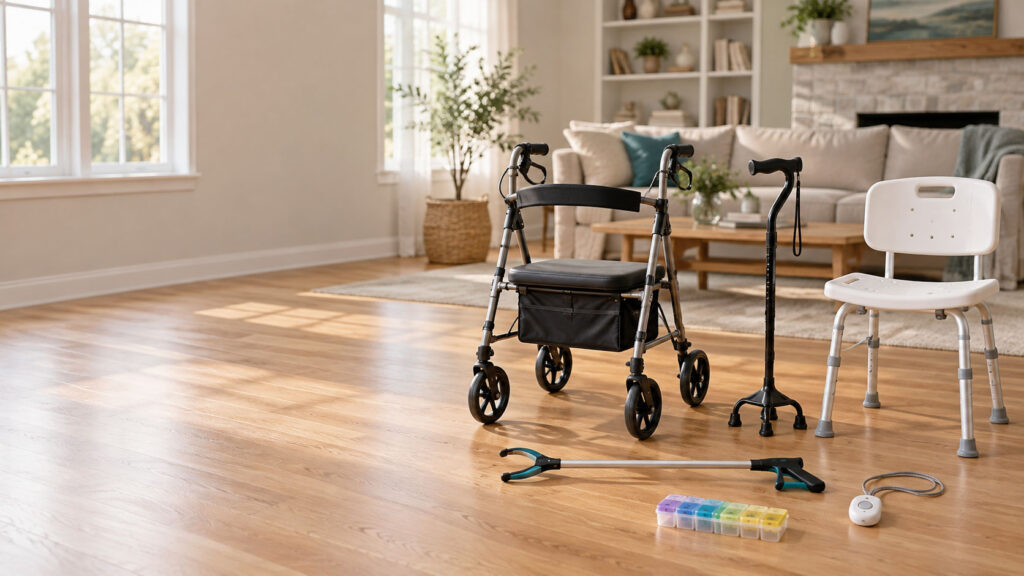
A $30 grab bar can protect your mom better than a full bathroom remodel. Most senior falls don’t happen on icy sidewalks; they happen stepping out of the shower or getting up from the toilet at 2 a.m.
Table of Contents
The good news? The best assistive devices for the elderly are often simple, cheap, and sometimes free to borrow. This guide covers what to get, where to find it, and who pays for it.
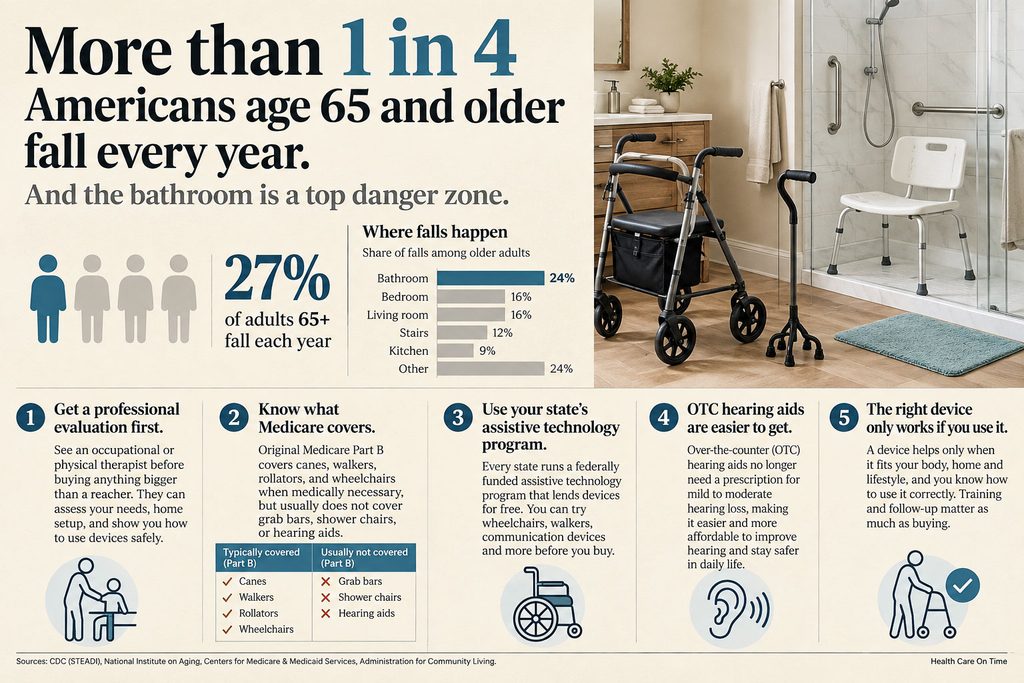
Quick Answer: The best assistive devices for the elderly fall into five groups: mobility aids (canes, walkers, rollators), bathroom safety gear (grab bars, shower chairs, raised toilet seats), daily living aids (reachers, sock aids, jar openers), hearing and vision aids, and safety tech like medical alert systems. Get covered items from a Medicare-enrolled supplier, where Part B pays 80% after your deductible, or borrow devices free through your state assistive technology program.
At a Glance
- More than 1 in 4 Americans age 65 and older fall every year, and the bathroom is a top danger zone.
- Get an occupational or physical therapy evaluation before buying anything bigger than a reacher.
- Original Medicare Part B covers canes, walkers, rollators, and wheelchairs, but usually not grab bars, shower chairs, or hearing aids.
- Every state runs a federally funded assistive technology program that lends devices for free.
- OTC hearing aids no longer need a prescription for mild to moderate hearing loss.
- A device only helps if it fits and gets used; training matters as much as buying.
The 10 Best Assistive Devices for the Elderly (Quick List)
Short on time? These are the assistive devices for seniors that our medical reviewers see make the biggest difference at home:
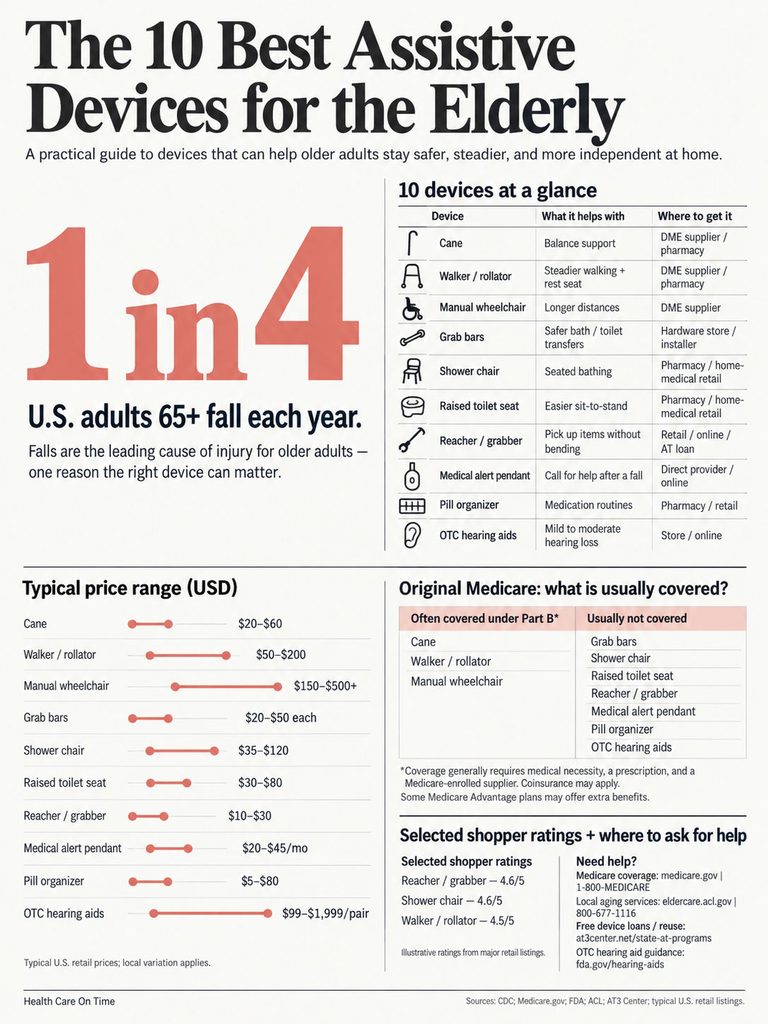
- Grab bars for safe moves in and out of the tub and on and off the toilet
- Shower chair or tub transfer bench so bathing happens seated
- Raised toilet seat or toilet safety frame for easier standing
- Cane (standard or quad) for mild balance problems
- Walker or rollator for bigger balance or stamina problems
- Reacher grabber to avoid bending and climbing
- Medical alert system with fall detection for seniors who live alone
- Automatic pill dispenser to prevent missed or double doses
- OTC hearing aids or a captioned phone for hearing loss
- Motion-sensor night lights to light the path to the bathroom
Each one is covered in detail below, with prices, Medicare rules, and where to get it.
What Counts as an Assistive Device for Seniors?
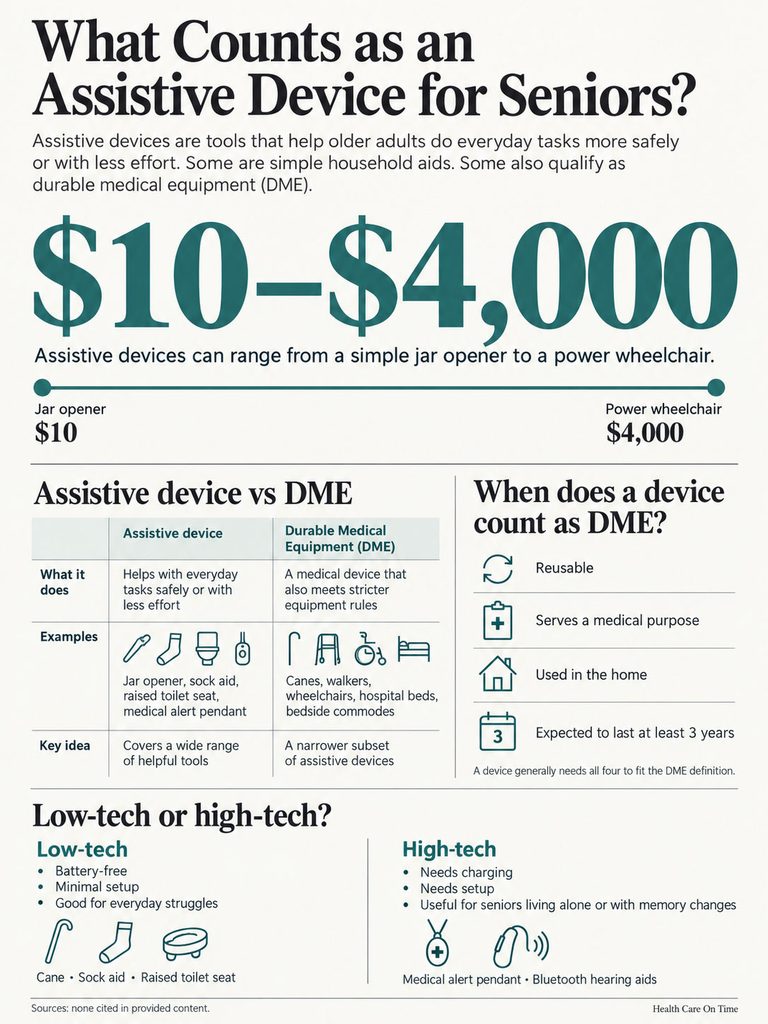
An assistive device is any tool that helps an older adult do an everyday task more safely or with less effort. That covers everything from a $10 jar opener to a $4,000 power wheelchair.
Doctors and insurers sort these tools into different buckets. That sorting decides who pays, so it’s worth knowing before you shop.
Assistive Devices vs. Durable Medical Equipment (DME)
Durable medical equipment is a narrower, insurance-defined group. Medicare calls something DME when it’s reusable, serves a medical purpose, is used at home, and is expected to last at least three years.
Canes, walkers, wheelchairs, hospital beds, and bedside commodes usually qualify. Grab bars, reachers, and shower benches usually don’t, because Medicare treats them as convenience items, even though they prevent injuries.
Low-Tech vs. High-Tech Options
Low-tech aids have no batteries: canes, sock aids, long-handled sponges, raised toilet seats. They’re cheap, reliable, and easy to learn.
High-tech aids include medical alert pendants, smart pill dispensers, and Bluetooth hearing aids. They solve bigger problems, but they need charging, setup, and often a monthly fee.
Our medical team has reviewed a wide range of caregiver questions, and the pattern is clear. Low-tech fixes solve most daily struggles. High-tech tools earn their place when a senior lives alone or has memory changes.
Why the Right Device Matters Now
Getting the right equipment isn’t only about convenience. For many families, it’s the difference between aging in place and moving to assisted living after a bad fall.
The Fall Problem in Numbers
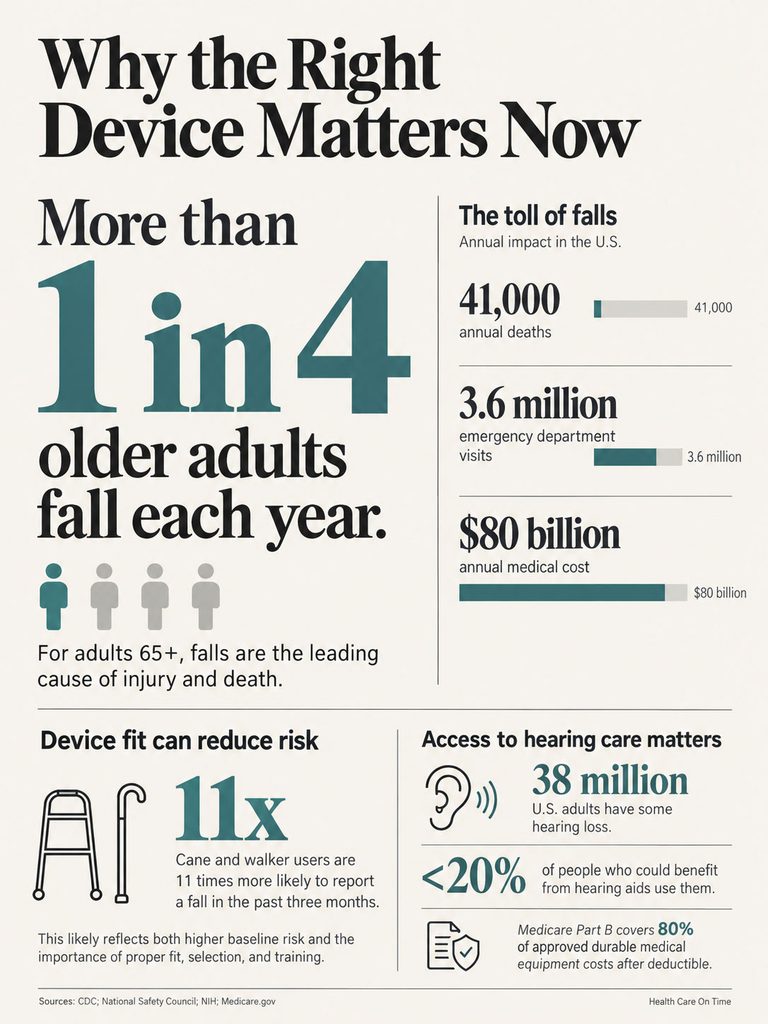
Falls are the leading cause of injury and injury death among U.S. adults age 65 and over, and more than 1 in 4 older adults fall each year, according to the CDC. These falls lead to about 41,000 deaths, 3.6 million emergency department visits, and 1.2 million hospital stays.
The cost is staggering too. Older adult falls run up about $80 billion in medical costs every year.
One surprise: people who already use mobility aids fall more. Cane and walker users are 11 times more likely to report a fall in the past three months than non-users, per the National Safety Council. Devices don’t cause this; users already have balance problems. That’s exactly why fit and training matter.
| Statistic | Figure | Source |
| Adults 65+ who fall each year | More than 1 in 4 | CDC |
| Older adult fall deaths per year | About 41,000 | CDC |
| ER visits from older adult falls per year | 3.6 million | CDC |
| Hospital stays from older adult falls per year | 1.2 million | CDC |
| Annual medical cost of older adult falls | About $80 billion | CDC |
| Fall risk, cane/walker users vs. non-users (past 3 months) | 11 times more likely to report a fall | National Safety Council |
| U.S. adults with some hearing loss | About 38 million | NIH-indexed review (PMC) |
| People who could benefit from hearing aids who use them | Under 20% | NIH-indexed review (PMC) |
| Device users trained on proper use | About 50% | Published fall research |
| Medicare Part B share of approved DME cost | 80% after deductible | Medicare.gov |
Signs Your Parent Needs an Assistive Device
Small changes usually show up months before a fall. Watch for these:
- Holding onto furniture or walls to move around (“furniture walking”)
- Taking longer to stand up from a chair or toilet
- Skipping showers or wearing the same clothes for days
- Missing pill doses or doubling up
- Turning the TV up loud or avoiding phone calls
- Cooking less and eating more ready-made food
- A recent fall, even one with no injury
Caregivers who reach out to us often say the warning signs were there; they just didn’t link them to a fixable problem. Any one of these is a good reason to call your parent’s doctor.
The Best Assistive Devices for the Elderly, by Category
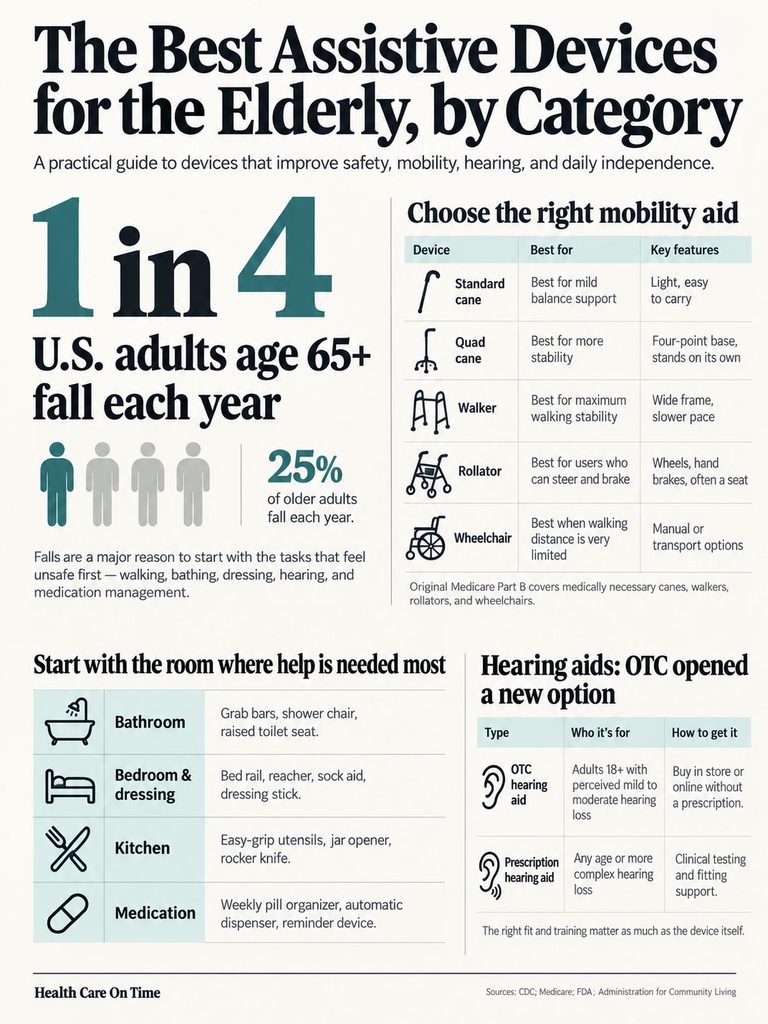
There’s no single “best” device. The right one depends on what your parent struggles with. Here are the top picks in each category, with what they do well and where they fall short.
Mobility Aids
Mobility aids are the most common assistive devices for seniors. Picking the wrong one, though, can make balance worse instead of better.
Canes (Standard vs. Quad)
A standard single-point cane works for mild balance problems or one weaker leg. Your parent holds it in the hand opposite the weak leg.
The handle should line up with the wrist crease when arms hang relaxed. That leaves a slight bend in the elbow, which is the sweet spot for support.
A quad cane has four small feet and stands on its own. It gives more stability, which helps after a stroke, but it’s heavier and clumsy on uneven ground.
Walkers and Rollators
A standard walker has four legs with rubber tips and no wheels. Your parent lifts it with each step, so it’s the most stable choice and also the slowest. A two-wheeled front walker is a middle ground.
A rollator has four wheels, hand brakes, and usually a seat. It suits seniors who can walk a decent distance but tire fast.
The rule of thumb is simple. If your parent leans hard on the device, choose a walker. If they need rest stops more than balance support, a rollator wins. One warning: rollator brakes must be locked before sitting, or the seat can roll out from under them.
Wheelchairs, Transport Chairs, and Lift Chairs
Transport chairs are light and pushed by a caregiver. Standard wheelchairs let the user roll themselves. Power chairs and scooters need heavy paperwork for Medicare coverage.
Lift chairs tilt forward to help a senior stand. Medicare covers only the seat-lift mechanism, not the chair itself, so expect to pay most of the cost.
| Device | Best For | Typical USA Price | Covered by Original Medicare? | Key Limitation |
| Standard cane | Mild imbalance, one weak leg | $15 to $40 | Yes, as DME | Little help for serious balance loss |
| Quad cane | Post-stroke, one-sided weakness | $30 to $70 | Yes, as DME | Heavy, poor on uneven ground |
| Standard walker | Major balance problems | $40 to $100 | Yes, as DME | Must be lifted every step |
| Rollator (4 wheels) | Low stamina, needs rest stops | $70 to $250 | Yes, as DME | Rolls away if brakes aren’t set |
| Transport chair | Outings, caregiver-pushed | $100 to $250 | Sometimes, with documentation | User can’t self-propel |
| Shower chair or tub bench | Weakness or fatigue while bathing | $30 to $120 | Usually no | Must fit the tub properly |
| Raised toilet seat or safety frame | Trouble standing from toilet | $25 to $80 | Usually no (bedside commode is covered) | Must match toilet shape |
| Grab bar (installed) | Bathroom transfers | $20 to $60 each, plus install | No | Must anchor into studs |
| Medical alert with fall detection | Seniors living alone | $20 to $50 per month | No | Monthly fee; only works if worn |
Prices are typical ranges at major U.S. retailers and vary by brand and features.
Bathroom Safety Devices
The bathroom mixes wet floors, hard surfaces, and constant sitting and standing. That’s why our medical reviewers suggest families fix this room first.
- Grab bars next to the toilet, inside the shower, and at the tub entry
- A shower chair, or a tub transfer bench that straddles the tub wall so your parent never steps over it
- A handheld showerhead on a slide bar
- A raised toilet seat or toilet safety frame with armrests
- Non-slip strips inside the tub and a rubber-backed mat outside
- A long-handled sponge for the back and feet
Never trust suction-cup grab bars or towel racks to hold full body weight. Real grab bars screw into wall studs or use rated anchors.
Bedroom and Dressing Aids
Getting out of bed and getting dressed are often the first tasks seniors struggle with.
- A bed assist handle that slides under the mattress for extra support when standing
- A sock aid, so your parent can pull on socks without bending
- A button hook and zipper pull for stiff fingers
- A long-handled shoehorn and elastic no-tie shoelaces
- Motion-sensor night lights along the path to the bathroom
- A reacher grabber for items on the floor or high shelves
Choose bed handles built to limit gaps between the rail and mattress. The FDA warns that these gaps can trap a person and cause serious injury.
Kitchen and Eating Aids
Arthritis and tremors make cooking and eating frustrating. These small tools help seniors stay independent at meals:
- Built-up or weighted utensils with thick, easy-grip handles
- Jar openers, either lever-style or battery-powered
- Plate guards and scoop dishes that keep food from sliding off
- Lightweight pots and a kettle tipper for pouring without lifting
- An automatic stove shutoff device for seniors with memory changes
Hearing, Vision, and Communication Aids
Hearing loss is one of the most ignored problems in aging. About 38 million U.S. adults have some hearing loss, yet fewer than 20% of those who could benefit from hearing aids actually use them.
That gap is easier to close now. On October 17, 2022, the FDA created a new over-the-counter hearing aid category, letting adults with perceived mild to moderate hearing loss buy without a prescription or hearing test. The FDA has even authorized software that turns compatible AirPods Pro into an OTC hearing aid.
When shopping, look for “OTC” and “hearing aid” printed on the package. If hearing drops suddenly or loss seems severe, skip OTC devices and see a doctor first.
Other helpful tools:
- Amplified or captioned phones
- TV listening devices that stream sound to headphones
- Lighted magnifiers and large-print books
- Large-button remotes and talking clocks
- High-contrast tape on stair edges
Medication Management Devices
Many older adults juggle several prescriptions a day. Mix-ups are common, and some are dangerous.
- A weekly pill organizer with morning and evening slots
- An automatic locking dispenser that beeps and opens only at dose time
- Pharmacy blister packs sorted by date and time
- Reminder alarms on a phone or smart speaker
Families we work with often find that a pharmacist will set up blister packs at little or no cost. Ask before buying a $100 dispenser.
Safety Tech: Medical Alerts and Fall Detection
A medical alert system, sometimes called a PERS, is a wearable button that calls a monitoring center. Mobile versions with GPS work outside the home.
Many models include automatic fall detection. It isn’t perfect; it can miss slow slides to the floor or trigger false alarms. Still, for seniors who live alone, it can cut the time spent on the floor after a fall.
Expect a monthly fee. These systems typically run about $20 to $50 a month and aren’t covered by Medicare. Pick a waterproof model, since many falls happen in the shower.
How to Choose the Right Device
Buying first and asking questions later is the most common mistake families make. A short evaluation saves money and prevents falls.
Start With an Occupational or Physical Therapy Evaluation
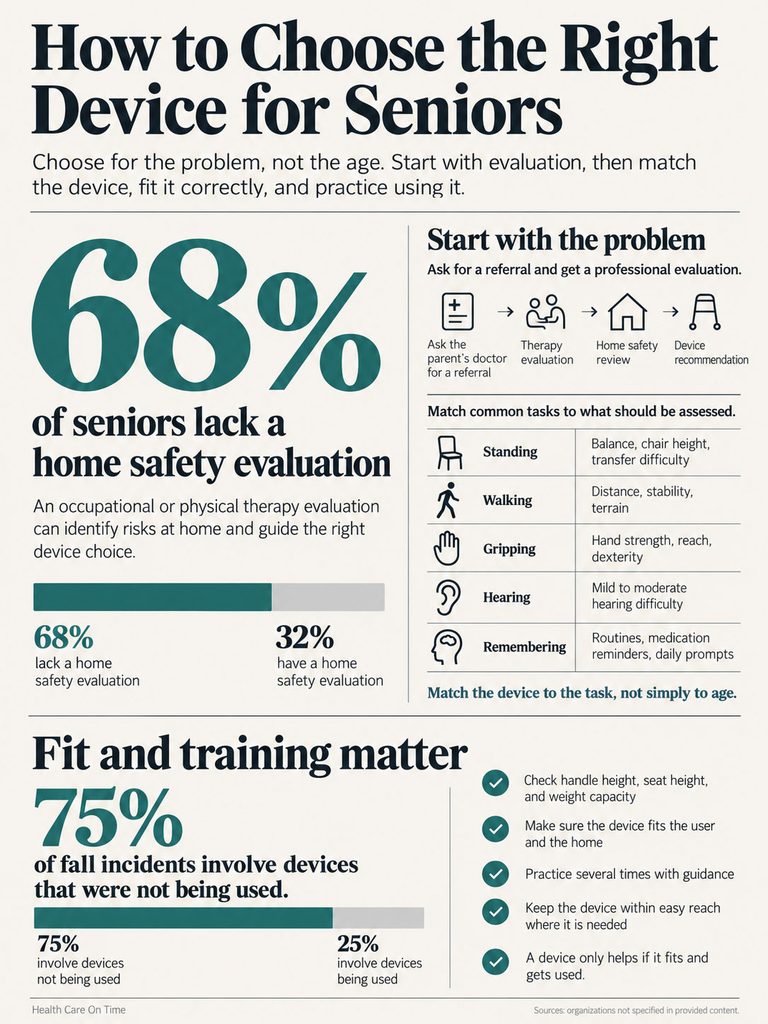
An occupational therapist (OT) looks at daily tasks like bathing, dressing, and cooking. A physical therapist (PT) checks walking and balance and fits mobility aids.
Ask your parent’s doctor for a referral. Medicare Part B covers outpatient therapy when it’s medically needed, and home health visits after a hospital stay often include a home safety check.
Many seniors never get one. In one study, 68% of respondents had never received a home safety evaluation.
Match the Device to the Problem, Not the Age
A healthy 85-year-old may need nothing more than a night light. A 68-year-old after a hip replacement may need a walker, a raised toilet seat, and a reacher.
Focus on the task that’s hard. Is it standing, walking, gripping, hearing, or remembering? Each points to a different tool.
Fit, Height, and Weight Capacity Checks
- Set cane and walker handles at wrist crease height.
- Check weight limits on the label; bariatric models exist for heavier users.
- Measure tub wall height and toilet shape (round or elongated) before buying bathroom gear.
- Measure doorways; most wheelchairs need about 32 inches of clear width.
Training Matters More Than the Purchase
A device in the closet protects no one. Research found that 75% of people who fell weren’t using their device when it happened, and only half had been trained to use it.
Ask the PT or supplier to show your parent how to use the device on stairs, curbs, and carpet. Practice together for a week. Keep the cane or walker within arm’s reach of the bed at night.
Where to Find Assistive Devices
You have more options than the pharmacy aisle. Some are cheaper, and some are free.
Medicare-Enrolled DME Suppliers
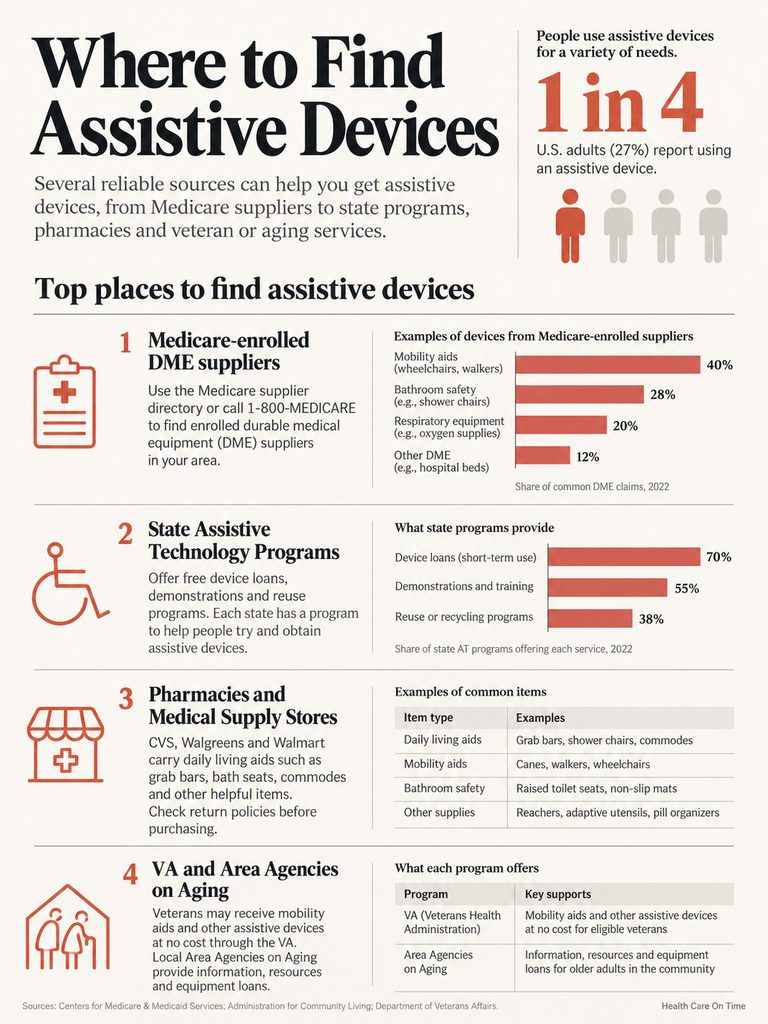
If you want Medicare to pay, where you buy matters. Medicare only covers DME from an enrolled supplier, and you can’t buy a wheelchair at any store and mail Medicare the receipt.
Use the Medicare supplier directory or call 1-800-MEDICARE. Ask whether the supplier “accepts assignment,” which means they take Medicare’s approved price as full payment and usually costs you less.
State Assistive Technology Programs (Free Loans and Reuse)
This is one of the best-kept secrets in senior care. The Assistive Technology Act funds AT programs in every state and territory, and most of their services are free.
These programs offer device demonstrations, short-term loans so you can test equipment first, reuse programs with gently used devices at big savings, and cash loan programs. In Florida, for example, residents can borrow a device for 15 to 35 days, shipped at no charge.
Find your state’s program through the AT3 Center. Information and demonstrations are usually free, though some programs charge a small fee to cover shipping on loans.
Pharmacies, Medical Supply Stores, and Online Retailers
CVS, Walgreens, Walmart, and Amazon carry most daily living aids. Local medical supply stores cost a bit more, but your parent can try a rollator or shower chair before buying.
Check return policies before you order. Read weight ratings carefully, and be wary of no-name grab bars with vague mounting instructions.
VA, Area Agencies on Aging, and Centers for Independent Living
Veterans enrolled in VA health care may get mobility aids, hearing aids, and other devices through the VA’s Prosthetic and Sensory Aids Service, often at no cost.
Your local Area Agency on Aging can point you to loan closets, home modification help, and in-home services. Find yours through the Eldercare Locator or by calling 1-800-677-1116.
Centers for Independent Living, churches, senior centers, and Lions Clubs often run equipment loan closets too.
How to Pay for Assistive Devices
Cost stops many families from buying what their parent needs. Here’s how coverage actually works.
What Original Medicare Covers (and Doesn’t)
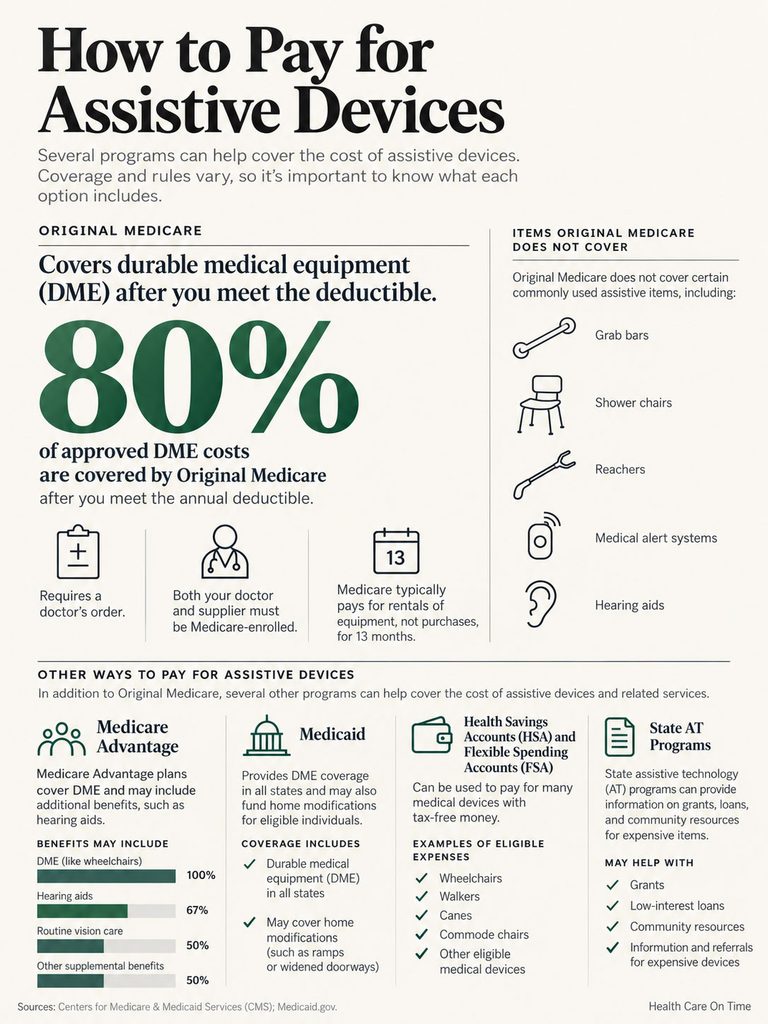
Under Original Medicare, Part B pays for DME. Once the deductible is met, Medicare covers 80% of the approved amount, and you pay the other 20% unless you have a Medigap plan.
Your doctor must write an order, and both the doctor and supplier must be enrolled in Medicare. Medicare also pays only for the standard model that meets basic medical needs.
Rent vs. buy is Medicare’s call, not yours. Inexpensive items like canes and standard walkers can usually be bought right away, while for other equipment Medicare often pays a monthly rental fee for 13 months.
What Original Medicare usually won’t cover: grab bars, shower chairs, reachers, medical alert systems, and hearing aids. Traditional Medicare generally doesn’t pay for hearing aids or the exams to fit them.
Medicare Advantage and Medicaid
Medicare Advantage plans cover the same medically necessary DME as Original Medicare. Many also add hearing benefits and over-the-counter allowance cards that can be spent on bathroom safety items.
Medicaid covers DME in every state. Some state waiver programs also pay for home modifications, grab bars, and medical alert systems for seniors who want to keep aging in place.
HSA/FSA, VA Benefits, and Low-Interest AT Loans
Health Savings Accounts and Flexible Spending Accounts can pay for many medical devices, including canes, walkers, and hearing aids. Save receipts in case your plan asks for proof.
For pricier items, state AT programs may know of public programs, community groups, grants, or cash loans, and their alternative financing programs often offer better terms than a credit card.
Common Mistakes Families Make
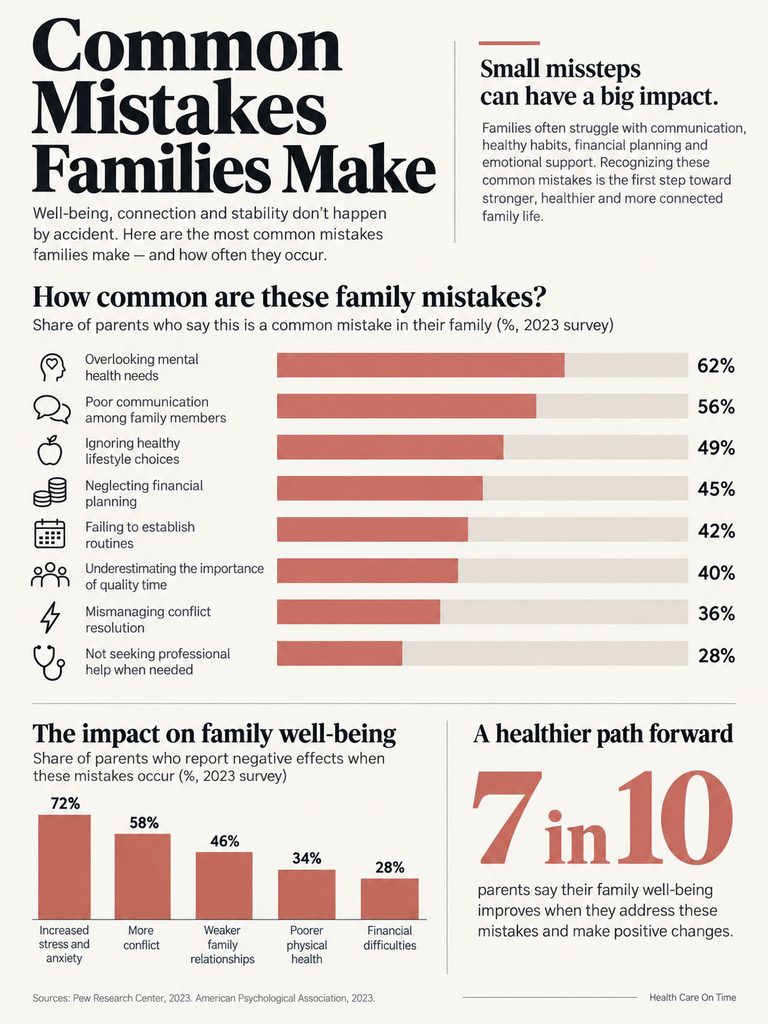
Across the families we hear from, the same errors come up again and again:
- Buying before an evaluation. A $200 rollator is wasted money if your parent really needs a standard walker.
- Setting the wrong height. A cane that’s too tall or short throws off posture and balance.
- Trusting towel bars or suction cups. Neither is built to hold an adult who slips.
- Using a non-enrolled supplier. Medicare won’t reimburse you after the fact.
- Leaving the alert button on the nightstand. A medical alert only works if it’s worn.
- Ignoring pride. Seniors resist devices that feel like a label, so involve your parent in choosing colors and styles.
- Skipping hearing and vision. Poor hearing and eyesight raise fall risk and isolation, yet they’re often the last things checked.
Your Action Plan: Matching Needs to Devices
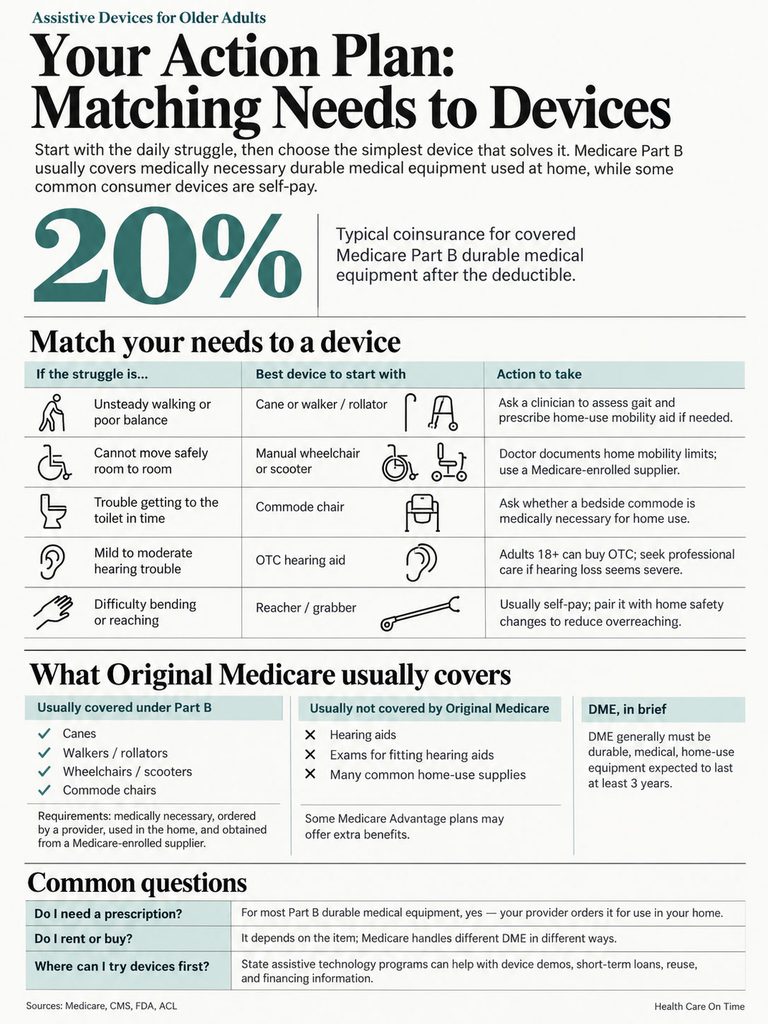
Use this table to turn a specific struggle into a clear next step.
| If Your Parent… | Recommended Device | Where to Get It | First Step |
| Feels unsteady walking indoors | Cane or front-wheeled walker | Medicare-enrolled DME supplier | Ask doctor for a PT referral and fitting |
| Tires after short walks outside | Rollator with seat and hand brakes | DME supplier (Part B) | Get a written order; practice using brakes |
| Struggles to stand from the toilet | Raised toilet seat or safety frame, plus grab bar | Pharmacy, online, or state AT reuse program | Measure toilet height and shape |
| Is afraid of the shower | Tub transfer bench, handheld shower, grab bars | Medical supply store or state AT loan | Book an OT home safety evaluation |
| Lives alone | Medical alert with fall detection | Monitoring company or Medicare Advantage benefit | Compare monthly fees; test the button weekly |
| Has arthritis in the hands | Jar opener, built-up utensils, button hook | Pharmacy or online | Ask an OT for a hand function check |
| Turns the TV up loud or misses calls | OTC hearing aids or captioned phone | Pharmacy, electronics store, state phone program | Get a hearing test if loss seems severe |
| Misses or doubles pill doses | Locking automatic pill dispenser | Pharmacy or online | Ask the pharmacist about blister packs |
| Has early memory loss | Stove shutoff, GPS medical alert, simple phone | Online or Area Agency on Aging | Build a safety plan with the doctor |
Start with one room and one problem. A few well-chosen, well-fitted devices often do more than a cart full of gadgets.
Frequently Asked Questions
What is the most common assistive device for the elderly?
Canes are the most common, followed by walkers and bathroom aids like grab bars and shower chairs. They’re popular because they’re cheap, easy to learn, and target the biggest risk for older adults: falls. A physical therapist can confirm whether a cane gives enough support or a walker is safer.
Does Medicare cover assistive devices for seniors?
Medicare Part B covers devices classed as durable medical equipment, such as canes, walkers, rollators, wheelchairs, and hospital beds. A doctor must order them, and you must use a Medicare-enrolled supplier. After the Part B deductible, Medicare pays 80% of the approved amount and you pay 20%.
Does Medicare pay for shower chairs and grab bars?
Usually not. Original Medicare treats shower chairs, tub benches, and grab bars as convenience items, not medical equipment. A bedside commode is covered, though. Some Medicare Advantage plans offer allowance cards for bathroom safety items, and Medicaid waiver programs in many states pay for grab bars.
Is a rollator or a walker better for seniors?
A standard walker is better for seniors with serious balance problems, because it doesn’t roll. A rollator is better for seniors who walk fairly well but tire quickly, since it has a built-in seat. If your parent leans heavily on the frame, choose a walker. A PT can test both.
Where can seniors get free assistive devices?
Start with your state’s Assistive Technology Act program, which lends devices for free and runs reuse programs with donated equipment. Area Agencies on Aging, Centers for Independent Living, churches, and senior centers often run loan closets. Veterans may receive devices through the VA at no cost.
Does Medicare cover hearing aids?
Original Medicare doesn’t cover hearing aids or fitting exams. Many Medicare Advantage plans include some hearing aid benefits, so check your plan. Since 2022, adults with mild to moderate hearing loss can also buy FDA-regulated OTC hearing aids without a prescription, often for far less than prescription models.
Are medical alert systems worth it for seniors living alone?
For most seniors living alone, yes. A medical alert system gets help fast after a fall, which lowers the risk of complications from lying on the floor for hours. Fall detection models call automatically. Plans usually run $20 to $50 per month and aren’t covered by Original Medicare.
How do you know if an elderly person needs a walker?
Signs include holding onto furniture to move around, a recent fall, shuffling steps, trouble rising from a chair, or fear of walking. If a cane no longer feels steady, a walker is the next step. Ask the doctor for a physical therapy referral so the walker is fitted correctly.
What assistive devices help seniors with arthritis?
Helpful tools include jar openers, built-up utensils, button hooks, zipper pulls, sock aids, reachers, and lever-style door handles. Electric can openers and lightweight cookware also reduce strain. An occupational therapist can match tools to the joints that hurt most and teach easier ways to do daily tasks.
What devices help elderly people with dementia stay safe?
Useful options include automatic stove shutoffs, GPS medical alert devices, locking pill dispensers, door chimes or alarms, simplified phones with photo buttons, and motion-sensor lights. Choose devices that need little learning. Involve the doctor and family in a safety plan as memory changes progress.
How can you get a parent to actually use a mobility aid?
Involve your parent in picking the device, including color and style. Have a physical therapist do the fitting and training, since advice from a professional often lands better than advice from family. Frame it as a tool for staying independent, and keep the device within reach at all times.
Disclaimer: This article is for general information only and isn’t medical advice. Assistive device needs vary from person to person. Talk with a doctor, physical therapist, or occupational therapist before choosing mobility or safety equipment, and confirm coverage with Medicare, Medicaid, or your insurance plan before buying.
References
- CDC: Older Adult Fall Prevention
- CDC: Older Adult Fall Prevention At-a-Glance (PDF)
- National Safety Council Injury Facts: Older Adult Falls
- Medicare.gov: Durable Medical Equipment Coverage
- Medicare.gov: Medicare Coverage of Durable Medical Equipment (PDF)
- Medicare.gov: Find Medical Equipment Suppliers
- WellCare: Medicare DME Coverage for Walkers, Canes, and Wheelchairs
- FDA: Bed Rail Safety
- FDA: How to Get Hearing Aids
- FDA: First Over-the-Counter Hearing Aid Software
- Frontiers in Audiology: Over-the-Counter Hearing Aids
- NIH PMC: OTC Hearing Aids and Health-Monitoring Sensors Review
- Administration for Community Living: Assistive Technology
- AT3 Center: Find Solutions
- AT3 Center: Find AT
- FAAST: Short-Term Device Loans
- VA Prosthetic and Sensory Aids Service
- Eldercare Locator
- Assistive Technology and Home Modifications on Falls: Systematic Review Protocol