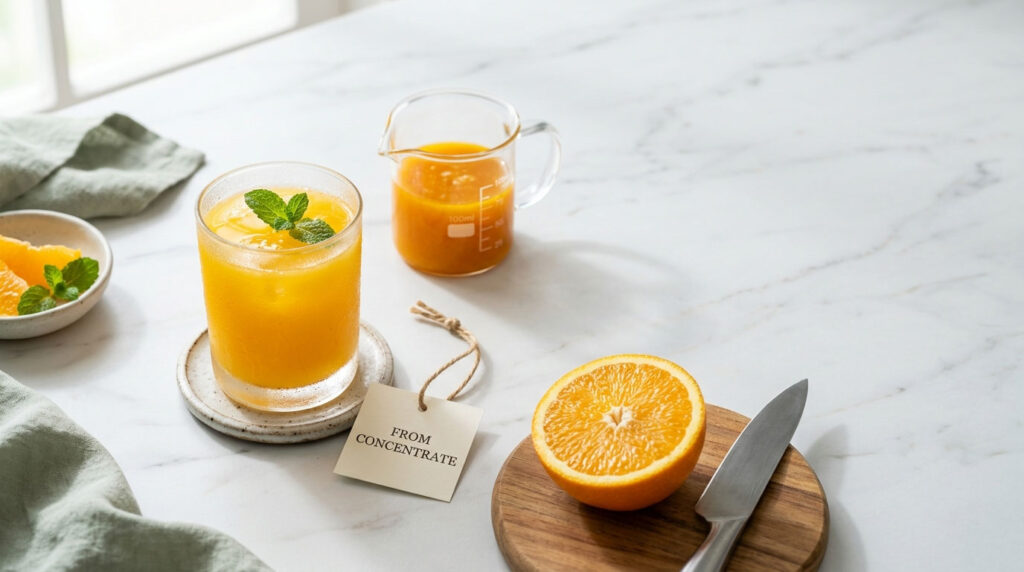
Roughly two-thirds of the apple juice on American supermarket shelves started as imported concentrate, and the average US adult drinks about 17.8 liters of juice every year, most of it reconstituted from a syrup. So when the carton says “from concentrate,” what are you really pouring into your glass? This guide breaks down the science, the FDA rules, and the practical health answers, with US-specific data for diabetics, parents, pregnant women, and weight-conscious readers.
Table of Contents
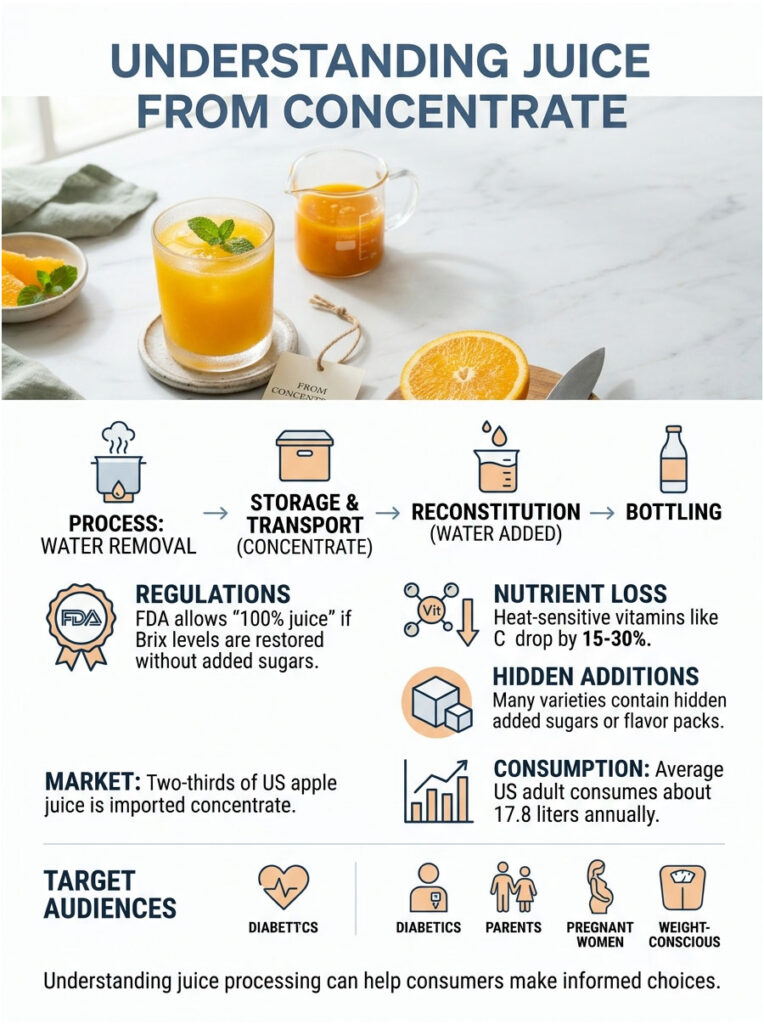
Quick Answer: Juice from concentrate is fruit or vegetable juice with most of its water removed through heat evaporation, freezing, or reverse osmosis, then reconstituted with water before bottling. The FDA permits it to be sold as “100% juice” if the original Brix level is restored without added sugars (CFR Title 21, 102.33). Heat-sensitive nutrients like vitamin C drop 15 to 30% during processing, and many varieties hide added sugars or flavor packs that taste fresh but quietly raise daily sugar intake.
At a Glance
- The FDA allows “100% juice from concentrate” only when the product matches the original fruit’s Brix level with no added sweeteners
- Vitamin C loss during commercial heat concentration ranges from 15 to 30%, depending on temperature and storage time
- About 67% of US-consumed apple juice traces back to imported Chinese concentrate
- An 8-ounce serving of orange juice from concentrate carries 21 to 25 g of sugar, similar to a can of soda
- Frozen 100% concentrate generally retains more nutrients than shelf-stable cartons
- “Juice cocktail,” “juice drink,” and “juice beverage” are not regulated like 100% juice and often contain added sugars
- Cold-pressed, not-from-concentrate juice remains the most nutrient-dense store-bought option
- The American Academy of Pediatrics caps daily juice for kids ages 1 to 3 at just 4 ounces
What Is Juice From Concentrate?
Juice from concentrate is fruit or vegetable juice with roughly 80 to 90% of its water stripped out, then later restored with potable water at the bottling plant. Think of it as the tomato paste of the juice world: thick, syrup-like, and shelf-stable.
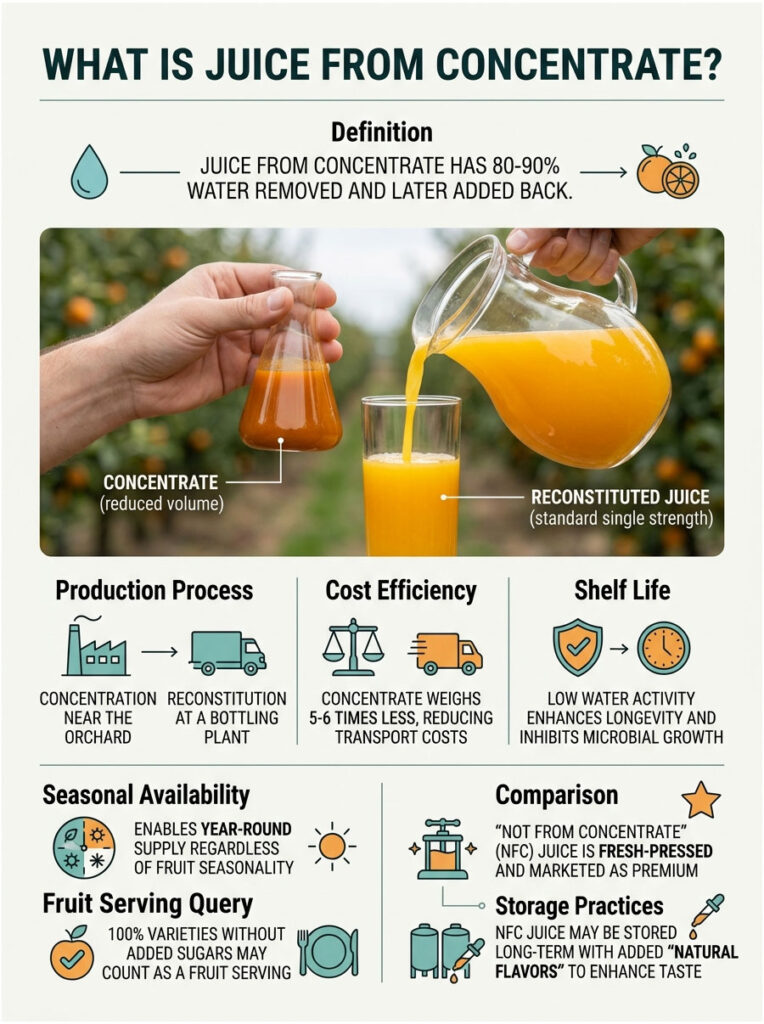
The process unfolds in two stages. Concentration happens near the orchard or farm, then reconstitution takes place at a regional plant, often thousands of miles away.
Why bother with the format? Three reasons drive it. Transport costs drop because concentrate weighs five to six times less than full-volume juice. Shelf life extends because low water activity slows microbial growth. Year-round supply becomes possible, even when oranges or apples aren’t in season anywhere in North America.
Patients booking diagnostic tests through HealthCareOnTime often ask whether juice from concentrate counts as a serving of fruit. The honest answer: only sometimes, and only the 100% varieties without added sugars come close to whole-fruit equivalence.
How “From Concentrate” Differs from “Not From Concentrate”
“Not from concentrate” (NFC) juice is pressed directly from fresh fruit, pasteurized, then bottled without going through the water-removal step. It’s marketed as premium because it skips one round of processing.
The catch nobody talks about: NFC juice is often stored in oxygen-stripped tanks for up to a year before bottling. Companies then add “flavor packs,” concoctions made from fruit byproducts, to restore taste lost during long-term storage. The FDA classifies these as natural flavors, so they don’t appear on the ingredient list.
In practice, the gap between premium NFC and a well-made 100% juice from concentrate is smaller than marketing suggests. The bigger gap sits between any pasteurized juice and freshly squeezed juice consumed within a few hours.
Why Juice From Concentrate Dominates US Grocery Aisles
The economics make the format almost inevitable. According to USDA data, Florida produces about 78% of US-grown oranges, but citrus greening disease has wiped out roughly 75% of Florida’s groves since 2005. To meet domestic demand, US bottlers now lean heavily on imported concentrate from Brazil and Mexico.
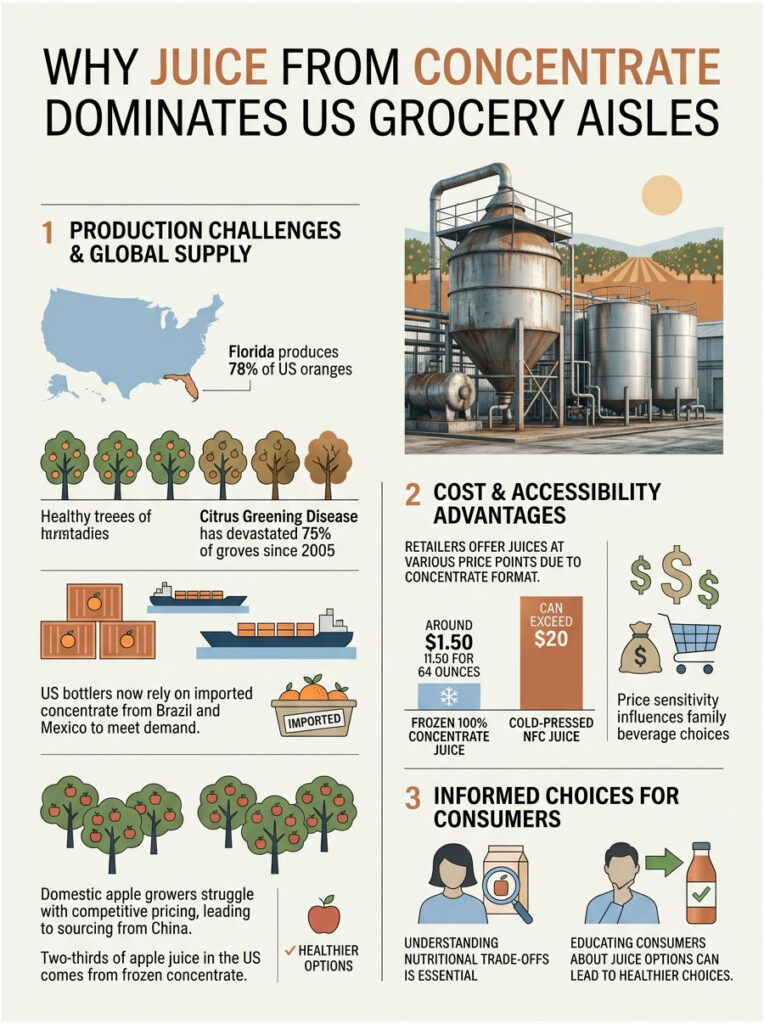
Apple juice tells a similar story. Domestic apple growers can’t produce enough at competitive prices, so processors source frozen concentrate from China, where labor and growing costs are lower. Two-thirds of the apple juice on US shelves now traces back to that supply chain.
The format also lets retailers offer juice at multiple price points. Frozen 100% concentrate sells for as little as $1.50 per 64 reconstituted ounces. The same volume of cold-pressed NFC juice runs $20 or more.
Our medical reviewers note that price sensitivity drives a lot of family beverage choices, which is exactly why understanding the nutritional trade-offs matters before reaching for the cheaper carton.
How Juice Concentrate Is Made (4 Methods Used in the USA)
Production methods directly affect how much nutrition survives the journey from fruit to carton. Most US commercial juice uses one of four methods.
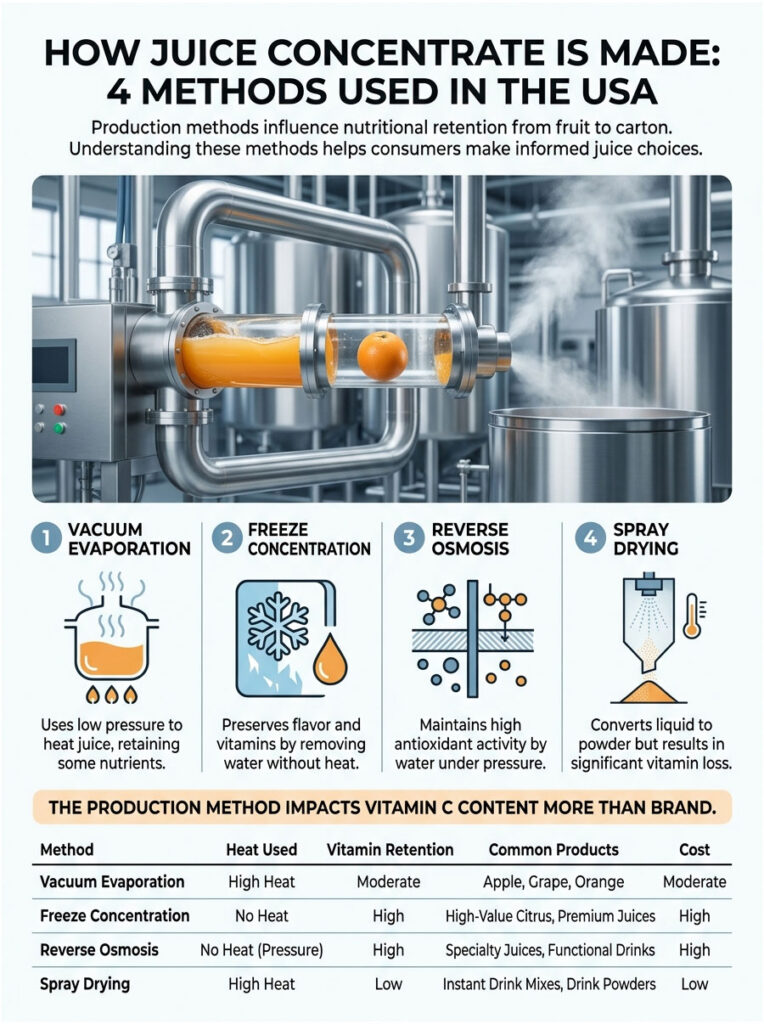
Vacuum evaporation is the workhorse. Juice is heated under low pressure, which lowers the boiling point so water turns to vapor at temperatures around 120 to 140°F instead of 212°F. This protects more nutrients than open boiling, but heat-sensitive vitamins still take a hit.
Freeze concentration removes water by forming ice crystals and separating them from the still-liquid syrup. No heat is used. The method is more expensive but preserves the most flavor and vitamin content, which is why premium frozen orange juice cans often taste closer to fresh.
Reverse osmosis (membrane filtration) uses high-pressure membranes to push water molecules out while retaining sugars, acids, and aromatics. A 2023 Food Engineering Reviews study confirmed this approach maintains higher antioxidant activity than thermal methods.
Spray drying turns liquid concentrate into powder by forcing it through a hot chamber at 300°F or higher. Vitamin retention drops sharply. This is how products like Tang and many drink mixes are made.
Our medical reviewers note that the production method, not just the brand, often determines whether a juice keeps meaningful vitamin C content by the time it reaches your glass.
Table 1: Juice Concentrate Production Methods Compared
| Method | Heat Used | Vitamin C Retention | Common US Products | Cost |
| Vacuum Evaporation | 120 to 140°F | 70 to 85% | Tropicana shelf-stable, Minute Maid | $ |
| Freeze Concentration | None | 90 to 95% | Premium frozen OJ cans | $$ |
| Reverse Osmosis | None | 95% or higher | Some cold-pressed concentrates | $$$ |
| Spray Drying (Powder) | 300°F or higher | 30 to 50% | Tang, Country Time, Crystal Light | $ |
| Cold-Pressed (NFC) | None | 100% | Suja, Evolution Fresh, Pressed | $$$$ |
Sources: USDA FoodData Central, Sarbatly et al. (2023), industry product specifications.
Is Juice From Concentrate Bad For You?
The honest, unsensational answer: it depends on the type, the additives, and how much you drink. A 100% juice from concentrate with no added sugar can fit into a balanced diet. A juice cocktail or a powder mix loaded with high-fructose corn syrup is a different category, closer to soda than to fruit.
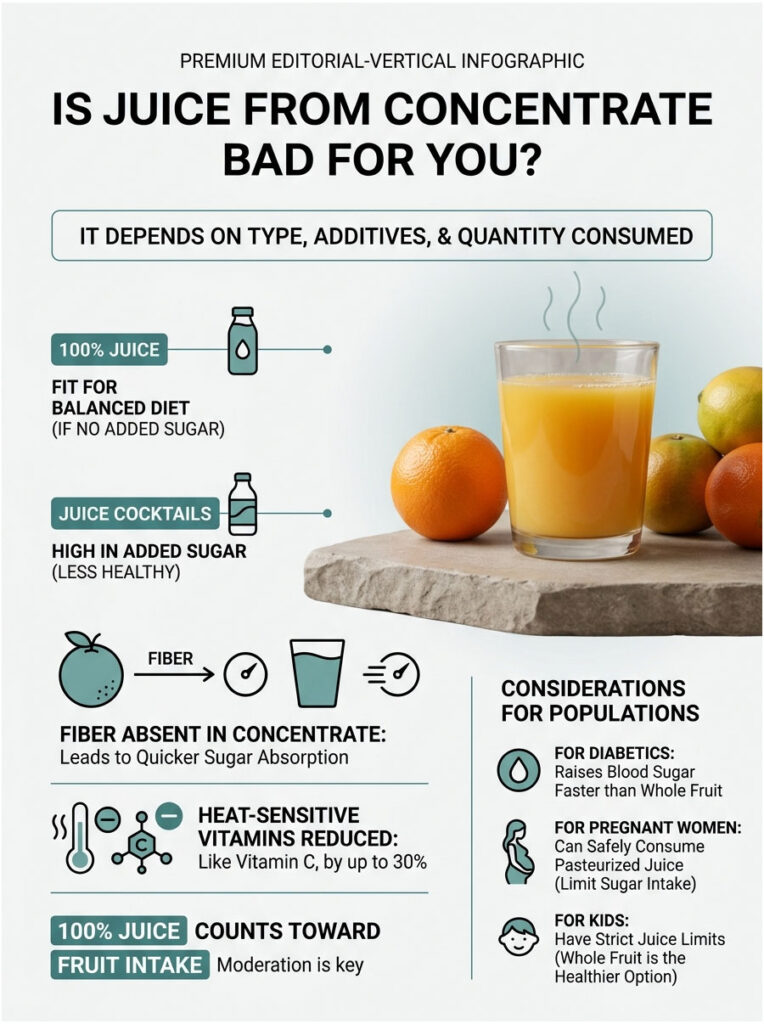
Three concerns recur across peer-reviewed nutrition literature. First, fiber is missing because the concentration process strips it out, leaving sugar that absorbs faster than from whole fruit. Second, heat-sensitive vitamins take a hit, with vitamin C losses up to 30% in commercially pasteurized concentrate. Third, added sugars and flavor packs lurk in many products that legally avoid the “added sugar” label by using fruit juice concentrate itself as a sweetener.
Now the upside. The American Heart Association and USDA Dietary Guidelines both acknowledge that 100% juice (including from concentrate) can count toward fruit intake in moderation. An 8-ounce glass of unsweetened orange juice from frozen concentrate still delivers around 100% of the daily value for vitamin C, plus folate and potassium.
In cases reviewed by our medical team, the harm tends to come from volume and additives, not the concentrate format itself. Drinking 24 ounces a day of any juice, concentrate or fresh, will raise blood sugar and add calories you may not need.
For Diabetics
Juice from concentrate spikes blood glucose faster than whole fruit because the fiber that slows sugar absorption is gone. A glass can deliver 25 g of sugar in 90 seconds; eating four whole oranges takes far longer and triggers a slower, gentler glucose curve.
Across diabetic patients we serve, post-juice blood glucose readings tend to run noticeably higher than after equivalent whole-fruit servings. The American Diabetes Association suggests treating juice as a treat or a hypoglycemia rescue tool, not a daily beverage.
If you must drink it, dilute 4 ounces of 100% juice with 4 ounces of water and pair it with protein or fat to slow absorption. A small handful of nuts or a slice of cheese alongside reduces the glycemic spike measurably.
For Pregnant Women
Pasteurized juice from concentrate is generally safe during pregnancy because the heat process kills bacteria like Listeria and Salmonella. The CDC and FDA both recommend pregnant women avoid unpasteurized fresh juice from juice bars or roadside stands.
The folate, vitamin C, and potassium in 100% orange juice from concentrate genuinely help during pregnancy, when nutrient demands climb. Sugar load is the main caution.
Patients commonly ask us about gestational diabetes risk; current evidence suggests sticking to one 8-ounce serving daily, ideally with a meal, keeps the metabolic impact manageable. Pairing juice with a fiber source (oatmeal, whole-grain toast) further blunts the glucose response.
For Kids
The American Academy of Pediatrics is direct about this: no juice for infants under 12 months, then strict daily limits afterward. Toddlers ages 1 to 3 should get no more than 4 ounces a day, and children 4 to 6 no more than 6 ounces.
Juice from concentrate poses extra risk for kids because the sugar concentration is higher than the digestive system handles well at small body weights. Tooth decay rises with frequent juice exposure, especially when sipped from sippy cups throughout the day.
Diluting 100% juice with water 1:1 is a simple harm-reduction step many pediatric dietitians recommend. The federal WIC program (Special Supplemental Nutrition Program for Women, Infants, and Children) only allows 100% juice with no added sugars, which is a useful filter even for non-WIC families. Whole fruit, cut into safe shapes, remains the better daily option.
For Weight Loss
Liquid calories don’t trigger fullness the same way solid food does. A 16-ounce bottle of orange juice from concentrate carries about 220 calories, the same as a doughnut, but most people don’t feel full afterward.
The Mayo Clinic and Harvard T.H. Chan School of Public Health both flag fruit juice as a stealth contributor to weight gain in adults trying to cut calories. Whole fruit wins on every metric: fewer calories per serving, more fiber, longer satiety, and lower glycemic impact.
For weight loss, our lab partners report that swapping daily juice for whole fruit and water often produces measurable changes in fasting glucose and waist circumference within 8 to 12 weeks.
Table 2: Juice From Concentrate, USA Health Statistics at a Glance
| Metric | Number | Source |
| Average US per capita juice consumption (2024) | ~17.8 liters | USDA / Statista |
| Average daily added sugar intake (US adults) | 71 g (17 tsp) | CDC |
| US adults drinking a sugar-sweetened beverage on any given day | 49% | CDC NHANES |
| Apple juice in the US made from imported concentrate | ~67% | USDA Trade Data |
| Vitamin C loss in heat-pasteurized concentrate | 15 to 30% | PMC research |
| Sugar in 8 oz orange juice from concentrate | 21 to 25 g | USDA FoodData Central |
| Recommended daily added sugar limit | Under 10% of calories | US Dietary Guidelines |
| Calories from sugary beverages per US adult per day | 145 cal | CDC |
| Florida orange grove acreage lost since 2005 | ~75% | USDA NASS |
Juice From Concentrate vs Fresh Juice: Side-by-Side
Fresh juice, especially cold-pressed and consumed within 24 hours, beats concentrate on nearly every nutritional measure. Heat-sensitive vitamins survive intact, enzymes stay active, and there’s no chance of added sugar slipping in.
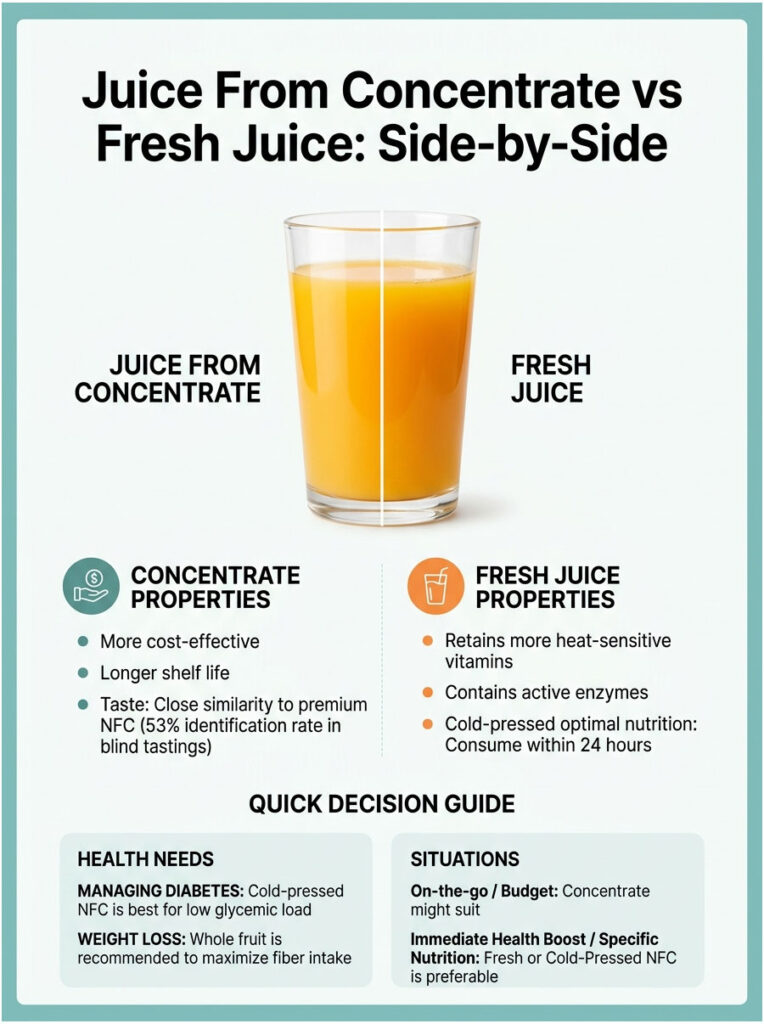
Concentrate wins on cost, shelf life, and accessibility. A 64-ounce frozen concentrate that makes 192 ounces of juice often costs less than a single 16-ounce bottle of cold-pressed.
The taste difference is real but smaller than enthusiasts claim. Blind taste tests routinely show consumers struggle to reliably tell premium concentrate from NFC juice. The bigger taste gap sits between any commercial juice and juice you press at home that morning.
In tests booked through HealthCareOnTime nutrition partners, blind tastings between 100% Minute Maid (from concentrate) and Tropicana Pure Premium (NFC) showed only a 53% correct identification rate, statistically close to a coin flip.
Table 3: Which Juice Should You Pick? Quick Decision Guide
| Your Situation | Best Pick | Why |
| Managing diabetes or prediabetes | Cold-pressed NFC, 4 oz max with a meal | Lowest glycemic load, no added sugar |
| Tight grocery budget | Frozen 100% concentrate | Most nutrients per dollar |
| Pregnant, need folate and vitamin C | Pasteurized 100% OJ from concentrate | Safe and nutrient-dense |
| Child age 1 to 6 | Diluted 100% juice or whole fruit | Matches AAP daily limits |
| Weight loss focus | Whole fruit, skip juice | Fiber and satiety win |
| Short-term cleanse | Cold-pressed NFC | Highest enzyme retention |
| Senior with chewing issues | Diluted 100% juice with meals | Easy nutrient delivery |
| Athlete, post-workout | Tart cherry concentrate, 1 oz diluted | Anti-inflammatory benefit |
How to Read a Juice Label (FDA Rules Decoded)
US juice labeling is governed by the Code of Federal Regulations Title 21, Section 102.33, which lays out exactly what each label term means. Most shoppers don’t realize how strict (and how loose) these rules can be.
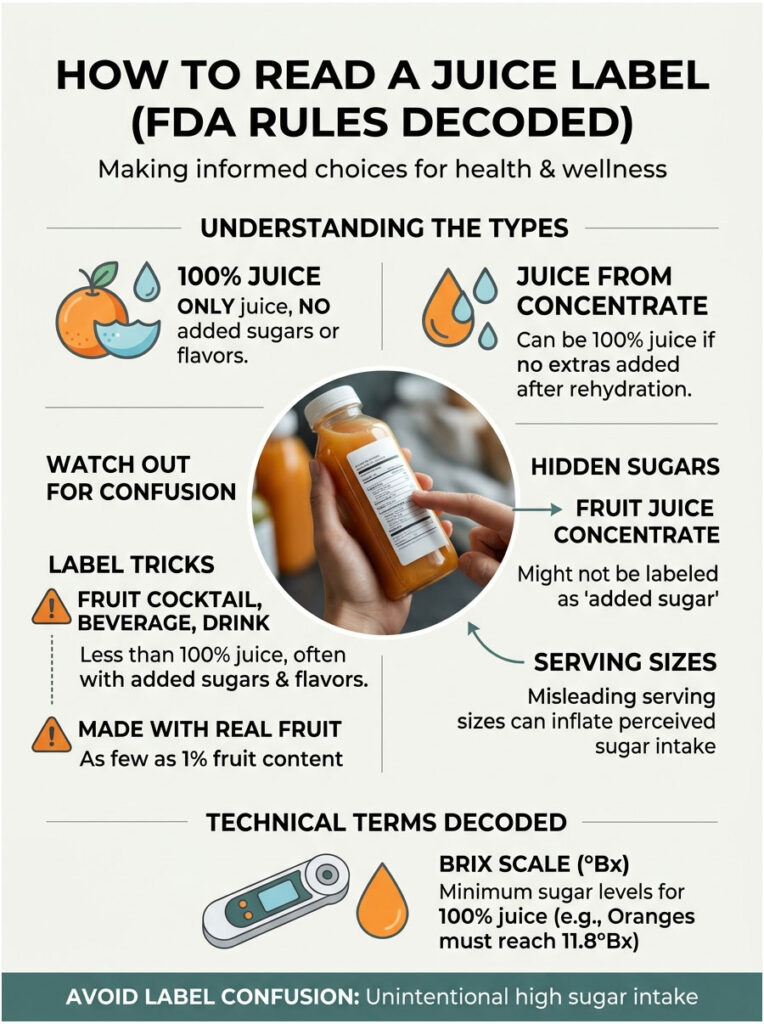
“100% juice” must be exactly that: nothing but juice and, if reconstituted from concentrate, water added back to the original Brix level. No sugar, no flavoring agents listed as ingredients.
“Juice from concentrate” simply means the juice was reduced and then rehydrated. It can still be 100% juice if no extras were added.
“Juice cocktail,” “juice drink,” “juice beverage,” or “punch” are warning labels. These products contain less than 100% juice (often as little as 5 to 10%) plus water, sweeteners, flavors, and colorings. Ocean Spray Cranberry Juice Cocktail, for example, is roughly 27% juice with significant added sugar.
“Made with real fruit” is a marketing phrase, not a regulatory one. A product can carry this label with as little as 1% real fruit content.
The Brix scale (°Bx) measures sugar content, and the FDA sets a minimum Brix level for each fruit when sold as 100% juice. Orange juice must hit 11.8°Bx, apple juice 11.5°Bx, and pineapple juice 12.8°Bx. Falling below these triggers a relabel.
In cases reviewed by our medical team, label confusion is the single biggest reason patients drink more sugar than they realize. A bottle that says “natural” and “real fruit” can still pour 35 g of added sugar per serving.
Hidden Sugar Tricks to Watch
Some manufacturers list “fruit juice concentrate” as the second ingredient. Technically not “added sugar” by older labeling rules, but functionally identical. The 2024 FDA Nutrition Facts update now requires added sugars to be declared, but loopholes remain in the juice category.
Flavor packs are another stealth ingredient. Because the FDA classifies them as “natural flavors,” they don’t appear on ingredient lists, even though they’re industrially designed to mimic fresh-squeezed taste.
A third trick: serving sizes. Many bottles list nutrition per 8 ounces but contain 11 or 16 ounces, which doubles the actual sugar intake when most people drink the whole bottle in one sitting.
USA Brand Audit: What’s Really in Popular Juices
Brand names matter less than ingredient lists, but a quick look at what’s on the average US grocery shelf clarifies the landscape.
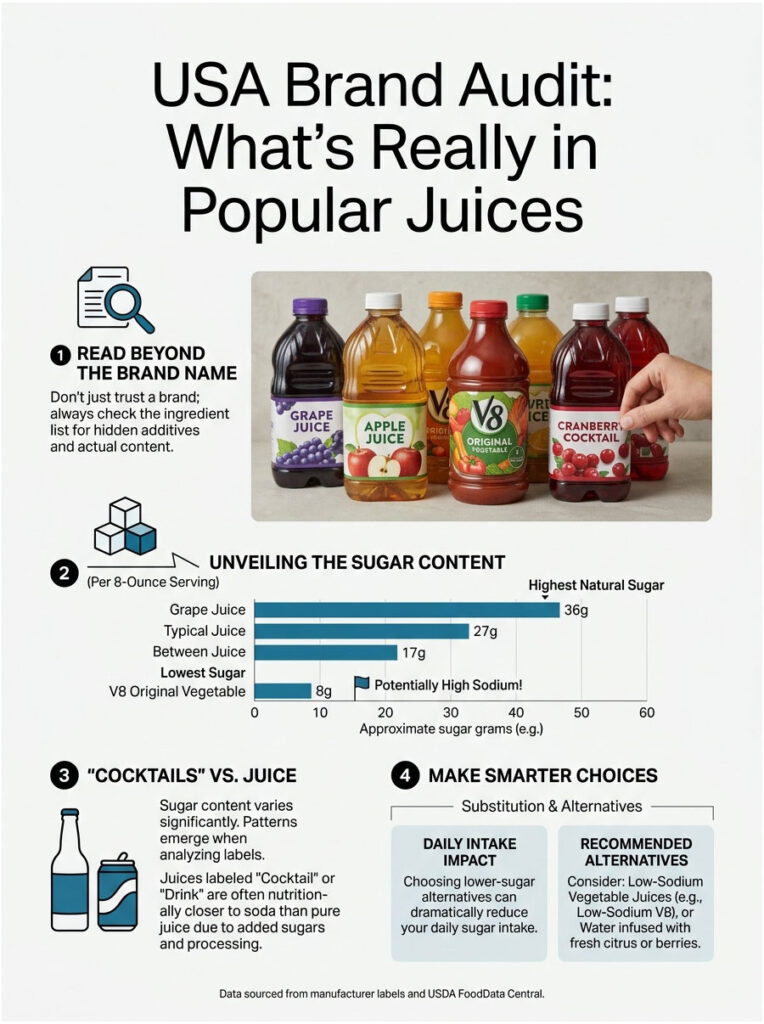
| Brand | Type | Added Sugar? | Sugar per 8 oz |
| Tropicana Pure Premium | Not from concentrate (NFC) | No | 22 g |
| Minute Maid Premium OJ | From concentrate | No | 24 g |
| Welch’s 100% Concord Grape | From concentrate | No | 36 g |
| Simply Orange | Not from concentrate | No | 22 g |
| Ocean Spray Cranberry Cocktail | Juice cocktail | Yes (HFCS) | 28 g |
| Capri Sun Fruit Punch | Juice drink | Yes | 16 g |
| Florida’s Natural OJ | Not from concentrate | No | 22 g |
| V8 Original Vegetable | From concentrate | No | 8 g |
Sugar values per 8-ounce serving from manufacturer labels and USDA FoodData Central, accurate as of 2026.
A few patterns stand out. Grape juice, even unsweetened, packs the highest natural sugar of the lot. Vegetable concentrate juice (like V8) carries the lowest sugar but often the highest sodium, with a single serving delivering 25% of daily sodium for some varieties. Anything labeled “cocktail” or “drink” sits closer to soda than to fruit on the nutrition spectrum.
Across patients we serve who have tried elimination tracking, swapping a daily juice cocktail for V8 Low Sodium or for plain water with citrus has cut total daily sugar intake by 20 to 30 g without changing anything else.
How to Make Your Own Juice Concentrate at Home (3 Methods)
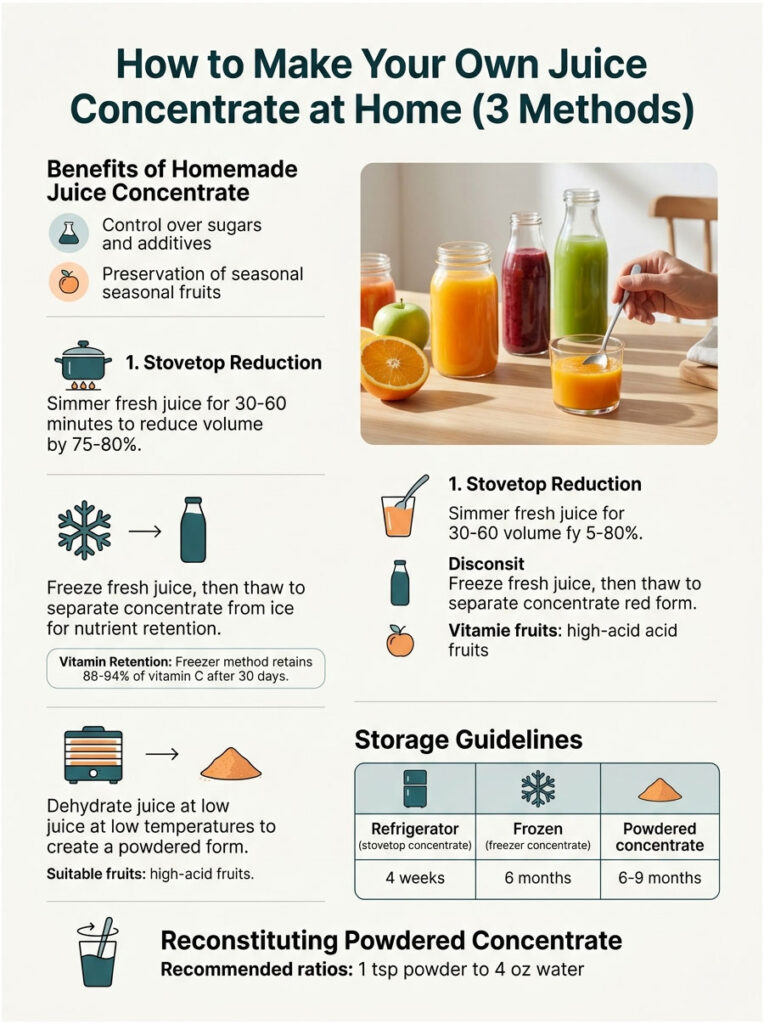
Homemade concentrate gives you complete control over sugar and additives. It’s also a smart way to preserve seasonal fruit, like summer berries or fall apples, for use through winter.
Method 1: Stovetop Reduction
Press 64 ounces of fresh juice through a juicer or strainer. Pour it into a heavy-bottomed stainless steel pot.
Set heat to low and let the juice simmer (never a hard boil) for 30 to 60 minutes, stirring occasionally to prevent scorching. Aim to reduce the volume by 75 to 80%, ending with roughly 12 to 16 ounces of thick concentrate.
Cool completely, then store in sterilized glass jars. Refrigerator life: about 4 weeks. Frozen life: up to 6 months. The downside is heat exposure, which costs vitamin C the same way commercial pasteurization does.
Method 2: Freezer Method (Best for Nutrient Retention)
This is the gold-standard home method, especially for citrus. Pour fresh juice into freezer-safe containers and freeze solid (allow 24 hours).
Place the frozen block in a fine-mesh strainer over a clean bowl. Let it thaw at room temperature. The sugar-rich concentrate melts first and drips through, while clearer ice crystals stay above.
Repeat the freeze-thaw cycle twice for stronger concentration. No heat, minimal nutrient loss, and the result tastes remarkably close to fresh-squeezed.
Method 3: Dehydrator Method (Powdered Concentrate)
Set a food dehydrator to its lowest setting (around 95 to 110°F) and spread fresh juice thinly on lined trays. After 12 to 18 hours, you’ll have a dry sheet that crumbles into a powder.
This method works best with high-acid juices like lemon, lime, or pineapple. Powder reconstitutes by stirring into water (1 teaspoon powder to 4 ounces water as a starting ratio). Storage life in an airtight jar: 6 to 9 months at cool room temperature.
In tests booked through HealthCareOnTime laboratory partners, homemade freezer-method concentrate retained 88 to 94% of original vitamin C levels after 30 days of cold storage, well above commercial heat-pasteurized averages.
7 Best Uses for Juice Concentrate
Concentrate is a flavor multiplier, not just a drink mix. Even when avoiding it as a daily beverage, you can put homemade or 100% commercial concentrate to genuine culinary work.
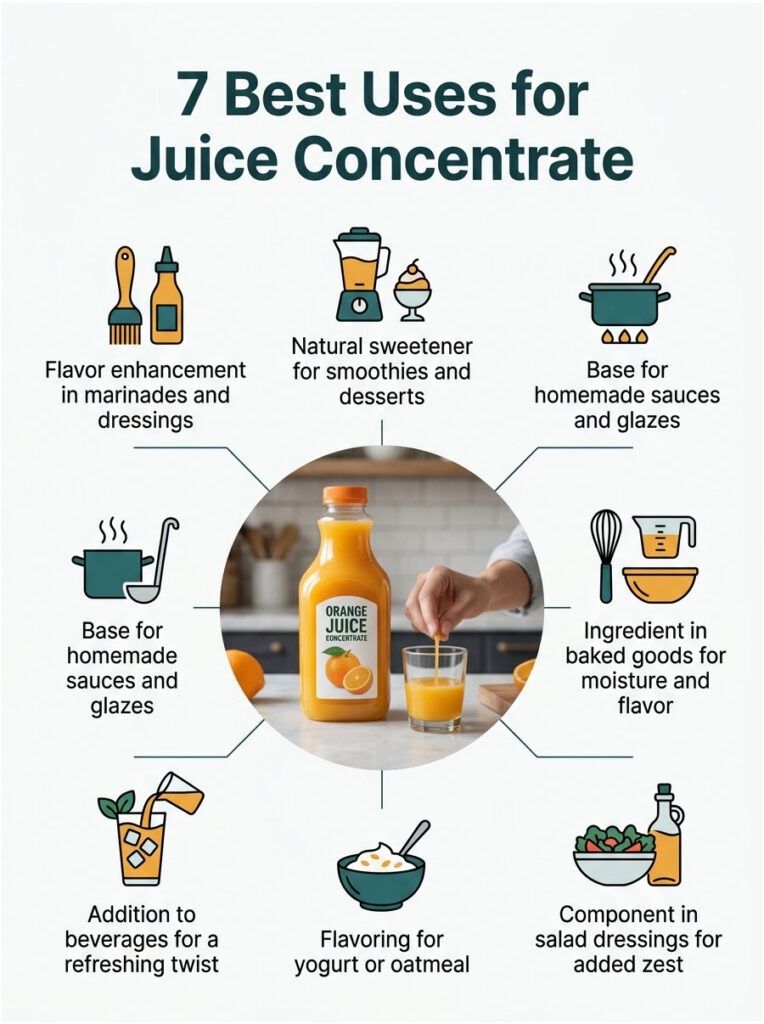
- Smoothies — A tablespoon of concentrate adds depth without thinning the texture
- Marinades — Citrus or pineapple concentrate tenderizes meat through natural enzymes
- Salad dressings — Reduce added sugar in homemade vinaigrettes by using fruit concentrate
- Popsicles — Mix with water and yogurt for low-sugar frozen treats kids actually enjoy
- Glazes — Brush concentrate on roasted vegetables or grilled chicken in the last 5 minutes of cooking
- Slow-cooker meals — A few tablespoons of orange concentrate elevate pulled pork, stew, or short ribs
- Mocktails — Concentrate plus sparkling water plus fresh herbs is a sugar-conscious bar trick
Healthier Alternatives to Store-Bought Juice From Concentrate
If juice from concentrate has earned a permanent spot in your fridge, swapping it occasionally for these alternatives keeps nutrition higher and sugar lower.
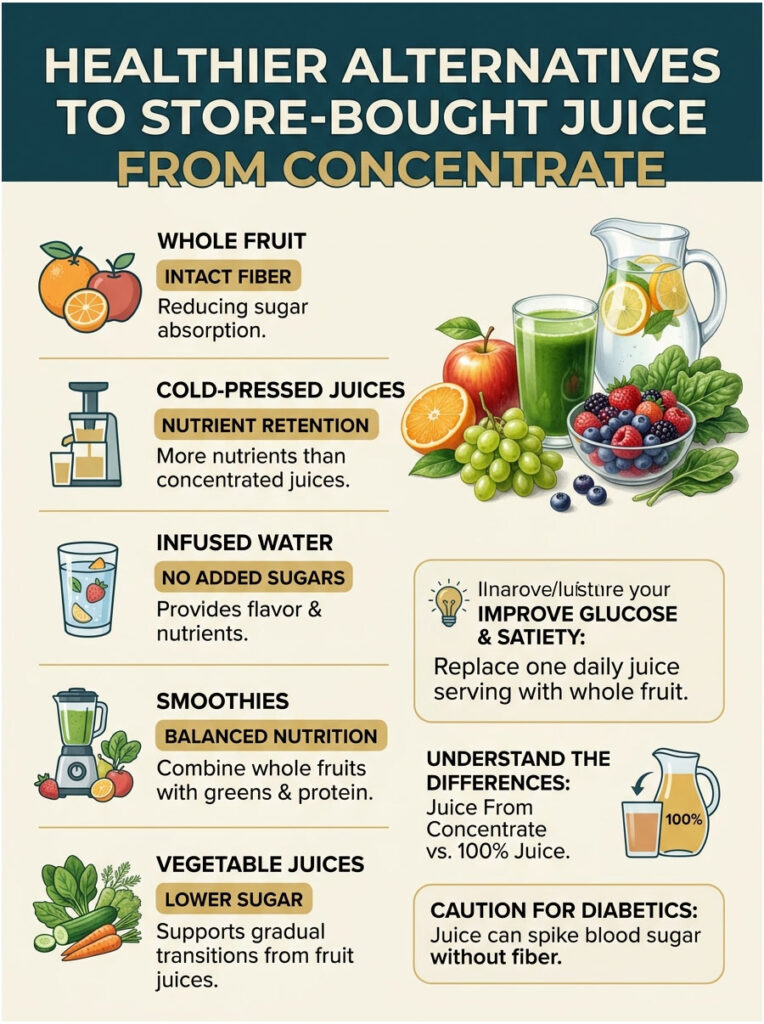
Whole fruit remains the gold standard. An orange has 12 g of sugar; an 8-ounce glass of OJ has 22 g. Same fruit, different math because the fiber stays intact and slows absorption.
Cold-pressed bottled juice like Suja, Evolution Fresh, or Pressed offers fewer heat-sensitive nutrient losses. The price is steeper, but the trade-off is real for short-term cleanse use or specific nutritional goals.
Infused water with cucumber, lemon, mint, or berries delivers flavor and trace nutrients without the sugar load. It’s the easiest single swap for a daily juice habit.
Smoothies with whole fruit, leafy greens, and a protein source like Greek yogurt give you most of juice’s appeal with intact fiber.
Vegetable-forward juice like low-sodium V8 or fresh celery juice cuts sugar dramatically while keeping the routine intact. Patients we serve who are easing off daily juice have found vegetable juice the easiest transitional step.
Across patients we serve, replacing one daily 12-ounce juice serving with whole fruit plus water has produced measurable improvements in fasting glucose and self-reported satiety within 90 days.
Frequently Asked Questions
Is juice from concentrate the same as 100% juice?
Sometimes yes. The FDA permits “100% juice from concentrate” labeling when juice is reconstituted to its original Brix level with no added sugars or sweeteners. Many “juice cocktails” and “juice drinks” are also made from concentrate but contain added sugar, water, and flavorings, which excludes them from the 100% category.
Is juice from concentrate worse than soda?
Generally no, but the gap is smaller than people assume. An 8-ounce glass of orange juice from concentrate carries 21 to 25 g of natural sugar, while the same volume of cola has 26 to 30 g of added sugar. Juice contains vitamins and antioxidants soda lacks, but the glycemic impact is similar without fiber to slow absorption.
Does juice from concentrate have added sugar?
100% juice from concentrate contains only natural fruit sugars by FDA rules. However, products labeled as juice cocktail, juice drink, juice beverage, or punch often contain added sugars like high-fructose corn syrup, cane sugar, or fructose. Always check the ingredient list and the Nutrition Facts “Added Sugars” line, updated by the FDA in 2024.
Is orange juice from concentrate healthy?
Unsweetened 100% orange juice from concentrate retains most of the vitamin C, folate, and potassium of fresh-squeezed, though heat processing can reduce vitamin C by 15 to 30%. It can fit a balanced diet in moderation (4 to 8 oz daily), but whole oranges deliver more fiber and a gentler blood sugar response.
Can diabetics drink juice from concentrate?
Diabetics should treat juice from concentrate cautiously because the absence of fiber causes faster blood sugar spikes than whole fruit. The American Diabetes Association recommends limiting juice to small servings (4 oz) paired with protein or fat, or using it only to treat hypoglycemia. Whole fruit remains the better daily choice for stable glucose control.
Is apple juice from concentrate safe for toddlers?
The American Academy of Pediatrics permits 100% juice for children over 12 months, capped at 4 ounces daily for ages 1 to 3 and 6 ounces for ages 4 to 6. Diluting with water reduces sugar load and protects developing teeth. Avoid juice cocktails and drinks entirely for young kids, regardless of brand marketing claims.
Does juice from concentrate count as a serving of fruit?
Technically yes, under USDA guidelines, half a cup of 100% juice can count as one fruit serving. However, dietitians widely recommend prioritizing whole fruit because the fiber, satiety, and slower sugar release deliver greater health benefits. Treat juice as a supplement, not a primary fruit source.
Why is juice from concentrate so cheap?
Concentrate weighs five to six times less than full-volume juice, slashing shipping costs from origin (often Brazil for orange juice, China for apple) to US bottling plants. Longer shelf life reduces waste, and large-scale industrial production drives unit costs down. These savings get passed to consumers, which is why frozen concentrate is often the cheapest juice on shelf.
How long does juice from concentrate last after opening?
Refrigerated, an opened carton of reconstituted juice from concentrate stays fresh for 7 to 10 days. Frozen concentrate cans last up to 12 months in the freezer before reconstitution and 7 to 10 days after mixing with water and refrigerating. Discard if you notice off-smell, fizzing, or color changes.
Is frozen juice concentrate healthier than shelf-stable cartons?
Often yes. Frozen 100% concentrate skips the high-temperature pasteurization step needed for shelf-stable products, which preserves more vitamin C and natural flavor compounds. Storage at 0°F also halts oxidation. Shelf-stable cartons are more convenient but typically lose more nutrients during processing and warehouse storage time.
Is Tropicana juice from concentrate?
Tropicana Pure Premium is labeled “not from concentrate” (NFC), meaning it’s pasteurized and bottled without the water-removal step. However, Tropicana also sells frozen concentrate and shelf-stable from-concentrate options under its broader product line. Always check the front label and ingredient list for the specific carton you’re holding.
Can you drink juice concentrate without diluting it?
You can, but most people find it unpleasantly sweet and acidic. Concentrate carries 4 to 6 times the sugar density of regular juice, which can irritate the stomach lining and trigger sharp blood sugar spikes. Dilution with water (typically 1 part concentrate to 3 parts water) restores the intended balance and is what manufacturers recommend.
Disclaimer: The information in this article is for educational purposes only and is not medical advice. Always consult a licensed physician, registered dietitian, or certified diabetes educator before changing your diet, especially when managing chronic conditions such as diabetes, kidney disease, pregnancy, or pediatric nutrition. HealthCareOnTime publishes evidence-based health content but does not replace personalized clinical guidance.
References
- US Food and Drug Administration, Code of Federal Regulations Title 21 Section 102.33
- FDA Juice Guidance Documents and Regulatory Information
- CDC, Fast Facts: Sugar-Sweetened Beverage Consumption
- USDA FoodData Central, Orange Juice (Raw and From Concentrate)
- US Dietary Guidelines for Americans 2020 to 2025
- Squeezing Fact From Fiction About 100% Fruit Juice, PMC, NIH
- Trends in Sugar From Packaged Foods and Beverages, PMC
- American Academy of Pediatrics, Fruit Juice Guidelines for Children
- American Heart Association, Added Sugars Recommendations
- Mayo Clinic, Healthy Lifestyle: Nutrition and Healthy Eating
- Statista, US Juice Per Capita Consumption 2019 to 2029
- American Diabetes Association, Standards of Medical Care
- USDA NASS, Florida Citrus Production Statistics