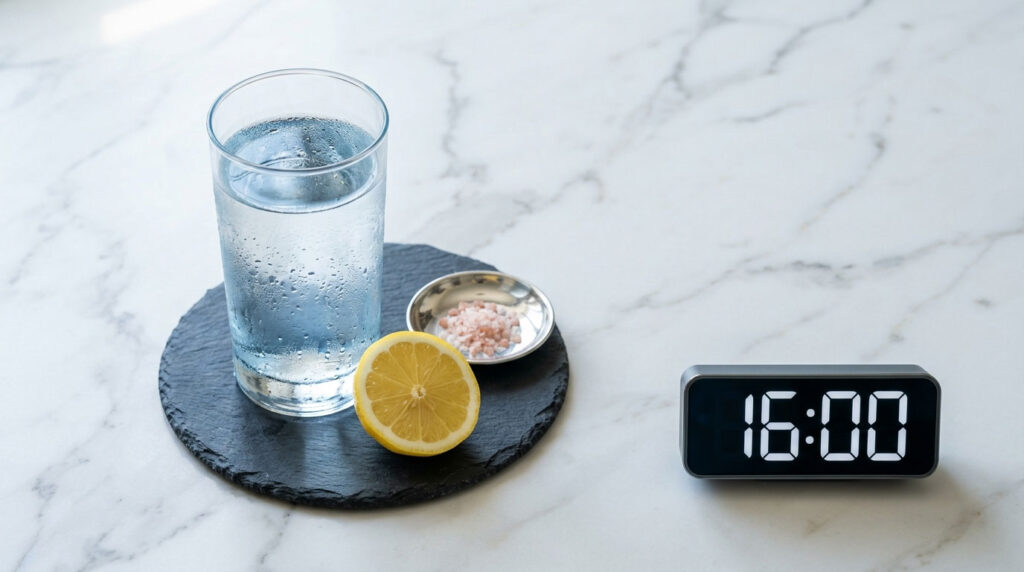
Three days into her first 16:8 fast, a client of mine almost quit because of a pounding headache she couldn’t shake. She’d been sipping water all morning, hour after hour, and still felt awful. The fix wasn’t more water. It was a quarter teaspoon of sea salt stirred into a tall glass of it. Within twenty minutes, the headache faded.
Table of Contents
That story plays out in my inbox every week. People do everything right with their fasting window, then trip over the simplest part of the puzzle: water.
Quick Answer: Yes, drinking water while fasting is allowed and encouraged. Plain water has zero calories and won’t raise insulin, so it doesn’t break an intermittent fast, water fast, or most blood-test fasts. The only exception is dry fasting. Healthy adults should aim for 91 to 125 fl oz daily.
At a Glance
- Plain water is the safest fasting beverage and won’t trigger an insulin response
- Aim for about half your body weight in ounces, plus extra during fasts over 18 hours
- Sparkling, lemon-infused, and mineral waters are usually fasting-friendly
- Dry fasting (no liquids at all) carries real medical risks and isn’t backed by USA dietitians
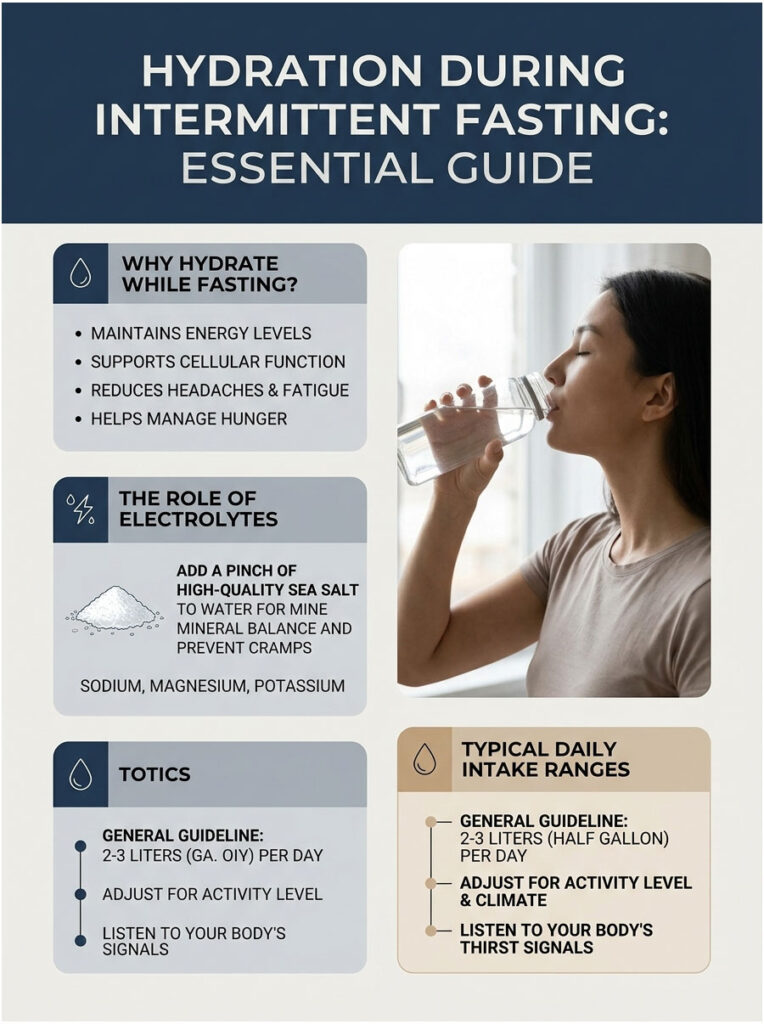
- A pinch of sea salt in your water prevents most fasting headaches
- Hyponatremia (water poisoning) is rare but real; cap intake near 130 fl oz/day
- Black coffee, plain tea, and apple cider vinegar in water also stay within fasting rules
Can You Drink Water While Fasting? The Short Answer
Yes. For nearly every type of fast practiced in the United States, drinking water is allowed and recommended. That covers intermittent fasting (IF), extended water fasts, and most pre-surgical or blood-test fasts.
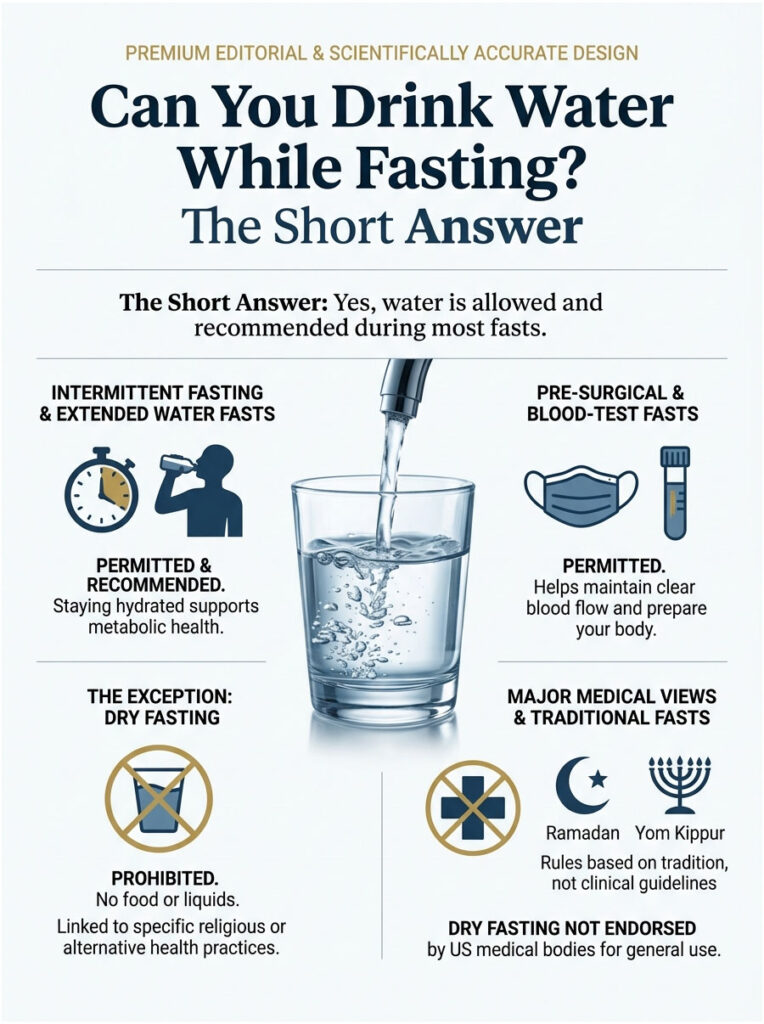
The single exception is dry fasting, where you skip both food and liquid for a set window. That style is usually tied to specific religious or alternative-health practices, and major USA medical bodies don’t endorse it for general use.
If you’re observing Ramadan, Yom Kippur, or another religious fast, the rules come from your tradition rather than from a clinical playbook. I’ll cover how those compare further down.
Why Drinking Water While Fasting Won’t Break Your Fast (The Science)
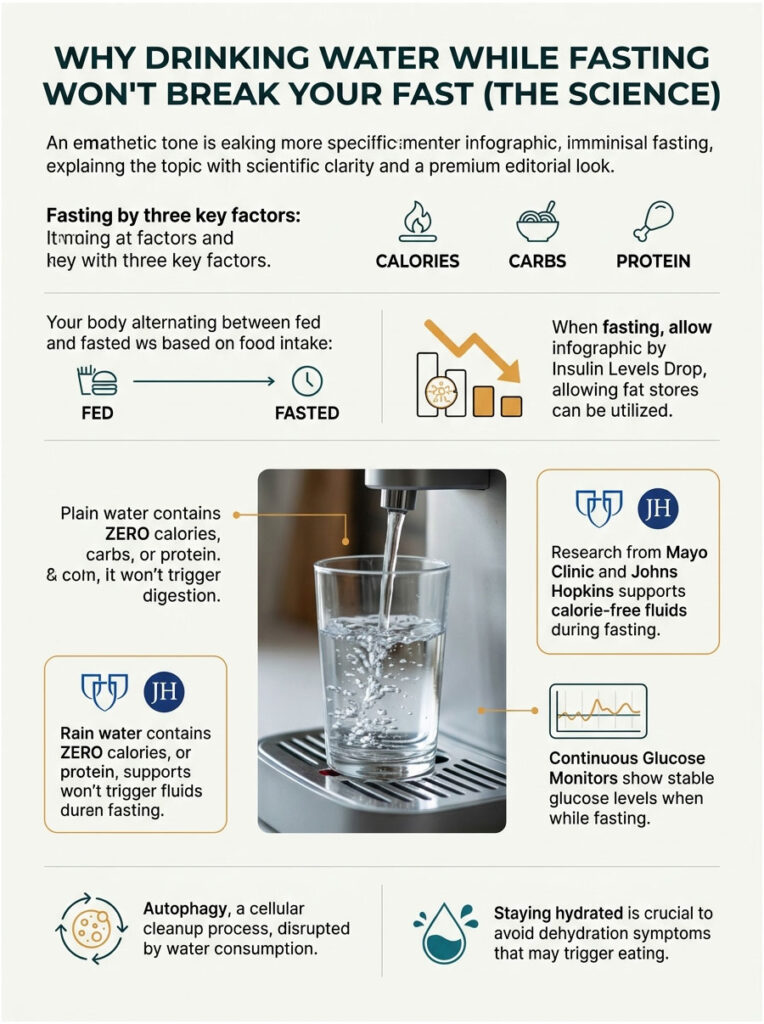
Three numbers decide whether something breaks a fast: calories, carbs, and protein. Plain water has zero of all three.
Calories, Insulin, and the Fed-vs-Fasted State
Your body sits in one of two metabolic modes at any given time. After eating, you’re “fed,” with rising blood glucose and insulin. After about 12 hours without food, you slip into a fasted state, where insulin drops and your body starts pulling from fat stores.
Water doesn’t change either signal. Mayo Clinic and Johns Hopkins both confirm that calorie-free fluids keep you in the fasted state. I’ve watched continuous glucose monitor (CGM) data from clients sipping water through a 20-hour fast: the line stays flat as a board.
Water and Autophagy
Autophagy is your body’s cellular cleanup process, which ramps up after roughly 16 to 24 hours without food. Researchers at the National Institutes of Health have studied how fasting triggers autophagy, and water has never been flagged as a disruptor. Hydration actually supports the kidneys and liver as they clear metabolic waste during the process.
So when you read that “drinking water cancels autophagy,” that’s a myth. Skipping water is far more likely to cancel your fast, because dehydration headaches and dizziness usually send people running for food.
How Much Water Should You Drink While Fasting?
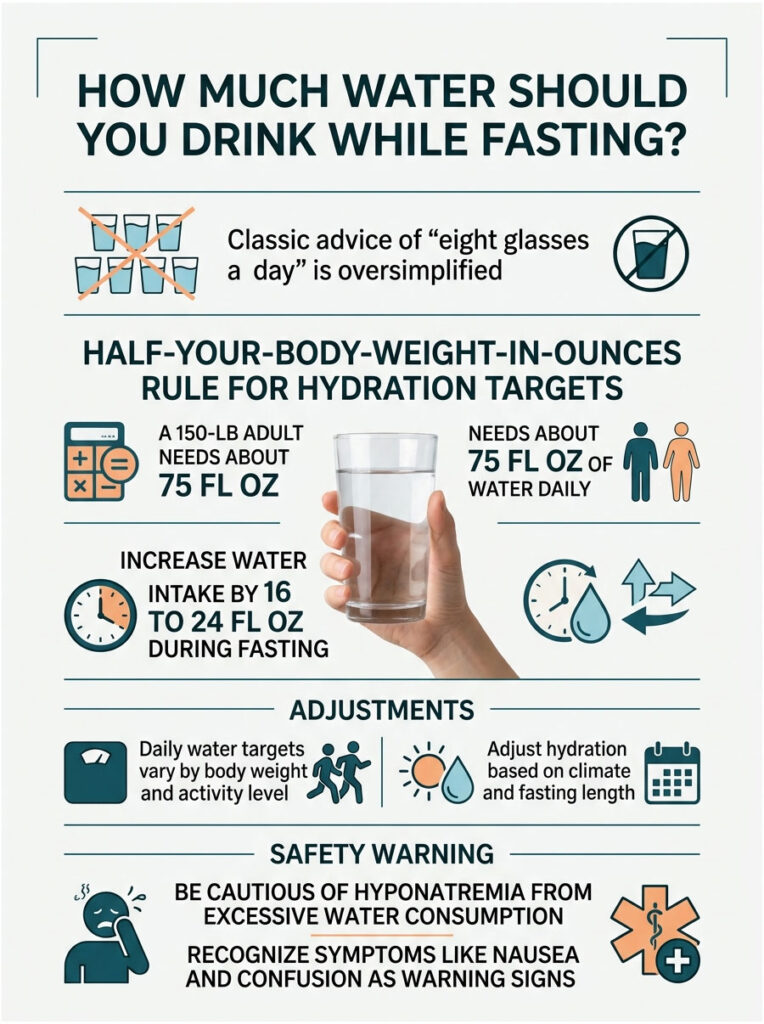
The classic American advice is “eight glasses a day,” but that ignores body size, activity level, and fast duration. Here’s a more useful framework I use with clients.
The Half-Your-Body-Weight-in-Ounces Rule
Take your body weight in pounds, divide by two, and that’s your baseline daily water target in fluid ounces. A 150-lb adult lands at roughly 75 fl oz. A 200-lb adult lands at 100 fl oz.
During a fast, bump that up by 16 to 24 fl oz, since you’re not getting any food-based water (fruits, soups, and cooked grains usually supply about 20% of daily hydration).
Table 1: Daily Water Targets by Body Weight and Fasting Status
| Body Weight | Sedentary Day (fl oz) | Active Day (fl oz) | Fasting Day (fl oz) | Approx. Bottles (16.9 fl oz each) |
| 120 lb | 60 | 80 | 76 to 96 | 4 to 5 |
| 150 lb | 75 | 100 | 91 to 116 | 5 to 7 |
| 180 lb | 90 | 115 | 106 to 131 | 6 to 8 |
| 210 lb | 105 | 130 | 121 to 146 | 7 to 9 |
| 240 lb | 120 | 145 | 136 to 161 | 8 to 10 |
These figures align with the National Academies of Sciences fluid recommendations of 91 fl oz (2.7 L) for women and 125 fl oz (3.7 L) for men, scaled for body weight and added fasting losses.
Adjusting for Climate, Activity, and Fast Length
If you’re hiking in Phoenix in July, add another 16 to 32 fl oz to whatever the table suggests. If you’re sitting in a Boston office in February, you’re probably fine at the lower end of your range.
Fast length matters, too. A 14:10 schedule barely changes hydration math. A 36-hour fast doubles down on the need for steady sipping plus electrolytes.
When You’re Drinking Too Much (Hyponatremia Warning)
This part rarely gets covered, and I’ve seen it bite serious fasters. Hyponatremia happens when blood sodium drops too low, often from drinking large volumes of plain water without replacing electrolytes.
Symptoms include nausea, confusion, severe headache, and in rare cases seizures. The Mayo Clinic flags risk above roughly 1 liter per hour for sustained periods. Practical cap: don’t push past about 130 fl oz in a fasting day unless a doctor has cleared you.
Hydration by Fasting Type (Complete Comparison)
Not all fasts treat water the same way. According to the International Food Information Council 2024 Food & Health Survey, about 12.5% of US adults tried some form of intermittent fasting in the past year, making it the most-tried eating pattern after Mediterranean. Here’s a side-by-side look at the styles most popular in the United States.
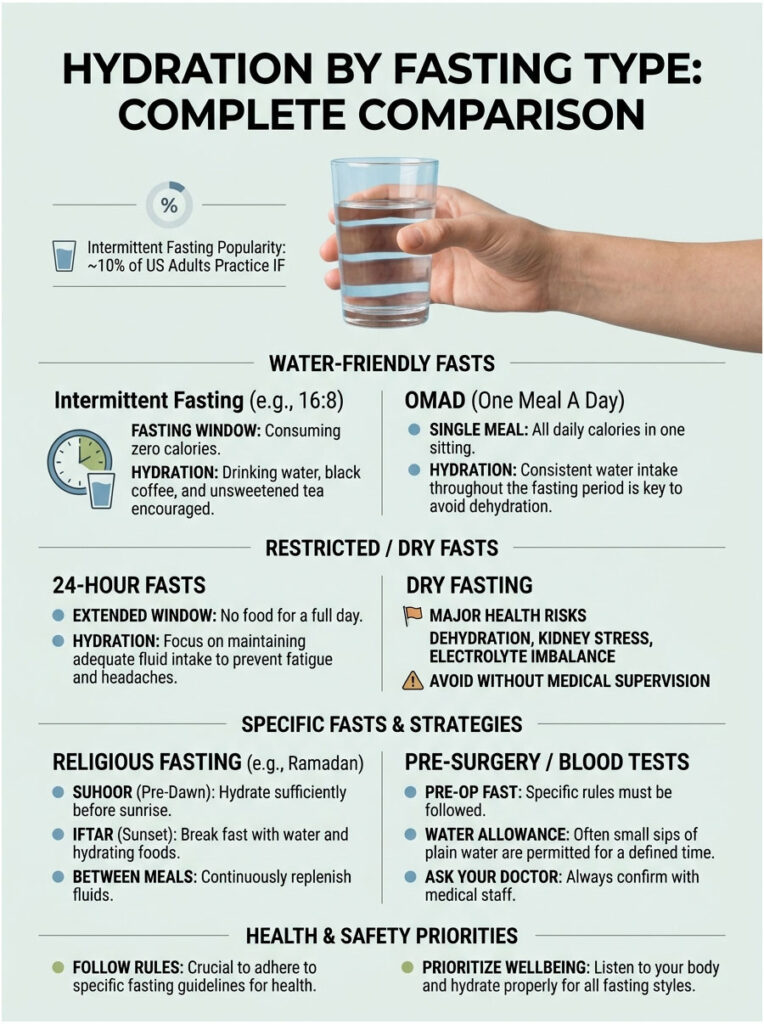
Table 2: Fasting Methods, Water Rules, and USA Adoption Stats
| Fasting Method | Water Allowed? | Recommended Daily Water | USA Adoption / Notes (Source) |
| 16:8 Intermittent Fasting | Yes | 75 to 110 fl oz | Most popular IF style; ~12.5% US adults tried IF in past year (IFIC 2024) |
| OMAD (One Meal a Day) | Yes | 90 to 130 fl oz | Growing among men 25 to 44; tighter window means higher daily target |
| 5:2 Diet | Yes | 75 to 110 fl oz | Popularized by Dr. Michael Mosley; 500 to 600 cal on fast days |
| 24 to 72-Hour Water Fast | Yes (mandatory) | 90 to 130 fl oz | Short-term weight loss with rebound risk (UIC research) |
| Dry Fasting | No | 0 | Not endorsed by AMA or AND; high dehydration risk |
| Religious Fasting (Ramadan) | No (during daylight) | Compressed to night | About 3.5 million Muslim adults in the US (Pew Research) |
| Pre-Surgery Fasting | Clear liquids up to 2 hr | Per surgeon’s order | American Society of Anesthesiologists guideline |
16:8 Intermittent Fasting
The most common pattern in the United States. Sip water from morning through your fasting hours; nothing about it disrupts the fat-burning state.
18:6 and 20:4 (OMAD)
Tighter eating windows make hydration even more important. Most of my OMAD clients keep a 32-fl-oz bottle within arm’s reach all day and refill twice.
5:2 Diet
On your two low-calorie days (about 500 to 600 calories), water rules are the same as any restricted day. You’re allowed both food and unlimited water; you’re just keeping calories tight.
24 to 72-Hour Water Fast
This is where electrolytes stop being optional. By hour 30, most people start feeling lightheaded if they’re only drinking plain water. A pinch of pink Himalayan salt in each glass usually fixes it, and I’ve watched that small fix save more than one client’s first multi-day fast.
Dry Fasting
I get asked about this often, mostly from social media. Dry fasting means zero water. The American Academy of Family Physicians and most registered dietitians (RDs) I’ve worked with strongly discourage it. Dehydration symptoms can hit hard within 12 to 18 hours, and prolonged dry fasting risks kidney injury.
Religious Fasting (Ramadan, Yom Kippur, Lent)
Ramadan fasting prohibits water from dawn (suhoor) to sunset (iftar). Cleveland Clinic recommends drinking 8 to 12 cups of water between iftar and suhoor, spaced out rather than chugged. Yom Kippur is a 25-hour dry fast for observant Jews. Christian Lenten practices vary widely; most allow water.
Pre-Surgery and Blood Test Fasting
Cleveland Clinic guidelines say plain water is fine before most fasting blood tests, and actually helps the phlebotomist find your vein. Pre-surgery rules are stricter; the American Society of Anesthesiologists allows clear liquids up to 2 hours before, but always follow your surgeon’s exact instructions.
Best Time to Drink Water During an Intermittent Fast
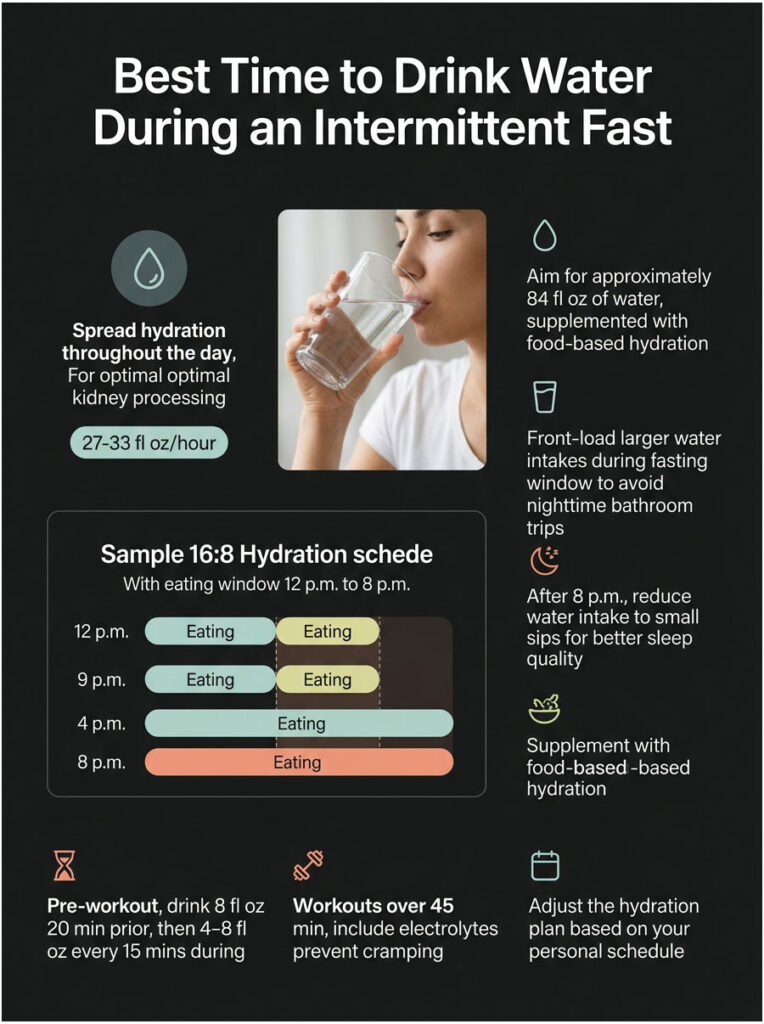
Spreading water across the day beats front-loading it. Your kidneys can only process about 27 to 33 fl oz per hour, so chugging a quart at 7 a.m. just sends most of it straight out.
A Sample 16:8 Hydration Schedule
Here’s a plan I built with a Chicago-based client doing a 12 p.m. to 8 p.m. eating window. Adjust the clock to match your own schedule.
- 6:30 a.m. 16 fl oz on waking, with a small pinch of sea salt
- 8:30 a.m. 12 fl oz with black coffee or green tea
- 10:30 a.m. 12 fl oz, plain or with lemon
- 12:00 p.m. Sip with first meal
- 2:30 p.m. 12 fl oz
- 5:00 p.m. 12 fl oz
- 7:30 p.m. Sip with last meal
- 9:30 p.m. 8 fl oz, last sip 90 minutes before bed
That’s about 84 fl oz with food-based water layered on top.
Morning vs Evening Sipping Strategy
Front-load the bigger pours during the fasting window so you’re not running to the bathroom all night. After 8 p.m., taper to small sips so sleep stays solid.
How to Sip During a Fasted Workout
If you train fasted, drink 8 fl oz about 20 minutes before, then 4 to 8 fl oz every 15 minutes during. For sessions over 45 minutes, add electrolytes; plain water alone often triggers cramping in the second half.
What Type of Water Is Best While Fasting?
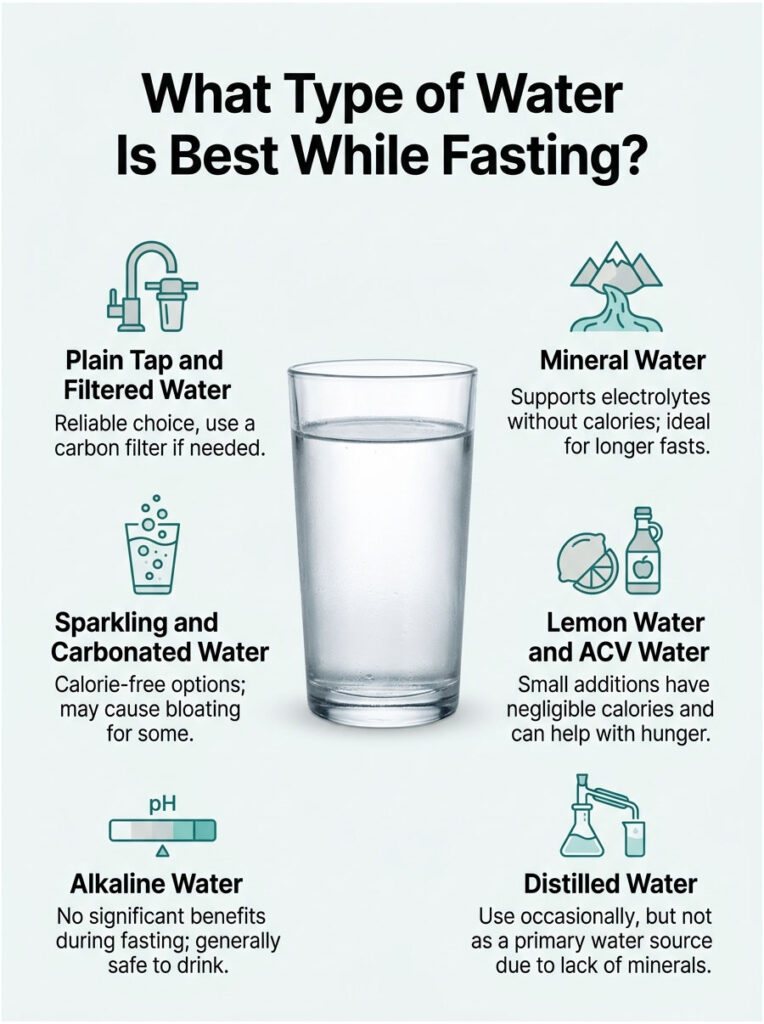
You’ve got options, and most of them work fine. Here’s what I tell clients.
Plain Tap and Filtered Water
The most reliable choice. If your local tap water tastes off or you live in an area with hard water buildup, a basic carbon filter pitcher (Brita, PUR) cleans it up nicely.
Mineral Water
A quiet winner during longer fasts because it carries naturally occurring sodium, magnesium, and calcium. Brands like Gerolsteiner and Mountain Valley deliver real electrolyte support without any added calories.
Sparkling and Carbonated Water
Calorie-free and fasting-friendly. Perrier, LaCroix (the unsweetened types), and Topo Chico all keep your fast intact. Some people get bloated; if that’s you, switch to flat water for the morning hours.
Lemon Water and ACV Water
A small splash works fine. True Citrus and several USA dietitians note that 2 to 3 lemon slices per quart adds maybe 4 calories, which is biologically negligible. Apple cider vinegar (1 tablespoon in 10 fl oz water) is also fine and may help blunt morning hunger.
Alkaline Water (Hype vs Reality)
The marketing claims alkaline water boosts fasting benefits. The science says your stomach acid neutralizes any pH effect within seconds. There’s no harm in drinking it, but you’re not getting a meaningful upgrade over regular filtered water.
Distilled Water
Fine for occasional use, especially in coffee or tea. Don’t make it your only water source long-term, though, since it lacks the trace minerals your body uses for nerve and muscle function.
Other Drinks That Won’t Break Your Fast
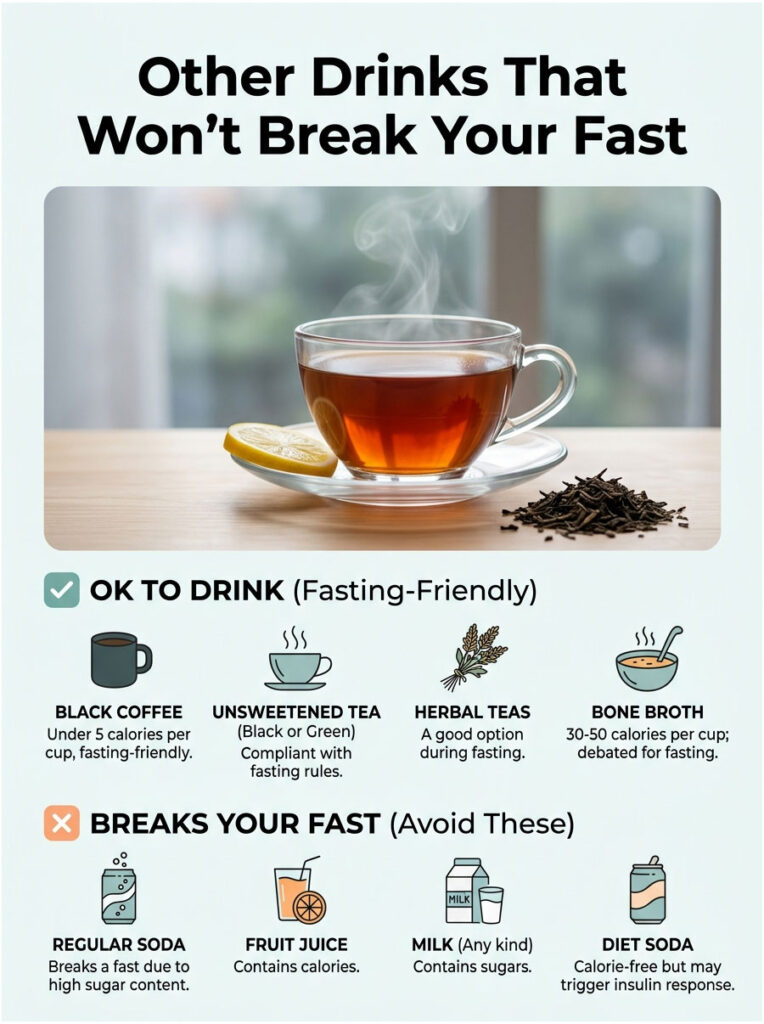
Black coffee (under 5 calories per cup), unsweetened black or green tea, and herbal teas all stay within fasting rules. Bone broth is a gray area; it has 30 to 50 calories per cup, so it technically breaks a strict fast but is often allowed during longer water fasts to prevent electrolyte loss.
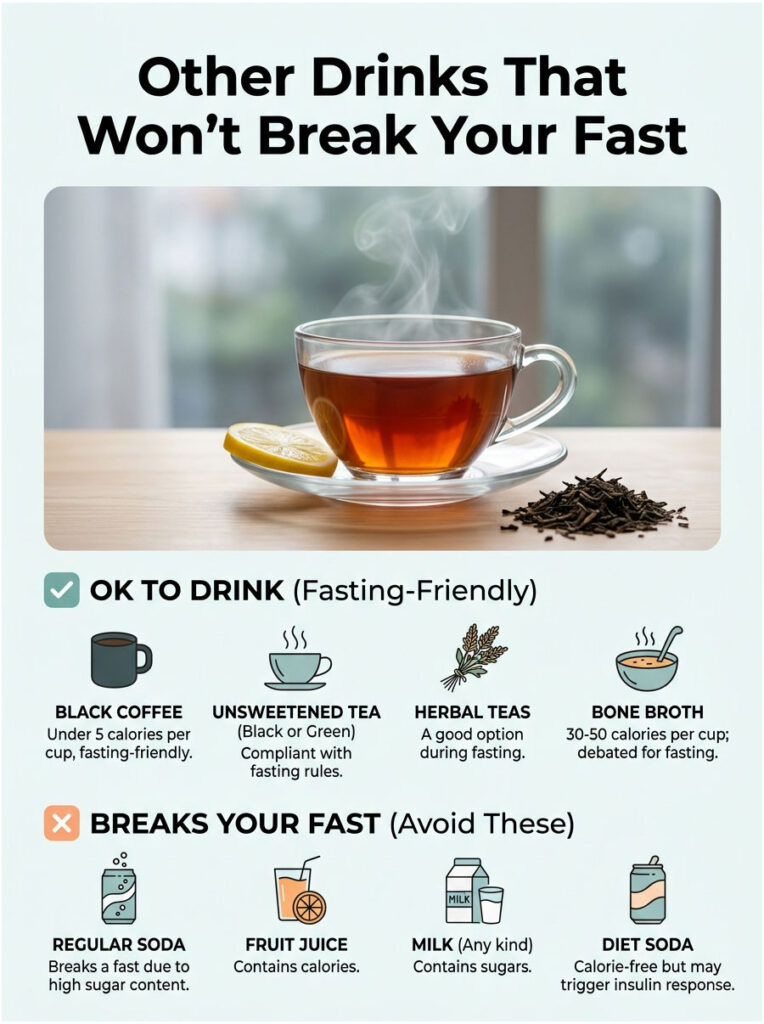
What absolutely does break a fast: regular soda, fruit juice, milk (any kind), sweet tea, sports drinks like Gatorade, and any flavored coffee creamer. Diet soda is technically calorie-free, but the artificial sweeteners can trigger an insulin response in some people, so I tell clients to skip it during the fasting window.
Electrolytes While Fasting (The Section No One Else Nails)
Most fasting articles stop at “drink water.” That’s where headaches start. I’ve coached enough fasters through the first-week wall to know this is the single biggest fix that gets ignored.
Your body loses sodium, potassium, and magnesium through urine and sweat, and your kidneys actually dump extra sodium during the first 24 hours of a fast.
CDC sodium intake data shows the average American eats about 3,400 mg of sodium per day, mostly from processed foods. When you stop eating, that supply stops too. Add a few hours of plain water sipping, and your blood sodium can dip enough to trigger headaches, brain fog, and muscle twitches.
Why Sodium, Potassium, and Magnesium Matter
- Sodium keeps fluid balance and nerve function steady
- Potassium prevents muscle cramps and supports heart rhythm
- Magnesium helps with sleep, muscle relaxation, and over 300 enzyme reactions
DIY Fasting Electrolyte Drink Recipe
In practice, this is what I send clients who don’t want to buy a powder:
- 16 fl oz of cold water
- 1/4 teaspoon Himalayan pink salt or sea salt
- 1 tablespoon fresh lemon juice
- 1/8 teaspoon Morton’s “No Salt” potassium chloride (optional)
Total calories: under 5. Total cost: pennies per glass.
When to Reach for LMNT, Liquid IV, or Re-Lyte
If you’re fasting more than 18 hours, training hard, or live in a hot climate, a quality electrolyte powder beats DIY. LMNT (1,000 mg sodium per stick) is the gold standard for low-carb fasters. Re-Lyte runs slightly lower in sodium with extra magnesium. Liquid IV adds glucose, so it does break a strict fast; save it for your eating window.
Benefits of Drinking Water While Fasting
I’ve watched the same five wins show up across hundreds of fasting plans:
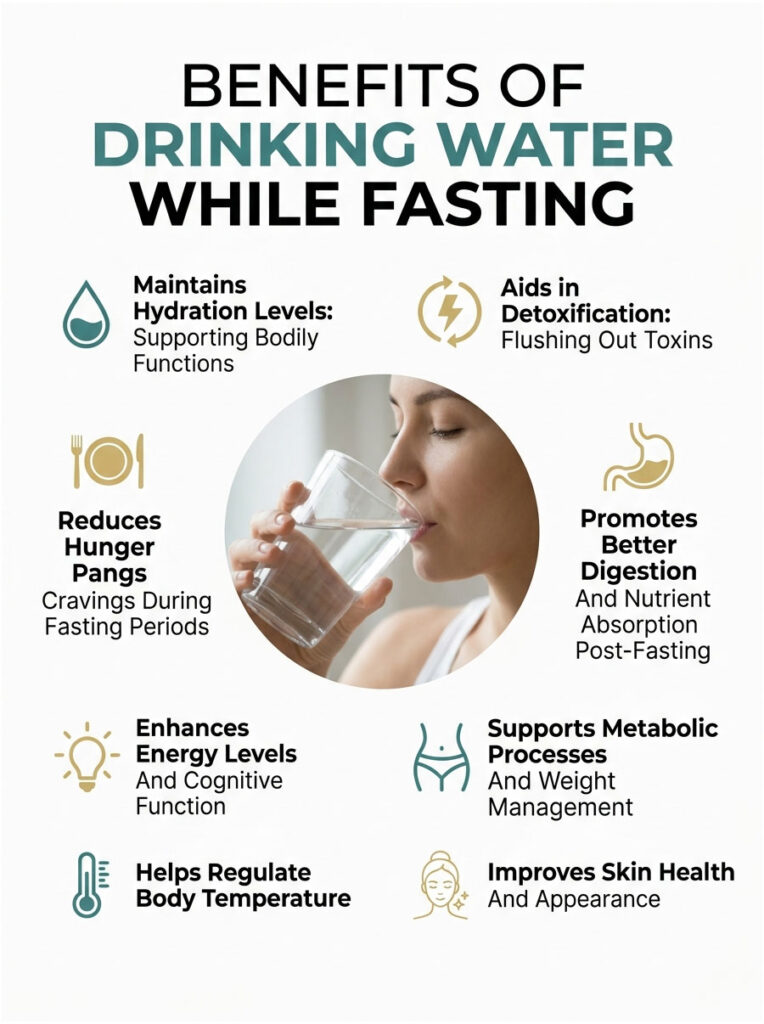
- Sharper hunger control. Thirst often masquerades as hunger. A glass of cold water can buy you 60 to 90 minutes of fasted comfort.
- Fewer headaches. Most “fasting headaches” are dehydration plus sodium drop. Water with a pinch of salt usually clears them in 20 minutes.
- Better autophagy support. Hydration helps the kidneys clear cellular waste, which is exactly what your body’s doing during the fasted state.
- Mental clarity. Even mild dehydration slows reaction time. Steady sipping keeps focus sharp through long workdays.
- Smoother fat oxidation. Water supports the metabolic pathways that pull stored fat into circulation.
Warning Signs Your Hydration Is Off
I keep this chart printed and pinned next to my desk. It’s the fastest way to read what your body’s telling you mid-fast.
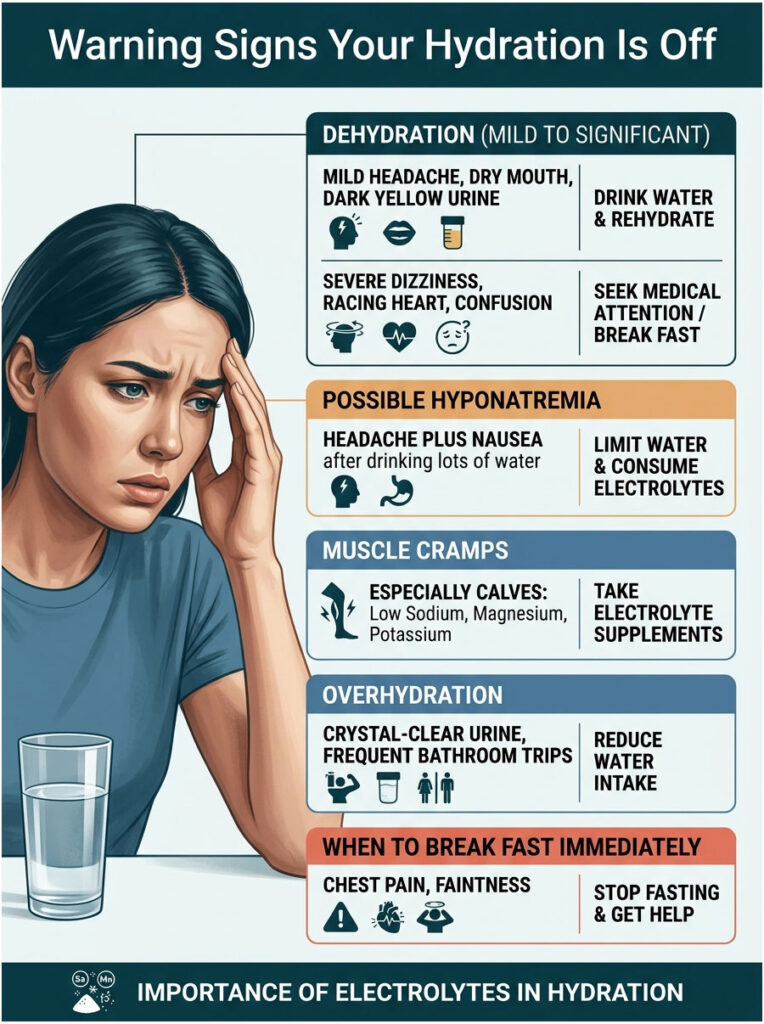
Table 3: Fasting Hydration Symptoms and What to Do
| Symptom | Likely Cause | What to Do Right Now |
| Mild headache, dry mouth, dark yellow urine | Dehydration | Sip 12 to 16 fl oz water plus 1/4 tsp sea salt; recheck in 30 minutes |
| Severe dizziness, racing heart, confusion | Significant dehydration or low blood sugar | Stop fasting; drink water with electrolytes and eat a small meal |
| Headache plus nausea after drinking lots of water | Possible hyponatremia | Stop drinking plain water; take electrolytes and call your doctor if it worsens |
| Muscle cramps, especially calves | Low sodium, magnesium, or potassium | Add a full electrolyte dose; magnesium glycinate at bedtime |
| Crystal-clear urine, frequent bathroom trips | Overhydration | Reduce intake; add electrolytes to remaining water |
When to Break Your Fast Immediately
If you feel chest pain, faint, or get confused, stop the fast. No fasting protocol is worth a medical emergency. Eat a small meal with carbohydrates and salt, and call your doctor if symptoms persist.
Common Fasting Hydration Mistakes (From My Experience)
After working with hundreds of fasting clients, I see the same handful of slip-ups:
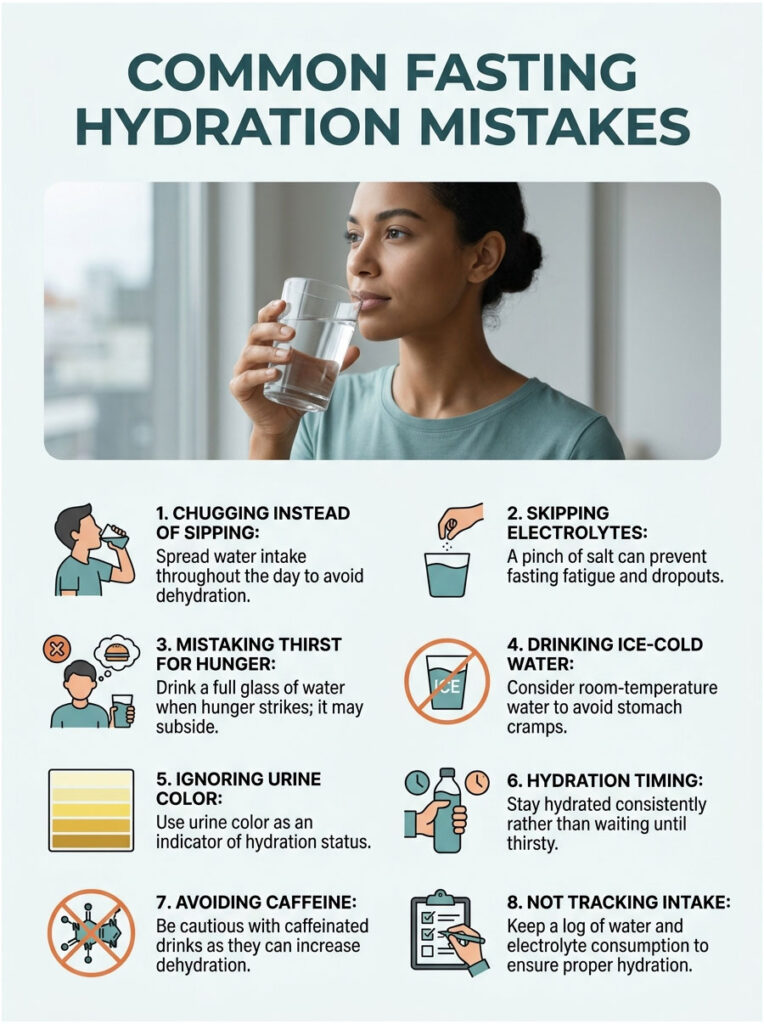
Chugging instead of sipping. Drinking 24 fl oz at once stretches your stomach, triggers urination, and leaves you dry an hour later. Spread it out.
Skipping electrolytes. This is the single biggest reason people quit fasting in week one. A 5-cent pinch of salt prevents most of those quits.
Mistaking thirst for hunger. Next time hunger hits at hour 14, drink a full glass of water and wait 15 minutes. About 70% of the time, the hunger fades.
Drinking only ice-cold water on an empty stomach. Some people get stomach cramps from very cold water during a fast. Try room-temperature first if that’s you.
Ignoring urine color. Pale straw means you’re hydrated. Apple-juice yellow means drink more. Crystal clear all day means cut back and add electrolytes.
Who Should Skip Water Fasting Entirely
This isn’t a list to gloss over. Some health conditions make extended water fasting genuinely risky.
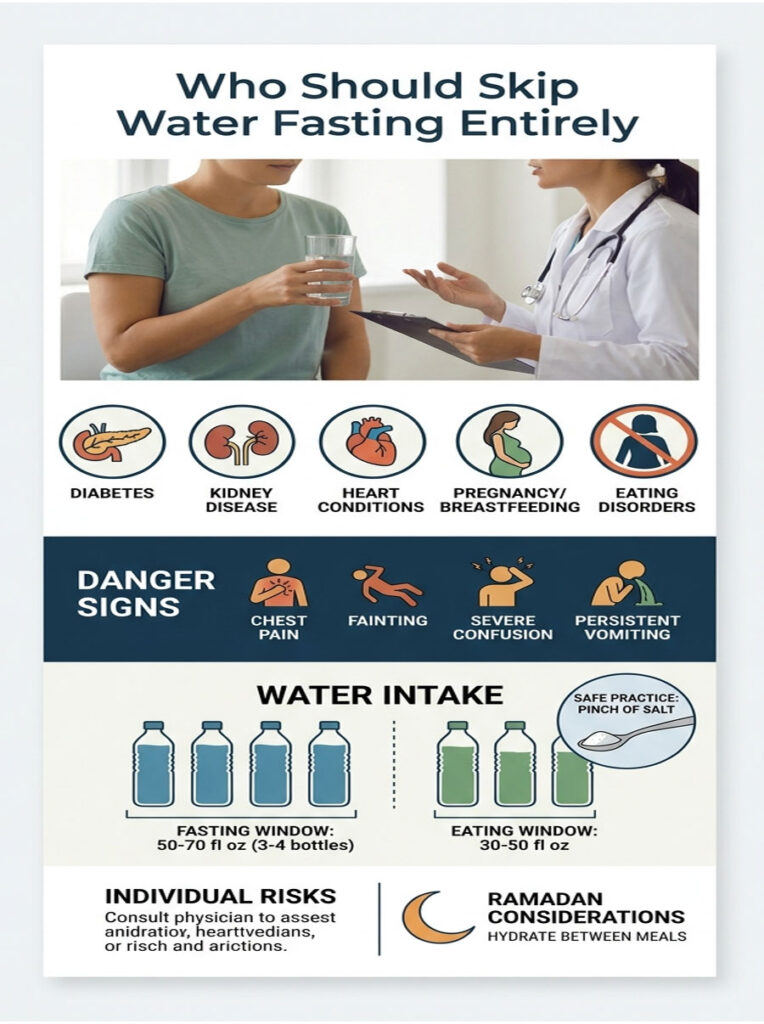
- Pregnant or breastfeeding women. The American College of Obstetricians and Gynecologists advises against extended fasting during pregnancy or lactation.
- Children and teens under 18. Growing bodies need consistent calories.
- People with a history of eating disorders. Fasting can re-trigger restrictive patterns. The National Alliance for Eating Disorders discourages fasting protocols in this group.
- Type 1 diabetics and insulin-dependent type 2 diabetics. Hypoglycemia risk is too high without doctor supervision.
- People on blood pressure or kidney medications. Diuretics plus fasting can crash sodium fast.
- Anyone with active kidney disease, heart failure, or gout. Your doctor’s call, not an internet article’s.
Frequently Asked Questions
Will drinking water really break my intermittent fast?
No. Plain water has zero calories, no carbs, and no protein, so it doesn’t trigger insulin or pull you out of the fasted state. Every major USA medical center, from Mayo Clinic to Johns Hopkins, confirms water is fine during intermittent fasting. The only fast water breaks is a dry fast.
How many bottles of water should I drink during a 16-hour fast?
Aim for 50 to 70 fl oz during the fasting window itself, which is roughly three to four standard 16.9 fl oz bottles. Add another 30 to 50 fl oz during your eating window through food and drinks. Active days or hot climates push the upper end of that range.
Can I drink lemon water while intermittent fasting?
Yes, in small amounts. Two to three lemon slices or a tablespoon of fresh lemon juice in a quart of water adds about 4 to 6 calories, which is biologically too small to break a fast. Skip pre-made lemonade or lemon-flavored drinks with added sugar; those will end your fast.
Is sparkling water OK during a fast?
Yes. Plain sparkling water (LaCroix unsweetened, Perrier, Topo Chico, San Pellegrino) is calorie-free and won’t break your fast. The carbonation is fine for most people. If you get bloated or notice extra hunger from carbonation, switch to flat water during fasting hours.
Does adding salt to water break a fast?
No. A pinch of sea salt or pink Himalayan salt has zero calories and zero macronutrients. It actually helps prevent the headaches, fatigue, and dizziness many fasters blame on the fast itself. Stick to about 1/4 teaspoon per 16 fl oz of water during longer fasts.
Why do I get headaches when I fast even though I drink water?
Most fasting headaches come from low sodium rather than low water. As insulin drops during a fast, your kidneys release more sodium through urine. Plain water without salt dilutes blood sodium further. Add a pinch of sea salt or an electrolyte powder, and headaches usually clear within 30 minutes.
Can I drink water before a fasting blood test?
Yes, and it actually helps. The Cleveland Clinic recommends drinking water before a fasting blood draw because hydration makes veins easier to find and reduces dizziness. Skip coffee, tea, juice, and flavored waters; stick to plain water unless your doctor says otherwise.
Is it safe to drink water during Ramadan fasting?
During the daylight fasting hours, water is not allowed under Ramadan rules. Between iftar (sunset) and suhoor (pre-dawn), drink 8 to 12 cups of water spaced out, not chugged at once. Cleveland Clinic and CDC both recommend including hydrating foods like watermelon and cucumber at those meals.
Can drinking too much water be dangerous during a fast?
Yes, though it’s rare. Hyponatremia happens when blood sodium drops too low, often from drinking over 1 liter of plain water per hour without electrolytes. Symptoms include nausea, severe headache, and confusion. Cap intake near 130 fl oz per day for most healthy adults, and always pair high-volume days with electrolytes.
Should I drink cold or warm water while fasting?
Either works. Cold water may slightly increase calorie burn (a tiny effect, around 5 to 10 extra calories per liter) and can blunt hunger more sharply. Warm water sits easier on an empty stomach for some people. Pick what feels best and what you’ll actually drink consistently.
Does water help with autophagy?
Yes, indirectly. Water doesn’t trigger autophagy, but it supports the kidney and liver function needed to clear the metabolic waste autophagy produces. Dehydration during long fasts slows that cleanup process. Steady hydration with electrolytes is the practical way to support what your body’s doing.
How long can a healthy adult survive on water alone?
Documented cases run from a few days to over 70 days under medical supervision, but those are extreme outliers. For DIY fasting, University of Illinois Chicago researchers advise capping water fasts at 5 days, and only with a doctor’s clearance. Beyond that, muscle loss, electrolyte crashes, and refeeding syndrome become serious risks.
Disclaimer: This article is for general education only and is not medical advice. Fasting affects people differently, especially those with diabetes, kidney disease, heart conditions, eating disorder history, or who are pregnant or breastfeeding. Talk with your physician or a registered dietitian before starting any fasting protocol or making major changes to your hydration. If you experience chest pain, fainting, severe confusion, or persistent vomiting during a fast, stop fasting and seek medical care immediately.
References
- Healthline: Drinking Water While Fasting: Is It Recommended?
- Johns Hopkins Medicine: Intermittent Fasting: What Is It, and How Does It Work?
- Mayo Clinic: Hyponatremia Symptoms and Causes
- Mayo Clinic: Water: How Much Should You Drink Every Day?
- Cleveland Clinic: Fasting Before a Blood Test
- Cleveland Clinic: Dry Fasting
- CDC: Sodium and the Dietary Guidelines
- University of Illinois Chicago: Water Fasts and Weight Regain
- National Academies of Sciences: Dietary Reference Intakes for Water
- Pew Research Center: Religion in America
- International Food Information Council: 2024 Food & Health Survey