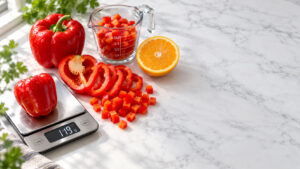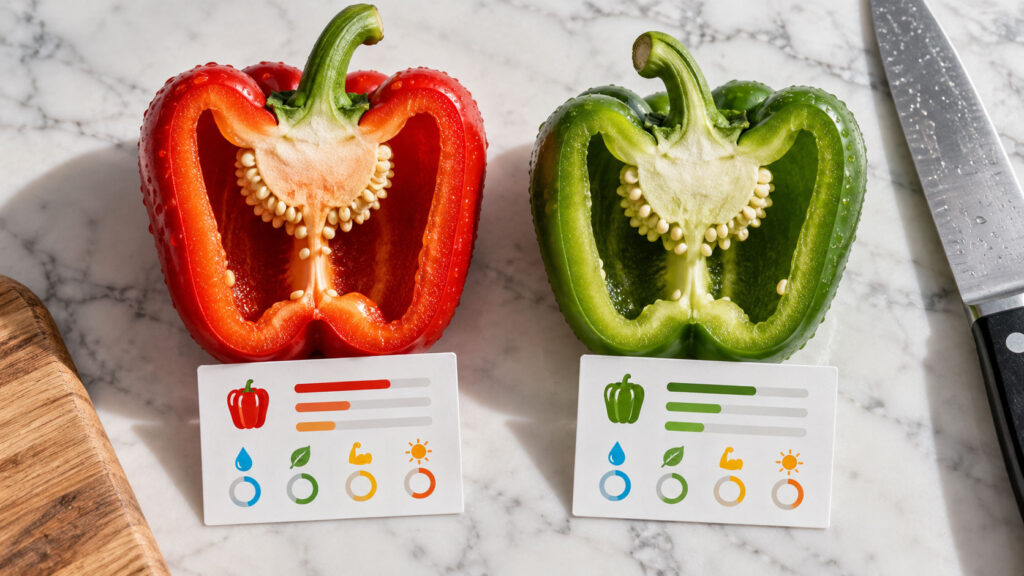
Same plant. Same seed. Same field. The only real difference between a green bell pepper and a red one is a few extra weeks on the vine.
Table of Contents
Yet at the register, red usually costs more. So the real question isn’t just which pepper is healthier. It’s whether those extra weeks of ripening buy you enough nutrition to be worth the price.
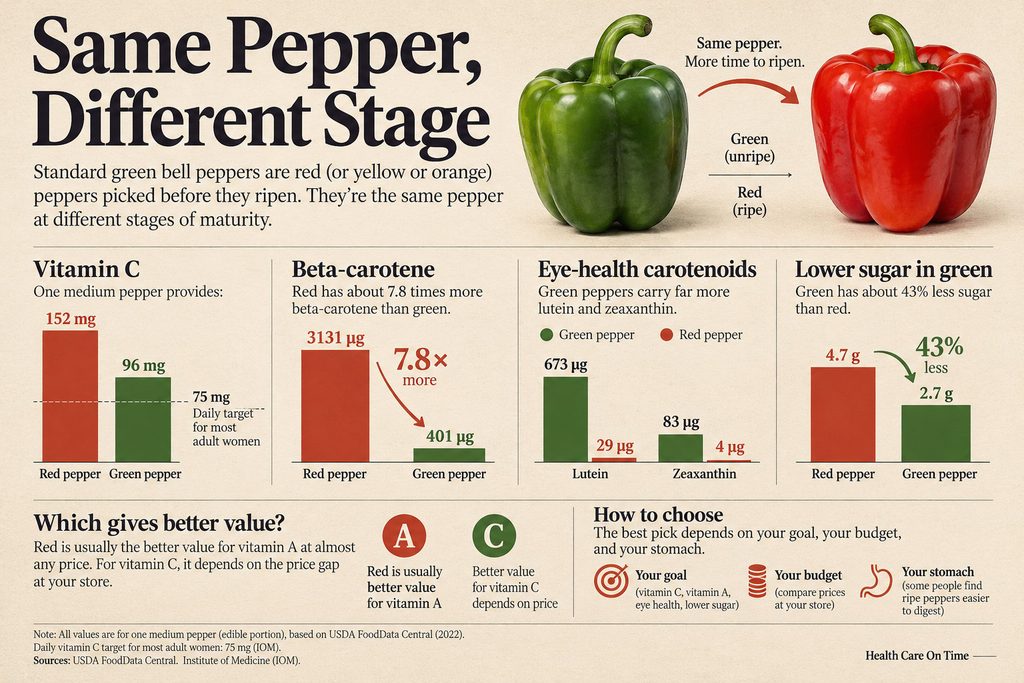
Quick Answer: Red bell peppers are more nutritious on most measures. Per USDA data, red has about 1.6 times the vitamin C, 8.7 times the vitamin A, 7.8 times the beta-carotene, and over 4 times the vitamin E and folate of green. Green wins on lutein and zeaxanthin (about 6.7 times more), has less sugar, and usually costs less. Both are excellent vitamin C sources.
Where each pepper wins (per 100 g, USDA):
- Vitamin C: red, 127.7 mg vs 80.4 mg
- Vitamin A: red, 157 mcg vs 18 mcg
- Beta-carotene: red, 1,624 mcg vs 208 mcg
- Vitamin E: red, 1.58 mg vs 0.37 mg
- Folate: red, 46 mcg vs 10 mcg
- Lutein plus zeaxanthin: green, 341 mcg vs 51 mcg
- Sugar: green, 2.4 g vs 4.2 g
- Calories: green, 20 vs 26
At a Glance
- Standard green bell peppers are red (or yellow or orange) peppers picked before they ripen.
- One medium red pepper gives about 152 mg of vitamin C; one medium green gives about 96 mg. Both clear the daily target for most adult women.
- The popular “11 times more beta-carotene” claim doesn’t match current USDA data. The real gap is about 7.8 times.
- Green peppers carry far more lutein and zeaxanthin, the carotenoids tied to eye health.
- Green has about 43% less sugar than red, a small win for low-carb eaters.
- Red is usually the better value for vitamin A at almost any price; for vitamin C, it depends on the price gap at your store.
- The best pick depends on your goal, your budget, and your stomach.
Are Green Peppers Just Unripe Red Peppers?
Yes, in most cases. Bell peppers (Capsicum annuum) start green on every plant. Left on the vine, most varieties pass through yellow or orange before turning red.
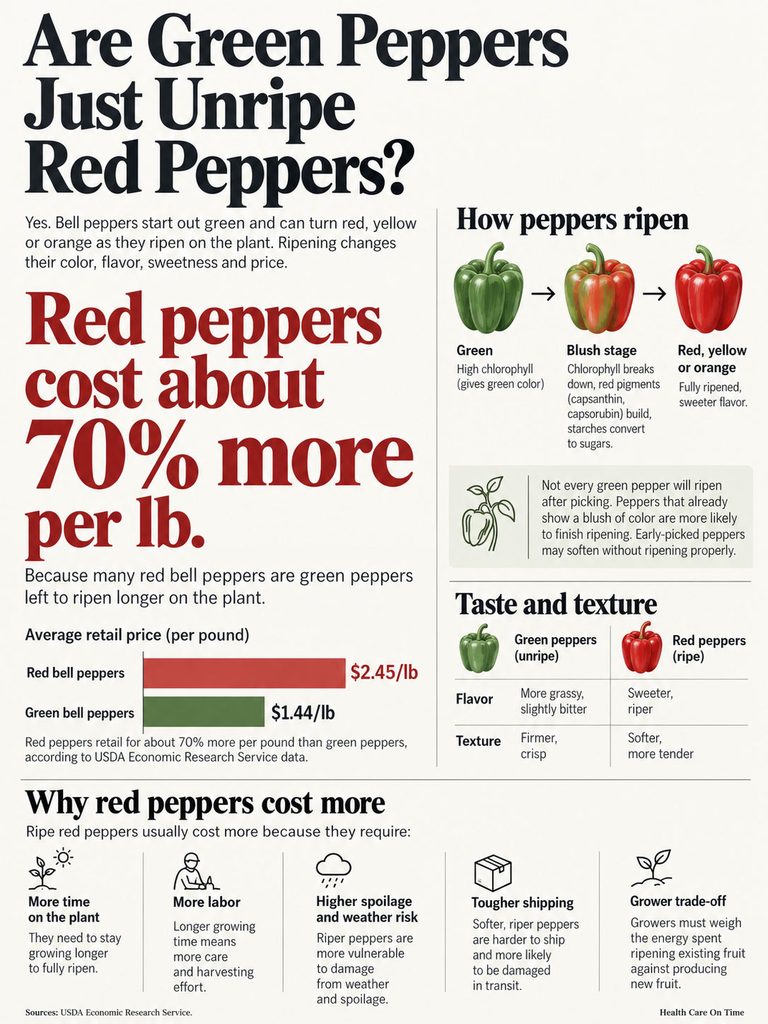
Some varieties are bred to finish yellow, orange, or even purple. But the standard green pepper at a US grocery store is usually a pepper picked early.
What Happens During Ripening
Ripening is chemistry. As the pepper matures, three big changes happen at once.
First, chlorophyll breaks down. That’s the green pigment, and as it fades, other pigments take over.
Second, the pepper builds new red pigments, mainly capsanthin and capsorubin. These are rare in the produce aisle. Beta-carotene and beta-cryptoxanthin climb sharply at the same time.
Third, starches turn into sugars. That’s why a red pepper tastes sweet and fruity, while a green one tastes grassy and a little bitter.
Why Some Green Peppers Never Turn Red
Not every green pepper will ripen on your counter. Peppers picked very early may soften or wrinkle before they color up.
A pepper that already shows a blush of red or orange has a better chance. Keep it at room temperature, out of direct sun, and use it as soon as it turns.
Why Red Peppers Cost More
Leaving peppers on the plant longer has real costs for growers. The plant spends energy ripening existing fruit instead of setting new fruit, so total yield per plant drops.
Ripe peppers are also softer and bruise more easily in shipping. Add the extra field weeks, labor, and higher spoilage, and the price gap makes sense.
The USDA Economic Research Service publishes average retail prices per pound and per cup equivalent for green peppers and red peppers as separate items. It’s the best free source for checking the national gap yourself.
Red vs Green Bell Pepper Nutrition, Side by Side
Patients who ask our team about produce choices usually want one thing: the actual numbers. So here they are, straight from USDA FoodData Central, using the standard raw entries for red (FDC 170108) and green (FDC 170427) sweet peppers.
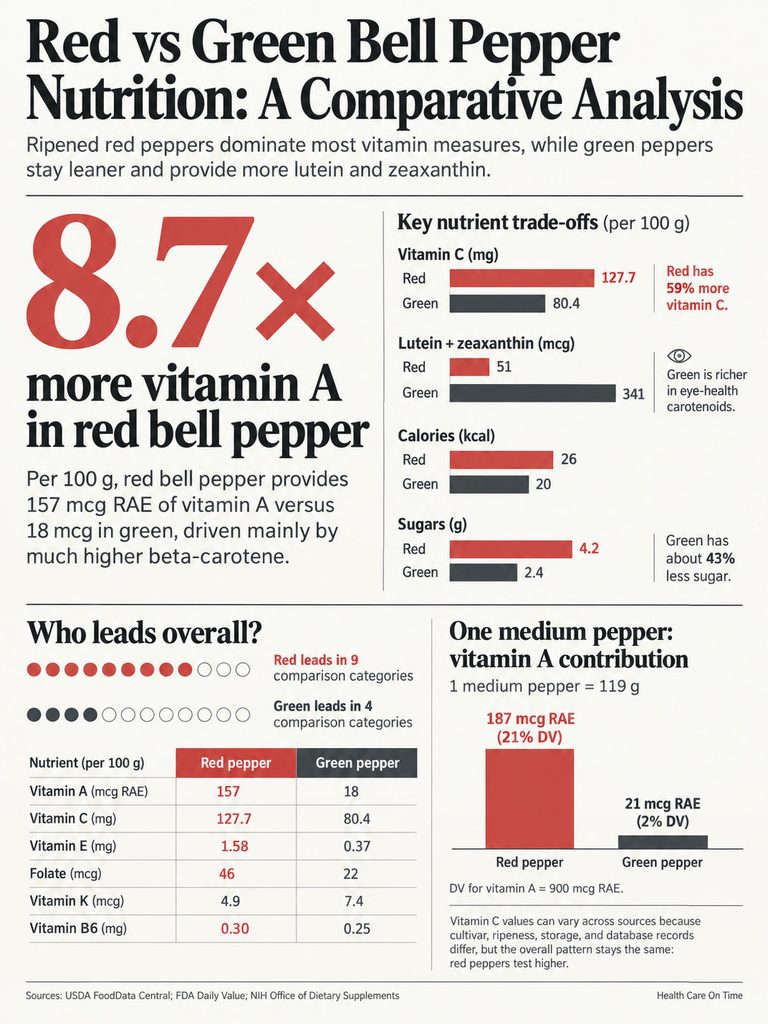
All values are per 100 grams, about 3.5 ounces, or a little less than one medium pepper.
| Nutrient (per 100 g raw) | Red Bell Pepper | Green Bell Pepper | Winner and Gap |
| Calories | 26 kcal | 20 kcal | Green (23% fewer) |
| Total sugars | 4.2 g | 2.4 g | Green (43% less) |
| Fiber | 2.1 g | 1.7 g | Red (1.2x) |
| Vitamin C | 127.7 mg | 80.4 mg | Red (1.6x) |
| Vitamin A (RAE) | 157 mcg | 18 mcg | Red (8.7x) |
| Beta-carotene | 1,624 mcg | 208 mcg | Red (7.8x) |
| Beta-cryptoxanthin | 490 mcg | 7 mcg | Red (70x) |
| Lutein plus zeaxanthin | 51 mcg | 341 mcg | Green (6.7x) |
| Vitamin E | 1.58 mg | 0.37 mg | Red (4.3x) |
| Folate | 46 mcg | 10 mcg | Red (4.6x) |
| Vitamin B6 | 0.29 mg | 0.22 mg | Red (1.3x) |
| Potassium | 211 mg | 175 mg | Red (1.2x) |
| Vitamin K | 4.9 mcg | 7.4 mcg | Green (1.5x) |
Red wins nine categories; green wins four. But how big each win is matters more than the count.
The Vitamin C Gap
Red beats green on vitamin C by about 59%. In real portions, a medium red pepper (about 119 grams, or 4.2 ounces) delivers roughly 152 mg. A medium green pepper delivers about 96 mg.
The NIH Office of Dietary Supplements sets the adult daily target at 90 mg for men and 75 mg for women. People who smoke need an extra 35 mg a day.
So one medium green pepper covers a woman’s full day. One medium red pepper covers anyone’s full day, including a male smoker who needs 125 mg.
Why Sources Disagree on Red Pepper Vitamin C
You’ll see red pepper vitamin C listed as 128 mg in one place and 142 mg in another. Both numbers come from USDA.
The older SR Legacy database lists 127.7 mg per 100 grams. The newer Foundation Foods database lists 141.7 mg for a separate set of samples. Variety, season, and storage all shift the number, so treat any figure as an average, not a promise.
The Vitamin A Gap
This is red’s biggest knockout. Red peppers carry about 8.7 times the vitamin A (as retinol activity equivalents) of green.
That comes mostly from beta-carotene and beta-cryptoxanthin, carotenoids your body can convert into vitamin A. Beta-cryptoxanthin is the standout: red has roughly 70 times as much as green.
A medium red pepper provides about 187 mcg RAE. That’s about 21% of the 900 mcg daily target for men and 27% of the 700 mcg target for women.
Where Green Wins
Green peppers aren’t simply the lesser pepper. They win four categories, and one of those wins is large.
Green carries about 6.7 times more lutein plus zeaxanthin than red. These carotenoids gather in the macula, the part of the eye responsible for sharp central vision.
Green also has fewer calories, less sugar, and a little more vitamin K. The calorie and sugar gaps are small per pepper, but they add up if you eat peppers by the bowlful. For a serving-by-serving calorie breakdown, see our guide to how many calories are in a bell pepper.
Myth Check: What Popular Articles Get Wrong
Our medical review team checked the top-ranking articles on this topic against current USDA data. Several widely repeated claims fall apart under the numbers.
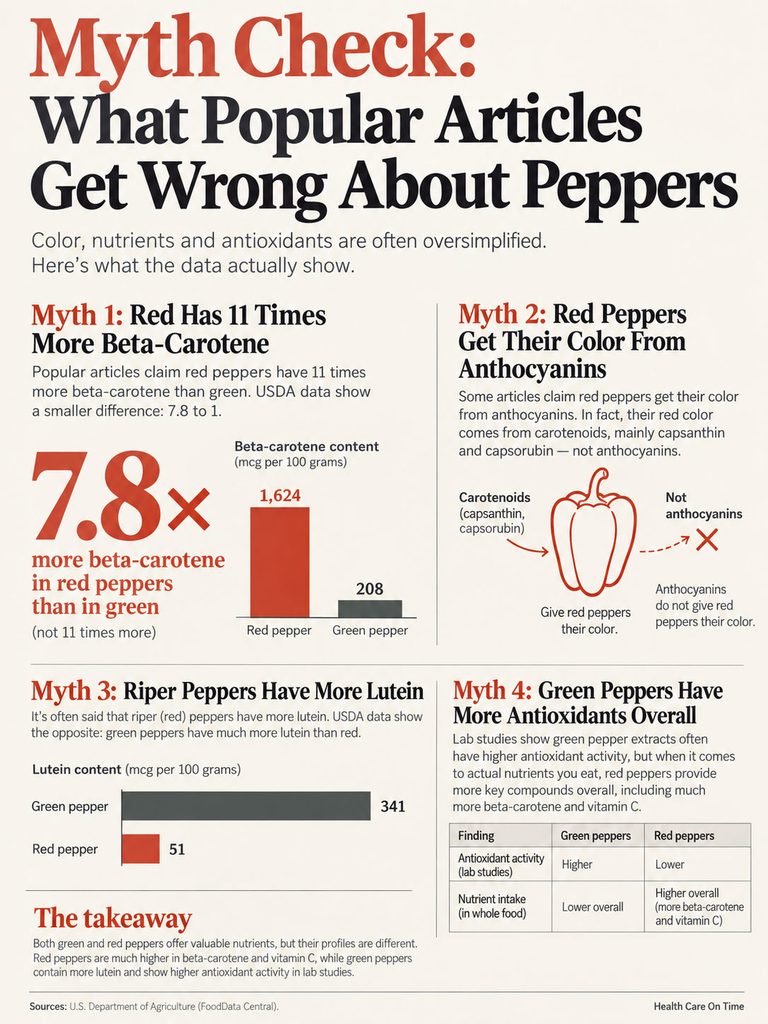
Myth 1: “Red Has 11 Times More Beta-Carotene”
This figure appears across food and lifestyle sites, usually paired with a claim that red has 1.5 times the vitamin C of green.
Current USDA numbers give 1,624 mcg for red and 208 mcg for green. That’s about 7.8 to 1, not 11 to 1. Red still wins by a wide margin, but the famous number is out of date.
Myth 2: “Red Peppers Get Their Color From Anthocyanins”
Some coverage says red bell peppers contain anthocyanins and that these give them their red color. That’s a pigment mix-up.
Anthocyanins are the purple-blue pigments in blueberries, red cabbage, and purple bell peppers. A standard red bell pepper gets its color from carotenoids, mainly capsanthin and capsorubin.
Myth 3: “Riper Peppers Have More Lutein”
Some articles say the riper the pepper, the higher its lutein and zeaxanthin. For lutein, it’s the reverse.
USDA data shows green peppers carry 341 mcg of lutein plus zeaxanthin per 100 grams, versus 51 mcg in red. A few food sites get this right and point readers to green peppers for these eye-health carotenoids.
Myth 4: “Green Peppers Have More Antioxidants Overall”
This claim traces back to a 2013 lab study in which green bell pepper extract showed higher antioxidant activity than red, orange, and yellow extracts. That’s a real finding, but it measured extracts in a test tube, not peppers eaten by people.
Lab antioxidant scores don’t reliably predict what happens in your body. On the nutrients your body actually uses and that USDA measures, red comes out ahead in most categories.
| Common Claim | What USDA Data Shows | Verdict |
| Red has 11x the beta-carotene | 1,624 vs 208 mcg = 7.8x | Overstated |
| Red’s color comes from anthocyanins | Color comes from capsanthin and capsorubin | False |
| Riper peppers have more lutein | Green 341 mcg vs red 51 mcg | False |
| Green has more antioxidants | Lab extract result only; red wins most nutrients | Misleading |
| Red has 1.5x the vitamin C | 127.7 vs 80.4 mg = 1.6x | Roughly right |
Health Benefits by Color
Both peppers support good health. The question is which color fits what you need most.
Immune Support and Vitamin C
Vitamin C supports immune cell function, wound healing, and collagen production. It also helps your body absorb non-heme iron from plant foods like beans and spinach.
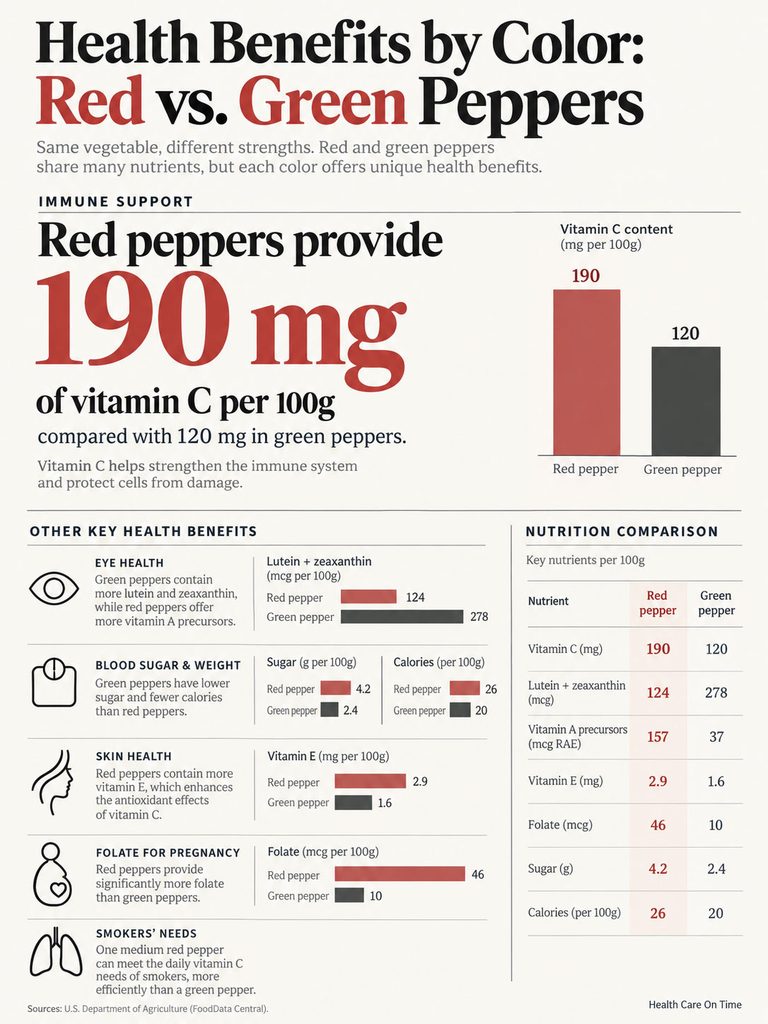
Red has the edge. But in practical terms, either pepper easily covers a day. A cup of chopped red pepper (149 grams) gives about 190 mg; the same cup of green gives about 120 mg.
Deficiency still happens in the US. A large NHANES analysis found about 7.1% of Americans aged 6 and older were vitamin C deficient, with higher rates among smokers and lower-income adults. That data is from 2003-2004, the most recent national deficiency estimate widely cited, so treat it as a baseline rather than a current snapshot.
Eye Health: A Split Decision
This is where color choice gets interesting. Red and green support eye health in different ways.
Green gives you more lutein and zeaxanthin. The National Eye Institute’s AREDS2 trial used these two carotenoids in its supplement formula for people at risk of advanced age-related macular degeneration (AMD).
Red gives you more vitamin A precursors. Vitamin A is needed for the light-sensing pigment in your retina and for seeing in dim light.
Keep the scale in mind. A medium green pepper gives about 0.4 mg of lutein plus zeaxanthin, while AREDS2 used 10 mg of lutein and 2 mg of zeaxanthin daily. Spinach and kale remain far richer food sources than either pepper.
Blood Sugar and Weight
Green has about 2.4 grams of sugar per 100 grams; red has about 4.2 grams. That’s roughly 2 grams of sugar saved per medium green pepper.
Both peppers have a very low glycemic load, so neither will spike blood sugar in normal servings. Patients booking HbA1c tests with us often ask which color to pick, and the honest answer is that either fits a balanced plate.
At 26 calories per 100 grams for red and 20 for green, both are low-energy-density foods. That makes them useful for filling up on volume when you’re watching calories.
Skin and Collagen
Vitamin C is a required helper for building collagen, the protein that gives skin its structure. Red peppers also bring vitamin E, about 4.3 times the amount in green.
Vitamins C and E work together as antioxidants in skin. That doesn’t make peppers a skincare treatment, but red’s richer mix supports the nutrients your skin relies on.
Folate for Pregnancy and Cell Growth
Red pepper has about 46 mcg of folate per 100 grams versus 10 mcg in green, a 4.6 times difference.
Folate supports cell division and fetal development. The daily target in pregnancy is 600 mcg DFE, so peppers help but won’t cover it alone. Prenatal vitamins and fortified grains still do the heavy lifting.
Smokers: Red Is the Easy Win
Smoking raises oxidative stress and lowers blood vitamin C, which is why NIH adds 35 mg to the daily target. Across patients we serve, smokers are among the most likely to fall short on vitamin C.
One medium red pepper (about 152 mg) covers the full 125 mg target for a male smoker. A medium green pepper (about 96 mg) gets you most of the way there. If you smoke, red is the more efficient pick.
What About Yellow and Orange Peppers?
Yellow and orange peppers sit between green and red on the ripening path, but their nutrition doesn’t fall neatly in the middle.
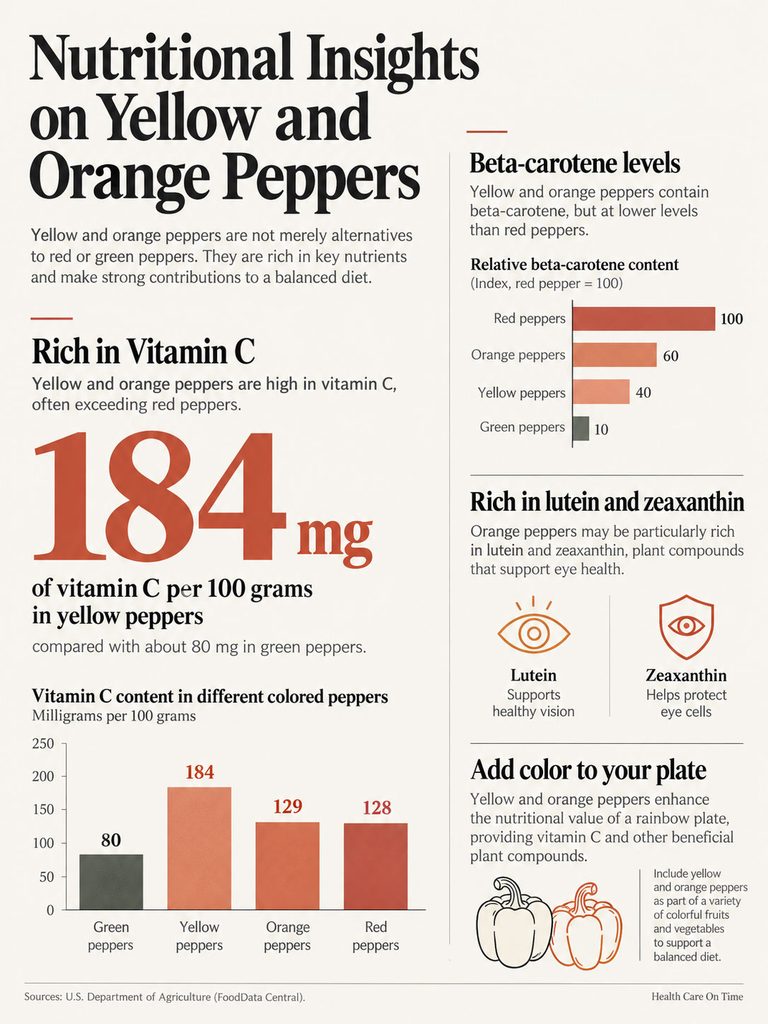
Both tend to be very high in vitamin C, often near or even above red. Tufts researchers have noted that green peppers average about 80 mg of vitamin C per 100 grams versus 184 mg for yellow.
Their beta-carotene is lower than red. Orange varieties can be rich in lutein and zeaxanthin, depending on the variety. If you’re building a rainbow plate, yellow and orange are strong additions, not compromises.
Bell Peppers in the US Diet: The Numbers
Most Americans fall short on vegetables, which makes nutrient-dense picks like red peppers more valuable. Here’s where things stand.
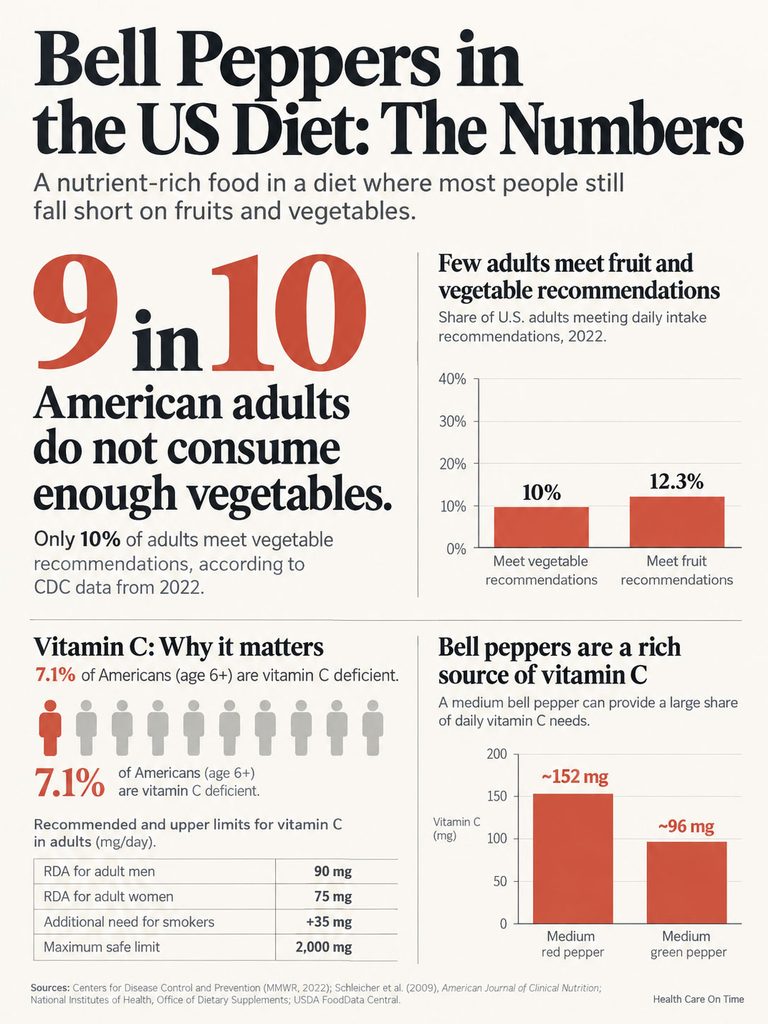
| US Statistic | Figure | Source |
| Adults meeting vegetable recommendations | 10.0% | CDC MMWR, 2022 |
| Adults meeting fruit recommendations | 12.3% | CDC MMWR, 2022 |
| Americans (age 6+) vitamin C deficient | 7.1% | Schleicher et al., AJCN 2009 (NHANES) |
| Vitamin C RDA, adult men / women | 90 mg / 75 mg | NIH ODS |
| Extra vitamin C needed by smokers | +35 mg/day | NIH ODS |
| Vitamin C upper limit, adults | 2,000 mg/day | NIH ODS |
| Vitamin C in 1 medium red vs green pepper | ~152 mg vs ~96 mg | USDA FoodData Central |
The bigger gap isn’t red versus green. It’s that 9 in 10 American adults don’t eat enough vegetables at all. Either color moves you in the right direction.
Is Red Worth the Higher Price?
Prices swing by region, season, and store, so a single national number won’t match your receipt. A simple rule works better.
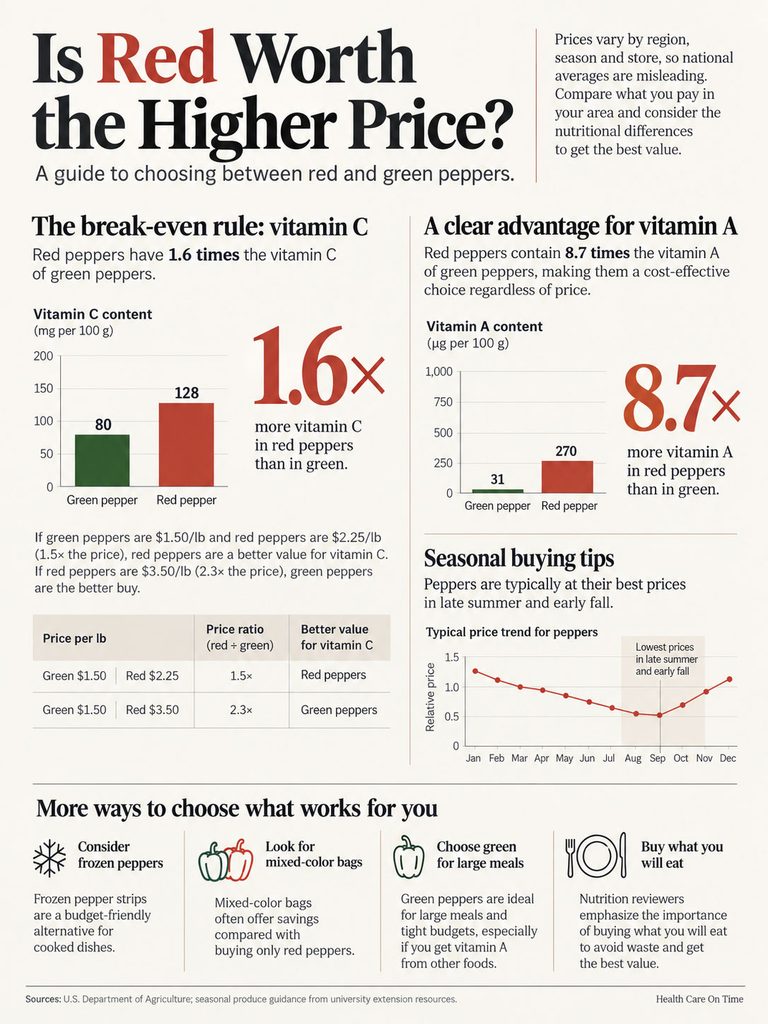
The Break-Even Rule for Vitamin C
Red has about 1.6 times the vitamin C of green. So if red costs less than 1.6 times green per pound, red gives you more vitamin C per dollar.
Here’s an example with sample prices. If green is $1.50 per pound and red is $2.25 (1.5 times as much), red wins on vitamin C value. If red is $3.50 (2.3 times as much), green wins.
For vitamin A, the math is lopsided. Red has 8.7 times the vitamin A, so it wins on cost per unit of vitamin A at almost any realistic price.
Seasonal Buying Tips
Peppers are usually cheapest in late summer and early fall, when US field crops peak. That’s often when the red-to-green price gap is narrowest.
Bags of mixed-color peppers at warehouse clubs often cost less per pepper than single red peppers. Frozen pepper strips are another budget option for cooked dishes, though freezing softens texture.
When Green Is the Smarter Buy
Green makes sense for big batches like chili, fajitas, or stuffed peppers for a family. It also makes sense on a tight budget if you already get vitamin A from carrots, sweet potatoes, or leafy greens.
Our nutrition reviewers keep coming back to one point: buy what you’ll actually eat. A green pepper eaten beats a red pepper going soft in the crisper drawer.
Digestion, Heartburn, and FODMAPs
Some people find that green peppers repeat on them, causing burping or a lingering aftertaste. Red peppers tend to draw fewer complaints.
Why Green Peppers Bother Some People
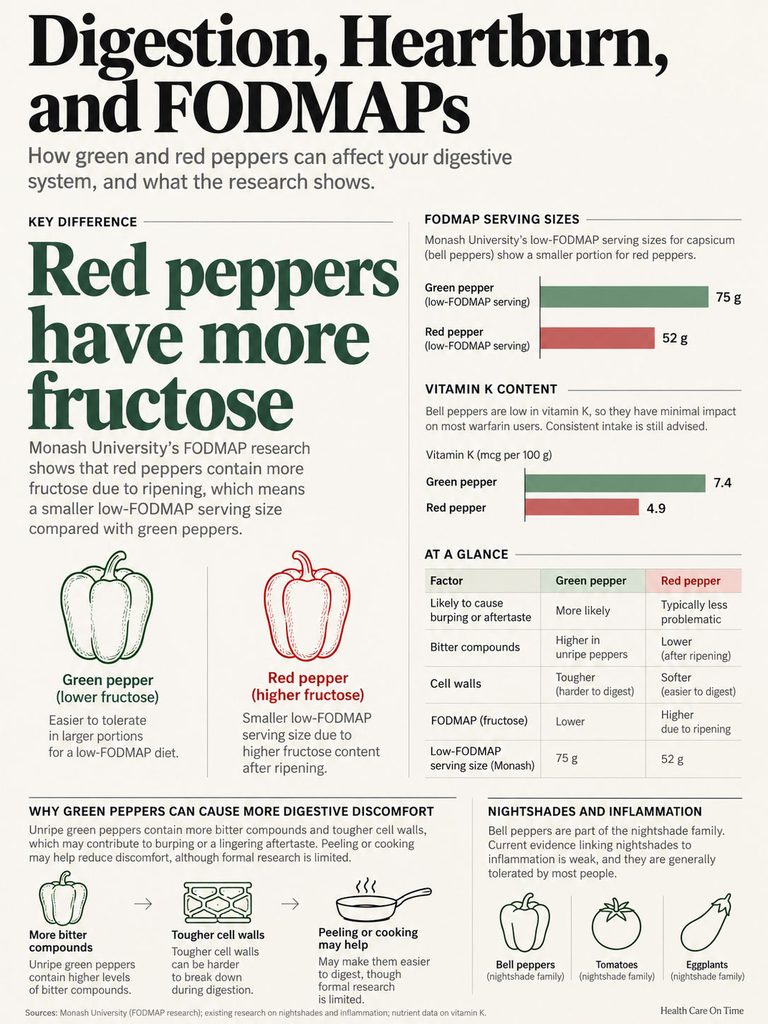
Unripe produce often has more bitter compounds and tougher cell walls. The grassy, bitter taste of green peppers comes from compounds that fade as the pepper ripens.
Formal research on this is limited, so treat it as common experience rather than proven effect. If green peppers bother you, peeling them or cooking them until soft often helps.
FODMAPs by Color
For people with irritable bowel syndrome (IBS), Monash University’s FODMAP research tests red and green peppers separately. Red peppers carry more fructose, because ripening turns starch into sugar.
Monash lists a smaller low-FODMAP serving for red bell pepper than for green. Check the Monash app for current gram amounts, since servings are updated as testing continues. On a low-FODMAP plan, green is often the easier color in larger portions.
Nightshade Concerns
Bell peppers belong to the nightshade family, along with tomatoes, potatoes, and eggplant. Some people believe nightshades worsen joint pain or inflammation.
Strong human evidence for this is lacking. A small number of people do report symptoms, and a short elimination trial with a clinician can sort it out. Most people have no reason to avoid peppers.
Vitamin K and Blood Thinners
Both colors are low in vitamin K, at 4.9 mcg (red) and 7.4 mcg (green) per 100 grams. That’s tiny next to leafy greens.
If you take warfarin, peppers won’t cause big swings. The standard advice still applies: keep vitamin K intake steady week to week. Our warfarin guide covers this in more depth.
Cooking: Which Color Holds Up Better?
How you prepare peppers matters about as much as which color you buy.
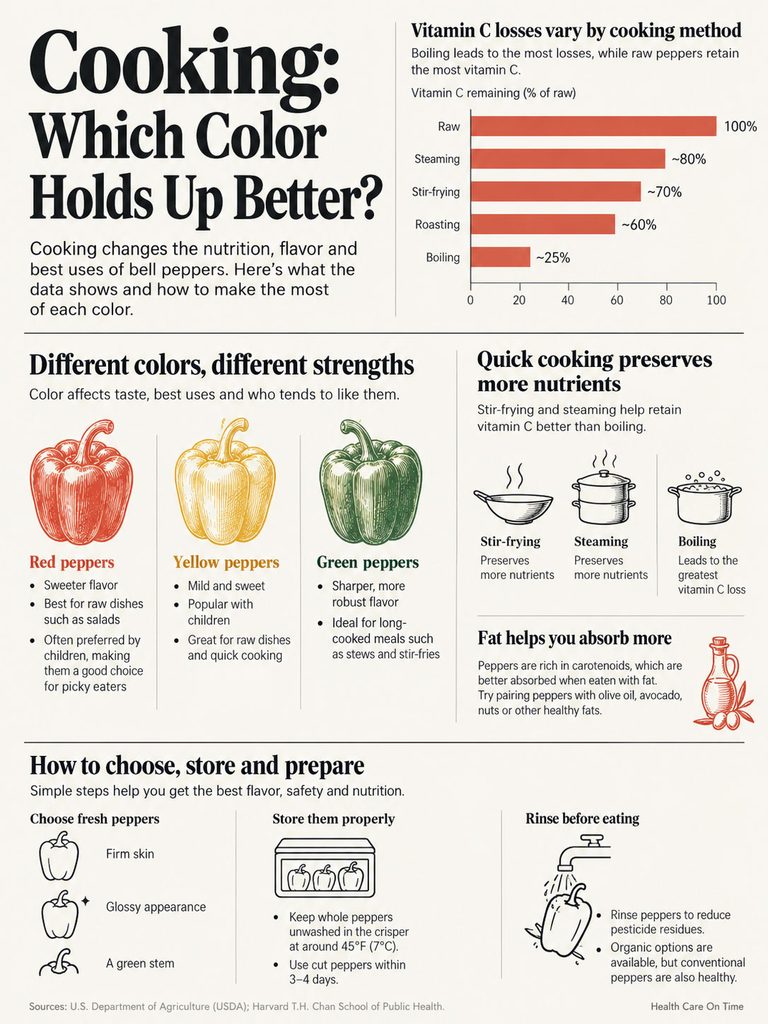
Vitamin C Losses by Cooking Method
Vitamin C dissolves in water and breaks down with heat. Boiling causes the biggest losses because the vitamin leaches into the cooking water.
Quick stir-frying, steaming, or short roasting hold onto more. Raw peppers keep the most. Since red starts so high, a lightly cooked red pepper often still matches or beats a raw green one.
For method-by-method detail, see our article on vitamin C in red bell peppers.
Fat Helps Carotenoid Absorption
Beta-carotene, lutein, and zeaxanthin are fat soluble. Your body absorbs them much better when you eat them with some fat.
A drizzle of olive oil, a few slices of avocado, or a scoop of hummus does more than add flavor. It helps you absorb the carotenoids both peppers are known for.
Light cooking also breaks down cell walls and can release more carotenoids. So for vitamin C, raw is best; for carotenoids, lightly cooked with fat often wins. Eating peppers both ways through the week covers both.
Flavor and Best Uses by Color
Red peppers are sweet and mild. They shine raw in salads, roasted on sandwiches, blended into soups, and as dippers for kids who find green bitter.
Green peppers are sharper and slightly bitter. They hold up in long-cooked dishes like chili, gumbo, jambalaya, and sausage and peppers. In Cajun and Creole cooking, green pepper joins onion and celery as the “holy trinity.”
Getting Kids to Eat Peppers
Children are often more sensitive to bitter tastes than adults. That’s one reason red, yellow, and orange peppers tend to go over better with picky eaters.
Try raw red pepper strips with ranch or hummus, or mild roasted peppers mixed into pasta sauce. Once kids accept red, green can follow in cooked dishes where the bitterness mellows.
Buying and Storing Tips
Pick peppers that feel heavy for their size, with firm, glossy skin and no soft spots. A fresh, green stem is a good sign.
Store whole peppers unwashed in the crisper drawer at about 45°F. Green peppers usually last one to two weeks; red peppers often soften sooner. Use cut peppers within three to four days.
Bell peppers regularly appear on EWG’s pesticide residue rankings, so rinse them well under running water. Organic is a personal choice, and conventional peppers remain a healthy option.
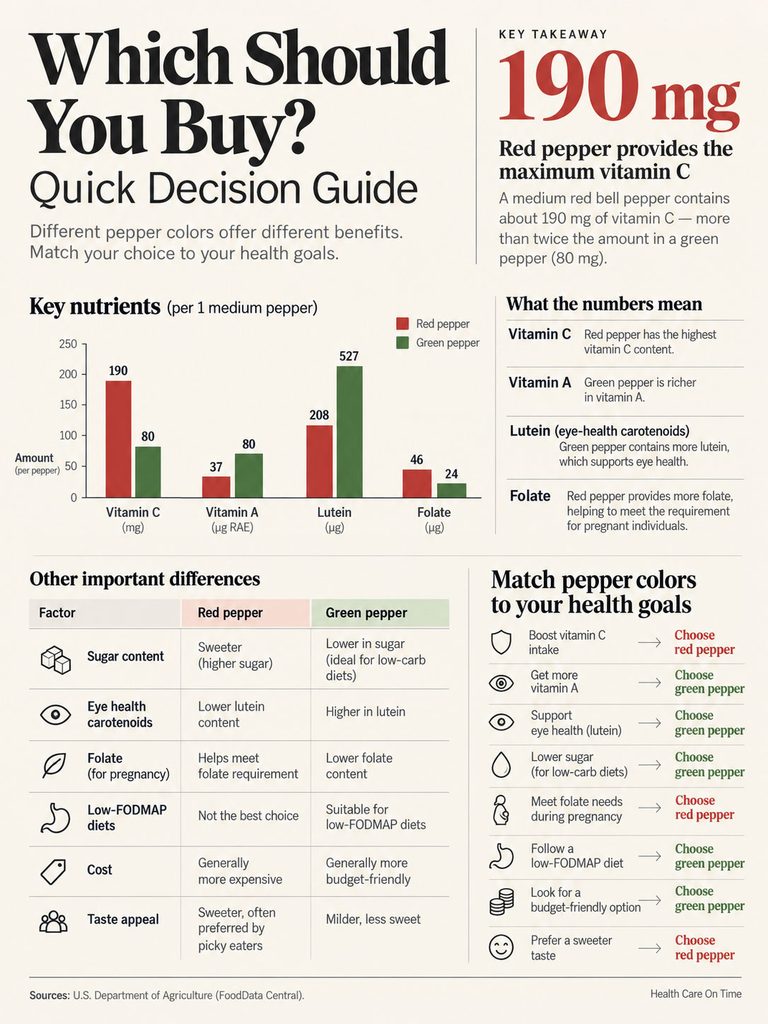
Which Should You Buy? Quick Decision Guide
Use this table to match the pepper to your goal.
| Your Situation | Better Pick | Why |
| You want maximum vitamin C | Red | 127.7 mg vs 80.4 mg per 100 g |
| You need more vitamin A | Red | 8.7x the vitamin A of green |
| You want eye-health carotenoids (lutein) | Green | 341 mcg vs 51 mcg per 100 g |
| You’re low-carb or keto | Green | 2.4 g vs 4.2 g sugar per 100 g |
| You’re on a tight budget | Green | Usually cheaper per pound |
| You smoke | Red | One medium pepper covers the 125 mg target |
| You’re pregnant | Red | 4.6x the folate of green |
| You have IBS and follow low-FODMAP | Green | Larger low-FODMAP serving per Monash |
| You’re feeding picky kids | Red | Sweeter, less bitter taste |
| You’re making chili or gumbo | Green | Sharper flavor holds up in long cooking |
Can’t decide? Buy one of each. Mixing colors through the week gets you red’s vitamin A and vitamin C plus green’s lutein, at a blended price.
What This Comparison Can’t Tell You
In cases reviewed by our medical team, readers sometimes take nutrient tables as health guarantees. They aren’t, and it’s worth being clear about the limits.
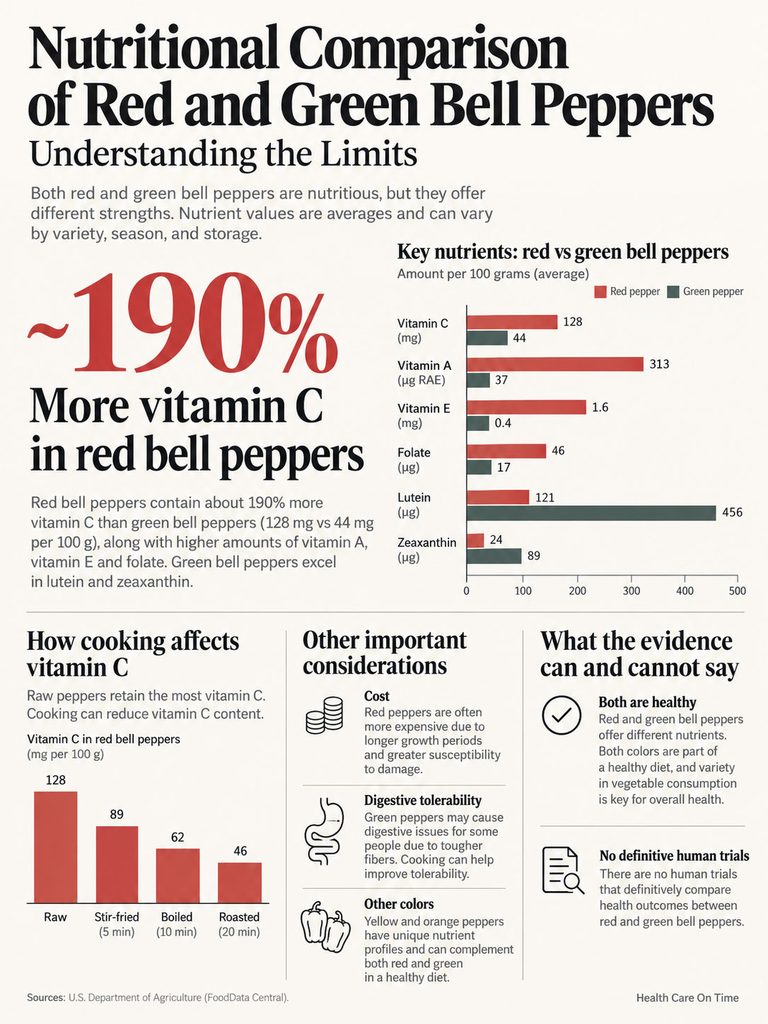
There are no human trials comparing people who eat red peppers to people who eat green peppers. The case for red rests on nutrient content, not on measured health outcomes.
USDA values are averages from a limited number of samples. Variety, farm, season, and days in storage can move any nutrient up or down. And the US vitamin C deficiency estimate dates from 2003-2004, so current rates may differ.
What the evidence does support is simple: eating more vegetables of any color is linked to better health, and most Americans need more of them.
Frequently Asked Questions
Are red peppers healthier than green peppers?
On most nutrients, yes. Red bell peppers have about 1.6 times the vitamin C, 8.7 times the vitamin A, and over 4 times the vitamin E and folate of green. Green wins on lutein, zeaxanthin, vitamin K, and lower sugar. Both are healthy, low-calorie vegetables worth eating often.
Do red bell peppers have more vitamin C than oranges?
Yes. A medium red bell pepper has about 152 mg of vitamin C, while a medium navel orange has roughly 70 to 85 mg depending on size. Even a medium green pepper, at about 96 mg, edges out the orange. Peppers are among the richest everyday vitamin C sources.
Are green peppers just unripe red peppers?
In most cases, yes. Standard green bell peppers are harvested before they ripen. Left on the plant, they turn yellow, orange, or red depending on variety. Some varieties are bred to finish a specific color, but the typical grocery-store green pepper is simply picked early.
Why are red bell peppers more expensive?
Red peppers need several extra weeks on the plant, which lowers how much fruit each plant produces. Ripe peppers also bruise more easily and spoil faster in shipping. Those added costs for growers and stores show up as a higher price per pound at checkout.
Which bell pepper is best for weight loss?
Both work well. Green has slightly fewer calories (20 vs 26 per 100 grams) and less sugar, but the difference is about 7 calories per medium pepper. Choose the color that helps you eat more vegetables, since both are low in calories and high in water and fiber.
Which bell pepper is best for eye health?
It’s a split. Green peppers carry about 6.7 times more lutein and zeaxanthin, which concentrate in the macula. Red peppers carry far more vitamin A precursors, which support vision in dim light. Eating both colors, plus leafy greens like spinach and kale, covers both sides.
Why do green peppers cause gas or heartburn for some people?
Unripe peppers have more bitter compounds and tougher fibers, which some people find harder to digest. Research is limited, so this is mostly reported experience. Cooking green peppers until soft, peeling them, or switching to red, yellow, or orange often eases symptoms.
Do yellow and orange peppers fall in between?
Mostly, but not perfectly. Yellow and orange peppers often match or beat red on vitamin C, and orange varieties can be rich in lutein and zeaxanthin. Their beta-carotene is lower than red. Each color has its own strengths, so variety is a smart approach.
Does cooking destroy the vitamin C in peppers?
Cooking lowers vitamin C, especially boiling, since the vitamin leaches into water. Quick stir-frying, steaming, or short roasting saves more. Raw keeps the most. Because red peppers start so high, even cooked red peppers remain a strong vitamin C source.
Will a green pepper turn red on the counter?
Sometimes. A pepper that already shows a blush of color has the best chance of ripening at room temperature. A fully green pepper picked early may soften or wrinkle first. Keep it out of direct sun and use it as soon as it colors up.
Are bell peppers safe on a low-FODMAP diet?
Yes, in the right portions. Monash University tests red and green separately, and green has a larger low-FODMAP serving because it contains less fructose. Check the Monash app for current gram amounts, and work with a dietitian if you’re managing IBS symptoms.
Disclaimer: This article is for general education and does not replace advice from your doctor or a registered dietitian. Nutrient values are USDA averages and vary by variety, season, and storage. If you have a medical condition, take blood thinners, follow a therapeutic diet, or are pregnant, talk with your healthcare provider before making major diet changes.
References
- USDA FoodData Central: Peppers, sweet, red, raw (FDC 170108)
- USDA FoodData Central: Peppers, sweet, green, raw (FDC 170427)
- NIH Office of Dietary Supplements: Vitamin C Fact Sheet for Health Professionals
- CDC MMWR: Adults Meeting Fruit and Vegetable Intake Recommendations, United States, 2019
- Schleicher RL et al. Serum vitamin C and the prevalence of vitamin C deficiency in the United States: NHANES 2003-2004. Am J Clin Nutr. 2009
- National Eye Institute: Age-Related Eye Disease Studies (AREDS/AREDS2)
- USDA Economic Research Service: Fruit and Vegetable Prices
- Monash University FODMAP Diet
- Tufts Health & Nutrition Letter: Which Color of Bell Pepper Has Most Nutrients?