Two of the most-read health sites in America give opposite answers to this question. One says discharge increases before your period. The other says the days right before your period are the driest of your whole cycle.
They can’t both be right. This guide settles it, then shows you exactly what normal looks like, day by day, and which changes deserve a closer look.
Table of Contents
Quick Answer: Before your period, normal discharge is usually white, off-white, or creamy, and it feels thick, sticky, or pasty instead of slippery. The amount is smaller than mid-cycle, often half a teaspoon or less a day, with little or no smell. A pink or brown tinge in the last day or two is common. Itching, a fishy odor, gray or green color, or a cottage-cheese texture is not normal.
At a Glance
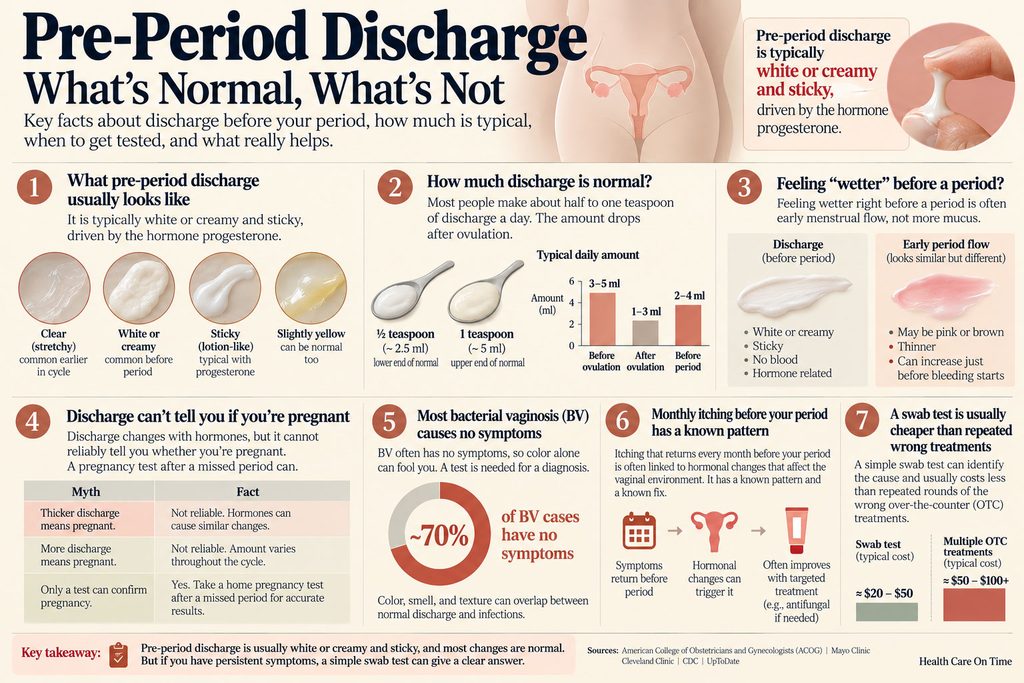
- Pre-period discharge is typically white or creamy and sticky, driven by the hormone progesterone.
- Most people make about half to one teaspoon of discharge a day; the amount drops after ovulation.
- Feeling “wetter” right before a period is often early menstrual flow, not more mucus.
- Discharge cannot reliably tell you whether you’re pregnant. A test after a missed period can.
- Most bacterial vaginosis causes no symptoms, so color alone can fool you.
- Itching that returns every month before your period has a known pattern and a known fix.
- A swab test usually costs less than repeated rounds of the wrong OTC treatment.
What Normal Discharge Looks Like Before Your Period
Discharge before period days follows a predictable pattern for most people with regular cycles. It comes from your cervix, the walls of your vagina, shed cells, and healthy bacteria.
That mix protects tissue, keeps the area moist, and keeps the vaginal environment acidic. Its look changes because your hormones change.
Color, Texture, Smell, and Amount
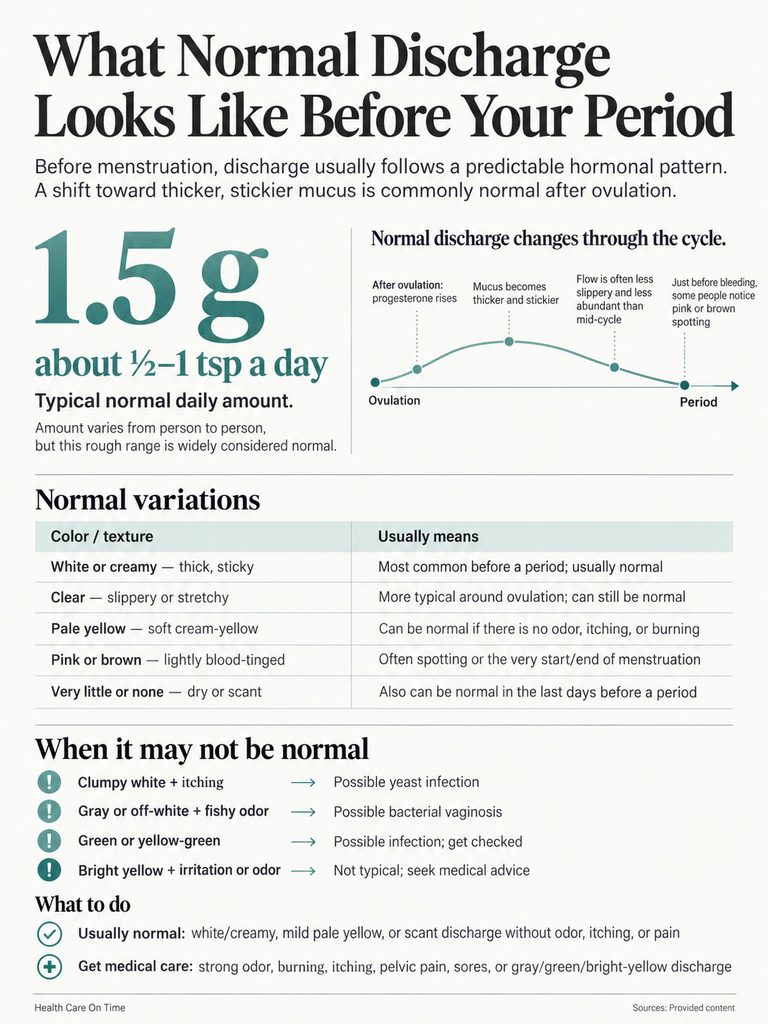
In the week or so before your period, normal discharge tends to look like this:
- Color: white, off-white, cream, or very pale yellow once it dries on underwear
- Texture: thick, sticky, tacky, or lotion-like; it doesn’t stretch between your fingers
- Smell: none, or a mild, slightly sour scent
- Amount: light; some days you may barely notice it
How much is “light”? A typical person in their reproductive years produces about 1.5 grams of vaginal discharge a day, roughly half to one teaspoon. Patients booking wellness panels with us often say they had no idea a normal daily amount even existed, so a number helps.
Why It Gets Thicker and Stickier
The shift comes from progesterone. After ovulation, the empty follicle in your ovary releases progesterone, and that hormone thickens cervical mucus and cuts its volume.
The change is dramatic. Discharge around ovulation can run up to 30 times greater than the amount right after a period. So when your discharge turns from slippery to pasty, that’s the hormone doing its job.
Here’s a color guide to what you might see in the week before your period. Our medical team built it to answer the question most readers are really asking: “Is mine normal?”
| Color / Look | Texture | What It Usually Means | Normal Before a Period? | What to Do |
| White or creamy | Thick, sticky, lotion-like | Progesterone-driven luteal phase mucus | Yes | Nothing |
| Clear | Watery or slightly slick | Vaginal fluid, heat, exercise, or arousal | Yes, in small amounts | Nothing |
| Pale yellow (dried on underwear) | Creamy, no odor | Normal discharge oxidized by air | Usually | Watch for itch or odor |
| Pink or light brown | Thin, streaky, last 1 to 2 days | Earliest blood mixing with mucus | Yes | Expect your period soon |
| White and clumpy | Cottage cheese-like, itchy | Likely yeast infection | No | Get tested before treating |
| Gray or off-white | Thin, watery, fishy odor | Likely bacterial vaginosis | No | See a clinician |
| Green or yellow-green | Frothy or thick, odor, irritation | Possible trichomoniasis or other STI | No | See a clinician promptly |
| Bright yellow with pelvic pain or fever | Thick, pus-like | Possible cervicitis or PID | No | Same-day care |
Wet or Dry? Clearing Up the Before-Period Contradiction
Here’s the conflict. One popular pharmacy site quotes a clinician saying it’s common for discharge to increase before your period. A popular telehealth site says the one to two days before a period are typically the driest of the cycle.
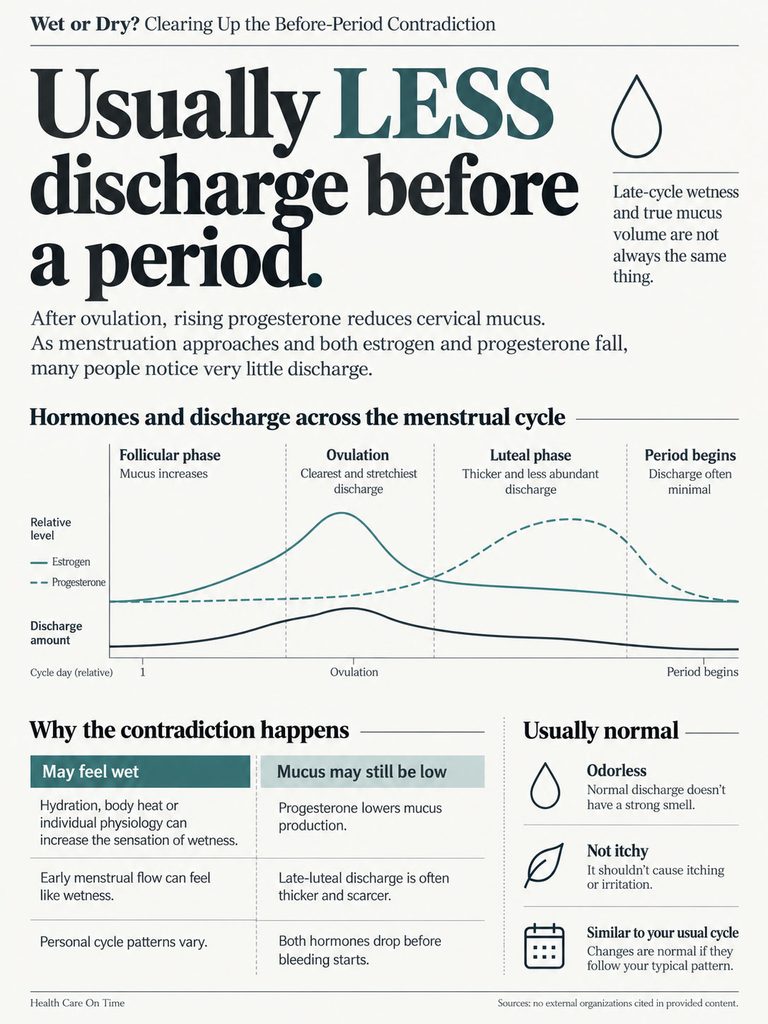
Hormone physiology backs the “drier” side. After ovulation, rising progesterone lowers the amount of cervical mucus your body makes.
What the Hormones Actually Do
Your cycle has two halves. In the first half, rising estrogen produces more and more mucus, peaking at clear, stretchy, egg-white discharge around ovulation.
In the second half, the luteal phase, progesterone takes over. Mucus gets thicker, cloudier, and scantier. Right before your period, both estrogen and progesterone fall, and many people notice the least discharge of the month.
Why Some People Feel Wetter Anyway
If you feel damp right before your period, you’re not imagining it. A few things can cause that:
- Early flow. The first hours of a period are often thin, watery, and only faintly pink.
- Vaginal fluid. The vaginal walls release a clear fluid that rises with heat, exercise, stress, and arousal.
- Shed cells. More cells from the vaginal lining can make discharge look heavier and whiter.
- Infection. A sudden, clearly heavier amount with odor or itching is a different story.
So the honest answer is that mucus usually decreases, while overall wetness can vary. If your “extra” discharge has no odor, no itch, and matches your pattern from month to month, it’s very likely normal.
Discharge Day by Day: 1 Week to 1 Day Before Your Period
Most people searching “discharge 1 week before period” or “discharge 2 days before period” want a timeline. Here’s what a typical regular cycle looks like, counting backward from day one of bleeding.
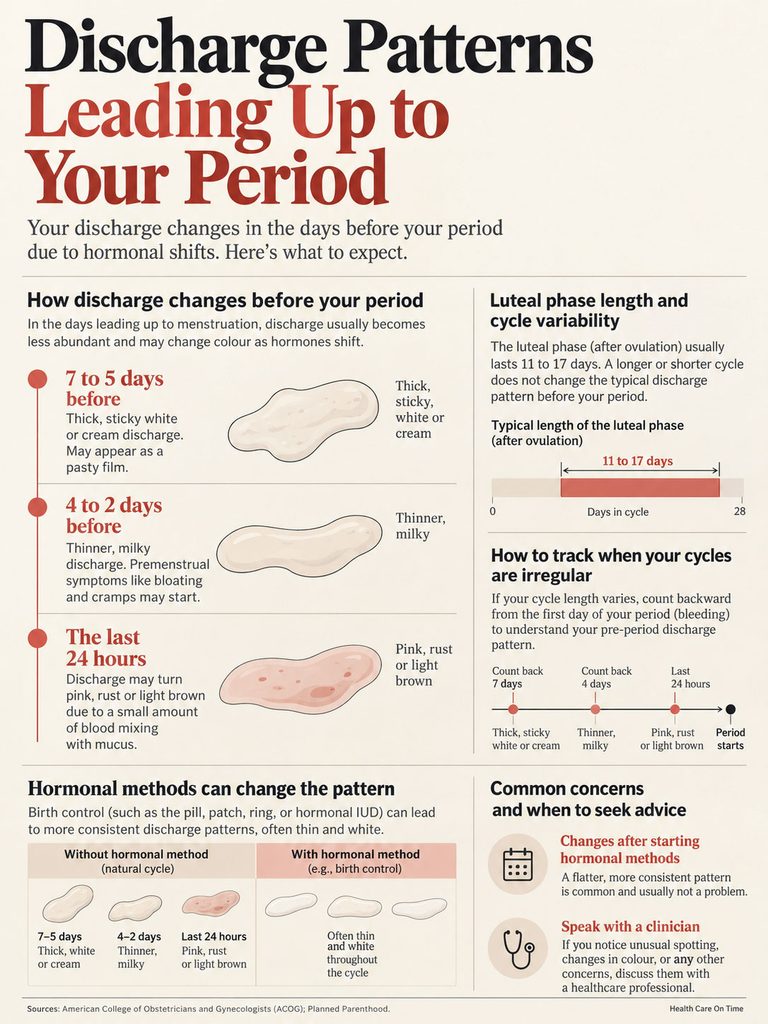
7 to 5 Days Before
This is the middle of the luteal phase, when progesterone peaks. Discharge is usually white or cream, thick, and sticky.
You might see it as a pasty film on underwear that dries pale yellow. Some people notice almost nothing at all, which is also normal.
4 to 2 Days Before
Progesterone starts to fall. Discharge may become slightly thinner, more milky, or scant and dry.
This is also when premenstrual symptoms like bloating, breast tenderness, and cramps often start. Those symptoms don’t change what normal discharge looks like.
The Last 24 Hours
In the final day or so, discharge often turns pink, rust, or light brown. That’s a small amount of blood mixing with mucus as the uterine lining begins to shed.
A day of spotting before full flow is common. Spotting for many days before every period is worth mentioning to your clinician.
If Your Cycle Isn’t 28 Days
The luteal phase is fairly steady at roughly 11 to 17 days for most people, while the first half of the cycle is what varies. So “a week before your period” still lines up with the thick, sticky stage, even in a 35-day cycle.
If your cycles are irregular, count backward from bleeding instead of forward from your last period. A free tracking app works fine.
On the Pill, a Hormonal IUD, or the Implant
Many hormonal methods stop ovulation or thin the uterine lining. Without ovulation, you won’t get the mid-cycle egg-white peak or the classic luteal shift.
Your discharge may look about the same all month, often thin and white. In cases seen across our diagnostic network, this flat pattern is one of the most common reasons patients worry that “something changed” after starting birth control.
How Pre-Period Discharge Changes Across Life Stages
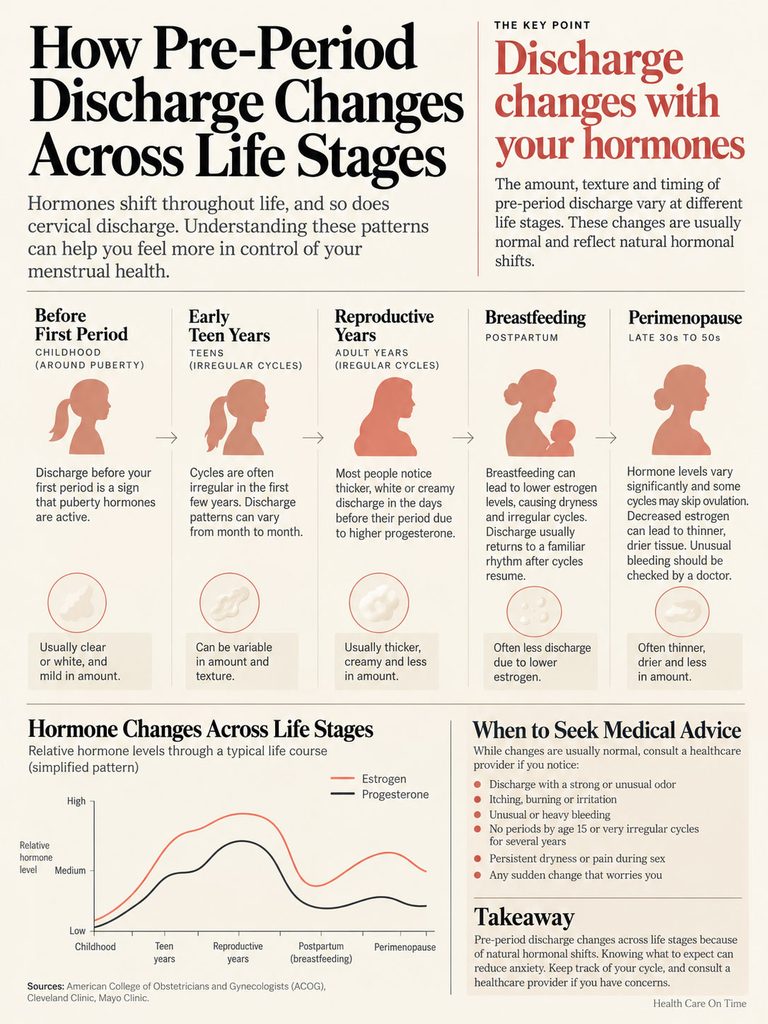
The “normal” pattern above describes regular adult cycles. It shifts at a few points in life, and knowing that saves a lot of worry.
Teens Before and After a First Period
White or clear discharge often starts several months to a year before a first period. It’s one of the clearest signs that puberty hormones are working.
For the first year or two, cycles are often irregular, so the pre-period pattern may not be predictable yet. Itching, odor, or discolored discharge in a young teen still deserves a check with a pediatrician.
After Childbirth and While Breastfeeding
Breastfeeding keeps estrogen low, so many people feel drier than usual and may not see a clear luteal pattern. Periods may be absent or irregular for months.
When cycles return, discharge usually follows the familiar thick-then-dry rhythm again. Dryness that makes sex painful is common and treatable.
Perimenopause
In your 40s, cycles can lengthen, shorten, or skip. Some cycles don’t include ovulation, so the luteal discharge pattern may show up one month and vanish the next.
Falling estrogen can make tissue thinner and drier. Any vaginal bleeding after 12 straight months without a period is never normal and needs prompt evaluation.
Is It Pre-Period Discharge or Early Pregnancy?
This is the most anxious version of the question, and the answer is simple: discharge cannot tell you. Creamy white discharge happens in a normal luteal phase and in early pregnancy, because progesterone stays high in both.
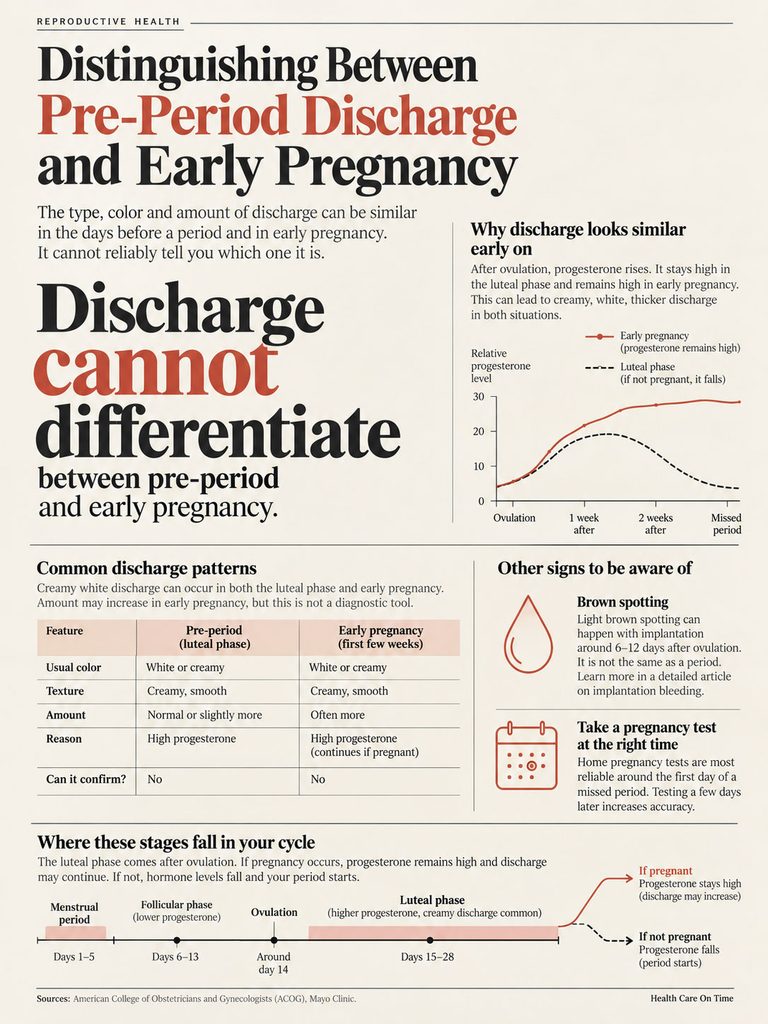
Some people do notice a bit more white discharge in early pregnancy. But the overlap is so large that no clinician uses it to diagnose pregnancy.
What works is a test. Research on the natural limits of pregnancy testing found that most pregnancies become detectable around the first day of a missed period, and a test a few days later is more reliable still.
What to do instead of reading your underwear:
- Wait until the day your period is due.
- Take a home urine test with first-morning urine.
- If negative and your period still hasn’t come, test again in 3 to 5 days.
- If you have one-sided pelvic pain, dizziness, or heavy bleeding, seek same-day care.
If you see brown spotting and wonder about implantation, our article on brown discharge before your period and pregnancy covers that question in detail. So does our guide on whether you can be pregnant and still have a period.
Why Color Alone Can Fool You
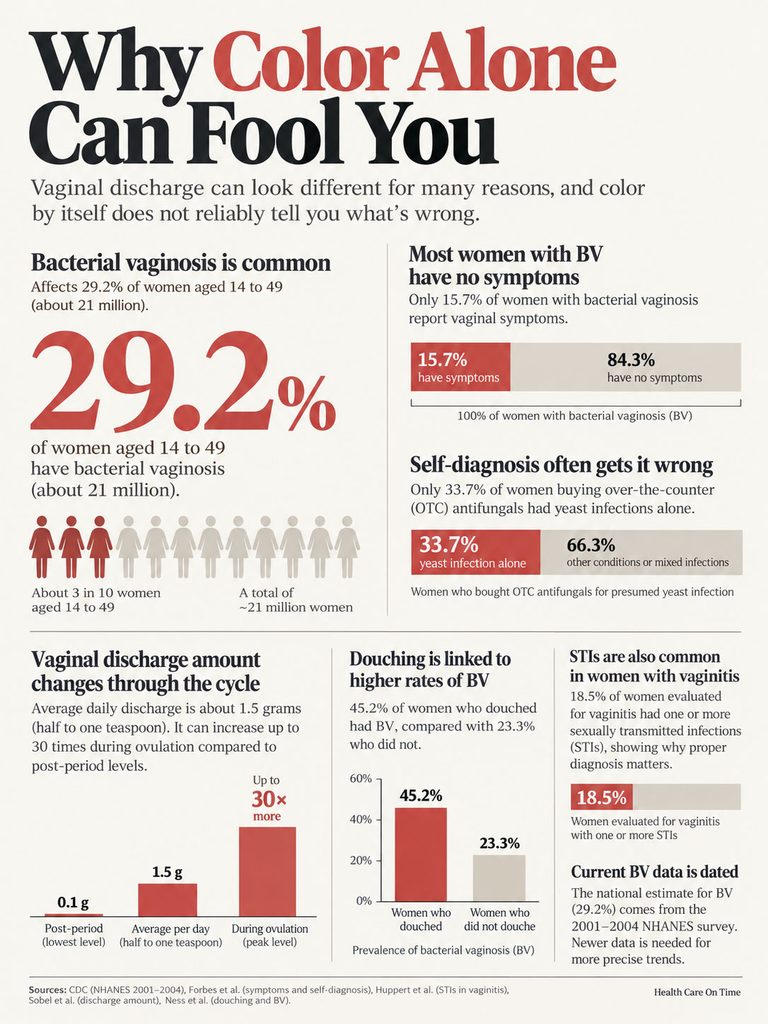
Most discharge guides teach you to judge by color. That’s useful, but it has a blind spot, and the numbers show how big it is.
Bacterial Vaginosis Often Hides
Bacterial vaginosis (BV) is the most common vaginal condition in women of reproductive age. In a nationally representative CDC study, BV prevalence was 29.2%, about 21 million women aged 14 to 49, yet only 15.7% of women with BV reported any vaginal symptoms.
In other words, plenty of people with BV see discharge that looks “fine” to them. Untreated BV is linked to higher STI risk and pregnancy complications, so a fishy odor, even faint, is worth a check.
Self-Diagnosis Misses More Often Than It Hits
Many people treat any itch before their period as a yeast infection. Research says that guess is often wrong.
In a well-known study of 95 women buying an over-the-counter antifungal for immediate use, only 33.7% had a yeast infection alone. Another 21.1% had mixed infections, 18.9% had BV, 2.1% had trichomoniasis, and 13.7% had nothing abnormal at all. Women who had been diagnosed with yeast before were no more accurate.
STIs can hide inside “vaginitis” too. In a 2024 multi-center US study of 1,051 women evaluated for vaginitis, 18.5% had one or more STIs, including 9.6% with trichomoniasis and 8.8% with Mycoplasma genitalium.
Our lab partners report the same pattern: a simple swab often changes the treatment plan. Here are the key US numbers behind that advice.
| Statistic | Figure | Source |
| Normal daily discharge | About 1.5 g (half to one teaspoon) | Clinical physiology references |
| Ovulation vs post-period discharge | Up to 30 times more at ovulation | Clinical physiology data |
| US women 14 to 49 with BV | 29.2% (about 21 million) | CDC, NHANES 2001–2004 |
| Women with BV reporting symptoms | 15.7% | Koumans et al., Sex Transm Dis 2007 |
| OTC antifungal buyers who actually had yeast alone | 33.7% of 95 | Ferris et al., Obstet Gynecol 2002 |
| BV in women who douched in past month vs not | 45.2% vs 23.3% | CDC NHANES 2001–2002 analysis |
| Women evaluated for vaginitis who also had an STI | 18.5% of 1,051 | Schwebke et al., US multi-center study, 2024 |
What These Numbers Can and Can’t Tell You
The national BV figures come from NHANES survey data collected in 2001 to 2004, and no newer nationally representative swab study has replaced them. The self-diagnosis study is from 2002 and small.
Both still match what clinics see today, and the 2024 STI data is current. But treat the exact percentages as reliable direction, not a precise snapshot of this year.
The Monthly Itch: Cyclic Yeast Before Your Period
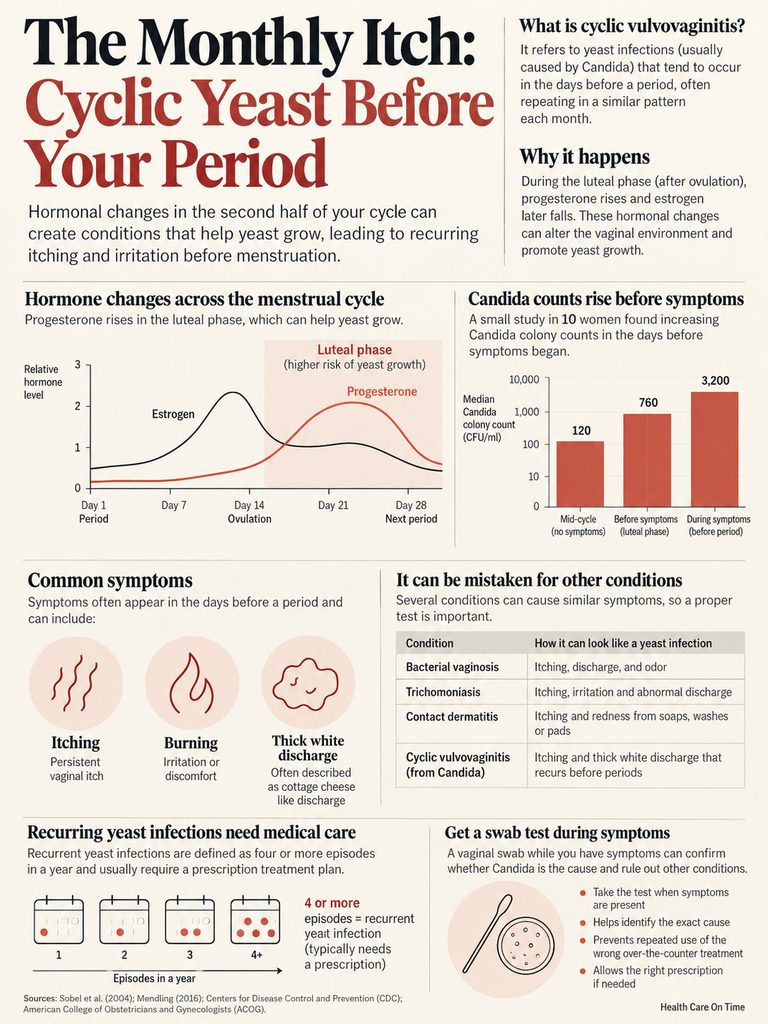
Some people get itching, burning, and thick white discharge in the same few days before every period. Then it fades once bleeding starts. That pattern has a name: cyclic vulvovaginitis, often linked to yeast.
Why the Luteal Phase Favors Yeast
Clinical guidelines for recurrent candidiasis note that symptoms are often cyclical, increasing before menses. Several factors line up in the luteal phase: hormone-driven changes in vaginal cells, shifts in local immune activity, and more warmth and moisture.
A small Australian study that took daily vaginal swabs during the luteal phase found Candida colony counts rising before symptoms appeared. It included only 10 women, so treat it as a clue rather than proof.
When Monthly “Yeast” Isn’t Yeast
If OTC antifungals keep “working” for a few days and the itch returns next month, the diagnosis may be wrong. Common look-alikes include:
- BV, which can itch mildly and often flares around menstruation
- Contact dermatitis from pads, scented liners, wipes, or detergents
- Non-albicans yeast, which often resists standard OTC creams
- Skin conditions such as lichen sclerosus, which causes long-lasting vulvar itch
Patients commonly ask us whether they should just keep a stash of OTC yeast cream at home. A better plan is one confirmed swab while symptoms are active. Four or more yeast infections a year is called recurrent, and it usually needs a prescription suppression plan.
Brown, Pink, and Yellow Before a Period
These three colors drive a lot of searches. Here’s the short version for each.
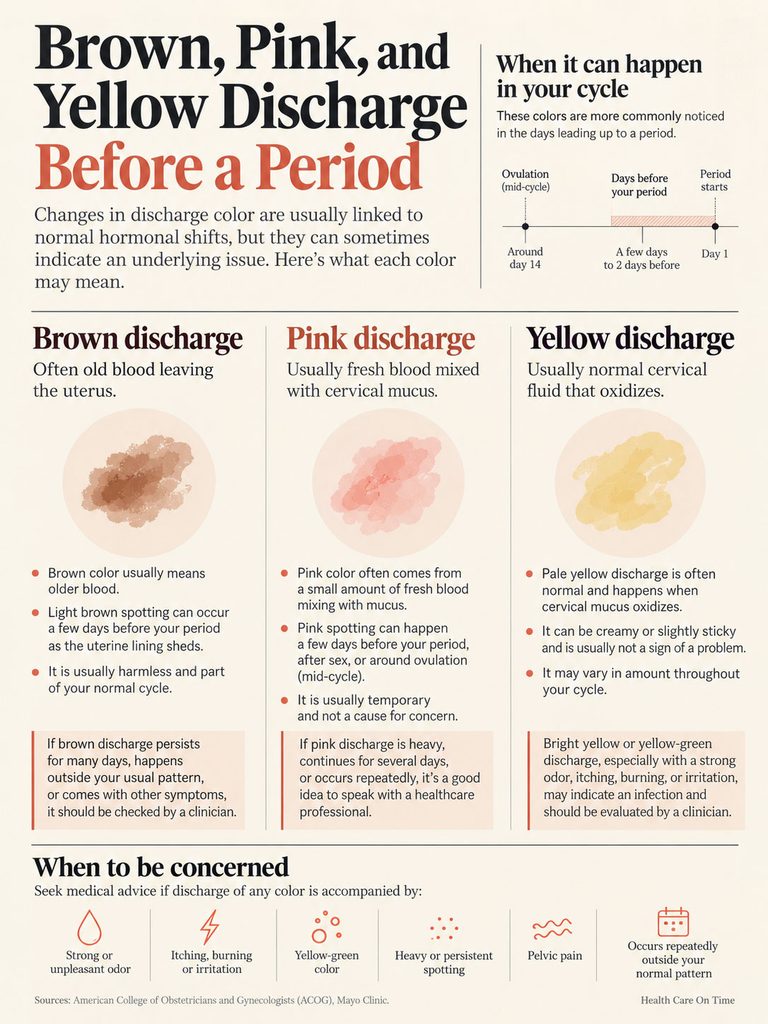
Brown. Light brown discharge in the last day or two is usually old blood that took longer to leave the uterus. Brown spotting for days before every period, or brown discharge with no period at all, deserves its own deep dive, which we cover in our brown discharge articles.
Pink. Pink usually means fresh blood mixing with clear or white mucus right before flow begins. Pink spotting after sex, or mid-cycle every month, is worth a check.
Yellow. Normal creamy discharge often dries pale yellow on fabric. That’s simple oxidation. Bright yellow or yellow-green discharge with odor, itch, or pain is a different signal, and it points toward infection.
When Discharge Before Your Period Is Not Normal
Normal pre-period discharge doesn’t hurt, itch, burn, or smell bad. Get checked if you notice any of the following:
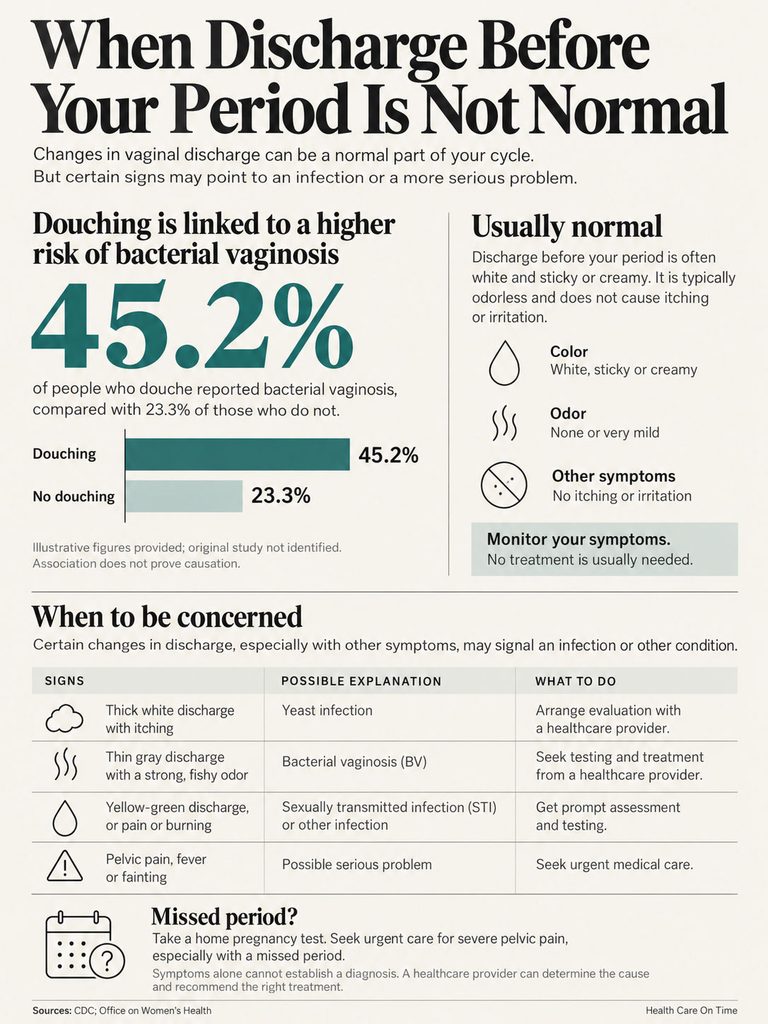
- A fishy odor, especially after sex or during your period
- Itching, burning, or swelling of the vulva
- Thick, white, cottage cheese-like clumps
- Gray, green, or frothy discharge
- A clear jump in volume that soaks through a liner
- Pain with urination or sex
- Pelvic pain with fever or chills
- Bleeding between periods or after sex
- Any new discharge after a new sexual partner
CDC data show women who had douched in the previous month had a BV prevalence of 45.2%, compared with 23.3% among those who had not. So if you’ve been washing inside to “fix” discharge, that habit may be part of the problem.
Use this quick-reference table to decide your next step.
| Scenario | What It Likely Means | Recommended Action |
| White, sticky, no itch or odor, 3 to 7 days before period | Normal luteal phase discharge | No action needed |
| Pink or brown streaks within 48 hours of period | Period starting | No action needed |
| Thick white clumps with itching, every month before period | Possible cyclic yeast or a look-alike | Swab test while symptoms are active; ask about suppression therapy if 4+ episodes a year |
| Thin gray discharge with fishy odor | Likely bacterial vaginosis | Clinic or telehealth visit; prescription treatment within a few days |
| Green, frothy, or new discharge after a new partner | Possible trichomoniasis or other STI | STI testing within a week; avoid sex until cleared |
| Discharge plus pelvic pain and fever above 100.4°F | Possible pelvic inflammatory disease | Same-day urgent care or ER |
| Missed period with any discharge | Could be pregnancy | Home pregnancy test; repeat in 3 to 5 days if negative |
Getting Checked in the US: Options and Typical Costs
You don’t always need an in-person exam to sort out abnormal discharge. Here’s how the main options compare, using typical US cash prices.

- Home vaginal pH test kits run about $10 to $20 at most pharmacies. A reading above 4.5 points away from yeast and toward BV or trichomoniasis. A normal reading doesn’t rule out infection.
- OTC antifungal creams cost roughly $10 to $25. They help only if the problem is actually yeast, which, as the data above shows, is often not the case.
- Telehealth visits for vaginal symptoms often cost about $30 to $80 without insurance. Many can prescribe BV or yeast treatment, though some will still send you for a swab.
- Clinic or urgent care visits with a lab swab commonly run $100 to $250 uninsured. Most insurance plans cover diagnostic visits with your usual copay.
- Title X family planning clinics offer STI testing on a sliding fee scale, and under the Affordable Care Act, many plans cover recommended STI screening without cost-sharing.
In tests booked through HealthCareOnTime, a vaginal pH reading and swab panel usually answer the “is this normal?” question in a single visit. That’s often faster and cheaper than three rounds of the wrong OTC treatment.
How to Keep Discharge Healthy (and What to Skip)
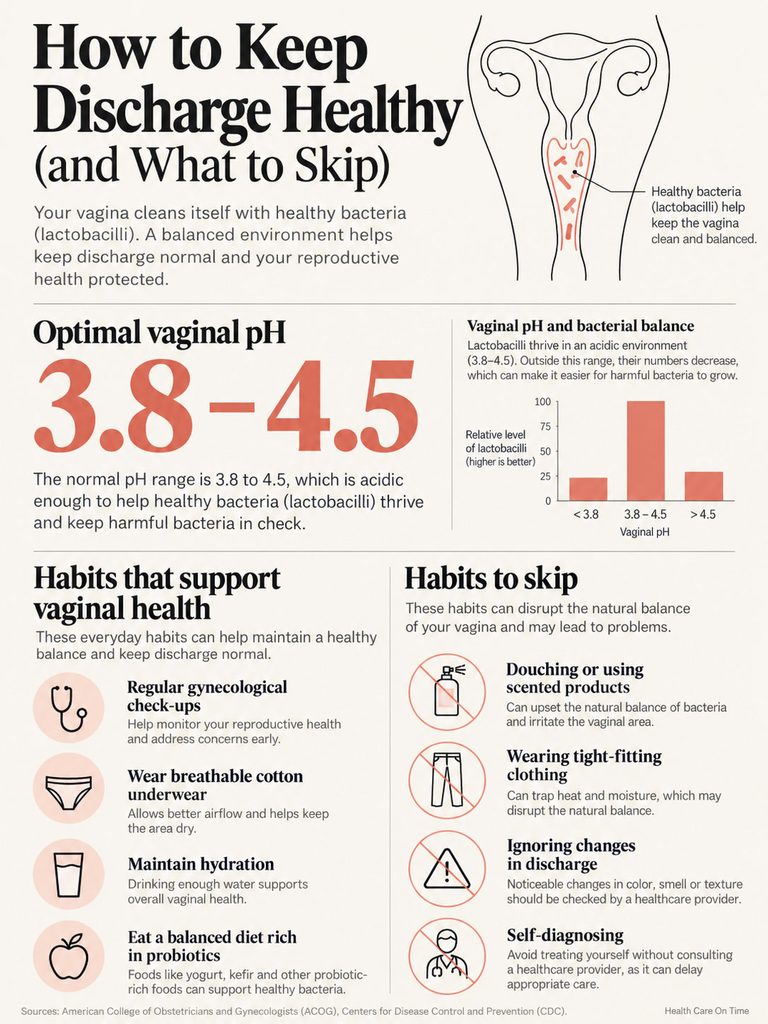
Your vagina cleans itself. Healthy bacteria called lactobacilli keep the pH acidic, roughly 3.8 to 4.5, which blocks most problem germs.
Habits that help:
- Wash the vulva (outside only) with warm water or a mild, unscented cleanser.
- Wear breathable cotton underwear, and change out of sweaty workout clothes quickly.
- Use unscented liners if discharge bothers you, and change them often.
- Track discharge alongside your period in an app for two or three cycles to learn your baseline.
Habits to skip:
- Douching of any kind
- Scented pads, wipes, sprays, and bath products
- Treating every itch with OTC yeast cream without a confirmed diagnosis
- Leaving a tampon or menstrual disc in longer than the label allows
Frequently Asked Questions
Is it normal to have no discharge before your period?
Yes. Many people notice very little discharge in the last few days before their period because progesterone and estrogen are both falling. A dry stretch is common and doesn’t signal a problem. Dryness that comes with pain during sex, itching, or burning, or that appears with perimenopause or new medications, is worth discussing with a clinician.
Why is discharge thick and white before a period?
Progesterone, which rises after ovulation, thickens cervical mucus and reduces its volume. That turns slippery, clear mid-cycle discharge into the white, creamy, sticky kind you see before your period. As long as it has no strong odor and causes no itching or burning, thick white discharge in this window is a normal hormonal pattern.
Does discharge increase before a period?
Cervical mucus usually decreases before a period, because progesterone suppresses it. Some people still feel wetter due to vaginal fluid, heat, exercise, arousal, or the first thin hours of menstrual flow. A sudden large increase, especially with odor, itching, or a color change, is not the normal pattern and is worth checking.
Is yellow discharge before a period normal?
Pale yellow is often normal. White or cream discharge commonly dries yellowish on underwear because of exposure to air. If the discharge is bright yellow or yellow-green, frothy, smells bad, or comes with itching, burning, or pelvic pain, it may point to an infection such as trichomoniasis or cervicitis and should be tested.
What discharge means a period is coming?
Thick, white, sticky discharge in the week before, followed by a drier stretch and then pink or brown streaks in the final day or two, is the classic sign. The pink or brown tinge is the most specific clue that bleeding will start within about 24 to 48 hours. Patterns vary, so tracking a few cycles helps.
Can discharge before a period be a sign of pregnancy?
Not reliably. Creamy white discharge happens in both a normal luteal phase and early pregnancy because progesterone stays high in each. Some people notice slightly more discharge when pregnant, but the overlap is too large to tell the difference. A home pregnancy test taken on or after the day your period is due is the reliable way to know.
Why does a yeast infection come back before every period?
The days before a period can favor yeast growth through hormonal shifts, local immune changes, and more warmth and moisture. Guidelines describe recurrent yeast symptoms that often worsen before menses. Still, many monthly “yeast” episodes turn out to be BV or skin irritation, so a confirmed swab test during symptoms is the best first step.
How much discharge is normal per day?
Most people in their reproductive years make roughly half to one teaspoon of discharge a day, about 1.5 grams on average. The amount peaks around ovulation, which can produce up to 30 times more than just after a period, then drops in the luteal phase. Your personal baseline matters more than any single number.
Is clear watery discharge before a period normal?
Small amounts usually are. Clear, watery fluid can come from the vaginal walls and tends to rise with heat, exercise, stress, or arousal. It can also be the very first, faint start of menstrual flow. Large amounts of watery discharge with odor, itching, or a gray tint suggest bacterial vaginosis and should be checked.
Does birth control change discharge before a period?
Often, yes. Methods that stop ovulation, such as most combined pills, the patch, ring, implant, and shot, remove the usual mid-cycle peak and luteal shift. Discharge may look similar all month, often thin and white. A withdrawal bleed on the pill isn’t a true period, so the pre-period pattern may not appear at all.
Should discharge smell before a period?
Normal discharge has no smell or a mild, slightly sour scent from healthy lactobacilli. A fishy odor, especially after sex or during your period, is a common sign of bacterial vaginosis. A strong or foul smell can also come from a forgotten tampon. Any new or strong odor is a good reason to get tested.
When should discharge before a period be checked by a doctor?
Get checked for itching, burning, swelling, a fishy or foul odor, gray or green color, cottage-cheese clumps, pain with urination or sex, bleeding between periods, or pelvic pain with fever. Also get tested after a new sexual partner or if OTC treatment hasn’t fully worked. Same-day care is needed for pelvic pain with fever.
Disclaimer: This article is for general education and is not a substitute for medical advice, diagnosis, or treatment. Discharge changes can have many causes, and the same color can mean different things for different people. If you have pain, fever, unusual bleeding, odor, or itching, or you might be pregnant, contact a licensed healthcare provider. In an emergency, call 911.
References
- CDC: Bacterial Vaginosis Statistics
- Koumans EH et al. The prevalence of bacterial vaginosis in the United States, 2001–2004. Sex Transm Dis. 2007
- CDC NHANES 2001–2002 BV prevalence and douching analysis
- Schwebke JR et al. Vaginitis and Risk of Sexually Transmitted Infections: Results of a Multi-Center U.S. Clinical Study. 2024
- Luteal-phase Candida colonization study. Journal of Medical Microbiology
- Melbourne Sexual Health Centre: Vulvovaginal Candidiasis Treatment Guidelines
- CDC STI Treatment Guidelines: Diseases Characterized by Vaginal Discharge
- ACOG: Vaginitis FAQ
- Office on Women’s Health: Vaginal Yeast Infections
- Ferris DG et al. Over-the-counter antifungal drug misuse associated with patient-diagnosed vulvovaginal candidiasis. Obstet Gynecol. 2002
- Wilcox AJ et al. Natural limits of pregnancy testing in relation to the expected menstrual period. JAMA. 2001