
A grocery store clerk tells a parent to “get your kid under control.” The child on the floor isn’t trying to win anything. Their nervous system has simply run out of room.
Table of Contents
That gap between what a meltdown looks like and what it actually is causes most of the harm around it. This guide closes that gap with research, real US numbers, and steps you can use today.
Quick Answer: An autistic meltdown is an involuntary reaction to overload, whether sensory, emotional, or from too many demands, where a person temporarily loses control of their behavior. Unlike a tantrum, it isn’t aimed at a goal and doesn’t stop when you give in. The best help is simple: keep everyone safe, cut noise and talk, give space, and allow real recovery time afterward.
At a Glance
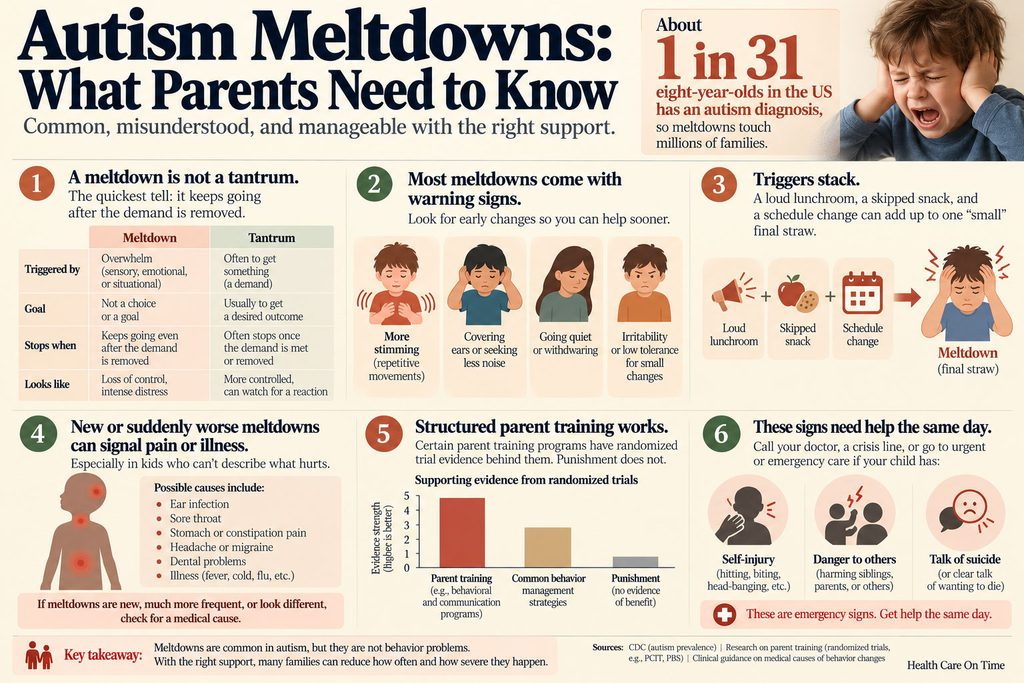
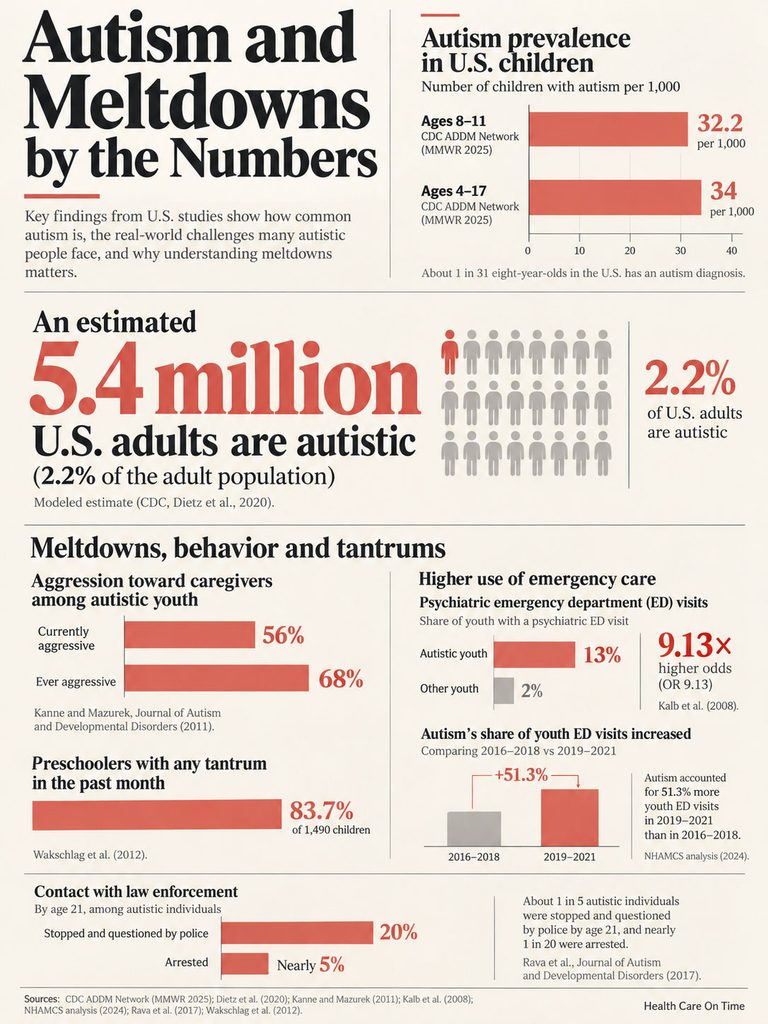
- About 1 in 31 eight-year-olds in the US has an autism diagnosis, so meltdowns touch millions of families.
- A meltdown is not a tantrum. The quickest tell: it keeps going after the demand is removed.
- Most meltdowns come with warning signs, such as more stimming, covering ears, or going quiet.
- Triggers stack. A loud lunchroom, a skipped snack, and a schedule change can add up to one “small” final straw.
- New or suddenly worse meltdowns can signal pain or illness, especially in kids who can’t describe what hurts.
- Structured parent training has randomized trial evidence behind it. Punishment does not.
- Self-injury, danger to others, or talk of suicide means getting help the same day.
What Is an Autistic Meltdown?
An autistic meltdown is what happens when incoming stress exceeds a person’s capacity to process it. The brain shifts into survival mode, and normal control over words, movement, and emotion drops away for a while.
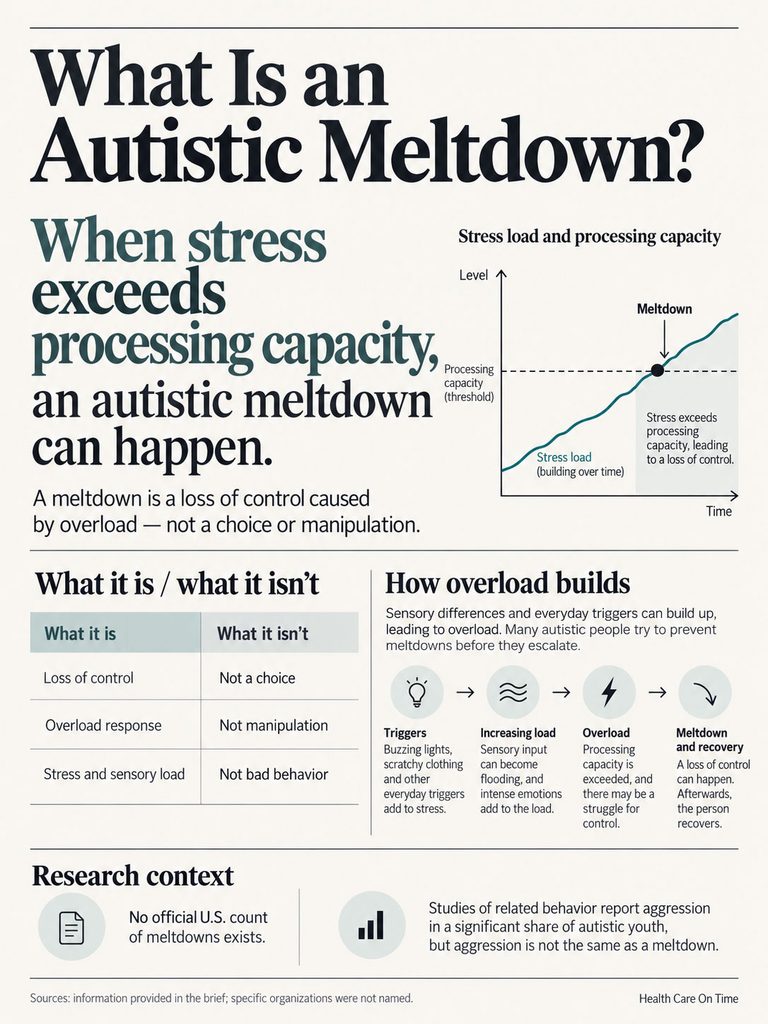
It isn’t a choice, a manipulation, or a parenting failure. It’s closer to a circuit breaker tripping than to a decision.
What It Feels Like From the Inside
For years, research described meltdowns only from the outside, through parents and teachers. A 2023 study in the journal Autism changed that. Researchers asked 32 autistic adults about their meltdowns. Most described feeling flooded by information, sensory input, and social and emotional stress, along with intense anger, sadness, or fear and trouble thinking and remembering.
Participants also described fighting to stay in control and often not feeling like themselves, while some saw the meltdown as a release for emotions that had grown too extreme. Many tried to avoid triggers or get somewhere alone when they sensed one building, to protect their bodies, emotions, and relationships.
That last point matters. Many autistic people work hard to prevent meltdowns long before anyone else notices a problem.
Why Autistic Brains Reach Overload Faster
Sensory differences sit at the center of the story. A 2019 meta-analysis pooled 55 questionnaire studies covering 4,606 autistic people. It found large differences from typical peers in sensory over-responsivity, under-responsivity, and sensation seeking, and called over-responsivity in particular a core feature of autism.
In plain terms, a buzzing light or a scratchy tag can feel like an alarm that won’t turn off. Add a crowded room and a surprise schedule change, and the system overloads.
How Common Are Meltdowns?
There’s no national US count of meltdowns, and any page quoting one is guessing. Our medical reviewers flag this often, because invented “percent of autistic kids have meltdowns” figures circulate widely online.
What does exist is data on related behaviors. In a study of 1,380 youth with autism, 56% were currently showing some aggression toward caregivers and 32% toward non-caregivers, and 68% had done so toward a caregiver at some point. Aggression isn’t the same as a meltdown, but it’s one of the most common ways meltdowns show up.
Meltdown vs Tantrum vs Shutdown vs Burnout
These four get mixed up constantly, and the mix-up leads to the wrong response. Here’s how they compare.
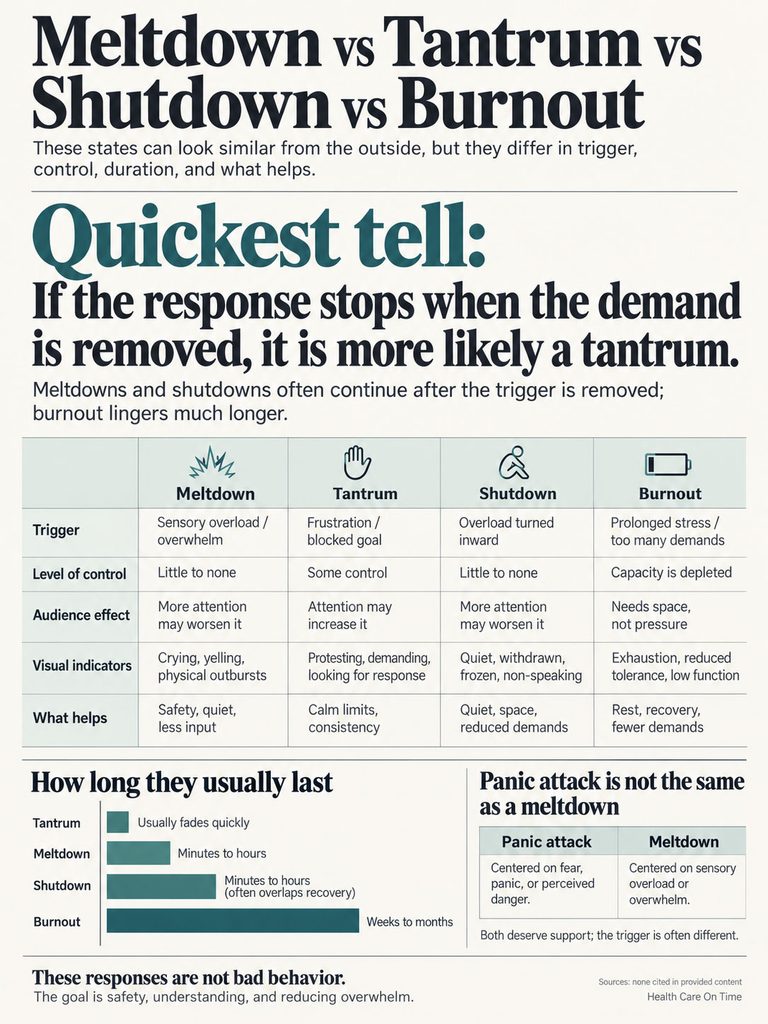
| Feature | Autistic Meltdown | Tantrum | Autistic Shutdown | Autistic Burnout |
| What drives it | Sensory, emotional, or demand overload | Wanting something, or frustration at “no” | Same overload as a meltdown, turned inward | Months of stress and masking beyond capacity |
| Level of control | Little to none during the peak | Usually some control | Little to none | Not an episode; a lasting state |
| Effect of an audience | Happens with or without one; crowds often worsen it | Often increases with attention | Often worse with attention or questions | Not applicable |
| Stops when demand is removed? | No, it has to run its course | Often yes, quickly | No | No; needs weeks of reduced load |
| Typical length | A few minutes to over an hour | Usually minutes | Minutes to several hours | Weeks, months, sometimes longer |
| What it looks like | Crying, yelling, bolting, hitting, self-injury | Yelling, crying, demanding | Going silent, freezing, not responding | Exhaustion, lost skills, lower sensory tolerance |
| What helps | Safety, quiet, space, fewer words | Calm, consistent limits | Quiet, no pressure to talk | Rest, fewer demands, less masking |
The Quickest Tell: Does It Stop When the Demand Is Removed?
A tantrum usually fades once the child gets what they wanted or accepts they won’t. A meltdown keeps going because nothing was “wanted” in the first place; the system is overloaded and needs time to reset.
Autistic children can have tantrums too. That’s normal development. The skill is telling the two apart in the moment, and the “would giving in stop it?” test is the fastest filter.
Panic Attack vs Meltdown
Panic attacks center on fear and physical symptoms like a pounding heart and a sense of doom. Meltdowns center on overload, often with outward release such as yelling or movement.
They can overlap, and anxiety can feed a meltdown. If chest pain or trouble breathing shows up, treat it as a medical question, not a behavioral one.
9 Warning Signs a Meltdown Is Coming
Most meltdowns don’t come from nowhere. Watch for these signs:
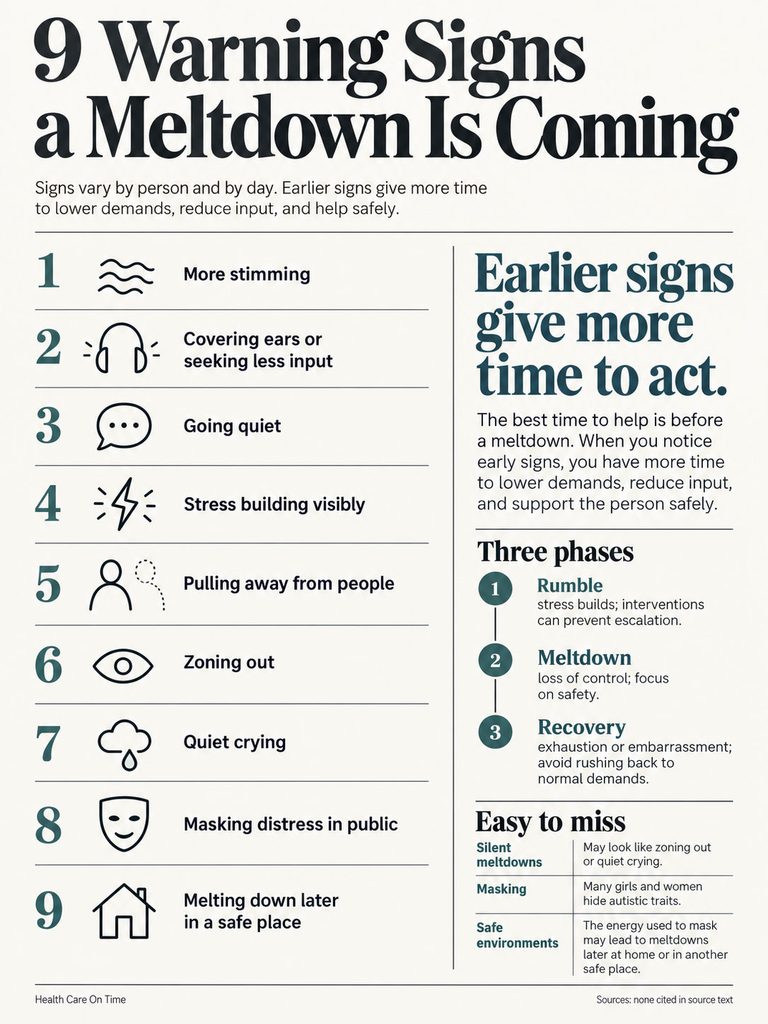
- More stimming than usual, such as rocking, hand flapping, or pacing.
- Covering ears or eyes, or pulling a hood over the head.
- Repeating questions or phrases, like “When are we leaving?” again and again.
- Restlessness: shifting, getting up, unable to settle.
- Going quiet or giving suddenly shorter answers.
- Irritability at small things that wouldn’t normally bother them.
- Trying to leave, edging toward exits, or bolting.
- Body tension: clenched fists, stiff shoulders, grinding teeth.
- Physical stress signs: flushed face, fast breathing, sweating.
How much warning you get varies by person and by day. Earlier signs are more useful: catching sign 1 or 2 gives you time, while catching sign 7 usually doesn’t.
The Three Phases of a Meltdown
Rumble
Stress builds and the warning signs above appear. This is the window where a break, a quieter room, or fewer demands can still prevent the peak.
Meltdown
Control drops. Talking, reasoning, and consequences won’t work here, so the only goal is safety.
Recovery
The person may be exhausted, quiet, embarrassed, or need sleep. Pushing back into normal demands too fast can set off a second episode.
Silent Meltdowns, Masking, and Why Many Girls and Women Get Missed
Not every meltdown is loud. Some people freeze, stare, lose speech, or cry quietly, which can look like a shutdown or simply “zoning out.”
Many autistic people, especially girls and women, learn to mask, meaning they hide autistic traits to fit in. Masking takes energy, and the bill often comes due at home after school or work, where a parent or partner sees the meltdown the outside world never does.
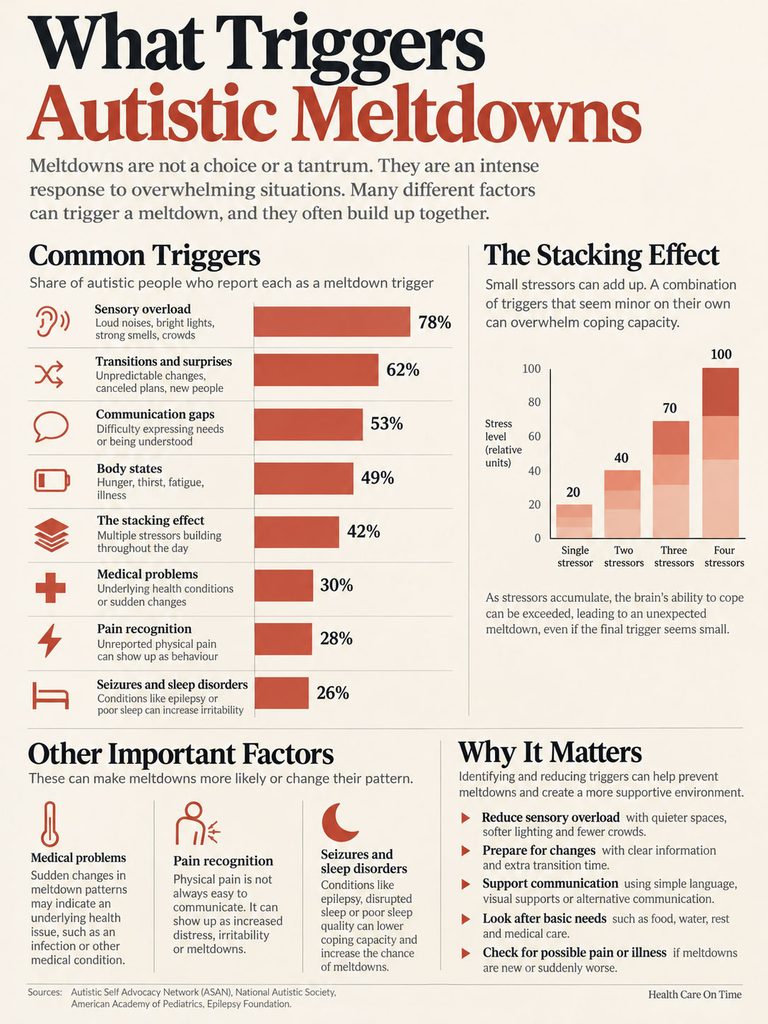
What Triggers Autistic Meltdowns
Triggers vary widely, but most fall into five groups.
Sensory Overload
Loud or sudden noise, bright or flickering lights, strong smells, crowds, and certain textures are the classic culprits. Places that combine all of them, like big-box stores, cafeterias, and birthday parties, are high-risk.
Transitions and Surprises
Many autistic people rely on predictability to feel safe. A canceled plan, a substitute teacher, or a new route to school can feel far bigger to them than it looks to anyone else.
Communication Gaps
Not being understood is exhausting. A child who can’t find words for “this sock is wet” or “that alarm hurts” may reach a meltdown because no other option worked.
Kids who use AAC (augmentative and alternative communication, such as picture boards or speech apps) need that tool available at all times. Taking it away as a “consequence” removes their way of asking for help.
Body States: Hunger, Sleep, and Illness
Hunger, thirst, poor sleep, and feeling sick all shrink a person’s capacity. Parents who book pediatric visits through HealthCareOnTime commonly tell us meltdowns cluster in the late afternoon, which often lines up with a long day, an empty stomach, and fatigue.
The Stacking Effect
Think of capacity like a cup. Each stressor adds water: a noisy bus, a hard test, a skipped snack, a crowded hallway.
The final drop gets blamed, but it wasn’t the cause. That’s why a meltdown over a “tiny” thing often follows a hard day.
When New or Worse Meltdowns Point to a Medical Problem
If meltdowns suddenly increase, change in pattern, or start at a new age, look for a physical cause before assuming it’s behavioral. This is the step most guides skip.
Pain the Child Can’t Report
Ear infections, dental pain, constipation, acid reflux, headaches, and menstrual cramps can all show up as distress rather than words. Watch for clues like hitting one side of the head, refusing certain foods, pressing on the belly, or new sleep problems.
Seizures, Sleep Disorders, and Medication Effects
Epilepsy occurs more often in autistic people than in the general population, and some seizures cause confusion or sudden behavior changes. Untreated sleep problems and new or changed medications can also raise irritability.
In cases reviewed by our medical team, a pediatric visit with basic lab work, such as a CBC, iron studies, and a metabolic panel when symptoms point that way, is a reasonable first step when the pattern shifts without a clear reason.
Autism and Meltdowns by the Numbers
| Statistic | Figure | Source |
| US autism prevalence, age 8 | 1 in 31 (32.2 per 1,000) | CDC ADDM Network, MMWR 2025 (2022 data) |
| US autism prevalence, age 4 | 1 in 34 | CDC ADDM Network, MMWR 2025 |
| Estimated US autistic adults | 5.4 million (2.2%), modeled estimate | CDC, Dietz et al., 2020 |
| Youth currently aggressive toward caregivers | 56% (68% ever) | Kanne and Mazurek, J Autism Dev Disord 2011, n=1,380 |
| ED visits that are psychiatric | 13% autistic youth vs 2% other youth (OR 9.13) | Kalb et al., 2008 National ED Sample |
| Autism share of youth ED visits | Up 51.3% (2016-18 vs 2019-21) | NHAMCS analysis, 2024 |
| Stopped and questioned by police by age 21 | About 20% (nearly 5% arrested) | Rava et al., J Autism Dev Disord 2017 |
| Preschoolers with any tantrum in past month | 83.7% of 1,490 children | Wakschlag et al., 2012 |
The CDC figure comes from surveillance across 16 sites, and prevalence ranged from 1 in 78 in Indiana to 1 in 17 in California. CDC experts link much of the rise to better identification.
The adult figure is softer. CDC projected it from childhood rates and state mortality data, since no national adult surveillance system exists. Treat it as an estimate, not a count.
The ER data tells a sharper story. In national 2008 data, autistic children were about 9 times more likely than other children to have a psychiatric ED visit. A newer analysis found the autism share of youth ED visits rose 51.3% between 2016-2018 and 2019-2021. Many of those visits follow a crisis that community care didn’t catch in time.
What to Do During a Meltdown
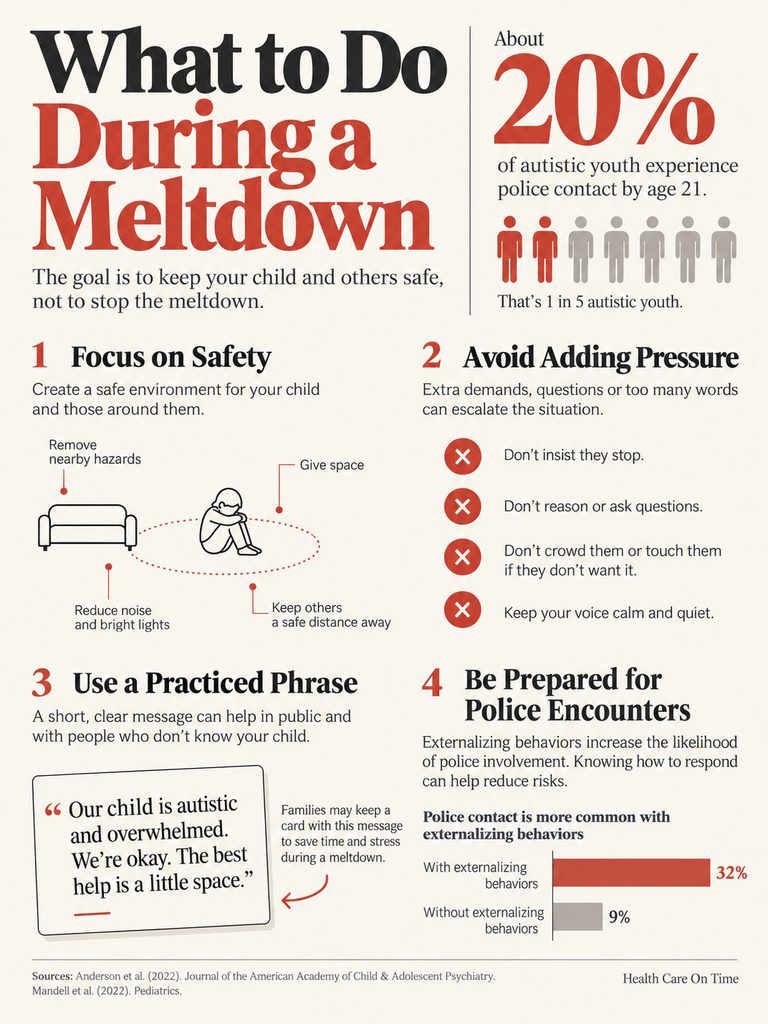
The goal during the peak is not to stop the meltdown. It’s to keep everyone safe and avoid making it longer.
Safety First, Words Last
- Clear the space. Move sharp or breakable objects, and guide others away.
- Cut the input. Dim lights, turn off music or TV, and move somewhere quieter if it’s safe.
- Use very few words. One short, calm phrase like “You’re safe. We’re here.” beats a long explanation.
- Give space, unless the person is known to seek deep pressure, like a firm hug or weighted blanket.
- Stay calm yourself. Your breathing and tone are input too.
What Not to Do
- Don’t reason, argue, or ask “why” questions. The thinking brain is offline.
- Don’t punish or threaten. It adds stress and can make future meltdowns more likely.
- Don’t crowd the person or let a group gather.
- Don’t touch without known consent. For someone in sensory overload, touch can feel like pain.
- Don’t use physical restraint except as a last resort to prevent serious injury.
Meltdowns in Public: A Script for Bystanders and Staff
Strangers usually mean well but add pressure. A short, practiced line helps: “Our child is autistic and overwhelmed. We’re okay. The best help is a little space.”
Some families carry a small card with the same message. It saves words when you have none to spare.
If Police or 911 Get Involved
Police contact is more common than many families expect. A national study found that roughly 20% of autistic youth had been stopped and questioned by police by age 21, and nearly 5% had been arrested. Youth with externalizing behaviors were more likely to be involved.
A few steps lower the risk:
- When calling 911, say “autism” first and ask for an officer trained in crisis intervention (CIT), if your area has one.
- Create a free Smart911 profile in areas that use it, so dispatchers see key details automatically.
- Give your local police department a heads-up if a family member often bolts or has frequent crises.
- Carry an autism information card that explains how the person communicates and what helps.
After the Meltdown: Recovery and Repair
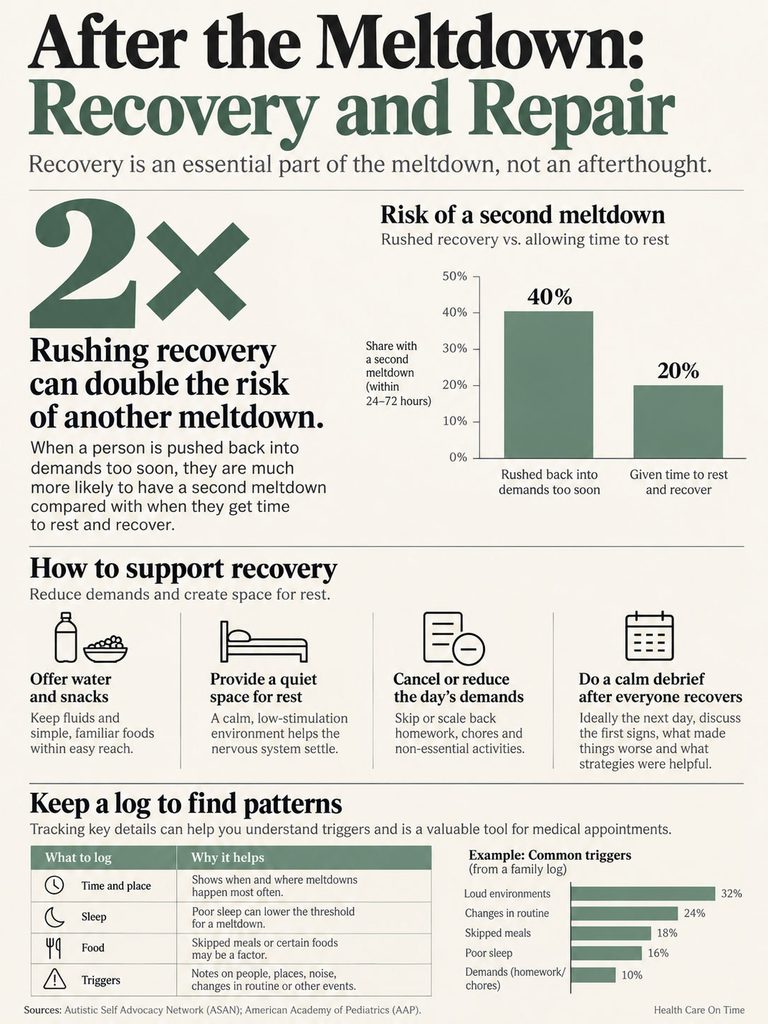
Recovery is part of the event, not an afterthought. Rushing it is one of the most common causes of a second meltdown the same day.
Rest, Low Demands, No Lectures
Offer water, a snack, a quiet space, and a favorite low-effort activity. Many people need sleep.
Cancel or shrink the rest of the day’s demands if you can. Homework and chores can wait.
The Calm Debrief (Later, Not the Same Hour)
Once everyone is fully calm, often the next day, talk through it briefly and without blame. What was the first sign? What made it worse? What helped?
Keep a simple log of time of day, place, sleep, food, and triggers. Patterns invisible in the moment often jump out after two or three weeks of notes, and that log is the single most useful thing to bring to a doctor’s appointment.
Prevention That Actually Has Evidence
Not every popular tip has research behind it. Here’s what does, roughly in order of evidence strength.
Structured Parent Training
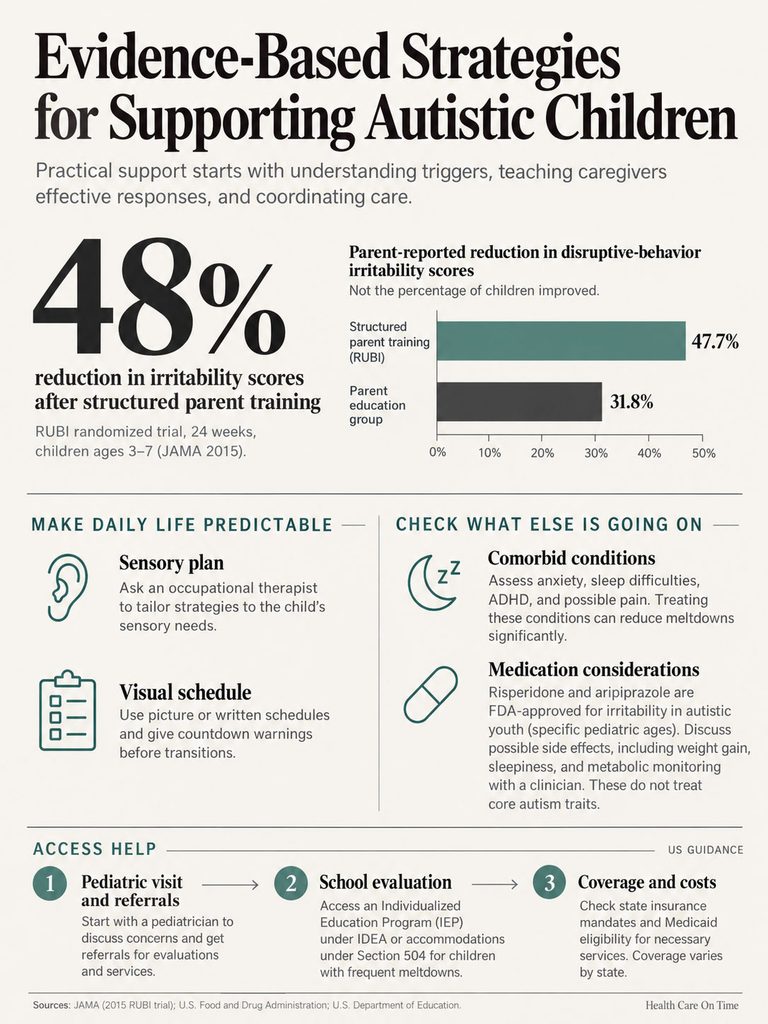
The strongest evidence for families of young children comes from the RUBI trial, published in JAMA in 2015. It randomly assigned 180 autistic children ages 3 to 7 with behavior problems to either 24 weeks of parent training or 24 weeks of parent education.
Parent ratings of disruptive behavior improved 48% in the training group versus 32% in the education group. By the end, 70% of children in the training group had improved compared with 40% in the education group. Both groups got better, which shows that simply understanding autism helps too.
Parent training teaches skills like spotting early signs, planning transitions, and responding consistently. Ask your pediatrician or developmental specialist where it’s offered locally or by telehealth.
A Sensory Plan With an Occupational Therapist
An occupational therapist (OT) can map which senses are over- or under-responsive and build a daily plan. That might include noise-canceling headphones, movement breaks, chewy items, or a calm-down corner.
The plan works best when it’s used every day, not just after a crisis.
Visual Schedules and Transition Warnings
Picture or written schedules show what’s coming next. Countdown warnings (“Five more minutes, then shoes”) soften the shock of change.
For bigger changes, like a new school or a trip, preview them with photos, videos, or a practice visit.
Treating Anxiety, Sleep, and ADHD
Anxiety, poor sleep, and ADHD all shrink the cup. Treating them often reduces meltdowns more than any meltdown-specific strategy.
Cognitive behavioral therapy adapted for autism has evidence for anxiety in verbal children and adults. Our clinical reviewers note that sleep problems are one of the most often overlooked pieces, so it’s worth asking about them directly.
Medication: When Doctors Consider It
No medication treats autism itself or “cures” meltdowns. For severe, persistent irritability with aggression or self-injury, doctors sometimes add medication alongside behavioral support.
The FDA has approved two drugs, risperidone in 2006 and aripiprazole in 2009, for irritability in autistic youth, including tantrums and aggression. Risperidone is approved for ages 5 to 16 and aripiprazole for ages 6 to 17.
These are serious medicines with real trade-offs. Rapid weight gain was the most common side effect in risperidone studies, so doctors typically monitor weight, blood sugar, and cholesterol. Aripiprazole works a bit faster and doesn’t raise prolactin much, while risperidone may be slightly more effective but tends to cause more side effects.
School Rights: IEP, 504, and Behavior Plans
Under the federal Individuals with Disabilities Education Act (IDEA), a child with frequent school meltdowns may qualify for an Individualized Education Program (IEP). Others get supports through a Section 504 plan.
Ask the school in writing for a functional behavior assessment (FBA), which looks at what happens before each meltdown. It should lead to a behavior intervention plan with sensory breaks, a safe space, and clear staff steps. Also ask for the school’s written policy on restraint and seclusion.
Coverage, Costs, and Where to Start in the US
Every US state now has some form of autism insurance mandate, though rules differ on age limits and which plans are covered. Self-funded employer plans follow federal rules instead, so call your plan and ask specifically about OT, parent training, and behavioral therapy.
Children on Medicaid are covered under EPSDT (Early and Periodic Screening, Diagnostic, and Treatment), which requires medically necessary services for those under 21. Families booking through HealthCareOnTime often start with a pediatric visit, because a doctor’s referral is the key that opens most of these benefits.
Autistic Meltdowns in Adults
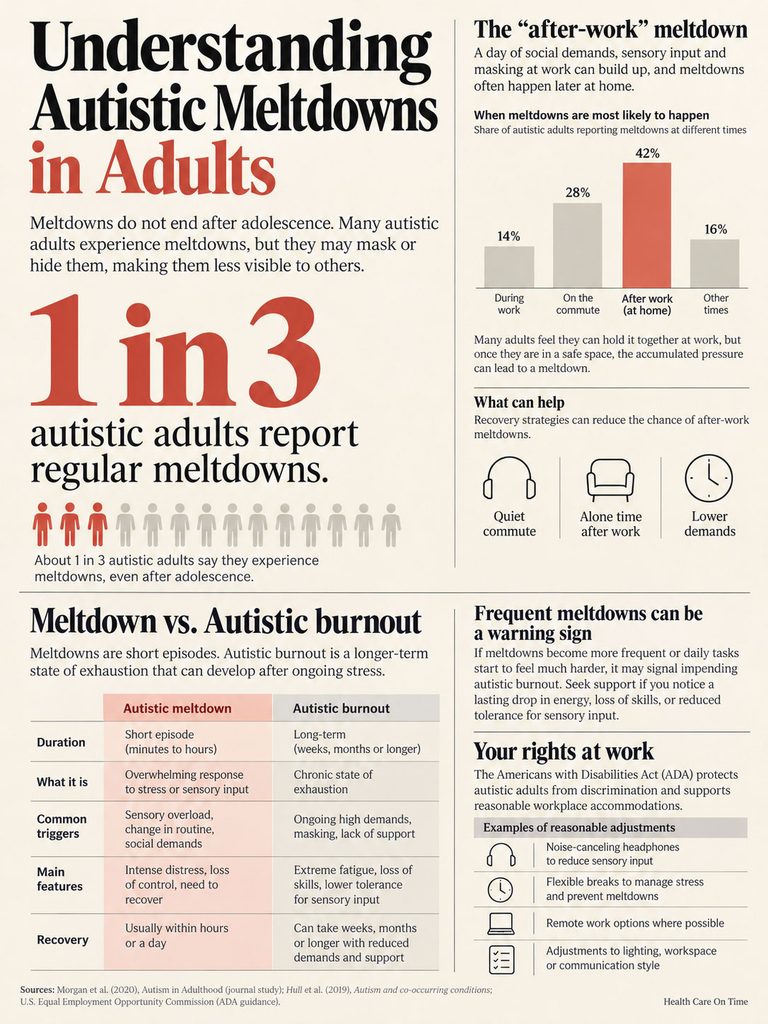
Meltdowns don’t end at 18. Adults often learn to delay or hide them, which can make them harder to spot and more draining.
Masking and the “After-Work” Meltdown
An adult may hold it together through a full workday, then fall apart in the car or at home. Partners sometimes mistake this for anger at them, when it’s really leftover overload.
Building recovery time into the day, like a quiet commute or 20 minutes alone after work, can prevent the evening crash.
Meltdown vs Autistic Burnout
A meltdown is an episode. Autistic burnout is a longer state. In a 2020 study, autistic adults described burnout mainly as chronic exhaustion, loss of skills, and reduced tolerance to sensory input. The authors judged it distinct from both job burnout and clinical depression.
Frequent meltdowns can be an early sign that burnout is building. If daily skills like cooking, talking, or showering are slipping for weeks, talk with a clinician who understands autism.
Workplace Accommodations Under the ADA
The Americans with Disabilities Act (ADA) covers many autistic adults. Reasonable accommodations might include noise-canceling headphones, a quieter desk, written instructions, flexible breaks, or some remote work.
You don’t have to disclose a diagnosis to coworkers. Disclosure to HR is usually needed only for a formal accommodation request.
When to Get Help
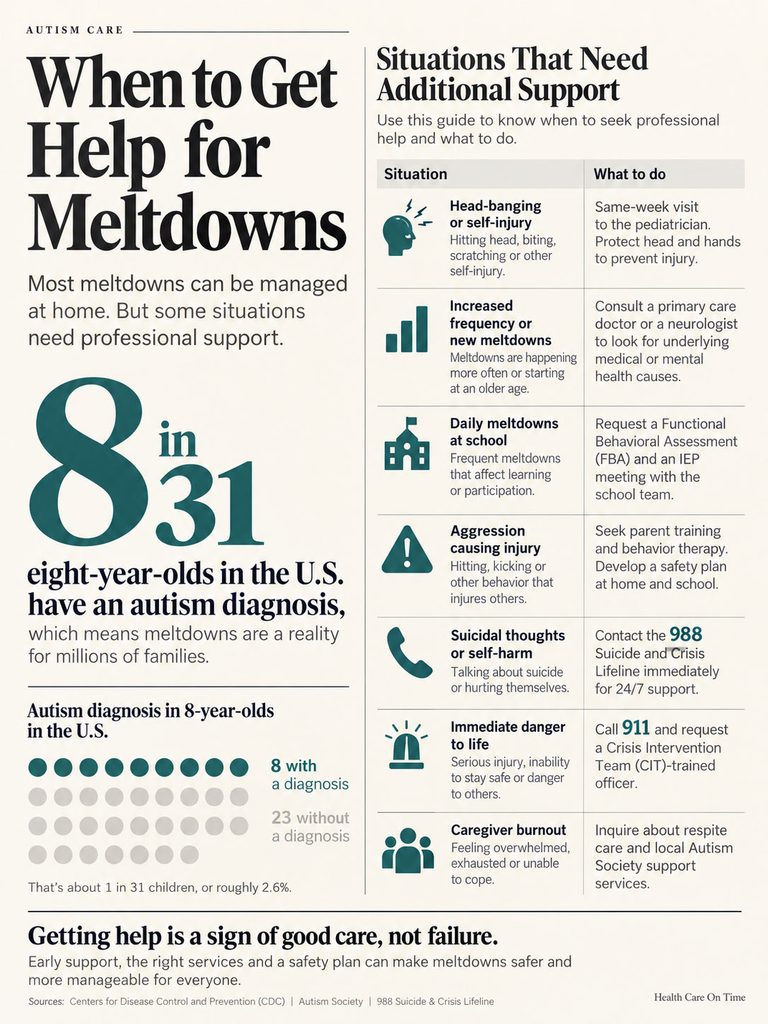
Most meltdowns can be handled at home. These situations call for more support.
| Scenario | Recommended Action | Who to Contact |
| Head-banging or self-injury causing marks or bruises | Same-week visit; protect head and hands meanwhile | Pediatrician or primary care doctor |
| Meltdowns suddenly more frequent or new at an older age | Rule out pain, illness, seizures, sleep or medication issues | Primary care doctor; neurologist if seizure signs |
| Daily meltdowns at school | Request an FBA and IEP or 504 meeting in writing | School special education coordinator |
| Aggression injuring siblings or caregivers | Ask about parent training and behavior therapy; make a safety plan | Developmental pediatrician or child psychologist |
| Adult or teen talks about suicide or self-harm | Call or text 988 right away | 988 Suicide and Crisis Lifeline |
| Immediate danger to life | Call 911, say “autism,” request a CIT-trained officer | 911 |
| Child restrained or secluded at school | Request incident report in writing within 24 hours | School principal; district special education office |
| Caregiver exhausted or not coping | Ask about respite care and caregiver support | Local Autism Society chapter; state disability services |
The suicide row isn’t hypothetical. One national study found ED visits involving suicidal ideation or intentional self-injury made up 5.1% of visits by autistic youth versus 1.2% for youth without autism or intellectual disability.
Frequently Asked Questions
How long does an autistic meltdown last?
Most last from a few minutes to about an hour, though some run longer if overload keeps coming. Recovery afterward often takes longer than the meltdown itself, sometimes the rest of the day. Reducing noise, talk, and demands usually shortens both. Tracking duration in a log helps show whether episodes are getting longer over time.
Do autistic people remember their meltdowns?
Often only partly. In the 2023 study of 32 autistic adults, many described trouble with thinking and memory during the episode. Some remember feelings but not details, and many feel embarrassed afterward. That’s why a gentle, blame-free conversation the next day works better than asking questions right after it ends.
Can you stop a meltdown once it starts?
Usually not. Once the peak hits, the brain needs time to reset, so the goal shifts to safety and lowering input. The best chance to prevent a meltdown comes earlier, during the rumble stage, when you notice signs like more stimming, covering ears, or repeated questions and offer a break.
Should you hug someone during a meltdown?
Only if you already know they find touch calming. Some autistic people seek deep pressure, like a firm hug or weighted blanket. For others, touch during sensory overload feels painful and makes things worse. If you don’t know, stay close, keep your hands to yourself, and ask about preferences once things are calm.
Do autistic children grow out of meltdowns?
Autism is lifelong, and meltdowns can continue into adulthood. Many people do have fewer or milder episodes as they grow, because they learn their triggers, build coping tools, and gain more control over their surroundings. Supportive schools, treated anxiety, and good sleep make a real difference to how often meltdowns happen.
What does a silent meltdown look like?
A silent meltdown happens inside. The person may freeze, stare, stop speaking, cry quietly, or seem far away. It’s common in people who mask, especially girls and women. Because it’s quiet, it often gets missed or mistaken for daydreaming. It needs the same response: less input, no pressure to talk, and recovery time.
Are meltdowns a sign of autism in toddlers?
Not by themselves. Most toddlers have tantrums, and one large study found 83.7% of preschoolers had a tantrum in the past month. Concern arises when meltdowns come with other signs, like limited eye contact, delayed speech, strong sensory reactions, or loss of skills. Ask your pediatrician about formal autism screening.
Why would an autistic child suddenly have more meltdowns?
A sudden increase often means something changed. Common causes include pain or illness the child can’t describe, poor sleep, a new medication, puberty, school changes, or stress at home. Start with a medical checkup to rule out physical causes, then look at recent changes in routine, demands, and environment.
Is it a meltdown or a tantrum if a child is autistic?
Autistic children can have both. Ask one question: would giving them what they want stop it? If yes, it’s likely a tantrum. If it keeps going regardless, with signs of overload like covering ears or bolting, it’s likely a meltdown. The response differs, so telling them apart matters.
What should you say to strangers during a public meltdown?
Keep it short: “Our child is autistic and overwhelmed. We’re okay. Space helps most.” You don’t owe anyone a longer explanation. Some families carry a printed card with this message, which helps when you’re busy keeping your child safe and don’t have words to spare.
Can adults have autistic meltdowns at work?
Yes, though many adults delay them until they get home, which can lead to evening crashes. Workplace triggers include open offices, harsh lighting, surprise meetings, and unclear instructions. ADA accommodations like headphones, a quieter desk, written tasks, and flexible breaks can lower the load and reduce meltdowns.
Is there medication for autistic meltdowns?
No drug treats meltdowns directly. For severe irritability with aggression or self-injury, the FDA has approved risperidone (ages 5 to 16) and aripiprazole (ages 6 to 17). Both carry side effects, especially weight gain, and work best alongside behavioral and sensory support. Treating anxiety, ADHD, or sleep problems can also help.
Disclaimer: This article is for general information and isn’t a substitute for advice from a doctor, psychologist, or other qualified professional. If anyone is in immediate danger, call 911. If you or someone you know is thinking about suicide or self-harm, call or text 988 to reach the Suicide and Crisis Lifeline, available 24/7.
References
- CDC ADDM Network: Prevalence and Early Identification of Autism Spectrum Disorder, 16 Sites, 2022 (MMWR 2025)
- Montaque et al. The lived experience of meltdowns for autistic adults. Autism, 2023
- Kanne and Mazurek. Aggression in children and adolescents with ASD: prevalence and risk factors. J Autism Dev Disord, 2011
- Kalb et al. Psychiatric-related emergency department visits among children with ASD, 2012
- Trend in ED Visits Among Children and Youth With Autism, NHAMCS 2016-2021
- Suicidal ideation and self-inflicted injury in autism: US youth ED visits 2006-2014. Autism, 2022
- Rava et al. Criminal justice involvement among youth on the autism spectrum. J Autism Dev Disord, 2017
- Emory News: Parent training effective for reducing behavior problems in ASD (Bearss et al., JAMA 2015)
- Emory Medicine: Skills for parenting children with autism (RUBI results)
- US Pharmacist: Antipsychotics for Irritability in Autistic Youth, 2025
- Pharmacological Therapies for Autism Spectrum Disorder: A Review (PMC)
- Ben-Sasson et al. Update of a Meta-analysis of Sensory Symptoms in ASD. J Autism Dev Disord, 2019
- Raymaker et al. Defining Autistic Burnout. Autism in Adulthood, 2020
- CDC estimate of US adults with autism (Dietz et al., 2020), news coverage