If a urine test just flagged protein, drinking extra water won’t make your kidneys leak less of it. What water can change is how the protein reads on certain tests, and knowing which ones matters before you give your next sample.
Table of Contents
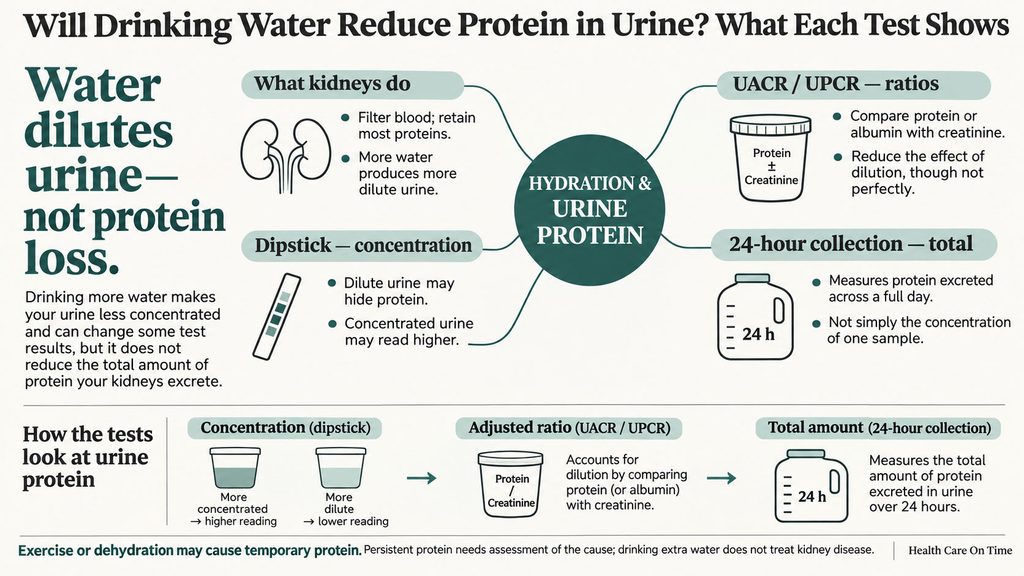
Quick answer: Drinking water does not reduce protein in urine unless dehydration caused it. More water dilutes urine, which can make a dipstick read lower or even negative while the true daily loss stays the same. Ratio tests (UACR and UPCR) correct for dilution because creatinine is diluted too, and a 24-hour urine test measures the total amount. Persistent protein needs a cause found and treated, usually with blood pressure and kidney-protecting medicines.
Concentration vs. Amount: What Extra Water Actually Changes
Your kidneys filter blood through clusters of tiny blood vessels called glomeruli. Healthy filters let water, salt and waste through and hold back large proteins like albumin. When the filters are damaged, or when the body is under short-term stress, protein slips into the urine, and the amount depends on the condition of those filters; the number of glasses of water you drank today has little to do with it.
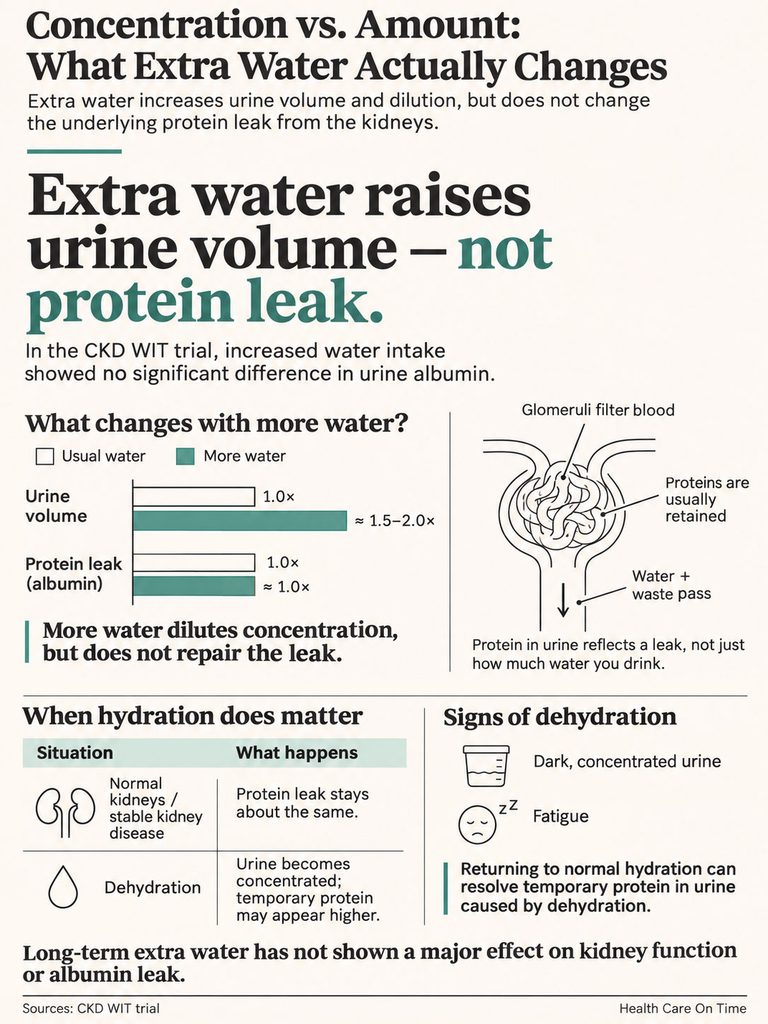
When you drink more, your kidneys simply make more urine. The protein coming through the filters gets spread across a bigger volume, so each milliliter holds less, and you pee more often with less protein each time while the kidneys keep losing the same amount. Double the urine with the same leak and the concentration falls by about half, yet the grams of protein leaving your body that day stay put.
Even a year of deliberately drinking more doesn’t seem to change the leak. In CKD WIT, published in JAMA in 2018, 631 adults with stage 3 chronic kidney disease at nine centers in Ontario were coached either to drink more water or to keep their usual intake for a year. The hydration group did drink more, and their 24-hour urine volume rose 0.6 L per day more than the control group’s. Their 24-hour urine albumin barely moved. The between-group difference was 7 mg per day, small enough that it could easily have been chance, and kidney function fell at about the same rate in both groups (eGFR −2.2 vs −1.9 mL/min/1.73 m²). The trial may have been too small to catch a modest effect.
Dehydration is the one real exception. Not drinking enough can cause temporary protein on its own, and in that situation drinking enough fluid does help. Think of a sample given after a hot day outdoors, a long shift with no water breaks, or a stomach bug with vomiting or diarrhea. Dark, strong-smelling urine is another clue. In those cases, a repeat sample after a day of normal drinking usually sorts it out.
How Hydration Affects Each Urine Protein Test
Part of the confusion is that “a urine protein test” can mean several different tests. Some read concentration, some correct for it and one measures the whole day, so dilution matters a lot for the first kind and very little for the others.
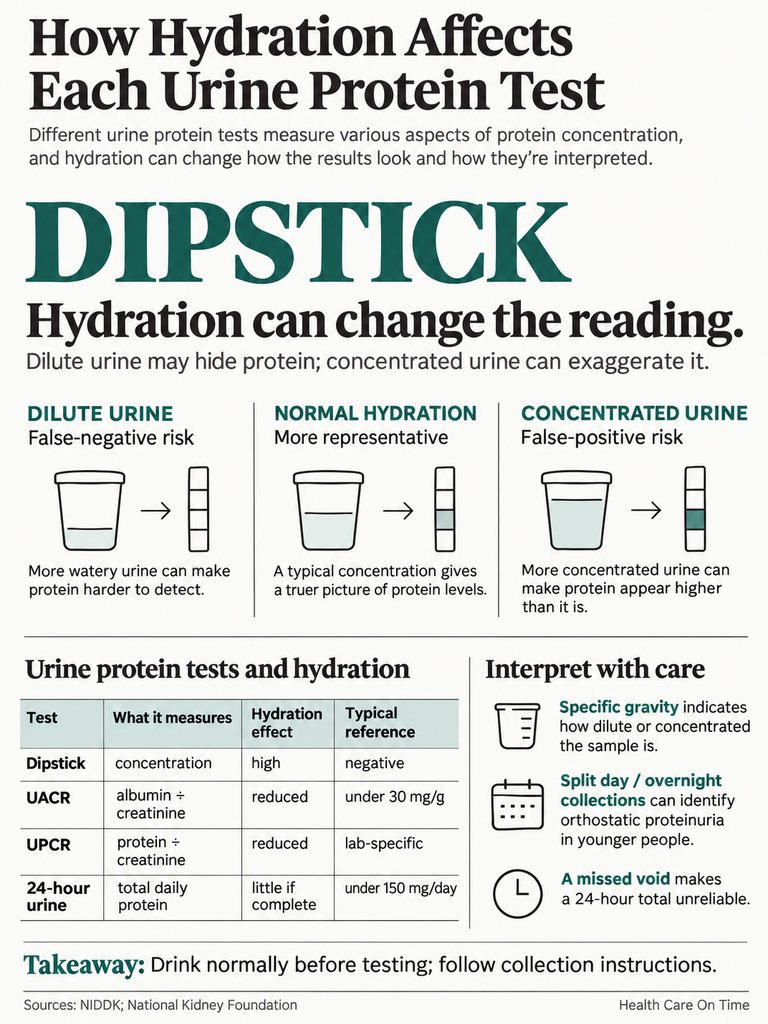
| Test | What it measures | Usual normal result | Can extra water make protein look lower? | Best next step |
| Urine dipstick (part of a urinalysis) | Protein concentration in that one sample, graded negative to 4+ | Negative (under 10 mg/dL) | Yes. Dilute urine can give a false negative; very concentrated urine can read falsely high | Repeat on a first morning sample; confirm any positive with UACR or UPCR |
| Spot urine albumin-to-creatinine ratio (UACR) | Albumin divided by creatinine in one sample | Under 30 mg/g | Mostly no, because creatinine is diluted by the same water | Confirm a result of 30 mg/g or higher with a first morning sample, often within 3 to 6 months |
| Spot urine protein-to-creatinine ratio (UPCR) | Total protein divided by creatinine in one sample | Under 0.2 | Mostly no. In one study, very dilute urine (creatinine 38.8 mg/dL or lower) tended to read about 6.9% high | Ask whether the sample was dilute if a result sits right at a cutoff |
| 24-hour urine protein | Total protein lost over a full day | Under 150 mg per day | No. It counts the total amount, so dilution only adds volume to the jug | Collect every void for 24 hours; the lab checks creatinine to confirm the collection is complete |
| Split day and night collection | Protein while upright compared with lying down | Overnight under 50 mg per 8 hours when the cause is posture | No | Used mainly for people under 30 with suspected orthostatic (posture-related) protein |
The urine dipstick
A dipstick is the color strip dipped into your sample during a routine urinalysis, and it estimates how much protein sits in each deciliter of that particular sample. Results are graded as negative (under 10 mg/dL), trace (10 to 20 mg/dL), 1+ (30 mg/dL), 2+ (100 mg/dL), 3+ (300 mg/dL) and 4+ (1,000 mg/dL).
The strip only sees concentration. That means hydration can move the result in both directions: a dilute specimen can produce a false negative, while highly concentrated urine, alkaline urine (pH above 7.5), visible blood (often reported as red blood cells on the same report), pus, semen or vaginal secretions can push the reading falsely high. The strip also reacts mainly to albumin and can miss smaller, non-albumin proteins. In one Tokyo hospital’s records, a reading of 1+ or higher caught 88.4% of heavy (A3-level) proteinuria overall, but only 70.2% when the urine was dilute (specific gravity below 1.010). Faint results were the bigger worry: of 1,330 “trace” readings on dilute samples, 31.7% were moderately and 68.1% severely increased on the ratio test. That 2023 study covered 41,058 samples from a single hospital using one brand of strip, so US figures could differ.
Reading the specific gravity on your report
Most urinalysis reports print a line called specific gravity, which shows how concentrated the sample was. Normal runs from 1.003 to 1.030; a value under 1.010 points to relative hydration and one over 1.020 to relative dehydration. A negative or trace protein on a sample near the bottom of that range tells you much less than the same result on concentrated urine, and a 1+ on very concentrated urine after a hot day with little to drink may reflect concentration more than kidney damage. Either way, the usual next step for a dipstick finding is a ratio test rather than a judgment made from the strip alone.
Why ratio tests (UACR and UPCR) handle dilution
The two ratio tests divide the protein (or just the albumin) in your sample by its creatinine. Creatinine is a waste product your muscles make at a fairly steady rate, and the same water that dilutes the protein dilutes it too. Drink a lot, and both numbers fall together, so the ratio stays largely unaffected by urine concentration. A UACR in mg/g roughly equals the albumin you excrete in milligrams per day.
The two ratios answer slightly different questions. UACR counts only albumin, the protein that tends to leak first when the filters are damaged, and the quantitative UACR is the preferred first test for adults at high risk of kidney disease. UPCR counts every protein in the sample, including the smaller non-albumin proteins a dipstick can miss, so a doctor may order it when other proteins are a concern.
Ratios still have blind spots at the extremes. Very dilute urine (specific gravity 1.005 or lower) made the UPCR overestimate daily protein by an average of 6.9%, in a 2015 comparison against 540 complete 24-hour collections from Taiwan, especially when urine creatinine was 38.8 mg/dL or lower, which means overhydrating before a ratio test tends to push the result slightly up rather than hide protein. Concentrated urine did the opposite, with underestimates from 11.2% at a specific gravity of 1.015 up to 23.7% at 1.030 or above.
Body size and diet shift the ratio too, mostly through creatinine. Low body weight means less creatinine and a falsely high ratio, while high protein intake or exercise raises creatinine output and lowers it. Women excrete less creatinine than men on average, so their ratios run a little higher.
The 24-hour collection
A 24-hour collection sidesteps the concentration question entirely. You discard the first morning void, then save every drop for the next 24 hours, including the first void of the second morning, and the lab measures the protein in the whole container. Normal is under 150 mg of protein per day.
Missing even one trip to the bathroom makes the total come out low, which is the test’s main weakness, and labs measure creatinine in the jug partly to check that the collection looks complete. For routine screening, a spot ratio is usually enough.
If you’re handed a jug anyway, plan the collection for a day you’ll be home. Write the start time on the label. Set a reminder for the end, and keep the container in the refrigerator or on ice between trips. Return the whole container, even if the volume looks small, and mention any missed void instead of guessing.
Split collections for posture-related protein
Some teenagers and young adults spill protein only while they’re standing. This orthostatic proteinuria affects about 3 to 5 percent of adolescents and young adults, and it’s generally harmless in people under 30 whose daily loss stays below 2 g. To confirm it, daytime urine is collected separately from an 8-hour overnight sample, and an overnight result back in the normal range (under 50 mg per eight hours) points to posture rather than kidney disease.
Drinking Extra Water Before the Test Can Backfire
Some people drink a liter of water before an appointment, hoping the protein line comes back clean. On a dipstick, a diluted sample can turn a real 1+ into a trace or a negative, so a kidney problem goes unnoticed for another year. A ratio test corrects for the dilution anyway, and a 24-hour collection counts the total regardless of how much you drank.
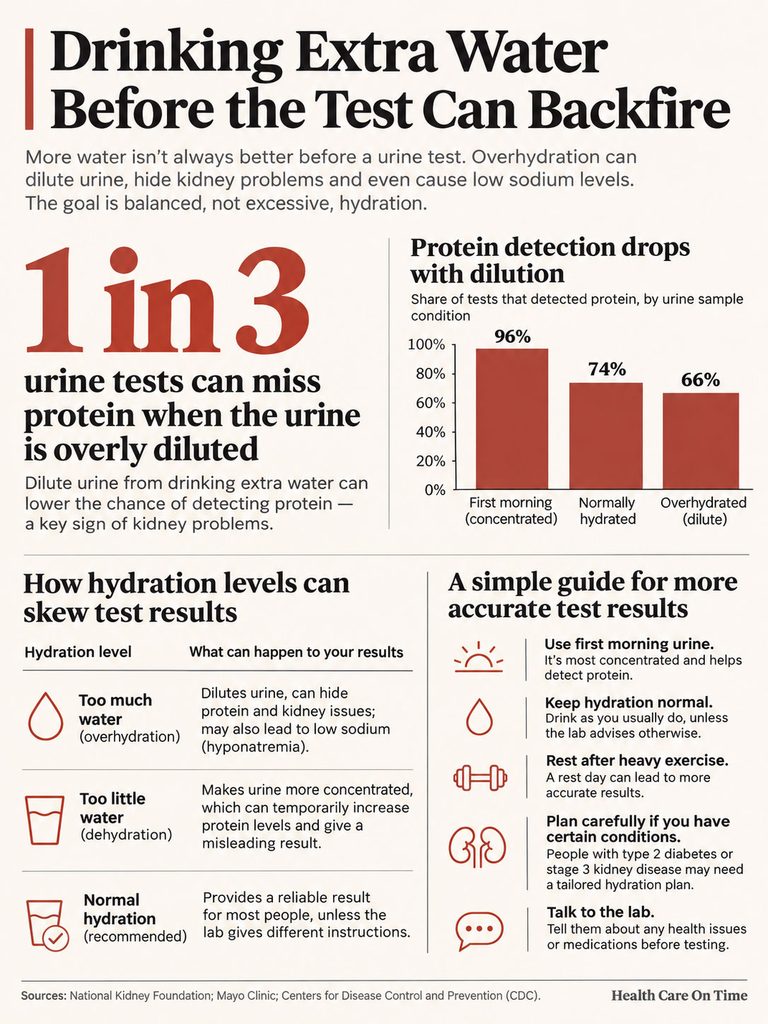
Guidelines also ask for concentrated urine on purpose. Overnight you usually go several hours without drinking, so the first urine of the day is naturally the most concentrated, and that’s exactly what makes it useful. The first morning void is preferred because concentrated urine makes small amounts of albumin easier to detect, and KDIGO guidance asks for any random ACR of 30 mg/g or higher to be confirmed with a later first-void morning midstream sample. Gulping that much in the waiting room isn’t harmless either, because too much water taken too fast can drop the salt in your blood low enough to harm the brain, and it has caused deaths.
The safest plan for test day is ordinary hydration. Drink the way you normally do the day before, unless your lab gives you other instructions. Going without fluids is no better. Dehydration concentrates urine, pushes test results the other way and can itself produce temporary protein. Skip a hard workout in the 24 hours before the sample, and tell the lab if you have a fever, an infection or your period.
A few collection details make the result more trustworthy:
- If your doctor asks for a first morning sample, collect the first urine after you get up, before breakfast and before your usual coffee or water.
- Use a midstream clean catch: start peeing into the toilet, then fill the cup partway through the stream. That works for men and women alike, and wiping beforehand has no proven benefit.
- Get the cup to the lab promptly, since urine should be refrigerated if it can’t be examined soon and delays of more than two hours often make urinalysis results unreliable.
- For a 24-hour collection, keep the jug cold and don’t skip a single void, including overnight trips to the bathroom.
Three situations where the water question comes up
Picture someone with type 2 diabetes who finishes a large bottle of water in the waiting room before an annual check. The dipstick reads trace, and the specific gravity on the same report is low. That trace deserves a UACR, because in dilute samples a faint dipstick result often hides more protein than it shows.
A runner gets a urinalysis the morning after a long race, and the strip shows 1+. Protein after hard exercise usually fades within 24 to 48 hours. A repeat sample after a few rest days makes more sense than any change in how much they drink.
Then there’s the person with stage 3 kidney disease and a UACR above 30 mg/g who has been told to “flush” the protein out with extra water. In CKD WIT, a year of coached extra drinking didn’t meaningfully change albumin loss, and in advanced kidney disease extra fluid can build up as swelling. The more useful conversation is about blood pressure medicines, SGLT2 inhibitors and sodium.
When Dehydration or Something Else Is Behind Temporary Protein
A single positive urine protein result is common, and most of the time it doesn’t mean kidney disease. A positive dipstick turns up in as much as 17 percent of some screened groups, yet fewer than 2 percent of people with a positive dipstick turn out to have a serious, treatable urinary tract problem.
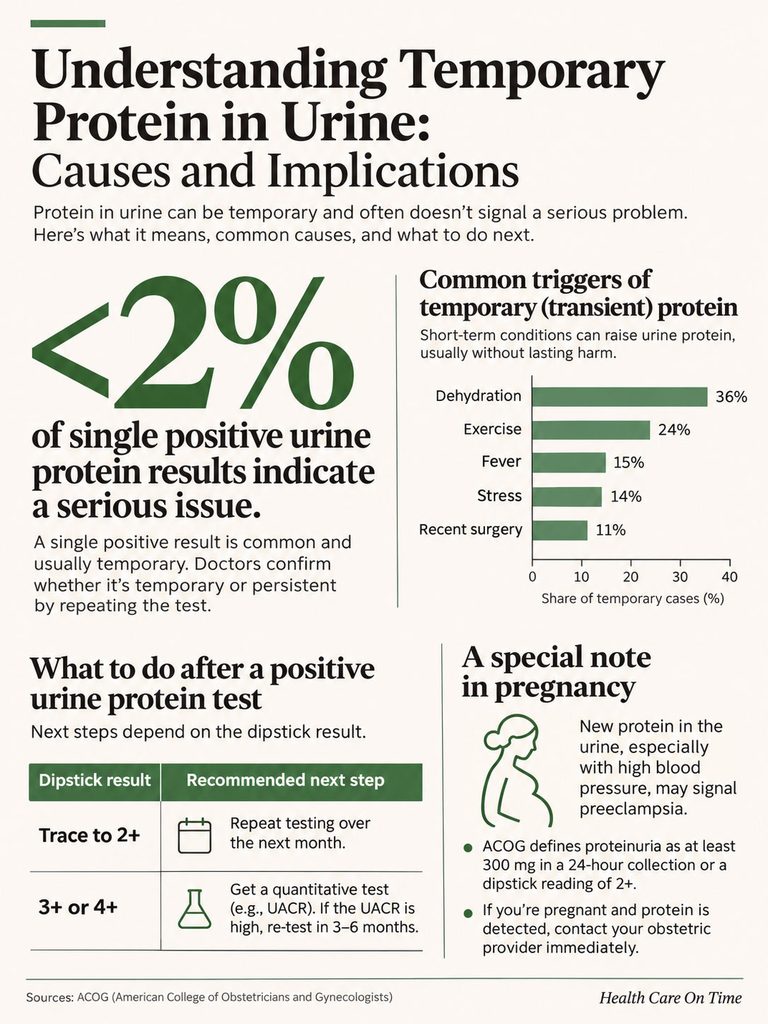
The usual short-term triggers for transient protein include:
- dehydration, which concentrates the urine and stresses the kidneys a little (the one cause that water itself fixes)
- fever and acute illness, including infections
- hard exercise, which can raise urine protein for 24 to 48 hours afterward, seldom beyond 1 to 2 g a day
- emotional stress, very cold temperatures and heat injury
- a heart failure flare
- regular aspirin or NSAIDs such as ibuprofen
- long periods of standing, in young people with orthostatic proteinuria
Doctors tell temporary from persistent protein by repeating the test. For a trace to 2+ dipstick with nothing else worrying, a common approach is a repeat test on a morning sample at least twice over the next month; if those come back negative, the protein was transient. A 3+ or 4+ result calls for a quantitative test instead of more dipsticks. A high UACR is usually repeated within 3 to 6 months, since chronic kidney disease is defined by changes lasting at least 3 months and one result rarely decides anything.
After 20 weeks of pregnancy, new protein in the urine together with high blood pressure can signal preeclampsia, and under ACOG’s criteria proteinuria means at least 300 mg in a 24-hour collection, a protein-to-creatinine ratio of at least 0.3, or a dipstick reading of 2+.
If you’re pregnant and a urine test shows protein, contact your obstetric provider the same day instead of trying to fix it with fluids.
Normal Ranges, and Why Kidney Protein Often Goes Unnoticed
Most labs now report albumin as a UACR, where lower is better, and results fall into three bands:
- Under 30 mg/g: normal, or “at goal”
- 30 to 299 mg/g: moderately increased
- 300 mg/g or higher: severely increased
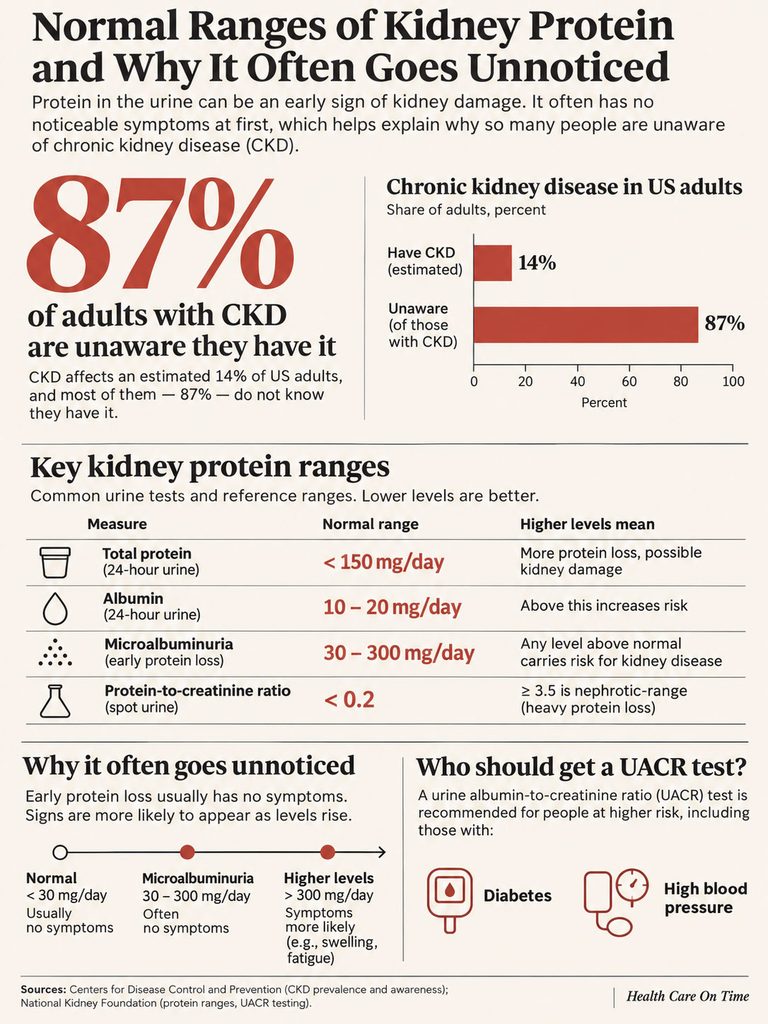
For total protein, normal is less than 150 mg per day, and albumin makes up only a small slice of that, roughly 10 to 20 mg. Albumin that keeps showing up at 30 to 300 mg a day is what older reports called microalbuminuria; the “micro” and “macro” labels have largely been dropped because any level above the goal range carries risk. For a protein-to-creatinine ratio, a value under 0.2 is considered normal, while 3.5 or more is nephrotic-range, or heavy, proteinuria.
Early protein loss rarely causes symptoms. When levels climb, people may notice foamy urine, puffiness around the eyes in the morning, or swelling of the feet, ankles, belly or face, but many notice nothing at all, and most US adults with kidney disease don’t know they have it.
| Measure | Figure | Source |
| US adults estimated to have chronic kidney disease | 14%, about 37 million people | CDC, CKD in the United States (data from NHANES Aug 2021 to Aug 2023, updated March 2026) |
| Adults with CKD who did not know they had it | 87%, about 9 in 10 | CDC, same report (adults 20 and older) |
| Adults with diabetes estimated to have CKD | 38% (49% with type 1, 41% with type 2) | CDC, same report |
| Adults with high blood pressure estimated to have CKD | 21% | CDC, same report |
| CKD by age | 34% at 65 and older, 13% at 45 to 64, 6% at 18 to 44 | CDC, same report |
| People living with kidney failure (ESKD) in 2023 | About 831,000; 131,564 started treatment that year | CDC fact sheet, based on US Renal Data System data |
That gap between who has kidney disease and who knows it is why a UACR is now routine for higher-risk groups. Under the American Diabetes Association’s 2026 Standards of Care, people with type 2 diabetes should have a UACR and eGFR at diagnosis, people with type 1 diabetes after five years, and both groups at least once a year after that, with testing one to four times a year once kidney disease is found.
High blood pressure, a family history of kidney disease and a history of preeclampsia also raise the risk of long-term protein in the urine. If any of those apply to you and your last urine check was a dipstick only, it’s reasonable to ask whether a UACR would add useful information.
What Actually Lowers Persistent Proteinuria
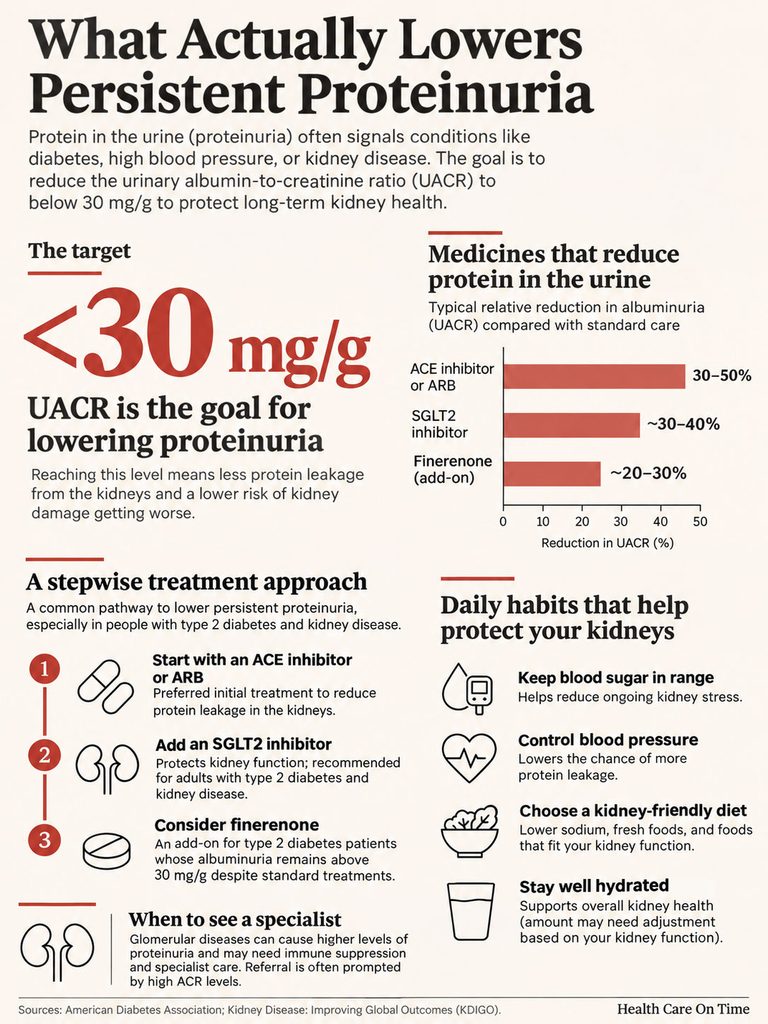
If protein keeps showing up on repeat tests, the target is the cause, usually diabetes, high blood pressure or a disease of the kidney filters themselves. Treatment aims to protect those filters, and a falling UACR is one sign it’s working. Doctors generally aim to get the UACR under 30 mg/g when possible, and a doubling of the ratio on a later test goes beyond normal lab variation and deserves a closer look.
Blood pressure medicines that protect the kidneys
ACE inhibitors and angiotensin receptor blockers (ARBs) lower pressure inside the kidney’s filters and reduce the protein that leaks through, and they’re usually the preferred starting treatment for albuminuria. Current kidney guidelines favor one of these drugs for people with diabetes whose albuminuria is moderately or severely increased, and for people without diabetes whose albuminuria is severely increased, with a softer suggestion when it’s only moderately raised. Taking an ACE inhibitor and an ARB together is discouraged.
SGLT2 inhibitors and finerenone
SGLT2 inhibitors were first developed for blood sugar and later shown to protect the kidneys and heart. KDIGO’s 2024 guidance strongly backs them for adults with type 2 diabetes and kidney disease who have an eGFR of 20 or higher, and for adults with kidney disease who have a UACR of 200 mg/g or more, or heart failure, with or without diabetes. People with an eGFR between 20 and 45 and a lower UACR may be offered one as well. If you have diabetes and your UACR sits above goal, this is a drug class to ask about by name.
Finerenone, a nonsteroidal mineralocorticoid receptor antagonist, is an add-on for adults with type 2 diabetes whose albuminuria stays above 30 mg/g despite the highest tolerated dose of an ACE inhibitor or ARB, provided potassium is normal and eGFR is above 25. Its FDA approval for albuminuria covers only people with type 2 diabetes.
When the kidney filters themselves are the problem
Sometimes the cause is a disease aimed at the glomeruli, such as glomerulonephritis, lupus or another autoimmune condition. Treatment in these cases can include medicines that suppress the immune system, and some people eventually need dialysis or a kidney transplant if the kidneys fail. A kidney specialist (nephrologist) usually leads this care, sometimes after a kidney biopsy to pin down the exact disease (if one is suggested, ask what the result would change about treatment), and a consistent ACR of 300 mg/g or higher is one of the findings that typically prompts a referral.
Daily habits that help the medicines work
Blood sugar and blood pressure control come first, since diabetes and high blood pressure are the main causes of kidney failure in US adults. After that, a few habits have guideline support:
- Cut sodium. For people with kidney disease, the suggested target is under 2 g a day. Reading the labels on packaged foods and asking about restaurant dishes is how most people get there.
- Keep protein moderate. For adults with stage 3 to 5 kidney disease, about 0.8 g of protein per kilogram of body weight per day is the suggested amount. Eating less protein isn’t always helpful, so work out your number with your doctor or a kidney dietitian, especially if you’ve been following a plan with very high daily protein intake.
- Stop smoking and limit alcohol.
- Stay active. Aim for at least 30 minutes of activity on most days.
- Check your pain relievers. If you take NSAIDs often, go over them with your doctor.
What to eat
No single food lowers urine protein. The eating pattern that helps is the one that controls blood pressure and blood sugar: mostly fresh, lower-sodium foods, plenty of vegetables and fruit (unless you’ve been told to limit potassium), whole grains, and protein portions that match your kidney stage. If your kidney function is already reduced, potassium and phosphorus may matter too, and a diet for chronic kidney disease is built around those lab results.
In practice, lower sodium often comes down to small swaps. Fresh chicken or fish instead of deli meat. Dried beans, or canned beans rinsed before cooking. Herbs, garlic, citrus and vinegar for flavor, and plain frozen vegetables rather than ones packed in sauce. Cooking at home a few more nights a week makes every one of those swaps easier.
Staying normally hydrated supports your kidneys and helps prevent kidney stones and urinary infections. Once kidney damage is the cause, though, drinking water won’t reduce protein in urine, which is why it isn’t on the list above.
When Drinking More Is the Wrong Advice
For some people with protein in the urine, the safe advice runs the other way. If you have advanced chronic kidney disease or kidney failure, including dialysis, you may need to keep fluids within an amount your healthcare team sets, because fluid the kidneys can’t remove builds up as swelling, shortness of breath, high blood pressure and strain on the heart.
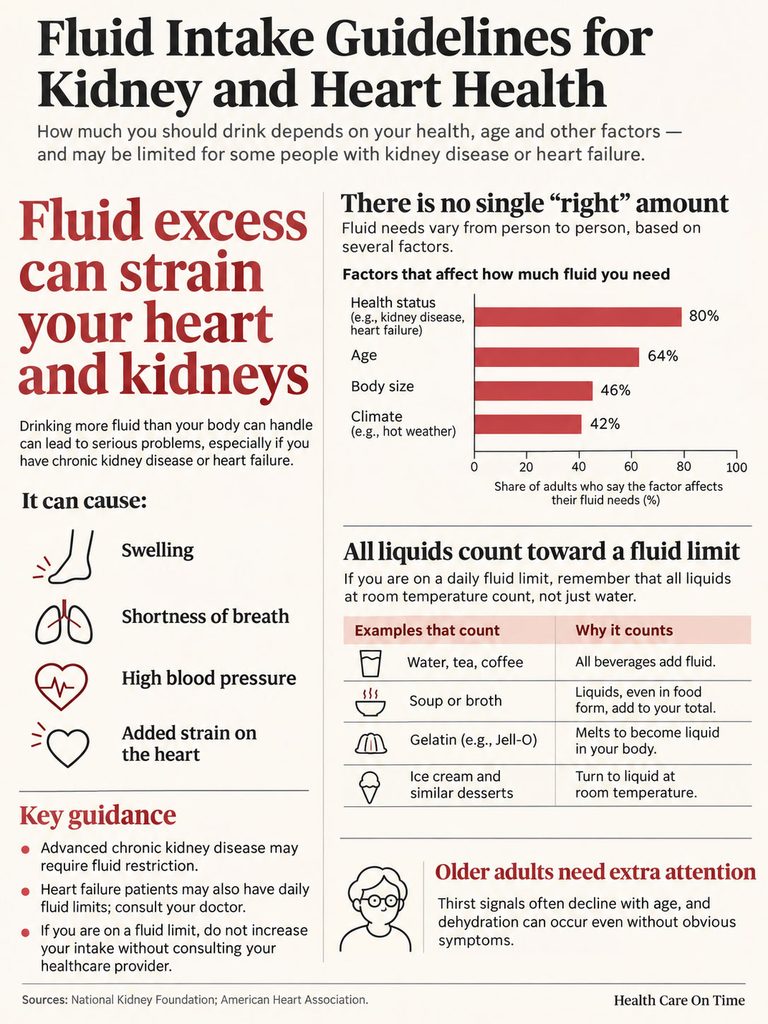
With heart failure, you may also be given a daily fluid limit, so ask your doctor how much you can have. If you already live with a fluid limit and a urine test shows protein, call the team that set the limit rather than drinking more. Anything liquid at room temperature counts toward a limit, including soup, gelatin, ice cream and ice cubes (8 oz equals 240 mL, or 1 cup).
Without a heart or kidney condition that calls for a limit, there’s no rule that everyone needs the familiar eight cups a day. Needs depend on age, body size, climate, exercise, pregnancy or breastfeeding, and illnesses such as vomiting or diarrhea. Older adults deserve extra attention here, since thirst often weakens with age and dehydration can creep in without any warning sign.
Reading Your Result: Next Steps by Scenario
Each row assumes you have the full report in hand, including the specific gravity line, since the same protein result can mean different things on dilute and concentrated urine.
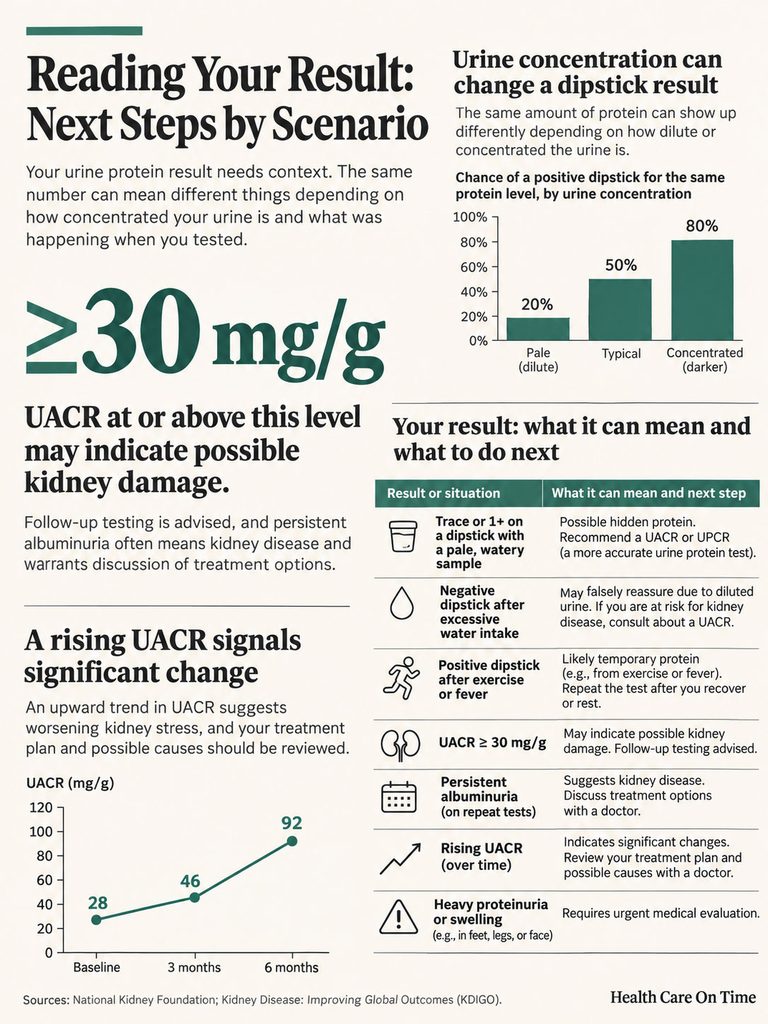
| Your situation | What it may mean | What to do next |
| Trace or 1+ on a dipstick from a pale, watery sample | Dilution may be hiding more protein than the strip shows | Ask for a UACR or UPCR, ideally on a first morning sample |
| Negative dipstick after drinking a lot of water | The result may be falsely reassuring | If you have diabetes, high blood pressure or kidney risk, ask whether a UACR is due |
| Positive dipstick after a hard workout, fever or a day of little fluid | Likely temporary protein | Repeat on a morning sample at least twice over the next month, without hard exercise in the 24 hours before |
| UACR of 30 mg/g or higher on one test | Possible kidney damage, not yet confirmed | Repeat with a first morning sample, often within 3 to 6 months, and check eGFR |
| UACR of 30 mg/g or higher on two tests at least 3 months apart | Persistent albuminuria consistent with kidney disease | Discuss an ACE inhibitor or ARB, an SGLT2 inhibitor if eligible, sodium under 2 g a day, and blood sugar and pressure targets |
| UACR rising to double the earlier value | Change larger than normal lab variation | Ask for a review of your treatment and possible causes |
| Dipstick 3+ or 4+, or swelling of the legs, face or belly | Heavy proteinuria possible | See your doctor promptly for quantitative testing and blood work |
| Pregnant, past 20 weeks, with new urine protein | Possible preeclampsia, especially with high blood pressure | Call your obstetric provider the same day |
Questions Worth Asking at Your Next Visit
Bring the actual report. A note that “the protein was high” leaves out the details that decide what happens next, such as which test was used and how concentrated the sample was. Good questions to bring:
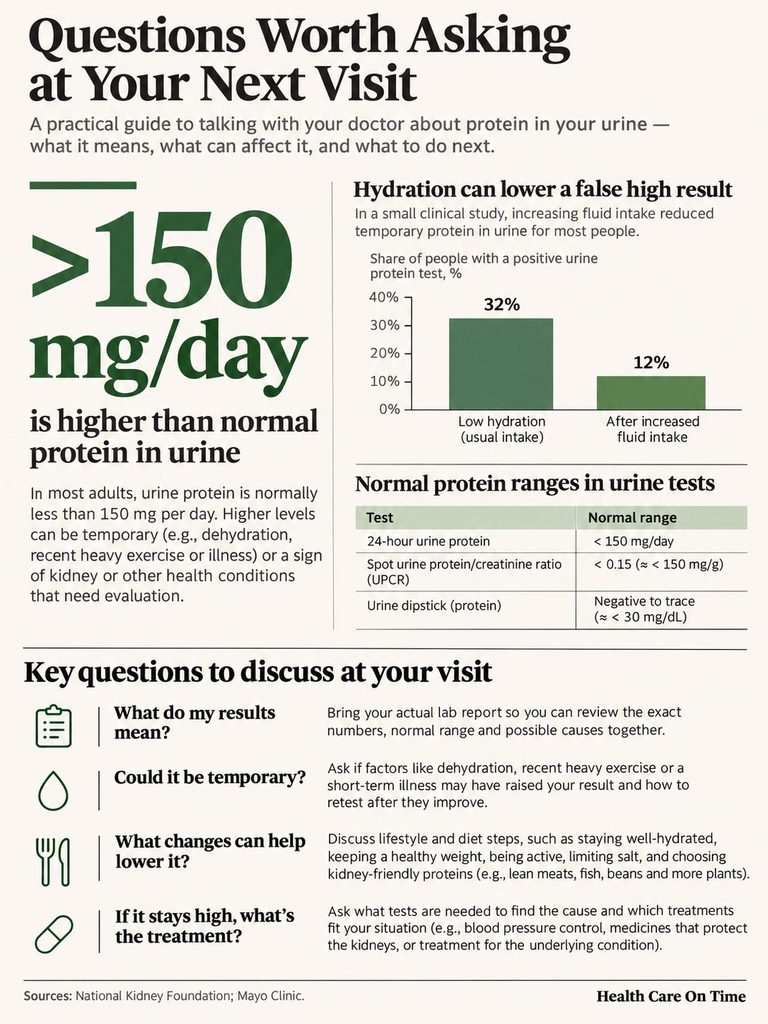
- Was this a dipstick or a UACR, and what was the actual number?
- Should the test be repeated on a first morning sample?
- Could yesterday’s workout, a fever or an infection explain it?
- Does the protein result line up with the eGFR?
- Would an ACE inhibitor or ARB help in this case, and would an SGLT2 inhibitor add anything?
- Is there a daily fluid amount to aim for, or a limit to stay under?
- If the UACR comes back normal, does the dipstick result still need follow-up?
- When should the next UACR be done, and how big a change would be a worry?
Frequently Asked Questions
Does being really hydrated hide protein in urine tests?
It can on a dipstick, which reads concentration. It mostly doesn’t on a UACR, UPCR or 24-hour urine test, which correct for dilution or measure the total.
Can you drink too much water and dilute your urine and mess up your urine lab test?
Yes, mainly on a dipstick urinalysis, where very dilute urine can turn a real protein result into a trace or a negative. Ratio tests are more forgiving, although very dilute urine can push a UPCR slightly high. Drinking large amounts quickly can also lower your blood sodium dangerously, so ordinary hydration is the safest plan before any test.
How can you reduce protein in urine quickly?
Temporary protein often settles on its own within days. Protein after hard exercise usually fades within 24 to 48 hours, and protein from dehydration improves once you’re drinking normally again. Persistent protein from diabetes, high blood pressure or kidney disease has no fast fix; medicines such as ACE inhibitors, ARBs and SGLT2 inhibitors, along with less sodium, bring it down gradually, and your doctor tracks progress with repeat UACR tests.
How can you reduce protein in urine naturally?
Lifestyle steps help most when paired with medical treatment for persistent protein. Keep blood pressure and blood sugar in your target range, cut sodium to under 2 g a day if you have kidney disease, keep protein moderate (about 0.8 g per kilogram a day in stage 3 to 5 kidney disease), stop smoking, limit alcohol and stay active most days. Extra water only helps if you were dehydrated.
What should you eat to reduce protein in urine?
Build meals around lower-sodium, mostly fresh foods such as vegetables, fruit, whole grains, beans and lean protein in moderate portions. Check labels on canned, frozen and packaged foods, and go easy on processed meats and restaurant meals. With reduced kidney function, your doctor or a kidney dietitian may also adjust potassium and phosphorus to fit your lab results.
What is the normal range for urine protein?
A UACR under 30 mg/g is normal. Total urine protein under 150 mg per day, or a protein-to-creatinine ratio under 0.2, is normal for adults. Reference ranges can differ slightly between labs, so check the one printed on your own report.
What are the symptoms of protein in urine?
Small amounts usually cause none, which is why testing matters. Larger amounts can bring foamy or bubbly urine, morning puffiness around the eyes and swelling in the feet, ankles, belly or face, and some people also notice tiredness, nausea or muscle cramps at night.
What is the treatment for protein in urine?
Treatment depends on the cause. For most people with persistent albuminuria, it means an ACE inhibitor or an ARB, often alongside an SGLT2 inhibitor, plus control of blood pressure and blood sugar. People with type 2 diabetes whose albuminuria stays above 30 mg/g on one of those blood pressure drugs may add finerenone. Specific kidney diseases, including some forms of glomerulonephritis, can need immune-suppressing treatment from a nephrologist, while temporary protein from exercise, fever or dehydration needs nothing beyond a repeat test.
Medical disclaimer: This article is for general education and does not replace advice from your own doctor. Urine test results need to be read alongside your medical history, blood tests and medicines. Don’t start, stop or change any medicine, or change how much fluid you drink if you have kidney disease or heart failure, without talking to your healthcare provider.
References
- Proteinuria in adults: a diagnostic approach. American Family Physician. September 15, 2000. https://www.aafp.org/pubs/afp/issues/2000/0915/p1333.html
- Urinalysis: a comprehensive review. American Family Physician. March 15, 2005. https://www.aafp.org/pubs/afp/issues/2005/0315/p1153.html
- Clark WF, Sontrop JM, Huang SH, et al. Effect of coaching to increase water intake on kidney function decline in adults with chronic kidney disease: the CKD WIT randomized clinical trial. JAMA. 2018;319(18):1870-1879. https://jamanetwork.com/journals/jama/fullarticle/2680548
- Kojima C, Umemura H, Shimosawa T, Nakayama T. Sex differences in the evaluation of proteinuria using the urine dipstick test. Frontiers in Medicine. 2023. https://www.frontiersin.org/journals/medicine/articles/10.3389/fmed.2023.1148698/pdf
- Yang CY, Chen FA, Chen CF, et al. Diagnostic accuracy of urine protein/creatinine ratio is influenced by urine concentration. PLoS ONE. 2015;10(9):e0137460. https://pmc.ncbi.nlm.nih.gov/articles/PMC4564100/
- KDIGO 2024 Clinical Practice Guideline for the Evaluation and Management of Chronic Kidney Disease: Summary of Recommendations and Practice Points. https://kdigo.org/wp-content/uploads/2026/05/KDIGO-2024-CKD-Guideline-Summary-Recommendations-and-Practice-Points.pdf
- National Institute of Diabetes and Digestive and Kidney Diseases. Quick Reference on UACR and GFR. https://www.niddk.nih.gov/health-information/professionals/advanced-search/quick-reference-uacr-gfr
- National Institute of Diabetes and Digestive and Kidney Diseases. Assess Urine Albumin. https://www.niddk.nih.gov/health-information/professionals/clinical-tools-patient-management/kidney-disease/identify-manage-patients/evaluate-ckd/assess-urine-albumin
- Centers for Disease Control and Prevention. Chronic Kidney Disease in the United States (updated March 2026). https://www.cdc.gov/kidney-disease/php/data-research
- Centers for Disease Control and Prevention. Chronic Kidney Disease in the United States fact sheet (March 2026). https://cdc.gov/kidney-disease/media/pdfs/ckd-factsheet-h.pdf
- National Kidney Foundation. Albuminuria (proteinuria). https://www.kidney.org/kidney-topics/albuminuria-proteinuria
- National Kidney Foundation. Healthy Hydration and Your Kidneys. https://www.kidney.org/kidney-topics/healthy-hydration-and-your-kidneys
- American Kidney Fund. Protein in your urine (proteinuria). https://www.kidneyfund.org/all-about-kidneys/other-kidney-problems/protein-urine
- Cleveland Clinic. Protein in Urine (Proteinuria). https://my.clevelandclinic.org/health/symptoms/16428-proteinuria
- Cleveland Clinic. Heart Failure: Limiting Sodium and Fluids. https://my.clevelandclinic.org/departments/heart/patient-education/hvti-resources/heart-failure-limiting-sodium-and-fluids
- Cleveland Clinic Consult QD. Diabetes and Chronic Kidney Disease Management: A Practical Primary Care Approach (April 2026). https://consultqd.clevelandclinic.org/diabetes-and-chronic-kidney-disease-management-a-practical-primary-care-approach
- Saeed F, Devaki PNPK, Mahendrakar L, Holley JL. Exercise-induced proteinuria? The Journal of Family Practice. 61(1):23-26. https://community.the-hospitalist.org/content/exercise-induced-proteinuria
- Gestational Hypertension and Preeclampsia: A Practice Bulletin from ACOG. American Family Physician. 2019;100(10):649-650. https://www.aafp.org/pubs/afp/issues/2019/1115/p649.html