About 6.5% of American adults have red blood cells hiding in their urine right now, and most of them feel completely fine. No pain, no color change, nothing unusual in the bathroom. Then a routine urinalysis flags red blood cells, and the worry sets in. Here is the part most people never hear: a normal-looking sample is the rule, not the exception.
Table of Contents
Quick Answer: RBC in urine means red blood cells were detected in a urine sample, a finding doctors call hematuria. A normal result is usually 4 red blood cells per high power field (RBC/HPF) or fewer, though labs vary. Most causes are minor, such as a urinary tract infection or hard exercise. Still, any confirmed RBC in urine deserves follow-up to rule out kidney, bladder, or other urinary tract conditions.
At a Glance
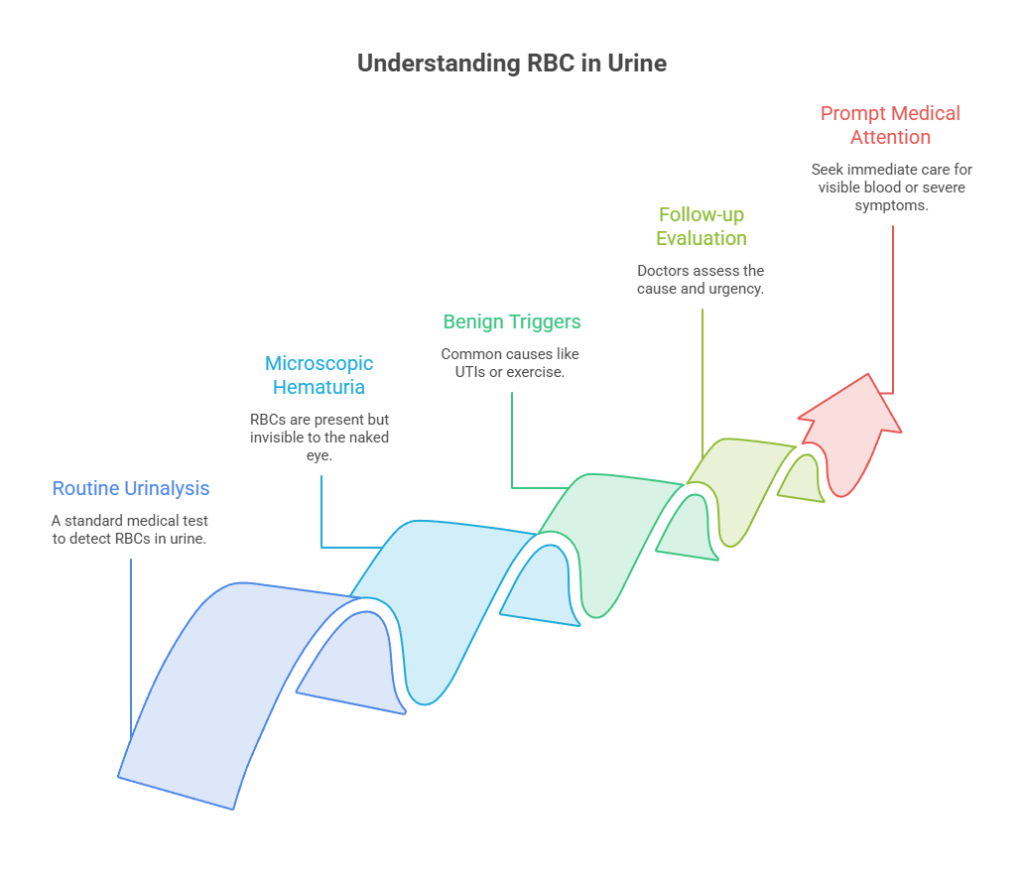
- Normal is generally 4 RBC/HPF or fewer; the American Urological Association flags 3 or more as microhematuria worth evaluating.
- Two types exist: microscopic (invisible, found under a lab microscope) and gross (visible pink, red, or cola-colored urine).
- Common benign triggers include UTIs, kidney stones, intense workouts, menstruation, and certain medications.
- About 6.5% of US adults have microscopic hematuria, with the rate climbing past 20% in older men.
- The number of RBC/HPF, your age, and your smoking history together decide how urgent follow-up should be.
- Visible blood, clots, flank pain, or fever means see a doctor promptly.
What Does RBC in Urine Actually Mean?
Red blood cells carry oxygen through your body and normally stay sealed inside your blood vessels. When they show up in urine, it signals that blood is leaking somewhere along the urinary tract, anywhere from the kidneys down through the ureters, bladder, and urethra.
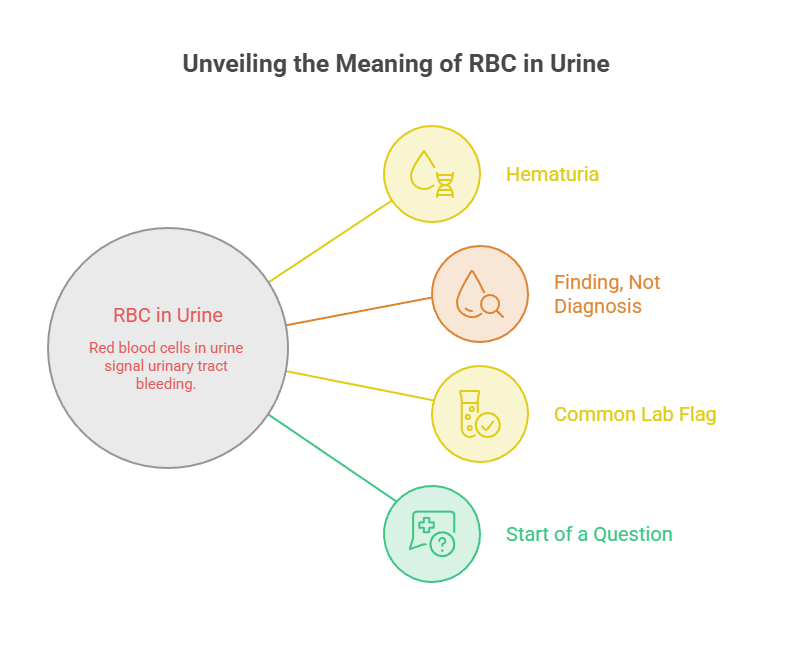
The medical term is hematuria. It is a finding, not a diagnosis on its own. Think of it as a smoke alarm: useful for telling you to look closer, not for telling you what is burning.
On a routine panel, this is one of the more common flags a lab returns. Seeing it does not place you in rare or frightening territory; it places you in a large group of people whose results simply need a second look.
Our medical reviewers note that a single RBC in urine result rarely settles anything by itself. Doctors treat it as the start of a question, then use your symptoms, history, and repeat testing to reach an answer.
Microscopic vs. Gross Hematuria
These two words describe how the blood was found, and the difference shapes how seriously it gets handled.
Microscopic hematuria means the red blood cells are invisible to you. Your urine looks its normal yellow, and the cells only appear when a technician examines a sample under a microscope. This is the most common scenario flagged on routine lab work.
Gross hematuria means you can see it. According to Johns Hopkins Medicine, urine may turn pink, red, or the color of tea or cola. Even a tiny amount of blood, less than a teaspoon, can tint a full toilet bowl, so the color is alarming but not always proof of heavy bleeding.
Why Red Blood Cells Leak Into Urine
Your kidneys filter waste from blood and send it out as urine. That filtering system is delicate. When any part of it gets irritated, inflamed, injured, or blocked, red blood cells can slip through and end up in the sample.
The source could sit high in the system, such as the kidneys, or low, such as the bladder or urethra. Medical News Today explains that pinpointing the location is part of what later testing aims to do.
In cases reviewed by our diagnostic team, the same RBC count can trace back to wildly different causes, from a passing infection to a kidney stone. That is exactly why the sections below separate the harmless from the serious.
Doctors also pay attention to the shape of those red blood cells. Cells that look distorted often point to a kidney source, while normal-looking cells more often come from lower down, such as the bladder. This detail helps narrow the search before any imaging is ordered.
RBC in Urine Normal Range (and What Your Number Means)
This is the number you came here for. When a lab counts red blood cells in urine, it reports them per high power field, written as RBC/HPF. That is simply how many cells appear in the magnified view a technician examines.
A normal result is generally 4 RBC/HPF or fewer, per UF Health. Some labs set the bar at 0 to 2 or 0 to 3, so always read your result against the reference range printed on your own report.
The Clinical Threshold: 3 or More RBC/HPF
The American Urological Association defines microhematuria as 3 or more red blood cells per high power field on a properly collected sample. A positive dipstick alone does not count; the cells must be confirmed under a microscope.
That distinction protects you from overreacting to a color-strip test. A dipstick can flag blood for reasons that are not red blood cells at all, which is why microscopic confirmation is the real standard.
A trace dipstick result should prompt a formal microscopic look rather than immediate alarm. The strip is a screening step, not a verdict, and confirming it under magnification is what makes the number trustworthy.
It also helps to know that units can differ slightly between labs. Most US labs report cells per high power field, but the cutoff for normal may read as 0 to 2, 0 to 3, or up to 4. Reading your own report’s reference column prevents needless worry over a result that is actually within range.
What 3-10, 11-25, and 25+ RBC/HPF Signal
The count is not just a yes or no. The higher the number, the more attention it tends to warrant, especially alongside other risk factors. The table below breaks down what each band generally means.
| RBC/HPF Level | Classification | Common Likelihood | Suggested Next Step |
| 0-4 | Normal range | Routine, no concern on its own | No follow-up unless symptoms appear |
| 3-10 | Mild microhematuria | Often benign (UTI, exercise, mild irritation) | Confirm with repeat urinalysis; assess risk tier |
| 11-25 | Moderate microhematuria | Needs a proper workup | Cystoscopy plus imaging per AUA guidance |
| 25+ | High microhematuria | Requires full evaluation | Cystoscopy plus CT urography |
| Visible (any) | Gross hematuria | Always evaluated, never ignored | Prompt referral to a urologist |
Patients booking urinalysis panels through HealthCareOnTime often ask whether 3 to 5 RBC/HPF is dangerous. On its own, in a young person with no symptoms, it usually is not. The point is to confirm it and let your clinician weigh it against your age and history.
What Causes Red Blood Cells in Urine?
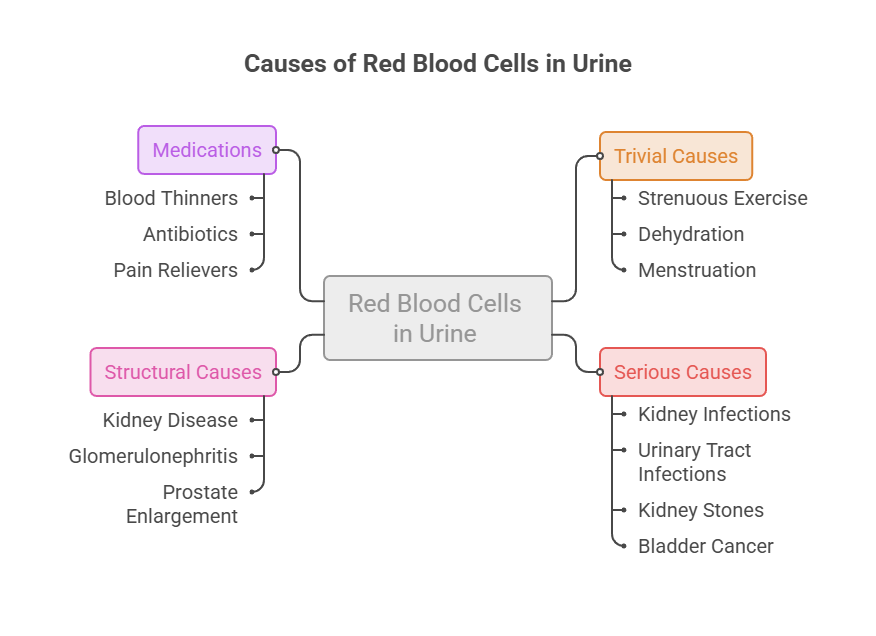
There is a long list of reasons RBC in urine shows up, and they range from trivial to serious. Sorting them by category makes the picture clearer and calmer.
Common Benign Causes
Most of the time, the trigger is something temporary and treatable. Healthline groups several of the everyday culprits, and these account for a large share of flagged results.
Urinary tract infections lead the list. Bacteria inflame the lining of the bladder or urethra, and that irritation lets red blood cells leak into urine, often with burning, urgency, or cloudy urine.
Intense exercise is another frequent cause. Long-distance running and high-impact activity can briefly irritate the bladder, producing what is sometimes called runner’s hematuria that clears within a day or two.
Menstruation can contaminate a urine sample with blood that has nothing to do with the urinary tract. Recent sexual activity and even mild dehydration can also nudge the count up temporarily.
A useful way to think about these triggers is transient versus persistent. A one-time finding after a hard run or during a cycle often clears on a repeat test. A result that keeps returning across separate samples is the kind that earns a closer look, regardless of how minor the suspected cause seems.
Structural Causes
Sometimes the bleeding comes from a physical problem inside the urinary tract rather than an infection. These causes often announce themselves with pain or changes in how you urinate.
Kidney stones and bladder stones top this group. Sharp mineral deposits scrape the tract as they move, and that abrasion shows up as blood, often paired with sudden, severe pain in the side or back.
An enlarged prostate is common in older men and can cause both microscopic and visible bleeding. Across the lab partners we work with, prostate-related findings are a regular reason older male patients get referred onward for evaluation.
Both stones and an enlarged prostate can cause bleeding that comes and goes. A clear result on one day does not always rule them out, which is why doctors weigh your symptoms and history rather than a single sample.
Serious Causes Worth Ruling Out
A smaller share of cases point to something that needs prompt care. These are the reasons doctors do not simply shrug off a confirmed result, even when you feel well.
Kidney disease, including inflammation called glomerulonephritis, can let red blood cells escape the kidney’s filters. Inherited conditions such as sickle cell disease change red blood cell shape and can cause bleeding too.
Bladder and kidney cancers sit at the serious end. They are far from the most likely cause, but ruling them out is the central reason evaluation guidelines exist, particularly for older adults and people who have smoked.
Medications That Can Cause RBC in Urine
Several drugs raise the odds of finding blood in urine. Blood thinners and antiplatelet medicines, including warfarin and aspirin, are well-recognized examples noted by Johns Hopkins Medicine.
Research backs this up. A study of older adults found microscopic hematuria in about 27% of regular aspirin users compared with roughly 24% of non-users, a difference that held up after statistical adjustment.
Before any urine test, tell your provider about everything you take, including over-the-counter products. A medication on your list can change how your result gets interpreted, and sometimes it explains the finding entirely.
How Common Is RBC in Urine? (US Data)
If a result like this just landed in your inbox, here is some reassurance: you are in very large company. Hematuria is one of the most frequently encountered findings in American clinics.
In the United States, microscopic hematuria affects an estimated 6.5% of the population, according to StatPearls (NIH). The rate is not even across groups, and it rises sharply with age.
| US Statistic | Figure | Source |
| Microscopic hematuria prevalence, US adults | ~6.5% | StatPearls (NIH) |
| Prevalence in older men | Up to 21% | StatPearls (NIH) |
| Range across 80,000-person AUA review | 2.4% to 31.1% | American Urological Association |
| Women with microhematuria in a 6-year database | About 20% | Kaiser Permanente / ACOG |
| Standard normal reference | 4 RBC/HPF or fewer | UF Health |
The spread in those numbers is not sloppiness; it reflects how much the definition and the population studied change the result. A study of healthy young volunteers and a study of older smokers will land in very different places.
Age is the strongest driver of those figures. A finding that is routine in a healthy 25-year-old carries more weight in someone past 60, simply because the list of possible causes lengthens with age. The same number means different things at different stages of life.
In a large Kaiser Permanente database spanning six years, roughly one in five women tested showed microscopic hematuria, as reported by ACOG. Readers who order tests with us frequently want to know if their result is rare, and the honest answer is that it is common, which is precisely why a calm, structured follow-up beats panic.
One pattern in the research deserves a flag, especially for women. Evaluation of microscopic hematuria has historically been delayed more often in women, which can lead to later diagnosis of bladder and other urinary cancers. A result should be taken just as seriously regardless of sex.
When Should You Worry About RBC in Urine?
Not every result carries the same weight. Some findings call for a quick recheck, while others call for a same-week appointment. Knowing the red flags helps you act at the right speed.
Red-Flag Symptoms
Certain signs alongside RBC in urine deserve faster attention. Visible blood you can see, blood clots, or cola-colored urine all point to heavier bleeding than a microscopic trace.
Pain is another signal. Severe flank or side pain may mean a kidney stone, while fever and chills can indicate an infection that has reached the kidneys. The Levels guide notes that abdominal or pelvic pain frequently accompanies stones and bladder problems.
If you see blood and also feel feverish, nauseated, or unable to urinate normally, do not wait it out. Those combinations move the situation from schedule a visit to be seen quickly.
Timing matters too. Blood that appears only at the start of urination, only at the end, or throughout the stream can hint at where the bleeding originates. Mentioning this pattern to your provider gives them a useful clue before any testing begins.
The AUA Risk Tiers Explained
The American Urological Association built a risk system so follow-up matches actual danger instead of treating every result identically. It sorts patients into low, intermediate, and high risk based on age, sex, smoking history, and the RBC count.
| Risk Tier | Who Fits (Examples) | RBC/HPF | Typical Follow-Up |
| Low | Women under 50, men under 40; never-smoker or under 10 pack-years; no other risk factors | 3-10 | Shared decision; possible repeat testing |
| Intermediate | Women 50-59, men 40-59; 10-30 pack-years smoking | 11-25 | Cystoscopy plus renal ultrasound |
| High | Anyone 60 or older; over 30 pack-years; any history of visible blood | Over 25 | Cystoscopy plus CT urography |
This framework, detailed in the AUA guideline, is why two people with identical RBC counts can get very different advice. A 32-year-old non-smoker and a 65-year-old former smoker are simply not in the same risk position.
Cancer Risk by Tier, in Perspective
The word cancer is what makes people anxious here, so it helps to see the real numbers. They are smaller than fear suggests.
Data presented at the 2025 AUA hematuria guideline review found cancer rates of about 0.4% in low-risk patients, 1.0% in intermediate-risk, 2.6% in high-risk microhematuria, and 11.0% in those with gross (visible) hematuria.
Put plainly, more than 99 out of 100 low-risk people with microscopic hematuria do not have a urinary cancer. The evaluation exists to catch the rare case early, when it is most treatable, not because the odds are stacked against you.
When cancers are found, location matters for how patients get checked. In one analysis of more than 1,000 patients, nearly 70% of the malignancies were in the kidney or upper tract, which is why imaging, not just a bladder scope, is part of higher-risk workups.
How Doctors Test and Diagnose RBC in Urine
Finding red blood cells is step one. Figuring out why they are there is a process, and it usually unfolds in a logical order rather than all at once.
Urinalysis, Dipstick, and Microscopic Confirmation
It starts with a urinalysis, which checks your sample for cells, chemicals, and signs of infection. A dipstick, a chemically treated strip, gives a fast initial reading and changes color when blood is present.
A positive dipstick is not the final word. As the AUA standard makes clear, the result must be confirmed by examining the urine under a microscope and counting actual red blood cells.
In tests processed through HealthCareOnTime’s lab network, microscopic confirmation is the step that separates a true finding from a false alarm. Asking your provider whether your blood was confirmed under the microscope is a fair and useful question.
The Clean-Catch Sample
How you collect the sample affects how trustworthy the result is. The clean-catch method, described by UF Health, reduces contamination from skin and surrounding tissue.
You start urinating, then catch the sample midstream in the sterile cup. This simple technique keeps stray cells and bacteria out, which matters because a sloppy sample can produce a misleading count.
For menstruating patients, timing the test outside your period avoids contamination from menstrual blood. A retest after your cycle ends gives a far cleaner reading.
Follow-Up Tests
When a result needs more answers, several tools come next depending on your risk tier. A urine culture identifies infection and the antibiotic best suited to treat it.
Imaging looks at the urinary tract directly. A renal ultrasound or CT urography examines the kidneys and ureters, while cystoscopy uses a thin scope to inspect the bladder from inside.
These steps are not automatic for everyone. Low-risk patients may simply repeat a urinalysis, while higher-risk patients move toward imaging and scoping sooner. If a repeat test comes back clean, further bladder or kidney evaluation is often unnecessary unless new symptoms appear.
It helps to walk into the appointment prepared. Bring a list of your medications, note any recent exercise or infections, and mention whether anyone in your family has had kidney or bladder disease. In tests arranged through HealthCareOnTime, patients who share this context up front often reach an answer with fewer repeat visits.
How to Reduce RBC in Urine and Protect Your Urinary Health
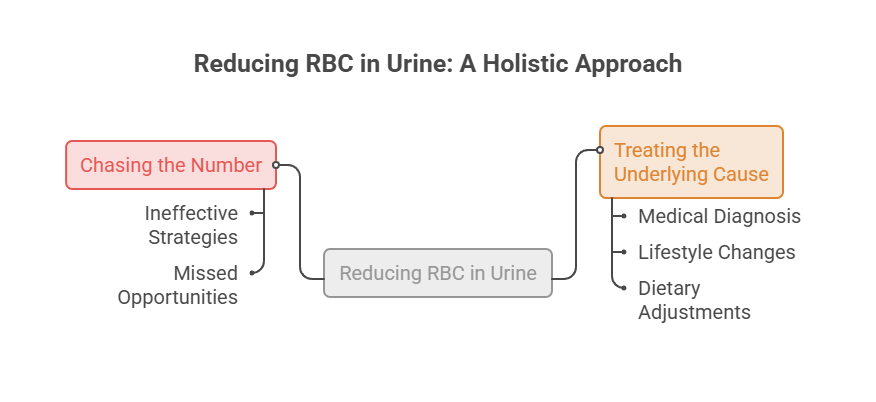
Here is the honest framing most natural remedy articles skip: you do not lower RBC in urine directly. You treat whatever is causing it, and the count follows. Chasing the number itself misses the point.
Treat the Underlying Cause, Not the Symptom
If a UTI is the cause, antibiotics clear the infection, and the bleeding resolves with it. Finishing the full prescribed course matters even after symptoms fade, so the infection does not rebound.
If a kidney stone is responsible, treatment ranges from hydration and waiting to procedures that break up or remove the stone. If a medication is the trigger, your doctor decides whether any change is appropriate.
In cases reviewed by our diagnostic team, the patients who recover fastest are the ones who pursue the cause rather than self-treating the symptom. The cause is the lever; the RBC count is just the readout.
Follow-up testing is part of the cure, not an afterthought. Repeating a urinalysis after treatment confirms the bleeding has stopped. If red blood cells persist once an infection or stone is cleared, that signal tells your doctor to keep looking rather than close the case.
Habits That Genuinely Help
While the specific fix depends on the cause, several habits support urinary health broadly and lower the odds of common triggers like UTIs and stones.
Drinking enough water keeps urine diluted and helps flush the urinary tract. A practical marker is urine that stays light yellow to nearly clear, a guideline echoed by WebMD for general urinary care.
Good bathroom hygiene, urinating after sexual activity, and not holding urine for long stretches all reduce infection risk. For stone-prone people, staying hydrated and following dietary advice from a clinician helps prevent repeat episodes.
Quitting smoking deserves its own mention. Tobacco is one of the strongest risk factors for bladder cancer, and it directly raises where you land in the AUA risk tiers. Cutting it lowers both your long-term risk and the intensity of follow-up a future result would trigger.
What Does Not Work
Plenty of online sources promise herbal cures that stop blood in urine. As a Quora discussion of remedies shows, even well-meaning advice often circles back to one truth: see a doctor and find the cause.
Cranberry products may help some people with UTI prevention, but they do not treat stones, prostate issues, or anything serious. Treating a potentially significant finding with supplements alone can delay a diagnosis that matters.
The table below turns all of this into quick guidance for common real-world situations.
| Your Situation | Recommended Action | Urgency |
| You can see pink, red, or cola-colored urine | See a doctor and request a urinalysis | Within a few days |
| RBC found, plus UTI symptoms (burning, urgency) | Treat the UTI, then repeat the urinalysis | Soon, within 1-2 weeks |
| RBC after a hard workout, no symptoms | Rehydrate; repeat the test after 48+ hours of rest | Routine |
| RBC found during your period | Retest after your cycle fully ends | Routine |
| RBC, no infection, no symptoms | Pursue AUA risk-tier evaluation | Schedule promptly |
| Visible blood plus clots, fever, or flank pain | Seek urgent or emergency care | Immediate |
Frequently Asked Questions
Is RBC in urine always serious?
No. Most causes are minor and temporary, such as a UTI, intense exercise, or menstruation contaminating the sample. That said, every confirmed result deserves follow-up because a small share of cases point to kidney disease, stones, or, rarely, cancer that benefits from early detection.
What is a dangerous level of RBC in urine?
There is no single dangerous number, since the count is read alongside your age, sex, and smoking history. Generally, higher counts (over 25 RBC/HPF) and any visible blood prompt fuller evaluation. Even 3 RBC/HPF can matter in an older adult or smoker, while it may be minor in a healthy young person.
Can dehydration cause RBC in urine?
Dehydration can contribute, especially when combined with intense exercise that irritates the bladder. Concentrated urine and physical stress on the urinary tract can briefly raise the count. Rehydrating and retesting after rest often shows the level returning to normal, though persistent results still need a doctor’s review.
What does RBC in urine but no infection mean?
It means red blood cells were found, but a urine culture ruled out a UTI as the cause. This points attention toward other sources such as stones, exercise, an enlarged prostate, kidney issues, or medications. Doctors then use the AUA risk tiers to decide whether imaging or further testing is warranted.
Can exercise cause blood in urine?
Yes. Strenuous activity, particularly long-distance running and high-impact sports, can irritate the bladder and cause temporary bleeding, sometimes called runner’s hematuria. It typically clears within a day or two. If blood persists after rest and rehydration, it should not be assumed to be exercise-related and needs evaluation.
Does a UTI always cause visible blood?
No. Many UTIs cause only microscopic hematuria, invisible without a lab microscope. Others produce visibly pink or red urine. Common UTI signs include burning during urination, frequent urges, and cloudy or foul-smelling urine. Treatment with antibiotics usually clears both the infection and the associated bleeding.
Can RBC in urine go away on its own?
Sometimes. Transient causes like exercise, mild irritation, or menstruation often resolve without treatment, and a repeat test comes back normal. This is generally reassuring. Persistent or recurrent RBC in urine, however, signals an ongoing cause that should be identified rather than assumed harmless.
What does 3-5 RBC/HPF mean?
This is mild microhematuria, just above the typical normal cutoff. In a young person with no symptoms, it is frequently benign and may simply need confirmation with a repeat test. In older adults or those with risk factors, even this range can warrant a formal risk-tier evaluation under AUA guidance.
Can my period affect my urine RBC result?
Yes. Menstrual blood can contaminate a urine sample and falsely raise the red blood cell count. For an accurate reading, schedule testing outside your period when possible. If a result was collected during menstruation, a retest after your cycle ends gives a far more reliable picture.
How fast should I see a doctor about blood in urine?
Visible blood, blood clots, or cola-colored urine warrants a prompt visit within a few days. If you also have fever, severe flank pain, nausea, or trouble urinating, seek urgent or emergency care. Microscopic findings with no symptoms are less urgent but still need timely follow-up, not indefinite delay.
Are there natural remedies to lower RBC in urine?
There is no proven natural remedy that reliably lowers RBC in urine, because the count reflects an underlying cause. Hydration and good urinary hygiene support general health and may prevent some triggers like UTIs. Treating the actual cause, diagnosed by a clinician, is what resolves the finding safely.
Does RBC in urine mean kidney damage?
Not necessarily. Red blood cells can come from anywhere in the urinary tract, and many sources have nothing to do with the kidneys, such as a bladder infection or a urethral irritation. When bleeding does come from the kidneys, testing for protein and abnormal cell shapes helps distinguish harmless causes from genuine kidney disease.
Medical Disclaimer: This article is for general educational purposes and does not replace professional medical advice, diagnosis, or treatment. RBC in urine can have many causes, some minor and some serious. Always consult a licensed healthcare provider about your specific results and symptoms. If you notice visible blood in your urine, seek medical care promptly.
References
- UF Health: RBC Urine Test
- Johns Hopkins Medicine: Hematuria (Blood in the Urine)
- StatPearls, NIH: Gross and Microscopic Hematuria
- American Family Physician (AAFP): Microscopic Hematuria in Adults, AUA Recommendations
- American Urological Association: Microhematuria Guideline (PDF)
- ACOG: Asymptomatic Microscopic Hematuria in Women
- UroToday: 2025 AUA Hematuria Guidelines Overview
- NIH/PMC: Aspirin Use and Microscopic Hematuria Study
- Medical News Today: What Can Cause Red Blood Cells in Urine
- Healthline: Why Are There Red Blood Cells in My Urine?