Most hot flashes in pregnancy come from rising hormones and a bigger blood supply, and they’re harmless. A thermometer and a quick look at what else you’re feeling will tell you whether yours is the ordinary kind.
Table of Contents
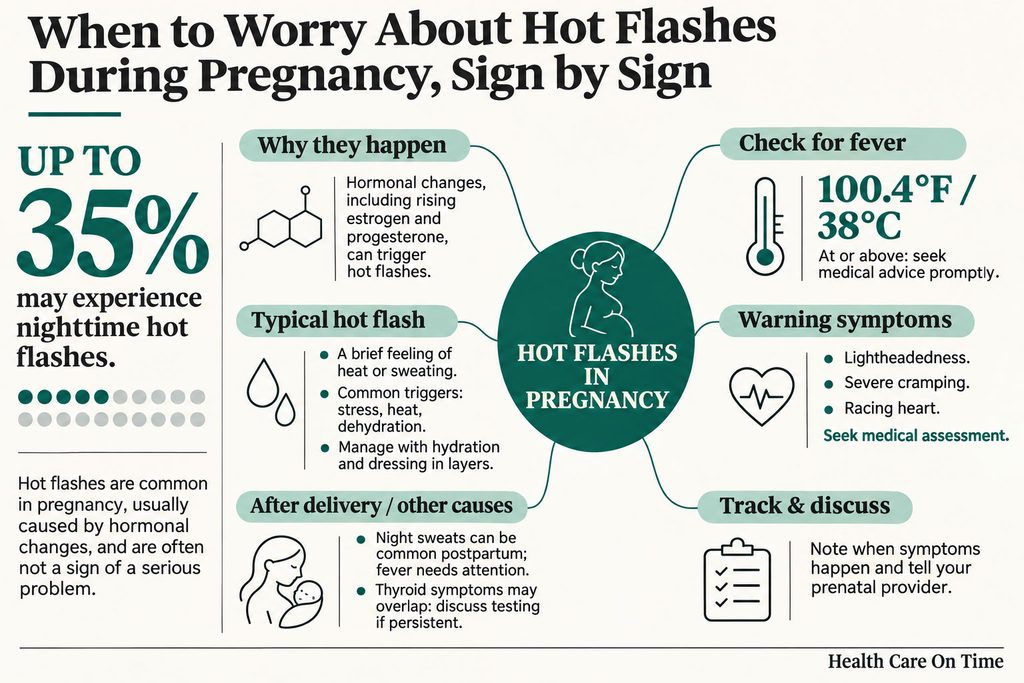
Quick answer: Take your temperature first. A reading of 100.4°F (38°C) or higher is a fever, which the CDC lists as an urgent maternal warning sign, so call your OB the same day. Then look at what came with the flash. Heat plus fainting, severe belly pain, bleeding, chest pain, trouble breathing or a racing, irregular heartbeat needs care right away. A flash on its own that fades in minutes, often leaving you a little chilly, is usually normal.
Hot flashes in pregnancy are common, and usually harmless
A pregnancy hot flash tends to arrive the same way each time. Warmth spreads over your face, neck and chest, your skin may redden, you might sweat, and a few minutes later it fades.
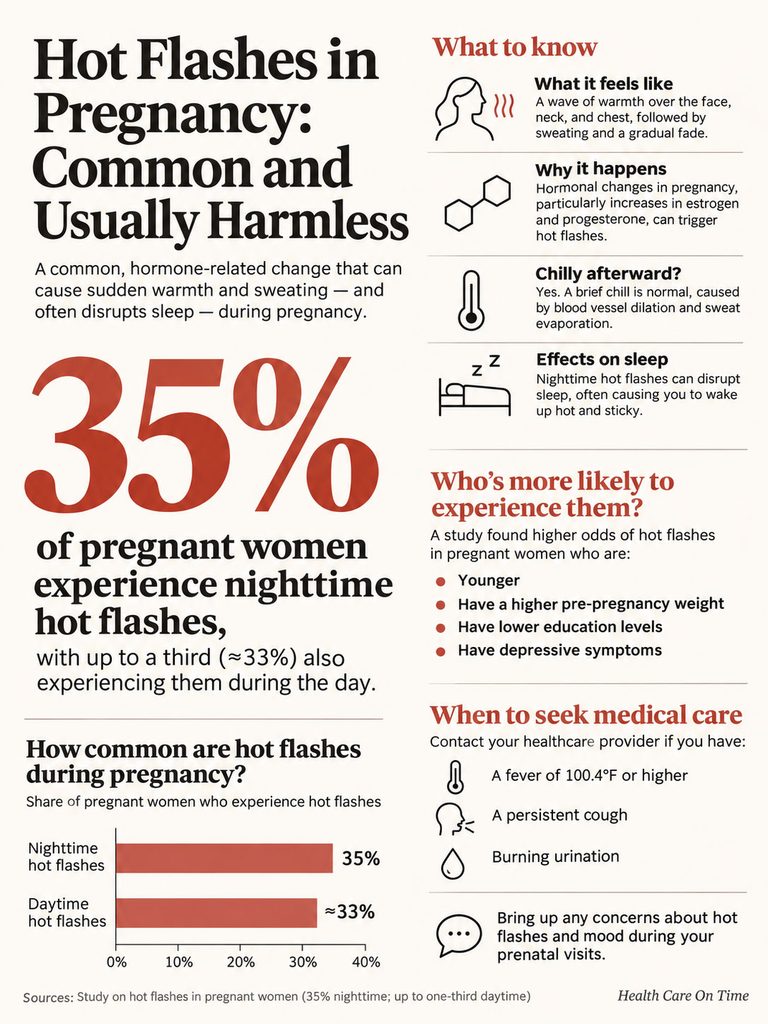
Plenty of pregnant people get them. A study that followed 429 women from mid-pregnancy to a year after birth found that 35% had nighttime hot flashes during pregnancy and 29% had them after delivery. Counting daytime flashes too, Cleveland Clinic puts the figure at up to a third of pregnancies.
Menopausal hot flashes come from estrogen falling away. In pregnancy the hormones move the other direction, with estrogen and progesterone climbing steeply, and those surges are often felt as hot flashes. Progesterone also pushes your resting temperature up slightly, which is why a basal body temperature chart stays high after conception. On top of that, your blood volume grows by almost 50% over the pregnancy, your heart beats faster, and your body has to shed heat for two. Running warm is close to expected.
Some people get them more than others. Younger women, women who carried more weight before pregnancy, women without a college degree and women with more depressive symptoms all reported more nighttime hot flashes in that study, and a lower education level was linked to more than double the odds. Those are the same groups more likely to have hot flashes at menopause. None of this makes a hot flash dangerous, though knowing you’re in a higher-risk group can make the first few episodes less alarming.
The depression link held after delivery as well as during pregnancy, though, and that part is worth acting on. If you’ve been feeling low, flat or anxious for more than a couple of weeks, tell your OB, whether or not the heat bothers you.
Why you might feel chilly right after
The flash peaks, sweat breaks out, and then for a few minutes your skin feels cold and clammy. Blood vessels near the surface opened wide to release heat, the sweat kept evaporating after the heat was already gone, and your body briefly overcorrected. That chill passes by itself and comes with a normal reading.
A fever chill usually runs in the opposite order: shivering or shaking first, then heat that builds over the next hour as the thermometer climbs. When you can’t tell which one you had, take the reading anyway.
When the heat hits at night
Night is when many pregnant people notice hot flashes most, partly because a warm bed and heavy covers hold heat in and partly because waking up drenched is hard to ignore. A typical night version looks like this: you surface from sleep hot and sticky, the pillow is damp, you kick the blanket off, and ten minutes later you’re cold enough to pull it back, which is annoying but normal.
What isn’t normal is a night sweat that comes with a temperature at or over 100.4°F, shaking chills, a cough that won’t quit or burning when you pee. Keep a thermometer on the nightstand so you can check without getting fully up. A cotton or moisture-wicking sleep shirt, a spare one within reach and a towel over the pillow make the normal kind far easier to live with. If the flashes wake you night after night, mention it at your next prenatal visit, along with how you’ve been sleeping and how your mood has held up.
Hot flash or fever: a two-minute check
Feeling hot tells you very little on its own, since a hot flash can make your face burn while your core temperature stays normal and a real fever can start with chills that send you looking for a blanket.
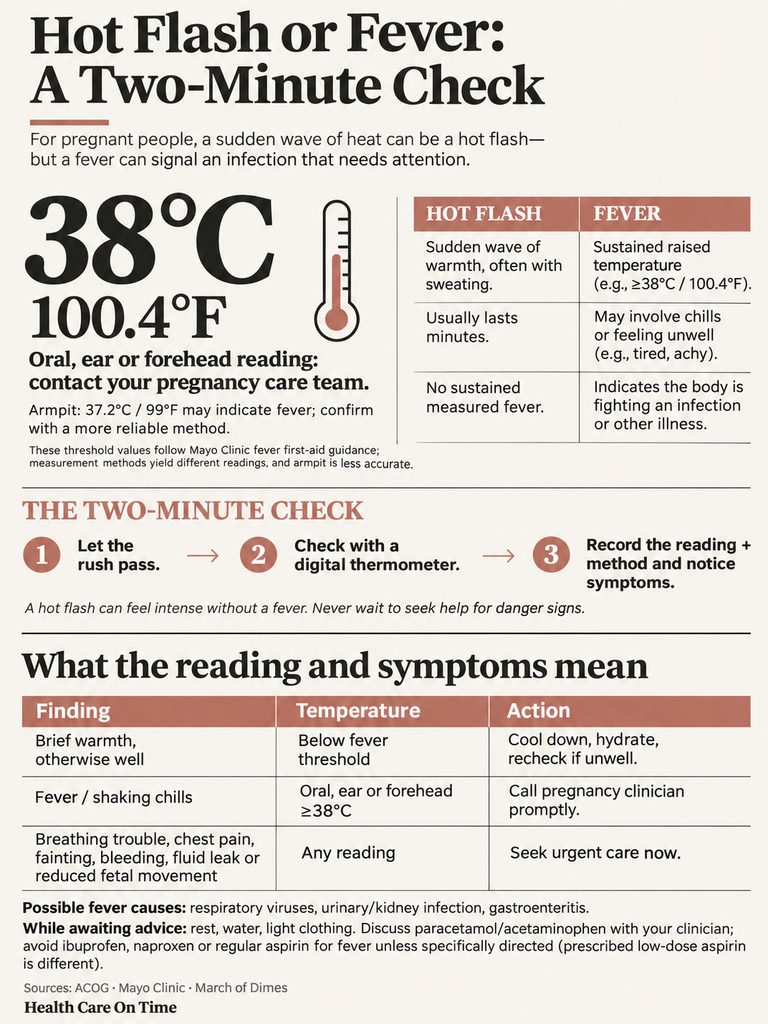
So wait until the flash has passed and you’ve been sitting quietly for a few minutes, then take your temperature. Give it longer if you just showered, worked out or finished a hot drink. The line to remember is 100.4°F (38°C). A fever at or above that number is on the CDC’s list of urgent maternal warning signs for anyone pregnant or within a year of giving birth, and the advice for every sign on that list is to get medical care right away.
The spot you measure from shifts the reading. By March of Dimes thresholds, fever means above 100°F (37.8°C) by mouth, above 100.4°F (38°C) by forehead, ear or rectum, and above 99°F (37.2°C) in the armpit, which reads lower. An oral digital thermometer is simple and cheap, so most people can use one and treat 100.4°F as the point to pick up the phone.
Before you even find the thermometer, a few things hint at the answer:
- Timing. A hot flash builds and fades in minutes, while a fever hangs around for hours and often creeps back up when a medicine wears off.
- Chills. A brief chill right after the heat is common. Shaking chills, body aches and feeling unwell all afternoon point more toward an infection.
- Something else going on. Burning when you pee, a cough, a sore throat, vomiting, diarrhea or discharge with a bad smell all suggest a source for a fever.
- Repeat readings. If one reading is borderline, check again a little later. A flash leaves nothing behind, and a fever usually shows up a second time.
If the sweating, flushing or chills keep coming back through the day, measure each time rather than guessing.
Colds, flu and COVID-19, stomach bugs, food poisoning, ear infections, pneumonia and urinary tract infections, including kidney infections, are the usual reasons for a fever in pregnancy. Some clear up by themselves and some need treatment, and only your OB or an urgent care clinician can tell which. Any fever during pregnancy gets taken seriously for two reasons: the infection behind it may need treating, and the heat itself can matter for the baby, especially early on.
While you wait to hear back, skip aspirin and ibuprofen. Both are on the avoid list for fever in pregnancy, and NSAIDs such as ibuprofen are generally avoided after week 20 unless a provider decides otherwise. Call and ask what to use instead.
Early in the first trimester, a mild cold can easily come with a night of repeated flushes. If the reading sits a bit above your usual but under 100.4°F, rest, drink fluids and check again later. If it reaches 100.4°F or higher, call the after-hours line that night rather than waiting for the office to open, because early pregnancy is when a fever matters most.
| What you notice | What it often feels like | What the thermometer shows | What to do | Get care right away if |
| Hot flash on its own | Sudden heat in face, neck and chest for a few minutes, sweat, then a chill | Below 100.4°F (38°C) once it passes | Cool down, drink water, mention it at your next visit | It starts happening with any symptom in this column |
| Fever | Heat that lasts for hours, chills or shaking, aches, feeling ill | 100.4°F (38°C) or higher | Call your OB the same day, even if you feel only mildly sick | Fever with severe belly pain, trouble breathing, bad-smelling discharge or a baby moving less |
| Hot flash with lightheadedness | Woozy or faint, often after standing up fast or in a hot room | Usually normal | Sit or lie down, drink fluids, cool the room | You faint, the dizziness lasts after resting, or you are short of breath or have chest pain |
| Hot flash with cramping in early pregnancy | Warmth plus period-like cramps in the first weeks | Usually normal; fever changes the picture | Call your OB during office hours to report it | Cramping is severe, one-sided or comes with bleeding, shoulder pain, dizziness or fever |
| Hot flash with racing heart | Pounding or fluttering heart during or after the flash | Usually normal | Sit, slow your breathing, cut back on caffeine, report it | Fast or irregular beats with chest pain, trouble breathing, dizziness, confusion or fainting |
| Night sweats after delivery | Waking soaked, often in the first weeks after birth | Should stay below 100.4°F (38°C) | Light bedding, a fan, extra fluids, mention it at your postpartum visit | Fever, soaking a pad in an hour, clots larger than an egg or foul-smelling discharge |
The symptom pairings that change the answer
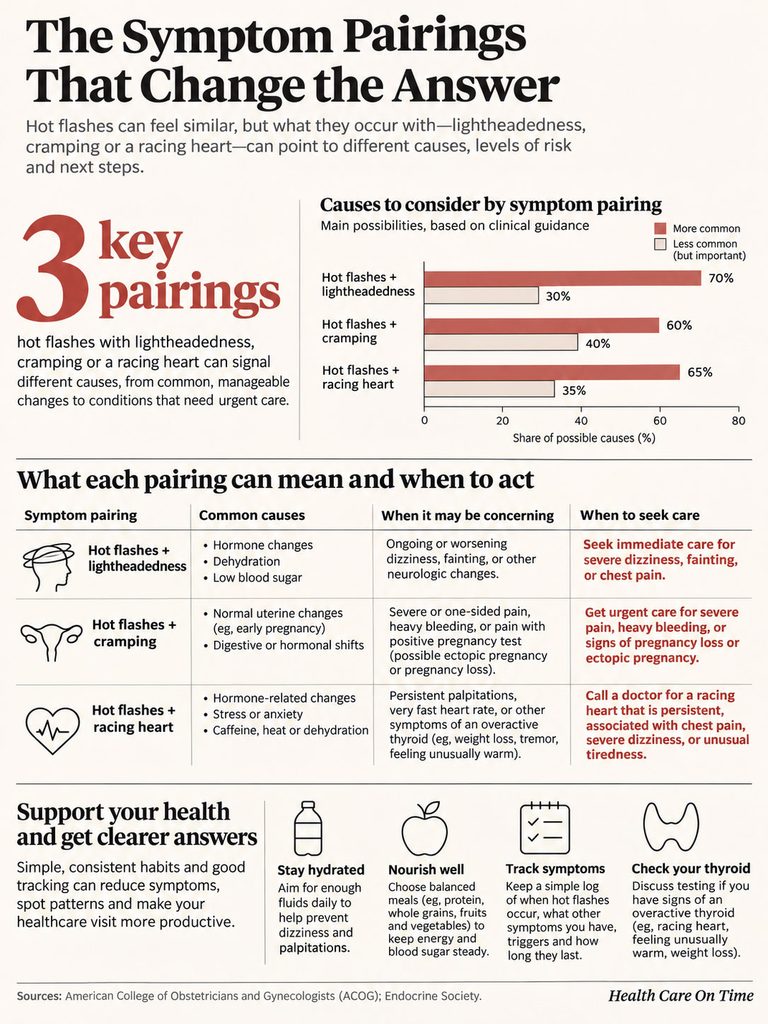
What a hot flash comes with matters far more than the flash itself, and these three combinations account for most of the late-night worry.
Hot flashes with lightheadedness
Hot and dizzy at the same time is common in pregnancy. The reasons are mostly mechanical. Pregnancy hormones relax and widen your blood vessels, which lowers your blood pressure, so for a moment less blood reaches your head when you stand up fast, stand still in a long line or walk into a warm room. Heat adds to it by pulling more blood toward the skin. Early on, nausea and vomiting can leave you dehydrated, and low blood sugar can add to the wooziness if you’ve barely eaten. Later, the growing uterus can press on your blood vessels.
Short, mild spells usually respond to simple fixes: drink fluids (an electrolyte drink helps if you’ve been sweating), get up slowly, rest, and try compression socks if you’re on your feet a lot. Sitting or lying down until it passes also keeps you from falling.
Some versions of hot-and-dizzy need a doctor quickly. Fainting, dizziness that keeps going after you’ve sat down and rested, shortness of breath (including waking up breathless or not being able to lie flat) and chest pain all call for immediate care. After about week 20, dizziness can also be a sign of preeclampsia, a blood pressure disorder that affects about 1 in 25 pregnancies in the US. A headache that won’t go away, changes in your vision and extreme swelling of the hands or face belong on that same urgent list.
Pregnancy also brings on heat illness sooner, because your body is cooling two people and you dehydrate more easily. At first, heat-related illness can feel like an ordinary flash, with heavy sweating and lightheadedness, but it adds things a flash doesn’t: muscle cramps, headache, nausea or vomiting, and sometimes preterm contractions. If you feel faint after time outside on a hot day or in a hot car, get somewhere cool, drink something, and get medical care right away if the symptoms don’t clear.
Hot flashes with cramping in early pregnancy
A warm flush and some mild, period-like cramps often turn up together in the first weeks, and both usually trace back to the same hormone and blood-flow changes. Spotting and cramping in early pregnancy are common, and many people who have both do not miscarry.
Watch how the pain behaves. Cramps that come with bleeding, cramps that turn into steady pain low in the belly or back, and any fluid, tissue or clots passing from the vagina can be signs of a pregnancy loss, and they’re a reason to call your provider immediately.
One-sided pain gets extra attention because of ectopic pregnancy, where the pregnancy implants outside the uterus, usually in a fallopian tube. It accounts for about 2% of pregnancies in the United States, and symptoms usually start around 6 to 10 weeks. A tube that is bleeding or has ruptured can cause sharp or stabbing belly pain that comes in waves, dizziness or fainting, shoulder or neck pain, fever and vomiting. Feeling hot and clammy, lightheaded and in one-sided pain in the first trimester is a reason to go to an emergency room, not to wait for office hours, because a ruptured tube can bleed heavily inside the belly.
Add a fever to cramping and the likely cause shifts again. Urinary tract and kidney infections are among the common sources of fever in pregnancy, and severe cramps together with a fever are a reason to reach your provider as soon as possible.
When the cramping is mild, comes and goes, and there’s no bleeding and no fever, a call during office hours is still reasonable. Describe where it hurts, how long it lasts and whether it’s getting stronger. Expect a few questions back. Is it on one side? Any bleeding? Do you feel faint when you stand? Having those answers ready, along with the date of your last period or your due date, gets you to the right level of care faster, whether that turns out to be reassurance over the phone, an office visit the same day or a trip to the emergency room.
Hot flashes with a racing heart or palpitations
A pounding or fluttering heartbeat during or just after a hot flash is another very common pairing. Your heart is moving a far larger volume of blood than before, and palpitations become more frequent in the third trimester as the baby grows and needs more of it. Anxiety, caffeine, dehydration, low blood sugar, low blood pressure and anemia can each set your heart racing, and these palpitations usually fade after delivery.
A few free habits make them less frequent. Drink enough water, keep caffeine to about one cup of coffee a day, avoid alcohol and nicotine, and slow your breathing when one starts. Jot down when they happen and what you were doing at the time, since a short log gives your OB something concrete to work with. If the pounding tends to start in the afternoon after a second iced coffee and stops when you sit down, cutting the coffee may be all it takes. A racing heart that wakes you from sleep, or one that keeps going after you’ve rested for several minutes, deserves a call.
Palpitations need immediate help when they come with chest pain or pressure (especially pain that spreads to the back, neck or arm), trouble breathing, dizziness, confusion or fainting, severe swelling in the legs, or a sudden, unusual tiredness. The rare but serious causes include arrhythmias such as atrial fibrillation, inflammation of the heart muscle and peripartum cardiomyopathy, a weakening of the heart muscle that can show up as dizziness and shortness of breath late in pregnancy or after delivery.
When it might be your thyroid
An overactive thyroid can look a lot like an ordinary pregnancy, since a faster heart rate, trouble with heat and tiredness happen in healthy pregnancies too. A fast and irregular heartbeat, shaky hands and unexplained weight loss, or not gaining weight as expected, point more toward hyperthyroidism. It affects about 1 to 4 of every 1,000 pregnancies in the US, usually because of Graves’ disease, and a blood test can check for it. When morning sickness is severe enough to be called hyperemesis gravidarum, the high hCG behind it can occasionally push thyroid hormone up too, and that kind usually settles in the second half of pregnancy.
How the heat changes from early pregnancy to the weeks after birth
Hot flashes can start in the first trimester, though they’re rarely the first clue; breast tenderness, mood changes and fatigue usually come earlier. They can carry on into the second trimester or show up for the first time then. Nausea usually eases in the second trimester, so the middle months often feel calmer overall, yet a warm flush can still arrive after a big meal, a hot shower or a brisk walk up the stairs. By the third trimester, the heat has as much to do with the physical work of carrying a bigger baby as with hormones.
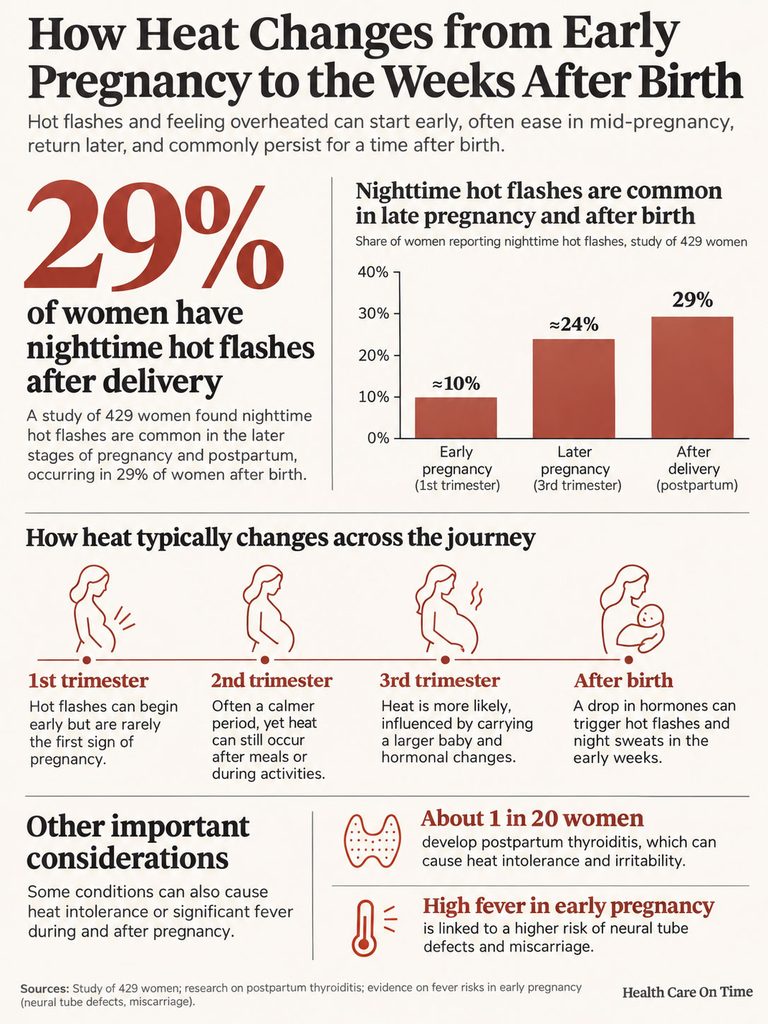
The study of 429 women only looked at nighttime hot flashes and didn’t start until week 20, so it says nothing about the first trimester. What it does show is that the symptom is common in the second half of pregnancy and doesn’t stop at delivery.
After the birth, estrogen and progesterone drop quickly, and that drop brings hot flashes and night sweats of its own, which are normal in the early weeks. A new pattern that starts several weeks or months later can have a different cause. Postpartum thyroiditis affects about 1 in 20 women in the first year after giving birth, and its overactive phase, which can last up to 3 months, brings heat intolerance, irritability, poor sleep and a fast heartbeat.
| Stage of pregnancy or recovery | What happens or what to watch | Key number | Source |
| Before about week 6 | A high fever or overheating carries a small extra risk of neural tube defects | Risk window ends around week 6 | MotherToBaby (OTIS), Feb 2025 |
| First trimester | A very high fever may raise the risk of some birth defects and miscarriage | Above 103°F (39.4°C) | March of Dimes |
| Weeks 6 to 10 | Ectopic pregnancy symptoms usually appear | About 2% of US pregnancies | UCHealth, citing ACOG |
| Weeks 20 to 36 | Nighttime hot flashes at some point in pregnancy | 35% of 429 women | Thurston et al., Fertility and Sterility, 2013 |
| After week 20 | Preeclampsia can start; dizziness in late pregnancy can be a sign | About 1 in 25 US pregnancies | American Heart Association, 2024 |
| Whole pregnancy | Overactive thyroid, usually Graves’ disease | 1 to 4 per 1,000 pregnancies | NIDDK |
| Weeks 2 to 52 after delivery | Nighttime hot flashes after birth | 29% of the same women | Thurston et al., 2013 |
| First year after birth | Postpartum thyroiditis, with a hyperthyroid phase of up to 3 months | About 1 in 20 women | NIDDK |
| Up to a year after delivery | CDC urgent maternal warning signs, including fever, still apply | 100.4°F (38°C) or higher | CDC Hear Her |
Why a true fever or overheating matters more now
The worries about heat in pregnancy center on real fevers and on overheating from your surroundings, and the first weeks are the most sensitive time.
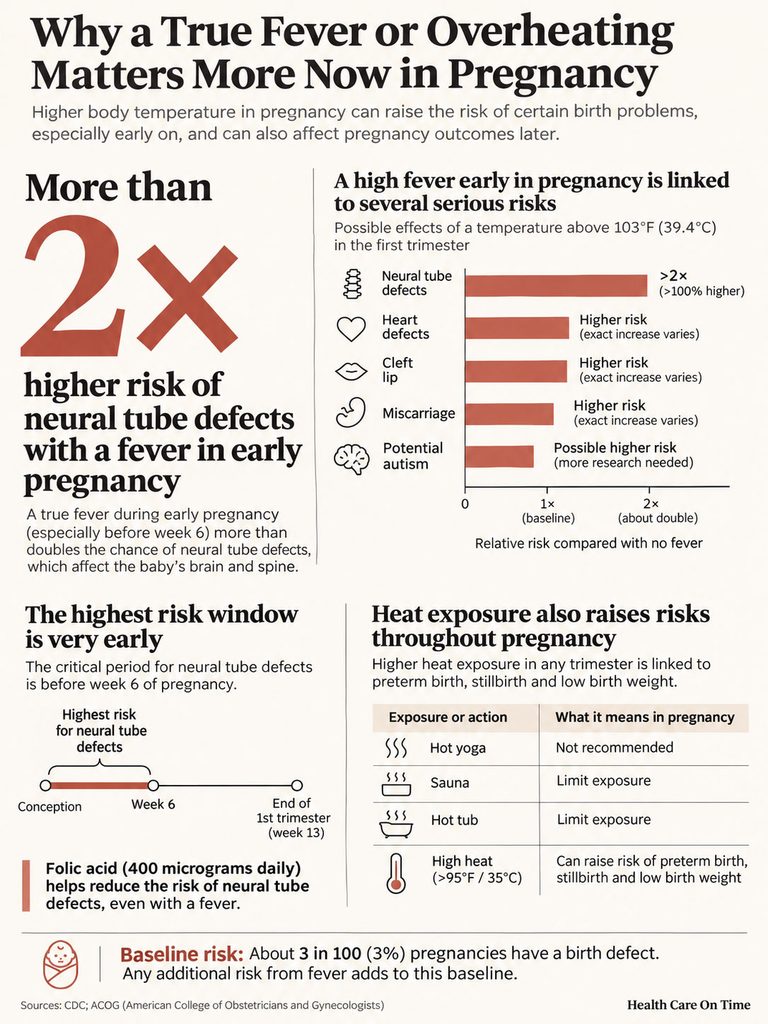
A fever just before or during early pregnancy was linked to more than twice the chance of a neural tube defect, a birth defect of the brain or spine. A temperature above 103°F (39.4°C) in the first trimester may also raise the risk of cleft lip and palate, heart defects and miscarriage, and possibly autism, though that last link needs more research. Later on, a fever may make preterm labor more likely.
Timing narrows the worry. The extra risk of neural tube defects seen in several studies applies to fever or overheating before week 6, and heat after week 6 isn’t expected to raise that particular risk. A few studies tie fever before week 12, especially when it goes untreated, to some other birth defects, and other studies haven’t found the same link. Every pregnancy starts with a background chance of a birth defect of about 3 in 100, so any extra risk from a fever sits on top of a baseline everyone already has. Folic acid lowers that baseline for neural tube defects: 400 micrograms a day, usually from a prenatal vitamin, reduces the risk even if you do run a fever.
Hot weather matters too. Heat exposure in any trimester has been linked to preterm birth, stillbirth and low birthweight, and as little as one day of high heat may raise the risk. Hot tubs, saunas and hot yoga are where people tend to overheat without meaning to, and hot yoga and hot Pilates rooms usually run between 95°F and 104°F (35°C to 40°C). Hot yoga isn’t recommended in pregnancy, and hot tubs and saunas are best skipped, or at least kept short.
Cooling down safely
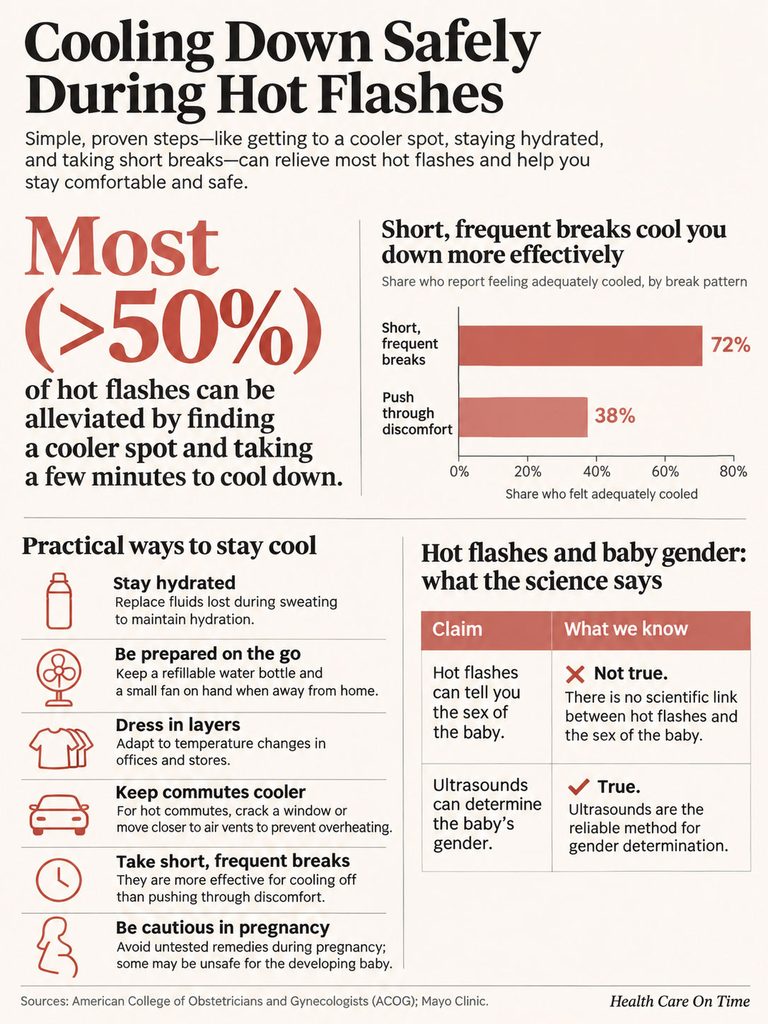
Most hot flashes need nothing more than a few minutes and a cooler spot. Bring your skin temperature down, replace the fluid you sweated out, and leave alone anything that hasn’t been tested in pregnancy.
- Get air moving with a desk fan, a ceiling fan or a small handheld one. Moving air speeds up sweat evaporation, which is how your body cools.
- Use cool water: a lukewarm-to-cool shower, a damp cloth on the back of your neck and wrists, or a cold drink. A cold pack works too. Wrap it in a thin towel first.
- Wear loose, light layers you can peel off, and keep a lighter blanket on the bed so you can push it away without fully waking.
- Drink steadily through the day. Pregnancy makes dehydration more likely, and a dehydrated body is worse at cooling itself by sweating. If you sweat heavily, ask your doctor how to replace salt and minerals, since plain water may not cover it.
- Keep the bedroom cool, and on hot days look up the CDC HeatRisk forecast for your zip code before planning time outside.
- Cut back on caffeine, which can also set off palpitations.
- Try slow breathing, meditation or prenatal yoga (the unheated kind) when the racing feeling comes along with a flash.
Away from home, plan a little. Keep a refillable water bottle and a small fan at your desk, dress in layers for overheated offices and stores, and if your commute involves a hot car or a crowded train, crack a window or move toward the air vents before the flash builds. Short, frequent breaks to cool off are easier than trying to push through one.
Herbal or “natural” hot flash remedies are best avoided while you’re pregnant. Supplements are loosely regulated, and some contain ingredients that aren’t safe for a developing baby.
The boy-or-girl idea
The old wives’ tale goes that running hot means a boy, or a girl, depending on who’s telling it. No research links hot flashes to the baby’s sex, and they don’t point to twins either. An ultrasound or a blood test is how you find out.
What to do in the moment
When a flash hits and something feels off, the next step depends on the thermometer reading and on what else is happening. If your OB has given you different instructions, follow theirs.
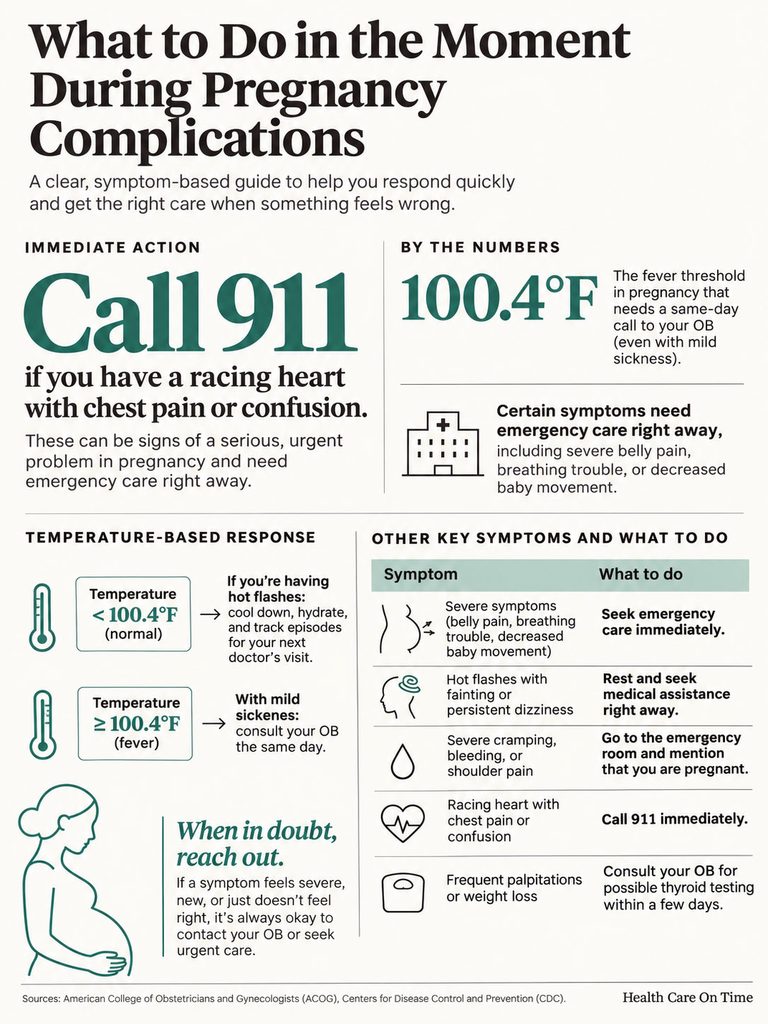
| If this happens | Do this | How fast |
| A hot flash that fades in minutes, temperature normal | Cool down, drink water, keep a note of how often | Mention at your next prenatal visit |
| Temperature 100.4°F (38°C) or higher, feeling only mildly sick | Call your OB or the after-hours line and ask what to take | Same day, without waiting for it to pass |
| Fever plus severe belly pain, trouble breathing, bad-smelling discharge or less baby movement | Go to labor and delivery or an emergency room | Right away |
| Hot flash with fainting, or dizziness that doesn’t ease after resting | Lie down, have someone stay with you, seek care | Right away |
| Severe or one-sided cramping, bleeding or shoulder pain in early pregnancy | Go to an emergency room; say you are pregnant | Right away |
| Racing heart with chest pain, shortness of breath, confusion or swelling | Call 911 | Right away |
| Frequent palpitations, shaky hands or weight loss without other red flags | Ask your OB about a thyroid blood test | Within a few days |
| Soaking night sweats after delivery, no fever | Keep cool, drink fluids, mention at your postpartum visit | Next visit, sooner if a fever starts |
When you call or arrive, say right away that you’re pregnant or gave birth within the last year, since complications from pregnancy can still show up months after delivery.
It helps to show a partner, parent or friend the warning signs too. The CDC’s Hear Her campaign was built around that idea: the people closest to a pregnant or postpartum woman often notice first that something is off, and they can push for care or drive her in. If you live with someone, tell them which symptoms mean you should go in tonight, so nobody has to debate it in the middle of the night.
What the check-up may involve
If you call about a fever or one of the pairings above, expect the basics first: your temperature, blood pressure and heart rate, and, depending on how far along you are, the baby’s heart rate or movement. A urine test can show infection and, later in pregnancy, protein, which together with high blood pressure is part of how preeclampsia is recognized. Blood tests can look for anemia, which is common in pregnancy and treatable with iron, and measure thyroid hormone if a fast or irregular heartbeat, shaky hands or poor weight gain raise that question. In early pregnancy, pain or bleeding usually leads to an ultrasound and blood tests to confirm where the pregnancy is growing.
Bring your temperature readings with the times you took them, a rough count of how many hot flashes you’ve had and what came with each one, and a list of any medicines or supplements you take. Also write down whether the heat came before or after the cramping, dizziness or racing heart.
Questions to bring to your next prenatal visit
Jot a few of these down before the appointment so they don’t get lost when time is short.
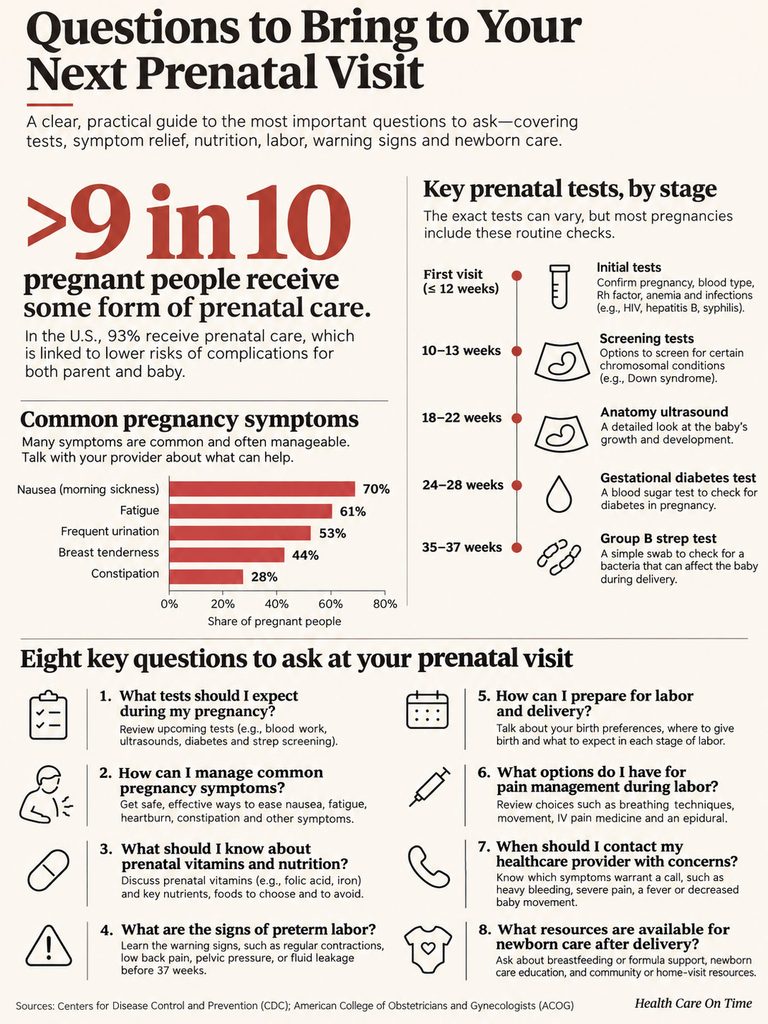
- Is waking up drenched most nights normal at this stage of pregnancy?
- Should we call you for any temperature over 100.4°F, or only if there are other symptoms too?
- What can be taken for a fever here, and what’s off limits?
- When the dizziness comes with the heat, is that a reason to check blood pressure or iron?
- Could the racing heart be thyroid-related, and is a blood test worth doing?
- Is a walk outside in summer still fine, and what should make us cut it short?
Frequently Asked Questions
Are hot flashes during pregnancy normal?
Yes. Up to about a third of pregnant people get them, mostly because estrogen and progesterone rise so steeply. A flash that fades within minutes and comes with a normal temperature isn’t harmful.
When should you worry about hot flashes during pregnancy?
Worry when the thermometer reads 100.4°F (38°C) or higher, or when the heat comes with fainting, dizziness that doesn’t ease with rest, chest pain, trouble breathing, a fast and irregular heartbeat, severe or one-sided belly pain, bleeding, leaking fluid or a baby who is moving less than usual. All of these are urgent warning signs, and each one means getting care right away instead of waiting to see whether it passes. A flash with none of them that fades in a few minutes can wait for your next visit.
What are the causes of hot flashes during pregnancy?
Mainly the steep rise in estrogen and progesterone, which changes how your body sets its temperature. A blood volume that grows by almost 50% and a faster heart rate add to it, and later in pregnancy the physical work of carrying the baby plays a bigger part. Younger women, women with a higher body mass index and women with more depressive symptoms tend to get them more. Less often, an overactive thyroid causes heat intolerance and a fast heartbeat, and an infection can cause a fever that feels like a hot flash at first.
When do you start feeling hot in the third trimester?
There’s no set week. Heat builds gradually for most people. Many people feel warmer as the third trimester goes on, because the baby is bigger and your heart is pumping more blood. Report sudden dizziness or a headache that won’t go away, since late in pregnancy either one can point to preeclampsia.
How can you stop hot flashes fast naturally while pregnant?
Get to a cooler spot, turn on a fan, put a cool damp cloth on your neck and wrists and sip a cold drink. Skip herbal hot flash products.
Can hot flashes be caused by something other than menopause?
Yes. Pregnancy and the weeks after birth are common times for them. An overactive thyroid can cause heat intolerance during pregnancy, and postpartum thyroiditis can do the same in the first year after birth. Infections cause fevers that can start with a hot, flushed feeling, and hot weather can trigger heat illness, which pregnancy makes more likely. If your hot flashes are new, frequent or come with other symptoms, a check-up and blood tests can find the cause.
Do hot flashes mean you’re having a boy or a girl?
No. Nothing links hot flashes to the baby’s sex, and they don’t mean twins either.
Is it normal to have hot flashes and night sweats after giving birth?
Yes, especially in the first weeks, as estrogen and progesterone drop after delivery; 29% of women in one study had nighttime hot flashes after birth. Fever of 100.4°F or more, bleeding that soaks a pad in an hour, clots larger than an egg or foul-smelling discharge need care right away.
Medical disclaimer: This article is for general information and does not replace advice from your obstetrician, midwife or other health care provider. If you are pregnant or gave birth within the past year and have a fever of 100.4°F (38°C) or higher or any urgent warning sign, seek medical care right away. In an emergency, call 911.
References
- Thurston RC, Luther JF, Wisniewski SR, Eng H, Wisner KL. Prospective evaluation of nighttime hot flashes during pregnancy and postpartum. Fertility and Sterility. 2013;100(6):1667-1672. https://pubmed.ncbi.nlm.nih.gov/24035604/
- Cleveland Clinic Health Essentials. Why You Get Hot Flashes During Pregnancy. January 8, 2025. https://health.clevelandclinic.org/hot-flashes-pregnancy
- Centers for Disease Control and Prevention. Hear Her: Urgent Maternal Warning Signs and Symptoms. https://www.cdc.gov/hearher/maternal-warning-signs/
- March of Dimes. Can having a fever while pregnant hurt my baby? https://www.marchofdimes.org/can-having-fever-while-pregnant-hurt-my-baby
- MotherToBaby (OTIS). Fever/Hyperthermia fact sheet. February 1, 2025. https://mothertobaby.org/fact-sheets/hyperthermia-pregnancy/
- MotherToBaby (OTIS). Exercise fact sheet. March 1, 2026. https://mothertobaby.org/fact-sheets/exercise-pregnancy/
- Centers for Disease Control and Prevention. Heat and Pregnancy. https://www.cdc.gov/heat-health/risk-factors/heat-and-pregnancy.html
- Centers for Disease Control and Prevention. Clinical Overview of Heat and Pregnancy. September 18, 2025. https://www.cdc.gov/heat-health/hcp/clinical-overview/heat-and-pregnant-women.html
- National Institute of Diabetes and Digestive and Kidney Diseases. Thyroid Disease and Pregnancy. https://niddk.nih.gov/health-information/endocrine-diseases/pregnancy-thyroid-disease
- Cleveland Clinic. Heart Palpitations in Pregnancy. https://my.clevelandclinic.org/health/diseases/21941-heart-palpitations-in-pregnancy
- American Heart Association News. Dizziness during pregnancy: When is it a concern? January 18, 2024. https://www.heart.org/en/news/2024/01/18/dizziness-during-pregnancy-when-is-it-a-concern
- Eunice Kennedy Shriver National Institute of Child Health and Human Development. What are the symptoms of pregnancy loss? https://www.nichd.nih.gov/health/topics/pregnancyloss/conditioninfo/symptoms
- UCHealth. Ectopic pregnancy. https://www.uchealth.org/diseases-conditions/ectopic-pregnancy/