Pregnancy lowers your odds of getting appendicitis. That sounds reassuring until you see how well pregnancy hides it, and how much a few hours of delay can cost.
Table of Contents
The most repeated “fact” about appendicitis during pregnancy, that the pain climbs up under your ribs, traces back to a 1932 study of pregnant women who never had appendicitis. This guide separates what’s true from what’s been copied for decades.
Quick Answer: Appendicitis during pregnancy is inflammation of the appendix that needs emergency care. The most common sign is still pain that starts near the belly button and settles in the lower right belly, often with nausea and loss of appetite. Ultrasound comes first, then MRI if needed. Surgery, usually laparoscopic, is the standard treatment and is considered safe in any trimester. Delay, not surgery, is the biggest threat to the baby.
The 7 signs to watch for:
- Pain that starts near your belly button and moves to your lower right side
- Steady pain that gets worse when you walk, cough, or ride over bumps
- Sudden loss of appetite
- Nausea or vomiting that starts after the pain begins
- A fever, even a low one (though many pregnant women never get one)
- Burning or frequent urination alongside right-sided pain
- Cramping, tightening, or contractions paired with pain on your right side
At a Glance
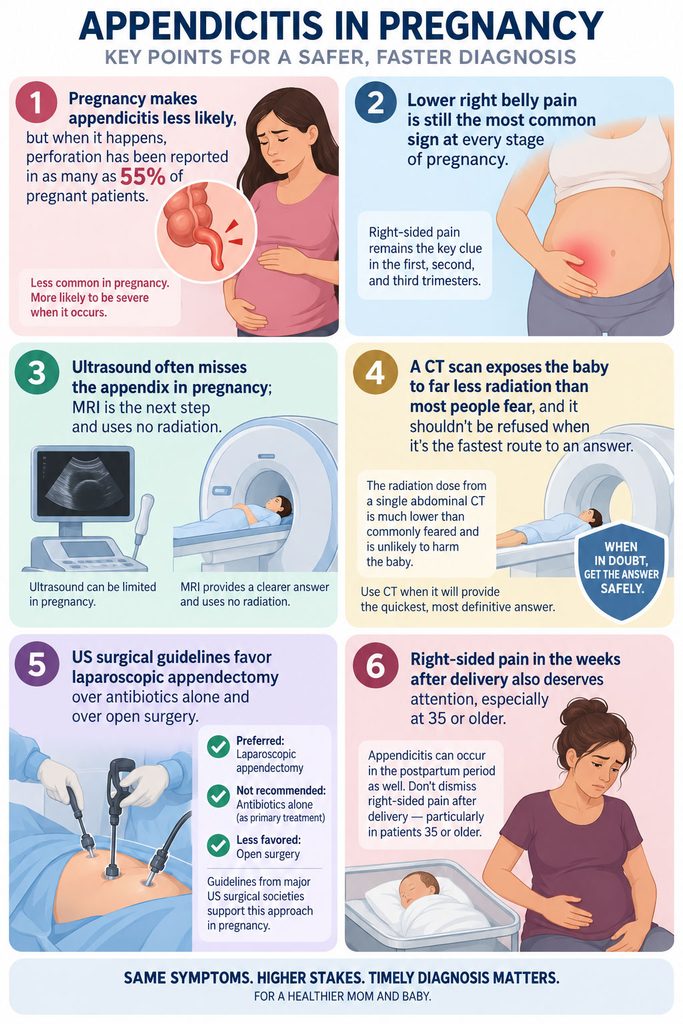
- Pregnancy makes appendicitis less likely, but when it happens, perforation has been reported in as many as 55% of pregnant patients.
- Lower right belly pain is still the most common sign at every stage of pregnancy.
- Ultrasound often misses the appendix in pregnancy; MRI is the next step and uses no radiation.
- A CT scan exposes the baby to far less radiation than most people fear, and it shouldn’t be refused when it’s the fastest route to an answer.
- US surgical guidelines favor laparoscopic appendectomy over antibiotics alone and over open surgery.
- Right-sided pain in the weeks after delivery also deserves attention, especially at 35 or older.
What Appendicitis During Pregnancy Is and How Common It Really Is
Your appendix is a small, finger-shaped pouch attached to the start of the large intestine on the lower right side. Appendicitis starts when that pouch gets blocked, usually by hardened stool or swollen lymph tissue, then swells and becomes inflamed.
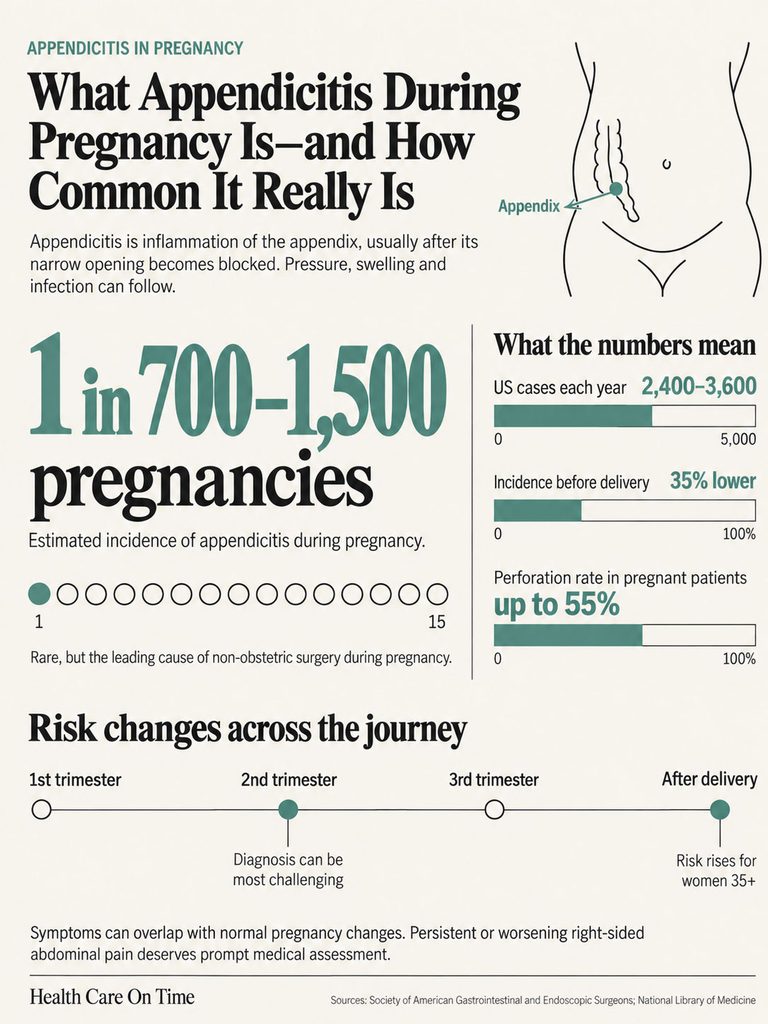
During pregnancy, it’s the leading reason for surgery that has nothing to do with the pregnancy itself. Published estimates range from about 1 in 700 to 1 in 1,500 pregnancies.
In real numbers: the CDC counted 3,606,400 US births in 2025. At 1 in 1,000 to 1 in 1,500 pregnancies, that’s roughly 2,400 to 3,600 American women facing appendicitis while pregnant each year.
Our medical review team checked every figure in this guide against its original study. Incidence numbers vary because studies count different things: diagnoses, surgeries, or confirmed cases.
Lower Odds, Higher Stakes
The best population data suggest pregnancy is mildly protective. In an English study of 362,219 pregnancies published in Annals of Surgery, appendicitis was 35% less common before delivery than outside pregnancy, with the lowest rate in the third trimester.
The catch is what happens once it starts. Emergency medicine researchers report perforation rates as high as 55% in pregnant women, compared with 4% to 19% in the general population.
Why? Nausea, belly aches, and a higher white blood cell count are all normal in pregnancy. So women wait, doctors hesitate over imaging, and the appendix has more time to burst.
Which Trimester Carries the Most Risk
Most cases show up in the second trimester. It’s also the trickiest to diagnose: the English cohort found the highest rate of surgery that turned up a normal appendix in the second trimester and the lowest in the third.
The third trimester has the lowest rate but the hardest exam. A large uterus sits between the appendix and the belly wall, which blunts the tenderness doctors rely on.
Appendicitis After Delivery
Most pages stop at delivery. They shouldn’t. For women 35 and older, the risk of appendicitis in the months after birth was 84% higher than outside pregnancy.
After birth, right-sided pain is easy to blame on cramping, C-section healing, or constipation. If it’s steady, builds over hours, and stays on the right, get it checked. Our guide to lower right abdominal pain covers causes beyond pregnancy.
7 Signs of Appendicitis During Pregnancy
No single symptom proves appendicitis. The pattern does: pain that starts, settles, and keeps getting worse over hours, with other signs lining up behind it.
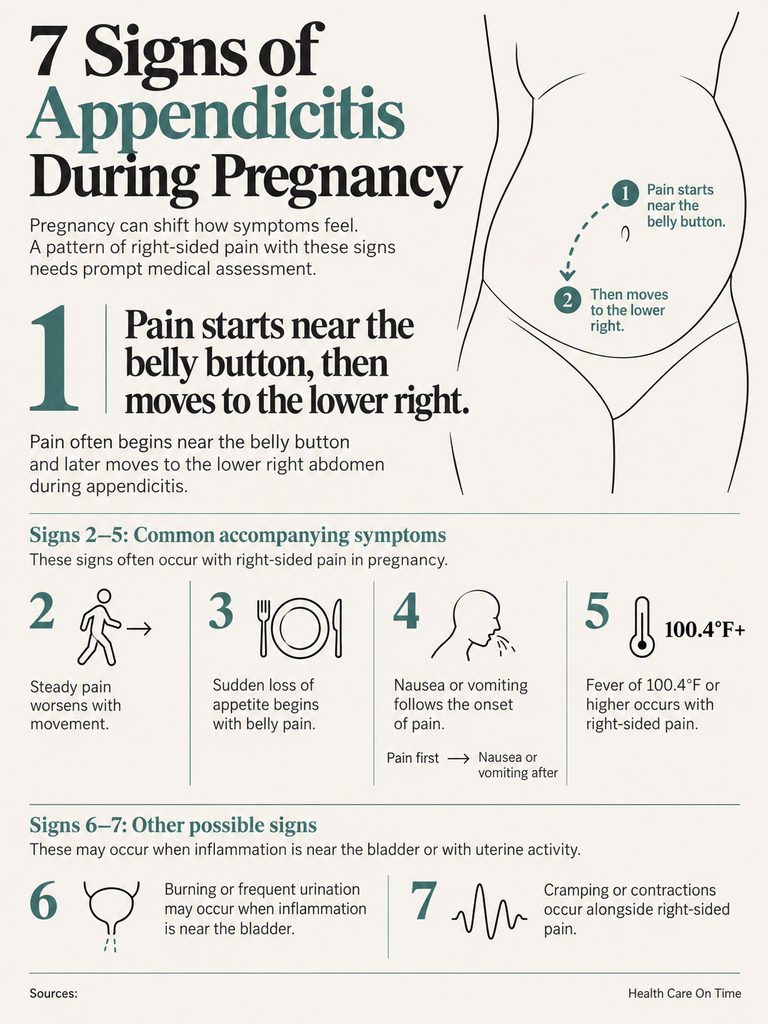
1. Pain That Starts Near Your Belly Button and Moves Right
A dull ache starts around the navel, then shifts over several hours to the lower right side and sharpens. Some women feel it only on the right from the start. Either way, new right-sided pain that doesn’t ease is the lead sign.
2. Steady Pain That Gets Worse When You Move
Appendicitis pain is constant, not a quick jab. Walking, coughing, or a bumpy car ride makes it worse because the inflamed appendix irritates the belly lining. Many women end up walking hunched over or lying very still.
3. Sudden Loss of Appetite
Appetite swings are normal in pregnancy. Losing all interest in food at the same moment belly pain starts is different, and it’s one of the more reliable early clues.
4. Nausea or Vomiting That Starts After the Pain
Morning sickness usually comes early in the day and fades after the first trimester. With appendicitis, nausea tends to follow the pain rather than lead it. If vomiting returns later in pregnancy alongside belly pain, treat it as new.
5. A Fever, Even a Low One
A temperature of 100.4°F or higher with right-sided pain needs same-day care. A normal reading doesn’t rule appendicitis out, though, as explained below.
6. Burning or Frequent Urination
An inflamed appendix can sit near the bladder or ureter, causing burning or frequent urination. That’s how appendicitis gets mislabeled: white or red cells in the urine can steer doctors toward a kidney infection. If you’re on antibiotics for a UTI and right-sided pain keeps building, go back in.
7. Cramping or Contractions With Right-Sided Pain
Irritation near the uterus can trigger tightening or contractions. Right-sided pain plus contractions, bleeding, or leaking fluid needs labor and delivery triage now, whatever the cause. Our guide to bleeding during pregnancy explains which patterns are urgent.
Does the Pain Really Move Up as Your Baby Grows?
This is the most repeated claim online about appendicitis during pregnancy. It’s mostly wrong.
What the 1932 Study Actually Measured
According to Mayo Clinic’s emergency medicine journal club, the idea comes from one 1932 study by Baer, and the women in it were pregnant but did not have appendicitis. It tracked where the appendix sits as the uterus grows. It never measured where appendicitis hurts.
Later clinical data tell a different story. An Iranian surgical series found most pregnant patients with appendicitis had right lower quadrant pain at every gestational age, and its authors warned the upper-right myth delays diagnosis.
What Later Pregnancy Can Change
The appendix does shift somewhat as the uterus grows, and late in pregnancy some women feel pain higher up or toward the right flank. Tenderness may be more spread out, and guarding weaker, because the stretched belly muscles are looser.
The practical rule: any new, steady pain on your right side, low or high, deserves a same-day evaluation.
Why Fever and White Blood Cell Counts Can Fool You
About one in four pregnant women with appendicitis never runs a fever. White blood cell counts also rise naturally in pregnancy, so a “high” CBC result means little on its own.
Not every pregnant patient with appendicitis tops 16,000 cells/µL, although about three in four show a left shift, meaning more young immune cells, on the differential.
Patients who book a CBC through HealthCareOnTime during pregnancy often ask whether an elevated white count means infection. Usually it doesn’t; the symptom pattern matters more. Our guides to high WBC and immature granulocytes explain pregnancy-specific ranges.
Appendicitis or Normal Pregnancy Pain? How to Tell the Difference
Belly pain in pregnancy is common, and most of it is harmless. This table compares appendicitis with the conditions it’s most often confused with.
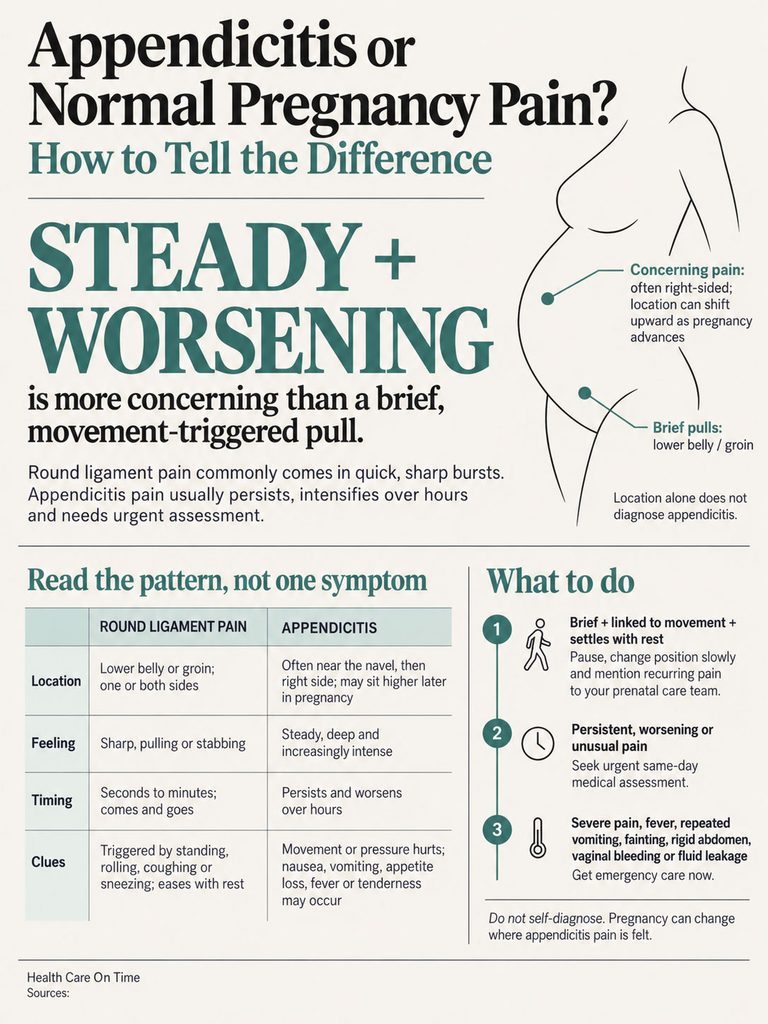
| Condition | Where It Hurts | How the Pain Behaves | Telltale Clues | How Fast to Act |
| Appendicitis | Starts near belly button, settles lower right; can feel higher or in the right flank late in pregnancy | Steady, builds over 6 to 24 hours, worse with walking or coughing | Appetite loss, nausea after pain starts, low fever or none | ER or labor and delivery triage now |
| Round ligament pain | Groin or lower belly, one or both sides | Sharp, brief pull lasting seconds to minutes | Triggered by standing, rolling over, sneezing; eases with rest; most common in the second trimester | Mention at next visit; call if it doesn’t settle |
| UTI or kidney infection | Low pelvis (bladder) or back and side (kidney) | Burning with urination; kidney pain is a deep ache | Frequency and urgency; kidney infection brings fever and chills | Same-day call; fever means go now |
| Ovarian torsion | Low on one side of the pelvis | Sudden, severe, may come in waves | Vomiting; more likely early in pregnancy or with an ovarian cyst or IVF | ER now |
| Placental abruption | Belly or low back | Constant pain with a hard, tender uterus | Vaginal bleeding (not always), contractions, fewer baby movements | Labor and delivery now |
| Gallbladder attack or HELLP syndrome | Upper right belly under the ribs | Gallbladder pain after fatty meals; HELLP pain steady | HELLP: headache, vision changes, high blood pressure, usually third trimester | Same day for gallbladder; now for HELLP signs |
| Gas or constipation | Moves around the belly | Crampy, comes and goes | Relieved by passing gas or a bowel movement; no fever | Home care; call if it persists |
| Preterm labor | Low belly, pelvis, low back | Regular tightening that doesn’t stop with rest | Pelvic pressure, fluid leak, or spotting before 37 weeks | Labor and delivery now |
Round Ligament Pain vs Appendicitis
Patients commonly ask us how to tell round ligament pain from something serious. It’s the most common mix-up, and it happens in hospitals too.
One published case report describes a young woman at 16 weeks who was sent home with a round ligament pain diagnosis while her right-sided pain continued.
The difference is behavior. Round ligament pain is a sharp, brief pull when you stand, roll over, or sneeze, and it eases with rest. Appendicitis pain stays, builds over hours, and brings other symptoms with it.
Red Flags That Mean Go Now
- Right-sided belly pain that lasts more than a few hours and keeps getting worse
- Pain with a fever of 100.4°F or higher, chills, or vomiting
- Pain so strong you can’t walk upright or get comfortable
- Pain with vaginal bleeding, leaking fluid, or regular contractions
- A tender belly that hurts more when pressure is released
- Fewer baby movements than usual (after about 28 weeks)
- Fast heartbeat, dizziness, or feeling faint
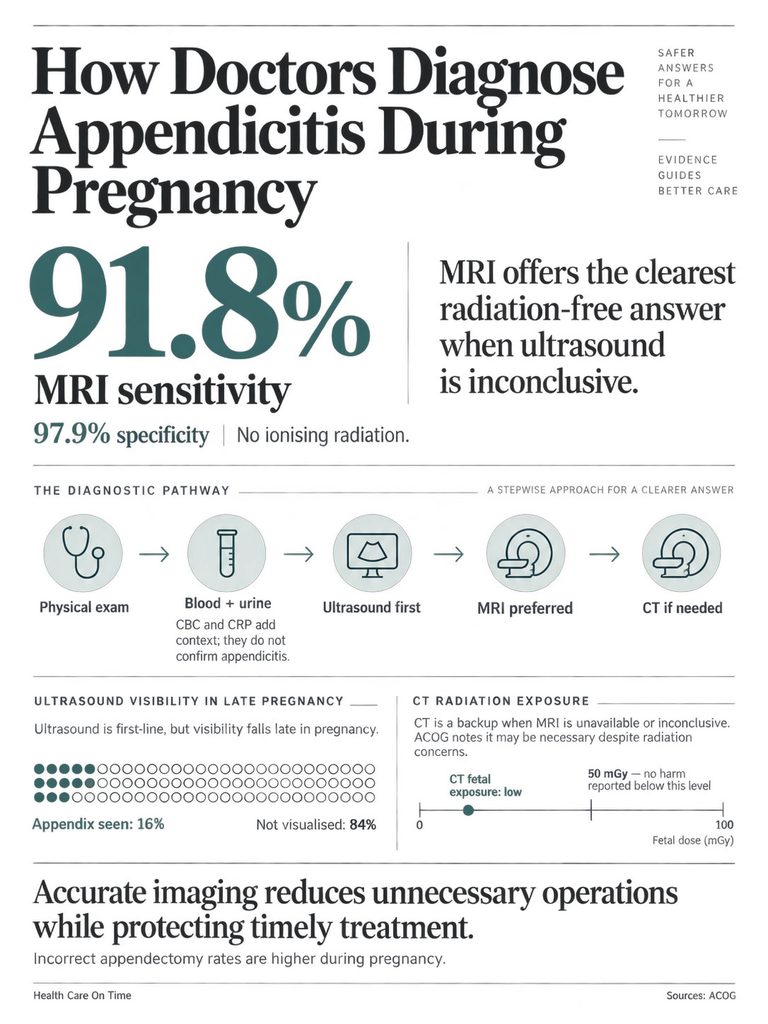
How Doctors Diagnose Appendicitis During Pregnancy
Expect a physical exam, blood and urine tests, a check of the baby’s heartbeat, and imaging. Imaging does most of the work, because the exam and lab tests are less reliable in pregnancy.
Blood and Urine Tests
A CBC and often a C-reactive protein (CRP) test add context, but neither confirms appendicitis. A urinalysis checks for infection and can mislead, as covered above. Our high CRP guide explains how inflammation markers behave.
Ultrasound Comes First
Ultrasound uses no radiation, so it’s the usual first test. The limitation is visibility. One study of 471 pregnant patients found ultrasound saw the appendix only 16% of the time, and body mass index strongly predicted visibility in later trimesters.
An ultrasound that simply didn’t find the appendix is not the same as a clean result. Ask which one you got.
MRI Is the Next Step
MRI is now the preferred follow-up test. A meta-analysis of 19 studies found 91.8% sensitivity and 97.9% specificity for appendicitis in pregnant patients, with no radiation.
A Cochrane review covering 21 studies and 2,282 pregnant women reported 96% sensitivity and 97% specificity. Most appendicitis MRIs don’t need contrast dye, and ACOG advises using gadolinium only when it clearly improves the diagnosis.
When a CT Scan Is the Right Call
Not every hospital can run an MRI at 2 a.m. When MRI isn’t available or results are unclear, a CT scan may be the fastest safe route. ACOG says radiation-based tests shouldn’t be withheld from a pregnant patient when they’re needed.
The Radiological Society of North America makes the same point: a missed or delayed diagnosis may threaten mother and baby more than the radiation does.
What the Radiation Numbers Mean for Your Baby
Our medical reviewers see the same fear again and again: that one CT scan will harm the baby. Here’s the math.
ACOG-based figures put the fetal dose at about 1.3 to 35 mGy for an abdominal CT and 10 to 50 mGy for a pelvic CT, and no fetal harm has been reported below 50 mGy. A baby absorbs about 1 mGy of natural background radiation over a typical pregnancy.
The main long-term concern is childhood leukemia. An exposure of 10 to 20 mGy may raise that risk 1.5 to 2 times over a baseline of about 1 in 3,000, which still leaves roughly a 99.97% chance of no effect.
| Test | Radiation to the Baby | Accuracy for Appendicitis in Pregnancy | Role in the Workup |
| Ultrasound | None | Finds the appendix in about 16% of pregnant patients | First test; a positive result helps, a “not seen” result isn’t reassuring |
| MRI (no contrast) | None | 91.8% to 96% sensitivity; 97% to 97.9% specificity | Preferred next step after an unclear ultrasound |
| CT abdomen | 1.3 to 35 mGy | About 94% sensitivity, 95% specificity (general population) | Used when MRI isn’t available or results are unclear |
| CT pelvis | 10 to 50 mGy | Part of an abdomen and pelvis scan | Dose can be lowered with pregnancy protocols |
| CBC, CRP, urinalysis | None | Supportive only; can mislead in pregnancy | Adds context; never rules appendicitis in or out alone |
The Cost of Guessing Wrong
Removing a healthy appendix isn’t harmless in pregnancy. A California study found 23% of appendectomies in pregnant women removed a normal appendix, versus 18% in nonpregnant women, and fetal loss followed 4% of those negative operations.
Good imaging cuts those unnecessary operations without delaying the ones that are needed.
Treatment Options: Surgery, Antibiotics, and What Guidelines Say
The guiding principle for treating appendicitis during pregnancy comes from ACOG: a pregnant patient should never be denied needed surgery or have it delayed, because that can harm both mother and baby.
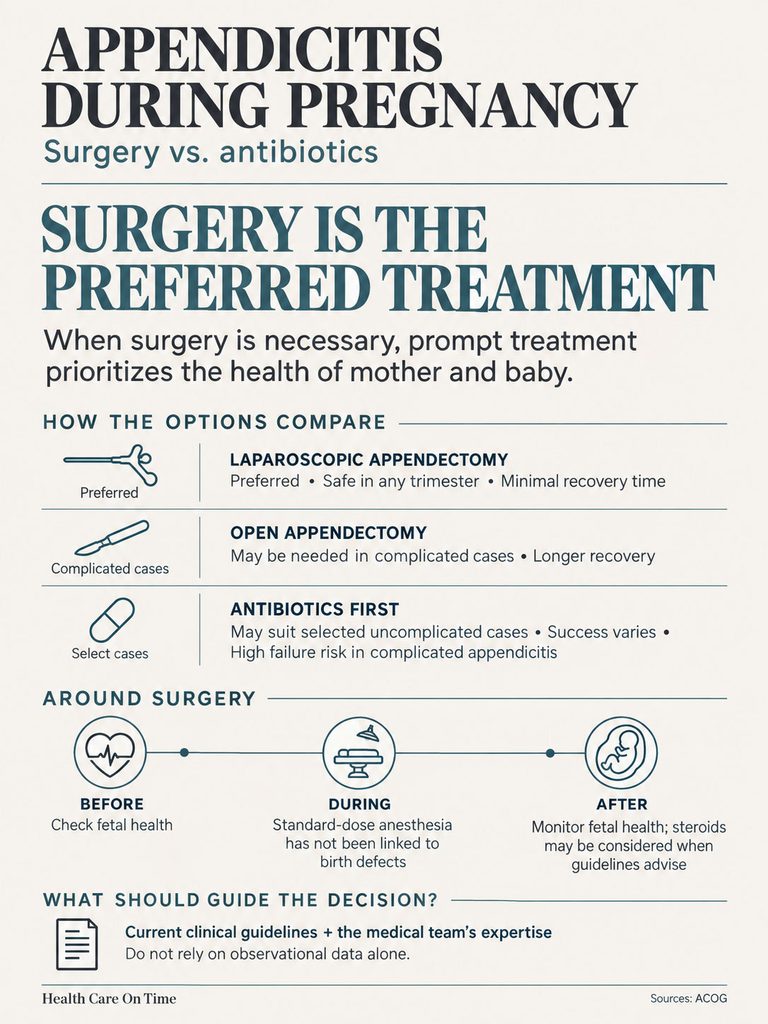
Laparoscopic Appendectomy
Laparoscopic (“keyhole”) surgery uses a camera and a few small cuts. The 2024 SAGES guideline made conditional recommendations for appendectomy over nonoperative care, and for laparoscopic over open surgery.
Earlier SAGES guidance states laparoscopy is safe in any trimester, recommends tilting patients past the first trimester onto the left side to protect blood flow, and supports carbon dioxide pressure of 10 to 15 mmHg.
It’s also what US hospitals mostly do. In a Queens, New York series of 44 pregnant patients, 78% of those treated surgically had laparoscopic appendectomy, and no mother or baby died.
Open Appendectomy
Open surgery uses one larger cut. Surgeons may choose it when the appendix has burst with widespread infection, when the uterus leaves little working room late in pregnancy, or when laparoscopy isn’t available. Recovery takes longer, but it’s a safe, standard option.
Antibiotics Alone: Where the Evidence Stands
Antibiotics-first treatment works for many nonpregnant adults. In pregnancy, the data are thinner and point in different directions.
Uncomplicated Appendicitis
An Italian study of 1,231,040 deliveries found 38.46% of uncomplicated cases were treated without surgery, with no significant difference in outcomes for babies. A Japanese nationwide study of 3,158 patients found second-trimester appendectomy tied to higher odds of preterm delivery, preterm labor, or pregnancy loss (OR 2.91).
US claims data point the other way. A University of Washington thesis of 3,735 pregnant patients linked second-trimester antibiotics-first care to more adverse outcomes, 28% versus 18%. It’s a thesis, not a peer-reviewed paper, so weigh it accordingly.
Our medical team’s reading: antibiotics alone may be reasonable for a carefully chosen patient with imaging-confirmed, uncomplicated appendicitis and close monitoring. It isn’t the default.
Burst (Complicated) Appendicitis
Here the US data are clearer. Among 8,087 pregnant women with complicated appendicitis, antibiotics-first care succeeded in 954 and failed in 2,646, who then needed delayed surgery. That’s nearly three failures for every success.
Delayed surgery after failed antibiotics carried higher odds of preterm delivery, preterm labor, or pregnancy loss (OR 1.45), and even successful nonsurgical care carried higher odds of amniotic infection (OR 4.35) and sepsis (OR 1.52) compared with operating right away.
How Your Baby Is Protected During Surgery
No anesthetic drug in current use has been shown to cause birth defects at standard doses, at any stage of pregnancy. An obstetrician should be part of the plan before surgery.
If your baby could survive outside the womb, ACOG advises considering steroid shots for the baby’s lungs and watching closely for preterm labor afterward. Guidelines call for checking the fetal heart rate before and after surgery and using labor-stopping drugs only if signs of preterm labor appear.
What the Evidence Can and Can’t Tell You
Every pregnancy figure in this guide comes from observational studies, not randomized trials in pregnant women. Here’s what that means in practice.
- The largest US trial of antibiotics versus surgery, CODA, enrolled 1,552 adults and excluded pregnant women. Its widely quoted finding, that about 7 in 10 antibiotic patients avoided surgery, doesn’t transfer to pregnancy.
- The California surgery data come from 1995 to 2002, before MRI was routine. Today’s rate of unnecessary surgery is likely lower.
- The English, Italian, and Japanese cohorts are large but reflect other health systems, and the US claims analysis hasn’t been peer reviewed.
- In these studies, doctors chose between antibiotics and surgery based on how sick patients looked, which can tilt comparisons in either direction.
The takeaway: current US guidelines and your care team’s judgment should drive the decision. Ask what’s behind their recommendation.
Risks to Mom and Baby, and How Timing Changes Them
These numbers show why speed matters more than any single test or treatment choice.
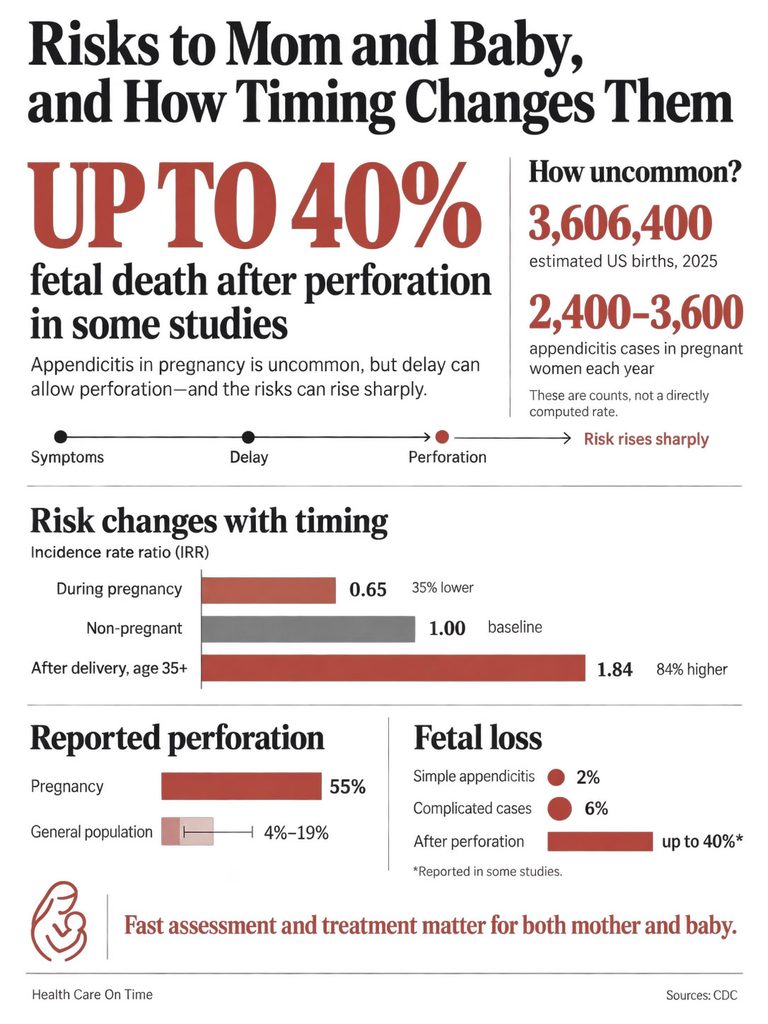
| Measure | Figure | Source |
| US births, 2025 | 3,606,400 | CDC NCHS, Vital Statistics Rapid Release No. 43 |
| Estimated US cases each year | About 2,400 to 3,600 | Calculated from 1 in 1,000 to 1 in 1,500 pregnancies |
| Appendicitis risk before delivery vs not pregnant | 35% lower (IRR 0.65) | Zingone, Annals of Surgery (England, 362,219 pregnancies) |
| Risk after delivery, women 35+ | 84% higher (IRR 1.84) | Zingone, Annals of Surgery |
| Reported perforation rate | Up to 55% pregnant vs 4% to 19% general population | Lotfipour, CPCEM 2018 |
| Appendix seen on ultrasound | 16% of 471 pregnant patients | Abdominal Radiology 2020 |
| MRI accuracy | 91.8% sensitivity, 97.9% specificity | Kave, World J Emerg Surg 2019 (19 studies) |
| Negative appendectomy rate | 23% pregnant vs 18% nonpregnant | McGory, J Am Coll Surg 2007 (California, 1995 to 2002) |
| Fetal loss by appendix finding | 2% simple, 4% normal appendix, 6% complicated | McGory, J Am Coll Surg 2007 |
| Burst appendix treated with antibiotics first | 954 succeeded, 2,646 failed and needed surgery | Matsushima, JAMA Netw Open 2022 (US NIS, 8,087 women) |
Why Delay Is the Real Danger
The California data show a clear gradient: fetal loss ran 2% with simple appendicitis and 6% with complicated appendicitis, and preterm delivery 4% versus 11%.
Older hospital series looked worse, with some reporting fetal death rates of 35% to 40% after perforation, while maternal death stayed very rare. Better imaging and surgery have improved those numbers, but the lesson holds: a burst appendix is far more dangerous than an operation.
In the general population, rupture risk stays around 2% for the first 36 hours, then climbs about 5% with each added 12 hours, according to StatPearls. Pregnancy often adds hours of delay before anyone suspects appendicitis.
Risks by Trimester
- First trimester: Background miscarriage risk is highest now, with or without surgery. Don’t let “wait until the second trimester” advice delay emergency care.
- Second trimester: The most common time for appendicitis and the traditional “best window” for surgery. Evidence on antibiotics versus surgery conflicts most here.
- Third trimester: Diagnosis is hardest and preterm labor risk after surgery is highest. Near term, your team may discuss delivery timing along with treatment.
Recovery After an Appendectomy While Pregnant
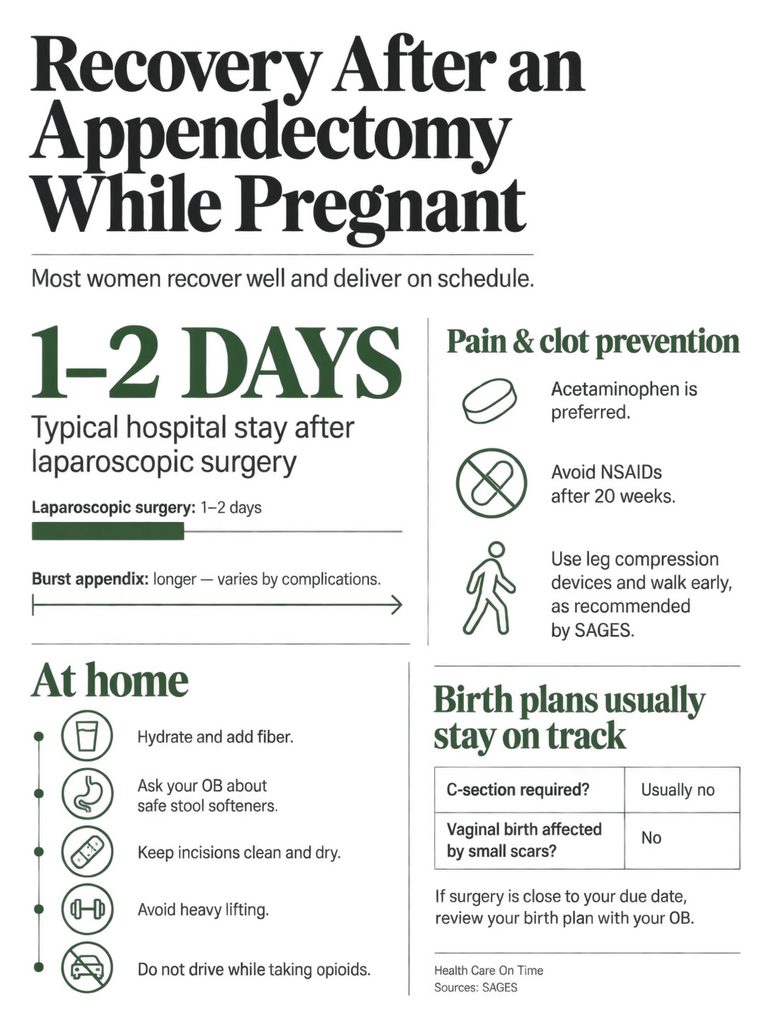
Most women recover well, and most go on to deliver on schedule.
In the Hospital
After laparoscopic surgery for uncomplicated appendicitis, many women go home within a day or two. A burst appendix usually means a longer stay and several days of IV antibiotics.
Pain control starts with acetaminophen, with short-term opioids if needed. The FDA advises avoiding NSAIDs such as ibuprofen and naproxen from around 20 weeks, because they can cause rare but serious kidney problems in the baby and low amniotic fluid.
Pregnancy raises clot risk, so expect leg compression devices and early walking, both of which SAGES recommends for pregnant surgical patients.
The First Two Weeks at Home
Among the questions our team receives from recovering patients, constipation and pain control come up most. Drink plenty of water, add fiber gradually, and ask your OB which stool softener is safe. Our appendicitis diet guide covers what to eat.
Keep incisions clean and dry, skip heavy lifting (including older children) for the period your surgeon sets, and don’t drive while taking opioid pain medicine.
Call your doctor right away for:
- A fever of 100.4°F or higher
- Pain that gets worse instead of better
- Redness, swelling, or pus at an incision
- Contractions, bleeding, or leaking fluid
- Fewer baby movements than usual
Labor and Delivery After Surgery
An appendectomy alone usually isn’t a reason for a C-section. Small laparoscopic scars don’t interfere with a vaginal birth. If surgery happens close to your due date, review your birth plan with your OB.
What to Do Right Now If You Suspect Appendicitis
Use this table as a quick guide to appendicitis during pregnancy. When in doubt, get seen.
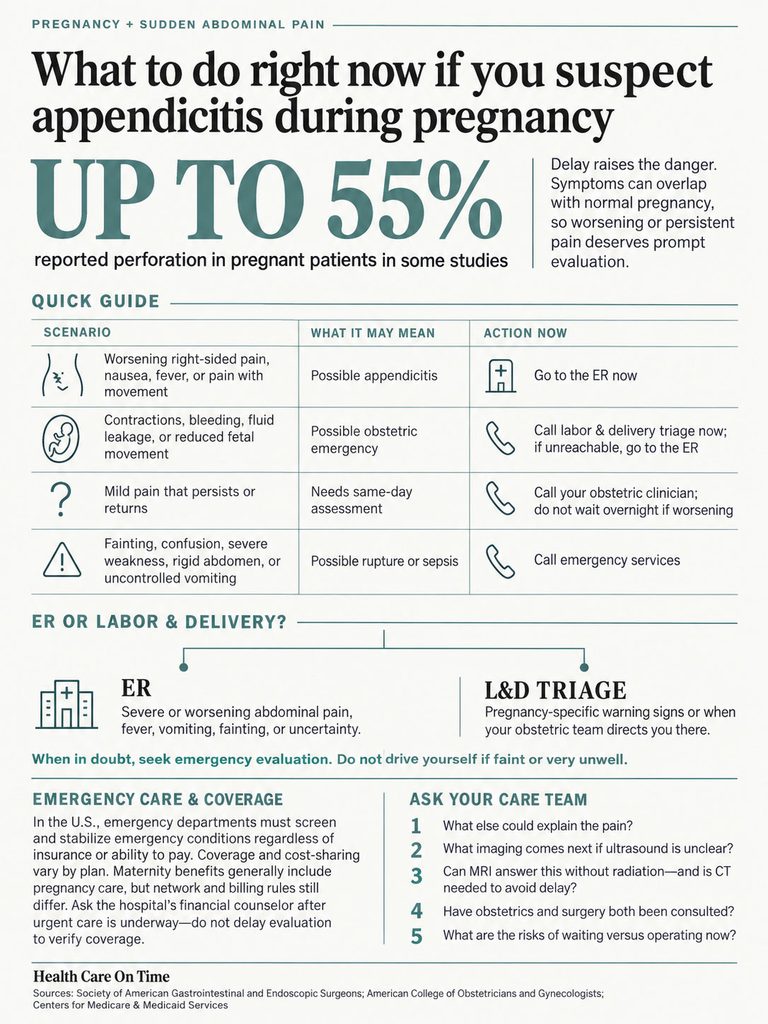
| Scenario | What It May Mean | What to Do Now |
| Brief, sharp groin pull when standing or sneezing that fades with rest | Likely round ligament pain | Rest, change position slowly, and mention it at your next prenatal visit |
| Right-sided pain lasting 2 to 4 hours that isn’t easing, no other symptoms | Could be early appendicitis or a urinary or bowel cause | Call your OB’s line today for same-day evaluation |
| Steady right-sided pain plus appetite loss, nausea, or vomiting | Appendicitis is a real possibility | Go to the ER or labor and delivery triage now; don’t eat or drink |
| Right-sided pain with fever of 100.4°F or higher | Infection, possibly appendicitis or kidney infection | Go now and bring your prenatal records |
| Pain with contractions, bleeding, or leaking fluid (20+ weeks) | Preterm labor, abruption, or appendicitis irritating the uterus | Labor and delivery triage now |
| Ultrasound “didn’t see the appendix” but pain continues | Test was inconclusive, not negative | Ask whether MRI is available; don’t go home without a plan |
| CT recommended because MRI isn’t available | Fastest route to a diagnosis | Ask about the estimated fetal dose, then proceed; the risk is small |
| Offered antibiotics instead of surgery | Option for selected uncomplicated cases | Ask whether imaging confirms it’s uncomplicated and what happens if it fails |
| Steady right-sided pain within weeks of delivery | Postpartum appendicitis, especially 35+ | Get seen the same day; don’t assume it’s C-section healing |
ER or Labor and Delivery Triage?
Many US hospitals send pregnant patients past about 20 weeks straight to labor and delivery triage, where the baby can be monitored while surgeons are called. Call your OB’s after-hours line on the way; they’ll tell you where to go.
What Insurance Covers in an Emergency
Under the federal EMTALA law, hospital emergency departments must screen and stabilize anyone with an emergency, including pregnant women, regardless of ability to pay.
Marketplace and most employer plans must cover emergency services and maternity care, and the No Surprises Act protects you from most surprise out-of-network bills for emergency care. Medicaid covers pregnancy-related care in every state, so ask the hospital about pregnancy Medicaid if you’re uninsured.
Questions to Ask Your Care Team
- Did the ultrasound actually show the appendix, or just not find it?
- Is an MRI available, and how soon?
- If a CT is recommended, what’s the estimated dose to the baby?
- Is the appendix inflamed only, or has it burst?
- Why surgery (or antibiotics) in this case, and what are the risks of each?
- Will an obstetrician be involved, and will the baby be monitored?
What Not to Do While You Wait
- Don’t take laxatives or use enemas; they can add pressure on an inflamed appendix.
- Don’t eat or drink if surgery is possible; an empty stomach makes anesthesia safer.
- Don’t take ibuprofen or naproxen, especially after 20 weeks.
- Don’t use a heating pad to wait it out; it can mask worsening pain.
- Don’t drive yourself if pain is severe.
Frequently Asked Questions
Can appendicitis cause a miscarriage?
It can, mainly if the appendix bursts. In California data, fetal loss was 2% with simple appendicitis and 6% with complicated appendicitis. Prompt diagnosis and surgery keep the risk low, which is why new, steady right-sided pain during pregnancy needs same-day medical care.
Is an appendectomy safe during pregnancy?
Yes. ACOG says needed surgery should never be denied or delayed during pregnancy, and SAGES considers laparoscopy safe in any trimester. Standard anesthesia drugs haven’t been shown to cause birth defects. An obstetrician joins the team, and the baby’s heart rate is checked before and after.
Can antibiotics treat appendicitis during pregnancy?
Sometimes, for carefully selected uncomplicated cases, but results are mixed. Italian data showed similar baby outcomes, while US claims data suggested more problems in the second trimester. For a burst appendix, most antibiotics-first attempts failed. The main US antibiotics trial excluded pregnant women, and guidelines still favor surgery.
Where does appendicitis hurt when pregnant?
Usually the same place as always: pain starts near the belly button and settles in the lower right belly. Later in pregnancy it can feel higher or toward the right side and back. The claim that it moves under the ribs comes from a 1932 study of women without appendicitis.
How is round ligament pain different from appendicitis?
Round ligament pain is a sharp, brief pull in the groin or lower belly when you move, stand, or sneeze, and it eases with rest. Appendicitis pain is steady, builds over hours, and usually comes with appetite loss, nausea, or fever. Pain that doesn’t settle within an hour or two needs a call.
Is an MRI safe during pregnancy?
Yes. MRI uses no radiation and is considered safe in all three trimesters. For appendicitis it’s highly accurate, with pooled sensitivity above 90% in pregnant patients. Contrast dye (gadolinium) usually isn’t needed and is used only when it clearly improves the diagnosis.
Can a CT scan for appendicitis harm the baby?
The risk is small. An abdominal CT delivers about 1.3 to 35 mGy to the fetus, and no harm has been reported below 50 mGy. The main concern is a slight rise in childhood leukemia risk. A missed appendicitis is usually the bigger danger, so CT shouldn’t be refused when needed.
Which trimester is appendicitis most common in?
The second trimester has the most cases in most studies. English cohort data show appendicitis is least common in the third trimester, but that’s also when it’s hardest to diagnose, because the large uterus blunts the usual exam findings. Late-pregnancy right-sided pain still needs attention.
Can appendicitis happen right after giving birth?
Yes. In English data, women 35 and older had an 84% higher risk of appendicitis in the months after delivery than outside pregnancy. Postpartum right-sided pain is easy to blame on cramping or C-section healing, so steady, worsening pain deserves a same-day exam.
Is a C-section needed after appendicitis surgery?
Usually not. An appendectomy alone isn’t a reason for cesarean delivery, and small laparoscopic incisions don’t interfere with a vaginal birth. If surgery happens near your due date or with severe infection, your team may discuss delivery timing. Review your birth plan with your OB.
How long is recovery from an appendectomy during pregnancy?
After uncomplicated laparoscopic surgery, many women go home within a day or two and resume light activity in one to two weeks. A burst appendix often means a longer hospital stay and IV antibiotics. Avoid heavy lifting for the period your surgeon sets, and watch for fever or contractions.
Does a high white blood cell count mean appendicitis in pregnancy?
Not by itself. White counts rise normally during pregnancy, and many pregnant women with appendicitis don’t exceed 16,000 cells/µL. Doctors look at the full picture: symptoms, exam, the differential (a left shift), CRP, and imaging. A high count plus steady right-sided pain needs prompt evaluation.
Medical Disclaimer: This article is for general education and isn’t a substitute for professional medical advice, diagnosis, or treatment. Belly pain during pregnancy can signal an emergency. If you have severe or worsening pain, fever, bleeding, leaking fluid, or reduced baby movement, call 911 or go to the nearest emergency department or labor and delivery unit right away.
References
- CDC NCHS: Births, Provisional Data for 2025
- StatPearls: Appendicitis in Pregnancy
- Zingone F, et al. Risk of Acute Appendicitis in and Around Pregnancy. Annals of Surgery
- Lotfipour S, et al. Latest Considerations in Diagnosis and Treatment of Appendicitis During Pregnancy. CPCEM
- Mayo Clinic Emergency Medicine Journal Club: Appendicitis in Pregnancy
- Iranian Journal of Medical Sciences: Appendicitis Location in Pregnancy
- Abdominal Radiology: Ultrasound Visualization of the Appendix in Pregnancy
- Kave M, et al. MRI for Appendicitis in Pregnancy. World Journal of Emergency Surgery
- AAFP: Cochrane Review of MRI for Diagnosing Acute Appendicitis
- RSNA: Medical Imaging During Pregnancy
- First10EM: Diagnostic Imaging During Pregnancy and Lactation (ACOG Committee Opinion 723 summary)
- McGory ML, et al. Negative Appendectomy in Pregnant Women (summary)
- Matsushima K, et al. Complicated Appendicitis in Pregnancy. JAMA Network Open
- SAGES Guidelines for the Use of Laparoscopy During Pregnancy (2024)
- SAGES Guidelines for Laparoscopy During Pregnancy (2017)
- ASA and ACOG Committee Opinion 775: Nonobstetric Surgery During Pregnancy
- OpenAnesthesia: Nonobstetric Surgery in Pregnancy
- Surgery and Pregnancy Review (ACOG steroid and monitoring guidance)
- Ceresoli M, et al. Operative and Non-Operative Management of Appendicitis in Pregnancy. Archives of Gynecology and Obstetrics
- Impact of Gestational Age on Management of Appendicitis During Pregnancy: Japanese Nationwide Study
- Droullard D. Management of Appendicitis During Pregnancy. University of Washington Thesis
- Tian J, et al. Acute Appendicitis in Pregnancy, Is There a Role for Conservative Management?
- ClinicalTrials.gov: CODA Trial (NCT02800785)
- Cleveland Clinic Journal of Medicine: The CODA Trial
- FDA: Avoid NSAIDs in Pregnancy at 20 Weeks or Later
- JABFM: Appendicitis in Pregnancy Case Reports
- MDedge: Abdominal Pain in a Pregnant Woman