Pick up a zucchini and you are holding a pumpkin that got picked early. That is not a metaphor. Zucchini is Cucurbita pepo, the same species as the jack-o’-lantern on your porch in October.
Table of Contents
The cucumber sitting beside it in the produce bin is Cucumis sativus, a different genus entirely. They are cousins, not siblings, and nearly everything that matters about them follows from that one fact.
Quick Answer: Cucumber (Cucumis sativus) and zucchini (Cucurbita pepo) are different species that only look alike. Cucumber is crisp, waxy-skinned and eaten raw. Zucchini is a summer squash with dry, faintly ridged skin and a short stem, and it is almost always cooked. Per 100 grams the two are nearly identical in calories, but raw zucchini carries far more vitamin C and potassium while cucumber carries about four times more vitamin K.
Five differences that actually matter:
- Species. Cucumber is Cucumis sativus. Zucchini is Cucurbita pepo, the pumpkin species.
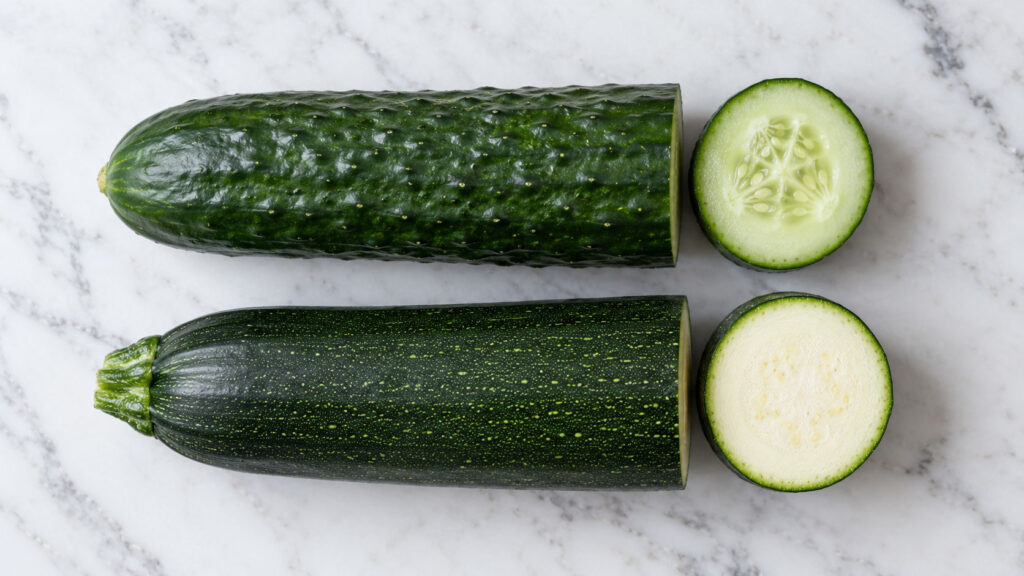
- Skin. Cucumber skin is waxy, cool and often bumpy. Zucchini skin is dry, faintly ridged and slightly gritty.
- Stem. Store-bought zucchini keeps a short woody stem. Cucumbers are sold trimmed clean.
- Heat. Zucchini browns and sweetens when cooked. Cucumber collapses into a watery mess.
- Nutrients. Zucchini leads on vitamin C, potassium and fiber. Cucumber leads on vitamin K and runs marginally lower in calories per gram.
At a Glance
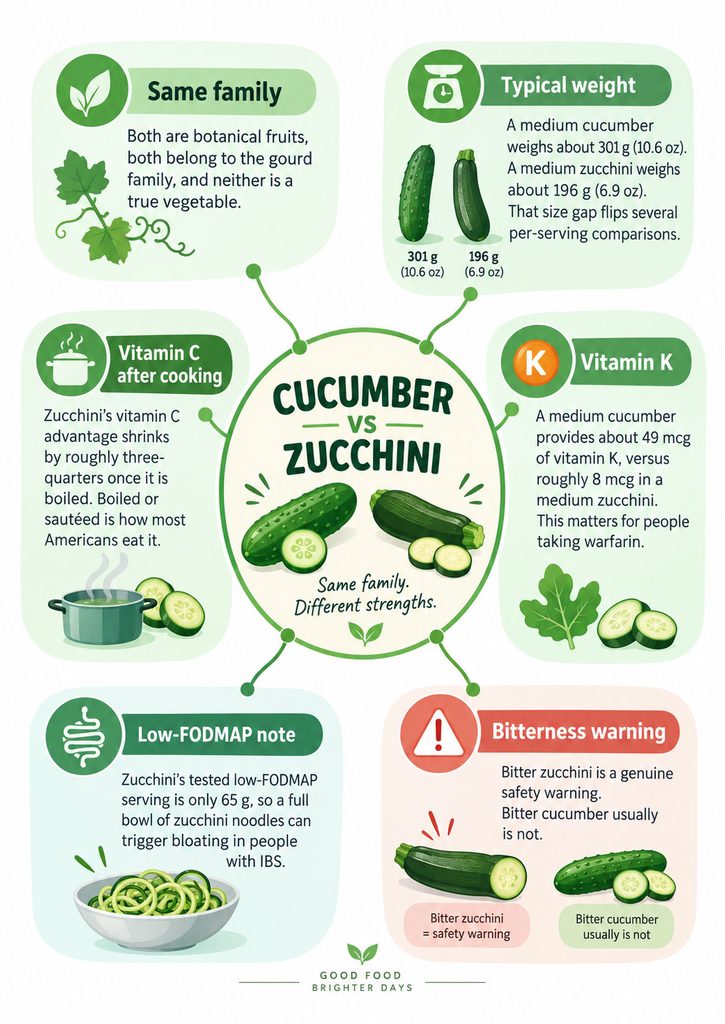
- Both are botanical fruits, both sit in the gourd family, and neither is a true vegetable.
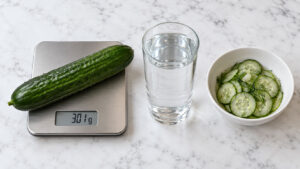
- A medium cucumber weighs about 301 grams (10.6 oz); a medium zucchini about 196 grams (6.9 oz). That size gap flips several per-serving comparisons.
- Zucchini’s vitamin C advantage shrinks by roughly three-quarters once it is boiled, and boiled or sautéed is how most Americans eat it.
- Cucumber supplies about 49 micrograms of vitamin K per medium fruit against roughly 8 micrograms in a medium zucchini, which matters on warfarin.
- Zucchini’s tested low-FODMAP serving is only 65 grams, so a full bowl of zucchini noodles can trigger bloating in people with IBS.
- Bitter zucchini is a genuine safety warning. Bitter cucumber usually is not.
Cucumber vs Zucchini at a Glance
The table below settles the question fastest, whether you are standing in the produce aisle or staring at a recipe substitution mid-cook.
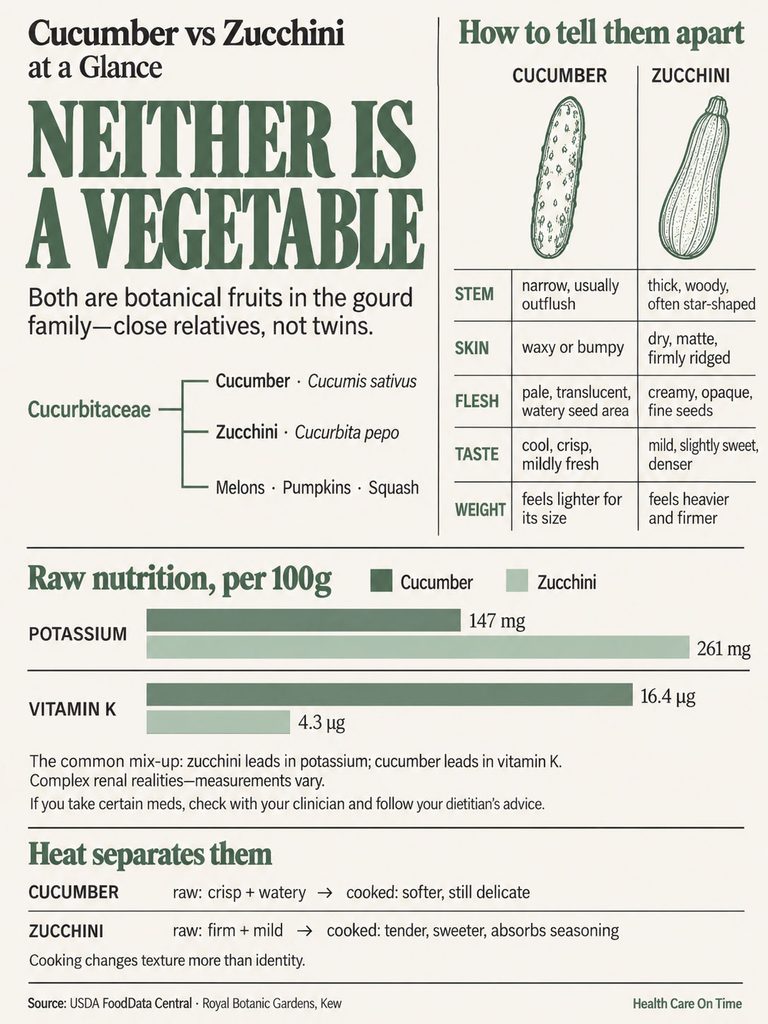
Table 1. Cucumber vs Zucchini: The Core Differences
| Feature | Cucumber | Zucchini | What it means for you |
| Species and genus | Cucumis sativus | Cucurbita pepo, same as pumpkin | They are not varieties of each other, so they behave differently in the kitchen |
| Skin and stem | Waxy, cool, often bumpy with tiny spines, no stem | Dry, faintly ridged, slightly gritty, short woody stem attached | The attached stem is the fastest identifier at the store |
| Flesh and seeds | Pale green, translucent, visible seed core down the center | Creamy white to pale yellow, opaque, small seeds blended into the flesh | Cut one open and the seed core settles it immediately |
| Taste raw | Cool, watery, faintly melon-like, occasionally bitter at the ends | Mild, grassy, slightly sweet, drier on the tongue | Cucumber reads refreshing; zucchini reads neutral |
| Typical medium weight | About 301 g (10.6 oz) | About 196 g (6.9 oz) | Per-fruit nutrition differs even when per-gram figures match |
| How Americans eat it | Raw in salads and sandwiches, or pickled | Cooked: sautéed, grilled, roasted, spiralized, baked into bread | Raw versus cooked drives the real nutrition comparison |
| Water content, raw | 95.23 g per 100 g with the peel on | 94.79 g per 100 g | The “cucumber is mostly water” gap is far smaller than advertised |
| Calories, raw | 15 kcal per 100 g | 17 kcal per 100 g | Both are effectively free calories at any realistic portion |
Source: USDA FoodData Central, records 168409 and 169291.
The five-second test at the grocery store
Look for the stem first. Grocery zucchini nearly always arrives with a short, hard, cut stem at one end, and sometimes a shriveled blossom scar at the other. Cucumbers are trimmed clean at both ends.
Then touch it. Cucumber skin feels cool, slick and waxed, because most American slicing cucumbers are coated to slow moisture loss. Zucchini skin feels dry and faintly sandy under the fingertips.
Finally, weigh it in your hand. A cucumber of the same length feels noticeably heavier and denser, because it holds more water inside a tighter seed core.
Patients booking tests with us mention produce mix-ups more often than you would expect, usually while they are logging potassium or vitamin K intake, and this pair causes more of them than any other.
Where the confusion actually comes from
Both plants belong to the Cucurbitaceae family, alongside watermelon, cantaloupe, pumpkin and ornamental gourds. Both grow from a flower and carry seeds, which makes both botanically fruits even though every supermarket and every dietitian treats them as vegetables.
The resemblance stops at the skin. Zucchini is far more closely related to a pumpkin than to the cucumber lying beside it, because zucchini and pumpkin are the same species harvested at different stages of maturity.
That relationship is not a piece of trivia. It explains the bitterness risk covered later, and it explains why zucchini takes heat well while cucumber does not.
The Nutrition Numbers, Straight From USDA
Here is what no page currently ranking for this query prints: the two raw records side by side, plus the cooked zucchini record, because almost nobody eats zucchini raw.
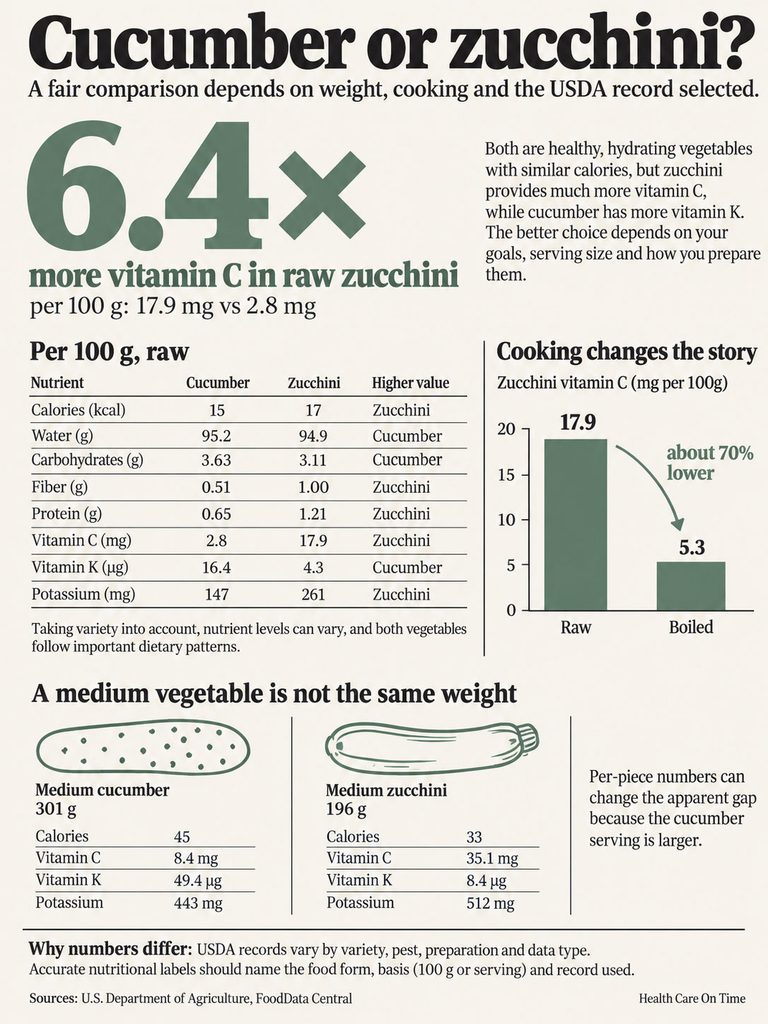
Table 2. USDA Nutrient Comparison per 100 Grams (3.5 oz)
| Nutrient | Cucumber, with peel, raw | Zucchini, raw with skin | Zucchini, cooked and boiled | Winner on the plate |
| Calories | 15 kcal | 17 kcal | 16 kcal | Effectively tied |
| Water | 95.23 g | 94.79 g | About 94.9 g | Effectively tied |
| Carbohydrate | 3.63 g | 3.11 g | 3.93 g | Zucchini, raw |
| Fiber | 0.5 g | 1.0 g | 1.4 g | Zucchini |
| Protein | 0.65 g | 1.21 g | 0.64 g | Zucchini, raw only |
| Vitamin C | 2.8 mg (3% DV) | 17.9 mg (20% DV) | 4.6 mg (5% DV) | Zucchini, but the gap closes when cooked |
| Vitamin K | 16.4 mcg (14% DV) | 4.3 mcg (4% DV) | About 4 mcg | Cucumber, by roughly 4 to 1 |
| Potassium | 147 mg (3% DV) | 261 mg (6% DV) | 253 mg (5% DV) | Zucchini |
| Lutein plus zeaxanthin | 23 mcg | 2,125 mcg | Retained, fat-soluble | Zucchini, decisively |
Source: USDA FoodData Central records 168409 (cucumber with peel, raw), 169291 (zucchini raw with skin), 169293 (zucchini boiled and drained).
Two results jump out. Raw zucchini holds roughly six times the vitamin C of cucumber and nearly double the potassium, and it carries close to ninety times the lutein and zeaxanthin, the two carotenoids that concentrate in the retina.
Cucumber wins exactly one nutrient outright, and it happens to be the clinically loaded one. Vitamin K, at 16.4 micrograms per 100 grams, runs about four times higher than zucchini’s 4.3 micrograms.
Our medical reviewers flag that row every time this comparison comes up, because vitamin K is the nutrient most likely to interact with a prescription a reader is already taking.
Why every website gives you a different number
Search “zucchini calories” and you will be told 15, 16, 17, 19, 21 and 27, all citing USDA. Those pages are not lying. They are quoting different records and forgetting to say which.
Table 3. Why Page One Disagrees With Itself
| Number you will see | Which USDA record it comes from | What pages usually call it | The honest label |
| Cucumber, 15 kcal | FDC 168409, with peel, raw | “Cucumber” | Cucumber with peel, per 100 g |
| Cucumber, about 12 kcal | Peeled cucumber record | “Cucumber” | Peeled cucumber, per 100 g |
| Cucumber, 96% water | Peeled record, 96.73 g water | “Cucumbers are 96 percent water” | True only after you peel it |
| Cucumber, 147 vs 169.6 mg potassium | FDC 168409 vs FDC 2346406 | “Cucumber potassium” | Two separate lab analyses of the same food |
| Zucchini, 17 kcal | FDC 169291, raw with skin | “Zucchini per 100 g” | Correct for raw, per 100 g |
| Zucchini, 21 kcal | Same record, 1 cup chopped at 124 g | Often printed as “per 100 g” | Per cup, not per 100 g |
| Zucchini, 16 kcal | FDC 169293, boiled and drained | Rarely labeled at all | Cooked, per 100 g |
The water claim deserves its own correction, because it drives the entire “cucumber is the hydrating one” narrative. With the peel on, cucumber is 95.23% water and zucchini is 94.79%.
That is a gap of under half a percentage point, not the three or four points repeated across food blogs. The widely quoted 96% figure comes from the peeled record, where water rises to 96.73 grams per 100 grams.
The comparison nobody runs: raw cucumber versus cooked zucchini
Every competing page compares raw to raw, then admits in the next paragraph that cucumbers are eaten raw while zucchini is eaten cooked. That compares a food you will eat against a food you will not.
Run it honestly. USDA’s boiled zucchini record lists vitamin C at 4.6 milligrams per 100 grams against 17.9 milligrams raw, a drop of roughly three-quarters.
Now scale it to real portions. A medium cucumber at 301 grams supplies about 8.4 milligrams of vitamin C. A 180 gram cup of cooked zucchini supplies about 8.3 milligrams.
The six-to-one advantage collapses to a tie the moment the pan gets hot. Vitamin C is water soluble and heat sensitive, so it leaches into cooking water and degrades under sustained heat.
Per 100 grams versus per whole vegetable
Serving size quietly rewrites the scoreboard, and this is where most head-to-head comparisons quietly mislead.
A medium cucumber weighs about 301 grams. A medium zucchini weighs about 196 grams, roughly a third less.
Run the per-fruit math and potassium nearly evens out, at about 442 milligrams for the cucumber against about 512 milligrams for the zucchini. Vitamin K goes the other direction and widens, to roughly 49 micrograms against 8.
For the full portion breakdown on cucumbers by size, cup and slice, our companion piece on cucumber calories and USDA weights carries every published gram weight.
Which One Is Actually Healthier?
Neither is a health food in the sense of moving a lab value on its own. Both are volume, water and a modest nutrient contribution at almost no caloric cost.
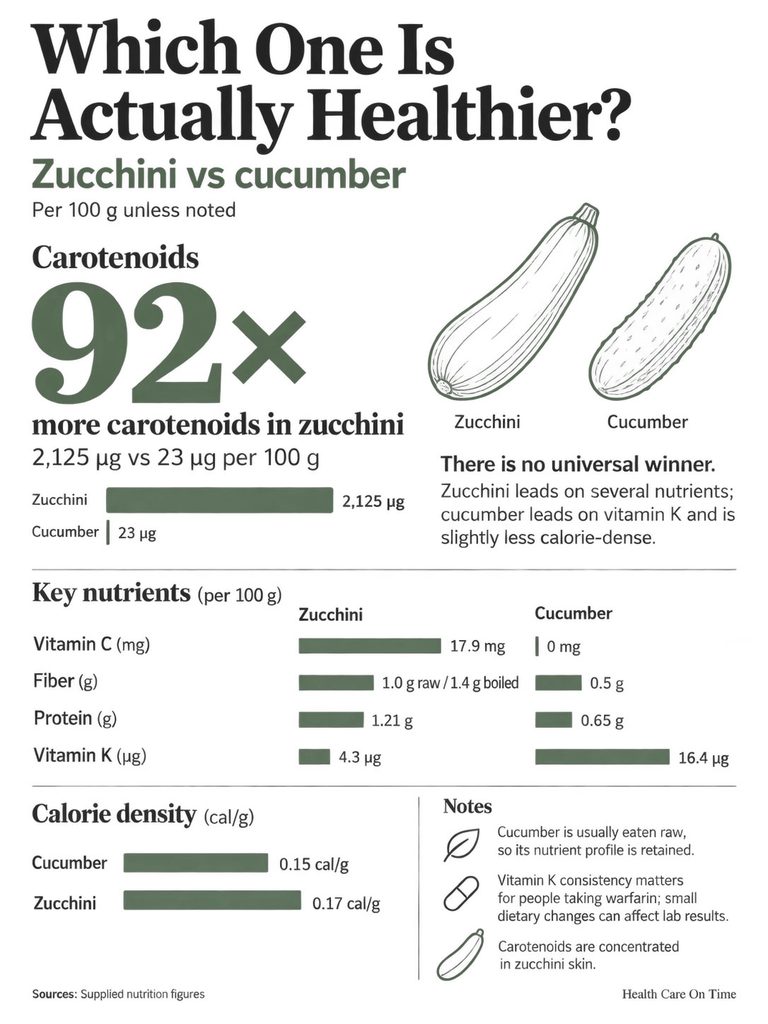
The useful question is not which wins on paper. It is which fits your specific situation, and the answer changes by nutrient.
Where zucchini wins
Vitamin C, clearly, as long as you eat it raw or lightly cooked. Raw zucchini at 17.9 milligrams per 100 grams covers about a fifth of the Daily Value.
Potassium and fiber, modestly. Zucchini doubles cucumber’s fiber at 1.0 gram against 0.5 gram per 100 grams, and boiling nudges it to 1.4 grams as water leaves.
Carotenoids, decisively. At roughly 2,125 micrograms of lutein plus zeaxanthin per 100 grams against cucumber’s 23, zucchini sits in a different category. Most of that pigment lives in the skin, which is the practical argument against peeling it.
Those carotenoids are fat soluble, so they survive cooking well and absorb better alongside a little olive oil. A sautéed zucchini with the skin on is close to the best-case version of this vegetable.
Protein, technically. Zucchini’s 1.21 grams per 100 grams nearly doubles cucumber’s 0.65 gram, though neither figure meaningfully changes anyone’s daily protein total.
Where cucumber wins
Calorie density, marginally. Cucumber runs about 0.15 calories per gram against zucchini’s 0.17, a rounding error at realistic portions, though it does mean a slightly bigger pile for the same calories.
Preparation, meaningfully. Cucumber is eaten raw by default, so it loses nothing to heat, leaching or drained cooking water. Zucchini’s numbers on the plate are always lower than its numbers in the database.
And vitamin K, which is where the comparison stops being academic.
Vitamin K, warfarin, and why this matters
Cucumber with peel supplies 16.4 micrograms of vitamin K per 100 grams, or about 49 micrograms in a medium fruit. Zucchini supplies 4.3 micrograms per 100 grams, roughly 8 micrograms in a medium fruit.
Neither is a leafy green. A cup of cooked spinach or broccoli carries several times more than either. But on warfarin, the operative rule is consistency, not avoidance.
Swapping a daily cucumber salad for a daily zucchini sauté quietly removes close to 40 micrograms of vitamin K from your day. Making that change in the week before an INR check is exactly the kind of unlogged shift that produces a confusing result at the lab.
Across the diagnostic network we serve, readers on anticoagulants ask about produce swaps constantly, and this is the swap most likely to move a number. Our guide to warfarin and food interactions covers the full consistency rule.
Can You Swap One for the Other?
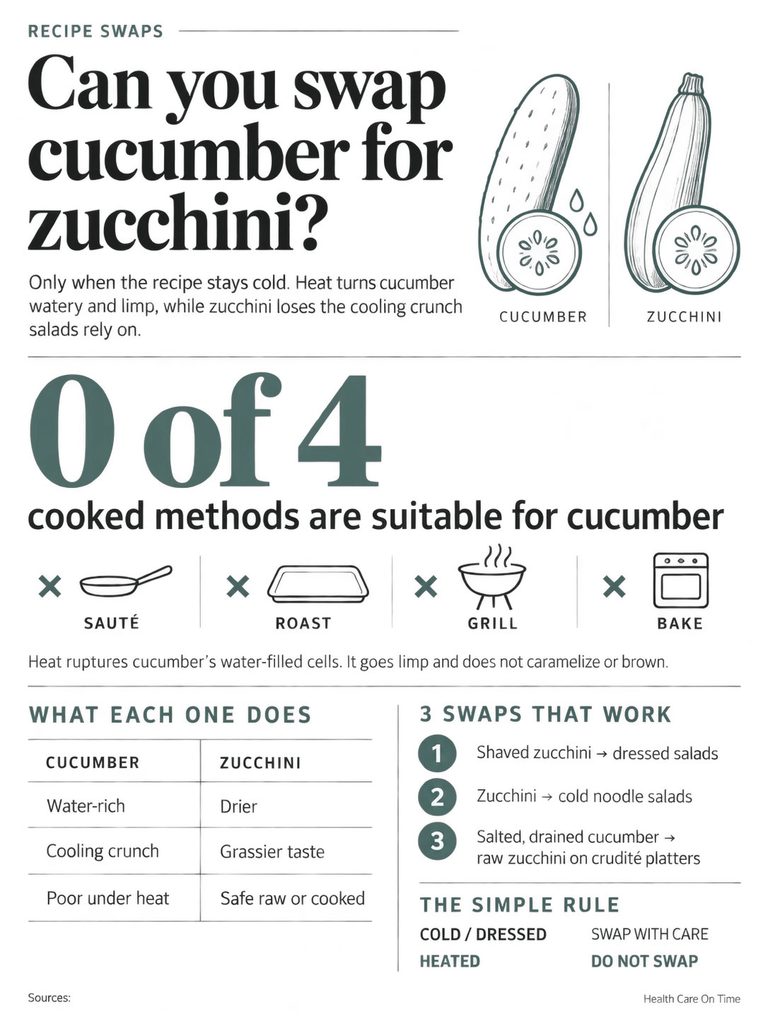
The short answer is no, and only in one direction does a partial swap work. The reason is water behavior under heat, not flavor, and no recipe page on this query explains it.
What happens when you cook a cucumber
Cucumber holds its water in large, thin-walled cells around a loose seed core. Apply heat and those cell walls rupture almost immediately, dumping liquid into the pan.
The result is a translucent, limp product swimming in its own juice, with no browning, because there is nothing left dry enough to caramelize. It is not dangerous, just unpleasant.
Some cuisines do cook cucumber deliberately, in Chinese stir-fries and in older French preparations, using thick batons and very brief high heat over 400°F. That is a specific technique, not a substitution.
What happens when you eat zucchini raw
Raw zucchini is perfectly safe and reasonably pleasant when thin-sliced or shaved into ribbons with a peeler. It reads drier and grassier than cucumber, with more resistance to the bite.
What it cannot do is deliver the cooling, high-crunch effect a cucumber salad depends on. Raw zucchini in a Greek salad tastes like a mistake even though it is nutritionally the stronger choice.
The three swaps that do work
Shaved zucchini ribbons stand in for cucumber ribbons in a dressed salad, where oil and acid soften both to a similar texture.
Zucchini works in cold noodle salads where cucumber batons would normally appear, since both are dressed rather than heated.
Cucumber works in place of raw zucchini on a crudité platter or in a slaw, provided you salt and drain it for 15 minutes first to control the water release.
Cucumber never works in a cooked application. If a recipe says sauté, roast, grill, bake or spiralize-and-heat, cucumber is not a substitute at any ratio.
Blood Sugar, Weight, and Gut: The Practical Questions
Carbs and blood sugar
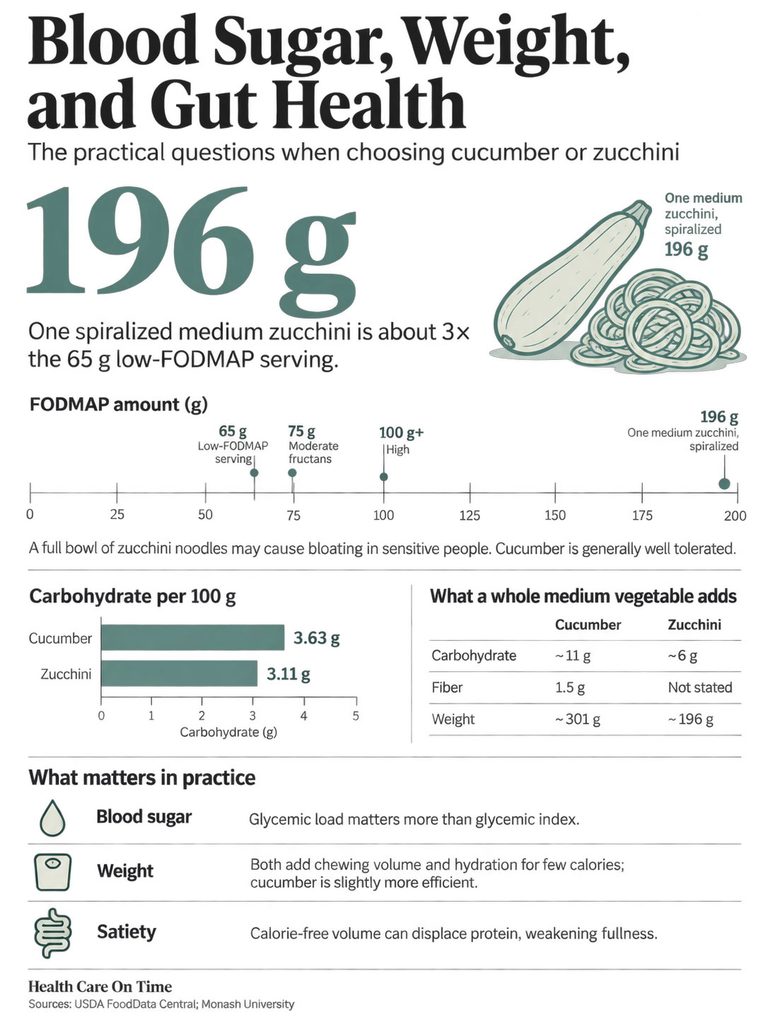
Both are functionally carb-free at normal portions. Cucumber carries 3.63 grams of carbohydrate per 100 grams with 0.5 gram of fiber; zucchini carries 3.11 grams with 1.0 gram.
A whole medium cucumber lands around 11 grams of carbohydrate, of which about 1.5 grams is fiber. A whole medium zucchini lands around 6 grams.
Glycemic index is the wrong frame here. Formal GI testing requires a 50 gram carbohydrate dose, which would mean eating roughly four and a half pounds of cucumber inside fifteen minutes. Glycemic load, which accounts for the portion people actually eat, is negligible for both.
For readers managing blood sugar, the deciding variable is not the vegetable but what goes on it. A cucumber salad drowned in ranch and a zucchini fried in four tablespoons of oil are both dominated by the addition, not the produce.
Weight loss
Both are useful for the same mechanical reason: they add chewing volume and water to a meal at almost no caloric cost. Cucumber does it slightly more efficiently per gram.
The trade-off is that calorie-free volume can crowd out protein, which matters far more than the two-calorie difference between them. Our full breakdown of cucumber, satiety and hydration walks through the trial evidence on pre-meal volume.
Zoodles, FODMAPs, and why some people bloat
This is the most useful paragraph on this page, and it appears nowhere else on the query.
Monash University lists the low-FODMAP zucchini serving at 65 grams, roughly one-third of a cup. At 75 grams it grades moderate for fructans, and at 100 grams and above it grades high.
Now consider what a bowl of zucchini noodles actually is. Spiralizing one medium zucchini produces close to 196 grams, about three times the tested low-FODMAP threshold.
FODMAP Friendly, the other major testing lab, passes zucchini at 75 grams. The two labs disagree slightly, which is normal for produce, since variety, soil, harvest timing and storage all shift the result. Either way, a full bowl of zoodles clears both numbers.
Cucumber does not carry a comparable portion ceiling and is generally well tolerated at standard servings. If you have IBS and zucchini pasta reliably leaves you bloated while cucumber never does, that is a plausible mechanism rather than a coincidence.
Readers who contact HealthCareOnTime about bloating after a “healthy” swap are often describing this exact pattern without knowing the cause.
The Safety Difference Nobody Mentions
Bitter zucchini is a real warning, bitter cucumber usually is not
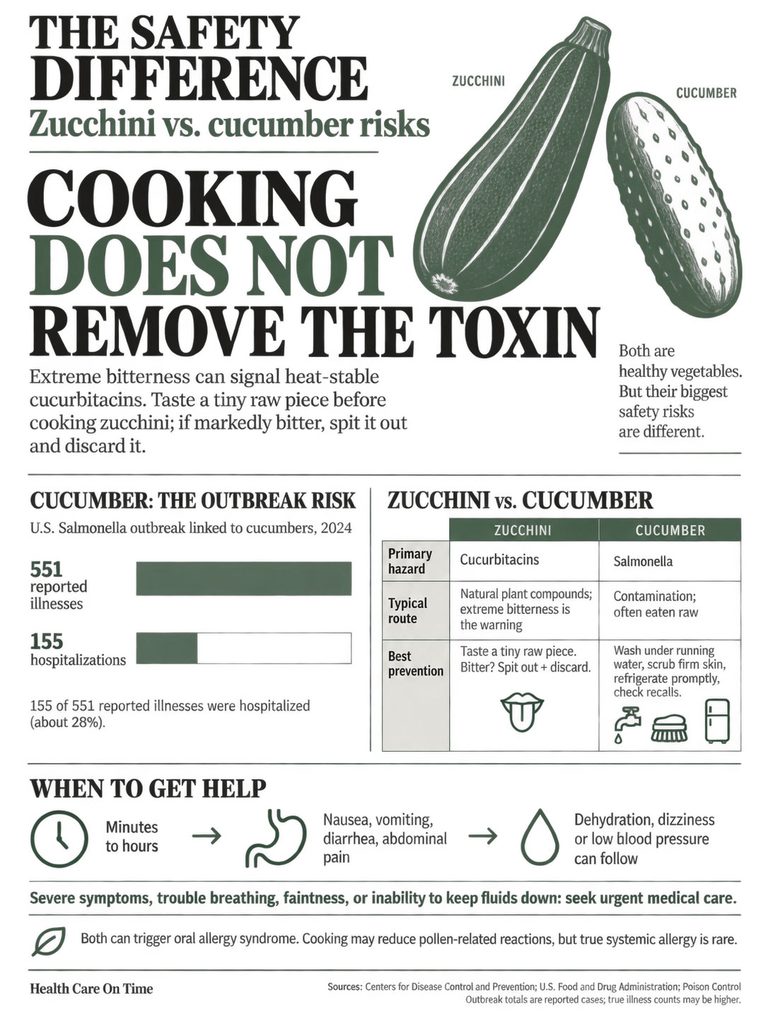
Wild cucurbits produce cucurbitacins, intensely bitter compounds that evolved to stop animals eating the fruit. Commercial breeding has removed nearly all of them from grocery produce.
Nearly all. Cross-pollination with wild or ornamental gourds, seed saved from a previous season, drought stress or depleted soil can push cucurbitacin levels back up in a single fruit. The vegetable looks completely normal. The only warning sign is taste.
Poison Control calls the result toxic squash syndrome. Reported effects include vomiting, diarrhea, abdominal pain and dehydration, and in more severe cases low blood pressure and a fast heart rate.
The guidance is simple and worth repeating twice: taste a small raw piece before you cook. If it is bitter, spit it out and discard the entire vegetable. Heat does not deactivate the toxin, so boiling, baking or frying a bitter squash accomplishes nothing.
This is not a theoretical risk. A review published in Clinical Toxicology in 2018 collected 353 patients poisoned by non-edible squash across French poison centers between 2012 and 2016, and most of those cases involved store-bought vegetables rather than garden ones.
A 2018 case report in JAMA Dermatology went further. Two unrelated women in France, one after a bitter pumpkin soup and one after a bitter squash side dish, developed food-poisoning symptoms and then substantial hair loss roughly a week later. Both regrew their hair.
What the timeline usually looks like
| When | What typically appears | What to do |
| Within minutes | Overwhelming bitterness on the first bite | Spit it out, discard the whole vegetable |
| 30 minutes to a few hours | Nausea, vomiting, diarrhea, stomach cramps | Call Poison Help at 1-800-222-1222 |
| Same day | Dizziness, weakness, signs of dehydration | Seek medical care, fluids may be needed |
| About one week later | Hair shedding, reported in rare cases | Contact your physician, reported cases recovered |
Cucumber contains cucurbitacins too, concentrated near the stem end and just under the peel, which is why cucumber ends sometimes taste sharp. In commercial slicing varieties the levels are low enough that trimming an inch off each end and peeling solves it. A cucumber that tastes unmistakably, aggressively bitter should still be thrown out.
Our nutrition reviewers treat bitterness as a hard stop rather than a preference issue, and that distinction is the one most home cooks get wrong.
Cucumber’s different risk profile
Zucchini’s risk is a plant toxin. Cucumber’s risk is a pathogen, and the recent American record is worse than most readers realize.
Fresh cucumbers have been linked to three multistate Salmonella outbreaks inside roughly eighteen months. The June 2024 outbreak alone sickened 551 people across 34 states and the District of Columbia, with 155 hospitalizations.
A November 2024 outbreak added 113 illnesses across 23 states, and a May 2025 outbreak added 69 illnesses across 21 states with 22 hospitalizations.
The reason cucumber keeps appearing and zucchini does not comes down to preparation. Cucumber is eaten raw, so anything on the skin reaches the plate. Zucchini is cooked, and cooking kills Salmonella.
Practical steps: rinse under running water and scrub the skin with a clean produce brush even when you plan to peel, because the knife drags surface bacteria into the flesh. Refrigerate cut cucumber within two hours and check FDA outbreak advisories when a recall is in the news.
Oral allergy syndrome with ragweed
Both vegetables can trigger oral allergy syndrome in people sensitized to ragweed pollen, producing an itchy mouth, tingling lips or a scratchy throat within minutes of eating them raw.
The proteins responsible are heat sensitive, so cooked zucchini is usually tolerated by people who react to the raw version. Cucumber, eaten raw by definition, offers no such workaround, though peeling helps some people.
True systemic allergy to either is uncommon. Symptoms that spread beyond the mouth, especially swelling or breathing difficulty, need medical evaluation rather than self-management.
Buying, Storing and Prepping Each One
The two vegetables want opposite conditions in your kitchen, which is another reason they are not interchangeable.
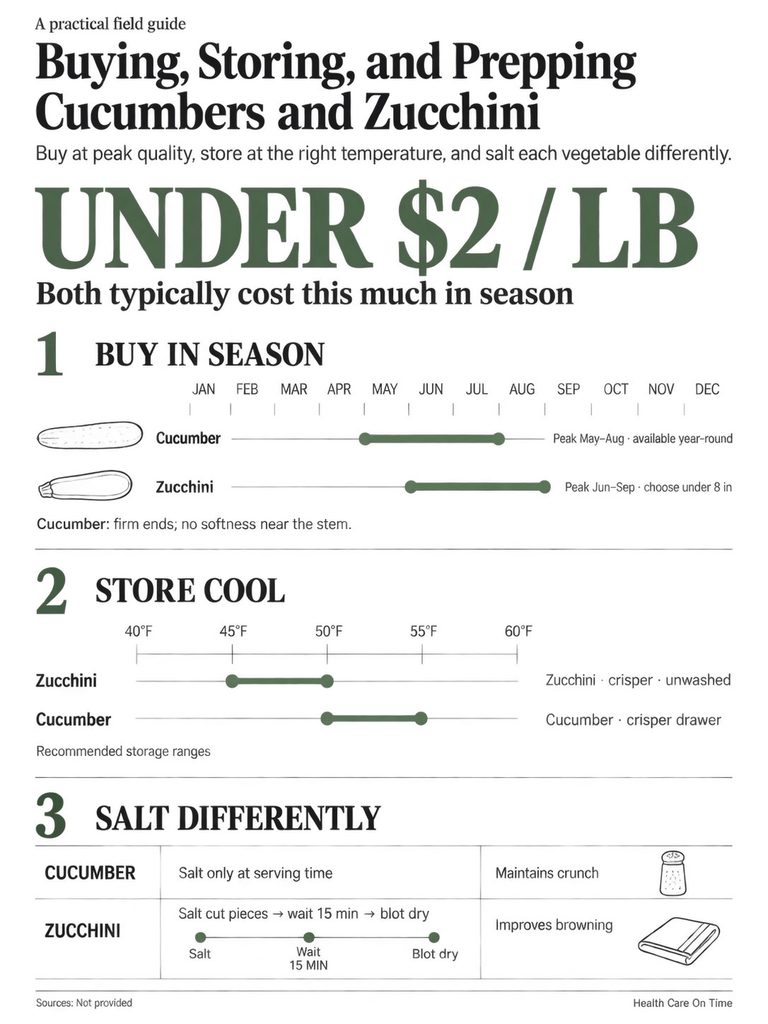
Cucumber. Peak US season runs May through August, though greenhouse and imported supply keeps shelves stocked year-round. Look for firm ends and skip anything soft near the stem. Cucumbers suffer chilling injury below about 50°F, so the back wall of the refrigerator is the worst spot. The crisper drawer, around 50 to 55°F, keeps them firm for about a week. Salt sliced cucumber only at serving time, since salting early pulls water out and softens the crunch you paid for.
Zucchini. Peak season is June through September, and smaller is better. A zucchini over about 8 inches tends toward seedy, watery flesh and a higher chance of bitterness. Store unwashed in the crisper at 45 to 50°F for four to five days. Do not peel it, since the skin carries the carotenoids. For sautéing or grilling, salt the cut pieces for 15 minutes and blot them dry, which drives off surface water so the pieces brown instead of steaming.
On price, both sit at the cheap end of the produce aisle across most US markets, typically well under two dollars per pound in season, which means the choice between them is almost never a budget question.
Our dietitian reviewers point out that the storage mistake costs people more nutrition than the species choice does, because a limp vegetable gets thrown away rather than eaten.
How Americans Actually Eat Them
Cucumber is the more popular of the two by a wide margin and has been gaining ground. Per-capita availability, which USDA’s Economic Research Service uses as a consumption proxy, hit a record 8.49 pounds per person in 2023, up about 4% on the prior year.
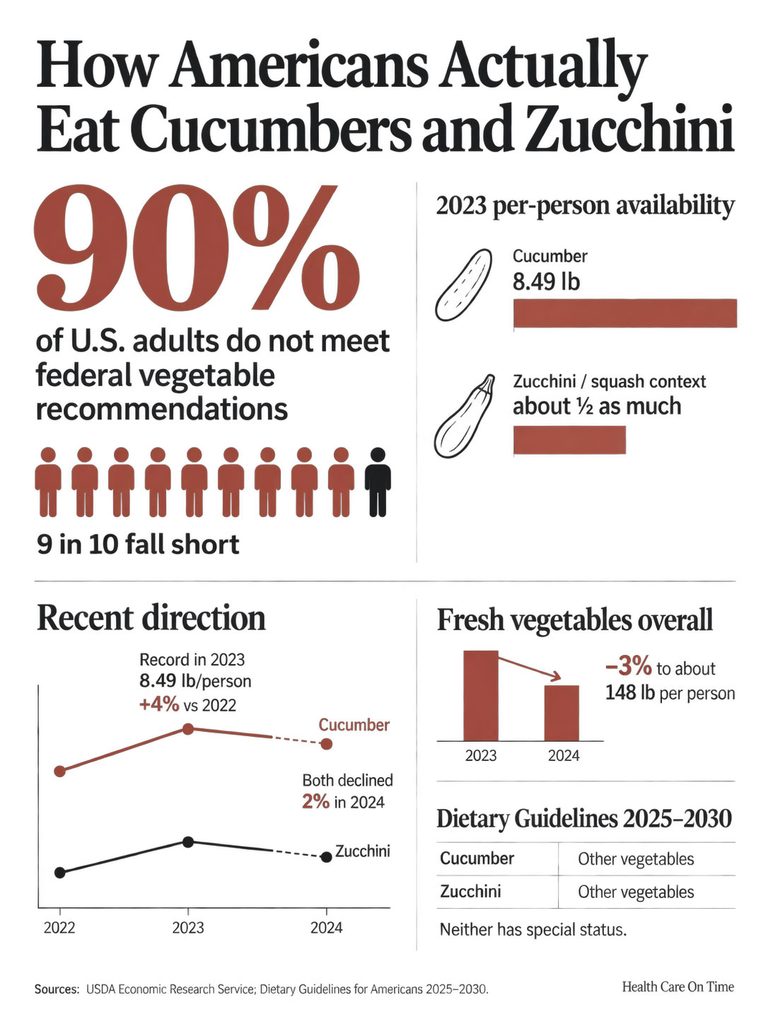
Squash, the category zucchini falls into, sits at roughly half that figure. Both slipped about 2% in 2024 while total fresh vegetable availability fell 3% to roughly 148 pounds per person.
That decline dwarfs any nutritional difference between these two vegetables. CDC surveillance has put the share of US adults meeting federal vegetable recommendations at about 10%.
Under the Dietary Guidelines for Americans 2025-2030, both cucumber and summer squash count toward the “other vegetables” subgroup. Neither carries special status, and neither counts more than the other.
In questions sent to our team, the reader weighing cucumber against zucchini has already cleared a bar that nine in ten American adults do not.
What This Evidence Does and Does Not Show
Three honest limits belong on the record.
The poison-center series and the hair-loss case report are both from 2018, and the poison-center data comes from France rather than the United States. US exposure patterns may differ, and the hair-loss finding rests on two patients.
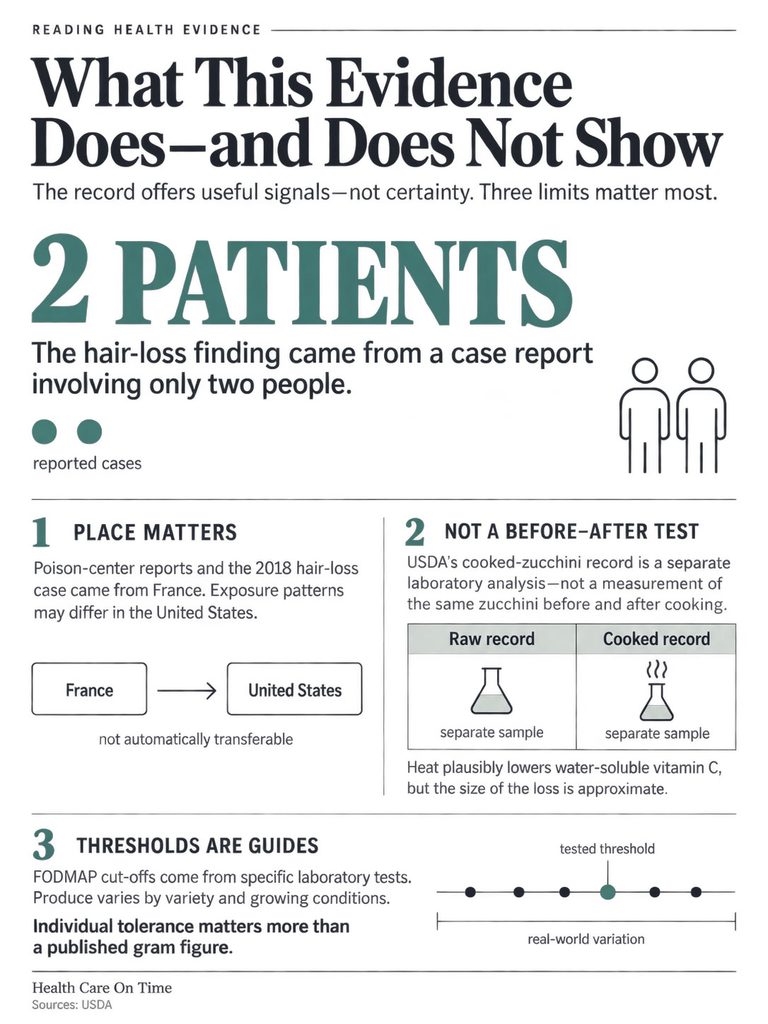
USDA’s cooked zucchini record is a separate laboratory analysis rather than a before-and-after measurement of the same squash. The direction of the vitamin C drop is consistent with what heat does to water-soluble vitamins, but treat the exact size of the loss as approximate.
FODMAP thresholds come from laboratory testing of specific samples, and produce varies by variety, growing conditions and storage. Your personal tolerance is the number that counts, not the published gram figure.
Which Should You Buy? A Scenario Guide
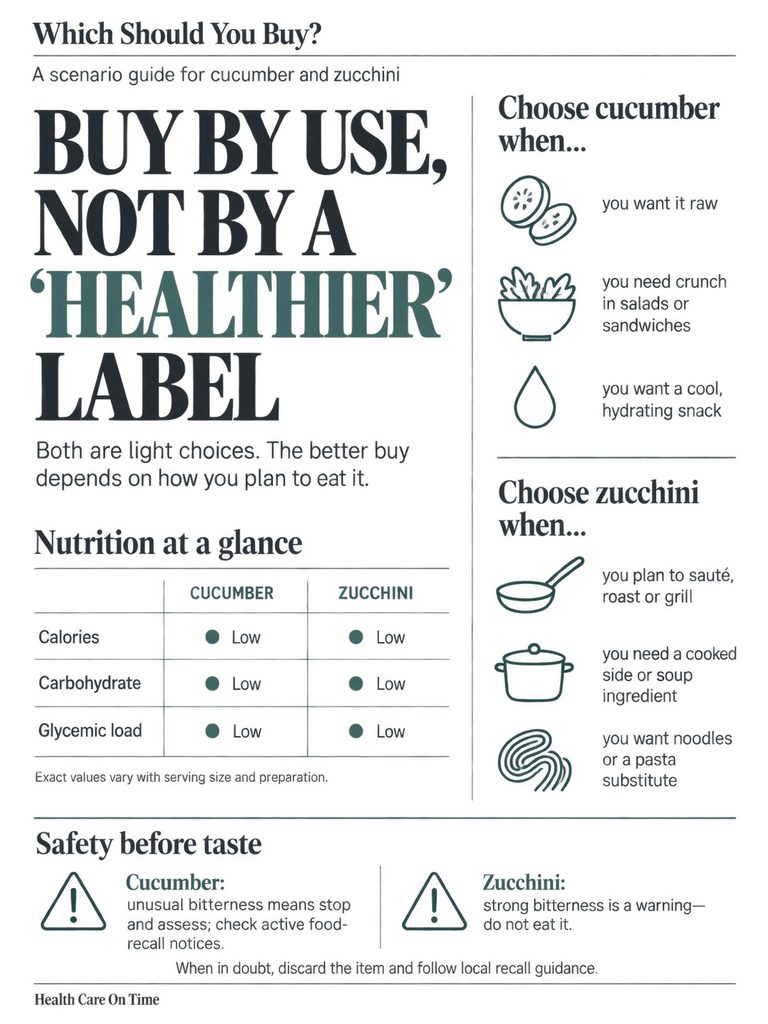
Table 4. Scenario to Recommendation
| If this is your situation | Choose | Why | Portion note |
| Taking warfarin | Whichever you already eat, consistently | Cucumber carries about 49 mcg vitamin K per medium fruit against about 8 mcg for zucchini | Log any swap and mention it before an INR check |
| Managing blood sugar | Either one | Both under 12 g carbohydrate per whole fruit with negligible glycemic load | Watch the dressing or cooking oil, not the vegetable |
| In a low-FODMAP elimination phase | Cucumber | Zucchini’s tested low-FODMAP serving is only 65 g | Weigh zucchini; skip full bowls of zoodles for now |
| Want maximum volume for fewest calories | Cucumber | About 0.15 kcal per gram, eaten raw with nothing added | A medium cucumber runs about 45 calories |
| Cooking a hot dish | Zucchini | Browns and sweetens; cucumber disintegrates | Salt and drain 15 minutes, then blot dry |
| Building a cold salad | Cucumber | Crisp texture survives dressing | Salt at serving time, not in advance |
| Focused on eye health | Zucchini, skin on | About 2,125 mcg lutein plus zeaxanthin per 100 g against 23 mcg | Cook with a little olive oil for absorption |
| Feeding a child who refuses cooked vegetables | Cucumber | Raw, mild, familiar and no prep required | Cut sticks, trim the bitter stem end |
| It tastes bitter | Neither, discard it | Cucurbitacin is not destroyed by cooking | Taste a raw sliver before cooking any squash |
| A produce recall is in the news | Cooked zucchini | Cooking kills Salmonella; raw cucumber skips that step | Scrub the skin under running water regardless |
Frequently Asked Questions
Is zucchini just a green cucumber?
No. Zucchini is *Cucurbita pepo*, the same species as pumpkin, while cucumber is *Cucumis sativus*. They share a plant family but sit in different genera. The resemblance is limited to shape and color, and their texture, flavor and behavior under heat differ completely.
Can you eat zucchini raw the way you eat cucumber?
Yes, raw zucchini is safe and pleasant thin-sliced or shaved into ribbons. It tastes drier and grassier than cucumber and will not deliver the same cooling crunch. Taste a small piece first, because a bitter raw zucchini should be discarded rather than cooked.
Which has more calories, cucumber or zucchini?
Per 100 grams, cucumber has 15 calories and raw zucchini has 17, per USDA records 168409 and 169291. Per whole fruit, cucumber is higher at about 45 calories for a medium against about 33 for a medium zucchini, because cucumbers weigh more.
Can I substitute cucumber for zucchini in a recipe?
Only in cold, raw applications such as salads, slaws and crudités. Cucumber collapses under heat, releasing water and turning translucent, so it cannot replace zucchini in anything sautéed, grilled, roasted or baked. Shaved zucchini can replace cucumber in dressed cold dishes.
Is cucumber or zucchini better for weight loss?
Cucumber has a marginally lower calorie density at about 0.15 calories per gram against 0.17. Both add chewing volume and water at minimal calorie cost. Neither causes weight loss on its own, and what you dress or cook them with matters far more than the choice.
Why does my zucchini taste bitter, and is it safe to eat?
Bitterness signals cucurbitacins, which can cause vomiting, diarrhea and dehydration. Cross-pollination, saved seed or drought stress raises levels. Cooking does not destroy the toxin. Poison Control advises tasting a small raw piece and discarding the entire vegetable if it tastes bitter.
Which is better for blood sugar?
Both are effectively neutral. A medium cucumber holds about 11 grams of carbohydrate and a medium zucchini about 6 grams, with negligible glycemic load either way. Zucchini offers slightly more fiber. The practical difference comes from added oils, dressings and breading.
Do cucumbers and zucchini have the same amount of water?
Nearly. With the peel on, cucumber is 95.23% water and raw zucchini is 94.79%, a gap under half a percentage point. The widely quoted 96% cucumber figure comes from USDA’s peeled record, where water rises to 96.73 grams per 100 grams.
Should you peel zucchini or cucumber?
Leave zucchini unpeeled, since its skin holds most of the lutein and zeaxanthin at roughly 2,125 micrograms per 100 grams. Cucumber peel carries the vitamin K, so peeling drops that contribution sharply. Peel either one only for texture or if waxing bothers you.
Why do zucchini noodles make some people bloated?
Monash University lists zucchini’s low-FODMAP serving at 65 grams, moderate for fructans at 75 grams and high at 100 grams. A spiralized medium zucchini weighs about 196 grams, roughly three times the tested threshold. Cucumber carries no comparable portion limit.
Is cucumber a fruit or a vegetable?
Botanically both cucumber and zucchini are fruits, since both develop from the plant’s flower and contain seeds. Culinary and nutrition practice treats both as vegetables, and USDA counts both toward the “other vegetables” subgroup under the Dietary Guidelines for Americans.
Can cucumbers and zucchini cross-pollinate in a home garden?
Not with each other, because they belong to different genera. Zucchini can cross with other *Cucurbita pepo* plants including ornamental gourds and pumpkins, which is how bitter, cucurbitacin-heavy fruit shows up in home gardens. Use fresh commercial seed and separate ornamental gourds.
Medical Disclaimer: This article provides general information and does not replace advice from your physician, pharmacist or registered dietitian. If you take warfarin or another anticoagulant, discuss any consistent change in vegetable intake with your care team before making it. If you or someone else develops vomiting, diarrhea or abdominal pain after eating a bitter-tasting squash, cucumber, pumpkin or gourd, contact Poison Help at 1-800-222-1222 or seek medical care. Call 911 for severe symptoms such as fainting, confusion or trouble breathing.
References
- USDA FoodData Central, Cucumber, with peel, raw (FDC 168409)
- USDA FoodData Central, Squash, summer, zucchini, includes skin, raw (FDC 169291)
- USDA FoodData Central, Squash, summer, zucchini, cooked, boiled, drained (FDC 169293)
- National Capital Poison Center, Toxic Squash Syndrome
- Le Roux G, Leborgne I, Labadie M, et al. Poisoning by non-edible squash: retrospective series of 353 patients from French Poison Control Centers. Clinical Toxicology. 2018;56(8):790-794.
- Assouly P. Hair loss associated with cucurbit poisoning. JAMA Dermatology. 2018;154(5):617-618.
- USDA Economic Research Service, Food Availability (Per Capita) Data System
- Monash University FODMAP Program
- Centers for Disease Control and Prevention
- FDA, Outbreaks of Foodborne Illness
- Dietary Guidelines for Americans, 2025-2030