
When Medicare Advantage members appealed a denied prior authorization in 2024, the plan reversed itself, fully or partly, more than 80% of the time. Yet only about 11.5% of denied requests were ever appealed. Roughly 1 in 9 denials gets challenged, and most challenges win.
Table of Contents
Part of that gap is paperwork. The daughter, son, or friend who could fight a denial often has no legal permission to act, or they filed the wrong form.
This guide to appointing a representative shows which form does what, how to fill it out, and how to avoid the mistakes that stall an appeal.
Quick Answer: Appointing a representative means giving someone written permission to act for you on a Medicare claim, appeal, or grievance. Use Form CMS-1696, or a signed letter with the required details, and file it with each appeal. The appointment stays valid for one year after both of you sign. To let someone simply call 1-800-MEDICARE for you, use a different form: CMS-10106.
At a Glance
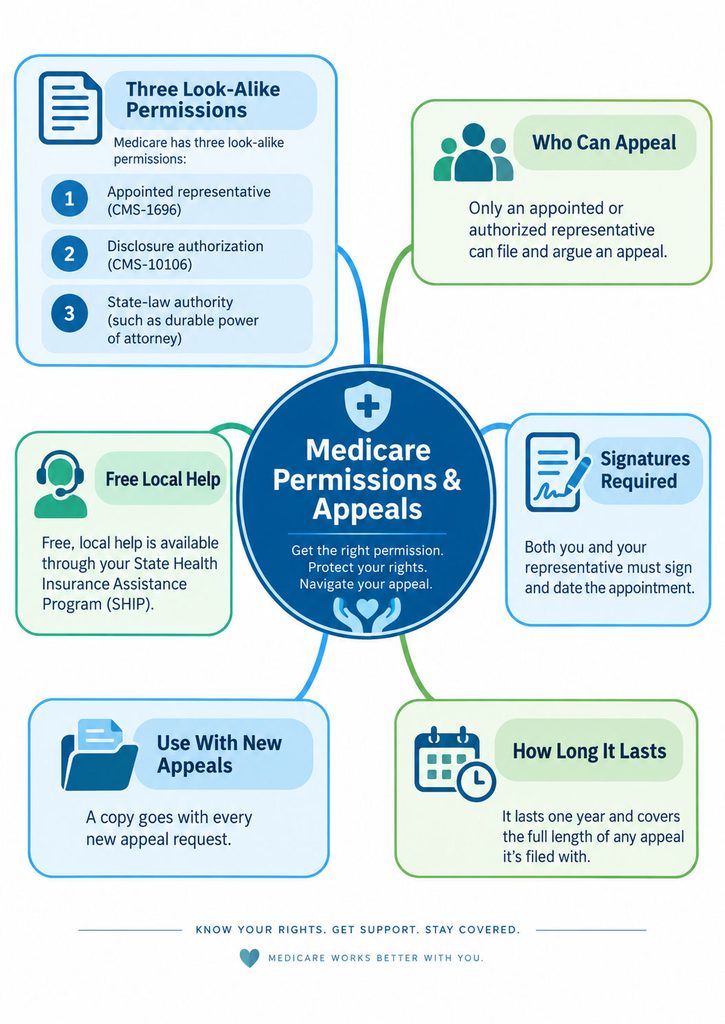
- Medicare has three look-alike permissions: an appointed representative (CMS-1696), a disclosure authorization (CMS-10106), and state-law authority such as a durable power of attorney.
- Only an appointed or authorized representative can file and argue an appeal.
- Both you and your representative must sign and date the appointment.
- It lasts one year and covers the full length of any appeal it’s filed with.
- A copy goes with every new appeal request.
- Free, local help is available through your State Health Insurance Assistance Program (SHIP).
What Appointing a Representative Means in Medicare
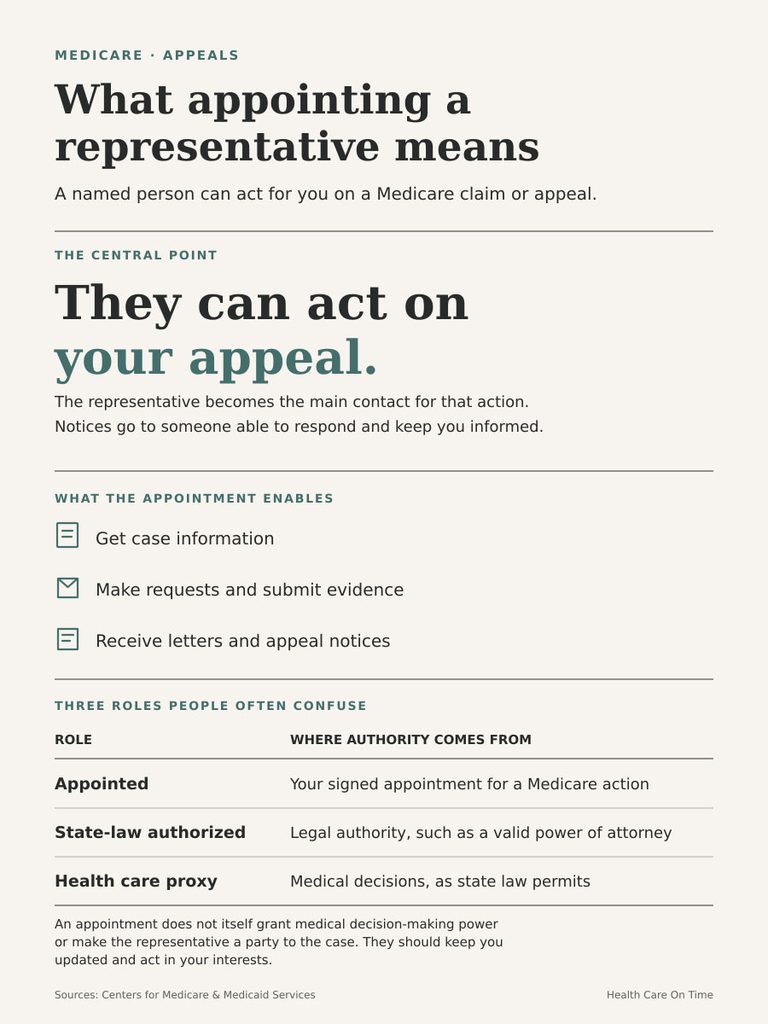
An appointed representative is a person you name in writing, on Form CMS-1696 or a signed letter, to act for you on a Medicare claim, appeal, or grievance. They can file requests, send evidence, and receive every notice about the case. An authorized representative gets similar power from state law instead, such as a guardian or an agent under a durable power of attorney.
Appointed vs. Authorized Representative
An appointed representative is someone you choose to act for you in a Medicare claim or appeal, named while you’re able to make that choice.
An authorized representative gets power from state or other law to act for a person who can no longer act for themselves.
Our care team hears the same mix-up often. Families assume “power of attorney” and “Medicare representative” mean the same thing. They overlap only when the document grants the right powers.
What a Medicare Representative Can Do
Under federal rules, an appointed representative can obtain appeal information just as you could, submit evidence, make statements about the facts and the law, and make or receive any request or notice about the appeal.
Once the appointment is on file, decision letters go to your representative, and a notice sent to them counts the same as one sent to you. For adult children in another state, that means the mail finally reaches someone who will act on it.
What a Representative Cannot Do
An appointed representative doesn’t become a party to the case and can act only on your behalf. The case stays yours.
They also can’t make medical treatment decisions. That’s the job of a healthcare proxy under your state’s laws. And the role carries duties: your representative must keep you updated on the appeal’s status and results, tell you about any financial risk you could face on the bill, and never act against your interests.
The 3 Permissions People Confuse
This is where most families go wrong. Patients booking lab work with HealthCareOnTime often tell us a relative “already filled out the Medicare form.” Later they learn it was the wrong one.
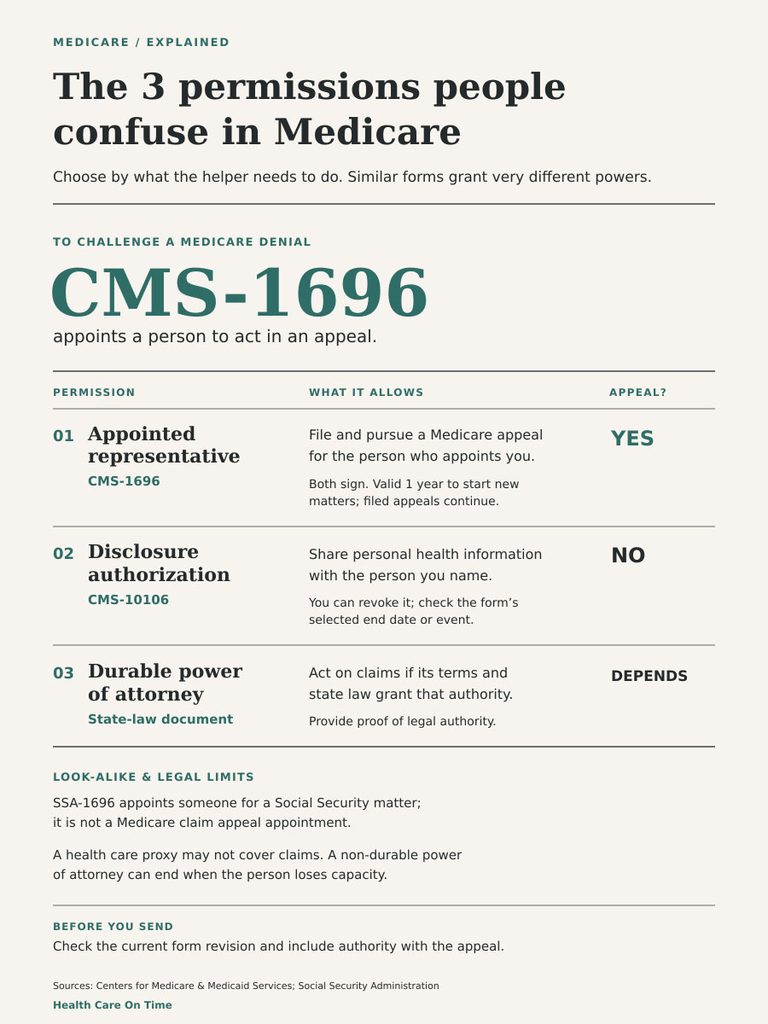
| Permission | What It Lets Someone Do | Where It Goes | How Long It Lasts | Best For |
| Appointed representative (Form CMS-1696 or signed letter) | File and argue claims, appeals, and grievances; receive all notices and decisions | With each appeal: MAC, QIC, your plan, or OMHA | 1 year from both signatures, plus the full length of any appeal it’s filed with | Fighting a denial |
| Authorization to Disclose (Form CMS-10106) | Lets 1-800-MEDICARE share your information and talk with the person; no appeal rights | 1-800-MEDICARE, by mail or online in your Medicare.gov account | Until the end date you choose, or until you revoke it | Billing questions and routine calls |
| Authorized representative (durable POA, guardian, other state-law authority) | Whatever the document or court order allows, which can include Medicare appeals | A copy goes with the appeal or to your plan | As long as the document or court order stays valid | Someone who can no longer sign |
| Social Security representative (Form SSA-1696) | Handles matters before Social Security, including Medicare enrollment and premium issues | Your Social Security office | Until the claim ends or you revoke it | Enrollment problems, late penalties, premium surcharges |
| Social Security representative payee | Receives and manages Social Security or SSI payments | Social Security | Until Social Security changes it | Money management only; not Medicare appeals |
Why CMS-10106 Won’t Let Someone Appeal for You
The Authorization to Disclose Personal Health Information form tells 1-800-MEDICARE it may share your health information with someone else. It allows conversations, not appeals.
Its advantage is speed. Filed online through your Medicare.gov account, it lets your helper call and speak for you right away. The current version carries a March 2026 revision date, so replace any old printout.
When a Power of Attorney Is Enough
A durable power of attorney can work for Medicare if it gives the agent power over health insurance, benefits, or claims, and you send a copy with the appeal. Plan materials note that others may already be authorized under state law to act for you.
Watch for two traps. A healthcare-only proxy may not cover insurance claims. And a non-durable financial power of attorney can end exactly when you need it, when the person loses capacity.
Where Social Security Fits In
Social Security, not Medicare, handles enrollment and premium issues. Its Form SSA-1696 can appoint someone for several types of claims, including Medicare coverage under Title XVIII. A representative payee manages benefit checks only and has no Medicare appeal power.
Why a Medicare Representative Matters More Now
Three recent changes make a ready-to-go Medicare representative more useful than ever.
More Care Needs Approval First
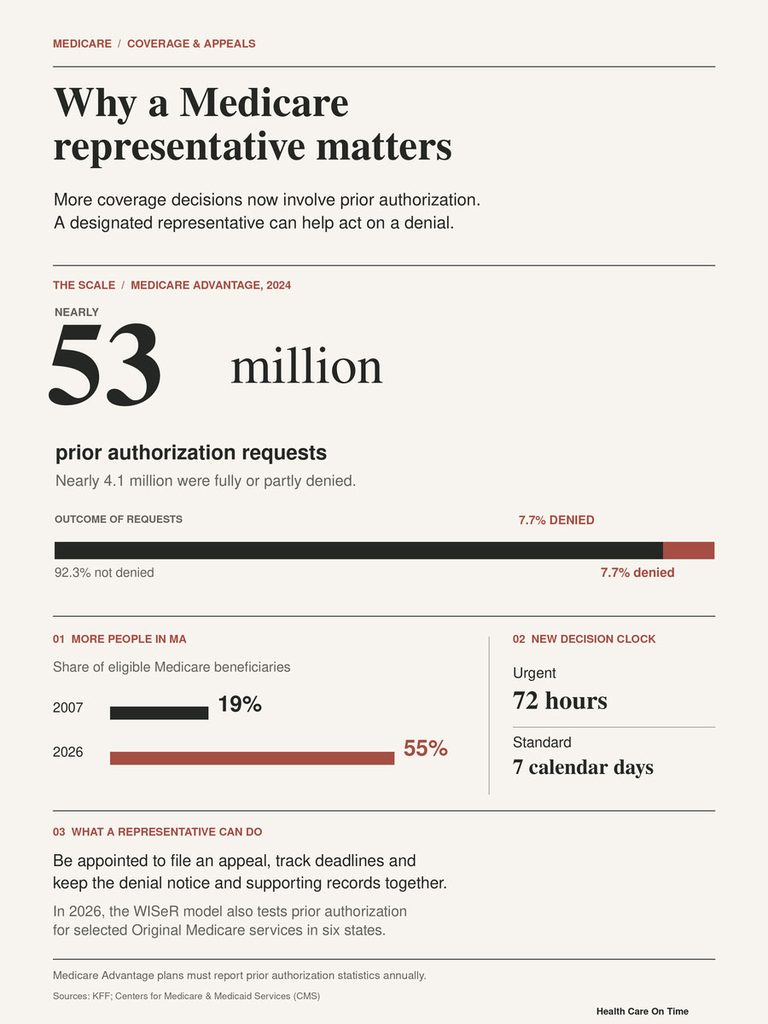
Medicare Advantage insurers received nearly 53 million prior authorization requests in 2024, and close to 8% were fully or partly denied. And Medicare Advantage now covers 55% of eligible beneficiaries, up from 19% in 2007.
New plan-reported data points the same way: standard prior authorization denials in Medicare Advantage were overturned on appeal 67% of the time.
Traditional Medicare is changing, too. The WISeR Model, launched January 1, 2026, adds prior authorization in six states (Arizona, New Jersey, Ohio, Oklahoma, Texas, and Washington) for a six-year trial. For comparison, traditional Medicare received only about 625,000 prior authorization requests in 2024, so WISeR marks a real shift.
Faster Decisions Mean Less Time to Scramble
Covered plans must now decide urgent prior authorization requests within 72 hours and non-urgent ones within 7 calendar days, with a specific reason for any denial. A denial can arrive within a week, so having your representative already on file saves days of chasing signatures.
Plans must also publish their prior authorization statistics every year, with the first set due by March 31, 2026. That new reporting is where the 67% overturn figure above comes from.
Hearings Are Fast Again
The average time to resolve an appeal at the hearing level fell from 1,430.1 days in fiscal year 2020 to 69.0 days in the first quarter of fiscal year 2026. A prepared representative can now get a hearing decision in weeks.
In cases reviewed by our medical team, the hard part is rarely the medicine. It’s the missing signature, the missed deadline, or the wrong mailing address.
| Measure | Latest US Figure | Source |
| Medicare Advantage prior authorization decisions | Nearly 53 million (2024) | KFF, January 2026 |
| Share of requests denied in full or in part | Nearly 8% (2024) | KFF, via Healthcare Dive |
| Share of denials that were appealed | 11.5% (2024) | KFF |
| Share of appeals overturned in full or in part | 80.7% (2024) | KFF |
| Standard prior authorization denials overturned on appeal (new plan-reported metric) | 67% | KFF, August 2026 |
| Average ALJ appeal processing time | 1,430.1 days (FY2020) vs. 69.0 days (Q1 FY2026) | HHS Office of Medicare Hearings and Appeals |
| Minimum amount in dispute for an ALJ hearing / federal court | $200 / $1,960 (2026) | CMS |
| People in Medicare Parts A and B; share in Medicare Advantage | 64.2 million; 55% (2026) | KFF |
| Free SHIP counseling network | 54 programs; 2,200+ community organizations | Congressional Research Service, July 2026 |
How to Appoint a Representative, Step by Step
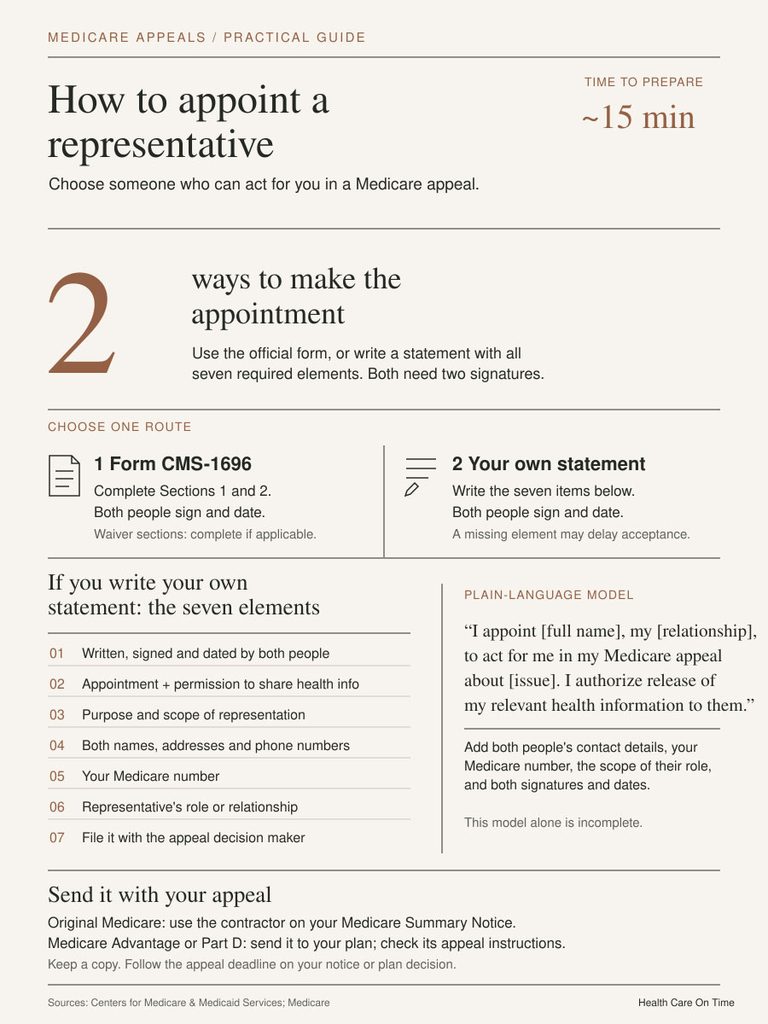
Appointing a representative takes about 15 minutes. Here’s the order:
- Pick the right person (see the next section).
- Download Form CMS-1696, or plan to write your own statement.
- Fill in your name, Medicare Number, address, and phone.
- Have your representative add their details and their relationship to you.
- Both of you sign and date it.
- Attach a copy to the appeal and send it to the office named on your notice.
- Keep a copy and mark the one-year expiration on your calendar.
Option 1: Fill Out Form CMS-1696
The official Appointment of Representative form is the cleanest route because reviewers recognize it instantly. The current version is approved through December 31, 2028, and every field in Sections 1 and 2 is required unless marked optional.
Section 1: The Person Appointing
Enter your name, Medicare Number (from your red, white, and blue card), mailing address, and phone. If there’s no Medicare Number or provider number, write “not applicable.”
Section 2: The Representative
Your representative enters their name, address, phone, and relationship to you (daughter, friend, attorney). Then they sign to accept the role.
Sections 3 and 4: Special Cases Only
Most families skip these. Section 3 applies when a representative must, or agrees to, waive a fee. Section 4 applies when a provider represents its own patient and liability for the bill is at issue.
Option 2: Write Your Own Statement
You don’t have to use the official form. Under 42 CFR 405.910, a valid appointment has seven required elements: written and signed and dated by both people; a statement naming the representative and authorizing release of your health information; the purpose and scope of the representation; both people’s names, phone numbers, and addresses; your Medicare Number; the representative’s relationship to you or professional status; and filing with the office handling your appeal.
Some popular online guides leave out the signature requirement. Don’t. If any element is missing, the reviewer should contact you, but until it’s fixed, the would-be representative has no authority and can’t even receive the appeal decision.
Sample Statement You Can Adapt
Here’s a plain-language model that covers all seven elements. Fill in the brackets, and have both people sign.
Appointment of Representative. [Full name of person with Medicare], Medicare Number [number], of [address and phone], appoints [representative’s full name], of [address and phone], to act as representative for [the appeal of the denial dated ___, or all Medicare claims and appeals for one year]. The representative is the beneficiary’s [relationship, such as daughter]. Medicare and its contractors may release health information about this matter to the representative. Signed: [beneficiary signature and date]. Accepted: [representative signature and date].
Attach this page to the appeal request, just as you would the official form.
Where to Send It
The appointment travels with the appeal. To start an appeal within the one-year window, the representative must file a copy with the appeal request.
Deadlines depend on the level. In Original Medicare, you have 120 days to request a redetermination, 180 days for a reconsideration, and 60 days to request an ALJ hearing. Medicare Advantage members generally have 65 days to request a plan reconsideration.
For Original Medicare, send the first appeal to the contractor listed on your Medicare Summary Notice. For a plan, use the appeals address on your denial letter.
Use a method you can track, such as USPS Certified Mail, or fax if the notice lists a number. Write the Medicare Number on every page. Medicare also advises keeping a copy of everything you submit.
Medicare Advantage and Part D Differences
Plans may give you their own version of the form. You can use Medicare’s CMS-1696 or an equivalent notice that meets the same requirements.
Doctors get a shortcut. Medicare’s appeals booklet says your doctor can sometimes file for you without being appointed, but a higher-level appeal by your doctor or prescriber requires the appointment form or an equivalent written request.
Who Should You Choose?
The best Medicare representative is organized, calm on the phone, and good with deadlines. Legal training helps at the hearing level but isn’t needed for the first two levels.

One hard rule applies. You can’t name anyone who is disqualified, suspended, or barred by law from representing people before HHS or Social Security.
5 Questions to Ask Before You Choose
Run through these before anyone signs:
- Will they open and read mail within a day or two?
- Are they comfortable with long phone calls and taking notes?
- Can they reach you easily to sign papers or answer questions?
- Do they know your health history, or can they learn it quickly?
- Would you trust them to see your medical records?
A Family Member or Friend
This is the most common choice, and it’s free. A relative knows your history and cares about the outcome.
The catch is time. Appeals involve calls, faxes, and follow-ups. Pick the person who answers mail and texts quickly, not just the oldest child.
A SHIP Counselor or Nonprofit Advocate
Free SHIP counseling operates in all 50 states, DC, and three territories through more than 2,200 community organizations. The program helps up to 4 million beneficiaries a year with paid staff and trained volunteers.
Counselors can explain denial letters and help file appeals. Nonprofits such as the Medicare Rights Center and the Center for Medicare Advocacy also help. To find your local program, visit shiphelp.org, which lists each state’s SHIP phone number.
An Attorney
A lawyer makes the most sense for high-dollar cases, complex coverage rules, or appeals headed to a hearing. Elder law attorneys also draft the powers of attorney that keep a representative working if your health changes.
The Fee Rules in Plain English
- First two levels: No fee approval is needed to represent you in a redetermination or reconsideration.
- Hearing level and above: Anyone charging for an ALJ hearing or Medicare Appeals Council review must have the fee approved first, using form OMHA-118.
- Never from Medicare: No representative fees or costs may be paid from the Medicare trust funds.
Social Security runs a separate system, where fee agreements are capped at the lower of 25% of past-due benefits or $9,200.
Your Doctor, Hospital, or Supplier
A provider that furnished the disputed service may represent you, but it can’t charge you any fee for doing so. Usually everyone wants the claim paid. If the dispute is over who owes the bill, though, a relative or SHIP counselor is the safer choice.
Across the patients we serve, the representatives who do best keep one folder with every notice, every envelope, and a call log with names and dates.
How Long It Lasts and How to Change It
An appointment is valid for one year from the date both people sign. During that year, the same form can be reused for other appeals, and it covers the full length of any appeal it was filed with, unless revoked.
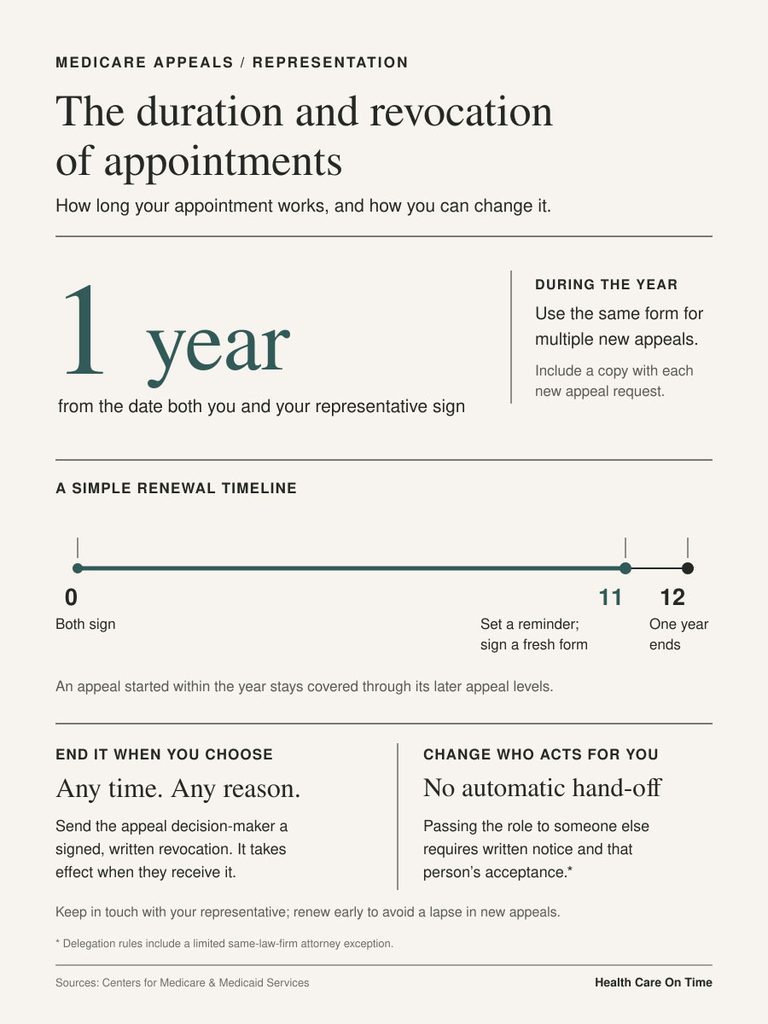
You can end it anytime, for any reason. But the revocation takes effect only when the reviewer receives your signed, written statement.
Your representative can’t quietly hand the job to someone else. Passing the role to another person requires written notice to you and your signed acceptance.
Set a phone reminder at 11 months. Signing a fresh form before a big appeal is far easier than fixing an expired one mid-case.
What Happens After You File
Once the appeal and appointment arrive, the reviewer checks the paperwork first. If an element is missing, expect a letter asking for it. The time spent fixing a defective appointment doesn’t count against the reviewer’s decision deadline, so gaps slow everything down.
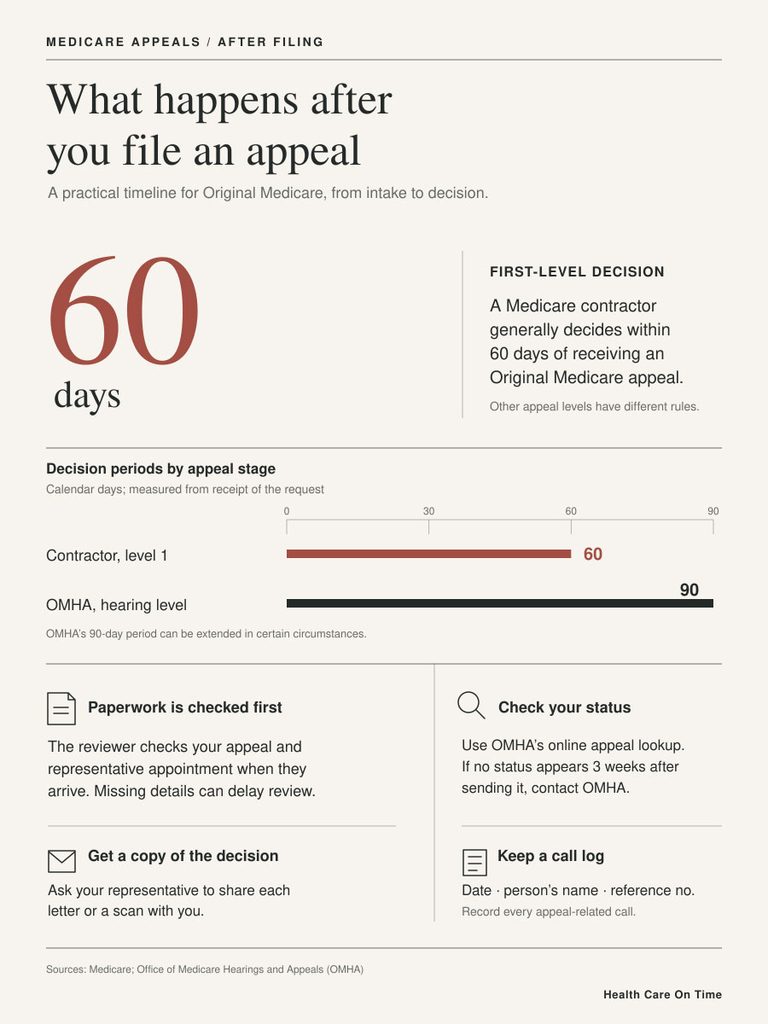
In Original Medicare, the contractor and the Qualified Independent Contractor each generally have 60 days to decide. At the hearing level, OMHA generally works within a 90-day time frame once your request is received.
Decision letters now go to your representative. Ask them to forward copies or share a scanned folder, so no one is surprised by a result.
For hearing-level appeals, OMHA offers an online status lookup at aasis.omha.hhs.gov. If an appeal doesn’t appear within 3 weeks of sending it, the office can be reached at 1-855-556-8475.
Our care team suggests one simple habit: log every call with the date, the person’s name, and any reference number. It turns a stressful week into a clean record.
Special Situations
Real life rarely follows the form’s instructions. Here’s how to handle the situations families ask about most.
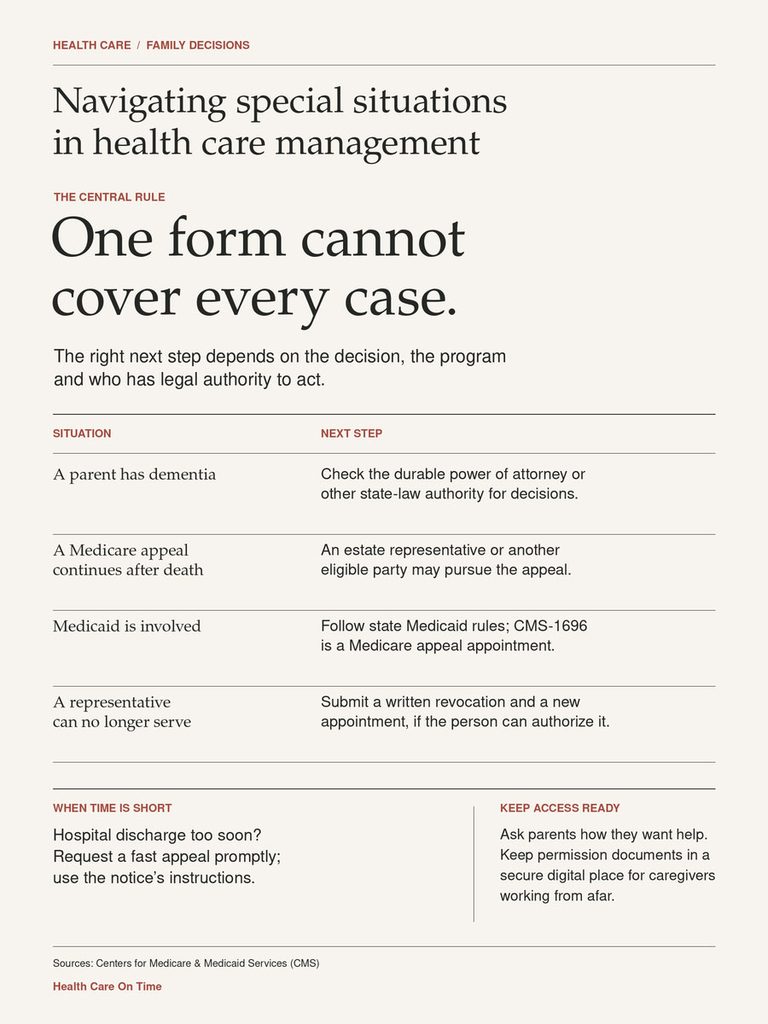
A Parent With Dementia or Who Can’t Sign
Form CMS-1696 needs the beneficiary’s own signature, given with an understanding of what they’re signing. If a parent can no longer do that, a new appointment usually isn’t possible.
The path then runs through state law: a durable power of attorney signed earlier, or a guardianship ordered by a court. Send a copy with the appeal.
Timing matters. In early dementia, clear days and foggy days can alternate, so sign documents on a good day. Some families also ask the doctor to note the parent’s decision-making ability in the chart that week.
Our medical reviewers note that families who plan ahead, with a CMS-1696, a CMS-10106, and a durable power of attorney signed while memory is still good, face far fewer delays later.
Appealing for Someone Who Has Died
Death usually ends an appointment, but an appeal already underway can continue if someone else may receive or owe the payment, and the appointment stays in effect for that appeal.
To get records from 1-800-MEDICARE, you’ll need legal proof of authority, such as executor papers or court documents bearing a court stamp and a judge’s signature.
A Hospital or Nursing Facility Discharge Is Coming
You have the right to a fast appeal if you believe covered care is ending too soon, including hospital, skilled nursing, home health, and hospice services. The Quality Improvement Organization reviews these on a 72-hour clock.
The filing window is measured in hours. Call the number on the notice right away, and have the appointment form or power of attorney ready to send.
If You Also Have Medicaid
Medicaid is run by your state and has its own representative rules and forms. A CMS-1696 covers Medicare matters only. Ask the state Medicaid agency for its form, too.
This affects a lot of families. More than 8 million people were enrolled in special needs plans as of February 2026, many of them eligible for both programs.
Starting the Conversation With a Parent
Many adult children hesitate to bring this up because it can feel like taking over. Frame it as backup, not control. The parent stays in charge of the case; the form only lets a trusted person help.
Pick a calm moment, not the day a denial arrives. Bring the forms, explain that the appointment can be revoked anytime in writing, and let the parent choose the person.
Patients who book screenings with us often say the same thing afterward: signing early felt like relief, not a loss of independence. If a parent says no, respect it. A CMS-10106 alone still lets you help with phone calls.
If the Representative Can’t Continue
People move, get sick, or burn out. If your representative can’t keep going, send a signed revocation and a new appointment naming someone else to the office handling any open appeal.
Long-Distance Caregivers
Set up two permissions. File CMS-10106 online so you can call Medicare, and keep a signed CMS-1696 scanned in cloud storage so you can attach it to any appeal in minutes.
7 Mistakes That Delay or Sink an Appeal
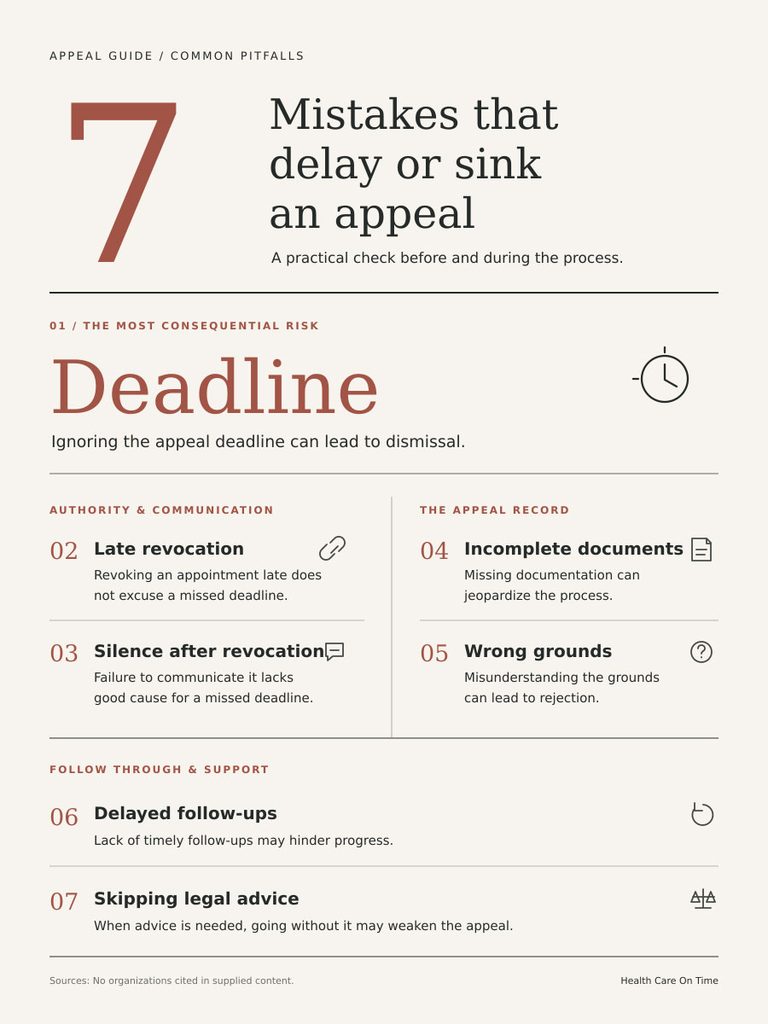
- Filing CMS-10106 instead of CMS-1696. One allows phone calls; only the other allows appeals.
- Only one signature. Both people must sign and date.
- Skipping the copy. Every new appeal request needs its own copy of the appointment.
- Letting the year lapse. An expired appointment can’t start a new appeal.
- Missing the filing deadline. You may still get a decision if you show good cause, such as an illness or accident that delayed you. Don’t count on it.
- Assuming a power of attorney covers everything. Confirm it reaches insurance and benefits, and that the plan will accept it.
- Dropping “small” claims. In 2026, ALJ appeals need at least $200 in dispute and federal court at least $1,960, and claims can sometimes be combined to reach those amounts.
A late revocation won’t excuse a missed deadline either. Failing to tell the reviewer about a revoked appointment doesn’t count as good cause.
What to Do Next: Your 15-Minute Setup
You don’t need a denial in hand to get ready. Families who book tests through HealthCareOnTime often do this setup after a new diagnosis or a hospital stay, while everyone is thinking clearly.

| Scenario | Recommended Action | Form or Contact |
| Adult child wants to call Medicare about a parent’s bills | Submit the disclosure form online in the parent’s Medicare.gov account | CMS-10106 |
| Original Medicare denied a claim on the Medicare Summary Notice | Appoint the helper, then file a redetermination within 120 days | CMS-1696 plus the MAC listed on the notice |
| Medicare Advantage plan denied a service or prior authorization | Ask the doctor to support the appeal; file a plan reconsideration within 65 days | CMS-1696 (or plan version) plus plan appeals office |
| Part D plan denied a drug | Ask the prescriber to request a redetermination; appoint a helper for later levels | Plan redetermination form; CMS-1696 |
| Hospital or nursing facility says Medicare coverage is ending | Call the Quality Improvement Organization on the notice right away | Discharge or termination notice |
| Parent has dementia and can’t sign | Use existing durable POA or guardianship papers; send a copy | POA document or court order |
| Attorney will handle an ALJ hearing | Attorney requests fee approval before charging | OMHA-118 |
| Family member died with a denied claim | Check whether an appeal was already underway; the estate’s legal representative handles new appeals | Executor or court documents |
The Document Folder to Keep
Keep these together, on paper or in a shared cloud folder:
- The signed CMS-1696 or written statement, with the date both people signed
- Proof that CMS-10106 was submitted
- Any power of attorney or guardianship papers
- Every Medicare Summary Notice, plan denial letter, and appeal decision
- Mail receipts or fax confirmations showing when each item was sent
- A call log with dates, names, and reference numbers
This week, do three things: sign a CMS-1696 with your chosen person, submit a CMS-10106 online, and save both in a shared folder with a reminder set for next year.
Frequently Asked Questions
What is the difference between an authorized and appointed representative for Medicare?
An appointed representative is someone you pick and name in writing, usually on Form CMS-1696. An authorized representative gets power from state law or a court, such as a guardian or an agent under a durable power of attorney. Both can handle appeals. Authorized representatives usually step in when the person can no longer sign.
How long is a Medicare appointment of representative valid?
It stays valid for one year from the date both you and your representative sign it. During that year, a copy can be used for other appeals. When filed with an appeal, it also covers that entire appeal, even past the one-year mark, unless you revoke it in writing.
Can a family member call Medicare for someone else?
Yes, with permission. The person with Medicare can give verbal permission during the call or submit Form CMS-10106 ahead of time. Filing online through Medicare.gov lets the relative call right away. This form allows conversations and information sharing, but it doesn’t allow the relative to file appeals.
Does Medicare accept a power of attorney?
Often, yes. A durable power of attorney can make someone an authorized representative if it covers health insurance, benefits, or claims under your state’s law. Send a copy with the appeal. Call the plan or Medicare contractor early to confirm they’ll accept it, since wording varies by state.
Where do you send the CMS-1696 form?
Send it with the appeal to the office handling that level. For Original Medicare, that’s the contractor listed on your Medicare Summary Notice. For Medicare Advantage or Part D, use your plan’s appeals address. Later levels go to the Qualified Independent Contractor, OMHA, or the Medicare Appeals Council.
Can a doctor file a Medicare appeal for a patient?
In some cases, yes. Treating doctors can often request certain plan appeals without being formally appointed, especially decisions made before care is given. For higher appeal levels, Medicare generally requires the appointment form or an equivalent signed statement. Ask the office which route they’ll use so nothing gets missed.
Can more than one person be appointed?
Form CMS-1696 has room for one representative. The simplest approach is to name one person as the appointed representative and add a second helper through CMS-10106 so they can talk with Medicare. A representative can’t hand the role to someone else without your signed approval.
Can an appointed representative charge a fee?
At the first two appeal levels, no fee approval is needed. For work at an ALJ hearing or Medicare Appeals Council review, the representative must get the fee approved before charging. Doctors or suppliers representing their own patient can’t charge any fee, and no fee can come from Medicare funds.
How do you revoke an appointment of representative?
Send a signed, written statement ending the appointment to the office handling your appeal. You don’t need to give a reason. It takes effect only when that office receives it, so use a trackable delivery method and keep a copy for your records.
Can someone appeal a Medicare denial for a person who has died?
Sometimes. Death usually ends an appointed representative’s authority, but an appeal already underway can continue if someone else may receive or owe the payment. For new appeals or records, the estate’s legal representative usually acts, using documents such as executor papers or letters of administration.
Is a healthcare proxy enough for Medicare?
Not always. A healthcare proxy is designed for medical treatment decisions. Whether it also covers insurance claims depends on your state’s laws and the document’s wording. If it doesn’t clearly include benefits or claims, pair it with a signed CMS-1696 while the person can still sign.
Where can you get free help with a Medicare appeal?
Start with your State Health Insurance Assistance Program (SHIP). Counselors are free, available in every state, and can explain notices and help file appeals. You can also call 1-800-MEDICARE or contact nonprofits such as the Medicare Rights Center or the Center for Medicare Advocacy.
Disclaimer: This article is for general education and isn’t legal advice. Medicare rules, plan procedures, and state laws on powers of attorney and guardianship vary. Before any deadline, confirm the details with 1-800-MEDICARE (1-800-633-4227; TTY 1-877-486-2048), your plan, a SHIP counselor, or a licensed elder law attorney in your state.
References
- CMS: Form CMS-1696, Appointment of Representative
- CMS: Form CMS-10106, Authorization to Disclose Personal Health Information
- 42 CFR 405.910: Appointed Representatives (Cornell LII)
- HHS OMHA: Your Right to Representation
- HHS OMHA: Average Processing Time by Fiscal Year
- Medicare.gov: Filing an Appeal
- Medicare.gov: Appeals in Original Medicare
- Medicare.gov: Appeals in Medicare Health Plans
- Medicare.gov: Medicare Appeals Booklet
- CMS National Training Program: Medicare Appeals Processes Chart
- CMS: Third Level of Appeal, Amount in Controversy
- KFF: Medicare Advantage Insurers Made Nearly 53 Million Prior Authorization Determinations in 2024
- KFF: Prior Authorization Metrics Provide New Insights into Insurer Practices
- KFF: Medicare Advantage in 2026, Enrollment Update and Key Trends
- KFF: Medicare Advantage Enrollment Grew by About 1 Million People, Mainly Due to Special Needs Plans
- KFF: Examining the Potential Impact of Medicare’s New WISeR Model
- CMS: Interoperability and Prior Authorization Final Rule (CMS-0057-F)
- Congressional Research Service: State Health Insurance Assistance Program (SHIP)
- KFF: The Role of SHIPs in Helping People with Medicare
- SSA POMS: Fee Agreement Limits