Search “kale” in three calorie apps and you can get three answers: 7 calories per cup, 33 calories per cup, or 49 calories per 100 grams. All three point back to the USDA, and none of them is invented.
Table of Contents
What changed wasn’t the kale. The cup got lighter, the lab method got sharper, and many apps never updated. This guide lines up the real USDA records, the gram weights behind them, and the simple math for logging kale correctly.
Quick Answer: One loose cup of raw kale (about 21 grams) has about 7 calories. 100 grams of raw kale has 35 calories under USDA’s current record. One cup of boiled kale has about 36 to 47 calories, because cooking packs several raw cups into one. Apps that show 33 calories per cup are using an older record that weighed a chopped cup at 67 grams.
Kale calories by serving (current USDA record):
- 1 loose cup raw (21 g): about 7 calories
- 1 ounce raw (28 g): about 10 calories
- 100 grams raw: 35 calories
- 8-ounce bunch raw (227 g): about 79 calories
- 1 cup boiled (about 130 g): about 36 to 47 calories
At a Glance
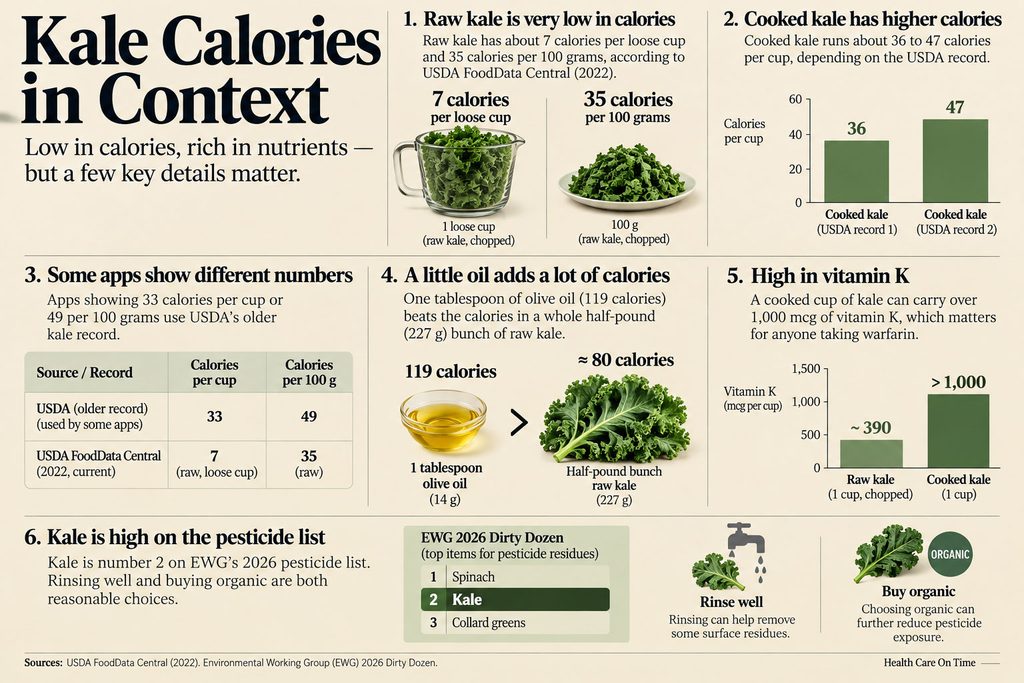
- Raw kale is about 7 calories per loose cup and 35 calories per 100 grams.
- Cooked kale runs about 36 to 47 calories per cup, depending on the USDA record.
- Apps showing 33 per cup or 49 per 100 grams use USDA’s older kale record.
- One tablespoon of olive oil (119 calories) beats the calories in a whole half-pound bunch of raw kale.
- A cooked cup can carry over 1,000 mcg of vitamin K, which matters for anyone on warfarin.
- Kale is number 2 on EWG’s 2026 pesticide list; rinsing well and buying organic are both reasonable choices.
How Many Calories Are in Kale? The Short Answer by Serving
USDA’s current record for raw kale, shared by Foundation Foods and the revised SR Legacy database, lists 35 calories per 100 grams, with 2.9 g of protein, 1.5 g of fat, 4.4 g of carbohydrates, and 4.1 g of fiber. That’s the number to use for fresh, raw kale.
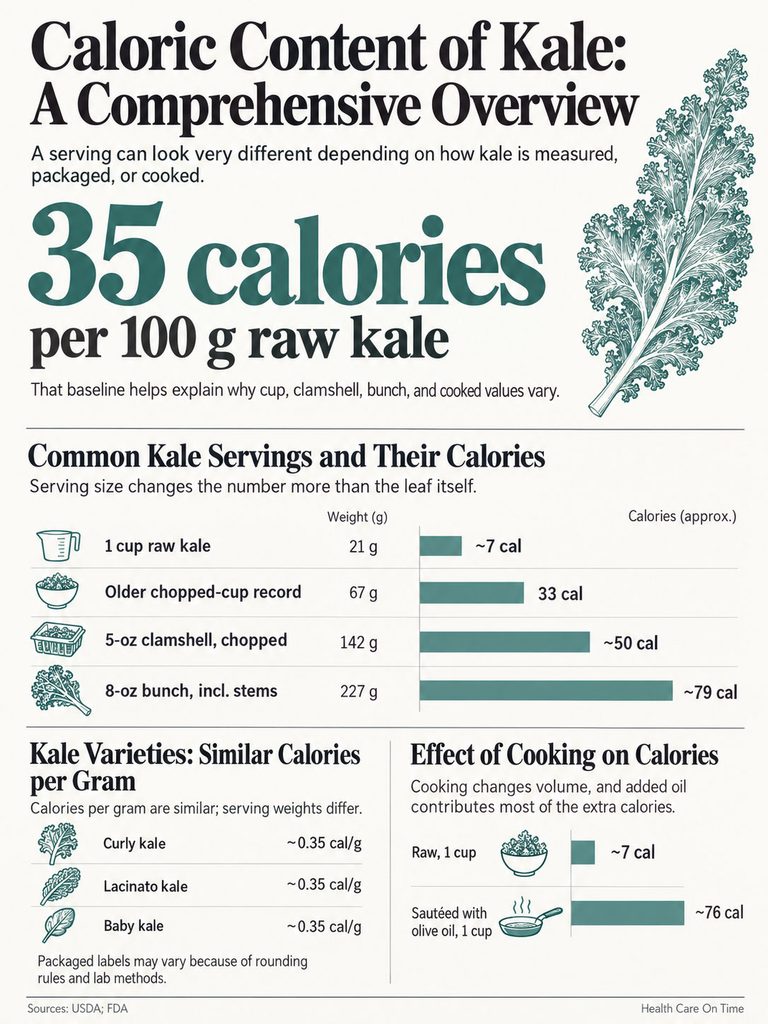
Every other serving is weight math. Our nutrition review team checks food-log questions against this record, and the most common error isn’t the calorie figure. It’s the serving weight.
Calories per cup, raw
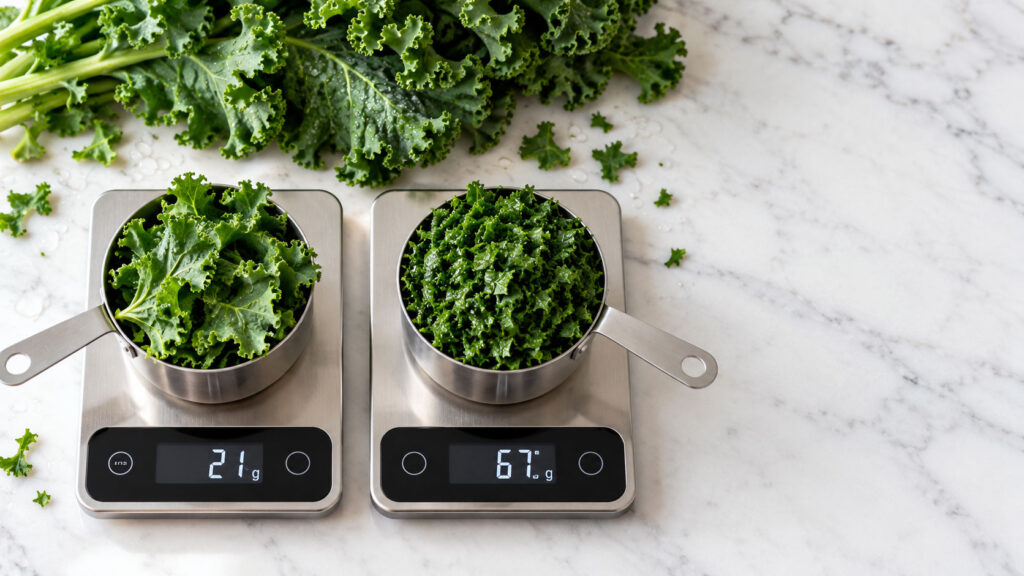
USDA now weighs a cup of raw kale at about 21 grams, or about 7 calories. Healthline uses the same weight, listing one cup of raw kale at 7 or 8 calories.
The older record used a much heavier cup: 1 cup, chopped, at 67 grams and 33 calories. Same words, about three times the kale.
Your own cup depends on how you fill it. Torn leaves dropped loosely into a measuring cup land near 21 grams. Finely chopped kale pressed down can top 60 grams, which is roughly 20 to 25 calories on the current record.
Calories per ounce and per bunch
At 35 calories per 100 grams, raw kale is about 10 calories per ounce. A 5-ounce clamshell of chopped kale comes to about 50 calories.
Bunches vary, so weigh yours. An 8-ounce (227 g) bunch holds about 79 calories, stems included. If you strip the thick center ribs, the edible weight and calories drop a bit.
Curly, lacinato, and baby kale
USDA doesn’t publish separate calorie records for curly kale, lacinato (Tuscan or “dinosaur”) kale, or baby kale. All three are varieties of the same species, and their calories per gram are close.
What differs is how they fill a cup. Flat lacinato leaves stack more tightly than curly leaves, and tender baby kale packs down easily. Weighing removes the guesswork.
What packaged kale labels say
Bagged kale labels round to the nearest 5 calories and use their own lab data. One chopped kale brand lists 45 calories for 2 cups (3 oz), which is about 53 calories per 100 grams.
That’s closer to the old USDA record than the new one. It’s a good reminder that a package label and a database can both be “right” and still disagree.
| Form of kale | Serving weight | Calories per serving | Calories per 100 g | Calories per ounce |
| Raw, loose cup (current USDA) | 21 g | 7 | 35 | 10 |
| Raw, chopped cup (legacy USDA) | 67 g | 33 | 49 | 14 |
| Raw, 8-oz bunch (current USDA) | 227 g | 79 | 35 | 10 |
| Boiled, drained, 1 cup (legacy USDA) | 130 g | 36 | 28 | 8 |
| Frozen, unprepared (USDA) | 100 g | 28 | 28 | 8 |
| Bagged chopped kale label (2 cups) | 85 g | 45 | 53 | 15 |
| Sauteed, 1 cup cooked plus 1 tsp olive oil | about 135 g | about 76 | about 56 | about 16 |
| Kale chips (generic app entry) | 28 g (1 oz) | about 123 | 434 | 123 |
Calories per ounce are rounded. The sauteed row assumes 36 calories of kale plus about 40 calories from 1 teaspoon of olive oil.
Why Kale Calorie Numbers Disagree (7 vs 33 vs 35 vs 43 vs 49)
Patients who book nutrition-related lab work with us often ask why their app, their grocery bag, and their dietitian’s handout all disagree. Kale is one of the clearest cases, because at least three USDA records are in active use.
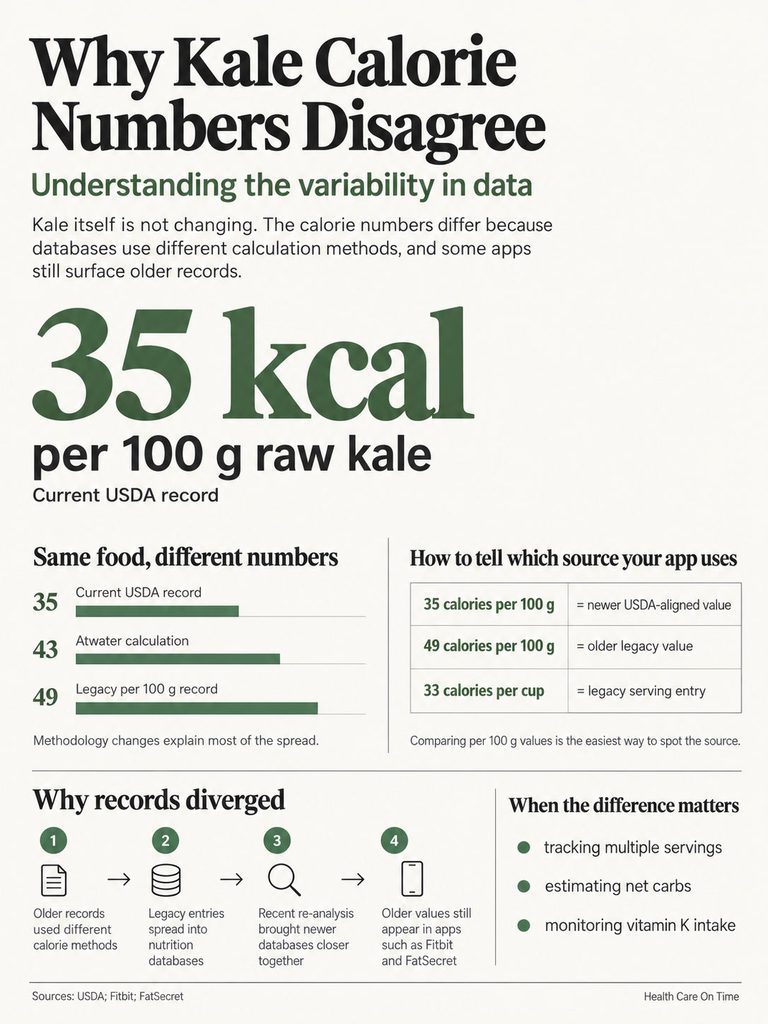
Each record answers a slightly different question. Once you know which is which, the numbers stop fighting each other.
The current record: 35 calories per 100 grams
USDA re-analyzed raw kale for Foundation Foods (FDC 323505), and the revised SR Legacy entry (FDC 168421) carries matching values. Both list 35 calories per 100 grams with a cup of about 21 grams.
This is the record Healthline links to, and it’s the one used throughout this guide.
Atwater factors: where 43 comes from
Calories on a database aren’t measured by burning food. They’re calculated from protein, fat, and carbs using conversion factors called Atwater factors.
The kale record shows both methods side by side: 43 calories using general factors and 35 calories using specific factors. The specific factors account for kale’s fiber, which gives your body very few usable calories.
USDA’s survey database, used in national diet studies, also lands higher. That entry, FDC 2709599, lists raw kale at 43 calories per 100 grams. Apps built on survey data will show 43.
The legacy record still powering apps
The highest numbers come from kale’s pre-revision record. Fitbit’s database still lists 33 calories per cup and 49 per 100 grams, and FatSecret shows 50 calories per 100 grams.
Those figures reflected older samples and older methods. They aren’t wrong so much as retired, and they also carry older vitamin values, covered below.
How to check which number your app uses
Ignore the per-cup figure and look at calories per 100 grams. If it reads 35, your app uses the current record. If it reads 43, it uses survey data. If it reads 49 or 50, it’s on the legacy record.
| USDA record | Database | Calories per 100 g | Cup weight | Where you’ll see it |
| FDC 323505 | Foundation Foods | 35 | about 21 g | Healthline, newer databases |
| FDC 168421 | SR Legacy (revised) | 35 | about 21 g | Nutrition label tools |
| FDC 2709599 | FNDDS (survey) | 43 | varies | Diet-study apps |
| NDB 11233 | Legacy (pre-revision) | 49 | 67 g | Fitbit, FatSecret, hospital libraries |
| FDC 169239 | SR Legacy (frozen, unprepared) | 28 | not listed per cup | Frozen kale entries |
For a food this low in calories, the gap rarely matters. It matters more if you eat several cups a day, track net carbs, or need steady vitamin K.
Raw vs Cooked Kale: Calories, Shrinkage, and Nutrient Changes
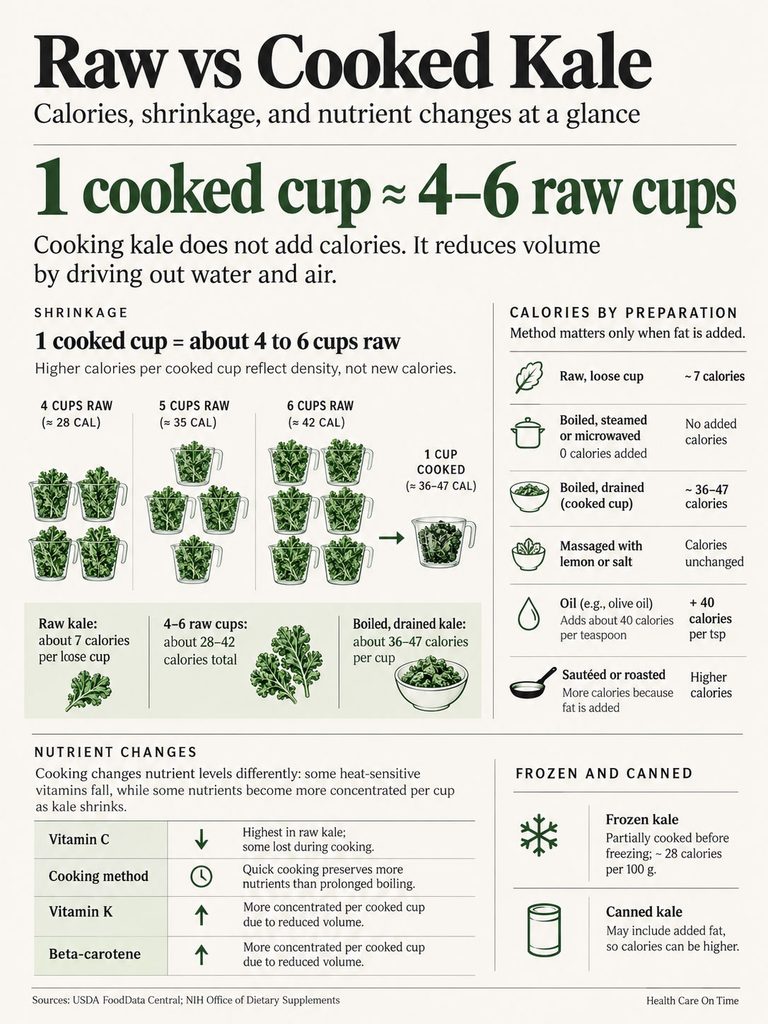
Cooking doesn’t add calories to kale. It drives out water and air, so more leaves fit in the same cup.
A home cook on a diet forum described it exactly: a package listed 45 calories for 2 1/2 cups of chopped kale, and after steaming, only about a cup was left. That cup still holds all 45 calories.
Why one cooked cup holds several raw cups
A cup of raw kale is mostly air. Heat collapses the leaves, so roughly 4 to 6 loose raw cups shrink into one cooked cup.
USDA’s legacy record lists boiled, drained kale at 36 calories per 1-cup, chopped serving of 130 grams. Newer boiled-kale entries run closer to 36 calories per 100 grams, which would put a 130-gram cup near 47 calories. Either way, plan on 36 to 47 per cooked cup.
Boiled, steamed, sauteed, and massaged kale
Boiling, steaming, and microwaving add zero calories. Sauteing and roasting add whatever fat goes in, and that’s usually most of the dish.
Massaging raw kale with lemon juice or salt softens the leaves without changing calories. Massaging with oil adds about 40 calories per teaspoon.
Vitamin C losses with boiling
Vitamin C dissolves into cooking water and breaks down with heat. The legacy boiled cup still lists 53.3 mg of vitamin C, but that’s spread across far more kale than a raw cup holds.
Quick steaming or a short saute keeps more vitamin C than long boiling. For the most vitamin C, eat some kale raw.
Vitamin K and beta-carotene rise per cup, not per leaf
Nutrients that survive heat get concentrated in a cooked cup. The legacy boiled cup lists 1,062.1 mcg of vitamin K and 10,624.9 mcg of beta-carotene.
For most people that’s a plus. For anyone taking warfarin, it’s the most important number in this guide.
Frozen and canned kale
Frozen kale is blanched before freezing, so it’s already partly collapsed. USDA lists frozen, unprepared kale at 28 calories per 100 grams, with 2.7 g of protein and 2.0 g of fiber.
“Cooked kale” entries in apps often include fat. FatSecret lists cooked kale from canned at 86 calories per cup, which reflects added fat, not the greens.
Full USDA Nutrition Breakdown for Kale
The values below come from USDA’s current raw kale record, per 100 grams, with the 21-gram cup amount alongside. Daily values follow FDA labeling standards.
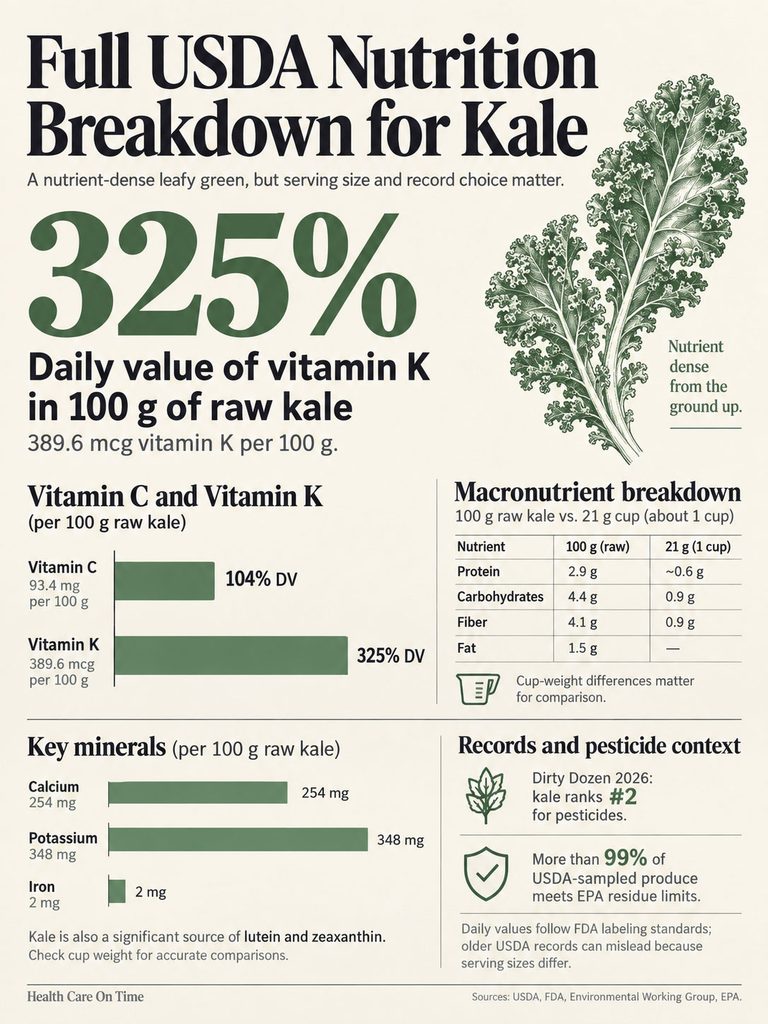
Our medical reviewers point out that kale’s strengths are vitamins K and C and its carotenoids. Per cup, its protein and minerals are modest.
Macros: protein, carbs, fiber, and fat
Per 100 grams, raw kale has 2.9 g of protein, 4.4 g of carbs, 4.1 g of fiber, and 1.5 g of fat. A 21-gram cup gives about 0.6 g of protein, 0.9 g of carbs, and 0.9 g of fiber.
That works out to about 0.3 g of net carbs per 100 grams. The legacy record told a different story: its 67-gram cup listed 6.7 g of carbs and 1.3 g of fiber, or about 5.4 g net. Keto trackers should check which record their app uses.
Vitamins: K, C, A, and folate
The current record lists 93.4 mg of vitamin C, 389.6 mcg of vitamin K, and 241 mcg RAE of vitamin A per 100 grams.
That’s about 325% of the daily value for vitamin K and about 104% for vitamin C per 100 grams. One 21-gram cup gives about 82 mcg of vitamin K (68% DV), about 20 mg of vitamin C (22% DV), and about 51 mcg RAE of vitamin A (6% DV).
That 6% surprises many readers. Kale is rich in beta-carotene, but your body converts it to vitamin A at a modest rate, so the RAE number is lower than many superfood lists suggest.
Minerals: calcium, potassium, and iron
The current Foundation record shows 254 mg of calcium, about 2 mg of iron, and 348 mg of potassium per 100 grams.
Per 21-gram cup, that’s about 53 mg of calcium, 0.4 mg of iron, and 73 mg of potassium. A cooked cup carries several times more, simply because it holds more kale.
Lutein, zeaxanthin, and why old values look bigger
Kale is one of the richest food sources of lutein and zeaxanthin, the carotenoids concentrated in the retina. The legacy record lists 26,498.5 mcg of lutein plus zeaxanthin per 1-cup chopped serving, but that cup weighed 67 grams.
When you see giant per-cup numbers for kale online, check the cup weight first. A 21-gram cup holds about a third as much.
| Nutrient or statistic | Value | Source |
| Calories, raw kale | 35 kcal per 100 g | USDA FoodData Central, FDC 323505 |
| Vitamin K, raw kale | 390 mcg per 100 g (325% DV) | USDA FDC 323505 |
| Vitamin C, raw kale | 93.4 mg per 100 g (104% DV) | USDA FDC 168421 |
| Calcium, raw kale | 254 mg per 100 g (20% DV) | USDA FDC 323505 |
| Vitamin K adequate intake | 120 mcg men, 90 mcg women per day | NIH Office of Dietary Supplements |
| US adults meeting vegetable recommendations | About 1 in 10 | CDC MMWR, 2022 |
| Kale’s pesticide ranking | Number 2 on the 2026 Dirty Dozen | EWG Shopper’s Guide, 2026 |
| USDA-sampled produce below EPA residue limits | More than 99% | Alliance for Food and Farming, citing USDA PDP |
Where the Real Calories in Kale Dishes Come From
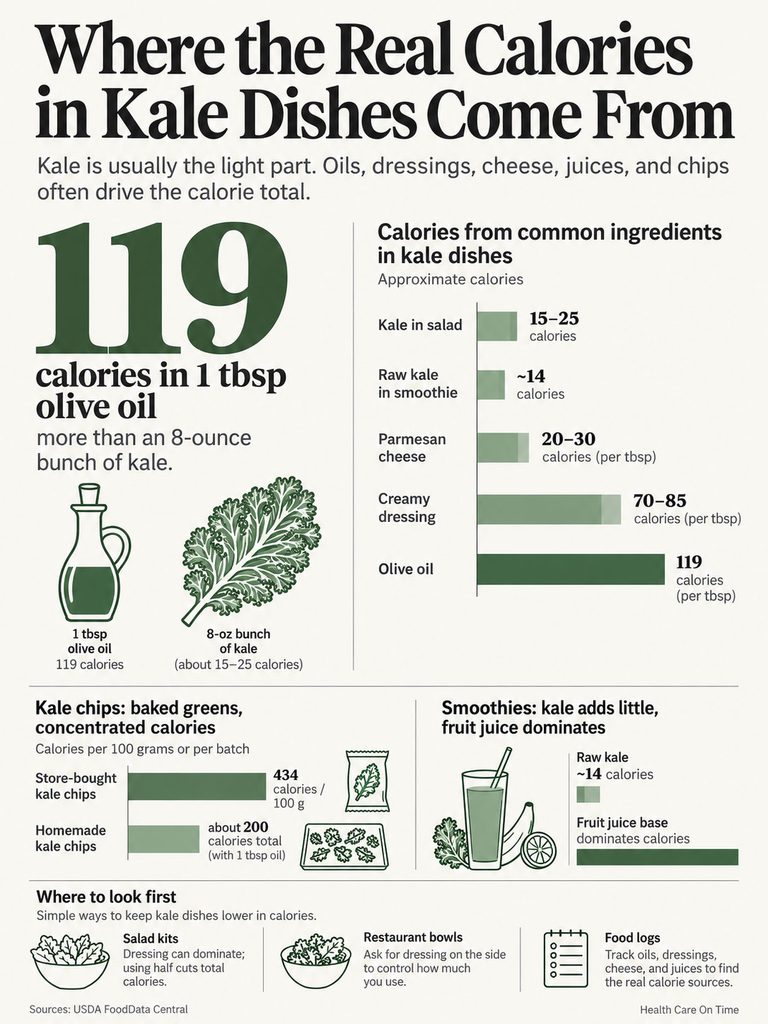
In food logs reviewed by our nutrition team, the kale itself is almost never the calorie problem. The extras are.
A big kale salad can land anywhere from 30 to 600 calories. The leaves account for maybe 15 to 25 of those.
Olive oil, dressings, and cheese
One tablespoon of olive oil has 119 calories. That’s more than an entire 8-ounce bunch of raw kale.
Creamy dressings often run 70 to 85 calories per tablespoon, and shredded Parmesan adds roughly 20 to 30 per tablespoon. Check your bottle’s label and log each extra on its own line, so you can see where the calories come from.
Kale chips: store-bought vs homemade
Kale chips concentrate calories because the water bakes off and the oil stays. A generic app entry lists kale chips at 434 calories per 100 grams, or about 123 per ounce.
Homemade chips from an 8-ounce bunch and 1 tablespoon of oil total about 200 calories for the whole tray. Store-bought chips coated in cashew or seed paste often run higher, so read the label.
Kale smoothies and juices
Two loose cups of raw kale add about 14 calories to a smoothie. The banana, mango, yogurt, nut butter, or juice base brings nearly everything else.
Bottled green juices are often mostly apple or other fruit juice. If the first ingredient is a fruit juice, treat the drink as a fruit drink with some kale in it.
Salad kits and restaurant kale bowls
Salad kits are convenient, but the dressing and topping packets usually supply most of the calories. Using half the dressing packet is an easy way to cut a kit’s total by a third or more.
Restaurant kale bowls follow the same pattern. Ask for dressing on the side and you control the biggest calorie lever on the plate.
Is Kale Good for Weight Loss? What the Evidence Actually Says
Kale is a very low energy-density food, meaning you get very few calories per bite. Eating patterns built on low energy-density foods tend to help people eat less without feeling hungrier.
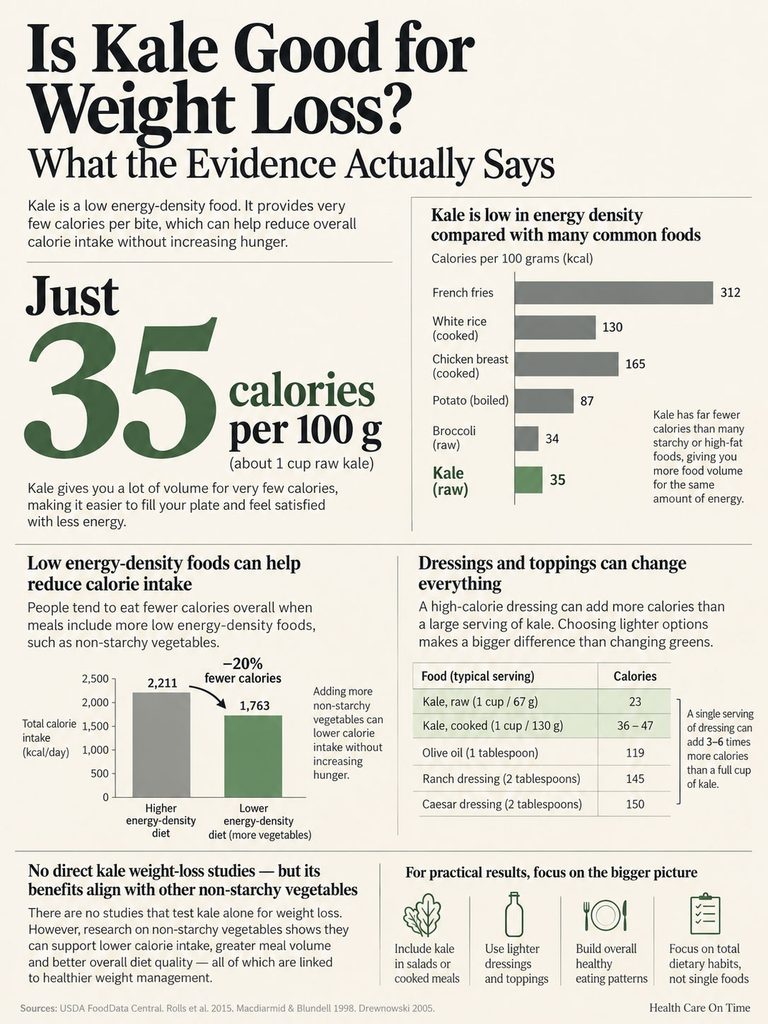
The honest caveat: even Healthline’s benefits page says no studies directly test kale’s effects on weight loss. The case for kale is the same as for most non-starchy vegetables.
Where kale helps is volume. A raw kale salad base, or a cup of greens folded into eggs, soup, or pasta, gives you a bigger plate for very few added calories.
What kale can’t do is offset the oil, cheese, and dressing that tend to come with it. Among patients we serve who track their food, switching from a creamy dressing to lemon juice and a teaspoon of oil saves more calories than any change in which green they choose.
Kale Safety: Warfarin, Thyroid, Kidneys, and Pesticides
For nearly everyone, kale is a safe everyday vegetable. A few groups should pay attention to how much they eat and how steadily.
Vitamin K and blood thinners
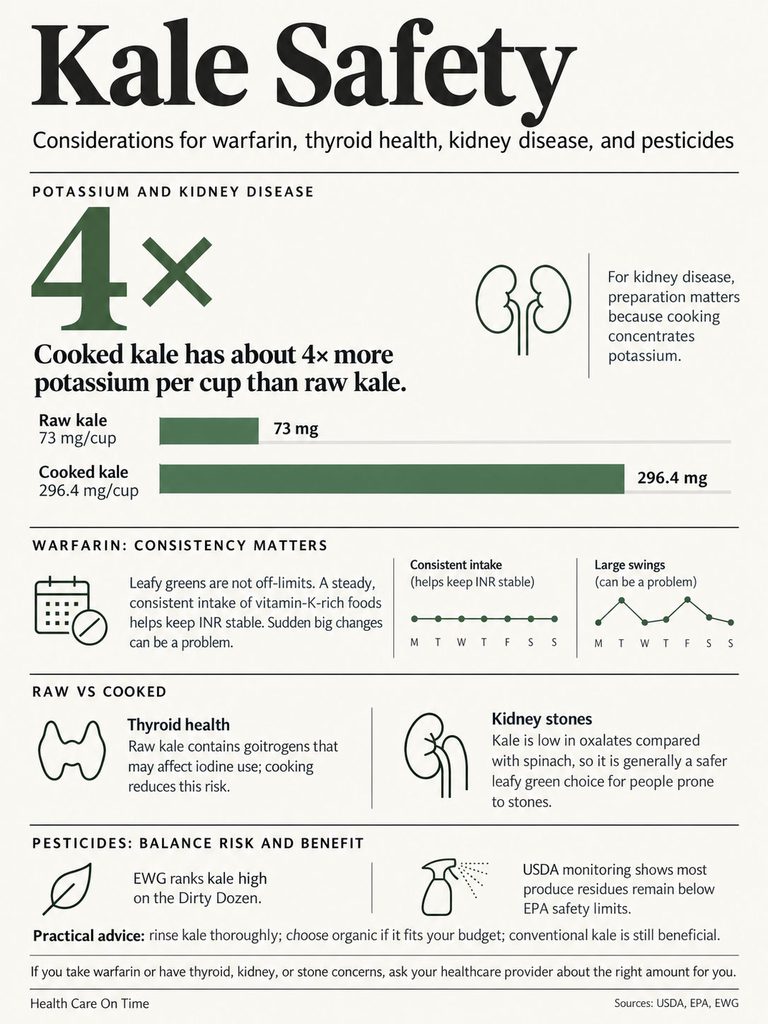
Warfarin (Coumadin) works by blocking vitamin K’s role in clotting. Big swings in vitamin K intake can change how well it works, which shows up on INR blood tests.
The goal is consistency, not avoidance. WebMD’s advice matches standard practice: eating about the same amount of leafy greens every day lets your doctor adjust your medication.
Across patients on anticoagulants who test with our lab partners, unexpected INR changes most often follow a sudden diet shift, like starting daily kale smoothies. A raw cup has about 82 mcg of vitamin K; a cooked cup can exceed 1,000 mcg. Tell your prescriber before kale becomes a daily habit.
Newer blood thinners such as apixaban (Eliquis) and rivaroxaban (Xarelto) don’t work through vitamin K. Your pharmacist can confirm which type you take.
Raw kale and the thyroid
Kale contains goitrogens, compounds that can interfere with iodine use by the thyroid at very high intakes. Most of the worry comes from extreme intake or iodine deficiency.
In the US, where iodized salt and dairy supply iodine, normal servings of kale aren’t a thyroid concern for most people. If you have hypothyroidism and drink several cups of raw kale a day in juices, mention it to your doctor and keep your TSH checks on schedule. Cooking also lowers goitrogen activity.
Potassium and kidney disease
People with advanced kidney disease often need to limit potassium. Raw kale is fairly modest, at about 73 mg per cup.
Cooked kale is a different story. The legacy boiled cup lists 296.4 mg of potassium. If your care team set a potassium limit, count cooked greens by the cooked cup.
Oxalates: why kale is the low-oxalate leafy green
Spinach is high in oxalates, which can add to calcium-oxalate kidney stone risk in people prone to them. Kale is much lower in oxalate than spinach.
That’s why kale is a common swap for people told to cut back on spinach. If you’ve had stones, follow the plan from your own stone workup, because the right diet depends on stone type.
Pesticides: what the 2026 EWG list does and doesn’t mean
The Environmental Working Group ranked kale, collard, and mustard greens number two on its 2026 Dirty Dozen, up from number three. EWG also reported that more than half of the kale samples tested contained possibly cancer-causing pesticides.
There’s another side. The Alliance for Food and Farming points out that more than 99 percent of USDA-sampled commodities have residues well below EPA safety standards. EWG itself acknowledges that the produce on its list falls well below allowable limits.
The practical move: rinse kale under running water, rubbing the curly folds, and remove damaged outer leaves. Buy organic if it fits your budget. Eating conventional kale is still far better than skipping greens.
How to Count Kale Accurately in Your Food Log
A kitchen scale fixes almost every kale logging problem. Weigh in grams and use 35 calories per 100 grams for raw kale.
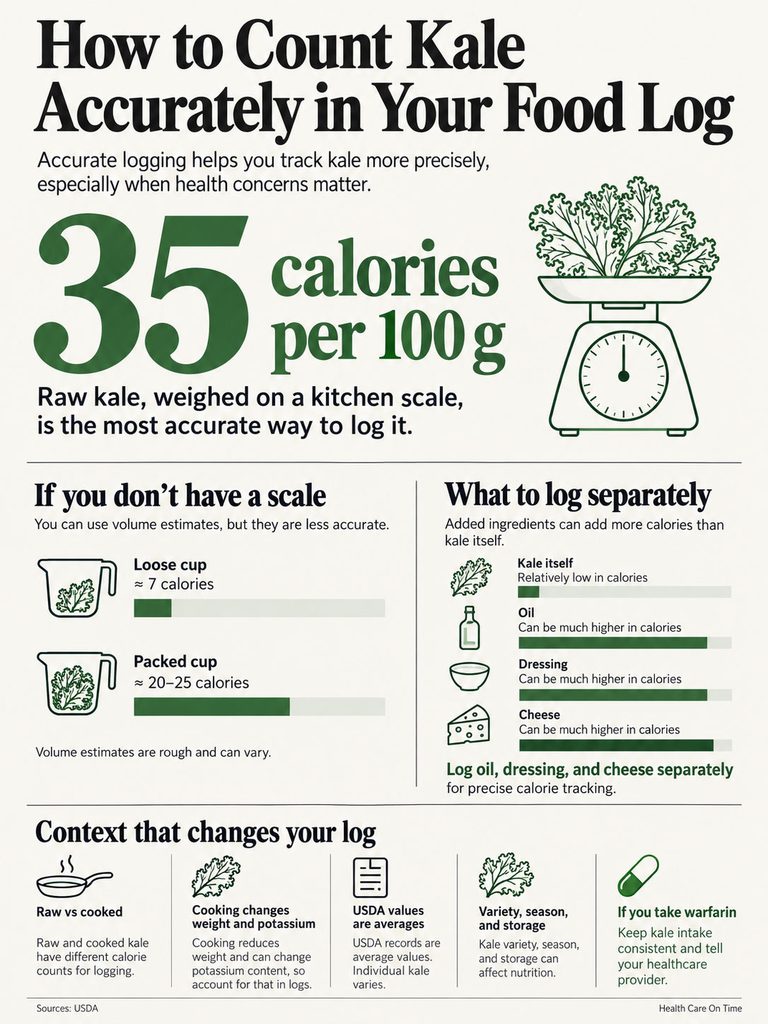
If you can’t weigh, match the cup to how you filled it. A loose, torn cup is about 7 calories. A packed, chopped cup is closer to 20 to 25.
Log oil, dressing, and cheese as separate entries. Your log will show exactly where the calories come from.
| Scenario | What to log | Why |
| App shows 33 calories per cup of raw kale | Re-log by weight at 35 kcal per 100 g | The app uses the old 67 g cup and 49 kcal record |
| Sauteed kale, 1 cup cooked | 36 to 47 kcal for kale plus 40 kcal per tsp oil | Cooking adds no calories; oil does |
| Homemade kale chips | Weigh raw kale before baking; log oil separately | Water loss makes finished weight misleading |
| On warfarin and starting daily kale | Keep the amount steady; tell your prescriber first | Vitamin K swings change INR results |
| Kidney disease with a potassium limit | Count cooked kale by the cooked cup | A cooked cup holds about 4x the potassium of a raw cup |
| Keto, counting net carbs | Use the current record (about 0.3 g net per 100 g) | The legacy record overstates net carbs |
| Green smoothie with 2 cups raw kale | Log 14 kcal for kale; log fruit and liquids separately | Fruit and juice carry most smoothie calories |
What these numbers can’t tell you
USDA records describe average samples. Your kale’s calories and vitamins shift with variety, season, soil, storage time, and how long it sat in the fridge.
The cooked-kale figures also come from separate lab analyses, not from weighing the same leaves before and after cooking. Treat them as reliable ranges, not exact readings for your pot.
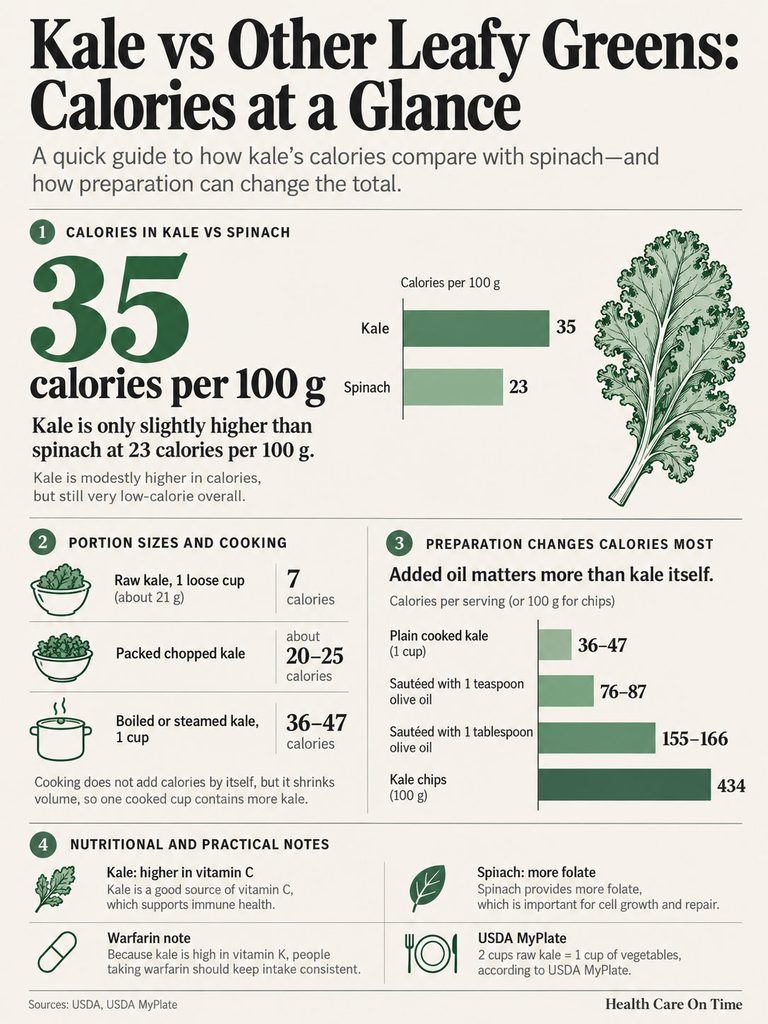
Kale vs Other Leafy Greens: Calories at a Glance
Every common leafy green is low in calories, so choose based on taste, nutrients, and medical needs. Per 100 grams raw, using USDA SR Legacy values:
- Romaine lettuce: about 17 calories; mild and watery, with far less vitamin K than kale.
- Swiss chard: about 19 calories; high in vitamin K and moderate in oxalate.
- Spinach: about 23 calories; rich in folate, but high in oxalate.
- Collard greens: about 32 calories; close to kale and also very high in vitamin K.
- Kale: about 35 calories; the most vitamin C in this group and low in oxalate.
So kale is a little higher in calories than spinach, by about 12 calories per 100 grams. For most diets, that gap is too small to matter.
Frequently Asked Questions
How many calories are in 1 cup of raw kale?
One loose cup of raw kale weighs about 21 grams and has about 7 calories under USDA’s current record. Packed, chopped kale can weigh three times as much, bringing a cup to roughly 20 to 25 calories. Weighing in grams gives the most accurate number for your food log.
How many calories are in cooked kale?
One cup of boiled or steamed kale has about 36 to 47 calories, depending on the USDA record and how tightly the cup is packed. Cooking adds no calories. It shrinks several cups of raw kale into one cup, so the same calories fit in less space.
How many calories are in 100 grams of kale?
USDA’s current Foundation and revised SR Legacy records list raw kale at 35 calories per 100 grams. Survey-based entries show 43, and the older legacy record shows 49. Frozen, unprepared kale is about 28 calories per 100 grams. Use 35 for fresh raw kale.
Why does my app say kale has 33 calories per cup?
Your app likely uses USDA’s older kale record, which weighed a chopped cup at 67 grams and listed 49 calories per 100 grams. The current record uses about 21 grams per cup. Check your app’s per-100-gram value; if it shows 49 or 50, the entry is outdated.
Does cooking kale add calories?
No. Boiling, steaming, and microwaving add zero calories. A cooked cup simply holds more kale than a raw cup. Sauteing, roasting, and baking chips add calories only through the oil or butter, at about 40 calories per teaspoon of oil.
How many calories are in sauteed kale with olive oil?
One cup of cooked kale sauteed in 1 teaspoon of olive oil comes to about 76 to 87 calories. With a full tablespoon of oil, it rises to about 155 to 166 calories. The oil, not the kale, drives the total.
How many calories are in kale chips?
Generic kale chips run about 434 calories per 100 grams, or about 123 calories per ounce. Homemade chips from an 8-ounce bunch and 1 tablespoon of oil total about 200 calories for the whole tray. Store-bought chips with nut or seed coatings often run higher.
Is curly kale lower in calories than lacinato kale?
Not in any meaningful way. USDA doesn’t publish separate calorie records for curly, lacinato, or baby kale, and they’re close per gram. The difference is in how they fill a cup: flat lacinato and tender baby kale pack more tightly, so weigh them for accuracy.
Is kale lower in calories than spinach?
No, slightly higher. Raw kale has about 35 calories per 100 grams, while raw spinach has about 23. The gap is small for most diets. Kale has more vitamin C and much less oxalate, while spinach provides more folate.
Can people on warfarin eat kale?
Usually yes, as long as intake stays consistent. Kale is very high in vitamin K, which affects how warfarin works. A sudden jump, like starting daily kale smoothies, can lower your INR. Talk with your prescriber before changing how much kale or other leafy greens you eat.
Is raw kale bad for your thyroid?
For most people, no. Kale contains goitrogens, but normal servings don’t harm thyroid function when iodine intake is adequate, as it usually is in the US. People with hypothyroidism who drink large amounts of raw kale daily should tell their doctor and keep regular TSH checks.
How many cups of kale count as a vegetable serving?
Under USDA MyPlate, 2 cups of raw leafy greens count as 1 cup of vegetables. One cup of cooked kale counts as 1 cup. So 2 loose cups of raw kale, at about 14 calories, equal one cup-equivalent of vegetables.
Disclaimer: This article is for general information and isn’t a substitute for advice from your doctor, pharmacist, or registered dietitian. If you take warfarin or other medicines, have kidney disease, or manage a thyroid condition, talk with your care team before making major changes to your diet. Nutrient values come from USDA records and can vary by variety, growing conditions, and preparation.
References
- USDA FoodData Central: Kale, raw (Foundation, FDC 323505)
- USDA FoodData Central: Kale, raw (SR Legacy, FDC 168421)
- USDA FoodData Central: Kale, raw (FNDDS survey, FDC 2709599)
- USDA FoodData Central: Kale, frozen, unprepared (FDC 169239)
- NIH Office of Dietary Supplements: Vitamin K Fact Sheet for Health Professionals
- CDC MMWR: Adults Meeting Fruit and Vegetable Intake Recommendations
- USDA MyPlate: Vegetables Group
- EWG: 2026 Shopper’s Guide to Pesticides in Produce
- Food Safety News: EWG Reveals Its Dirty Dozen; AFF Challenges Validity of List
- Healthline: Health Benefits of Kale
- WebMD: Health Benefits of Kale