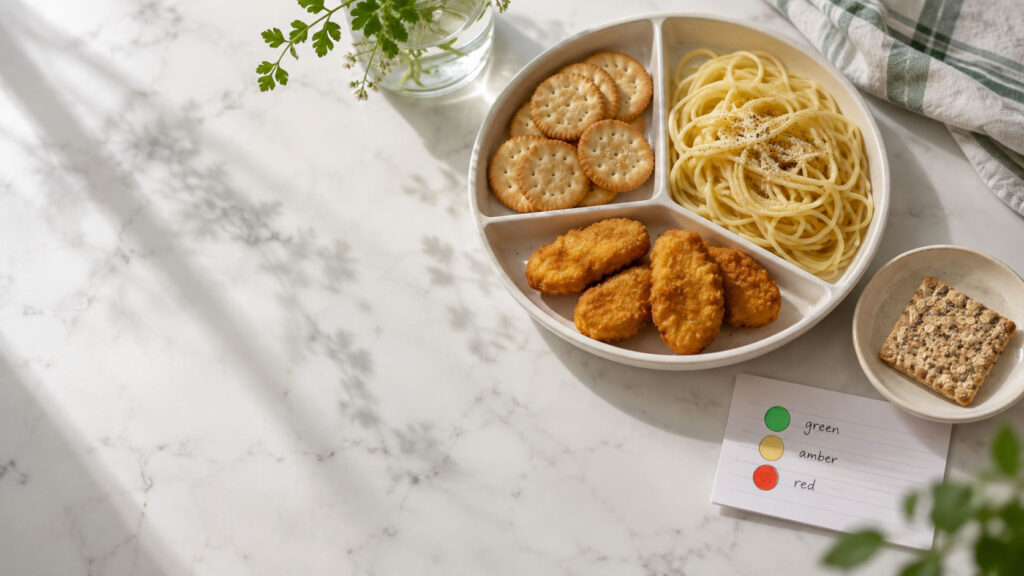
The scariest moment in ARFID often isn’t a new food on the plate. It’s the day an old one disappears.
A cracker brand quietly changes its recipe. A school cafeteria switches suppliers. Overnight, someone has one fewer food they can eat without panic, and nobody warned them it could happen.
Table of Contents
That’s why this guide starts with protection, not pressure. You’ll learn what ARFID safe foods really are, why popular advice gets the research backward, and how to expand safe foods one small, deliberate step at a time, whether you’re a parent or an adult living with ARFID yourself.
Quick Answer: ARFID safe foods are foods a person with avoidant/restrictive food intake disorder can eat with little anxiety, disgust, or fear. To expand safe foods, keep the current list stable, add near-copies through food chaining, and use repeated, pressure-free exposure. New foods sit beside safe foods, not hidden inside them. Structured therapy such as CBT-AR or FBT-ARFID offers the best-supported path.
The six rules that make expansion work:
- Never remove or replace a safe food to “force” variety.
- Rotate safe foods and keep brand backups to prevent burnout.
- Start with the smallest possible change: brand, shape, or sauce.
- Offer new foods separately, with no pressure to eat them.
- Repeat each new food many times before judging it.
- Bring in a trained clinician when weight, energy, or daily life slip.
At a Glance
- Safe foods are a foundation, not a problem to fix.
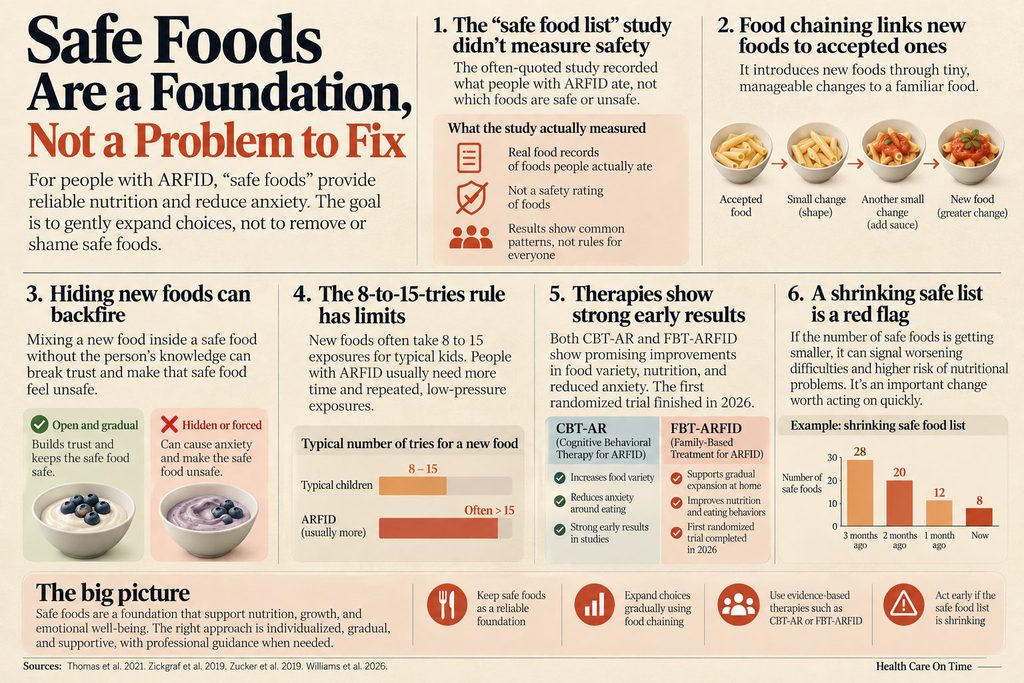
- The often-quoted “safe food list” study actually measured food records, not safety ratings.
- Food chaining links new foods to accepted ones through tiny changes.
- Hiding new foods inside safe foods can turn a safe food unsafe.
- The 8-to-15-tries rule comes from typical kids; ARFID often needs more.
- CBT-AR and FBT-ARFID show strong early results; the first randomized trial finished in 2026.
- A shrinking safe list is a red flag worth acting on quickly.
What ARFID Safe Foods Are (and What They Aren’t)
A safe food is any food a person with ARFID can eat reliably, with minimal distress. It’s predictable. It tastes, feels, and looks the same every single time.
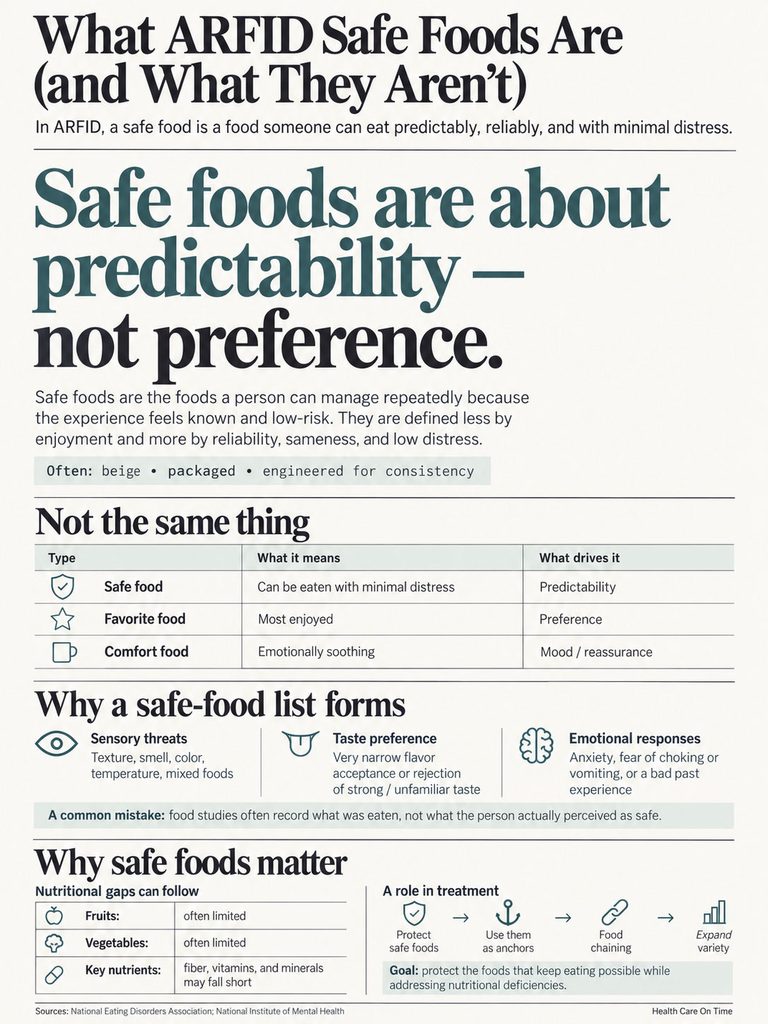
That predictability is the whole point. When the nervous system treats unfamiliar food as a threat, sameness is what makes eating possible at all.
Safe Foods vs Favorite Foods vs Comfort Foods
These words get blurred, and the blur leads to bad advice. A favorite food is enjoyed. A comfort food soothes. A safe food is tolerable, and that’s a lower, more fragile bar.
Clinicians at Equip, a US virtual eating disorder program, point out that someone with ARFID may genuinely like a food yet still avoid it after one bad experience. Liking and safety run on separate tracks.
Safe foods can also be startlingly specific. One brand of chicken nugget, at one temperature, with no browned edges. A different box from the same company may already feel risky.
The Three Drivers Behind a Safe List
ARFID isn’t about weight or body shape. Clinicians describe three main drivers, and many people have more than one:
- Sensory sensitivity: textures, smells, colors, or temperatures feel overwhelming.
- Fear of aversive consequences: worry about choking, vomiting, pain, or an allergic reaction.
- Lack of interest: low appetite, early fullness, or simply forgetting to eat.
A 2024 study of lived experience found that “hidden” foods, like candies with liquid centers or casseroles, felt especially unsafe. Anything that can surprise the mouth becomes suspect.
Why So Many Safe Foods Are Beige and Packaged
Plain bread, crackers, fries, and boxed cereal show up on safe lists again and again. Packaged foods are engineered to be identical every time, which is exactly what an anxious brain wants.
The Study Everyone Misquotes
Several top-ranking pages claim research shows young people with ARFID “reported” cookies, soda, and bread “as safe.” That isn’t what the study measured.
The Harshman 2019 study in Nutrients, led by Massachusetts General Hospital researchers, compared four-day food records from 52 people aged 9 to 22 with full or subthreshold ARFID against 52 healthy controls. It recorded what people ate, not what they rated as safe.
The real findings still matter. The ARFID group had no fruit or vegetable category in its top five foods; controls had three. The ARFID group also ate less protein and fewer vegetables, and took in less vitamin K and vitamin B12.
Our medical reviewers note that this distinction changes the goal. The aim isn’t to shame “junk” safe foods. It’s to protect them while building a bridge toward the nutrients that are missing.
| Feature | ARFID Safe Food | Picky-Eating Preference | Comfort Food | ARFID Fear Food |
| What it is | Eaten with minimal distress; often one of fewer than 10 to 15 items | A liked food within a wider, flexible menu | Eaten for emotional soothing | Triggers disgust, panic, or gagging |
| Main driver | Predictable texture, taste, brand | Taste preference, mild neophobia | Mood and memory | Sensory threat or fear of choking, vomiting, pain |
| If it’s unavailable | Person may skip the meal entirely | Person picks another food | Mild disappointment | Not applicable; already avoided |
| Brand or recipe swap | Often rejected, even when “identical” | Usually accepted | Usually accepted | Not applicable |
| Role in expansion | Anchor for food chaining; never removed | Rarely needs a plan | Can serve as a chaining anchor | Long-term target, approached last |
| Typical example | One brand of plain crackers at room temperature | Prefers pasta over rice | Grandma’s mac and cheese | Mixed casserole, mashed foods, fish |
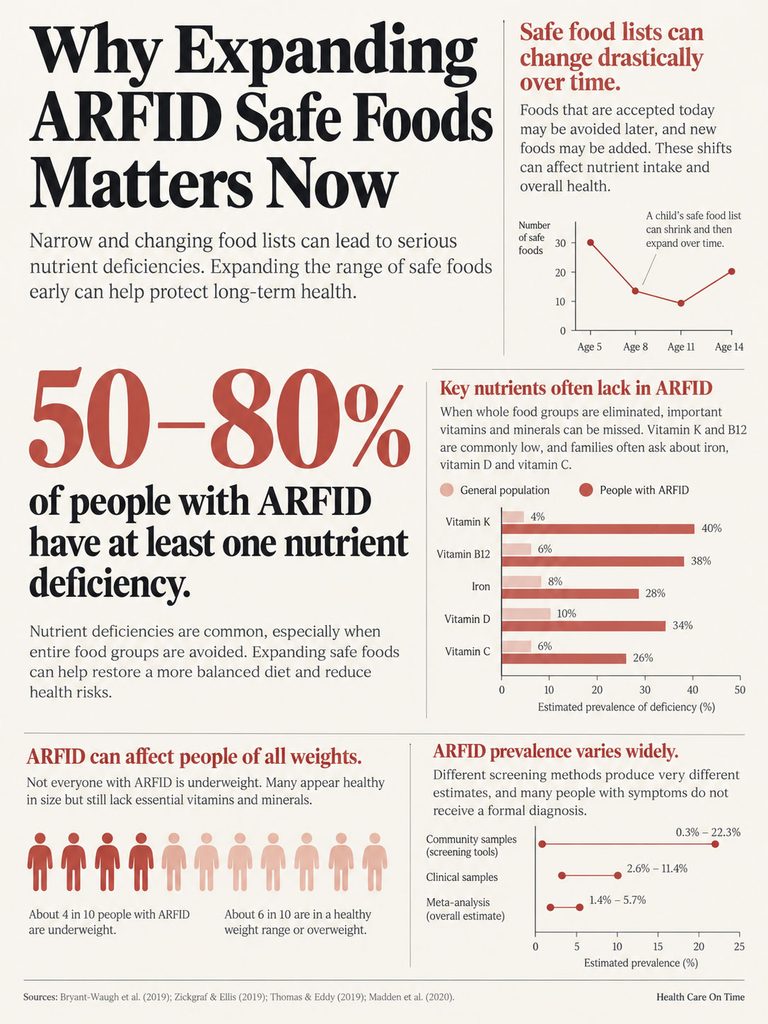
Why Expanding ARFID Safe Foods Matters Now
A narrow list can hold steady for years, then shrink fast. That’s the hidden risk: safe lists rarely stay the same size on their own.
Nutrient Gaps That Follow Narrow Lists
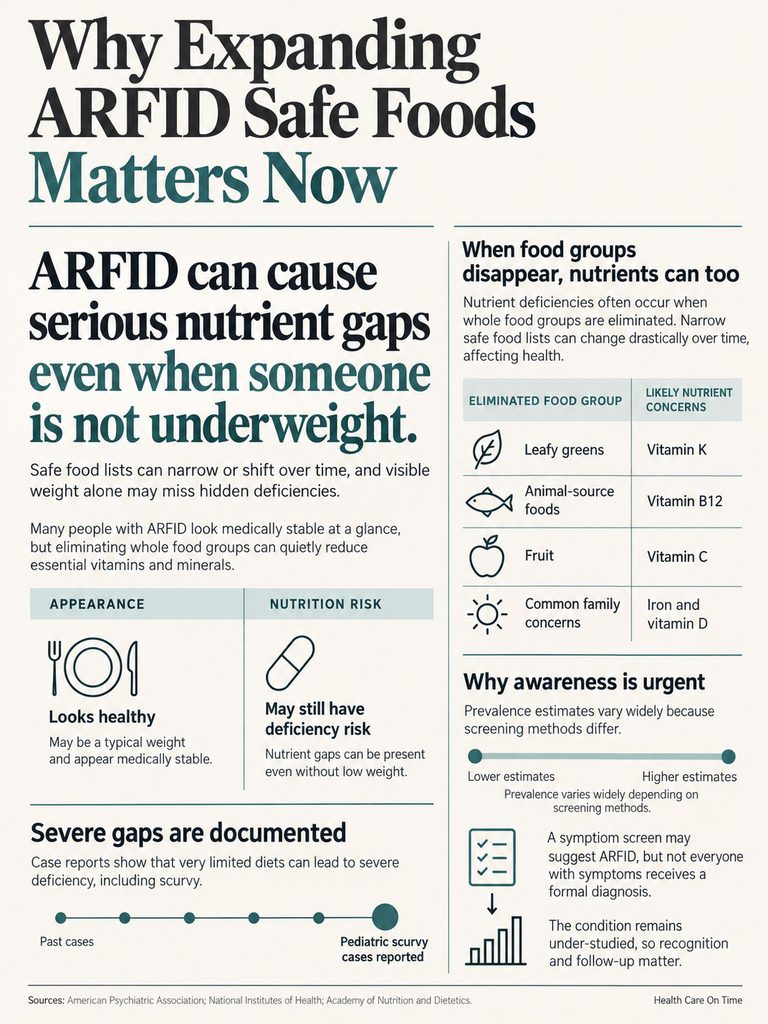
When whole food groups fall away, specific nutrients go with them. Harshman’s data point to vitamin K and B12. Families who book nutrient panels through HealthCareOnTime often ask about iron, vitamin D, and vitamin C as well.
Severe gaps aren’t theoretical. Our ARFID and autism guide covers US hospital data on pediatric scurvy, a disease most people assume vanished centuries ago.
A low weight isn’t required for harm. The Eating Recovery Center reports that only 11% of teens with possible ARFID in one study were clinically underweight. A normal-looking child, or adult, can still be short on key vitamins.
How Common Is ARFID, Really?
You’ll see wildly different numbers online, and each is “true” for its own method. A quick screening questionnaire catches far more people than a full clinical interview.
| Statistic | Figure | Population | Source |
| Top-5 food categories with any fruit or vegetable | 0 in ARFID vs 3 in controls | 104 youth aged 9 to 22 | Harshman, Nutrients 2019 |
| Adults screening positive for ARFID | 4.7% | 50,082 adults, NEDA online screen | Eating Recovery Center summary |
| Adults screening positive on a symptom screen | About 1 in 4 | 4,002 adults, UK and USA | PMC12884231 |
| Prevalence range in non-clinical child samples | 0.3% to 15.5% | Systematic review of pediatric studies | PMC10108140 |
| Full ARFID in pediatric GI referrals | 8% (23% with symptoms) | 129 patients aged 6 to 18 | J Pediatr Gastroenterol Nutr 2022 |
| Fear of GI symptoms as the main driver | 67% | 30 pediatric patients with symptoms | J Pediatr Gastroenterol Nutr 2022 |
| Patients in virtual CBT-AR or FBT-ARFID | Reliable gains on all measures | 783 patients (532 youth, 251 adults) | Int J Eat Disord 2025 |
| Teens with possible ARFID who were underweight | 11% | Adolescent cohort | Eating Recovery Center summary |
The takeaway: a 1-in-4 symptom screen isn’t the same as 1 in 4 people having ARFID. The gap between screens and diagnoses tells you the condition is under-studied, not that everyone has it.
Rule One: Protect the Safe Foods You Already Have
Most guides jump straight to “try new foods.” That order is backward. Before you add anything, guard what’s already working.
Safe Food Burnout and How to Prevent It
Eat the same food at every meal for months and it can start to feel dull, then uncomfortable, then unsafe. People in ARFID communities call this “safe food burnout.”
You can lower the risk with a few habits:
- Rotate: spread safe foods across the week instead of leaning on one.
- Stock backups: keep spare boxes of exact brands, flavors, and sizes.
- Write it down: note brand, package size, and how each food is prepared.
- Watch the signals: slower eating, new complaints, or leftover portions deserve attention.
When a Recipe or Package Changes
Food makers reformulate products often, and the change can look tiny on the label. To a sensory-sensitive eater, a slightly different crunch is a different food.
Patients commonly tell our team that a reformulation felt like a loss, not an inconvenience. Treat it that way. It isn’t a failure of willpower.
Practical steps: buy the old version while it’s still on shelves, then use food chaining (below) to bridge from old to new. Our medical reviewers note that this “bridge back” often moves faster than starting from scratch, because the new version shares most of the old one’s features.
Why Removing Safe Foods Backfires
It can be tempting to clear the pantry of crackers so a child “has to” try vegetables. It almost never works.
Pediatric experts at Columbia University warn that pressure can lead children to choose hunger over eating unfamiliar food. For someone with ARFID, an empty plate feels safer than a scary one.
Keep safe food portions steady while you work on new foods. Nourishment comes first; variety comes second.
How to Expand ARFID Safe Foods: 7 Steps That Work
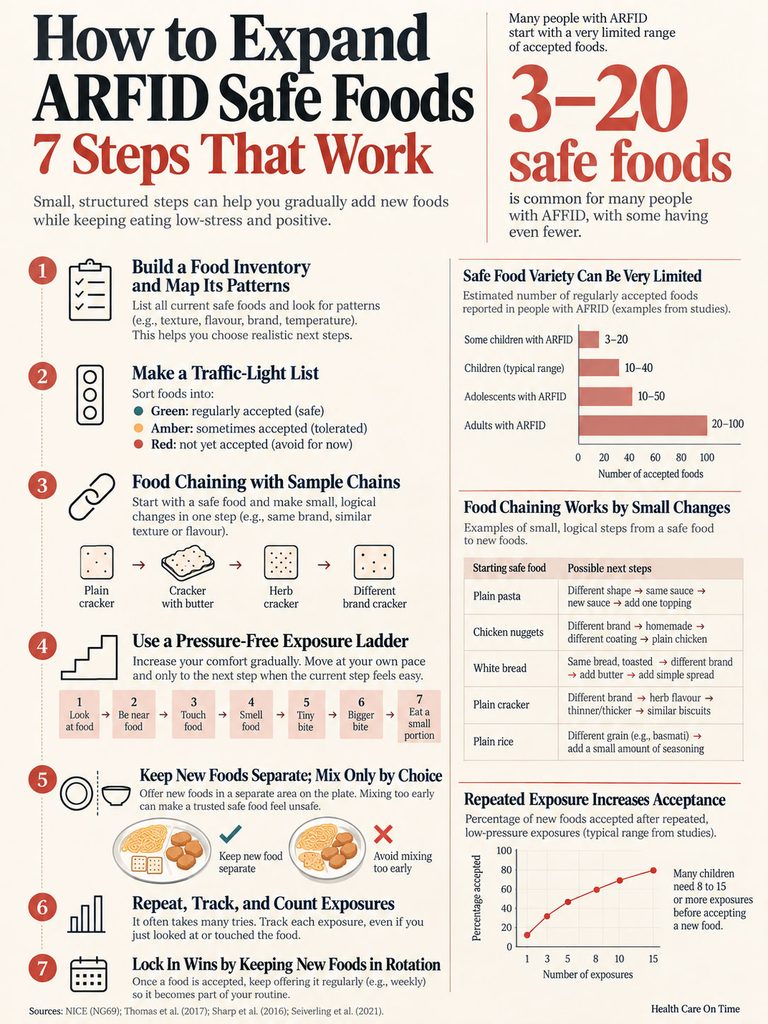
These steps blend food chaining, exposure, and principles from CBT-AR. They’re a home starting point, not a replacement for treatment, and they work whether a parent is guiding a child or an adult is running the plan solo.
Step 1: Build a Food Inventory and Map Its Patterns
List every food eaten in the past month, including brand and preparation. Then sort by texture (crunchy, smooth, chewy), flavor (salty, sweet, mild), color, and temperature.
Patterns jump out fast. Pretzels, crackers, and chips say “dry, salty, crunchy.” That pattern is your map for choosing the first new food.
Step 2: Make a Traffic-Light List
Sort foods into three groups:
- Green: current safe foods.
- Amber: foods that might be possible to try.
- Red: foods that feel impossible right now.
Rate each amber food from 0 to 10 for expected anxiety, then start with the lowest score. Red foods stay off the table for now.
Step 3: Food Chaining
Food chaining moves from an accepted food to a new one through tiny, “just noticeable” changes. It was developed by speech-language pathologist Cheri Fraker and pediatric gastroenterologist Mark Fishbein.
Each link shares most features with the last. Change one thing at a time: brand, shape, flavor, texture, or color.
Sample Chains
- Nuggets: favorite nugget brand → second nugget brand → dinosaur-shaped nuggets → breaded chicken tenders → baked chicken strips → grilled chicken strips.
- Crackers: plain butter crackers → whole wheat version → cheese crackers → thin pretzel crisps → pita chips → crunchy roasted chickpeas.
- Pasta: plain buttered spaghetti → buttered penne → penne with a little parmesan → penne with a thin butter-tomato sauce → pasta with small pieces of chicken.
Working through one chain can take weeks. Slow is normal, and a pause on one link isn’t a failure.
Step 4: Use a Pressure-Free Exposure Ladder
Eating is the top rung, not the first one. A ladder might look like this:
- Tolerate the food on the table.
- Tolerate it on the plate.
- Touch it.
- Smell it.
- Touch it to the lips.
- Lick it.
- Take a tiny bite, with permission to spit it out.
- Chew and swallow a small bite.
Every rung counts as progress. Picking up a new food without eating it is a real win.
Step 5: Keep New Foods Separate; Mix Only by Choice
Here the top search results disagree with each other. One popular page suggests mixing a bit of new food into a safe food. A UK National Health Service caregiver guide says the opposite: keep them apart so the safe food isn’t rejected too.
Our medical reviewers side with separation as the default. A safe food is hard to earn back once it’s “contaminated.” Mixing can work later, but only when the eater chooses it, knows exactly what’s in it, and controls the amount.
Why Hiding Foods Breaks Trust
Sneaking spinach into a smoothie may feel clever. For someone with ARFID, discovering it can make the smoothie, and the person who made it, feel untrustworthy.
The F.E.A.S.T. 2026 family guide lists sneaking foods in and forcing tastes among approaches to avoid. Trust is the engine of expansion; don’t spend it on one hidden vegetable.
Step 6: Repeat, Track, and Count Exposures
One try tells you very little. Research on typical children shows that repeated, pressure-free tasting changes liking over time.
A systematic review in the American Journal of Clinical Nutrition found that tasting a food daily for 8 to 10 or more days increased acceptance in infants and toddlers. For older children and adults, exposure researchers suggest 10 to 15 tastes may be needed.
One honest caveat: those numbers come from children without ARFID. Someone with ARFID may need more exposures, longer gaps, or smaller steps. Track every try so progress stays visible on hard days.
A Sample 4-Week Chain Plan
- Week 1: Second brand of a safe cracker on the table at snack time, 4 to 5 days. Goal: touch and smell.
- Week 2: Same new cracker. Goal: lick or tiny bite, spitting allowed.
- Week 3: Small bites most days. If it feels close to safe, keep going; if not, stay here.
- Week 4: New cracker joins the green list, or the plan steps back one rung. Both outcomes are fine.
Step 7: Lock In Wins by Keeping New Foods in Rotation
A food accepted once can fade if it disappears for a month. Keep each new food showing up a few times a week.
Once a new food feels as easy as an old one, promote it to the green list. Now it can anchor the next chain.
Expansion by ARFID Type
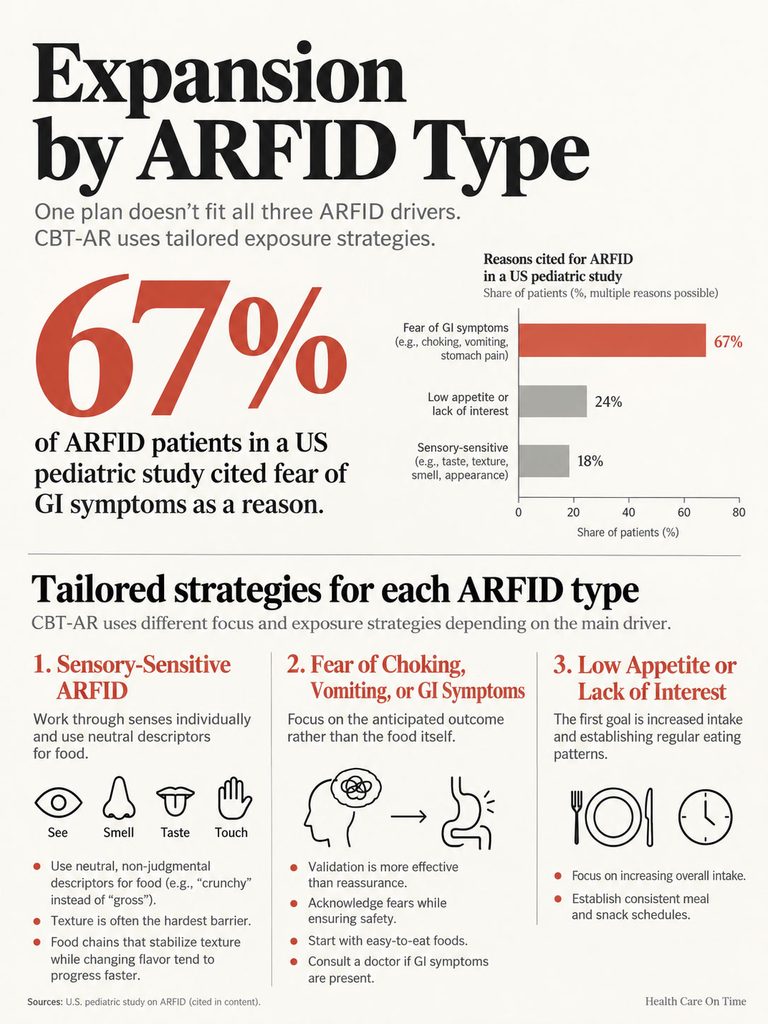
One plan doesn’t fit all three ARFID drivers. CBT-AR, the main structured therapy, uses different exposure strategies for each, according to a 2026 review in Frontiers in Psychiatry.
Sensory-Sensitive ARFID
Work through the senses one at a time. Describe new foods with neutral words (crunchy, soft, warm) instead of “yummy” or “gross.”
Texture is usually the hardest barrier. Chains that hold texture steady while changing flavor tend to move faster.
Fear of Choking, Vomiting, or GI Symptoms
Here, the food itself isn’t the main problem; the predicted outcome is. Validation lands better than reassurance: “That fear makes sense, and you’re safe right now” beats “You’ll be fine.”
Begin with foods that feel physically easy: soft, small, quick to dissolve. If GI symptoms are real, a doctor should check for medical causes alongside therapy. In one US pediatric study, 67% of patients with ARFID symptoms named fear of GI symptoms as their reason.
Low Appetite or Lack of Interest
For this group, the first goal is often more eating, not new foods. Set meal and snack times, use phone alarms, and keep mealtimes calm and pleasant.
Expansion can wait until intake feels steadier. A Cigna clinician handout puts it plainly: not every ARFID client progresses to adding new foods, and that’s okay.
Expanding Safe Foods as an Adult
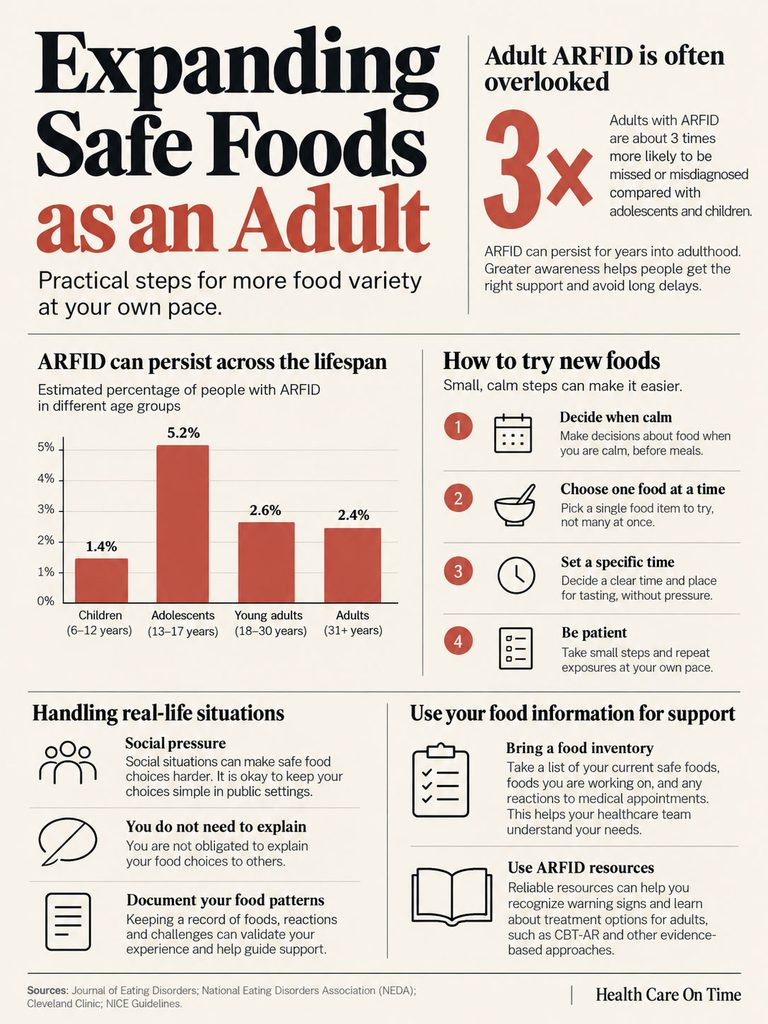
Most ARFID advice is written for parents. Yet in the largest treatment study to date, 251 of 783 patients were adults, and adult ARFID is easy to miss for years.
Running Your Own Food Chain
Adults can run every step above without a parent in the room. The trick is to make decisions before the food is in front of you, when anxiety is lower.
Choose the next link on a calm day, buy only that one item, and set a specific time to try it. Give yourself full permission to stop at any rung.
Work Lunches, Restaurants, and Social Meals
Social pressure is often the hardest part of adult ARFID. A few strategies help:
- Check restaurant menus online in advance and pick a safe or near-safe option.
- Keep a portable safe snack at work for meetings that run through lunch.
- Practice a short, simple line: “This is a medical eating condition, so sticking with this works best.”
You don’t owe anyone a full explanation. Protecting your safe foods in public is part of treatment, not avoidance.
Getting Taken Seriously
Adults often hear “you’re just picky.” Bring your food inventory to appointments. A written list of 15 foods across a month makes the pattern hard to dismiss, and our ARFID in adults guide covers warning signs to mention.
What the Evidence Actually Shows
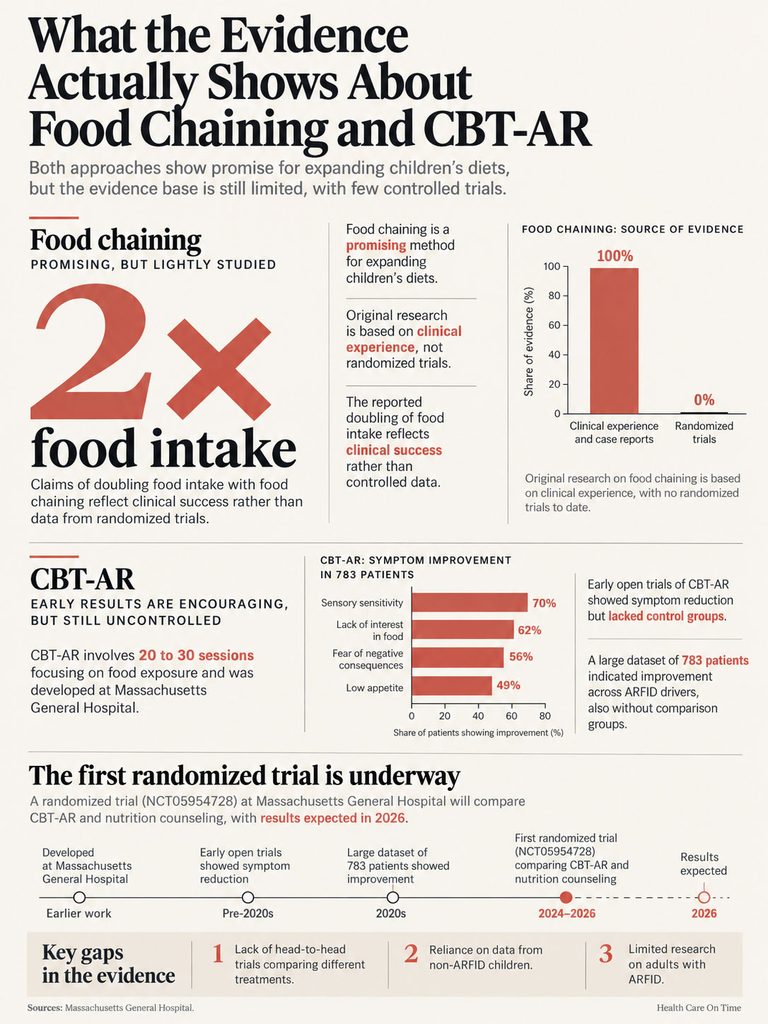
Many top pages call food chaining and CBT-AR “proven.” The honest picture is more hopeful than proven.
Food Chaining: Promising, Lightly Studied
The original paper, Fishbein and colleagues, 2006, is a chart review in Nutrition in Clinical Practice. That’s valuable clinical experience, but not a randomized trial.
Claims that chaining can double the foods a child eats reflect clinical success, not controlled data. Food chaining is low-risk and widely used by US feeding teams; just don’t expect a guaranteed timeline.
CBT-AR and FBT-ARFID
CBT-AR, developed at Massachusetts General Hospital by Jennifer Thomas and Kamryn Eddy, runs 20 to 30 sessions of about 50 minutes, with food exposure at its core. FBT-ARFID puts parents at the center of treatment for younger children.
Early CBT-AR open trials included 20 youth and 15 adults, and a later open trial included 42 people aged 10 to 55. All showed large symptom drops, but none had a control group.
The largest real-world dataset followed 783 patients in virtual care and found reliable improvement in youth and adults across all three ARFID drivers. Again, there was no comparison group.
The first randomized trial to watch is NCT05954728 at Mass General, comparing CBT-AR with nutrition counseling in 53 young people aged 10 to 18. It finished in March 2026; results aren’t published yet.
Honest Limits
Three gaps deserve plain language. Almost no trials compare expansion methods head-to-head. Most exposure numbers come from children without ARFID. And adult ARFID research is still small.
None of that means these methods fail. It means patience and professional guidance matter, because no method guarantees a pace.
Mistakes That Shrink a Safe List
Well-meant moves can make things worse. Watch for these:
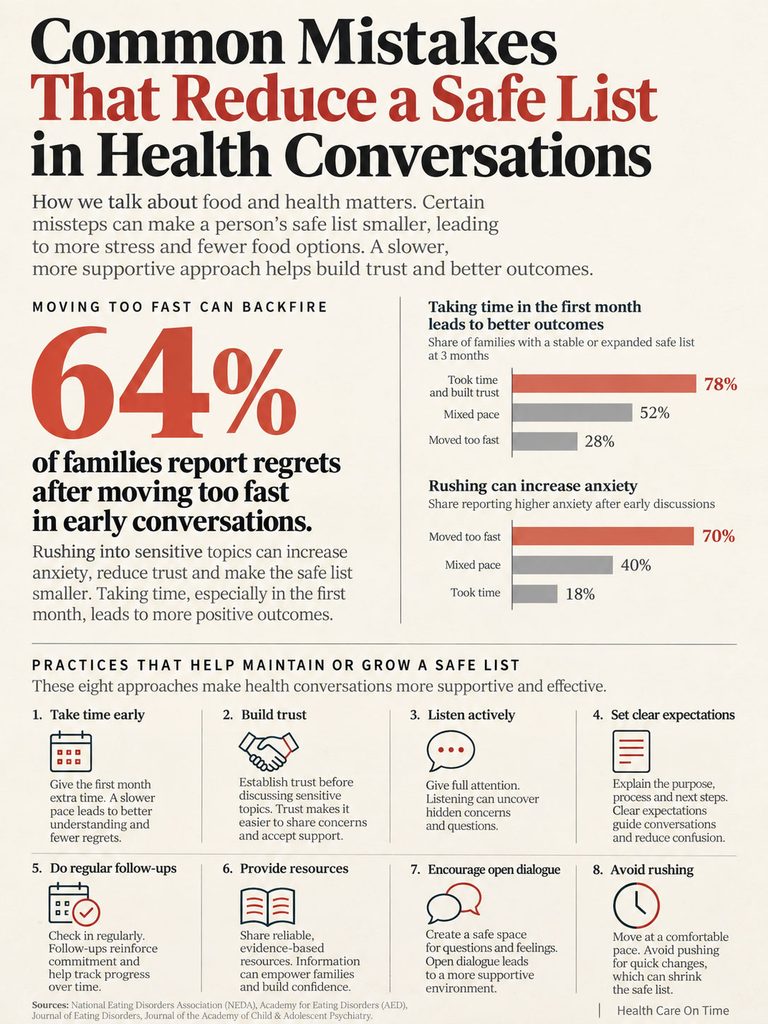
- Pressure: “Just one bite” turns the table into a test.
- Bite-based rewards: Paying for bites can make a food feel more suspicious. Praise bravery and effort instead.
- Hiding foods: It risks the safe food itself.
- Steps that are too big: Jumping from nuggets to salmon skips a dozen links.
- Mealtime battles: If a session turns into a fight, stop and try again another day.
- Comparisons: Every eater’s chain is different, including siblings’.
In conversations with families across our diagnostic network, the most common regret is moving too fast in the first month. Slower starts usually go further.
When to Get Professional Help in the US
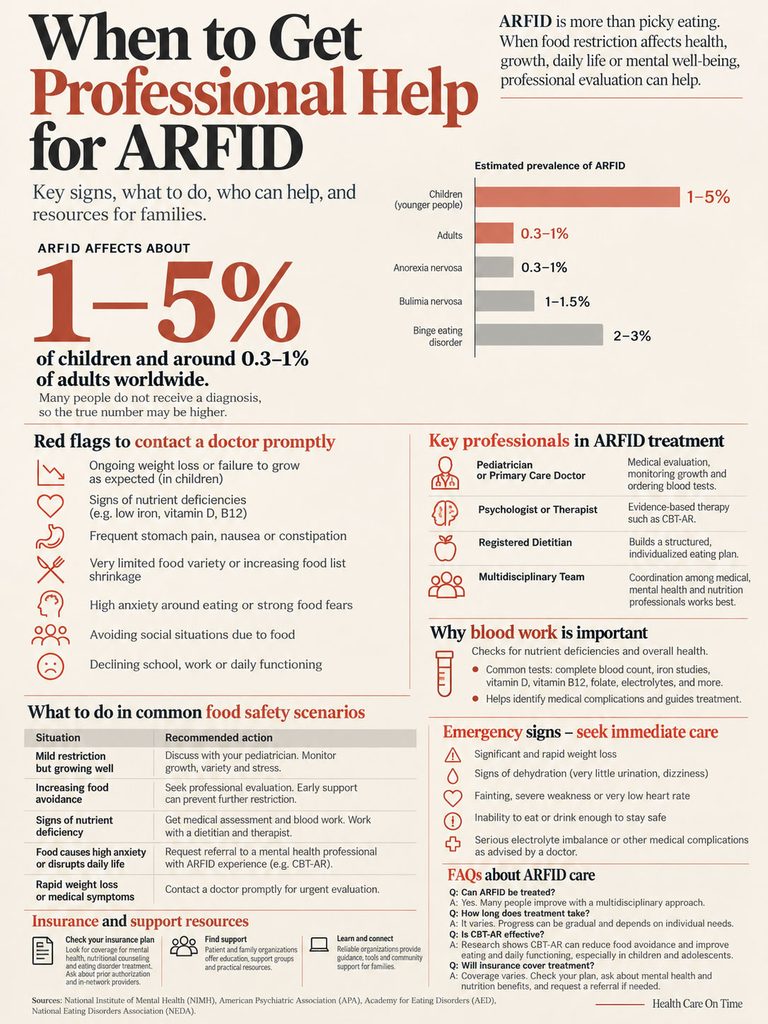
Home strategies help. But ARFID is a recognized eating disorder, and it often needs a team.
Red Flags
Contact a doctor promptly if you notice:
- The safe list keeps shrinking, or a whole food group disappears
- Unplanned weight loss, or a child falling off their growth curve
- Fatigue, dizziness, fainting, easy bruising, or bleeding gums
- Reliance on nutrition drinks or tube feeding
- Skipping school, work, or social events because of food
- Signs of depression, severe anxiety, or thoughts of self-harm
Who Treats ARFID
A strong team often includes a therapist trained in CBT-AR or FBT-ARFID, a registered dietitian with eating disorder experience, and a pediatrician or primary care doctor. Feeding therapists (speech-language or occupational therapists) help with oral-motor and sensory issues, and Feeding Matters lists US pediatric feeding resources.
Blood work shows whether a narrow diet is already affecting health. Our medical reviewers often see clinicians order a CBC, ferritin, vitamin B12, vitamin D, and a metabolic panel at the first visit.
Insurance, School, and Finding Care
ARFID is a DSM-5 eating disorder, so treatment generally falls under federal mental health parity protections, though prior authorization is common. Ask your insurer for in-network eating disorder providers by name, and request a single-case agreement if none exist nearby.
For school-age children, a Section 504 plan can protect access to safe foods, extra lunch time, and a quieter eating space. NIMH and ANAD both offer US directories and free support.
| Scenario | Recommended Action | Urgency |
| A safe food changes recipe or is discontinued | Buy remaining stock, then chain from old to new version | Within days |
| Safe list drops by 3 or more foods in a month | Contact your doctor; request an eating disorder referral | Within 1 to 2 weeks |
| Stable list but a whole food group is missing | Start home food chaining; book a dietitian and nutrient labs | Within 1 month |
| Unplanned weight loss or falling growth percentile | See a doctor for an exam and blood work | Within 1 week |
| Fainting, chest pain, or confusion | Go to the ER or call 911 | Same day |
| New fear of choking after a choking episode | Ask for a CBT-AR referral; rule out swallowing problems | Within 2 weeks |
| Child refuses school lunch every day | Request a Section 504 plan meeting | Within 1 month |
| Thoughts of self-harm or hopelessness | Call or text 988 | Immediately |
Frequently Asked Questions
Is it OK to only eat safe foods?
Eating only safe foods is far better than not eating, and safe foods should never be taken away. Over time, though, a narrow list can leave gaps in protein, vitamins, and minerals. The goal is to keep safe foods steady while slowly adding new ones, ideally with a dietitian or therapist trained in ARFID.
How many safe foods do people with ARFID usually have?
It varies widely. Many people with ARFID describe fewer than 10 to 15 individual safe foods, and some have fewer. The trend matters more than the number. A list that keeps shrinking, or one missing whole food groups like protein or fruit, is a reason to talk with a doctor soon.
Why do safe foods stop feeling safe?
Safe foods can turn unsafe after a recipe or packaging change, an illness, a choking or vomiting episode, or months of eating the same item daily. This burnout isn’t a lack of effort. Rotating safe foods, stocking exact brand backups, and chaining back from a changed product can help restore them.
Should you hide new foods in safe foods?
Generally, no. Hiding a new food inside a safe food can make the safe food feel untrustworthy, so the list shrinks instead of grows. Keep new foods separate and visible. Mixing can come later, but only when the eater chooses it, knows what’s in it, and controls the amount.
How long does food chaining take?
Each link in a chain can take days to several weeks, and a full chain from one food to a very different one may take months. Progress is rarely steady; plateaus and small setbacks are normal. Tracking every attempt makes it easier to see real progress that’s easy to miss day to day.
How many tries does a new food need?
Studies in typical children suggest 8 to 15 tastes before a new food becomes accepted. People with ARFID often need more, sometimes many more, with smaller steps between tries. A food shouldn’t be labeled a failure after one or two attempts, as long as each exposure stays pressure-free.
Does food chaining work for adults?
Food chaining was first described in children, but the same idea, small changes from accepted foods, is used in adult ARFID care. Adults can run chains independently, choosing each link on a calm day. A therapist or dietitian can help design the steps and manage the anxiety that comes with them.
Are ARFID safe foods always unhealthy?
No. Many safe lists lean toward plain, packaged, carbohydrate-rich foods because they’re predictable, but safe foods can include fruit, yogurt, cheese, or plain chicken. Safe foods shouldn’t be labeled “bad.” They’re the base that makes eating possible, and new foods are added around them, not in place of them.
Can a child grow out of ARFID?
Typical picky eating often fades with age, but ARFID frequently continues into adolescence and adulthood without treatment. Early support from a pediatrician, dietitian, and ARFID-trained therapist gives the best chance of building a wider, more flexible diet. Waiting for a child to outgrow a shrinking list is risky.
What is CBT-AR?
CBT-AR is cognitive behavioral therapy for ARFID, developed at Massachusetts General Hospital. It usually runs 20 to 30 sessions and uses gradual food exposure tailored to sensory, fear-based, or low-interest ARFID. Early studies show large improvements, and the first randomized trial in young people finished in 2026.
Should parents reward trying new foods?
Small, non-food praise for effort, like a sticker or a high five, helps some children. Big rewards tied to swallowing bites can add pressure and make the food feel more suspicious. Most ARFID clinicians suggest praising bravery and curiosity, such as touching or smelling a food, rather than counting bites.
When does ARFID need medical care?
Seek medical care for unplanned weight loss, falling growth, fatigue, dizziness, fainting, bleeding gums, or a shrinking safe list. Chest pain or confusion needs emergency care. Anyone with thoughts of self-harm should call or text 988 right away. ARFID is a treatable eating disorder at any age.
Disclaimer: This article is for general education and isn’t a substitute for professional medical or mental health care. ARFID is a serious eating disorder; please work with a qualified clinician before making major changes to eating. For eating disorder support, contact the ANAD Helpline at 1-888-375-7767. If you or someone you know is in crisis, call or text 988 to reach the Suicide and Crisis Lifeline.
References
- Harshman SG et al. A diet high in processed foods, total carbohydrates and added sugars… characteristic of youth with ARFID. Nutrients, 2019
- Lived experience of ARFID. Journal of Eating Disorders, 2024
- Fishbein M et al. Food chaining: a systematic approach for the treatment of children with feeding aversion. Nutr Clin Pract, 2006
- Clinical outcomes in 783 patients receiving virtual treatment for ARFID. Int J Eat Disord, 2025
- Mechanisms of change in an open trial of CBT-AR, 2024
- Adults treated for ARFID at a tertiary care program. J Eat Disord, 2024
- Digital CBT for pediatric ARFID trial protocol. Frontiers in Psychiatry, 2026
- ClinicalTrials.gov NCT05954728: CBT vs Nutrition Counseling for ARFID
- Prevalence and burden of ARFID symptoms in UK and USA adults
- Epidemiology of ARFID in children and adolescents: systematic review
- ARFID in pediatric neurogastroenterology patients. J Pediatr Gastroenterol Nutr, 2022
- Repeated exposure and food acceptability in infants and toddlers. Am J Clin Nutr, 2019
- Fildes A et al. Parent-administered exposure RCT, 2014
- Healthy eating in childhood: the importance of exposure
- F.E.A.S.T. Family Guide: Beyond Picky Eating, 2026
- ELFT NHS (UK): Simple Steps to Add New Foods
- Columbia Doctors: ARFID, A Bigger Problem Than Picky Eating
- Equip: ARFID Safe Foods
- Eating Recovery Center: ARFID Statistics and Facts
- Cigna: Eating Disorders Handout, 2023
- Feeding Matters
- NIMH: Eating Disorders
- ANAD: National Association of Anorexia Nervosa and Associated Disorders