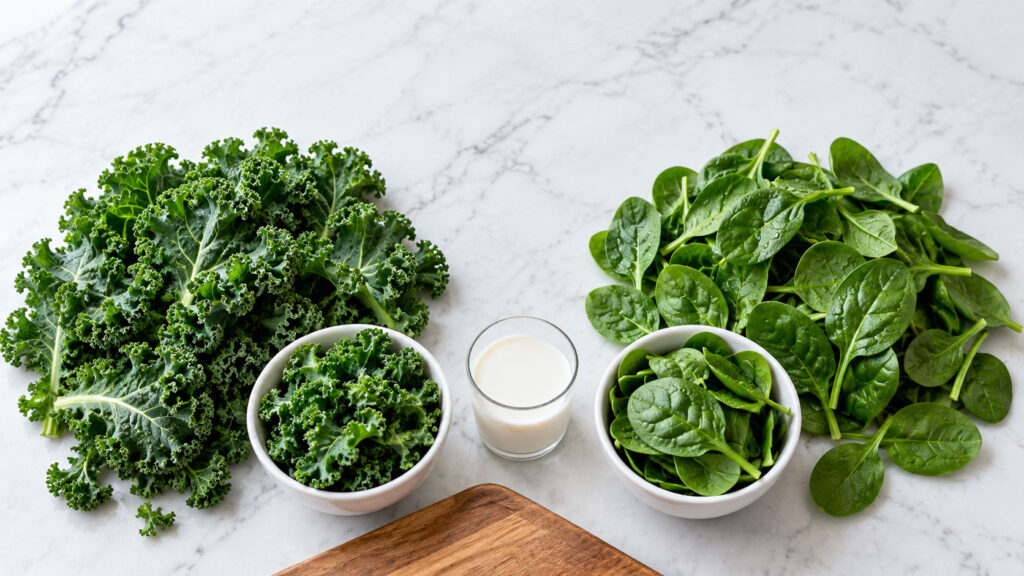
Search “kale vs spinach” and respected health sites will name different winners for vitamin K, fiber, calcium, and even calories. One says spinach has more vitamin K. Another says kale crushes spinach on it. They can’t both be right, or can they?
Table of Contents
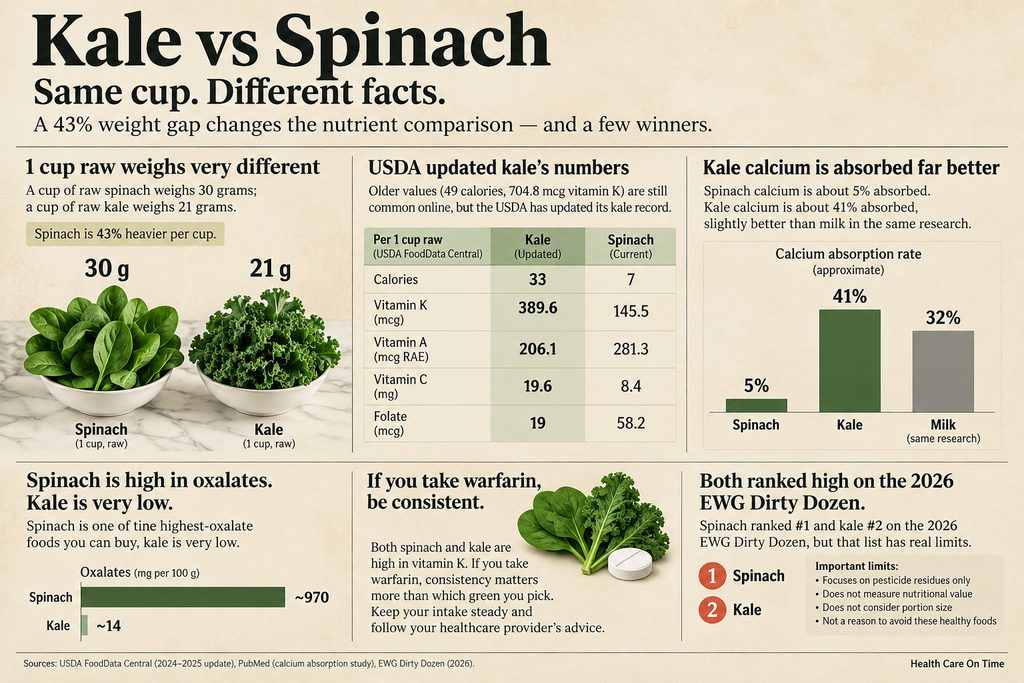
They can, and the reason has nothing to do with the vegetables. It comes down to two different cup sizes and two different USDA records for kale. Fix those, and the real answer gets much clearer.
Quick Answer: Neither green wins outright. Spinach has more folate, vitamin A, magnesium, potassium, and iron, plus more vitamin K per cup. Kale has about three times the vitamin C, nearly twice the fiber, and far more calcium your body can actually absorb (roughly 104 mg vs 5 mg per 100 grams). Choose spinach for folate and eye nutrients. Choose kale for bone health or if you form kidney stones. Eating both is best.
Kale vs spinach, winner by nutrient (per 100 grams, raw):
- Vitamin C: Kale (93.4 mg vs 28.1 mg)
- Absorbable calcium: Kale (about 104 mg vs 5 mg)
- Fiber: Kale (4.1 g vs 2.2 g)
- Folate: Spinach (194 mcg vs 62 mcg)
- Vitamin A: Spinach (469 mcg vs 241 mcg RAE)
- Vitamin K: Spinach (482.9 mcg vs 389.6 mcg)
- Magnesium and potassium: Spinach
- Low oxalate: Kale, by a wide margin
At a Glance
- A cup of raw spinach weighs 30 grams; a cup of raw kale weighs 21 grams. That 43% gap flips several “winners.”
- USDA updated its kale record. Old figures (49 calories, 704.8 mcg vitamin K) still circulate online.
- Spinach calcium is about 5% absorbed. Kale calcium is about 41% absorbed, slightly better than milk in the same research.
- Spinach is one of the highest-oxalate foods you can buy; kale is very low.
- If you take warfarin, consistency matters more than which green you pick.
- Spinach ranked #1 and kale #2 on the 2026 EWG Dirty Dozen, but that list has real limits.
The Short Answer: Kale vs Spinach Scorecard
Both greens rank near the top of any nutrient-density list. The honest verdict is a split decision, and the split depends on which nutrient matters most to you.
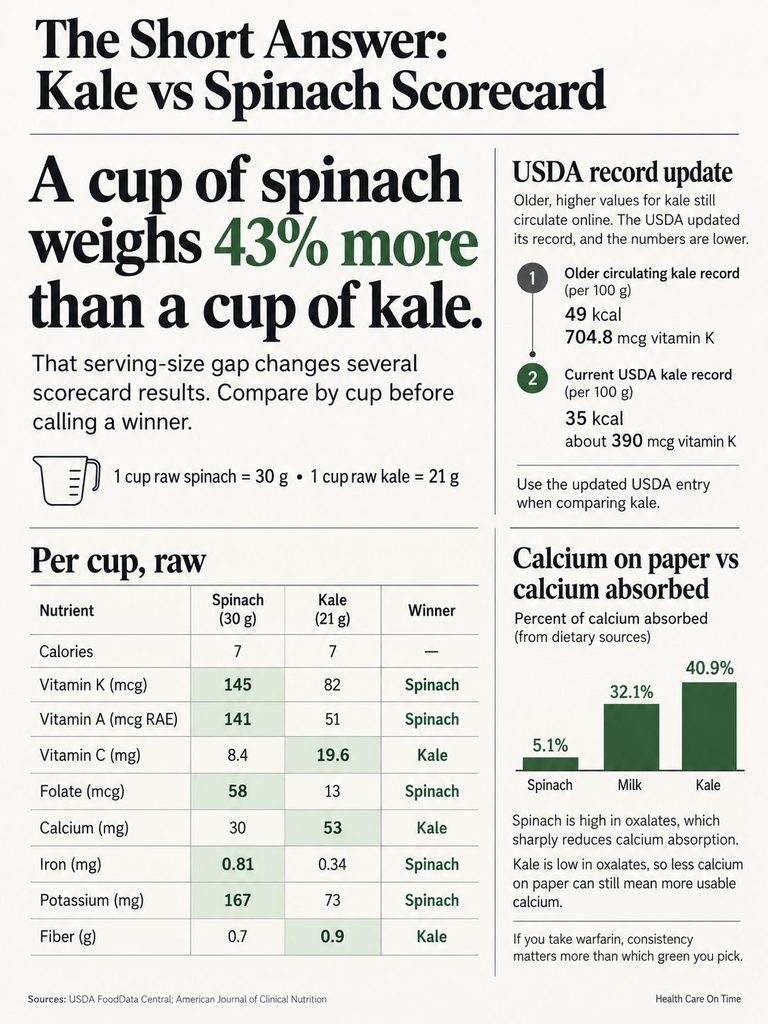
Our nutrition reviewers pulled the current USDA FoodData Central records for both: raw kale (FDC 168421) and raw spinach (FDC 168462). Every number below comes from those two records unless noted.
Why Page One Gives You Four Different Answers
If you’ve read three kale vs spinach articles and left more confused, that’s not your fault. The sources disagree for two fixable reasons.
The Cup Trap (21 Grams vs 30 Grams)
USDA lists one cup of chopped raw kale at 21 grams and one cup of raw spinach at 30 grams. Spinach leaves pack tighter, so a “cup” of spinach is 43% more food.
That’s why per-cup comparisons favor spinach on vitamin K, while per-100-gram comparisons can tell a different story. Neither is wrong. They’re just weighing different amounts.
The Old vs New USDA Kale Record
USDA’s older kale entry listed 49 calories, 120 mg vitamin C, 704.8 mcg vitamin K, and 150 mg calcium per 100 grams. The current Standard Reference record lists 35 calories, 93.4 mg vitamin C, 389.6 mcg vitamin K, and 254 mg calcium.
Many websites still quote the old figures, and some mix old and new numbers on one page. When you see kale “beating” spinach on vitamin K by a wide margin, check which record it came from. One fitness site even lists a raw cup of spinach at 41 calories; that’s actually close to a cooked cup.
Here’s the full comparison using current records.
| Nutrient | Kale (100 g) | Spinach (100 g) | Kale (1 cup, 21 g) | Spinach (1 cup, 30 g) | Winner |
| Calories | 35 kcal | 23 kcal | 7 kcal | 7 kcal | Tie per cup |
| Protein | 2.92 g | 2.86 g | 0.6 g | 0.9 g | Tie |
| Fiber | 4.1 g | 2.2 g | 0.9 g | 0.7 g | Kale |
| Vitamin C | 93.4 mg | 28.1 mg | 19.6 mg | 8.4 mg | Kale |
| Vitamin A (RAE) | 241 mcg | 469 mcg | 51 mcg | 141 mcg | Spinach |
| Vitamin K | 389.6 mcg | 482.9 mcg | 82 mcg | 145 mcg | Spinach |
| Folate | 62 mcg | 194 mcg | 13 mcg | 58 mcg | Spinach |
| Calcium (listed) | 254 mg | 99 mg | 53 mg | 30 mg | Kale |
| Calcium (absorbed, est.) | ~104 mg | ~5 mg | ~22 mg | ~1.5 mg | Kale, by ~20x |
| Iron | 1.6 mg | 2.71 mg | 0.34 mg | 0.81 mg | Spinach |
| Magnesium | 33 mg | 79 mg | 7 mg | 24 mg | Spinach |
| Potassium | 348 mg | 558 mg | 73 mg | 167 mg | Spinach |
Absorbed calcium estimated from Heaney and Weaver absorption rates (40.9% kale, 5.1% spinach). Per-cup values rounded.
For full serving-size calorie breakdowns, see our kale calories guide and our spinach calories guide.
Vitamins Head to Head
The vitamin results show the clearest split. Kale owns vitamin C. Spinach takes vitamin A and folate. Vitamin K depends on how you measure.
Vitamin C: Kale by a Wide Margin
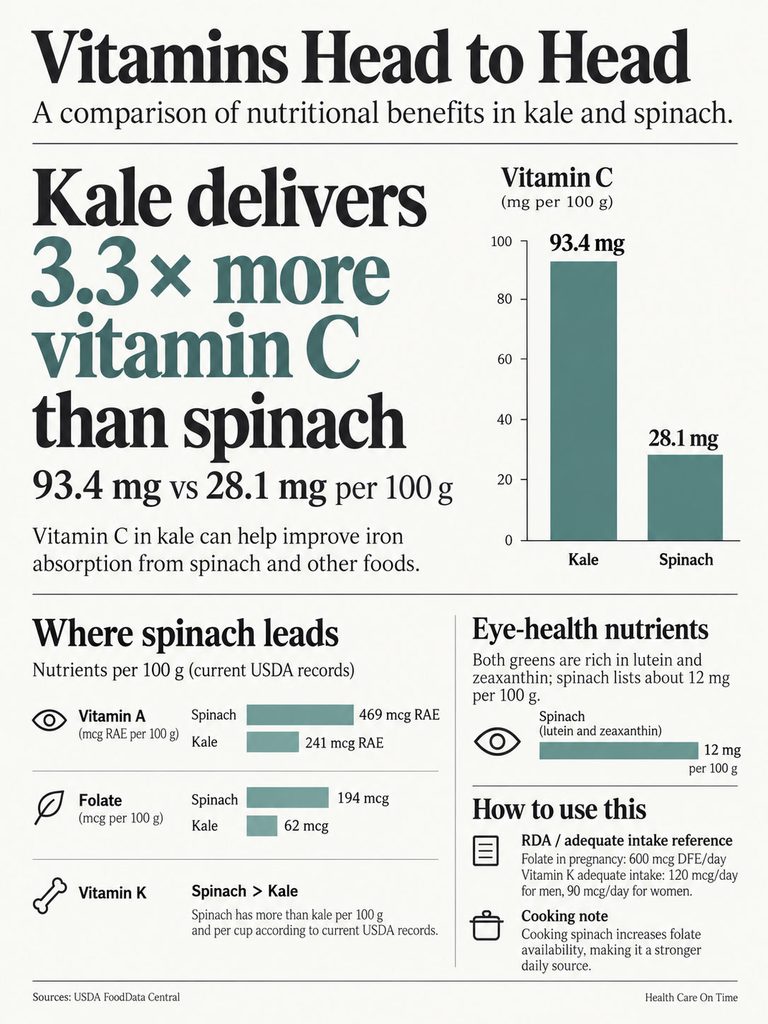
Kale has 93.4 mg of vitamin C per 100 grams, more than three times spinach’s 28.1 mg. One cup of raw kale gives you about 22% of the 90 mg daily value.
Vitamin C also helps your body absorb the plant (non-heme) iron in other foods. A kale-and-spinach salad works better than either green alone.
Vitamin A and Folate: Spinach Leads
Spinach delivers nearly twice kale’s vitamin A per 100 grams (469 vs 241 mcg RAE). Per cup, the gap widens to almost three to one because of the heavier spinach cup.
Folate is spinach’s biggest win. At 194 mcg per 100 grams, it has about three times kale’s 62 mcg. The NIH Office of Dietary Supplements sets the pregnancy RDA at 600 mcg DFE.
Patients booking prenatal panels with HealthCareOnTime often ask which greens help most with folate. Spinach, especially cooked, is one of the strongest everyday sources, though it doesn’t replace a prenatal vitamin.
Vitamin K: The Winner Depends on How You Measure
Using current USDA records, spinach has more vitamin K both per 100 grams (482.9 vs 389.6 mcg) and per cup (145 vs 82 mcg). Sites claiming kale wins are usually quoting the old 704.8 mcg figure.
Either way, both are extreme sources. The NIH adequate intake is 120 mcg a day for men and 90 mcg for women. One cup of raw spinach covers your whole day.
Lutein and Zeaxanthin for Your Eyes
These carotenoids collect in the retina and help filter blue light. The National Eye Institute’s AREDS2 formula uses 10 mg of lutein and 2 mg of zeaxanthin daily for people with intermediate macular degeneration.
Raw spinach lists about 12 mg of lutein plus zeaxanthin per 100 grams, a full AREDS2-level dose in roughly three and a half cups. Kale is also a top source, but its USDA lutein figure varies sharply between old and new records.
For that reason, our medical team doesn’t rank one above the other on eye health. Both belong in an eye-friendly diet, ideally eaten with a little fat for better absorption.
Minerals and the Absorption Problem
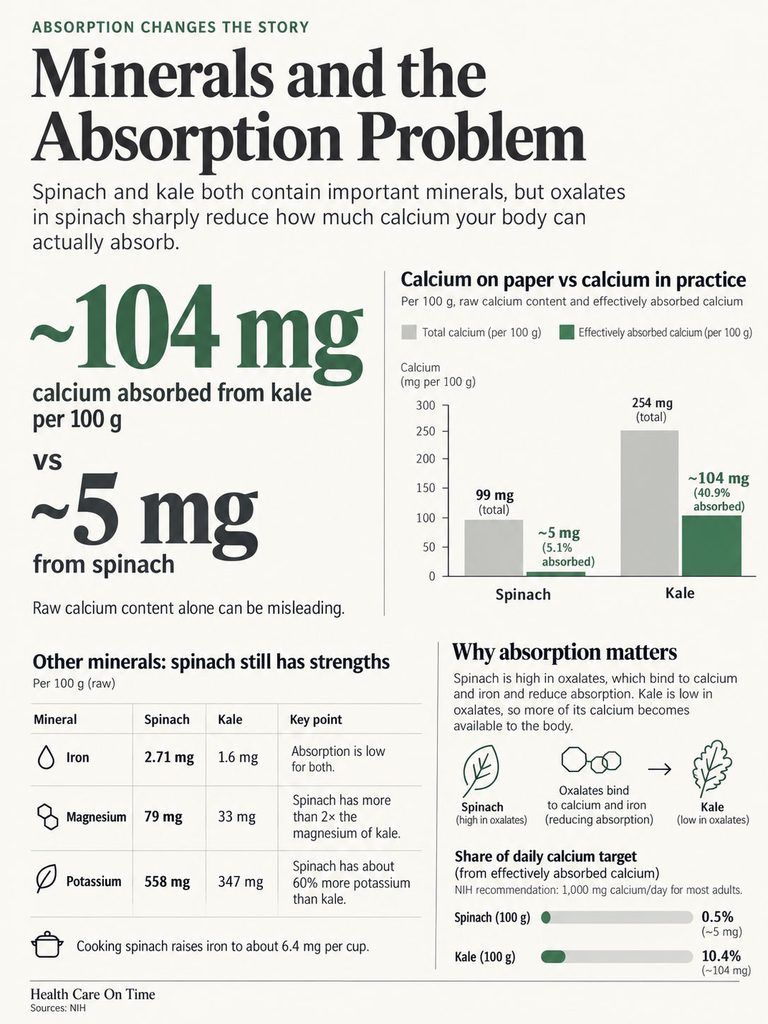
On paper, spinach looks like a mineral powerhouse. In your gut, the picture changes. The main reason is oxalate, a compound that binds minerals and blocks their absorption.
Calcium: What’s on the Label vs What You Absorb
Kale lists 254 mg of calcium per 100 grams; spinach lists 99 mg. That’s already a kale win, but the absorption numbers make it a landslide.
In a 1988 study by Robert Heaney and Connie Weaver, people absorbed just 5.1% of spinach calcium, compared with 27.6% from milk. In 1990, the same team found 40.9% absorption from kale, compared with 32.1% from milk.
The Math: About 104 mg vs 5 mg Absorbed per 100 Grams
Multiply calcium content by absorption rate:
- Kale: 254 mg × 40.9% = about 104 mg absorbed
- Spinach: 99 mg × 5.1% = about 5 mg absorbed
That’s roughly a 20-fold difference. If you skip dairy and rely on greens for calcium, kale (along with bok choy and broccoli) is the better choice. Spinach shouldn’t count toward your calcium goal.
The NIH calcium RDA is 1,000 mg for most adults, rising to 1,200 mg for women over 50 and men over 70. Even kale gets you only part of the way.
Reading the Nutrition Facts Label
On a US bag of spinach, the calcium %DV is calculated against the FDA’s 1,300 mg Daily Value. That percentage reflects calcium content, not absorption.
So a spinach label showing calcium at a few percent of DV overstates what you’ll actually get. Kale’s label percentage is much closer to reality. No US label adjusts for oxalate.
Iron: Spinach Has More, But Neither Is Easy to Absorb
Spinach has 2.71 mg of iron per 100 grams versus kale’s 1.6 mg. A cooked cup of spinach packs about 6.4 mg because cooking shrinks the leaves.
But plant iron is absorbed far less efficiently than iron from meat, and spinach’s oxalates may lower it further. In cases reviewed by our medical team, people with low ferritin rarely fix it with spinach alone.
Our iron in spinach guide covers absorption in depth. The short version: pair spinach with vitamin C and keep coffee and tea away from iron-rich meals.
Magnesium and Potassium: Spinach’s Quiet Edge
Spinach has more than twice kale’s magnesium (79 vs 33 mg) and about 60% more potassium (558 vs 348 mg) per 100 grams. Both minerals support healthy blood pressure.
Oxalate binds some magnesium too, so the real-world gap is smaller than the label suggests. Spinach is still the stronger pick here.
Plant Compounds: Different Greens, Different Defenses
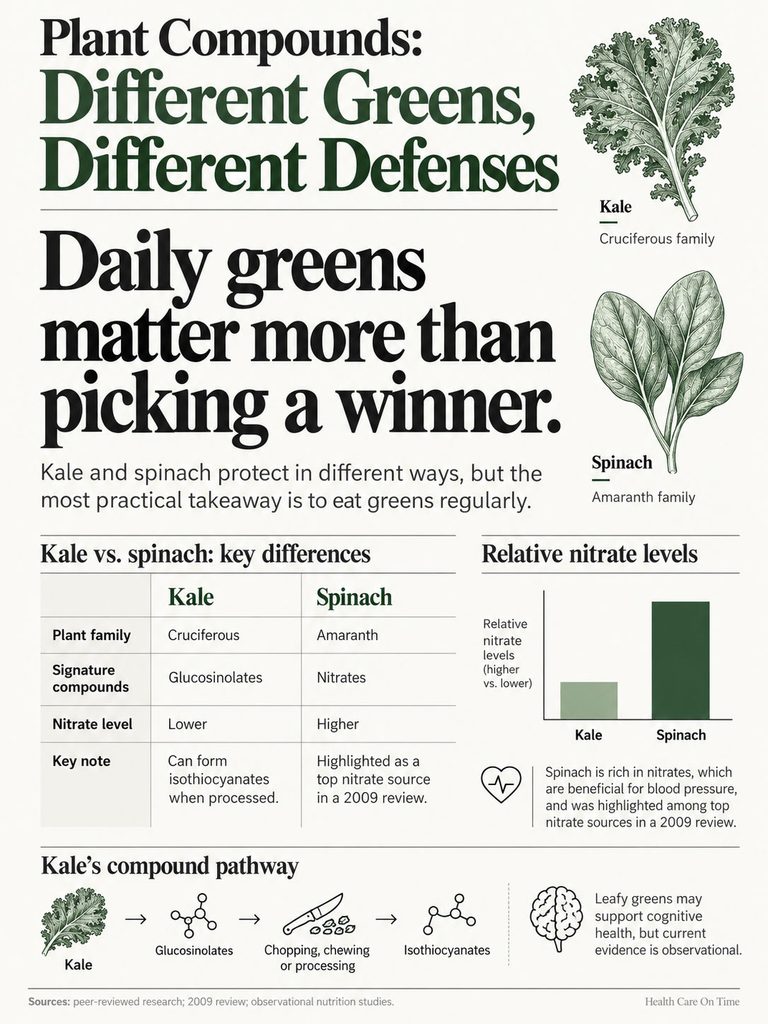
Kale and spinach belong to different plant families, and each produces its own protective compounds.
Glucosinolates: Kale Has Them, Spinach Doesn’t
Kale is a cruciferous vegetable, like broccoli and cabbage. It makes glucosinolates, which break down into compounds called isothiocyanates when you chop or chew the leaves.
Spinach belongs to the amaranth family and has no glucosinolates. If cruciferous compounds are your reason for eating greens, only kale qualifies. Most human evidence here is observational, so treat it as a reason to include crucifers, not as proof of cancer prevention.
Nitrates and Blood Pressure: Spinach’s Strength
Spinach is one of the richest dietary sources of nitrate, which your body converts to nitric oxide to relax blood vessels. A 2009 American Journal of Clinical Nutrition review places leafy greens like spinach among the top nitrate foods.
Kale contains nitrate too, but less. For blood pressure support, spinach has the edge, especially combined with its potassium.
What the Research Can and Can’t Prove
The strongest brain-health data looks at leafy greens as a group. In the Rush Memory and Aging Project, 960 older adults who ate about 1.3 servings of greens daily had cognitive decline equal to being 11 years younger than those who ate few.
That’s observational and can’t prove cause. It does suggest the daily habit matters more than which green you pick.
Downsides and Who Should Pick Which
This is where the right choice becomes personal. Your health history can make one green clearly better for you.
Oxalates and Kidney Stones
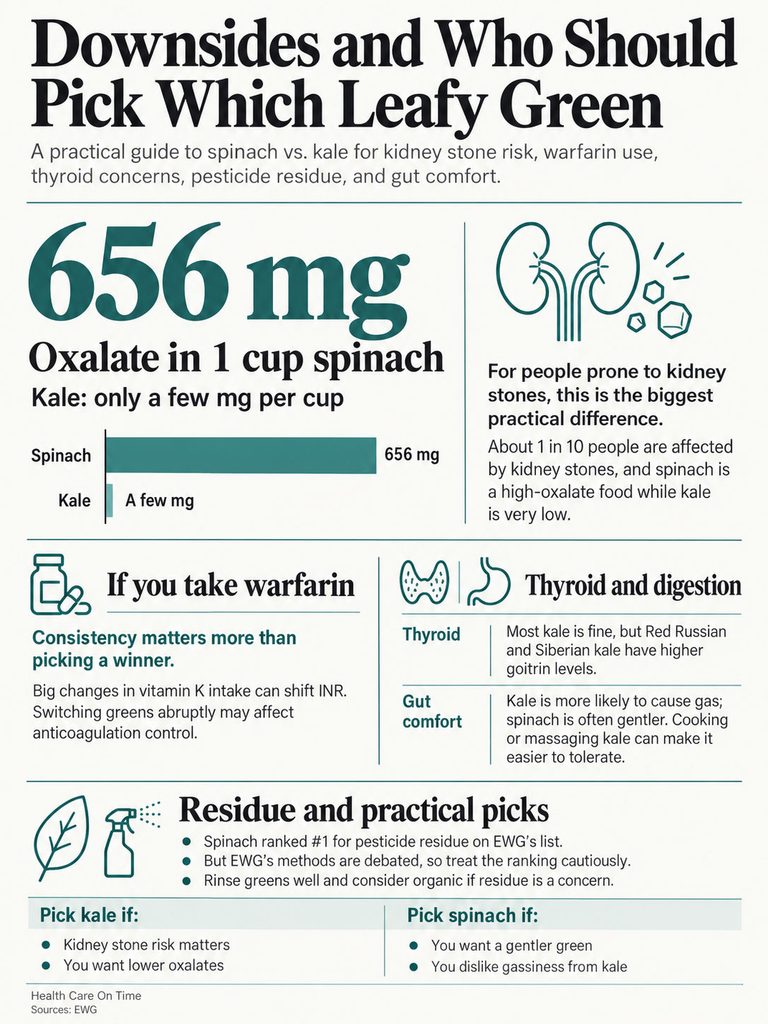
About 1 in 10 people will have a kidney stone at some point, according to the National Kidney Foundation. Most stones are calcium oxalate, and spinach is one of the highest-oxalate foods in the American diet.
Harvard’s oxalate food table lists about 656 mg of oxalate in one cup of raw spinach. Kale has only a few milligrams per cup. Many stone-prevention diets aim for under 100 mg a day, so one spinach salad can blow past that target.
If you’ve had calcium oxalate stones, swapping spinach for kale is one of the simplest changes you can make. Ask your urologist or dietitian about your personal limit.
Warfarin and Vitamin K Consistency
Warfarin works by blocking vitamin K. A sudden jump in vitamin K can lower your INR and make the drug less effective. Suddenly cutting greens can push your INR too high.
Patients on warfarin often ask us whether they should avoid both greens. Usually not. The goal is steady intake, not zero. Here’s why portion and form matter:
- 1 cup raw kale: about 82 mcg vitamin K
- 1 cup raw spinach: about 145 mcg
- 1 cup cooked spinach (180 g): about 889 mcg, per USDA’s cooked spinach record
- 1 cup cooked kale: several hundred mcg, with older USDA data putting it near 1,000 mcg
Switching from a raw kale salad to a cooked spinach side can mean a tenfold jump in vitamin K. Keep your usual green and amount steady, and tell your care team before big changes. Our warfarin guide covers INR monitoring.
Thyroid: The One Kale Type to Watch
Kale’s glucosinolates can break down into goitrin, which may interfere with iodine uptake in very large amounts. For common curly and Tuscan kale, the risk at normal intake is very low.
A 2016 Nutrition Reviews analysis found most kale has far too little goitrin to matter, but Red Russian and Siberian kale (a different species) contain much more. See our kale and thyroid guide. Spinach has no meaningful goitrin.
Pesticides: What the 2026 Dirty Dozen Does and Doesn’t Mean
The Environmental Working Group’s 2026 Shopper’s Guide ranked spinach #1 and kale, collard, and mustard greens #2, based on 54,344 USDA samples across 47 fruits and vegetables.
There’s an important limit. USDA doesn’t test every crop every year, and the spinach data behind the 2026 ranking dates back to 2016. EWG measures residue presence, not proven harm, and food-safety scientists have criticized its methods.
Practical takeaway: rinse greens under running water, consider organic or frozen if your budget allows, and don’t stop eating greens over residue worries.
Leafy greens also carry occasional bacterial risk. The 2006 bagged spinach E. coli outbreak sickened 199 people in 26 states. Cooking kills bacteria; rinsing alone does not.
Gut Comfort and Smoothie Bloat
Kale’s tougher fiber and cruciferous compounds cause more gas for some people, especially raw. Spinach is gentler and blends smoothly.
If raw kale bothers your stomach, massage it with a little olive oil and lemon juice, or cook it briefly. Start small and build up.
Raw vs Cooked: How Preparation Changes the Winner
How you prepare these greens changes the numbers enough to shift some results.
Cooking Shrinks Spinach
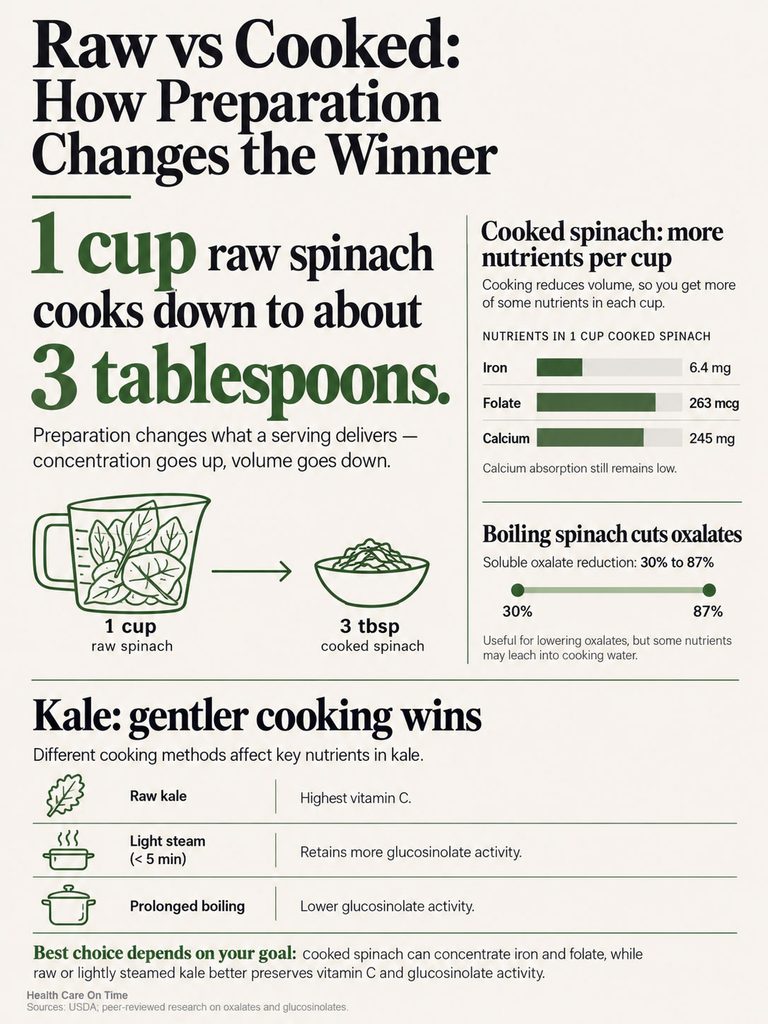
One cup of raw spinach (30 grams) wilts to about 3 tablespoons. A cup of cooked spinach holds about 180 grams of leaves, six times as much.
That’s why a cooked cup delivers about 6.4 mg of iron, 263 mcg of folate, and 245 mg of listed calcium. The calcium is still poorly absorbed. Our raw vs cooked spinach guide covers this in depth.
Boiling Cuts Oxalate; Steaming Protects Kale
Boiling spinach and draining the water can cut soluble oxalate by roughly 30% to 87%, according to research by Chai and Liebman. Boiling also leaches some folate and vitamin C into the water.
For kale, light steaming (under 5 minutes) preserves more glucosinolate activity than long boiling. Raw kale keeps the most vitamin C.
Simple rules:
- Eat spinach cooked if oxalates or volume matter to you.
- Eat kale raw or lightly steamed for vitamin C and glucosinolates.
- Add a little fat (olive oil, avocado, nuts) to boost carotenoid absorption from both.
Kale vs Spinach for Your Goal
Interest in both greens has grown. USDA data shows US fresh spinach availability reached 2.52 pounds per person in 2023, up 19% from 2018. Yet most Americans still eat far too few vegetables.
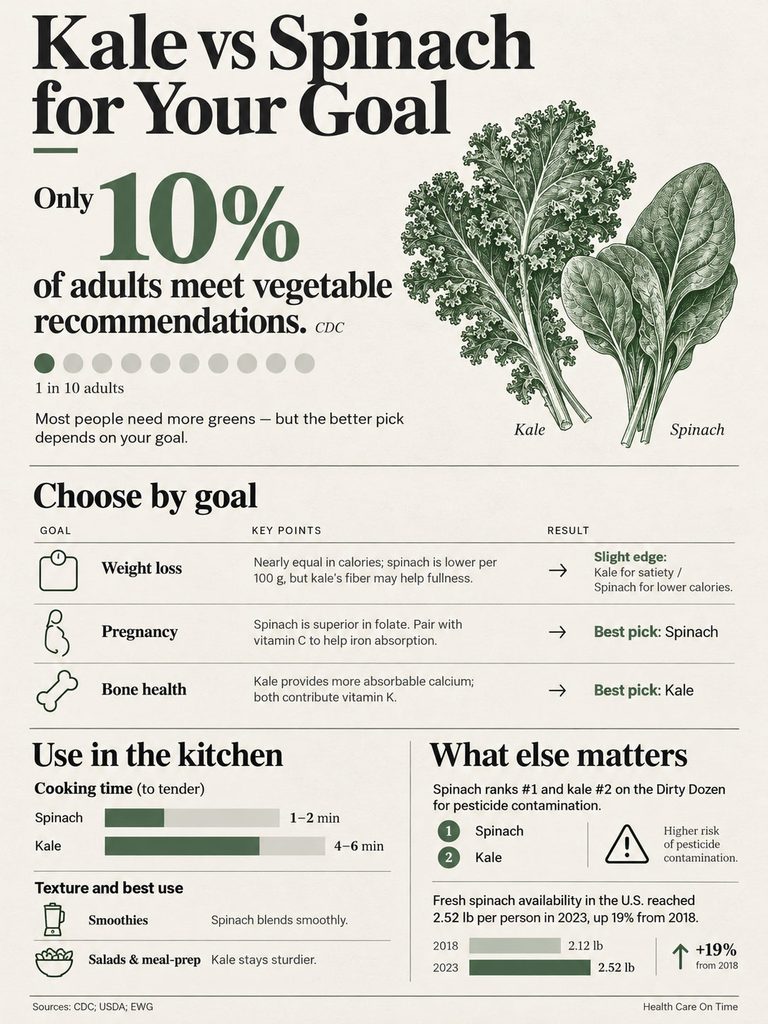
| US Statistic | Figure | Source |
| Adults meeting vegetable recommendations | 10.0% | CDC MMWR, BRFSS |
| Fresh spinach availability per person (2023) | 2.52 lb, up 19% vs 2018 | USDA ERS via The Packer |
| Dark green vegetable availability per person | 21.7 lb (2000) to 27.5 lb (2019) | USDA ERS Amber Waves |
| Calcium absorption, spinach vs milk | 5.1% vs 27.6% | Heaney et al., 1988 |
| Calcium absorption, kale vs milk | 40.9% vs 32.1% | Heaney and Weaver, 1990 |
| Vitamin K adequate intake | 120 mcg (men), 90 mcg (women) | NIH ODS |
| Lifetime kidney stone risk | About 1 in 10 people | National Kidney Foundation |
| EWG 2026 Dirty Dozen rank | Spinach #1; kale, collard, mustard greens #2 | EWG Shopper’s Guide |
For Weight Loss
It’s essentially a tie. Per cup raw, both have about 7 calories. Per 100 grams, spinach is lower (23 vs 35), but kale’s extra fiber may keep you a bit fuller.
What you add matters more. Two tablespoons of ranch dressing (about 130 calories) outweighs any difference between the greens.
For Pregnancy
Spinach wins on folate. Cook it, or rinse pre-washed leaves well, to limit bacterial risk. Pair it with vitamin C to help iron absorption, since iron needs rise to 27 mg a day in pregnancy.
For Bone Health
Kale wins clearly because of absorbable calcium. Both greens supply vitamin K, which helps build bone proteins.
For Smoothies, Salads, and Sautés
Spinach blends almost invisibly, making it the easier smoothie green. Kale holds up better in salads and meal-prep bowls. For sautés, spinach cooks in 1 to 2 minutes; kale needs 4 to 6.
What This Data Can’t Tell You
Good comparisons should be honest about their limits. Our reviewers flag three here.
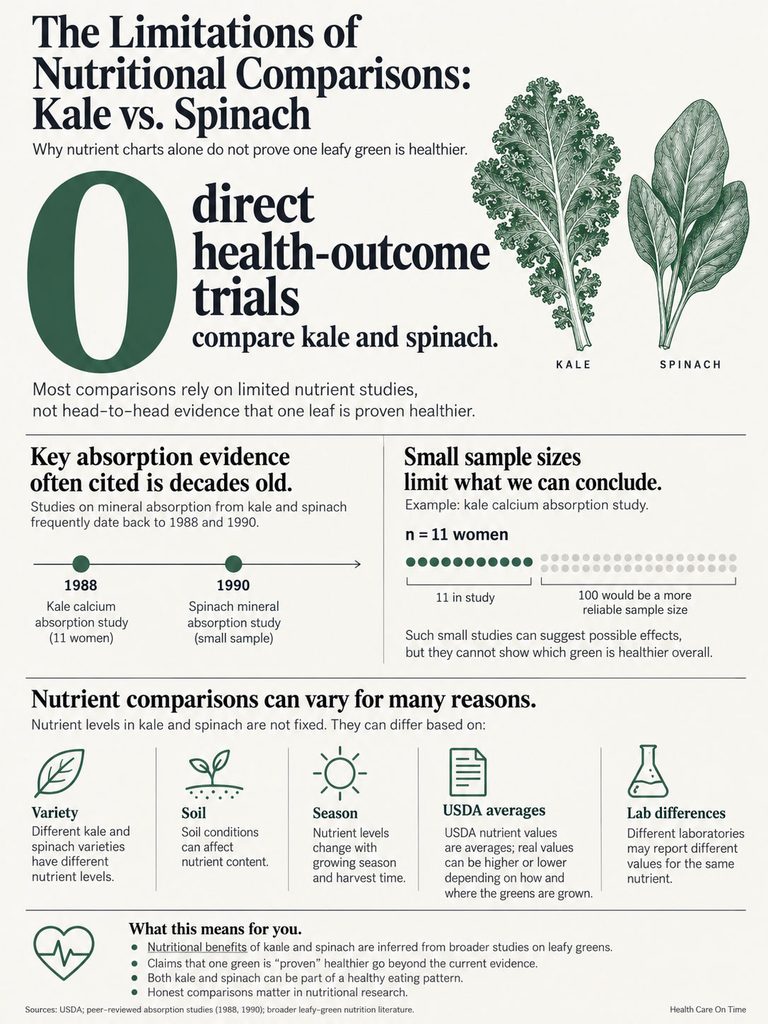
The absorption studies are small and old. The kale study tested 11 women, and both studies date to 1988 and 1990. Later work by the same group confirms the pattern, but the exact percentages shouldn’t be read as precise for every person.
Nutrient levels vary by variety, soil, and season. Curly, Tuscan, and Red Russian kale differ, as do flat-leaf and savoy spinach. USDA values are averages, which is why two labs can report different numbers.
No trial has compared kale and spinach head to head on health outcomes. The benefits above come from nutrient data and studies of leafy greens in general. Anyone claiming one green is “proven” healthier is going beyond the evidence.
Buying, Storing, and Eating More of Both
A few simple habits get more nutrition from every bunch.
Baby vs Mature Leaves
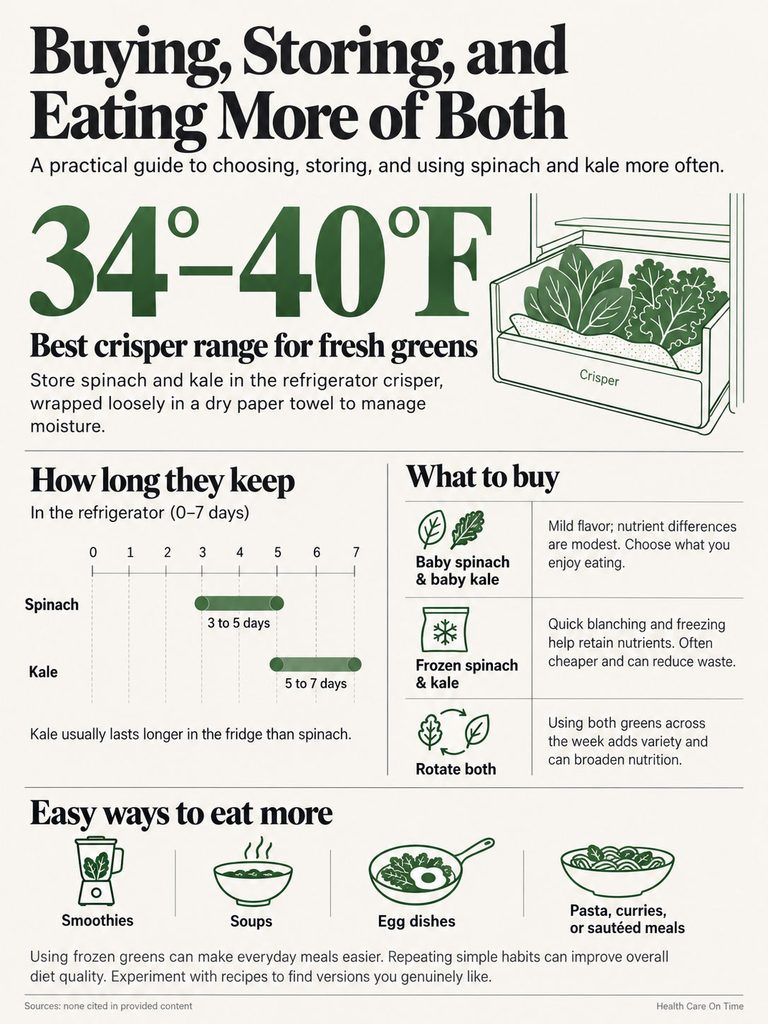
Baby spinach and baby kale are milder and more tender, with modest nutrient differences. Pick the one you’ll actually eat.
Frozen Is Fine
Frozen spinach and kale are blanched and frozen quickly, which preserves most minerals and carotenoids. They’re often cheaper per serving at US grocery stores and cut waste.
Store fresh greens in your crisper at 34°F to 40°F, wrapped loosely in a dry paper towel. Spinach usually lasts 3 to 5 days; kale lasts 5 to 7.
5 Easy Ways to Rotate Both
- Blend a handful of spinach into a morning smoothie.
- Use kale as a salad base that keeps for days.
- Stir frozen spinach into soups, pasta sauce, or eggs.
- Bake kale chips at 300°F with a light coat of oil.
- Mix half kale, half spinach in sautés for balance.
Your Action Plan
Use this table to pick the right green for your situation. When in doubt, eat both on different days.
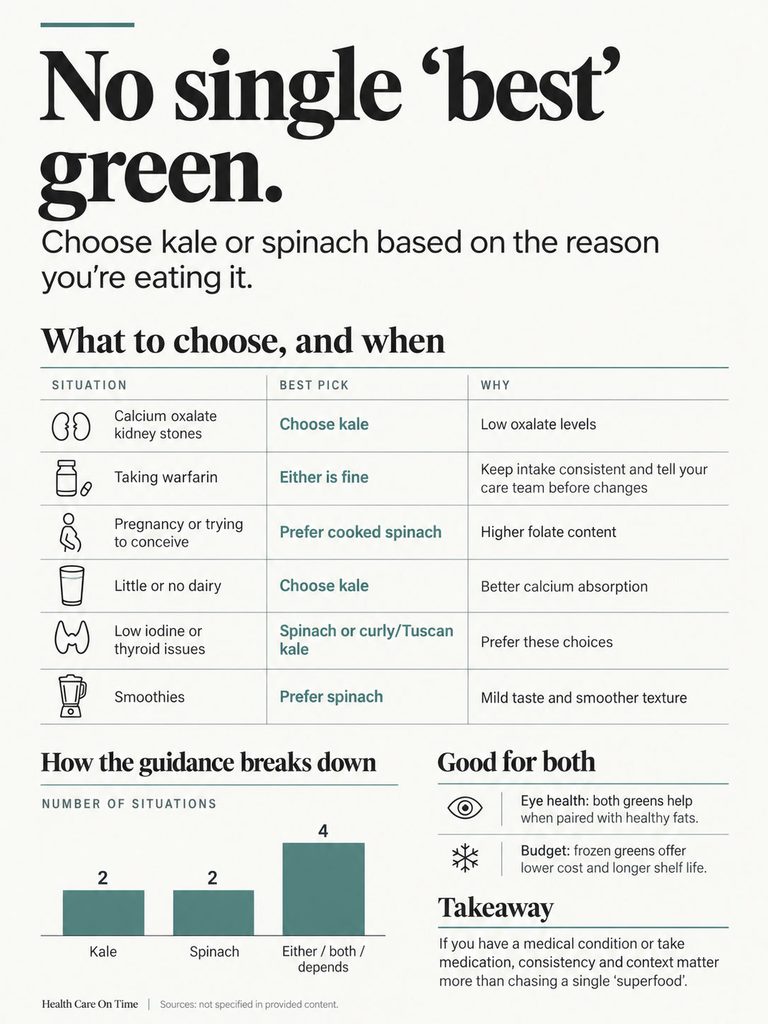
| If You… | Choose | Why / How Much |
| Have had calcium oxalate kidney stones | Kale | Spinach has about 656 mg oxalate per raw cup; kale has a few mg |
| Take warfarin | Either, kept steady | Same green, same amount, same form most days; tell your care team before changes |
| Are pregnant or trying to conceive | Spinach (cooked) | About 3x the folate of kale; cooking reduces bacterial risk |
| Eat little or no dairy | Kale | About 104 mg absorbed calcium per 100 g vs about 5 mg for spinach |
| Have low iodine or a thyroid condition | Spinach, or curly/Tuscan kale | Avoid large daily amounts of Red Russian or Siberian kale |
| Want a daily smoothie green | Spinach | Mild taste, smooth texture; rotate to limit oxalate load |
| Want eye-health support | Both, with healthy fat | Raw spinach gives about 12 mg lutein plus zeaxanthin per 100 g |
| Are on a tight budget | Frozen spinach or kale | Similar nutrition, longer shelf life, less waste |
Across the patients we serve, the most common mistake isn’t picking the “wrong” green. It’s eating too few greens at all. Pick one, eat it most days, and rotate when you can.
Frequently Asked Questions
Is it better to eat kale or spinach every day?
Rotating both is better than picking one. Eating large amounts of raw spinach daily can add up to a heavy oxalate load, while kale every day is safe for most people. Alternating gives you spinach’s folate and magnesium plus kale’s vitamin C and absorbable calcium without overdoing any one compound.
Which has more iron, kale or spinach?
Spinach has more iron, 2.71 mg per 100 grams versus kale’s 1.6 mg. A cooked cup of spinach provides about 6.4 mg. However, plant iron is poorly absorbed, and spinach’s oxalates may reduce absorption further. Pair either green with vitamin C foods like peppers or citrus to help.
Which has more calcium, kale or spinach?
Kale wins on both content and absorption. It has 254 mg per 100 grams versus spinach’s 99 mg. Research found people absorb about 41% of kale’s calcium but only about 5% of spinach’s. That works out to roughly 104 mg versus 5 mg of usable calcium per 100 grams.
Is kale or spinach better for weight loss?
They’re nearly equal. One cup of either raw green has about 7 calories. Kale has slightly more fiber, which may help fullness, while spinach is lower in calories per 100 grams. Your dressing, cheese, and toppings will affect weight far more than which green you choose.
Can you eat kale or spinach if you take warfarin?
Usually yes, as long as your intake stays consistent. Both are high in vitamin K, which affects how warfarin works. Sudden increases can lower your INR. Pick a usual amount and form, keep it steady, and check with your care team before making big diet changes.
Is spinach bad for kidney stones?
Spinach is very high in oxalate, the main building block of the most common kidney stones. One raw cup has about 656 mg. If you’ve had calcium oxalate stones, your doctor may suggest limiting spinach and swapping in kale, which is very low in oxalate.
Does kale hurt your thyroid?
For most people, no. Common curly and Tuscan kale contain very little goitrin, the compound linked to thyroid effects. Red Russian and Siberian kale contain much more. If you have hypothyroidism or low iodine intake, avoid eating very large daily amounts of those types.
Is baby kale as healthy as regular kale?
Baby kale is nutritionally similar to mature kale, with only modest differences in most vitamins and minerals. It’s milder and more tender, making it easier to eat raw. If baby kale means you’ll eat more greens, that’s the healthier choice for you in practice.
Should you buy organic kale and spinach?
Both topped EWG’s 2026 Dirty Dozen, so organic is a reasonable choice if it fits your budget. But the spinach data behind that ranking dates to 2016, and residue levels aren’t proof of harm. Rinsing conventional greens well and eating them is far better than skipping them.
Which is better in smoothies, kale or spinach?
Spinach is usually better for smoothies because it’s mild and blends smoothly with almost no taste. Kale adds more vitamin C and fiber but has a stronger flavor and tougher texture. A good option is mostly spinach with a small handful of kale.
Is cooked spinach healthier than raw?
It depends on your goal. Cooking shrinks spinach so you eat more leaves, and boiling can cut soluble oxalate by roughly 30% to 87%. Raw spinach keeps more vitamin C and folate. If you form kidney stones, cooked and drained spinach is the better choice.
Which has more protein, kale or spinach?
They’re almost identical, with about 2.9 grams of protein per 100 grams each. Per cup raw, spinach has slightly more (0.9 vs 0.6 grams) because its cup weighs more. Neither green is a meaningful protein source, so pair them with beans, eggs, fish, or meat.
Disclaimer: This article is for general education and is not a substitute for medical advice. If you take blood thinners such as warfarin, have a history of kidney stones, have a thyroid condition, are pregnant, or have kidney disease, talk with your doctor or a registered dietitian before making significant changes to how much leafy greens you eat.
References
- USDA FoodData Central: Kale, raw (FDC 168421)
- USDA FoodData Central: Spinach, raw (FDC 168462)
- USDA FoodData Central: Spinach, cooked, boiled, drained (FDC 168463)
- Heaney RP, Weaver CM, Recker RR. Calcium absorbability from spinach. 1988
- Heaney RP, Weaver CM. Calcium absorption from kale. Am J Clin Nutr. 1990
- NIH Office of Dietary Supplements: Vitamin K
- NIH Office of Dietary Supplements: Calcium
- NIH Office of Dietary Supplements: Folate
- National Eye Institute: AREDS and AREDS2
- Morris MC et al. Nutrients and bioactives in green leafy vegetables and cognitive decline. Neurology. 2018
- Hord NG et al. Food sources of nitrates and nitrites. Am J Clin Nutr. 2009
- Felker P et al. Concentrations of thiocyanate and goitrin in human plasma. Nutr Rev. 2016
- Chai W, Liebman M. Effect of different cooking methods on vegetable oxalate content. 2005
- Harvard T.H. Chan School of Public Health: Oxalate Content of Foods
- National Kidney Foundation: Kidney Stones
- EWG 2026 Shopper’s Guide to Pesticides in Produce
- Fortune: Spinach tops EWG Dirty Dozen, April 2026
- CDC MMWR: Adults Meeting Fruit and Vegetable Intake Recommendations
- CDC: Multistate Outbreak of E. coli O157:H7 Linked to Fresh Spinach, 2006
- USDA ERS Amber Waves: US Vegetable Supplies, 2000 to 2019
- The Packer: USDA Fresh Vegetable Per Capita Availability, 2023