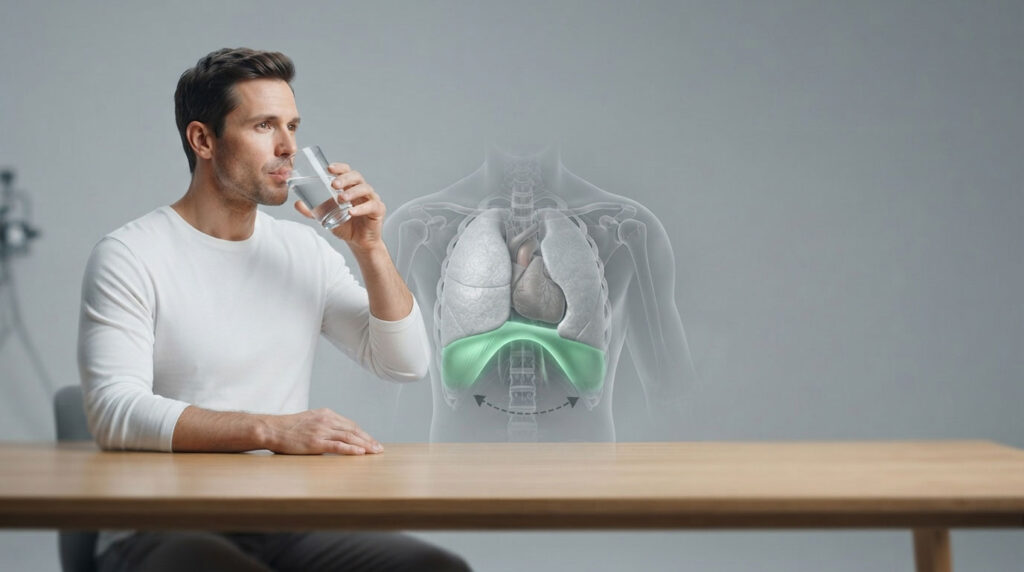
In June 1922, an Iowa farmer named Charles Osborne bent down to weigh a hog, fell, and started hiccupping. He did not stop for 68 years, firing off 20 to 40 hiccups a minute until they finally quit in 1990, by which point he had hiccupped an estimated 430 million times.
Table of Contents
Most of us get the two-minute version. You gulp a soda, your chest jumps, it passes before the can is empty. Same reflex, wildly different sentence.
Here is the strange part. Medicine can describe exactly what your body does during a hiccup, down to the millisecond. It still cannot say for certain why you have the reflex at all.
Quick Answer: Hiccups happen when your diaphragm, the dome-shaped muscle beneath your lungs, contracts involuntarily and pulls air in between normal breaths. A fraction of a second later your vocal cords snap shut, producing the sharp “hic” sound. The reflex runs along the phrenic and vagus nerves through a control center in the brainstem. Stomach distension from eating or drinking too fast is the most common trigger, and most bouts clear on their own within minutes.
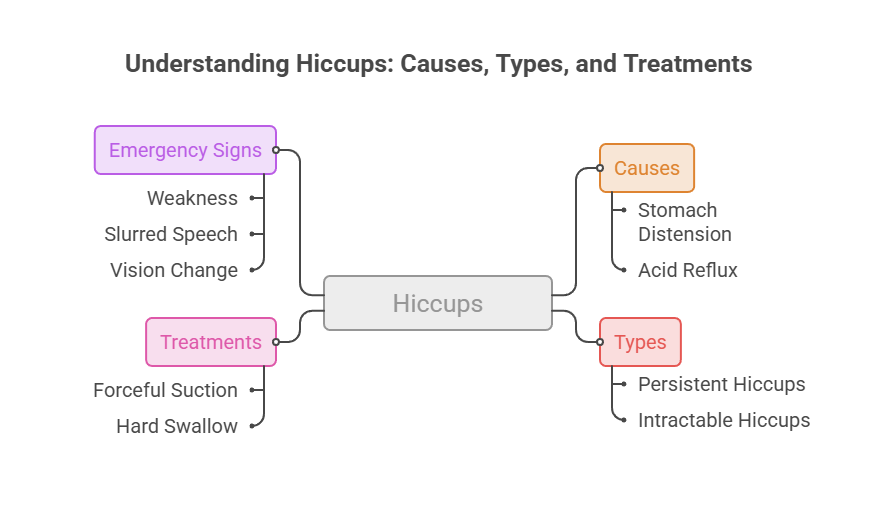
The seven most common causes of hiccups, in order:
- Eating or drinking too fast
- A large meal that stretches the stomach
- Carbonated drinks
- Alcohol, especially beer
- Sudden hot-to-cold temperature swings
- Stress, excitement, or a startle
- Swallowed air from gum, straws, smoking, or vaping
At a Glance
- A hiccup is a diaphragm spasm plus an abrupt vocal cord closure, not a breathing problem.
- Stomach distension causes more hiccups than everything else combined.
- Past 48 hours they are called persistent; past one month, intractable.
- About 80% of persistent hiccup cases trace back to acid reflux.
- Up to 4,000 Americans land in the hospital each year because of hiccups.
- The best-evidenced fix is forceful suction followed instantly by a hard swallow.
- Hiccups plus weakness, slurred speech, or vision change is an emergency, not a nuisance.
Need it gone right now? Skip to the section on how to stop hiccups. The short version: hold your breath for 15 seconds, then sip ice water in five rapid small swallows. If that fails twice, the suction-and-swallow method further down has the best published success rate of anything tested.
What a Hiccup Actually Is
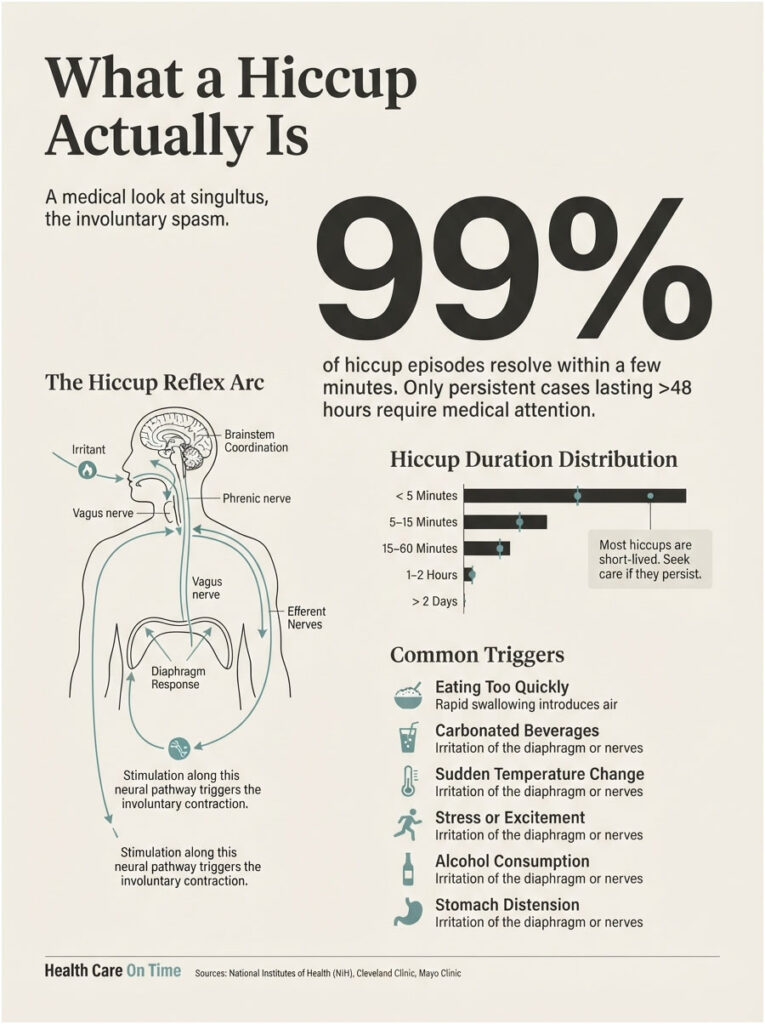
Doctors call it singultus. The Latin root describes the catch in your breath when you sob, which is a fair description of the motion.
Your Diaphragm Contracts Without Asking
The diaphragm is the sheet of muscle separating your chest from your belly. On a normal inhale it pulls downward to draw air in, then pushes upward on the exhale to send it back out.
A hiccup breaks that rhythm. The muscle yanks down out of sequence, sucking air in between breaths rather than during one.
Think of it as a muscle misfire, not a lung problem. Your lungs are fine. The motor running them briefly stops taking orders.
The Glottis Slams Shut and Makes the Noise
That inrushing air never arrives. The glottis, the gap between your vocal cords, closes suddenly and blocks it.
The fast, involuntary vocal cord closure is what makes the “hic.” The sound is a byproduct of the door slamming, not the event itself.
Which is why clamping your mouth shut accomplishes nothing. The noise starts in your throat.
The Reflex Arc: Phrenic Nerve, Vagus Nerve, Brainstem
Hiccups run on a loop rather than a single signal. The arc involves the phrenic nerve, the vagus nerve, and sympathetic pathways, with the brain modulating the whole thing centrally.
The phrenic nerve drives the diaphragm. The vagus nerve wanders from the brainstem down through your throat, chest, and abdomen, brushing past nearly every organ on the trip.
Why Irritation Anywhere Can Trip It
That map explains a lot of otherwise baffling triggers. Any irritant along the arc, whether physical, chemical, inflammatory, or a growth pressing against it, can start hiccups.
An ear infection can do it. So can a swollen thyroid, a sore throat, or a hair resting against your eardrum. They all sit on the same wiring.
Patients booking diagnostic tests with us often assume hiccups have to be a stomach issue. The nerve map is much wider than the stomach.
How Long a Normal Bout Runs
Most episodes last a few minutes and stop without intervention. Transient hiccups do not cause complications.
The clock is what turns a nuisance into a symptom. UCLA Health advises calling your primary care physician if hiccups last more than two days or start interfering with sleeping and eating.
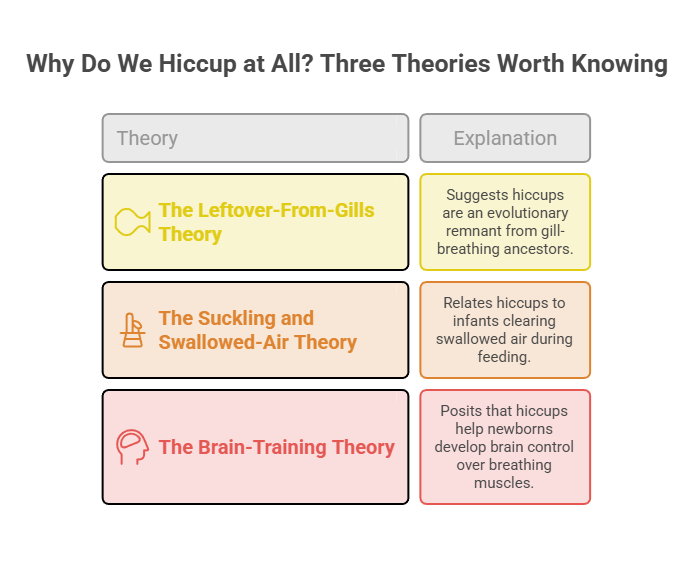
Why Do We Hiccup at All? Three Theories Worth Knowing
Nobody has proven why this reflex exists. Three explanations compete, and each brings something to the table.
The Leftover-From-Gills Theory
One long-running idea treats hiccups as an evolutionary holdover from ancestors that had gills and lived in water.
The motion fits. A sharp inward pull followed instantly by a sealed airway is close to how gill-breathing animals move water across their gills while keeping it out of the lungs. Tadpoles use a similar motor pattern.
Elegant, yes. Testable, not really, which is why it stays a hypothesis after decades.
The Suckling and Swallowed-Air Theory
The second explanation looks at nursing infants. A diaphragm contraction with a closed glottis is exactly what you would design if you needed to clear swallowed air from a milk-filled stomach without inhaling milk.
Cleveland Clinic notes that providers do not know precisely why baby hiccups happen, but the leading belief involves extra gas in the stomach after a baby eats a lot or swallows air while feeding.
The pattern fits infancy well. It does not explain why adults keep the hardware.
The Brain-Training Theory, and What Newborn Brain Scans Showed
The most compelling recent work came out of University College London. Researchers monitored 13 newborns and found that hiccupping triggered a large wave of brain signals that may support development.
Each diaphragm contraction produced two large cortical brainwaves followed by a third. Because that third wave resembles the brain response to a noise, the team suggested the baby may be linking the sound of the hiccup to the feel of the muscle contracting.
The senior author framed it as the brain learning to monitor its own breathing muscles, so that breathing can eventually be controlled on purpose.
The timing backs it up. Hiccups begin in the womb at nine weeks of gestation, one of the earliest patterns of human activity, and preterm infants spend roughly 1% of their time hiccupping, about 15 minutes a day.
Where That Leaves Us
The study lead author raised the possibility that adult hiccups, which mostly register as an annoyance, are a vestigial reflex left over from infancy when the function actually mattered.
That is the current best synthesis. The reflex likely had a job early on, and nothing ever switched it off.
Common Causes of Hiccups in Everyday Life
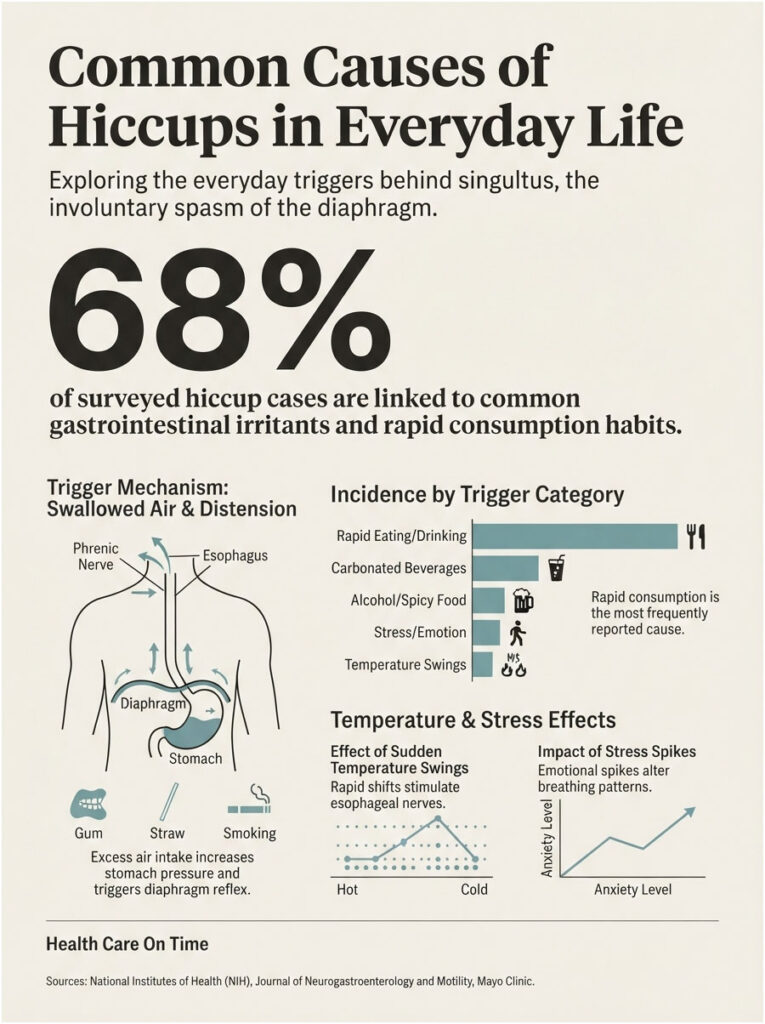
Now the part most people came for. Everyday hiccups almost always trace back to something you did to your stomach, your nerves, or your breathing rhythm in the last twenty minutes.
Eating and Drinking Too Fast
This is the leading cause by a wide margin. Eating or drinking too much or too quickly distends the stomach, which sits directly below the diaphragm, and that stretch irritates the muscle into contracting.
Most experts tie hiccups to fast eating and drinking, with bloating the single most common cause.
Picture a Thanksgiving plate cleared in eight minutes. The stomach balloons upward, the diaphragm gets shoved, and the reflex fires.
Volume Matters as Much as Speed
You can eat slowly and still hiccup if the portion is large enough. Mechanical pressure does not care about your pace.
Smaller plates and a genuine pause halfway through a meal remove the pressure before it builds.
Carbonated Drinks and Beer
Soda, seltzer, and beer land a double hit. Liquid fills the stomach, then dissolved gas expands inside it.
WebMD lists carbonated beverages among the standard diaphragm irritants alongside eating and drinking too fast.
Alcohol, Spicy Food, and Stomach Irritation
Alcohol and heavy smoking rank among the most frequent benign causes of hiccups.
Alcohol irritates the stomach lining and relaxes the valve between stomach and esophagus, letting acid drift up toward the vagus nerve. Spicy food irritates the same tissue directly.
Beer stacks all three mechanisms at once, which is why it is the most reliable hiccup trigger in the American diet.
Sudden Temperature Swings
A sharp change in temperature counts as a recognized benign trigger, whether from very hot or very cold food and drink or even a cold shower.
Ice water chased straight after hot soup is the classic setup. The thermal jolt reaches nerve endings in the esophagus that feed the same reflex loop.
Stress, Excitement, and Emotional Spikes
Heightened emotions like fright and excitement, plus ordinary stress, can all bring hiccups on. Sudden excitement or emotional stress falls under the psychogenic trigger category.
In cases reviewed by our medical team, this shows up most in people who hiccup before presentations, mid-argument, or during a panic episode. Stress reshapes your breathing, and the diaphragm is the muscle doing that work.
Swallowed Air From Gum, Straws, Smoking, and Vaping
Aerophagia is the clinical term for swallowing air. It sits in the same gastric distension bucket as overeating and carbonated drinks.
Chewing gum, drinking through a straw, talking while eating, smoking, and vaping all push extra air into your stomach. The stomach expands, and you are right back to mechanical pressure on the diaphragm.
Table 1. Everyday hiccup triggers, what they do, and what actually helps
| Common Trigger | What It Does to the Body | Typical Onset | Usual Bout Length | What Actually Helps |
| Eating too fast | Rapid stomach distension pressing on the diaphragm | 2 to 10 minutes | 1 to 5 minutes | Stop eating, sip water slowly, stay upright 20 minutes |
| Large meal | Sustained stomach stretch plus upward pressure | 10 to 30 minutes | 2 to 10 minutes | Walk gently, loosen the waistband, avoid lying down |
| Carbonated drinks | Liquid volume plus expanding gas in the stomach | 1 to 5 minutes | 1 to 5 minutes | Switch to still water, burp deliberately |
| Alcohol (especially beer) | Gastric irritation, relaxed esophageal valve, carbonation | 5 to 20 minutes | 5 to 20 minutes | Stop drinking, eat something bland, hydrate |
| Very hot or very cold food | Thermal shock to esophageal nerve endings | Under 2 minutes | 1 to 3 minutes | Let food reach room temperature before the next bite |
| Sudden excitement or stress | Altered breathing pattern and shifted vagal tone | Immediate | 1 to 5 minutes | Slow paced breathing with a long exhale, then a breath hold |
| Gum, straws, talking while eating | Swallowed air inflating the stomach | 5 to 15 minutes | 1 to 5 minutes | Drop the straw or gum, eat without talking |
| Smoking or vaping | Swallowed air plus direct throat and vagal irritation | 2 to 10 minutes | 2 to 10 minutes | Pause the session, sip cold water in small swallows |
Sometimes There Is No Trigger at All
Plenty of episodes have no findable cause, and that is not a failure of investigation. There is often no clear reason for getting the hiccups.
The same holds in clinical settings. In a Mayo Clinic multi-site review of 320 cancer patients with documented hiccups, no specific cause was cited in 210 of them, about 66%.
If you cannot pin down what set yours off, you are in the majority.
When Hiccups Signal Something Medical
Nearly all hiccups are harmless. The small fraction that are not tend to announce themselves the same way: they refuse to stop.
Acute, Persistent, and Intractable
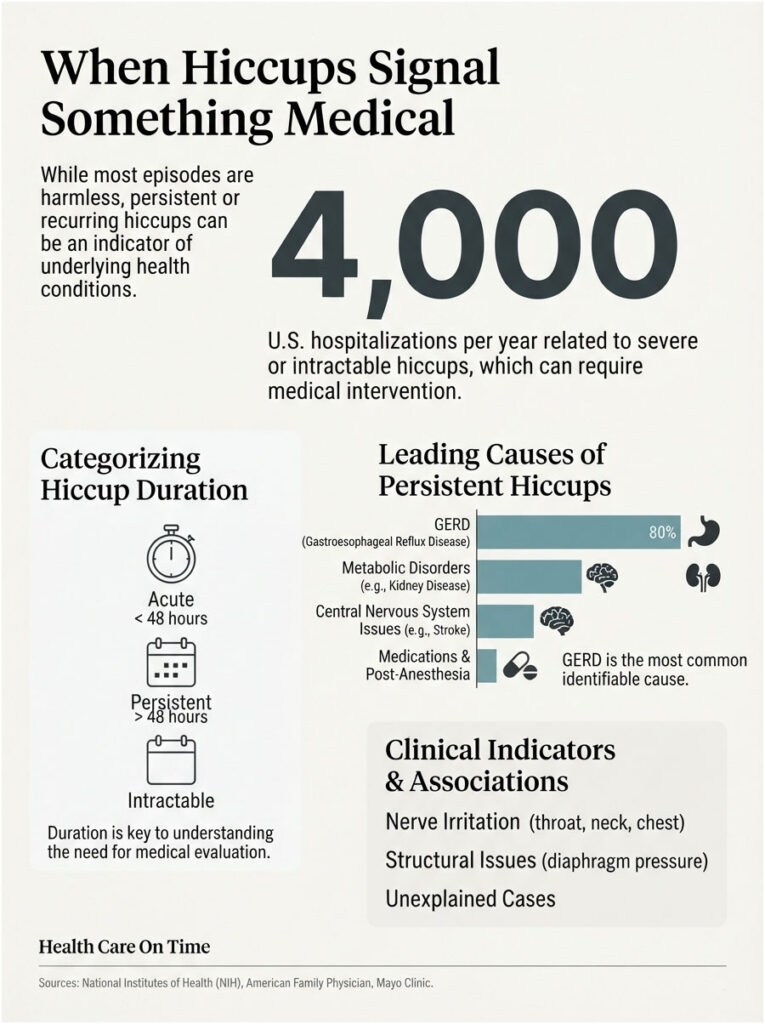
A single episode can run anywhere from a few seconds to several days. Past 48 hours the label becomes persistent; past one month, intractable.
Some references stretch that second threshold and reserve intractable for episodes running beyond two months.
The 48-Hour Line
Two full days of hiccupping is no longer a quirk. It is a symptom asking for a cause.
Persistent hiccups can bring trouble breathing, swallowing, or speaking, along with disrupted sleep, exhaustion, and weight loss.
The One-Month Line
Intractable cases almost always have a driver underneath, and finding it matters more than muffling the symptom.
Round-the-clock hiccups running for days, weeks, or months disrupt sleeping, eating, and social life.
GERD and the Reflux Connection
If you remember one number from this article, remember this one. Roughly 80% of persistent hiccup cases are related to GERD, in which stomach acid travels back up toward the mouth and upsets the diaphragm.
A physician evaluating long-running hiccups will often check for reflux first, then treat it with lifestyle changes, medication, or surgery, which frequently resolves the hiccups.
Patients ask us regularly whether hiccups alone justify suspecting reflux. Alone, no. Paired with heartburn, a sour taste, or a nagging dry cough, the suspicion climbs fast.
Nerve Irritation From the Ear, Throat, Neck, and Chest
Hiccups sometimes come from a disturbance in the nerve pathways running from the brain to the muscles between the ribs.
Anything pressing on the vagus or phrenic nerve qualifies: an inflamed eardrum, tonsillitis, an enlarged thyroid, a neck mass, or irritation of the sac surrounding the heart.
Infections including shingles, herpes simplex, and malaria have all been documented as hiccup causes.
Central Nervous System Causes
Central causes include stroke, space-occupying lesions, and brain injury, with brainstem stroke the most common stroke type behind hiccups.
This is precisely why the red flag list further down matters. New, unexplained hiccups alongside any neurological symptom belong in an emergency department, not on a home remedy list.
Metabolic Causes: Kidneys, Diabetes, and Electrolytes
Recognized causes span idiopathic cases, post-surgical states, chemotherapy, cancer, heart attack, liver disease, uremia, and central nervous system lesions.
Uremia from advanced kidney disease is a classic. So are diabetic emergencies. One published case describes a 59-year-old man with type 2 diabetes and hypertension who reached an emergency department after five days of hiccups during an episode of diabetic ketoacidosis.
Across the diagnostic network HealthCareOnTime works with, unexplained persistent hiccups are one of the quieter reasons a physician orders kidney function markers, an electrolyte profile, or a blood glucose workup.
Medications and Procedures
Drug-induced hiccups get missed constantly, and they are often reversible once spotted.
Cleveland Clinic lists dopamine agonists, low-dose benzodiazepines, some chemotherapy drugs, dexamethasone, and azithromycin among medications that can cause persistent hiccups.
After General Anesthesia
Persistent hiccups can also follow surgeries and procedures, particularly those requiring general anesthesia.
Airway instrumentation, air pushed into the stomach, and the drugs themselves all touch the reflex arc.
Steroids and Chemotherapy
Beyond anesthesia, ongoing hiccups have been linked to azithromycin, the corticosteroid dexamethasone, low-dose benzodiazepines, and dopamine agonists used in Parkinson disease.
In the Mayo Clinic cohort, when a cause was identified it was more often a non-chemotherapy medication (11%) than chemotherapy itself (6%).
Table 2. Hiccup statistics from recent United States research
| Statistic | Figure | Population or Context | Source |
| Annual U.S. hospitalizations for hiccups | Up to 4,000 | General U.S. population | UCLA Health |
| Persistent hiccup cases linked to GERD | About 80% | Hiccups lasting beyond 48 hours | UCLA Health |
| Hiccups reported during cancer therapy | 16% of 213 | Mayo Clinic Connect survey respondents | PubMed |
| Hiccups after cisplatin or oxaliplatin chemo | 28% (95 of 337) | Patients reached by phone post-treatment | PLOS One |
| Insomnia as a hiccup complication | 16% of 320 | Cancer patients with documented hiccups | Mayo Clinic study |
| Hospitalization or ED visit from hiccups | 11% of 320 | Same cancer patient cohort | Mayo Clinic study |
| Time preterm infants spend hiccupping | About 1%, 15 min daily | Infants born before 37 weeks | University College London |
Babies, Pregnancy, and Older Adults
Hiccups behave differently at different life stages, and the level of concern shifts right along with them.
Why Newborns Hiccup So Much
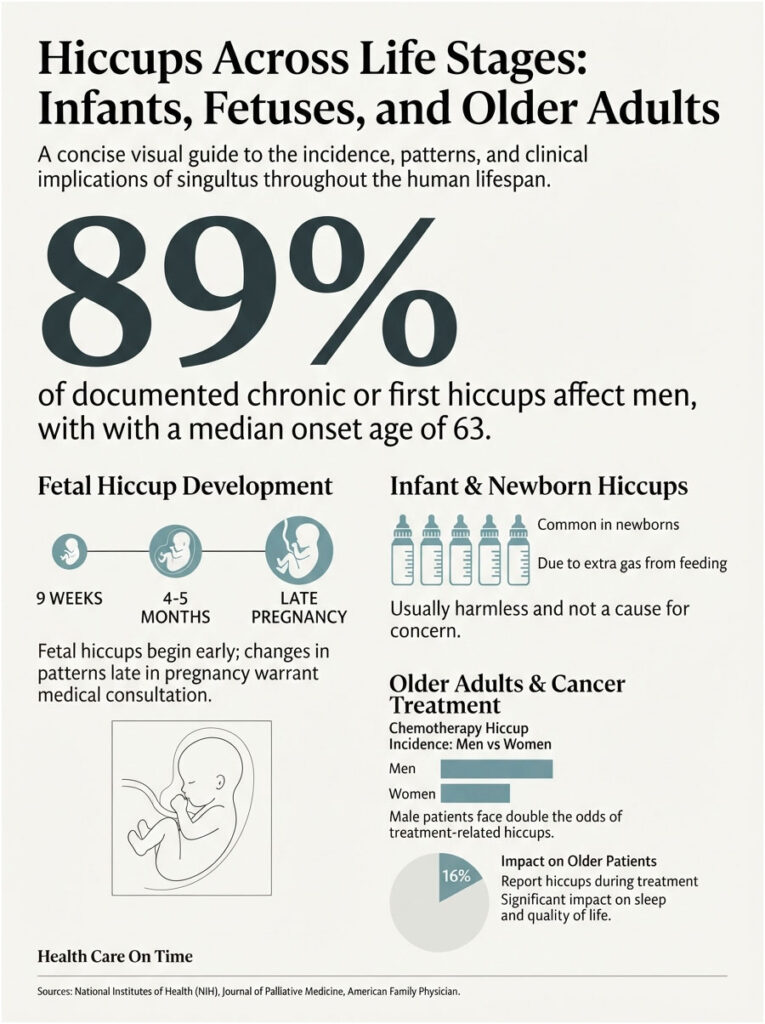
Providers believe it comes down to extra gas in the stomach from eating a lot or swallowing air while feeding, which expands the belly and irritates the diaphragm.
Frequent newborn hiccups are not a warning sign. Slower feeds, more frequent burping, and holding the baby upright for fifteen minutes afterward usually cut them down.
New parents often worry the hiccups are painful. Watch the baby face during a bout. Most sleep straight through them.
Fetal Hiccups During Pregnancy
Around the fourth or fifth month, many people feel rhythmic jerking inside the abdomen, and sometimes see it, which is usually the fetus hiccupping. It is a normal response.
The reflex starts far earlier than most parents realize, at nine weeks of gestation.
Our medical reviewers point out that a marked change in the usual pattern late in pregnancy, rather than the hiccups themselves, is what justifies a call to an obstetric provider.
Hiccups After Surgery and During Cancer Treatment
This group carries the heaviest burden by far. Among 213 survey respondents, 16% reported hiccups with cancer therapy, and most of those affected were over 50.
In a separate patient-reported analysis, 95 of 337 contacted patients (28%) who had received cisplatin or oxaliplatin reported hiccups.
The downstream effects are not minor. Among 320 patients, 16% had sleep problems, 11% had a hospitalization or emergency department visit, and 7% developed musculoskeletal pain.
Why Persistent Cases Skew Older and Male
The demographic tilt is hard to miss. In that same cohort, the median age at first documented hiccups was 63, and 284 of 320 patients (89%) were men.
Male gender was also tied to roughly double the odds of chemotherapy-related hiccups.
Nobody has fully explained the gap. Differences in reflux rates, alcohol intake, and diaphragm size are the usual suspects.
How to Stop Hiccups, Ranked by Evidence
Sorted by how much support each method actually has, strongest first.
Maneuvers With Real Physiological Logic
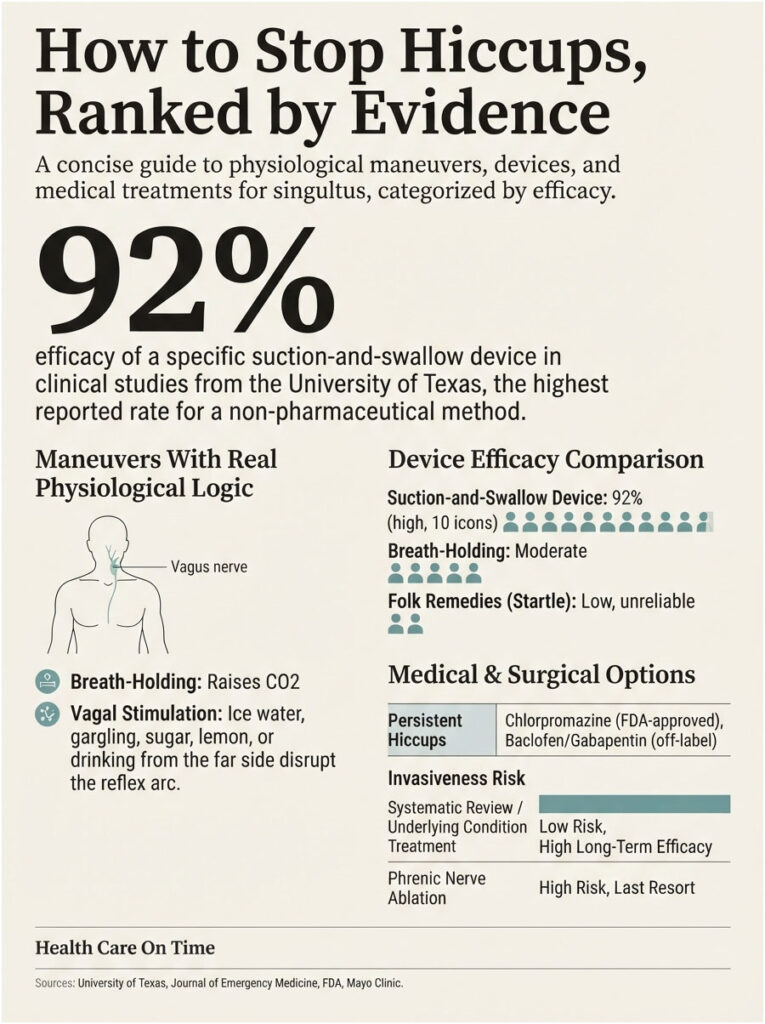
The techniques that work tend to do one of two things: raise blood carbon dioxide, or stimulate the vagus nerve.
Breath-Holding and Carbon Dioxide
Hold your breath 10 to 20 seconds, exhale slowly, repeat twice. Rising carbon dioxide appears to dampen the reflex.
Breath holding and rebreathing into a paper bag are standard home remedies, though researchers criticize them for vague instructions and inconsistent results.
Vagal Maneuvers: Cold Water, Swallowing, Gargling
Ice water in rapid small swallows, gargling, a spoonful of granulated sugar, or a bite of lemon all stimulate the vagus nerve through the throat.
Drinking water from the far side of a glass belongs to the same family of physical maneuvers.
None is guaranteed. All are fast and essentially risk-free, which is why they have survived generations.
The Suction-and-Swallow Method With Published Data
The strongest evidence for a physical fix comes from a device built at the University of Texas Health Science Center at San Antonio.
The forced inspiratory suction and swallow tool is a rigid drinking tube with an inlet valve requiring real suction effort to pull water from a cup. Generating that negative pressure forces the diaphragm to contract, followed immediately by closure of the epiglottis.
That sequence hits the phrenic and vagus nerves back to back, which happens to be the exact pair running the hiccup loop.
In JAMA Network Open, the tool stopped hiccups in nearly 92% of cases and was rated better than home remedies across every demographic group, hiccup frequency, and duration tested. No adverse effects were reported.
The valve is engineered to generate roughly negative 100 cm of water pressure in adults and negative 50 in children.
You can approximate the mechanism without buying anything. Pinch a straw nearly shut, suck with real effort, then swallow immediately and forcefully.
Folk Remedies, and Why Some Still Work
Getting startled is the most famous one. It probably works, when it works, by forcing a sharp breath change plus a sympathetic surge.
The trouble is that you cannot reliably startle yourself, and the whole category resists testing.
Houston Methodist puts it plainly: because we still do not really understand why we get hiccups, how to get rid of them is not well understood either.
Prescription Options When Hiccups Do Not Quit
Medication enters only for persistent or intractable cases, and always after a hunt for the underlying cause.
The One FDA-Approved Drug
Chlorpromazine, a dopamine antagonist, remains the only agent with United States Food and Drug Administration approval for hiccups, and its side effect profile often limits how useful it is.
Typical dosing runs 25 to 50 mg by mouth three or four times daily, with a slow intravenous option available.
Low blood pressure, sedation, extrapyramidal symptoms, and QT prolongation all require monitoring and careful patient selection.
What Clinicians Reach for Off-Label
Because the approved option is constrained, clinicians repurpose GABA-B agonists such as baclofen, anticonvulsants such as gabapentin, and prokinetic agents such as metoclopramide.
A systematic review across 341 patients in 15 studies found that treating the underlying condition worked best, and suggested baclofen and gabapentin as reasonable first-line agents given lower long-term risk, holding metoclopramide and chlorpromazine in reserve.
Dosing in that literature runs 5 to 20 mg of baclofen three times daily and 300 to 600 mg of gabapentin three times daily.
A Cochrane review concluded the evidence base is insufficient to guide treatment of persistent or intractable hiccups by drug or non-drug means, and surgical phrenic nerve ablation remains a last resort carrying considerable morbidity.
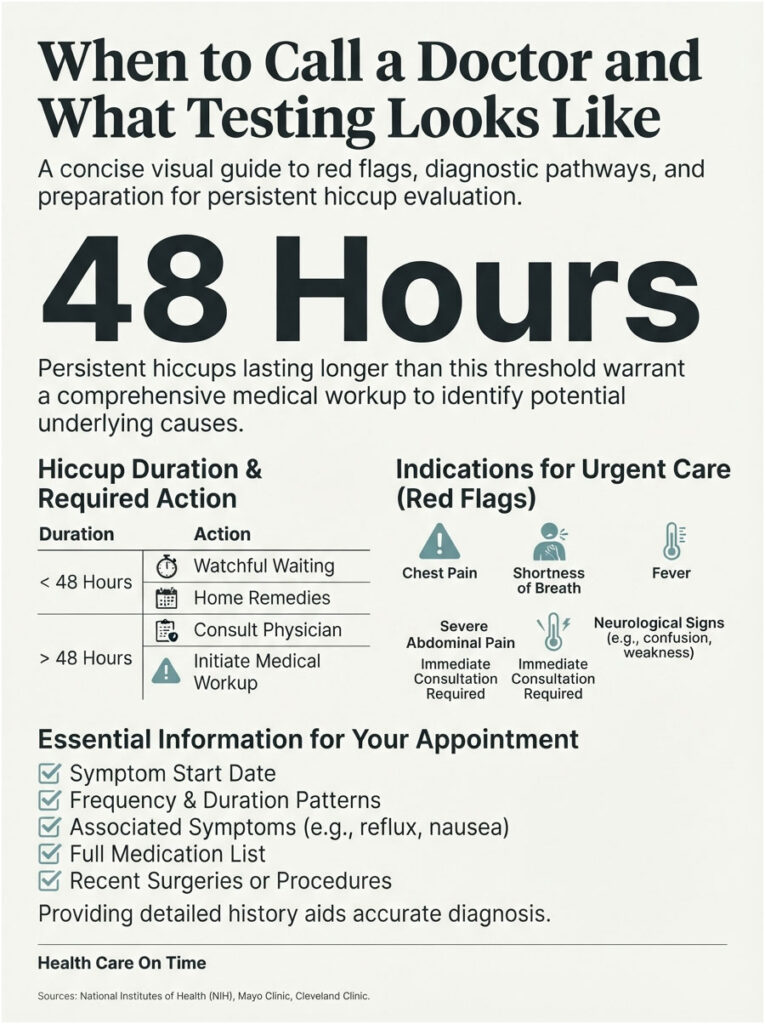
When to Call a Doctor and What Testing Looks Like
Red Flags That Mean Call Today
Contact a clinician promptly if hiccups arrive alongside any of these:
- Weakness, numbness, slurred speech, facial droop, or vision changes
- Chest pain, shortness of breath, or a racing heartbeat
- Vomiting, trouble swallowing, or unintended weight loss
- Severe abdominal pain or visible abdominal swelling
- Fever with a stiff neck or a severe headache
- Onset within days of starting a new medication
- Any bout running past 48 hours without a break
Table 3. What to do based on your hiccup scenario
| Your Scenario | What It May Point To | Recommended Action | Urgency Level |
| Under 15 minutes with a clear trigger | Normal transient reflex | Slow sipping or a breath hold, then move on | None |
| Recurs after every large or fast meal | Gastric distension pattern | Smaller portions, slower pace, stay upright after eating | Low |
| Hiccups plus heartburn or a sour taste | Possible GERD | Book a primary care visit and discuss reflux testing | Moderate, 1 to 2 weeks |
| Continuous beyond 48 hours | Persistent hiccups needing a cause | Call your primary care physician this week | Moderate to high |
| Continuous beyond one month | Intractable hiccups | Request a specialist referral and structured workup | High |
| Started within days of a new prescription | Drug-induced hiccups | Contact the prescriber before changing anything | Moderate, within days |
| Plus weight loss, vomiting, or trouble swallowing | Possible esophageal or abdominal pathology | Schedule an urgent evaluation | High |
| Plus weakness, numbness, slurred speech, or vision change | Possible central nervous system event | Seek emergency care immediately | Emergency |
What a Hiccup Workup Usually Includes
Past the 48-hour mark, a physician starts with history and a physical exam covering the ears, throat, neck, chest, and abdomen.
Blood work typically follows: a metabolic panel, kidney function markers, electrolytes, and glucose, since metabolic causes are correctable once identified. Chest imaging comes next if a chest or diaphragm source seems likely.
Upper endoscopy enters when reflux or an esophageal problem is suspected. Brain imaging is reserved for neurological findings or cases with no other explanation.
What to Bring to the Appointment
Your physician will want to know how long the hiccups have run, how often they occur, and whether other symptoms are present.
Bring a short log: start date, rough hiccups per minute, what makes them better or worse, and every medication or supplement started in the past month. In tests booked through HealthCareOnTime, patients who show up with that information move through diagnosis noticeably faster.
How to Lower Your Odds of Getting Hiccups
Prevention is mostly about intercepting triggers before they reach your diaphragm.
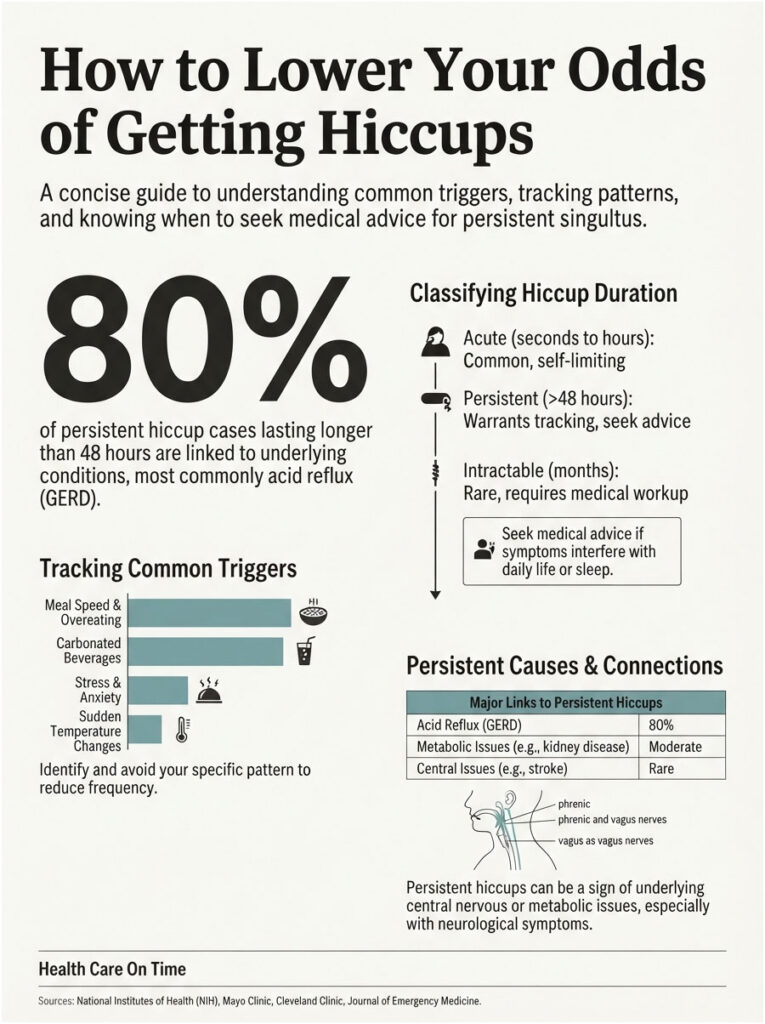
- Eat slowly and stop before you feel full, since stomach stretch drives more hiccups than anything else.
- Cut back on carbonated drinks, especially alongside meals.
- Limit alcohol, and skip beer specifically if hiccups are a recurring problem for you.
- Let very hot food cool, and avoid ice-cold drinks straight after hot ones.
- Drop straws and chewing gum if you notice a pattern.
- Skip smoking and vaping, which push swallowed air and irritate the throat at the same time.
- Manage reflux actively: lighter evening meals, no lying down for three hours after eating, and a raised head of the bed.
- Use slow paced breathing during high-stress stretches of your day.
Our lab partners report that people who track their own triggers for two weeks almost always surface one dominant pattern, usually meal speed or carbonation, and cut their episodes sharply by changing that single habit.
Frequently Asked Questions
What is the main cause of hiccups?
Stomach distension. Eating or drinking too much or too quickly stretches the stomach, which sits directly beneath the diaphragm, and that pressure irritates the muscle into contracting out of sequence. Carbonated drinks, alcohol, and swallowed air all work through the same basic mechanism.
Why do we hiccup for no reason at all?
Because most hiccups genuinely have no findable trigger. There is often no clear reason for getting them. The reflex arc is long and sensitive, so mild irritation anywhere along the phrenic or vagus pathway can set it off without you noticing a thing.
How long is too long for hiccups?
Past 48 hours they are classified as persistent, and past one month as intractable. Call your primary care physician if hiccups run beyond two days or start interfering with eating and sleeping. Anything past a month needs a structured medical workup.
Can hiccups be a sign of a stroke?
Rarely, yes. Central causes include stroke, and brainstem stroke is the most common type behind hiccups. Hiccups alone are not a stroke sign. Hiccups plus weakness, numbness, slurred speech, or vision change require emergency care right away.
Do hiccups mean I have acid reflux?
Not by themselves. But the link is strong in long-running cases. About 80% of persistent hiccup cases relate to GERD, where stomach acid moving upward irritates the diaphragm. If yours come with heartburn or a sour taste, raise reflux with your doctor.
Why do babies hiccup so much?
The leading explanation is extra gas in the stomach, from eating a lot or swallowing air during feeding, which expands the belly and irritates the diaphragm. It is normal and harmless. Slower feeds, frequent burping, and upright positioning afterward usually help.
Why do I hiccup after drinking beer or soda?
Three mechanisms stack at once. Liquid volume fills the stomach, dissolved carbon dioxide expands inside it, and alcohol irritates the lining while relaxing the valve that keeps acid down. Carbonated drinks and alcohol both rank among the most frequent benign hiccup causes.
Can anxiety or stress cause hiccups?
Yes. Sudden excitement and emotional stress are recognized psychogenic triggers, and fright can bring hiccups on too. Stress reshapes your breathing rhythm, and the diaphragm does that work, so the reflex is easier to trip.
Why do I get hiccups after surgery?
Persistent hiccups can follow surgeries and procedures, especially those involving general anesthesia. Airway instrumentation, air introduced into the stomach, and the anesthetic drugs themselves all touch the reflex arc. Most post-operative cases settle within a day or two.
What is the fastest way to stop hiccups?
Forced suction followed instantly by a hard swallow. A tool built on that principle stopped hiccups in nearly 92% of cases in a JAMA Network Open study. Without the device, pinch a straw nearly shut, suck with real effort, and swallow immediately.
Can a medication cause hiccups?
Yes, and it is frequently missed. Dopamine agonists, low-dose benzodiazepines, some chemotherapy drugs, dexamethasone, and azithromycin can all cause persistent hiccups. If yours started within days of a new prescription, call the prescriber instead of stopping the drug yourself.
What is the longest anyone has hiccupped?
Charles Osborne of Iowa holds the Guinness World Record, hiccupping continuously from 1922 to 1990 at 20 to 40 per minute, an estimated 430 million times in total. He died in May 1991 at 97. His physician suspected a small brain injury from the fall that started it.
Medical Disclaimer: This article is published by HealthCareOnTime for general education and does not replace evaluation by a licensed clinician. Hiccups lasting more than 48 hours, or accompanied by neurological, chest, or abdominal symptoms, need professional assessment. Never start, stop, or adjust any prescription medication based on information published here.
References
- Cleveland Clinic: Hiccups, Causes and Treatment
- Mayo Clinic: Hiccups, Symptoms and Causes
- UCLA Health: Prone to Hiccups? Here Is What You Need to Know
- Houston Methodist: What Causes Hiccups, Plus How to Get Rid of Them
- University College London: Newborn Baby Hiccups Could Be Key to Brain Development
- JAMA Network Open: Evaluation of the Forced Inspiratory Suction and Swallow Tool to Stop Hiccups
- PLOS One: Hiccups With Oxaliplatin or Cisplatin-Based Chemotherapy
- PubMed Central: Hiccups in Patients With Cancer, Etiology, Severity, and Outcomes
- PubMed: Frequency and Symptomatology of Hiccups in Patients With Cancer
- Journal of Pain and Symptom Management: Pharmacotherapy for Chronic and Intractable Hiccups00937-6/fulltext)
- Palliative Care Network of Wisconsin: Management of Hiccups
- Medscape: Hiccups Treatment and Management
- Medical News Today: Why Do We Hiccup? Causes and Treatments
- Guinness World Records: Longest Attack of Hiccups