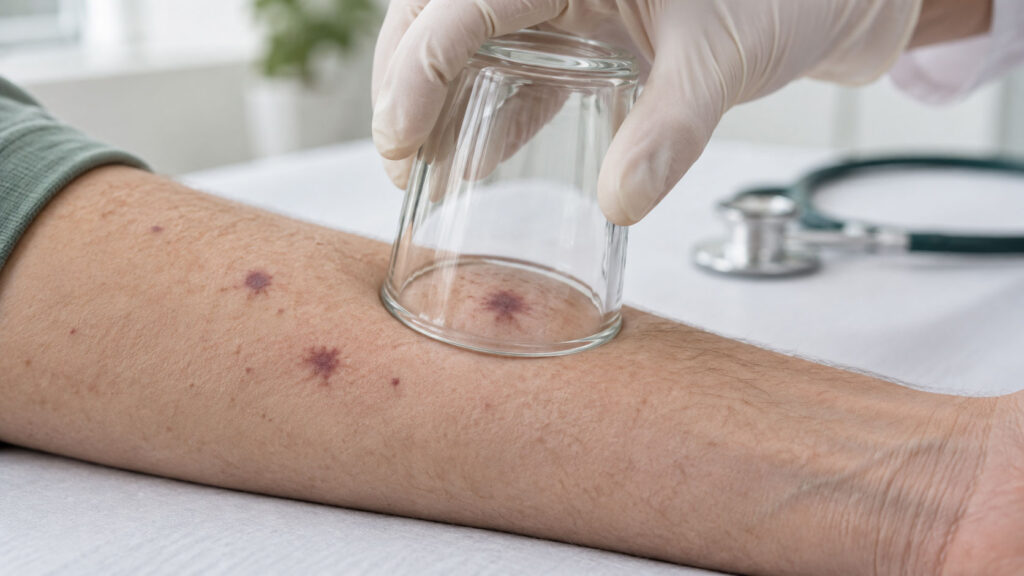
Grab a clear drinking glass and press it firmly against the spot. If the color fades, you’re likely looking at an ordinary rash. If it stays put, that’s blood sitting under your skin, and it has a name: purpura.
Table of Contents
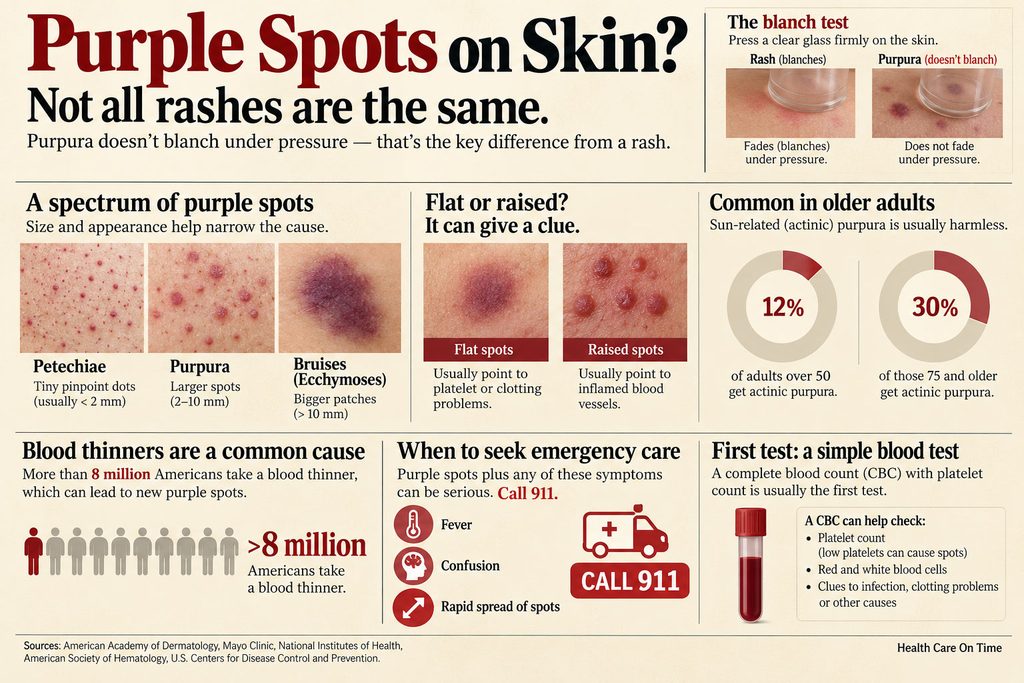
Most of the time, purpura is harmless. Once in a while, it’s one of the most time-sensitive warning signs in medicine. This guide shows you how to tell the two apart, and exactly what to do next.
Quick Answer: Purpura is purple, red, or brown spots caused by blood leaking from tiny vessels under the skin. Unlike a rash, the spots don’t fade when you press them. Common harmless causes include aging skin, minor bumps, and blood thinners. Serious causes include low platelets, inflamed blood vessels, and bloodstream infections. Purple spots with fever, confusion, or fast spreading need emergency care right away.
At a Glance
• Purpura doesn’t blanch (fade) under pressure. That’s the key difference from a rash.
• Tiny pinpoint dots are petechiae; larger spots are purpura; bigger patches are bruises (ecchymoses).
• Flat spots usually point to platelet or clotting problems. Raised spots you can feel usually point to inflamed blood vessels.
• About 12% of adults over 50 and 30% of those 75 and older get harmless sun-related (actinic) purpura.
• More than 8 million Americans take a blood thinner, a very common reason for new purple spots.
• Spots plus fever, confusion, or rapid spread is a 911 situation.
• A complete blood count (CBC) with platelet count is usually the first test.
What Purpura Is (and Isn’t)
Purpura isn’t a disease. It’s a sign. Small blood vessels leak, blood collects in the skin, and you see a purple, red, or brownish patch.
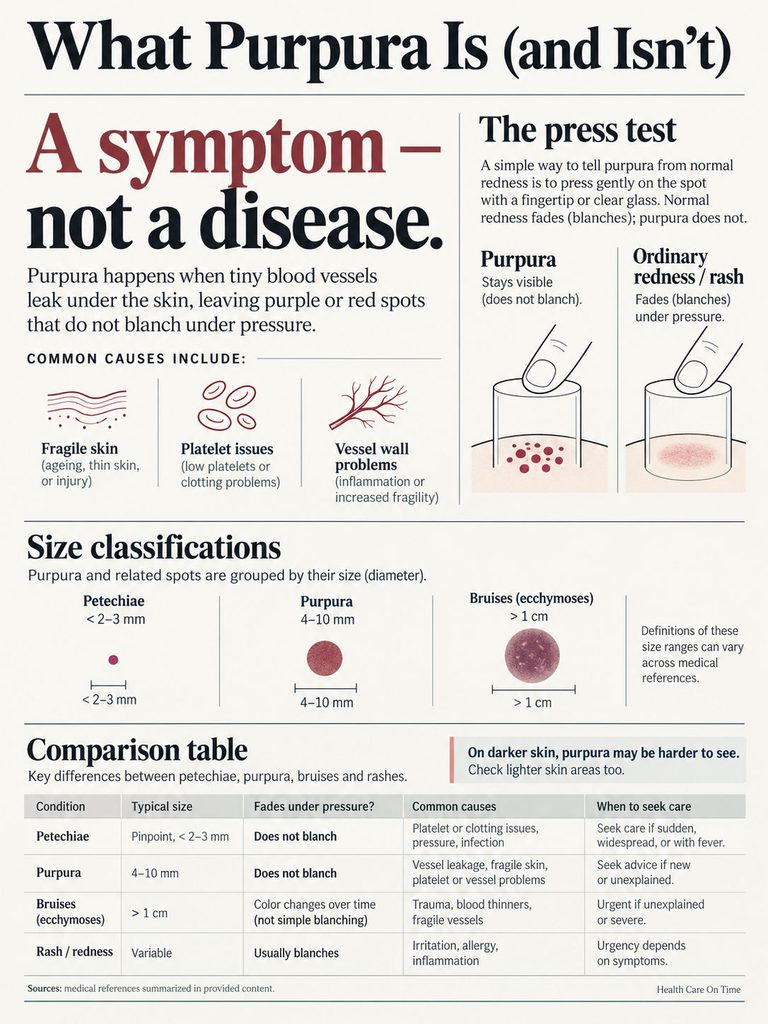
The cause could be as simple as fragile skin on your forearms. It could also be a problem with your platelets, your clotting system, or the vessel walls themselves.
The Press Test: Blanching vs Non-Blanching
Normal redness comes from blood flowing through widened vessels. Press on it, the blood moves away, and the skin turns pale. That’s called blanching.
Purpura is different. The blood has already left the vessels, so pressure can’t push it away. As Cleveland Clinic explains, pressing on purpura doesn’t change its color.
Petechiae, Purpura, and Bruises: The Size Ladder
Doctors sort these spots mostly by size:
- Petechiae: pinpoint dots, roughly 2 to 3 millimeters or smaller (about pinhead size)
- Purpura: larger spots, roughly 4 to 10 millimeters (pencil eraser size or a bit bigger)
- Ecchymoses: patches larger than about 1 centimeter, what most people call a bruise
Why Different Websites Give You Different Numbers
Patients commonly ask us why one site says petechiae are under 2 mm and another says under 4 mm. The honest answer: medical references don’t fully agree on the cutoff.
The size label matters less than the pattern. A shower of new pinpoint dots across your legs carries more weight than one bruise on your shin.
How Purpura Looks on Darker Skin Tones
On lighter skin, purpura looks red to purple. On brown or Black skin, it often looks dark brown, deep purple, or nearly black, and tiny petechiae can be hard to spot.
Check places with lighter skin too: the inside of the mouth, the whites of the eyes, the palms, and the soles of the feet.
Table 1: Petechiae vs Purpura vs Bruise vs Ordinary Rash
| Feature | Petechiae | Purpura | Ecchymosis (Bruise) | Ordinary Rash |
| Typical size | Under 2 to 3 mm | About 4 to 10 mm | Over 1 cm | Any size |
| Fades when pressed? | No | No | No | Usually yes |
| Flat or raised | Flat | Flat or raised | Flat, sometimes swollen | Often raised or bumpy |
| Common causes | Straining, low platelets, infection | Aging skin, drugs, platelets, vasculitis | Bumps, falls, blood thinners | Allergy, virus, heat, eczema |
| Itch or pain | Rarely | Sometimes tender | Tender | Often itchy |
| Color change over time | Red to brown | Purple to brown | Purple, green, yellow | Usually stays red or pink |
| Urgency if new and widespread | High | Moderate to high | Low unless unexplained | Low |
Flat or Raised? The Clue That Splits the Causes
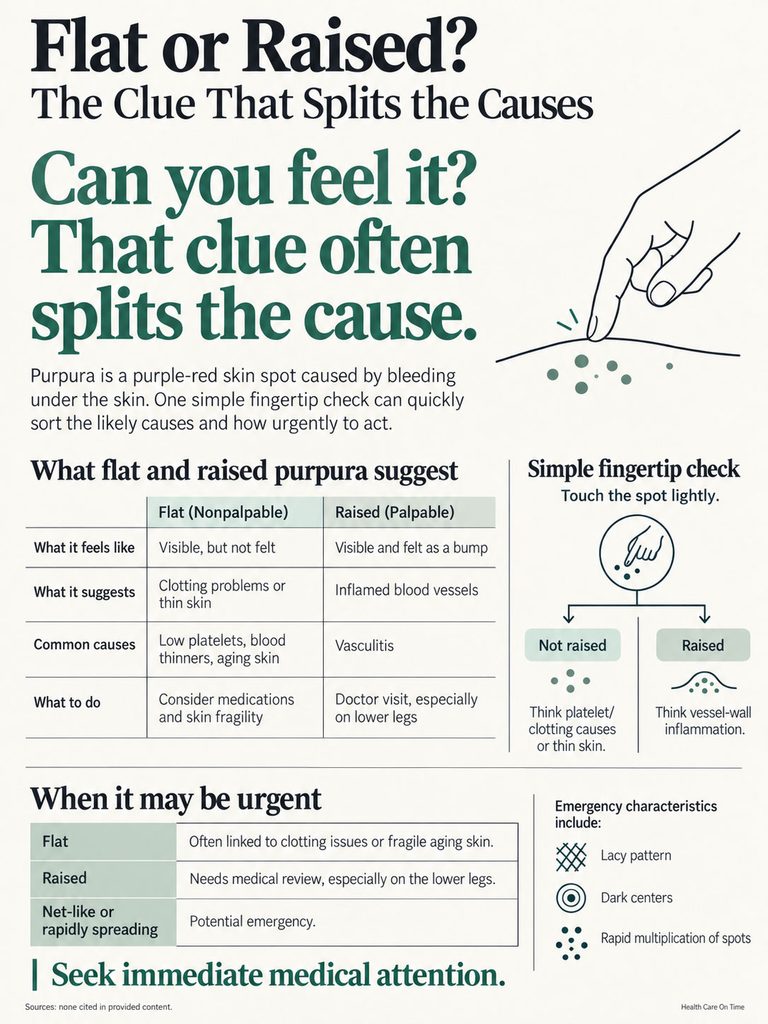
Run your fingertip lightly over the spots. This simple check narrows the list of causes more than almost anything else you can do at home.
Flat (Nonpalpable) Purpura: Think Platelets and Clotting
Flat spots usually mean the blood can’t clot normally or the skin is too thin to protect its vessels. Low platelets, blood thinners, and aging skin all fall here.
Raised (Palpable) Purpura: Think Inflamed Vessels
Raised spots you can feel usually mean the blood vessel walls are inflamed. This is called vasculitis. In cases reviewed by our medical team, raised purpura on the lower legs is one of the clearest signals to book a doctor’s visit soon.
Net-Like or Rapidly Spreading Purpura: Think Emergency
Purpura with a lacy, net-like pattern, dark centers, or skin that turns gray or black can mean blocked vessels or a severe infection. So can spots that multiply over a few hours. Don’t wait on these.
11 Causes of Sudden Purple Spots, From Common to Critical
Here are the main causes, ordered roughly from most common and least worrying to rarest and most urgent:
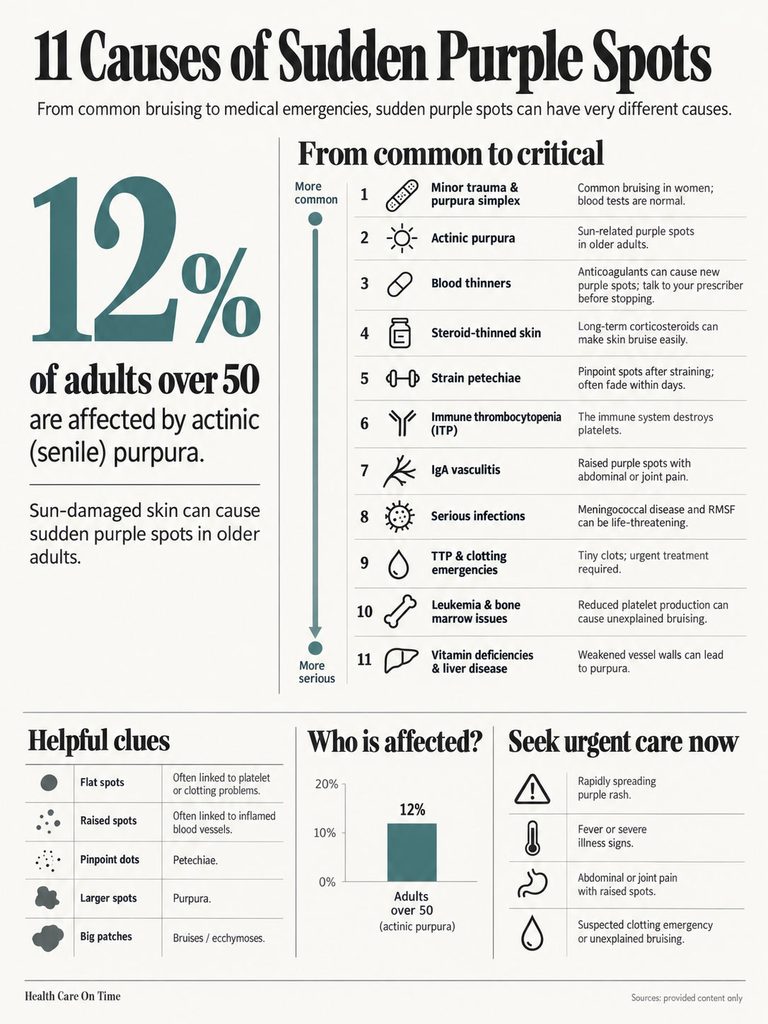
- Minor trauma and purpura simplex
- Actinic (senile) purpura
- Blood thinners and other medications
- Steroid-thinned skin
- Strain petechiae from coughing or vomiting
- Immune thrombocytopenia (ITP)
- IgA vasculitis and other vasculitis
- Serious infections
- TTP and other clotting emergencies
- Leukemia and bone marrow problems
- Vitamin deficiency and liver disease
1. Minor Trauma and Purpura Simplex
Some people, especially women, simply bruise easily. Small purple spots show up on the thighs and arms after bumps they don’t remember.
This is called purpura simplex. Blood tests come back normal, and it doesn’t lead to serious bleeding. A first-time blood count can confirm that.
2. Actinic (Senile) Purpura in Older Adults
Decades of sun exposure break down the collagen that supports small blood vessels. Light bumps then cause dark purple blotches, usually on the backs of the hands and forearms.
StatPearls estimates it affects about 12% of people over 50 and 30% of those 75 or older. The spots often last 1 to 3 weeks and can leave brown staining behind.
It’s harmless by itself. But it signals thin skin that tears easily, so gentle skin care matters.
3. Blood Thinners and Antiplatelet Drugs
More than 8 million Americans take an anticoagulant. Drugs like apixaban (Eliquis), rivaroxaban (Xarelto), and warfarin slow clotting, while aspirin and clopidogrel (Plavix) block platelets.
New purple spots are a very common side effect. Other drugs that raise bruising risk include NSAIDs such as ibuprofen and naproxen, SSRI antidepressants, and fish oil or ginkgo supplements.
Patients commonly ask us whether they should stop their blood thinner. Never stop it on your own; that can trigger a stroke or clot. Call your prescriber, and if you take warfarin, ask whether your INR needs checking.
4. Steroid-Thinned Skin (Oral, Inhaled, Topical)
Long-term corticosteroids such as prednisone, high-dose inhaled steroids, or strong steroid creams thin the skin. The result looks a lot like actinic purpura, often on the forearms and shins.
5. Strain Petechiae (Coughing, Vomiting, Heavy Lifting)
Hard straining briefly spikes pressure in small vessels of the face, neck, and chest. Pinpoint petechiae around the eyes after a bout of vomiting or a coughing fit are a classic example.
These fade in a few days. If they show up anywhere you didn’t strain, or keep coming back, get a blood count.
6. Immune Thrombocytopenia (ITP)
In ITP, the immune system destroys platelets by mistake. Mayo Clinic lists easy bruising, pinpoint spots mostly on the lower legs, bleeding gums or nosebleeds, and unusually heavy periods as common signs.
A large US claims study in Blood estimated 6.0 new cases per 100,000 people each year. Rates were higher in women and highest in adults 65 and older, at 13.7 per 100,000.
In children, ITP often follows a virus and goes away on its own. In adults, it more often becomes long-term. In CBCs reviewed by our medical team, a platelet count far below the normal range of 150,000 to 450,000 per microliter, with otherwise normal results, is the pattern that most often leads to an ITP workup.
7. IgA Vasculitis and Other Vasculitis
IgA vasculitis (formerly called Henoch-Schönlein purpura) causes raised purple spots, mostly on the legs and buttocks. Belly pain, joint pain, and blood in the urine often come with it.
The NIDDK puts new cases at about 3 to 27 per 100,000 children and fewer than 2 per 100,000 adults each year. Most people recover fully, but adults are more likely to develop long-term kidney disease.
That’s why a urine test matters, even after the rash fades. Other causes of vasculitis include drug reactions, hepatitis C, and autoimmune diseases such as lupus.
8. Serious Infections: Meningococcal Disease, RMSF, and Sepsis
Meningococcal disease. This bacterial infection can cause a fast-spreading purple rash and can turn deadly within hours. CDC surveillance shows US cases have climbed since 2021, with 503 cases in 2024 and 463 in 2025 (preliminary), driven largely by serogroup Y.
A CDC health advisory noted that this strain often shows up as a bloodstream infection rather than classic meningitis. That means fever, body aches, and vomiting, sometimes without a stiff neck.
Vaccines help. The CDC recommends the MenACWY vaccine for preteens at 11 to 12 with a booster at 16, and MenB vaccination can be added for teens and young adults. Check your child’s records if you’re unsure.
Rocky Mountain spotted fever (RMSF). This tick-borne illness starts with fever and headache. According to a CDC clinical timeline, the rash can turn petechial and merge into purpura by days 5 to 7, and 20 to 25% of untreated cases are fatal.
Many people never noticed a tick bite. Doxycycline works best when started within the first 5 days.
Sepsis and DIC. Severe infections from many bacteria can trigger widespread clotting that uses up platelets and clotting factors. The skin may show large, dark, irregular purpura called purpura fulminans.
9. TTP and Other Clotting Emergencies
Thrombotic thrombocytopenic purpura (TTP) causes tiny clots throughout the body. Per Cleveland Clinic, signs include confusion, headache, fatigue, yellow skin, and petechiae.
It’s rare, at roughly 1.5 to 6 cases per million adults per year. Medscape reports mortality as high as 90% untreated, falling to 10 to 20% with plasma exchange.
That gap is why hospitals treat suspected TTP as an emergency, even before lab results confirm it.
10. Leukemia, Bone Marrow Problems, and Chemotherapy
When the bone marrow can’t make enough platelets, purpura follows. Leukemia, other blood cancers, and chemotherapy are the main examples.
Look for unexplained bruising plus fatigue, frequent infections, fevers, night sweats, or bone pain. A CBC usually shows more than one abnormal cell line, not just low platelets.
11. Vitamin C or K Deficiency and Liver Disease
Severe vitamin C deficiency (scurvy) weakens vessel walls. Classic signs include tiny spots around hair follicles, corkscrew hairs, and swollen, bleeding gums. It still appears in the US, especially with very restricted diets or heavy alcohol use.
Vitamin K deficiency and liver disease both reduce clotting factors. Purpura here often comes with nosebleeds, gum bleeding, or cuts that are slow to stop.
Rare Causes Worth Knowing
- von Willebrand disease: the most common inherited bleeding disorder; heavy periods and nosebleeds are typical
- Amyloidosis: purple spots around the eyes after coughing or straining
- Ehlers-Danlos syndrome: fragile skin and connective tissue from childhood
- Cocaine contaminated with levamisole: dark, net-like purpura on the ears and face
The Numbers Behind Purpura
Few sources pull purpura data together in one place. Our medical team compiled the most current US figures available.
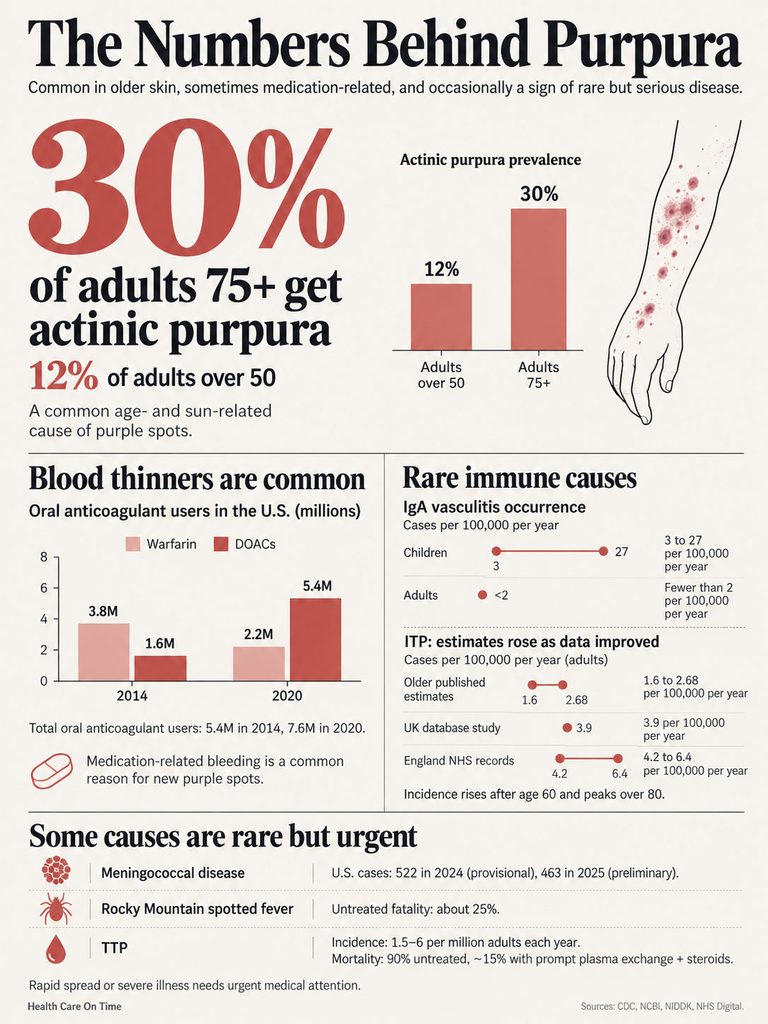
Table 2: Key Purpura Statistics
| Condition | Key Figure | Source |
| Actinic (senile) purpura | About 12% of adults over 50; 30% at 75+ | StatPearls (NIH) |
| Blood thinner use | More than 8 million Americans | National Blood Clot Alliance |
| Immune thrombocytopenia (ITP) | 6.0 new cases per 100,000 per year; 13.7 in adults 65+ | Blood (US claims study) |
| IgA vasculitis | 3 to 27 per 100,000 children; under 2 per 100,000 adults yearly | NIDDK |
| Meningococcal disease | 503 US cases in 2024; 463 in 2025 (preliminary) | CDC surveillance |
| Rocky Mountain spotted fever | 20 to 25% fatal if untreated | CDC clinical timeline |
| TTP | 1.5 to 6 per million adults; up to 90% fatal untreated vs 10 to 20% treated | Medscape TTP overview |
You’ll see ITP estimates anywhere from about 2 to 6 per 100,000. Older figures came from small regional studies, while the newer number comes from US insurance claims covering millions of people. The higher figure likely catches milder cases that older studies missed.
When Purple Spots Are an Emergency
Most purple spots can wait for a regular appointment. Some can’t wait even an hour.

Go to the ER or Call 911 If You Have Purple Spots Plus…
- Fever, chills, or feeling very unwell
- Spots that spread or multiply within hours
- Confusion, severe headache, stiff neck, or unusual sleepiness
- Bleeding from gums, nose, or urine, or black stools
- Yellow skin or eyes, or dark urine
- Cold hands and feet, mottled skin, or fast breathing
- A recent tick bite or travel to an area where RMSF is common
The Glass Test: How to Do It and Its Limits
Press the side of a clear glass firmly against the spots and look through it. If the spots stay visible, they’re non-blanching.
A non-blanching rash with fever is a medical emergency, full stop. But the test has limits: a rash can start out blanching and turn non-blanching later, and some people with meningococcal disease have little or no rash. Never use a fading rash as a reason to stay home if you feel very sick.
Children and Purple Spots: What Parents Should Watch
Kids get petechiae from coughing, vomiting, and minor viruses all the time. The deciding factor is how the child looks and acts.
A sleepy, feverish, or irritable child with new purple spots needs emergency care. A playful child with a few dots on the face after vomiting usually doesn’t. Raised spots on the legs with belly or joint pain point toward IgA vasculitis and need a same-week doctor visit plus a urine test.
Older Adults: When “Just Senile Purpura” Isn’t
Actinic purpura stays on the forearms and backs of the hands. Be suspicious when spots show up on the trunk or legs, appear with no bump at all, or come with fatigue, weight loss, or new bleeding.
Across patients we serve, a common miss is blaming everything on age while a new medication, or a dropping platelet count, is the real cause.
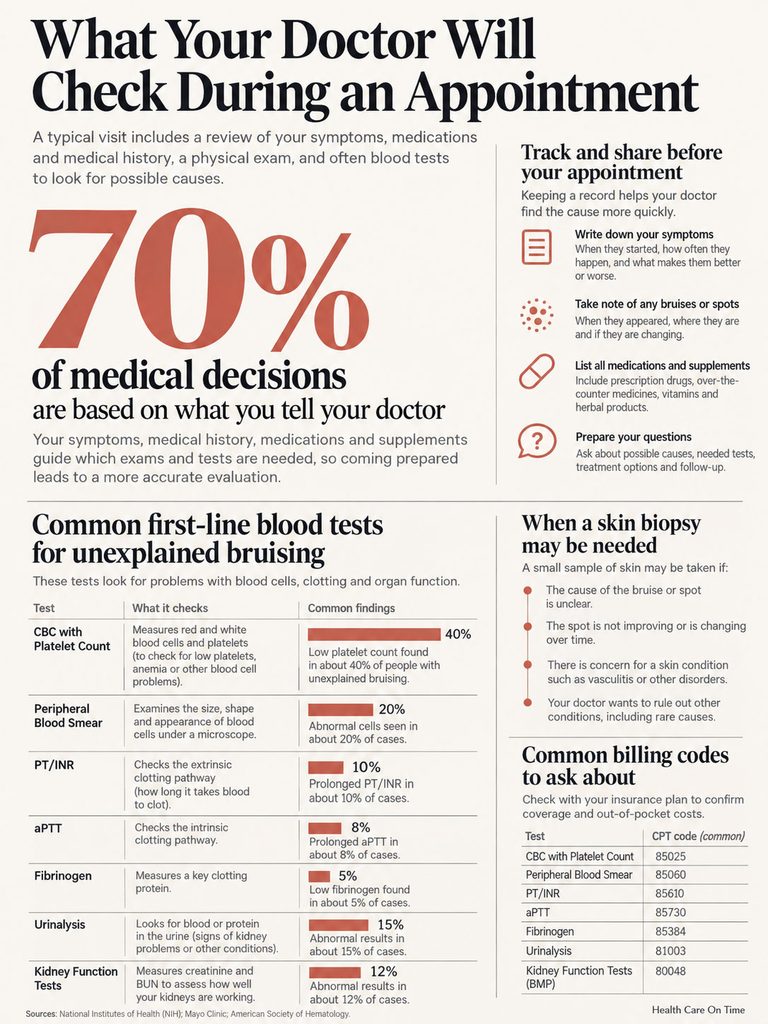
What Your Doctor Will Check
Expect a short list of questions and a few basic blood tests. Most causes can be sorted out in a single visit.
How to Track Your Spots Before the Visit
A few minutes of tracking at home can save time at the appointment. Doctors find it much easier to judge spots that have a clear timeline.
- Take a clear photo of the spots each morning in the same light, with a coin next to them for size
- Trace the edge of one larger patch with a pen so you can see whether it grows
- Write down when the spots first appeared and whether any came with a bump, cough, or vomiting
- Note any fever, using a thermometer reading in degrees Fahrenheit rather than a guess
- Keep a list of every pill, cream, and supplement started in the past 3 months
Across patients we serve, this simple log often points straight to the cause. A blood thinner started two weeks earlier, or a shower of new dots after a cold, tells the doctor a lot before any test is run.
Photos matter most for spots that come and go. Raised vasculitis spots and strain petechiae can fade by the time you’re seen, so a dated picture keeps the evidence.
The Questions to Expect
- When did the spots appear, and are they spreading?
- Any new medications, supplements, or dose changes?
- Recent illness, fever, tick bite, or travel?
- Bleeding gums, nosebleeds, heavy periods, or blood in urine or stool?
- Family history of bleeding problems?
Bring a list of everything you take, including over-the-counter pain relievers and supplements.
First-Line Blood Tests
Patients booking tests with us for unexplained bruising most often start with this panel.
CBC With Platelet Count
The complete blood count shows your platelets, red cells, and white cells. Normal platelets run about 150,000 to 450,000 per microliter. Low platelets with otherwise normal results suggest ITP or a drug effect. Several abnormal cell lines suggest a bone marrow problem.
Peripheral Blood Smear
A lab specialist looks at your blood under a microscope. Fragmented red cells (schistocytes) raise concern for TTP; abnormal white cells raise concern for leukemia.
PT/INR, aPTT, and Fibrinogen
These measure how fast your blood clots. They flag warfarin effects, liver disease, vitamin K deficiency, and DIC.
Urinalysis and Kidney Function
Blood or protein in the urine, or a rising creatinine, points to vasculitis affecting the kidneys.
When a Skin Biopsy Helps
If the spots are raised, or blood tests are normal but spots keep appearing, a small punch biopsy can confirm vasculitis and identify the type. It’s a quick office procedure with local numbing.
The Billing Codes to Know
If you want to check coverage or compare self-pay prices before your visit, ask your insurer or lab about these standard CPT codes:
- 85025: CBC with automated differential and platelet count
- 85610: Prothrombin time (PT/INR)
- 85730: Partial thromboplastin time (aPTT)
- 85384: Fibrinogen
- 81001: Urinalysis with microscopy
These are routine, low-complexity tests, and most US health plans cover them when a doctor orders them for new purpura.
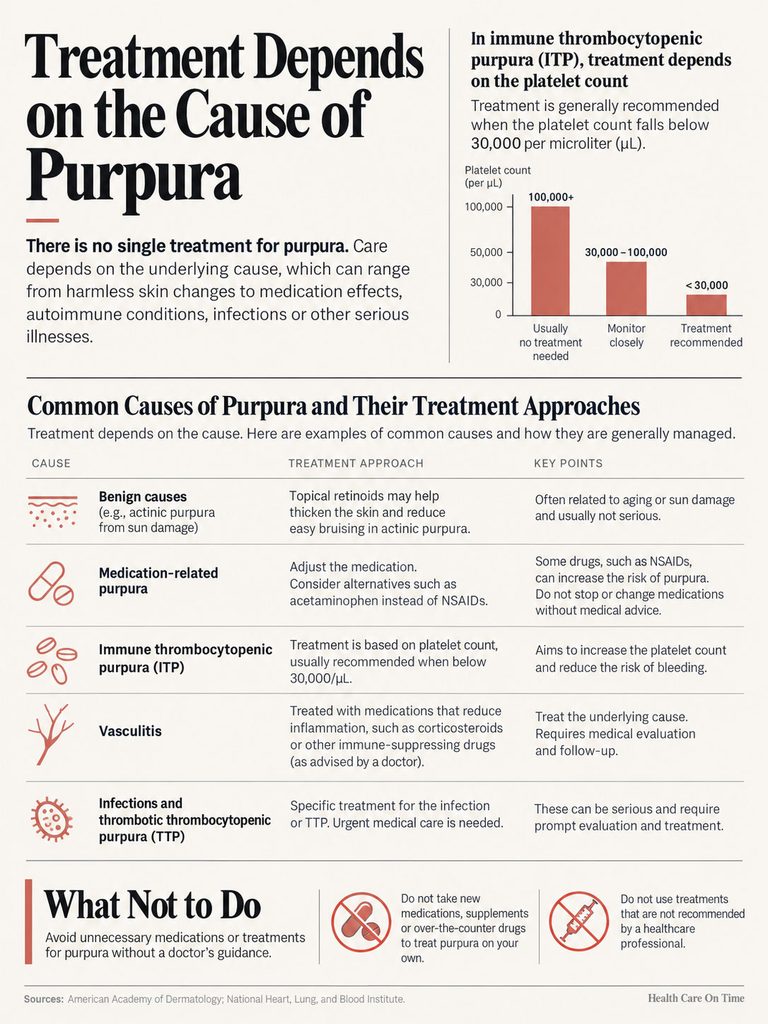
Treatment Depends on the Cause
There’s no single treatment for purpura. Doctors treat whatever is causing it.
Benign Causes: Protect the Skin
For actinic purpura and steroid-thinned skin:
- Use broad-spectrum sunscreen (SPF 30 or higher) on hands and forearms
- Wear long sleeves for yard work and moisturize daily
- Pad sharp furniture corners and wear gloves for chores
- Ask your doctor whether long-term steroids can be reduced
Topical retinoids may thicken the skin over months. Evidence is limited, so treat them as an option to discuss, not a fix.
Medication-Related Purpura
Your prescriber may check your INR, adjust the dose, or stop an extra drug you don’t need, like a daily aspirin taken on top of a blood thinner. Switch to acetaminophen for routine pain if your doctor agrees, since NSAIDs add to bleeding risk.
ITP
Treatment depends on platelet count and bleeding, not the numbers alone. The American Society of Hematology’s ITP guideline suggests treating newly diagnosed adults when the platelet count falls below 30,000 per microliter. First-line options include corticosteroids, with IVIG when a fast rise is needed.
Vasculitis, Infection, and TTP
IgA vasculitis in children usually needs rest, pain control, and urine monitoring. Adults and anyone with kidney involvement may need steroids or other immune treatments.
Meningococcal disease, RMSF, and sepsis need hospital care and antibiotics right away. TTP needs urgent plasma exchange in a hospital.
What Not to Do
- Don’t stop a prescribed blood thinner without talking to your doctor
- Don’t add aspirin or ibuprofen for pain from the spots
- Don’t massage or apply heat to fresh spots
- Don’t wait out spots that come with fever or feeling ill
Your Next Steps: A Quick Decision Guide
Use this table to match what you’re seeing with what to do next. When in doubt, choose the more urgent option.

Table 3: Scenario and Recommended Action
| Scenario | What It Might Mean | Recommended Action |
| Older adult, flat spots only on forearms and backs of hands | Actinic purpura | Mention at next routine visit; use sun protection |
| New spots within weeks of starting a blood thinner or aspirin | Drug effect | Call prescriber within 1 to 2 days; don’t stop the drug yourself |
| Pinpoint dots on face or chest right after vomiting or coughing | Strain petechiae | Watch for 2 to 3 days; see doctor if new spots appear elsewhere |
| Raised spots on legs plus belly or joint pain, especially a child | IgA vasculitis | Doctor visit within 1 to 3 days with a urine test |
| Pinpoint dots on lower legs plus bleeding gums or heavy periods | Low platelets (ITP or other) | Same-day or next-day CBC; urgent care if bleeding won’t stop |
| Unexplained bruises plus fatigue, fevers, or night sweats | Possible bone marrow problem | CBC and smear within a few days |
| Spots plus fever, confusion, spreading, or yellow skin | Infection, TTP, or DIC | Call 911 or go to the ER now |
Frequently Asked Questions
What do sudden purple spots on skin mean?
Sudden purple spots that don’t fade when pressed mean blood has leaked under the skin. This is called purpura. Common harmless causes include minor bumps, aging skin, and blood thinners. Less common causes include low platelets, vasculitis, and serious infections. Spots with fever or rapid spread need emergency care.
Should you go to the ER for purple spots on your skin?
Go to the ER if purple spots come with fever, confusion, severe headache, stiff neck, fast spreading, or bleeding you can’t stop. Spots with yellow skin or dark urine also need urgent care. Spots that are few, stable, and painless with no other symptoms can usually wait for a regular doctor visit.
Can stress cause purpura?
Emotional stress doesn’t directly cause purpura in most people. Physical strain can, though; hard coughing, vomiting, or heavy lifting can produce pinpoint petechiae on the face and chest. A rare condition called psychogenic purpura exists, but doctors diagnose it only after ruling out blood and vessel problems.
Is purpura a sign of leukemia?
Purpura can be a sign of leukemia, but it’s an uncommon cause. Leukemia-related purpura usually comes with fatigue, frequent infections, fevers, or bone pain. A complete blood count is the quickest way to check. In leukemia, more than one blood cell type is usually abnormal, not just platelets.
What deficiency causes purple spots on skin?
Vitamin C deficiency (scurvy) and vitamin K deficiency can both cause purple spots. Scurvy weakens blood vessel walls and often causes swollen, bleeding gums and spots around hair follicles. Vitamin K deficiency reduces clotting factors. Both are uncommon in the US but occur with very restricted diets, alcohol misuse, or absorption problems.
How long does purpura last?
Most purpura spots fade over 1 to 3 weeks as the body clears the leaked blood. Actinic purpura often leaves brown staining that can last much longer. If new spots keep appearing, the underlying cause is still active and needs evaluation, even if older spots are fading normally.
What’s the difference between purpura and a bruise?
A bruise (ecchymosis) is a larger patch, usually over 1 centimeter, typically caused by a clear injury. Purpura spots are smaller, about 4 to 10 millimeters, and often appear without any injury you remember. Neither fades when pressed. Purpura without a known bump deserves more attention than a bruise from a fall.
Can blood thinners cause purple spots?
Yes. Blood thinners like apixaban, rivaroxaban, and warfarin, plus antiplatelet drugs like aspirin and clopidogrel, commonly cause easy bruising and purple spots. Call your prescriber if spots are new, large, or come with other bleeding. Don’t stop the medication on your own, since that raises clot and stroke risk.
What blood test checks for purpura?
The first test is usually a complete blood count (CBC) with platelet count. Doctors often add a peripheral blood smear, PT/INR, aPTT, and a urinalysis. Together, these show whether the cause is low platelets, a clotting problem, a bone marrow issue, or inflamed blood vessels affecting the kidneys.
Why do purple spots show up on your legs?
Leg spots are common because blood pressure in leg vessels is higher when you stand. Pinpoint dots on the lower legs can signal low platelets. Raised spots on the legs often point to vasculitis. Spots after long standing, exercise, or tight socks can be harmless, but new widespread spots need a blood count.
Does purpura go away on its own?
Individual spots fade on their own over 1 to 3 weeks. Whether new spots stop appearing depends on the cause. Purpura from minor straining or a viral illness often clears without treatment. Purpura from low platelets, vasculitis, medications, or infection needs the cause treated to stop new spots.
What does purpura look like on dark skin?
On brown or Black skin, purpura usually looks dark brown, deep purple, or almost black rather than red. Small petechiae can be hard to see. Check lighter-skinned areas such as the inside of the mouth, the whites of the eyes, the palms, and the soles of the feet.
Disclaimer: This article is for general information only and isn’t a substitute for professional medical advice, diagnosis, or treatment. If you have purple spots along with fever, confusion, rapid spreading, or bleeding, call 911 or go to the nearest emergency room. Always talk to your doctor before starting, stopping, or changing any medication.
References
- Cleveland Clinic: Purpura
- StatPearls (NIH): Actinic Purpura
- StatPearls (NIH): Immune Thrombocytopenia
- Mayo Clinic: Immune Thrombocytopenia (ITP)
- Blood: Immune Thrombocytopenia in US Clinical Practice
- American Society of Hematology: 2019 Guidelines for Immune Thrombocytopenia
- NIDDK: IgA Vasculitis
- CDC: Meningococcal Disease Surveillance and Trends
- CDC Health Alert Network: Increase in Invasive Serogroup Y Meningococcal Disease
- CDC: Timeline of Rocky Mountain Spotted Fever Signs and Symptoms
- Cleveland Clinic: Thrombotic Thrombocytopenic Purpura
- Medscape: Thrombotic Thrombocytopenic Purpura
- National Blood Clot Alliance: Living With Blood Thinners